mirror of
https://github.com/pchuan98/codex.git
synced 2026-07-01 00:31:56 +08:00
a287c5dffdc96855e61a75526e86428fee6663e4
103 Commits
-
skills: make backend plugin skills invocable without an executor (#27387)
## Why #27198 made the extension-owned `codex_apps` MCP connection the hosted plugin runtime, but its `mcp/skill` resources still bypassed the skills extension. App-server could list and read those resources through generic MCP APIs, but a thread with no selected environment did not expose them in the model's skills catalog or load their `SKILL.md` through `$skill`. Hosted skills should stay remote while using the same typed catalog, source authority, deduplication, bounded contextual catalog, and selected-skill prompt injection as host and executor skills. They should not be downloaded or exposed as ambient filesystem paths. ## What changed - Add a session-scoped `McpResourceClient` over the replaceable MCP connection manager so resource list/read calls follow startup and refresh replacements. - Add a `BackendSkillProvider` that pages `codex_apps` resources, accepts bounded and validated `mcp/skill` entries, and reads a selected skill's `SKILL.md` through the same MCP connection. - Register the remote provider in app-server and include it in the skills catalog even when a thread has no selected capability roots or executor. - Contribute hosted skill metadata through the bounded `AvailableSkillsInstructions` developer-context path, exclude remote entries from per-turn catalog injection, and classify `<skills>` messages as contextual developer content so rollback can trim and rebuild them correctly. ## Testing - Extend the app-server MCP resource integration test with `environments: []` to exercise two-page discovery, filter a non-`mcp/skill` resource, verify the escaped developer catalog entry and user-role `<skill>` fragment containing the fetched `SKILL.md`, and preserve generic MCP resource reads. - Add core event-mapping coverage that classifies `<skills>` developer messages as contextual history.
jif ·
2026-06-11 11:28:16 +02:00 -
[codex] Store compact window id in rollout (#27264)
## Why Compaction window identity is part of session history, not model-client transport state. Persisting it with the compacted rollout item lets resumed threads continue from the reconstructed window without keeping mutable window state on `ModelClient`. ## What changed - Added `window_id` to `CompactedItem` and stamp it when `replace_compacted_history` installs compacted history. - Moved auto-compact window id ownership into `AutoCompactWindow` / `SessionState`; `ModelClient` now receives the request window id from callers instead of storing it. - Returned `window_id` from rollout reconstruction for resume. Reconstruction uses the newest surviving compacted item's stored `window_id` when present, and falls back to the legacy compacted-item count when it is absent. - Kept fork startup at the fresh default window id and updated direct model-client tests to pass explicit test window ids. ## Validation - `cargo check -p codex-core --tests`
pakrym-oai ·
2026-06-10 08:47:16 -07:00 -
Use latest-wins MCP manager replacement (#27259)
## Summary We originally addressed startup prewarming holding the read side of `RwLock<McpConnectionManager>` by snapshotting tool-list state. Review feedback identified the broader ownership problem: the outer synchronization should only publish or retrieve the current manager, while MCP operations rely on the manager's internal synchronization. A follow-up preserved operation retirement with a separate gate, but further review questioned whether that synchronization was actually required and whether we could support latest-wins replacement instead. This PR now stores the current MCP manager in `ArcSwap`. Each operation uses `load_full()` to obtain an owned `Arc<McpConnectionManager>`, then performs MCP I/O without retaining the publication mechanism. Refresh cancels obsolete startup work, constructs a replacement, and atomically publishes it. New operations see the latest manager, while operations that already loaded the previous manager retain a valid handle. Refresh happens at a turn boundary, so there should be no active user tool calls to drain. Git history supports dropping the outer `RwLock`. It was introduced in `03ffe4d595` on November 17, 2025 for non-blocking MCP startup: the session published an empty manager, startup initialized that same object while holding the write lock, and readers waited for initialization. `7cd2e84026` on February 19, 2026 removed that two-phase initialization in favor of constructing a fresh manager and swapping it in, explicitly noting that `Option` or `OnceCell` could replace the placeholder design. Hot reload later reused the existing lock to publish a replacement, but I found no indication that the lock was introduced to guarantee in-flight tool calls finish before refresh or shutdown. Terminal shutdown remains separate from refresh: it aborts startup prewarming and active tasks before shutting down the current manager, so tool calls may be interrupted and no model WebSocket work continues after shutdown. Focused regression coverage exercises pending tool-list cancellation, deferred refresh, and startup-prewarm shutdown.
Charlie Marsh ·
2026-06-10 08:33:21 -07:00 -
[codex] Make MCP connection startup fallible (#27261)
## Why Required MCP server startup was enforced in `Session::new` after `McpConnectionManager` had already created the clients. That split let other manager construction paths bypass the same requirement and exposed manager internals solely so the session could validate them. Keeping required-server readiness in the constructor gives every caller one consistent startup contract. ## What changed - make `McpConnectionManager::new` return `anyhow::Result<Self>` and fail when an enabled, required server cannot initialize - pass the startup cancellation token into the constructor so required-server waits remain cancellable - propagate constructor failures through resource reads, connector discovery, and MCP status collection - preserve the active manager and cancellation token when a refreshed replacement fails - keep required-startup failure collection private and cover the constructor error contract directly ## Validation - updated the focused connection-manager test to assert the complete required-server startup error - local tests not run; relying on CI
Ahmed Ibrahim ·
2026-06-10 00:17:58 -07:00 -
[codex-analytics] add extensible feature thread sources (#27063)
## Why - `ThreadSource` currently defines a closed set of core-owned values - Product features also create threads for background or scheduled work - Adding every product-specific value to the core enum would require repeated `codex-rs` protocol changes - Feature-backed values let product callers provide precise attribution while preserving the existing core classifications ## What Changed - Adds `ThreadSource::Feature(String)` for app-owned thread source values - Represents all app-server v2 thread sources as scalar strings, so a feature source is supplied as `"automation"` - Persists and emits the feature's plain string label, so `"automation"` produces `thread_source="automation"` in analytics - Keeps `user`, `subagent`, and `memory_consolidation` as explicit core-owned values and regenerates the app-server schemas and TypeScript bindings ## Verification - `just write-app-server-schema` - `cargo check --workspace` - `just test -p codex-protocol feature_thread_source_serializes_as_its_app_owned_label` - `just test -p codex-app-server-protocol thread_sources_round_trip_as_scalar_labels` - `cargo test -p codex-analytics thread_initialized_event_serializes_expected_shape` - `just fmt`
marksteinbrick-oai ·
2026-06-09 12:27:10 -07:00 -
Load selected executor skills through extensions (#27184)
## Why CCA is moving toward a split runtime where the orchestrator may not have a filesystem, while executors can expose preinstalled plugins and skills. A thread therefore needs to select capabilities without asking app-server or core to interpret executor-owned paths through the orchestrator's filesystem. The longer-term model is broader than executor skills: - A plugin is a bundle of skills, MCP servers, connectors/apps, and hooks. - A plugin root can be local, executor-owned, or hosted by a backend. - Components inside one plugin can use different access and execution mechanisms. A skill may be read from a filesystem or through backend tools; an HTTP MCP server can run without an executor; a stdio MCP server or hook needs an execution environment. - Core should carry generic extension initialization data. The extension that owns a component should discover it, expose it to the model, and invoke it through the appropriate runtime. This PR establishes that architecture through one complete vertical: selecting a root on an executor, discovering the skills beneath it, exposing those skills to the model, and reading an explicitly invoked `SKILL.md` through the same executor. ## Contract `thread/start` gains an experimental `selectedCapabilityRoots` field: ```json { "selectedCapabilityRoots": [ { "id": "deploy-plugin@1", "location": { "type": "environment", "environmentId": "workspace", "path": "/opt/codex/plugins/deploy" } } ] } ``` The root is intentionally not classified as a "plugin" or "skill" in the API. It can point at a standalone skill, a directory containing several skills, or a plugin containing skills and other components. This PR only teaches the skills extension how to consume it; later extensions can resolve MCP, connector, and hook components from the same selection. The platform-supplied `id` is stable selection identity. The location says which runtime owns the root and gives that runtime an opaque path. App-server does not inspect or canonicalize the path. ## What changed ### Generic thread extension initialization App-server converts selected roots into `ExtensionDataInit`. Core carries that generic initialization value until the final thread ID is known, then creates thread-scoped `ExtensionData` before lifecycle contributors run. This keeps `Session` and core independent of the capability-selection contract. The initialization value is consumed during construction; it is not retained as another long-lived `Session` field. ### Executor-backed skills The skills extension now owns an `ExecutorSkillProvider` that: - resolves the selected environment through `EnvironmentManager` - discovers, canonicalizes, and reads skills through that environment's `ExecutorFileSystem` - contributes the bounded selected-skill catalog as stable developer context - reads an explicitly invoked skill body through the authority that listed it - warns when an environment or root is unavailable - never falls back to the orchestrator filesystem for an executor-owned root Skill catalog and instruction fragments have hard byte bounds, which also bound them below the 10K-token per-item context limit. If a selected executor skill has the same name as a legacy local skill, the executor selection owns that invocation and the local body is not injected a second time. Existing local and bundled skill loading remains in place. Omitting `selectedCapabilityRoots` therefore preserves current local-only behavior. ## Current semantics - Only environment-owned locations are represented in this first contract. - Roots are resolved by the destination extension, not by app-server or core. - An unavailable executor or invalid root produces a warning and no capabilities from that root; it does not trigger a local-filesystem fallback. - Selection applies to a newly started active thread. - MCP servers, connectors, and hooks beneath a selected plugin root are not activated yet. - Selection is not yet persisted or inherited across resume, fork, or subagent creation. Existing local capabilities continue to behave as they do today in those flows. ## Planned vertical follow-ups 1. **Hosted HTTP MCP:** add an extension-backed HTTP MCP source that works without an executor, then replace the special-purpose MCP plugins loader with that implementation. 2. **Executor MCP:** register and execute stdio MCP servers through the environment that owns the selected plugin root. 3. **Backend skills:** add a hosted skill source whose catalog and bodies are accessed through extension tools rather than a filesystem. 4. **Connectors and hooks:** activate those components through their owning extensions, using the same selected-root boundary and component-specific runtime. 5. **Durable selection:** define the desired-selection lifecycle, persist it, and make resume, fork, and subagent inheritance explicit rather than accidental. 6. **Local convergence:** incrementally route existing local plugin, skill, and MCP loading through the same extension model while preserving current local behavior. Each follow-up remains reviewable as an end-to-end capability. The platform selects roots, generic thread extension data carries the selection, and the owning extension resolves and operates its component. ## Verification Coverage added for: - app-server end-to-end discovery and explicit invocation of a skill inside an executor-selected plugin root - exclusive invocation when a selected executor skill collides with a local skill name - executor filesystem authority for discovery, canonicalization, and reads - thread extension initialization before lifecycle contributors run - stable executor catalog context, explicit invocation, context rebuilding, hidden skills, and preserved host/remote catalog behavior Targeted protocol, core-skills, skills-extension, core lifecycle, and app-server executor-skill tests were run during development.jif ·
2026-06-09 19:51:54 +02:00 -
Boyang Niu ·
2026-06-09 00:38:35 +00:00 -
Pair thread environment settings (#26687)
## Why Thread cwd and environment selections are a single logical setting in core: updating one without the other can silently desynchronize the next-turn execution context. This change makes that relationship explicit in the internal thread settings flow while preserving the existing app-server public API shape. ## What changed - Moved the cwd/environment pair through internal `ThreadSettingsOverrides.environment_settings` instead of a top-level internal `cwd` field. - Kept `thread/settings/update` public params unchanged, with app-server translating top-level `cwd` into the paired internal settings shape. - Moved `Op::UserInput` environment overrides into thread settings so user turns and settings updates use the same core path. - Updated core, app-server, MCP, memories, sample, and test callsites to construct the paired settings shape. ## Verification - `git diff --check` - Local test run starting after PR creation.
pakrym-oai ·
2026-06-08 13:55:15 -07:00 -
feat: count V2 concurrency by active execution (#26969)
## Why Multi-Agent V2 concurrency should count active non-root turns, not resident or durable agent threads. The limit is intentionally best effort: admission checks are synchronous, but concurrent successful checks may overshoot slightly. ## What changed - Keep one root-derived execution limit on the shared `AgentControl`. - Count active V2 subagent turns with an RAII guard owned by `RunningTask`. - Check capacity before spawning or starting an idle agent, including direct app-server `turn/start` submissions. - Preserve queued delivery for agents that are already running. - Exempt automatic idle continuations so `/goal` work is not dropped when capacity is temporarily full. - Keep root and V1 turns outside this limiter. ## Test coverage - `execution_guards_count_active_v2_subagent_turns` - `execution_guards_ignore_root_and_v1_turns` - `v2_nested_spawn_checks_shared_active_execution_capacity`
jif ·
2026-06-08 14:21:28 +02:00 -
[2 of 2] Finish moving goal runtime to extension (#26548)
## Stack 1. [#26547](https://github.com/openai/codex/pull/26547) - [1 of 2] Align goal extension with core behavior 2. [#26548](https://github.com/openai/codex/pull/26548) - [2 of 2] Move goal runtime to extension ## Why This PR completes the switch of the goal behavior to the extension-backed runtime and removes the old core goal implementation. ## What Changed - Installs the goal extension for app-server `ThreadManager` sessions. - Routes app-server thread goal `get`, `set`, and `clear` through `GoalService`. - Uses thread-idle lifecycle emission after goal resume and snapshot ordering so the extension can decide whether to continue the goal. - Forwards extension goal updates through a FIFO async app-server notification path so backpressure does not drop them or reorder updates. - Keeps review turns from enabling goal runtime behavior. - Plans extension tools before dynamic tools so built-in goal tool names keep their old precedence when goals are enabled. - Removes the old core goal runtime, core goal tool handlers, and core goal tool specs. - Updates tests that were coupled to the core-owned goal runtime while leaving the legacy `<goal_context>` compatibility path in core for old threads. - Removes the stale cargo-shear ignore now that `codex-goal-extension` is used by the workspace. - Keeps realtime event matching exhaustive after removing the old goal-specific realtime text path. ## Validation - Ran manual `/goal` runs in TUI. Validated time accounting matched wall-clock time and goal lifecycle state transitions.
Eric Traut ·
2026-06-05 14:17:30 -07:00 -
Require absolute cwd in thread settings (#26532)
## Why Thread settings cwd overrides are expected to be resolved before they enter core. Keeping this boundary as a plain `PathBuf` made it easy for core/session code to keep fallback normalization and relative-path resolution logic in places that should only receive an already-resolved cwd. This is intentionally the absolute-cwd-only slice: it does not change environment selection stickiness or cwd-to-default-environment fallback behavior. ## What changed - Changes `ThreadSettingsOverrides.cwd`, `CodexThreadSettingsOverrides.cwd`, and `SessionSettingsUpdate.cwd` to use `AbsolutePathBuf`. - Removes core-side cwd normalization/resolution from session settings updates. - Updates affected core/app-server test helpers and callsites to pass existing absolute cwd values or use `abs()` helpers. ## Validation Opening as draft so CI can start while local validation continues.
pakrym-oai ·
2026-06-05 09:29:15 -07:00 -
Route AGENTS.md loading through environment filesystems (#26205)
## Why Workspace-specific `AGENTS.md` loading needs to use the selected environment filesystem so remote workspaces and child agents read instructions from their actual environment instead of the host filesystem. The app-server should report the same instruction sources the initialized thread actually loaded, rather than independently rescanning configuration and filesystem state. ## What changed - Introduce `LoadedAgentsMd` to retain ordered user, project, and internal instructions with their provenance. - Load and canonicalize workspace `AGENTS.md` paths through the primary `EnvironmentManager` environment, then render the loaded instructions when constructing turn context. - Expose cached loaded instruction sources from initialized threads and use them for app-server start, resume, and fork responses. - Preserve global `CODEX_HOME` loading and separator behavior while excluding empty project files that did not supply model-visible instructions. - Add integration coverage for CLI injection, selected-environment provenance and rendering, empty environment selection, and cached sources on loaded-thread resume. ## Validation - `just test -p codex-core agents_md` - `just test -p codex-core selected_environment_sources_match_model_visible_instructions` - `just test -p codex-exec agents_md` - `just test -p codex-app-server instruction_sources` - `just test -p codex-app-server --status-level fail`
Adam Perry @ OpenAI ·
2026-06-04 12:43:07 -07:00 -
[codex-analytics] emit forked thread id on initialization (#26248)
## Why - Thread initialization analytics do not identify the source thread for forked threads. - The session viewer needs this lineage to construct thread trees. - Depends on openai/openai#987854. Do not release this change before that backend schema change is deployed. ## What Changed - Adds optional `forked_from_thread_id` to `codex_thread_initialized`. - Populates it from the existing thread fork lineage for app-server and in-process subagent initialization paths. - Keeps it null for non-forked threads. ## Verification - `just fmt` - `just test -p codex-analytics` - `just test -p codex-app-server thread_fork_tracks_thread_initialized_analytics`
kbazzi ·
2026-06-04 11:24:12 -07:00 -
core: stop threading SandboxPolicy through exec (#25700)
## Why #25450 attempts a broad `SandboxPolicy` removal across several unrelated surfaces, which makes it hard to review and still leaves new helper code moving legacy policies around. This PR is a narrower alternative: migrate only the exec-side Windows sandbox plumbing so the review can focus on one production path and one compatibility boundary. The goal is to stop threading `SandboxPolicy` through exec code without expanding the migration into app-server, protocol, telemetry, config, or session behavior. ## What changed - Removed `ExecRequest::compatibility_sandbox_policy()`. - Changed the Windows restricted-token and elevated filesystem override helpers to accept `PermissionProfile` plus the split filesystem/network policies instead of a `SandboxPolicy`. - Kept the remaining legacy projection local to the writable-root comparison that still needs to compare split policy behavior against the legacy Windows backend model. - Rejected restricted split filesystem policies that still grant full-disk writes before using the Windows restricted-token backend, preserving the previous clear-failure behavior for profiles that project to `ExternalSandbox`. - Updated the Windows sandbox override tests to exercise the new call shape and cover the full-write split-profile regression. ## Verification - `just test -p codex-core windows_restricted_token` - `just test -p codex-core windows_elevated`
Michael Bolin ·
2026-06-03 10:41:41 -07:00 -
chore: mechanical rename (#26156)
Rename `Session::conversation_id` to `Session::thread_id` with an auto refactor in RustRover
jif ·
2026-06-03 15:38:30 +02:00 -
Resolve per-thread multi-agent runtime (#25722)
Stack split from #25708. Original PR intentionally left open. This third PR resolves the effective per-thread multi-agent runtime from persisted metadata, inherited runtime, and current model selection.
jif-oai ·
2026-06-02 14:31:00 +02:00 -
Persist multi-agent runtime metadata (#25721)
Stack split from #25708. Original PR intentionally left open. This second PR persists multi-agent runtime metadata through thread creation, rollout recording, and thread storage.
jif-oai ·
2026-06-02 13:05:20 +02:00 -
app-server: remove experimental persist_extended_history bool flag (#25712)
## Summary Remove the dead experimental `persistExtendedHistory` app-server flag and collapse rollout persistence to the single policy app-server already used. ## What Changed - Removed `persistExtendedHistory` from v2 thread start/resume/fork params and deleted its deprecation notice path. - Removed the persistence-mode enums and plumbing through core, rollout, and thread-store. - Made rollout filtering mode-free, keeping the existing limited persisted-history behavior. ## Test Plan - `just write-app-server-schema` - `cargo nextest run --no-fail-fast -p codex-app-server-protocol schema_fixtures` - `cargo nextest run --no-fail-fast -p codex-app-server thread_shell_command_history_responses_exclude_persisted_command_executions` - `cargo nextest run --no-fail-fast -p codex-rollout -p codex-thread-store` - final `rg` for removed flag/type names
Owen Lin ·
2026-06-01 23:33:42 +00:00 -
store and expose parent_thread_id on Threads (#25113)
## Why This PR https://github.com/openai/codex/pull/24161#discussion_r3325692763 revealed a subagent data modeling issue, where we overloaded `forked_from_id` to also mean `parent_thread_id`. That's incorrect since guardian and review subagents can be a subagent and NOT fork the main thread's history. The solution here is to explicitly store a new `parent_thread_id` on `SessionMeta`, alongside `forked_from_id` which already exists. While we're at it, also expose it in the app-server protocol on the `Thread` object. A thread->subagent relationship and a fork of thread history are orthogonal concepts. ## What Changed - Added top-level `parent_thread_id` persistence on `SessionMeta` and runtime/session plumbing through `SessionConfiguredEvent`, `CodexSpawnArgs`, `SessionConfiguration`, `ThreadConfigSnapshot`, `TurnContext`, and `ModelClient`. - Made turn metadata, request headers, analytics, and subagent-start events read the separate runtime/top-level parent field instead of deriving general parent lineage from `SessionSource` or `forked_from_thread_id`. - Passed parent lineage separately at delegated subagent, review, guardian, agent-job, and multi-agent spawn construction sites; copied-history fork lineage remains derived only from `InitialHistory`. - Persisted and exposed parent lineage through rollout/thread-store projections and app-server v2 `Thread.parentThreadId`. - Updated app-server README text and regenerated app-server schema fixtures for the additive `parentThreadId` response field.
Owen Lin ·
2026-06-01 04:33:20 +00:00 -
Add thread start contributor facts (#24915)
Summary: add session source and persistent-state availability to ThreadStartInput; populate them from session init; update existing goal test harness constructors. Tests: just fmt; git diff --check. No full tests or clippy run per request.
jif-oai ·
2026-05-28 16:10:55 +02:00 -
Thread Guardian cache key through session (#24895)
Split from the Guardian prompt cache key change. This PR only updates codex-rs/core/src/session/session.rs. Validation was not run per request; this branch is expected to rely on the companion split PRs.
jif-oai ·
2026-05-28 12:36:40 +02:00 -
Add forked_from_thread_id turn metadata (#24160)
## Why When Codex calls responsesapi, we currently send `session_id`, `thread_id`, and `turn_id` among other things as `client_metadata["x-codex-turn-metadata"]`. This PR adds `forked_from_thread_id` which helps explain the "lineage" of a forked thread. ## What's changed - Track the immediate history source copied into a forked thread through thread/session creation, including subagent and review turn metadata paths. - Include `forked_from_thread_id` in Codex turn metadata while preventing turn-scoped Responses API client metadata from overwriting Codex-owned lineage fields. - Add coverage for fork lineage in turn metadata and the app-server Responses API request path.
Owen Lin ·
2026-05-26 14:05:28 -07:00 -
Move MCP tool naming mode into manager (#21576)
## Why The `non_prefixed_mcp_tool_names` feature should be applied where MCP tools become model-visible, not by remapping names later in core. Keeping the decision in `McpConnectionManager` construction makes `ToolInfo` the single shaped view that spec building, deferred tool search, routing, and unavailable-tool placeholders can consume directly. This also preserves the existing external behavior while the feature is off, and keeps the feature-on behavior for code mode and hooks explicit at the manager boundary. ## What Changed - Add `McpToolNameMode` to `codex-mcp` and flow it through `McpConfig` into `McpConnectionManager::new`. - Normalize MCP `ToolInfo` names in the manager using either legacy-prefixed namespaces or non-prefixed namespaces; the legacy path adds `mcp__` without restoring the old trailing namespace suffix. - Remove the core-side MCP name remapping path so specs, tool search, session resolution, and unavailable-tool placeholder construction use the manager-provided `ToolName` values directly. - Keep code mode flattening on the `__` namespace separator. - Preserve hook compatibility by giving non-prefixed MCP hook names legacy `mcp__...` matcher aliases. - Add/adjust integration and unit coverage for non-prefixed code-mode behavior, hook matching with the feature on and off, and manager-level legacy prefixing. ## Testing - `cargo test -p codex-mcp --lib` - `cargo test -p codex-core --lib tools::spec::tests -- --nocapture` - `cargo test -p codex-core --lib mcp_tools -- --nocapture` - `cargo test -p codex-core --lib mcp_tool_exposure -- --nocapture` - `cargo test -p codex-core --test all mcp_tool -- --nocapture` - `cargo test -p codex-core --test all search_tool -- --nocapture` - `cargo test -p codex-core --test all hooks_mcp -- --nocapture` - `cargo test -p codex-core --test all code_mode_uses_non_prefixed_mcp_tool_names_when_feature_enabled -- --nocapture` - `cargo test -p codex-tools` - `cargo test -p codex-features`
pakrym-oai ·
2026-05-26 08:21:15 -07:00 -
package: include zsh fork in Codex package (#23756)
## Why The package layout gives Codex a stable place for runtime helpers that should travel with the entrypoint. `shell_zsh_fork` still required users to configure `zsh_path` manually, even though we already publish prebuilt zsh fork artifacts. This PR builds on #24129 and uses the shared DotSlash artifact fetcher to include the zsh fork in Codex packages when a matching target artifact exists. Packaged Codex builds can then discover the bundled fork automatically; the user/profile `zsh_path` override is removed so the feature uses the package-managed artifact instead of a legacy path knob. ## What Changed - Added `scripts/codex_package/codex-zsh`, a checked-in DotSlash manifest for the current macOS arm64 and Linux zsh fork artifacts. - Taught `scripts/build_codex_package.py` to fetch the matching zsh fork artifact and install it at `codex-resources/zsh/bin/zsh` when available for the selected target. - Added package layout validation for the optional bundled zsh resource. - Added `InstallContext::bundled_zsh_path()` and `InstallContext::bundled_zsh_bin_dir()` for package-layout resource discovery. - Threaded the packaged zsh path through config loading as the runtime `zsh_path` for packaged installs, and removed the config/profile/CLI override path. - Kept the packaged default zsh override typed as `AbsolutePathBuf` until the existing runtime `Config::zsh_path` boundary. - Updated app-server zsh-fork integration tests to spawn `codex-app-server` from a temporary package layout with `codex-resources/zsh/bin/zsh`, matching the new packaged discovery path instead of setting `zsh_path` in config. - Switched package executable copying from metadata-preserving `copy2()` to `copyfile()` plus explicit executable bits, which avoids macOS file-flag failures when local smoke tests use system binaries as inputs. ## Testing To verify that the `zsh` executable from the Codex package is picked up correctly, first I ran: ```shell ./scripts/build_codex_package.py ``` which created: ``` /private/var/folders/vw/x2knqmks50sfhfpy27nftl900000gp/T/codex-package-pms94kdp/ ``` so then I ran: ``` /private/var/folders/vw/x2knqmks50sfhfpy27nftl900000gp/T/codex-package-pms94kdp/bin/codex exec --enable shell_zsh_fork 'run `echo $0`' ``` which reported the following, as expected: ``` /private/var/folders/vw/x2knqmks50sfhfpy27nftl900000gp/T/codex-package-pms94kdp/codex-resources/zsh/bin/zsh ``` --- [//]: # (BEGIN SAPLING FOOTER) Stack created with [Sapling](https://sapling-scm.com). Best reviewed with [ReviewStack](https://reviewstack.dev/openai/codex/pull/23756). * #23768 * __->__ #23756
Michael Bolin ·
2026-05-22 17:54:07 -07:00 -
otel: drop legacy profile usage telemetry (#24061)
## Summary - drop the dead legacy profile usage metric and active-profile conversation-start fields - update role comments so they describe provider and service-tier preservation without legacy config-profile wording - pair the code cleanup with the file-backed profile docs update in openai/developers-website#1476 ## Testing - `just fmt` - `cargo test -p codex-otel` - `cargo test -p codex-core` *(fails: existing stack overflow in `mcp_tool_call::tests::guardian_mode_mcp_denial_returns_rationale_message`)* - `cargo test -p codex-core --lib mcp_tool_call::tests::guardian_mode_mcp_denial_returns_rationale_message` *(fails with the same stack overflow)*
jif-oai ·
2026-05-22 13:14:44 +02:00 -
config: remove legacy profile write paths (#24055)
## Why [#23883](https://github.com/openai/codex/pull/23883) moved the user-facing `--profile` flag onto profile v2 and [#23886](https://github.com/openai/codex/pull/23886) removed CLI forwarding for the legacy profile-v1 path. Core and TUI config persistence still carried `active_profile` and `ConfigEditsBuilder::with_profile`, which let later writes continue targeting legacy `[profiles.<name>]` tables after profile selection moved to profile-v2 config files. ## What - Remove legacy profile routing from [`ConfigEditsBuilder`](https://github.com/openai/codex/blob/4b38e9c22e762261d7f7eef49d8a21792e241a06/codex-rs/core/src/config/edit.rs#L1064-L1294), so core config edits no longer carry `with_profile` or infer `[profiles.*]` write targets from a `profile` key. - Drop `active_profile` plumbing from runtime `Config`, TUI startup/state, app-server config override forwarding, and Windows sandbox setup persistence. - Make app-server-backed TUI config edits use unscoped model, service-tier, feature, Auto-review, plan-mode, and Windows sandbox paths through [`tui/src/config_update.rs`](https://github.com/openai/codex/blob/4b38e9c22e762261d7f7eef49d8a21792e241a06/codex-rs/tui/src/config_update.rs#L43-L112). - Update config edit coverage so legacy `profile` state stays untouched by direct model writes, and remove tests whose only contract was the deleted profile-scoped persistence path. ## Testing - Not run locally.
jif-oai ·
2026-05-22 12:50:42 +02:00 -
Route MCP servers through explicit environments (#23583)
## Summary - route each configured MCP server through an explicit per-server `environment_id` instead of a manager-wide remote toggle - default omitted `environment_id` to `local`, resolve named ids through `EnvironmentManager`, and fail only the affected MCP server when an explicit id is unknown - keep local stdio on the existing local launcher path for now, while named-environment stdio uses the selected environment backend and requires an absolute `cwd` - allow local HTTP MCP servers to keep using the ambient HTTP client when no local `Environment` is configured; named-environment HTTP MCPs use that environment's HTTP client ## Validation - devbox Bazel build: `bazel build --bes_backend= --bes_results_url= //codex-rs/cli:codex //codex-rs/rmcp-client:test_stdio_server //codex-rs/rmcp-client:test_streamable_http_server` - devbox app-server config matrix with real `config.toml` / `environments.toml` files covering omitted local, explicit local, omitted local under remote default, explicit remote stdio, local HTTP without local env, explicit remote HTTP, local stdio without local env, unknown explicit env, and remote stdio without `cwd`
starr-openai ·
2026-05-21 17:19:54 +02:00 -
Honor client-resolved service tier defaults (#23537)
## Why Model catalog responses can now advertise a nullable `default_service_tier` for each model. Codex needs to preserve three distinct states all the way from config/app-server inputs to inference: - no explicit service tier, so the client may apply the current model catalog default when FastMode is enabled - explicit `default`, meaning the user intentionally wants standard routing - explicit catalog tier ids such as `priority`, `flex`, or future tiers Keeping those states distinct prevents the UI from showing one tier while core sends another, especially after model switches or app-server `thread/start` / `turn/start` updates. ## What Changed - Plumbed `default_service_tier` through model catalog protocol types, app-server model responses, generated schemas, model cache fixtures, and provider/model-manager conversions. - Added the request-only `default` service tier sentinel and normalized legacy config spelling so `fast` in `config.toml` still materializes as the runtime/request id `priority`. - Moved catalog default resolution to the TUI/client side, including recomputing the effective service tier when model/FastMode-dependent surfaces change. - Updated app-server thread lifecycle config construction so `serviceTier: null` preserves explicit standard-routing intent by mapping to `default` instead of internal `None`. - Kept core responsible for validating explicit tiers against the current model and stripping `default` before `/v1/responses`, without applying catalog defaults itself. ## Validation - `CARGO_INCREMENTAL=0 cargo build -p codex-cli` - `CARGO_INCREMENTAL=0 cargo test -p codex-app-server model_list` - `cargo test -p codex-tui service_tier` - `cargo test -p codex-protocol service_tier_for_request` - `cargo test -p codex-core get_service_tier` - `RUST_MIN_STACK=8388608 CARGO_INCREMENTAL=0 cargo test -p codex-core service_tier`
Shijie Rao ·
2026-05-20 15:57:50 -07:00 -
core: refresh active permission profiles at runtime (#22931)
## Why Once a named permission profile is selected, runtime state has to keep that profile identity intact instead of collapsing back to anonymous effective permissions. The session refresh path also needs to rebuild profile-derived network proxy state so active profile switches take effect consistently. ## What changed - Preserve the active permission profile through session updates. - Rebuild profile-derived runtime/network configuration when the active profile changes. - Keep the runtime path aligned with the current session configuration APIs. - Tighten the affected tests, including the Windows delete-pending memory-file case that was intermittently tripping CI. ## Stack 1. **This PR**: runtime/session/network propagation for active permission profiles. 2. [#23708](https://github.com/openai/codex/pull/23708): TUI selection plumbing and guardrail flow. 3. [#21559](https://github.com/openai/codex/pull/21559): profile-aware `/permissions` menu and custom profile display. <img width="1296" height="906" alt="image" src="https://github.com/user-attachments/assets/077fa3a7-80cb-4925-80b1-d2395018d90a" />
viyatb-oai ·
2026-05-20 21:55:21 +00:00 -
Support compact SessionStart hooks (#21272)
# Why Compaction replaces the live conversation history, so hooks that use `SessionStart` to re-inject durable model context need a way to run again after that rewrite. Related - #19905 adds dedicated compact lifecycle hooks # What - add `compact` as a supported `SessionStart` source and matcher value - change pending `SessionStart` state from a single slot to a small FIFO queue so `resume` / `startup` / `clear` can be preserved alongside a later `compact` - drain all queued `SessionStart` sources before the next model request, preserving their original order # Testing The new integration coverage verifies both the basic `compact` matcher path and the stacked `resume` -> `compact` case where both hooks contribute `additionalContext` to the next model turn.
Abhinav ·
2026-05-20 20:46:19 +00:00 -
Move plugin and skill warmup into session startup (#23535)
## Why Plugin and skill loading is useful as warmup and early validation, but session startup does not need to wait for that work before it can continue building the session. Keeping it on the serial startup path adds avoidable latency to every fresh thread start. We still want invalid skill configurations to show up quickly, and we want the warmup to exercise the same plugin and skill manager caches that the normal turn path uses. ## What changed - moved plugin and skill warmup into the session startup async path instead of eagerly awaiting it on the serial setup path - kept the warmup using the session's resolved filesystem/environment context so skill loading still sees the right roots - preserved early skill-load error logging so broken skill configurations still surface during startup - left the per-turn plugin and skill loading path unchanged, so turns still use the normal cached managers ## Testing - Not run locally; relying on CI for validation.
Ahmed Ibrahim ·
2026-05-19 20:05:52 -07:00 -
Make local environment optional in EnvironmentManager (#23369)
## Summary - make `EnvironmentManager` local environment/runtime paths optional - simplify constructor surface around snapshot materialization - rename local env accessors to `require_local_environment` / `try_local_environment` ## Validation - devbox Bazel build for touched crate surfaces - `//codex-rs/exec-server:exec-server-unit-tests` - `//codex-rs/app-server-client:app-server-client-unit-tests` - filtered touched `//codex-rs/core:core-unit-tests` cases
starr-openai ·
2026-05-19 12:55:34 -07:00 -
[5 of 7] Replace OverrideTurnContext with ThreadSettings (#22508)
**Stack position:** [5 of 7] ## Summary This PR adds `Op::ThreadSettings`, a queued settings-only update mechanism for changing stored thread settings without starting a new turn. It also removes the legacy `Op::OverrideTurnContext` in the same layer, so reviewers can see the replacement and deletion together. ## Changes - Add `Op::ThreadSettings` for settings-only queued updates. - Emit `ThreadSettingsApplied` with the effective thread settings snapshot after core applies an update. - Route settings-only updates through the same submission queue as user input. - Migrate remaining `OverrideTurnContext` tests and callers to the queued `Op::ThreadSettings` path. - Delete `Op::OverrideTurnContext` from the core protocol and submission loop. This stack addresses #20656 and #22090. ## Stack 1. [1 of 7] [Add thread settings to UserInput](https://github.com/openai/codex/pull/23080) 2. [2 of 7] [Remove UserInputWithTurnContext](https://github.com/openai/codex/pull/23081) 3. [3 of 7] [Remove UserTurn](https://github.com/openai/codex/pull/23075) 4. [4 of 7] [Placeholder for OverrideTurnContext cleanup](https://github.com/openai/codex/pull/23087) 5. [5 of 7] [Replace OverrideTurnContext with ThreadSettings](https://github.com/openai/codex/pull/22508) (this PR) 6. [6 of 7] [Add app-server thread settings API](https://github.com/openai/codex/pull/22509) 7. [7 of 7] [Sync TUI thread settings](https://github.com/openai/codex/pull/22510)
Eric Traut ·
2026-05-18 21:03:51 -07:00 -
[codex] Move pending input into input queue (#22728)
## Why Pending model input was split across `Session`, `TurnState`, and the agent mailbox. That made it easy for new paths to manage queued user input or mailbox delivery outside the intended ownership boundary. This PR consolidates the model-facing input lifecycle behind the session input queue so turn-local pending input, next-turn queued items, and mailbox delivery coordination are owned in one place. ## What Changed - Added `session/input_queue.rs` to own pending input queues and mailbox delivery coordination. - Removed the standalone `agent/mailbox.rs` channel wrapper and store mailbox items directly in the input queue. - Moved pending-input mutations off `TurnState`; `TurnState` now exposes the queue-owned storage directly for now. - Routed abort cleanup, mailbox delivery phase changes, next-turn queued items, and active-turn pending input through `InputQueue`. - Boxed stack-heavy agent resume/fork startup futures that the refactor pushed over the default test stack. - Updated session, task, goal, stream-event, and multi-agent call sites and tests to use the new queue ownership. ## Verification - `cargo test -p codex-core --lib agent::control::tests` - `cargo test -p codex-core --lib agent::control::tests::resume_closed_child_reopens_open_descendants -- --exact` - `cargo test -p codex-core --lib agent::control::tests::spawn_agent_fork_last_n_turns_keeps_only_recent_turns -- --exact` - `cargo test -p codex-core --lib agent::control::tests::resume_thread_subagent_restores_stored_nickname_and_role -- --exact` - `cargo test -p codex-core` was also run; it completed with 1814 passed, 4 ignored, and one timeout in `agent::control::tests::resume_thread_subagent_restores_stored_nickname_and_role`, which passed when rerun in isolation.
pakrym-oai ·
2026-05-18 15:43:01 -07:00 -
Make extension lifecycle hooks async (#23291)
## Why Extension lifecycle hooks sit on the host/extension boundary, but the current trait surface only allows synchronous callbacks. That forces extensions that need to seed, rehydrate, observe, or flush extension-owned state during thread and turn transitions to either block inside the callback or move async work into separate host plumbing. This PR makes those lifecycle callbacks awaitable so extension implementations can perform async work directly at the lifecycle point where the host already has the relevant session, thread, or turn stores available. ## What changed - Makes `ThreadLifecycleContributor` and `TurnLifecycleContributor` async in `codex-extension-api`. - Awaits thread start/resume/stop and turn start/stop/abort lifecycle callbacks from `codex-core`. - Updates the guardian and memories extensions to implement the async lifecycle trait surface. - Updates the existing lifecycle tests to use async contributor implementations. - Adds `async-trait` to the crates that now expose or implement these async object-safe lifecycle traits. ## Testing - Existing `codex-core` lifecycle tests were updated to cover async implementations for thread stop and turn abort ordering.
jif-oai ·
2026-05-18 13:53:58 +02:00 -
core: set permission profiles from snapshots (#22920)
## Why #22891 moved the TUI turn-command path to pass `ActivePermissionProfile` instead of the full `PermissionProfile`, but the remaining config/session bridge still accepted the concrete `PermissionProfile` and active profile id as separate arguments. That shape made it too easy for future callers to update the concrete profile and active profile id out of sync. This PR makes the trusted session snapshot path pass one coherent value into `Permissions`, while keeping `requirements.toml` enforcement owned by the existing constrained permission state. ## What Changed - Added `PermissionProfileSnapshot` as the public snapshot value for trusted session/config synchronization. - Changed `Permissions::set_permission_profile_from_session_snapshot()` and `replace_permission_profile_from_session_snapshot()` to take a `PermissionProfileSnapshot`. - Updated the replacement path to derive its constrained `PermissionProfile` from the snapshot, so callers cannot pass a separate profile that disagrees with the snapshot. - Removed the internal tuple-style `PermissionProfileState::set_active_permission_profile()` mutation path. - Updated core session projection and TUI call sites to construct explicit legacy or active snapshots. - Documented the snapshot constructors so legacy use and id/profile mismatch hazards are called out at the API boundary. - Added a focused config test that verifies snapshot updates still respect existing permission constraints. ## How To Review 1. Start with `codex-rs/core/src/config/resolved_permission_profile.rs`; `PermissionProfileSnapshot` is the public wrapper, while `ResolvedPermissionProfile` stays internal. 2. Check `codex-rs/core/src/config/mod.rs` to confirm both session-snapshot setters validate through `PermissionProfileState` and no longer accept loose profile/id pairs. 3. Skim `codex-rs/core/src/session/session.rs` for the session projection path; it now builds the snapshot before installing it. 4. Skim the TUI changes as call-site migration from loose argument pairs to explicit snapshot construction. ## Verification - `cargo test -p codex-core permission_snapshot_setter_preserves_permission_constraints` - `cargo test -p codex-tui status_permissions_` - `cargo test -p codex-tui session_configured_preserves_profile_workspace_roots` - `just fix -p codex-core -p codex-tui`
Michael Bolin ·
2026-05-16 07:26:18 -07:00 -
app-server: use permission ids and runtime workspace roots (#22611)
## Why This PR builds on [#22610](https://github.com/openai/codex/pull/22610) and is the app-server side of the migration from mutable per-turn `SandboxPolicy` replacement toward selecting immutable permission profiles by id plus mutable runtime workspace roots. Once permission profiles can carry their own immutable `workspace_roots`, app-server no longer needs to mutate the selected `PermissionProfile` just to represent thread-specific filesystem context. The mutable part now lives on the thread as explicit `runtimeWorkspaceRoots`, while `:workspace_roots` remains symbolic until the sandbox is realized for a turn. ## What Changed - Replaced the v2 permission-selection wrapper surface with plain profile ids for `thread/start`, `thread/resume`, `thread/fork`, and `turn/start`. - Removed the API surface for profile modifications (`PermissionProfileSelectionParams`, `PermissionProfileModificationParams`, `ActivePermissionProfileModification`). - Added experimental `runtimeWorkspaceRoots` fields to the thread lifecycle and turn-start APIs. - Threaded runtime workspace roots through core session/thread snapshots, turn overrides, app-server request handling, and command execution permission resolution. - Kept session permission state symbolic so later runtime root updates and cwd-only implicit-root retargeting rebind `:workspace_roots` correctly. - Updated the embedded clients just enough to send and restore the new thread state. - Refreshed the generated schema/TypeScript artifacts and the app-server README to match the new contract. ## Verification Targeted coverage for this layer lives in: - `codex-rs/app-server-protocol/src/protocol/v2/tests.rs` - `codex-rs/app-server/tests/suite/v2/thread_start.rs` - `codex-rs/app-server/tests/suite/v2/thread_resume.rs` - `codex-rs/app-server/tests/suite/v2/turn_start.rs` - `codex-rs/core/src/session/tests.rs` The key regression checks exercise that: - `runtimeWorkspaceRoots` resolve against the effective cwd on thread start. - Profile-declared workspace roots are excluded from the runtime workspace roots returned by app-server. - A turn-level runtime workspace-root update persists onto the thread and is returned by `thread/resume`. - A named permission profile selected on one turn remains symbolic so a later runtime-root-only turn update changes the actual sandbox writes. - A cwd-only turn update retargets the implicit runtime cwd root while preserving additional runtime roots. - The protocol fixtures and generated client artifacts stay in sync with the string-based permission selection contract. --- [//]: # (BEGIN SAPLING FOOTER) Stack created with [Sapling](https://sapling-scm.com). Best reviewed with [ReviewStack](https://reviewstack.dev/openai/codex/pull/22611). * #22612 * __->__ #22611
Michael Bolin ·
2026-05-14 23:00:05 -07:00 -
permissions: resolve profile identity with constraints (#22683)
## Why This PR is the invariant-cleanup layer that follows the workspace-roots base merged in [#22610](https://github.com/openai/codex/pull/22610). #22610 adds `[permissions.<id>.workspace_roots]` and keeps runtime workspace roots separate from the raw permission profile, but its in-memory representation is intentionally transitional: `Permissions` still carries the selected profile identity next to a constrained `PermissionProfile`. That makes APIs such as `set_constrained_permission_profile_with_active_profile()` fragile because the id and value only mean the right thing when every caller keeps them in sync. This PR introduces a single resolved profile state so profile identity, `extends`, the profile value, and profile-declared workspace roots travel together. The next PR, [#22611](https://github.com/openai/codex/pull/22611), builds on this by changing the app-server turn API to select permission profiles by id plus runtime workspace roots. ## Stack Context - #22610, now merged: adds profile-declared `workspace_roots`, runtime workspace roots, and `:workspace_roots` materialization. - This PR: replaces the parallel active-profile/profile-value fields with `PermissionProfileState`. - #22611: switches app-server turn updates toward profile ids plus runtime workspace roots. - #22612: updates TUI/exec summaries to show the effective workspace roots. Keeping this separate from #22611 is deliberate: reviewers can validate the internal state invariant before reviewing the app-server protocol migration. ## What Changed - Added `ResolvedPermissionProfile::{Legacy, BuiltIn, Named}` and `PermissionProfileState`. - Typed built-in profile ids with `BuiltInPermissionProfileId`. - Moved selected profile identity and profile-declared workspace roots into the resolved state. - Replaced `Permissions` parallel profile fields with one `permission_profile_state`. - Removed `set_constrained_permission_profile_with_active_profile()` from session sync paths. - Kept trusted session replay/`SessionConfigured` compatibility through explicit session snapshot helpers. - Updated session configuration, MCP initialization, app-server, exec, TUI, and guardian call sites to consume `&PermissionProfile` directly. ## Review Guide Start with `codex-rs/core/src/config/resolved_permission_profile.rs`; it is the new invariant boundary. Then review `codex-rs/core/src/config/mod.rs` to see how config loading records active profile identity and profile workspace roots. The remaining call-site changes are mostly mechanical fallout from `Permissions::permission_profile()` returning `&PermissionProfile` instead of `&Constrained<PermissionProfile>`. ## Verification The existing config/session coverage now constructs and asserts through `PermissionProfileState`. The workspace-root config test also asserts that profile-declared roots are preserved in the resolved state, which is the behavior #22611 relies on when runtime roots become mutable through the app-server API. --- [//]: # (BEGIN SAPLING FOOTER) Stack created with [Sapling](https://sapling-scm.com). Best reviewed with [ReviewStack](https://reviewstack.dev/openai/codex/pull/22683). * #22612 * #22611 * __->__ #22683
Michael Bolin ·
2026-05-14 18:47:44 -07:00 -
permissions: support workspace roots in profiles (#22610)
## Why This is the configuration/model half of the alternative permissions migration we discussed as a comparison point for [#22401](https://github.com/openai/codex/pull/22401) and [#22402](https://github.com/openai/codex/pull/22402). The old `workspace-write` model mixes three concerns that we want to keep separate: - reusable profile rules that should stay immutable once selected - user/runtime workspace roots from `cwd`, `--add-dir`, and legacy workspace-write config - internal Codex writable roots such as memories, which should not be shown as user workspace roots This PR gives permission profiles first-class `workspace_roots` so users can opt multiple repositories into the same `:workspace_roots` rules without using broad absolute-path write grants. It also starts separating the raw selected profile from the effective runtime profile by making `Permissions` expose explicit accessors instead of public mutable fields. A representative `config.toml` looks like this: ```toml default_permissions = "dev" [permissions.dev.workspace_roots] "~/code/openai" = true "~/code/developers-website" = true [permissions.dev.filesystem.":workspace_roots"] "." = "write" ".codex" = "read" ".git" = "read" ".vscode" = "read" ``` If Codex starts in `~/code/codex` with that profile selected, the effective workspace-root set becomes: - `~/code/codex` from the runtime `cwd` - `~/code/openai` from the profile - `~/code/developers-website` from the profile The `:workspace_roots` rules are materialized across each root, so `.git`, `.codex`, and `.vscode` stay scoped the same way everywhere. Runtime additions such as `--add-dir` can still layer on later stack entries without mutating the selected profile. ## Stack Shape This PR intentionally stops before the profile-identity cleanup in [#22683](https://github.com/openai/codex/pull/22683) so the base review stays focused on config loading, workspace-root materialization, and compatibility with legacy `workspace-write`. The representation in this PR is therefore transitional: `Permissions` carries enough state to distinguish the raw constrained profile from the effective runtime profile, and there are still call sites that must keep the active profile identity and constrained profile value in sync. The follow-up PR replaces that with a single resolved profile state (`ResolvedPermissionProfile` / `PermissionProfileState`) that keeps the profile id, immutable `PermissionProfile`, and profile-declared workspace roots together. That follow-up removes APIs such as `set_constrained_permission_profile_with_active_profile()` where separate arguments could drift out of sync. Downstream PRs then build on this base to switch app-server turn updates to profile ids plus runtime workspace roots and to finish the user-visible summary behavior. Reviewers should judge this PR as the workspace-roots foundation, not as the final in-memory shape of selected permission profiles. ## Review Guide Suggested review order: 1. Start with `codex-rs/core/src/config/mod.rs`. This is the main shape change in the base slice. `Permissions` now stores a private raw `Constrained<PermissionProfile>` plus runtime `workspace_roots`. Callers use `permission_profile()` when they need the raw constrained value and `effective_permission_profile()` when they need a materialized runtime profile. As noted above, [#22683](https://github.com/openai/codex/pull/22683) replaces this transitional shape with a resolved profile state that keeps identity and profile data together. 2. Review `codex-rs/config/src/permissions_toml.rs` and `codex-rs/core/src/config/permissions.rs`. These add `[permissions.<id>.workspace_roots]`, resolve enabled entries relative to the policy cwd, and keep `:workspace_roots` deny-read glob patterns symbolic until the actual roots are known. 3. Review `codex-rs/protocol/src/permissions.rs` and `codex-rs/protocol/src/models.rs`. These add the policy/profile materialization helpers that expand exact `:workspace_roots` entries and scoped deny-read globs over every workspace root. This is also where `ActivePermissionProfileModification` is removed from the core model. 4. Review the legacy bridge in `Config::load_from_base_config_with_overrides` and `Config::set_legacy_sandbox_policy`. This is where legacy `workspace-write` roots become runtime workspace roots, while Codex internal writable roots stay internal and do not appear as user-facing workspace roots. 5. Then skim downstream call sites. The interesting pattern is raw-vs-effective access: state/proxy/bwrap paths keep the raw constrained profile, while execution, summaries, and user-visible status use the effective profile and workspace-root list. ## What Changed - added `[permissions.<id>.workspace_roots]` to the config model and schema - added runtime `workspace_roots` state to `Config`/`Permissions` and `ConfigOverrides` - made `Permissions` profile fields private and replaced direct mutation with accessors/setters - added `PermissionProfile` and `FileSystemSandboxPolicy` helpers for materializing `:workspace_roots` exact paths and deny-read globs across all roots - moved legacy additional writable roots into runtime workspace-root state instead of active profile modifications - removed `ActivePermissionProfileModification` and its app-server protocol/schema export - updated sandbox/status summary paths so internal writable roots are not reported as user workspace roots ## Verification Strategy The targeted tests cover the behavior at the layers where regressions are most likely: - `codex-rs/core/src/config/config_tests.rs` verifies config loading, legacy workspace-root seeding, effective profile materialization, and memory-root handling. - `codex-rs/core/src/config/permissions_tests.rs` verifies profile `workspace_roots` parsing and `:workspace_roots` scoped/glob compilation. - `codex-rs/protocol/src/permissions.rs` unit tests verify exact and glob materialization over multiple workspace roots. - `codex-rs/tui/src/status/tests.rs` and `codex-rs/utils/sandbox-summary/src/sandbox_summary.rs` verify the user-facing summaries show effective workspace roots and hide internal writes. I also ran `cargo check --tests` locally after the latest stack refresh to catch cross-crate API breakage from the private-field/accessor changes. --- [//]: # (BEGIN SAPLING FOOTER) Stack created with [Sapling](https://sapling-scm.com). Best reviewed with [ReviewStack](https://reviewstack.dev/openai/codex/pull/22610). * #22612 * #22611 * #22683 * __->__ #22610
Michael Bolin ·
2026-05-14 18:25:23 -07:00 -
[codex] Remove experimental instructions file config (#22724)
## Summary Remove the deprecated `experimental_instructions_file` config setting from the typed config surface and the remaining deprecation-notice plumbing. `model_instructions_file` remains the supported setting and its loading path is unchanged. The setting was deprecated when it was renamed to `model_instructions_file` on January 20, 2026 in https://github.com/openai/codex/pull/9555. ## Changes - Remove `experimental_instructions_file` from `ConfigToml` and `ConfigProfile`. - Delete the custom config-layer scan and session deprecation notice for the removed setting. - Stop clearing the removed field from generated session config locks. - Remove the obsolete deprecation-notice test case while keeping `model_instructions_file` coverage intact. ## Validation - `just write-config-schema` - `just fmt` - `cargo test -p codex-config` - `cargo test -p codex-core model_instructions_file` - `just fix -p codex-core` - `git diff --check` Co-authored-by: Codex <noreply@openai.com>
Dylan Hurd ·
2026-05-14 18:04:26 -07:00 -
feat: move extension scope ids into ExtensionData (#22490)
## Summary - add a scoped level_id to ExtensionData and expose it through level_id() - remove thread_id/turn_id parameters from extension contributor inputs where the scoped ExtensionData already carries that identity - move turn-scoped extension data onto TurnContext so token usage and lifecycle contributors can share the same turn store ## Testing - cargo check -p codex-extension-api -p codex-core --tests - cargo test -p codex-extension-api - cargo test -p codex-guardian - cargo test -p codex-core --lib record_token_usage_info_notifies_extension_contributors - cargo test -p codex-core --lib submission_loop_channel_close_emits_thread_stop_lifecycle - cargo test -p codex-core --lib submission_loop_channel_close_aborts_active_turn_before_thread_stop_lifecycle - just fix -p codex-extension-api - just fix -p codex-guardian - just fix -p codex-core - just fmt ## Note - Attempted cargo test -p codex-core; it aborted in agent::control::tests::spawn_agent_fork_last_n_turns_keeps_only_recent_turns with the existing stack overflow before the full suite completed.
jif-oai ·
2026-05-13 16:13:16 +02:00 -
feat: add thread lifecycle contributor hooks (#22476)
## Why Extensions that need thread-scoped state currently only get a start-time callback. That is enough for seeding stores, but it leaves the host without a shared extension seam for later thread rehydrate and flush work as thread ownership evolves. This PR turns that start-only seam into a host-owned thread lifecycle contributor contract so extension-private state can stay behind the extension API instead of leaking extra orchestration through core. ## What changed - Replaced `ThreadStartContributor` with `ThreadLifecycleContributor` and added typed lifecycle inputs for thread start, resume, and stop. The contract lives in [`contributors/thread_lifecycle.rs`](https://github.com/openai/codex/blob/d0e9211f70e58d6b07ef07e84f359d1b9aa25955/codex-rs/ext/extension-api/src/contributors/thread_lifecycle.rs#L1-L64). - Kept the existing start-time behavior intact by routing session construction through `on_thread_start`. - Invoked `on_thread_stop` during session shutdown before thread-scoped extension state is dropped, while isolating contributor failures behind warning logs. - Migrated `git-attribution` and `guardian` onto the lifecycle registration path. - Renamed the extension registry plumbing from start-specific contributors to lifecycle-specific contributors. ## Notes `on_thread_resume` is introduced at the API boundary here so extensions can target the final lifecycle shape; host resume dispatch can be wired where that runtime path is finalized.
jif-oai ·
2026-05-13 13:11:30 +02:00 -
feat: guardian as an extension (contributors part) (#22216)
Part 1 of guardian as extension. This bind all the logic to spawn another agent from an extension and it adds `ThreadId` in the start thread collaborator
jif-oai ·
2026-05-12 14:41:45 +02:00 -
[elicitation] Advertise new url elicitation capability when auth_elicitation is enabled. (#22188)
## Why We've added support for auth elicitation behind the auth_elicitation flag, but servers need to explicitly check the capability before it decides to send elicitations in order to be backward compatible. This PR adds the capability advertising conditioned on the flag. ## What changed - Build `client_elicitation_capability` from the `AuthElicitation` feature state. - Thread that capability through MCP config, session startup, and `McpConnectionManager` so RMCP initialization advertises the correct elicitation support. - Advertise both `form` and `url` elicitation when the feature is enabled, and preserve the empty default capability when it is disabled. - Add coverage for the feature-derived config shape and the advertised initialization payload. ## Testing - `cargo test -p codex-mcp` - `cargo test -p codex-core to_mcp_config_preserves_auth_elicitation_feature_from_config` - `cargo test -p codex-core` *(currently fails outside this change in `tools::handlers::multi_agents::tests::tool_handlers_cascade_close_and_resume_and_keep_explicitly_closed_subtrees_closed` with a stack overflow after unrelated tests have started running)*
Matthew Zeng ·
2026-05-11 12:23:55 -07:00 -
extension: wire extension registries into sessions (#21737)
## Why [#21736](https://github.com/openai/codex/pull/21736) introduces the typed extension API, but the runtime does not yet carry a registry through thread/session startup or give contributors host-owned stores to read from. This PR wires that host-side path so later feature migrations can move product-specific behavior behind typed contributions without adding another bespoke seam directly to `codex-core`. ## What changed - Thread `ExtensionRegistry<Config>` through `ThreadManager`, `CodexSpawnArgs`, `Session`, and sub-agent spawn paths. - Wire `ThreadStartContributor` and `ContextContributor` - Expose the small supporting surface needed by non-core callers that construct threads directly, including `empty_extension_registry()` through `codex-core-api`. This PR lands the host plumbing only: the app-server registry is still empty, and concrete feature migrations are intended to follow separately.
jif-oai ·
2026-05-11 11:38:18 +02:00 -
Reapply "Move skills watcher to app-server" (#21652)
## Why PR #21460 reverted the earlier move of skills change watching from `codex-core` into app-server. This reapplies that boundary change so app-server owns client-facing `skills/changed` notifications and core no longer carries the watcher. ## What - Restore the app-server `SkillsWatcher` and register it from thread listener setup. - Remove the core-owned skills watcher and its core live-reload integration surface. - Restore app-server coverage for `skills/changed` notifications after a watched skill file changes. ## Validation - `cargo test -p codex-app-server --test all suite::v2::skills_list::skills_changed_notification_is_emitted_after_skill_change -- --exact --nocapture` - `cargo test -p codex-core --lib --no-run`
pakrym-oai ·
2026-05-08 17:41:15 -07:00 -
[codex] request desktop attestation from app (#20619)
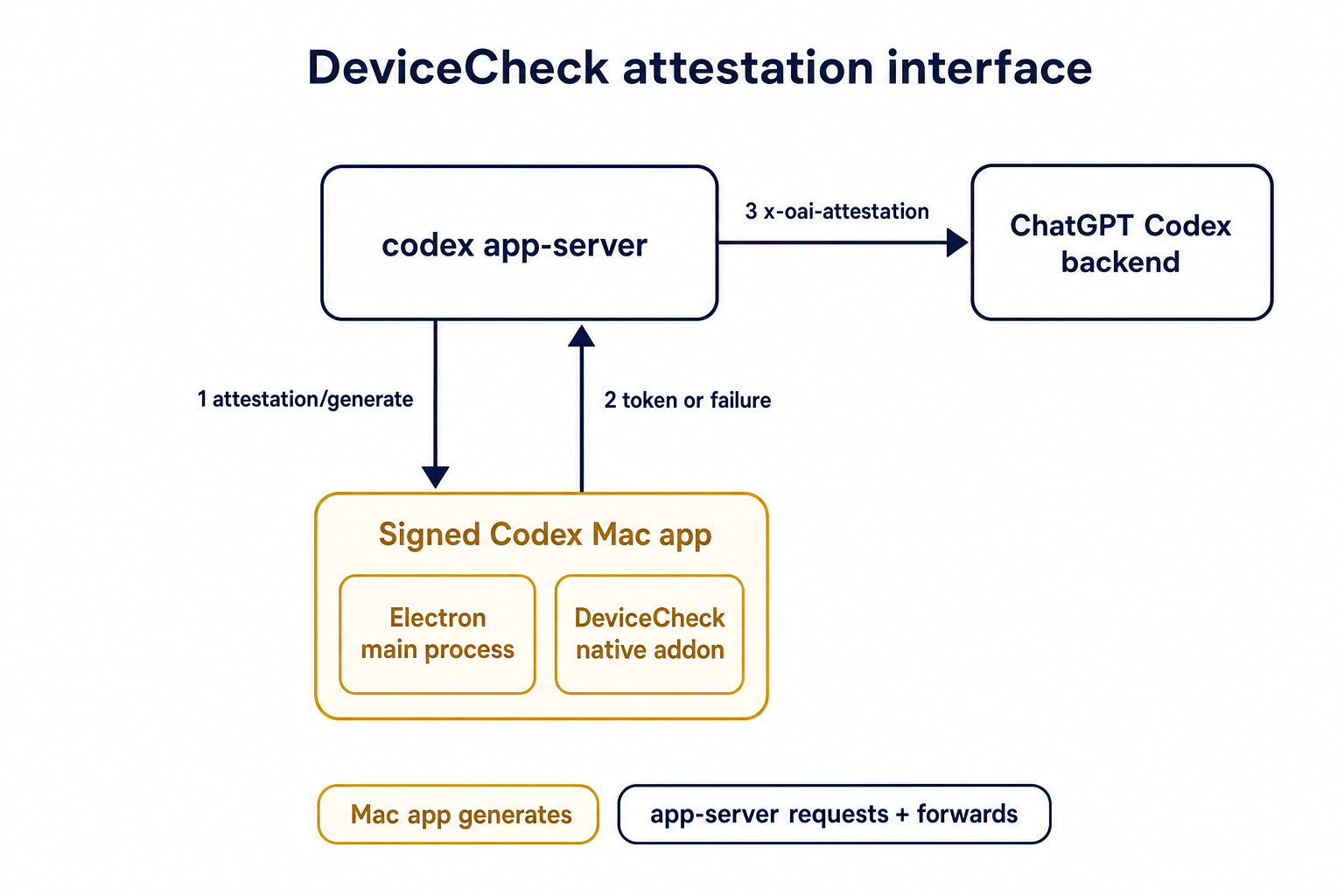
## Summary TL;DR: teaches `codex-rs` / app-server to request a desktop-provided attestation token and attach it as `x-oai-attestation` on the scoped ChatGPT Codex request paths.  ## Details This PR teaches the Codex app-server runtime how to request and attach an attestation token. It does not generate DeviceCheck tokens directly; instead, it relies on the connected desktop app to advertise that it can generate attestation and then asks that app for a fresh header value when needed. The flow is: 1. The Codex desktop app connects to app-server. 2. During `initialize`, the app can advertise that it supports `requestAttestation`. 3. Before app-server calls selected ChatGPT Codex endpoints, it sends the internal server request `attestation/generate` to the app. 4. app-server receives a pre-encoded header value back. 5. app-server forwards that value as `x-oai-attestation` on the scoped outbound requests. The code in this repo is mostly protocol and runtime plumbing: it adds the app-server request/response shape, introduces an attestation provider in core, wires that provider into Responses / compaction / realtime setup paths, and covers the intended scoping with tests. The signed macOS DeviceCheck generation remains owned by the desktop app PR. ## Related PR - Codex desktop app implementation: https://github.com/openai/openai/pull/878649 ## Validation <details> <summary>Tests run</summary> ```sh cargo test -p codex-app-server-protocol cargo test -p codex-core attestation --lib cargo test -p codex-app-server --lib attestation ``` Also ran: ```sh just fix -p codex-core just fix -p codex-app-server just fix -p codex-app-server-protocol just fmt just write-app-server-schema ``` </details> <details> <summary>E2E DeviceCheck validation</summary> First validated the signed desktop app boundary directly: launched a packaged signed `Codex.app`, sent `attestation/generate`, decoded the returned `v1.` attestation header, and validated the extracted DeviceCheck token with `personal/jm/verify_devicecheck_token.py` using bundle ID `com.openai.codex`. Apple returned `status_code: 200` and `is_ok: true`. Then ran the fuller app + app-server flow. The packaged `Codex.app` launched a current-branch app-server via `CODEX_CLI_PATH`, and a local MITM proxy intercepted outbound `chatgpt.com` traffic. The app-server requested `attestation/generate` from the real Electron app process, and the intercepted `/backend-api/codex/responses` traffic included `x-oai-attestation` on both routes: ```text GET /backend-api/codex/responses Upgrade: websocket x-oai-attestation: present POST /backend-api/codex/responses Upgrade: none x-oai-attestation: present ``` The captured header decoded to a DeviceCheck token that also validated with Apple for `com.openai.codex` (`status_code: 200`, `is_ok: true`, team `2DC432GLL2`). </details> --------- Co-authored-by: Codex <noreply@openai.com>
Jiaming Zhang ·
2026-05-08 12:36:02 -07:00 -
Move thread name edits to ThreadStore (#21264)
- Route live thread renames through `ThreadStore` metadata updates. - Read resumed thread names from store metadata with legacy local fallback preserved in the store.
Tom ·
2026-05-07 11:12:22 -07:00 -
feat: make built-in MCPs first-class runtime servers (#21356)
## DISCLAIMER This is experimental and no production service must rely on this ## Why Built-in MCPs are product-owned runtime capabilities, but they were previously flattened into the same config-backed stdio path as user-configured servers. That made them depend on a hidden `codex builtin-mcp` re-exec path, exposed them through config-oriented CLI flows, and erased distinctions the runtime needs to preserve—most notably whether an MCP call should count as external context for memory-mode pollution. ## What changed - Model product-owned built-ins separately from config-backed MCP servers via `BuiltinMcpServer` and `EffectiveMcpServer`. - Launch built-ins in process through a reusable async transport instead of the hidden `builtin-mcp` stdio subcommand. - Keep config-oriented CLI operations such as `codex mcp list/get/login/logout` scoped to configured servers, while merging built-ins only into the effective runtime server set. - Retain server metadata after launch so parallel-tool support and context classification come from the live server set; built-in `memories` is now classified as local Codex state rather than external context. ## Test plan - `cargo test -p codex-mcp` - `cargo test -p codex-core --test suite builtin_memories_mcp_call_does_not_mark_thread_memory_mode_polluted_when_configured` --------- Co-authored-by: Codex <noreply@openai.com>
jif-oai ·
2026-05-07 10:36:32 +02:00 -
Revert state DB injection and agent graph store (#21481)
## Why Reverts #20689 to restore the previous optional state DB plumbing. The conflict resolution keeps the newer installation ID and session/thread identity changes that landed after #20689, while removing the mandatory state DB and agent graph store dependency from ThreadManager construction. ## What changed - Restored `Option<StateDbHandle>` through app-server, MCP server, prompt debug, and test entry points. - Removed the `codex-core` dependency on `codex-agent-graph-store` and reverted descendant lookup back to the existing state DB path when available. - Kept newer `installation_id` forwarding by passing it beside the optional DB handle. - Kept local thread-name updates working when the optional state DB handle is absent. ## Validation - `git diff --check` - `cargo test -p codex-thread-store` - `cargo test -p codex-state -p codex-rollout -p codex-app-server-protocol` - Attempted `env CARGO_INCREMENTAL=0 cargo test -p codex-core -p codex-app-server -p codex-app-server-client -p codex-mcp-server -p codex-thread-manager-sample -p codex-tui`; blocked locally by a rustc ICE while compiling `v8 v146.4.0` with `rustc 1.93.0 (254b59607 2026-01-19)` on `aarch64-apple-darwin`.
pakrym-oai ·
2026-05-06 22:48:29 -07:00