


 e56e6dad4d
* Remove Foundry toolbox helpers; standardize on MCP for toolbox consumption

- Remove RawFoundryChatClient.get_toolbox() and its fetch_toolbox import
- Remove fetch_toolbox, select_toolbox_tools, get_toolbox_tool_name,
  get_toolbox_tool_type, FoundryHostedToolType, ToolboxToolSelectionInput
  from agent_framework_foundry._tools
- Remove ExperimentalFeature.TOOLBOXES from _feature_stage.py (no consumers)
- Drop toolbox re-exports from agent_framework_foundry/__init__.py and
  agent_framework.foundry namespace
- Update _sanitize_foundry_response_tool docstring to remove toolbox framing;
  sanitization logic itself is unchanged
- Update _agent.py docstring: 'toolbox-fetched MCP' → 'hosted MCP'
- Delete tests/test_toolbox.py (all tests covered removed helpers)
- Update test_foundry_chat_client.py: rename/redoc tests that mentioned
  toolbox but test sanitization that remains
- Delete foundry_chat_client_with_toolbox.py (bespoke toolbox API sample)
- Delete foundry_toolbox_context_provider.py (relied on select_toolbox_tools)
- Rename foundry_chat_client_with_toolbox_mcp.py →
  foundry_chat_client_with_toolbox.py (canonical MCP pattern)
- Rewrite 04_foundry_toolbox/main.py to use MCPStreamableHTTPTool
- Update provider/README, context_providers/README, 04_foundry_toolbox/README

Co-authored-by: Copilot <223556219+Copilot@users.noreply.github.com>

* fix(samples): update 06_files sample to consume toolbox via MCP (#5670)

Replace removed get_toolbox/select_toolbox_tools APIs with
MCPStreamableHTTPTool, using allowed_tools=["code_interpreter"] to
select only the code interpreter from the toolbox endpoint.

Update .env.example and README to use FOUNDRY_TOOLBOX_ENDPOINT
instead of TOOLBOX_NAME.

Co-authored-by: Copilot <223556219+Copilot@users.noreply.github.com>

* fix(foundry): remove non-existent toolbox helper APIs from README (#5670)

Remove the 'fetch, optionally filter, and pass tools directly' pattern
from the FoundryChatClient toolbox documentation, as select_toolbox_tools
and get_toolbox were removed. Only the MCP endpoint pattern is documented.

Co-authored-by: Copilot <223556219+Copilot@users.noreply.github.com>

* fix(foundry): remove residual toolbox docstring references and reproduction report

Remove REPRODUCTION_REPORT.md (workflow artifact that should not be committed),
and update two remaining docstring references that still said 'toolbox reads'
/'toolbox definition' after the toolbox helpers were removed.

Co-authored-by: Copilot <223556219+Copilot@users.noreply.github.com>

* Python: Remove bespoke Foundry toolbox helpers; standardize on MCP for toolbox consumption

Fixes #5670

* fix(#5670): resolve toolbox endpoint from TOOLBOX_NAME fallback; add namespace regression tests

- Add _resolve_toolbox_endpoint() helper in 04_foundry_toolbox/main.py and
  06_files/main.py that prefers FOUNDRY_TOOLBOX_ENDPOINT but falls back to
  deriving the MCP URL from FOUNDRY_PROJECT_ENDPOINT + TOOLBOX_NAME — fixing
  the startup KeyError when agents are deployed via azd provision (which injects
  TOOLBOX_NAME, not FOUNDRY_TOOLBOX_ENDPOINT).
- Update 04_foundry_toolbox/.env.example to use FOUNDRY_TOOLBOX_ENDPOINT
  (consistent with 06_files).
- Add TOOLBOX_NAME env var to 06_files/agent.yaml so deployed agents have it
  available for the fallback derivation.
- Update both READMEs to document the two ways to supply the toolbox endpoint.
- Add test_foundry_namespace_no_longer_exposes_toolbox_helpers() with negative
  assertions for FoundryHostedToolType, get_toolbox_tool_name,
  get_toolbox_tool_type, and select_toolbox_tools — guarding against accidental
  re-introduction of removed symbols.

Co-authored-by: Copilot <223556219+Copilot@users.noreply.github.com>

* fix(samples): fail fast on empty FOUNDRY_TOOLBOX_ENDPOINT; add unit tests

Addresses review feedback for #5670:

- In _resolve_toolbox_endpoint() (04_foundry_toolbox/main.py and
  06_files/main.py) change the walrus-operator check from a truthy
  test to an explicit 'is not None' guard.  An explicitly set empty
  string now raises ValueError immediately with a clear message
  instead of silently falling through to the fallback URL
  construction.

- Add tests/samples/hosting/test_toolbox_endpoint.py covering both
  sample modules:
    (a) FOUNDRY_TOOLBOX_ENDPOINT set → returned as-is
    (b) FOUNDRY_TOOLBOX_ENDPOINT set to empty string → ValueError
    (c) fallback constructs URL from FOUNDRY_PROJECT_ENDPOINT + TOOLBOX_NAME,
        stripping trailing slashes
    (d) neither variable group set → KeyError

Co-authored-by: Copilot <223556219+Copilot@users.noreply.github.com>

* Address review feedback: remove extraneous test and docstring content

- Remove test_foundry_namespace_no_longer_exposes_toolbox_helpers (no longer warranted)
- Remove docstring from _agent.py _prepare_tools_for_openai (extraneous)
- Trim _chat_client.py _prepare_tools_for_openai docstring to one-liner (toolbox references no longer relevant)

Co-authored-by: Copilot <223556219+Copilot@users.noreply.github.com>

* fix: remove remaining extraneous docstring from RawFoundryChatClient._prepare_tools_for_openai

Address review comment on PR #5671: reviewer noted the description
isn't warranted now that toolbox helpers have been removed. Matches
the pattern in RawFoundryAgentChatClient which has no docstring.

Co-authored-by: Copilot <223556219+Copilot@users.noreply.github.com>

---------

Co-authored-by: Copilot <copilot@github.com>
Co-authored-by: Copilot <223556219+Copilot@users.noreply.github.com>

Welcome to Microsoft Agent Framework!




Microsoft Agent Framework (MAF) is an open, multi-language framework for building production-grade AI agents and multi-agent workflows in .NET and Python.
Microsoft Agent Framework is built for teams taking agents from prototype to production. It provides a consistent foundation for building, orchestrating, and operating agent systems across Python and .NET, while keeping architecture choices open as requirements evolve, and supports a broad ecosystem including Microsoft Foundry, Azure OpenAI, OpenAI, and the GitHub Copilot SDK, with samples and hosting patterns for both local development and cloud deployment.
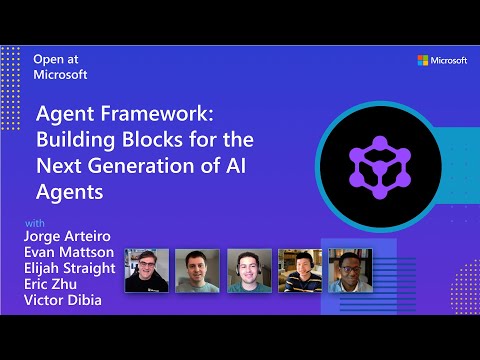
Watch the full Agent Framework introduction (30 min)
Is this the right framework for you?
MAF is a strong fit if you:
- are building agents and workflows you expect to run in production,
- need orchestration beyond a single prompt or stateless chat loop,
- want graph-based patterns such as sequential, concurrent, handoff, and group collaboration,
- care about durability, restartability, observability, governance, or human-in-the-loop control,
- need provider flexibility so your architecture can evolve without major rewrites.
Key Features
Explore new MAF capabilities and real implementation patterns on the official blog.
- Python and C#/.NET Support: Full framework support for both Python and C#/.NET implementations with consistent APIs
- Multiple Agent Provider Support: Support for various LLM providers with more being added continuously
- Middleware: Flexible middleware system for request/response processing, exception handling, and custom pipelines
- Orchestration Patterns & Workflows: Build multi-agent systems with graph-based workflows supporting sequential, concurrent, handoff, and group collaboration patterns; includes checkpointing, streaming, human-in-the-loop, and time-travel
- Foundry Hosted Agents (new): Deploy and host your agents to Foundry-hosted infrastructure with just 2 additional lines of code
- Observability: Built-in OpenTelemetry integration for distributed tracing, monitoring, and debugging
- Declarative Agents: Define agents using YAML for faster setup and versioning
- Agent Skills: Build domain-specific knowledge bases from multiple sources—files, inline code, class libraries—for agents to discover and use
- AF Labs: Experimental packages for cutting-edge features including benchmarking, reinforcement learning, and research initiatives
- DevUI: Interactive developer UI for agent development, testing, and debugging workflows
Table of Contents
Getting Started
Installation
Python
pip install agent-framework
# This will install all sub-packages, see `python/packages` for individual packages.
# It may take a minute on first install on Windows.
.NET
dotnet add package Microsoft.Agents.AI
# For Foundry integration (used in the .NET quickstart below):
dotnet add package Microsoft.Agents.AI.Foundry
dotnet add package Azure.AI.Projects
dotnet add package Azure.Identity
Learning Resources
- Overview - High level overview of the framework
- Quick Start - Get started with a simple agent
- Tutorials - Step by step tutorials
- User Guide - In-depth user guide for building agents and workflows
- Migration from Semantic Kernel - Guide to migrate from Semantic Kernel
- Migration from AutoGen - Guide to migrate from AutoGen
Quickstart
Basic Agent - Python
Create a simple Azure Responses Agent that writes a haiku about the Microsoft Agent Framework
# pip install agent-framework
# Use `az login` to authenticate with Azure CLI
import os
import asyncio
from agent_framework import Agent
from agent_framework.foundry import FoundryChatClient
from azure.identity import AzureCliCredential


async def main():
    # Initialize a chat agent with Microsoft Foundry
    # the endpoint, deployment name, and api version can be set via environment variables
    # or they can be passed in directly to the FoundryChatClient constructor
    agent = Agent(
      client=FoundryChatClient(
          credential=AzureCliCredential(),
          # project_endpoint=os.environ["FOUNDRY_PROJECT_ENDPOINT"],
          # model=os.environ["FOUNDRY_MODEL_DEPLOYMENT_NAME"],
      ),
      name="HaikuAgent",
      instructions="You are an upbeat assistant that writes beautifully.",
    )

    print(await agent.run("Write a haiku about Microsoft Agent Framework."))

if __name__ == "__main__":
    asyncio.run(main())
Basic Agent - .NET
Create a simple Agent, using Microsoft Foundry that writes a haiku about the Microsoft Agent Framework
// This sample shows how to create and run a basic agent with AIProjectClient.AsAIAgent(...).

using Azure.AI.Projects;
using Azure.Identity;
using Microsoft.Agents.AI;

string endpoint = Environment.GetEnvironmentVariable("AZURE_AI_PROJECT_ENDPOINT") ?? throw new InvalidOperationException("AZURE_AI_PROJECT_ENDPOINT is not set.");
string deploymentName = Environment.GetEnvironmentVariable("AZURE_AI_MODEL_DEPLOYMENT_NAME") ?? "gpt-5.4-mini";

AIAgent agent =
    new AIProjectClient(new Uri(endpoint), new DefaultAzureCredential())
    .AsAIAgent(model: deploymentName, instructions: "You are an upbeat assistant that writes beautifully.", name: "HaikuAgent");

// Once you have the agent, you can invoke it like any other AIAgent.
Console.WriteLine(await agent.RunAsync("Write a haiku about Microsoft Agent Framework."));
More Examples & Samples
Python
- Getting Started: progressive tutorial from hello-world to hosting
- Agent Concepts: deep-dive samples by topic (tools, middleware, providers, etc.)
- Workflows: workflow creation and integration with agents
- Hosting: A2A, Azure Functions, Durable Task hosting
- End-to-End: full applications, evaluation, and demos
.NET
- Getting Started: progressive tutorial from hello agent to hosting
- Agent Concepts: basic agent creation and tool usage
- Agent Providers: samples showing different agent providers
- Workflows: advanced multi-agent patterns and workflow orchestration
- Hosting: A2A, Durable Agents, Durable Workflows
- End-to-End: full applications and demos
Community & Feedback
- Found a bug? File a GitHub issue to help us improve.
- Enjoying MAF?
to show your support and help others discover the project.
- Have questions? Join our Discord or visit weekly office hours.
Troubleshooting
Authentication
| Problem | Cause | Fix |
|---|---|---|
| Authentication errors when using Azure credentials | Not signed in to Azure CLI | Run az login before starting your app |
| API key errors | Wrong or missing API key | Verify the key and ensure it's for the correct resource/provider |
Tip:
DefaultAzureCredentialis convenient for development but in production, consider using a specific credential (e.g.,ManagedIdentityCredential) to avoid latency issues, unintended credential probing, and potential security risks from fallback mechanisms.
Environment Variables
For environment variable configuration specific to each sample, refer to the README in the sample directory (Python samples | .NET samples).
Contributor Resources
Important Notes
Important
If you use Microsoft Agent Framework to build applications that operate with any third-party servers, agents, code, or non-Azure Direct models (“Third-Party Systems”), you do so at your own risk. Third-Party Systems are Non-Microsoft Products under the Microsoft Product Terms and are governed by their own third-party license terms. You are responsible for any usage and associated costs.
We recommend reviewing all data being shared with and received from Third-Party Systems and being cognizant of third-party practices for handling, sharing, retention and location of data. It is your responsibility to manage whether your data will flow outside of your organization’s Azure compliance and geographic boundaries and any related implications, and that appropriate permissions, boundaries and approvals are provisioned.
You are responsible for carefully reviewing and testing applications you build using Microsoft Agent Framework in the context of your specific use cases, and making all appropriate decisions and customizations. This includes implementing your own responsible AI mitigations such as metaprompt, content filters, or other safety systems, and ensuring your applications meet appropriate quality, reliability, security, and trustworthiness standards. See also: Transparency FAQ