


 da32e8cf80
* Add functional workflow api

* cleanup

* More cleanup

* address copilot feedback

* Address PR feedbacK

* updates

* PR feedback

* Address review comments on functional workflow samples

- Swap 05/06 get-started samples: agent workflow first (motivates
  why workflows exist), simple text workflow second
- Rename text_pipeline → text_workflow, poem_pipeline → poem_workflow
- Add @step to agent workflow sample (05) to demonstrate caching
- Switch agent samples to AzureOpenAIResponsesClient with Foundry
- Remove .as_agent() from agent_integration.py to focus on the key
  difference between inline agent calls vs @step-cached calls
- Add commented-out Agent.run example in hitl_review.py
- Add clarifying comment in _functional.py that event streaming is
  buffered (not true per-token streaming)
- Add naive_group_chat.py functional sample: round-robin group chat
  as a plain Python loop
- Update READMEs to reflect new file names and group chat sample

Co-authored-by: Copilot <223556219+Copilot@users.noreply.github.com>

* Fix pyright type errors

* Address PR review comments on functional workflow API

1. Allow request_info inside @step: Auto-inject RunContext into step
   functions that declare a RunContext parameter (by type or name 'ctx'),
   and expose get_run_context() for programmatic access.

2. Handle None responses: Log a warning when a response value is None,
   and document the behavior in request_info docstring.

3. Add executor_bypassed event type: Replace executor_invoked +
   executor_completed with a single executor_bypassed event when a step
   replays from cache, making cached vs live execution explicit.

Co-authored-by: Copilot <223556219+Copilot@users.noreply.github.com>

* Add regression tests for PR review comments on functional workflow API

The three review comments (request_info in @step, None response handling,
executor_bypassed event type) were already addressed in 7da7db4e. This
commit adds cross-cutting regression tests that exercise the interactions
between these features:

- HITL in step with caching: preceding step bypassed on resume
- Full checkpoint lifecycle with HITL step (interrupt -> resume -> restore)
- None response inside step-level request_info logs warning
- WorkflowInterrupted from step does not emit executor_failed

Co-authored-by: Copilot <223556219+Copilot@users.noreply.github.com>

* Address PR #4238 review comments on functional workflow API

Comment 1 (request_info in @step): Already supported. Added comment in
StepWrapper.__call__ explaining why WorkflowInterrupted (BaseException)
safely bypasses the except Exception handler.

Comment 2 (None response): Added docstring to _get_response clarifying
the (found, value) return tuple semantics and None handling.

Comment 3 (bypass event type): executor_bypassed is already a dedicated
event type in WorkflowEventType. Updated comment at the bypass site to
make the deliberate event type choice explicit.

Co-authored-by: Copilot <223556219+Copilot@users.noreply.github.com>

* Add experimental API warnings to functional workflow module

Mark all public classes and decorators (workflow, step, RunContext,
FunctionalWorkflow, StepWrapper, FunctionalWorkflowAgent) as
experimental and subject to change or removal.

* Address PR #4238 review comments from @eavanvalkenburg

- RunContext docstring leads with purpose (opt-in handle for HITL,
  custom events, state) so readers importing it from the public surface
  understand its role before the mechanics (#2993513452).
- Rename `06_first_functional_workflow.py` to
  `06_functional_workflow_basics.py`; the previous filename was
  confusing since it followed `05_functional_workflow_with_agents.py`
  (#2993531979).
- Simplify `05_functional_workflow_with_agents.py` to call agents
  directly without a @step wrapper; the step-vs-no-step contrast lives
  in `03-workflows/functional/agent_integration.py`, keeping the
  get-started sample minimal (#2993525532).
- Switch functional samples to `FoundryChatClient` for consistency with
  the rest of 01-get-started and 03-workflows (follow-up on #2876988570).
- Use walrus in `hitl_review.py` final-state assertion (#2993572182).
- Add expected-output block to `basic_streaming_pipeline.py` (#2993557609).
- Clarify in `parallel_pipeline.py` that `@step` composes with
  `asyncio.gather` (#2993597282).
- `naive_group_chat.py` threads `list[Message]` between turns instead
  of stringifying the transcript, preserving role/authorship (#2993583231).

Drive-by: pre-commit hook sorts an unrelated import block in
`samples/04-hosting/foundry-hosted-agents/responses/02_local_tools/main.py`.

* Fix 10 functional-workflow API bugs from /ultrareview pass

- bug_001: `ctx.request_info()` without an explicit `request_id` now derives
  a deterministic `auto::<index>` id from the call-counter, so HITL resume
  works correctly on the documented default path.  A uuid was regenerated on
  every replay, making resume impossible.

- bug_002: `StepWrapper.__call__` no longer deepcopies arguments on the
  cache-hit replay branch.  The copy is only performed on the live-execution
  path (for the event log) and falls back to the original mapping if deepcopy
  fails, so steps whose args aren't deepcopyable (locks, sockets, sessions)
  can still resume from checkpoint.

- bug_007: `_set_responses` now prunes each resolved `request_id` from
  `_pending_requests`, and the cache-hit branch in `request_info` does the
  same.  Previously, answered requests were re-serialized into every
  subsequent checkpoint and the final checkpoint falsely claimed pending
  requests even after the workflow completed.

- bug_008: `_compute_signature_hash` now mixes the function's `co_code` and
  `co_names` into the checkpoint signature, so changes to the workflow body
  invalidate older checkpoints even when steps are accessed via module /
  class attributes (which `_discover_step_names` can't see statically).
  `RunContext._record_observed_step` records observed step names for
  diagnostics.

- bug_010: `FunctionalWorkflow.run()` docstring corrected — says "at least
  one of message/responses/checkpoint_id" and explicitly notes `responses`
  may be combined with `checkpoint_id` (the validator already allowed this).

- bug_013: `FunctionalWorkflowAgent` now surfaces `request_info` events as
  `FunctionApprovalRequestContent` items (mirroring graph `WorkflowAgent`),
  threads `responses=` and `checkpoint_id=` through to the underlying
  workflow, and exposes `pending_requests`.  Previously `.as_agent()`
  returned empty `AgentResponse` for HITL workflows — effectively unusable.

- bug_014: `FunctionalWorkflow` now clears `_last_message`,
  `_last_step_cache`, and `_last_pending_request_ids` on clean completion.
  `run()` validates that `responses=` keys intersect the currently-pending
  request set (or raises with a clear error) instead of silently replaying
  against stale singleton state from a prior run.

- bug_015: `FunctionalWorkflow.as_agent` signature now matches graph
  `Workflow.as_agent`: accepts `name`, `description`, `context_providers`,
  and `**kwargs`.  `FunctionalWorkflowAgent` stores the overrides.

- bug_017: `RunContext.set_state` raises `ValueError` for underscore-
  prefixed keys (the framework's `_step_cache` / `_original_message` keys
  would silently clobber user state on checkpoint save and user
  underscore-prefixed state was dropped on restore).  Docstring documents
  the reserved prefix.

- merged_bug_003: Workflow function arity is validated at decoration time.
  Multiple non-ctx parameters raise `ValueError` immediately (previously
  every arg past the first was silently dropped at call time).  Passing a
  non-None `message` to a ctx-only workflow raises `ValueError` instead of
  silently discarding the message.

Test coverage: +18 regression tests covering every fix.  Full workflow
suite now 766 passed, 1 skipped, 2 xfailed; full core suite 2338 passed.

* Deslop functional.py fix commit

- Remove dead instrumentation added in the prior commit that was never
  consumed: `RunContext._observed_step_names`,
  `RunContext._record_observed_step`, `FunctionalWorkflow._runtime_step_names`,
  and `FunctionalWorkflowAgent._extra_kwargs`.  The signature hash relies on
  `co_code` alone, which covers the attribute-access case without the
  collection-scaffolding.
- Trim over-explanatory comments that restated what the code does or what
  it no longer does.  Keep only the comments that answer "why" for the
  non-obvious bits (deterministic id contract, defensive deepcopy, stale
  replay guard).
- Compress the `_compute_signature_hash` and FunctionalWorkflow `__init__`
  block docstrings without losing the user-facing reasoning.

Net -49 lines.  Regression lock preserved (766 passed, 1 skipped, 2 xfailed).

* Fix functional workflow review feedback

---------

Co-authored-by: Copilot <223556219+Copilot@users.noreply.github.com>
Co-authored-by: Copilot <copilot@github.com>

Welcome to Microsoft Agent Framework!



Welcome to Microsoft's comprehensive multi-language framework for building, orchestrating, and deploying AI agents with support for both .NET and Python implementations. This framework provides everything from simple chat agents to complex multi-agent workflows with graph-based orchestration.
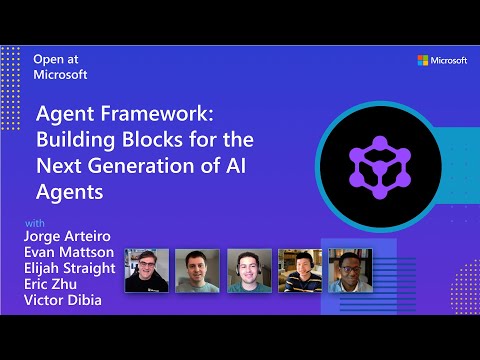
Watch the full Agent Framework introduction (30 min)
📋 Getting Started
📦 Installation
Python
pip install agent-framework
# This will install all sub-packages, see `python/packages` for individual packages.
# It may take a minute on first install on Windows.
.NET
dotnet add package Microsoft.Agents.AI
📚 Documentation
- Overview - High level overview of the framework
- Quick Start - Get started with a simple agent
- Tutorials - Step by step tutorials
- User Guide - In-depth user guide for building agents and workflows
- Migration from Semantic Kernel - Guide to migrate from Semantic Kernel
- Migration from AutoGen - Guide to migrate from AutoGen
Still have questions? Join our weekly office hours or ask questions in our Discord channel to get help from the team and other users.
✨ Highlights
- Graph-based Workflows: Connect agents and deterministic functions using data flows with streaming, checkpointing, human-in-the-loop, and time-travel capabilities
- AF Labs: Experimental packages for cutting-edge features including benchmarking, reinforcement learning, and research initiatives
- DevUI: Interactive developer UI for agent development, testing, and debugging workflows
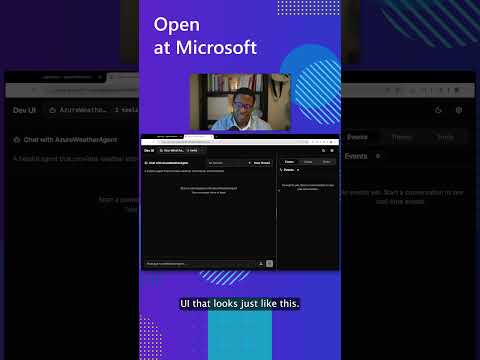
See the DevUI in action (1 min)
- Python and C#/.NET Support: Full framework support for both Python and C#/.NET implementations with consistent APIs
- Observability: Built-in OpenTelemetry integration for distributed tracing, monitoring, and debugging
- Multiple Agent Provider Support: Support for various LLM providers with more being added continuously
- Middleware: Flexible middleware system for request/response processing, exception handling, and custom pipelines
💬 We want your feedback!
- For bugs, please file a GitHub issue.
Quickstart
Basic Agent - Python
Create a simple Azure Responses Agent that writes a haiku about the Microsoft Agent Framework
# pip install agent-framework
# Use `az login` to authenticate with Azure CLI
import os
import asyncio
from agent_framework import Agent
from agent_framework.foundry import FoundryChatClient
from azure.identity import AzureCliCredential


async def main():
    # Initialize a chat agent with Microsoft Foundry
    # the endpoint, deployment name, and api version can be set via environment variables
    # or they can be passed in directly to the FoundryChatClient constructor
    agent = Agent(
      client=FoundryChatClient(
          credential=AzureCliCredential(),
          # project_endpoint=os.environ["FOUNDRY_PROJECT_ENDPOINT"],
          # model=os.environ["FOUNDRY_MODEL_DEPLOYMENT_NAME"],
      ),
      name="HaikuBot",
      instructions="You are an upbeat assistant that writes beautifully.",
    )

    print(await agent.run("Write a haiku about Microsoft Agent Framework."))

if __name__ == "__main__":
    asyncio.run(main())
Basic Agent - .NET
Create a simple Agent, using Microsoft Foundry with token-based auth, that writes a haiku about the Microsoft Agent Framework
// dotnet add package Microsoft.Agents.AI.Foundry
// Use `az login` to authenticate with Azure CLI
using Azure.AI.Projects;
using Azure.Identity;
using System;
using Azure.AI.Projects;
using Azure.Identity;

var endpoint = Environment.GetEnvironmentVariable("AZURE_AI_PROJECT_ENDPOINT") ?? throw new InvalidOperationException("AZURE_AI_PROJECT_ENDPOINT is not set.");
var deploymentName = Environment.GetEnvironmentVariable("AZURE_AI_MODEL_DEPLOYMENT_NAME") ?? "gpt-5.4-mini";

var agent = new AIProjectClient(new Uri(endpoint), new DefaultAzureCredential())
    .AsAIAgent(model: deploymentName, name: "HaikuBot", instructions: "You are an upbeat assistant that writes beautifully.");

Console.WriteLine(await agent.RunAsync("Write a haiku about Microsoft Agent Framework."));
Create a simple Agent, using OpenAI Responses, that writes a haiku about the Microsoft Agent Framework
// dotnet add package Microsoft.Agents.AI.OpenAI
using System;
using OpenAI;
using OpenAI.Responses;

// Replace the <apikey> with your OpenAI API key.
var agent = new OpenAIClient("<apikey>")
    .GetResponsesClient()
    .AsAIAgent(model: "gpt-5.4-mini", name: "HaikuBot", instructions: "You are an upbeat assistant that writes beautifully.");

Console.WriteLine(await agent.RunAsync("Write a haiku about Microsoft Agent Framework."));
More Examples & Samples
Python
- Getting Started: progressive tutorial from hello-world to hosting
- Agent Concepts: deep-dive samples by topic (tools, middleware, providers, etc.)
- Workflows: workflow creation and integration with agents
- Hosting: A2A, Azure Functions, Durable Task hosting
- End-to-End: full applications, evaluation, and demos
.NET
- Getting Started: progressive tutorial from hello agent to hosting
- Agent Concepts: basic agent creation and tool usage
- Agent Providers: samples showing different agent providers
- Workflows: advanced multi-agent patterns and workflow orchestration
- Hosting: A2A, Durable Agents, Durable Workflows
- End-to-End: full applications and demos
Troubleshooting
Authentication
| Problem | Cause | Fix |
|---|---|---|
| Authentication errors when using Azure credentials | Not signed in to Azure CLI | Run az login before starting your app |
| API key errors | Wrong or missing API key | Verify the key and ensure it's for the correct resource/provider |
Tip:
DefaultAzureCredentialis convenient for development but in production, consider using a specific credential (e.g.,ManagedIdentityCredential) to avoid latency issues, unintended credential probing, and potential security risks from fallback mechanisms.
Environment Variables
The samples typically read configuration from environment variables. Common required variables:
| Variable | Used by | Purpose |
|---|---|---|
AZURE_OPENAI_ENDPOINT |
Azure OpenAI samples | Your Azure OpenAI resource URL |
AZURE_OPENAI_DEPLOYMENT_NAME |
Azure OpenAI samples | Model deployment name (e.g. gpt-4o-mini) |
AZURE_AI_PROJECT_ENDPOINT |
Microsoft Foundry samples | Your Microsoft Foundry project endpoint |
AZURE_AI_MODEL_DEPLOYMENT_NAME |
Microsoft Foundry samples | Model deployment name |
OPENAI_API_KEY |
OpenAI (non-Azure) samples | Your OpenAI platform API key |
Contributor Resources
Important Notes
Important
If you use Microsoft Agent Framework to build applications that operate with any third-party servers, agents, code, or non-Azure Direct models (“Third-Party Systems”), you do so at your own risk. Third-Party Systems are Non-Microsoft Products under the Microsoft Product Terms and are governed by their own third-party license terms. You are responsible for any usage and associated costs.
We recommend reviewing all data being shared with and received from Third-Party Systems and being cognizant of third-party practices for handling, sharing, retention and location of data. It is your responsibility to manage whether your data will flow outside of your organization’s Azure compliance and geographic boundaries and any related implications, and that appropriate permissions, boundaries and approvals are provisioned.
You are responsible for carefully reviewing and testing applications you build using Microsoft Agent Framework in the context of your specific use cases, and making all appropriate decisions and customizations. This includes implementing your own responsible AI mitigations such as metaprompt, content filters, or other safety systems, and ensuring your applications meet appropriate quality, reliability, security, and trustworthiness standards. See also: Transparency FAQ