

 b03cb324d5
* initial work on code_mode

* updated samples

* updates to codeact

* udpated codeact

* Draft CodeAct ADR and sample updates

Co-authored-by: Copilot <223556219+Copilot@users.noreply.github.com>

* initial implementation and adr and feature

* Python: Limit Hyperlight wasm backend to Python <3.14

Co-authored-by: Copilot <223556219+Copilot@users.noreply.github.com>

* Python: Fix CI for Hyperlight CodeAct PR

Co-authored-by: Copilot <223556219+Copilot@users.noreply.github.com>

* Python: Run Hyperlight integration when available

Co-authored-by: Copilot <223556219+Copilot@users.noreply.github.com>

* Python: Address Hyperlight review feedback

Co-authored-by: Copilot <223556219+Copilot@users.noreply.github.com>

* Python: Simplify Hyperlight file mount inputs

Co-authored-by: Copilot <223556219+Copilot@users.noreply.github.com>

* Python: Accept Path host paths in Hyperlight mounts

Co-authored-by: Copilot <223556219+Copilot@users.noreply.github.com>

* Python: Fix Hyperlight mount typing for CI

Co-authored-by: Copilot <223556219+Copilot@users.noreply.github.com>

* temp run integration test

* Python: Strengthen Hyperlight real sandbox tests

Co-authored-by: Copilot <223556219+Copilot@users.noreply.github.com>

* added additional tests

* Python: Simplify Hyperlight CodeAct API

Co-authored-by: Copilot <223556219+Copilot@users.noreply.github.com>

* set tests as non-integration

* Retry Hyperlight allowed-domain registration

Co-authored-by: Copilot <223556219+Copilot@users.noreply.github.com>

* Gate Hyperlight integration tests by runtime support

Co-authored-by: Copilot <223556219+Copilot@users.noreply.github.com>

* Fix Hyperlight skip test on Python 3.14

Co-authored-by: Copilot <223556219+Copilot@users.noreply.github.com>

* Delay Hyperlight runtime probe until test execution

Co-authored-by: Copilot <223556219+Copilot@users.noreply.github.com>

* Relax Hyperlight Windows integration stdout assertion

Co-authored-by: Copilot <223556219+Copilot@users.noreply.github.com>

* Scan Hyperlight output directory for artifacts

Co-authored-by: Copilot <223556219+Copilot@users.noreply.github.com>

* Retry Hyperlight output artifact collection

Co-authored-by: Copilot <223556219+Copilot@users.noreply.github.com>

* Harden Hyperlight integration output assertions

Co-authored-by: Copilot <223556219+Copilot@users.noreply.github.com>

* Retry Hyperlight read-back check in integration test

Co-authored-by: Copilot <223556219+Copilot@users.noreply.github.com>

* Simplify Hyperlight integration write assertion

Co-authored-by: Copilot <223556219+Copilot@users.noreply.github.com>

* Avoid pathlib in Hyperlight integration sandbox

Co-authored-by: Copilot <223556219+Copilot@users.noreply.github.com>

* Use socket network check in Hyperlight sandbox

Co-authored-by: Copilot <223556219+Copilot@users.noreply.github.com>

* Replace blocked Azure AI Search blog link

Co-authored-by: Copilot <223556219+Copilot@users.noreply.github.com>

* Clarify Hyperlight guest stdlib limits

Co-authored-by: Copilot <223556219+Copilot@users.noreply.github.com>

* Use _socket in Hyperlight integration sandbox

Co-authored-by: Copilot <223556219+Copilot@users.noreply.github.com>

* Handle Hyperlight mounted file paths

Co-authored-by: Copilot <223556219+Copilot@users.noreply.github.com>

* Broaden Hyperlight sandbox path fallbacks

Co-authored-by: Copilot <223556219+Copilot@users.noreply.github.com>

* Search Hyperlight guest mounts recursively

Co-authored-by: Copilot <223556219+Copilot@users.noreply.github.com>

* Split Hyperlight mount coverage

Co-authored-by: Copilot <223556219+Copilot@users.noreply.github.com>

* Split Hyperlight live network tests

Co-authored-by: Copilot <223556219+Copilot@users.noreply.github.com>

* Fix Hyperlight file-write test on Windows

Enable the sandbox filesystem by providing a workspace_root so
/output is mounted. Remove os.path.exists assertion (unsupported
in WASM guest) and fix Content data assertion to use .uri.
Skip the network integration test on Windows where the WASM
sandbox lacks the encodings.idna codec.

Co-authored-by: Copilot <223556219+Copilot@users.noreply.github.com>

* Address PR review: ADR intro, manual wiring sample, doc clarifications

- Add CodeAct introduction section to ADR for unfamiliar readers
- Clarify 'less runtime efficient' con with specific overhead description
- Add note in Python impl doc clarifying ADR vs impl doc split
- Explain why before_run hooks must be per-run (CRUD, concurrency, approval)
- Rename code_interpreter variable to codeact in E2E sample
- Add manual static wiring sample (codeact_manual_wiring.py)
- Add 'when to use which pattern' guidance to samples README

Co-authored-by: Copilot <223556219+Copilot@users.noreply.github.com>

* Address PR #5185 review comments and add .NET CodeAct design doc

- Fix async callback: _make_sandbox_callback returns sync wrapper with
  thread + asyncio.run() bridge (was broken with real Wasm FFI)
- Fix stale output: clear output_dir before each sandbox.run() call
- Fix blocking event loop: _run_code now async with asyncio.to_thread()
- Revert _agents.py options['tools'] injection (unnecessary; provider
  uses context.extend_tools())
- Revert SessionContext.options docstring back to read-only
- Add real-sandbox test fixtures (shared/restored/fresh)
- Add 8 new real-sandbox tests for callback round-trip, stale output,
  event loop non-blocking, basic execution, stdout/stderr, errors,
  snapshot/restore, and tool registration
- Add comprehensive .NET HyperlightCodeActProvider design document

Co-authored-by: Copilot <223556219+Copilot@users.noreply.github.com>

* Update hyperlight README with code snippets and remove Public API section

Replace bare export list with Quick Start code examples covering the
context provider, standalone tool, manual static wiring, and file
mounts / network access patterns.

Co-authored-by: Copilot <223556219+Copilot@users.noreply.github.com>

---------

Co-authored-by: Copilot <223556219+Copilot@users.noreply.github.com>

Welcome to Microsoft Agent Framework!



Welcome to Microsoft's comprehensive multi-language framework for building, orchestrating, and deploying AI agents with support for both .NET and Python implementations. This framework provides everything from simple chat agents to complex multi-agent workflows with graph-based orchestration.
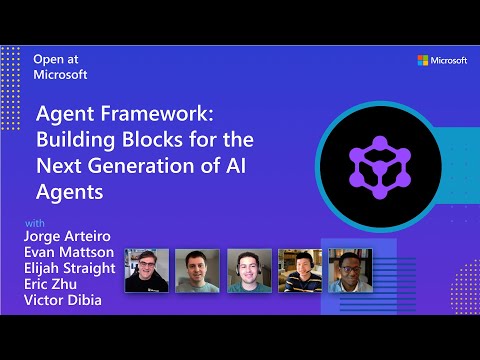
Watch the full Agent Framework introduction (30 min)
📋 Getting Started
📦 Installation
Python
pip install agent-framework
# This will install all sub-packages, see `python/packages` for individual packages.
# It may take a minute on first install on Windows.
.NET
dotnet add package Microsoft.Agents.AI
📚 Documentation
- Overview - High level overview of the framework
- Quick Start - Get started with a simple agent
- Tutorials - Step by step tutorials
- User Guide - In-depth user guide for building agents and workflows
- Migration from Semantic Kernel - Guide to migrate from Semantic Kernel
- Migration from AutoGen - Guide to migrate from AutoGen
Still have questions? Join our weekly office hours or ask questions in our Discord channel to get help from the team and other users.
✨ Highlights
- Graph-based Workflows: Connect agents and deterministic functions using data flows with streaming, checkpointing, human-in-the-loop, and time-travel capabilities
- AF Labs: Experimental packages for cutting-edge features including benchmarking, reinforcement learning, and research initiatives
- DevUI: Interactive developer UI for agent development, testing, and debugging workflows
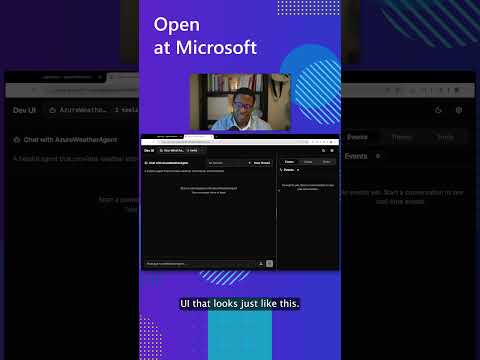
See the DevUI in action (1 min)
- Python and C#/.NET Support: Full framework support for both Python and C#/.NET implementations with consistent APIs
- Observability: Built-in OpenTelemetry integration for distributed tracing, monitoring, and debugging
- Multiple Agent Provider Support: Support for various LLM providers with more being added continuously
- Middleware: Flexible middleware system for request/response processing, exception handling, and custom pipelines
💬 We want your feedback!
- For bugs, please file a GitHub issue.
Quickstart
Basic Agent - Python
Create a simple Azure Responses Agent that writes a haiku about the Microsoft Agent Framework
# pip install agent-framework
# Use `az login` to authenticate with Azure CLI
import os
import asyncio
from agent_framework import Agent
from agent_framework.foundry import FoundryChatClient
from azure.identity import AzureCliCredential


async def main():
    # Initialize a chat agent with Microsoft Foundry
    # the endpoint, deployment name, and api version can be set via environment variables
    # or they can be passed in directly to the FoundryChatClient constructor
    agent = Agent(
      client=FoundryChatClient(
          credential=AzureCliCredential(),
          # project_endpoint=os.environ["FOUNDRY_PROJECT_ENDPOINT"],
          # model=os.environ["FOUNDRY_MODEL_DEPLOYMENT_NAME"],
      ),
      name="HaikuBot",
      instructions="You are an upbeat assistant that writes beautifully.",
    )

    print(await agent.run("Write a haiku about Microsoft Agent Framework."))

if __name__ == "__main__":
    asyncio.run(main())
Basic Agent - .NET
Create a simple Agent, using Microsoft Foundry with token-based auth, that writes a haiku about the Microsoft Agent Framework
// dotnet add package Microsoft.Agents.AI.Foundry
// Use `az login` to authenticate with Azure CLI
using Azure.AI.Projects;
using Azure.Identity;
using System;
using Azure.AI.Projects;
using Azure.Identity;

var endpoint = Environment.GetEnvironmentVariable("AZURE_AI_PROJECT_ENDPOINT") ?? throw new InvalidOperationException("AZURE_AI_PROJECT_ENDPOINT is not set.");
var deploymentName = Environment.GetEnvironmentVariable("AZURE_AI_MODEL_DEPLOYMENT_NAME") ?? "gpt-5.4-mini";

var agent = new AIProjectClient(new Uri(endpoint), new DefaultAzureCredential())
    .AsAIAgent(model: deploymentName, name: "HaikuBot", instructions: "You are an upbeat assistant that writes beautifully.");

Console.WriteLine(await agent.RunAsync("Write a haiku about Microsoft Agent Framework."));
Create a simple Agent, using OpenAI Responses, that writes a haiku about the Microsoft Agent Framework
// dotnet add package Microsoft.Agents.AI.OpenAI
using System;
using OpenAI;
using OpenAI.Responses;

// Replace the <apikey> with your OpenAI API key.
var agent = new OpenAIClient("<apikey>")
    .GetResponsesClient()
    .AsAIAgent(model: "gpt-5.4-mini", name: "HaikuBot", instructions: "You are an upbeat assistant that writes beautifully.");

Console.WriteLine(await agent.RunAsync("Write a haiku about Microsoft Agent Framework."));
More Examples & Samples
Python
- Getting Started: progressive tutorial from hello-world to hosting
- Agent Concepts: deep-dive samples by topic (tools, middleware, providers, etc.)
- Workflows: workflow creation and integration with agents
- Hosting: A2A, Azure Functions, Durable Task hosting
- End-to-End: full applications, evaluation, and demos
.NET
- Getting Started: progressive tutorial from hello agent to hosting
- Agent Concepts: basic agent creation and tool usage
- Agent Providers: samples showing different agent providers
- Workflows: advanced multi-agent patterns and workflow orchestration
- Hosting: A2A, Durable Agents, Durable Workflows
- End-to-End: full applications and demos
Troubleshooting
Authentication
| Problem | Cause | Fix |
|---|---|---|
| Authentication errors when using Azure credentials | Not signed in to Azure CLI | Run az login before starting your app |
| API key errors | Wrong or missing API key | Verify the key and ensure it's for the correct resource/provider |
Tip:
DefaultAzureCredentialis convenient for development but in production, consider using a specific credential (e.g.,ManagedIdentityCredential) to avoid latency issues, unintended credential probing, and potential security risks from fallback mechanisms.
Environment Variables
The samples typically read configuration from environment variables. Common required variables:
| Variable | Used by | Purpose |
|---|---|---|
AZURE_OPENAI_ENDPOINT |
Azure OpenAI samples | Your Azure OpenAI resource URL |
AZURE_OPENAI_DEPLOYMENT_NAME |
Azure OpenAI samples | Model deployment name (e.g. gpt-4o-mini) |
AZURE_AI_PROJECT_ENDPOINT |
Microsoft Foundry samples | Your Microsoft Foundry project endpoint |
AZURE_AI_MODEL_DEPLOYMENT_NAME |
Microsoft Foundry samples | Model deployment name |
OPENAI_API_KEY |
OpenAI (non-Azure) samples | Your OpenAI platform API key |
Contributor Resources
Important Notes
Important
If you use Microsoft Agent Framework to build applications that operate with any third-party servers, agents, code, or non-Azure Direct models (“Third-Party Systems”), you do so at your own risk. Third-Party Systems are Non-Microsoft Products under the Microsoft Product Terms and are governed by their own third-party license terms. You are responsible for any usage and associated costs.
We recommend reviewing all data being shared with and received from Third-Party Systems and being cognizant of third-party practices for handling, sharing, retention and location of data. It is your responsibility to manage whether your data will flow outside of your organization’s Azure compliance and geographic boundaries and any related implications, and that appropriate permissions, boundaries and approvals are provisioned.
You are responsible for carefully reviewing and testing applications you build using Microsoft Agent Framework in the context of your specific use cases, and making all appropriate decisions and customizations. This includes implementing your own responsible AI mitigations such as metaprompt, content filters, or other safety systems, and ensuring your applications meet appropriate quality, reliability, security, and trustworthiness standards. See also: Transparency FAQ