


 5e8fe0be1f
* Fix reasoning text done events duplicating streamed delta content (#5157)

The OpenAI Responses API sends both reasoning_text.delta (incremental
chunks) and reasoning_text.done (full accumulated text) events. The
chat client was emitting Content for both, causing ag-ui to append the
full done text onto already-accumulated delta text, producing
duplicated reasoning output.

Stop emitting Content for reasoning_text.done and
reasoning_summary_text.done events, matching how output_text.done is
already handled (not emitted). The deltas contain all the content;
the done event is redundant.

Co-authored-by: Copilot <223556219+Copilot@users.noreply.github.com>

* fix(openai): emit reasoning done content as fallback when no deltas observed (#5157)

Address PR review feedback:
- Track item_ids that received reasoning deltas via seen_reasoning_delta_item_ids set
- Emit content from done events only when no deltas were received for the
  item_id, preventing silent content loss on stream resumption
- Add comment documenting code_interpreter done event asymmetry
- Replace redundant ag-ui test with deduplication-focused test
- Add integration test for delta+done sequence in OpenAI chat client tests
- Add fallback path tests for done events without preceding deltas

Co-authored-by: Copilot <223556219+Copilot@users.noreply.github.com>

* Address review feedback for #5157: Python: [Bug]: "type": "response.reasoning_text.delta" and "response.reasoning_text.done" both get exposed as "text_reasoning"

* Fix AG-UI reasoning streaming to use proper Start/End pattern (#5157)

_emit_text_reasoning now follows the same streaming pattern as _emit_text:
- Emits ReasoningStartEvent/ReasoningMessageStartEvent only on the first
  delta for a given message_id
- Emits only ReasoningMessageContentEvent for subsequent deltas
- Defers ReasoningMessageEndEvent/ReasoningEndEvent until
  _close_reasoning_block is called (on content type switch or end-of-run)

This produces the correct protocol pattern:
  ReasoningStartEvent
    ReasoningMessageStartEvent
    ReasoningMessageContentEvent(delta1)
    ReasoningMessageContentEvent(delta2)
    ReasoningMessageEndEvent
  ReasoningEndEvent

Instead of wrapping every delta in a full Start→End sequence.

Backward compatibility is preserved: calling _emit_text_reasoning without
a flow argument still produces the full sequence per call.

Co-authored-by: Copilot <223556219+Copilot@users.noreply.github.com>

* Fix import ordering lint error in AG-UI test file (#5157)

Move inline import of TextMessageContentEvent to the top-level import
block and ensure alphabetical ordering to satisfy ruff I001 rule.

Co-authored-by: Copilot <223556219+Copilot@users.noreply.github.com>

* Fix mypy error: rename loop variable to avoid type conflict with WorkflowEvent

The 'event' variable was already typed as WorkflowEvent[Any] from the
async for loop at line 590. Reusing it in the _close_reasoning_block
loop (which returns list[BaseEvent]) caused an incompatible assignment
error. Renamed to 'reasoning_evt' to avoid the conflict.

Fixes #5162

Co-authored-by: Copilot <223556219+Copilot@users.noreply.github.com>

* Address review feedback for #5157: review comment fixes

* narrow test result reporting to explicit pytest JUnit XML

* Fix test args

* Fix pytest-results-action in merge workflow and remove committed test artifacts

Apply the same JUnit XML fix from python-tests.yml to python-merge-tests.yml:
add --junitxml=pytest.xml to all test commands and narrow the results action
path from ./python/**.xml to ./python/pytest.xml. Also remove accidentally
committed pytest.xml and python-coverage.xml and add them to .gitignore.

---------

Co-authored-by: Copilot <copilot@github.com>
Co-authored-by: Copilot <223556219+Copilot@users.noreply.github.com>

Welcome to Microsoft Agent Framework!



Welcome to Microsoft's comprehensive multi-language framework for building, orchestrating, and deploying AI agents with support for both .NET and Python implementations. This framework provides everything from simple chat agents to complex multi-agent workflows with graph-based orchestration.
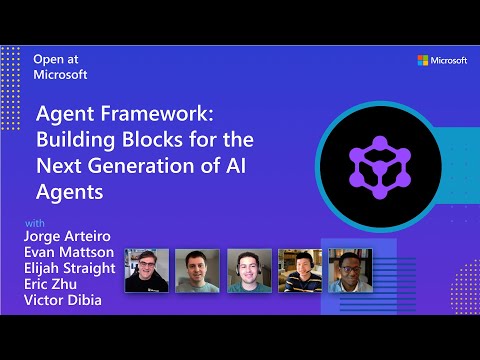
Watch the full Agent Framework introduction (30 min)
📋 Getting Started
📦 Installation
Python
pip install agent-framework
# This will install all sub-packages, see `python/packages` for individual packages.
# It may take a minute on first install on Windows.
.NET
dotnet add package Microsoft.Agents.AI
📚 Documentation
- Overview - High level overview of the framework
- Quick Start - Get started with a simple agent
- Tutorials - Step by step tutorials
- User Guide - In-depth user guide for building agents and workflows
- Migration from Semantic Kernel - Guide to migrate from Semantic Kernel
- Migration from AutoGen - Guide to migrate from AutoGen
Still have questions? Join our weekly office hours or ask questions in our Discord channel to get help from the team and other users.
✨ Highlights
- Graph-based Workflows: Connect agents and deterministic functions using data flows with streaming, checkpointing, human-in-the-loop, and time-travel capabilities
- AF Labs: Experimental packages for cutting-edge features including benchmarking, reinforcement learning, and research initiatives
- DevUI: Interactive developer UI for agent development, testing, and debugging workflows
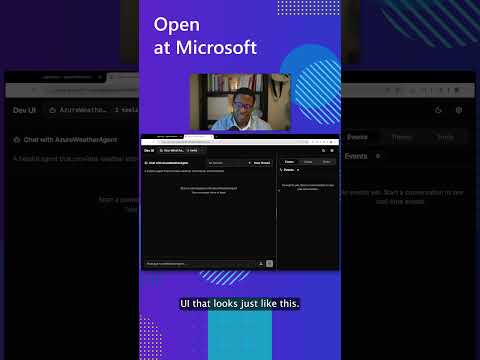
See the DevUI in action (1 min)
- Python and C#/.NET Support: Full framework support for both Python and C#/.NET implementations with consistent APIs
- Observability: Built-in OpenTelemetry integration for distributed tracing, monitoring, and debugging
- Multiple Agent Provider Support: Support for various LLM providers with more being added continuously
- Middleware: Flexible middleware system for request/response processing, exception handling, and custom pipelines
💬 We want your feedback!
- For bugs, please file a GitHub issue.
Quickstart
Basic Agent - Python
Create a simple Azure Responses Agent that writes a haiku about the Microsoft Agent Framework
# pip install agent-framework
# Use `az login` to authenticate with Azure CLI
import os
import asyncio
from agent_framework import Agent
from agent_framework.foundry import FoundryChatClient
from azure.identity import AzureCliCredential


async def main():
    # Initialize a chat agent with Microsoft Foundry
    # the endpoint, deployment name, and api version can be set via environment variables
    # or they can be passed in directly to the FoundryChatClient constructor
    agent = Agent(
      client=FoundryChatClient(
          credential=AzureCliCredential(),
          # project_endpoint=os.environ["FOUNDRY_PROJECT_ENDPOINT"],
          # model=os.environ["FOUNDRY_MODEL_DEPLOYMENT_NAME"],
      ),
      name="HaikuBot",
      instructions="You are an upbeat assistant that writes beautifully.",
    )

    print(await agent.run("Write a haiku about Microsoft Agent Framework."))

if __name__ == "__main__":
    asyncio.run(main())
Basic Agent - .NET
Create a simple Agent, using Microsoft Foundry with token-based auth, that writes a haiku about the Microsoft Agent Framework
// dotnet add package Microsoft.Agents.AI.Foundry
// Use `az login` to authenticate with Azure CLI
using Azure.AI.Projects;
using Azure.Identity;
using System;
using Azure.AI.Projects;
using Azure.Identity;

var endpoint = Environment.GetEnvironmentVariable("AZURE_AI_PROJECT_ENDPOINT") ?? throw new InvalidOperationException("AZURE_AI_PROJECT_ENDPOINT is not set.");
var deploymentName = Environment.GetEnvironmentVariable("AZURE_AI_MODEL_DEPLOYMENT_NAME") ?? "gpt-5.4-mini";

var agent = new AIProjectClient(new Uri(endpoint), new DefaultAzureCredential())
    .AsAIAgent(model: deploymentName, name: "HaikuBot", instructions: "You are an upbeat assistant that writes beautifully.");

Console.WriteLine(await agent.RunAsync("Write a haiku about Microsoft Agent Framework."));
Create a simple Agent, using OpenAI Responses, that writes a haiku about the Microsoft Agent Framework
// dotnet add package Microsoft.Agents.AI.OpenAI
using System;
using OpenAI;
using OpenAI.Responses;

// Replace the <apikey> with your OpenAI API key.
var agent = new OpenAIClient("<apikey>")
    .GetResponsesClient()
    .AsAIAgent(model: "gpt-5.4-mini", name: "HaikuBot", instructions: "You are an upbeat assistant that writes beautifully.");

Console.WriteLine(await agent.RunAsync("Write a haiku about Microsoft Agent Framework."));
More Examples & Samples
Python
- Getting Started: progressive tutorial from hello-world to hosting
- Agent Concepts: deep-dive samples by topic (tools, middleware, providers, etc.)
- Workflows: workflow creation and integration with agents
- Hosting: A2A, Azure Functions, Durable Task hosting
- End-to-End: full applications, evaluation, and demos
.NET
- Getting Started: progressive tutorial from hello agent to hosting
- Agent Concepts: basic agent creation and tool usage
- Agent Providers: samples showing different agent providers
- Workflows: advanced multi-agent patterns and workflow orchestration
- Hosting: A2A, Durable Agents, Durable Workflows
- End-to-End: full applications and demos
Troubleshooting
Authentication
| Problem | Cause | Fix |
|---|---|---|
| Authentication errors when using Azure credentials | Not signed in to Azure CLI | Run az login before starting your app |
| API key errors | Wrong or missing API key | Verify the key and ensure it's for the correct resource/provider |
Tip:
DefaultAzureCredentialis convenient for development but in production, consider using a specific credential (e.g.,ManagedIdentityCredential) to avoid latency issues, unintended credential probing, and potential security risks from fallback mechanisms.
Environment Variables
The samples typically read configuration from environment variables. Common required variables:
| Variable | Used by | Purpose |
|---|---|---|
AZURE_OPENAI_ENDPOINT |
Azure OpenAI samples | Your Azure OpenAI resource URL |
AZURE_OPENAI_DEPLOYMENT_NAME |
Azure OpenAI samples | Model deployment name (e.g. gpt-4o-mini) |
AZURE_AI_PROJECT_ENDPOINT |
Microsoft Foundry samples | Your Microsoft Foundry project endpoint |
AZURE_AI_MODEL_DEPLOYMENT_NAME |
Microsoft Foundry samples | Model deployment name |
OPENAI_API_KEY |
OpenAI (non-Azure) samples | Your OpenAI platform API key |
Contributor Resources
Important Notes
Important
If you use Microsoft Agent Framework to build applications that operate with any third-party servers, agents, code, or non-Azure Direct models (“Third-Party Systems”), you do so at your own risk. Third-Party Systems are Non-Microsoft Products under the Microsoft Product Terms and are governed by their own third-party license terms. You are responsible for any usage and associated costs.
We recommend reviewing all data being shared with and received from Third-Party Systems and being cognizant of third-party practices for handling, sharing, retention and location of data. It is your responsibility to manage whether your data will flow outside of your organization’s Azure compliance and geographic boundaries and any related implications, and that appropriate permissions, boundaries and approvals are provisioned.
You are responsible for carefully reviewing and testing applications you build using Microsoft Agent Framework in the context of your specific use cases, and making all appropriate decisions and customizations. This includes implementing your own responsible AI mitigations such as metaprompt, content filters, or other safety systems, and ensuring your applications meet appropriate quality, reliability, security, and trustworthiness standards. See also: Transparency FAQ