 Leo Yao
56bba795cb
Leo Yao
56bba795cb
* Add foundry extension samples for python and dotnet

* Align foundry extension samples with existing hosted agent patterns

- Fix Python multiagent indentation bug (from_agent_framework ran in both modes)
- Remove hardcoded personal endpoint from appsettings.Development.json
- Rename .NET folders/projects to PascalCase (FoundryMultiAgent, FoundrySingleAgent)
- Upgrade .NET multiagent from net9.0 to net10.0
- Add ManagePackageVersionsCentrally=false and analyzer blocks to .csproj files
- Replace wildcard package versions with fixed versions
- Use alpine Docker images and standard build pattern
- Align agent.yaml structure (template nesting, displayName, resources, authors)
- Convert .NET multiagent from namespace/class to top-level statements
- Add run-requests.http for multiagent sample
- Fix Python requirements.txt (remove dev deps, add agent-framework)
- Add proper copyright headers

Co-authored-by: Copilot <223556219+Copilot@users.noreply.github.com>

* Align foundry samples: fix builds, upgrade AgentServer to beta.8

- Fix TargetFrameworks (plural) to override inherited net472 from Directory.Build.props
- Upgrade Azure.AI.AgentServer.AgentFramework to 1.0.0-beta.8 (latest)
- Bump OpenTelemetry packages to 1.12.0 (required by beta.8)
- Fix Roslynator/format errors (imports ordering, BOM, sealed record, target-typed new)
- Verified with docker dotnet format (matching CI pipeline)

Co-authored-by: Copilot <223556219+Copilot@users.noreply.github.com>

* Refactor hosted samples to use AIProjectClient.CreateAIAgentAsync

Replace PersistentAgentsClient and manual AzureOpenAIClient setup with
AIProjectClient.CreateAIAgentAsync() from Microsoft.Agents.AI.AzureAI.

- FoundryMultiAgent: Remove Azure.AI.Agents.Persistent, use CreateAIAgentAsync
  for Writer and Reviewer agents with cleanup in finally block
- FoundrySingleAgent: Remove manual GetConnection/AzureOpenAIClient chain,
  use CreateAIAgentAsync with hotel search tool
- Update csproj: add Microsoft.Agents.AI.AzureAI, remove unused packages

Co-authored-by: Copilot <223556219+Copilot@users.noreply.github.com>

* Update READMEs to reflect AIProjectClient.CreateAIAgentAsync usage

- Reference Microsoft.Agents.AI.AzureAI and Microsoft.Agents.AI.Workflows packages
- Add Azure AI Developer role requirement for agents/write data action
- Replace PersistentAgentsClient references

Co-authored-by: Copilot <223556219+Copilot@users.noreply.github.com>

* Add HostedAgents READMEs and Foundry samples to solution

- Create dotnet/samples/05-end-to-end/HostedAgents/README.md with sample index
- Create python/samples/05-end-to-end/hosted_agents/README.md with sample index
- Add FoundryMultiAgent and FoundrySingleAgent to agent-framework-dotnet.slnx

Co-authored-by: Copilot <223556219+Copilot@users.noreply.github.com>

* Fix Python linting: reorder imports before load_dotenv, remove trailing whitespace

Co-authored-by: Copilot <223556219+Copilot@users.noreply.github.com>

* Update uv.lock to match latest package versions

Co-authored-by: Copilot <223556219+Copilot@users.noreply.github.com>

* Fix trailing whitespace in foundry_single_agent agent.yaml

Co-authored-by: Copilot <223556219+Copilot@users.noreply.github.com>

* Exclude dotnet.microsoft.com from link checker

This domain intermittently times out in CI, causing flaky markdown
link check failures unrelated to PR changes.

Co-authored-by: Copilot <223556219+Copilot@users.noreply.github.com>

* Align env vars to AZURE_AI_PROJECT_ENDPOINT and default model to gpt-4o-mini

Addresses PR review feedback:
- Rename PROJECT_ENDPOINT to AZURE_AI_PROJECT_ENDPOINT across all
  Foundry samples (dotnet + python) to match existing samples
- Change default model from gpt-4.1-mini to gpt-4o-mini consistently

Co-authored-by: Copilot <223556219+Copilot@users.noreply.github.com>

* Skip flaky test CreatesWorkflowEndToEndActivities_WithCorrectName_DefaultAsync

Tracked in #4398

Co-authored-by: Copilot <223556219+Copilot@users.noreply.github.com>

* Remove Python foundry samples from PR scope

Python hosted agent samples need further alignment with the azure-ai
package conventions. Removing from this PR to ship .NET samples first.

Co-authored-by: Copilot <223556219+Copilot@users.noreply.github.com>

* Narrow linkspector exclusion to dotnet.microsoft.com/download only

Co-authored-by: Copilot <223556219+Copilot@users.noreply.github.com>

---------

Co-authored-by: Leo Yao <leoyao@Leos-MacBook-Pro.local>
Co-authored-by: Roger Barreto <19890735+rogerbarreto@users.noreply.github.com>
Co-authored-by: Copilot <223556219+Copilot@users.noreply.github.com>

Welcome to Microsoft Agent Framework!



Welcome to Microsoft's comprehensive multi-language framework for building, orchestrating, and deploying AI agents with support for both .NET and Python implementations. This framework provides everything from simple chat agents to complex multi-agent workflows with graph-based orchestration.
Watch the full Agent Framework introduction (30 min)
📋 Getting Started
📦 Installation
Python
pip install agent-framework --pre
# This will install all sub-packages, see `python/packages` for individual packages.
# It may take a minute on first install on Windows.
.NET
dotnet add package Microsoft.Agents.AI
📚 Documentation
- Overview - High level overview of the framework
- Quick Start - Get started with a simple agent
- Tutorials - Step by step tutorials
- User Guide - In-depth user guide for building agents and workflows
- Migration from Semantic Kernel - Guide to migrate from Semantic Kernel
- Migration from AutoGen - Guide to migrate from AutoGen
Still have questions? Join our weekly office hours or ask questions in our Discord channel to get help from the team and other users.
✨ Highlights
- Graph-based Workflows: Connect agents and deterministic functions using data flows with streaming, checkpointing, human-in-the-loop, and time-travel capabilities
- AF Labs: Experimental packages for cutting-edge features including benchmarking, reinforcement learning, and research initiatives
- DevUI: Interactive developer UI for agent development, testing, and debugging workflows
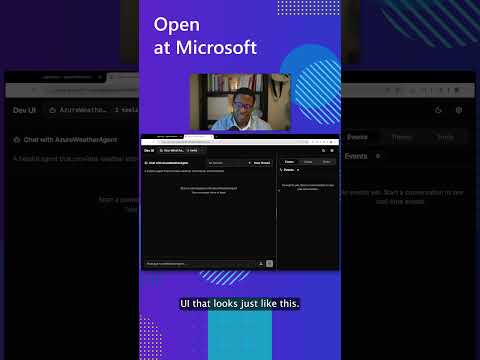
See the DevUI in action (1 min)
- Python and C#/.NET Support: Full framework support for both Python and C#/.NET implementations with consistent APIs
- Observability: Built-in OpenTelemetry integration for distributed tracing, monitoring, and debugging
- Multiple Agent Provider Support: Support for various LLM providers with more being added continuously
- Middleware: Flexible middleware system for request/response processing, exception handling, and custom pipelines
💬 We want your feedback!
- For bugs, please file a GitHub issue.
Quickstart
Basic Agent - Python
Create a simple Azure Responses Agent that writes a haiku about the Microsoft Agent Framework
# pip install agent-framework --pre
# Use `az login` to authenticate with Azure CLI
import os
import asyncio
from agent_framework.azure import AzureOpenAIResponsesClient
from azure.identity import AzureCliCredential


async def main():
    # Initialize a chat agent with Azure OpenAI Responses
    # the endpoint, deployment name, and api version can be set via environment variables
    # or they can be passed in directly to the AzureOpenAIResponsesClient constructor
    agent = AzureOpenAIResponsesClient(
        # endpoint=os.environ["AZURE_OPENAI_ENDPOINT"],
        # deployment_name=os.environ["AZURE_OPENAI_RESPONSES_DEPLOYMENT_NAME"],
        # api_version=os.environ["AZURE_OPENAI_API_VERSION"],
        # api_key=os.environ["AZURE_OPENAI_API_KEY"],  # Optional if using AzureCliCredential
        credential=AzureCliCredential(), # Optional, if using api_key
    ).as_agent(
        name="HaikuBot",
        instructions="You are an upbeat assistant that writes beautifully.",
    )

    print(await agent.run("Write a haiku about Microsoft Agent Framework."))

if __name__ == "__main__":
    asyncio.run(main())
Basic Agent - .NET
Create a simple Agent, using OpenAI Responses, that writes a haiku about the Microsoft Agent Framework
// dotnet add package Microsoft.Agents.AI.OpenAI --prerelease
using Microsoft.Agents.AI;
using OpenAI;
using OpenAI.Responses;

// Replace the <apikey> with your OpenAI API key.
var agent = new OpenAIClient("<apikey>")
    .GetResponsesClient("gpt-4o-mini")
    .AsAIAgent(name: "HaikuBot", instructions: "You are an upbeat assistant that writes beautifully.");

Console.WriteLine(await agent.RunAsync("Write a haiku about Microsoft Agent Framework."));
Create a simple Agent, using Azure OpenAI Responses with token based auth, that writes a haiku about the Microsoft Agent Framework
// dotnet add package Microsoft.Agents.AI.OpenAI --prerelease
// dotnet add package Azure.Identity
// Use `az login` to authenticate with Azure CLI
using System.ClientModel.Primitives;
using Azure.Identity;
using Microsoft.Agents.AI;
using OpenAI;
using OpenAI.Responses;

// Replace <resource> and gpt-4o-mini with your Azure OpenAI resource name and deployment name.
var agent = new OpenAIClient(
    new BearerTokenPolicy(new AzureCliCredential(), "https://ai.azure.com/.default"),
    new OpenAIClientOptions() { Endpoint = new Uri("https://<resource>.openai.azure.com/openai/v1") })
    .GetResponsesClient("gpt-4o-mini")
    .AsAIAgent(name: "HaikuBot", instructions: "You are an upbeat assistant that writes beautifully.");

Console.WriteLine(await agent.RunAsync("Write a haiku about Microsoft Agent Framework."));
More Examples & Samples
Python
- Getting Started with Agents: progressive tutorial from hello-world to hosting
- Agent Concepts: deep-dive samples by topic (tools, middleware, providers, etc.)
- Getting Started with Workflows: workflow creation and integration with agents
.NET
- Getting Started with Agents: basic agent creation and tool usage
- Agent Provider Samples: samples showing different agent providers
- Workflow Samples: advanced multi-agent patterns and workflow orchestration
Contributor Resources
Important Notes
If you use the Microsoft Agent Framework to build applications that operate with third-party servers or agents, you do so at your own risk. We recommend reviewing all data being shared with third-party servers or agents and being cognizant of third-party practices for retention and location of data. It is your responsibility to manage whether your data will flow outside of your organization's Azure compliance and geographic boundaries and any related implications.