

 4c317eb7cf
* refactor(foundry_hosting): build FoundryHostedAgentHistoryProvider on azure.ai.agentserver SDK

Rebuilds the Foundry hosted-agent history provider on top of
``azure.ai.agentserver``'s ``FoundryStorageProvider`` instead of the
in-house ``_HttpStorageBackend``. Splits the monolithic ``_responses.py``
into focused modules:

- ``_history_provider.py`` — new ``FoundryHostedAgentHistoryProvider``
  that talks to the SDK's ``FoundryStorageProvider``, threads
  ``response_id`` / ``previous_response_id`` through ``ContextVar``s via
  ``bind_request_context``, and lifts host-bound isolation keys
  (``x-agent-{user,chat}-isolation-key``) from the optional
  ``agent_framework_hosting`` package into a provider-local
  ``IsolationContext`` so the storage layer carries the correct
  partition keys without channels having to know about them.
- ``_shared.py`` — extracts all SDK ``Item`` / ``OutputItem`` ↔
  framework ``Message`` conversion helpers into one place so both
  ``_responses.py`` and the new history provider can share them.
  Restores ``_convert_file_data`` for inline ``input_file`` payloads,
  and the hosted-MCP routing for ``custom_tool_call_output`` items
  whose ``call_id`` carries the ``mcp_*`` prefix.
- ``_ids.py`` — shared id helpers.
- ``_responses.py`` — shrinks ~700 lines, re-exports converters for
  back-compat with existing tests.
- ``tests/test_history_provider.py`` — exercises the new provider
  against a fake SDK backend; the host-isolation test is gated on the
  optional ``agent_framework_hosting`` import.

Co-authored-by: Copilot <223556219+Copilot@users.noreply.github.com>

* feat(foundry_hosting): add local_storage_root for file-based dev history

Adds an optional `local_storage_root: str | Path | None` parameter to
`FoundryHostedAgentHistoryProvider`. When set and the provider is
running outside a Foundry Hosted Agent container, conversations are
persisted to JSONL files via `agent_framework.FileHistoryProvider`
laid out as:

  {root}/{user_key or '~none'}/{chat_key or '~none'}/{session_id}.jsonl

Hosted mode (FOUNDRY_HOSTING_ENVIRONMENT set) ignores the option with a
one-time INFO log so Foundry storage always wins on the platform. The
in-memory fallback is unchanged when the option is omitted.

Path safety: isolation segments are validated against the same character
allowlist FileHistoryProvider uses for session-id stems and
base64-url-encoded with a reserved "~iso-" prefix when unsafe. "~none"
sentinel for missing keys can never collide with a real isolation key
(real keys starting with "~" are encoded). The resolved target dir is
also re-checked to be inside the configured root.

Co-authored-by: Copilot <223556219+Copilot@users.noreply.github.com>

* fix(foundry_hosting): address PR-1 review comments

- _shared.py:_capture_raw narrows `except Exception` to `except TypeError`
  and emits a WARNING with traceback so the lossy fallback to a
  synthesized round-trip is observable. Mirrors the reviewer suggestion.

- _history_provider.py:save_messages narrows `except Exception` to
  `except FoundryStorageError` so only storage-validation failures
  (4xx/5xx, opaque server errors) are swallowed. Network / TLS / auth
  / payload-builder bugs propagate so the caller can retry / alert.
  Adds an instance-level `failed_writes` counter operators can poll
  for silent-drop visibility.

- _history_provider.py id-stamping loop: drops the
  `contextlib.suppress(AttributeError, TypeError)` around
  `item.id = new_id` so SDK contract changes surface in the test
  suite instead of silently corrupting the chain (the storage backend
  rejects the entire `create_response` with HTTP 500 when synthetic
  prefix-based ids leak through). `import contextlib` removed.

- tests:
  * Unit-cover `foundry_response_id` / `foundry_response_id_factory` /
    `foundry_item_id` so SDK `IdGenerator` contract changes are caught
    locally.
  * Cover the `save_messages` wire payload: required-by-storage fields
    (`background`, `parallel_tool_calls`, `instructions`,
    `agent_reference`), env-var-driven stamping (`FOUNDRY_AGENT_NAME` /
    `FOUNDRY_AGENT_VERSION` / `FOUNDRY_AGENT_SESSION_ID` /
    `MODEL_DEPLOYMENT_NAME` with `AZURE_AI_MODEL_DEPLOYMENT_NAME`
    fallback), and the rule that `model` / `agent_session_id` /
    `agent_reference.version` are omitted (not stamped to `None`) when
    their env vars are unset.
  * Cover the `FOUNDRY_AGENT_SESSION_ID` last-resort chain anchor on
    both the get and save paths, including the prefix gate that blocks
    non-`caresp_*`/`resp_*` values from reaching storage, and the
    precedence rule that a host binding wins over the env.
  * Replace the old `test_save_messages_swallows_backend_errors` with
    two tests asserting the new contract: storage errors are swallowed
    and bump `failed_writes`; everything else propagates and leaves the
    counter at zero.

141 unit tests pass; mypy + pyright + ruff clean.

Co-authored-by: Copilot <223556219+Copilot@users.noreply.github.com>

* fix(foundry_hosting): address PR-1 round-2 review comments

- Hosted detection now delegates to AgentConfig.from_env().is_hosted so
  a future Foundry SDK rename of FOUNDRY_HOSTING_ENVIRONMENT propagates
  automatically; drop the local _ENV_FOUNDRY_HOSTING_ENVIRONMENT
  constant.
- Drop the FOUNDRY_AGENT_SESSION_ID fallback in both get_messages and
  save_messages: per the SDK it identifies the *container instance*,
  not the conversation, so chaining off it would silently merge
  unrelated conversations across container restarts. The host-bound
  previous_response_id (set by ResponsesChannel) is the only
  authoritative anchor; the env value is still stamped into the
  persisted envelope's agent_session_id for operator correlation.
- Update module docstring + replace TestFoundryAgentSessionIdAnchor
  with assertions for the new contract (env var ignored as anchor,
  still stamped onto persisted envelope, host binding wins).

Co-authored-by: Copilot <223556219+Copilot@users.noreply.github.com>

* refactor(foundry_hosting): reconcile with upstream main (#5851, #5666)

Brings the FoundryHostedAgentHistoryProvider refactor branch back into
sync with the foundry_hosting changes that have landed on upstream
main since PR-1 was opened:

* #5851 (path traversal in checkpoint storage, CWE-22).
  The workflow-host code in ``_responses.py`` builds a
  ``FileCheckpointStorage`` from a caller-controlled ``context_id``
  (``previous_response_id`` / ``conversation_id`` / ``response_id``).
  Switch both call sites to route through
  ``_checkpoint_storage_for_context``, which rejects separators,
  NUL bytes, drive letters, absolute paths, and all-dot segments,
  and enforces ``is_relative_to(root)`` before any directory is
  created.

* #5666 (function approval flow).
  Make the SDK-Item → AF-Message conversion helpers in ``_shared.py``
  async and accept an optional ``approval_storage`` keyword:

  - ``_items_to_messages`` / ``_item_to_message`` /
    ``_item_to_message_inner``
  - ``_output_items_to_messages`` / ``_output_item_to_message`` /
    ``_output_item_to_message_inner``

  For ``mcp_approval_request`` / ``mcp_approval_response`` items the
  helpers now load the original function-call Content from the
  approval storage (via ``ApprovalStorage.load_approval_request``)
  instead of synthesising a placeholder. This matches upstream
  semantics and lets approval round-trips reconstruct the real
  payload.

  The ``ApprovalStorage`` Protocol moves to ``_shared.py`` so the
  conversion helpers can reference it without pulling in
  ``_responses.py`` (which would create a circular import). The
  concrete ``InMemoryFunctionApprovalStorage`` and
  ``FileBasedFunctionApprovalStorage`` stay in ``_responses.py``
  next to the host that owns them, and re-export
  ``ApprovalStorage`` from ``_shared`` for compatibility.

  The workflow-host streaming path passes its own
  ``self._approval_storage`` into ``_to_outputs`` so approval
  requests are saved at emit time.

* Bump ``_history_provider.FoundryHostedAgentHistoryProvider.get_messages``
  to ``await`` the now-async ``_output_items_to_messages`` call.

No public API change beyond the new keyword-only ``approval_storage``
parameter on the four conversion entry points.

Validation:
- uv run poe check-packages -P foundry_hosting (lint + pyright clean)
- uv run poe mypy -P foundry_hosting (clean)
- uv run poe test -P foundry_hosting (183 passed, 1 skipped)

Co-authored-by: Copilot <223556219+Copilot@users.noreply.github.com>

---------

Co-authored-by: Copilot <223556219+Copilot@users.noreply.github.com>

Welcome to Microsoft Agent Framework!




Microsoft Agent Framework (MAF) is an open, multi-language framework for building production-grade AI agents and multi-agent workflows in .NET and Python.
Microsoft Agent Framework is built for teams taking agents from prototype to production. It provides a consistent foundation for building, orchestrating, and operating agent systems across Python and .NET, while keeping architecture choices open as requirements evolve, and supports a broad ecosystem including Microsoft Foundry, Azure OpenAI, OpenAI, and the GitHub Copilot SDK, with samples and hosting patterns for both local development and cloud deployment.
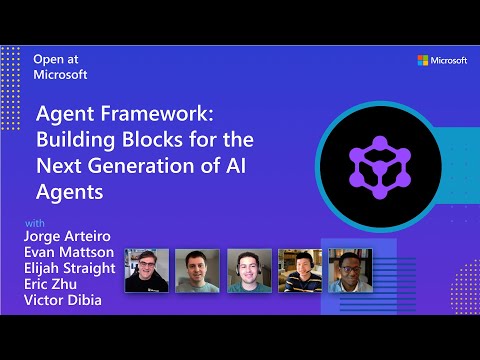
Watch the full Agent Framework introduction (30 min)
Is this the right framework for you?
MAF is a strong fit if you:
- are building agents and workflows you expect to run in production,
- need orchestration beyond a single prompt or stateless chat loop,
- want graph-based patterns such as sequential, concurrent, handoff, and group collaboration,
- care about durability, restartability, observability, governance, or human-in-the-loop control,
- need provider flexibility so your architecture can evolve without major rewrites.
Key Features
Explore new MAF capabilities and real implementation patterns on the official blog.
- Python and C#/.NET Support: Full framework support for both Python and C#/.NET implementations with consistent APIs
- Multiple Agent Provider Support: Support for various LLM providers with more being added continuously
- Middleware: Flexible middleware system for request/response processing, exception handling, and custom pipelines
- Orchestration Patterns & Workflows: Build multi-agent systems with graph-based workflows supporting sequential, concurrent, handoff, and group collaboration patterns; includes checkpointing, streaming, human-in-the-loop, and time-travel
- Foundry Hosted Agents (new): Deploy and host your agents to Foundry-hosted infrastructure with just 2 additional lines of code
- Observability: Built-in OpenTelemetry integration for distributed tracing, monitoring, and debugging
- Declarative Agents: Define agents using YAML for faster setup and versioning
- Agent Skills: Build domain-specific knowledge bases from multiple sources—files, inline code, class libraries—for agents to discover and use
- AF Labs: Experimental packages for cutting-edge features including benchmarking, reinforcement learning, and research initiatives
- DevUI: Interactive developer UI for agent development, testing, and debugging workflows
Table of Contents
Getting Started
Installation
Python
pip install agent-framework
# This will install all sub-packages, see `python/packages` for individual packages.
# It may take a minute on first install on Windows.
.NET
dotnet add package Microsoft.Agents.AI
# For Foundry integration (used in the .NET quickstart below):
dotnet add package Microsoft.Agents.AI.Foundry
dotnet add package Azure.AI.Projects
dotnet add package Azure.Identity
Learning Resources
- Overview - High level overview of the framework
- Quick Start - Get started with a simple agent
- Tutorials - Step by step tutorials
- User Guide - In-depth user guide for building agents and workflows
- Migration from Semantic Kernel - Guide to migrate from Semantic Kernel
- Migration from AutoGen - Guide to migrate from AutoGen
Quickstart
Basic Agent - Python
Create a simple Azure Responses Agent that writes a haiku about the Microsoft Agent Framework
# pip install agent-framework
# Use `az login` to authenticate with Azure CLI
import os
import asyncio
from agent_framework import Agent
from agent_framework.foundry import FoundryChatClient
from azure.identity import AzureCliCredential


async def main():
    # Initialize a chat agent with Microsoft Foundry
    # the endpoint, deployment name, and api version can be set via environment variables
    # or they can be passed in directly to the FoundryChatClient constructor
    agent = Agent(
      client=FoundryChatClient(
          credential=AzureCliCredential(),
          # project_endpoint=os.environ["FOUNDRY_PROJECT_ENDPOINT"],
          # model=os.environ["FOUNDRY_MODEL_DEPLOYMENT_NAME"],
      ),
      name="HaikuAgent",
      instructions="You are an upbeat assistant that writes beautifully.",
    )

    print(await agent.run("Write a haiku about Microsoft Agent Framework."))

if __name__ == "__main__":
    asyncio.run(main())
Basic Agent - .NET
Create a simple Agent, using Microsoft Foundry that writes a haiku about the Microsoft Agent Framework
// This sample shows how to create and run a basic agent with AIProjectClient.AsAIAgent(...).

using Azure.AI.Projects;
using Azure.Identity;
using Microsoft.Agents.AI;

string endpoint = Environment.GetEnvironmentVariable("AZURE_AI_PROJECT_ENDPOINT") ?? throw new InvalidOperationException("AZURE_AI_PROJECT_ENDPOINT is not set.");
string deploymentName = Environment.GetEnvironmentVariable("AZURE_AI_MODEL_DEPLOYMENT_NAME") ?? "gpt-5.4-mini";

AIAgent agent =
    new AIProjectClient(new Uri(endpoint), new DefaultAzureCredential())
    .AsAIAgent(model: deploymentName, instructions: "You are an upbeat assistant that writes beautifully.", name: "HaikuAgent");

// Once you have the agent, you can invoke it like any other AIAgent.
Console.WriteLine(await agent.RunAsync("Write a haiku about Microsoft Agent Framework."));
More Examples & Samples
Python
- Getting Started: progressive tutorial from hello-world to hosting
- Agent Concepts: deep-dive samples by topic (tools, middleware, providers, etc.)
- Workflows: workflow creation and integration with agents
- Hosting: A2A, Azure Functions, Durable Task hosting
- End-to-End: full applications, evaluation, and demos
.NET
- Getting Started: progressive tutorial from hello agent to hosting
- Agent Concepts: basic agent creation and tool usage
- Agent Providers: samples showing different agent providers
- Workflows: advanced multi-agent patterns and workflow orchestration
- Hosting: A2A, Durable Agents, Durable Workflows
- End-to-End: full applications and demos
Community & Feedback
- Found a bug? File a GitHub issue to help us improve.
- Enjoying MAF?
to show your support and help others discover the project.
- Have questions? Join our Discord or visit weekly office hours.
Troubleshooting
Authentication
| Problem | Cause | Fix |
|---|---|---|
| Authentication errors when using Azure credentials | Not signed in to Azure CLI | Run az login before starting your app |
| API key errors | Wrong or missing API key | Verify the key and ensure it's for the correct resource/provider |
Tip:
DefaultAzureCredentialis convenient for development but in production, consider using a specific credential (e.g.,ManagedIdentityCredential) to avoid latency issues, unintended credential probing, and potential security risks from fallback mechanisms.
Environment Variables
For environment variable configuration specific to each sample, refer to the README in the sample directory (Python samples | .NET samples).
Contributor Resources
Important Notes
Important
If you use Microsoft Agent Framework to build applications that operate with any third-party servers, agents, code, or non-Azure Direct models (“Third-Party Systems”), you do so at your own risk. Third-Party Systems are Non-Microsoft Products under the Microsoft Product Terms and are governed by their own third-party license terms. You are responsible for any usage and associated costs.
We recommend reviewing all data being shared with and received from Third-Party Systems and being cognizant of third-party practices for handling, sharing, retention and location of data. It is your responsibility to manage whether your data will flow outside of your organization’s Azure compliance and geographic boundaries and any related implications, and that appropriate permissions, boundaries and approvals are provisioned.
You are responsible for carefully reviewing and testing applications you build using Microsoft Agent Framework in the context of your specific use cases, and making all appropriate decisions and customizations. This includes implementing your own responsible AI mitigations such as metaprompt, content filters, or other safety systems, and ensuring your applications meet appropriate quality, reliability, security, and trustworthiness standards. See also: Transparency FAQ