

 4609535e22
* Python: feat: add agent-framework-monty (Monty-backed CodeAct)

New alpha package that wraps pydantic-monty (a Rust-based Python
interpreter) behind the same CodeAct API surface as
agent-framework-hyperlight, so users can swap providers with minimal
code change.

Public API (agent_framework_monty):
- MontyCodeActProvider — ContextProvider that injects a run-scoped
  execute_code tool plus dynamic CodeAct instructions.
- MontyExecuteCodeTool — standalone FunctionTool for mixed-tool agents
  or manual static wiring.
- FileMount / FileMountInput / MountMode — public types mirroring the
  Hyperlight names, with Monty's mode (read-only/read-write/overlay)
  and write_bytes_limit on FileMount.

Constructor kwargs (both classes) mirror Hyperlight where possible:
tools, approval_mode, workspace_root, file_mounts; plus a Monty-only
resource_limits forwarding ResourceLimits to Monty.start().

Filesystem flow:
- workspace_root auto-mounts at /input (read-write), matching Hyperlight.
- file_mounts accepts string shorthand, (host, mount) tuple, or
  FileMount with mode + write cap.
- Files written under read-write mounts are scanned post-execution and
  returned as Content.from_data items (mirrors Hyperlight /output).
- overlay mounts buffer writes in-memory; read-only mounts reject writes.

Internals:
- _monty_bridge.InlineCodeBridge ports the inline (non-durable) bridge
  from anthonychu/maf-codeact-monty-python; handles FunctionSnapshot /
  FutureSnapshot pause/resume, dispatches direct typed calls + the
  call_tool fallback, forwards mount/limits to Monty.start(...).
- generate_type_stubs emits per-tool stubs so Monty's `ty` type-checker
  rejects bad calls before any host tool runs.

Alpha-policy compliance (per python-package-management skill):
- Added agent-framework-monty = { workspace = true } to root
  pyproject.toml.
- Added row to python/PACKAGE_STATUS.md.
- Added monty entry under Experimental in python/AGENTS.md.
- NOT added to core[all]; NO agent_framework.monty lazy shim (deferred
  to beta promotion).

Samples (three sets, import from agent_framework_monty directly):
- samples/02-agents/context_providers/code_act/monty_code_act.py
  (provider pattern) + updated local README.
- samples/02-agents/tools/monty_code_interpreter/ (standalone +
  manual-wiring + README).
- samples/04-hosting/foundry-hosted-agents/responses/11_monty_codeact/
  (full hosted-agent layout with uv-based pyproject.toml + Dockerfile,
  Azure Monitor wiring via APPLICATIONINSIGHTS_CONNECTION_STRING +
  enable_instrumentation, ENABLE_INSTRUMENTATION and
  ENABLE_SENSITIVE_DATA env vars). The alpha wheel is vendored into
  ./wheels/ (gitignored) via vendor-wheel.sh; new row added to the
  parent Responses-API README.

Tests:
- 28 hermetic unit tests (stubbed pydantic_monty).
- 18 integration tests marked @pytest.mark.integration, auto-skipped
  when pydantic_monty is unimportable; exercise the real Monty
  runtime: print round-trip, last-expression value, direct typed
  tool dispatch, call_tool fallback, async tool, asyncio.gather
  parallelism, ty type-check rejection, OS blocked by default,
  workspace_root read+write capture, read-only / overlay mount
  semantics, resource_limits.max_duration_secs abort, approval
  gating end-to-end, full Agent run with a scripted chat client.

Co-authored-by: Copilot <223556219+Copilot@users.noreply.github.com>

* Python: fix: monty FileMount test compares against the normalized POSIX path

The shorthand string mount goes through _normalize_mount_path, which
rewrites Windows drive letters like 'C:\\Users\\...' into
'/C:/Users/...' (POSIX-style). The Windows CI runners surfaced this
because tmp_path resolves to a backslashed Windows path; the test was
comparing against the raw str(host_a) instead of the normalized form.

Compare against _normalize_mount_path(str(host_a)) so the assertion is
platform-independent.

Co-authored-by: Copilot <223556219+Copilot@users.noreply.github.com>

* Python: fix: address PR #5915 review feedback

- _execute_code_tool docstring: clarify that the Monty backend supports
  scoped filesystem access via workspace_root / file_mounts (blocked by
  default).
- _to_monty_mount: import pydantic_monty lazily through load_monty so
  missing-dependency errors surface as the same actionable RuntimeError
  the rest of the package raises (not a bare ImportError at module load).
  Renamed _load_monty -> load_monty for the same reason.
- _python_type_repr: emit None for type(None) instead of Any, and
  normalize both typing.Union[...] and PEP-604 X | Y to PEP-604 syntax
  so Optional[X] / Union[..., None] / -> None signatures round-trip
  correctly through ty validation. Added a regression test.
- _PrintCollector: track a running character count instead of
  recomputing sum(len(c) for c in self.chunks) per callback. Eliminates
  the O(n^2) cost on print-heavy code.
- Instructions: mention that the value of the final expression is also
  returned alongside captured stdout (matches actual behavior).
- 11_monty_codeact Dockerfile: pin ghcr.io/astral-sh/uv to 0.11.6
  instead of :latest for reproducible builds.
- 11_monty_codeact README: replace the bare "see parent README" pointer
  with sample-specific steps (./vendor-wheel.sh + uv sync + uv run),
  since the sample uses pyproject.toml + a vendored wheel rather than
  requirements.txt.

Co-authored-by: Copilot <223556219+Copilot@users.noreply.github.com>

* Python: sample: 11_monty_codeact installs agent-framework-monty from PyPI

Drop the vendored-wheel scaffolding now that agent-framework-monty is on
PyPI as an alpha (1.0.0a*) release:

- pyproject.toml: remove [tool.uv.sources] override; keep [tool.uv]
  prerelease = "allow" so uv pulls the alpha automatically.
- Dockerfile: drop the COPY wheels/ step.
- README: drop the ./vendor-wheel.sh setup step and the
  not-yet-on-PyPI warning.
- Delete vendor-wheel.sh and the gitignored wheels/ directory.

Co-authored-by: Copilot <223556219+Copilot@users.noreply.github.com>

* Python: fix(monty): harden post-execution file capture against symlink escape

Same class of issue as the MSRC-reported Hyperlight finding: the
post-execution capture walked workspace_root with Path.rglob() +
is_file() + read_bytes() - all of which follow symlinks. An attacker
who controls the workspace (cloned repo, extracted archive, shared
workspace) could pre-place `workspace/leak.txt -> /etc/passwd` or
`workspace/outside_dir -> /etc/` and have host files surface as
captured Content items.

Monty's mount layer already rejects symlink reads from inside the
sandbox across all three modes (verified empirically), so the runtime
path was safe. This commit closes the post-execution scan path.

Changes:
- New `_iter_real_files(root)` walker that uses iterdir() +
  is_symlink() to skip symlinks at every directory level and yields
  only real files. Replaces the previous `host_root.rglob("*")` calls
  in both `_snapshot_writable_mounts` and `_capture_written_files`.
- Use `Path.lstat()` instead of `Path.stat()` so size/mtime can never
  be taken from a symlink target.
- Three new integration tests reproducing the MSRC attack shape
  against the workspace_root flow: symlink-to-file outside workspace,
  symlink-to-directory outside workspace, and a guard ensuring
  legitimate sandbox writes are still captured when symlinks are
  present.

Per user request, hyperlight is untouched in this commit (separate fix).

Co-authored-by: Copilot <223556219+Copilot@users.noreply.github.com>

* Python: fix(monty): skip symlink regression tests when unsupported

Apply the same Windows-CI safety guard as the hyperlight fix in PR #5919:
the three symlink integration tests create symlinks via Path.symlink_to(),
which fails with OSError / NotImplementedError on unprivileged Windows
runners. Add a local _symlinks_supported helper (mirroring the one in
packages/core/tests/core/test_skills.py) and pytest.skip when symlinks
aren't available, so the tests no longer fail for environment reasons.

Co-authored-by: Copilot <223556219+Copilot@users.noreply.github.com>

* Python: fix(monty): address PR #5915 follow-up review feedback

- _invoke_tool: drop the inspect.iscoroutinefunction(...) branch and
  always `await self.tool_map[name](**kwargs)`. Every entry in
  tool_map is `partial(FunctionTool.invoke, skip_parsing=True)` and
  FunctionTool.invoke is `async def`, so the branching was dead code -
  and on Python versions affected by cpython#98590,
  iscoroutinefunction(partial(bound_async_method, ...)) returns False,
  causing the bridge to take the asyncio.to_thread path, return an
  unawaited coroutine, and surface it as a JSON-serialization failure
  for every tool call. Added a regression test
  test_invoke_tool_awaits_partial_wrapped_async_method.

- generate_type_stubs: skip tools whose name is not a valid Python
  identifier or is a Python keyword. FunctionTool.name has no upstream
  validation, so a name like "weird-name" produced a syntax error in
  the stubs and a name like "broken\n    pass\nasync def injected"
  would inject arbitrary stub source. Non-identifier names stay
  reachable via `call_tool("weird-name", ...)` at runtime; they just
  don't get type-checked stubs. Added regression test
  test_generate_type_stubs_skips_non_identifier_tool_names.

Co-authored-by: Copilot <223556219+Copilot@users.noreply.github.com>

---------

Co-authored-by: Copilot <223556219+Copilot@users.noreply.github.com>

Welcome to Microsoft Agent Framework!




Microsoft Agent Framework (MAF) is an open, multi-language framework for building production-grade AI agents and multi-agent workflows in .NET and Python.
Microsoft Agent Framework is built for teams taking agents from prototype to production. It provides a consistent foundation for building, orchestrating, and operating agent systems across Python and .NET, while keeping architecture choices open as requirements evolve, and supports a broad ecosystem including Microsoft Foundry, Azure OpenAI, OpenAI, and the GitHub Copilot SDK, with samples and hosting patterns for both local development and cloud deployment.
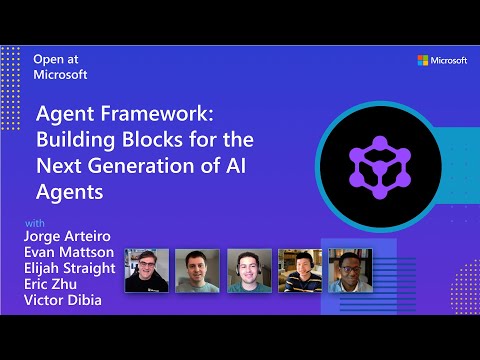
Watch the full Agent Framework introduction (30 min)
Is this the right framework for you?
MAF is a strong fit if you:
- are building agents and workflows you expect to run in production,
- need orchestration beyond a single prompt or stateless chat loop,
- want graph-based patterns such as sequential, concurrent, handoff, and group collaboration,
- care about durability, restartability, observability, governance, or human-in-the-loop control,
- need provider flexibility so your architecture can evolve without major rewrites.
Key Features
Explore new MAF capabilities and real implementation patterns on the official blog.
- Python and C#/.NET Support: Full framework support for both Python and C#/.NET implementations with consistent APIs
- Multiple Agent Provider Support: Support for various LLM providers with more being added continuously
- Middleware: Flexible middleware system for request/response processing, exception handling, and custom pipelines
- Orchestration Patterns & Workflows: Build multi-agent systems with graph-based workflows supporting sequential, concurrent, handoff, and group collaboration patterns; includes checkpointing, streaming, human-in-the-loop, and time-travel
- Foundry Hosted Agents (new): Deploy and host your agents to Foundry-hosted infrastructure with just 2 additional lines of code
- Observability: Built-in OpenTelemetry integration for distributed tracing, monitoring, and debugging
- Declarative Agents: Define agents using YAML for faster setup and versioning
- Agent Skills: Build domain-specific knowledge bases from multiple sources—files, inline code, class libraries—for agents to discover and use
- AF Labs: Experimental packages for cutting-edge features including benchmarking, reinforcement learning, and research initiatives
- DevUI: Interactive developer UI for agent development, testing, and debugging workflows
Table of Contents
Getting Started
Installation
Python
pip install agent-framework
# This will install all sub-packages, see `python/packages` for individual packages.
# It may take a minute on first install on Windows.
.NET
dotnet add package Microsoft.Agents.AI
# For Foundry integration (used in the .NET quickstart below):
dotnet add package Microsoft.Agents.AI.Foundry
dotnet add package Azure.AI.Projects
dotnet add package Azure.Identity
Learning Resources
- Overview - High level overview of the framework
- Quick Start - Get started with a simple agent
- Tutorials - Step by step tutorials
- User Guide - In-depth user guide for building agents and workflows
- Migration from Semantic Kernel - Guide to migrate from Semantic Kernel
- Migration from AutoGen - Guide to migrate from AutoGen
Quickstart
Basic Agent - Python
Create a simple Azure Responses Agent that writes a haiku about the Microsoft Agent Framework
# pip install agent-framework
# Use `az login` to authenticate with Azure CLI
import os
import asyncio
from agent_framework import Agent
from agent_framework.foundry import FoundryChatClient
from azure.identity import AzureCliCredential


async def main():
    # Initialize a chat agent with Microsoft Foundry
    # the endpoint, deployment name, and api version can be set via environment variables
    # or they can be passed in directly to the FoundryChatClient constructor
    agent = Agent(
      client=FoundryChatClient(
          credential=AzureCliCredential(),
          # project_endpoint=os.environ["FOUNDRY_PROJECT_ENDPOINT"],
          # model=os.environ["FOUNDRY_MODEL_DEPLOYMENT_NAME"],
      ),
      name="HaikuAgent",
      instructions="You are an upbeat assistant that writes beautifully.",
    )

    print(await agent.run("Write a haiku about Microsoft Agent Framework."))

if __name__ == "__main__":
    asyncio.run(main())
Basic Agent - .NET
Create a simple Agent, using Microsoft Foundry that writes a haiku about the Microsoft Agent Framework
// This sample shows how to create and run a basic agent with AIProjectClient.AsAIAgent(...).

using Azure.AI.Projects;
using Azure.Identity;
using Microsoft.Agents.AI;

string endpoint = Environment.GetEnvironmentVariable("AZURE_AI_PROJECT_ENDPOINT") ?? throw new InvalidOperationException("AZURE_AI_PROJECT_ENDPOINT is not set.");
string deploymentName = Environment.GetEnvironmentVariable("AZURE_AI_MODEL_DEPLOYMENT_NAME") ?? "gpt-5.4-mini";

AIAgent agent =
    new AIProjectClient(new Uri(endpoint), new DefaultAzureCredential())
    .AsAIAgent(model: deploymentName, instructions: "You are an upbeat assistant that writes beautifully.", name: "HaikuAgent");

// Once you have the agent, you can invoke it like any other AIAgent.
Console.WriteLine(await agent.RunAsync("Write a haiku about Microsoft Agent Framework."));
More Examples & Samples
Python
- Getting Started: progressive tutorial from hello-world to hosting
- Agent Concepts: deep-dive samples by topic (tools, middleware, providers, etc.)
- Workflows: workflow creation and integration with agents
- Hosting: A2A, Azure Functions, Durable Task hosting
- End-to-End: full applications, evaluation, and demos
.NET
- Getting Started: progressive tutorial from hello agent to hosting
- Agent Concepts: basic agent creation and tool usage
- Agent Providers: samples showing different agent providers
- Workflows: advanced multi-agent patterns and workflow orchestration
- Hosting: A2A, Durable Agents, Durable Workflows
- End-to-End: full applications and demos
Community & Feedback
- Found a bug? File a GitHub issue to help us improve.
- Enjoying MAF?
to show your support and help others discover the project.
- Have questions? Join our Discord or visit weekly office hours.
Troubleshooting
Authentication
| Problem | Cause | Fix |
|---|---|---|
| Authentication errors when using Azure credentials | Not signed in to Azure CLI | Run az login before starting your app |
| API key errors | Wrong or missing API key | Verify the key and ensure it's for the correct resource/provider |
Tip:
DefaultAzureCredentialis convenient for development but in production, consider using a specific credential (e.g.,ManagedIdentityCredential) to avoid latency issues, unintended credential probing, and potential security risks from fallback mechanisms.
Environment Variables
For environment variable configuration specific to each sample, refer to the README in the sample directory (Python samples | .NET samples).
Contributor Resources
Important Notes
Important
If you use Microsoft Agent Framework to build applications that operate with any third-party servers, agents, code, or non-Azure Direct models (“Third-Party Systems”), you do so at your own risk. Third-Party Systems are Non-Microsoft Products under the Microsoft Product Terms and are governed by their own third-party license terms. You are responsible for any usage and associated costs.
We recommend reviewing all data being shared with and received from Third-Party Systems and being cognizant of third-party practices for handling, sharing, retention and location of data. It is your responsibility to manage whether your data will flow outside of your organization’s Azure compliance and geographic boundaries and any related implications, and that appropriate permissions, boundaries and approvals are provisioned.
You are responsible for carefully reviewing and testing applications you build using Microsoft Agent Framework in the context of your specific use cases, and making all appropriate decisions and customizations. This includes implementing your own responsible AI mitigations such as metaprompt, content filters, or other safety systems, and ensuring your applications meet appropriate quality, reliability, security, and trustworthiness standards. See also: Transparency FAQ