Commit Graph

51 Commits

  • [codex] Load user instructions through an injected provider (#27101)
    ## Why
    
    We want to remove implicit use of `$CODEX_HOME` from `codex-core` and
    make embedders responsible for supplying user-level instructions. This
    also ensures user instructions load when no primary environment is
    selected.
    
    ## What changed
    
    Stacked on #27415, which makes `codex exec` surface thread-scoped
    runtime warnings.
    
    - Added `UserInstructionsProvider` to `codex-extension-api`, with
    absolute source attribution and recoverable loading warnings.
    - Added `codex-home` with the filesystem-backed provider for
    `AGENTS.override.md` and `AGENTS.md`, preserving precedence, fallback,
    trimming, lossy UTF-8 handling, and the existing uncapped global
    instruction size.
    - Removed global instruction loading from `Config` and require
    `ThreadManager` callers to inject a provider.
    - Load provider instructions once for each fresh root runtime, including
    runtimes without a primary environment. Running sessions retain their
    snapshot, while child agents inherit the parent snapshot without
    invoking the provider.
    - Keep provider instructions separate while loading project `AGENTS.md`,
    then assemble the model-visible instructions with the existing ordering,
    source attribution, warning, and turn-context behavior.
    - Wired the Codex home provider through the CLI, app server, MCP server,
    core facade, and thread-manager sample.
    
    ## Validation
    
    - `just test -p codex-home -p codex-extension-api`
    - `just test -p codex-core agents_md`
    - `just test -p codex-core guardian`
    - `just test -p codex-app-server
    thread_start_without_selected_environment_includes_only_global_instruction_source`
    - `just test -p codex-exec warning`
    - `just bazel-lock-check`
  • fix(tui): scope MCP startup status by thread (#26639)
    ## Why
    
    MCP startup failures from spawned subagents were rendered as global
    notifications, so a child thread's failure could pollute the visible
    parent transcript. Routing the notification to the child exposed two
    related replay problems: session refresh could discard the buffered
    event, and a newly created child `ChatWidget` did not know the expected
    MCP server set, which could leave its startup spinner running after
    every server had settled.
    
    MCP startup diagnostics should remain visible in the thread that owns
    the startup without affecting other transcripts. The protocol also needs
    to support a future app-scoped MCP lifecycle where startup is not owned
    by any thread.
    
    ## Reported Behavior
    
    The [originating Slack
    report](https://openai.slack.com/archives/C08JZTV654K/p1780604538859939)
    called out that using subagents could turn MCP startup failures into a
    wall of yellow CLI warnings because repeated failures were not
    deduplicated. The intended behavior is for those diagnostics to remain
    visible once in the thread that owns the startup, without polluting the
    parent transcript.
    
    ## What Changed
    
    - add nullable `threadId` ownership to `mcpServer/startupStatus/updated`
    - populate it from the app-server conversation ID for the current
    thread-scoped lifecycle and regenerate the protocol schema and
    TypeScript artifacts
    - treat a missing or null `threadId` as app-scoped without injecting it
    into the active chat transcript
    - route and buffer thread-owned MCP startup notifications by thread in
    the TUI
    - preserve buffered MCP startup events across child session refresh
    - seed expected MCP servers before replaying a thread snapshot so
    startup reaches its terminal state
    - suppress an identical repeated failure warning for the same server
    within one startup round
    
    The owning thread still renders the detailed failure and final `MCP
    startup incomplete (...)` summary.
    
    ## How to Test
    
    1. Configure an optional MCP server named `smoke` that exits during
    initialization.
    2. Launch the TUI with multi-agent support enabled.
    3. Confirm the main thread's own startup failure renders one detailed
    `smoke` warning and one incomplete-startup summary.
    4. Spawn exactly one subagent.
    5. Confirm the parent transcript does not receive the subagent's MCP
    startup failure.
    6. Switch to the subagent thread and confirm it contains exactly one
    detailed `smoke` failure and one incomplete-startup summary.
    7. Confirm the subagent's MCP startup spinner disappears and the thread
    remains usable.
    8. Switch between the parent and subagent and confirm the warnings
    neither move nor duplicate.
    
    Targeted tests:
    
    - `just test -p codex-app-server-protocol`
    - `just test -p codex-app-server
    thread_start_emits_mcp_server_status_updated_notifications`
    - `just test -p codex-tui mcp_startup`
    
    The parent/child behavior and spinner completion were also exercised
    manually in tmux. `just argument-comment-lint` was attempted but blocked
    by an unrelated local Bazel LLVM empty-glob failure; touched Rust
    callsites were inspected manually.
  • Make runtime workspace roots absolute in app-server API (#26552)
    Stacked on #26532.
    
    ## Why
    
    #26532 moves cwd normalization to the app-server/core boundary.
    `runtimeWorkspaceRoots` still accepted raw paths in v2 requests and in
    `ConfigOverrides`, which left core responsible for interpreting those
    roots later. This makes runtime workspace roots follow the same
    absolute-path boundary as cwd.
    
    ## What
    
    - Change v2 `runtimeWorkspaceRoots` request fields for `thread/start`,
    `thread/resume`, `thread/fork`, and `turn/start` to `AbsolutePathBuf`.
    - Deduplicate already-absolute runtime roots in app-server handlers and
    pass them through `ConfigOverrides.workspace_roots` as
    `AbsolutePathBuf`.
    - Update TUI and exec client request builders to pass absolute runtime
    roots directly.
    - Update app-server docs, schema fixtures, and focused tests for
    absolute runtime roots.
    
    ## Testing
    
    - `just test -p codex-app-server-protocol`
    - `just test -p codex-app-server runtime_workspace_roots`
    - `just test -p codex-core
    session_permission_profile_rebinds_runtime_workspace_roots`
    - `just test -p codex-tui app_server_session`
    - `just test -p codex-exec`
  • [codex] Preserve logical paths during AGENTS.md discovery (#26465)
    ## Intent
    
    Follow up on #26205 by avoiding unnecessary filesystem canonicalization
    during `AGENTS.md` discovery. The configured working directory is
    already absolute, and canonicalization incorrectly switches symlinked
    workspaces from their logical parent hierarchy to the target's
    hierarchy.
    
    ## User-facing behavior
    
    For a symlinked working directory such as:
    
    ```text
    test-root/
    |-- logical-repo/
    |   |-- AGENTS.md              ("logical parent doc")
    |   `-- workspace ------------> physical-repo/workspace/
    `-- physical-repo/
        |-- AGENTS.md              ("physical parent doc")
        `-- workspace/
            `-- AGENTS.md          ("workspace doc")
    ```
    
    Before this change, Codex canonicalized `logical-repo/workspace` to
    `physical-repo/workspace` before discovery. It therefore loaded
    `physical-repo/AGENTS.md` and `physical-repo/workspace/AGENTS.md`,
    ignoring the instructions from the repository through which the user
    entered the workspace.
    
    After this change, ancestor discovery walks the configured logical path,
    so Codex loads `logical-repo/AGENTS.md`. Opening
    `logical-repo/workspace/AGENTS.md` still follows the symlink through the
    host filesystem, so the workspace document is also loaded.
    `physical-repo/AGENTS.md` is not loaded.
    
    ## Implementation
    
    Use the logical absolute working directory when discovering project
    instructions and reporting instruction sources. Filesystem reads still
    follow the working-directory symlink, so an `AGENTS.md` in the target
    workspace continues to load while ancestor discovery uses the symlink's
    parents.
    
    ## Validation
    
    Added integration coverage proving that discovery loads the logical
    parent's instructions and the target workspace's instructions, but not
    the target parent's instructions.
  • Route AGENTS.md loading through environment filesystems (#26205)
    ## Why
    
    Workspace-specific `AGENTS.md` loading needs to use the selected
    environment filesystem so remote workspaces and child agents read
    instructions from their actual environment instead of the host
    filesystem. The app-server should report the same instruction sources
    the initialized thread actually loaded, rather than independently
    rescanning configuration and filesystem state.
    
    ## What changed
    
    - Introduce `LoadedAgentsMd` to retain ordered user, project, and
    internal instructions with their provenance.
    - Load and canonicalize workspace `AGENTS.md` paths through the primary
    `EnvironmentManager` environment, then render the loaded instructions
    when constructing turn context.
    - Expose cached loaded instruction sources from initialized threads and
    use them for app-server start, resume, and fork responses.
    - Preserve global `CODEX_HOME` loading and separator behavior while
    excluding empty project files that did not supply model-visible
    instructions.
    - Add integration coverage for CLI injection, selected-environment
    provenance and rendering, empty environment selection, and cached
    sources on loaded-thread resume.
    
    ## Validation
    
    - `just test -p codex-core agents_md`
    - `just test -p codex-core
    selected_environment_sources_match_model_visible_instructions`
    - `just test -p codex-exec agents_md`
    - `just test -p codex-app-server instruction_sources`
    - `just test -p codex-app-server --status-level fail`
  • Switch runtime to cloud config bundle (#24622)
    ## Summary
    
    - Adapts the moved `codex-cloud-config` crate from the legacy cloud
    requirements endpoint to the new config bundle endpoint.
    - Switches runtime consumers from `CloudRequirementsLoader` to
    `CloudConfigBundleLoader` so one shared bundle supplies cloud-delivered
    config and requirements.
    - Removes the legacy cloud requirements domain loader path.
    
    ## Details
    
    This intentionally keeps `codex-cloud-config` monolithic for review
    lineage: the previous PR establishes the crate move, and this PR shows
    the behavior change against that moved implementation. A follow-up PR
    splits the module back into focused files.
    
    The new bundle path preserves the important cloud requirements loader
    semantics where intended: account-scoped signed cache, 30 minute TTL, 5
    minute refresh cadence, retry/backoff, auth recovery, and fail-closed
    startup loading. The cached payload changes from a single requirements
    TOML string to the backend-delivered bundle, and validation rejects
    malformed config or requirements fragments before cache write/use.
  • app-server: remove experimental persist_extended_history bool flag (#25712)
    ## Summary
    
    Remove the dead experimental `persistExtendedHistory` app-server flag
    and collapse rollout persistence to the single policy app-server already
    used.
    
    ## What Changed
    
    - Removed `persistExtendedHistory` from v2 thread start/resume/fork
    params and deleted its deprecation notice path.
    - Removed the persistence-mode enums and plumbing through core, rollout,
    and thread-store.
    - Made rollout filtering mode-free, keeping the existing limited
    persisted-history behavior.
    
    ## Test Plan
    
    - `just write-app-server-schema`
    - `cargo nextest run --no-fail-fast -p codex-app-server-protocol
    schema_fixtures`
    - `cargo nextest run --no-fail-fast -p codex-app-server
    thread_shell_command_history_responses_exclude_persisted_command_executions`
    - `cargo nextest run --no-fail-fast -p codex-rollout -p
    codex-thread-store`
    - final `rg` for removed flag/type names
  • fix: rename McpServer to TestAppServer (#25701)
    This PR brought to you via VS Code rather than Codex...
    
    - opened `codex-rs/app-server/tests/common/mcp_process.rs`
    - put the cursor on `McpServer`
    - hit `F2` and renamed the symbol to `TestAppServer`
    - went to the file tree
    - hit enter and renamed `mcp_process.rs` to `test_app_server.rs`
    - ran **Save All Files** from the Command Palette
    - ran `just fmt`
    
    The End
    
    (Admittedly, most of the local variables for `TestAppServer` are still
    named `mcp`, though.)
  • [codex-analytics] add grouped session id to runtime events (#24655)
    ## Why
    - Runtime analytics events report `thread_id`, which identifies the
    individual thread emitting an event
    - They don't report `session_id`, which identifies the shared session
    for a root thread and its subagent threads
    - Emitting both identifiers allows analytics to group related activity
    
    ## What Changed
    - Adds `session_id` to relevant analytics events (thread_initalized,
    turn, turn_steer, compaction, guardian_review)
    - Tracks each thread's session ID in the analytics reducer so subsequent
    thread scoped events emit the same value
    - Carries the shared session ID through subagent initialization
    
    ## Verification
    - `just test -p codex-analytics` validates event payloads and subagent
    session grouping.
    - Focused `codex-app-server` tests validate session IDs for thread,
    turn, and steer events.
    - Focused `codex-core` tests validate root and subagent session ID
    propagation.
  • Honor client-resolved service tier defaults (#23537)
    ## Why
    
    Model catalog responses can now advertise a nullable
    `default_service_tier` for each model. Codex needs to preserve three
    distinct states all the way from config/app-server inputs to inference:
    
    - no explicit service tier, so the client may apply the current model
    catalog default when FastMode is enabled
    - explicit `default`, meaning the user intentionally wants standard
    routing
    - explicit catalog tier ids such as `priority`, `flex`, or future tiers
    
    Keeping those states distinct prevents the UI from showing one tier
    while core sends another, especially after model switches or app-server
    `thread/start` / `turn/start` updates.
    
    ## What Changed
    
    - Plumbed `default_service_tier` through model catalog protocol types,
    app-server model responses, generated schemas, model cache fixtures, and
    provider/model-manager conversions.
    - Added the request-only `default` service tier sentinel and normalized
    legacy config spelling so `fast` in `config.toml` still materializes as
    the runtime/request id `priority`.
    - Moved catalog default resolution to the TUI/client side, including
    recomputing the effective service tier when model/FastMode-dependent
    surfaces change.
    - Updated app-server thread lifecycle config construction so
    `serviceTier: null` preserves explicit standard-routing intent by
    mapping to `default` instead of internal `None`.
    - Kept core responsible for validating explicit tiers against the
    current model and stripping `default` before `/v1/responses`, without
    applying catalog defaults itself.
    
    ## Validation
    
    - `CARGO_INCREMENTAL=0 cargo build -p codex-cli`
    - `CARGO_INCREMENTAL=0 cargo test -p codex-app-server model_list`
    - `cargo test -p codex-tui service_tier`
    - `cargo test -p codex-protocol service_tier_for_request`
    - `cargo test -p codex-core get_service_tier`
    - `RUST_MIN_STACK=8388608 CARGO_INCREMENTAL=0 cargo test -p codex-core
    service_tier`
  • app-server: use permission ids and runtime workspace roots (#22611)
    ## Why
    
    This PR builds on [#22610](https://github.com/openai/codex/pull/22610)
    and is the app-server side of the migration from mutable per-turn
    `SandboxPolicy` replacement toward selecting immutable permission
    profiles by id plus mutable runtime workspace roots.
    
    Once permission profiles can carry their own immutable
    `workspace_roots`, app-server no longer needs to mutate the selected
    `PermissionProfile` just to represent thread-specific filesystem
    context. The mutable part now lives on the thread as explicit
    `runtimeWorkspaceRoots`, while `:workspace_roots` remains symbolic until
    the sandbox is realized for a turn.
    
    ## What Changed
    
    - Replaced the v2 permission-selection wrapper surface with plain
    profile ids for `thread/start`, `thread/resume`, `thread/fork`, and
    `turn/start`.
    - Removed the API surface for profile modifications
    (`PermissionProfileSelectionParams`,
    `PermissionProfileModificationParams`,
    `ActivePermissionProfileModification`).
    - Added experimental `runtimeWorkspaceRoots` fields to the thread
    lifecycle and turn-start APIs.
    - Threaded runtime workspace roots through core session/thread
    snapshots, turn overrides, app-server request handling, and command
    execution permission resolution.
    - Kept session permission state symbolic so later runtime root updates
    and cwd-only implicit-root retargeting rebind `:workspace_roots`
    correctly.
    - Updated the embedded clients just enough to send and restore the new
    thread state.
    - Refreshed the generated schema/TypeScript artifacts and the app-server
    README to match the new contract.
    
    ## Verification
    
    Targeted coverage for this layer lives in:
    
    - `codex-rs/app-server-protocol/src/protocol/v2/tests.rs`
    - `codex-rs/app-server/tests/suite/v2/thread_start.rs`
    - `codex-rs/app-server/tests/suite/v2/thread_resume.rs`
    - `codex-rs/app-server/tests/suite/v2/turn_start.rs`
    - `codex-rs/core/src/session/tests.rs`
    
    The key regression checks exercise that:
    
    - `runtimeWorkspaceRoots` resolve against the effective cwd on thread
    start.
    - Profile-declared workspace roots are excluded from the runtime
    workspace roots returned by app-server.
    - A turn-level runtime workspace-root update persists onto the thread
    and is returned by `thread/resume`.
    - A named permission profile selected on one turn remains symbolic so a
    later runtime-root-only turn update changes the actual sandbox writes.
    - A cwd-only turn update retargets the implicit runtime cwd root while
    preserving additional runtime roots.
    - The protocol fixtures and generated client artifacts stay in sync with
    the string-based permission selection contract.


    ---
    [//]: # (BEGIN SAPLING FOOTER)
    Stack created with [Sapling](https://sapling-scm.com). Best reviewed
    with [ReviewStack](https://reviewstack.dev/openai/codex/pull/22611).
    * #22612
    * __->__ #22611
  • 2- Use string service tiers in session protocol (#20971)
    ## Summary
    - break service tier session/op/app-server protocol fields from the
    closed enum to string tier ids
    - send the service tier string directly through model requests, prewarm,
    compaction, memories, and TUI/app-server turn starts
    - regenerate app-server protocol JSON/TypeScript schemas, removing the
    standalone ServiceTier TS enum
    
    ## Verification
    - just fmt
    - cargo check -p codex-core -p codex-app-server -p codex-tui
    - just write-app-server-schema
    
    ---------
    
    Co-authored-by: Codex <noreply@openai.com>
  • feat(app-server): move v2 sessionId onto Thread (#21336)
    ## Why
    
    `session_id` and `thread_id` are separate identities after #20437, but
    app-server only surfaced `sessionId` on the `thread/start`,
    `thread/resume`, and `thread/fork` response envelopes. Other
    thread-bearing surfaces such as `thread/list`, `thread/read`,
    `thread/started`, `thread/rollback`, `thread/metadata/update`, and
    `thread/unarchive` either lacked the grouping key or forced clients to
    special-case those three responses.
    
    Making `sessionId` part of the reusable `Thread` payload gives every v2
    API surface one place to expose session-tree identity.
    
    ## Mental model
      1. thread.sessionId lives on `Thread`
    2. It is a view/runtime identity for the current live session tree, not
    durable stored lineage metadata
    3. When app-server has a live loaded thread, it copies the real value
    from core’s session_configured.session_id
    4. When it only has stored/unloaded data, it falls back to
    thread.sessionId = thread.id
    
    ## What changed
    
    - Added `sessionId` to the v2
    [`Thread`](https://github.com/openai/codex/blob/8fc9e9b4cf81b6f61d432e71f1eb266f6f104b63/codex-rs/app-server-protocol/src/protocol/v2/thread_data.rs#L105-L109).
    - Removed the duplicate top-level `sessionId` fields from
    `thread/start`, `thread/resume`, and `thread/fork`; clients should now
    read `response.thread.sessionId`.
    - Populated `thread.sessionId` when building live thread responses,
    replaying loaded threads, and returning stored-thread summaries so the
    field is present across start, resume, fork, list, read, rollback,
    metadata-update, unarchive, and `thread/started` paths. See
    [`load_thread_from_resume_source_or_send_internal`](https://github.com/openai/codex/blob/8fc9e9b4cf81b6f61d432e71f1eb266f6f104b63/codex-rs/app-server/src/request_processors/thread_processor.rs#L2824-L2918)
    and
    [`thread_from_stored_thread`](https://github.com/openai/codex/blob/8fc9e9b4cf81b6f61d432e71f1eb266f6f104b63/codex-rs/app-server/src/request_processors/thread_processor.rs#L3671-L3719).
    - Preserved the stored-thread fallback: if a thread has not been loaded
    into a live session tree yet, `thread.sessionId` falls back to
    `thread.id`; once the thread is live again, the field reports the active
    session tree root.
    - Regenerated the JSON/TypeScript schemas and updated the app-server
    README examples to show
    [`thread.sessionId`](https://github.com/openai/codex/blob/8fc9e9b4cf81b6f61d432e71f1eb266f6f104b63/codex-rs/app-server/README.md#L306-L310)
    on the thread object.
  • feat: add session_id (#20437)
    ## Summary
    
    Related to
    https://openai.slack.com/archives/C095U48JNL9/p1777537279707449
    TLDR:
    We update the meaning of session ids and thread ids:
    * thread_id stays as now
    * session_id become a shared id between every thread under a /root
    thread (i.e. every sub-agent share the same session id)
    
    This PR introduces an explicit `SessionId` and threads it through the
    protocol/client boundary so `session_id` and `thread_id` can diverge
    when they need to, while preserving compatibility for older serialized
    `session_configured` events.
    
    ---------
    
    Co-authored-by: Codex <noreply@openai.com>
  • [codex-analytics] rework thread_source for thread analytics (#20949)
    ## Summary
    - make `thread_source` an explicit optional thread-level field on
    `thread/start`, `thread/fork`, and returned thread payloads
    - persist `thread_source` in rollout/session metadata so resumed live
    threads retain the original value
    - replace the old best-effort `session_source` -> `thread_source`
    mapping with an explicit caller-supplied analytics classification
    
    ## Why
    Before this change, analytics `thread_source` was populated by a
    best-effort mapping from `session_source`. `session_source` describes
    the runtime/client surface, not the actual thread-level origin, so that
    projection was not accurate enough to distinguish cases such as `user`,
    `subagent`, `memory_consolidation`, and future thread origins reliably.
    
    Making `thread_source` explicit keeps one thread-level analytics field
    while letting callers provide the real classification directly instead
    of recovering it indirectly from `session_source`.
    
    ## Impact
    For new analytics events, `thread_source` now reflects the explicit
    thread-level classification supplied by the caller rather than an
    inferred value derived from `session_source`. Existing protocol fields
    remain optional; callers that omit `threadSource` now produce `null`
    instead of a best-effort inferred value.
    
    ## Validation
    - `just write-app-server-schema`
    - `cargo test -p codex-analytics -p codex-core -p
    codex-app-server-protocol --no-run`
    - `cargo test -p codex-app-server-protocol
    generated_ts_optional_nullable_fields_only_in_params`
    - `cargo test -p codex-analytics
    thread_initialized_event_serializes_expected_shape`
    - `cargo test -p codex-core
    resume_stopped_thread_from_rollout_preserves_thread_source`
  • app-server: ignore persist_extended_history param (#21225)
    ## Why
    
    Taking a step to removing the `persistExtendedHistory` field. It's not
    scalable to be persisting so much data in the rollout file and returning
    it in the thread history.
    
    When a client explicitly sends `true`, the server now tells that client
    the parameter is deprecated and ignored so the caller has a clear
    migration signal via the `deprecationNotice` notification.
    
    ## What changed
    
    - Keep the `persist_extended_history` / `persistExtendedHistory` field
    in the v2 protocol for compatibility, but document it as deprecated and
    ignored.
    - Ignore the parameter in app-server `thread/start`, `thread/resume`,
    and `thread/fork`; those paths always use limited history persistence
    now.
    - Stop treating `persistExtendedHistory` as a running-thread resume
    override mismatch.
    - Emit a connection-scoped `deprecationNotice` when a request explicitly
    sets `persist_extended_history: true`.
    
    ## Verification
    
    - Added `thread_start_deprecates_persist_extended_history_true` to cover
    the deprecation notice.
    - `cargo test -p codex-app-server`
    - `cargo test -p codex-app-server-protocol`
  • [codex] Move config loading into codex-config (#19487)
    ## Why
    
    Config loading had become split across crates: `codex-config` owned the
    config types and merge logic, while `codex-core` still owned the loader
    that assembled the layer stack. This change consolidates that
    responsibility in `codex-config`, so the crate that defines config
    behavior also owns how configs are discovered and loaded.
    
    To make that move possible without reintroducing the old dependency
    cycle, the shell-environment policy types and helpers that
    `codex-exec-server` needs now live in `codex-protocol` instead of
    flowing through `codex-config`.
    
    This also makes the migrated loader tests more deterministic on machines
    that already have managed or system Codex config installed by letting
    tests override the system config and requirements paths instead of
    reading the host's `/etc/codex`.
    
    ## What Changed
    
    - moved the config loader implementation from `codex-core` into
    `codex-config::loader` and deleted the old `core::config_loader` module
    instead of leaving a compatibility shim
    - moved shell-environment policy types and helpers into
    `codex-protocol`, then updated `codex-exec-server` and other downstream
    crates to import them from their new home
    - updated downstream callers to use loader/config APIs from
    `codex-config`
    - added test-only loader overrides for system config and requirements
    paths so loader-focused tests do not depend on host-managed config state
    - cleaned up now-unused dependency entries and platform-specific cfgs
    that were surfaced by post-push CI
    
    ## Testing
    
    - `cargo test -p codex-config`
    - `cargo test -p codex-core config_loader_tests::`
    - `cargo test -p codex-protocol -p codex-exec-server -p
    codex-cloud-requirements -p codex-rmcp-client --lib`
    - `cargo test --lib -p codex-app-server-client -p codex-exec`
    - `cargo test --no-run --lib -p codex-app-server`
    - `cargo test -p codex-linux-sandbox --lib`
    - `cargo shear`
    - `just bazel-lock-check`
    
    ## Notes
    
    - I did not chase unrelated full-suite failures outside the migrated
    loader surface.
    - `cargo test -p codex-core --lib` still hits unrelated proxy-sensitive
    failures on this machine, and Windows CI still shows unrelated
    long-running/timeouting test noise outside the loader migration itself.
  • Add sticky environment API and thread state (#18897)
    ## Summary
    - add sticky environment selections to app-server v2 thread/start and
    turn/start request flow
    - carry thread-level selections through core session/thread state
    - add app-server coverage for sticky selections and turn overrides
    
    ## Stack
    1. This PR: API and thread persistence
    2. #18898: config.toml named environment loading
    3. #18899: downstream tool/runtime consumers
    
    ## Validation
    - Not run locally; split only.
    
    ---------
    
    Co-authored-by: Codex <noreply@openai.com>
  • Respect explicit untrusted project config (#18626)
    ## Why
    
    Fixes #18475. A `-c` override such as `projects.<cwd>.trust_level =
    "untrusted"` is meant to be a runtime config override, but app-server
    thread startup treated any non-trusted project as eligible for automatic
    trust persistence when a permissive sandbox/cwd was requested. That
    meant an explicit `untrusted` session override could still cause
    `config.toml` to be updated with `trusted`.
    
    ## What changed
    
    The app-server auto-trust path now runs only when the active project
    trust level is unknown. Explicit `trusted` and explicit `untrusted`
    values are both respected, regardless of whether they came from
    persisted config or session flags.
    
    A focused `thread/start` test now covers the explicit `untrusted` case
    with a permissive sandbox request.
    
    ## Verification
    
    - `cargo test -p codex-app-server`
    - `just fix -p codex-app-server`
  • Update models.json (#18586)
    - Replace the active models-manager catalog with the deleted core
    catalog contents.
    - Replace stale hardcoded test model slugs with current bundled model
    slugs.
    - Keep this as a stacked change on top of the cleanup PR.
  • fix: trust-gate project hooks and exec policies (#14718)
    ## Summary
    - trust-gate project `.codex` layers consistently, including repos that
    have `.codex/hooks.json` or `.codex/execpolicy/*.rules` but no
    `.codex/config.toml`
    - keep disabled project layers in the config stack so nested trusted
    project layers still resolve correctly, while preventing hooks and exec
    policies from loading until the project is trusted
    - update app-server/TUI onboarding copy to make the trust boundary
    explicit and add regressions for loader, hooks, exec-policy, and
    onboarding coverage
    
    ## Security
    Before this change, an untrusted repo could auto-load project hooks or
    exec policies from `.codex/` as long as `config.toml` was absent. This
    makes trust the single gate for project-local config, hooks, and exec
    policies.
    
    ## Stack
    - Parent of #15936
    
    ## Test
    - cargo test -p codex-core without_config_toml
    
    ---------
    
    Co-authored-by: Codex <noreply@openai.com>
  • Refactor config loading to use filesystem abstraction (#18209)
    Initial pass propagating FileSystem through config loading.
  • Async config loading (#18022)
    Parts of config will come from executor. Prepare for that by making
    config loading methods async.
  • Spread AbsolutePathBuf (#17792)
    Mechanical change to promote absolute paths through code.
  • [codex-analytics] enable general analytics by default (#17389)
    ## Summary
    - Make GeneralAnalytics stable and enabled by default.
    - Update feature tests and app-server lifecycle fixtures for explicit
    general_analytics=false.
    - Keep app-server integration tests isolated from host managed config so
    explicit feature fixtures are deterministic.
    
    ## Validation
    - cargo test -p codex-features
    - cargo test -p codex-app-server general_analytics (matched 0 tests)
    - cargo test -p codex-app-server thread_start_
    - cargo test -p codex-app-server thread_fork_
    - cargo test -p codex-app-server thread_resume_
    - cargo test -p codex-app-server
    config_read_includes_system_layer_and_overrides
  • [codex-analytics] feature plumbing and emittance (#16640)
    ---
    [//]: # (BEGIN SAPLING FOOTER)
    Stack created with [Sapling](https://sapling-scm.com). Best reviewed
    with [ReviewStack](https://reviewstack.dev/openai/codex/pull/16640).
    * #16870
    * #16706
    * #16641
    * __->__ #16640
  • Expose instruction sources (AGENTS.md) via app server (#17506)
    Addresses #17498
    
    Problem: The TUI derived /status instruction source paths from the local
    client environment, which could show stale <none> output or incorrect
    paths when connected to a remote app server.
    
    Solution: Add an app-server v2 instructionSources snapshot to thread
    start/resume/fork responses, default it to an empty list when older
    servers omit it, and render TUI /status from that server-provided
    session data.
    
    Additional context: The app-server field is intentionally named
    instructionSources rather than AGENTS.md-specific terminology because
    the loaded instruction sources can include global instructions, project
    AGENTS.md files, AGENTS.override.md, user-defined instruction files, and
    future dynamic sources.
  • Refactor config types into a separate crate (#16962)
    Move config types into a separate crate because their macros expand into
    a lot of new code.
  • [codex-analytics] subagent analytics (#15915)
    - creates custom event that emits subagent thread analytics from core
    - wires client metadata (`product_client_id, client_name,
    client_version`), through from app-server
    - creates `created_at `timestamp in core
    - subagent analytics are behind `FeatureFlag::GeneralAnalytics`
    
    PR stack
    - [[telemetry] thread events
    #15690](https://github.com/openai/codex/pull/15690)
    - --> [[telemetry] subagent events
    #15915](https://github.com/openai/codex/pull/15915)
    - [[telemetry] turn events
    #15591](https://github.com/openai/codex/pull/15591)
    - [[telemetry] steer events
    #15697](https://github.com/openai/codex/pull/15697)
    - [[telemetry] queued prompt data
    #15804](https://github.com/openai/codex/pull/15804)
    
    Notes:
    - core does not spawn a subagent thread for compact, but represented in
    mapping for consistency
    
    `INFO | 2026-04-01 13:08:12 | codex_backend.routers.analytics_events |
    analytics_events.track_analytics_events:399 | Tracked
    codex_thread_initialized event params={'thread_id':
    '019d4aa9-233b-70f2-a958-c3dbae1e30fa', 'product_surface': 'codex',
    'app_server_client': {'product_client_id': 'CODEX_CLI', 'client_name':
    'codex-tui', 'client_version': '0.0.0', 'rpc_transport': 'in_process',
    'experimental_api_enabled': None}, 'runtime': {'codex_rs_version':
    '0.0.0', 'runtime_os': 'macos', 'runtime_os_version': '26.4.0',
    'runtime_arch': 'aarch64'}, 'model': 'gpt-5.3-codex', 'ephemeral':
    False, 'initialization_mode': 'new', 'created_at': 1775074091,
    'thread_source': 'subagent', 'subagent_source': 'thread_spawn',
    'parent_thread_id': '019d4aa8-51ec-77e3-bafb-2c1b8e29e385'} | `
    
    `INFO | 2026-04-01 13:08:41 | codex_backend.routers.analytics_events |
    analytics_events.track_analytics_events:399 | Tracked
    codex_thread_initialized event params={'thread_id':
    '019d4aa9-94e3-75f1-8864-ff8ad0e55e1e', 'product_surface': 'codex',
    'app_server_client': {'product_client_id': 'CODEX_CLI', 'client_name':
    'codex-tui', 'client_version': '0.0.0', 'rpc_transport': 'in_process',
    'experimental_api_enabled': None}, 'runtime': {'codex_rs_version':
    '0.0.0', 'runtime_os': 'macos', 'runtime_os_version': '26.4.0',
    'runtime_arch': 'aarch64'}, 'model': 'gpt-5.3-codex', 'ephemeral':
    False, 'initialization_mode': 'new', 'created_at': 1775074120,
    'thread_source': 'subagent', 'subagent_source': 'review',
    'parent_thread_id': None} | `
    
    ---------
    
    Co-authored-by: jif-oai <jif@openai.com>
    Co-authored-by: Michael Bolin <mbolin@openai.com>
  • Fix Windows Bazel app-server trust tests (#16711)
    ## Why
    
    Extracted from [#16528](https://github.com/openai/codex/pull/16528) so
    the Windows Bazel app-server test failures can be reviewed independently
    from the rest of that PR.
    
    This PR targets:
    
    -
    `suite::v2::thread_shell_command::thread_shell_command_runs_as_standalone_turn_and_persists_history`
    -
    `suite::v2::thread_start::thread_start_with_elevated_sandbox_trusts_project_and_followup_loads_project_config`
    -
    `suite::v2::thread_start::thread_start_with_nested_git_cwd_trusts_repo_root`
    
    There were two Windows-specific assumptions baked into those tests and
    the underlying trust lookup:
    
    - project trust keys were persisted and looked up using raw path
    strings, but Bazel's Windows test environment can surface canonicalized
    paths with `\\?\` / UNC prefixes or normalized symlink/junction targets,
    so follow-up `thread/start` requests no longer matched the project entry
    that had just been written
    - `item/commandExecution/outputDelta` assertions compared exact trailing
    line endings even though shell output chunk boundaries and CRLF handling
    can differ on Windows, and Bazel made that timing-sensitive mismatch
    visible
    
    There was also one behavior bug separate from the assertion cleanup:
    `thread/start` decided whether to persist trust from the final resolved
    sandbox policy, but on Windows an explicit `workspace-write` request may
    be downgraded to `read-only`. That incorrectly skipped writing trust
    even though the request had asked to elevate the project, so the new
    logic also keys off the requested sandbox mode.
    
    ## What
    
    - Canonicalize project trust keys when persisting/loading `[projects]`
    entries, while still accepting legacy raw keys for existing configs.
    - Persist project trust when `thread/start` explicitly requests
    `workspace-write` or `danger-full-access`, even if the resolved policy
    is later downgraded on Windows.
    - Make the Windows app-server tests compare persisted trust paths and
    command output deltas in a path/newline-normalized way.
    
    ## Verification
    
    - Existing app-server v2 tests cover the three failing Windows Bazel
    cases above.
  • Auto-trust cwd on thread start (#16492)
    - Persist trusted cwd state during thread/start when the resolved
    sandbox is elevated.
    - Add app-server coverage for trusted root resolution and confirm
    turn/start does not mutate trust.
  • core: remove cross-crate re-exports from lib.rs (#16512)
    ## Why
    
    `codex-core` was re-exporting APIs owned by sibling `codex-*` crates,
    which made downstream crates depend on `codex-core` as a proxy module
    instead of the actual owner crate.
    
    Removing those forwards makes crate boundaries explicit and lets leaf
    crates drop unnecessary `codex-core` dependencies. In this PR, this
    reduces the dependency on `codex-core` to `codex-login` in the following
    files:
    
    ```
    codex-rs/backend-client/Cargo.toml
    codex-rs/mcp-server/tests/common/Cargo.toml
    ```
    
    ## What
    
    - Remove `codex-rs/core/src/lib.rs` re-exports for symbols owned by
    `codex-login`, `codex-mcp`, `codex-rollout`, `codex-analytics`,
    `codex-protocol`, `codex-shell-command`, `codex-sandboxing`,
    `codex-tools`, and `codex-utils-path`.
    - Delete the `default_client` forwarding shim in `codex-rs/core`.
    - Update in-crate and downstream callsites to import directly from the
    owning `codex-*` crate.
    - Add direct Cargo dependencies where callsites now target the owner
    crate, and remove `codex-core` from `codex-rs/backend-client`.
  • [codex-analytics] thread events (#15690)
    - add event for thread initialization
    - thread/start, thread/fork, thread/resume
    - feature flagged behind `FeatureFlag::GeneralAnalytics`
    - does not yet support threads started by subagents
    
    PR stack:
    - --> [[telemetry] thread events
    #15690](https://github.com/openai/codex/pull/15690)
    - [[telemetry] subagent events
    #15915](https://github.com/openai/codex/pull/15915)
    - [[telemetry] turn events
    #15591](https://github.com/openai/codex/pull/15591)
    - [[telemetry] steer events
    #15697](https://github.com/openai/codex/pull/15697)
    - [[telemetry] queued prompt data
    #15804](https://github.com/openai/codex/pull/15804)
    
    
    Sample extracted logs in Codex-backend
    ```
    INFO     | 2026-03-29 16:39:37 | codex_backend.routers.analytics_events | analytics_events.track_analytics_events:398 | Tracked analytics event codex_thread_initialized thread_id=019d3bf7-9f5f-7f82-9877-6d48d1052531 product_surface=codex product_client_id=CODEX_CLI client_name=codex-tui client_version=0.0.0 rpc_transport=in_process experimental_api_enabled=True codex_rs_version=0.0.0 runtime_os=macos runtime_os_version=26.4.0 runtime_arch=aarch64 model=gpt-5.3-codex ephemeral=False thread_source=user initialization_mode=new subagent_source=None parent_thread_id=None created_at=1774827577 | 
    INFO     | 2026-03-29 16:45:46 | codex_backend.routers.analytics_events | analytics_events.track_analytics_events:398 | Tracked analytics event codex_thread_initialized thread_id=019d3b84-5731-79d0-9b3b-9c6efe5f5066 product_surface=codex product_client_id=CODEX_CLI client_name=codex-tui client_version=0.0.0 rpc_transport=in_process experimental_api_enabled=True codex_rs_version=0.0.0 runtime_os=macos runtime_os_version=26.4.0 runtime_arch=aarch64 model=gpt-5.3-codex ephemeral=False thread_source=user initialization_mode=resumed subagent_source=None parent_thread_id=None created_at=1774820022 | 
    INFO     | 2026-03-29 16:45:49 | codex_backend.routers.analytics_events | analytics_events.track_analytics_events:398 | Tracked analytics event codex_thread_initialized thread_id=019d3bfd-4cd6-7c12-a13e-48cef02e8c4d product_surface=codex product_client_id=CODEX_CLI client_name=codex-tui client_version=0.0.0 rpc_transport=in_process experimental_api_enabled=True codex_rs_version=0.0.0 runtime_os=macos runtime_os_version=26.4.0 runtime_arch=aarch64 model=gpt-5.3-codex ephemeral=False thread_source=user initialization_mode=forked subagent_source=None parent_thread_id=None created_at=1774827949 | 
    INFO     | 2026-03-29 17:20:29 | codex_backend.routers.analytics_events | analytics_events.track_analytics_events:398 | Tracked analytics event codex_thread_initialized thread_id=019d3c1d-0412-7ed2-ad24-c9c0881a36b0 product_surface=codex product_client_id=CODEX_SERVICE_EXEC client_name=codex_exec client_version=0.0.0 rpc_transport=in_process experimental_api_enabled=True codex_rs_version=0.0.0 runtime_os=macos runtime_os_version=26.4.0 runtime_arch=aarch64 model=gpt-5.3-codex ephemeral=False thread_source=user initialization_mode=new subagent_source=None parent_thread_id=None created_at=1774830027 | 
    ```
    
    Notes
    - `product_client_id` gets canonicalized in codex-backend
    - subagent threads are addressed in a following pr
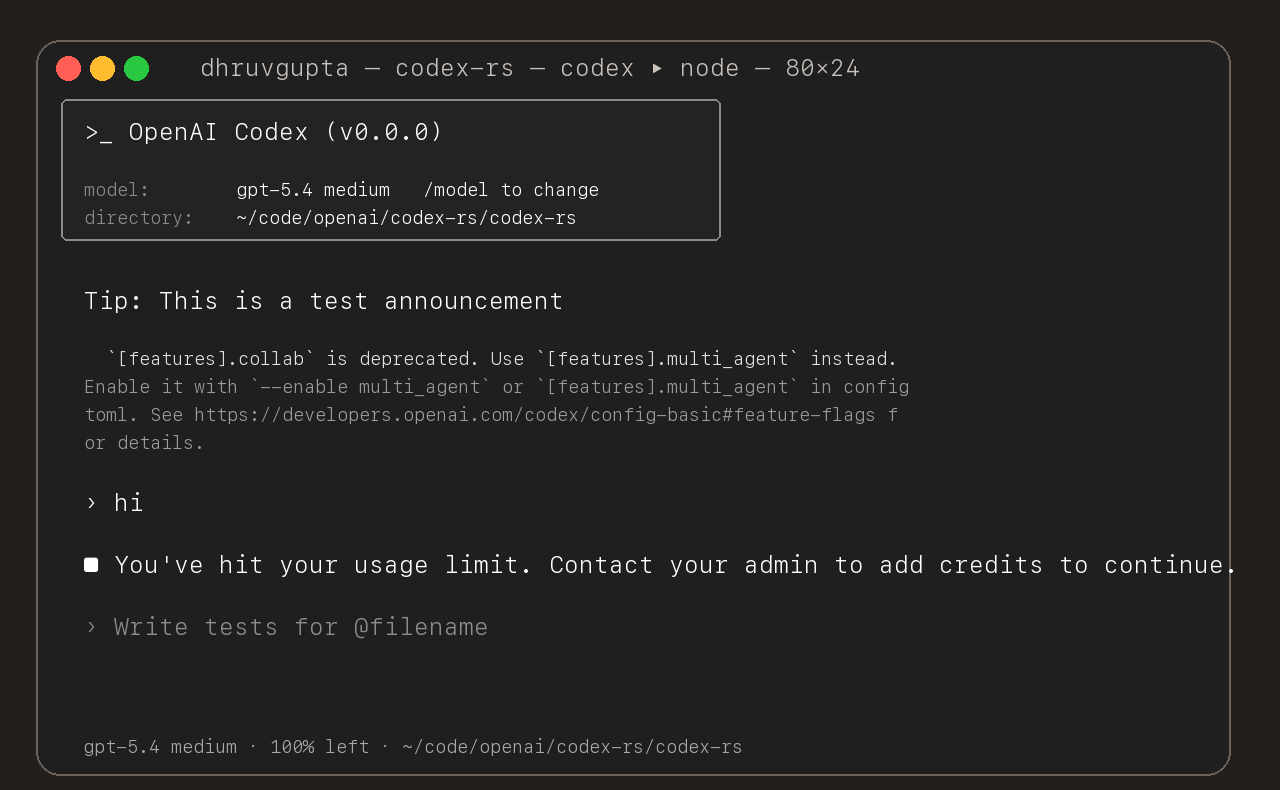
  • [codex-cli][app-server] Update self-serve business usage limit copy in error returned (#15478)
    ## Summary
    - update the self-serve business usage-based limit message to direct
    users to their admin for additional credits
    - add a focused unit test for the self_serve_business_usage_based plan
    branch
    
    Added also: 
    
    If you are at a rate limit but you still have credits, codex cli would
    tell you to switch the model. We shouldnt do this if you have credits so
    fixed this.
    
    ## Test
    - launched the source-built CLI and verified the updated message is
    shown for the self-serve business usage-based plan
    
    ![Test
    screenshot](https://raw.githubusercontent.com/openai/codex/5cc3c013ef17ac5c66dfd9395c0d3c4837602231/docs/images/self-serve-business-usage-limit.png)
  • feat(app-server): add mcpServer/startupStatus/updated notification (#15220)
    Exposes the legacy `codex/event/mcp_startup_update` event as an API v2
    notification.
    
    The legacy event has this shape:
    ```
    #[derive(Debug, Clone, Deserialize, Serialize, JsonSchema, TS)]
    pub struct McpStartupUpdateEvent {
        /// Server name being started.
        pub server: String,
        /// Current startup status.
        pub status: McpStartupStatus,
    }
    
    #[derive(Debug, Clone, Deserialize, Serialize, JsonSchema, TS)]
    #[serde(rename_all = "snake_case", tag = "state")]
    #[ts(rename_all = "snake_case", tag = "state")]
    pub enum McpStartupStatus {
        Starting,
        Ready,
        Failed { error: String },
        Cancelled,
    }
    ```
  • Refactor cloud requirements error and surface in JSON-RPC error (#14504)
    Refactors cloud requirements error handling to carry structured error
    metadata and surfaces that metadata through JSON-RPC config-load
    failures, including:
    * adds typed CloudRequirementsLoadErrorCode values plus optional
    statusCode
    * marks thread/start, thread/resume, and thread/fork config failures
    with structured cloud-requirements error data
  • app-server: Silence thread status changes caused by thread being created (#13079)
    Currently we emit `thread/status/changed` with `Idle` status right
    before sending `thread/started` event (which also has `Idle` status in
    it).
    It feels that there is no point in that as client has no way to know
    prior state of the thread as it didn't exist yet, so silence these kinds
    of notifications.
  • app-server: Add ephemeral field to Thread object (#13084)
    Currently there is no alternative way to know that thread is ephemeral,
    only client which did create it has the knowledge.
  • feat: add service name to app-server (#12319)
    Add service name to the app-server so that the app can use it's own
    service name
    
    This is on thread level because later we might plan the app-server to
    become a singleton on the computer
  • Add field to Thread object for the latest rename set for a given thread (#12301)
    Exposes through the app server updated names set for a thread. This
    enables other surfaces to use the core as the source of truth for thread
    naming. `threadName` is gathered using the helper functions used to
    interact with `session_index.jsonl`, and is hydrated in:
    - `thread/list`
    - `thread/read`
    - `thread/resume`
    - `thread/unarchive`
    - `thread/rollback`
    
    We don't do this for `thread/start` and `thread/fork`.
  • app-server: expose loaded thread status via read/list and notifications (#11786)
    Motivation
    - Today, a newly connected client has no direct way to determine the
    current runtime status of threads from read/list responses alone.
    - This forces clients to infer state from transient events, which can
    lead to stale or inconsistent UI when reconnecting or attaching late.
    
    Changes
    - Add `status` to `thread/read` responses.
    - Add `statuses` to `thread/list` responses.
    - Emit `thread/status/changed` notifications with `threadId` and the new
    status.
    - Track runtime status for all loaded threads and default unknown
    threads to `idle`.
    - Update protocol/docs/tests/schema fixtures for the revised API.
    
    Testing
    - Validated protocol API changes with automated protocol tests and
    regenerated schema/type fixtures.
    - Validated app-server behavior with unit and integration test suites,
    including status transitions and notifications.
  • Defer persistence of rollout file (#11028)
    - Defer rollout persistence for fresh threads (`InitialHistory::New`):
    keep rollout events in memory and only materialize rollout file + state
    DB row on first `EventMsg::UserMessage`.
    - Keep precomputed rollout path available before materialization.
    - Change `thread/start` to build thread response from live config
    snapshot and optional precomputed path.
    - Improve pre-materialization behavior in app-server/TUI: clearer
    invalid-request errors for file-backed ops and a friendlier `/fork` “not
    ready yet” UX.
    - Update tests to match deferred semantics across
    start/read/archive/unarchive/fork/resume/review flows.
    - Improved resilience of user_shell test, which should be unrelated to
    this change but must be affected by timing changes
    
    For Reviewers:
    * The primary change is in recorder.rs
    * Most of the other changes were to fix up broken assumptions in
    existing tests
    
    Testing:
    * Manually tested CLI
    * Exercised app server paths by manually running IDE Extension with
    rebuilt CLI binary
    * Only user-visible change is that `/fork` in TUI generates visible
    error if used prior to first turn
  • Handle required MCP startup failures across components (#10902)
    Summary
    - add a `required` flag for MCP servers everywhere config/CLI data is
    touched so mandatory helpers can be round-tripped
    - have `codex exec` and `codex app-server` thread start/resume fail fast
    when required MCPs fail to initialize
  • Add layered config.toml support to app server (#9510)
    This PR adds support for chained (layered) config.toml file merging for
    clients that use the app server interface. This feature already exists
    for the TUI, but it does not work for GUI clients.
    
    It does the following:
    * Changes code paths for new thread, resume thread, and fork thread to
    use the effective config based on the cwd.
    * Updates the `config/read` API to accept an optional `cwd` parameter.
    If specified, the API returns the effective config based on that cwd
    path. Also optionally includes all layers including project config
    files. If cwd is not specified, the API falls back on its older behavior
    where it considers only the global (non-project) config files when
    computing the effective config.
    
    The changes in codex_message_processor.rs look deceptively large. They
    mostly just involve moving existing blocks of code to a later point in
    some functions so it can use the cwd to calculate the config.
    
    This PR builds upon #9509 and should be reviewed and merged after that
    PR.
    
    Tested:
    * Verified change with (dependent, as-yet-uncommitted) changes to IDE
    Extension and confirmed correct behavior
    
    The full fix requires additional changes in the IDE Extension code base,
    but they depend on this PR.
  • [chore] move app server tests from chat completion to responses (#8939)
    We are deprecating chat completions. Move all app server tests from chat
    completion to responses.
  • fix: add more fields to ThreadStartResponse and ThreadResumeResponse (#6847)
    This adds the following fields to `ThreadStartResponse` and
    `ThreadResumeResponse`:
    
    ```rust
        pub model: String,
        pub model_provider: String,
        pub cwd: PathBuf,
        pub approval_policy: AskForApproval,
        pub sandbox: SandboxPolicy,
        pub reasoning_effort: Option<ReasoningEffort>,
    ```
    
    This is important because these fields are optional in
    `ThreadStartParams` and `ThreadResumeParams`, so the caller needs to be
    able to determine what values were ultimately used to start/resume the
    conversation. (Though note that any of these could be changed later
    between turns in the conversation.)
    
    Though to get this information reliably, it must be read from the
    internal `SessionConfiguredEvent` that is created in response to the
    start of a conversation. Because `SessionConfiguredEvent` (as defined in
    `codex-rs/protocol/src/protocol.rs`) did not have all of these fields, a
    number of them had to be added as part of this PR.
    
    Because `SessionConfiguredEvent` is referenced in many tests, test
    instances of `SessionConfiguredEvent` had to be updated, as well, which
    is why this PR touches so many files.
  • Update defaults to gpt-5.1 (#6652)
    ## Summary
    - update documentation, example configs, and automation defaults to
    reference gpt-5.1 / gpt-5.1-codex
    - bump the CLI and core configuration defaults, model presets, and error
    messaging to the new models while keeping the model-family/tool coverage
    for legacy slugs
    - refresh tests, fixtures, and TUI snapshots so they expect the upgraded
    defaults
    
    ## Testing
    - `cargo test -p codex-core
    config::tests::test_precedence_fixture_with_gpt5_profile`
    
    
    ------
    [Codex
    Task](https://chatgpt.com/codex/tasks/task_i_6916c5b3c2b08321ace04ee38604fc6b)
  • [app-server] feat: expose additional fields on Thread (#6338)
    Add the following fields to Thread:
    
    ```
        pub preview: String,
        pub model_provider: String,
        pub created_at: i64,
    ```
    
    Will prob need another PR once this lands:
    https://github.com/openai/codex/pull/6337