mirror of
https://github.com/pchuan98/codex.git
synced 2026-07-01 00:31:56 +08:00
fce10e009d2b56536d01145a809b8e862dbb671d
207 Commits
-
Add
user_input_requested_during_turnto MCP turn metadata (#22237)## Why - Similar change as https://github.com/openai/codex/pull/21219 - Without change: MCP tool calls receive `_meta["x-codex-turn-metadata"]` with various key values. - Issue: MCP servers currently do not know if user input was requested during the turn (Ex: Model decides to prompt the user for approval mid-turn before making a possibly risky tool call). MCP servers may want to know this when tracking latency metrics because these instances are inflated. ## What Changed - With change: MCP turn metadata now includes `user_input_requested_during_turn` when a model-visible `request_user_input` call happened earlier in the turn, propagated in `_meta["x-codex-turn-metadata"]`. - `mark_turn_user_input_requested()` is called when user input is requested through either MCP elicitation (`mcp.rs`) or the `request_user_input` tool (`mod.rs`). - MCP tool call `_meta` is now built immediately before execution (`mcp_tool_call.rs`) so user input requested earlier in the same turn, including within the same tool call via elicitation, is reflected in the metadata. - Normal `/responses` turn metadata headers are unchanged. ## Verification - `codex-rs/core/src/session/mcp_tests.rs` - `codex-rs/core/src/tools/handlers/request_user_input_tests.rs` - `codex-rs/core/src/turn_metadata_tests.rs` - `codex-rs/core/tests/suite/search_tool.rs`
mchen-oai ·
2026-05-15 01:26:50 +00:00 -
Remove SSE fixture loaders (#22684)
## Why The Responses API test support already has structured SSE event builders. Keeping separate JSON fixture loaders made small mock streams harder to read and left an on-disk fixture for a single event. ## What changed - Removed `load_sse_fixture` and `load_sse_fixture_with_id_from_str` from `core_test_support`. - Deleted the one `tests/fixtures/incomplete_sse.json` Responses API fixture. - Replaced the remaining call sites with `responses::sse(...)` and existing event helpers. ## Validation - `cargo test -p codex-core --test all stream_no_completed::retries_on_early_close` - `cargo test -p codex-core --test all history_dedupes_streamed_and_final_messages_across_turns` - `cargo test -p codex-core --test all review::`
pakrym-oai ·
2026-05-15 00:40:32 +00:00 -
chore(features) rm Feature::ApplyPatchFreeform (#22711)
## Summary Removes the feature since this is effectively on by default in all cases where we should use it, or can be configured via models.json. ## Testing - [x] unit tests pass
Dylan Hurd ·
2026-05-14 16:15:56 -07:00 -
Fix remote environment test fixtures (#22572)
## Why The Docker remote-env coverage was failing before it reached the behavior those tests are meant to exercise. The remote-aware test fixture only registered the remote environment, so tests that intentionally select both `local` and `remote` could not start a turn. After that was fixed, two tests exposed stale fixtures: the approval test was auto-approving under workspace-write, and the remote `view_image` test was writing invalid PNG bytes. ## What Changed - Added `EnvironmentManager::create_for_tests_with_local(...)` so tests can keep the provider default while also selecting `local` explicitly. - Updated `build_remote_aware()` to use that test-only manager when a remote exec-server URL is present. - Changed the remote apply-patch approval helper to use `SandboxPolicy::new_read_only_policy()` so the test actually exercises approval caching per environment. - Replaced the hardcoded remote `view_image` PNG blob with the existing `png_bytes(...)` helper so the test uses a valid image fixture. ## Validation Ran these isolated Docker remote-env tests on the devbox with `$remote-tests` setup: - `suite::remote_env::apply_patch_freeform_routes_to_selected_remote_environment` - `suite::remote_env::apply_patch_approvals_are_remembered_per_environment` - `suite::remote_env::apply_patch_intercepted_exec_command_routes_to_selected_remote_environment` - `suite::remote_env::exec_command_routes_to_selected_remote_environment` - `suite::view_image::view_image_routes_to_selected_remote_environment` All five pass.
starr-openai ·
2026-05-14 12:40:01 -07:00 -
feat: add layered --profile-v2 config files (#17141)
## Why `--profile-v2 <name>` gives launchers and runtime entry points a named profile config without making each profile duplicate the base user config. The base `$CODEX_HOME/config.toml` still loads first, then `$CODEX_HOME/<name>.config.toml` layers above it and becomes the active writable user config for that session. That keeps shared defaults, plugin/MCP setup, and managed/user constraints in one place while letting a named profile override only the pieces that need to differ. ## What Changed - Added the shared `--profile-v2 <name>` runtime option with validated plain names, now represented by `ProfileV2Name`. - Extended config layer state so the base user config and selected profile config are both `User` layers; APIs expose the active user layer and merged effective user config. - Threaded profile selection through runtime entry points: `codex`, `codex exec`, `codex review`, `codex resume`, `codex fork`, and `codex debug prompt-input`. - Made user-facing config writes go to the selected profile file when active, including TUI/settings persistence, app-server config writes, and MCP/app tool approval persistence. - Made plugin, marketplace, MCP, hooks, and config reload paths read from the merged user config so base and profile layers both participate. - Updated app-server config layer schemas to mark profile-backed user layers. ## Limits `--profile-v2` is still rejected for config-management subcommands such as feature, MCP, and marketplace edits. Those paths remain tied to the base `config.toml` until they have explicit profile-selection semantics. Some adjacent background writes may still update base or global state rather than the selected profile: - marketplace auto-upgrade metadata - automatic MCP dependency installs from skills - remote plugin sync or uninstall config edits - personality migration marker/default writes ## Verification Added targeted coverage for profile name validation, layer ordering/merging, selected-profile writes, app-server config writes, session hot reload, plugin config merging, hooks/config fixture updates, and MCP/app approval persistence. --------- Co-authored-by: Codex <noreply@openai.com>
jif-oai ·
2026-05-14 15:16:15 +02:00 -
[codex] Remove unused legacy shell tools (#22246)
## Why Recent session history showed no active use of the raw `shell`, `local_shell`, or `container.exec` execution surfaces. Keeping those handlers/specs wired into core leaves duplicate shell execution paths alongside the supported `shell_command` and unified exec tools. ## What changed - Removed the raw `shell` handler/spec and its `ShellToolCallParams` protocol helper. - Removed the legacy `local_shell` and `container.exec` handler/spec plumbing while preserving persisted-history compatibility for old response items. - Normalized model/config `default` and `local` shell selections to `shell_command`. - Pruned tests that exercised removed raw-shell/local-shell/apply-patch variants and kept coverage on `shell_command`, unified exec, and freeform `apply_patch`. ## Verification - `git diff --check` - `cargo test -p codex-protocol` - `cargo test -p codex-tools` - `cargo test -p codex-core tools::handlers::shell` - `cargo test -p codex-core tools::spec` - `cargo test -p codex-core tools::router` - `cargo test -p codex-core active_call_preserves_triggering_command_context` - `cargo test -p codex-core guardian_tests` - `cargo test -p codex-core --test all shell_serialization` - `cargo test -p codex-core --test all apply_patch_cli` - `cargo test -p codex-core --test all shell_command_` - `cargo test -p codex-core --test all local_shell` - `cargo test -p codex-core --test all otel::` - `cargo test -p codex-core --test all hooks::` - `just fix -p codex-core` - `just fix -p codex-tools`
pakrym-oai ·
2026-05-13 16:43:25 +00:00 -
Remove CODEX_RS_SSE_FIXTURE test hook (#22413)
## Why `CODEX_RS_SSE_FIXTURE` let integration-style CLI, exec, and TUI tests bypass the normal Responses transport by reading SSE from local files. That kept test-only behavior wired through production client code. The affected tests can stay hermetic by using the existing `core_test_support::responses` mock server and passing `openai_base_url` instead. ## What Changed - Removed the `CODEX_RS_SSE_FIXTURE` flag, `codex_api::stream_from_fixture`, the `env-flags` dependency, and the checked-in SSE fixture files. - Repointed the affected core, exec, and TUI tests at `MockServer` with the existing SSE event constructors. - Removed the Bazel test data plumbing for the deleted fixtures and refreshed cargo/Bazel lock state. ## Verification - `cargo build -p codex-cli` - `cargo test -p codex-api` - `cargo test -p codex-core --test all responses_api_stream_cli` - `cargo test -p codex-core --test all integration_creates_and_checks_session_file` - `cargo test -p codex-exec --test all ephemeral` - `cargo test -p codex-exec --test all resume` - `cargo test -p codex-tui --test all resume_startup_does_not_consume_model_availability_nux_count` - `just bazel-lock-update` - `just bazel-lock-check` - `just fix -p codex-api -p codex-core -p codex-exec -p codex-tui` - `git diff --check`
pakrym-oai ·
2026-05-13 03:08:01 +00:00 -
extension: wire extension registries into sessions (#21737)
## Why [#21736](https://github.com/openai/codex/pull/21736) introduces the typed extension API, but the runtime does not yet carry a registry through thread/session startup or give contributors host-owned stores to read from. This PR wires that host-side path so later feature migrations can move product-specific behavior behind typed contributions without adding another bespoke seam directly to `codex-core`. ## What changed - Thread `ExtensionRegistry<Config>` through `ThreadManager`, `CodexSpawnArgs`, `Session`, and sub-agent spawn paths. - Wire `ThreadStartContributor` and `ContextContributor` - Expose the small supporting surface needed by non-core callers that construct threads directly, including `empty_extension_registry()` through `codex-core-api`. This PR lands the host plumbing only: the app-server registry is still empty, and concrete feature migrations are intended to follow separately.
jif-oai ·
2026-05-11 11:38:18 +02:00 -
tests: cover sandbox link write behavior (#21819)
## Why [PR #1705](https://github.com/openai/codex/pull/1705) moved `apply_patch` execution under the configured sandbox and called out the need for integration coverage. We already covered textual `../` escapes, but did not have coverage for link aliases that live inside a writable workspace while pointing at, or aliasing, files visible outside it. This PR locks in the current sandbox boundary without changing production write semantics. Symlink escapes into a read-only outside root should fail and leave the outside file unchanged. Existing hard links are characterized separately: if a user-created hard link already exists inside the writable root, sandboxed writes preserve normal hard-link semantics rather than replacing the link and silently breaking that relationship. ## What Changed - Added `apply_patch_cli_does_not_write_through_symlink_escape_outside_workspace` to verify `apply_patch` cannot update a symlink that targets a file outside the writable workspace. - Added `apply_patch_cli_preserves_existing_hard_link_outside_workspace` to verify `apply_patch` intentionally writes through an existing hard link and does not unlink or replace it. - Added `file_system_sandboxed_write_preserves_existing_hard_link` to verify sandboxed `fs/writeFile` preserves an existing hard link and writes the shared inode. ## Testing - `cargo test -p codex-exec-server file_system_sandboxed_write` - `cargo test -p codex-core apply_patch_cli_does_not_write_through_symlink_escape_outside_workspace` - `cargo test -p codex-core apply_patch_cli_preserves_existing_hard_link_outside_workspace` - `just fix -p codex-exec-server -p codex-core` - `just fix -p codex-core` --- [//]: # (BEGIN SAPLING FOOTER) Stack created with [Sapling](https://sapling-scm.com). Best reviewed with [ReviewStack](https://reviewstack.dev/openai/codex/pull/21819). * #21845 * __->__ #21819
Michael Bolin ·
2026-05-09 08:28:15 -07:00 -
[codex] Delete function-style apply_patch (#21651)
## Why `apply_patch` is now a freeform/custom tool. Keeping the old JSON/function-style registration and parsing path left another way for models and tests to invoke `apply_patch`, which made the tool surface harder to reason about. ## What changed - Removed the `ApplyPatchToolType::Function` variant, JSON `apply_patch` spec, and handler support for function payloads. - Kept `apply_patch_tool_type = freeform` as the supported model metadata path, including Bedrock catalog metadata. - Migrated `apply_patch` tests and SSE fixtures to custom/freeform tool calls. ## Verification - `cargo test -p codex-tools -p codex-protocol -p codex-model-provider` - `cargo test -p codex-core tools::handlers::apply_patch --lib` - `cargo test -p codex-core --test all apply_patch_tool_executes_and_emits_patch_events` - `cargo test -p codex-core --test all apply_patch_reports_parse_diagnostics` - `cargo test -p codex-exec test_apply_patch_tool` - `just fix -p codex-core` - `just fix -p codex-tools -p codex-protocol -p codex-model-provider -p codex-exec`
pakrym-oai ·
2026-05-08 13:00:57 -07:00 -
[codex] request desktop attestation from app (#20619)
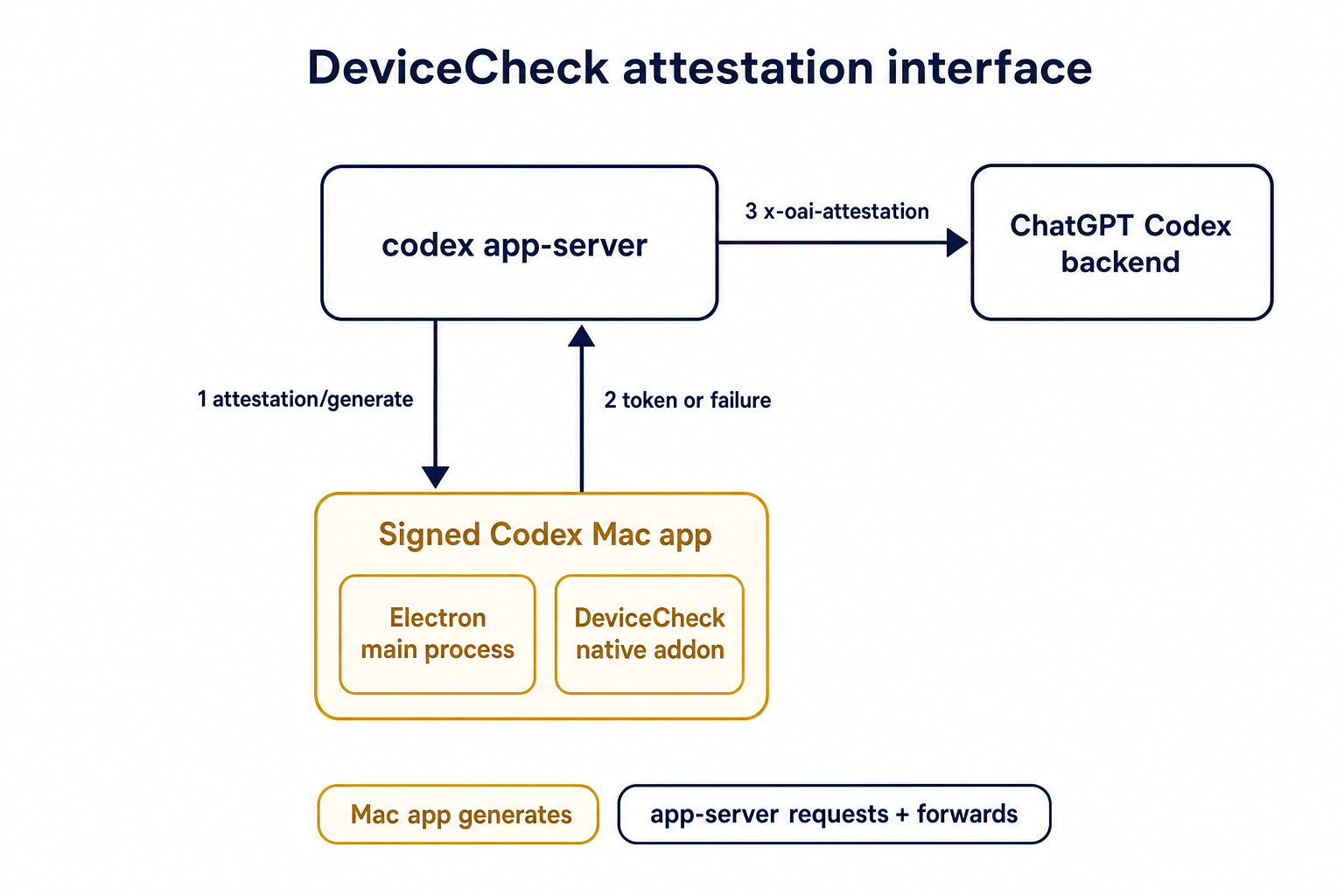
## Summary TL;DR: teaches `codex-rs` / app-server to request a desktop-provided attestation token and attach it as `x-oai-attestation` on the scoped ChatGPT Codex request paths.  ## Details This PR teaches the Codex app-server runtime how to request and attach an attestation token. It does not generate DeviceCheck tokens directly; instead, it relies on the connected desktop app to advertise that it can generate attestation and then asks that app for a fresh header value when needed. The flow is: 1. The Codex desktop app connects to app-server. 2. During `initialize`, the app can advertise that it supports `requestAttestation`. 3. Before app-server calls selected ChatGPT Codex endpoints, it sends the internal server request `attestation/generate` to the app. 4. app-server receives a pre-encoded header value back. 5. app-server forwards that value as `x-oai-attestation` on the scoped outbound requests. The code in this repo is mostly protocol and runtime plumbing: it adds the app-server request/response shape, introduces an attestation provider in core, wires that provider into Responses / compaction / realtime setup paths, and covers the intended scoping with tests. The signed macOS DeviceCheck generation remains owned by the desktop app PR. ## Related PR - Codex desktop app implementation: https://github.com/openai/openai/pull/878649 ## Validation <details> <summary>Tests run</summary> ```sh cargo test -p codex-app-server-protocol cargo test -p codex-core attestation --lib cargo test -p codex-app-server --lib attestation ``` Also ran: ```sh just fix -p codex-core just fix -p codex-app-server just fix -p codex-app-server-protocol just fmt just write-app-server-schema ``` </details> <details> <summary>E2E DeviceCheck validation</summary> First validated the signed desktop app boundary directly: launched a packaged signed `Codex.app`, sent `attestation/generate`, decoded the returned `v1.` attestation header, and validated the extracted DeviceCheck token with `personal/jm/verify_devicecheck_token.py` using bundle ID `com.openai.codex`. Apple returned `status_code: 200` and `is_ok: true`. Then ran the fuller app + app-server flow. The packaged `Codex.app` launched a current-branch app-server via `CODEX_CLI_PATH`, and a local MITM proxy intercepted outbound `chatgpt.com` traffic. The app-server requested `attestation/generate` from the real Electron app process, and the intercepted `/backend-api/codex/responses` traffic included `x-oai-attestation` on both routes: ```text GET /backend-api/codex/responses Upgrade: websocket x-oai-attestation: present POST /backend-api/codex/responses Upgrade: none x-oai-attestation: present ``` The captured header decoded to a DeviceCheck token that also validated with Apple for `com.openai.codex` (`status_code: 200`, `is_ok: true`, team `2DC432GLL2`). </details> --------- Co-authored-by: Codex <noreply@openai.com>
Jiaming Zhang ·
2026-05-08 12:36:02 -07:00 -
Add CODEX_HOME environments TOML provider (#20666)
## Why After stdio transports and provider-owned defaults exist, Codex needs a config-backed provider that can describe more than the single legacy `CODEX_EXEC_SERVER_URL` remote. This PR adds that provider without activating it in product entrypoints yet, keeping parser/validation review separate from runtime wiring. **Stack position:** this is PR 4 of 5. It builds on PR 3's provider/default model and adds the `environments.toml` provider used by PR 5. ## What Changed - Add `environment_toml.rs` as the TOML-specific home for parsing, validation, and provider construction. - Keep the TOML schema/provider structs private; the public constructor added here is `EnvironmentManager::from_codex_home(...)`. - Add `TomlEnvironmentProvider`, including validation for: - reserved ids such as `local` and `none` - duplicate ids - unknown explicit defaults - empty programs or URLs - exactly one of `url` or `program` per configured environment - Support websocket environments with `url = "ws://..."` / `wss://...`. - Support stdio-command environments with `program = "..."`. - Add helpers to load `environments.toml` from `CODEX_HOME`, but do not wire entrypoints to call them yet. - Add the `toml` dependency for parsing. ## Stack - 1. https://github.com/openai/codex/pull/20663 - Add stdio exec-server listener - 2. https://github.com/openai/codex/pull/20664 - Add stdio exec-server client transport - 3. https://github.com/openai/codex/pull/20665 - Make environment providers own default selection - **4. This PR:** https://github.com/openai/codex/pull/20666 - Add CODEX_HOME environments TOML provider - 5. https://github.com/openai/codex/pull/20667 - Load configured environments from CODEX_HOME Split from original draft: https://github.com/openai/codex/pull/20508 ## Validation Not run locally; this was split out of the original draft stack. ## Documentation This introduces the config shape for `environments.toml`; user-facing documentation should be added before this stack is treated as a documented public workflow. --------- Co-authored-by: Codex <noreply@openai.com>
starr-openai ·
2026-05-08 01:37:47 +00:00 -
Disable empty Cargo test targets (#21584)
## Summary `cargo test` has entails both running standard Rust tests and doctests. It turns out that the doctest discovery is fairly slow, and it's a cost you pay even for crates that don't include any doctests. This PR disables doctests with `doctest = false` for crates that lack any doctests. For the collection of crates below, this speeds up test execution by >4x. E.g., before this PR: ``` Benchmark 1: cargo test -p codex-utils-absolute-path -p codex-utils-cache -p codex-utils-cli -p codex-utils-home-dir -p codex-utils-output-truncation -p codex-utils-path -p codex-utils-string -p codex-utils-template -p codex-utils-elapsed -p codex-utils-json-to-toml Time (mean ± σ): 1.849 s ± 4.455 s [User: 0.752 s, System: 1.367 s] Range (min … max): 0.418 s … 14.529 s 10 runs ``` And after: ``` Benchmark 1: cargo test -p codex-utils-absolute-path -p codex-utils-cache -p codex-utils-cli -p codex-utils-home-dir -p codex-utils-output-truncation -p codex-utils-path -p codex-utils-string -p codex-utils-template -p codex-utils-elapsed -p codex-utils-json-to-toml Time (mean ± σ): 428.6 ms ± 6.9 ms [User: 187.7 ms, System: 219.7 ms] Range (min … max): 418.0 ms … 436.8 ms 10 runs ``` For a single crate, with >2x speedup, before: ``` Benchmark 1: cargo test -p codex-utils-string Time (mean ± σ): 491.1 ms ± 9.0 ms [User: 229.8 ms, System: 234.9 ms] Range (min … max): 480.9 ms … 512.0 ms 10 runs ``` And after: ``` Benchmark 1: cargo test -p codex-utils-string Time (mean ± σ): 213.9 ms ± 4.3 ms [User: 112.8 ms, System: 84.0 ms] Range (min … max): 206.8 ms … 221.0 ms 13 runs ``` Co-authored-by: Codex <noreply@openai.com>
Charlie Marsh ·
2026-05-07 15:44:17 -07:00 -
Revert state DB injection and agent graph store (#21481)
## Why Reverts #20689 to restore the previous optional state DB plumbing. The conflict resolution keeps the newer installation ID and session/thread identity changes that landed after #20689, while removing the mandatory state DB and agent graph store dependency from ThreadManager construction. ## What changed - Restored `Option<StateDbHandle>` through app-server, MCP server, prompt debug, and test entry points. - Removed the `codex-core` dependency on `codex-agent-graph-store` and reverted descendant lookup back to the existing state DB path when available. - Kept newer `installation_id` forwarding by passing it beside the optional DB handle. - Kept local thread-name updates working when the optional state DB handle is absent. ## Validation - `git diff --check` - `cargo test -p codex-thread-store` - `cargo test -p codex-state -p codex-rollout -p codex-app-server-protocol` - Attempted `env CARGO_INCREMENTAL=0 cargo test -p codex-core -p codex-app-server -p codex-app-server-client -p codex-mcp-server -p codex-thread-manager-sample -p codex-tui`; blocked locally by a rustc ICE while compiling `v8 v146.4.0` with `rustc 1.93.0 (254b59607 2026-01-19)` on `aarch64-apple-darwin`.
pakrym-oai ·
2026-05-06 22:48:29 -07:00 -
Remove core MCP list tools op (#21281)
## Why The core `Op::ListMcpTools` request path is no longer needed. Keeping it around left a dead request/response surface alongside the app-server MCP inventory APIs that own current server status listing. ## What Changed - Removed `Op::ListMcpTools`, `EventMsg::McpListToolsResponse`, and the core handler that built the MCP snapshot response. - Removed the now-unused `codex-mcp` snapshot wrapper/export and passive event handling arms in rollout and MCP-server consumers. - Updated tests that used the old op as a synchronization hook to wait on existing startup/skills events, and deleted the plugin test that only exercised the removed listing op. ## Validation - `cargo test -p codex-protocol` - `cargo test -p codex-mcp` - `cargo test -p codex-rollout -p codex-rollout-trace -p codex-mcp-server` - `cargo test -p codex-core --test all pending_input::queued_inter_agent_mail` - `cargo test -p codex-core --test all rmcp_client::stdio_mcp_tool_call_includes_sandbox_state_meta` - `cargo test -p codex-core --test all rmcp_client::stdio_image_responses` - `just fix -p codex-core -p codex-protocol -p codex-mcp -p codex-rollout -p codex-rollout-trace -p codex-mcp-server`
pakrym-oai ·
2026-05-06 11:20:34 -07:00 -
2- Use string service tiers in session protocol (#20971)
## Summary - break service tier session/op/app-server protocol fields from the closed enum to string tier ids - send the service tier string directly through model requests, prewarm, compaction, memories, and TUI/app-server turn starts - regenerate app-server protocol JSON/TypeScript schemas, removing the standalone ServiceTier TS enum ## Verification - just fmt - cargo check -p codex-core -p codex-app-server -p codex-tui - just write-app-server-schema --------- Co-authored-by: Codex <noreply@openai.com>
Ahmed Ibrahim ·
2026-05-06 18:00:21 +03:00 -
Move installation ID resolution out of core startup (#21182)
## Summary - resolve or inject the installation ID before core startup and pass it through `ThreadManager`, `CodexSpawnArgs`, and `Session` as a plain `String` - keep child sessions on the parent installation ID instead of rediscovering it inside core - propagate installation ID startup failures in `mcp-server` instead of panicking ## Why Core was still touching the filesystem on the session startup path to discover `installation_id`. This moves that work to the outer host boundary so core no longer depends on `codex_home` reads during session construction. --------- Co-authored-by: Codex <noreply@openai.com>
jif-oai ·
2026-05-06 10:48:54 +00:00 -
Propagate cache key and service tiers in compact (#21249)
## Why `/responses/compact` should preserve the request-affinity fields that apply to the active auth mode. ChatGPT-auth compact requests need the effective `service_tier`, and compact requests for every auth mode need the stable `prompt_cache_key`, so compaction does not quietly lose routing or cache behavior that normal sampling already has. This follows the request-parity direction from #20719, but keeps the net change focused on the compact payload fields needed here. ## What changed - Add `service_tier` and `prompt_cache_key` to the compact endpoint input payload. - Build the remote compact payload from the existing responses request builder output so `Fast` still maps to `priority` when compact sends a service tier. - Pass the turn service tier into remote compaction, but only include it in compact payloads for ChatGPT-backed auth. - Keep `prompt_cache_key` on compact payloads for all auth modes. - Add request-body diff snapshot coverage in `core/tests/suite/compact_remote.rs` for: - API-key auth reusing `prompt_cache_key` while omitting `service_tier` even when `Fast` is configured. - ChatGPT auth reusing both `service_tier` and `prompt_cache_key`. - Drive the snapshot coverage through five varied turns: plain text, multi-part text, tool-call continuation, image+text input, local-shell continuation, and final-turn reasoning output. ## Verification - Added insta snapshots for compact request-body parity against the last normal `/responses` request after five varied turns. - Not run locally per repo guidance; relying on GitHub CI for test execution. --------- Co-authored-by: Codex <noreply@openai.com>
Ahmed Ibrahim ·
2026-05-06 13:38:43 +03:00 -
Inject state DB, agent graph store (#20689)
## Why We want the agent graph store to be passed down the stack as a real dependency, the same way we already treat the thread store. This will let us inject the agent graph store as a real dependency and support implementations other than the local SQLite-backed one. Right now most code instantiates a state DB and an agent graph store just-in-time. Ideally, we would not depend on the state DB directly but only read through the higher-level interfaces. This change makes the dependency boundaries explicit and moves state DB initialization to process bootstrap instead of hiding it inside local store implementations. ## What changed - `ThreadManager` now requires a `StateDbHandle` and an `AgentGraphStore` at construction time instead of treating them as optional internals. - The local store constructors no longer lazily initialize SQLite. Callers now initialize the state DB once per process and use that shared handle to build: - `LocalThreadStore` - `LocalAgentGraphStore` - App bootstraps (`app-server`, `mcp-server`, `prompt_debug`, and the thread-manager sample) now initialize the state DB up front and inject the resulting handle down the stack. - `app-server` now consistently uses its process-scoped state DB handle instead of reopening SQLite or trying to recover it from loaded threads. - Device-key storage now reuses the shared state DB handle instead of maintaining its own lazy opener. - The thread archive / descendant traversal paths now use the injected `AgentGraphStore` instead of reaching through local thread-store-specific state. ## Verification - `cargo check -p codex-core -p codex-thread-store -p codex-app-server -p codex-mcp-server -p codex-thread-manager-sample --tests` - `cargo test -p codex-thread-store` - `cargo test -p codex-core thread_manager_accepts_separate_agent_graph_store_and_thread_store -- --nocapture` - `cargo test -p codex-app-server thread_archive_archives_spawned_descendants -- --nocapture`
Rasmus Rygaard ·
2026-05-05 21:45:29 +00:00 -
hook trust metadata and enforcement (#20321)
# Why We want shared hook trust that both the app and the TUI can build on, but the metadata is only useful if runtime behavior agrees with it. This PR adds a single backend trust model for hooks so unmanaged hooks cannot run until the current definition has been reviewed, while managed hooks remain runnable and non-configurable. # What - persist `trusted_hash` alongside hook state in `config.toml` - expose `currentHash` and derived `trustStatus` through `hooks/list` - derive trust from normalized hook definitions so equivalent hooks from `config.toml` and `hooks.json` share the same trust identity - gate unmanaged hooks on trust before they enter the runnable handler set # Reviewer Notes - key file to review is `codex-rs/hooks/src/engine/discovery.rs` - the only **core** change is schema related
Abhinav ·
2026-05-05 19:13:55 +00:00 -
core: fix apply_patch request permissions test (#21060)
## Why The Bazel test coverage change exposed `approved_folder_write_request_permissions_unblocks_later_apply_patch`, and `rust-ci-full.yml` showed the same test failing on `main` on macOS. There were two separate classes of problems here. ### Clean CI failure The test emits an `apply_patch` tool call, but its config did not enable the `apply_patch` tool, so the mocked response completed without an `apply-patch-call` output. After enabling the tool, the same path also needs the aggregate `codex-core` test binary to dispatch `--codex-run-as-fs-helper`; sandboxed `apply_patch` uses that helper under macOS Seatbelt. The test now also canonicalizes the temporary patch target before building the patch payload so the path matches normalized grants on macOS, where `/var` paths often normalize to `/private/var`. ### Local/enterprise config isolation The core test harness now builds its default test config with managed config disabled, so host-managed enterprise config cannot alter these tests. The request-permissions turns in this test also explicitly use the user reviewer path, keeping the assertions focused on `request_permissions` behavior rather than reviewer defaults from the host. ## What Changed - Enable `apply_patch` in `approved_folder_write_request_permissions_unblocks_later_apply_patch`. - Teach the core integration test binary to dispatch `CODEX_FS_HELPER_ARG1`, matching the existing apply-patch and linux-sandbox dispatch paths. - Canonicalize the tempdir-backed patch target before creating the patch. - Ignore managed config in default core test configs and explicitly pin this test to `ApprovalsReviewer::User`. ## Verification Run outside the Codex app sandbox because these macOS tests intentionally spawn Seatbelt: - `cargo test -p codex-core approved_folder_write_request_permissions_unblocks_later_apply_patch` - `cargo test -p codex-core approved_folder_write_request_permissions_unblocks_later_exec_without_sandbox_args`
Michael Bolin ·
2026-05-04 12:48:59 -07:00 -
state: pass state db handles through consumers (#20561)
## Why SQLite state was still being opened from consumer paths, including lazy `OnceCell`-backed thread-store call sites. That let one process construct multiple state DB connections for the same Codex home, which makes SQLite lock contention and `database is locked` failures much easier to hit. State DB lifetime should be chosen by main-like entrypoints and tests, then passed through explicitly. Consumers should use the supplied `Option<StateDbHandle>` or `StateDbHandle` and keep their existing filesystem fallback or error behavior when no handle is available. The startup path also needs to keep the rollout crate in charge of SQLite state initialization. Opening `codex_state::StateRuntime` directly bypasses rollout metadata backfill, so entrypoints should initialize through `codex_rollout::state_db` and receive a handle only after required rollout backfills have completed. ## What Changed - Initialize the state DB in main-like entrypoints for CLI, TUI, app-server, exec, MCP server, and the thread-manager sample. - Pass `Option<StateDbHandle>` through `ThreadManager`, `LocalThreadStore`, app-server processors, TUI app wiring, rollout listing/recording, personality migration, shell snapshot cleanup, session-name lookup, and memory/device-key consumers. - Remove the lazy local state DB wrapper from the thread store so non-test consumers use only the supplied handle or their existing fallback path. - Make `codex_rollout::state_db::init` the local state startup path: it opens/migrates SQLite, runs rollout metadata backfill when needed, waits for concurrent backfill workers up to a bounded timeout, verifies completion, and then returns the initialized handle. - Keep optional/non-owning SQLite helpers, such as remote TUI local reads, as open-only paths that do not run startup backfill. - Switch app-server startup from direct `codex_state::StateRuntime::init` to the rollout state initializer so app-server cannot skip rollout backfill. - Collapse split rollout lookup/list APIs so callers use the normal methods with an optional state handle instead of `_with_state_db` variants. - Restore `getConversationSummary(ThreadId)` to delegate through `ThreadStore::read_thread` instead of a LocalThreadStore-specific rollout path special case. - Keep DB-backed rollout path lookup keyed on the DB row and file existence, without imposing the filesystem filename convention on existing DB rows. - Verify readable DB-backed rollout paths against `session_meta.id` before returning them, so a stale SQLite row that points at another thread's JSONL falls back to filesystem search and read-repairs the DB row. - Keep `debug prompt-input` filesystem-only so a one-off debug command does not initialize or backfill SQLite state just to print prompt input. - Keep goal-session test Codex homes alive only in the goal-specific helper, rather than leaking tempdirs from the shared session test helper. - Update tests and call sites to pass explicit state handles where DB behavior is expected and explicit `None` where filesystem-only behavior is intended. ## Validation - `CARGO_TARGET_DIR=/tmp/codex-target-state-db cargo check -p codex-rollout -p codex-thread-store -p codex-app-server -p codex-core -p codex-tui -p codex-exec -p codex-cli --tests` - `CARGO_TARGET_DIR=/tmp/codex-target-state-db cargo test -p codex-rollout state_db_` - `CARGO_TARGET_DIR=/tmp/codex-target-state-db cargo test -p codex-rollout find_thread_path` - `CARGO_TARGET_DIR=/tmp/codex-target-state-db cargo test -p codex-rollout find_thread_path -- --nocapture` - `CARGO_TARGET_DIR=/tmp/codex-target-state-db cargo test -p codex-rollout try_init_ -- --nocapture` - `CARGO_TARGET_DIR=/tmp/codex-target-state-db cargo test -p codex-rollout` - `CARGO_TARGET_DIR=/tmp/codex-target-state-db cargo clippy -p codex-rollout --lib -- -D warnings` - `CARGO_TARGET_DIR=/tmp/codex-target-state-db cargo test -p codex-thread-store read_thread_falls_back_when_sqlite_path_points_to_another_thread -- --nocapture` - `CARGO_TARGET_DIR=/tmp/codex-target-state-db cargo test -p codex-thread-store` - `CARGO_TARGET_DIR=/tmp/codex-target-state-db cargo test -p codex-core shell_snapshot` - `CARGO_TARGET_DIR=/tmp/codex-target-state-db cargo test -p codex-core --test all personality_migration` - `CARGO_TARGET_DIR=/tmp/codex-target-state-db cargo test -p codex-core --test all rollout_list_find` - `RUST_MIN_STACK=8388608 CODEX_SKIP_VENDORED_BWRAP=1 CARGO_TARGET_DIR=/tmp/codex-target-state-db cargo test -p codex-core --test all rollout_list_find::find_prefers_sqlite_path_by_id -- --nocapture` - `RUST_MIN_STACK=8388608 CODEX_SKIP_VENDORED_BWRAP=1 CARGO_TARGET_DIR=/tmp/codex-target-state-db cargo test -p codex-core --test all rollout_list_find -- --nocapture` - `CARGO_TARGET_DIR=/tmp/codex-target-state-db cargo test -p codex-core interrupt_accounts_active_goal_before_pausing` - `CARGO_TARGET_DIR=/tmp/codex-target-state-db cargo test -p codex-app-server get_auth_status -- --test-threads=1` - `CODEX_SKIP_VENDORED_BWRAP=1 CARGO_TARGET_DIR=/tmp/codex-target-state-db cargo test -p codex-app-server --lib` - `CODEX_SKIP_VENDORED_BWRAP=1 CARGO_TARGET_DIR=/tmp/codex-target-state-db cargo check -p codex-rollout -p codex-app-server --tests` - `CARGO_TARGET_DIR=/tmp/codex-target-state-db just fix -p codex-rollout -p codex-thread-store -p codex-core -p codex-app-server -p codex-tui -p codex-exec -p codex-cli` - `CODEX_SKIP_VENDORED_BWRAP=1 CARGO_TARGET_DIR=/tmp/codex-target-state-db just fix -p codex-rollout -p codex-app-server` - `CARGO_TARGET_DIR=/tmp/codex-target-state-db just fix -p codex-rollout` - `CODEX_SKIP_VENDORED_BWRAP=1 CARGO_TARGET_DIR=/tmp/codex-target-state-db just fix -p codex-core` - `just argument-comment-lint -p codex-core` - `just argument-comment-lint -p codex-rollout` Focused coverage added in `codex-rollout`: - `recorder::tests::state_db_init_backfills_before_returning` verifies the rollout metadata row exists before startup init returns. - `state_db::tests::try_init_waits_for_concurrent_startup_backfill` verifies startup waits for another worker to finish backfill instead of disabling the handle for the process. - `state_db::tests::try_init_times_out_waiting_for_stuck_startup_backfill` verifies startup does not hang indefinitely on a stuck backfill lease. - `tests::find_thread_path_accepts_existing_state_db_path_without_canonical_filename` verifies DB-backed lookup accepts valid existing rollout paths even when the filename does not include the thread UUID. - `tests::find_thread_path_falls_back_when_db_path_points_to_another_thread` verifies DB-backed lookup ignores a stale row whose existing path belongs to another thread and read-repairs the row after filesystem fallback. Focused coverage updated in `codex-core`: - `rollout_list_find::find_prefers_sqlite_path_by_id` now uses a DB-preferred rollout file with matching `session_meta.id`, so it still verifies that valid SQLite paths win without depending on stale/empty rollout contents. `cargo test -p codex-app-server thread_list_respects_search_term_filter -- --test-threads=1 --nocapture` was attempted locally but timed out waiting for the app-server test harness `initialize` response before reaching the changed thread-list code path. `bazel test //codex-rs/thread-store:thread-store-unit-tests --test_output=errors` was attempted locally after the thread-store fix, but this container failed before target analysis while fetching `v8+` through BuildBuddy/direct GitHub. The equivalent local crate coverage, including `cargo test -p codex-thread-store`, passes. A plain local `cargo check -p codex-rollout -p codex-app-server --tests` also requires system `libcap.pc` for `codex-linux-sandbox`; the follow-up app-server check above used `CODEX_SKIP_VENDORED_BWRAP=1` in this container.
Ruslan Nigmatullin ·
2026-05-04 11:46:03 -07:00 -
Make thread store process-scoped (#19474)
- Build one app-server process ThreadStore from startup config and share it with ThreadManager and CodexMessageProcessor. - Remove per-thread/fork store reconstruction so effective thread config cannot switch the persistence backend. - Add params to ThreadStore create/resume for specifying thread metadata, since otherwise the metadata from store creation would be used (incorrectly).
Tom ·
2026-04-30 21:24:59 -07:00 -
Reduce the surface of collaboration modes (#20149)
Collaboration modes were slightly invasive both into ThreadManager construction and ModelProvider
pakrym-oai ·
2026-04-29 17:22:41 -07:00 -
Add ThreadManager sample crate (#20141)
Summary: - Add codex-thread-manager-sample, a one-shot binary that starts a ThreadManager thread, submits a prompt, and prints the final assistant output. - Pass ThreadStore into ThreadManager::new and expose thread_store_from_config for existing callsites. - Build the sample Config directly with only --model and prompt inputs. Verification: - just fmt - cargo check -p codex-thread-manager-sample -p codex-app-server -p codex-mcp-server - git diff --check Tests: Not run per request.
pakrym-oai ·
2026-04-29 11:21:06 -07:00 -
Add environment provider snapshot (#20058)
## Summary - Change `EnvironmentProvider` to return concrete `Environment` instances instead of `EnvironmentConfigurations`. - Make `DefaultEnvironmentProvider` provide the provider-visible `local` environment plus optional `remote` environment from `CODEX_EXEC_SERVER_URL`. - Keep `EnvironmentManager` as the concrete cache while exposing its own explicit local environment for `local_environment()` fallback paths. ## Validation - `just fmt` - `git diff --check` --------- Co-authored-by: Codex <noreply@openai.com>
starr-openai ·
2026-04-28 20:05:18 -07:00 -
core tests: migrate zsh-fork permissions to profiles (#20034)
## Summary - Updates the zsh-fork test helper to configure `PermissionProfile` directly instead of constructing a legacy `SandboxPolicy`. - Sends permission-profile-backed turns from the skill approval zsh-fork tests so the runtime and request path exercise the canonical permissions model. - Leaves the broader approvals suite on legacy policies for now, except for the zsh-fork test that shares this helper. ## Verification - `cargo check -p codex-core --tests` - `just fmt`
Michael Bolin ·
2026-04-28 17:15:58 -07:00 -
core tests: build user turns from permission profiles (#20011)
## Summary - Add `turn_permission_fields()` so tests that construct `Op::UserTurn` directly can provide a canonical `PermissionProfile` while still filling the required legacy `sandbox_policy` compatibility field. - Migrate direct user-turn construction in core integration tests from `SandboxPolicy::DangerFullAccess` to `PermissionProfile::Disabled`. - Continue reducing direct `SandboxPolicy` usage in `codex-rs/core/tests`, from 41 files after #20010 to 32 files in this PR. ## Testing - `cargo check -p codex-core --tests` - `just fmt` - `just fix -p core_test_support` - `just fix -p codex-core`
Michael Bolin ·
2026-04-28 17:03:20 -07:00 -
core tests: submit turns with permission profiles (#20010)
## Summary - Add `PermissionProfile`-based turn submission helpers to `core_test_support`, while keeping the legacy `SandboxPolicy` helper for tests that intentionally exercise legacy fallback behavior. - Switch the default `TestCodex::submit_turn()` path to send a real `PermissionProfile` plus the required legacy compatibility projection in `Op::UserTurn`. - Migrate straightforward app/search/shell/truncation tests from `SandboxPolicy::{DangerFullAccess, ReadOnly}` to `PermissionProfile::{Disabled, read_only}`. - Add a TUI compatibility projection helper for legacy app-server fields so non-legacy writable roots are preserved instead of being downgraded to read-only. - Fix remote start/resume/fork sandbox-mode projection to classify any managed profile with writable roots as workspace-write, not only profiles that can write `cwd`. - Reduce `SandboxPolicy` references in `codex-rs/core/tests` from 47 files to 41 files without changing production behavior. ## Testing - `cargo check -p codex-core --tests` - `cargo test -p codex-tui compatibility_profile_preserves_unbridgeable_write_roots` - `cargo test -p codex-tui sandbox_mode_preserves_non_cwd_write_roots_for_remote_sessions` - `just fmt` - `just fix -p core_test_support` - `just fix -p codex-core`Michael Bolin ·
2026-04-28 23:01:40 +00:00 -
permissions: add built-in default profiles (#19900)
## Why The migration away from `SandboxPolicy` needs new configs to start from permissions profiles instead of deriving profiles from legacy sandbox modes. Existing users can have empty `config.toml` files, and we should not rewrite user-owned config files that may live in shared repositories. This PR introduces built-in profile names so an empty config can resolve to a canonical `PermissionProfile`, while explicit named `[permissions]` profiles still behave predictably. ## What changed - Adds built-in `default_permissions` profile names: - `:read-only` maps to `PermissionProfile::read_only()`. - `:workspace` maps to the workspace-write profile, including project-root metadata carveouts. - `:danger-no-sandbox` maps to `PermissionProfile::Disabled`, preserving the distinction between no sandbox and a broad managed sandbox. - Reserves the `:` prefix for built-in profiles so user-defined `[permissions]` profiles cannot collide with future built-ins. - Allows `default_permissions` to reference a built-in profile without requiring a `[permissions]` table. - Makes an otherwise empty config choose a built-in profile by trust/platform context: trusted or untrusted project roots use `:workspace` when the platform supports that sandbox, while roots without a trust decision use `:read-only`. - Keeps legacy `sandbox_mode` configs on the legacy path, and still rejects user-defined `[permissions]` profiles that omit `default_permissions` so we do not silently guess among custom profiles. - Preserves compatibility behavior for implicit defaults: bare `network.enabled = true` allows runtime network without starting the managed proxy, explicit profile proxy policy still starts the proxy, and implicit workspace/add-dir roots keep legacy metadata carveouts. ## Verification - `cargo test -p codex-core builtin --lib` - `cargo test -p codex-core profile_network_proxy_config` - `cargo test -p codex-core implicit_builtin_workspace_profile_preserves_add_dir_metadata_carveouts` - `cargo test -p codex-core permissions_profiles_network_enabled_allows_runtime_network_without_proxy` - `cargo test -p codex-core permissions_profiles_proxy_policy_starts_managed_network_proxy` ## Documentation Public Codex config docs should mention these built-in names when the `[permissions]` config format is ready to document as stable. --- [//]: # (BEGIN SAPLING FOOTER) Stack created with [Sapling](https://sapling-scm.com). Best reviewed with [ReviewStack](https://reviewstack.dev/openai/codex/pull/19900). * #20041 * #20040 * #20037 * #20035 * #20034 * #20033 * #20032 * #20030 * #20028 * #20027 * #20026 * #20024 * #20021 * #20018 * #20016 * #20015 * #20013 * #20011 * #20010 * #20008 * __->__ #19900
Michael Bolin ·
2026-04-28 11:21:39 -07:00 -
Michael Bolin ·
2026-04-26 20:59:58 -07:00 -
Delete unused ResponseItem::Message.end_turn (#19605)
This field is unused. Delete it.
Andrey Mishchenko ·
2026-04-26 17:18:09 -07:00 -
test: harden app-server integration tests (#19683)
## Why Windows Bazel runs in the permissions stack exposed that app-server integration tests were launching normal plugin startup warmups in every subprocess. Those warmups can call `https://chatgpt.com/backend-api/plugins/featured` when a test is not specifically exercising plugin startup, which adds slow background work, noisy stderr, and dependence on external network state. The relevant startup/featured-plugin behavior was introduced across #15042 and #15264. A few app-server tests also had long optional waits or unbounded cleanup paths, making failures expensive to diagnose and contributing to slow Windows shards. One external-agent config test from #18246 used a GitHub-style marketplace source, which was enough to exercise the pending remote-import path but also meant the background completion task could attempt a real clone. ## What Changed - Adds explicit `AppServerRuntimeOptions` / `PluginStartupTasks` plumbing and a hidden debug-only `--disable-plugin-startup-tasks-for-tests` app-server flag, so integration tests can suppress startup plugin warmups without adding a production env-var gate. - Has the app-server test harness pass that hidden flag by default, while opting plugin-startup coverage back in for tests that intentionally exercise startup sync and featured-plugin warmup behavior. - Lowers normal app-server subprocess logging from `info`/`debug` to `warn` to avoid multi-megabyte stderr output in Bazel logs. - Prevents the external-agent config test from attempting a real marketplace clone by using an invalid non-local source while still exercising the pending-import completion path. - Bounds optional filesystem/realtime waits and fake WebSocket test-server shutdown so failures produce targeted timeouts instead of hanging a shard. - Fixes the Unix script-resolution test in `rmcp-client` to exercise PATH resolution directly and include the actual spawn error in failures. ## Verification - `cargo check -p codex-app-server` - `cargo clippy -p codex-app-server --tests -- -D warnings` - `cargo test -p codex-rmcp-client program_resolver::tests::test_unix_executes_script_without_extension` - `cargo test -p codex-app-server --test all external_agent_config_import_sends_completion_notification_after_pending_plugins_finish -- --nocapture` - `cargo test -p codex-app-server --test all plugin_list_uses_warmed_featured_plugin_ids_cache_on_first_request -- --nocapture` - Windows Local Bazel passed with this test-hardening bundle before it was extracted from #19606. --- [//]: # (BEGIN SAPLING FOOTER) Stack created with [Sapling](https://sapling-scm.com). Best reviewed with [ReviewStack](https://reviewstack.dev/openai/codex/pull/19683). * #19395 * #19394 * #19393 * #19392 * #19606 * __->__ #19683
Michael Bolin ·
2026-04-26 12:43:16 -07:00 -
permissions: remove legacy read-only access modes (#19449)
## Why `ReadOnlyAccess` was a transitional legacy shape on `SandboxPolicy`: `FullAccess` meant the historical read-only/workspace-write modes could read the full filesystem, while `Restricted` tried to carry partial readable roots. The partial-read model now belongs in `FileSystemSandboxPolicy` and `PermissionProfile`, so keeping it on `SandboxPolicy` makes every legacy projection reintroduce lossy read-root bookkeeping and creates unnecessary noise in the rest of the permissions migration. This PR makes the legacy policy model narrower and explicit: `SandboxPolicy::ReadOnly` and `SandboxPolicy::WorkspaceWrite` represent the old full-read sandbox modes only. Split readable roots, deny-read globs, and platform-default/minimal read behavior stay in the runtime permissions model. ## What changed - Removes `ReadOnlyAccess` from `codex_protocol::protocol::SandboxPolicy`, including the generated `access` and `readOnlyAccess` API fields. - Updates legacy policy/profile conversions so restricted filesystem reads are represented only by `FileSystemSandboxPolicy` / `PermissionProfile` entries. - Keeps app-server v2 compatible with legacy `fullAccess` read-access payloads by accepting and ignoring that no-op shape, while rejecting legacy `restricted` read-access payloads instead of silently widening them to full-read legacy policies. - Carries Windows sandbox platform-default read behavior with an explicit override flag instead of depending on `ReadOnlyAccess::Restricted`. - Refreshes generated app-server schema/types and updates tests/docs for the simplified legacy policy shape. ## Verification - `cargo check -p codex-app-server-protocol --tests` - `cargo check -p codex-windows-sandbox --tests` - `cargo test -p codex-app-server-protocol sandbox_policy_` --- [//]: # (BEGIN SAPLING FOOTER) Stack created with [Sapling](https://sapling-scm.com). Best reviewed with [ReviewStack](https://reviewstack.dev/openai/codex/pull/19449). * #19395 * #19394 * #19393 * #19392 * #19391 * __->__ #19449
Michael Bolin ·
2026-04-24 17:16:58 -07:00 -
tui: carry permission profiles on user turns (#18285)
## Why Per-turn permission overrides should use the same canonical profile abstraction as session configuration. That lets TUI submissions preserve exact configured permissions without round-tripping through legacy sandbox fields. ## What changed This adds `permission_profile` to user-turn operations, threads it through TUI/app-server submission paths, fills the new field in existing test fixtures, and adds coverage that composer submission includes the configured profile. ## Verification - `cargo test -p codex-tui permissions -- --nocapture` - `cargo test -p codex-core --test all permissions_messages -- --nocapture` --- [//]: # (BEGIN SAPLING FOOTER) Stack created with [Sapling](https://sapling-scm.com). Best reviewed with [ReviewStack](https://reviewstack.dev/openai/codex/pull/18285). * #18288 * #18287 * #18286 * __->__ #18285
Michael Bolin ·
2026-04-23 11:54:17 -07:00 -
Add safety check notification and error handling (#19055)
Adds a new app-server notification that fires when a user account has been flagged for potential safety reasons.
Eric Traut ·
2026-04-22 22:24:12 -07:00 -
codex: support hooks in config.toml and requirements.toml (#18893)
## Summary Support the existing hooks schema in inline TOML so hooks can be configured from both `config.toml` and enterprise-managed `requirements.toml` without requiring a separate `hooks.json` payload. This gives enterprise admins a way to ship managed hook policy through the existing requirements channel while still leaving script delivery to MDM or other device-management tooling, and it keeps `hooks.json` working unchanged for existing users. This also lays the groundwork for follow-on managed filtering work such as #15937, while continuing to respect project trust gating from #14718. It does **not** implement `allow_managed_hooks_only` itself. NOTE: yes, it's a bit unfortunate that the toml isn't formatted as closely as normal to our default styling. This is because we're trying to stay compatible with the spec for plugins/hooks that we'll need to support & the main usecase here is embedding into requirements.toml ## What changed - moved the shared hook serde model out of `codex-rs/hooks` into `codex-rs/config` so the same schema can power `hooks.json`, inline `config.toml` hooks, and managed `requirements.toml` hooks - added `hooks` support to both `ConfigToml` and `ConfigRequirementsToml`, including requirements-side `managed_dir` / `windows_managed_dir` - treated requirements-managed hooks as one constrained value via `Constrained`, so managed hook policy is merged atomically and cannot drift across requirement sources - updated hook discovery to load requirements-managed hooks first, then per-layer `hooks.json`, then per-layer inline TOML hooks, with a warning when a single layer defines both representations - threaded managed hook metadata through discovered handlers and exposed requirements hooks in app-server responses, generated schemas, and `/debug-config` - added hook/config coverage in `codex-rs/config`, `codex-rs/hooks`, `codex-rs/core/src/config_loader/tests.rs`, and `codex-rs/core/tests/suite/hooks.rs` ## Testing - `cargo test -p codex-config` - `cargo test -p codex-hooks` - `cargo test -p codex-app-server config_api` ## Documentation Companion updates are needed in the developers website repo for: - the hooks guide - the config reference, sample, basic, and advanced pages - the enterprise managed configuration guide --------- Co-authored-by: Michael Bolin <mbolin@openai.com>
Andrei Eternal ·
2026-04-22 21:20:09 -07:00 -
Add turn-scoped environment selections (#18416)
## Summary - add experimental turn/start.environments params for per-turn environment id + cwd selections - pass selections through core protocol ops and resolve them with EnvironmentManager before TurnContext creation - treat omitted selections as default behavior, empty selections as no environment, and non-empty selections as first environment/cwd as the turn primary ## Testing - ran `just fmt` - ran `just write-app-server-schema` - not run: unit tests for this stacked PR --------- Co-authored-by: Codex <noreply@openai.com>
starr-openai ·
2026-04-21 17:48:33 -07:00 -
Support multiple managed environments (#18401)
## Summary - refactor EnvironmentManager to own keyed environments with default/local lookup helpers - keep remote exec-server client creation lazy until exec/fs use - preserve disabled agent environment access separately from internal local environment access ## Validation - not run (per Codex worktree instruction to avoid tests/builds unless requested) --------- Co-authored-by: Codex <noreply@openai.com>
starr-openai ·
2026-04-21 15:29:35 -07:00 -
Update models.json (#18586)
- Replace the active models-manager catalog with the deleted core catalog contents. - Replace stale hardcoded test model slugs with current bundled model slugs. - Keep this as a stacked change on top of the cleanup PR.
Ahmed Ibrahim ·
2026-04-20 10:27:01 -07:00 -
Make thread unsubscribe test deterministic (#18000)
## Summary - replace the unsubscribe-during-turn test's sleep/polling flow with a gated streaming SSE response - add request-count notification support to the streaming SSE test server so the test can wait for the in-flight Responses request deterministically ## Scope - codex-rs/app-server/tests/suite/v2/thread_unsubscribe.rs - codex-rs/core/tests/common/streaming_sse.rs ## Validation - Not run locally; this is a narrow extraction from the prior CI-green branch. --------- Co-authored-by: Codex <noreply@openai.com>
starr-openai ·
2026-04-16 19:34:04 +00:00 -
David de Regt ·
2026-04-16 07:57:51 -07:00 -
[codex][mcp] Add resource uri meta to tool call item. (#17831)
- [x] Add resource uri meta to tool call item so that the app-server client can start prefetching resources immediately without loading mcp server status.
Matthew Zeng ·
2026-04-16 05:09:17 +00:00 -
register all mcp tools with namespace (#17404)
stacked on #17402. MCP tools returned by `tool_search` (deferred tools) get registered in our `ToolRegistry` with a different format than directly available tools. this leads to two different ways of accessing MCP tools from our tool catalog, only one of which works for each. fix this by registering all MCP tools with the namespace format, since this info is already available. also, direct MCP tools are registered to responsesapi without a namespace, while deferred MCP tools have a namespace. this means we can receive MCP `FunctionCall`s in both formats from namespaces. fix this by always registering MCP tools with namespace, regardless of deferral status. make code mode track `ToolName` provenance of tools so it can map the literal JS function name string to the correct `ToolName` for invocation, rather than supporting both in core. this lets us unify to a single canonical `ToolName` representation for each MCP tool and force everywhere to use that one, without supporting fallbacks.
sayan-oai ·
2026-04-15 21:02:59 +08:00 -
Reuse remote exec-server in core tests (#17837)
## Summary - reuse a shared remote exec-server for remote-aware codex-core integration tests within a test binary process - keep per-test remote cwd creation and cleanup so tests retain workspace isolation - leave codex_self_exe, codex_linux_sandbox_exe, cwd_path(), and workspace_path() behavior unchanged ## Validation - rustfmt codex-rs/core/tests/common/test_codex.rs - git diff --check - CI is running on the updated branch
starr-openai ·
2026-04-14 20:42:03 -07:00 -
Stabilize exec-server filesystem tests in CI (#17671)
## Summary\n- add an exec-server package-local test helper binary that can run exec-server and fs-helper flows\n- route exec-server filesystem tests through that helper instead of cross-crate codex helper binaries\n- stop relying on Bazel-only extra binary wiring for these tests\n\n## Testing\n- not run (per repo guidance for codex changes) --------- Co-authored-by: Codex <noreply@openai.com>
starr-openai ·
2026-04-13 16:53:42 -07:00 -
Use AbsolutePathBuf in skill loading and codex_home (#17407)
Helps with FS migration later
pakrym-oai ·
2026-04-13 10:26:51 -07:00 -
Run exec-server fs operations through sandbox helper (#17294)
## Summary - run exec-server filesystem RPCs requiring sandboxing through a `codex-fs` arg0 helper over stdin/stdout - keep direct local filesystem execution for `DangerFullAccess` and external sandbox policies - remove the standalone exec-server binary path in favor of top-level arg0 dispatch/runtime paths - add sandbox escape regression coverage for local and remote filesystem paths ## Validation - `just fmt` - `git diff --check` - remote devbox: `cd codex-rs && bazel test --bes_backend= --bes_results_url= //codex-rs/exec-server:all` (6/6 passed) --------- Co-authored-by: Codex <noreply@openai.com>
starr-openai ·
2026-04-12 18:36:03 -07:00 -
[codex-analytics] add compaction analytics event (#17155)
- event for compaction analytics - introduces thread-connection and thread metadata caches for data denormalization, expected to be useful for denormalization onto core emitted events in general - threads analytics event client into core (mirrors approved implementation in #16640) - denormalizes key thread metadata: thread_source, subagent_source, parent_thread_id, as well as app-server client and runtime metadata) - compaction strategy defaults to memento, forward compatible with expected prefill_compaction strategy 1. Manual standalone compact, local `INFO | 2026-04-09 17:35:50 | codex_backend.routers.analytics_events | analytics_events.track_analytics_events:526 | Tracked codex_compaction_event event params={'thread_id': '019d74d0-5cfb-70c0-bef9-165c3bf9b2df', 'turn_id': '019d74d0-d7f6-7c81-acc6-aae2030243d6', 'product_surface': 'codex', 'app_server_client': {'product_client_id': 'CODEX_CLI', 'client_name': 'codex-tui', 'client_version': '0.0.0', 'rpc_transport': 'in_process', 'experimental_api_enabled': True}, 'runtime': {'codex_rs_version': '0.0.0', 'runtime_os': 'macos', 'runtime_os_version': '26.4.0', 'runtime_arch': 'aarch64'}, 'trigger': 'manual', 'reason': 'user_requested', 'implementation': 'responses', 'phase': 'standalone_turn', 'strategy': 'memento', 'status': 'completed', 'active_context_tokens_before': 20170, 'active_context_tokens_after': 4830, 'started_at': 1775781337, 'completed_at': 1775781350, 'thread_source': 'user', 'subagent_source': None, 'parent_thread_id': None, 'error': None, 'duration_ms': 13524} | ` 2. Auto pre-turn compact, local `INFO | 2026-04-09 17:37:30 | codex_backend.routers.analytics_events | analytics_events.track_analytics_events:526 | Tracked codex_compaction_event event params={'thread_id': '019d74d2-45ef-71d1-9c93-23cc0c13d988', 'turn_id': '019d74d2-7b42-7372-9f0e-c0da3f352328', 'product_surface': 'codex', 'app_server_client': {'product_client_id': 'CODEX_CLI', 'client_name': 'codex-tui', 'client_version': '0.0.0', 'rpc_transport': 'in_process', 'experimental_api_enabled': True}, 'runtime': {'codex_rs_version': '0.0.0', 'runtime_os': 'macos', 'runtime_os_version': '26.4.0', 'runtime_arch': 'aarch64'}, 'trigger': 'auto', 'reason': 'context_limit', 'implementation': 'responses', 'phase': 'pre_turn', 'strategy': 'memento', 'status': 'completed', 'active_context_tokens_before': 20063, 'active_context_tokens_after': 4822, 'started_at': 1775781444, 'completed_at': 1775781449, 'thread_source': 'user', 'subagent_source': None, 'parent_thread_id': None, 'error': None, 'duration_ms': 5497} | ` 3. Auto mid-turn compact, local `INFO | 2026-04-09 17:38:28 | codex_backend.routers.analytics_events | analytics_events.track_analytics_events:526 | Tracked codex_compaction_event event params={'thread_id': '019d74d3-212f-7a20-8c0a-4816a978675e', 'turn_id': '019d74d3-3ee1-7462-89f6-2ffbeefcd5e3', 'product_surface': 'codex', 'app_server_client': {'product_client_id': 'CODEX_CLI', 'client_name': 'codex-tui', 'client_version': '0.0.0', 'rpc_transport': 'in_process', 'experimental_api_enabled': True}, 'runtime': {'codex_rs_version': '0.0.0', 'runtime_os': 'macos', 'runtime_os_version': '26.4.0', 'runtime_arch': 'aarch64'}, 'trigger': 'auto', 'reason': 'context_limit', 'implementation': 'responses', 'phase': 'mid_turn', 'strategy': 'memento', 'status': 'completed', 'active_context_tokens_before': 20325, 'active_context_tokens_after': 14641, 'started_at': 1775781500, 'completed_at': 1775781508, 'thread_source': 'user', 'subagent_source': None, 'parent_thread_id': None, 'error': None, 'duration_ms': 7507} | ` 4. Remote /responses/compact, manual standalone `INFO | 2026-04-09 17:40:20 | codex_backend.routers.analytics_events | analytics_events.track_analytics_events:526 | Tracked codex_compaction_event event params={'thread_id': '019d74d4-7a11-78a1-89f7-0535a1149416', 'turn_id': '019d74d4-e087-7183-9c20-b1e40b7578c0', 'product_surface': 'codex', 'app_server_client': {'product_client_id': 'CODEX_CLI', 'client_name': 'codex-tui', 'client_version': '0.0.0', 'rpc_transport': 'in_process', 'experimental_api_enabled': True}, 'runtime': {'codex_rs_version': '0.0.0', 'runtime_os': 'macos', 'runtime_os_version': '26.4.0', 'runtime_arch': 'aarch64'}, 'trigger': 'manual', 'reason': 'user_requested', 'implementation': 'responses_compact', 'phase': 'standalone_turn', 'strategy': 'memento', 'status': 'completed', 'active_context_tokens_before': 23461, 'active_context_tokens_after': 6171, 'started_at': 1775781601, 'completed_at': 1775781620, 'thread_source': 'user', 'subagent_source': None, 'parent_thread_id': None, 'error': None, 'duration_ms': 18971} | `
rhan-oai ·
2026-04-10 13:03:54 -07:00 -
feat: add Codex Apps sediment file remapping (#15197)
## Summary - bridge Codex Apps tools that declare `_meta["openai/fileParams"]` through the OpenAI file upload flow - mask those file params in model-visible tool schemas so the model provides absolute local file paths instead of raw file payload objects - rewrite those local file path arguments client-side into `ProvidedFilePayload`-shaped objects before the normal MCP tool call ## Details - applies to scalar and array file params declared in `openai/fileParams` - Codex uploads local files directly to the backend and uses the uploaded file metadata to build the MCP tool arguments locally - this PR is input-only ## Verification - `just fmt` - `cargo test -p codex-core mcp_tool_call -- --nocapture` --------- Co-authored-by: Codex <noreply@openai.com>
Casey Chow ·
2026-04-09 14:10:44 -04:00