Commit Graph

235 Commits

  • [3/3] app-server: configure environment connection timeout (#29025)
    ## Why
    
    Remote environments registered through `environment/add` currently use
    the fixed 10-second WebSocket connection timeout. Slow-starting
    executors need a caller-selected connection window, but this should not
    add retry policy or couple exec-server behavior to Core’s
    `deferred_executor` feature.
    
    Make the timeout an optional part of the existing experimental request.
    Existing clients continue using the current default, while callers that
    know an executor may take longer can request a larger window explicitly.
    
    Depends on #28683.
    
    ## What changed
    
    - Add optional `connectTimeoutMs` to `EnvironmentAddParams` and document
    it in the app-server README.
    - Pass the optional timeout through `EnvironmentRequestProcessor` into
    one `EnvironmentManager::upsert_environment()` path; the manager applies
    the existing default when it is omitted.
    - Preserve the existing single-attempt lifecycle. The configured value
    controls WebSocket connection and handshake time for both initial
    connection and later reconnects; initialization retains its separate
    timeout.
    - Add an app-server integration test that sends the real JSON-RPC
    request and verifies a stalled handshake observes the requested timeout.
    
    ## Test plan
    
    - `just test -p codex-app-server-protocol`
    - `just test -p codex-exec-server`
    - `just test -p codex-app-server
    environment_add_applies_connect_timeout`
    
    ## Rollout
    
    This is additive and does not enable `deferred_executor`. Callers should
    send a non-default timeout only after a compatible app-server is
    deployed; omitted or `null` values retain the existing 10-second
    default.
  • Always use AVAS for realtime WebRTC calls (#28856)
    ## Summary
    
    - Remove the realtime `architecture` selector from core protocol,
    app-server protocol, config parsing, generated schemas, and callers.
    - Always create WebRTC realtime calls with the AVAS query params:
    `intent=quicksilver&architecture=avas`.
    - Keep direct websocket realtime behavior on the existing config/default
    path, while WebRTC starts without an explicit version now default to
    realtime v1 because AVAS requires v1.
    
    ## Notes
    
    - WebRTC realtime now means AVAS. If a caller explicitly asks to start
    WebRTC with realtime v2, Codex rejects that request because the AVAS
    WebRTC path only supports realtime v1. Websocket realtime is separate
    and can still use realtime v2.
    - The old `[realtime] architecture = "realtimeapi" | "avas"` config knob
    is removed. Local configs that still set it will need to delete that
    line.
    - Some app-server tests that were only trying to exercise realtime v2
    protocol behavior now use websocket transport, because WebRTC is
    intentionally locked to AVAS/v1. Separate WebRTC tests cover the AVAS
    query params, v1 startup, SDP flow, and sideband join.
    
    ## Validation
    
    - Merged fresh `origin/main` at `83e6a786a2`.
    - `just fmt`
    - `just write-config-schema`
    - `just write-app-server-schema`
    - `git diff --check`
    - `just test -p codex-api -p codex-core -p codex-app-server-protocol -p
    codex-app-server realtime` (176 passed)
    - `just test -p codex-protocol -p codex-config` (413 passed)
  • core: load AGENTS.md from foreign environments (#28958)
    ## Why
    
    Make it possible to load AGENTS.md from remote exec-servers whose OS is
    different than app-server.
    
    ## What
    
    - keep `AGENTS.md` discovery and provenance as `PathUri`, with
    root-aware parent and ancestor traversal
    - expose lifecycle instruction sources as legacy app-server path strings
    in events while retaining `PathUri` internally
    - preserve and test mixed POSIX and Windows paths in model context and
    TUI status output
    - cover remote Windows loading end to end by seeding the Wine prefix
    through host filesystem APIs
    - fix bug in `PathUri`'s parent() implementation that would erase
    Windows drive letters
  • Add app-server current-time impl (varlatency 3/n) (#28835)
    ## What
    
    Server should request:
    
    ```
    {
      "id": 42,
      "method": "currentTime/read",
      "params": {
        "threadId": "11111111-1111-1111-1111-aaaaafdc2c11"
      }
    }
    ```
    
    Client should respond with something like:
    
    ```rust
    {
      "id": 42,
      "result": {
        "currentTimeAt": 1781717655
      }
    }
    ```
    
    ## Why
    
    Sessions configured with `clock_source = "external"` need a
    thread-specific external time source before inference. The system clock
    remains the default production provider.
    
    ## Validation
    
    - `cargo test -p codex-app-server-protocol`
    - `cargo test -p codex-app-server --test all
    current_time_read_round_trip_adds_reminder_to_model_input`
    - `cargo test -p codex-app-server
    first_attestation_capable_connection_for_thread_only_uses_thread_subscribers`
    - `cargo test -p codex-analytics`
    - `just fix -p codex-app-server-protocol`
    - `just fix -p codex-app-server`
    
    Stacked on #28824.
  • Support openai/form extended form elicitations (#27500)
    # Summary
    Allow App Server clients to opt into `openai/form` MCP elicitations.
  • [codex] control automatic realtime handoff delivery (#27986)
    ## What
    
    Built on the realtime speech-control plumbing merged in #27917.
    
    - Add optional `codexResponseHandoffPrefix` to `thread/realtime/start`.
    - Apply that prefix only to automatic V1 commentary sent through
    `conversation.handoff.append`; final answers remain unprefixed.
    - Add opt-in `clientManagedHandoffs`. When true, core suppresses
    automatic response handoffs and completion output so delivery is
    controlled by explicit client append APIs.
    - Preserve existing automatic behavior by default.
    `codexResponsesAsItems: true` continues to select item routing when
    client-managed mode is disabled.
    
    ## Why
    
    Voice clients need two delivery policies: automatic background context
    with silent commentary instructions and fully client-owned handoffs.
    Phase-aware prefixing keeps routine commentary silent without
    suppressing the final answer, while client-managed mode lets an app
    decide exactly which updates to append.
    
    ## Validation
    
    - `just fmt`
    - `cargo test -p codex-app-server-protocol
    serialize_thread_realtime_start`
    - `RUST_MIN_STACK=16777216 cargo test -p codex-core --test all
    conversation_handoff_persists_across_item_done_until_turn_complete`
    - `RUST_MIN_STACK=16777216 cargo test -p codex-app-server --test all
    webrtc_v1_client_managed_handoffs_disable_automatic_output`
    - `RUST_MIN_STACK=16777216 cargo test -p codex-app-server --test all
    webrtc_v1_final_automatic_handoff_omits_silent_prefix`
    - `cargo build -p codex-cli --bin codex`
    - Local Codex Apps compatibility check: 43 focused webview tests passed,
    and a live voice session routed through the source-built app-server.
    
    The explicit `RUST_MIN_STACK` avoids a macOS Tokio test-worker stack
    overflow seen with the default test environment.
  • [codex] Restore thread recency with compatible migration history (#28671)
    ## Summary
    
    - Revert #28655, restoring the thread `recencyAt` behavior introduced by
    #27910.
    - Move `threads_recency_at` to migration 0039 so it no longer collides
    with `external_agent_config_imports` at version 0038.
    - Repair databases that already applied the recency migration as version
    38 by moving the matching migration-history row to version 39 before
    SQLx validation. The current version-38 migration can then apply
    normally.
    
    ## Validation
    
    - `just test -p codex-state
    migrations::tests::repairs_recency_migration_that_was_applied_as_version_38`
    - `just test -p codex-state -p codex-rollout -p codex-thread-store -p
    codex-app-server-protocol -p codex-tui`: 3,439 passed; six TUI tests
    could not open the machine's existing read-only incident database at
    `~/.codex/sqlite/state_5.sqlite`.
    - `just fix -p codex-state`
    - `just fmt`
    - Verified that state migration versions are unique.
  • Scope command approvals by execution environment (#28738)
    ## Why
    
    Command approval cache keys included the command and working directory,
    but not the execution environment. An approval for `/workspace` locally
    could therefore be reused for the same command and path on an executor.
    
    ## What changed
    
    - Include the selected environment ID in shell and unified-exec approval
    cache keys.
    - Carry that ID through the normal command approval request so clients
    can show which environment is being approved.
    - Expose the environment through app-server as a required nullable
    `environmentId` and show it in the inline TUI approval prompt.
    - Keep older recorded approval events compatible when the environment is
    absent.
    
    For example, `echo ok` in local `/workspace` and `echo ok` in executor
    `/workspace` now produce different approval keys and separate prompts.
    
    ## Scope
    
    This PR does not change network approvals, Guardian review actions, MCP
    elicitation, full-screen TUI rendering, or environment-ID validation.
    Remote `shell_command` execution itself remains in #28722; this PR only
    makes its approval key environment-aware.
  • Revert thread recencyAt for sidebar ordering (#28655)
    ## Why
    
    Revert #27910 to remove the newly introduced thread `recencyAt`
    persistence and API behavior from `main`.
    
    ## What changed
    
    This reverts commit `fac3158c2a783095768076489815f361fa9b0db4`,
    including the state migration, thread-store propagation, app-server API
    surface, generated schemas, and related tests.
    
    ## Validation
    
    Not run before opening; relying on CI for the initial fast signal.
  • Add thread recencyAt for sidebar ordering (#27910)
    ## Summary
    
    Add a server-owned `recencyAt` timestamp and `recency_at` thread-list
    sort key for product recency ordering while preserving the existing
    meaning of `updatedAt` as the latest persisted thread mutation.
    
    This is the server-side alternative to #27697. Rather than narrowing
    `updatedAt`, clients can sort the sidebar by `recency_at` and continue
    treating `updatedAt` as mutation time.
    
    Paired Codex Apps PR:
    [openai/openai#1024599](https://github.com/openai/openai/pull/1024599)
    
    ## Contract
    
    - `recencyAt` initializes when a thread is created.
    - A turn start advances `recencyAt` monotonically.
    - Commentary, agent output, tool results, token/accounting updates, turn
    completion, archive, unarchive, resume, and generic metadata writes do
    not advance it.
    - `updatedAt` retains its existing behavior and continues to advance for
    persisted thread mutations.
    - Current servers populate `recencyAt`; the response field is optional
    in generated TypeScript so clients connected to older servers can fall
    back to `updatedAt`.
    - Filesystem-only fallback uses existing updated/mtime ordering when
    SQLite is unavailable.
    
    ## Persistence and compatibility
    
    Migration 0038 adds second- and millisecond-precision recency columns,
    backfills them from the existing updated timestamp, creates list
    indexes, and includes an insert trigger so older binaries writing to a
    migrated database seed recency without causing later mutations to
    advance it.
    
    Generic metadata upserts preserve existing recency values. Turn-start
    updates use a dedicated monotonic touch, and process-local allocation
    keeps millisecond cursor values unique. State DB list, search, read,
    filtered-list repair, rollout fallback propagation, and app-server
    conversions all carry the new field.
    
    ## API
    
    `Thread` responses include:
    
    ```ts
    recencyAt?: number
    ```
    
    `thread/list` and `thread/search` accept:
    
    ```json
    { "sortKey": "recency_at" }
    ```
    
    Generated TypeScript and JSON schemas are included.
    
    ## Validation
    
    - `just test -p codex-state` — 146 passed
    - `just test -p codex-rollout` — 69 passed
    - `just test -p codex-thread-store` — 81 passed
    - `just test -p codex-app-server-protocol` — 231 passed
    - Focused app-server list ordering, response mapping, archive/unarchive,
    and resume lifecycle tests passed
    - Scoped `just fix` for state, rollout, thread-store,
    app-server-protocol, and app-server
    - `just fmt`
    - `git diff --check`
    - Independent correctness, simplicity, elegance, security, and
    test-quality reviews; actionable ordering, lifecycle, query-projection,
    and timestamp-uniqueness findings were addressed
  • [codex] expose Bedrock credential source in account/read (#27751)
    ## Why
    
    `account/read` currently reports only `type: "amazonBedrock"`, so
    clients cannot distinguish a Codex-managed Bedrock API key from
    credentials supplied by AWS. The app UI needs that distinction to render
    the appropriate account state without duplicating provider-auth logic.
    
    Credential-source selection belongs to the Bedrock model provider
    because it already owns the precedence between managed Bedrock auth and
    the external AWS credential path. This builds on #27443 and #27689.
    
    ## What changed
    
    - Added `AmazonBedrockCredentialSource` with `codexManaged` and
    `awsManaged` values.
    - Included the selected credential source in
    `ProviderAccount::AmazonBedrock` and the app-server `Account` response.
    - Made `AmazonBedrockModelProvider::account_state()` classify the source
    from its managed-auth state.
    - Regenerated the app-server JSON and TypeScript schemas.
    - Updated app-server account documentation and downstream TUI matches.
    
    `codexManaged` means the provider found a managed Bedrock API key.
    `awsManaged` identifies the provider's external AWS credential path; it
    does not assert that the AWS credential chain has been validated.
    
    ## Testing
    
    - Added model-provider coverage for Codex-managed precedence and
    AWS-managed fallback.
    - Added app-server protocol serialization coverage for both wire values.
    - Added app-server integration coverage for both `account/read`
    responses.
    - `just test -p codex-protocol -p codex-model-provider -p
    codex-app-server-protocol` (497 tests passed).
    
    After rebasing onto #27711, the `codex-app-server` test target compiled
    past the image-generation `PathUri` migration. Local linking was then
    interrupted by disk exhaustion (`No space left on device`).
  • [codex] Record external agent import results (#28396)
    ## Summary
    - restore `externalAgentConfig/import/progress` notifications while
    keeping `externalAgentConfig/import/completed` as the must-deliver event
    - persist completed external-agent config imports in state DB by
    `importId`, including concrete success/failure details for config,
    AGENTS.md, skills, plugins, MCP servers, subagents, hooks, commands, and
    sessions
    - add `externalAgentConfig/import/readHistories` so clients can recover
    persisted import results after missing the live completion notification
    - include `errorType` on import failures in protocol
    responses/notifications and persisted DB JSON so future code can
    classify failures without another wire/storage shape change
    
    ## Validation
    - `git diff --check`
    - `just test -p codex-state external_agent_config_imports`
    - `just test -p codex-app-server-protocol`
    - `CODEX_SQLITE_HOME=/private/tmp/codex-app-server-sqlite-read-details
    just test -p codex-app-server
    external_agent_config_import_sends_completion_notification_for_sync_only_import`
    
    Also ran earlier broader checks before publishing:
    - `just test -p codex-state`
    -
    `CODEX_SQLITE_HOME=/private/tmp/codex-app-server-external-agent-test-sqlite
    just test -p codex-app-server external_agent_config`
    - `just test -p codex-external-agent-migration`
  • Use ApiPathString in app-server filesystem permission paths (#28367)
    ## Why
    
    Clients running an app-server on one OS and an exec-server on another OS
    need to be able to pass sandbox config to app-server that refers to
    resources on the executor's foreign OS.
    
    ## What
    
    `AbsolutePathBuf` can't represent these paths and we don't want users to
    be exposed to `PathUri` yet, so this moves the public app-server API to
    be expressed in terms of `ApiPathString`.
    
    Stacked on #28165.
    
    - change app-server v2 filesystem permission paths, including legacy
    read/write roots, to `ApiPathString`
    - localize API paths through `PathUri` when converting into the current
    native core permission types
    - make path-bearing permission conversions fallible and surface
    localization failures instead of silently treating malformed grants as
    ordinary denials
    - propagate conversion failures through app-server and TUI approval
    handling
    - regenerate the app-server JSON and TypeScript schemas
    - leave migration TODOs on native-path conversions so they can be
    removed once core permission paths use `PathUri`
  • Add a toggle for realtime startup context (#28405)
    ## Summary
    - Add `includeStartupContext` to realtime start requests so callers can
    explicitly skip Codex startup context while keeping the backend prompt
    - Thread the new flag through protocol types, request processing, and
    realtime session config
    - Update app-server docs and coverage for the new default and opt-out
    behavior
    
    ## Testing
    - Added protocol serialization coverage for `includeStartupContext`
    - Added realtime integration coverage for starting a session with
    startup context disabled
  • Add realtime speech append control (#27917)
    ## Why
    
    Realtime voice harness tuning needs app-side control over what backend
    Codex text is spoken. Backend orchestrator text is written for a reading
    UI, so automatically speaking every preamble, progress update, or final
    assistant message can make the realtime voice model too chatty.
    
    For experimentation, clients need two simple controls: keep app/client
    text-item injection on the existing item-create path, and add an
    explicit speakable path that app code can call only when it wants
    realtime to speak. Automatic Codex output also needs an opt-in way to
    switch from the protocol's default speakable path to regular realtime
    items, with a caller-provided prefix so prompt wording can be tuned
    outside core.
    
    The default remains unchanged: if a client omits the new start fields
    and never calls `appendSpeech`, automatic backend output continues down
    the existing speakable path for the selected realtime protocol.
    
    ## What Changed
    
    - Adds experimental `thread/realtime/appendSpeech` for app-provided
    speakable text.
    - Keeps existing `thread/realtime/appendText` as the item-create API for
    app-provided realtime text items.
    - Adds `codexResponsesAsItems` / `codex_responses_as_items` on
    `thread/realtime/start` to send automatic Codex responses with
    `conversation.item.create` instead of the protocol's default speakable
    output path.
    - Adds `codexResponseItemPrefix` / `codex_response_item_prefix` so
    clients can prepend experiment instructions to those automatic Codex
    response items.
    - Keeps literal `conversation.handoff.append` routing scoped to the v1
    speakable path; v2 default speech uses its item/function-output plus
    `response.create` behavior.
    - Removes the earlier public silent-context API and hardcoded
    silent-context prefix.
    - Updates realtime tests to cover default automatic speakable behavior,
    opt-in automatic item-create behavior, and explicit `appendSpeech`
    behavior.
    
    ## Validation
    
    - `cargo check -p codex-core -p codex-app-server -p codex-api`
    - `just test -p codex-app-server realtime_conversation`
    - `just test -p codex-core realtime_conversation` (50/51 passed in the
    filtered parallel run; the lone failure passed when rerun in isolation)
    - `just test -p codex-core
    conversation_mirrors_assistant_message_text_to_realtime_handoff`
    - `just test -p codex-api
    e2e_connect_and_exchange_events_against_mock_ws_server`
    - `just fix -p codex-core`
    - `just fix -p codex-app-server`
    - `cargo build -p codex-cli`
  • feat(app-server): expose rate-limit reset credits (#28143)
    ## Why
    
    Codex users can earn personal rate-limit reset credits, but app-server
    clients do not currently have an API for reading or redeeming them. This
    adds the backend and protocol foundation used by the `/usage` TUI flow
    in #28154.
    
    ## What changed
    
    - Extend `account/rateLimits/read` with a nullable
    `rateLimitResetCredits` summary sourced from the existing usage
    response.
    - Add backend-client and app-server support for consuming a reset with a
    caller-generated idempotency key. A UUID is recommended, and clients
    reuse the same key when retrying the same logical reset.
    - Return only the consume `outcome`; clients refetch
    `account/rateLimits/read` for updated window state.
    - Document the response field and each consume outcome, and regenerate
    the JSON and TypeScript schema fixtures.
    - Clarify in `AGENTS.md` that new app-server string enum values use
    camelCase on the wire.
    - Update the existing TUI response fixture for the expanded protocol
    shape.
    - Add coverage for authentication, response mapping, backend failures,
    consume outcomes, and request timeout behavior.
    
    ## Validation
    
    - `just test -p codex-app-server-protocol` — 231 passed.
    - `just test -p codex-backend-client` — 14 passed.
    - Focused `codex-app-server` reset-credit tests — 5 passed.
    - Focused `codex-tui` protocol response fixture test — passed.
    - `just fix -p codex-backend-client -p codex-app-server-protocol -p
    codex-app-server` — passed.
    - `just fmt` — passed.
  • feat(app-server): filter threads by parent (#26662)
    ## Why
    
    Clients that display or coordinate spawned subagents need an
    authoritative snapshot of a thread's immediate spawned children when
    they connect to app-server or recover after missing live events.
    `thread/list` cannot query by parent, so clients must otherwise scan
    unrelated threads or reconstruct relationships from rollout history and
    transient events.
    
    The direct spawn relationship already exists in persisted
    `thread_spawn_edges` state. Review and Guardian threads do not
    participate in that lifecycle and are intentionally outside this
    filter's scope.
    
    ## What changed
    
    This adds an experimental `parentThreadId` filter to `thread/list`.
    Parent-filtered requests return direct spawned children from persisted
    state while preserving the existing response shape, explicit filters,
    sorting, and timestamp-only cursor behavior. The lookup does not read
    rollout transcripts or recursively return descendants.
    
    Supersedes #25112 with the narrower `thread/list` filter approach.
    
    ## How it works
    
    1. An experimental client passes a valid thread ID as `parentThreadId`.
    2. App-server routes the list through the existing thread-store and
    state-database boundaries.
    3. SQLite selects threads whose IDs have a direct persisted spawn edge
    from that parent.
    4. Omitted provider and source filters include all values; explicit
    filters keep ordinary `thread/list` semantics.
    5. Grandchildren, Review threads, and Guardian threads are excluded.
    
    ## Verification
    
    State (144 tests), rollout (69 tests), and focused app-server
    thread-list (31 tests) suites passed. Scoped Clippy checks and
    repository formatting also passed. Coverage includes direct spawned
    children, omitted grandchildren, pagination, malformed IDs, mixed source
    kinds, explicit filters, and operation without rollout files.
  • [codex] Gate plugin MCP servers by auth route (#27459)
    ## Context
    
    Some plugins expose both Apps and MCP servers. This PR moves auth-aware
    surface projection into `core-plugins::PluginsManager`, so callers get a
    consistent effective plugin view. Later PRs narrow the conflict rule and
    update listing/install paths.
    
    The high level goal of this PR is to set up the plumbing to
    conditionally filter App/MCP in the plugin manager layer. We start by
    removing MCP servers when using SIWC/Codex-backend auth, and removing
    Apps when using API-key-style auth.
    
    This PR is now stacked on #27652, which contains only the constructor
    plumbing for seeding `PluginsManager` with the current auth mode.
    
    ## Stack
    
    - PR1: #27652 seed plugin manager auth at construction.
    - PR2: #27459 route plugin surfaces by auth mode.
    - PR3: #27607 dedupe plugin MCP servers by App declaration name.
    - PR4: #27602 preserve plugin Apps in connector listings.
    - PR5: #27461 skip install-time plugin MCP OAuth for matching App
    routes.
    
    ## Summary
    
    - API-key/non-ChatGPT routes hide plugin Apps and keep plugin MCPs.
    - ChatGPT/SIWC with Apps enabled keeps plugin Apps and suppresses MCPs
    for dual-surface plugins.
    - MCP-only plugins stay available for ChatGPT/SIWC sessions.
    - Cached plugin load outcomes are re-projected when auth mode changes.
    
    ## Validation
    
    ```bash
    cargo test -p codex-core-plugins plugin_auth_projection
    cargo test -p codex-core list_tool_suggest_discoverable_plugins
    git diff --check
    ```
  • realtime: add AVAS architecture override (#27720)
    ## Summary
    
    Adds a `RealtimeConversationArchitecture` option for realtime
    conversation startup, with `realtimeapi` as the default and `avas` as an
    opt-in architecture.
    
    The AVAS path is limited to realtime v1 conversational WebRTC starts,
    and WebRTC call creation appends `intent=quicksilver&architecture=avas`
    to `/v1/realtime/calls`. The existing sideband websocket still joins by
    `call_id`.
    
    This also exposes the per-session architecture override through
    app-server v2 `thread/realtime/start` params and updates the config
    schema for `[realtime].architecture`.
    
    ## Validation
    
    - `just fmt`
    - `just write-config-schema`
    - `just test -p codex-api sends_avas_session_call_query_params`
    - `just test -p codex-core -E
    'test(~conversation_webrtc_start_uses_avas_architecture_query)'`
    - `just test -p codex-core -E 'test(realtime_loads_from_config_toml)'`
    - `just test -p codex-app-server-protocol -E
    'test(~serialize_thread_realtime_start) |
    test(generated_ts_optional_nullable_fields_only_in_params)'`
    - `just test -p codex-app-server -E
    'test(realtime_webrtc_start_emits_sdp_notification)'`
  • feat(app-server): persist remote-control desired state (#27445)
    ## Why
    
    Remote-control runtime enablement and persisted enrollment preference
    were represented by separate flags. That made startup rehydration, RPC
    persistence, and new-enrollment seeding race with one another, and it
    did not cleanly distinguish runtime-only CLI or daemon starts from
    durable app-server RPC changes.
    
    ## What Changed
    
    - Replace the parallel enablement, seed, and rehydration flags with one
    transport-owned `RemoteControlDesiredState`.
    - Add nullable enrollment-scoped persistence and preserve existing
    preferences during enrollment upserts.
    - Rehydrate plain startup only after auth and client scope resolve,
    without overwriting a concurrent RPC transition.
    - Make ordinary `remoteControl/enable` and `remoteControl/disable`
    durable while retaining `ephemeral: true` for runtime-only callers.
    - Have the daemon explicitly request ephemeral enablement and regenerate
    the app-server schemas.
    
    ## Verification
    
    - Covered migration and `NULL`/`0`/`1` persistence round trips.
    - Covered plain-start rehydration and runtime-only versus durable
    enrollment seeding.
    - Covered durable enable, durable disable, and ephemeral enable through
    app-server RPC.
    - Covered the daemon's exact `{ "ephemeral": true }` request payload.
    
    Related issue: N/A (internal remote-control persistence architecture
    change).
  • feat: add Bedrock API key as a managed auth mode (#27443)
    ## Why
    
    Codex needs to manage Amazon Bedrock API key credentials through the
    existing auth lifecycle instead of introducing a separate auth manager
    or provider-specific credential file. Treating Bedrock API key login as
    a primary auth mode gives it the same persistence, keyring, reload, and
    logout behavior as the existing OpenAI API key and ChatGPT modes.
    
    The credential is valid only for the `amazon-bedrock` model provider.
    OpenAI-compatible providers must reject this auth mode rather than
    treating the Bedrock key as an OpenAI bearer token.
    
    ## What changed
    
    - Added `bedrockApiKey` as an app-server `AuthMode` and
    `CodexAuth::BedrockApiKey` as a primary `AuthManager` mode.
    - Added `BedrockApiKeyAuth`, containing the API key and AWS region, to
    the existing `AuthDotJson` payload stored in `$CODEX_HOME/auth.json` or
    the configured keyring backend.
    - Added `login_with_bedrock_api_key(...)`, parallel to
    `login_with_api_key(...)`, which replaces the current stored login with
    Bedrock credentials.
    - Reused generic auth reload and logout behavior instead of adding a
    Bedrock-specific auth manager or logout path.
    - Updated login restrictions, status reporting, diagnostics, telemetry
    classification, generated app-server schemas, and auth fixtures for the
    new mode.
    - Added explicit errors when Bedrock API key auth is selected with an
    OpenAI-compatible model provider.
    
    This PR establishes managed storage and auth-mode behavior. Routing the
    managed key and region into Amazon Bedrock requests will be in follow-up
    PRs.
  • Add app-server thread/delete API (#25018)
    ## Why
    
    Clients can archive and unarchive threads today, but there is no
    app-server API for permanently removing a thread. Deletion also needs to
    cover the full session tree: deleting a main thread should remove
    spawned subagent threads and the related local metadata instead of
    leaving orphaned rollout files, goals, or subagent state behind.
    
    ## What
    
    - Adds the v2 `thread/delete` request and `thread/deleted` notification,
    with the response shape kept consistent with `thread/archive`.
    - Implements local hard delete for active and archived rollout files.
    - Deletes the requested thread's state DB row as the commit point, then
    best-effort cleans associated state including spawned descendants,
    goals, spawn edges, logs, dynamic tools, and agent job assignments.
    - Updates app-server API docs and generated protocol schema/TypeScript
    fixtures.
  • Add app-server background terminal process APIs (#26041)
    ## Summary
    
    Codex Apps needs app-server as the source of truth for chat-started
    background terminals instead of guessing from local process trees.
    
    This PR adds experimental v2 APIs to list and terminate background
    terminals for a loaded thread using app-server process ids, so clients
    can manage background terminals without local PID discovery.
    
    ## Changes
    
    - `thread/backgroundTerminals/list` returns paginated background
    terminal records with `itemId`, app-server `processId`, `command`,
    `cwd`, nullable `osPid`, nullable `cpuPercent`, and nullable `rssKb`.
    - `thread/backgroundTerminals/terminate` terminates one running
    background terminal by app-server `processId` and returns whether a
    process was terminated.
    - Background terminal list and terminate operations use unified-exec
    process manager state as their source of truth.
  • Add per-session realtime model and version overrides (#24999)
    ## Why
    
    Clients need to select a realtime session configuration for an
    individual start without rewriting persisted configuration or restarting
    the app-server process.
    
    ## What Changed
    
    - Add optional `model` and `version` fields to `thread/realtime/start`
    - Forward those optional values through the realtime start operation and
    apply them only for that session
    - Preserve existing configured/default behavior when the new fields are
    omitted
    - Update generated protocol schema and app-server documentation
    
    ## Validation
    
    - Added/updated protocol serialization coverage for the new optional
    request fields
    - Added focused core coverage for a session override taking precedence
    over configured realtime selection
    - Added focused app-server coverage that a request override reaches the
    realtime WebSocket handshake
  • [codex-rs] support v2 personal access tokens (#25731)
    ## Summary
    
    - add v2 personal access token support for `codex login
    --with-access-token` and `CODEX_ACCESS_TOKEN`
    - classify opaque `at-` tokens separately from legacy Agent Identity
    JWTs
    - hydrate required ChatGPT account metadata through AuthAPI
    `/v1/user-auth-credential/whoami`
    - use PATs directly as bearer tokens while preserving existing ChatGPT
    account surfaces
    - expose PAT-backed auth as the explicit `personalAccessToken`
    app-server auth mode
    
    ## Implementation
    
    PAT auth is intentionally small and stateless. Loading a PAT performs
    one AuthAPI metadata request, stores the hydrated metadata in the
    in-memory auth object, and redacts the secret from debug output. Legacy
    Agent Identity JWT handling remains unchanged. The shared access-token
    classifier lives in a private neutral module because it dispatches
    between both credential types.
    
    PAT hydration fails closed when AuthAPI omits any required metadata,
    including email. Hydrated metadata is intentionally not persisted:
    startup performs a live `whoami` preflight so revoked tokens or changed
    account metadata are not accepted from a stale cache.
    
    ## Workspace restriction scope
    
    This change intentionally does **not** apply
    `forced_chatgpt_workspace_id` to PAT authentication. The setting is a
    client-side config guardrail, not an authorization boundary, and PAT
    does not currently require workspace-ID parity. The PAT login and
    `CODEX_ACCESS_TOKEN` paths therefore validate through AuthAPI without
    threading workspace-restriction state through access-token loading.
    Existing workspace checks for non-PAT auth remain on their established
    paths.
    
    ## App-server compatibility
    
    The public app-server `AuthMode` is shared across v1 and v2, and
    PAT-backed auth reports `personalAccessToken` through both APIs.
    Following human review, this intentionally removes the temporary v1
    compatibility mapping that reported PATs as `chatgpt`; the deprecated v1
    API is kept in parity with v2 rather than maintaining a separate closed
    enum. Clients with exhaustive auth-mode handling in either API version
    must add the new case and should generally treat it as ChatGPT-backed
    unless they need PAT-specific behavior.
    
    The v1 auth-status response still omits the raw PAT when `includeToken`
    is requested because that response cannot carry the account metadata
    needed to reuse the credential safely. Persisted PAT auth also omits the
    new enum value so older Codex builds can deserialize `auth.json` and
    infer PAT auth from the credential field after a rollback.
    
    ## Validation
    
    Latest review-fix validation:
    
    - `CARGO_INCREMENTAL=0 just test -p codex-login` (126 passed)
    - `CARGO_INCREMENTAL=0 just test -p codex-cli` (263 passed)
    - `CARGO_INCREMENTAL=0 just test -p codex-cli
    stored_auth_validation_handles_personal_access_token`
    - `CARGO_INCREMENTAL=0 just test -p codex-app-server-protocol` (226
    passed)
    - `CARGO_INCREMENTAL=0 just test -p codex-models-manager
    refresh_available_models_uses_remote_only_catalog_for_chatgpt_auth`
    - `CARGO_INCREMENTAL=0 just test -p codex-tui
    existing_non_oauth_chatgpt_login_counts_as_signed_in`
    - `CARGO_INCREMENTAL=0 just fix -p codex-login -p
    codex-app-server-protocol -p codex-models-manager -p codex-tui -p
    codex-cli`
    - `just fmt`
    - `git diff --check`
    
    The broader `codex-tui` suite previously compiled and ran 2,834 tests.
    Three unrelated environment-sensitive guardian/IDE-socket tests failed
    after retries; the PAT-relevant TUI coverage passed.
  • feat(app-server): add remote control pairing status RPC (#26450)
    ## What
    
    Exposes the pairing status transport as experimental app-server v2 RPC
    `remoteControl/pairing/status`.
    
    - Adds request/response protocol types for exactly one lookup key:
    `pairingCode` or `manualPairingCode`, returning `{ claimed }`.
    - Registers the RPC with `global_shared_read("remote-control-pairing")`.
    - Wires the method through `MessageProcessor` and
    `RemoteControlRequestProcessor`.
    - Validates missing/conflicting pairing-code params as invalid requests.
    - Documents the RPC in `app-server/README.md`.
    - Adds processor, protocol export, and JSON-RPC integration coverage for
    both code paths.
    
    ## Why
    
    This is the app-server surface the desktop app can poll while the
    QR/manual pairing modal is active.
    
    Depends on https://github.com/openai/codex/pull/26449
    Related backend change: https://github.com/openai/openai/pull/990244
    
    ## Verification
    
    - `cargo test --manifest-path app-server-protocol/Cargo.toml
    remote_control`
    - `cargo test --manifest-path app-server/Cargo.toml remote_control`
    - `cargo fmt --all --check`
    - `git diff --check`
  • feat(app-server): expose account token usage [1 of 2] (#25344)
    ## Why
    
    Token activity is useful account-level context, but terminal clients
    need a supported app-server path to fetch it without reaching into
    ChatGPT backend details directly. The API should also live under the
    broader account usage umbrella so future usage surfaces can be added
    without proliferating user-facing concepts.
    
    ## What Changed
    
    - Add `codex-backend-client` support for the ChatGPT profile token-usage
    payload.
    - Add the v2 `account/usage/read` app-server RPC.
    - Map lifetime usage, peak daily usage, streak, longest task duration,
    and daily buckets into app-server protocol types.
    - Gate the request on Codex-backend auth, which supports ChatGPT auth
    tokens and AgentIdentity.
    - Regenerate the app-server JSON and TypeScript schema fixtures.
    
    ## Token Count Source
    
    `account/usage/read` returns the token-usage aggregate supplied by the
    ChatGPT profile backend. App-server maps that backend-owned aggregate
    into protocol fields; it does not recompute cached-token treatment,
    usage multipliers, or raw input/output totals locally.
    
    ## Stack
    
    1. feat(app-server): expose account token usage [1 of 2] (this PR)
    2. [#25345](https://github.com/openai/codex/pull/25345) feat(tui): add
    token activity command [2 of 2]
    
    ## How to Test
    
    1. Start an app-server client from this branch while authenticated with
    ChatGPT or AgentIdentity.
    2. Call `account/usage/read`.
    3. Confirm the response includes `summary` and `dailyUsageBuckets`.
    4. Also verify a session without Codex-backend auth receives the
    existing auth error path.
    
    Targeted tests:
    - `just test -p codex-backend-client -p codex-app-server-protocol -p
    codex-app-server`
    - `just write-app-server-schema`
  • [codex] Forward turn moderation metadata through app-server (#25710)
    ## Why
    First-party backends can supply turn-scoped moderation metadata that
    app-server clients need for client-side presentation. Exposing this as
    an experimental typed notification lets opted-in clients consume it
    without interpreting raw Responses API events.
    
    ## What changed
    - forward `response.metadata.openai_chatgpt_moderation_metadata` from
    Responses API SSE and WebSocket streams as turn-scoped moderation
    metadata
    - emit the experimental app-server v2 `turn/moderationMetadata`
    notification with `{ threadId, turnId, metadata }`
    - add app-server integration coverage for the typed moderation metadata
    notification
    
    ## Testing
    - `just test -p codex-core
    build_ws_client_metadata_includes_window_lineage_and_turn_metadata`
    - `just test -p codex-core` (fails locally: 46 failures and 1 timeout,
    primarily missing `test_stdio_server` and shell snapshot timeouts)
    - `just test -p codex-app-server-protocol`
    - `just test -p codex-app-server
    turn_moderation_metadata_emits_typed_notification_v2`
    - `just test -p codex-app-server` (fails locally: 792 passed, 10 failed,
    and 5 timed out; failures are in existing environment-sensitive tests,
    primarily because nested macOS `sandbox-exec` is not permitted)
    - `just write-app-server-schema --experimental --schema-root
    /tmp/codex-app-server-schema-experimental`
  • feat(app-server): add remote control client management RPCs (#25785)
    ## Why
    
    Remote-control clients need to list and revoke controller-device grants
    without enabling or enrolling the local relay. These are signed-in
    account-management operations, so coupling them to websocket, pairing,
    enrollment, or persisted relay state would prevent clients from managing
    stale grants from the picker.
    
    Related enhancement request: N/A. This adds the Codex app-server surface
    for the planned upstream environment-scoped revoke endpoint.
    
    ## What Changed
    
    - Added experimental app-server v2 RPCs:
      - `remoteControl/client/list`
      - `remoteControl/client/revoke`
    - Added picker-oriented protocol types and standard generated schema
    fixtures. The list response intentionally omits backend account id,
    enrollment status, and location fields.
    - Added `app-server-transport/src/transport/remote_control/clients.rs`
    for environment-scoped GET and DELETE requests. It builds escaped URL
    path segments, forwards optional pagination query fields, sends ChatGPT
    auth plus `chatgpt-account-id`, converts RFC3339 `last_seen_at` values
    to Unix seconds, accepts `204 No Content` revoke responses, and retries
    once after a `401`.
    - Extracted shared ChatGPT auth loading and recovery into
    `app-server-transport/src/transport/remote_control/auth.rs` so
    websocket, pairing, and client management use the same account-auth
    boundary.
    - Retained the configured remote-control base URL on
    `RemoteControlHandle` and resolve management URLs lazily, preserving
    deferred validation while relay startup is disabled.
    - Registered list as `global_shared_read("remote-control-clients")` and
    revoke as `global("remote-control-clients")`.
    
    ## Verification
    
    - Added transport coverage proving list and revoke work while relay
    state is disabled, IDs are escaped, picker-only fields are returned,
    timestamps are converted, revoke accepts `204`, auth headers are
    forwarded, `401` retries exactly once, `403` is not retried, and
    malformed list payloads retain decode context.
    - Added an app-server integration test proving both JSON-RPC methods
    work before relay enablement and successful revoke returns `{}`.
    - Regenerated and validated experimental and standard app-server schema
    fixtures.
  • feat(remote-control): add pairing start (#25675)
    ## Why
    
    Remote control enrollment authorizes a desktop server, but app-server v2
    did not expose the follow-up pairing operation needed to mint a
    short-lived controller pairing artifact from that enrolled server.
    Clients need a narrow RPC that starts pairing without exposing the
    backend `serverId` or conflating pairing with websocket connection
    state.
    
    Issue: N/A; internal remote-control pairing API change.
    
    ## What Changed
    
    Added experimental app-server v2 `remoteControl/pairing/start` with
    `manualCode` input and `pairingCode`, nullable `manualPairingCode`,
    `environmentId`, and Unix-seconds `expiresAt` output. The method
    serializes under its own `global("remote-control-pairing")` scope and is
    documented in `app-server/README.md`.
    
    Extended the remote-control transport with private `/server/pair`
    request/response types and normalized `pair_url` handling. Pairing uses
    the current enrolled server bearer, refreshes that bearer when needed,
    keeps backend `server_id` private, validates returned `server_id` and
    `environment_id` against the current enrollment, and preserves backend
    status/header/body context for failures and malformed responses.
    
    Wired the request through `RemoteControlRequestProcessor` and
    `MessageProcessor`, mapping unavailable/disabled pairing to
    `invalid_request` and backend failures to internal errors.
    
    ## Verification
    
    - `just test -p codex-app-server-transport`
    - `just test -p codex-app-server
    remote_control_pairing_start_returns_pairing_artifacts`
  • store and expose parent_thread_id on Threads (#25113)
    ## Why
    
    This PR
    https://github.com/openai/codex/pull/24161#discussion_r3325692763
    revealed a subagent data modeling issue, where we overloaded
    `forked_from_id` to also mean `parent_thread_id`. That's incorrect since
    guardian and review subagents can be a subagent and NOT fork the main
    thread's history.
    
    The solution here is to explicitly store a new `parent_thread_id` on
    `SessionMeta`, alongside `forked_from_id` which already exists. While
    we're at it, also expose it in the app-server protocol on the `Thread`
    object.
    
    A thread->subagent relationship and a fork of thread history are
    orthogonal concepts.
    
    ## What Changed
    
    - Added top-level `parent_thread_id` persistence on `SessionMeta` and
    runtime/session plumbing through `SessionConfiguredEvent`,
    `CodexSpawnArgs`, `SessionConfiguration`, `ThreadConfigSnapshot`,
    `TurnContext`, and `ModelClient`.
    - Made turn metadata, request headers, analytics, and subagent-start
    events read the separate runtime/top-level parent field instead of
    deriving general parent lineage from `SessionSource` or
    `forked_from_thread_id`.
    - Passed parent lineage separately at delegated subagent, review,
    guardian, agent-job, and multi-agent spawn construction sites;
    copied-history fork lineage remains derived only from `InitialHistory`.
    - Persisted and exposed parent lineage through rollout/thread-store
    projections and app-server v2 `Thread.parentThreadId`.
    - Updated app-server README text and regenerated app-server schema
    fixtures for the additive `parentThreadId` response field.
  • Add runtime extra skill roots API (#24977)
    ## Summary
    - Add v2 `skills/extraRoots/set` to replace app-server process-local
    standalone skill roots. The setting is not persisted, accepts missing
    roots, and `extraRoots: []` clears the runtime set.
    - Wire runtime roots into core skill discovery for `skills/list` and
    turn loads, clear skill caches on set, and register the roots with the
    skills watcher so later filesystem changes emit `skills/changed`.
    - Update app-server docs, generated JSON/TypeScript schemas, and
    coverage for serialization, missing roots, empty clears, and restart
    behavior.
    
    ## Testing
    - `cargo test -p codex-app-server-protocol`
    - `cargo test -p codex-core-skills`
    - `cargo test -p codex-app-server
    skills_extra_roots_set_updates_process_runtime_roots`
    - `just fix -p codex-app-server-protocol`
    - `just fix -p codex-core-skills`
    - `just fix -p codex-app-server`
  • fix(app-server): fix optional bool annotations (#24099)
    `#[serde(default)]` wasn't sufficient for our generated TS types to
    reflect that clients didn't have to set them. We also need
    `skip_serializing_if = "std::ops::Not::not"`. This is already a rule in
    our agents.md file.
  • [codex] Add rollout-backed thread content search (#23519)
    ## Summary
    - add experimental `thread/search` for local rollout-backed thread
    search using `rg` over JSONL rollouts
    - return search-specific result rows with optional previews instead of
    storing preview data on `StoredThread` or ordinary `Thread` responses
    - keep `thread/list` separate from full-content search and document the
    new app-server surface
    
    ## Testing
    - `cargo test -p codex-app-server-protocol`
    - `cargo test -p codex-app-server
    thread_search_returns_content_and_title_matches -- --nocapture`
  • Make goals feature on by default and no longer experimental (#23732)
    ## Why
    
    The `goals` feature is ready to be available without requiring users to
    opt into experimental features. Keeping it behind the beta flag leaves
    persisted thread goals and automatic goal continuation disabled by
    default.
    
    This PR also marks the goal-related app server APIs and events as no
    longer experimental.
    
    ## What changed
    
    - Mark `goals` as `Stage::Stable`.
    - Enable `goals` by default in `codex-rs/features/src/lib.rs`.
  • Add thread/settings/update app-server API (#23502)
    ## Why
    
    App-server clients need a way to update a thread's next-turn settings
    without starting a turn, adding transcript content, or waiting for turn
    lifecycle events. This gives settings UI a direct path for durable
    thread settings while clients observe the eventual effective state
    through a notification.
    
    This is a simplified rework of PR
    https://github.com/openai/codex/pull/22509. In particular, it changes
    the `thread/settings/update` api to return immediately rather than
    waiting and returning the effective (updated) thread settings. This
    makes the new api consistent with `turn/start` and greatly reduces the
    complexity of the implementation relative to the earlier attempt.
    
    ## What Changed
    
    - Adds experimental `thread/settings/update` with partial-update request
    fields and an empty acknowledgment response.
    - Adds experimental `thread/settings/updated`, carrying full effective
    `ThreadSettings` and scoped by `threadId` to subscribed clients for the
    affected thread.
    - Shares durable settings validation with `turn/start`, including
    `sandboxPolicy` plus `permissions` rejection and `serviceTier: null`
    clearing.
    - Emits the same settings notification when `turn/start` overrides
    change the stored effective thread settings.
    - Regenerates app-server protocol schema fixtures and updates
    `app-server/README.md`.
  • feat: add permission profile list api (#23412)
    ## Why
    
    Clients need a typed permission-profile catalog instead of
    reconstructing that state from config internals.
    
    ## What changed
    
    - Added `permissionProfile/list` to the app-server v2 protocol with
    cursor pagination and optional `cwd`.
    - The list response includes built-in permission profiles plus
    config-defined `[permissions.<id>]` profiles from the effective config
    for the request context.
    - Permission profiles keep optional `description` metadata for display
    purposes.
    - App-server docs and schema fixtures are updated for the new RPC.
  • app-server: use profile ids in v2 permission params (#23360)
    ## Why
    
    The v2 app-server permission profile fields are experimental, but the
    previous migration kept a legacy object payload for profile selection.
    That made clients aware of server-owned `activePermissionProfile`
    metadata such as `extends`, and it kept a
    `legacy_additional_writable_roots` path even though
    `runtimeWorkspaceRoots` now owns runtime workspace-root selection.
    
    This PR makes the client contract match the intended model: clients
    select a permission profile by id, and the server resolves and reports
    active profile provenance in response payloads.
    
    Follow-up to #22611.
    
    ## What Changed
    
    - Changed `thread/start`, `thread/resume`, `thread/fork`, and
    `turn/start` permission profile selection to plain profile id strings.
    - Changed `command/exec.permissionProfile` to a plain profile id string
    for the same client/server ownership split.
    - Removed `PermissionProfileSelectionParams` and the legacy `{ type:
    "profile", modifications: [...] }` compatibility deserializer.
    - Updated app-server, TUI, and `codex exec` call sites to send only ids,
    while keeping `activePermissionProfile` as server response metadata.
    - Updated app-server docs and schema fixtures for the revised
    `command/exec.permissionProfile` shape.
    
    ## Verification
    
    - `cargo test -p codex-app-server-protocol`
    - `RUST_MIN_STACK=8388608 cargo test -p codex-app-server`
    - `cargo test -p codex-exec`
    - `RUST_MIN_STACK=8388608 cargo test -p codex-tui`
    
    ---
    [//]: # (BEGIN SAPLING FOOTER)
    Stack created with [Sapling](https://sapling-scm.com). Best reviewed
    with [ReviewStack](https://reviewstack.dev/openai/codex/pull/23360).
    * #23368
    * __->__ #23360
  • feat(app-server): add optional thread_id to experimentalFeature/list (#23335)
    ## Why
    
    `experimentalFeature/list` reports effective feature enablement, but
    currently does not resolve it against a working directory where
    project-local config.toml files can exist and toggle on/off features
    when merged into the effective config after resolving the various config
    layers. That means we effectively (and incorrectly) ignore features set
    in project-local config.
    
    To address that, this PR exposes an optional `thread_id` param which
    allows us to load the thread's `cwd.
    
    ## Testing
    
    - `cargo test -p codex-app-server-protocol`
    - `cargo test -p codex-app-server experimental_feature_list`
  • [codex] Add installed-plugin mention API (#22448)
    ## Summary
    - add app-server `plugin/installed` for mention-oriented plugin loading
    - return installed plugins plus explicitly requested install-suggestion
    rows
    - keep remote handling on installed-state data instead of the broad
    catalog listing path
    
    ## Why
    The `@` mention surface only needs plugins that are usable now, plus a
    small product-approved set of install suggestions. It does not need the
    full catalog-shaped `plugin/list` payload that the Plugins page uses.
    
    ## Validation
    - `just write-app-server-schema`
    - `just fmt`
    - `cargo test -p codex-app-server-protocol`
    - `cargo test -p codex-core-plugins`
    - `cargo test -p codex-app-server --test all plugin_installed_`
    
    ## Notes
    - The package-wide `cargo test -p codex-app-server` run still hits an
    existing unrelated stack overflow in
    `in_process::tests::in_process_start_clamps_zero_channel_capacity`.
    - Companion webview PR: https://github.com/openai/openai/pull/915672
  • app-server-protocol: remove PermissionProfile from API (#22924)
    ## Why
    
    The app server API should expose permission profile identity, not the
    lower-level runtime permission model. `PermissionProfile` is the
    compiled sandbox/network representation that the server uses internally;
    exposing it through app-server-protocol forces clients to understand
    details that should remain implementation-level.
    
    The API boundary should prefer `ActivePermissionProfile`: a stable
    profile id, plus future parent-profile metadata, that clients can pass
    back when they want to select the same active permissions. This also
    avoids schema generation collisions between the app-server v2 API type
    space and the core protocol model.
    
    Incidentally, while PR makes a number of changes to `command/exec`, note
    that we are hoping to deprecate this API in favor of `process/spawn`, so
    we don't need to be too finicky about these changes.
    
    ## What Changed
    
    - Removed `PermissionProfile` from the app-server-protocol API surface,
    including generated schema and TypeScript exports.
    - Changed `CommandExecParams.permissionProfile` to
    `ActivePermissionProfile`.
    - Resolve command exec profile ids through `ConfigManager` for the
    command cwd, matching turn override selection semantics.
    - Updated downstream TUI tests/helpers to use core permission types
    directly instead of app-server-protocol `PermissionProfile` shims.
  • feat(app-server): update remote control APIs for better UX (#22877)
    ## Why
    To help improve `codex remote-control` CLI UX which I plan to do in a
    followup, this PR adds `server-name` to the various remote control APIs:
    - `remoteControl/enable`
    - `remoteControl/disable`
    - `remoteControl/status/changed`
    
    Also, add a `remoteControl/status/read` API. This will be helpful in the
    Codex App.
  • app-server: stop returning thread permission profiles (#22792)
    ## Why
    
    The app-server thread lifecycle API should no longer expose the full
    `PermissionProfile` value. After the permissions-profile migration,
    clients should round-trip only the active profile identity through
    `activePermissionProfile` and `permissions` when that identity is known.
    
    The full profile is server-side config. Treating a response-derived
    legacy sandbox projection as a new local profile can lose named-profile
    restrictions and accidentally widen permissions on the next turn. The
    legacy `sandbox` response field remains only as the
    compatibility/display fallback.
    
    ## What Changed
    
    - Removed `permissionProfile` from `ThreadStartResponse`,
    `ThreadResumeResponse`, and `ThreadForkResponse`.
    - Stopped populating that field in app-server thread start/resume/fork
    responses.
    - Updated embedded exec/TUI response mapping to derive display
    permission state from local config or the legacy sandbox fallback
    instead of a response profile value.
    - Added a TUI turn override shape that distinguishes preserving server
    permissions, selecting an active profile id, and sending a legacy
    sandbox for an explicit local override.
    - Preserved remote app-server permissions across turns by sending
    `permissions` only when an `activePermissionProfile` id is known, and
    otherwise sending no sandbox override unless the user selected a local
    override.
    - Kept embedded `thread/resume` hydration server-authored when
    `activePermissionProfile` is absent, which matches the live-thread
    attach path where the server ignores requested overrides.
    - Updated the app-server README to remove the obsolete lifecycle
    response `permissionProfile` reference. The remaining
    `permissionProfile` README references are request-side permission
    overrides.
    - Regenerated app-server JSON schema and TypeScript fixtures.
    - Kept the generated typed response enum exempt from
    `large_enum_variant`, matching the existing payload enum exemption after
    the lifecycle response variants shrank.
    
    ## How To Review
    
    Start with `codex-rs/app-server-protocol/src/protocol/v2/thread.rs` to
    confirm the response shape, then check the response construction in
    `codex-rs/app-server/src/request_processors`. The generated schema and
    TypeScript fixture changes are mechanical follow-through from the
    protocol removal.
    
    The TUI behavior is the delicate part: review
    `codex-rs/tui/src/app_server_session.rs` for response hydration and
    turn-start override projection, then
    `codex-rs/tui/src/app/thread_routing.rs` for the decision about whether
    the next turn should preserve the server snapshot, send an active
    profile id, or send a legacy sandbox for an explicit local override.
    
    ## Verification
    
    - `just write-app-server-schema`
    - `cargo test -p codex-app-server-protocol
    thread_lifecycle_responses_default_missing_optional_fields`
    - `cargo test -p codex-exec
    session_configured_from_thread_response_uses_permission_profile_from_config`
    - `cargo test -p codex-tui --lib thread_response`
    - `cargo test -p codex-tui turn_permissions_`
    - `cargo test -p codex-tui
    resume_response_restores_turns_from_thread_items`
    - `cargo test -p codex-analytics
    track_response_only_enqueues_analytics_relevant_responses`
    - `just fix -p codex-analytics`
    - `just fix -p codex-app-server-protocol`
    - `just fix -p codex-tui`
    - `just argument-comment-lint`
    
    ---
    [//]: # (BEGIN SAPLING FOOTER)
    Stack created with [Sapling](https://sapling-scm.com). Best reviewed
    with [ReviewStack](https://reviewstack.dev/openai/codex/pull/22792).
    * #22795
    * __->__ #22792
  • app-server: use permission ids and runtime workspace roots (#22611)
    ## Why
    
    This PR builds on [#22610](https://github.com/openai/codex/pull/22610)
    and is the app-server side of the migration from mutable per-turn
    `SandboxPolicy` replacement toward selecting immutable permission
    profiles by id plus mutable runtime workspace roots.
    
    Once permission profiles can carry their own immutable
    `workspace_roots`, app-server no longer needs to mutate the selected
    `PermissionProfile` just to represent thread-specific filesystem
    context. The mutable part now lives on the thread as explicit
    `runtimeWorkspaceRoots`, while `:workspace_roots` remains symbolic until
    the sandbox is realized for a turn.
    
    ## What Changed
    
    - Replaced the v2 permission-selection wrapper surface with plain
    profile ids for `thread/start`, `thread/resume`, `thread/fork`, and
    `turn/start`.
    - Removed the API surface for profile modifications
    (`PermissionProfileSelectionParams`,
    `PermissionProfileModificationParams`,
    `ActivePermissionProfileModification`).
    - Added experimental `runtimeWorkspaceRoots` fields to the thread
    lifecycle and turn-start APIs.
    - Threaded runtime workspace roots through core session/thread
    snapshots, turn overrides, app-server request handling, and command
    execution permission resolution.
    - Kept session permission state symbolic so later runtime root updates
    and cwd-only implicit-root retargeting rebind `:workspace_roots`
    correctly.
    - Updated the embedded clients just enough to send and restore the new
    thread state.
    - Refreshed the generated schema/TypeScript artifacts and the app-server
    README to match the new contract.
    
    ## Verification
    
    Targeted coverage for this layer lives in:
    
    - `codex-rs/app-server-protocol/src/protocol/v2/tests.rs`
    - `codex-rs/app-server/tests/suite/v2/thread_start.rs`
    - `codex-rs/app-server/tests/suite/v2/thread_resume.rs`
    - `codex-rs/app-server/tests/suite/v2/turn_start.rs`
    - `codex-rs/core/src/session/tests.rs`
    
    The key regression checks exercise that:
    
    - `runtimeWorkspaceRoots` resolve against the effective cwd on thread
    start.
    - Profile-declared workspace roots are excluded from the runtime
    workspace roots returned by app-server.
    - A turn-level runtime workspace-root update persists onto the thread
    and is returned by `thread/resume`.
    - A named permission profile selected on one turn remains symbolic so a
    later runtime-root-only turn update changes the actual sandbox writes.
    - A cwd-only turn update retargets the implicit runtime cwd root while
    preserving additional runtime roots.
    - The protocol fixtures and generated client artifacts stay in sync with
    the string-based permission selection contract.


    ---
    [//]: # (BEGIN SAPLING FOOTER)
    Stack created with [Sapling](https://sapling-scm.com). Best reviewed
    with [ReviewStack](https://reviewstack.dev/openai/codex/pull/22611).
    * #22612
    * __->__ #22611
  • Unqueue plugin list and read requests (#22703)
    ## Summary
    - remove the app-server `plugin-read` serialization queue from
    `plugin/list` and `plugin/read`
    - allow plugin read/list requests to start immediately instead of
    waiting behind other plugin read/list requests
    
    ## Test plan
    - `just fmt`
    - `cargo test -p codex-app-server-protocol`
  • enable/disable remote control at runtime, not via features (#22578)
    ## Why
    reapplies https://github.com/openai/codex/pull/22386 which was
    previously reverted
    
    Also, introduce `remoteControl/enable` and `remoteControl/disable`
    app-server APIs to toggle on/off remote control at runtime for a given
    running app-server instance.
    
    ## What Changed
    
    - Adds experimental v2 RPCs:
      - `remoteControl/enable`
      - `remoteControl/disable`
    - Adds `RemoteControlRequestProcessor` and routes the new RPCs through
    it instead of `ConfigRequestProcessor`.
    - Adds named `RemoteControlHandle::enable`, `disable`, and `status`
    methods.
    - Makes `remoteControl/enable` return an error when sqlite state DB is
    unavailable, while keeping enrollment/websocket failures as async status
    updates.
    - Adds `AppServerRuntimeOptions.remote_control_enabled` and hidden
    `--remote-control` flags for `codex app-server` and `codex-app-server`.
    - Updates managed daemon startup to use `codex app-server
    --remote-control --listen unix://`.
    - Marks `Feature::RemoteControl` as removed and ignores
    `[features].remote_control`.
    - Updates app-server README entries for the new remote-control methods.
  • [codex] isolate plugin/list from config serialization queue (#22437)
    ## Summary
    - move `plugin/list` from the shared `config` read queue onto a
    dedicated `plugin-list` shared-read queue
    - move `plugin/read` onto that same dedicated shared-read queue as well
    - keep the existing scheduler behavior unchanged
    - allow plugin list/read operations to proceed independently of
    config-family writes, accepting temporary stale or transient read errors
    during concurrent mutations
    
    ## Validation
    - `just fmt`
    - `cargo test -p codex-app-server-protocol`
  • feat: Add plugin share checkout (#22435)
    Adds plugin/share/checkout to turn a shared remote plugin into a local
    working copy under ~/plugins/<name>.
    
    Registers the copy in the managed personal marketplace and records the
    remote-to-local mapping for later share/save flows.
    
    ---------
    
    Co-authored-by: Codex <noreply@openai.com>
  • [codex] support executor registry remote environments (#21323)
    ## Summary
    
    Support registry-backed remote executors end to end so downstream
    services can resolve an executor id into an exec-server URL and make
    that environment available to Codex without relying on the legacy cloud
    environments flow.
    
    ## What changed
    
    - switch remote executor registration to the executor registry bootstrap
    contract
    - allow named remote environments to be inserted into
    `EnvironmentManager` at runtime
    - add the experimental app-server RPC `environment/add` so initialized
    experimental clients can register those remote environments for later
    `thread/start` and `turn/start` selection
    
    ## Validation
    
    Ran focused validation locally:
    - `cargo test -p codex-exec-server environment_manager_`
    - `cargo test -p codex-exec-server
    register_executor_posts_with_bearer_token_header`
    - `cargo test -p codex-app-server-protocol`
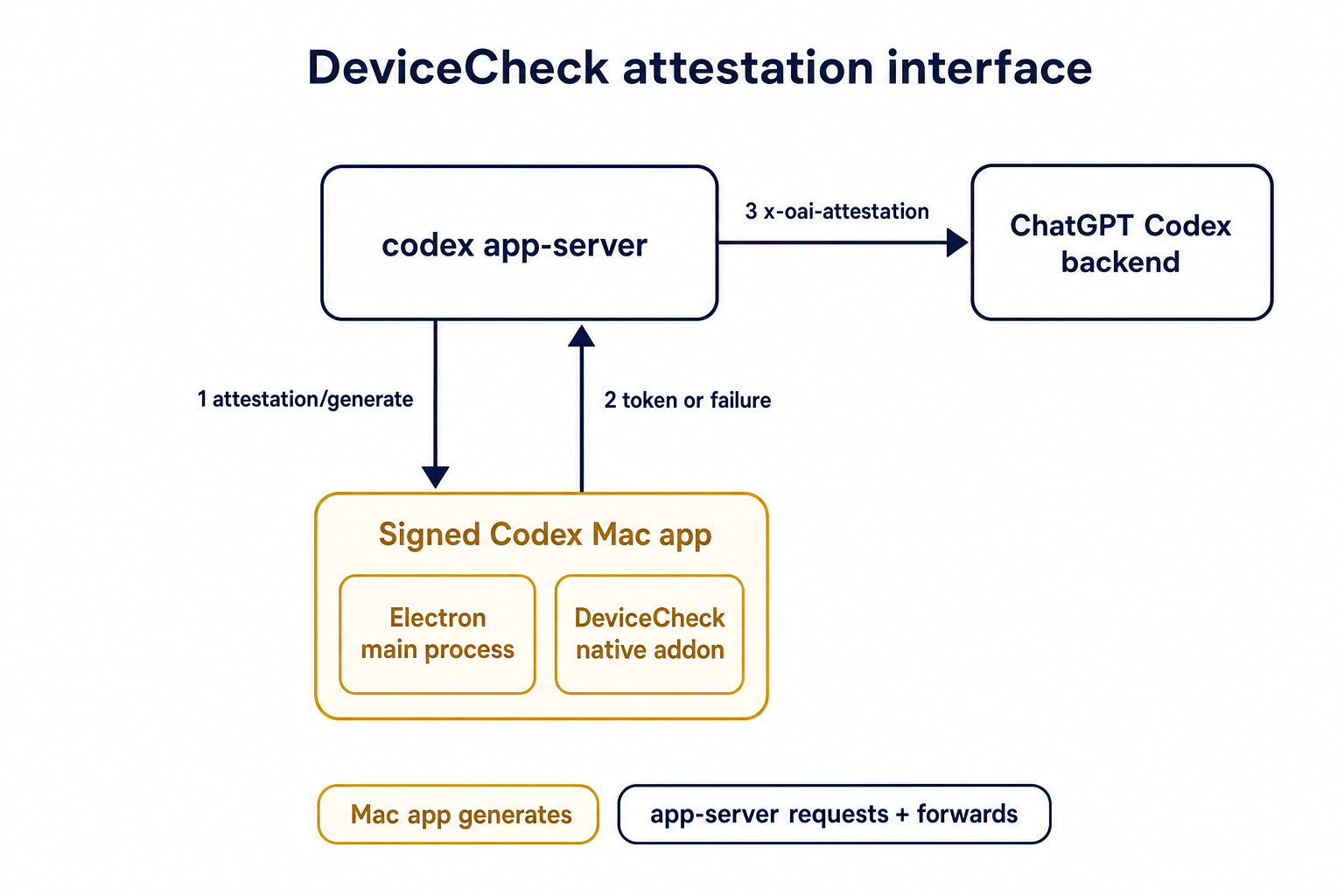
  • [codex] request desktop attestation from app (#20619)
    ## Summary
    
    TL;DR: teaches `codex-rs` / app-server to request a desktop-provided
    attestation token and attach it as `x-oai-attestation` on the scoped
    ChatGPT Codex request paths.
    
    ![DeviceCheck attestation
    interface](https://raw.githubusercontent.com/openai/codex/dev/jm/devicecheck-diagram-assets/pr-assets/devicecheck-attestation-interface.png)
    
    ## Details
    
    This PR teaches the Codex app-server runtime how to request and attach
    an attestation token. It does not generate DeviceCheck tokens directly;
    instead, it relies on the connected desktop app to advertise that it can
    generate attestation and then asks that app for a fresh header value
    when needed.
    
    The flow is:
    
    1. The Codex desktop app connects to app-server.
    2. During `initialize`, the app can advertise that it supports
    `requestAttestation`.
    3. Before app-server calls selected ChatGPT Codex endpoints, it sends
    the internal server request `attestation/generate` to the app.
    4. app-server receives a pre-encoded header value back.
    5. app-server forwards that value as `x-oai-attestation` on the scoped
    outbound requests.
    
    The code in this repo is mostly protocol and runtime plumbing: it adds
    the app-server request/response shape, introduces an attestation
    provider in core, wires that provider into Responses / compaction /
    realtime setup paths, and covers the intended scoping with tests. The
    signed macOS DeviceCheck generation remains owned by the desktop app PR.
    
    ## Related PR
    
    - Codex desktop app implementation:
    https://github.com/openai/openai/pull/878649
    
    ## Validation
    
    <details>
    <summary>Tests run</summary>
    
    ```sh
    cargo test -p codex-app-server-protocol
    cargo test -p codex-core attestation --lib
    cargo test -p codex-app-server --lib attestation
    ```
    
    Also ran:
    
    ```sh
    just fix -p codex-core
    just fix -p codex-app-server
    just fix -p codex-app-server-protocol
    just fmt
    just write-app-server-schema
    ```
    
    </details>
    
    <details>
    <summary>E2E DeviceCheck validation</summary>
    
    First validated the signed desktop app boundary directly: launched a
    packaged signed `Codex.app`, sent `attestation/generate`, decoded the
    returned `v1.` attestation header, and validated the extracted
    DeviceCheck token with `personal/jm/verify_devicecheck_token.py` using
    bundle ID `com.openai.codex`. Apple returned `status_code: 200` and
    `is_ok: true`.
    
    Then ran the fuller app + app-server flow. The packaged `Codex.app`
    launched a current-branch app-server via `CODEX_CLI_PATH`, and a local
    MITM proxy intercepted outbound `chatgpt.com` traffic. The app-server
    requested `attestation/generate` from the real Electron app process, and
    the intercepted `/backend-api/codex/responses` traffic included
    `x-oai-attestation` on both routes:
    
    ```text
    GET  /backend-api/codex/responses  Upgrade: websocket  x-oai-attestation: present
    POST /backend-api/codex/responses  Upgrade: none       x-oai-attestation: present
    ```
    
    The captured header decoded to a DeviceCheck token that also validated
    with Apple for `com.openai.codex` (`status_code: 200`, `is_ok: true`,
    team `2DC432GLL2`).
    
    </details>
    
    ---------
    
    Co-authored-by: Codex <noreply@openai.com>