## Why

When `Feature::TokenBudget` is enabled, compaction should behave like
`new_context`: start a fresh context window with the standard injected
context, without asking the server to summarize old history and without
carrying prior user or assistant messages into the next model request.

This is still a compaction operation from the client lifecycle
perspective. Manual `/compact` and auto-compaction should keep the same
observable side effects that clients and hooks expect, including compact
hooks and `TurnItem::ContextCompaction`.

## What changed

- Added `compact_token_budget` to run token-budget manual and inline
auto-compaction through a shared compaction lifecycle.
- Split pending `new_context` requests from forced context-window
startup: `take_new_context_window_request()` consumes pending requests,
and `start_new_context_window()` installs a fresh context window.
- Routed token-budget manual `/compact` and inline auto-compaction to
install a fresh context window locally instead of calling server/local
summarization.
- Preserved compact lifecycle side effects for token-budget compaction
by running pre/post compact hooks and emitting `ContextCompaction` item
start/completion events.
- Updated token-budget tests to assert fresh window IDs, absence of
server-side compaction calls, dropped prior transcript messages/tool
output after reset, and compact hook/item lifecycle behavior.

## Testing

- `just test -p codex-core
token_budget_context_uses_new_window_after_compaction`
- `just test -p codex-core token_budget_compaction_runs_compact_hooks`
- `just test -p codex-core
token_budget_mid_turn_auto_compaction_resets_before_active_follow_up`

---------

Co-authored-by: pakrym-oai <pakrym@openai.com>
## Why

PR #29494 made context-window IDs visible to the model by wrapping the
token-budget window payload in `<context_window>`, but rollout JSONL
consumers still could not see the initial window identity by tailing the
session file. Compacted rollout items carry window IDs only after
compaction has happened, so a session with no compaction had no durable
JSONL record for window 0.

This change gives tailing consumers a stable initial-window record at
session creation time.

## What Changed

- Added `session_meta.context_window.window_id` for the initial
context-window identity.
- `CreateThreadParams` now requires `initial_window_id: String`, so
thread-store callers cannot accidentally create new threads without
window-0 metadata.
- Live thread creation derives the persisted initial window ID from the
same `AutoCompactWindowIds` used to initialize `SessionState`, keeping
runtime state and JSONL metadata aligned.
- Rollout reconstruction uses `session_meta.context_window.window_id` as
the initial-window fallback and derives `window_number = 0`,
`first_window_id = window_id`, and `previous_window_id = None`
internally.
- Fork reconstruction intentionally uses the same rollout reconstruction
path; consumers that need to distinguish copied initial-window metadata
can use the rollout `thread_id`.
- Legacy compactions without `window_number` still use compaction-count
fallback accounting instead of being reset to window 0 by the
initial-window fallback.
- Compacted rollout metadata still takes precedence once compaction
records exist, preserving the richer chain fields there.

## JSONL Shape

Real rollout JSONL is one object per line. This example is expanded for
readability, but shows the new initial `session_meta.context_window`
record followed by the existing compacted rollout item shape that also
carries window IDs:

```jsonl
{
  "timestamp": "2026-06-22T12:00:00.000Z",
  "type": "session_meta",
  "payload": {
    "session_id": "<THREAD_ID>",
    "id": "<THREAD_ID>",
    "timestamp": "2026-06-22T12:00:00.000Z",
    "cwd": "/repo",
    "originator": "codex",
    "cli_version": "0.0.0",
    "source": "cli",
    "model_provider": "<MODEL_PROVIDER>",
    "context_window": {
      "window_id": "<INITIAL_WINDOW_ID>"
    }
  }
}
...
{
  "timestamp": "2026-06-22T12:34:56.000Z",
  "type": "compacted",
  "payload": {
    "message": "<COMPACTION_SUMMARY>",
    "replacement_history": [
      "..."
    ],
    "window_number": 1,
    "first_window_id": "<INITIAL_WINDOW_ID>",
    "previous_window_id": "<INITIAL_WINDOW_ID>",
    "window_id": "<NEXT_WINDOW_ID>"
  }
}
```

The nested `context_window` object is intentional: it gives rollout
consumers a stable namespace for context-window metadata while only
writing the non-derivable initial `window_id`. For the initial window,
`window_number`, `first_window_id`, and `previous_window_id` are derived
internally instead of being written to the rollout.

## Verification

- `just test -p codex-protocol`
- `just test -p codex-rollout
recorder_materializes_on_flush_with_pending_items`
- `just test -p codex-core reconstruct_history`
- `just test -p codex-core
record_initial_history_reconstructs_forked_transcript`
- `just test -p codex-thread-store`
- `just test -p codex-state`
- `just test -p codex-app-server
thread_read_returns_summary_without_turns`
- `just test -p codex-rollout persistence_metrics`
## Why

The token-budget feature reports coarse remaining-context milestones,
but it does not give the model a configurable wrap-up prompt before
automatic compaction. A strict threshold-crossing check can also miss
resumed or reconfigured windows that are already inside the threshold.

## What changed

- Add structured `[features.token_budget]` configuration for an absolute
`reminder_threshold_tokens` and bounded `reminder_message_template`;
`{n_remaining}` is expanded when the reminder is delivered.
- Compute remaining tokens against the next effective auto-compaction
boundary, including scoped `body_after_prefix` accounting and the full
context-window limit.
- Make reminder delivery level-triggered before and after sampling, with
one-shot state owned by `AutoCompactWindow` and re-armed on compaction,
`new_context`, restore, or history replacement.
- Leave the existing initial full-window token-budget context, 25/50/75%
notices, and token-budget tools unchanged.
- Persist the resolved feature configuration in the session config lock
and regenerate the config schema.

## Validation

- `just test -p codex-core token_budget`
- `just test -p codex-core
token_budget_reminder_emits_after_crossing_compaction_threshold`
- `just test -p codex-core auto_compact_window`
- `just test -p codex-core
lock_contains_prompts_and_materializes_features`
- `just test -p codex-features`
- `just test -p codex-config`
## Why

The rendered `<token_budget>` fragment identifies the thread and current
context window, but it does not expose enough lineage to identify the
first window in the thread or the immediately preceding window. Those
IDs also need to remain stable across compaction, resume, and rollback.

## What changed

- Track first, previous, and current UUIDv7 context-window IDs in
auto-compaction state.
- Render `thread_id`, `first_window_id`, `previous_window_id`, and the
current window ID in the full `<token_budget>` fragment.
- Persist the first and previous window IDs in compacted rollout
checkpoints and restore them during rollout reconstruction.
- Preserve compatibility with older compacted records that do not
contain the new optional fields.
- Update focused state, rendering, reconstruction, rollback, and
serialization coverage.

## Validation

- `just test -p codex-core token_budget`
- `just test -p codex-protocol compacted_item::tests`
- `just test -p codex-core tracks_prefill_and_window_boundaries`
- `just test -p codex-core
reconstruct_history_uses_replacement_history_verbatim`
- `just test -p codex-core
thread_rollback_restores_cleared_reference_context_item_after_compaction`
## Why

The token-budget context currently identifies a context window by its
thread-local sequence number. A UUIDv7 gives the model a stable opaque
identity that remains fixed for a window and rotates when compaction or
`new_context` starts the next one.

## What changed

- Preserve the existing monotonic value as `window_number` and add a
UUIDv7 `window_id` to `CompactedItem`.
- Generate and rotate the UUID with auto-compaction window state,
persist it alongside the number, and reconstruct it on resume and
rollback.
- Accept legacy compacted rollout records where the numeric `window_id`
represented the window number.
- Use the UUID only in token-budget context; existing request headers
and metadata continue using `thread_id:window_number`.

## Testing

- `just test -p codex-protocol compacted_item::tests`
- `just test -p codex-core token_budget`
Stacked on #28822.

## Summary

- add a host-injectable current-time provider with a built-in system
implementation
- record UTC developer reminders in history immediately before due model
requests
- keep cadence state per session and force a refresh after compaction

This does NOT include the app server client <-> server clock logic. This
PR is only for the reminder message & system clock that will be used in
prod.

## Testing

- `just test -p codex-core varlatency_`
- `just clippy -p codex-core -p codex-app-server -p codex-mcp-server -p
codex-thread-manager-sample`
- `just fmt`
## Why

Host skill discovery was still exposed as a manager even though it is a
process-owned service shared by sessions, the app-server catalog, and
file-watcher invalidation. The skills extension also consumed an ad hoc
loaded-skills wrapper instead of a named immutable snapshot.

## What changed

- replace `SkillsManager` with concrete `SkillsService`
- make the service cache and return immutable `HostSkillsSnapshot`
values
- migrate the skills extension host provider to the snapshot boundary
- migrate app-server catalog, watcher, and invalidation paths to the
service

This keeps the service limited to host discovery, caching, roots, and
invalidation. Catalog rendering and invocation remain extension
responsibilities for the next stacked change.
## Why

Shell snapshots are currently session-scoped even though shell and cwd
are properties of a selected turn environment. That makes snapshot
refresh depend on separate session-cwd plumbing, prevents retained
environments from retaining their snapshot work, and can make snapshot
construction use a different shell than command execution.

This follows #27955 by making the retained thread-environment service
own environment snapshot lifecycles. Session configuration remains the
requested selection state, while `ThreadEnvironments` remains the source
of successfully resolved environments.

## What changed

- Configure the shell-snapshot builder before initial environment
resolution.
- Start each local environment snapshot task when its `TurnEnvironment`
is built and retain that shared task while environment ID and cwd still
match.
- Inherit retained environment snapshots into spawned child threads.
- Carry the selected `TurnEnvironment` through shell runtimes so
snapshot construction and command execution use the same
environment-specific shell and cwd.
- Load project instructions and warm plugins/skills after initial
environment resolution.
- Continue decoding invalid UTF-8 instruction files lossily without
emitting a startup warning.
- Keep requested selections in `SessionConfiguration`; failed or
duplicate resolutions only affect the resolved environment snapshot.

## Validation

- `cargo check -p codex-core --tests`
- `just test -p codex-home instructions` (6 passed)
- Focused environment, instruction, shell-snapshot, and user-shell tests
(84 passed)
- Focused shell-snapshot, user-shell, and unified-exec tests (126
passed; two event-timing tests passed on retry)
## Why

Selected execution environments are thread-scoped resources, but startup
and turn construction repeatedly resolved their IDs and working
directories. That discarded existing environment handles and shell
metadata even when a selection had not changed.

Session configuration updates also need to affect future turns without
changing the resolved environment set already captured by a running
turn.

## What changed

- Create a `ThreadEnvironments` service inside `Codex` from the spawned
`EnvironmentManager` and raw environment selections, then store it on
`SessionServices`.
- Split service construction from `update_selections`, allowing session
configuration updates to mutate the resolved set in place.
- Retain an existing `TurnEnvironment` when its environment ID and
working directory match; resolve only added or changed selections and
remove selections that are no longer present.
- Normalize duplicate IDs by keeping the first selection and skip
individual selections that fail to resolve instead of rejecting the
entire update.
- Give each `TurnContext` a cloned `TurnEnvironmentSnapshot`, so later
session configuration updates affect future turns without rewriting an
active turn.
- Reuse the service-owned environment manager and resolved snapshot for
startup work, MCP initialization, and child-thread spawning instead of
flowing resolved environments through spawn arguments.

## Test plan

- `cargo check -p codex-core --tests`
- `just test -p codex-core environment_selection`
- `just test -p codex-core turn_environments`
- `just test -p codex-core
session_update_settings_does_not_rewrite_sticky_environment_cwds`
- `just test -p codex-core
default_turn_does_not_overlay_legacy_fallback_cwd_onto_stored_thread_environments`
## Why

Tool router construction rebuilds the deferred-tool BM25 index during
session initialization and before each sampling continuation, even when
the searchable tool metadata is unchanged. Local profiling measured
`append_tool_search_executor` at roughly 113 ms per continuation, making
repeated index construction the largest measured router-building cost.

## What changed

- Add a session-scoped `ToolSearchHandlerCache` so continuations and
user turns can reuse the existing handler.
- Key reuse on the complete ordered `Vec<ToolSearchInfo>`, rebuilding
when searchable text, loadable tool specs, source metadata, or ordering
changes.
- Build handlers outside the cache lock and recheck before publishing
them, avoiding holding the mutex during index construction.

## Verification

- `cache_reuses_identical_search_infos_and_rebuilds_changed_inputs`
covers exact cache reuse and invalidation when the ordered search
metadata changes.
- Local rollout profiling showed the initial router build populating the
cache and unchanged later continuations reusing it:
  - uncached: 118 ms median across 14 spans from 3 rollouts
  - cached: 4 ms median across 12 spans from 3 rollouts
## Why

Shell snapshot lifecycle state was split between `Shell` and
`SessionServices`: `Shell` carried the receiver while session code
exposed and forwarded the raw sender. That coupled shell identity to
mutable snapshot state and made refresh, inheritance, and file lifetime
harder to reason about.

## What changed

- make each `Arc<ShellSnapshot>` represent one cwd-specific snapshot
generation
- store the active generation in `SessionServices` with `ArcSwapOption`
- have construction start the background build and expose only a
cwd-validated snapshot path
- use `ShellSnapshotFile` ownership to delete snapshot files
automatically
- pass snapshot paths explicitly to shell runtimes instead of storing
snapshot state on `Shell`
- preserve inherited and in-flight generations by pinning their `Arc`
while they are in use

## Test plan

- `cargo check -p codex-core --lib`
- `just test -p codex-core 'shell_snapshot::tests'`
- `just test -p codex-core
shell_command_snapshot_still_intercepts_apply_patch`
- `just test -p codex-core
shell_snapshot_deleted_after_shutdown_with_skills`
## Why

`selectedCapabilityRoots` belongs to one thread, but MCP contributors
previously received only the global Codex config. That left no clean way
for a selected executor capability to contribute MCP servers to its own
thread.

## What this PR does

- Gives MCP contributors a small context containing the config and, for
a running thread, its frozen host-seeded inputs.
- Uses the same thread inputs during startup, status queries, refreshes,
and skill dependency checks.
- Keeps threadless MCP operations and the existing hosted Apps behavior
unchanged.
- Adds coverage showing that two threads resolve independent
registrations and that later lifecycle mutations do not change the
frozen MCP inputs.

This PR does not discover plugin manifests, add MCP servers, or launch
anything new. It only establishes the thread-scoped registration
boundary.

## Follow-ups

- Resolve selected executor plugin roots through their owning
environment filesystem.
- Convert their stdio MCP declarations into environment-bound
registrations and add an executor MCP end-to-end test.

## Verification

- `just fmt`
- `cargo check --tests -p codex-protocol -p codex-extension-api -p
codex-mcp-extension -p codex-core -p codex-app-server`

Tests and Clippy were not run.
## Why

#27198 made the extension-owned `codex_apps` MCP connection the hosted
plugin runtime, but its `mcp/skill` resources still bypassed the skills
extension. App-server could list and read those resources through
generic MCP APIs, but a thread with no selected environment did not
expose them in the model's skills catalog or load their `SKILL.md`
through `$skill`.

Hosted skills should stay remote while using the same typed catalog,
source authority, deduplication, bounded contextual catalog, and
selected-skill prompt injection as host and executor skills. They should
not be downloaded or exposed as ambient filesystem paths.

## What changed

- Add a session-scoped `McpResourceClient` over the replaceable MCP
connection manager so resource list/read calls follow startup and
refresh replacements.
- Add a `BackendSkillProvider` that pages `codex_apps` resources,
accepts bounded and validated `mcp/skill` entries, and reads a selected
skill's `SKILL.md` through the same MCP connection.
- Register the remote provider in app-server and include it in the
skills catalog even when a thread has no selected capability roots or
executor.
- Contribute hosted skill metadata through the bounded
`AvailableSkillsInstructions` developer-context path, exclude remote
entries from per-turn catalog injection, and classify `<skills>`
messages as contextual developer content so rollback can trim and
rebuild them correctly.

## Testing

- Extend the app-server MCP resource integration test with
`environments: []` to exercise two-page discovery, filter a
non-`mcp/skill` resource, verify the escaped developer catalog entry and
user-role `<skill>` fragment containing the fetched `SKILL.md`, and
preserve generic MCP resource reads.
- Add core event-mapping coverage that classifies `<skills>` developer
messages as contextual history.
## Why

The token budget feature tells the model how much room remains in the
current context window. When the model decides the current window is no
longer useful, it needs a way to ask Codex to start over with a fresh
context window without spending tokens on a compaction summary.

This PR adds that model-requestable escape hatch on top of #27438.

## What changed

- Added a direct-model-only `new_context` tool behind
`Feature::TokenBudget`.
- Stores the tool request on `AutoCompactWindow` and consumes it after
sampling so the next follow-up request in the same turn starts in the
new window.
- Starts the new window as a no-summary compaction checkpoint that
contains only fresh initial context, not preserved conversation history.
- Keeps the new window aligned with token-budget startup context,
including the `Current context window Z` message.
- Added integration coverage and a snapshot showing the same-turn
`new_context` flow into a fresh full-context follow-up request.

## Validation

- `just test -p codex-core token_budget`
## Why

Compaction window identity is part of session history, not model-client
transport state. Persisting it with the compacted rollout item lets
resumed threads continue from the reconstructed window without keeping
mutable window state on `ModelClient`.

## What changed

- Added `window_id` to `CompactedItem` and stamp it when
`replace_compacted_history` installs compacted history.
- Moved auto-compact window id ownership into `AutoCompactWindow` /
`SessionState`; `ModelClient` now receives the request window id from
callers instead of storing it.
- Returned `window_id` from rollout reconstruction for resume.
Reconstruction uses the newest surviving compacted item's stored
`window_id` when present, and falls back to the legacy compacted-item
count when it is absent.
- Kept fork startup at the fresh default window id and updated direct
model-client tests to pass explicit test window ids.

## Validation

- `cargo check -p codex-core --tests`
## Summary

We originally addressed startup prewarming holding the read side of
`RwLock<McpConnectionManager>` by snapshotting tool-list state. Review
feedback identified the broader ownership problem: the outer
synchronization should only publish or retrieve the current manager,
while MCP operations rely on the manager's internal synchronization. A
follow-up preserved operation retirement with a separate gate, but
further review questioned whether that synchronization was actually
required and whether we could support latest-wins replacement instead.

This PR now stores the current MCP manager in `ArcSwap`. Each operation
uses `load_full()` to obtain an owned `Arc<McpConnectionManager>`, then
performs MCP I/O without retaining the publication mechanism. Refresh
cancels obsolete startup work, constructs a replacement, and atomically
publishes it. New operations see the latest manager, while operations
that already loaded the previous manager retain a valid handle. Refresh
happens at a turn boundary, so there should be no active user tool calls
to drain.

Git history supports dropping the outer `RwLock`. It was introduced in
`03ffe4d595` on November 17, 2025 for non-blocking MCP startup: the
session published an empty manager, startup initialized that same object
while holding the write lock, and readers waited for initialization.
`7cd2e84026` on February 19, 2026 removed that two-phase initialization
in favor of constructing a fresh manager and swapping it in, explicitly
noting that `Option` or `OnceCell` could replace the placeholder design.
Hot reload later reused the existing lock to publish a replacement, but
I found no indication that the lock was introduced to guarantee
in-flight tool calls finish before refresh or shutdown.

Terminal shutdown remains separate from refresh: it aborts startup
prewarming and active tasks before shutting down the current manager, so
tool calls may be interrupted and no model WebSocket work continues
after shutdown. Focused regression coverage exercises pending tool-list
cancellation, deferred refresh, and startup-prewarm shutdown.
## Why

Required MCP server startup was enforced in `Session::new` after
`McpConnectionManager` had already created the clients. That split let
other manager construction paths bypass the same requirement and exposed
manager internals solely so the session could validate them. Keeping
required-server readiness in the constructor gives every caller one
consistent startup contract.

## What changed

- make `McpConnectionManager::new` return `anyhow::Result<Self>` and
fail when an enabled, required server cannot initialize
- pass the startup cancellation token into the constructor so
required-server waits remain cancellable
- propagate constructor failures through resource reads, connector
discovery, and MCP status collection
- preserve the active manager and cancellation token when a refreshed
replacement fails
- keep required-startup failure collection private and cover the
constructor error contract directly

## Validation

- updated the focused connection-manager test to assert the complete
required-server startup error
- local tests not run; relying on CI
## Why

Multi-Agent V2 concurrency should count active non-root turns, not
resident or durable agent threads. The limit is intentionally best
effort: admission checks are synchronous, but concurrent successful
checks may overshoot slightly.

## What changed

- Keep one root-derived execution limit on the shared `AgentControl`.
- Count active V2 subagent turns with an RAII guard owned by
`RunningTask`.
- Check capacity before spawning or starting an idle agent, including
direct app-server `turn/start` submissions.
- Preserve queued delivery for agents that are already running.
- Exempt automatic idle continuations so `/goal` work is not dropped
when capacity is temporarily full.
- Keep root and V1 turns outside this limiter.

## Test coverage

- `execution_guards_count_active_v2_subagent_turns`
- `execution_guards_ignore_root_and_v1_turns`
- `v2_nested_spawn_checks_shared_active_execution_capacity`
## Stack

1. This PR (#25850) - Key request-permission grants by environment:
stores and applies sticky permission grants per environment id.
2. #25858 - Add `environmentId` to `request_permissions`: lets the model
target a selected environment and resolves relative permission paths
against it.
3. #25862 - Propagate permission approval environment id: carries the
selected environment id through approval events, app-server requests,
TUI prompts, and delegate forwarding.
4. #25867 - Add remote request permissions integration coverage:
verifies the selected remote environment across request, approval, grant
reuse, and exec.

#25858, #25862, and #25867 are stacked on this PR and should be reviewed
after it.

## Why

Multi-environment CCA turns can attach both local and remote executors,
but request-permission grants were still effectively cwd-only. Pending
permission requests tracked a cwd, while stored turn/session grants had
no environment identity, so sticky grants could be reused through the
wrong executor context.

This makes the first permission-grant step environment-aware without
changing the external `request_permissions` payload shape: omitted
environment targeting remains bound to the primary turn environment.

## What Changed

- Store turn- and session-scoped request-permission grants by
`environment_id`.
- Keep the selected `TurnEnvironmentSelection` with pending
`request_permissions` calls so approval responses normalize and record
grants against the same environment.
- Resolve relative `request_permissions` file paths against the primary
turn environment cwd instead of deprecated `turn.cwd`.
- Apply sticky grants in `shell`, `exec_command`, and `apply_patch` by
selected environment id while still using the actual tool cwd for
cwd-relative permission materialization.
- Update Guardian and request-permissions coverage for the
environment-keyed grant behavior.

## Testing

Not run locally. Added or updated focused coverage for:

- `request_permission_grants_are_environment_keyed`
-
`request_permissions_tool_resolves_relative_paths_against_primary_environment`
- related Guardian/request-permissions sticky grant tests
## Summary

Enterprise users can have an effective monthly credit limit, but Codex
`/status` currently drops that metadata from the account-usage response.

This change adds the optional `spend_control.individual_limit`
projection to the existing rate-limit snapshot flow. The backend client
reads the monthly limit, app-server exposes it as `individualLimit`, and
the TUI renders a `Monthly credit limit` row through the existing
progress-bar renderer.

When the backend does not return an effective monthly limit, existing
rate-limit behavior is unchanged.

## Existing backend state

The account-usage backend already returns the effective monthly limit
and current usage together:

```json
{
  "spend_control": {
    "reached": false,
    "individual_limit": {
      "limit": "25000",
      "used": "8000",
      "remaining": "17000",
      "used_percent": 32,
      "remaining_percent": 68,
      "reset_after_seconds": 86400,
      "reset_at": 1778137680
    }
  }
}
```

Before this change, Codex projected rolling `primary` and `secondary`
windows plus `credits`. It ignored `spend_control.individual_limit`, so
app-server clients and `/status` could not render the monthly cap.

The updated flow is:

```text
account usage backend
  -> backend-client reads spend_control.individual_limit
  -> existing rate-limit snapshot carries optional individual_limit
  -> app-server exposes optional individualLimit
  -> TUI renders Monthly credit limit
```

## App-server contract

`account/rateLimits/read` and sparse `account/rateLimits/updated`
notifications now include an additive nullable
`rateLimits.individualLimit` field:

```json
{
  "individualLimit": {
    "limit": "25000",
    "used": "8000",
    "remainingPercent": 68,
    "resetsAt": 1778137680
  }
}
```

In an `account/rateLimits/read` response, `null` means no monthly limit
is available. `account/rateLimits/updated` remains a sparse rolling
notification: clients merge available values into their most recent
`account/rateLimits/read` snapshot or refetch. Nullable account metadata
in a rolling notification does not clear a previously observed value.

## Design decisions

- Extend the existing rate-limit snapshot instead of introducing a
separate request or wire-level update protocol.
- Keep the Codex projection narrow: `/status` needs the effective limit,
current usage, remaining percentage, and reset timestamp.
- Render the monthly row through the existing progress-bar renderer,
with one optional detail line for `8,000 of 25,000 credits used`.
- Keep the backend response optional so existing accounts and older
usage states preserve their current behavior.
- Preserve cached monthly metadata when sparse rolling notifications
omit it. Live account-usage reads remain authoritative and can clear a
removed limit.

## Visual evidence

```text
 Monthly credit limit:   [██████████████░░░░░░] 68% left (resets 07:08 on 7 May)
                         8,000 of 25,000 credits used
```

Snapshot:
`codex-rs/tui/src/status/snapshots/codex_tui__status__tests__status_snapshot_includes_enterprise_monthly_credit_limit.snap`

## Testing

Tests: generated app-server schema verification, protocol tests,
backend-client tests, app-server integration coverage, TUI snapshot
coverage, formatting, and workspace lint cleanup.
## Summary

Adds experimental `additionalContext` support to `turn/start` and
`turn/steer` so clients can provide ephemeral external context, such as
browser or automation state, without turning that plumbing into a
visible user prompt or triggering user-prompt lifecycle behavior.

## API Shape

The parameter shape is:

```ts
additionalContext?: Record<string, {
  value: string
  kind: "untrusted" | "application"
}> | null
```

Example:

```json
{
  "additionalContext": {
    "browser_info": {
      "value": "Active tab is CI failures.",
      "kind": "untrusted"
    },
    "automation_info": {
      "value": "CI rerun is in progress.",
      "kind": "application"
    }
  }
}
```

The keys are opaque and caller-defined.

## Context Injection

When provided, accepted entries are inserted into model context as
hidden contextual message items, not as visible thread user-message
items.

`kind: "untrusted"` entries are inserted with role `user`:

```text
<external_${key}>${value}</external_${key}>
```

`kind: "application"` entries are inserted with role `developer`:

```text
<${key}>${value}</${key}>
```

Values are not escaped. Each value is truncated to 1k approximate tokens
before wrapping.

For `turn/start`, accepted additional context is inserted before normal
user input. For `turn/steer`, additional context is merged only when the
steer includes non-empty user input; context-only steers still reject as
empty input.

## Dedupe Strategy

`AdditionalContextStore` lives on session state and stores the latest
complete additional-context map.

Each `turn/start` or non-empty `turn/steer` treats its
`additionalContext` as the current complete set of values. Entries are
injected only when the key is new or the exact entry for that key
changed, including `value` or `kind`. After merging, the store is
replaced with the provided map, so omitted keys are removed from the
retained set and can be injected again later if reintroduced.

Omitting `additionalContext`, passing `null`, or passing an empty object
resets the store to empty and injects nothing.

## What Changed

- Threads experimental v2 `additionalContext` through app-server into
core turn start and steer handling.
- Adds separate contextual fragment types for untrusted user-role
context and application developer-role context.
- Uses pending response input items so additional context can be
combined with normal user input without treating it as prompt text.
- Adds integration coverage for start/steer flow, role routing,
dedupe/reset behavior, deletion/re-add behavior, hook-blocked input
behavior, empty context-only steer rejection, external-fragment marker
matching, and truncation.
## Why

`ActiveTurn` already runs at most one task: starting a task requires
that no task is present, and replacement aborts existing work first.
Representing that state as an `IndexMap` leaves a multi-task shape for a
single-task invariant and makes each lifecycle lookup operate like a
collection lookup.

The slot remains optional because goal continuation uses an empty active
turn as a reservation while deciding whether to start continuation work.

## What changed

- Replace `ActiveTurn.tasks` with `task: Option<RunningTask>`.
- Update task abort/completion, session lookup and steering, input-queue
matching, goal reservation, and network-approval lookup to operate on
the singular slot.
- Mutate the singular task slot directly instead of retaining
collection-era add/remove/take helpers.
- Record token usage on the completing active task span without a
regular-task-only opt-in flag.

## Validation

- `cargo test -p codex-core --lib session::tests::steer_input`
- `cargo test -p codex-core --lib
session::tests::abort_empty_active_turn_preserves_pending_input`
- `cargo test -p codex-core --lib
session::tests::queued_response_items_for_next_turn_move_into_next_active_turn`
- `cargo test -p codex-core --lib
session::tests::active_goal_continuation_runs_again_after_no_tool_turn`
- `cargo test -p codex-core --lib
session::tests::abort_regular_task_emits_turn_aborted_only`
- `cargo test -p codex-core --lib session::input_queue::tests`
## Why

Once a named permission profile is selected, runtime state has to keep
that profile identity intact instead of collapsing back to anonymous
effective permissions. The session refresh path also needs to rebuild
profile-derived network proxy state so active profile switches take
effect consistently.

## What changed

- Preserve the active permission profile through session updates.
- Rebuild profile-derived runtime/network configuration when the active
profile changes.
- Keep the runtime path aligned with the current session configuration
APIs.
- Tighten the affected tests, including the Windows delete-pending
memory-file case that was intermittently tripping CI.

## Stack

1. **This PR**: runtime/session/network propagation for active
permission profiles.
2. [#23708](https://github.com/openai/codex/pull/23708): TUI selection
plumbing and guardrail flow.
3. [#21559](https://github.com/openai/codex/pull/21559): profile-aware
`/permissions` menu and custom profile display.

<img width="1296" height="906" alt="image"
src="https://github.com/user-attachments/assets/077fa3a7-80cb-4925-80b1-d2395018d90a"
/>
# Why

Compaction replaces the live conversation history, so hooks that use
`SessionStart` to re-inject durable model context need a way to run
again after that rewrite.

Related - #19905 adds dedicated compact lifecycle hooks

# What

- add `compact` as a supported `SessionStart` source and matcher value
- change pending `SessionStart` state from a single slot to a small FIFO
queue so `resume` / `startup` / `clear` can be preserved alongside a
later `compact`
- drain all queued `SessionStart` sources before the next model request,
preserving their original order

# Testing

The new integration coverage verifies both the basic `compact` matcher
path and the stacked `resume` -> `compact` case where both hooks
contribute `additionalContext` to the next model turn.
## Why

`model_auto_compact_token_limit` has only been able to budget the full
active context. That makes it hard to set a small "growth since
compaction" budget for sessions that preserve a large carried window
prefix: the preserved prefix can consume the whole budget and force
immediate repeated compaction.

This PR adds an opt-in `body_after_prefix` scope so callers can apply
`model_auto_compact_token_limit` to sampled output and later growth
after the current carried prefix, while still forcing compaction before
the full model context window is exhausted.

## What changed

- Adds `AutoCompactTokenLimitScope` with the existing `total` behavior
as the default and a new `body_after_prefix` mode:
[`config_types.rs`](https://github.com/openai/codex/blob/973806b1cb35792555bead994cb3ed94656eb171/codex-rs/protocol/src/config_types.rs#L24-L37).
- Threads `model_auto_compact_token_limit_scope` through config loading,
`Config`, `core-api`, and app-server v2 schema/TypeScript generation.
- Records the first observed input-token count for a `body_after_prefix`
compaction window and uses it as the baseline when deciding whether the
scoped auto-compaction budget is exhausted:
[`turn.rs`](https://github.com/openai/codex/blob/973806b1cb35792555bead994cb3ed94656eb171/codex-rs/core/src/session/turn.rs#L743-L781).
- Keeps a hard context-window cap in `body_after_prefix`, so scoped
budgeting cannot let the active context overrun the usable window.

## Verification

Added compact-suite coverage for the two key behaviors:
`body_after_prefix` does not re-compact just because the carried prefix
is larger than the scoped budget, and it still compacts when the total
active context reaches the configured context window:
[`compact.rs`](https://github.com/openai/codex/blob/973806b1cb35792555bead994cb3ed94656eb171/codex-rs/core/tests/suite/compact.rs#L3003-L3128).
Deletes the skill env var dependency prompt feature and its runtime
path. env_var entries in skill dependency metadata are now silently
ignored during skill loading.
## Why

Pending model input was split across `Session`, `TurnState`, and the
agent mailbox. That made it easy for new paths to manage queued user
input or mailbox delivery outside the intended ownership boundary.

This PR consolidates the model-facing input lifecycle behind the session
input queue so turn-local pending input, next-turn queued items, and
mailbox delivery coordination are owned in one place.

## What Changed

- Added `session/input_queue.rs` to own pending input queues and mailbox
delivery coordination.
- Removed the standalone `agent/mailbox.rs` channel wrapper and store
mailbox items directly in the input queue.
- Moved pending-input mutations off `TurnState`; `TurnState` now exposes
the queue-owned storage directly for now.
- Routed abort cleanup, mailbox delivery phase changes, next-turn queued
items, and active-turn pending input through `InputQueue`.
- Boxed stack-heavy agent resume/fork startup futures that the refactor
pushed over the default test stack.
- Updated session, task, goal, stream-event, and multi-agent call sites
and tests to use the new queue ownership.

## Verification

- `cargo test -p codex-core --lib agent::control::tests`
- `cargo test -p codex-core --lib
agent::control::tests::resume_closed_child_reopens_open_descendants --
--exact`
- `cargo test -p codex-core --lib
agent::control::tests::spawn_agent_fork_last_n_turns_keeps_only_recent_turns
-- --exact`
- `cargo test -p codex-core --lib
agent::control::tests::resume_thread_subagent_restores_stored_nickname_and_role
-- --exact`
- `cargo test -p codex-core` was also run; it completed with 1814
passed, 4 ignored, and one timeout in
`agent::control::tests::resume_thread_subagent_restores_stored_nickname_and_role`,
which passed when rerun in isolation.
## Summary
- carry the per-turn extension data through RunningTask so abort
handling can rebuild SessionTaskContext
- update stale test ExtensionData::new() callsites to pass the turn id

## Testing
- Not run after PR branch creation; CI will cover.
## Summary
- add a scoped level_id to ExtensionData and expose it through
level_id()
- remove thread_id/turn_id parameters from extension contributor inputs
where the scoped ExtensionData already carries that identity
- move turn-scoped extension data onto TurnContext so token usage and
lifecycle contributors can share the same turn store

## Testing
- cargo check -p codex-extension-api -p codex-core --tests
- cargo test -p codex-extension-api
- cargo test -p codex-guardian
- cargo test -p codex-core --lib
record_token_usage_info_notifies_extension_contributors
- cargo test -p codex-core --lib
submission_loop_channel_close_emits_thread_stop_lifecycle
- cargo test -p codex-core --lib
submission_loop_channel_close_aborts_active_turn_before_thread_stop_lifecycle
- just fix -p codex-extension-api
- just fix -p codex-guardian
- just fix -p codex-core
- just fmt

## Note
- Attempted cargo test -p codex-core; it aborted in
agent::control::tests::spawn_agent_fork_last_n_turns_keeps_only_recent_turns
with the existing stack overflow before the full suite completed.
## Why

Extensions can already contribute prompt, tool, turn-item, and
thread-lifecycle behavior, but there was no explicit host-owned hook for
per-turn setup and cleanup. That makes extension-private turn state
awkward: an extension either has to stash it outside the turn lifecycle
or depend on core runtime objects.

This adds a small turn lifecycle boundary. Extensions receive stable
identifiers plus the existing session, thread, and turn `ExtensionData`
stores, while core keeps owning task scheduling, cancellation, and turn
teardown.

## What Changed

- Added `TurnLifecycleContributor` with `on_turn_start`, `on_turn_stop`,
and `on_turn_abort` callbacks in `codex-rs/ext/extension-api`.
- Added typed `TurnStartInput`, `TurnStopInput`, and `TurnAbortInput`
payloads that expose `thread_id`, `turn_id`, `session_store`,
`thread_store`, and `turn_store`.
- Registered and re-exported turn lifecycle contributors through
`ExtensionRegistry` and `ExtensionRegistryBuilder`.
- Wired `Session` to emit turn start, stop, and abort callbacks from the
existing turn/task lifecycle paths.
- Carried the turn-scoped `ExtensionData` through `RunningTask` and
`RemovedTask` so stop/abort callbacks receive the same turn store
created at turn start.

## Verification

- Not run locally.
## Why

[#21736](https://github.com/openai/codex/pull/21736) introduces the
typed extension API, but the runtime does not yet carry a registry
through thread/session startup or give contributors host-owned stores to
read from. This PR wires that host-side path so later feature migrations
can move product-specific behavior behind typed contributions without
adding another bespoke seam directly to `codex-core`.

## What changed

- Thread `ExtensionRegistry<Config>` through `ThreadManager`,
`CodexSpawnArgs`, `Session`, and sub-agent spawn paths.
- Wire `ThreadStartContributor` and `ContextContributor`
- Expose the small supporting surface needed by non-core callers that
construct threads directly, including `empty_extension_registry()`
through `codex-core-api`.

This PR lands the host plumbing only: the app-server registry is still
empty, and concrete feature migrations are intended to follow
separately.
## Why

PR #21460 reverted the earlier move of skills change watching from
`codex-core` into app-server. This reapplies that boundary change so
app-server owns client-facing `skills/changed` notifications and core no
longer carries the watcher.

## What

- Restore the app-server `SkillsWatcher` and register it from thread
listener setup.
- Remove the core-owned skills watcher and its core live-reload
integration surface.
- Restore app-server coverage for `skills/changed` notifications after a
watched skill file changes.

## Validation

- `cargo test -p codex-app-server --test all
suite::v2::skills_list::skills_changed_notification_is_emitted_after_skill_change
-- --exact --nocapture`
- `cargo test -p codex-core --lib --no-run`
## Summary
TL;DR: teaches `codex-rs` / app-server to request a desktop-provided
attestation token and attach it as `x-oai-attestation` on the scoped
ChatGPT Codex request paths.
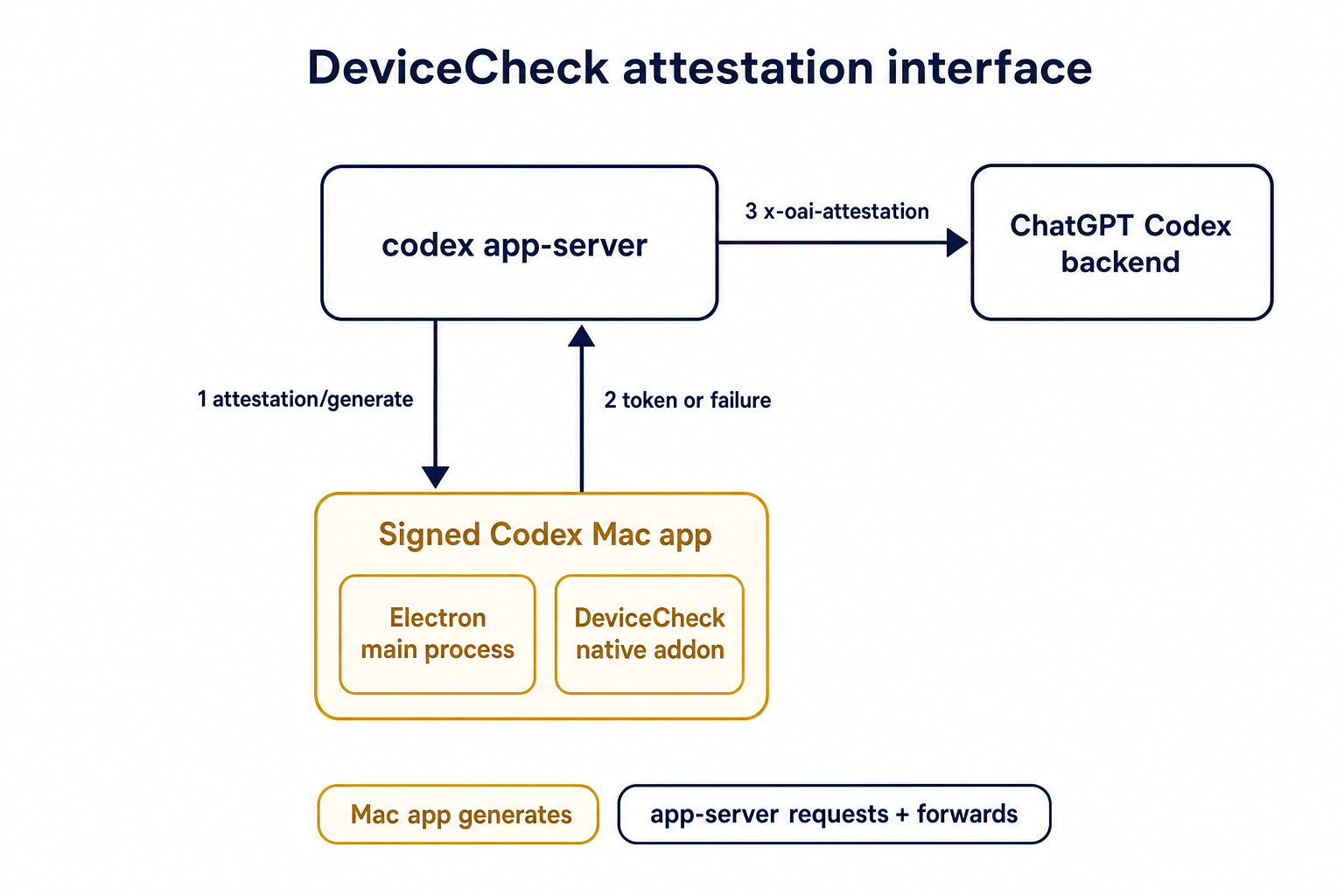
## Details
This PR teaches the Codex app-server runtime how to request and attach
an attestation token. It does not generate DeviceCheck tokens directly;
instead, it relies on the connected desktop app to advertise that it can
generate attestation and then asks that app for a fresh header value
when needed.
The flow is:
1. The Codex desktop app connects to app-server.
2. During `initialize`, the app can advertise that it supports
`requestAttestation`.
3. Before app-server calls selected ChatGPT Codex endpoints, it sends
the internal server request `attestation/generate` to the app.
4. app-server receives a pre-encoded header value back.
5. app-server forwards that value as `x-oai-attestation` on the scoped
outbound requests.
The code in this repo is mostly protocol and runtime plumbing: it adds
the app-server request/response shape, introduces an attestation
provider in core, wires that provider into Responses / compaction /
realtime setup paths, and covers the intended scoping with tests. The
signed macOS DeviceCheck generation remains owned by the desktop app PR.
## Related PR
- Codex desktop app implementation:
https://github.com/openai/openai/pull/878649
## Validation
<details>
<summary>Tests run</summary>
```sh
cargo test -p codex-app-server-protocol
cargo test -p codex-core attestation --lib
cargo test -p codex-app-server --lib attestation
```
Also ran:
```sh
just fix -p codex-core
just fix -p codex-app-server
just fix -p codex-app-server-protocol
just fmt
just write-app-server-schema
```
</details>
<details>
<summary>E2E DeviceCheck validation</summary>
First validated the signed desktop app boundary directly: launched a
packaged signed `Codex.app`, sent `attestation/generate`, decoded the
returned `v1.` attestation header, and validated the extracted
DeviceCheck token with `personal/jm/verify_devicecheck_token.py` using
bundle ID `com.openai.codex`. Apple returned `status_code: 200` and
`is_ok: true`.
Then ran the fuller app + app-server flow. The packaged `Codex.app`
launched a current-branch app-server via `CODEX_CLI_PATH`, and a local
MITM proxy intercepted outbound `chatgpt.com` traffic. The app-server
requested `attestation/generate` from the real Electron app process, and
the intercepted `/backend-api/codex/responses` traffic included
`x-oai-attestation` on both routes:
```text
GET /backend-api/codex/responses Upgrade: websocket x-oai-attestation: present
POST /backend-api/codex/responses Upgrade: none x-oai-attestation: present
```
The captured header decoded to a DeviceCheck token that also validated
with Apple for `com.openai.codex` (`status_code: 200`, `is_ok: true`,
team `2DC432GLL2`).
</details>
---------
Co-authored-by: Codex <noreply@openai.com>
## Why

Skills update notifications are app-server API behavior, but the watcher
lived in `codex-core` and surfaced through
`EventMsg::SkillsUpdateAvailable`. Moving the watcher out keeps core
focused on thread execution and lets app-server own both cache
invalidation and the `skills/changed` notification.

## What changed

- Added an app-server-owned skills watcher that watches local skill
roots, clears the shared skills cache, and emits `skills/changed`
directly.
- Registers skill watches from the common app-server thread listener
attach path, including direct starts, resumes, and app-server-observed
child or forked threads.
- Stores the `WatchRegistration` on `ThreadState`, so listener
replacement, thread teardown, idle unload, and app-server shutdown
deregister by dropping the RAII guard.
- Removed `EventMsg::SkillsUpdateAvailable`, the core watcher, and the
old core live-reload test.
- Extended the app-server skills change test to verify a cached skills
list is refreshed after a filesystem change without forcing reload.

## Validation

- `cargo check -p codex-core -p codex-app-server -p codex-mcp-server -p
codex-rollout -p codex-rollout-trace`
- `cargo test -p codex-app-server
skills_changed_notification_is_emitted_after_skill_change`
## Why

After `hooks/list` exposes the hook inventory, clients need a way to
persist user hook preferences, make those changes effective in
already-open sessions, and distinguish user-controllable hooks from
managed requirements without adding another bespoke app-server write
API.

## What

- Extends `hooks/list` entries with effective `enabled` state.
- Persists user-level hook state under `hooks.state.<hook-id>` so the
model can grow beyond a single boolean over time.
- Uses the existing `config/batchWrite` path for hook state updates
instead of introducing a dedicated hook write RPC.
- Refreshes live session hook engines after config writes so
already-open threads observe updated enablement without a restart.

## Stack

1. openai/codex#19705
2. openai/codex#19778
3. This PR - openai/codex#19840
4. openai/codex#19882

## Reviewer Notes

The generated schema files account for much of the raw diff. The core
behavior is in:

- `hooks/src/config_rules.rs`, which resolves per-hook user state from
the config layer stack.
- `hooks/src/engine/discovery.rs`, which projects effective enablement
into `hooks/list` from source-derived managedness.
- `config/src/hook_config.rs`, which defines the new `hooks.state`
representation.
- `core/src/session/mod.rs`, which rebuilds live hook state after user
config reloads.

---------

Co-authored-by: Codex <noreply@openai.com>
## Why

Slow Codex turns are easier to debug when token usage is visible in the
trace itself, without joining against separate analytics. This adds
token usage to existing turn-handling spans for regular user turns only.

[Example
turn](https://openai.datadoghq.com/apm/trace/9d353efa2cb5de1f4c5b93dc33c3df04?colorBy=service&graphType=flamegraph&shouldShowLegend=true&sort=time&spanID=3555541504891512675&spanViewType=metadata&traceQuery=)
<img width="1447" height="967" alt="Screenshot 2026-04-24 at 3 03 07 PM"
src="https://github.com/user-attachments/assets/ab7bb187-e7fc-41f0-a366-6c44610b2b2c"
/>

## What Changed

Added response-level token fields on completed handle_responses spans:

gen_ai.usage.input_tokens
gen_ai.usage.cache_read.input_tokens
gen_ai.usage.output_tokens
codex.usage.reasoning_output_tokens
codex.usage.total_tokens
Added aggregate token fields on regular turn spans:

codex.turn.token_usage.*
Added an explicit regular-turn opt-in via
SessionTask::records_turn_token_usage_on_span() so this is not coupled
to span-name strings.

## Testing

- `cargo test -p codex-otel`
- `cargo test -p codex-core
turn_and_completed_response_spans_record_token_usage`
- `just fmt`
- `just fix -p codex-core`
- `just fix -p codex-otel`
- Manual local Electron/app-server smoke test: regular user turn emits
the new span fields

Known status: `cargo test -p codex-core` was attempted and failed in
unrelated existing areas: config approvals, request-permissions,
git-info ordering, and subagent metadata persistence.
Adds the core runtime behavior for active goals on top of the model
tools from PR 3.

## Why

A long-running goal should be a core runtime concern, not something
every client has to implement. Core owns the turn lifecycle, tool
completion boundaries, interruptions, resume behavior, and token usage,
so it is the right place to account progress, enforce budgets, and
decide when to continue work.

## What changed

- Centralized goal lifecycle side effects behind
`Session::goal_runtime_apply(GoalRuntimeEvent::...)`.
- Starts goal continuation turns only when the session is idle; pending
user input and mailbox work take priority.
- Accounts token and wall-clock usage at turn, tool, mutation,
interrupt, and resume boundaries; `get_thread_goal` remains read-only.
- Preserves sub-second wall-clock remainder across accounting boundaries
so long-running goals do not drift downward over time.
- Treats token budget exhaustion as a soft stop by marking the goal
`budget_limited` and injecting wrap-up steering instead of aborting the
active turn.
- Suppresses budget steering when `update_goal` marks a goal complete.
- Pauses active goals on interrupt and auto-reactivates paused goals
when a thread resumes outside plan mode.
- Suppresses repeated automatic continuation when a continuation turn
makes no tool calls.
- Added continuation and budget-limit prompt templates.

## Verification

- Added focused core coverage for continuation scheduling, accounting
boundaries, budget-limit steering, completion accounting, interrupt
pause behavior, resume auto-activation, and wall-clock remainder
accounting.
## Why

`PermissionProfile` is becoming the canonical permissions abstraction,
but the old shape only carried optional filesystem and network fields.
It could describe allowed access, but not who is responsible for
enforcing it. That made `DangerFullAccess` and `ExternalSandbox` lossy
when profiles were exported, cached, or round-tripped through app-server
APIs.

The important model change is that active permissions are now a disjoint
union over the enforcement mode. Conceptually:

```rust
pub enum PermissionProfile {
    Managed {
        file_system: FileSystemSandboxPolicy,
        network: NetworkSandboxPolicy,
    },
    Disabled,
    External {
        network: NetworkSandboxPolicy,
    },
}
```

This distinction matters because `Disabled` means Codex should apply no
outer sandbox at all, while `External` means filesystem isolation is
owned by an outside caller. Those are not equivalent to a broad managed
sandbox. For example, macOS cannot nest Seatbelt inside Seatbelt, so an
inner sandbox may require the outer Codex layer to use no sandbox rather
than a permissive one.

## How Existing Modeling Maps

Legacy `SandboxPolicy` remains a boundary projection, but it now maps
into the higher-fidelity profile model:

- `ReadOnly` and `WorkspaceWrite` map to `PermissionProfile::Managed`
with restricted filesystem entries plus the corresponding network
policy.
- `DangerFullAccess` maps to `PermissionProfile::Disabled`, preserving
the “no outer sandbox” intent instead of treating it as a lax managed
sandbox.
- `ExternalSandbox { network_access }` maps to
`PermissionProfile::External { network }`, preserving external
filesystem enforcement while still carrying the active network policy.
- Split runtime policies that legacy `SandboxPolicy` cannot faithfully
express, such as managed unrestricted filesystem plus restricted
network, stay `Managed` instead of being collapsed into
`ExternalSandbox`.
- Per-command/session/turn grants remain partial overlays via
`AdditionalPermissionProfile`; full `PermissionProfile` is reserved for
complete active runtime permissions.

## What Changed

- Change active `PermissionProfile` into a tagged union: `managed`,
`disabled`, and `external`.
- Keep partial permission grants separate with
`AdditionalPermissionProfile` for command/session/turn overlays.
- Represent managed filesystem permissions as either `restricted`
entries or `unrestricted`; `glob_scan_max_depth` is non-zero when
present.
- Preserve old rollout compatibility by accepting the pre-tagged `{
network, file_system }` profile shape during deserialization.
- Preserve fidelity for important edge cases: `DangerFullAccess`
round-trips as `disabled`, `ExternalSandbox` round-trips as `external`,
and managed unrestricted filesystem + restricted network stays managed
instead of being mistaken for external enforcement.
- Preserve configured deny-read entries and bounded glob scan depth when
full profiles are projected back into runtime policies, including
unrestricted replacements that now become `:root = write` plus deny
entries.
- Regenerate the experimental app-server v2 JSON/TypeScript schema and
update the `command/exec` README example for the tagged
`permissionProfile` shape.

## Compatibility

Legacy `SandboxPolicy` remains available at config/API boundaries as the
compatibility projection. Existing rollout lines with the old
`PermissionProfile` shape continue to load. The app-server
`permissionProfile` field is experimental, so its v2 wire shape is
intentionally updated to match the higher-fidelity model.

## Verification

- `just write-app-server-schema`
- `cargo check --tests`
- `cargo test -p codex-protocol permission_profile`
- `cargo test -p codex-protocol
preserving_deny_entries_keeps_unrestricted_policy_enforceable`
- `cargo test -p codex-app-server-protocol
permission_profile_file_system_permissions`
- `cargo test -p codex-app-server-protocol serialize_client_response`
- `cargo test -p codex-core
session_configured_reports_permission_profile_for_external_sandbox`
- `just fix`
- `just fix -p codex-protocol`
- `just fix -p codex-app-server-protocol`
- `just fix -p codex-core`
- `just fix -p codex-app-server`
## Why

`codex-models-manager` had grown to own provider-specific concerns:
constructing OpenAI-compatible `/models` requests, resolving provider
auth, emitting request telemetry, and deciding how provider catalogs
should be sourced. That made the manager harder to reuse for providers
whose model catalog is not fetched from the OpenAI `/models` endpoint,
such as Amazon Bedrock.

This change moves provider-specific model discovery behind
provider-owned implementations, so the models manager can focus on
refresh policy, cache behavior, picker ordering, and model metadata
merging.

## What Changed

- Introduced a `ModelsManager` trait with separate `OpenAiModelsManager`
and `StaticModelsManager` implementations.
- Added `ModelsEndpointClient` so OpenAI-compatible HTTP fetching lives
outside `codex-models-manager`.
- Moved `/models` request construction, provider auth resolution,
timeout handling, and request telemetry into `codex-model-provider` via
`OpenAiModelsEndpoint`.
- Added provider-owned `models_manager(...)` construction so configured
OpenAI-compatible providers use `OpenAiModelsManager`, while
static/catalog-backed providers can return `StaticModelsManager`.
- Added an Amazon Bedrock static model catalog for the GPT OSS Bedrock
model IDs.
- Updated core/session/thread manager code and tests to depend on
`Arc<dyn ModelsManager>`.
- Moved offline model test helpers into
`codex_models_manager::test_support`.
## Metadata References

The Bedrock catalog metadata is based on the official Amazon Bedrock
OpenAI model documentation:

- [Amazon Bedrock OpenAI
models](https://docs.aws.amazon.com/bedrock/latest/userguide/model-parameters-openai.html)
lists the Bedrock model IDs, text input/output modalities, and `128,000`
token context window for `gpt-oss-20b` and `gpt-oss-120b`.
- [Amazon Bedrock `gpt-oss-120b` model
card](https://docs.aws.amazon.com/bedrock/latest/userguide/model-card-openai-gpt-oss-120b.html)
lists the `bedrock-runtime` model ID `openai.gpt-oss-120b-1:0`, the
`bedrock-mantle` model ID `openai.gpt-oss-120b`, text-only modalities,
and `128K` context window.
- [OpenAI `gpt-oss-120b` model
docs](https://developers.openai.com/api/docs/models/gpt-oss-120b)
document configurable reasoning effort with `low`, `medium`, and `high`,
plus text input/output modality.

The display names, default reasoning effort, and priority ordering are
Codex-local catalog choices.

## Test Plan
- Manually verified app-server model listing with an AWS profile:

```shell
CODEX_HOME="$(mktemp -d)" cargo run -p codex-app-server-test-client -- \
  --codex-bin ./target/debug/codex \
  -c 'model_provider="amazon-bedrock"' \
  -c 'model_providers.amazon-bedrock.aws.profile="codex-bedrock"' \
  -c 'model_providers.amazon-bedrock.aws.region="us-west-2"' \
  model-list
```

The response returned the Bedrock catalog with `openai.gpt-oss-120b-1:0`
as the default model and `openai.gpt-oss-20b-1:0` as the second listed
model, both text-only and supporting low/medium/high reasoning effort.
## Summary

Adds the debug CLI entry point for reducing recorded rollout traces.
This gives developers a direct way to inspect whether the emitted trace
stream reduces into the expected conversation/runtime model.

## Stack

This is PR 5/5 in the rollout trace stack.

- [#18876](https://github.com/openai/codex/pull/18876): Add rollout
trace crate
- [#18877](https://github.com/openai/codex/pull/18877): Record core
session rollout traces
- [#18878](https://github.com/openai/codex/pull/18878): Trace tool and
code-mode boundaries
- [#18879](https://github.com/openai/codex/pull/18879): Trace sessions
and multi-agent edges
- [#18880](https://github.com/openai/codex/pull/18880): Add debug trace
reduction command

## Review Notes

This PR is intentionally last: it depends on the trace crate, core
recorder, runtime/tool events, and session/agent edge data all existing.
The command should remain a debug/developer tool and avoid adding new
runtime behavior.

The useful review question is whether the CLI exposes the reducer in the
smallest practical way for local inspection without turning the debug
command into a supported user-facing workflow.
Begin migrating the thread write codepaths to ThreadStore.

This starts using ThreadStore inside of core session code, not only in
the app server code.

Rework the interfaces around thread recording/persistence. We're left
with the following:

* `ThreadManager`: owns the process-level registry of loaded threads and
handles cross-thread orchestration: start, resume, fork, lookup, remove,
and route ops to running CodexThreads.
* `CodexThread`: represents one loaded/running thread from the outside.
It is the handle app-server and callers use to submit ops, inspect
session metadata, and shut the thread down.
* `LiveThread`: session-owned persistence lifecycle handle for one
active thread. Core session code uses it to append rollout items,
materialize lazy persistence, flush, shutdown, discard init-failed
writers, and load that thread’s persisted history.
* `ThreadStore`: storage backend abstraction. It answers “how are
threads persisted, read, listed, updated, archived?” Local and remote
implementations live behind this trait.
* `LocalThreadStore`: local ThreadStore implementation. It owns the
file/sqlite-specific details and keeps RolloutRecorder as a local
implementation detail.

This is a few too many Thread abstractions for my liking, but they do
all represent different concepts / needs / layers.

Migration note: in places where the core code explicitly requires a
path, rather than a thread ID, throw an error if we're running with a
remote store.

Cover the new local live-writer lifecycle with focused tests and
preserve app-server thread-start behavior, including ephemeral pathless
sessions.
## Summary
Allow the user to approve a request_permissions_tool request with the
condition that all commands in the rest of the turn are reviewed by
guardian, regardless of sandbox status.

## Testing
- [x] Added unit tests
- [x] Ran locally
## Summary
Short circuit the convo if auto-review hits too many denials

## Testing
- [x] Added unit tests

---------

Co-authored-by: Codex <noreply@openai.com>
## Summary

Wires rollout trace recording into `codex-core` session and turn
execution. This records the core model request/response, compaction, and
session lifecycle boundaries needed for replay without yet tracing every
nested runtime/tool boundary.

## Stack

This is PR 2/5 in the rollout trace stack.

- [#18876](https://github.com/openai/codex/pull/18876): Add rollout
trace crate
- [#18877](https://github.com/openai/codex/pull/18877): Record core
session rollout traces
- [#18878](https://github.com/openai/codex/pull/18878): Trace tool and
code-mode boundaries
- [#18879](https://github.com/openai/codex/pull/18879): Trace sessions
and multi-agent edges
- [#18880](https://github.com/openai/codex/pull/18880): Add debug trace
reduction command

## Review Notes

This layer is the first live integration point. The important review
question is whether trace recording is isolated from normal session
behavior: trace failures should not become user-visible execution
failures, and recording should preserve the existing turn/session
lifecycle semantics.

The PR depends on the reducer/data model from the first stack entry and
only introduces the core recorder surface that later PRs use for richer
runtime and relationship events.
## Summary

This PR fully reverts the previously merged Agent Identity runtime
integration from the old stack:
https://github.com/openai/codex/pull/17387/changes

It removes the Codex-side task lifecycle wiring, rollout/session
persistence, feature flag plumbing, lazy `auth.json` mutation,
background task auth paths, and request callsite changes introduced by
that stack.

This leaves the repo in a clean pre-AgentIdentity integration state so
the follow-up PRs can reintroduce the pieces in smaller reviewable
layers.

## Stack

1. This PR: full revert
2. https://github.com/openai/codex/pull/18871: move Agent Identity
business logic into a crate
3. https://github.com/openai/codex/pull/18785: add explicit
AgentIdentity auth mode and startup task allocation
4. https://github.com/openai/codex/pull/18811: migrate auth callsites
through AuthProvider

## Testing

Tests: targeted Rust checks, cargo-shear, Bazel lock check, and CI.
## Why

Permission approval responses must not be able to grant more access than
the tool requested. Moving this flow to `PermissionProfile` means the
comparison must be profile-shaped instead of `SandboxPolicy`-shaped, and
cwd-relative special paths such as `:cwd` and `:project_roots` must stay
anchored to the turn that produced the request.

## What changed

This implements semantic `PermissionProfile` intersection in
`codex-sandboxing` for file-system and network permissions. The
intersection accepts narrower path grants, rejects broader grants,
preserves deny-read carve-outs and glob scan depth, and materializes
cwd-dependent special-path grants to absolute paths before they can be
recorded for reuse.

The request-permissions response paths now use that intersection
consistently. App-server captures the request turn cwd before waiting
for the client response, includes that cwd in the v2 approval params,
and core stores the requested profile plus cwd for direct TUI/client
responses and Guardian decisions before recording turn- or
session-scoped grants. The TUI app-server bridge now preserves the
app-server request cwd when converting permission approval params into
core events.

## Verification

- `cargo test -p codex-sandboxing intersect_permission_profiles --
--nocapture`
- `cargo test -p codex-app-server request_permissions_response --
--nocapture`
- `cargo test -p codex-core
request_permissions_response_materializes_session_cwd_grants_before_recording
-- --nocapture`
- `cargo check -p codex-tui --tests`
- `cargo check --tests`
- `cargo test -p codex-tui
app_server_request_permissions_preserves_file_system_permissions`


 rka-oaiandGitHub
 Gabriel PealandGitHub
 jifandGitHub
 mchen-oaiandGitHub
 Charlie MarshandGitHub
 Ahmed IbrahimandGitHub
 efrazer-oaiandGitHub
 viyatb-oaiandGitHub
 AbhinavandGitHub
 xl-openaiandGitHub


 charley-openaiandGitHub
 Eric TrautandGitHub
 Celia ChenandGitHub
 cassirer-openaiandGitHub
 TomandGitHub
 Dylan HurdandGitHub

