Commit Graph

1205 Commits

  • feat: add network proxy feature flag (#20147)
    ## Why
    
    The permissions migration is making
    `permissions.<profile>.network.enabled` the canonical sandbox network
    bit, while proxy startup is a separate concern. Enabling network access
    should not implicitly start the proxy, and users who are still on legacy
    sandbox modes need a separate place to opt into proxy startup and
    provide proxy-specific settings.
    
    This follow-up to #19900 gives the network proxy its own feature surface
    instead of overloading permission-profile network semantics.
    
    ## What changed
    
    - Add an experimental `network_proxy` feature with a configurable
    `[features.network_proxy]` table.
    - Overlay `features.network_proxy` settings onto the configured proxy
    state after permission-profile selection, so the proxy only starts when
    the active `NetworkSandboxPolicy` already allows network access.
    - Preserve `[experimental_network]` startup behavior independently of
    the new feature flag.
    
    ## Behavior and examples
    
    There are now three related knobs:
    
    - `permissions.<profile>.network.enabled` controls whether the active
    permission profile has network access at all.
    - `features.network_proxy` enables proxy restrictions for an
    already-network-enabled profile.
    - Legacy `sandbox_mode` plus `[sandbox_workspace_write].network_access`
    still control whether legacy `workspace-write` has network access at
    all.
    
    The rule is:
    
    - network off + proxy flag on -> network stays off, proxy is a no-op
    - network on + proxy flag off -> unrestricted direct network
    - network on + proxy flag on -> network stays on, with proxy
    restrictions applied
    
    For permission profiles, the feature toggle adds proxy restrictions only
    when network access is already enabled:
    
    ```toml
    default_permissions = "workspace"
    
    [permissions.workspace.filesystem]
    ":minimal" = "read"
    
    [permissions.workspace.network]
    enabled = true
    
    [features]
    network_proxy = true
    ```
    
    If `network.enabled = false`, the same feature flag is a no-op: network
    remains off and the proxy does not start.
    
    For legacy sandbox config, `network_access` remains the master switch:
    
    ```toml
    sandbox_mode = "workspace-write"
    
    [sandbox_workspace_write]
    network_access = true
    
    [features]
    network_proxy = true
    ```
    
    That keeps legacy `workspace-write` network access on, but routes it
    through the proxy policy. If `network_access = false`, the proxy feature
    is a no-op and legacy `workspace-write` remains offline.
    
    The same proxy opt-in can be supplied from the CLI:
    
    ```bash
    codex -c 'features.network_proxy=true'
    ```
    
    Additional proxy settings can be supplied when a table is needed:
    
    ```bash
    codex \
      -c 'features.network_proxy.enabled=true' \
      -c 'features.network_proxy.enable_socks5=false'
    ```
    
    The intended behavior matrix is:
    
    | Config surface | Network setting | `features.network_proxy` | Direct
    sandbox network | Proxy |
    | --- | --- | --- | --- | --- |
    | Permission profile | `network.enabled = false` | off | restricted |
    off |
    | Permission profile | `network.enabled = false` | on | restricted | off
    |
    | Permission profile | `network.enabled = true` | off | enabled | off |
    | Permission profile | `network.enabled = true` | on | enabled | on |
    | Legacy `workspace-write` | `network_access = false` | off | restricted
    | off |
    | Legacy `workspace-write` | `network_access = false` | on | restricted
    | off |
    | Legacy `workspace-write` | `network_access = true` | off | enabled |
    off |
    | Legacy `workspace-write` | `network_access = true` | on | enabled | on
    |
    
    `[experimental_network]` requirements remain separate from the user
    feature toggle and still start the proxy on their own.
    
    Relevant code:
    -
    [`features/src/feature_configs.rs`](https://github.com/openai/codex/blob/43785aff47/codex-rs/features/src/feature_configs.rs#L58-L117)
    defines the feature-specific proxy config.
    -
    [`core/src/config/mod.rs`](https://github.com/openai/codex/blob/43785aff47/codex-rs/core/src/config/mod.rs#L1959-L1964)
    reads the feature table, and [later applies it only when network access
    is already
    enabled](https://github.com/openai/codex/blob/43785aff47/codex-rs/core/src/config/mod.rs#L2448-L2458).
    
    ## Verification
    
    Added focused coverage for:
    - keeping the proxy off when `features.network_proxy` is enabled but
    sandbox network access is disabled
    - the full permission-profile and legacy `workspace-write` matrix above
    - preserving `[experimental_network]` startup without the feature
    - reusing profile-supplied proxy settings when the feature is enabled
    
    Ran:
    - `cargo test -p codex-features`
    - `cargo test -p codex-core network_proxy_feature`
    - `cargo test -p codex-core
    experimental_network_requirements_enable_proxy_without_feature`
  • fix(exec-policy) use is_known_safe_command less (#20305)
    ## Summary
    Restricts behavior of `is_known_safe_command` only to modes where it is
    explicitly part of the documented behavior:
    - when `environment_lacks_sandbox_protections`
    - in `AskForApproval::UnlessTrusted`
    
    Notably, as a result of this, escalations for commands that pass
    `is_known_safe_commands` are no longer auto-approved in
    AskForApproval::OnRequest or AskForApproval::Granular.
    
    ## Testing
    - [x] Updated unit tests
    - [x] Updated approvals scenario tests.
    
    ---------
    
    Co-authored-by: Codex <noreply@openai.com>
  • chore: drop built-in MCPs (#22173)
    Drop something that was never used
  • [codex] Harden overflow auto-compaction recovery (#22141)
    ## Why
    Dogfooder feedback exposed two correctness gaps in normal-loop overflow
    recovery:
    
    1. a sampling request that hit `ContextWindowExceeded` could keep
    re-entering auto-compaction indefinitely if the compacted retry still
    did not fit, and
    2. local compact-history rebuilds flattened user messages down to text,
    so an overflowing `[image, "what is this?"]` turn could be retried
    without the image after compaction.
    
    That means recovery could either fail to terminate cleanly or proceed
    with a materially weakened version of the user request.
    
    ## What changed
    - Move normal-loop `ContextWindowExceeded` handling into the sampling
    retry loop, so successful rescue compaction consumes the provider retry
    budget instead of creating an unbounded outer-turn loop.
    - Keep compacted user-history rebuilds structured:
    `collect_user_messages` now carries user `UserInput` content rather than
    flattened strings, and `build_compacted_history` reconstructs full user
    messages from that structured representation.
    - Preserve image inputs while retaining the existing text-budget
    truncation behavior for compacted user history.
    - Preserve existing compaction-task failure handling and client-session
    reset behavior while bounding repeated overflow retries.
    - Add focused regression coverage for:
      - recovery after a normal-loop overflow,
      - retry-budget exhaustion after repeated overflow,
      - local recovery preserving image + text input,
      - remote recovery preserving image + text input,
      - remote compaction v2 preserving image + text input, and
      - compaction failure still terminating cleanly.
    
    The main behavior changes are in `codex-rs/core/src/session/turn.rs` and
    `codex-rs/core/src/compact.rs`.
    
    ## Verification
    - Not run locally; relying on PR CI for this update.
    
    ---------
    
    Co-authored-by: Codex <noreply@openai.com>
  • Add x-codex-ws-stream-request-start-ms (#22113)
    For capturing client-side timing information.
  • extension: wire extension registries into sessions (#21737)
    ## Why
    
    [#21736](https://github.com/openai/codex/pull/21736) introduces the
    typed extension API, but the runtime does not yet carry a registry
    through thread/session startup or give contributors host-owned stores to
    read from. This PR wires that host-side path so later feature migrations
    can move product-specific behavior behind typed contributions without
    adding another bespoke seam directly to `codex-core`.
    
    ## What changed
    
    - Thread `ExtensionRegistry<Config>` through `ThreadManager`,
    `CodexSpawnArgs`, `Session`, and sub-agent spawn paths.
    - Wire `ThreadStartContributor` and `ContextContributor`
    - Expose the small supporting surface needed by non-core callers that
    construct threads directly, including `empty_extension_registry()`
    through `codex-core-api`.
    
    This PR lands the host plumbing only: the app-server registry is still
    empty, and concrete feature migrations are intended to follow
    separately.
  • tests: cover sandbox link write behavior (#21819)
    ## Why
    
    [PR #1705](https://github.com/openai/codex/pull/1705) moved
    `apply_patch` execution under the configured sandbox and called out the
    need for integration coverage. We already covered textual `../` escapes,
    but did not have coverage for link aliases that live inside a writable
    workspace while pointing at, or aliasing, files visible outside it.
    
    This PR locks in the current sandbox boundary without changing
    production write semantics. Symlink escapes into a read-only outside
    root should fail and leave the outside file unchanged. Existing hard
    links are characterized separately: if a user-created hard link already
    exists inside the writable root, sandboxed writes preserve normal
    hard-link semantics rather than replacing the link and silently breaking
    that relationship.
    
    ## What Changed
    
    - Added
    `apply_patch_cli_does_not_write_through_symlink_escape_outside_workspace`
    to verify `apply_patch` cannot update a symlink that targets a file
    outside the writable workspace.
    - Added `apply_patch_cli_preserves_existing_hard_link_outside_workspace`
    to verify `apply_patch` intentionally writes through an existing hard
    link and does not unlink or replace it.
    - Added `file_system_sandboxed_write_preserves_existing_hard_link` to
    verify sandboxed `fs/writeFile` preserves an existing hard link and
    writes the shared inode.
    
    ## Testing
    
    - `cargo test -p codex-exec-server file_system_sandboxed_write`
    - `cargo test -p codex-core
    apply_patch_cli_does_not_write_through_symlink_escape_outside_workspace`
    - `cargo test -p codex-core
    apply_patch_cli_preserves_existing_hard_link_outside_workspace`
    - `just fix -p codex-exec-server -p codex-core`
    - `just fix -p codex-core`


    ---
    [//]: # (BEGIN SAPLING FOOTER)
    Stack created with [Sapling](https://sapling-scm.com). Best reviewed
    with [ReviewStack](https://reviewstack.dev/openai/codex/pull/21819).
    * #21845
    * __->__ #21819
  • Reapply "Move skills watcher to app-server" (#21652)
    ## Why
    
    PR #21460 reverted the earlier move of skills change watching from
    `codex-core` into app-server. This reapplies that boundary change so
    app-server owns client-facing `skills/changed` notifications and core no
    longer carries the watcher.
    
    ## What
    
    - Restore the app-server `SkillsWatcher` and register it from thread
    listener setup.
    - Remove the core-owned skills watcher and its core live-reload
    integration surface.
    - Restore app-server coverage for `skills/changed` notifications after a
    watched skill file changes.
    
    ## Validation
    
    - `cargo test -p codex-app-server --test all
    suite::v2::skills_list::skills_changed_notification_is_emitted_after_skill_change
    -- --exact --nocapture`
    - `cargo test -p codex-core --lib --no-run`
  • Enable --deny-warnings for cargo shear (#21616)
    ## Summary
    
    In https://github.com/openai/codex/pull/21584, we disabled doctests for
    crates that lack any doctests. We can enforce that property via `cargo
    shear --deny-warnings`: crates that lack doctests will be flagged if
    doctests are enabled, and crates with doctests will be flagged if
    doctests are disabled.
    
    A few additional notes:
    
    - By adding `--deny-warnings`, `cargo shear` also flagged a number of
    modules that were not reachable at all. Some of those have been removed.
    - This PR removes a usage of `windows_modules!` (since `cargo shear` and
    `rustfmt` couldn't see through it) in favor of simple `#[cfg(target_os =
    "windows")]` macros. As a consequence, many of these files exhibit churn
    in this PR, since they weren't being formatted by `rustfmt` at all on
    main.
    - Again, to make the code more analyzable, this PR also removes some
    usages of `#[path = "cwd_junction.rs"]` in favor of a more standard
    module structure. The bin sidecar structure is still retained, but,
    e.g., `windows-sandbox-rs/src/bin/command_runner.rs‎` was moved to
    `windows-sandbox-rs/src/bin/command_runner/main.rs`, and so on.
    
    ---------
    
    Co-authored-by: Codex <noreply@openai.com>
  • [codex] Delete function-style apply_patch (#21651)
    ## Why
    
    `apply_patch` is now a freeform/custom tool. Keeping the old
    JSON/function-style registration and parsing path left another way for
    models and tests to invoke `apply_patch`, which made the tool surface
    harder to reason about.
    
    ## What changed
    
    - Removed the `ApplyPatchToolType::Function` variant, JSON `apply_patch`
    spec, and handler support for function payloads.
    - Kept `apply_patch_tool_type = freeform` as the supported model
    metadata path, including Bedrock catalog metadata.
    - Migrated `apply_patch` tests and SSE fixtures to custom/freeform tool
    calls.
    
    ## Verification
    
    - `cargo test -p codex-tools -p codex-protocol -p codex-model-provider`
    - `cargo test -p codex-core tools::handlers::apply_patch --lib`
    - `cargo test -p codex-core --test all
    apply_patch_tool_executes_and_emits_patch_events`
    - `cargo test -p codex-core --test all
    apply_patch_reports_parse_diagnostics`
    - `cargo test -p codex-exec test_apply_patch_tool`
    - `just fix -p codex-core`
    - `just fix -p codex-tools -p codex-protocol -p codex-model-provider -p
    codex-exec`
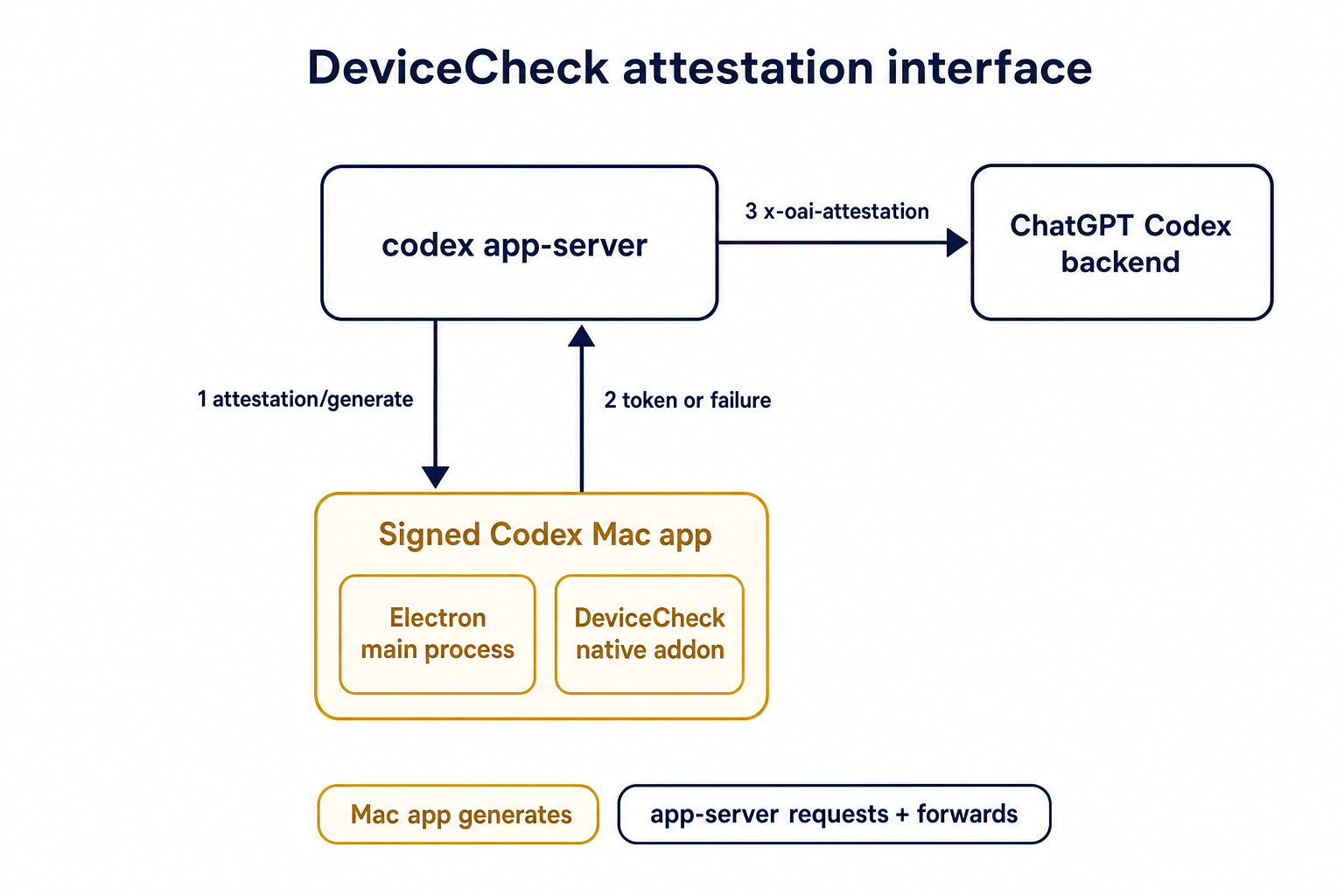
  • [codex] request desktop attestation from app (#20619)
    ## Summary
    
    TL;DR: teaches `codex-rs` / app-server to request a desktop-provided
    attestation token and attach it as `x-oai-attestation` on the scoped
    ChatGPT Codex request paths.
    
    ![DeviceCheck attestation
    interface](https://raw.githubusercontent.com/openai/codex/dev/jm/devicecheck-diagram-assets/pr-assets/devicecheck-attestation-interface.png)
    
    ## Details
    
    This PR teaches the Codex app-server runtime how to request and attach
    an attestation token. It does not generate DeviceCheck tokens directly;
    instead, it relies on the connected desktop app to advertise that it can
    generate attestation and then asks that app for a fresh header value
    when needed.
    
    The flow is:
    
    1. The Codex desktop app connects to app-server.
    2. During `initialize`, the app can advertise that it supports
    `requestAttestation`.
    3. Before app-server calls selected ChatGPT Codex endpoints, it sends
    the internal server request `attestation/generate` to the app.
    4. app-server receives a pre-encoded header value back.
    5. app-server forwards that value as `x-oai-attestation` on the scoped
    outbound requests.
    
    The code in this repo is mostly protocol and runtime plumbing: it adds
    the app-server request/response shape, introduces an attestation
    provider in core, wires that provider into Responses / compaction /
    realtime setup paths, and covers the intended scoping with tests. The
    signed macOS DeviceCheck generation remains owned by the desktop app PR.
    
    ## Related PR
    
    - Codex desktop app implementation:
    https://github.com/openai/openai/pull/878649
    
    ## Validation
    
    <details>
    <summary>Tests run</summary>
    
    ```sh
    cargo test -p codex-app-server-protocol
    cargo test -p codex-core attestation --lib
    cargo test -p codex-app-server --lib attestation
    ```
    
    Also ran:
    
    ```sh
    just fix -p codex-core
    just fix -p codex-app-server
    just fix -p codex-app-server-protocol
    just fmt
    just write-app-server-schema
    ```
    
    </details>
    
    <details>
    <summary>E2E DeviceCheck validation</summary>
    
    First validated the signed desktop app boundary directly: launched a
    packaged signed `Codex.app`, sent `attestation/generate`, decoded the
    returned `v1.` attestation header, and validated the extracted
    DeviceCheck token with `personal/jm/verify_devicecheck_token.py` using
    bundle ID `com.openai.codex`. Apple returned `status_code: 200` and
    `is_ok: true`.
    
    Then ran the fuller app + app-server flow. The packaged `Codex.app`
    launched a current-branch app-server via `CODEX_CLI_PATH`, and a local
    MITM proxy intercepted outbound `chatgpt.com` traffic. The app-server
    requested `attestation/generate` from the real Electron app process, and
    the intercepted `/backend-api/codex/responses` traffic included
    `x-oai-attestation` on both routes:
    
    ```text
    GET  /backend-api/codex/responses  Upgrade: websocket  x-oai-attestation: present
    POST /backend-api/codex/responses  Upgrade: none       x-oai-attestation: present
    ```
    
    The captured header decoded to a DeviceCheck token that also validated
    with Apple for `com.openai.codex` (`status_code: 200`, `is_ok: true`,
    team `2DC432GLL2`).
    
    </details>
    
    ---------
    
    Co-authored-by: Codex <noreply@openai.com>
  • [codex] Generalize service tier slash commands (#21745)
    ## Why
    
    `/fast` was wired as a one-off slash command even though model metadata
    now exposes service tiers as catalog data. That meant adding another
    tier, such as a slower/cheaper tier, would require more hardcoded TUI
    plumbing instead of letting the model catalog drive the available
    commands.
    
    This change makes service-tier commands data-driven: each advertised
    `service_tiers` entry becomes a `/name` command using the catalog
    description, while the request path sends the tier `id` only when the
    selected model supports it.
    
    ## What Changed
    
    - Removed the hardcoded `/fast` slash-command variant and introduced
    dynamic service-tier command items in the composer and command popup.
    - Added toggle behavior for service-tier commands: invoking `/name`
    selects that tier, and invoking it again clears the selection.
    - Preserved the existing Fast-mode keybinding/status affordances by
    resolving the current model tier whose name is `fast`, while still
    sending the tier request value such as `priority`.
    - Persisted service-tier selections as raw request strings so non-fast
    tiers can round-trip through config.
    - Updated the Bedrock catalog entry to advertise fast support through
    `service_tiers` with `id: "priority"` and `name: "fast"`.
    - Added defensive filtering in core so unsupported selected service
    tiers are omitted from `/responses` requests.
    
    ## Validation
    
    - Added/updated coverage for dynamic service-tier slash command lookup,
    popup descriptions, composer dispatch, TUI fast toggling, and
    unsupported-tier omission in core request construction.
    - Local tests were not run per request.
    
    ---------
    
    Co-authored-by: Codex <noreply@openai.com>
  • api: send hyphenated session and thread headers (#21757)
    ## Why
    Some consumers expect conventional hyphenated HTTP headers. Codex
    already sends the session and thread IDs on outbound Responses requests,
    but it only uses the underscore spellings today, which makes those IDs
    harder to consume in systems that normalize or reject underscore header
    names.
    
    Full context here:
    https://openai.slack.com/archives/C08KCGLSPSQ/p1778248578422369
    
    ## What changed
    - `build_session_headers` now emits both `session_id` and `session-id`
    when a session ID is present.
    - It does the same for `thread_id` and `thread-id`.
    - Added regression coverage in `codex-api/tests/clients.rs` and
    `core/tests/suite/client.rs` so both the lower-level client tests and
    the end-to-end request tests assert the two header spellings are
    present.
    
    ## Test plan
    - Added header assertions in `codex-api/tests/clients.rs`.
    - Added request-header assertions in `core/tests/suite/client.rs` for
    both the `/v1/responses` and `/api/codex/responses` request paths.
  • Update models.json (#19896)
    Automated update of models.json.
    
    ---------
    
    Co-authored-by: aibrahim-oai <219906144+aibrahim-oai@users.noreply.github.com>
    Co-authored-by: Ahmed Ibrahim <aibrahim@openai.com>
  • [codex] Enable apply_patch freeform by default (#21687)
    ## Summary
    - enable `apply_patch_freeform` by default in the feature registry
    
    ## Why
    - make the freeform `apply_patch` tool available by default when model
    metadata does not explicitly opt into another mode
    
    ## Validation
    - `just fmt`
    - did not run tests
    
    ---------
    
    Co-authored-by: Codex <noreply@openai.com>
  • Omit service_tier from remote /responses/compact requests under API auth (#21676)
    ## Summary
    
    API-key-auth remote compaction requests should not inherit
    `service_tier` from normal `/responses` turns. This path needs to match
    API auth expectations, while ChatGPT-auth remote compaction should keep
    reusing the shared request fields that still apply there.
    
    This change keeps the decision inline in
    `codex-rs/core/src/compact_remote.rs` only. Under API key auth, the
    classic remote `/responses/compact` path now omits `service_tier`; under
    ChatGPT auth, it keeps reusing the configured tier.
    `codex-rs/core/src/compact_remote_v2.rs` is unchanged. The remote
    compaction parity coverage and snapshots were updated to assert the
    API-key omission and preserve the ChatGPT-auth behavior.
    
    ## Testing
    
    - Updated remote compaction parity coverage in
    `codex-rs/core/tests/suite/compact_remote.rs` and the corresponding
    snapshots.
  • Send response.processed after remote compaction v2 (#21642)
    ## Why
    
    Remote compaction v2 consumes a normal Responses stream, but that
    compaction-specific stream consumer dropped the `response.completed` id.
    As a result, the `responses_websocket_response_processed` lifecycle
    notification was emitted for normal turn sampling but not after a v2
    remote compaction response was fully processed.
    
    ## What changed
    
    - Return the completed response id alongside the v2 `context_compaction`
    output item.
    - After v2 compacted history is installed, send `response.processed`
    through the same websocket session when the feature is enabled.
    - Add websocket regression coverage for a remote compaction v2 request
    followed by `response.processed`.
    
    ## Verification
    
    - `cargo test -p codex-core --test all
    responses_websocket_sends_response_processed_after_remote_compaction_v2
    -- --nocapture`
    - `cargo test -p codex-core
    collect_context_compaction_output_accepts_additional_output_items --
    --nocapture`
  • Add CODEX_HOME environments TOML provider (#20666)
    ## Why
    
    After stdio transports and provider-owned defaults exist, Codex needs a
    config-backed provider that can describe more than the single legacy
    `CODEX_EXEC_SERVER_URL` remote. This PR adds that provider without
    activating it in product entrypoints yet, keeping parser/validation
    review separate from runtime wiring.
    
    **Stack position:** this is PR 4 of 5. It builds on PR 3's
    provider/default model and adds the `environments.toml` provider used by
    PR 5.
    
    ## What Changed
    
    - Add `environment_toml.rs` as the TOML-specific home for parsing,
    validation, and provider construction.
    - Keep the TOML schema/provider structs private; the public constructor
    added here is `EnvironmentManager::from_codex_home(...)`.
    - Add `TomlEnvironmentProvider`, including validation for:
      - reserved ids such as `local` and `none`
      - duplicate ids
      - unknown explicit defaults
      - empty programs or URLs
      - exactly one of `url` or `program` per configured environment
    - Support websocket environments with `url = "ws://..."` / `wss://...`.
    - Support stdio-command environments with `program = "..."`.
    - Add helpers to load `environments.toml` from `CODEX_HOME`, but do not
    wire entrypoints to call them yet.
    - Add the `toml` dependency for parsing.
    
    ## Stack
    
    - 1. https://github.com/openai/codex/pull/20663 - Add stdio exec-server
    listener
    - 2. https://github.com/openai/codex/pull/20664 - Add stdio exec-server
    client transport
    - 3. https://github.com/openai/codex/pull/20665 - Make environment
    providers own default selection
    - **4. This PR:** https://github.com/openai/codex/pull/20666 - Add
    CODEX_HOME environments TOML provider
    - 5. https://github.com/openai/codex/pull/20667 - Load configured
    environments from CODEX_HOME
    
    Split from original draft: https://github.com/openai/codex/pull/20508
    
    ## Validation
    
    Not run locally; this was split out of the original draft stack.
    
    ## Documentation
    
    This introduces the config shape for `environments.toml`; user-facing
    documentation should be added before this stack is treated as a
    documented public workflow.
    
    ---------
    
    Co-authored-by: Codex <noreply@openai.com>
  • Route view_image through selected environments
    Route view_image through selected environments so image reads use the selected turn environment and cwd, with schema exposure limited to multi-environment toolsets.\n\nCo-authored-by: Codex <noreply@openai.com>
  • Disable empty Cargo test targets (#21584)
    ## Summary
    
    `cargo test` has entails both running standard Rust tests and doctests.
    It turns out that the doctest discovery is fairly slow, and it's a cost
    you pay even for crates that don't include any doctests.
    
    This PR disables doctests with `doctest = false` for crates that lack
    any doctests.
    
    For the collection of crates below, this speeds up test execution by
    >4x.
    
    E.g., before this PR:
    
    ```
    Benchmark 1: cargo test     -p codex-utils-absolute-path     -p codex-utils-cache     -p codex-utils-cli     -p codex-utils-home-dir     -p codex-utils-output-truncation     -p codex-utils-path     -p codex-utils-string     -p codex-utils-template     -p codex-utils-elapsed     -p codex-utils-json-to-toml
      Time (mean ± σ):      1.849 s ±  4.455 s    [User: 0.752 s, System: 1.367 s]
      Range (min … max):    0.418 s … 14.529 s    10 runs
    ```
    
    And after:
    
    ```
    Benchmark 1: cargo test     -p codex-utils-absolute-path     -p codex-utils-cache     -p codex-utils-cli     -p codex-utils-home-dir     -p codex-utils-output-truncation     -p codex-utils-path     -p codex-utils-string     -p codex-utils-template     -p codex-utils-elapsed     -p codex-utils-json-to-toml
      Time (mean ± σ):     428.6 ms ±   6.9 ms    [User: 187.7 ms, System: 219.7 ms]
      Range (min … max):   418.0 ms … 436.8 ms    10 runs
    ```
    
    For a single crate, with >2x speedup, before:
    
    ```
    Benchmark 1: cargo test -p codex-utils-string
      Time (mean ± σ):     491.1 ms ±   9.0 ms    [User: 229.8 ms, System: 234.9 ms]
      Range (min … max):   480.9 ms … 512.0 ms    10 runs
    ```
    
    And after:
    
    ```
    Benchmark 1: cargo test -p codex-utils-string
      Time (mean ± σ):     213.9 ms ±   4.3 ms    [User: 112.8 ms, System: 84.0 ms]
      Range (min … max):   206.8 ms … 221.0 ms    13 runs
    ```
    
    Co-authored-by: Codex <noreply@openai.com>
  • fix: preserve exact turn diffs after partial apply_patch failures (#21518)
    ## Why
    
    Follow-up to #21180: turn diffs are operation-backed now, but a failed
    `apply_patch` can still leave exact filesystem mutations behind. For
    example, a move can write the destination file before failing to remove
    the source. Treating the whole call as unknowable then drops a change
    that Codex actually knows happened, so the emitted turn diff can drift
    from the workspace.
    
    ## What changed
    
    -
    [`apply-patch`](https://github.com/openai/codex/blob/f55724e0276a9b3213170daf2701ccfa0ce22646/codex-rs/apply-patch/src/lib.rs#L248-L345)
    now returns `ApplyPatchFailure` with the exact committed prefix
    accumulated before an error. If a write failure may already have mutated
    the target, the delta is marked inexact instead of being reused blindly.
    - Move handling now records the destination write before attempting
    source removal, so a partially failed move can still report the
    destination file that definitely landed
    ([code](https://github.com/openai/codex/blob/f55724e0276a9b3213170daf2701ccfa0ce22646/codex-rs/apply-patch/src/lib.rs#L463-L521)).
    -
    [`ApplyPatchRuntime`](https://github.com/openai/codex/blob/f55724e0276a9b3213170daf2701ccfa0ce22646/codex-rs/core/src/tools/runtimes/apply_patch.rs#L49-L67)
    now accumulates committed deltas across attempts and forwards them even
    when the visible tool result is failed or sandbox-denied ([runtime
    path](https://github.com/openai/codex/blob/f55724e0276a9b3213170daf2701ccfa0ce22646/codex-rs/core/src/tools/runtimes/apply_patch.rs#L223-L250),
    [event
    path](https://github.com/openai/codex/blob/f55724e0276a9b3213170daf2701ccfa0ce22646/codex-rs/core/src/tools/events.rs#L215-L225)).
    - `TurnDiffTracker` now consumes committed exact deltas rather than only
    fully successful patches; exact-empty failures leave the aggregate
    unchanged, while inexact deltas still invalidate it.
    
    ## Verification
    
    - Added a regression test covering a failed move that still emits the
    committed destination diff:
    [`apply_patch_failed_move_preserves_committed_destination_diff`](https://github.com/openai/codex/blob/f55724e0276a9b3213170daf2701ccfa0ce22646/codex-rs/core/tests/suite/apply_patch_cli.rs#L1517-L1586).
    - Kept explicit coverage that an inexact delta clears the aggregate
    instead of publishing a guessed diff:
    [`apply_patch_clears_aggregated_diff_after_inexact_delta`](https://github.com/openai/codex/blob/f55724e0276a9b3213170daf2701ccfa0ce22646/codex-rs/core/tests/suite/apply_patch_cli.rs#L1589-L1655).
    
    ---------
    
    Co-authored-by: Codex <noreply@openai.com>
  • Make turn diff tracking operation backed (#21180)
    ## Summary
    - replace filesystem-based turn diff tracking with an operation-backed
    accumulator
    - preserve enough verified apply_patch state to render move-overwrite
    cases correctly
    - keep the turn/diff/updated contract intact while removing remote-only
    turn-diff test skips
    
    This takes the assumption that no 3P services rely on the output format
    of `apply_patch`
    
    ## Why
    For the CCA file system isolation push
    
    ---------
    
    Co-authored-by: Codex <noreply@openai.com>
  • feat: make built-in MCPs first-class runtime servers (#21356)
    ## DISCLAIMER
    This is experimental and no production service must rely on this
    
    ## Why
    
    Built-in MCPs are product-owned runtime capabilities, but they were
    previously flattened into the same config-backed stdio path as
    user-configured servers. That made them depend on a hidden `codex
    builtin-mcp` re-exec path, exposed them through config-oriented CLI
    flows, and erased distinctions the runtime needs to preserve—most
    notably whether an MCP call should count as external context for
    memory-mode pollution.
    
    ## What changed
    
    - Model product-owned built-ins separately from config-backed MCP
    servers via `BuiltinMcpServer` and `EffectiveMcpServer`.
    - Launch built-ins in process through a reusable async transport instead
    of the hidden `builtin-mcp` stdio subcommand.
    - Keep config-oriented CLI operations such as `codex mcp
    list/get/login/logout` scoped to configured servers, while merging
    built-ins only into the effective runtime server set.
    - Retain server metadata after launch so parallel-tool support and
    context classification come from the live server set; built-in
    `memories` is now classified as local Codex state rather than external
    context.
    
    ## Test plan
    
    - `cargo test -p codex-mcp`
    - `cargo test -p codex-core --test suite
    builtin_memories_mcp_call_does_not_mark_thread_memory_mode_polluted_when_configured`
    
    ---------
    
    Co-authored-by: Codex <noreply@openai.com>
  • Revert state DB injection and agent graph store (#21481)
    ## Why
    
    Reverts #20689 to restore the previous optional state DB plumbing. The
    conflict resolution keeps the newer installation ID and session/thread
    identity changes that landed after #20689, while removing the mandatory
    state DB and agent graph store dependency from ThreadManager
    construction.
    
    ## What changed
    
    - Restored `Option<StateDbHandle>` through app-server, MCP server,
    prompt debug, and test entry points.
    - Removed the `codex-core` dependency on `codex-agent-graph-store` and
    reverted descendant lookup back to the existing state DB path when
    available.
    - Kept newer `installation_id` forwarding by passing it beside the
    optional DB handle.
    - Kept local thread-name updates working when the optional state DB
    handle is absent.
    
    ## Validation
    
    - `git diff --check`
    - `cargo test -p codex-thread-store`
    - `cargo test -p codex-state -p codex-rollout -p
    codex-app-server-protocol`
    - Attempted `env CARGO_INCREMENTAL=0 cargo test -p codex-core -p
    codex-app-server -p codex-app-server-client -p codex-mcp-server -p
    codex-thread-manager-sample -p codex-tui`; blocked locally by a rustc
    ICE while compiling `v8 v146.4.0` with `rustc 1.93.0 (254b59607
    2026-01-19)` on `aarch64-apple-darwin`.
  • Add compact lifecycle hooks (started by vincentkoc - external contrib) (#19905)
    Based on work from Vincent K -
    https://github.com/openai/codex/pull/19060
    
    <img width="1836" height="642" alt="CleanShot 2026-04-29 at 20 47 40@2x"
    src="https://github.com/user-attachments/assets/b647bb89-65fe-40c8-80b0-7a6b7c984634"
    />
    
    ## Why
    
    Compaction rewrites the conversation context that future model turns
    receive, but hooks currently have no deterministic lifecycle point
    around that rewrite. This adds compact lifecycle hooks so users can
    audit manual and automatic compaction, surface hook messages in the UI,
    and run post-compaction follow-up without overloading tool or prompt
    hooks.
    
    ## What Changed
    
    - Added `PreCompact` and `PostCompact` hook events across hook config,
    discovery, dispatch, generated schemas, app-server notifications,
    analytics, and TUI hook rendering.
    - Added trigger matching for compact hooks with the documented `manual`
    and `auto` matcher values.
    - Wired `PreCompact` before both local and remote compaction, and
    `PostCompact` after successful local or remote compaction.
    - Kept compact hook command input to lifecycle metadata: session id,
    Codex turn id, transcript path, cwd, hook event name, model, and
    trigger.
    - Made compact stdout handling consistent with other hooks: plain stdout
    is ignored as debug output, while malformed JSON-looking stdout is
    reported as failed hook output.
    - Added integration coverage for compact hook dispatch, trigger
    matching, post-compact execution, and the audited behavior that
    `decision:"block"` does not block compaction.
    
    ## Out of Scope
    
    - Hook-specific compaction blocking is not implemented;
    `decision:"block"` and exit-code-2 blocking semantics are intentionally
    unsupported for `PreCompact`.
    - Custom compaction instructions are not exposed to compact hooks in
    this PR.
    - Compact summaries, summary character counts, and summary previews are
    not exposed to compact hooks in this PR.
    
    ## Verification
    
    - `cargo test -p codex-hooks`
    - `cargo test -p codex-core
    manual_pre_compact_block_decision_does_not_block_compaction`
    - `cargo test -p codex-app-server hooks_list`
    - `cargo test -p codex-core config_schema_matches_fixture`
    - `cargo test -p codex-tui hooks_browser`
    
    ## Docs
    
    The developer documentation for Codex hooks should be updated alongside
    this feature to document `PreCompact` and `PostCompact`, the
    `manual`/`auto` matcher values, and the compact hook payload fields.
    
    ---------
    
    Co-authored-by: Vincent Koc <vincentkoc@ieee.org>
  • Move skills watcher to app-server (#21287)
    ## Why
    
    Skills update notifications are app-server API behavior, but the watcher
    lived in `codex-core` and surfaced through
    `EventMsg::SkillsUpdateAvailable`. Moving the watcher out keeps core
    focused on thread execution and lets app-server own both cache
    invalidation and the `skills/changed` notification.
    
    ## What changed
    
    - Added an app-server-owned skills watcher that watches local skill
    roots, clears the shared skills cache, and emits `skills/changed`
    directly.
    - Registers skill watches from the common app-server thread listener
    attach path, including direct starts, resumes, and app-server-observed
    child or forked threads.
    - Stores the `WatchRegistration` on `ThreadState`, so listener
    replacement, thread teardown, idle unload, and app-server shutdown
    deregister by dropping the RAII guard.
    - Removed `EventMsg::SkillsUpdateAvailable`, the core watcher, and the
    old core live-reload test.
    - Extended the app-server skills change test to verify a cached skills
    list is refreshed after a filesystem change without forcing reload.
    
    ## Validation
    
    - `cargo check -p codex-core -p codex-app-server -p codex-mcp-server -p
    codex-rollout -p codex-rollout-trace`
    - `cargo test -p codex-app-server
    skills_changed_notification_is_emitted_after_skill_change`
  • Avoid hard-coded environment context shell (#21390)
    ## Summary
    - make resolved turn environment shell metadata optional instead of
    hard-coding bash
    - render environment context shells from explicit environment metadata
    when present, falling back to the existing session shell
    - update environment context tests for inherited PowerShell-style
    fallback and explicit per-environment shell override
    
    ## Testing
    - Not run (not requested; formatted with `just fmt`).
    
    Co-authored-by: Codex <noreply@openai.com>
  • Remove core MCP list tools op (#21281)
    ## Why
    
    The core `Op::ListMcpTools` request path is no longer needed. Keeping it
    around left a dead request/response surface alongside the app-server MCP
    inventory APIs that own current server status listing.
    
    ## What Changed
    
    - Removed `Op::ListMcpTools`, `EventMsg::McpListToolsResponse`, and the
    core handler that built the MCP snapshot response.
    - Removed the now-unused `codex-mcp` snapshot wrapper/export and passive
    event handling arms in rollout and MCP-server consumers.
    - Updated tests that used the old op as a synchronization hook to wait
    on existing startup/skills events, and deleted the plugin test that only
    exercised the removed listing op.
    
    ## Validation
    
    - `cargo test -p codex-protocol`
    - `cargo test -p codex-mcp`
    - `cargo test -p codex-rollout -p codex-rollout-trace -p
    codex-mcp-server`
    - `cargo test -p codex-core --test all
    pending_input::queued_inter_agent_mail`
    - `cargo test -p codex-core --test all
    rmcp_client::stdio_mcp_tool_call_includes_sandbox_state_meta`
    - `cargo test -p codex-core --test all
    rmcp_client::stdio_image_responses`
    - `just fix -p codex-core -p codex-protocol -p codex-mcp -p
    codex-rollout -p codex-rollout-trace -p codex-mcp-server`
  • [codex] Add response.processed websocket request (#21284)
    ## Summary
    
    - Add a `response.processed` websocket request payload and sender for
    Responses API websockets.
    - Send `response.processed` from `try_run_sampling_request` after a
    response completes, local turn processing succeeds, and the
    session-owned feature flag is enabled.
    - Add websocket coverage for both enabled and disabled feature-flag
    behavior.
    
    ## Validation
    
    - `just fmt`
    - `cargo test -p codex-core response_processed`
    - `cargo test -p codex-api responses_websocket`
    - `cargo test -p codex-features
    responses_websocket_response_processed_is_under_development`
    - `git diff --check`
    - `just fix -p codex-api -p codex-core -p codex-features`
    - `git diff --check origin/main...HEAD`
  • 2- Use string service tiers in session protocol (#20971)
    ## Summary
    - break service tier session/op/app-server protocol fields from the
    closed enum to string tier ids
    - send the service tier string directly through model requests, prewarm,
    compaction, memories, and TUI/app-server turn starts
    - regenerate app-server protocol JSON/TypeScript schemas, removing the
    standalone ServiceTier TS enum
    
    ## Verification
    - just fmt
    - cargo check -p codex-core -p codex-app-server -p codex-tui
    - just write-app-server-schema
    
    ---------
    
    Co-authored-by: Codex <noreply@openai.com>
  • Move installation ID resolution out of core startup (#21182)
    ## Summary
    
    - resolve or inject the installation ID before core startup and pass it
    through `ThreadManager`, `CodexSpawnArgs`, and `Session` as a plain
    `String`
    - keep child sessions on the parent installation ID instead of
    rediscovering it inside core
    - propagate installation ID startup failures in `mcp-server` instead of
    panicking
    
    ## Why
    
    Core was still touching the filesystem on the session startup path to
    discover `installation_id`. This moves that work to the outer host
    boundary so core no longer depends on `codex_home` reads during session
    construction.
    
    ---------
    
    Co-authored-by: Codex <noreply@openai.com>
  • Propagate cache key and service tiers in compact (#21249)
    ## Why
    
    `/responses/compact` should preserve the request-affinity fields that
    apply to the active auth mode. ChatGPT-auth compact requests need the
    effective `service_tier`, and compact requests for every auth mode need
    the stable `prompt_cache_key`, so compaction does not quietly lose
    routing or cache behavior that normal sampling already has.
    
    This follows the request-parity direction from #20719, but keeps the net
    change focused on the compact payload fields needed here.
    
    ## What changed
    
    - Add `service_tier` and `prompt_cache_key` to the compact endpoint
    input payload.
    - Build the remote compact payload from the existing responses request
    builder output so `Fast` still maps to `priority` when compact sends a
    service tier.
    - Pass the turn service tier into remote compaction, but only include it
    in compact payloads for ChatGPT-backed auth.
    - Keep `prompt_cache_key` on compact payloads for all auth modes.
    - Add request-body diff snapshot coverage in
    `core/tests/suite/compact_remote.rs` for:
    - API-key auth reusing `prompt_cache_key` while omitting `service_tier`
    even when `Fast` is configured.
      - ChatGPT auth reusing both `service_tier` and `prompt_cache_key`.
    - Drive the snapshot coverage through five varied turns: plain text,
    multi-part text, tool-call continuation, image+text input, local-shell
    continuation, and final-turn reasoning output.
    
    ## Verification
    
    - Added insta snapshots for compact request-body parity against the last
    normal `/responses` request after five varied turns.
    - Not run locally per repo guidance; relying on GitHub CI for test
    execution.
    
    ---------
    
    Co-authored-by: Codex <noreply@openai.com>
  • feat: include thread ID in MCP turn metadata (#21329)
    ## Why
    
    MCP tool calls already include `session_id` in `x-codex-turn-metadata`,
    but descendant threads intentionally share that value with the root
    thread. Consumers that need to correlate work at the concrete thread
    level also need the current `thread_id`.
    
    ## What changed
    
    - add `thread_id` to `x-codex-turn-metadata` while preserving
    `session_id` as the shared session identity
    - thread the two identities separately through normal turns and spawned
    review threads
    - add regression coverage for resumed sessions, reserved metadata
    fields, and deferred MCP tool calls
    
    ## Verification
    
    - added focused coverage in `core/src/session/tests.rs`,
    `core/src/turn_metadata_tests.rs`, and `core/tests/suite/search_tool.rs`
  • feat: add session_id (#20437)
    ## Summary
    
    Related to
    https://openai.slack.com/archives/C095U48JNL9/p1777537279707449
    TLDR:
    We update the meaning of session ids and thread ids:
    * thread_id stays as now
    * session_id become a shared id between every thread under a /root
    thread (i.e. every sub-agent share the same session id)
    
    This PR introduces an explicit `SessionId` and threads it through the
    protocol/client boundary so `session_id` and `thread_id` can diverge
    when they need to, while preserving compatibility for older serialized
    `session_configured` events.
    
    ---------
    
    Co-authored-by: Codex <noreply@openai.com>
  • Support Codex Apps auth elicitations (#19193)
    ## Summary
    
    - request URL-mode MCP elicitations when Codex Apps tool calls fail with
    connector auth metadata
    - route Codex Apps auth URL elicitations into the TUI app-link flow
    
    ## Test plan
    
    - `just fmt`
    - `cargo test -p codex-core mcp_tool_call::tests`
    - `cargo test -p codex-mcp`
    - `cargo test -p codex-tui bottom_pane::app_link_view::tests`
    - `just fix -p codex-core`
    - `just fix -p codex-mcp`
    - `just fix -p codex-tui`
    
    Also attempted broader local runs:
    
    - `cargo test -p codex-core` fails in unrelated
    config/request-permission/proxy-sensitive tests under the current Codex
    Desktop environment.
    - `cargo test -p codex-tui` fails in unrelated status
    snapshots/trust-default tests because the ambient environment renders
    workspace-write/network permission defaults.
  • [codex-analytics] rework thread_source for thread analytics (#20949)
    ## Summary
    - make `thread_source` an explicit optional thread-level field on
    `thread/start`, `thread/fork`, and returned thread payloads
    - persist `thread_source` in rollout/session metadata so resumed live
    threads retain the original value
    - replace the old best-effort `session_source` -> `thread_source`
    mapping with an explicit caller-supplied analytics classification
    
    ## Why
    Before this change, analytics `thread_source` was populated by a
    best-effort mapping from `session_source`. `session_source` describes
    the runtime/client surface, not the actual thread-level origin, so that
    projection was not accurate enough to distinguish cases such as `user`,
    `subagent`, `memory_consolidation`, and future thread origins reliably.
    
    Making `thread_source` explicit keeps one thread-level analytics field
    while letting callers provide the real classification directly instead
    of recovering it indirectly from `session_source`.
    
    ## Impact
    For new analytics events, `thread_source` now reflects the explicit
    thread-level classification supplied by the caller rather than an
    inferred value derived from `session_source`. Existing protocol fields
    remain optional; callers that omit `threadSource` now produce `null`
    instead of a best-effort inferred value.
    
    ## Validation
    - `just write-app-server-schema`
    - `cargo test -p codex-analytics -p codex-core -p
    codex-app-server-protocol --no-run`
    - `cargo test -p codex-app-server-protocol
    generated_ts_optional_nullable_fields_only_in_params`
    - `cargo test -p codex-analytics
    thread_initialized_event_serializes_expected_shape`
    - `cargo test -p codex-core
    resume_stopped_thread_from_rollout_preserves_thread_source`
  • [codex] Remove legacy ListSkills op (#21282)
    ## Why
    
    `skills/list` is already exposed through app-server v2 and covered by
    the app-server test suite. Keeping the separate core `Op::ListSkills`
    path leaves a duplicate legacy protocol surface that no longer needs to
    be maintained.
    
    ## What Changed
    
    - Removed `Op::ListSkills` and `EventMsg::ListSkillsResponse` from the
    core protocol.
    - Deleted the corresponding core session handler and stale core
    integration tests.
    - Removed rollout/MCP ignore branches and protocol v1 docs references
    for the deleted event/op.
    - Left app-server `skills/list` and its existing coverage intact.
    
    ## Validation
    
    - `cargo test -p codex-protocol`
    - `cargo test -p codex-core --test all suite::skills`
    - `cargo check -p codex-mcp-server -p codex-rollout -p
    codex-rollout-trace`
    - `just fix -p codex-core`
  • Add model and reasoning effort to MCP turn metadata (#21219)
    ## Why
    - Similar change as https://github.com/openai/codex/pull/19473.
    - Without change: MCP tool calls receive
    `_meta["x-codex-turn-metadata"]` with `session_id`, `turn_id`, and
    `turn_started_at_unix_ms`.
    - Issue: MCP servers may want the model and reasoning effort to better
    understand tool-call behavior and latency relative to turn start.
    
    ## What Changed
    - With change: MCP turn metadata now includes `model` and
    `reasoning_effort`, propagated in `_meta["x-codex-turn-metadata"]`.
    - Normal `/responses` turn metadata headers are unchanged.
    
    ## Verification
    - `codex-rs/core/src/mcp_tool_call_tests.rs`
    - `codex-rs/core/src/turn_metadata_tests.rs`
    - `codex-rs/core/tests/suite/search_tool.rs`
  • Inject state DB, agent graph store (#20689)
    ## Why
    
    We want the agent graph store to be passed down the stack as a real
    dependency, the same way we already treat the thread store.
    
    This will let us inject the agent graph store as a real dependency and
    support implementations other than the local SQLite-backed one. Right
    now most code instantiates a state DB and an agent graph store
    just-in-time. Ideally, we would not depend on the state DB directly but
    only read through the higher-level interfaces.
    
    This change makes the dependency boundaries explicit and moves state DB
    initialization to process bootstrap instead of hiding it inside local
    store implementations.
    
    ## What changed
    
    - `ThreadManager` now requires a `StateDbHandle` and an
    `AgentGraphStore` at construction time instead of treating them as
    optional internals.
    - The local store constructors no longer lazily initialize SQLite.
    Callers now initialize the state DB once per process and use that shared
    handle to build:
      - `LocalThreadStore`
      - `LocalAgentGraphStore`
    - App bootstraps (`app-server`, `mcp-server`, `prompt_debug`, and the
    thread-manager sample) now initialize the state DB up front and inject
    the resulting handle down the stack.
    - `app-server` now consistently uses its process-scoped state DB handle
    instead of reopening SQLite or trying to recover it from loaded threads.
    - Device-key storage now reuses the shared state DB handle instead of
    maintaining its own lazy opener.
    - The thread archive / descendant traversal paths now use the injected
    `AgentGraphStore` instead of reaching through local
    thread-store-specific state.
    
    ## Verification
    
    - `cargo check -p codex-core -p codex-thread-store -p codex-app-server
    -p codex-mcp-server -p codex-thread-manager-sample --tests`
    - `cargo test -p codex-thread-store`
    - `cargo test -p codex-core
    thread_manager_accepts_separate_agent_graph_store_and_thread_store --
    --nocapture`
    - `cargo test -p codex-app-server
    thread_archive_archives_spawned_descendants -- --nocapture`
  • hook trust metadata and enforcement (#20321)
    # Why
    
    We want shared hook trust that both the app and the TUI can build on,
    but the metadata is only useful if runtime behavior agrees with it. This
    PR adds a single backend trust model for hooks so unmanaged hooks cannot
    run until the current definition has been reviewed, while managed hooks
    remain runnable and non-configurable.
    
    # What
    
    - persist `trusted_hash` alongside hook state in `config.toml`
    - expose `currentHash` and derived `trustStatus` through `hooks/list`
    - derive trust from normalized hook definitions so equivalent hooks from
    `config.toml` and `hooks.json` share the same trust identity
    - gate unmanaged hooks on trust before they enter the runnable handler
    set
    
    # Reviewer Notes
    
    - key file to review is `codex-rs/hooks/src/engine/discovery.rs`
    - the only **core** change is schema related
  • Route process tools to selected environments (#20647)
    ## Why
    When a turn exposes multiple selected environments, shell-style tools
    need a model-facing way to identify the intended target environment and
    handlers need to resolve that target before parsing cwd-relative
    permission fields or launching processes.
    
    This PR scopes that rollout to process tools. Filesystem-oriented tools
    such as `apply_patch`, `view_image`, and `list_dir` are intentionally
    left for follow-up slices.
    
    ## What Changed
    - Adds an `include_environment_id` option to shell-style tool schema
    builders.
    - Exposes optional `environment_id` on `shell`, `shell_command`, and
    `exec_command` only when `ToolEnvironmentMode::Multiple` is active.
    - Adds a shared handler helper that parses `environment_id` and
    `workdir` from JSON function-call arguments and returns the selected
    `Environment` plus effective absolute cwd.
    - Uses that helper in `shell`, `shell_command`, and `exec_command`
    handling so process execution uses the selected environment filesystem
    and cwd.
    - Changes `ExecCommandRequest` to carry a required resolved `cwd`,
    removing the process-manager fallback to the primary turn cwd for new
    exec commands.
    - Leaves `write_stdin` unchanged because it targets an existing process
    id, not a new environment.
    
    ## Testing
    - Added unit coverage for process-tool schema exposure, selected
    environment resolution, primary fallback, no-environment handling,
    unknown environment ids, and resolving cwd-relative permission paths
    against the selected environment cwd.
    - Added a remote-suite e2e coverage case for `exec_command` routing
    across explicit zero environments, one local environment, and
    local+remote environments.
    - Ran `just fmt` and `git diff --check`.
    
    ---------
    
    Co-authored-by: Codex <noreply@openai.com>
  • revert legacy notify deprecation (#21152)
    # Why
    
    Revert #20524 for now because the computer use plugin has not migrated
    off legacy `notify` yet. Keeping the deprecation in place today would
    show users a warning before the plugin path is ready to move, so this
    rolls the change back until that migration is complete.
    
    # What
    
    - revert the legacy `notify` deprecation change from #20524
    - restore the prior `notify` behavior and remove the temporary
    deprecation metrics/docs from that change
    
    Once the computer use plugin has migrated, we can land the same
    deprecation again.
  • Support PreToolUse additionalContext (#20692)
    # Why
    
    `PreToolUse` already exposes `hookSpecificOutput.additionalContext` in
    the generated hook schema, but the runtime still rejected it as
    unsupported. That leaves `PreToolUse` out of step with the other
    context-injecting hooks and prevents hook authors from attaching
    model-visible guidance to a pending tool call before it runs.
    
    # What
    
    - Parse `PreToolUse.additionalContext` and carry it through the hook
    event pipeline.
    - Record `PreToolUse` context at the hook boundary so successful context
    is preserved for both allowed and blocked calls without widening the
    tool registry surface.
    - Preserve existing deny behavior when context is combined with either
    `permissionDecision: "deny"` or the legacy `decision: "block"` shape.
  • 1- Add model service tiers metadata (#20969)
    ## Why
    
    The model list needs to carry display-ready service tier metadata so
    clients can render tier choices with stable IDs, names, and
    descriptions. A raw speed-tier string list is not enough for richer UI
    copy or future tier labels.
    
    ## What changed
    
    - Added `ModelServiceTier` to shared model metadata with string `id`,
    `name`, and `description` fields.
    - Added `service_tiers` to `ModelInfo` and `ModelPreset`, preserving
    empty defaults for older cached model payloads.
    - Exposed `serviceTiers` on app-server v2 `Model` responses and threaded
    it through TUI app-server model conversion.
    - Marked legacy `additional_speed_tiers` / `additionalSpeedTiers`
    metadata as deprecated in source and generated schema output.
    - Regenerated app-server protocol JSON schema and TypeScript fixtures,
    including `ModelServiceTier.ts`.
    
    ## Verification
    
    - Ran `just write-app-server-schema`.
    - Did not run local tests per repo instruction; relying on PR CI.
    
    ---------
    
    Co-authored-by: Codex <noreply@openai.com>
  • Spill large hook outputs from context (#21069)
    ## Why
    
    Large hook outputs can enter model-visible context through hook-specific
    paths such as `additionalContext` and `Stop` continuation prompts.
    Without a dedicated cap, one hook can inject a large blob directly into
    conversation history instead of leaving a bounded preview for the model
    and preserving the full text elsewhere.
    
    ## What
    
    - spill hook text once it exceeds a fixed `2_500`-token budget,
    preserving the full output on disk and leaving a head/tail preview plus
    saved path in context
    - add shared hook-output spilling under
    `CODEX_HOME/hook_outputs/<thread_id>/<uuid>.txt`
    - apply the cap to both `additionalContext`, `feedback_message`, and
    `Stop` continuation fragments
  • [codex-analytics] add item lifecycle timing (#20514)
    ## Why
    
    Tool families already disagree on what their existing `duration` fields
    mean, so lifecycle latency should live on the shared item envelope
    instead of being inferred from per-tool execution fields. Carrying that
    envelope through app-server notifications gives downstream consumers one
    reusable timing signal without pretending every tool has the same
    execution semantics.
    
    ## What changed
    
    - Adds `started_at_ms` to core `ItemStartedEvent` values and
    `completed_at_ms` to core `ItemCompletedEvent` values.
    - Populates those timestamps in the shared session lifecycle emitters,
    so protocol-native items get timing without each producer tracking its
    own clock state.
    - Exposes `startedAtMs` on app-server `item/started` notifications and
    `completedAtMs` on `item/completed` notifications.
    - Maps the lifecycle timestamps through the app-server boundary while
    leaving legacy-converted notifications nullable when no lifecycle
    timestamp exists.
    - Regenerates the app-server JSON schema and TypeScript fixtures for the
    notification-envelope change and updates downstream fixtures that
    construct those notifications directly.
    - Extends the existing web-search and image-generation integration flows
    to assert the new lifecycle timestamps on the native item events.
    
    ## Verification
    
    - `cargo check -p codex-protocol -p codex-core -p
    codex-app-server-protocol -p codex-app-server -p codex-tui -p codex-exec
    -p codex-app-server-client`
    - `cargo test -p codex-core --test all web_search_item_is_emitted`
    - `cargo test -p codex-core --test all
    image_generation_call_event_is_emitted`
    - `cargo test -p codex-app-server-protocol`
    
    ---
    [//]: # (BEGIN SAPLING FOOTER)
    Stack created with [Sapling](https://sapling-scm.com). Best reviewed
    with [ReviewStack](https://reviewstack.dev/openai/codex/pull/20514).
    * #18748
    * #18747
    * #17090
    * #17089
    * __->__ #20514
  • Make realtime sideband startup async (#20715)
    ## Summary
    
    Moves the WebRTC realtime sideband websocket join out of the voice start
    critical path. Call creation still posts the SDP offer and session
    config synchronously so the client gets the SDP answer, but the sideband
    websocket now connects in the input task async and doesn't block
    conversation state installation.
    
    This lets the normal realtime input channels buffer text, handoff
    output, and audio while the WebRTC sideband websocket is connecting. If
    the sideband join fails while the conversation is still active, the task
    sends a RealtimeEvent::Error through the existing events_tx / fanout
    path.
    
    To rephrase this:
    * No longer blocked on sideband: the client can receive the SDP answer
    earlier, set up the WebRTC peer connection, and let the media leg
    progress while the sideband websocket joins.
    * Still blocked on sideband: queued text, handoff output, and sideband
    server events cannot flow until connect_webrtc_sideband(...).await
    finishes and then run_realtime_input_task(...) starts
    
    ## Validation
    
    - `env CODEX_SKIP_VENDORED_BWRAP=1 cargo test --manifest-path
    codex-rs/Cargo.toml -p codex-core --test all
    conversation_webrtc_start_posts_generated_session`
    
    `CODEX_SKIP_VENDORED_BWRAP=1` is needed in this local environment
    because `libcap.pc` is not installed for the vendored bubblewrap build.
    
    ## Testing
    I tested this locally by running `cargo run -p codex-cli --bin codex --
    --enable realtime_conversation` and invoking `/realtime`. Then, we get
    logs emitted in `~/.codex/log/codex-tui.log`.
    
    ### Before the Change
    Logging commit
    (https://github.com/openai/codex/commit/c0299e6edf1222fa0c43c1796e4811976c26fecd)
    ```
    2026-05-04T16:06:09.251956Z  INFO session_loop{thread_id=019df3b9-e3d8-7271-b13a-b880119aa4c2}:submission_dispatch{otel.name="op.dispatch.realtime_conversation_start" submission.id="019df3bd-65df-7ee2-8125-1d6701fe39d2" codex.op="realtime_conversation_start"}: codex_core::realtime_conversation: starting realtime conversation
    2026-05-04T16:06:09.251980Z  INFO session_loop{thread_id=019df3b9-e3d8-7271-b13a-b880119aa4c2}:submission_dispatch{otel.name="op.dispatch.realtime_conversation_start" submission.id="019df3bd-65df-7ee2-8125-1d6701fe39d2" codex.op="realtime_conversation_start"}: codex_core::realtime_conversation: creating realtime call transport="webrtc"
    2026-05-04T16:06:10.365722Z  INFO session_loop{thread_id=019df3b9-e3d8-7271-b13a-b880119aa4c2}:submission_dispatch{otel.name="op.dispatch.realtime_conversation_start" submission.id="019df3bd-65df-7ee2-8125-1d6701fe39d2" codex.op="realtime_conversation_start"}: codex_core::realtime_conversation: realtime call created; sdp answer ready transport="webrtc" call_id=rtc_u0_Dbq65nhak5eLjQZ73yhAy elapsed_ms=1113 total_elapsed_ms=1113
    2026-05-04T16:06:10.365843Z  INFO session_loop{thread_id=019df3b9-e3d8-7271-b13a-b880119aa4c2}:submission_dispatch{otel.name="op.dispatch.realtime_conversation_start" submission.id="019df3bd-65df-7ee2-8125-1d6701fe39d2" codex.op="realtime_conversation_start"}: codex_core::realtime_conversation: connecting realtime sideband websocket call_id=rtc_u0_Dbq65nhak5eLjQZ73yhAy
    2026-05-04T16:06:10.784528Z  INFO session_loop{thread_id=019df3b9-e3d8-7271-b13a-b880119aa4c2}:submission_dispatch{otel.name="op.dispatch.realtime_conversation_start" submission.id="019df3bd-65df-7ee2-8125-1d6701fe39d2" codex.op="realtime_conversation_start"}: codex_core::realtime_conversation: connected realtime sideband websocket call_id=rtc_u0_Dbq65nhak5eLjQZ73yhAy elapsed_ms=418 total_elapsed_ms=1532
    2026-05-04T16:06:10.784665Z  INFO session_loop{thread_id=019df3b9-e3d8-7271-b13a-b880119aa4c2}:submission_dispatch{otel.name="op.dispatch.realtime_conversation_start" submission.id="019df3bd-65df-7ee2-8125-1d6701fe39d2" codex.op="realtime_conversation_start"}: codex_core::realtime_conversation: realtime conversation started
    ```
    
    ### After the Change
    Logging commit
    (https://github.com/openai/codex/commit/c8b00ac21adf4f8dd1fe3a81403a2bb6183fe13b)
    ```
    2026-05-04T15:41:24.080363Z  INFO ... codex_core::realtime_conversation: starting realtime conversation
    2026-05-04T15:41:24.080434Z  INFO ... codex_core::realtime_conversation: creating realtime call transport="webrtc"
    2026-05-04T15:41:25.106906Z  INFO ... codex_core::realtime_conversation: realtime call created; sdp answer ready transport="webrtc" call_id=rtc_u0_Dbpi8nhak5eLjQZ73yhAy elapsed_ms=1026 total_elapsed_ms=1026
    2026-05-04T15:41:25.107067Z  INFO ... codex_core::realtime_conversation: spawned realtime sideband connection task transport="webrtc" total_elapsed_ms=1026
    2026-05-04T15:41:25.107160Z  INFO ... codex_core::realtime_conversation: realtime conversation started
    2026-05-04T15:41:25.107185Z  INFO codex_core::realtime_conversation: connecting realtime sideband websocket call_id=rtc_u0_Dbpi8nhak5eLjQZ73yhAy
    2026-05-04T15:41:25.107352Z  INFO ... codex_core::realtime_conversation: sent realtime sdp answer to client
    2026-05-04T15:41:26.076685Z  INFO codex_core::realtime_conversation: connected realtime sideband websocket call_id=rtc_u0_Dbpi8nhak5eLjQZ73yhAy elapsed_ms=969 total_elapsed_ms=1996
    2026-05-04T15:41:26.573893Z  INFO codex_core::realtime_conversation: realtime session updated realtime_session_id=sess_u0_Dbpi8nhak5eLjQZ73yhAy
    2026-05-04T15:41:26.573970Z  INFO codex_core::realtime_conversation: received realtime conversation event event=SessionUpdated { ... }
    ```
    
    ### Conclusion
    Here we see that we saved about a half a second in conversation startup
    (1532ms -> 969ms). This also checks out with my sanity tests; I was
    seeing at most a second of saving.
    
    ---------
    
    Co-authored-by: Codex <noreply@openai.com>
  • Add reasoning effort to turn tracing spans (#20060)
    Why
    #19432 added token usage to the turn and response spans. This follow-up
    adds the configured reasoning effort so performance traces can be
    filtered by model effort.
    
    [example
    trace](https://openai.datadoghq.com/apm/trace/1ff708a87159ff4898bdc8bd6091ec18?graphType=waterfall&shouldShowLegend=true&spanID=6596351544047485652&traceQuery=)
    <img width="533" height="434" alt="Screenshot 2026-04-28 at 3 52 12 PM"
    src="https://github.com/user-attachments/assets/77ef32fc-d7cd-4eec-87b4-26c6798f1af8"
    />
    
    
    What Changed
    - Adds `codex.turn.reasoning_effort` to the turn span.
    - Adds `codex.request.reasoning_effort` to `handle_responses`.
    - Extends the span test to cover explicit `high` effort with token
    usage.
    
    Testing
    - `cargo test -p codex-core
    turn_and_completed_response_spans_record_token_usage`
    - `cargo test -p codex-otel`
    - `just fmt`
    - `just fix -p codex-core`
    - `just fix -p codex-otel`