mirror of
https://github.com/pchuan98/codex.git
synced 2026-07-01 00:31:56 +08:00
e47ed5e57f299df15a3e40e413171ed331def8cd
945 Commits
-
[codex] Remove codex-core config type shim (#16529)
## Why This finishes the config-type move out of `codex-core` by removing the temporary compatibility shim in `codex_core::config::types`. Callers now depend on `codex-config` directly, which keeps these config model types owned by the config crate instead of re-expanding `codex-core` as a transitive API surface. ## What Changed - Removed the `codex-rs/core/src/config/types.rs` re-export shim and the `core::config::ApprovalsReviewer` re-export. - Updated `codex-core`, `codex-cli`, `codex-tui`, `codex-app-server`, `codex-mcp-server`, and `codex-linux-sandbox` call sites to import `codex_config::types` directly. - Added explicit `codex-config` dependencies to downstream crates that previously relied on the `codex-core` re-export. - Regenerated `codex-rs/core/config.schema.json` after updating the config docs path reference.
Michael Bolin ·
2026-04-02 01:19:44 -07:00 -
core: remove cross-crate re-exports from lib.rs (#16512)
## Why `codex-core` was re-exporting APIs owned by sibling `codex-*` crates, which made downstream crates depend on `codex-core` as a proxy module instead of the actual owner crate. Removing those forwards makes crate boundaries explicit and lets leaf crates drop unnecessary `codex-core` dependencies. In this PR, this reduces the dependency on `codex-core` to `codex-login` in the following files: ``` codex-rs/backend-client/Cargo.toml codex-rs/mcp-server/tests/common/Cargo.toml ``` ## What - Remove `codex-rs/core/src/lib.rs` re-exports for symbols owned by `codex-login`, `codex-mcp`, `codex-rollout`, `codex-analytics`, `codex-protocol`, `codex-shell-command`, `codex-sandboxing`, `codex-tools`, and `codex-utils-path`. - Delete the `default_client` forwarding shim in `codex-rs/core`. - Update in-crate and downstream callsites to import directly from the owning `codex-*` crate. - Add direct Cargo dependencies where callsites now target the owner crate, and remove `codex-core` from `codex-rs/backend-client`.
Michael Bolin ·
2026-04-01 23:06:24 -07:00 -
login: treat provider auth refresh_interval_ms=0 as no auto-refresh (#16480)
## Why Follow-up to #16288: the new dynamic provider auth token flow currently defaults `refresh_interval_ms` to a non-zero value and rejects `0` entirely. For command-backed bearer auth, `0` should mean "never auto-refresh". That lets callers keep using the cached token until the backend actually returns `401 Unauthorized`, at which point Codex can rerun the auth command as part of the existing retry path. ## What changed - changed `ModelProviderAuthInfo.refresh_interval_ms` to accept `0` and documented that value as disabling proactive refresh - updated the external bearer token refresher to treat `refresh_interval_ms = 0` as an indefinitely reusable cached token, while still rerunning the auth command during unauthorized recovery - regenerated `core/config.schema.json` so the schema minimum is `0` and the new behavior is described in the field docs - added coverage for both config deserialization and the no-auto-refresh plus `401` recovery behavior ## How tested - `cargo test -p codex-protocol` - `cargo test -p codex-login` - `cargo test -p codex-core test_deserialize_provider_auth_config_`
Michael Bolin ·
2026-04-01 15:30:10 -07:00 -
ci: sync Bazel clippy lints and fix uncovered violations (#16351)
## Why Follow-up to #16345, the Bazel clippy rollout in #15955, and the cleanup pass in #16353. `cargo clippy` was enforcing the workspace deny-list from `codex-rs/Cargo.toml` because the member crates opt into `[lints] workspace = true`, but Bazel clippy was only using `rules_rust` plus `clippy.toml`. That left the Bazel lane vulnerable to drift: `clippy.toml` can tune lint behavior, but it cannot set allow/warn/deny/forbid levels. This PR now closes both sides of the follow-up. It keeps `.bazelrc` in sync with `[workspace.lints.clippy]`, and it fixes the real clippy violations that the newly-synced Windows Bazel lane surfaced once that deny-list started matching Cargo. ## What Changed - added `.github/scripts/verify_bazel_clippy_lints.py`, a Python check that parses `codex-rs/Cargo.toml` with `tomllib`, reads the Bazel `build:clippy` `clippy_flag` entries from `.bazelrc`, and reports missing, extra, or mismatched lint levels - ran that verifier from the lightweight `ci.yml` workflow so the sync check does not depend on a Rust toolchain being installed first - expanded the `.bazelrc` comment to explain the Cargo `workspace = true` linkage and why Bazel needs the deny-list duplicated explicitly - fixed the Windows-only `codex-windows-sandbox` violations that Bazel clippy reported after the sync, using the same style as #16353: inline `format!` args, method references instead of trivial closures, removed redundant clones, and replaced SID conversion `unwrap` and `expect` calls with proper errors - cleaned up the remaining cross-platform violations the Bazel lane exposed in `codex-backend-client` and `core_test_support` ## Testing Key new test introduced by this PR: `python3 .github/scripts/verify_bazel_clippy_lints.py`
Michael Bolin ·
2026-03-31 17:09:48 -07:00 -
ci: verify codex-rs Cargo manifests inherit workspace settings (#16353)
## Why Bazel clippy now catches lints that `cargo clippy` can still miss when a crate under `codex-rs` forgets to opt into workspace lints. The concrete example here was `codex-rs/app-server/tests/common/Cargo.toml`: Bazel flagged a clippy violation in `models_cache.rs`, but Cargo did not because that crate inherited workspace package metadata without declaring `[lints] workspace = true`. We already mirror the workspace clippy deny list into Bazel after [#15955](https://github.com/openai/codex/pull/15955), so we also need a repo-side check that keeps every `codex-rs` manifest opted into the same workspace settings. ## What changed - add `.github/scripts/verify_cargo_workspace_manifests.py`, which parses every `codex-rs/**/Cargo.toml` with `tomllib` and verifies: - `version.workspace = true` - `edition.workspace = true` - `license.workspace = true` - `[lints] workspace = true` - top-level crate names follow the `codex-*` / `codex-utils-*` conventions, with explicit exceptions for `windows-sandbox-rs` and `utils/path-utils` - run that script in `.github/workflows/ci.yml` - update the current outlier manifests so the check is enforceable immediately - fix the newly exposed clippy violations in the affected crates (`app-server/tests/common`, `file-search`, `feedback`, `shell-escalation`, and `debug-client`) --- [//]: # (BEGIN SAPLING FOOTER) Stack created with [Sapling](https://sapling-scm.com). Best reviewed with [ReviewStack](https://reviewstack.dev/openai/codex/pull/16353). * #16351 * __->__ #16353
Michael Bolin ·
2026-03-31 21:59:28 +00:00 -
Fix Windows external bearer refresh test (#16366)
## Why https://github.com/openai/codex/pull/16287 introduced a change to `codex-rs/login/src/auth/auth_tests.rs` that uses a PowerShell helper to read the next token from `tokens.txt` and rewrite the remainder back to disk. On Windows, `Get-Content` can return a scalar when the file has only one remaining line, so `$lines[0]` reads the first character instead of the full token. That breaks the external bearer refresh test once the token list is nearly exhausted. https://github.com/openai/codex/pull/16288 introduced similar changes to `codex-rs/core/src/models_manager/manager_tests.rs` and `codex-rs/core/tests/suite/client.rs`. These went unnoticed because the failures showed up when the test was run via Cargo on Windows, but not in our Bazel harness. Figuring out that Cargo-vs-Bazel delta will happen in a follow-up PR. ## Verification On my Windows machine, I verified `cargo test` passes when run in `codex-rs/login` and `codex-rs/core`. Once this PR is merged, I will keep an eye on https://github.com/openai/codex/actions/workflows/rust-ci-full.yml to verify it goes green. ## What changed - Wrap `Get-Content -Path tokens.txt` in `@(...)` so the script always gets array semantics before counting, indexing, and rewriting the remaining lines.
Michael Bolin ·
2026-03-31 14:44:54 -07:00 -
[codex-analytics] thread events (#15690)
- add event for thread initialization - thread/start, thread/fork, thread/resume - feature flagged behind `FeatureFlag::GeneralAnalytics` - does not yet support threads started by subagents PR stack: - --> [[telemetry] thread events #15690](https://github.com/openai/codex/pull/15690) - [[telemetry] subagent events #15915](https://github.com/openai/codex/pull/15915) - [[telemetry] turn events #15591](https://github.com/openai/codex/pull/15591) - [[telemetry] steer events #15697](https://github.com/openai/codex/pull/15697) - [[telemetry] queued prompt data #15804](https://github.com/openai/codex/pull/15804) Sample extracted logs in Codex-backend ``` INFO | 2026-03-29 16:39:37 | codex_backend.routers.analytics_events | analytics_events.track_analytics_events:398 | Tracked analytics event codex_thread_initialized thread_id=019d3bf7-9f5f-7f82-9877-6d48d1052531 product_surface=codex product_client_id=CODEX_CLI client_name=codex-tui client_version=0.0.0 rpc_transport=in_process experimental_api_enabled=True codex_rs_version=0.0.0 runtime_os=macos runtime_os_version=26.4.0 runtime_arch=aarch64 model=gpt-5.3-codex ephemeral=False thread_source=user initialization_mode=new subagent_source=None parent_thread_id=None created_at=1774827577 | INFO | 2026-03-29 16:45:46 | codex_backend.routers.analytics_events | analytics_events.track_analytics_events:398 | Tracked analytics event codex_thread_initialized thread_id=019d3b84-5731-79d0-9b3b-9c6efe5f5066 product_surface=codex product_client_id=CODEX_CLI client_name=codex-tui client_version=0.0.0 rpc_transport=in_process experimental_api_enabled=True codex_rs_version=0.0.0 runtime_os=macos runtime_os_version=26.4.0 runtime_arch=aarch64 model=gpt-5.3-codex ephemeral=False thread_source=user initialization_mode=resumed subagent_source=None parent_thread_id=None created_at=1774820022 | INFO | 2026-03-29 16:45:49 | codex_backend.routers.analytics_events | analytics_events.track_analytics_events:398 | Tracked analytics event codex_thread_initialized thread_id=019d3bfd-4cd6-7c12-a13e-48cef02e8c4d product_surface=codex product_client_id=CODEX_CLI client_name=codex-tui client_version=0.0.0 rpc_transport=in_process experimental_api_enabled=True codex_rs_version=0.0.0 runtime_os=macos runtime_os_version=26.4.0 runtime_arch=aarch64 model=gpt-5.3-codex ephemeral=False thread_source=user initialization_mode=forked subagent_source=None parent_thread_id=None created_at=1774827949 | INFO | 2026-03-29 17:20:29 | codex_backend.routers.analytics_events | analytics_events.track_analytics_events:398 | Tracked analytics event codex_thread_initialized thread_id=019d3c1d-0412-7ed2-ad24-c9c0881a36b0 product_surface=codex product_client_id=CODEX_SERVICE_EXEC client_name=codex_exec client_version=0.0.0 rpc_transport=in_process experimental_api_enabled=True codex_rs_version=0.0.0 runtime_os=macos runtime_os_version=26.4.0 runtime_arch=aarch64 model=gpt-5.3-codex ephemeral=False thread_source=user initialization_mode=new subagent_source=None parent_thread_id=None created_at=1774830027 | ``` Notes - `product_client_id` gets canonicalized in codex-backend - subagent threads are addressed in a following pr
rhan-oai ·
2026-03-31 12:16:44 -07:00 -
fix: fix clippy issue caught by cargo but not bazel (#16345)
I noticed that https://github.com/openai/codex/actions/workflows/rust-ci-full.yml started failing on my own PR, https://github.com/openai/codex/pull/16288, even though CI was green when I merged it. Apparently, it introduced a lint violation that was [correctly!] caught by our Cargo-based clippy runner, but not our Bazel-based one. My next step is to figure out the reason for the delta between the two setups, but I wanted to get us green again quickly, first.
Michael Bolin ·
2026-03-31 16:01:06 +00:00 -
core: support dynamic auth tokens for model providers (#16288)
## Summary Fixes #15189. Custom model providers that set `requires_openai_auth = false` could only use static credentials via `env_key` or `experimental_bearer_token`. That is not enough for providers that mint short-lived bearer tokens, because Codex had no way to run a command to obtain a bearer token, cache it briefly in memory, and retry with a refreshed token after a `401`. This PR adds that provider config and wires it through the existing auth design: request paths still go through `AuthManager.auth()` and `UnauthorizedRecovery`, with `core` only choosing when to use a provider-backed bearer-only `AuthManager`. ## Scope To keep this PR reviewable, `/models` only uses provider auth for the initial request in this change. It does **not** add a dedicated `401` retry path for `/models`; that can be follow-up work if we still need it after landing the main provider-token support. ## Example Usage ```toml model_provider = "corp-openai" [model_providers.corp-openai] name = "Corp OpenAI" base_url = "https://gateway.example.com/openai" requires_openai_auth = false [model_providers.corp-openai.auth] command = "gcloud" args = ["auth", "print-access-token"] timeout_ms = 5000 refresh_interval_ms = 300000 ``` The command contract is intentionally small: - write the bearer token to `stdout` - exit `0` - any leading or trailing whitespace is trimmed before the token is used ## What Changed - add `model_providers.<id>.auth` to the config model and generated schema - validate that command-backed provider auth is mutually exclusive with `env_key`, `experimental_bearer_token`, and `requires_openai_auth` - build a bearer-only `AuthManager` for `ModelClient` and `ModelsManager` when a provider configures `auth` - let normal Responses requests and realtime websocket connects use the provider-backed bearer source through the same `AuthManager.auth()` path - allow `/models` online refresh for command-auth providers and attach the provider token to the initial `/models` request - keep `auth.cwd` available as an advanced escape hatch and include it in the generated config schema ## Testing - `cargo test -p codex-core provider_auth_command` - `cargo test -p codex-core refresh_available_models_uses_provider_auth_token` - `cargo test -p codex-core test_deserialize_provider_auth_config_defaults` ## Docs - `developers.openai.com/codex` should document the new `[model_providers.<id>.auth]` block and the token-command contract
Michael Bolin ·
2026-03-31 01:37:27 -07:00 -
chore: clean up argument-comment lint and roll out all-target CI on macOS (#16054)
## Why `argument-comment-lint` was green in CI even though the repo still had many uncommented literal arguments. The main gap was target coverage: the repo wrapper did not force Cargo to inspect test-only call sites, so examples like the `latest_session_lookup_params(true, ...)` tests in `codex-rs/tui_app_server/src/lib.rs` never entered the blocking CI path. This change cleans up the existing backlog, makes the default repo lint path cover all Cargo targets, and starts rolling that stricter CI enforcement out on the platform where it is currently validated. ## What changed - mechanically fixed existing `argument-comment-lint` violations across the `codex-rs` workspace, including tests, examples, and benches - updated `tools/argument-comment-lint/run-prebuilt-linter.sh` and `tools/argument-comment-lint/run.sh` so non-`--fix` runs default to `--all-targets` unless the caller explicitly narrows the target set - fixed both wrappers so forwarded cargo arguments after `--` are preserved with a single separator - documented the new default behavior in `tools/argument-comment-lint/README.md` - updated `rust-ci` so the macOS lint lane keeps the plain wrapper invocation and therefore enforces `--all-targets`, while Linux and Windows temporarily pass `-- --lib --bins` That temporary CI split keeps the stricter all-targets check where it is already cleaned up, while leaving room to finish the remaining Linux- and Windows-specific target-gated cleanup before enabling `--all-targets` on those runners. The Linux and Windows failures on the intermediate revision were caused by the wrapper forwarding bug, not by additional lint findings in those lanes. ## Validation - `bash -n tools/argument-comment-lint/run.sh` - `bash -n tools/argument-comment-lint/run-prebuilt-linter.sh` - shell-level wrapper forwarding check for `-- --lib --bins` - shell-level wrapper forwarding check for `-- --tests` - `just argument-comment-lint` - `cargo test` in `tools/argument-comment-lint` - `cargo test -p codex-terminal-detection` ## Follow-up - Clean up remaining Linux-only target-gated callsites, then switch the Linux lint lane back to the plain wrapper invocation. - Clean up remaining Windows-only target-gated callsites, then switch the Windows lint lane back to the plain wrapper invocation.
Michael Bolin ·
2026-03-27 19:00:44 -07:00 -
fix(sandbox): fix bwrap lookup for multi-entry PATH (#15973)
## Summary - split the joined `PATH` before running system `bwrap` lookup - keep the existing workspace-local `bwrap` skip behavior intact - add regression tests that exercise real multi-entry search paths ## Why The PATH-based lookup added in #15791 still wrapped the raw `PATH` environment value as a single `PathBuf` before passing it through `join_paths()`. On Unix, a normal multi-entry `PATH` contains `:`, so that wrapper path is invalid as one path element and the lookup returns `None`. That made Codex behave as if no system `bwrap` was installed even when `bwrap` was available on `PATH`, which is what users in #15340 were still hitting on `0.117.0-alpha.25`. ## Impact System `bwrap` discovery now works with normal multi-entry `PATH` values instead of silently falling back to the vendored binary. Fixes #15340. ## Validation - `just fmt` - `cargo test -p codex-sandboxing` - `cargo test -p codex-linux-sandbox` - `just fix -p codex-sandboxing` - `just argument-comment-lint`
viyatb-oai ·
2026-03-27 08:41:06 -07:00 -
permissions: remove macOS seatbelt extension profiles (#15918)
## Why `PermissionProfile` should only describe the per-command permissions we still want to grant dynamically. Keeping `MacOsSeatbeltProfileExtensions` in that surface forced extra macOS-only approval, protocol, schema, and TUI branches for a capability we no longer want to expose. ## What changed - Removed the macOS-specific permission-profile types from `codex-protocol`, the app-server v2 API, and the generated schema/TypeScript artifacts. - Deleted the core and sandboxing plumbing that threaded `MacOsSeatbeltProfileExtensions` through execution requests and seatbelt construction. - Simplified macOS seatbelt generation so it always includes the fixed read-only preferences allowlist instead of carrying a configurable profile extension. - Removed the macOS additional-permissions UI/docs/test coverage and deleted the obsolete macOS permission modules. - Tightened `request_permissions` intersection handling so explicitly empty requested read lists are preserved only when that field was actually granted, avoiding zero-grant responses being stored as active permissions.
Michael Bolin ·
2026-03-26 17:12:45 -07:00 -
[codex] import token_data from codex-login directly (#15903)
## Why `token_data` is owned by `codex-login`, but `codex-core` was still re-exporting it. That let callers pull auth token types through `codex-core`, which keeps otherwise unrelated crates coupled to `codex-core` and makes `codex-core` more of a build-graph bottleneck. ## What changed - remove the `codex-core` re-export of `codex_login::token_data` - update the remaining `codex-core` internals that used `crate::token_data` to import `codex_login::token_data` directly - update downstream callers in `codex-rs/chatgpt`, `codex-rs/tui_app_server`, `codex-rs/app-server/tests/common`, and `codex-rs/core/tests` to import `codex_login::token_data` directly - add explicit `codex-login` workspace dependencies and refresh lock metadata for crates that now depend on it directly ## Validation - `cargo test -p codex-chatgpt --locked` - `just argument-comment-lint` - `just bazel-lock-update` - `just bazel-lock-check` ## Notes - attempted `cargo test -p codex-core --locked` and `cargo test -p codex-core auth_refresh --locked`, but both ran out of disk while linking `codex-core` test binaries in the local environment
Michael Bolin ·
2026-03-26 13:34:02 -07:00 -
fix: box apply_patch test harness futures (#15835)
## Why `#[large_stack_test]` made the `apply_patch_cli` tests pass by giving them more stack, but it did not address why those tests needed the extra stack in the first place. The real problem is the async state built by the `apply_patch_cli` harness path. Those tests await three helper boundaries directly: harness construction, turn submission, and apply-patch output collection. If those helpers inline their full child futures, the test future grows to include the whole harness startup and request/response path. This change replaces the workaround from #12768 with the same basic approach used in #13429, but keeps the fix narrower: only the helper boundaries awaited directly by `apply_patch_cli` stay boxed. ## What Changed - removed `#[large_stack_test]` from `core/tests/suite/apply_patch_cli.rs` - restored ordinary `#[tokio::test(flavor = "multi_thread", worker_threads = 2)]` annotations in that suite - deleted the now-unused `codex-test-macros` crate and removed its workspace wiring - boxed only the three helper boundaries that the suite awaits directly: - `apply_patch_harness_with(...)` - `TestCodexHarness::submit(...)` - `TestCodexHarness::apply_patch_output(...)` - added comments at those boxed boundaries explaining why they remain boxed ## Testing - `cargo test -p codex-core --test all suite::apply_patch_cli -- --nocapture` ## References - #12768 - #13429
Michael Bolin ·
2026-03-26 17:32:04 +00:00 -
jif-oai ·
2026-03-26 16:07:32 +01:00 -
Michael Bolin ·
2026-03-26 07:46:04 -07:00 -
fix: fix old system bubblewrap compatibility without falling back to vendored bwrap (#15693)
Fixes #15283. ## Summary Older system bubblewrap builds reject `--argv0`, which makes our Linux sandbox fail before the helper can re-exec. This PR keeps using system `/usr/bin/bwrap` whenever it exists and only falls back to vendored bwrap when the system binary is missing. That matters on stricter AppArmor hosts, where the distro bwrap package also provides the policy setup needed for user namespaces. For old system bwrap, we avoid `--argv0` instead of switching binaries: - pass the sandbox helper a full-path `argv0`, - keep the existing `current_exe() + --argv0` path when the selected launcher supports it, - otherwise omit `--argv0` and re-exec through the helper's own `argv[0]` path, whose basename still dispatches as `codex-linux-sandbox`. Also updates the launcher/warning tests and docs so they match the new behavior: present-but-old system bwrap uses the compatibility path, and only absent system bwrap falls back to vendored. ### Validation 1. Install Ubuntu 20.04 in a VM 2. Compile codex and run without bubblewrap installed - see a warning about falling back to the vendored bwrap 3. Install bwrap and verify version is 0.4.0 without `argv0` support 4. run codex and use apply_patch tool without errors <img width="802" height="631" alt="Screenshot 2026-03-25 at 11 48 36 PM" src="https://github.com/user-attachments/assets/77248a29-aa38-4d7c-9833-496ec6a458b8" /> <img width="807" height="634" alt="Screenshot 2026-03-25 at 11 47 32 PM" src="https://github.com/user-attachments/assets/5af8b850-a466-489b-95a6-455b76b5050f" /> <img width="812" height="635" alt="Screenshot 2026-03-25 at 11 45 45 PM" src="https://github.com/user-attachments/assets/438074f0-8435-4274-a667-332efdd5cb57" /> <img width="801" height="623" alt="Screenshot 2026-03-25 at 11 43 56 PM" src="https://github.com/user-attachments/assets/0dc8d3f5-e8cf-4218-b4b4-a4f7d9bf02e3" /> --------- Co-authored-by: Michael Bolin <mbolin@openai.com>
viyatb-oai ·
2026-03-25 23:51:39 -07:00 -
[hooks] add non-streaming (non-stdin style) shell-only PostToolUse support (#15531)
CHAINED PR - note that base is eternal/hooks-pretooluse-bash, not main -- so the following PR should be first Matching post-tool hook to the pre-tool functionality here: https://github.com/openai/codex/pull/15211 So, PreToolUse calls for plain shell calls, allows blocking. This PostToolUse call runs after the command executed example run: ``` › as a test, run in parallel the following commands: - echo 'one' - echo '[block-pre-tool-use]' - echo '[block-post-tool-use]' ⚠ MCP startup incomplete (failed: notion, linear) • Cruising through those three commands in parallel now, and I’ll share the exact outputs right after they land. • Running PreToolUse hook: checking the observatory runes • Running PreToolUse hook: checking the observatory runes • Running PreToolUse hook: checking the observatory runes PreToolUse hook (blocked) warning: wizard-tower PreToolUse demo blocked a Bash command on purpose. feedback: PreToolUse demo blocked the command. Remove [block-pre-tool-use] to continue. PreToolUse hook (completed) warning: wizard-tower PreToolUse demo inspected Bash: echo 'one' PreToolUse hook (completed) warning: wizard-tower PreToolUse demo inspected Bash: echo '[block-post-tool-use]' • Ran echo '[block-post-tool-use]' └ [block-post-tool-use] • Ran echo 'one' └ one • Running PostToolUse hook: reading the observatory aftermath • Running PostToolUse hook: reading the observatory aftermath PostToolUse hook (blocked) warning: wizard-tower PostToolUse demo blocked the Bash follow-through on purpose. feedback: PostToolUse demo blocked the result after execution. Remove [block-post-tool-use] to continue. PostToolUse hook (completed) warning: wizard-tower PostToolUse demo inspected Bash: echo 'one' hook context: PostToolUse demo saw the Bash result. Response preview: one ────────────────────────────────────────────────────────────────────────────────────────────────────── • Ran them in parallel. Little wave report: - echo 'one' completed and returned one. - echo '[block-pre-tool-use]' was blocked before execution by the PreToolUse hook. - echo '[block-post-tool-use]' ran, but its result was blocked afterward by the PostToolUse hook. The hook messages were: - PreToolUse demo blocked the command. Remove [block-pre-tool-use] to continue. - PostToolUse demo blocked the result after execution. Remove [block-post-tool-use] to continue. › for the blocked messages (correctly blocked in this test) did the tool output land back into context? • Yeah, from this run: - PreToolUse block: the command itself did not execute, so no command output landed in context. Only the block message did. - PostToolUse block: the command did execute, but the actual stdout did not come back into context. Only the post-tool block message did. So the blocked notifications landed in context, but the blocked command payloads themselves did not. Nice clean guardrail, aloha. ```
Andrei Eternal ·
2026-03-25 19:18:03 -07:00 -
[mcp] Improve custom MCP elicitation (#15800)
- [x] Support don't ask again for custom MCP tool calls. - [x] Don't run arc in yolo mode. - [x] Run arc for custom MCP tools in always allow mode.
Matthew Zeng ·
2026-03-26 01:02:37 +00:00 -
Add cached environment manager for exec server URL (#15785)
Add environment manager that is a singleton and is created early in app-server (before skill manager, before config loading). Use an environment variable to point to a running exec server.
pakrym-oai ·
2026-03-25 16:14:36 -07:00 -
[apps][tool_suggest] Remove tool_suggest's dependency on tool search. (#14856)
- [x] Remove tool_suggest's dependency on tool search.
Matthew Zeng ·
2026-03-25 12:26:02 -07:00 -
Use AbsolutePathBuf for cwd state (#15710)
Migrate `cwd` and related session/config state to `AbsolutePathBuf` so downstream consumers consistently see absolute working directories. Add test-only `.abs()` helpers for `Path`, `PathBuf`, and `TempDir`, and update branch-local tests to use them instead of `AbsolutePathBuf::try_from(...)`. For the remaining TUI/app-server snapshot coverage that renders absolute cwd values, keep the snapshots unchanged and skip the Windows-only cases where the platform-specific absolute path layout differs.
pakrym-oai ·
2026-03-25 16:02:22 +00:00 -
chore: remove grep_files handler (#15775)
# External (non-OpenAI) Pull Request Requirements Before opening this Pull Request, please read the dedicated "Contributing" markdown file or your PR may be closed: https://github.com/openai/codex/blob/main/docs/contributing.md If your PR conforms to our contribution guidelines, replace this text with a detailed and high quality description of your changes. Include a link to a bug report or enhancement request. --------- Co-authored-by: Codex <noreply@openai.com>
jif-oai ·
2026-03-25 16:01:45 +00:00 -
fix(core): default approval behavior for mcp missing annotations (#15519)
- Changed `requires_mcp_tool_approval` to apply MCP spec defaults when annotations are missing. - Unannotated tools now default to: - `readOnlyHint = false` - `destructiveHint = true` - `openWorldHint = true` - This means unannotated MCP tools now go through approval/ARC monitoring instead of silently bypassing it. - Explicitly read-only tools still skip approval unless they are also explicitly marked destructive. **Previous behavior** Failed open for missing annotations, which was unsafe for custom MCP tools that omitted or forgot annotations. --------- Co-authored-by: colby-oai <228809017+colby-oai@users.noreply.github.com>
Fouad Matin ·
2026-03-25 07:55:41 -07:00 -
[plugins] Add a flag for tool search. (#15722)
- [x] Add a flag for tool search.
Matthew Zeng ·
2026-03-25 07:00:25 +00:00 -
[codex] Defer fork context injection until first turn (#15699)
## Summary - remove the fork-startup `build_initial_context` injection - keep the reconstructed `reference_context_item` as the fork baseline until the first real turn - update fork-history tests and the request snapshot, and add a `TODO(ccunningham)` for remaining nondiffable initial-context inputs ## Why Fork startup was appending current-session initial context immediately after reconstructing the parent rollout, then the first real turn could emit context updates again. That duplicated model-visible context in the child rollout. ## Impact Forked sessions now behave like resume for context seeding: startup reconstructs history and preserves the prior baseline, and the first real turn handles any current-session context emission. --------- Co-authored-by: Codex <noreply@openai.com>
Charley Cunningham ·
2026-03-24 18:34:44 -07:00 -
Move git utilities into a dedicated crate (#15564)
- create `codex-git-utils` and move the shared git helpers into it with file moves preserved for diff readability - move the `GitInfo` helpers out of `core` so stacked rollout work can depend on the shared crate without carrying its own git info module --------- Co-authored-by: Ahmed Ibrahim <219906144+aibrahim-oai@users.noreply.github.com> Co-authored-by: Codex <noreply@openai.com>
Ahmed Ibrahim ·
2026-03-24 13:26:23 -07:00 -
Trim pre-turn context updates during rollback (#15577)
## Summary - trim contiguous developer/contextual-user pre-turn updates when rollback cuts back to a user turn - add a focused history regression test for the trim behavior - update the rollback request-boundary snapshots to show the fixed non-duplicating context shape --------- Co-authored-by: Codex <noreply@openai.com>
Charley Cunningham ·
2026-03-24 12:43:53 -07:00 -
chore: stop app-server auth refresh storms after permanent token failure (#15530)
built from #14256. PR description from @etraut-openai: This PR addresses a hole in [PR 11802](https://github.com/openai/codex/pull/11802). The previous PR assumed that app server clients would respond to token refresh failures by presenting the user with an error ("you must log in again") and then not making further attempts to call network endpoints using the expired token. While they do present the user with this error, they don't prevent further attempts to call network endpoints and can repeatedly call `getAuthStatus(refreshToken=true)` resulting in many failed calls to the token refresh endpoint. There are three solutions I considered here: 1. Change the getAuthStatus app server call to return a null auth if the caller specified "refreshToken" on input and the refresh attempt fails. This will cause clients to immediately log out the user and return them to the log in screen. This is a really bad user experience. It's also a breaking change in the app server contract that could break third-party clients. 2. Augment the getAuthStatus app server call to return an additional field that indicates the state of "token could not be refreshed". This is a non-breaking change to the app server API, but it requires non-trivial changes for all clients to properly handle this new field properly. 3. Change the getAuthStatus implementation to handle the case where a token refresh fails by marking the AuthManager's in-memory access and refresh tokens as "poisoned" so it they are no longer used. This is the simplest fix that requires no client changes. I chose option 3. Here's Codex's explanation of this change: When an app-server client asks `getAuthStatus(refreshToken=true)`, we may try to refresh a stale ChatGPT access token. If that refresh fails permanently (for example `refresh_token_reused`, expired, or revoked), the old behavior was bad in two ways: 1. We kept the in-memory auth snapshot alive as if it were still usable. 2. Later auth checks could retry refresh again and again, creating a storm of doomed `/oauth/token` requests and repeatedly surfacing the same failure. This is especially painful for app-server clients because they poll auth status and can keep driving the refresh path without any real chance of recovery. This change makes permanent refresh failures terminal for the current managed auth snapshot without changing the app-server API contract. What changed: - `AuthManager` now poisons the current managed auth snapshot in memory after a permanent refresh failure, keyed to the unchanged `AuthDotJson`. - Once poisoned, later refresh attempts for that same snapshot fail fast locally without calling the auth service again. - The poison is cleared automatically when auth materially changes, such as a new login, logout, or reload of different auth state from storage. - `getAuthStatus(includeToken=true)` now omits `authToken` after a permanent refresh failure instead of handing out the stale cached bearer token. This keeps the current auth method visible to clients, avoids forcing an immediate logout flow, and stops repeated refresh attempts for credentials that cannot recover. --------- Co-authored-by: Eric Traut <etraut@openai.com>
Celia Chen ·
2026-03-24 12:39:58 -07:00 -
chore: use access token expiration for proactive auth refresh (#15545)
Follow up to #15357 by making proactive ChatGPT auth refresh depend on the access token's JWT expiration instead of treating `last_refresh` age as the primary source of truth.
Celia Chen ·
2026-03-24 19:34:48 +00:00 -
[codex] Stabilize second compaction history test (#15605)
## Summary - replace the second-compaction test fixtures with a single ordered `/responses` sequence - assert against the real recorded request order instead of aggregating per-mock captures - realign the second-summary assertion to the first post-compaction user turn where the summary actually appears ## Root cause `compact_resume_after_second_compaction_preserves_history` collected requests from multiple `mount_sse_once_match` recorders. Overlapping matchers could record the same HTTP request more than once, so the test indexed into a duplicated synthetic list rather than the true request stream. That made the summary assertion depend on matcher evaluation order and platform-specific behavior. ## Impact - makes the flaky test deterministic by removing duplicate request capture from the assertion path - keeps the change scoped to the test only ## Validation - `just fmt` - `just argument-comment-lint` - `env -u CODEX_SANDBOX_NETWORK_DISABLED cargo test -p codex-core compact_resume_after_second_compaction_preserves_history -- --nocapture` - repeated the same targeted test 10 times --------- Co-authored-by: Codex <noreply@openai.com>
Charley Cunningham ·
2026-03-24 10:14:21 -07:00 -
Extract sandbox manager and transforms into codex-sandboxing (#15603)
Extract sandbox manager
pakrym-oai ·
2026-03-24 08:20:57 -07:00 -
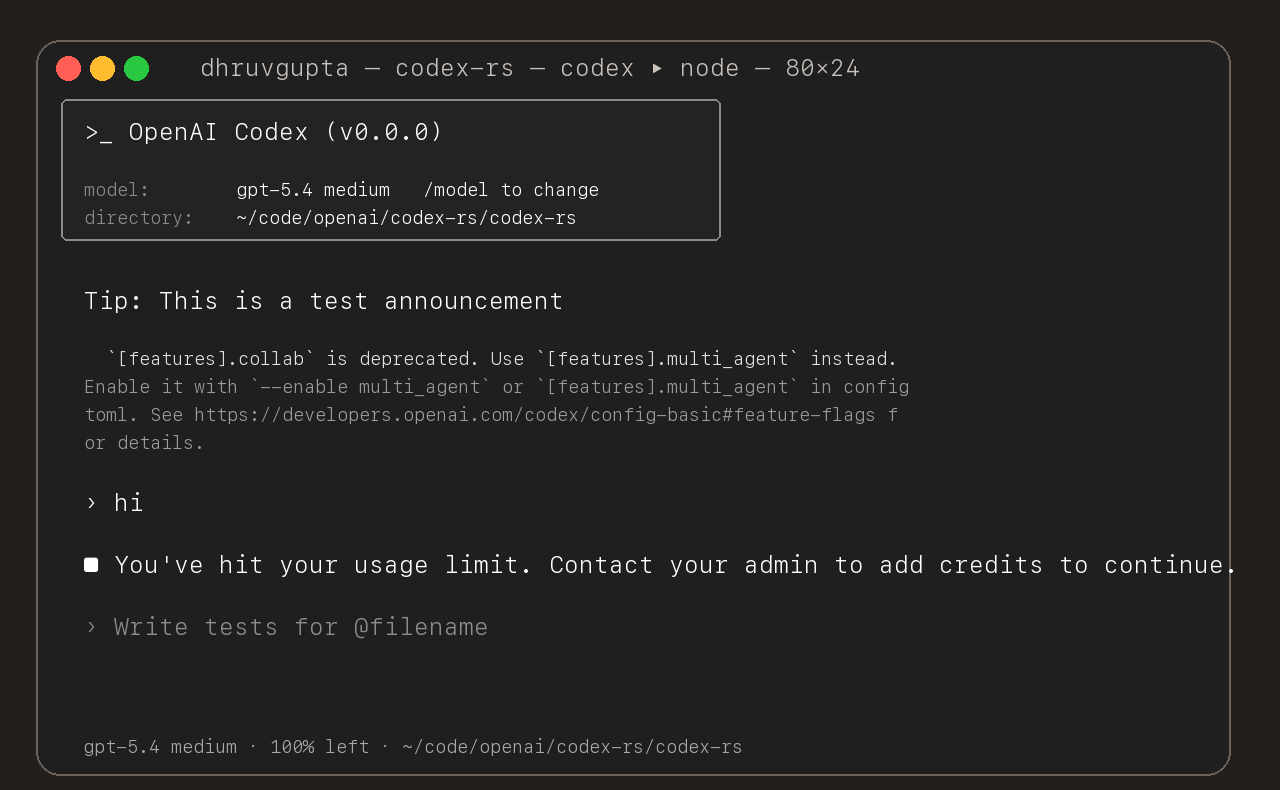
[codex-cli][app-server] Update self-serve business usage limit copy in error returned (#15478)
## Summary - update the self-serve business usage-based limit message to direct users to their admin for additional credits - add a focused unit test for the self_serve_business_usage_based plan branch Added also: If you are at a rate limit but you still have credits, codex cli would tell you to switch the model. We shouldnt do this if you have credits so fixed this. ## Test - launched the source-built CLI and verified the updated message is shown for the self-serve business usage-based plan 
dhruvgupta-oai ·
2026-03-24 04:41:38 +00:00 -
Add fork snapshot modes (#15239)
## Summary - add `ForkSnapshotMode` to `ThreadManager::fork_thread` so callers can request either a committed snapshot or an interrupted snapshot - share the model-visible `<turn_aborted>` history marker between the live interrupt path and interrupted forks - update the small set of direct fork callsites to pass `ForkSnapshotMode::Committed` Note: this enables /btw to work similarly as Esc to interrupt (hopefully somewhat in distribution) --------- Co-authored-by: Codex <noreply@openai.com>
Charley Cunningham ·
2026-03-23 19:05:42 -07:00 -
[codex] Add rollback context duplication snapshot (#15562)
## What changed - adds a targeted snapshot test for rollback with contextual diffs in `codex_tests.rs` - snapshots the exact model-visible request input before the rolled-back turn and on the follow-up request after rollback - shows the duplicate developer and environment context pair appearing again before the follow-up user message ## Why Rollback currently rewinds the reference context baseline without rewinding the live session overrides. On the next turn, the same contextual diff is emitted again and duplicated in the request sent to the model. ## Impact - makes the regression visible in a canonical snapshot test - keeps the snapshot on the shared `context_snapshot` path without adding new formatting helpers - gives a direct repro for future fixes to rollback/context reconstruction --------- Co-authored-by: Codex <noreply@openai.com>
Charley Cunningham ·
2026-03-23 15:36:23 -07:00 -
chore(core) Add approvals reviewer to UserTurn (#15426)
## Summary Adds support for approvals_reviewer to `Op::UserTurn` so we can migrate `[CodexMessageProcessor::turn_start]` to use Op::UserTurn ## Testing - [x] Adds quick test for the new field Co-authored-by: Codex <noreply@openai.com>
Dylan Hurd ·
2026-03-23 15:19:01 -07:00 -
[hooks] add non-streaming (non-stdin style) shell-only PreToolUse support (#15211)
- add `PreToolUse` hook for bash-like tool execution only at first - block shell execution before dispatch with deny-only hook behavior - introduces common.rs matcher framework for matching when hooks are run example run: ``` › run three parallel echo commands, and the second one should echo "[block-pre-tool-use]" as a test • Running the three echo commands in parallel now and I’ll report the output directly. • Running PreToolUse hook: name for demo pre tool use hook • Running PreToolUse hook: name for demo pre tool use hook • Running PreToolUse hook: name for demo pre tool use hook PreToolUse hook (completed) warning: wizard-tower PreToolUse demo inspected Bash: echo "first parallel echo" PreToolUse hook (blocked) warning: wizard-tower PreToolUse demo blocked a Bash command on purpose. feedback: PreToolUse demo blocked the command. Remove [block-pre-tool-use] to continue. PreToolUse hook (completed) warning: wizard-tower PreToolUse demo inspected Bash: echo "third parallel echo" • Ran echo "first parallel echo" └ first parallel echo • Ran echo "third parallel echo" └ third parallel echo • Three little waves went out in parallel. 1. printed first parallel echo 2. was blocked before execution because it contained the exact test string [block-pre-tool-use] 3. printed third parallel echo There was also an unrelated macOS defaults warning around the successful commands, but the echoes themselves worked fine. If you want, I can rerun the second one with a slightly modified string so it passes cleanly. ```
Andrei Eternal ·
2026-03-23 14:32:59 -07:00 -
Fix: proactive auth refresh to reload guarded disk state first (#15357)
## Summary Fix a managed ChatGPT auth bug where a stale Codex process could proactively refresh using an old in-memory refresh token even after another process had already rotated auth on disk. This changes the proactive `AuthManager::auth()` path to reuse the existing guarded `refresh_token()` flow instead of calling the refresh endpoint directly from cached auth state. ## Original Issue Users reported repeated `codexd` log lines like: ```text ERROR codex_core::auth: Failed to refresh token: error sending request for url (https://auth.openai.com/oauth/token) ``` In practice this showed up most often when multiple `codexd` processes were left running. Killing the extra processes stopped the noise, which suggested the issue was caused by stale auth state across processes rather than invalid user credentials. ## Diagnosis The bug was in the proactive refresh path used by `AuthManager::auth()`: - Process A could refresh successfully, rotate refresh token `R0` to `R1`, and persist the updated auth state plus `last_refresh` to disk. - Process B could keep an older auth snapshot cached in memory, still holding `R0` and the old `last_refresh`. - Later, when Process B called `auth()`, it checked staleness from its cached in-memory auth instead of first reloading from disk. - Because that cached `last_refresh` was stale, Process B would proactively call `/oauth/token` with stale refresh token `R0`. - On failure, `auth()` logged the refresh error but kept returning the same stale cached auth, so repeated `auth()` calls could keep retrying with dead state. This differed from the existing unauthorized-recovery flow, which already did the safer thing: guarded reload from disk first, then refresh only if the on-disk auth was unchanged. ## What Changed - Switched proactive refresh in `AuthManager::auth()` to: - do a pure staleness check on cached auth - call `refresh_token()` when stale - return the original cached auth on genuine refresh failure, preserving existing outward behavior - Removed the direct proactive refresh-from-cached-state path - Added regression tests covering: - stale cached auth with newer same-account auth already on disk - the same scenario even when the refresh endpoint would fail if called ## Why This Fix `refresh_token()` already contains the right cross-process safety behavior: - guarded reload from disk - same-account verification - skip-refresh when another process already changed auth Reusing that path makes proactive refresh consistent with unauthorized recovery and prevents stale processes from trying to refresh already-rotated tokens. ## Testing Test shape: - create a fresh temp `CODEX_HOME` from `~/.codex/auth.json` - force `last_refresh` to an old timestamp so proactive refresh is required - start two long-lived helper processes against the same auth file - start `B` first so it caches stale auth and sleeps - start `A` second so it refreshes first - point both at a local mock `/oauth/token` server - inspect whether `B` makes a second refresh request with the stale in-memory token, or reloads the rotated token from disk ### Before the fix The repro showed the bug clearly: the mock server saw two refreshes with the same stale token, `A` rotated to a new token, and `B` still returned the stale token instead of reloading from disk. ```text POST /oauth/token refresh_token=rt_j6s0... POST /oauth/token refresh_token=rt_j6s0... B:cached_before=rt_j6s0... B:cached_after=rt_j6s0... B:returned=rt_j6s0... A:cached_before=rt_j6s0... A:cached_after=rotated-refresh-token-logged-run-v2 A:returned=rotated-refresh-token-logged-run-v2 ``` ### After the fix After the fix, the mock server saw only one refresh request. `A` refreshed once, and `B` started with the stale token but reloaded and returned the rotated token. ```text POST /oauth/token refresh_token=rt_j6s0... B:cached_before=rt_j6s0... B:cached_after=rotated-refresh-token-fix-branch B:returned=rotated-refresh-token-fix-branch A:cached_before=rt_j6s0... A:cached_after=rotated-refresh-token-fix-branch A:returned=rotated-refresh-token-fix-branch ``` This shows the new behavior: `A` refreshes once, then `B` reuses the updated auth from disk instead of making a second refresh request with the stale token.
Celia Chen ·
2026-03-23 12:07:59 -07:00 -
chore(context) Include guardian approval context (#15366)
## Summary Include the guardian context in the developer message for approvals ## Testing - [x] Updated unit tests
Dylan Hurd ·
2026-03-21 16:31:22 +00:00 -
Code mode on v8 (#15276)
Moves Code Mode to a new crate with no dependencies on codex. This create encodes the code mode semantics that we want for lifetime, mounting, tool calling. The model-facing surface is mostly unchanged. `exec` still runs raw JavaScript, `wait` still resumes or terminates a `cell_id`, nested tools are still available through `tools.*`, and helpers like `text`, `image`, `store`, `load`, `notify`, `yield_control`, and `exit` still exist. The major change is underneath that surface: - Old code mode was an external Node runtime. - New code mode is an in-process V8 runtime embedded directly in Rust. - Old code mode managed cells inside a long-lived Node runner process. - New code mode manages cells in Rust, with one V8 runtime thread per active `exec`. - Old code mode used JSON protocol messages over child stdin/stdout plus Node worker-thread messages. - New code mode uses Rust channels and direct V8 callbacks/events. This PR also fixes the two migration regressions that fell out of that substrate change: - `wait { terminate: true }` now waits for the V8 runtime to actually stop before reporting termination. - synchronous top-level `exit()` now succeeds again instead of surfacing as a script error. --- - `core/src/tools/code_mode/*` is now mostly an adapter layer for the public `exec` / `wait` tools. - `code-mode/src/service.rs` owns cell sessions and async control flow in Rust. - `code-mode/src/runtime/*.rs` owns the embedded V8 isolate and JavaScript execution. - each `exec` spawns a dedicated runtime thread plus a Rust session-control task. - helper globals are installed directly into the V8 context instead of being injected through a source prelude. - helper modules like `tools.js` and `@openai/code_mode` are synthesized through V8 module resolution callbacks in Rust. --- Also added a benchmark for showing the speed of init and use of a code mode env: ``` $ cargo bench -p codex-code-mode --bench exec_overhead -- --samples 30 --warm-iterations 25 --tool-counts 0,32,128 Finished [`bench` profile [optimized]](https://doc.rust-lang.org/cargo/reference/profiles.html#default-profiles) target(s) in 0.18s Running benches/exec_overhead.rs (target/release/deps/exec_overhead-008c440d800545ae) exec_overhead: samples=30, warm_iterations=25, tool_counts=[0, 32, 128] scenario tools samples warmups iters mean/exec p95/exec rssΔ p50 rssΔ max cold_exec 0 30 0 1 1.13ms 1.20ms 8.05MiB 8.06MiB warm_exec 0 30 1 25 473.43us 512.49us 912.00KiB 1.33MiB cold_exec 32 30 0 1 1.03ms 1.15ms 8.08MiB 8.11MiB warm_exec 32 30 1 25 509.73us 545.76us 960.00KiB 1.30MiB cold_exec 128 30 0 1 1.14ms 1.19ms 8.30MiB 8.34MiB warm_exec 128 30 1 25 575.08us 591.03us 736.00KiB 864.00KiB memory uses a fresh-process max RSS delta for each scenario ``` --------- Co-authored-by: Codex <noreply@openai.com>Channing Conger ·
2026-03-20 23:36:58 -07:00 -
chore(core) Remove Feature::PowershellUtf8 (#15128)
## Summary This feature has been enabled for powershell for a while now, let's get rid of the logic ## Testing - [x] Unit tests
Dylan Hurd ·
2026-03-20 22:03:31 +00:00 -
feat: change multi-agent to use path-like system instead of uuids (#15313)
This PR add an URI-based system to reference agents within a tree. This comes from a sync between research and engineering. The main agent (the one manually spawned by a user) is always called `/root`. Any sub-agent spawned by it will be `/root/agent_1` for example where `agent_1` is chosen by the model. Any agent can contact any agents using the path. Paths can be used either in absolute or relative to the calling agents Resume is not supported for now on this new path
jif-oai ·
2026-03-20 18:23:48 +00:00 -
Add remote test skill (#15324)
Teach codex to run remote tests.
pakrym-oai ·
2026-03-20 10:37:57 -07:00 -
Add remote env CI matrix and integration test (#14869)
`CODEX_TEST_REMOTE_ENV` will make `test_codex` start the executor "remotely" (inside a docker container) turning any integration test into remote test.
pakrym-oai ·
2026-03-20 08:02:50 -07:00 -
Split features into codex-features crate (#15253)
- Split the feature system into a new `codex-features` crate. - Cut `codex-core` and workspace consumers over to the new config and warning APIs. Co-authored-by: Ahmed Ibrahim <219906144+aibrahim-oai@users.noreply.github.com> Co-authored-by: Codex <noreply@openai.com>
Ahmed Ibrahim ·
2026-03-19 20:12:07 -07:00 -
Michael Bolin ·
2026-03-20 02:38:12 +00:00 -
Move auth code into login crate (#15150)
- Move the auth implementation and token data into codex-login. - Keep codex-core re-exporting that surface from codex-login for existing callers. --------- Co-authored-by: Codex <noreply@openai.com>
Ahmed Ibrahim ·
2026-03-19 18:58:17 -07:00 -
changed save directory to codex_home (#15222)
saving image gen default save directory to codex_home/imagegen/thread_id/
Won Park ·
2026-03-19 15:16:26 -07:00 -
Plumb MCP turn metadata through _meta (#15190)
## Summary Some background. We're looking to instrument GA turns end to end. Right now a big gap is grouping mcp tool calls with their codex sessions. We send session id and turn id headers to the responses call but not the mcp/wham calls. Ideally we could pass the args as headers like with responses, but given the setup of the rmcp client, we can't send as headers without either changing the rmcp package upstream to allow per request headers or introducing a mutex which break concurrency. An earlier attempt made the assumption that we had 1 client per thread, which allowed us to set headers at the start of a turn. @pakrym mentioned that this assumption might break in the near future. So the solution now is to package the turn metadata/session id into the _meta field in the post body and pull out in codex-backend. - send turn metadata to MCP servers via `tools/call` `_meta` instead of assuming per-thread request headers on shared clients - preserve the existing `_codex_apps` metadata while adding `x-codex-turn-metadata` for all MCP tool calls - extend tests to cover both custom MCP servers and the codex apps search flow --------- Co-authored-by: Codex <noreply@openai.com>
nicholasclark-openai ·
2026-03-19 22:05:13 +00:00 -
[hooks] use a user message > developer message for prompt continuation (#14867)
## Summary Persist Stop-hook continuation prompts as `user` messages instead of hidden `developer` messages + some requested integration tests This is a followup to @pakrym 's comment in https://github.com/openai/codex/pull/14532 to make sure stop-block continuation prompts match training for turn loops - Stop continuation now writes `<hook_prompt hook_run_id="...">stop hook's user prompt<hook_prompt>` - Introduces quick-xml dependency, though we already indirectly depended on it anyway via syntect - This PR only has about 500 lines of actual logic changes, the rest is tests/schema ## Testing Example run (with a sessionstart hook and 3 stop hooks) - this shows context added by session start, then two stop hooks sending their own additional prompts in a new turn. The model responds with a single message addressing both. Then when that turn ends, the hooks detect that they just ran using `stop_hook_active` and decide not to infinite loop test files for this (unzip, move codex -> .codex): [codex.zip](https://github.com/user-attachments/files/26075806/codex.zip) ``` › cats • Running SessionStart hook: lighting the observatory SessionStart hook (completed) warning: Hi, I'm a session start hook for wizard-tower (startup). hook context: A wimboltine stonpet is an exotic cuisine from hyperspace • Cats are tiny zen wizards, my friend: equal parts nap, mystery, and chaos. If you want, we can talk cat facts, cat breeds, cat names, or build something cat-themed in this repo. • Running Stop hook: checking the tower wards • Running Stop hook: sacking the guards • Running Stop hook: hiring the guards Stop hook (completed) warning: Wizard Tower Stop hook reviewed the completed reply (177 chars). Stop hook (blocked) warning: Wizard Tower Stop hook continuing conversation feedback: cook the stonpet Stop hook (blocked) warning: Wizard Tower Stop hook continuing conversation feedback: eat the cooked stonpet • Stonpet’s cooked, aloha style: flash-seared over a blue quasiflame, glazed with nebula salt, and rested until the hyperspace juices settle. Now we eat with gratitude, my friend. One mindful bite in, and the flavor is pure cosmic surf: smoky, bright, and totally out of this dimension. • Running Stop hook: checking the tower wards • Running Stop hook: sacking the guards • Running Stop hook: hiring the guards Stop hook (completed) warning: Wizard Tower Stop hook reviewed the completed reply (285 chars). Stop hook (completed) warning: Wizard Tower Stop hook saw a second pass and stayed calm to avoid a loop. Stop hook (completed) warning: Wizard Tower Stop hook saw a second pass and stayed calm to avoid a loop. ```
Andrei Eternal ·
2026-03-19 10:53:08 -07:00