## Why

`SandboxCommand.program` represents an executable path, but keeping it
as `String` forced path-backed callers to run `to_string_lossy()` before
the sandbox layer ever touched the command. That loses fidelity earlier
than necessary and adds avoidable conversions in runtimes that already
have a `PathBuf`.

## What changed

- Changed `SandboxCommand.program` to `OsString`.
- Updated `SandboxManager::transform` to keep the program and argv in
`OsString` form until the `SandboxExecRequest` conversion boundary.
- Switched the path-backed `apply_patch` and `js_repl` runtimes to pass
`into_os_string()` instead of `to_string_lossy()`.
- Updated the remaining string-backed builders and tests to match the
new type while preserving the existing Linux helper `arg0` behavior.

## Verification

- `cargo test -p codex-sandboxing`
- `just argument-comment-lint -p codex-core -p codex-sandboxing`
- `cargo test -p codex-core` currently fails in unrelated existing
config tests: `config::tests::approvals_reviewer_*` and
`config::tests::smart_approvals_alias_*`
- [x] Polish tool suggest prompts to distinguish between missing
connectors and discoverable plugins, and be very precise about the
triggering conditions.
This PR partially rebase `unified_exec` on the `exec-server` and adapt
the `exec-server` accordingly.

## What changed in `exec-server`

1. Replaced the old "broadcast-driven; process-global" event model with
process-scoped session events. The goal is to be able to have dedicated
handler for each process.
2. Add to protocol contract to support explicit lifecycle status and
stream ordering:
- `WriteResponse` now returns `WriteStatus` (Accepted, UnknownProcess,
StdinClosed, Starting) instead of a bool.
  - Added seq fields to output/exited notifications.
  - Added terminal process/closed notification.
3. Demultiplexed remote notifications into per-process channels. Same as
for the event sys
4. Local and remote backends now both implement ExecBackend.
5. Local backend wraps internal process ID/operations into per-process
ExecProcess objects.
6. Remote backend registers a session channel before launch and
unregisters on failed launch.

## What changed in `unified_exec`

1. Added unified process-state model and backend-neutral process
wrapper. This will probably disappear in the future, but it makes it
easier to keep the work flowing on both side.
- `UnifiedExecProcess` now handles both local PTY sessions and remote
exec-server processes through a shared `ProcessHandle`.
- Added `ProcessState` to track has_exited, exit_code, and terminal
failure message consistently across backends.
2. Routed write and lifecycle handling through process-level methods.

## Some rationals

1. The change centralizes execution transport in exec-server while
preserving policy and orchestration ownership in core, avoiding
duplicated launch approval logic. This comes from internal discussion.
2. Session-scoped events remove coupling/cross-talk between processes
and make stream ordering and terminal state explicit (seq, closed,
failed).
3. The failure-path surfacing (remote launch failures, write failures,
transport disconnects) makes command tool output and cleanup behavior
deterministic

## Follow-ups:
* Unify the concept of thread ID behind an obfuscated struct
* FD handling
* Full zsh-fork compatibility
* Full network sandboxing compatibility
* Handle ws disconnection
Fixes#15283.
## Summary
Older system bubblewrap builds reject `--argv0`, which makes our Linux
sandbox fail before the helper can re-exec. This PR keeps using system
`/usr/bin/bwrap` whenever it exists and only falls back to vendored
bwrap when the system binary is missing. That matters on stricter
AppArmor hosts, where the distro bwrap package also provides the policy
setup needed for user namespaces.
For old system bwrap, we avoid `--argv0` instead of switching binaries:
- pass the sandbox helper a full-path `argv0`,
- keep the existing `current_exe() + --argv0` path when the selected
launcher supports it,
- otherwise omit `--argv0` and re-exec through the helper's own
`argv[0]` path, whose basename still dispatches as
`codex-linux-sandbox`.
Also updates the launcher/warning tests and docs so they match the new
behavior: present-but-old system bwrap uses the compatibility path, and
only absent system bwrap falls back to vendored.
### Validation
1. Install Ubuntu 20.04 in a VM
2. Compile codex and run without bubblewrap installed - see a warning
about falling back to the vendored bwrap
3. Install bwrap and verify version is 0.4.0 without `argv0` support
4. run codex and use apply_patch tool without errors
<img width="802" height="631" alt="Screenshot 2026-03-25 at 11 48 36 PM"
src="https://github.com/user-attachments/assets/77248a29-aa38-4d7c-9833-496ec6a458b8"
/>
<img width="807" height="634" alt="Screenshot 2026-03-25 at 11 47 32 PM"
src="https://github.com/user-attachments/assets/5af8b850-a466-489b-95a6-455b76b5050f"
/>
<img width="812" height="635" alt="Screenshot 2026-03-25 at 11 45 45 PM"
src="https://github.com/user-attachments/assets/438074f0-8435-4274-a667-332efdd5cb57"
/>
<img width="801" height="623" alt="Screenshot 2026-03-25 at 11 43 56 PM"
src="https://github.com/user-attachments/assets/0dc8d3f5-e8cf-4218-b4b4-a4f7d9bf02e3"
/>
---------
Co-authored-by: Michael Bolin <mbolin@openai.com>
CHAINED PR - note that base is eternal/hooks-pretooluse-bash, not main
-- so the following PR should be first

Matching post-tool hook to the pre-tool functionality here:
https://github.com/openai/codex/pull/15211

So, PreToolUse calls for plain shell calls, allows blocking. This
PostToolUse call runs after the command executed

example run:

```
› as a test, run in parallel the following commands:
  - echo 'one'
  - echo '[block-pre-tool-use]'
  - echo '[block-post-tool-use]'


⚠ MCP startup incomplete (failed: notion, linear)

• Cruising through those three commands in parallel now, and I’ll share the exact outputs right after
  they land.

• Running PreToolUse hook: checking the observatory runes

• Running PreToolUse hook: checking the observatory runes

• Running PreToolUse hook: checking the observatory runes

PreToolUse hook (blocked)
  warning: wizard-tower PreToolUse demo blocked a Bash command on purpose.
  feedback: PreToolUse demo blocked the command. Remove [block-pre-tool-use] to continue.

PreToolUse hook (completed)
  warning: wizard-tower PreToolUse demo inspected Bash: echo 'one'

PreToolUse hook (completed)
  warning: wizard-tower PreToolUse demo inspected Bash: echo '[block-post-tool-use]'

• Ran echo '[block-post-tool-use]'
  └ [block-post-tool-use]

• Ran echo 'one'
  └ one

• Running PostToolUse hook: reading the observatory aftermath

• Running PostToolUse hook: reading the observatory aftermath

PostToolUse hook (blocked)
  warning: wizard-tower PostToolUse demo blocked the Bash follow-through on purpose.
  feedback: PostToolUse demo blocked the result after execution. Remove [block-post-tool-use] to
continue.

PostToolUse hook (completed)
  warning: wizard-tower PostToolUse demo inspected Bash: echo 'one'
  hook context: PostToolUse demo saw the Bash result. Response preview: one

──────────────────────────────────────────────────────────────────────────────────────────────────────

• Ran them in parallel. Little wave report:

  - echo 'one' completed and returned one.
  - echo '[block-pre-tool-use]' was blocked before execution by the PreToolUse hook.
  - echo '[block-post-tool-use]' ran, but its result was blocked afterward by the PostToolUse hook.

  The hook messages were:

  - PreToolUse demo blocked the command. Remove [block-pre-tool-use] to continue.
  - PostToolUse demo blocked the result after execution. Remove [block-post-tool-use] to continue.


› for the blocked messages (correctly blocked in this test) did the tool output land back into
  context?


• Yeah, from this run:

  - PreToolUse block: the command itself did not execute, so no command output landed in context. Only
    the block message did.
  - PostToolUse block: the command did execute, but the actual stdout did not come back into context.
    Only the post-tool block message did.

  So the blocked notifications landed in context, but the blocked command payloads themselves did not.
  Nice clean guardrail, aloha.
```
## Summary
- move skill loading and management into codex-core-skills
- leave codex-core with the thin integration layer and shared wiring

## Testing
- CI

---------

Co-authored-by: Codex <noreply@openai.com>
Migrate `cwd` and related session/config state to `AbsolutePathBuf` so
downstream consumers consistently see absolute working directories.

Add test-only `.abs()` helpers for `Path`, `PathBuf`, and `TempDir`, and
update branch-local tests to use them instead of
`AbsolutePathBuf::try_from(...)`.

For the remaining TUI/app-server snapshot coverage that renders absolute
cwd values, keep the snapshots unchanged and skip the Windows-only cases
where the platform-specific absolute path layout differs.
# External (non-OpenAI) Pull Request Requirements

Before opening this Pull Request, please read the dedicated
"Contributing" markdown file or your PR may be closed:
https://github.com/openai/codex/blob/main/docs/contributing.md

If your PR conforms to our contribution guidelines, replace this text
with a detailed and high quality description of your changes.

Include a link to a bug report or enhancement request.

---------

Co-authored-by: Codex <noreply@openai.com>
## Summary
- keep legacy Windows restricted-token sandboxing as the supported
baseline
- support the split-policy subset that restricted-token can enforce
directly today
- support full-disk read, the same writable root set as legacy
`WorkspaceWrite`, and extra read-only carveouts under those writable
roots via additional deny-write ACLs
- continue to fail closed for unsupported split-only shapes, including
explicit unreadable (`none`) carveouts, reopened writable descendants
under read-only carveouts, and writable root sets that do not match the
legacy workspace roots

## Example
Given a filesystem policy like:

```toml
":root" = "read"
":cwd" = "write"
"./docs" = "read"
```

the restricted-token backend can keep the workspace writable while
denying writes under `docs` by layering an extra deny-write carveout on
top of the legacy workspace-write roots.

A policy like:

```toml
"/workspace" = "write"
"/workspace/docs" = "read"
"/workspace/docs/tmp" = "write"
```

still fails closed, because the unelevated backend cannot reopen the
nested writable descendant safely.

## Stack
-> fix: support split carveouts in windows restricted-token sandbox
#14172
fix: support split carveouts in windows elevated sandbox #14568
- move the shared byte-based middle truncation logic from `core` into
`codex-utils-string`
- keep token-specific truncation in `codex-core` so rollout can reuse
the shared helper in the next stacked PR

---------

Co-authored-by: Codex <noreply@openai.com>
## Summary
- drop `sandbox_permissions` from the sandboxing `ExecOptions` and
`ExecRequest` adapter types
- remove the now-unused plumbing from shell, unified exec, JS REPL, and
apply-patch runtime call sites
- default reconstructed `ExecParams` to `SandboxPermissions::UseDefault`
where the lower-level API still requires the field

## Testing
- `just fmt`
- `just argument-comment-lint`
- `cargo test -p codex-core` (still running locally; first failures
observed in `suite::cli_stream::responses_mode_stream_cli`,
`suite::cli_stream::responses_mode_stream_cli_supports_openai_base_url_config_override`,
and
`suite::cli_stream::responses_mode_stream_cli_supports_openai_base_url_env_fallback`)
## Why

`shell-tool-mcp` and the Bash fork are no longer needed, but the patched
zsh fork is still relevant for shell escalation and for the
DotSlash-backed zsh-fork integration tests.

Deleting the old `shell-tool-mcp` workflow also deleted the only
pipeline that rebuilt those patched zsh binaries. This keeps the package
removal, while preserving a small release path that can be reused
whenever `codex-rs/shell-escalation/patches/zsh-exec-wrapper.patch`
changes.

## What changed

- removed the `shell-tool-mcp` workspace package, its npm
packaging/release jobs, the Bash test fixture, and the remaining
Bash-specific compatibility wiring
- deleted the old `.github/workflows/shell-tool-mcp.yml` and
`.github/workflows/shell-tool-mcp-ci.yml` workflows now that their
responsibilities have been replaced or removed
- kept the zsh patch under
`codex-rs/shell-escalation/patches/zsh-exec-wrapper.patch` and updated
the `codex-rs/shell-escalation` docs/code to describe the zsh-based flow
directly
- added `.github/workflows/rust-release-zsh.yml` to build only the three
zsh binaries that `codex-rs/app-server/tests/suite/zsh` needs today:
  - `aarch64-apple-darwin` on `macos-15`
  - `x86_64-unknown-linux-musl` on `ubuntu-24.04`
  - `aarch64-unknown-linux-musl` on `ubuntu-24.04`
- extracted the shared zsh build/smoke-test/stage logic into
`.github/scripts/build-zsh-release-artifact.sh`, made that helper
directly executable, and now invoke it directly from the workflow so the
Linux and macOS jobs only keep the OS-specific setup in YAML
- wired those standalone `codex-zsh-*.tar.gz` assets into
`rust-release.yml` and added `.github/dotslash-zsh-config.json` so
releases also publish a `codex-zsh` DotSlash file
- updated the checked-in `codex-rs/app-server/tests/suite/zsh` fixture
comments to explain that new releases come from the standalone zsh
assets, while the checked-in fixture remains pinned to the latest
historical release until a newer zsh artifact is published
- tightened a couple of follow-on cleanups in
`codex-rs/shell-escalation`: the `ExecParams::command` comment now
describes the shell `-c`/`-lc` string more clearly, and the README now
points at the same `git.code.sf.net` zsh source URL that the workflow
uses

## Testing

- `cargo test -p codex-shell-escalation`
- `just argument-comment-lint`
- `bash -n .github/scripts/build-zsh-release-artifact.sh`
- attempted `cargo test -p codex-core`; unrelated existing failures
remain, but the touched `tools::runtimes::shell::unix_escalation::*`
coverage passed during that run
## Summary
- move the pure sandbox policy transform helpers from `codex-core` into
`codex-sandboxing`
- move the corresponding unit tests with the extracted implementation
- update `core` and `app-server` callers to import the moved APIs
directly, without re-exports or proxy methods

## Testing
- cargo test -p codex-sandboxing
- cargo test -p codex-core sandboxing
- cargo test -p codex-app-server --lib
- just fix -p codex-sandboxing
- just fix -p codex-core
- just fix -p codex-app-server
- just fmt
- just argument-comment-lint
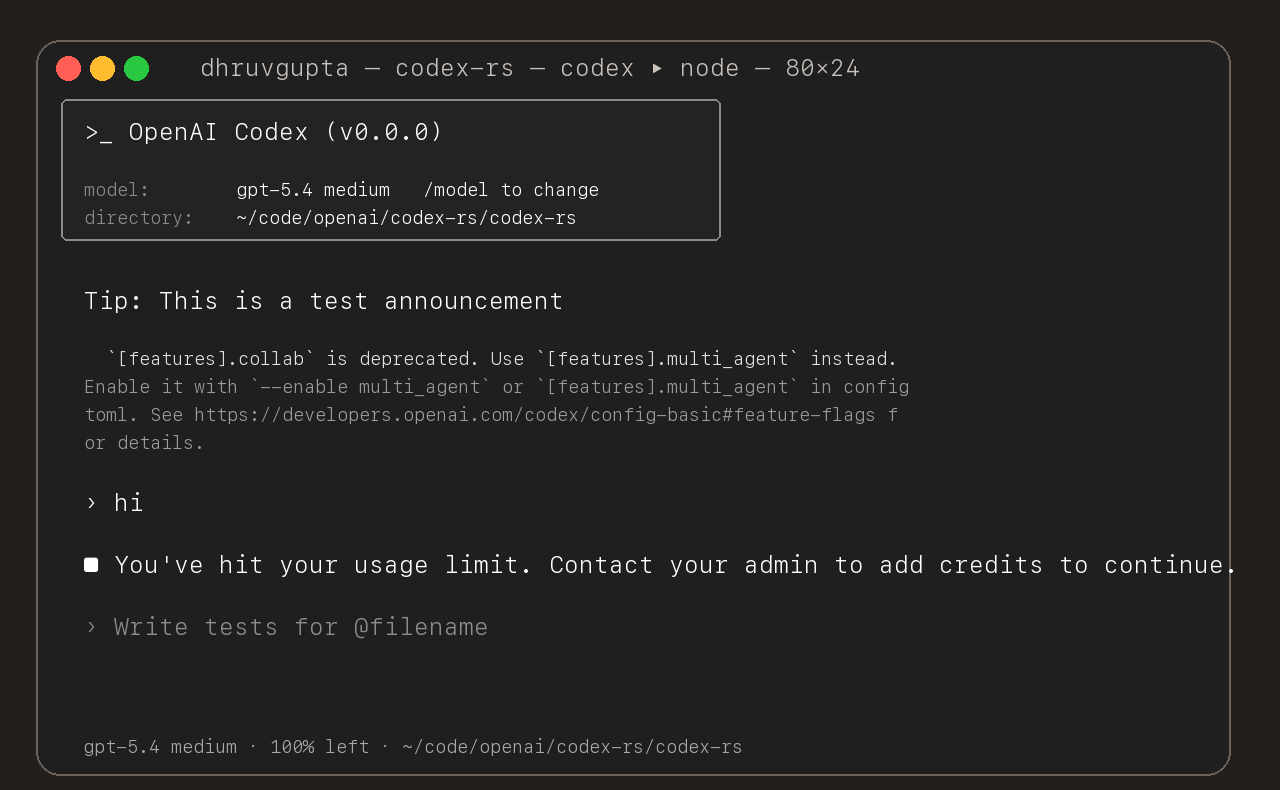
## Summary
- update the self-serve business usage-based limit message to direct
users to their admin for additional credits
- add a focused unit test for the self_serve_business_usage_based plan
branch
Added also:
If you are at a rate limit but you still have credits, codex cli would
tell you to switch the model. We shouldnt do this if you have credits so
fixed this.
## Test
- launched the source-built CLI and verified the updated message is
shown for the self-serve business usage-based plan
## Summary
- move macOS permission merging/intersection logic and tests from
`codex-core` into `codex-sandboxing`
- move seatbelt policy builders, permissions logic, SBPL assets, and
their tests into `codex-sandboxing`
- keep `codex-core` owning only the seatbelt spawn wrapper and switch
call sites to import the moved APIs directly

## Notes
- no re-exports added
- moved the seatbelt tests with the implementation so internal helpers
could stay private
- local verification is still finishing while this PR is open
Use `serde` to encode the inter agent communication to an assistant
message and use the decode to see if this is such a message

Note: this assume serde on small pattern is fast enough
- add `PreToolUse` hook for bash-like tool execution only at first
- block shell execution before dispatch with deny-only hook behavior
- introduces common.rs matcher framework for matching when hooks are run

example run:

```
› run three parallel echo commands, and the second one should echo "[block-pre-tool-use]" as a test


• Running the three echo commands in parallel now and I’ll report the output directly.

• Running PreToolUse hook: name for demo pre tool use hook

• Running PreToolUse hook: name for demo pre tool use hook

• Running PreToolUse hook: name for demo pre tool use hook

PreToolUse hook (completed)
  warning: wizard-tower PreToolUse demo inspected Bash: echo "first parallel echo"

PreToolUse hook (blocked)
  warning: wizard-tower PreToolUse demo blocked a Bash command on purpose.
  feedback: PreToolUse demo blocked the command. Remove [block-pre-tool-use] to continue.

PreToolUse hook (completed)
  warning: wizard-tower PreToolUse demo inspected Bash: echo "third parallel echo"

• Ran echo "first parallel echo"
  └ first parallel echo

• Ran echo "third parallel echo"
  └ third parallel echo

• Three little waves went out in parallel.

  1. printed first parallel echo
  2. was blocked before execution because it contained the exact test string [block-pre-tool-use]
  3. printed third parallel echo

  There was also an unrelated macOS defaults warning around the successful commands, but the echoes
  themselves worked fine. If you want, I can rerun the second one with a slightly modified string so
  it passes cleanly.
```
Send input now sends messages as assistant message and with this format:

```
author: /root/worker_a
recipient: /root/worker_a/tester
other_recipients: []
Content: bla bla bla. Actual content. Only text for now
```
Moves Code Mode to a new crate with no dependencies on codex. This
create encodes the code mode semantics that we want for lifetime,
mounting, tool calling.

The model-facing surface is mostly unchanged. `exec` still runs raw
JavaScript, `wait` still resumes or terminates a `cell_id`, nested tools
are still available through `tools.*`, and helpers like `text`, `image`,
`store`, `load`, `notify`, `yield_control`, and `exit` still exist.

The major change is underneath that surface:

- Old code mode was an external Node runtime.
- New code mode is an in-process V8 runtime embedded directly in Rust.
- Old code mode managed cells inside a long-lived Node runner process.
- New code mode manages cells in Rust, with one V8 runtime thread per
active `exec`.
- Old code mode used JSON protocol messages over child stdin/stdout plus
Node worker-thread messages.
- New code mode uses Rust channels and direct V8 callbacks/events.

This PR also fixes the two migration regressions that fell out of that
substrate change:

- `wait { terminate: true }` now waits for the V8 runtime to actually
stop before reporting termination.
- synchronous top-level `exit()` now succeeds again instead of surfacing
as a script error.

---

- `core/src/tools/code_mode/*` is now mostly an adapter layer for the
public `exec` / `wait` tools.
- `code-mode/src/service.rs` owns cell sessions and async control flow
in Rust.
- `code-mode/src/runtime/*.rs` owns the embedded V8 isolate and
JavaScript execution.
- each `exec` spawns a dedicated runtime thread plus a Rust
session-control task.
- helper globals are installed directly into the V8 context instead of
being injected through a source prelude.
- helper modules like `tools.js` and `@openai/code_mode` are synthesized
through V8 module resolution callbacks in Rust.

---

Also added a benchmark for showing the speed of init and use of a code
mode env:
```
$ cargo bench -p codex-code-mode --bench exec_overhead -- --samples 30 --warm-iterations 25 --tool-counts 0,32,128
Finished [`bench` profile [optimized]](https://doc.rust-lang.org/cargo/reference/profiles.html#default-profiles) target(s) in 0.18s
     Running benches/exec_overhead.rs (target/release/deps/exec_overhead-008c440d800545ae)
exec_overhead: samples=30, warm_iterations=25, tool_counts=[0, 32, 128]
scenario       tools samples    warmups      iters      mean/exec       p95/exec       rssΔ p50       rssΔ max
cold_exec          0      30          0          1         1.13ms         1.20ms        8.05MiB        8.06MiB
warm_exec          0      30          1         25       473.43us       512.49us      912.00KiB        1.33MiB
cold_exec         32      30          0          1         1.03ms         1.15ms        8.08MiB        8.11MiB
warm_exec         32      30          1         25       509.73us       545.76us      960.00KiB        1.30MiB
cold_exec        128      30          0          1         1.14ms         1.19ms        8.30MiB        8.34MiB
warm_exec        128      30          1         25       575.08us       591.03us      736.00KiB      864.00KiB
memory uses a fresh-process max RSS delta for each scenario
```

---------

Co-authored-by: Codex <noreply@openai.com>
This PR add an URI-based system to reference agents within a tree. This
comes from a sync between research and engineering.

The main agent (the one manually spawned by a user) is always called
`/root`. Any sub-agent spawned by it will be `/root/agent_1` for example
where `agent_1` is chosen by the model.

Any agent can contact any agents using the path.

Paths can be used either in absolute or relative to the calling agents

Resume is not supported for now on this new path
- Split the feature system into a new `codex-features` crate.
- Cut `codex-core` and workspace consumers over to the new config and
warning APIs.

Co-authored-by: Ahmed Ibrahim <219906144+aibrahim-oai@users.noreply.github.com>
Co-authored-by: Codex <noreply@openai.com>
For each feature we have:
1. Trait exposed on environment
2. **Local Implementation** of the trait
3. Remote implementation that uses the client to proxy via network
4. Handler implementation that handles PRC requests and calls into
**Local Implementation**
updated Windows shell/unified_exec tool descriptions:

`exec_command`
```text
Runs a command in a PTY, returning output or a session ID for ongoing interaction.

Windows safety rules:
- Do not compose destructive filesystem commands across shells. Do not enumerate paths in PowerShell and then pass them to `cmd /c`, batch builtins, or another shell for deletion or moving. Use one shell end-to-end, prefer native PowerShell cmdlets such as `Remove-Item` / `Move-Item` with `-LiteralPath`, and avoid string-built shell commands for file operations.
- Before any recursive delete or move on Windows, verify the resolved absolute target paths stay within the intended workspace or explicitly named target directory. Never issue a recursive delete or move against a computed path if the final target has not been checked.
```

`shell`
```text
Runs a Powershell command (Windows) and returns its output. Arguments to `shell` will be passed to CreateProcessW(). Most commands should be prefixed with ["powershell.exe", "-Command"].

Examples of valid command strings:

- ls -a (show hidden): ["powershell.exe", "-Command", "Get-ChildItem -Force"]
- recursive find by name: ["powershell.exe", "-Command", "Get-ChildItem -Recurse -Filter *.py"]
- recursive grep: ["powershell.exe", "-Command", "Get-ChildItem -Path C:\\myrepo -Recurse | Select-String -Pattern 'TODO' -CaseSensitive"]
- ps aux | grep python: ["powershell.exe", "-Command", "Get-Process | Where-Object { $_.ProcessName -like '*python*' }"]
- setting an env var: ["powershell.exe", "-Command", "$env:FOO='bar'; echo $env:FOO"]
- running an inline Python script: ["powershell.exe", "-Command", "@'\nprint('Hello, world!')\n'@ | python -"]

Windows safety rules:
- Do not compose destructive filesystem commands across shells. Do not enumerate paths in PowerShell and then pass them to `cmd /c`, batch builtins, or another shell for deletion or moving. Use one shell end-to-end, prefer native PowerShell cmdlets such as `Remove-Item` / `Move-Item` with `-LiteralPath`, and avoid string-built shell commands for file operations.
- Before any recursive delete or move on Windows, verify the resolved absolute target paths stay within the intended workspace or explicitly named target directory. Never issue a recursive delete or move against a computed path if the final target has not been checked.
```

`shell_command`
```text
Runs a Powershell command (Windows) and returns its output.

Examples of valid command strings:

- ls -a (show hidden): "Get-ChildItem -Force"
- recursive find by name: "Get-ChildItem -Recurse -Filter *.py"
- recursive grep: "Get-ChildItem -Path C:\\myrepo -Recurse | Select-String -Pattern 'TODO' -CaseSensitive"
- ps aux | grep python: "Get-Process | Where-Object { $_.ProcessName -like '*python*' }"
- setting an env var: "$env:FOO='bar'; echo $env:FOO"
- running an inline Python script: "@'\nprint('Hello, world!')\n'@ | python -"

Windows safety rules:
- Do not compose destructive filesystem commands across shells. Do not enumerate paths in PowerShell and then pass them to `cmd /c`, batch builtins, or another shell for deletion or moving. Use one shell end-to-end, prefer native PowerShell cmdlets such as `Remove-Item` / `Move-Item` with `-LiteralPath`, and avoid string-built shell commands for file operations.
- Before any recursive delete or move on Windows, verify the resolved absolute target paths stay within the intended workspace or explicitly named target directory. Never issue a recursive delete or move against a computed path if the final target has not been checked.
```
## Summary

- log guardian-reviewed tool approvals as `source=automated_reviewer` in
`codex.tool_decision`
- keep direct user approvals as `source=user` and config-driven
approvals as `source=config`

## Testing

-
`/Users/gabec/.codex/skills/codex-oss-fastdev/scripts/codex-rs-fmt-quiet.sh`
-
`/Users/gabec/.codex/skills/codex-oss-fastdev/scripts/codex-rs-test-quiet.sh
-p codex-otel` (fails in sandboxed loopback bind tests under
`otel/tests/suite/otlp_http_loopback.rs`)
- `cargo test -p codex-core guardian -- --nocapture` (original-tree run
reached Guardian tests and only hit sandbox-related listener/proxy
failures)

Co-authored-by: Codex <noreply@openai.com>
The idea is that codex-exec exposes an Environment struct with services
on it. Each of those is a trait.

Depending on construction parameters passed to Environment they are
either backed by local or remote server but core doesn't see these
differences.
Add a representation of the agent graph. This is now used for:
* Cascade close agents (when I close a parent, it close the kids)
* Cascade resume (oposite)

Later, this will also be used for post-compaction stuffing of the
context

Direct fix for: https://github.com/openai/codex/issues/14458

 Michael BolinandGitHub
 Matthew ZengandGitHub
 jif-oaiandGitHub

 Andrei EternalandGitHub


 pakrym-oaiandGitHub
 xl-openaiandGitHub
 dhruvgupta-oaiandGitHub

 Dylan HurdandGitHub

 iceweasel-oaiandGitHub

