## Why

We already have the machinery to support multiple environments on a
single thread, but we only show the model the contents of `AGENTS.md`
files in the primary environment.

We should show the model all of the relevant project instructions when
we know there's more than one environment.

## Known Gaps

As discussed in the RFC, this implementation:

1. doesn't handle environments being added/removed to/from the thread
after its creation
2. it doesn't enforce an aggregate context budget across environments,
and instead applies the configured project maximum independently to each
environment

## Implementation

- Discover project instructions in environment order with an independent
byte budget per environment and preserve source provenance/order.
- Keep the legacy fragment byte-for-byte when exactly one environment
contributes project instructions; use environment-labeled sections when
two or more environments contribute.
- Freeze the complete rendered fragment in `LoadedAgentsMd`, insert it
directly into requests, and recognize both layouts in contextual and
memory filtering.
- Add exact rendering, independent-budget, source-order,
creation-snapshot, and consumer coverage without changing app-server
schemas.
## What
Introduce a `CodexResponsesMetadata` struct that defines all the core
metadata we send to Responses API. Example fields are `thread_id`,
`turn_id`, `window_id`, etc.

Going forward, `client_metadata["x-codex-turn-metadata"]` will be the
canonical way Codex sends metadata to Responses API across both HTTP and
websocket transports.

For now, we continue to emit the existing top-level HTTP headers and
top-level `client_metadata` fields from the same
`CodexResponsesMetadata` struct for compatibility reasons.

Also, app-server clients who specify additional
`responsesapi_client_metadata` via `turn/start` and `turn/steer` will
have those fields merged into
`client_metadata["x-codex-turn-metadata"]`, but cannot override the
reserved fields that core uses (i.e. the fields in
`CodexResponsesMetadata`).

## Why

Responses API request instrumentation is the source of truth for
downstream Codex analytics that join requests by Codex IDs such as
session, thread, turn, and context window. Before this change, those
values were assembled through several request-specific paths: HTTP
request bodies, websocket handshake headers, websocket `response.create`
payloads, compaction requests, and the rich `x-codex-turn-metadata`
envelope all had their own wiring.

That made metadata propagation easy to drift across API-key/direct
Responses API requests, ChatGPT-auth/proxied requests, websocket
requests, and compaction requests. It also made additions like
`window_id` error-prone because a field could be added to one transport
projection but missed in another.

## What changed

- Added `CodexResponsesMetadata` as the core-owned snapshot for Codex
metadata sent to ResponsesAPI.
- Render `client_metadata["x-codex-turn-metadata"]`, flat
`client_metadata` projections, and direct compatibility headers from
that same snapshot.
- Include the known Codex-owned fields in the turn metadata blob,
including installation/session/thread/turn/window IDs, request kind,
lineage, sandbox/workspace metadata, timing, and compaction details.
- Treat app-server `responsesapi_client_metadata` as enrichment for the
Codex turn metadata blob while preventing those extras from overriding
Codex-owned fields.
- Use the same metadata path for normal turns, websocket prewarm, local
compaction, remote v1 compaction, and remote v2 compaction.
- Keep websocket connection-only preconnect metadata separate so
handshakes carry compatibility identity headers without inventing a fake
turn metadata blob.

## Verification

- `cargo check -p codex-core`
- `just fix -p codex-core`
## Why

We want to remove implicit use of `$CODEX_HOME` from `codex-core` and
make embedders responsible for supplying user-level instructions. This
also ensures user instructions load when no primary environment is
selected.

## What changed

Stacked on #27415, which makes `codex exec` surface thread-scoped
runtime warnings.

- Added `UserInstructionsProvider` to `codex-extension-api`, with
absolute source attribution and recoverable loading warnings.
- Added `codex-home` with the filesystem-backed provider for
`AGENTS.override.md` and `AGENTS.md`, preserving precedence, fallback,
trimming, lossy UTF-8 handling, and the existing uncapped global
instruction size.
- Removed global instruction loading from `Config` and require
`ThreadManager` callers to inject a provider.
- Load provider instructions once for each fresh root runtime, including
runtimes without a primary environment. Running sessions retain their
snapshot, while child agents inherit the parent snapshot without
invoking the provider.
- Keep provider instructions separate while loading project `AGENTS.md`,
then assemble the model-visible instructions with the existing ordering,
source attribution, warning, and turn-context behavior.
- Wired the Codex home provider through the CLI, app server, MCP server,
core facade, and thread-manager sample.

## Validation

- `just test -p codex-home -p codex-extension-api`
- `just test -p codex-core agents_md`
- `just test -p codex-core guardian`
- `just test -p codex-app-server
thread_start_without_selected_environment_includes_only_global_instruction_source`
- `just test -p codex-exec warning`
- `just bazel-lock-check`
## Why

We're moving exec-server to use PathUri for its internal path
representations.

## What

Move `ExecutorFileSystem` APIs to use `PathUri` instead of
`AbsolutePathBuf`. Future changes will convert higher-level parts of
exec-server.
## Why

Thread cwd and environment selections are a single logical setting in
core: updating one without the other can silently desynchronize the
next-turn execution context. This change makes that relationship
explicit in the internal thread settings flow while preserving the
existing app-server public API shape.

## What changed

- Moved the cwd/environment pair through internal
`ThreadSettingsOverrides.environment_settings` instead of a top-level
internal `cwd` field.
- Kept `thread/settings/update` public params unchanged, with app-server
translating top-level `cwd` into the paired internal settings shape.
- Moved `Op::UserInput` environment overrides into thread settings so
user turns and settings updates use the same core path.
- Updated core, app-server, MCP, memories, sample, and test callsites to
construct the paired settings shape.

## Verification

- `git diff --check`
- Local test run starting after PR creation.
## Why

This PR fixes approval sandbox semantics in the unified-exec path. The
zsh-fork runtime exposed the bug because the shell can do meaningful
work before any intercepted child `execv(2)` exists: redirections,
builtins, globbing, and pipeline setup all happen in the launch process.
If the model requested `sandbox_permissions=require_escalated`, or an
exec-policy `allow` rule explicitly bypassed the sandbox, that approved
sandbox decision needs to be preserved for the launch path and for
intercepted execs that use the same approval machinery.

The behavior is not only about zsh fork. The production changes are in
shared approval/escalation code, so they also affect non-zsh-fork
intercepted exec paths that go through the same sandbox decision logic.
The narrow intent is to preserve the approval decision while still
keeping denied-read profiles and bounded additional-permission requests
sandboxed.

## Production Changes

- `codex-rs/core/src/tools/runtimes/unified_exec.rs`: derives a
`launch_sandbox_permissions` value from the requested sandbox
permissions and the runtime filesystem policy, then uses that value for
managed-network/env setup and launch sandbox selection. This keeps full
approval or policy-bypass decisions visible to the first unified-exec
attempt, while still preventing a full sandbox override from discarding
denied-read restrictions. Direct unified exec keeps the same decision
surface; the important difference is that zsh-fork launch setup no
longer accidentally loses the approved parent sandbox decision.

- `codex-rs/core/src/tools/runtimes/shell/unix_escalation.rs`: makes
intercepted-exec escalation selection explicit for the three sandbox
permission modes. `UseDefault` only escalates when an exec-policy
decision allows sandbox bypass, `RequireEscalated` escalates when
unsandboxed execution is allowed, and `WithAdditionalPermissions`
escalates through the bounded additional-permissions path instead of
being treated as a full unsandboxed override. Unsandboxed intercepted
execs now also rebuild the environment as `RequireEscalated`, which
strips managed-network proxy variables consistently with other
unsandboxed execution.

## Test Coverage

Most of the PR is tests. The new coverage verifies:

- unified exec preserves parent approval and exec-policy sandbox
decisions for zsh-fork launch selection;
- bounded `with_additional_permissions` remains sandboxed and
permission-profile based;
- denied-read profiles are not weakened by parent approval;
- explicit prompt rules still prompt for intercepted execs after the
parent command is approved;
- unsandboxed intercepted execs strip managed-network env vars.

No documentation update is needed; this is an internal approval/sandbox
correctness fix.


---
[//]: # (BEGIN SAPLING FOOTER)
Stack created with [Sapling](https://sapling-scm.com). Best reviewed
with [ReviewStack](https://reviewstack.dev/openai/codex/pull/24981).
* #24982
* __->__ #24981
## Summary

Responses Lite does not execute hosted Responses tools, so models using
it must route web search and image generation through Codex-owned
executors & standalone Response's API endpoints.

This PR is stacked on #26487.

## Validation

- `cargo test -p codex-core responses_lite_ --lib`
- `cargo test -p codex-core
standalone_executors_remain_hidden_without_flags_or_responses_lite
--lib`
- `cargo test -p codex-core
hosted_tools_follow_provider_auth_model_and_config_gates --lib`
- `cargo test -p codex-web-search-extension -p
codex-image-generation-extension`
- `cargo test -p codex-app-server --test all standalone_`
- `cargo fmt --all -- --check`
## Why

Thread settings cwd overrides are expected to be resolved before they
enter core. Keeping this boundary as a plain `PathBuf` made it easy for
core/session code to keep fallback normalization and relative-path
resolution logic in places that should only receive an already-resolved
cwd.

This is intentionally the absolute-cwd-only slice: it does not change
environment selection stickiness or cwd-to-default-environment fallback
behavior.

## What changed

- Changes `ThreadSettingsOverrides.cwd`,
`CodexThreadSettingsOverrides.cwd`, and `SessionSettingsUpdate.cwd` to
use `AbsolutePathBuf`.
- Removes core-side cwd normalization/resolution from session settings
updates.
- Updates affected core/app-server test helpers and callsites to pass
existing absolute cwd values or use `abs()` helpers.

## Validation

Opening as draft so CI can start while local validation continues.
## Intent

Follow up on #26205 by avoiding unnecessary filesystem canonicalization
during `AGENTS.md` discovery. The configured working directory is
already absolute, and canonicalization incorrectly switches symlinked
workspaces from their logical parent hierarchy to the target's
hierarchy.

## User-facing behavior

For a symlinked working directory such as:

```text
test-root/
|-- logical-repo/
|   |-- AGENTS.md              ("logical parent doc")
|   `-- workspace ------------> physical-repo/workspace/
`-- physical-repo/
    |-- AGENTS.md              ("physical parent doc")
    `-- workspace/
        `-- AGENTS.md          ("workspace doc")
```

Before this change, Codex canonicalized `logical-repo/workspace` to
`physical-repo/workspace` before discovery. It therefore loaded
`physical-repo/AGENTS.md` and `physical-repo/workspace/AGENTS.md`,
ignoring the instructions from the repository through which the user
entered the workspace.

After this change, ancestor discovery walks the configured logical path,
so Codex loads `logical-repo/AGENTS.md`. Opening
`logical-repo/workspace/AGENTS.md` still follows the symlink through the
host filesystem, so the workspace document is also loaded.
`physical-repo/AGENTS.md` is not loaded.

## Implementation

Use the logical absolute working directory when discovering project
instructions and reporting instruction sources. Filesystem reads still
follow the working-directory symlink, so an `AGENTS.md` in the target
workspace continues to load while ancestor discovery uses the symlink's
parents.

## Validation

Added integration coverage proving that discovery loads the logical
parent's instructions and the target workspace's instructions, but not
the target parent's instructions.
## Summary

- Adapts the moved `codex-cloud-config` crate from the legacy cloud
requirements endpoint to the new config bundle endpoint.
- Switches runtime consumers from `CloudRequirementsLoader` to
`CloudConfigBundleLoader` so one shared bundle supplies cloud-delivered
config and requirements.
- Removes the legacy cloud requirements domain loader path.

## Details

This intentionally keeps `codex-cloud-config` monolithic for review
lineage: the previous PR establishes the crate move, and this PR shows
the behavior change against that moved implementation. A follow-up PR
splits the module back into focused files.

The new bundle path preserves the important cloud requirements loader
semantics where intended: account-scoped signed cache, 30 minute TTL, 5
minute refresh cadence, retry/backoff, auth recovery, and fail-closed
startup loading. The cached payload changes from a single requirements
TOML string to the backend-delivered bundle, and validation rejects
malformed config or requirements fragments before cache write/use.
Ensures MCP-backed `codex-core` integration tests exercise initialized
servers instead of racing server startup.

I've been idly investigating a few flakes and the failure modes are much
more confusing when a tool call fails because of a failed server start
than when the failed server start causes the test to fail directly.
## Summary

Adds experimental `additionalContext` support to `turn/start` and
`turn/steer` so clients can provide ephemeral external context, such as
browser or automation state, without turning that plumbing into a
visible user prompt or triggering user-prompt lifecycle behavior.

## API Shape

The parameter shape is:

```ts
additionalContext?: Record<string, {
  value: string
  kind: "untrusted" | "application"
}> | null
```

Example:

```json
{
  "additionalContext": {
    "browser_info": {
      "value": "Active tab is CI failures.",
      "kind": "untrusted"
    },
    "automation_info": {
      "value": "CI rerun is in progress.",
      "kind": "application"
    }
  }
}
```

The keys are opaque and caller-defined.

## Context Injection

When provided, accepted entries are inserted into model context as
hidden contextual message items, not as visible thread user-message
items.

`kind: "untrusted"` entries are inserted with role `user`:

```text
<external_${key}>${value}</external_${key}>
```

`kind: "application"` entries are inserted with role `developer`:

```text
<${key}>${value}</${key}>
```

Values are not escaped. Each value is truncated to 1k approximate tokens
before wrapping.

For `turn/start`, accepted additional context is inserted before normal
user input. For `turn/steer`, additional context is merged only when the
steer includes non-empty user input; context-only steers still reject as
empty input.

## Dedupe Strategy

`AdditionalContextStore` lives on session state and stores the latest
complete additional-context map.

Each `turn/start` or non-empty `turn/steer` treats its
`additionalContext` as the current complete set of values. Entries are
injected only when the key is new or the exact entry for that key
changed, including `value` or `kind`. After merging, the store is
replaced with the provided map, so omitted keys are removed from the
retained set and can be injected again later if reintroduced.

Omitting `additionalContext`, passing `null`, or passing an empty object
resets the store to empty and injects nothing.

## What Changed

- Threads experimental v2 `additionalContext` through app-server into
core turn start and steer handling.
- Adds separate contextual fragment types for untrusted user-role
context and application developer-role context.
- Uses pending response input items so additional context can be
combined with normal user input without treating it as prompt text.
- Adds integration coverage for start/steer flow, role routing,
dedupe/reset behavior, deletion/re-add behavior, hook-blocked input
behavior, empty context-only steer rejection, external-fragment marker
matching, and truncation.
## Why

The `non_prefixed_mcp_tool_names` feature should be applied where MCP
tools become model-visible, not by remapping names later in core.
Keeping the decision in `McpConnectionManager` construction makes
`ToolInfo` the single shaped view that spec building, deferred tool
search, routing, and unavailable-tool placeholders can consume directly.

This also preserves the existing external behavior while the feature is
off, and keeps the feature-on behavior for code mode and hooks explicit
at the manager boundary.

## What Changed

- Add `McpToolNameMode` to `codex-mcp` and flow it through `McpConfig`
into `McpConnectionManager::new`.
- Normalize MCP `ToolInfo` names in the manager using either
legacy-prefixed namespaces or non-prefixed namespaces; the legacy path
adds `mcp__` without restoring the old trailing namespace suffix.
- Remove the core-side MCP name remapping path so specs, tool search,
session resolution, and unavailable-tool placeholder construction use
the manager-provided `ToolName` values directly.
- Keep code mode flattening on the `__` namespace separator.
- Preserve hook compatibility by giving non-prefixed MCP hook names
legacy `mcp__...` matcher aliases.
- Add/adjust integration and unit coverage for non-prefixed code-mode
behavior, hook matching with the feature on and off, and manager-level
legacy prefixing.

## Testing

- `cargo test -p codex-mcp --lib`
- `cargo test -p codex-core --lib tools::spec::tests -- --nocapture`
- `cargo test -p codex-core --lib mcp_tools -- --nocapture`
- `cargo test -p codex-core --lib mcp_tool_exposure -- --nocapture`
- `cargo test -p codex-core --test all mcp_tool -- --nocapture`
- `cargo test -p codex-core --test all search_tool -- --nocapture`
- `cargo test -p codex-core --test all hooks_mcp -- --nocapture`
- `cargo test -p codex-core --test all
code_mode_uses_non_prefixed_mcp_tool_names_when_feature_enabled --
--nocapture`
- `cargo test -p codex-tools`
- `cargo test -p codex-features`
## Why

Model catalog responses can now advertise a nullable
`default_service_tier` for each model. Codex needs to preserve three
distinct states all the way from config/app-server inputs to inference:

- no explicit service tier, so the client may apply the current model
catalog default when FastMode is enabled
- explicit `default`, meaning the user intentionally wants standard
routing
- explicit catalog tier ids such as `priority`, `flex`, or future tiers

Keeping those states distinct prevents the UI from showing one tier
while core sends another, especially after model switches or app-server
`thread/start` / `turn/start` updates.

## What Changed

- Plumbed `default_service_tier` through model catalog protocol types,
app-server model responses, generated schemas, model cache fixtures, and
provider/model-manager conversions.
- Added the request-only `default` service tier sentinel and normalized
legacy config spelling so `fast` in `config.toml` still materializes as
the runtime/request id `priority`.
- Moved catalog default resolution to the TUI/client side, including
recomputing the effective service tier when model/FastMode-dependent
surfaces change.
- Updated app-server thread lifecycle config construction so
`serviceTier: null` preserves explicit standard-routing intent by
mapping to `default` instead of internal `None`.
- Kept core responsible for validating explicit tiers against the
current model and stripping `default` before `/v1/responses`, without
applying catalog defaults itself.

## Validation

- `CARGO_INCREMENTAL=0 cargo build -p codex-cli`
- `CARGO_INCREMENTAL=0 cargo test -p codex-app-server model_list`
- `cargo test -p codex-tui service_tier`
- `cargo test -p codex-protocol service_tier_for_request`
- `cargo test -p codex-core get_service_tier`
- `RUST_MIN_STACK=8388608 CARGO_INCREMENTAL=0 cargo test -p codex-core
service_tier`
**Stack position:** [5 of 7]

## Summary

This PR adds `Op::ThreadSettings`, a queued settings-only update
mechanism for changing stored thread settings without starting a new
turn. It also removes the legacy `Op::OverrideTurnContext` in the same
layer, so reviewers can see the replacement and deletion together.

## Changes

- Add `Op::ThreadSettings` for settings-only queued updates.
- Emit `ThreadSettingsApplied` with the effective thread settings
snapshot after core applies an update.
- Route settings-only updates through the same submission queue as user
input.
- Migrate remaining `OverrideTurnContext` tests and callers to the
queued `Op::ThreadSettings` path.
- Delete `Op::OverrideTurnContext` from the core protocol and submission
loop.

This stack addresses #20656 and #22090.

## Stack

1. [1 of 7] [Add thread settings to
UserInput](https://github.com/openai/codex/pull/23080)
2. [2 of 7] [Remove
UserInputWithTurnContext](https://github.com/openai/codex/pull/23081)
3. [3 of 7] [Remove
UserTurn](https://github.com/openai/codex/pull/23075)
4. [4 of 7] [Placeholder for OverrideTurnContext
cleanup](https://github.com/openai/codex/pull/23087)
5. [5 of 7] [Replace OverrideTurnContext with
ThreadSettings](https://github.com/openai/codex/pull/22508) (this PR)
6. [6 of 7] [Add app-server thread settings
API](https://github.com/openai/codex/pull/22509)
7. [7 of 7] [Sync TUI thread
settings](https://github.com/openai/codex/pull/22510)
## Why

The client and tool pipeline still carried compatibility code for legacy
structured shell output. Current shell and apply_patch responses are
already plain text for model consumption, so keeping a
JSON-serialization path plus shell-item rewrite logic makes the request
formatter and tests preserve a format we do not need anymore.

## What Changed

- Removed the client-side shell output rewrite from
`core/src/client_common.rs`.
- Removed the structured exec-output formatter and the shell `freeform`
switch so tool emitters use one model-facing formatter.
- Collapsed apply_patch/shell serialization tests around the remaining
plain-text output expectations and removed duplicate one-variant
parameterized cases.
- Kept the `ApplyPatchModelOutput::ShellCommandViaHeredoc` compatibility
input shape, but no longer treats it as a separate output-format mode.

## Validation

- `cargo test -p codex-core client_common`
- `cargo test -p codex-core shell_serialization`
- `cargo test -p codex-core apply_patch_cli`
- `just fix -p codex-core`

## Documentation

No external Codex documentation update is needed.
## Why
- Similar change as https://github.com/openai/codex/pull/21219
- Without change: MCP tool calls receive
`_meta["x-codex-turn-metadata"]` with various key values.
- Issue: MCP servers currently do not know if user input was requested
during the turn (Ex: Model decides to prompt the user for approval
mid-turn before making a possibly risky tool call). MCP servers may want
to know this when tracking latency metrics because these instances are
inflated.

## What Changed
- With change: MCP turn metadata now includes
`user_input_requested_during_turn` when a model-visible
`request_user_input` call happened earlier in the turn, propagated in
`_meta["x-codex-turn-metadata"]`.
- `mark_turn_user_input_requested()` is called when user input is
requested through either MCP elicitation (`mcp.rs`) or the
`request_user_input` tool (`mod.rs`).
- MCP tool call `_meta` is now built immediately before execution
(`mcp_tool_call.rs`) so user input requested earlier in the same turn,
including within the same tool call via elicitation, is reflected in the
metadata.
- Normal `/responses` turn metadata headers are unchanged.

## Verification
- `codex-rs/core/src/session/mcp_tests.rs`
- `codex-rs/core/src/tools/handlers/request_user_input_tests.rs`
- `codex-rs/core/src/turn_metadata_tests.rs`
- `codex-rs/core/tests/suite/search_tool.rs`
## Why

The Responses API test support already has structured SSE event
builders. Keeping separate JSON fixture loaders made small mock streams
harder to read and left an on-disk fixture for a single event.

## What changed

- Removed `load_sse_fixture` and `load_sse_fixture_with_id_from_str`
from `core_test_support`.
- Deleted the one `tests/fixtures/incomplete_sse.json` Responses API
fixture.
- Replaced the remaining call sites with `responses::sse(...)` and
existing event helpers.

## Validation

- `cargo test -p codex-core --test all
stream_no_completed::retries_on_early_close`
- `cargo test -p codex-core --test all
history_dedupes_streamed_and_final_messages_across_turns`
- `cargo test -p codex-core --test all review::`
## Summary
Removes the feature since this is effectively on by default in all cases
where we should use it, or can be configured via models.json.

## Testing
- [x] unit tests pass
## Why
The Docker remote-env coverage was failing before it reached the
behavior those tests are meant to exercise. The remote-aware test
fixture only registered the remote environment, so tests that
intentionally select both `local` and `remote` could not start a turn.
After that was fixed, two tests exposed stale fixtures: the approval
test was auto-approving under workspace-write, and the remote
`view_image` test was writing invalid PNG bytes.

## What Changed
- Added `EnvironmentManager::create_for_tests_with_local(...)` so tests
can keep the provider default while also selecting `local` explicitly.
- Updated `build_remote_aware()` to use that test-only manager when a
remote exec-server URL is present.
- Changed the remote apply-patch approval helper to use
`SandboxPolicy::new_read_only_policy()` so the test actually exercises
approval caching per environment.
- Replaced the hardcoded remote `view_image` PNG blob with the existing
`png_bytes(...)` helper so the test uses a valid image fixture.

## Validation
Ran these isolated Docker remote-env tests on the devbox with
`$remote-tests` setup:
-
`suite::remote_env::apply_patch_freeform_routes_to_selected_remote_environment`
-
`suite::remote_env::apply_patch_approvals_are_remembered_per_environment`
-
`suite::remote_env::apply_patch_intercepted_exec_command_routes_to_selected_remote_environment`
-
`suite::remote_env::exec_command_routes_to_selected_remote_environment`
- `suite::view_image::view_image_routes_to_selected_remote_environment`

All five pass.
## Why

`--profile-v2 <name>` gives launchers and runtime entry points a named
profile config without making each profile duplicate the base user
config. The base `$CODEX_HOME/config.toml` still loads first, then
`$CODEX_HOME/<name>.config.toml` layers above it and becomes the active
writable user config for that session.

That keeps shared defaults, plugin/MCP setup, and managed/user
constraints in one place while letting a named profile override only the
pieces that need to differ.

## What Changed

- Added the shared `--profile-v2 <name>` runtime option with validated
plain names, now represented by `ProfileV2Name`.
- Extended config layer state so the base user config and selected
profile config are both `User` layers; APIs expose the active user layer
and merged effective user config.
- Threaded profile selection through runtime entry points: `codex`,
`codex exec`, `codex review`, `codex resume`, `codex fork`, and `codex
debug prompt-input`.
- Made user-facing config writes go to the selected profile file when
active, including TUI/settings persistence, app-server config writes,
and MCP/app tool approval persistence.
- Made plugin, marketplace, MCP, hooks, and config reload paths read
from the merged user config so base and profile layers both participate.
- Updated app-server config layer schemas to mark profile-backed user
layers.

## Limits

`--profile-v2` is still rejected for config-management subcommands such
as feature, MCP, and marketplace edits. Those paths remain tied to the
base `config.toml` until they have explicit profile-selection semantics.

Some adjacent background writes may still update base or global state
rather than the selected profile:

- marketplace auto-upgrade metadata
- automatic MCP dependency installs from skills
- remote plugin sync or uninstall config edits
- personality migration marker/default writes

## Verification

Added targeted coverage for profile name validation, layer
ordering/merging, selected-profile writes, app-server config writes,
session hot reload, plugin config merging, hooks/config fixture updates,
and MCP/app approval persistence.

---------

Co-authored-by: Codex <noreply@openai.com>
## Why

Recent session history showed no active use of the raw `shell`,
`local_shell`, or `container.exec` execution surfaces. Keeping those
handlers/specs wired into core leaves duplicate shell execution paths
alongside the supported `shell_command` and unified exec tools.

## What changed

- Removed the raw `shell` handler/spec and its `ShellToolCallParams`
protocol helper.
- Removed the legacy `local_shell` and `container.exec` handler/spec
plumbing while preserving persisted-history compatibility for old
response items.
- Normalized model/config `default` and `local` shell selections to
`shell_command`.
- Pruned tests that exercised removed raw-shell/local-shell/apply-patch
variants and kept coverage on `shell_command`, unified exec, and
freeform `apply_patch`.

## Verification

- `git diff --check`
- `cargo test -p codex-protocol`
- `cargo test -p codex-tools`
- `cargo test -p codex-core tools::handlers::shell`
- `cargo test -p codex-core tools::spec`
- `cargo test -p codex-core tools::router`
- `cargo test -p codex-core
active_call_preserves_triggering_command_context`
- `cargo test -p codex-core guardian_tests`
- `cargo test -p codex-core --test all shell_serialization`
- `cargo test -p codex-core --test all apply_patch_cli`
- `cargo test -p codex-core --test all shell_command_`
- `cargo test -p codex-core --test all local_shell`
- `cargo test -p codex-core --test all otel::`
- `cargo test -p codex-core --test all hooks::`
- `just fix -p codex-core`
- `just fix -p codex-tools`
## Why

`CODEX_RS_SSE_FIXTURE` let integration-style CLI, exec, and TUI tests
bypass the normal Responses transport by reading SSE from local files.
That kept test-only behavior wired through production client code. The
affected tests can stay hermetic by using the existing
`core_test_support::responses` mock server and passing `openai_base_url`
instead.

## What Changed

- Removed the `CODEX_RS_SSE_FIXTURE` flag,
`codex_api::stream_from_fixture`, the `env-flags` dependency, and the
checked-in SSE fixture files.
- Repointed the affected core, exec, and TUI tests at `MockServer` with
the existing SSE event constructors.
- Removed the Bazel test data plumbing for the deleted fixtures and
refreshed cargo/Bazel lock state.

## Verification

- `cargo build -p codex-cli`
- `cargo test -p codex-api`
- `cargo test -p codex-core --test all responses_api_stream_cli`
- `cargo test -p codex-core --test all
integration_creates_and_checks_session_file`
- `cargo test -p codex-exec --test all ephemeral`
- `cargo test -p codex-exec --test all resume`
- `cargo test -p codex-tui --test all
resume_startup_does_not_consume_model_availability_nux_count`
- `just bazel-lock-update`
- `just bazel-lock-check`
- `just fix -p codex-api -p codex-core -p codex-exec -p codex-tui`
- `git diff --check`
## Why

[#21736](https://github.com/openai/codex/pull/21736) introduces the
typed extension API, but the runtime does not yet carry a registry
through thread/session startup or give contributors host-owned stores to
read from. This PR wires that host-side path so later feature migrations
can move product-specific behavior behind typed contributions without
adding another bespoke seam directly to `codex-core`.

## What changed

- Thread `ExtensionRegistry<Config>` through `ThreadManager`,
`CodexSpawnArgs`, `Session`, and sub-agent spawn paths.
- Wire `ThreadStartContributor` and `ContextContributor`
- Expose the small supporting surface needed by non-core callers that
construct threads directly, including `empty_extension_registry()`
through `codex-core-api`.

This PR lands the host plumbing only: the app-server registry is still
empty, and concrete feature migrations are intended to follow
separately.
## Why

[PR #1705](https://github.com/openai/codex/pull/1705) moved
`apply_patch` execution under the configured sandbox and called out the
need for integration coverage. We already covered textual `../` escapes,
but did not have coverage for link aliases that live inside a writable
workspace while pointing at, or aliasing, files visible outside it.

This PR locks in the current sandbox boundary without changing
production write semantics. Symlink escapes into a read-only outside
root should fail and leave the outside file unchanged. Existing hard
links are characterized separately: if a user-created hard link already
exists inside the writable root, sandboxed writes preserve normal
hard-link semantics rather than replacing the link and silently breaking
that relationship.

## What Changed

- Added
`apply_patch_cli_does_not_write_through_symlink_escape_outside_workspace`
to verify `apply_patch` cannot update a symlink that targets a file
outside the writable workspace.
- Added `apply_patch_cli_preserves_existing_hard_link_outside_workspace`
to verify `apply_patch` intentionally writes through an existing hard
link and does not unlink or replace it.
- Added `file_system_sandboxed_write_preserves_existing_hard_link` to
verify sandboxed `fs/writeFile` preserves an existing hard link and
writes the shared inode.

## Testing

- `cargo test -p codex-exec-server file_system_sandboxed_write`
- `cargo test -p codex-core
apply_patch_cli_does_not_write_through_symlink_escape_outside_workspace`
- `cargo test -p codex-core
apply_patch_cli_preserves_existing_hard_link_outside_workspace`
- `just fix -p codex-exec-server -p codex-core`
- `just fix -p codex-core`


---
[//]: # (BEGIN SAPLING FOOTER)
Stack created with [Sapling](https://sapling-scm.com). Best reviewed
with [ReviewStack](https://reviewstack.dev/openai/codex/pull/21819).
* #21845
* __->__ #21819
## Why

`apply_patch` is now a freeform/custom tool. Keeping the old
JSON/function-style registration and parsing path left another way for
models and tests to invoke `apply_patch`, which made the tool surface
harder to reason about.

## What changed

- Removed the `ApplyPatchToolType::Function` variant, JSON `apply_patch`
spec, and handler support for function payloads.
- Kept `apply_patch_tool_type = freeform` as the supported model
metadata path, including Bedrock catalog metadata.
- Migrated `apply_patch` tests and SSE fixtures to custom/freeform tool
calls.

## Verification

- `cargo test -p codex-tools -p codex-protocol -p codex-model-provider`
- `cargo test -p codex-core tools::handlers::apply_patch --lib`
- `cargo test -p codex-core --test all
apply_patch_tool_executes_and_emits_patch_events`
- `cargo test -p codex-core --test all
apply_patch_reports_parse_diagnostics`
- `cargo test -p codex-exec test_apply_patch_tool`
- `just fix -p codex-core`
- `just fix -p codex-tools -p codex-protocol -p codex-model-provider -p
codex-exec`
## Summary
TL;DR: teaches `codex-rs` / app-server to request a desktop-provided
attestation token and attach it as `x-oai-attestation` on the scoped
ChatGPT Codex request paths.
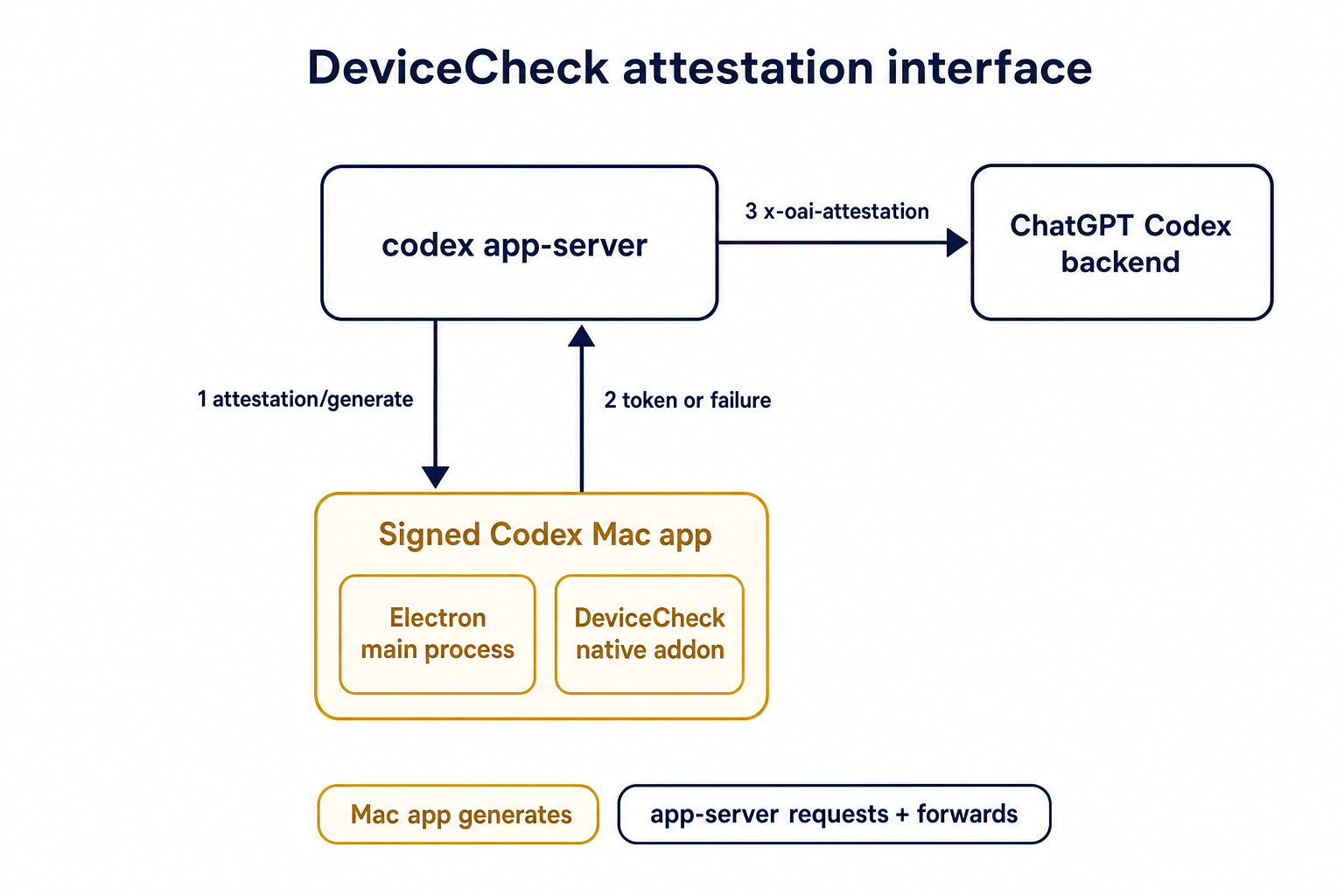
## Details
This PR teaches the Codex app-server runtime how to request and attach
an attestation token. It does not generate DeviceCheck tokens directly;
instead, it relies on the connected desktop app to advertise that it can
generate attestation and then asks that app for a fresh header value
when needed.
The flow is:
1. The Codex desktop app connects to app-server.
2. During `initialize`, the app can advertise that it supports
`requestAttestation`.
3. Before app-server calls selected ChatGPT Codex endpoints, it sends
the internal server request `attestation/generate` to the app.
4. app-server receives a pre-encoded header value back.
5. app-server forwards that value as `x-oai-attestation` on the scoped
outbound requests.
The code in this repo is mostly protocol and runtime plumbing: it adds
the app-server request/response shape, introduces an attestation
provider in core, wires that provider into Responses / compaction /
realtime setup paths, and covers the intended scoping with tests. The
signed macOS DeviceCheck generation remains owned by the desktop app PR.
## Related PR
- Codex desktop app implementation:
https://github.com/openai/openai/pull/878649
## Validation
<details>
<summary>Tests run</summary>
```sh
cargo test -p codex-app-server-protocol
cargo test -p codex-core attestation --lib
cargo test -p codex-app-server --lib attestation
```
Also ran:
```sh
just fix -p codex-core
just fix -p codex-app-server
just fix -p codex-app-server-protocol
just fmt
just write-app-server-schema
```
</details>
<details>
<summary>E2E DeviceCheck validation</summary>
First validated the signed desktop app boundary directly: launched a
packaged signed `Codex.app`, sent `attestation/generate`, decoded the
returned `v1.` attestation header, and validated the extracted
DeviceCheck token with `personal/jm/verify_devicecheck_token.py` using
bundle ID `com.openai.codex`. Apple returned `status_code: 200` and
`is_ok: true`.
Then ran the fuller app + app-server flow. The packaged `Codex.app`
launched a current-branch app-server via `CODEX_CLI_PATH`, and a local
MITM proxy intercepted outbound `chatgpt.com` traffic. The app-server
requested `attestation/generate` from the real Electron app process, and
the intercepted `/backend-api/codex/responses` traffic included
`x-oai-attestation` on both routes:
```text
GET /backend-api/codex/responses Upgrade: websocket x-oai-attestation: present
POST /backend-api/codex/responses Upgrade: none x-oai-attestation: present
```
The captured header decoded to a DeviceCheck token that also validated
with Apple for `com.openai.codex` (`status_code: 200`, `is_ok: true`,
team `2DC432GLL2`).
</details>
---------
Co-authored-by: Codex <noreply@openai.com>
## Why

After stdio transports and provider-owned defaults exist, Codex needs a
config-backed provider that can describe more than the single legacy
`CODEX_EXEC_SERVER_URL` remote. This PR adds that provider without
activating it in product entrypoints yet, keeping parser/validation
review separate from runtime wiring.

**Stack position:** this is PR 4 of 5. It builds on PR 3's
provider/default model and adds the `environments.toml` provider used by
PR 5.

## What Changed

- Add `environment_toml.rs` as the TOML-specific home for parsing,
validation, and provider construction.
- Keep the TOML schema/provider structs private; the public constructor
added here is `EnvironmentManager::from_codex_home(...)`.
- Add `TomlEnvironmentProvider`, including validation for:
  - reserved ids such as `local` and `none`
  - duplicate ids
  - unknown explicit defaults
  - empty programs or URLs
  - exactly one of `url` or `program` per configured environment
- Support websocket environments with `url = "ws://..."` / `wss://...`.
- Support stdio-command environments with `program = "..."`.
- Add helpers to load `environments.toml` from `CODEX_HOME`, but do not
wire entrypoints to call them yet.
- Add the `toml` dependency for parsing.

## Stack

- 1. https://github.com/openai/codex/pull/20663 - Add stdio exec-server
listener
- 2. https://github.com/openai/codex/pull/20664 - Add stdio exec-server
client transport
- 3. https://github.com/openai/codex/pull/20665 - Make environment
providers own default selection
- **4. This PR:** https://github.com/openai/codex/pull/20666 - Add
CODEX_HOME environments TOML provider
- 5. https://github.com/openai/codex/pull/20667 - Load configured
environments from CODEX_HOME

Split from original draft: https://github.com/openai/codex/pull/20508

## Validation

Not run locally; this was split out of the original draft stack.

## Documentation

This introduces the config shape for `environments.toml`; user-facing
documentation should be added before this stack is treated as a
documented public workflow.

---------

Co-authored-by: Codex <noreply@openai.com>
## Summary

`cargo test` has entails both running standard Rust tests and doctests.
It turns out that the doctest discovery is fairly slow, and it's a cost
you pay even for crates that don't include any doctests.

This PR disables doctests with `doctest = false` for crates that lack
any doctests.

For the collection of crates below, this speeds up test execution by
>4x.

E.g., before this PR:

```
Benchmark 1: cargo test     -p codex-utils-absolute-path     -p codex-utils-cache     -p codex-utils-cli     -p codex-utils-home-dir     -p codex-utils-output-truncation     -p codex-utils-path     -p codex-utils-string     -p codex-utils-template     -p codex-utils-elapsed     -p codex-utils-json-to-toml
  Time (mean ± σ):      1.849 s ±  4.455 s    [User: 0.752 s, System: 1.367 s]
  Range (min … max):    0.418 s … 14.529 s    10 runs
```

And after:

```
Benchmark 1: cargo test     -p codex-utils-absolute-path     -p codex-utils-cache     -p codex-utils-cli     -p codex-utils-home-dir     -p codex-utils-output-truncation     -p codex-utils-path     -p codex-utils-string     -p codex-utils-template     -p codex-utils-elapsed     -p codex-utils-json-to-toml
  Time (mean ± σ):     428.6 ms ±   6.9 ms    [User: 187.7 ms, System: 219.7 ms]
  Range (min … max):   418.0 ms … 436.8 ms    10 runs
```

For a single crate, with >2x speedup, before:

```
Benchmark 1: cargo test -p codex-utils-string
  Time (mean ± σ):     491.1 ms ±   9.0 ms    [User: 229.8 ms, System: 234.9 ms]
  Range (min … max):   480.9 ms … 512.0 ms    10 runs
```

And after:

```
Benchmark 1: cargo test -p codex-utils-string
  Time (mean ± σ):     213.9 ms ±   4.3 ms    [User: 112.8 ms, System: 84.0 ms]
  Range (min … max):   206.8 ms … 221.0 ms    13 runs
```

Co-authored-by: Codex <noreply@openai.com>
## Why

Reverts #20689 to restore the previous optional state DB plumbing. The
conflict resolution keeps the newer installation ID and session/thread
identity changes that landed after #20689, while removing the mandatory
state DB and agent graph store dependency from ThreadManager
construction.

## What changed

- Restored `Option<StateDbHandle>` through app-server, MCP server,
prompt debug, and test entry points.
- Removed the `codex-core` dependency on `codex-agent-graph-store` and
reverted descendant lookup back to the existing state DB path when
available.
- Kept newer `installation_id` forwarding by passing it beside the
optional DB handle.
- Kept local thread-name updates working when the optional state DB
handle is absent.

## Validation

- `git diff --check`
- `cargo test -p codex-thread-store`
- `cargo test -p codex-state -p codex-rollout -p
codex-app-server-protocol`
- Attempted `env CARGO_INCREMENTAL=0 cargo test -p codex-core -p
codex-app-server -p codex-app-server-client -p codex-mcp-server -p
codex-thread-manager-sample -p codex-tui`; blocked locally by a rustc
ICE while compiling `v8 v146.4.0` with `rustc 1.93.0 (254b59607
2026-01-19)` on `aarch64-apple-darwin`.
## Why

The core `Op::ListMcpTools` request path is no longer needed. Keeping it
around left a dead request/response surface alongside the app-server MCP
inventory APIs that own current server status listing.

## What Changed

- Removed `Op::ListMcpTools`, `EventMsg::McpListToolsResponse`, and the
core handler that built the MCP snapshot response.
- Removed the now-unused `codex-mcp` snapshot wrapper/export and passive
event handling arms in rollout and MCP-server consumers.
- Updated tests that used the old op as a synchronization hook to wait
on existing startup/skills events, and deleted the plugin test that only
exercised the removed listing op.

## Validation

- `cargo test -p codex-protocol`
- `cargo test -p codex-mcp`
- `cargo test -p codex-rollout -p codex-rollout-trace -p
codex-mcp-server`
- `cargo test -p codex-core --test all
pending_input::queued_inter_agent_mail`
- `cargo test -p codex-core --test all
rmcp_client::stdio_mcp_tool_call_includes_sandbox_state_meta`
- `cargo test -p codex-core --test all
rmcp_client::stdio_image_responses`
- `just fix -p codex-core -p codex-protocol -p codex-mcp -p
codex-rollout -p codex-rollout-trace -p codex-mcp-server`
## Summary

- resolve or inject the installation ID before core startup and pass it
through `ThreadManager`, `CodexSpawnArgs`, and `Session` as a plain
`String`
- keep child sessions on the parent installation ID instead of
rediscovering it inside core
- propagate installation ID startup failures in `mcp-server` instead of
panicking

## Why

Core was still touching the filesystem on the session startup path to
discover `installation_id`. This moves that work to the outer host
boundary so core no longer depends on `codex_home` reads during session
construction.

---------

Co-authored-by: Codex <noreply@openai.com>
## Why

`/responses/compact` should preserve the request-affinity fields that
apply to the active auth mode. ChatGPT-auth compact requests need the
effective `service_tier`, and compact requests for every auth mode need
the stable `prompt_cache_key`, so compaction does not quietly lose
routing or cache behavior that normal sampling already has.

This follows the request-parity direction from #20719, but keeps the net
change focused on the compact payload fields needed here.

## What changed

- Add `service_tier` and `prompt_cache_key` to the compact endpoint
input payload.
- Build the remote compact payload from the existing responses request
builder output so `Fast` still maps to `priority` when compact sends a
service tier.
- Pass the turn service tier into remote compaction, but only include it
in compact payloads for ChatGPT-backed auth.
- Keep `prompt_cache_key` on compact payloads for all auth modes.
- Add request-body diff snapshot coverage in
`core/tests/suite/compact_remote.rs` for:
- API-key auth reusing `prompt_cache_key` while omitting `service_tier`
even when `Fast` is configured.
  - ChatGPT auth reusing both `service_tier` and `prompt_cache_key`.
- Drive the snapshot coverage through five varied turns: plain text,
multi-part text, tool-call continuation, image+text input, local-shell
continuation, and final-turn reasoning output.

## Verification

- Added insta snapshots for compact request-body parity against the last
normal `/responses` request after five varied turns.
- Not run locally per repo guidance; relying on GitHub CI for test
execution.

---------

Co-authored-by: Codex <noreply@openai.com>
## Why

We want the agent graph store to be passed down the stack as a real
dependency, the same way we already treat the thread store.

This will let us inject the agent graph store as a real dependency and
support implementations other than the local SQLite-backed one. Right
now most code instantiates a state DB and an agent graph store
just-in-time. Ideally, we would not depend on the state DB directly but
only read through the higher-level interfaces.

This change makes the dependency boundaries explicit and moves state DB
initialization to process bootstrap instead of hiding it inside local
store implementations.

## What changed

- `ThreadManager` now requires a `StateDbHandle` and an
`AgentGraphStore` at construction time instead of treating them as
optional internals.
- The local store constructors no longer lazily initialize SQLite.
Callers now initialize the state DB once per process and use that shared
handle to build:
  - `LocalThreadStore`
  - `LocalAgentGraphStore`
- App bootstraps (`app-server`, `mcp-server`, `prompt_debug`, and the
thread-manager sample) now initialize the state DB up front and inject
the resulting handle down the stack.
- `app-server` now consistently uses its process-scoped state DB handle
instead of reopening SQLite or trying to recover it from loaded threads.
- Device-key storage now reuses the shared state DB handle instead of
maintaining its own lazy opener.
- The thread archive / descendant traversal paths now use the injected
`AgentGraphStore` instead of reaching through local
thread-store-specific state.

## Verification

- `cargo check -p codex-core -p codex-thread-store -p codex-app-server
-p codex-mcp-server -p codex-thread-manager-sample --tests`
- `cargo test -p codex-thread-store`
- `cargo test -p codex-core
thread_manager_accepts_separate_agent_graph_store_and_thread_store --
--nocapture`
- `cargo test -p codex-app-server
thread_archive_archives_spawned_descendants -- --nocapture`
# Why

We want shared hook trust that both the app and the TUI can build on,
but the metadata is only useful if runtime behavior agrees with it. This
PR adds a single backend trust model for hooks so unmanaged hooks cannot
run until the current definition has been reviewed, while managed hooks
remain runnable and non-configurable.

# What

- persist `trusted_hash` alongside hook state in `config.toml`
- expose `currentHash` and derived `trustStatus` through `hooks/list`
- derive trust from normalized hook definitions so equivalent hooks from
`config.toml` and `hooks.json` share the same trust identity
- gate unmanaged hooks on trust before they enter the runnable handler
set

# Reviewer Notes

- key file to review is `codex-rs/hooks/src/engine/discovery.rs`
- the only **core** change is schema related
## Why

The Bazel test coverage change exposed
`approved_folder_write_request_permissions_unblocks_later_apply_patch`,
and `rust-ci-full.yml` showed the same test failing on `main` on macOS.
There were two separate classes of problems here.

### Clean CI failure

The test emits an `apply_patch` tool call, but its config did not enable
the `apply_patch` tool, so the mocked response completed without an
`apply-patch-call` output. After enabling the tool, the same path also
needs the aggregate `codex-core` test binary to dispatch
`--codex-run-as-fs-helper`; sandboxed `apply_patch` uses that helper
under macOS Seatbelt.

The test now also canonicalizes the temporary patch target before
building the patch payload so the path matches normalized grants on
macOS, where `/var` paths often normalize to `/private/var`.

### Local/enterprise config isolation

The core test harness now builds its default test config with managed
config disabled, so host-managed enterprise config cannot alter these
tests. The request-permissions turns in this test also explicitly use
the user reviewer path, keeping the assertions focused on
`request_permissions` behavior rather than reviewer defaults from the
host.

## What Changed

- Enable `apply_patch` in
`approved_folder_write_request_permissions_unblocks_later_apply_patch`.
- Teach the core integration test binary to dispatch
`CODEX_FS_HELPER_ARG1`, matching the existing apply-patch and
linux-sandbox dispatch paths.
- Canonicalize the tempdir-backed patch target before creating the
patch.
- Ignore managed config in default core test configs and explicitly pin
this test to `ApprovalsReviewer::User`.

## Verification

Run outside the Codex app sandbox because these macOS tests
intentionally spawn Seatbelt:

- `cargo test -p codex-core
approved_folder_write_request_permissions_unblocks_later_apply_patch`
- `cargo test -p codex-core
approved_folder_write_request_permissions_unblocks_later_exec_without_sandbox_args`
## Why

SQLite state was still being opened from consumer paths, including lazy
`OnceCell`-backed thread-store call sites. That let one process
construct multiple state DB connections for the same Codex home, which
makes SQLite lock contention and `database is locked` failures much
easier to hit.

State DB lifetime should be chosen by main-like entrypoints and tests,
then passed through explicitly. Consumers should use the supplied
`Option<StateDbHandle>` or `StateDbHandle` and keep their existing
filesystem fallback or error behavior when no handle is available.

The startup path also needs to keep the rollout crate in charge of
SQLite state initialization. Opening `codex_state::StateRuntime`
directly bypasses rollout metadata backfill, so entrypoints should
initialize through `codex_rollout::state_db` and receive a handle only
after required rollout backfills have completed.

## What Changed

- Initialize the state DB in main-like entrypoints for CLI, TUI,
app-server, exec, MCP server, and the thread-manager sample.
- Pass `Option<StateDbHandle>` through `ThreadManager`,
`LocalThreadStore`, app-server processors, TUI app wiring, rollout
listing/recording, personality migration, shell snapshot cleanup,
session-name lookup, and memory/device-key consumers.
- Remove the lazy local state DB wrapper from the thread store so
non-test consumers use only the supplied handle or their existing
fallback path.
- Make `codex_rollout::state_db::init` the local state startup path: it
opens/migrates SQLite, runs rollout metadata backfill when needed, waits
for concurrent backfill workers up to a bounded timeout, verifies
completion, and then returns the initialized handle.
- Keep optional/non-owning SQLite helpers, such as remote TUI local
reads, as open-only paths that do not run startup backfill.
- Switch app-server startup from direct
`codex_state::StateRuntime::init` to the rollout state initializer so
app-server cannot skip rollout backfill.
- Collapse split rollout lookup/list APIs so callers use the normal
methods with an optional state handle instead of `_with_state_db`
variants.
- Restore `getConversationSummary(ThreadId)` to delegate through
`ThreadStore::read_thread` instead of a LocalThreadStore-specific
rollout path special case.
- Keep DB-backed rollout path lookup keyed on the DB row and file
existence, without imposing the filesystem filename convention on
existing DB rows.
- Verify readable DB-backed rollout paths against `session_meta.id`
before returning them, so a stale SQLite row that points at another
thread's JSONL falls back to filesystem search and read-repairs the DB
row.
- Keep `debug prompt-input` filesystem-only so a one-off debug command
does not initialize or backfill SQLite state just to print prompt input.
- Keep goal-session test Codex homes alive only in the goal-specific
helper, rather than leaking tempdirs from the shared session test
helper.
- Update tests and call sites to pass explicit state handles where DB
behavior is expected and explicit `None` where filesystem-only behavior
is intended.

## Validation

- `CARGO_TARGET_DIR=/tmp/codex-target-state-db cargo check -p
codex-rollout -p codex-thread-store -p codex-app-server -p codex-core -p
codex-tui -p codex-exec -p codex-cli --tests`
- `CARGO_TARGET_DIR=/tmp/codex-target-state-db cargo test -p
codex-rollout state_db_`
- `CARGO_TARGET_DIR=/tmp/codex-target-state-db cargo test -p
codex-rollout find_thread_path`
- `CARGO_TARGET_DIR=/tmp/codex-target-state-db cargo test -p
codex-rollout find_thread_path -- --nocapture`
- `CARGO_TARGET_DIR=/tmp/codex-target-state-db cargo test -p
codex-rollout try_init_ -- --nocapture`
- `CARGO_TARGET_DIR=/tmp/codex-target-state-db cargo test -p
codex-rollout`
- `CARGO_TARGET_DIR=/tmp/codex-target-state-db cargo clippy -p
codex-rollout --lib -- -D warnings`
- `CARGO_TARGET_DIR=/tmp/codex-target-state-db cargo test -p
codex-thread-store
read_thread_falls_back_when_sqlite_path_points_to_another_thread --
--nocapture`
- `CARGO_TARGET_DIR=/tmp/codex-target-state-db cargo test -p
codex-thread-store`
- `CARGO_TARGET_DIR=/tmp/codex-target-state-db cargo test -p codex-core
shell_snapshot`
- `CARGO_TARGET_DIR=/tmp/codex-target-state-db cargo test -p codex-core
--test all personality_migration`
- `CARGO_TARGET_DIR=/tmp/codex-target-state-db cargo test -p codex-core
--test all rollout_list_find`
- `RUST_MIN_STACK=8388608 CODEX_SKIP_VENDORED_BWRAP=1
CARGO_TARGET_DIR=/tmp/codex-target-state-db cargo test -p codex-core
--test all rollout_list_find::find_prefers_sqlite_path_by_id --
--nocapture`
- `RUST_MIN_STACK=8388608 CODEX_SKIP_VENDORED_BWRAP=1
CARGO_TARGET_DIR=/tmp/codex-target-state-db cargo test -p codex-core
--test all rollout_list_find -- --nocapture`
- `CARGO_TARGET_DIR=/tmp/codex-target-state-db cargo test -p codex-core
interrupt_accounts_active_goal_before_pausing`
- `CARGO_TARGET_DIR=/tmp/codex-target-state-db cargo test -p
codex-app-server get_auth_status -- --test-threads=1`
- `CODEX_SKIP_VENDORED_BWRAP=1
CARGO_TARGET_DIR=/tmp/codex-target-state-db cargo test -p
codex-app-server --lib`
- `CODEX_SKIP_VENDORED_BWRAP=1
CARGO_TARGET_DIR=/tmp/codex-target-state-db cargo check -p codex-rollout
-p codex-app-server --tests`
- `CARGO_TARGET_DIR=/tmp/codex-target-state-db just fix -p codex-rollout
-p codex-thread-store -p codex-core -p codex-app-server -p codex-tui -p
codex-exec -p codex-cli`
- `CODEX_SKIP_VENDORED_BWRAP=1
CARGO_TARGET_DIR=/tmp/codex-target-state-db just fix -p codex-rollout -p
codex-app-server`
- `CARGO_TARGET_DIR=/tmp/codex-target-state-db just fix -p
codex-rollout`
- `CODEX_SKIP_VENDORED_BWRAP=1
CARGO_TARGET_DIR=/tmp/codex-target-state-db just fix -p codex-core`
- `just argument-comment-lint -p codex-core`
- `just argument-comment-lint -p codex-rollout`

Focused coverage added in `codex-rollout`:

- `recorder::tests::state_db_init_backfills_before_returning` verifies
the rollout metadata row exists before startup init returns.
- `state_db::tests::try_init_waits_for_concurrent_startup_backfill`
verifies startup waits for another worker to finish backfill instead of
disabling the handle for the process.
-
`state_db::tests::try_init_times_out_waiting_for_stuck_startup_backfill`
verifies startup does not hang indefinitely on a stuck backfill lease.
-
`tests::find_thread_path_accepts_existing_state_db_path_without_canonical_filename`
verifies DB-backed lookup accepts valid existing rollout paths even when
the filename does not include the thread UUID.
-
`tests::find_thread_path_falls_back_when_db_path_points_to_another_thread`
verifies DB-backed lookup ignores a stale row whose existing path
belongs to another thread and read-repairs the row after filesystem
fallback.

Focused coverage updated in `codex-core`:

- `rollout_list_find::find_prefers_sqlite_path_by_id` now uses a
DB-preferred rollout file with matching `session_meta.id`, so it still
verifies that valid SQLite paths win without depending on stale/empty
rollout contents.

`cargo test -p codex-app-server thread_list_respects_search_term_filter
-- --test-threads=1 --nocapture` was attempted locally but timed out
waiting for the app-server test harness `initialize` response before
reaching the changed thread-list code path.

`bazel test //codex-rs/thread-store:thread-store-unit-tests
--test_output=errors` was attempted locally after the thread-store fix,
but this container failed before target analysis while fetching `v8+`
through BuildBuddy/direct GitHub. The equivalent local crate coverage,
including `cargo test -p codex-thread-store`, passes.

A plain local `cargo check -p codex-rollout -p codex-app-server --tests`
also requires system `libcap.pc` for `codex-linux-sandbox`; the
follow-up app-server check above used `CODEX_SKIP_VENDORED_BWRAP=1` in
this container.
- Build one app-server process ThreadStore from startup config and share
it with ThreadManager and CodexMessageProcessor.
- Remove per-thread/fork store reconstruction so effective thread config
cannot switch the persistence backend.
- Add params to ThreadStore create/resume for specifying thread
metadata, since otherwise the metadata from store creation would be used
(incorrectly).
Summary:
- Add codex-thread-manager-sample, a one-shot binary that starts a
ThreadManager thread, submits a prompt, and prints the final assistant
output.
- Pass ThreadStore into ThreadManager::new and expose
thread_store_from_config for existing callsites.
- Build the sample Config directly with only --model and prompt inputs.

Verification:
- just fmt
- cargo check -p codex-thread-manager-sample -p codex-app-server -p
codex-mcp-server
- git diff --check

Tests: Not run per request.
## Summary
- Change `EnvironmentProvider` to return concrete `Environment`
instances instead of `EnvironmentConfigurations`.
- Make `DefaultEnvironmentProvider` provide the provider-visible `local`
environment plus optional `remote` environment from
`CODEX_EXEC_SERVER_URL`.
- Keep `EnvironmentManager` as the concrete cache while exposing its own
explicit local environment for `local_environment()` fallback paths.

## Validation
- `just fmt`
- `git diff --check`

---------

Co-authored-by: Codex <noreply@openai.com>
## Summary
- Updates the zsh-fork test helper to configure `PermissionProfile`
directly instead of constructing a legacy `SandboxPolicy`.
- Sends permission-profile-backed turns from the skill approval zsh-fork
tests so the runtime and request path exercise the canonical permissions
model.
- Leaves the broader approvals suite on legacy policies for now, except
for the zsh-fork test that shares this helper.

## Verification
- `cargo check -p codex-core --tests`
- `just fmt`
## Summary
- Add `turn_permission_fields()` so tests that construct `Op::UserTurn`
directly can provide a canonical `PermissionProfile` while still filling
the required legacy `sandbox_policy` compatibility field.
- Migrate direct user-turn construction in core integration tests from
`SandboxPolicy::DangerFullAccess` to `PermissionProfile::Disabled`.
- Continue reducing direct `SandboxPolicy` usage in
`codex-rs/core/tests`, from 41 files after #20010 to 32 files in this
PR.

## Testing
- `cargo check -p codex-core --tests`
- `just fmt`
- `just fix -p core_test_support`
- `just fix -p codex-core`
## Summary

- Add `PermissionProfile`-based turn submission helpers to
`core_test_support`, while keeping the legacy `SandboxPolicy` helper for
tests that intentionally exercise legacy fallback behavior.
- Switch the default `TestCodex::submit_turn()` path to send a real
`PermissionProfile` plus the required legacy compatibility projection in
`Op::UserTurn`.
- Migrate straightforward app/search/shell/truncation tests from
`SandboxPolicy::{DangerFullAccess, ReadOnly}` to
`PermissionProfile::{Disabled, read_only}`.
- Add a TUI compatibility projection helper for legacy app-server fields
so non-legacy writable roots are preserved instead of being downgraded
to read-only.
- Fix remote start/resume/fork sandbox-mode projection to classify any
managed profile with writable roots as workspace-write, not only
profiles that can write `cwd`.
- Reduce `SandboxPolicy` references in `codex-rs/core/tests` from 47
files to 41 files without changing production behavior.

## Testing

- `cargo check -p codex-core --tests`
- `cargo test -p codex-tui
compatibility_profile_preserves_unbridgeable_write_roots`
- `cargo test -p codex-tui
sandbox_mode_preserves_non_cwd_write_roots_for_remote_sessions`
- `just fmt`
- `just fix -p core_test_support`
- `just fix -p codex-core`
## Why

The migration away from `SandboxPolicy` needs new configs to start from
permissions profiles instead of deriving profiles from legacy sandbox
modes. Existing users can have empty `config.toml` files, and we should
not rewrite user-owned config files that may live in shared
repositories.

This PR introduces built-in profile names so an empty config can resolve
to a canonical `PermissionProfile`, while explicit named `[permissions]`
profiles still behave predictably.

## What changed

- Adds built-in `default_permissions` profile names:
  - `:read-only` maps to `PermissionProfile::read_only()`.
- `:workspace` maps to the workspace-write profile, including
project-root metadata carveouts.
- `:danger-no-sandbox` maps to `PermissionProfile::Disabled`, preserving
the distinction between no sandbox and a broad managed sandbox.
- Reserves the `:` prefix for built-in profiles so user-defined
`[permissions]` profiles cannot collide with future built-ins.
- Allows `default_permissions` to reference a built-in profile without
requiring a `[permissions]` table.
- Makes an otherwise empty config choose a built-in profile by
trust/platform context: trusted or untrusted project roots use
`:workspace` when the platform supports that sandbox, while roots
without a trust decision use `:read-only`.
- Keeps legacy `sandbox_mode` configs on the legacy path, and still
rejects user-defined `[permissions]` profiles that omit
`default_permissions` so we do not silently guess among custom profiles.
- Preserves compatibility behavior for implicit defaults: bare
`network.enabled = true` allows runtime network without starting the
managed proxy, explicit profile proxy policy still starts the proxy, and
implicit workspace/add-dir roots keep legacy metadata carveouts.

## Verification

- `cargo test -p codex-core builtin --lib`
- `cargo test -p codex-core profile_network_proxy_config`
- `cargo test -p codex-core
implicit_builtin_workspace_profile_preserves_add_dir_metadata_carveouts`
- `cargo test -p codex-core
permissions_profiles_network_enabled_allows_runtime_network_without_proxy`
- `cargo test -p codex-core
permissions_profiles_proxy_policy_starts_managed_network_proxy`

## Documentation

Public Codex config docs should mention these built-in names when the
`[permissions]` config format is ready to document as stable.


---
[//]: # (BEGIN SAPLING FOOTER)
Stack created with [Sapling](https://sapling-scm.com). Best reviewed
with [ReviewStack](https://reviewstack.dev/openai/codex/pull/19900).
* #20041
* #20040
* #20037
* #20035
* #20034
* #20033
* #20032
* #20030
* #20028
* #20027
* #20026
* #20024
* #20021
* #20018
* #20016
* #20015
* #20013
* #20011
* #20010
* #20008
* __->__ #19900

 Adam Perry @ OpenAIandGitHub
 Owen LinandGitHub
 pakrym-oaiandGitHub
 Michael BolinandGitHub
 rka-oaiandGitHub
 joeflorencio-openaiandGitHub
 Gabriel PealandGitHub
 Shijie RaoandGitHub
 starr-openaiandGitHub
 Eric TrautandGitHub
 mchen-oaiandGitHub
 Dylan HurdandGitHub


 Rasmus RygaardandGitHub
 AbhinavandGitHub
 Ruslan NigmatullinandGitHub
 TomandGitHub
