Commit Graph

33 Commits

  • app-server: drop legacy profile config surface (#24067)
    ## Why
    
    Legacy `[profiles.<name>]` config tables and the legacy `profile`
    selector are being retired in favor of profile files selected with
    `--profile <name>`. After #23886 removed the CLI-side legacy profile
    plumbing, the app-server config surface still exposed those fields and
    still carried conversion code for the old protocol shape.
    
    ## What changed
    
    - Remove `profile`, `profiles`, and `ProfileV2` from the app-server
    config protocol/schema output so `config/read` no longer returns legacy
    profile config.
    - Drop the old v1 `UserSavedConfig` profile conversion path from
    `config`.
    - Reject new app-server config writes under `profiles.*` with the same
    migration direction used for `profile`, while still allowing callers to
    clear existing legacy profile tables.
    - Refresh app-server config coverage and the experimental API README
    example around the remaining `Config` nesting path.
    
    ## Verification
    
    - Added config-manager coverage that `config/read` omits legacy profile
    config, `profiles.*` writes are rejected, and existing legacy profile
    tables can still be cleared.
    - Updated the v2 config RPC test to cover the rejected `profiles.*`
    batch-write path.
  • [codex] Support multiple forced ChatGPT workspaces (#18161)
    ## Summary
    
    This change lets `forced_chatgpt_workspace_id` accept multiple workspace
    IDs instead of a single value.
    
    It keeps the existing config key name, adds backward-compatible parsing
    for a single string in `config.toml`, and normalizes the setting into an
    allowed workspace list across login enforcement, app-server config
    surfaces, and local ChatGPT auth helpers.
    
    ## Why
    
    Workspace-restricted deployments may need to allow more than one ChatGPT
    workspace without dropping the guardrail entirely.
    
    ## Server-side impact
    
    Codex's local server and app-server protocol needed changes because they
    previously assumed a single workspace ID. The local login flow now
    matches the auth backend interface by sending the allowed workspace list
    as a single comma-separated `allowed_workspace_id` query parameter.
    
    ## Validation
    
    This was tested with:
    
    - A single workspace config
    - With multi-workspace configs
    - With multiple workspaces in the config
    - The user only being a part of a subset of them
    
    All were successful.
    
    Automated coverage:
    
    - `cargo test -p codex-login`
    - `cargo test -p codex-app-server-protocol`
    - `cargo test -p codex-tui local_chatgpt_auth`
    - `cargo test --locked -p codex-app-server
    login_account_chatgpt_includes_forced_workspace_allowlist_query_param`
  • chore(config) rm tools.view_image (#22501)
    ## Summary
    It appears this config flag has been broken/a noop for quite some time:
    since https://github.com/openai/codex/pull/8850. Let's simplify and get
    rid of this.
    
    ## Testing
    - [x] Updated unit tests
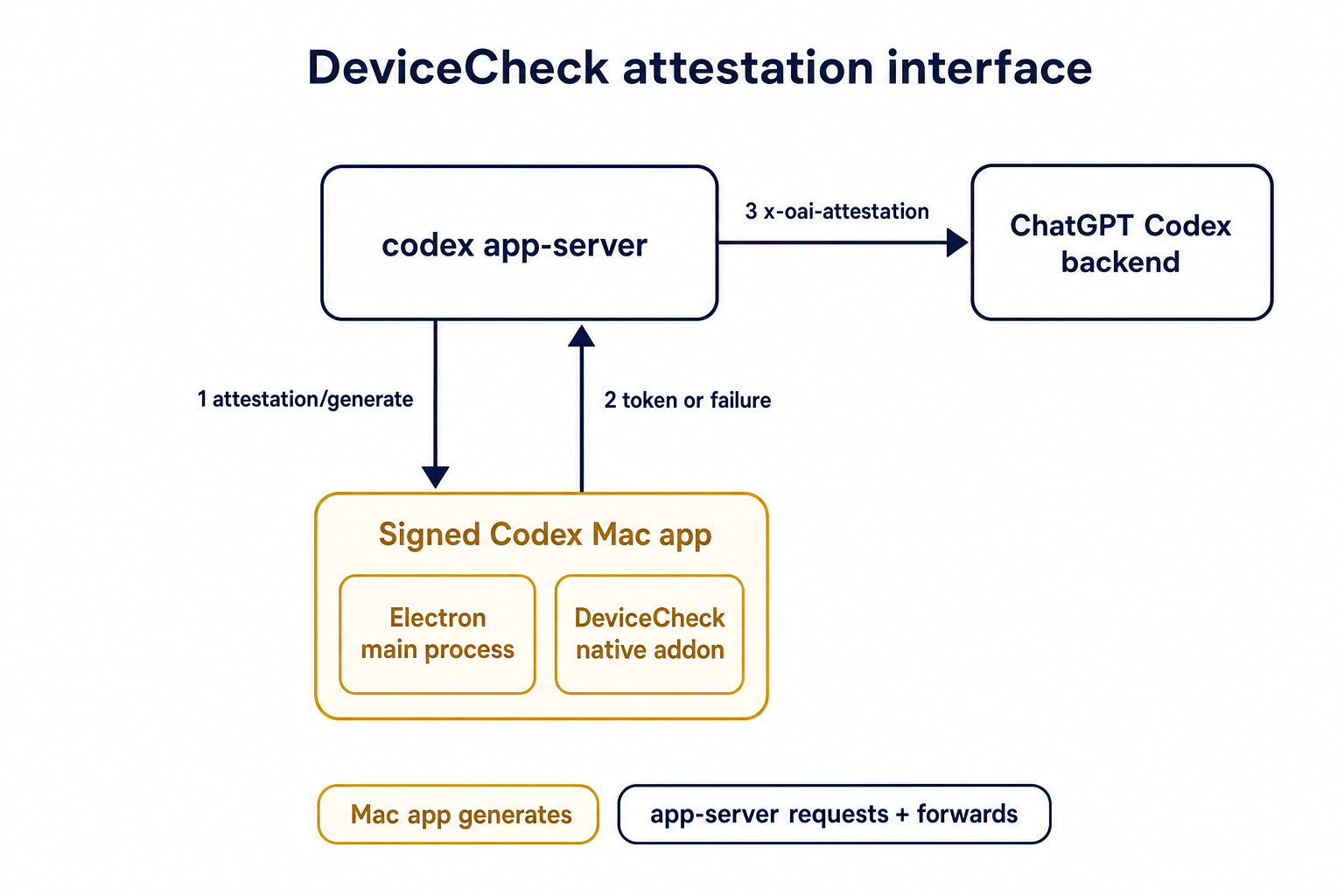
  • [codex] request desktop attestation from app (#20619)
    ## Summary
    
    TL;DR: teaches `codex-rs` / app-server to request a desktop-provided
    attestation token and attach it as `x-oai-attestation` on the scoped
    ChatGPT Codex request paths.
    
    ![DeviceCheck attestation
    interface](https://raw.githubusercontent.com/openai/codex/dev/jm/devicecheck-diagram-assets/pr-assets/devicecheck-attestation-interface.png)
    
    ## Details
    
    This PR teaches the Codex app-server runtime how to request and attach
    an attestation token. It does not generate DeviceCheck tokens directly;
    instead, it relies on the connected desktop app to advertise that it can
    generate attestation and then asks that app for a fresh header value
    when needed.
    
    The flow is:
    
    1. The Codex desktop app connects to app-server.
    2. During `initialize`, the app can advertise that it supports
    `requestAttestation`.
    3. Before app-server calls selected ChatGPT Codex endpoints, it sends
    the internal server request `attestation/generate` to the app.
    4. app-server receives a pre-encoded header value back.
    5. app-server forwards that value as `x-oai-attestation` on the scoped
    outbound requests.
    
    The code in this repo is mostly protocol and runtime plumbing: it adds
    the app-server request/response shape, introduces an attestation
    provider in core, wires that provider into Responses / compaction /
    realtime setup paths, and covers the intended scoping with tests. The
    signed macOS DeviceCheck generation remains owned by the desktop app PR.
    
    ## Related PR
    
    - Codex desktop app implementation:
    https://github.com/openai/openai/pull/878649
    
    ## Validation
    
    <details>
    <summary>Tests run</summary>
    
    ```sh
    cargo test -p codex-app-server-protocol
    cargo test -p codex-core attestation --lib
    cargo test -p codex-app-server --lib attestation
    ```
    
    Also ran:
    
    ```sh
    just fix -p codex-core
    just fix -p codex-app-server
    just fix -p codex-app-server-protocol
    just fmt
    just write-app-server-schema
    ```
    
    </details>
    
    <details>
    <summary>E2E DeviceCheck validation</summary>
    
    First validated the signed desktop app boundary directly: launched a
    packaged signed `Codex.app`, sent `attestation/generate`, decoded the
    returned `v1.` attestation header, and validated the extracted
    DeviceCheck token with `personal/jm/verify_devicecheck_token.py` using
    bundle ID `com.openai.codex`. Apple returned `status_code: 200` and
    `is_ok: true`.
    
    Then ran the fuller app + app-server flow. The packaged `Codex.app`
    launched a current-branch app-server via `CODEX_CLI_PATH`, and a local
    MITM proxy intercepted outbound `chatgpt.com` traffic. The app-server
    requested `attestation/generate` from the real Electron app process, and
    the intercepted `/backend-api/codex/responses` traffic included
    `x-oai-attestation` on both routes:
    
    ```text
    GET  /backend-api/codex/responses  Upgrade: websocket  x-oai-attestation: present
    POST /backend-api/codex/responses  Upgrade: none       x-oai-attestation: present
    ```
    
    The captured header decoded to a DeviceCheck token that also validated
    with Apple for `com.openai.codex` (`status_code: 200`, `is_ok: true`,
    team `2DC432GLL2`).
    
    </details>
    
    ---------
    
    Co-authored-by: Codex <noreply@openai.com>
  • Refactor config loading to use filesystem abstraction (#18209)
    Initial pass propagating FileSystem through config loading.
  • app-server: Return codex home in initialize response (#15689)
    This allows clients to get enough information to interact with the codex
    skills/configuration/etc.
  • Move git utilities into a dedicated crate (#15564)
    - create `codex-git-utils` and move the shared git helpers into it with
    file moves preserved for diff readability
    - move the `GitInfo` helpers out of `core` so stacked rollout work can
    depend on the shared crate without carrying its own git info module
    
    ---------
    
    Co-authored-by: Ahmed Ibrahim <219906144+aibrahim-oai@users.noreply.github.com>
    Co-authored-by: Codex <noreply@openai.com>
  • app-server: Add platform os and family to init response (#14527)
    This allows the client to pick os-specific behavior while interacting
    with the app server, e.g. to use proper path separators.
  • chore(app-server): delete unused rpc methods from v1.rs (#14394)
    ## Description
    
    This PR trims `app-server-protocol`'s v1 surface down to the small set
    of legacy types we still actually use.
    
    Unfortunately, we can't delete all of them yet because:
    - a few one-off v1 RPCs are still used by the Codex app
    - a few of these app-server-protocol v1 types are actually imported by
    core crates
    
    This change deletes that unused RPC surface, keeps the remaining
    compatibility types in place, and makes the crate root re-export only
    the v1 structs that downstream crates still depend on.
    
    ## Why
    
    The main goal here is to make the legacy protocol surface match reality.
    Leaving a large pile of dead v1 structs in place makes it harder to tell
    which compatibility paths are still intentional, and it keeps old
    schema/types around even though nothing should be building against them
    anymore.
    
    This also gives us a cleaner boundary for future cleanup. Instead of
    re-exporting all of `protocol::v1::*`, the crate now explicitly exposes
    only the v1 types that are still live, which makes it much easier to see
    what remains and delete more safely later.
    
    ## What changed
    
    - Deleted the unused v1 RPC/request/response structs from
    `app-server-protocol/src/protocol/v1.rs`.
    - Kept the small set of v1 compatibility types that are still live,
    including:
      - `initialize`
      - `getConversationSummary`
      - `getAuthStatus`
      - `gitDiffToRemote`
      - legacy approval payloads
      - config-related structs still used by downstream crates
    - Replaced the blanket `pub use protocol::v1::*` export in
    `app-server-protocol/src/lib.rs` with an explicit list of the remaining
    supported v1 types.
    - Regenerated the schema/type artifacts, which also updated the
    `InitializeCapabilities` opt-out example to use `thread/started` instead
    of the old `codex/event/session_configured` example.
    
    ## Validation
    
    - `just write-app-server-schema`
    - `cargo test -p codex-app-server-protocol`
    
    ## Follow-up
    
    The next cleanup is to keep shrinking the remaining v1 compatibility
    surface as callers migrate off it. Once the remaining consumers stop
    importing these legacy types, we should be able to remove more of the v1
    module and eventually stop exporting it from the crate root entirely.
  • chore(app-server): stop emitting codex/event/ notifications (#14392)
    ## Description
    
    This PR stops emitting legacy `codex/event/*` notifications from the
    public app-server transports.
    
    It's been a long time coming! app-server was still producing a raw
    notification stream from core, alongside the typed app-server
    notifications and server requests, for compatibility reasons. Now,
    external clients should no longer be depending on those legacy
    notifications, so this change removes them from the stdio and websocket
    contract and updates the surrounding docs, examples, and tests to match.
    
    ### Caveat
    I left the "in-process" version of app-server alone for now, since
    `codex exec` was recently based on top of app-server via this in-process
    form here: https://github.com/openai/codex/pull/14005
    
    Seems like `codex exec` still consumes some legacy notifications
    internally, so this branch only removes `codex/event/*` from app-server
    over stdio and websockets.
    
    ## Follow-up
    
    Once `codex exec` is fully migrated off `codex/event/*` notifications,
    we'll be able to stop emitting them entirely entirely instead of just
    filtering it at the external transport boundary.
  • Add guardian approval MVP (#13692)
    ## Summary
    - add the guardian reviewer flow for `on-request` approvals in command,
    patch, sandbox-retry, and managed-network approval paths
    - keep guardian behind `features.guardian_approval` instead of exposing
    a public `approval_policy = guardian` mode
    - route ordinary `OnRequest` approvals to the guardian subagent when the
    feature is enabled, without changing the public approval-mode surface
    
    ## Public model
    - public approval modes stay unchanged
    - guardian is enabled via `features.guardian_approval`
    - when that feature is on, `approval_policy = on-request` keeps the same
    approval boundaries but sends those approval requests to the guardian
    reviewer instead of the user
    - `/experimental` only persists the feature flag; it does not rewrite
    `approval_policy`
    - CLI and app-server no longer expose a separate `guardian` approval
    mode in this PR
    
    ## Guardian reviewer
    - the reviewer runs as a normal subagent and reuses the existing
    subagent/thread machinery
    - it is locked to a read-only sandbox and `approval_policy = never`
    - it does not inherit user/project exec-policy rules
    - it prefers `gpt-5.4` when the current provider exposes it, otherwise
    falls back to the parent turn's active model
    - it fail-closes on timeout, startup failure, malformed output, or any
    other review error
    - it currently auto-approves only when `risk_score < 80`
    
    ## Review context and policy
    - guardian mirrors `OnRequest` approval semantics rather than
    introducing a separate approval policy
    - explicit `require_escalated` requests follow the same approval surface
    as `OnRequest`; the difference is only who reviews them
    - managed-network allowlist misses that enter the approval flow are also
    reviewed by guardian
    - the review prompt includes bounded recent transcript history plus
    recent tool call/result evidence
    - transcript entries and planned-action strings are truncated with
    explicit `<guardian_truncated ... />` markers so large payloads stay
    bounded
    - apply-patch reviews include the full patch content (without
    duplicating the structured `changes` payload)
    - the guardian request layout is snapshot-tested using the same
    model-visible Responses request formatter used elsewhere in core
    
    ## Guardian network behavior
    - the guardian subagent inherits the parent session's managed-network
    allowlist when one exists, so it can use the same approved network
    surface while reviewing
    - exact session-scoped network approvals are copied into the guardian
    session with protocol/port scope preserved
    - those copied approvals are now seeded before the guardian's first turn
    is submitted, so inherited approvals are available during any immediate
    review-time checks
    
    ## Out of scope / follow-ups
    - the sandbox-permission validation split was pulled into a separate PR
    and is not part of this diff
    - a future follow-up can enable `serde_json` preserve-order in
    `codex-core` and then simplify the guardian action rendering further
    
    ---------
    
    Co-authored-by: Codex <noreply@openai.com>
  • chore(app-server): delete v1 RPC methods and notifications (#13375)
    ## Summary
    This removes the old app-server v1 methods and notifications we no
    longer need, while keeping the small set the main codex app client still
    depends on for now.
    
    The remaining legacy surface is:
    - `initialize`
    - `getConversationSummary`
    - `getAuthStatus`
    - `gitDiffToRemote`
    - `fuzzyFileSearch`
    - `fuzzyFileSearch/sessionStart`
    - `fuzzyFileSearch/sessionUpdate`
    - `fuzzyFileSearch/sessionStop`
    
    And the raw `codex/event/*` notifications emitted from core. These
    notifications will be removed in a followup PR.
    
    ## What changed
    - removed deprecated v1 request variants from the protocol and
    app-server dispatcher
    - removed deprecated typed notifications: `authStatusChange`,
    `loginChatGptComplete`, and `sessionConfigured`
    - updated the app-server test client to use v2 flows instead of deleted
    v1 flows
    - deleted legacy-only app-server test suites and added focused coverage
    for `getConversationSummary`
    - regenerated app-server schema fixtures and updated the MCP interface
    docs to match the remaining compatibility surface
    
    ## Testing
    - `just write-app-server-schema`
    - `cargo test -p codex-app-server-protocol`
    - `cargo test -p codex-app-server`
  • app-server service tier plumbing (plus some cleanup) (#13334)
    followup to https://github.com/openai/codex/pull/13212 to expose fast
    tier controls to app server
    (majority of this PR is generated schema jsons - actual code is +69 /
    -35 and +24 tests )
    
    - add service tier fields to the app-server protocol surfaces used by
    thread lifecycle, turn start, config, and session configured events
    - thread service tier through the app-server message processor and core
    thread config snapshots
    - allow runtime config overrides to carry service tier for app-server
    callers
    
    cleanup:
    - Removing useless "legacy" code supporting "standard" - we moved to
    None | "fast", so "standard" is not needed.
  • Enforce user input length cap (#12823)
    Currently there is no bound on the length of a user message submitted in
    the TUI or through the app server interface. That means users can paste
    many megabytes of text, which can lead to bad performance, hangs, and
    crashes. In extreme cases, it can lead to a [kernel
    panic](https://github.com/openai/codex/issues/12323).
    
    This PR limits the length of a user input to 2**20 (about 1M)
    characters. This value was chosen because it fills the entire context
    window on the latest models, so accepting longer inputs wouldn't make
    sense anyway.
    
    Summary
    - add a shared `MAX_USER_INPUT_TEXT_CHARS` constant in codex-protocol
    and surface it in TUI and app server code
    - block oversized submissions in the TUI submit flow and emit error
    history cells when validation fails
    - reject heavy app-server requests with JSON-RPC `-32602` and structured
    `input_too_large` data, plus document the behavior
    
    Testing
    - ran the IDE extension with this change and verified that when I
    attempt to paste a user message that's several MB long, it correctly
    reports an error instead of crashing or making my computer hot.
  • chore: remove codex-core public protocol/shell re-exports (#12432)
    ## Why
    
    `codex-rs/core/src/lib.rs` re-exported a broad set of types and modules
    from `codex-protocol` and `codex-shell-command`. That made it easy for
    workspace crates to import those APIs through `codex-core`, which in
    turn hides dependency edges and makes it harder to reduce compile-time
    coupling over time.
    
    This change removes those public re-exports so call sites must import
    from the source crates directly. Even when a crate still depends on
    `codex-core` today, this makes dependency boundaries explicit and
    unblocks future work to drop `codex-core` dependencies where possible.
    
    ## What Changed
    
    - Removed public re-exports from `codex-rs/core/src/lib.rs` for:
    - `codex_protocol::protocol` and related protocol/model types (including
    `InitialHistory`)
      - `codex_protocol::config_types` (`protocol_config_types`)
    - `codex_shell_command::{bash, is_dangerous_command, is_safe_command,
    parse_command, powershell}`
    - Migrated workspace Rust call sites to import directly from:
      - `codex_protocol::protocol`
      - `codex_protocol::config_types`
      - `codex_protocol::models`
      - `codex_shell_command`
    - Added explicit `Cargo.toml` dependencies (`codex-protocol` /
    `codex-shell-command`) in crates that now import those crates directly.
    - Kept `codex-core` internal modules compiling by using `pub(crate)`
    aliases in `core/src/lib.rs` (internal-only, not part of the public
    API).
    - Updated the two utility crates that can already drop a `codex-core`
    dependency edge entirely:
      - `codex-utils-approval-presets`
      - `codex-utils-cli`
    
    ## Verification
    
    - `cargo test -p codex-utils-approval-presets`
    - `cargo test -p codex-utils-cli`
    - `cargo check --workspace --all-targets`
    - `just clippy`
  • feat(core): plumb distinct approval ids for command approvals (#12051)
    zsh fork PR stack:
    - https://github.com/openai/codex/pull/12051 👈 
    - https://github.com/openai/codex/pull/12052
    
    With upcoming support for a fork of zsh that allows us to intercept
    `execve` and run execpolicy checks for each subcommand as part of a
    `CommandExecution`, it will be possible for there to be multiple
    approval requests for a shell command like `/path/to/zsh -lc 'git status
    && rg \"TODO\" src && make test'`.
    
    To support that, this PR introduces a new `approval_id` field across
    core, protocol, and app-server so that we can associate approvals
    properly for subcommands.
  • feat: opt-out of events in the app-server (#11319)
    Add `optOutNotificationMethods` in the app-server to opt-out events
    based on exact method matching
  • feat: experimental flags (#10231)
    ## Problem being solved
    - We need a single, reliable way to mark app-server API surface as
    experimental so that:
      1. the runtime can reject experimental usage unless the client opts in
    2. generated TS/JSON schemas can exclude experimental methods/fields for
    stable clients.
    
    Right now that’s easy to drift or miss when done ad-hoc.
    
    ## How to declare experimental methods and fields
    - **Experimental method**: add `#[experimental("method/name")]` to the
    `ClientRequest` variant in `client_request_definitions!`.
    - **Experimental field**: on the params struct, derive `ExperimentalApi`
    and annotate the field with `#[experimental("method/name.field")]` + set
    `inspect_params: true` for the method variant so
    `ClientRequest::experimental_reason()` inspects params for experimental
    fields.
    
    ## How the macro solves it
    - The new derive macro lives in
    `codex-rs/codex-experimental-api-macros/src/lib.rs` and is used via
    `#[derive(ExperimentalApi)]` plus `#[experimental("reason")]`
    attributes.
    - **Structs**:
    - Generates `ExperimentalApi::experimental_reason(&self)` that checks
    only annotated fields.
      - The “presence” check is type-aware:
        - `Option<T>`: `is_some_and(...)` recursively checks inner.
        - `Vec`/`HashMap`/`BTreeMap`: must be non-empty.
        - `bool`: must be `true`.
        - Other types: considered present (returns `true`).
    - Registers each experimental field in an `inventory` with `(type_name,
    serialized field name, reason)` and exposes `EXPERIMENTAL_FIELDS` for
    that type. Field names are converted from `snake_case` to `camelCase`
    for schema/TS filtering.
    - **Enums**:
    - Generates an exhaustive `match` returning `Some(reason)` for annotated
    variants and `None` otherwise (no wildcard arm).
    - **Wiring**:
    - Runtime gating uses `ExperimentalApi::experimental_reason()` in
    `codex-rs/app-server/src/message_processor.rs` to reject requests unless
    `InitializeParams.capabilities.experimental_api == true`.
    - Schema/TS export filters use the inventory list and
    `EXPERIMENTAL_CLIENT_METHODS` from `client_request_definitions!` to
    strip experimental methods/fields when `experimental_api` is false.
  • Add total (non-partial) TextElement placeholder accessors (#9545)
    ## Summary
    - Make `TextElement` placeholders private and add a text-backed accessor
    to avoid assuming `Some`.
    - Since they are optional in the protocol, we want to make sure any
    accessors properly handle the None case (getting the placeholder using
    the byte range in the text)
    - Preserve placeholders during protocol/app-server conversions using the
    accessor fallback.
    - Update TUI composer/remap logic and tests to use the new
    constructor/accessor.
  • feat(app-server, core): return threads by created_at or updated_at (#9247)
    Add support for returning threads by either `created_at` OR `updated_at`
    descending. Previously core always returned threads ordered by
    `created_at`.
    
    This PR:
    - updates core to be able to list threads by `updated_at` OR
    `created_at` descending based on what the caller wants
    - also update `thread/list` in app-server to expose this (default to
    `created_at` if not specified)
    
    All existing codepaths (app-server, TUI) still default to `created_at`,
    so no behavior change is expected with this PR.
    
    **Implementation**
    To sort by `updated_at` is a bit nontrivial (whereas `created_at` is
    easy due to the way we structure the folders and filenames on disk,
    which are all based on `created_at`).
    
    The most naive way to do this without introducing a cache file or sqlite
    DB (which we have to implement/maintain) is to scan files in reverse
    `created_at` order on disk, and look at the file's mtime (last modified
    timestamp according to the filesystem) until we reach `MAX_SCAN_FILES`
    (currently set to 10,000). Then, we can return the most recent N
    threads.
    
    Based on some quick and dirty benchmarking on my machine with ~1000
    rollout files, calling `thread/list` with limit 50, the `updated_at`
    path is slower as expected due to all the I/O:
    - updated-at: average 103.10 ms
    - created-at: average 41.10 ms
    
    Those absolute numbers aren't a big deal IMO, but we can certainly
    optimize this in a followup if needed by introducing more state stored
    on disk.
    
    **Caveat**
    There's also a limitation in that any files older than `MAX_SCAN_FILES`
    will be excluded, which means if a user continues a REALLY old thread,
    it's possible to not be included. In practice that should not be too big
    of an issue.
    
    If a user makes...
    - 1000 rollouts/day → threads older than 10 days won't show up
    - 100 rollouts/day → ~100 days
    
    If this becomes a problem for some reason, even more motivation to
    implement an updated_at cache.
  • Add text element metadata to protocol, app server, and core (#9331)
    The second part of breaking up PR
    https://github.com/openai/codex/pull/9116
    
    Summary:
    
    - Add `TextElement` / `ByteRange` to protocol user inputs and user
    message events with defaults.
    - Thread `text_elements` through app-server v1/v2 request handling and
    history rebuild.
    - Preserve UI metadata only in user input/events (not `ContentItem`)
    while keeping local image attachments in user events for rehydration.
    
    Details:
    
    - Protocol: `UserInput::Text` carries `text_elements`;
    `UserMessageEvent` carries `text_elements` + `local_images`.
    Serialization includes empty vectors for backward compatibility.
    - app-server-protocol: v1 defines `V1TextElement` / `V1ByteRange` in
    camelCase with conversions; v2 uses its own camelCase wrapper.
    - app-server: v1/v2 input mapping includes `text_elements`; thread
    history rebuilds include them.
    - Core: user event emission preserves UI metadata while model history
    stays clean; history replay round-trips the metadata.
  • feat: fork conversation/thread (#8866)
    ## Summary
    - add thread/conversation fork endpoints to the protocol (v1 + v2)
    - implement fork handling in app-server using thread manager and config
    overrides
    - add fork coverage in app-server tests and document `thread/fork` usage
  • chore: unify conversation with thread name (#8830)
    Done and verified by Codex + refactor feature of RustRover
  • feat: expose outputSchema to user_turn/turn_start app_server API (#8377)
    What changed
    - Added `outputSchema` support to the app-server APIs, mirroring `codex
    exec --output-schema` behavior.
    - V1 `sendUserTurn` now accepts `outputSchema` and constrains the final
    assistant message for that turn.
    - V2 `turn/start` now accepts `outputSchema` and constrains the final
    assistant message for that turn (explicitly per-turn only).
    
    Core behavior
    - `Op::UserTurn` already supported `final_output_json_schema`; now V1
    `sendUserTurn` forwards `outputSchema` into that field.
    - `Op::UserInput` now carries `final_output_json_schema` for per-turn
    settings updates; core maps it into
    `SessionSettingsUpdate.final_output_json_schema` so it applies to the
    created turn context.
    - V2 `turn/start` does NOT persist the schema via `OverrideTurnContext`
    (it’s applied only for the current turn). Other overrides
    (cwd/model/etc) keep their existing persistent behavior.
    
    API / docs
    - `codex-rs/app-server-protocol/src/protocol/v1.rs`: add `output_schema:
    Option<serde_json::Value>` to `SendUserTurnParams` (serialized as
    `outputSchema`).
    - `codex-rs/app-server-protocol/src/protocol/v2.rs`: add `output_schema:
    Option<JsonValue>` to `TurnStartParams` (serialized as `outputSchema`).
    - `codex-rs/app-server/README.md`: document `outputSchema` for
    `turn/start` and clarify it applies only to the current turn.
    - `codex-rs/docs/codex_mcp_interface.md`: document `outputSchema` for v1
    `sendUserTurn` and v2 `turn/start`.
    
    Tests added/updated
    - New app-server integration tests asserting `outputSchema` is forwarded
    into outbound `/responses` requests as `text.format`:
      - `codex-rs/app-server/tests/suite/output_schema.rs`
      - `codex-rs/app-server/tests/suite/v2/output_schema.rs`
    - Added per-turn semantics tests (schema does not leak to the next
    turn):
      - `send_user_turn_output_schema_is_per_turn_v1`
      - `turn_start_output_schema_is_per_turn_v2`
    - Added protocol wire-compat tests for the merged op:
      - serialize omits `final_output_json_schema` when `None`
      - deserialize works when field is missing
      - serialize includes `final_output_json_schema` when `Some(schema)`
    
    Call site updates (high level)
    - Updated all `Op::UserInput { .. }` constructions to include
    `final_output_json_schema`:
      - `codex-rs/app-server/src/codex_message_processor.rs`
      - `codex-rs/core/src/codex_delegate.rs`
      - `codex-rs/mcp-server/src/codex_tool_runner.rs`
      - `codex-rs/tui/src/chatwidget.rs`
      - `codex-rs/tui2/src/chatwidget.rs`
      - plus impacted core tests.
    
    Validation
    - `just fmt`
    - `cargo test -p codex-core`
    - `cargo test -p codex-app-server`
    - `cargo test -p codex-mcp-server`
    - `cargo test -p codex-tui`
    - `cargo test -p codex-tui2`
    - `cargo test -p codex-protocol`
    - `cargo clippy --all-features --tests --profile dev --fix -- -D
    warnings`
  • fix: introduce AbsolutePathBuf as part of sandbox config (#7856)
    Changes the `writable_roots` field of the `WorkspaceWrite` variant of
    the `SandboxPolicy` enum from `Vec<PathBuf>` to `Vec<AbsolutePathBuf>`.
    This is helpful because now callers can be sure the value is an absolute
    path rather than a relative one. (Though when using an absolute path in
    a Seatbelt config policy, we still have to _canonicalize_ it first.)
    
    Because `writable_roots` can be read from a config file, it is important
    that we are able to resolve relative paths properly using the parent
    folder of the config file as the base path.
  • Removed experimental "command risk assessment" feature (#7799)
    This experimental feature received lukewarm reception during internal
    testing. Removing from the code base.
  • Migrate model preset (#7542)
    - Introduce `openai_models` in `/core`
    - Move `PRESETS` under it
    - Move `ModelPreset`, `ModelUpgrade`, `ReasoningEffortPreset`,
    `ReasoningEffortPreset`, and `ReasoningEffortPreset` to `protocol`
    - Introduce `Op::ListModels` and `EventMsg::AvailableModels`
    
    Next steps:
    - migrate `app-server` and `tui` to use the introduced Operation
  • [app-server] feat: add v2 command execution approval flow (#6758)
    This PR adds the API V2 version of the command‑execution approval flow
    for the shell tool.
    
    This PR wires the new RPC (`item/commandExecution/requestApproval`, V2
    only) and related events (`item/started`, `item/completed`, and
    `item/commandExecution/delta`, which are emitted in both V1 and V2)
    through the app-server
    protocol. The new approval RPC is only sent when the user initiates a
    turn with the new `turn/start` API so we don't break backwards
    compatibility with VSCE.
    
    The approach I took was to make as few changes to the Codex core as
    possible, leveraging existing `EventMsg` core events, and translating
    those in app-server. I did have to add additional fields to
    `EventMsg::ExecCommandEndEvent` to capture the command's input so that
    app-server can statelessly transform these events to a
    `ThreadItem::CommandExecution` item for the `item/completed` event.
    
    Once we stabilize the API and it's complete enough for our partners, we
    can work on migrating the core to be aware of command execution items as
    a first-class concept.
    
    **Note**: We'll need followup work to make sure these APIs work for the
    unified exec tool, but will wait til that's stable and landed before
    doing a pass on app-server.
    
    Example payloads below:
    ```
    {
      "method": "item/started",
      "params": {
        "item": {
          "aggregatedOutput": null,
          "command": "/bin/zsh -lc 'touch /tmp/should-trigger-approval'",
          "cwd": "/Users/owen/repos/codex/codex-rs",
          "durationMs": null,
          "exitCode": null,
          "id": "call_lNWWsbXl1e47qNaYjFRs0dyU",
          "parsedCmd": [
            {
              "cmd": "touch /tmp/should-trigger-approval",
              "type": "unknown"
            }
          ],
          "status": "inProgress",
          "type": "commandExecution"
        }
      }
    }
    ```
    
    ```
    {
      "id": 0,
      "method": "item/commandExecution/requestApproval",
      "params": {
        "itemId": "call_lNWWsbXl1e47qNaYjFRs0dyU",
        "parsedCmd": [
          {
            "cmd": "touch /tmp/should-trigger-approval",
            "type": "unknown"
          }
        ],
        "reason": "Need to create file in /tmp which is outside workspace sandbox",
        "risk": null,
        "threadId": "019a93e8-0a52-7fe3-9808-b6bc40c0989a",
        "turnId": "1"
      }
    }
    ```
    
    ```
    {
      "id": 0,
      "result": {
        "acceptSettings": {
          "forSession": false
        },
        "decision": "accept"
      }
    }
    ```
    
    ```
    {
      "params": {
        "item": {
          "aggregatedOutput": null,
          "command": "/bin/zsh -lc 'touch /tmp/should-trigger-approval'",
          "cwd": "/Users/owen/repos/codex/codex-rs",
          "durationMs": 224,
          "exitCode": 0,
          "id": "call_lNWWsbXl1e47qNaYjFRs0dyU",
          "parsedCmd": [
            {
              "cmd": "touch /tmp/should-trigger-approval",
              "type": "unknown"
            }
          ],
          "status": "completed",
          "type": "commandExecution"
        }
      }
    }
    ```
  • [App Server] Add more session metadata to listConversations (#6337)
    This unlocks a few new product experience for app server consumers
  • [App-server] Add account/login/cancel v2 endpoint (#6288)
    Add `account/login/cancel` v2 endpoint for auth. this is similar
    implementation to `cancelLoginChatgpt` v1 endpoint.
  • [App-server] Implement v2 for account/login/start and account/login/completed (#6183)
    This PR implements `account/login/start` and `account/login/completed`.
    Instead of having separate endpoints for login with chatgpt and api, we
    have a single enum handling different login methods. For sync auth
    methods like sign in with api key, we still send a `completed`
    notification back to be compatible with the async login flow.
  • [App-server] v2 for account/updated and account/logout (#6175)
    V2 for `account/updated` and `account/logout` for app server. correspond
    to old `authStatusChange` and `LogoutChatGpt` respectively. Followup PRs
    will make other v2 endpoints call `account/updated` instead of
    `authStatusChange` too.
  • [app-server] refactor: split API types into v1 and v2 (#6005)
    Makes it easier to figure out which types are defined in the old vs. new
    API schema.