mirror of
https://github.com/pchuan98/codex.git
synced 2026-07-01 00:31:56 +08:00
c9dc0f6338450c2bc8b70b96852f7ac422d75bbf
127 Commits
-
[codex] Add user input client ids (#24653)
## Summary Adds an optional `clientId` field to app-server v2 `UserInput` and carries it through the core `UserInput` model so clients can correlate echoed user input items without relying on payload equality. ## Details - Adds `client_id: Option<String>` to core `UserInput` variants. - Exposes the v2 app-server field as `clientId` on the wire and in generated TypeScript. - Preserves the id when converting between app-server v2 and core protocol types. - Regenerates app-server schema fixtures. ## Validation - `just fmt` - `just write-app-server-schema` - `cargo test -p codex-app-server-protocol` - `cargo test -p codex-protocol` - `just fix -p codex-app-server-protocol` - `just fix -p codex-protocol` - `git diff --check`
Alexi Christakis ·
2026-05-28 14:54:39 -07:00 -
pakrym-oai ·
2026-05-28 07:23:08 -07:00 -
[codex] Remove redundant SQLite dynamic tool storage (#24819)
## Why Dynamic tools are defined at thread start and already stored in rollout `SessionMeta`, which restores resumed and forked sessions. Persisting the same tools through SQLite creates a second runtime persistence path that is unnecessary prework for the explicit namespace refactor. ## What changed - Restore missing thread-start dynamic tools directly from rollout history, including when SQLite is enabled. - Remove SQLite dynamic-tool reads, writes, backfill, and thread metadata patch plumbing. - Add SQLite-enabled resume integration coverage that verifies a rollout-defined dynamic tool is still sent after resume. ## Compatibility The existing `thread_dynamic_tools` table is intentionally not dropped even though it's now unused. Older Codex binaries are allowed to open databases migrated by newer binaries and still reference this table; dropping it would break that mixed-version path. See [here](https://github.com/openai/codex/blob/main/codex-rs/state/src/migrations.rs#L10-L11). ## Verification - `just test -p codex-state -p codex-rollout -p codex-thread-store` - `just test -p codex-core --test all resume_restores_dynamic_tools_from_rollout_with_sqlite_enabled`
sayan-oai ·
2026-05-27 17:57:32 -07:00 -
[codex-analytics] add grouped session id to runtime events (#24655)
## Why - Runtime analytics events report `thread_id`, which identifies the individual thread emitting an event - They don't report `session_id`, which identifies the shared session for a root thread and its subagent threads - Emitting both identifiers allows analytics to group related activity ## What Changed - Adds `session_id` to relevant analytics events (thread_initalized, turn, turn_steer, compaction, guardian_review) - Tracks each thread's session ID in the analytics reducer so subsequent thread scoped events emit the same value - Carries the shared session ID through subagent initialization ## Verification - `just test -p codex-analytics` validates event payloads and subagent session grouping. - Focused `codex-app-server` tests validate session IDs for thread, turn, and steer events. - Focused `codex-core` tests validate root and subagent session ID propagation.
marksteinbrick-oai ·
2026-05-26 16:38:46 -07:00 -
Add forked_from_thread_id turn metadata (#24160)
## Why When Codex calls responsesapi, we currently send `session_id`, `thread_id`, and `turn_id` among other things as `client_metadata["x-codex-turn-metadata"]`. This PR adds `forked_from_thread_id` which helps explain the "lineage" of a forked thread. ## What's changed - Track the immediate history source copied into a forked thread through thread/session creation, including subagent and review turn metadata paths. - Include `forked_from_thread_id` in Codex turn metadata while preventing turn-scoped Responses API client metadata from overwriting Codex-owned lineage fields. - Add coverage for fork lineage in turn metadata and the app-server Responses API request path.
Owen Lin ·
2026-05-26 14:05:28 -07:00 -
Add experimental turn additional context (#24154)
## Summary Adds experimental `additionalContext` support to `turn/start` and `turn/steer` so clients can provide ephemeral external context, such as browser or automation state, without turning that plumbing into a visible user prompt or triggering user-prompt lifecycle behavior. ## API Shape The parameter shape is: ```ts additionalContext?: Record<string, { value: string kind: "untrusted" | "application" }> | null ``` Example: ```json { "additionalContext": { "browser_info": { "value": "Active tab is CI failures.", "kind": "untrusted" }, "automation_info": { "value": "CI rerun is in progress.", "kind": "application" } } } ``` The keys are opaque and caller-defined. ## Context Injection When provided, accepted entries are inserted into model context as hidden contextual message items, not as visible thread user-message items. `kind: "untrusted"` entries are inserted with role `user`: ```text <external_${key}>${value}</external_${key}> ``` `kind: "application"` entries are inserted with role `developer`: ```text <${key}>${value}</${key}> ``` Values are not escaped. Each value is truncated to 1k approximate tokens before wrapping. For `turn/start`, accepted additional context is inserted before normal user input. For `turn/steer`, additional context is merged only when the steer includes non-empty user input; context-only steers still reject as empty input. ## Dedupe Strategy `AdditionalContextStore` lives on session state and stores the latest complete additional-context map. Each `turn/start` or non-empty `turn/steer` treats its `additionalContext` as the current complete set of values. Entries are injected only when the key is new or the exact entry for that key changed, including `value` or `kind`. After merging, the store is replaced with the provided map, so omitted keys are removed from the retained set and can be injected again later if reintroduced. Omitting `additionalContext`, passing `null`, or passing an empty object resets the store to empty and injects nothing. ## What Changed - Threads experimental v2 `additionalContext` through app-server into core turn start and steer handling. - Adds separate contextual fragment types for untrusted user-role context and application developer-role context. - Uses pending response input items so additional context can be combined with normal user input without treating it as prompt text. - Adds integration coverage for start/steer flow, role routing, dedupe/reset behavior, deletion/re-add behavior, hook-blocked input behavior, empty context-only steer rejection, external-fragment marker matching, and truncation.pakrym-oai ·
2026-05-26 13:02:34 -07:00 -
[codex] Make active turn task singular (#24105)
## Why `ActiveTurn` already runs at most one task: starting a task requires that no task is present, and replacement aborts existing work first. Representing that state as an `IndexMap` leaves a multi-task shape for a single-task invariant and makes each lifecycle lookup operate like a collection lookup. The slot remains optional because goal continuation uses an empty active turn as a reservation while deciding whether to start continuation work. ## What changed - Replace `ActiveTurn.tasks` with `task: Option<RunningTask>`. - Update task abort/completion, session lookup and steering, input-queue matching, goal reservation, and network-approval lookup to operate on the singular slot. - Mutate the singular task slot directly instead of retaining collection-era add/remove/take helpers. - Record token usage on the completing active task span without a regular-task-only opt-in flag. ## Validation - `cargo test -p codex-core --lib session::tests::steer_input` - `cargo test -p codex-core --lib session::tests::abort_empty_active_turn_preserves_pending_input` - `cargo test -p codex-core --lib session::tests::queued_response_items_for_next_turn_move_into_next_active_turn` - `cargo test -p codex-core --lib session::tests::active_goal_continuation_runs_again_after_no_tool_turn` - `cargo test -p codex-core --lib session::tests::abort_regular_task_emits_turn_aborted_only` - `cargo test -p codex-core --lib session::input_queue::tests`
pakrym-oai ·
2026-05-26 08:20:58 -07:00 -
Remove plugin hooks feature flag (#22552)
# Why This is a follow-up stacked on top of the `plugin_hooks` default-on change. Once we are comfortable making plugin hooks part of the normal plugin behavior, the separate feature flag stops buying us much and leaves extra branching/cache state behind. # What - remove the `PluginHooks` feature and generated config-schema entries - make plugin hook loading/listing follow plugin enablement directly - drop plugin-manager cache/state that only existed to distinguish hook-flag toggles - remove tests and fixtures that modeled `plugin_hooks = true/false`
Abhinav ·
2026-05-21 19:15:18 +00:00 -
Route MCP servers through explicit environments (#23583)
## Summary - route each configured MCP server through an explicit per-server `environment_id` instead of a manager-wide remote toggle - default omitted `environment_id` to `local`, resolve named ids through `EnvironmentManager`, and fail only the affected MCP server when an explicit id is unknown - keep local stdio on the existing local launcher path for now, while named-environment stdio uses the selected environment backend and requires an absolute `cwd` - allow local HTTP MCP servers to keep using the ambient HTTP client when no local `Environment` is configured; named-environment HTTP MCPs use that environment's HTTP client ## Validation - devbox Bazel build: `bazel build --bes_backend= --bes_results_url= //codex-rs/cli:codex //codex-rs/rmcp-client:test_stdio_server //codex-rs/rmcp-client:test_streamable_http_server` - devbox app-server config matrix with real `config.toml` / `environments.toml` files covering omitted local, explicit local, omitted local under remote default, explicit remote stdio, local HTTP without local env, explicit remote HTTP, local stdio without local env, unknown explicit env, and remote stdio without `cwd`
starr-openai ·
2026-05-21 17:19:54 +02:00 -
Honor client-resolved service tier defaults (#23537)
## Why Model catalog responses can now advertise a nullable `default_service_tier` for each model. Codex needs to preserve three distinct states all the way from config/app-server inputs to inference: - no explicit service tier, so the client may apply the current model catalog default when FastMode is enabled - explicit `default`, meaning the user intentionally wants standard routing - explicit catalog tier ids such as `priority`, `flex`, or future tiers Keeping those states distinct prevents the UI from showing one tier while core sends another, especially after model switches or app-server `thread/start` / `turn/start` updates. ## What Changed - Plumbed `default_service_tier` through model catalog protocol types, app-server model responses, generated schemas, model cache fixtures, and provider/model-manager conversions. - Added the request-only `default` service tier sentinel and normalized legacy config spelling so `fast` in `config.toml` still materializes as the runtime/request id `priority`. - Moved catalog default resolution to the TUI/client side, including recomputing the effective service tier when model/FastMode-dependent surfaces change. - Updated app-server thread lifecycle config construction so `serviceTier: null` preserves explicit standard-routing intent by mapping to `default` instead of internal `None`. - Kept core responsible for validating explicit tiers against the current model and stripping `default` before `/v1/responses`, without applying catalog defaults itself. ## Validation - `CARGO_INCREMENTAL=0 cargo build -p codex-cli` - `CARGO_INCREMENTAL=0 cargo test -p codex-app-server model_list` - `cargo test -p codex-tui service_tier` - `cargo test -p codex-protocol service_tier_for_request` - `cargo test -p codex-core get_service_tier` - `RUST_MIN_STACK=8388608 CARGO_INCREMENTAL=0 cargo test -p codex-core service_tier`
Shijie Rao ·
2026-05-20 15:57:50 -07:00 -
core: refresh active permission profiles at runtime (#22931)
## Why Once a named permission profile is selected, runtime state has to keep that profile identity intact instead of collapsing back to anonymous effective permissions. The session refresh path also needs to rebuild profile-derived network proxy state so active profile switches take effect consistently. ## What changed - Preserve the active permission profile through session updates. - Rebuild profile-derived runtime/network configuration when the active profile changes. - Keep the runtime path aligned with the current session configuration APIs. - Tighten the affected tests, including the Windows delete-pending memory-file case that was intermittently tripping CI. ## Stack 1. **This PR**: runtime/session/network propagation for active permission profiles. 2. [#23708](https://github.com/openai/codex/pull/23708): TUI selection plumbing and guardrail flow. 3. [#21559](https://github.com/openai/codex/pull/21559): profile-aware `/permissions` menu and custom profile display. <img width="1296" height="906" alt="image" src="https://github.com/user-attachments/assets/077fa3a7-80cb-4925-80b1-d2395018d90a" />
viyatb-oai ·
2026-05-20 21:55:21 +00:00 -
Support compact SessionStart hooks (#21272)
# Why Compaction replaces the live conversation history, so hooks that use `SessionStart` to re-inject durable model context need a way to run again after that rewrite. Related - #19905 adds dedicated compact lifecycle hooks # What - add `compact` as a supported `SessionStart` source and matcher value - change pending `SessionStart` state from a single slot to a small FIFO queue so `resume` / `startup` / `clear` can be preserved alongside a later `compact` - drain all queued `SessionStart` sources before the next model request, preserving their original order # Testing The new integration coverage verifies both the basic `compact` matcher path and the stacked `resume` -> `compact` case where both hooks contribute `additionalContext` to the next model turn.
Abhinav ·
2026-05-20 20:46:19 +00:00 -
Warn on invalid UTF-8 in AGENTS.md files (#23232)
Fixes #23223. ## Why Malformed AGENTS instructions should not fail silently. The reported issue had invalid UTF-8 in a global `AGENTS.md`; before this change, Codex treated that decode failure like a missing file, so the personal instructions disappeared without a user-visible explanation and the rollout had no `# AGENTS.md instructions` block. Project-level AGENTS files already used lossy decoding, so their instructions still appeared, but invalid bytes were replaced without telling the user. Global and project AGENTS files should behave consistently: keep usable instruction text when possible, and surface a diagnostic when bytes had to be replaced. ## What changed Global `AGENTS.override.md` and `AGENTS.md` loading now reads bytes and decodes with replacement characters on invalid UTF-8, matching project-level AGENTS behavior. Both global and project AGENTS loading now emit a startup warning when invalid UTF-8 is found, and both keep the instruction text with invalid byte sequences replaced. Missing files, non-file candidates, empty files, and the existing `AGENTS.override.md` before `AGENTS.md` precedence keep their current behavior. ## How users see it The warnings flow through the existing startup warning surface. App-server clients receive config-time startup warnings as `configWarning` notifications during initialization, and thread startup emits startup warnings as thread-scoped `warning` notifications. Global AGENTS invalid UTF-8 warnings can appear on both surfaces. Project-level AGENTS invalid UTF-8 warnings are discovered while building thread instructions, so they appear as thread-scoped `warning` notifications. Clients that render warning notifications in the conversation surface show the message as a visible diagnostic instead of silently hiding or altering instructions.
Eric Traut ·
2026-05-19 21:56:46 -07:00 -
Move plugin and skill warmup into session startup (#23535)
## Why Plugin and skill loading is useful as warmup and early validation, but session startup does not need to wait for that work before it can continue building the session. Keeping it on the serial startup path adds avoidable latency to every fresh thread start. We still want invalid skill configurations to show up quickly, and we want the warmup to exercise the same plugin and skill manager caches that the normal turn path uses. ## What changed - moved plugin and skill warmup into the session startup async path instead of eagerly awaiting it on the serial setup path - kept the warmup using the session's resolved filesystem/environment context so skill loading still sees the right roots - preserved early skill-load error logging so broken skill configurations still surface during startup - left the per-turn plugin and skill loading path unchanged, so turns still use the normal cached managers ## Testing - Not run locally; relying on CI for validation.
Ahmed Ibrahim ·
2026-05-19 20:05:52 -07:00 -
[codex] Preserve steer input as user input (#23405)
## Why Steered input was queued as a `ResponseInputItem`, then parsed back into a user message before recording. That path loses information that only exists on `UserInput`, such as UI text elements. This change keeps turn-local pending input typed as either original `UserInput` or existing response items, so steered user input reaches user-message recording without being reconstructed from a response item. ## What changed - Add `TurnInput` for active-turn pending input. - Queue `Session::steer_input` as `TurnInput::UserInput`. - Run pending-input hook inspection only for `TurnInput::UserInput`. - Process drained pending input item by item: accepted items are recorded, blocked items append hook context and are skipped. - Remove the pending-input prepend/requeue path. ## Validation - `just fmt` - `just fix -p codex-core` - `RUST_MIN_STACK=16777216 cargo test -p codex-core --lib session::tests::task_finish_emits_turn_item_lifecycle_for_leftover_pending_user_input -- --nocapture` - `RUST_MIN_STACK=16777216 cargo test -p codex-core --lib steer_input` - `RUST_MIN_STACK=16777216 cargo test -p codex-core --lib pending_input` - `RUST_MIN_STACK=16777216 cargo test -p codex-core --test all pending_input` - `RUST_MIN_STACK=16777216 cargo test -p codex-core` (unit tests passed: 1835 passed, 0 failed, 4 ignored; integration `all` target failed due missing helper binaries such as `codex`/`test_stdio_server` plus unrelated MCP/search/code-mode expectations)
pakrym-oai ·
2026-05-19 09:47:43 -07:00 -
[codex] Allow empty turn/start requests (#23409)
## Why `turn/start` already accepts an input array on the wire, including an empty array, but core treated empty input as a no-op before the turn could reach the model. App-server clients need to be able to start a real turn even when there is no new user message, for example to let the model proceed from existing thread context. ## What changed - Removed the `run_turn` early return that skipped empty-input turns when there was no pending input. - Kept empty active-turn steering rejected by moving the `steer_input` empty-input check until after core has determined whether there is an active regular turn. - Empty regular turns now refresh `previous_turn_settings` like other regular turns, so follow-up context injection state advances consistently. - Added an app-server v2 integration test proving `turn/start` with `input: []` emits started/completed notifications, sends one Responses request, and does not synthesize an empty user message. ## Validation - `cargo test -p codex-app-server --test all turn_start_with_empty_input_runs_model_request`
pakrym-oai ·
2026-05-19 08:39:45 -07:00 -
Add
body_after_prefixauto-compact token limit scope (#22870)## Why `model_auto_compact_token_limit` has only been able to budget the full active context. That makes it hard to set a small "growth since compaction" budget for sessions that preserve a large carried window prefix: the preserved prefix can consume the whole budget and force immediate repeated compaction. This PR adds an opt-in `body_after_prefix` scope so callers can apply `model_auto_compact_token_limit` to sampled output and later growth after the current carried prefix, while still forcing compaction before the full model context window is exhausted. ## What changed - Adds `AutoCompactTokenLimitScope` with the existing `total` behavior as the default and a new `body_after_prefix` mode: [`config_types.rs`](https://github.com/openai/codex/blob/973806b1cb35792555bead994cb3ed94656eb171/codex-rs/protocol/src/config_types.rs#L24-L37). - Threads `model_auto_compact_token_limit_scope` through config loading, `Config`, `core-api`, and app-server v2 schema/TypeScript generation. - Records the first observed input-token count for a `body_after_prefix` compaction window and uses it as the baseline when deciding whether the scoped auto-compaction budget is exhausted: [`turn.rs`](https://github.com/openai/codex/blob/973806b1cb35792555bead994cb3ed94656eb171/codex-rs/core/src/session/turn.rs#L743-L781). - Keeps a hard context-window cap in `body_after_prefix`, so scoped budgeting cannot let the active context overrun the usable window. ## Verification Added compact-suite coverage for the two key behaviors: `body_after_prefix` does not re-compact just because the carried prefix is larger than the scoped budget, and it still compacts when the total active context reaches the configured context window: [`compact.rs`](https://github.com/openai/codex/blob/973806b1cb35792555bead994cb3ed94656eb171/codex-rs/core/tests/suite/compact.rs#L3003-L3128).
jif-oai ·
2026-05-19 10:19:46 +00:00 -
Remove ToolsConfig from tool planning (#22835)
## Why `codex-tools` is meant to hold reusable tool primitives, but `ToolsConfig` had become a second copy of core runtime decisions instead of a small shared contract. It carried provider capabilities, auth/model gates, permission and environment state, web/search/image feature gates, multi-agent settings, and goal availability from core into `codex-tools` ([definition](https://github.com/openai/codex/blob/22dd9ad3929253ed24d7ee4f10f238e95ab25f37/codex-rs/tools/src/tool_config.rs#L97), [stored on each `TurnContext`](https://github.com/openai/codex/blob/22dd9ad3929253ed24d7ee4f10f238e95ab25f37/codex-rs/core/src/session/turn_context.rs#L87)). Every session/context variant then had to build and mutate that snapshot before assembling tools. This PR removes that master object instead of renaming it. Tool planning now reads the live `TurnContext`, where `codex-core` already owns those decisions, while `codex-tools` keeps only reusable primitives and a generic `ToolSetBuilder`/`ToolSet` accumulator. ## What Changed - Removed `ToolsConfig` / `ToolsConfigParams` from `codex-tools`; the crate keeps the shared helpers that still belong there, including request-user-input mode selection, shell backend/type resolution, `UnifiedExecShellMode`, and `ToolEnvironmentMode`. - Replaced config-snapshot planning with `ToolRouter::from_turn_context` and a `spec_plan` pipeline over `CoreToolPlanContext`, deriving provider capabilities, auth gates, model support, feature gates, environment count, goal support, multi-agent options, web search, and image generation from the authoritative turn state. - Added generic `codex_tools::ToolSetBuilder` / `ToolSet`, plus the small core adapter needed to accumulate `CoreToolRuntime` values and hosted model specs. - Added the `tool_family::shell` registration module and moved shell/unified-exec/memory accounting call sites to read the narrow per-turn fields directly. - Narrowed `TurnContext` to the remaining explicit per-turn fields needed by planning: `available_models`, `unified_exec_shell_mode`, and `goal_tools_supported`. - Reworked MCP exposure and tool-search setup so deferred/direct MCP behavior is driven by the current turn rather than a precomputed config snapshot. - Replaced the large expected-spec fixture tests with focused behavior-level coverage for shell tools, environments, goal and agent-job gates, MCP direct/deferred exposure, tool search, request-plugin-install, code mode, multi-agent mode, hosted tools, and extension executor dispatch. ## Verification - `cargo check -p codex-tools` - `cargo check -p codex-core --lib` - `cargo test -p codex-tools` - `cargo test -p codex-core spec_plan --lib` - `cargo test -p codex-core router --lib`
jif-oai ·
2026-05-19 11:24:09 +02:00 -
Preserve context baselines for full-history agent forks (#23352)
## Why Full-history agent forks should continue from the same prompt prefix as the parent. Dropping the stored `TurnContext` baseline forced the child to rebuild startup context on its first turn, which can duplicate developer instructions and also loses the cache continuity that a full-history fork is supposed to preserve. Truncated forks are different: once we keep only the last N turns, the original prompt prefix is no longer intact, so the child must establish a fresh context baseline. ## What changed - Preserve `RolloutItem::TurnContext` when forking with `SpawnAgentForkMode::FullHistory`, and keep dropping it for truncated forks: https://github.com/openai/codex/blob/4090717d94c1fc7f33c9bd122be133a0c5752052/codex-rs/core/src/agent/control.rs#L98-L126 and https://github.com/openai/codex/blob/4090717d94c1fc7f33c9bd122be133a0c5752052/codex-rs/core/src/agent/control.rs#L399-L401 - Remove the special-case MultiAgentV2 usage-hint filtering path. Full-history fork now preserves the cached developer prefix instead of trying to reconstruct part of it. - Extend the fork coverage to assert both sides of the contract: full-history forks keep the parent reference baseline, while last-N forks rebuild context after truncation: https://github.com/openai/codex/blob/4090717d94c1fc7f33c9bd122be133a0c5752052/codex-rs/core/src/agent/control_tests.rs#L603-L759 and https://github.com/openai/codex/blob/4090717d94c1fc7f33c9bd122be133a0c5752052/codex-rs/core/src/agent/control_tests.rs#L854-L977 ## Verification - `cargo test -p codex-core spawn_agent_can_fork_parent_thread_history_with_sanitized_items -- --nocapture` - `RUST_MIN_STACK=16777216 cargo test -p codex-core spawn_agent_fork_last_n_turns_keeps_only_recent_turns -- --nocapture`
jif-oai ·
2026-05-19 10:34:24 +02:00 -
Remove explicit connector tool undeferral (#23390)
## Summary - remove the explicit-connector carveout that kept mentioned app tools directly exposed instead of deferred - keep the surviving explicit-mention reconstruction only for analytics, preserving `codex_app_mentioned` and `codex_app_used.invoke_type` - trim the now-unused prompt/tool-exposure plumbing and refresh coverage around always-defer behavior ## Verification - `just fmt` - `cargo test -p codex-analytics` - `cargo test -p codex-core` *(one transient timeout in `shell_snapshot::tests::macos_zsh_snapshot_includes_sections`; isolated rerun passed)* - `cargo test -p codex-core --lib shell_snapshot::tests::macos_zsh_snapshot_includes_sections` - `cargo test -p codex-core --test all explicit_app_mentions_respect_always_defer` - `cargo test -p codex-core --lib mcp_tool_exposure::tests::always_defer_feature_defers_apps_too` - `just fix -p codex-analytics` - `just fix -p codex-core`
sayan-oai ·
2026-05-18 21:33:46 -07:00 -
[5 of 7] Replace OverrideTurnContext with ThreadSettings (#22508)
**Stack position:** [5 of 7] ## Summary This PR adds `Op::ThreadSettings`, a queued settings-only update mechanism for changing stored thread settings without starting a new turn. It also removes the legacy `Op::OverrideTurnContext` in the same layer, so reviewers can see the replacement and deletion together. ## Changes - Add `Op::ThreadSettings` for settings-only queued updates. - Emit `ThreadSettingsApplied` with the effective thread settings snapshot after core applies an update. - Route settings-only updates through the same submission queue as user input. - Migrate remaining `OverrideTurnContext` tests and callers to the queued `Op::ThreadSettings` path. - Delete `Op::OverrideTurnContext` from the core protocol and submission loop. This stack addresses #20656 and #22090. ## Stack 1. [1 of 7] [Add thread settings to UserInput](https://github.com/openai/codex/pull/23080) 2. [2 of 7] [Remove UserInputWithTurnContext](https://github.com/openai/codex/pull/23081) 3. [3 of 7] [Remove UserTurn](https://github.com/openai/codex/pull/23075) 4. [4 of 7] [Placeholder for OverrideTurnContext cleanup](https://github.com/openai/codex/pull/23087) 5. [5 of 7] [Replace OverrideTurnContext with ThreadSettings](https://github.com/openai/codex/pull/22508) (this PR) 6. [6 of 7] [Add app-server thread settings API](https://github.com/openai/codex/pull/22509) 7. [7 of 7] [Sync TUI thread settings](https://github.com/openai/codex/pull/22510)
Eric Traut ·
2026-05-18 21:03:51 -07:00 -
[1 of 7] Add thread settings to UserInput (#23080)
**Stack position:** [1 of 7] ## Summary The first three PRs in this stack are a cleanup pass before the actual thread settings API work. Today, core has several overlapping "user input" ops: `UserInput`, `UserInputWithTurnContext`, and `UserTurn`. They differ mostly in how much next-turn state they carry, which makes the later queued thread settings update harder to reason about and review. This PR starts that cleanup by adding the shared `ThreadSettingsOverrides` payload and allowing `Op::UserInput` to carry it. Existing variants remain in place here, so this layer is mostly a behavior-preserving API shape change plus mechanical constructor updates. ## End State After PR3 By the end of PR3, `Op::UserInput` is the only "user input" core op. It can carry optional thread settings overrides for callers that need to update stored defaults with a turn, while callers without updates use empty settings. `Op::UserInputWithTurnContext` and `Op::UserTurn` are deleted. ## End State After PR5 By the end of PR5, core will have only two ops for this area: - `Op::UserInput` for user-input-bearing submissions. - `Op::ThreadSettings` for settings-only updates. ## Stack 1. [1 of 7] [Add thread settings to UserInput](https://github.com/openai/codex/pull/23080) (this PR) 2. [2 of 7] [Remove UserInputWithTurnContext](https://github.com/openai/codex/pull/23081) 3. [3 of 7] [Remove UserTurn](https://github.com/openai/codex/pull/23075) 4. [4 of 7] [Placeholder for OverrideTurnContext cleanup](https://github.com/openai/codex/pull/23087) 5. [5 of 7] [Replace OverrideTurnContext with ThreadSettings](https://github.com/openai/codex/pull/22508) 6. [6 of 7] [Add app-server thread settings API](https://github.com/openai/codex/pull/22509) 7. [7 of 7] [Sync TUI thread settings](https://github.com/openai/codex/pull/22510)
Eric Traut ·
2026-05-18 18:48:35 -07:00 -
cleanup: Remove skill env var dependency prompting (#22721)
Deletes the skill env var dependency prompt feature and its runtime path. env_var entries in skill dependency metadata are now silently ignored during skill loading.
xl-openai ·
2026-05-19 01:24:19 +00:00 -
[codex] Move pending input into input queue (#22728)
## Why Pending model input was split across `Session`, `TurnState`, and the agent mailbox. That made it easy for new paths to manage queued user input or mailbox delivery outside the intended ownership boundary. This PR consolidates the model-facing input lifecycle behind the session input queue so turn-local pending input, next-turn queued items, and mailbox delivery coordination are owned in one place. ## What Changed - Added `session/input_queue.rs` to own pending input queues and mailbox delivery coordination. - Removed the standalone `agent/mailbox.rs` channel wrapper and store mailbox items directly in the input queue. - Moved pending-input mutations off `TurnState`; `TurnState` now exposes the queue-owned storage directly for now. - Routed abort cleanup, mailbox delivery phase changes, next-turn queued items, and active-turn pending input through `InputQueue`. - Boxed stack-heavy agent resume/fork startup futures that the refactor pushed over the default test stack. - Updated session, task, goal, stream-event, and multi-agent call sites and tests to use the new queue ownership. ## Verification - `cargo test -p codex-core --lib agent::control::tests` - `cargo test -p codex-core --lib agent::control::tests::resume_closed_child_reopens_open_descendants -- --exact` - `cargo test -p codex-core --lib agent::control::tests::spawn_agent_fork_last_n_turns_keeps_only_recent_turns -- --exact` - `cargo test -p codex-core --lib agent::control::tests::resume_thread_subagent_restores_stored_nickname_and_role -- --exact` - `cargo test -p codex-core` was also run; it completed with 1814 passed, 4 ignored, and one timeout in `agent::control::tests::resume_thread_subagent_restores_stored_nickname_and_role`, which passed when rerun in isolation.
pakrym-oai ·
2026-05-18 15:43:01 -07:00 -
goals: keep pause transitions explicit (#23088)
## Problem This addresses several user-reported cases where active goals were paused even though the user had not explicitly asked for that transition: - the guardian approval-review circuit breaker interrupted a turn and implicitly paused the goal - a shutdown in one app-server instance could pause a goal while a second instance was still actively running the same thread - steering-style interrupts could also pause the goal even though they are meant to redirect work, not stop the goal lifecycle The common problem was that core treated `TurnAbortReason::Interrupted` as an implicit request to transition the persisted goal to `paused`. That made unrelated interrupt paths mutate goal state as a side effect, and in the multi-app-server case it allowed stale process teardown to pause a live goal owned by another running client. After this change, transitioning a goal to `paused` is always an explicit action performed by a client or another intentional goal-state mutation. It is never an implicit transition triggered by generic interrupt handling. Refs #22884. ## What changed - Remove the goal runtime path that paused active goals after interrupted task aborts. - Drop the now-unused abort reason from `GoalRuntimeEvent::TaskAborted`. - Update the focused regression coverage so an interrupted active goal still accounts usage but remains `active`.
Eric Traut ·
2026-05-18 11:58:40 -07:00 -
chore: make token usage async (#23305)
Make the `TokenUsageContributor` async. This will be required for future extension and it's basically free
jif-oai ·
2026-05-18 15:59:06 +02:00 -
core: set permission profiles from snapshots (#22920)
## Why #22891 moved the TUI turn-command path to pass `ActivePermissionProfile` instead of the full `PermissionProfile`, but the remaining config/session bridge still accepted the concrete `PermissionProfile` and active profile id as separate arguments. That shape made it too easy for future callers to update the concrete profile and active profile id out of sync. This PR makes the trusted session snapshot path pass one coherent value into `Permissions`, while keeping `requirements.toml` enforcement owned by the existing constrained permission state. ## What Changed - Added `PermissionProfileSnapshot` as the public snapshot value for trusted session/config synchronization. - Changed `Permissions::set_permission_profile_from_session_snapshot()` and `replace_permission_profile_from_session_snapshot()` to take a `PermissionProfileSnapshot`. - Updated the replacement path to derive its constrained `PermissionProfile` from the snapshot, so callers cannot pass a separate profile that disagrees with the snapshot. - Removed the internal tuple-style `PermissionProfileState::set_active_permission_profile()` mutation path. - Updated core session projection and TUI call sites to construct explicit legacy or active snapshots. - Documented the snapshot constructors so legacy use and id/profile mismatch hazards are called out at the API boundary. - Added a focused config test that verifies snapshot updates still respect existing permission constraints. ## How To Review 1. Start with `codex-rs/core/src/config/resolved_permission_profile.rs`; `PermissionProfileSnapshot` is the public wrapper, while `ResolvedPermissionProfile` stays internal. 2. Check `codex-rs/core/src/config/mod.rs` to confirm both session-snapshot setters validate through `PermissionProfileState` and no longer accept loose profile/id pairs. 3. Skim `codex-rs/core/src/session/session.rs` for the session projection path; it now builds the snapshot before installing it. 4. Skim the TUI changes as call-site migration from loose argument pairs to explicit snapshot construction. ## Verification - `cargo test -p codex-core permission_snapshot_setter_preserves_permission_constraints` - `cargo test -p codex-tui status_permissions_` - `cargo test -p codex-tui session_configured_preserves_profile_workspace_roots` - `just fix -p codex-core -p codex-tui`
Michael Bolin ·
2026-05-16 07:26:18 -07:00 -
Move memory prompt injection to app-server extension (#22841)
## Why Memory prompt injection should be owned by the extension path that app-server composes at runtime, not by an inlined special case inside `codex-core`. This keeps `codex-core` focused on session orchestration while allowing the memories extension to own its app-server prompt behavior. ## What Changed - Registers `codex-memories-extension` in the app-server extension registry. - Moves the memory developer-instruction injection out of `core/src/session/mod.rs` and into the memories extension prompt contributor. - Adds config-change handling so the extension keeps its per-thread memory settings in sync after startup. - Leaves memories read/retrieval tools unregistered for now so this PR only changes prompt injection. - Removes the stale `cargo-shear` ignore now that app-server depends on the extension crate. ## Validation Not run locally; validation is left to CI.
jif-oai ·
2026-05-15 16:19:34 +02:00 -
app-server: use permission ids and runtime workspace roots (#22611)
## Why This PR builds on [#22610](https://github.com/openai/codex/pull/22610) and is the app-server side of the migration from mutable per-turn `SandboxPolicy` replacement toward selecting immutable permission profiles by id plus mutable runtime workspace roots. Once permission profiles can carry their own immutable `workspace_roots`, app-server no longer needs to mutate the selected `PermissionProfile` just to represent thread-specific filesystem context. The mutable part now lives on the thread as explicit `runtimeWorkspaceRoots`, while `:workspace_roots` remains symbolic until the sandbox is realized for a turn. ## What Changed - Replaced the v2 permission-selection wrapper surface with plain profile ids for `thread/start`, `thread/resume`, `thread/fork`, and `turn/start`. - Removed the API surface for profile modifications (`PermissionProfileSelectionParams`, `PermissionProfileModificationParams`, `ActivePermissionProfileModification`). - Added experimental `runtimeWorkspaceRoots` fields to the thread lifecycle and turn-start APIs. - Threaded runtime workspace roots through core session/thread snapshots, turn overrides, app-server request handling, and command execution permission resolution. - Kept session permission state symbolic so later runtime root updates and cwd-only implicit-root retargeting rebind `:workspace_roots` correctly. - Updated the embedded clients just enough to send and restore the new thread state. - Refreshed the generated schema/TypeScript artifacts and the app-server README to match the new contract. ## Verification Targeted coverage for this layer lives in: - `codex-rs/app-server-protocol/src/protocol/v2/tests.rs` - `codex-rs/app-server/tests/suite/v2/thread_start.rs` - `codex-rs/app-server/tests/suite/v2/thread_resume.rs` - `codex-rs/app-server/tests/suite/v2/turn_start.rs` - `codex-rs/core/src/session/tests.rs` The key regression checks exercise that: - `runtimeWorkspaceRoots` resolve against the effective cwd on thread start. - Profile-declared workspace roots are excluded from the runtime workspace roots returned by app-server. - A turn-level runtime workspace-root update persists onto the thread and is returned by `thread/resume`. - A named permission profile selected on one turn remains symbolic so a later runtime-root-only turn update changes the actual sandbox writes. - A cwd-only turn update retargets the implicit runtime cwd root while preserving additional runtime roots. - The protocol fixtures and generated client artifacts stay in sync with the string-based permission selection contract. --- [//]: # (BEGIN SAPLING FOOTER) Stack created with [Sapling](https://sapling-scm.com). Best reviewed with [ReviewStack](https://reviewstack.dev/openai/codex/pull/22611). * #22612 * __->__ #22611
Michael Bolin ·
2026-05-14 23:00:05 -07:00 -
permissions: resolve profile identity with constraints (#22683)
## Why This PR is the invariant-cleanup layer that follows the workspace-roots base merged in [#22610](https://github.com/openai/codex/pull/22610). #22610 adds `[permissions.<id>.workspace_roots]` and keeps runtime workspace roots separate from the raw permission profile, but its in-memory representation is intentionally transitional: `Permissions` still carries the selected profile identity next to a constrained `PermissionProfile`. That makes APIs such as `set_constrained_permission_profile_with_active_profile()` fragile because the id and value only mean the right thing when every caller keeps them in sync. This PR introduces a single resolved profile state so profile identity, `extends`, the profile value, and profile-declared workspace roots travel together. The next PR, [#22611](https://github.com/openai/codex/pull/22611), builds on this by changing the app-server turn API to select permission profiles by id plus runtime workspace roots. ## Stack Context - #22610, now merged: adds profile-declared `workspace_roots`, runtime workspace roots, and `:workspace_roots` materialization. - This PR: replaces the parallel active-profile/profile-value fields with `PermissionProfileState`. - #22611: switches app-server turn updates toward profile ids plus runtime workspace roots. - #22612: updates TUI/exec summaries to show the effective workspace roots. Keeping this separate from #22611 is deliberate: reviewers can validate the internal state invariant before reviewing the app-server protocol migration. ## What Changed - Added `ResolvedPermissionProfile::{Legacy, BuiltIn, Named}` and `PermissionProfileState`. - Typed built-in profile ids with `BuiltInPermissionProfileId`. - Moved selected profile identity and profile-declared workspace roots into the resolved state. - Replaced `Permissions` parallel profile fields with one `permission_profile_state`. - Removed `set_constrained_permission_profile_with_active_profile()` from session sync paths. - Kept trusted session replay/`SessionConfigured` compatibility through explicit session snapshot helpers. - Updated session configuration, MCP initialization, app-server, exec, TUI, and guardian call sites to consume `&PermissionProfile` directly. ## Review Guide Start with `codex-rs/core/src/config/resolved_permission_profile.rs`; it is the new invariant boundary. Then review `codex-rs/core/src/config/mod.rs` to see how config loading records active profile identity and profile workspace roots. The remaining call-site changes are mostly mechanical fallout from `Permissions::permission_profile()` returning `&PermissionProfile` instead of `&Constrained<PermissionProfile>`. ## Verification The existing config/session coverage now constructs and asserts through `PermissionProfileState`. The workspace-root config test also asserts that profile-declared roots are preserved in the resolved state, which is the behavior #22611 relies on when runtime roots become mutable through the app-server API. --- [//]: # (BEGIN SAPLING FOOTER) Stack created with [Sapling](https://sapling-scm.com). Best reviewed with [ReviewStack](https://reviewstack.dev/openai/codex/pull/22683). * #22612 * #22611 * __->__ #22683
Michael Bolin ·
2026-05-14 18:47:44 -07:00 -
Add
user_input_requested_during_turnto MCP turn metadata (#22237)## Why - Similar change as https://github.com/openai/codex/pull/21219 - Without change: MCP tool calls receive `_meta["x-codex-turn-metadata"]` with various key values. - Issue: MCP servers currently do not know if user input was requested during the turn (Ex: Model decides to prompt the user for approval mid-turn before making a possibly risky tool call). MCP servers may want to know this when tracking latency metrics because these instances are inflated. ## What Changed - With change: MCP turn metadata now includes `user_input_requested_during_turn` when a model-visible `request_user_input` call happened earlier in the turn, propagated in `_meta["x-codex-turn-metadata"]`. - `mark_turn_user_input_requested()` is called when user input is requested through either MCP elicitation (`mcp.rs`) or the `request_user_input` tool (`mod.rs`). - MCP tool call `_meta` is now built immediately before execution (`mcp_tool_call.rs`) so user input requested earlier in the same turn, including within the same tool call via elicitation, is reflected in the metadata. - Normal `/responses` turn metadata headers are unchanged. ## Verification - `codex-rs/core/src/session/mcp_tests.rs` - `codex-rs/core/src/tools/handlers/request_user_input_tests.rs` - `codex-rs/core/src/turn_metadata_tests.rs` - `codex-rs/core/tests/suite/search_tool.rs`
mchen-oai ·
2026-05-15 01:26:50 +00:00 -
permissions: support workspace roots in profiles (#22610)
## Why This is the configuration/model half of the alternative permissions migration we discussed as a comparison point for [#22401](https://github.com/openai/codex/pull/22401) and [#22402](https://github.com/openai/codex/pull/22402). The old `workspace-write` model mixes three concerns that we want to keep separate: - reusable profile rules that should stay immutable once selected - user/runtime workspace roots from `cwd`, `--add-dir`, and legacy workspace-write config - internal Codex writable roots such as memories, which should not be shown as user workspace roots This PR gives permission profiles first-class `workspace_roots` so users can opt multiple repositories into the same `:workspace_roots` rules without using broad absolute-path write grants. It also starts separating the raw selected profile from the effective runtime profile by making `Permissions` expose explicit accessors instead of public mutable fields. A representative `config.toml` looks like this: ```toml default_permissions = "dev" [permissions.dev.workspace_roots] "~/code/openai" = true "~/code/developers-website" = true [permissions.dev.filesystem.":workspace_roots"] "." = "write" ".codex" = "read" ".git" = "read" ".vscode" = "read" ``` If Codex starts in `~/code/codex` with that profile selected, the effective workspace-root set becomes: - `~/code/codex` from the runtime `cwd` - `~/code/openai` from the profile - `~/code/developers-website` from the profile The `:workspace_roots` rules are materialized across each root, so `.git`, `.codex`, and `.vscode` stay scoped the same way everywhere. Runtime additions such as `--add-dir` can still layer on later stack entries without mutating the selected profile. ## Stack Shape This PR intentionally stops before the profile-identity cleanup in [#22683](https://github.com/openai/codex/pull/22683) so the base review stays focused on config loading, workspace-root materialization, and compatibility with legacy `workspace-write`. The representation in this PR is therefore transitional: `Permissions` carries enough state to distinguish the raw constrained profile from the effective runtime profile, and there are still call sites that must keep the active profile identity and constrained profile value in sync. The follow-up PR replaces that with a single resolved profile state (`ResolvedPermissionProfile` / `PermissionProfileState`) that keeps the profile id, immutable `PermissionProfile`, and profile-declared workspace roots together. That follow-up removes APIs such as `set_constrained_permission_profile_with_active_profile()` where separate arguments could drift out of sync. Downstream PRs then build on this base to switch app-server turn updates to profile ids plus runtime workspace roots and to finish the user-visible summary behavior. Reviewers should judge this PR as the workspace-roots foundation, not as the final in-memory shape of selected permission profiles. ## Review Guide Suggested review order: 1. Start with `codex-rs/core/src/config/mod.rs`. This is the main shape change in the base slice. `Permissions` now stores a private raw `Constrained<PermissionProfile>` plus runtime `workspace_roots`. Callers use `permission_profile()` when they need the raw constrained value and `effective_permission_profile()` when they need a materialized runtime profile. As noted above, [#22683](https://github.com/openai/codex/pull/22683) replaces this transitional shape with a resolved profile state that keeps identity and profile data together. 2. Review `codex-rs/config/src/permissions_toml.rs` and `codex-rs/core/src/config/permissions.rs`. These add `[permissions.<id>.workspace_roots]`, resolve enabled entries relative to the policy cwd, and keep `:workspace_roots` deny-read glob patterns symbolic until the actual roots are known. 3. Review `codex-rs/protocol/src/permissions.rs` and `codex-rs/protocol/src/models.rs`. These add the policy/profile materialization helpers that expand exact `:workspace_roots` entries and scoped deny-read globs over every workspace root. This is also where `ActivePermissionProfileModification` is removed from the core model. 4. Review the legacy bridge in `Config::load_from_base_config_with_overrides` and `Config::set_legacy_sandbox_policy`. This is where legacy `workspace-write` roots become runtime workspace roots, while Codex internal writable roots stay internal and do not appear as user-facing workspace roots. 5. Then skim downstream call sites. The interesting pattern is raw-vs-effective access: state/proxy/bwrap paths keep the raw constrained profile, while execution, summaries, and user-visible status use the effective profile and workspace-root list. ## What Changed - added `[permissions.<id>.workspace_roots]` to the config model and schema - added runtime `workspace_roots` state to `Config`/`Permissions` and `ConfigOverrides` - made `Permissions` profile fields private and replaced direct mutation with accessors/setters - added `PermissionProfile` and `FileSystemSandboxPolicy` helpers for materializing `:workspace_roots` exact paths and deny-read globs across all roots - moved legacy additional writable roots into runtime workspace-root state instead of active profile modifications - removed `ActivePermissionProfileModification` and its app-server protocol/schema export - updated sandbox/status summary paths so internal writable roots are not reported as user workspace roots ## Verification Strategy The targeted tests cover the behavior at the layers where regressions are most likely: - `codex-rs/core/src/config/config_tests.rs` verifies config loading, legacy workspace-root seeding, effective profile materialization, and memory-root handling. - `codex-rs/core/src/config/permissions_tests.rs` verifies profile `workspace_roots` parsing and `:workspace_roots` scoped/glob compilation. - `codex-rs/protocol/src/permissions.rs` unit tests verify exact and glob materialization over multiple workspace roots. - `codex-rs/tui/src/status/tests.rs` and `codex-rs/utils/sandbox-summary/src/sandbox_summary.rs` verify the user-facing summaries show effective workspace roots and hide internal writes. I also ran `cargo check --tests` locally after the latest stack refresh to catch cross-crate API breakage from the private-field/accessor changes. --- [//]: # (BEGIN SAPLING FOOTER) Stack created with [Sapling](https://sapling-scm.com). Best reviewed with [ReviewStack](https://reviewstack.dev/openai/codex/pull/22610). * #22612 * #22611 * #22683 * __->__ #22610
Michael Bolin ·
2026-05-14 18:25:23 -07:00 -
feat: add layered --profile-v2 config files (#17141)
## Why `--profile-v2 <name>` gives launchers and runtime entry points a named profile config without making each profile duplicate the base user config. The base `$CODEX_HOME/config.toml` still loads first, then `$CODEX_HOME/<name>.config.toml` layers above it and becomes the active writable user config for that session. That keeps shared defaults, plugin/MCP setup, and managed/user constraints in one place while letting a named profile override only the pieces that need to differ. ## What Changed - Added the shared `--profile-v2 <name>` runtime option with validated plain names, now represented by `ProfileV2Name`. - Extended config layer state so the base user config and selected profile config are both `User` layers; APIs expose the active user layer and merged effective user config. - Threaded profile selection through runtime entry points: `codex`, `codex exec`, `codex review`, `codex resume`, `codex fork`, and `codex debug prompt-input`. - Made user-facing config writes go to the selected profile file when active, including TUI/settings persistence, app-server config writes, and MCP/app tool approval persistence. - Made plugin, marketplace, MCP, hooks, and config reload paths read from the merged user config so base and profile layers both participate. - Updated app-server config layer schemas to mark profile-backed user layers. ## Limits `--profile-v2` is still rejected for config-management subcommands such as feature, MCP, and marketplace edits. Those paths remain tied to the base `config.toml` until they have explicit profile-selection semantics. Some adjacent background writes may still update base or global state rather than the selected profile: - marketplace auto-upgrade metadata - automatic MCP dependency installs from skills - remote plugin sync or uninstall config edits - personality migration marker/default writes ## Verification Added targeted coverage for profile name validation, layer ordering/merging, selected-profile writes, app-server config writes, session hot reload, plugin config merging, hooks/config fixture updates, and MCP/app approval persistence. --------- Co-authored-by: Codex <noreply@openai.com>
jif-oai ·
2026-05-14 15:16:15 +02:00 -
Deprecate TurnContext cwd and resolve_path (#22519)
## Why `TurnContext::cwd` and `TurnContext::resolve_path` are being phased out in favor of using the selected turn environment cwd directly. Deprecating both APIs makes any new direct dependency visible while preserving the existing migration path for current callers. ## What Changed - Marked `TurnContext::cwd` and `TurnContext::resolve_path` as deprecated with guidance to use the selected turn environment cwd instead. - Added exact `#[allow(deprecated)]` suppressions at each existing direct usage site, including tests, rather than adding crate-wide suppression. - Kept the change behavior-preserving: current cwd reads, writes, and path resolution continue to use the same values. ## Verification - `just fmt` - `cargo check -p codex-core` - `cargo check -p codex-core --tests` - `git diff --check`
pakrym-oai ·
2026-05-13 11:15:25 -07:00 -
fix: main (#22503)
Fix main due to conflicting merge
jif-oai ·
2026-05-13 17:28:37 +02:00 -
feat: add config-change extension contributor (#22488)
## Why Extensions can observe thread and turn lifecycle events today, but there was no single host-owned hook for changes to the effective thread configuration. That makes features that need to react to model, permission, or tool-suggest updates either depend on individual mutation paths or risk going stale after runtime config refreshes. This adds a typed config-change contributor so extension-owned state can stay synchronized with the effective thread config while the host remains responsible for deciding when config changed. ## What Changed - Added `ConfigContributor<C>` to `codex_extension_api`, with before/after immutable snapshots of the effective config plus session/thread extension stores. - Added registry builder/accessor support through `config_contributor` and `config_contributors`. - Emits config-change callbacks after committed updates from session settings, per-turn setting updates, and `refresh_runtime_config`. - Builds effective config snapshots only when config contributors are registered, and suppresses no-op callbacks when the before/after snapshots are equal. - Added a core session regression test that verifies contributors observe both model changes and user-layer runtime config changes, including access to session and thread extension stores. ## Validation Added `config_change_contributor_observes_effective_config_changes` in `codex-rs/core/src/session/tests.rs` to cover the new contributor path.
jif-oai ·
2026-05-13 17:13:34 +02:00 -
Make context contributors async (#22491)
## Summary - make ContextContributor return a boxed Send future - await context contributors during initial context assembly - update existing contributors and extension-api examples for the async contract ## Testing - cargo test -p codex-extension-api --examples - cargo test -p codex-git-attribution - cargo test -p codex-core build_initial_context_includes_git_attribution_from_extensions -- --nocapture - cargo test -p codex-core build_initial_context_omits_git_attribution_when_feature_is_disabled -- --nocapture - cargo test -p codex-core (fails in unrelated agent::control::tests::spawn_agent_fork_last_n_turns_keeps_only_recent_turns stack overflow) - just fix -p codex-extension-api - just fix -p codex-git-attribution - just fix -p codex-core - cargo clippy -p codex-extension-api --examples
jif-oai ·
2026-05-13 16:43:28 +02:00 -
feat: move extension scope ids into ExtensionData (#22490)
## Summary - add a scoped level_id to ExtensionData and expose it through level_id() - remove thread_id/turn_id parameters from extension contributor inputs where the scoped ExtensionData already carries that identity - move turn-scoped extension data onto TurnContext so token usage and lifecycle contributors can share the same turn store ## Testing - cargo check -p codex-extension-api -p codex-core --tests - cargo test -p codex-extension-api - cargo test -p codex-guardian - cargo test -p codex-core --lib record_token_usage_info_notifies_extension_contributors - cargo test -p codex-core --lib submission_loop_channel_close_emits_thread_stop_lifecycle - cargo test -p codex-core --lib submission_loop_channel_close_aborts_active_turn_before_thread_stop_lifecycle - just fix -p codex-extension-api - just fix -p codex-guardian - just fix -p codex-core - just fmt ## Note - Attempted cargo test -p codex-core; it aborted in agent::control::tests::spawn_agent_fork_last_n_turns_keeps_only_recent_turns with the existing stack overflow before the full suite completed.
jif-oai ·
2026-05-13 16:13:16 +02:00 -
feat: add token usage contributor hook (#22485)
## Why Extensions need a stable place to observe token accounting after Codex folds model-provider usage into the session's cached `TokenUsageInfo`. Without a contributor hook, extension-owned features that need last-turn or cumulative token usage have to duplicate session plumbing or infer state from client-facing `TokenCount` notifications. ## What changed - Added `TokenUsageContributor` to `codex-extension-api`, passing session/thread `ExtensionData`, `ThreadId`, turn id, and the current `TokenUsageInfo`. - Added registry builder/storage support for token-usage contributors. - Invoked registered contributors from `Session::record_token_usage_info` after the session token cache is updated and before the client `TokenCount` notification is emitted. ## Testing - Added `record_token_usage_info_notifies_extension_contributors`, covering cumulative token usage updates and access to both extension stores.
jif-oai ·
2026-05-13 14:32:23 +02:00 -
add --dangerously-bypass-hook-trust CLI flag (#21768)
# Why Hook trust happens through the TUI in `/hooks` so it can block non-interactive use cases. This flag will allow users that are using codex headlessly to bypass hooks when they want to. # What This adds one invocation-scoped escape hatch. - the CLI flag sets a runtime-only `bypass_hook_trust` override; there is no durable `config.toml` setting - hook discovery still respects normal enablement, so explicitly disabled hooks remain disabled - we show a `--dangerously-bypass-hook-trust is enabled. Enabled hooks may run without review for this invocation.` message on startup so accidental use is visible in both interactive and exec flows This keeps “enabled” and “trusted” as separate concepts in the normal path, while giving CI/E2E callers a stable way to opt into the exceptional path when they already control the hook set.
Abhinav ·
2026-05-13 07:13:57 +00:00 -
Unify thread metadata updates above store (#22236)
- make ThreadStore::update_thread_metadata accept a broad range of metadata patches - keep ThreadStore::append_items as raw canonical history append (no metadata side effects) - in the local store, write these metadata updates to a combination of sqlite and rollout jsonl files for backwards-compat. It special cases which fields need to go into jsonl vs sqlite vs whatever, confining the awkwardness to just this implementation - in remote stores we can simply persist the metadata directly to a database, no special casing required. - move the "implicit metadata updates triggered by appending rollout items" from the RolloutRecorder (which is local-threadstore-specific) to the LiveThread layer above the ThreadStore, inside of a private helper utility called ThreadMetadataSync. LiveThread calls ThreadStore append_items and update_metadata separately. - Add a generic update metadata method to ThreadManager that works on both live threads and "cold" threads - Call that ThreadManager method from app server code, so app server doesn't need to worry about whether the thread is live or not
Tom ·
2026-05-13 00:28:15 +00:00 -
chore(config) include_collaboration_mode_instructions (#22383)
## Summary Adds include_collaboration_mode_instructions, which is a config equivalent to include_permissions_instructions for collaboration modes. Desired for situations where we want to disable this instruction from entering the context ## Testing - [x] Added unit test
Dylan Hurd ·
2026-05-12 15:50:10 -07:00 -
tools: remove is_mutating dispatch gating (#22382)
## Why Tool dispatch had two serialization mechanisms: - `supports_parallel_tool_calls` decides whether a tool participates in the shared parallel-execution lock. - `is_mutating` separately gated some calls inside dispatch. That second hook no longer carried its weight. The remaining parallel-support flag is already the per-tool concurrency policy, so keeping a second mutating gate made dispatch harder to follow and left behind extra session plumbing that only existed for that path. ## What changed - Removed `is_mutating` from tool handlers and deleted the `tool_call_gate` path that existed only to support it. - Simplified dispatch and routing to rely on the existing per-tool `supports_parallel_tool_calls` boolean. - Dropped the now-unused handler overrides and related session/test scaffolding. - Kept the router/parallel tests focused on the surviving per-tool behavior. - Removed the unused `codex-utils-readiness` dependency from `codex-core` as a follow-up fix for `cargo shear`. ## Testing - `cargo test -p codex-core parallel_support_does_not_match_namespaced_local_tool_names` - `cargo test -p codex-core mcp_parallel_support_uses_handler_data` - `cargo test -p codex-core tools_without_handlers_do_not_support_parallel`
pakrym-oai ·
2026-05-12 22:44:54 +00:00 -
[codex] Filter legacy warning messages during compaction (#22243)
## Why Older sessions can contain model-warning records persisted as `user` messages, including the unified exec process-limit warning, the `apply_patch`-via-`exec_command` warning, and the model-mismatch high-risk cyber fallback warning. Those warnings are no longer produced as conversation history items, but when old sessions compact they should still be recognized as injected context rather than preserved as real user turns. ## What changed - Removed `record_model_warning` and the production paths that emitted these warning messages into conversation history. - Added `LegacyUnifiedExecProcessLimitWarning`, `LegacyApplyPatchExecCommandWarning`, and `LegacyModelMismatchWarning` contextual fragments that are used only for matching old persisted messages. - Registered the legacy fragments with contextual user message detection so compaction filters them through the existing fragment path. - Added focused compaction coverage for old warning messages being dropped during compacted-history processing. ## Testing - `cargo test -p codex-core warning` - `just fix -p codex-core`
pakrym-oai ·
2026-05-11 19:51:51 -07:00 -
Simplify MCP tool handler plumbing (#21595)
## Why The MCP tool path had accumulated a few core-owned special cases: a dedicated payload variant, resolver plumbing, a legacy `AfterToolUse` translation path, and a side channel for parallel-call metadata. That made `ToolRegistry` and the spec builder know more about MCP than they needed to. This change moves MCP-specific execution details back onto `ToolInfo` and `McpHandler` so `codex-core` can treat MCP calls like normal function calls while still preserving MCP-specific dispatch and telemetry behavior where it belongs. ## What changed - removed `resolve_mcp_tool_info`, `ToolPayload::Mcp`, `ToolKind`, and the remaining registry-side MCP resolver path - stored MCP routing metadata directly on `McpHandler` and `ToolInfo`, including `supports_parallel_tool_calls` - deleted the legacy `AfterToolUse` consumer in `core`, which removes the need for handler-specific `after_tool_use_payload` implementations - switched tool-result telemetry to handler-provided tags and kept MCP-specific dispatch payload construction inside the handler - simplified tool spec planning/building by passing `ToolInfo` directly and dropping the direct/deferred MCP wrapper structs and the parallel-server side table ## Testing - `cargo check -p codex-core -p codex-mcp -p codex-otel` - `cargo test -p codex-core mcp_parallel_support_uses_exact_payload_server` - `cargo test -p codex-core direct_mcp_tools_register_namespaced_handlers` - `cargo test -p codex-core search_tool_description_lists_each_mcp_source_once` - `cargo test -p codex-mcp list_all_tools_uses_startup_snapshot_while_client_is_pending` - `just fix -p codex-core -p codex-mcp -p codex-otel`
pakrym-oai ·
2026-05-12 00:11:31 +00:00 -
[elicitation] Advertise new url elicitation capability when auth_elicitation is enabled. (#22188)
## Why We've added support for auth elicitation behind the auth_elicitation flag, but servers need to explicitly check the capability before it decides to send elicitations in order to be backward compatible. This PR adds the capability advertising conditioned on the flag. ## What changed - Build `client_elicitation_capability` from the `AuthElicitation` feature state. - Thread that capability through MCP config, session startup, and `McpConnectionManager` so RMCP initialization advertises the correct elicitation support. - Advertise both `form` and `url` elicitation when the feature is enabled, and preserve the empty default capability when it is disabled. - Add coverage for the feature-derived config shape and the advertised initialization payload. ## Testing - `cargo test -p codex-mcp` - `cargo test -p codex-core to_mcp_config_preserves_auth_elicitation_feature_from_config` - `cargo test -p codex-core` *(currently fails outside this change in `tools::handlers::multi_agents::tests::tool_handlers_cascade_close_and_resume_and_keep_explicitly_closed_subtrees_closed` with a stack overflow after unrelated tests have started running)*
Matthew Zeng ·
2026-05-11 12:23:55 -07:00 -
extension: move git attribution into an extension (#21738)
## Why Git commit attribution is prompt policy, not session orchestration. After #21737 adds the extension-registry seam, this moves that prompt-only behavior out of `codex-core` so `Session` can consume extension-contributed prompt fragments instead of owning a one-off policy path itself. Before this PR, `Session` injected the trailer instruction directly from `codex-core` ([session assembly](https://github.com/openai/codex/blob/a57a747eb667753118217b8bb47dfd1fff88cbde/codex-rs/core/src/session/mod.rs#L2733-L2739), [helper module](https://github.com/openai/codex/blob/a57a747eb667753118217b8bb47dfd1fff88cbde/codex-rs/core/src/commit_attribution.rs#L1-L33)). This branch moves that same responsibility into [`codex-git-attribution`](https://github.com/openai/codex/blob/b5029a67360fe5c948aa849d4cf65fd2597ebaae/codex-rs/ext/git-attribution/src/lib.rs#L14-L100). ## What changed - Added the `codex-git-attribution` extension crate. - Snapshot `CodexGitCommit` plus `commit_attribution` at thread start, then contribute the developer-policy fragment through the extension registry. - Register the extension in app-server thread extensions. - Remove the old `codex-core` helper module and direct `Session` injection path. This keeps the existing behavior intact: the prompt is only contributed when `CodexGitCommit` is enabled, blank attribution still disables the trailer, and the default remains `Codex <noreply@openai.com>`. ## Stack - Stacked on #21737.
jif-oai ·
2026-05-11 12:53:15 +02:00 -
extension: wire extension registries into sessions (#21737)
## Why [#21736](https://github.com/openai/codex/pull/21736) introduces the typed extension API, but the runtime does not yet carry a registry through thread/session startup or give contributors host-owned stores to read from. This PR wires that host-side path so later feature migrations can move product-specific behavior behind typed contributions without adding another bespoke seam directly to `codex-core`. ## What changed - Thread `ExtensionRegistry<Config>` through `ThreadManager`, `CodexSpawnArgs`, `Session`, and sub-agent spawn paths. - Wire `ThreadStartContributor` and `ContextContributor` - Expose the small supporting surface needed by non-core callers that construct threads directly, including `empty_extension_registry()` through `codex-core-api`. This PR lands the host plumbing only: the app-server registry is still empty, and concrete feature migrations are intended to follow separately.
jif-oai ·
2026-05-11 11:38:18 +02:00 -
Reapply "Move skills watcher to app-server" (#21652)
## Why PR #21460 reverted the earlier move of skills change watching from `codex-core` into app-server. This reapplies that boundary change so app-server owns client-facing `skills/changed` notifications and core no longer carries the watcher. ## What - Restore the app-server `SkillsWatcher` and register it from thread listener setup. - Remove the core-owned skills watcher and its core live-reload integration surface. - Restore app-server coverage for `skills/changed` notifications after a watched skill file changes. ## Validation - `cargo test -p codex-app-server --test all suite::v2::skills_list::skills_changed_notification_is_emitted_after_skill_change -- --exact --nocapture` - `cargo test -p codex-core --lib --no-run`
pakrym-oai ·
2026-05-08 17:41:15 -07:00 -
[codex] request desktop attestation from app (#20619)
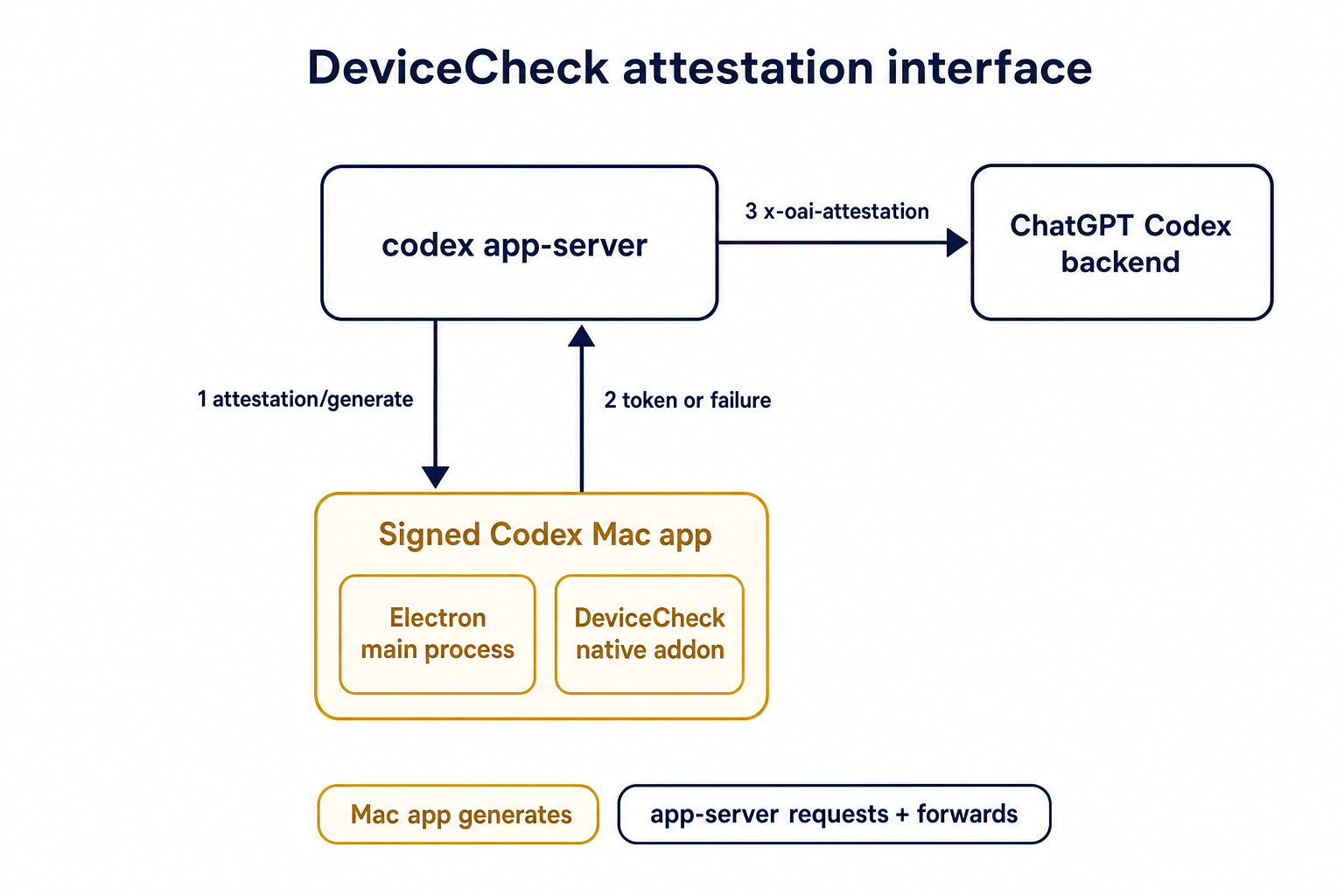
## Summary TL;DR: teaches `codex-rs` / app-server to request a desktop-provided attestation token and attach it as `x-oai-attestation` on the scoped ChatGPT Codex request paths.  ## Details This PR teaches the Codex app-server runtime how to request and attach an attestation token. It does not generate DeviceCheck tokens directly; instead, it relies on the connected desktop app to advertise that it can generate attestation and then asks that app for a fresh header value when needed. The flow is: 1. The Codex desktop app connects to app-server. 2. During `initialize`, the app can advertise that it supports `requestAttestation`. 3. Before app-server calls selected ChatGPT Codex endpoints, it sends the internal server request `attestation/generate` to the app. 4. app-server receives a pre-encoded header value back. 5. app-server forwards that value as `x-oai-attestation` on the scoped outbound requests. The code in this repo is mostly protocol and runtime plumbing: it adds the app-server request/response shape, introduces an attestation provider in core, wires that provider into Responses / compaction / realtime setup paths, and covers the intended scoping with tests. The signed macOS DeviceCheck generation remains owned by the desktop app PR. ## Related PR - Codex desktop app implementation: https://github.com/openai/openai/pull/878649 ## Validation <details> <summary>Tests run</summary> ```sh cargo test -p codex-app-server-protocol cargo test -p codex-core attestation --lib cargo test -p codex-app-server --lib attestation ``` Also ran: ```sh just fix -p codex-core just fix -p codex-app-server just fix -p codex-app-server-protocol just fmt just write-app-server-schema ``` </details> <details> <summary>E2E DeviceCheck validation</summary> First validated the signed desktop app boundary directly: launched a packaged signed `Codex.app`, sent `attestation/generate`, decoded the returned `v1.` attestation header, and validated the extracted DeviceCheck token with `personal/jm/verify_devicecheck_token.py` using bundle ID `com.openai.codex`. Apple returned `status_code: 200` and `is_ok: true`. Then ran the fuller app + app-server flow. The packaged `Codex.app` launched a current-branch app-server via `CODEX_CLI_PATH`, and a local MITM proxy intercepted outbound `chatgpt.com` traffic. The app-server requested `attestation/generate` from the real Electron app process, and the intercepted `/backend-api/codex/responses` traffic included `x-oai-attestation` on both routes: ```text GET /backend-api/codex/responses Upgrade: websocket x-oai-attestation: present POST /backend-api/codex/responses Upgrade: none x-oai-attestation: present ``` The captured header decoded to a DeviceCheck token that also validated with Apple for `com.openai.codex` (`status_code: 200`, `is_ok: true`, team `2DC432GLL2`). </details> --------- Co-authored-by: Codex <noreply@openai.com>
Jiaming Zhang ·
2026-05-08 12:36:02 -07:00