## Why

App-server clients need a way to update a thread's next-turn settings
without starting a turn, adding transcript content, or waiting for turn
lifecycle events. This gives settings UI a direct path for durable
thread settings while clients observe the eventual effective state
through a notification.

This is a simplified rework of PR
https://github.com/openai/codex/pull/22509. In particular, it changes
the `thread/settings/update` api to return immediately rather than
waiting and returning the effective (updated) thread settings. This
makes the new api consistent with `turn/start` and greatly reduces the
complexity of the implementation relative to the earlier attempt.

## What Changed

- Adds experimental `thread/settings/update` with partial-update request
fields and an empty acknowledgment response.
- Adds experimental `thread/settings/updated`, carrying full effective
`ThreadSettings` and scoped by `threadId` to subscribed clients for the
affected thread.
- Shares durable settings validation with `turn/start`, including
`sandboxPolicy` plus `permissions` rejection and `serviceTier: null`
clearing.
- Emits the same settings notification when `turn/start` overrides
change the stored effective thread settings.
- Regenerates app-server protocol schema fixtures and updates
`app-server/README.md`.
## Summary
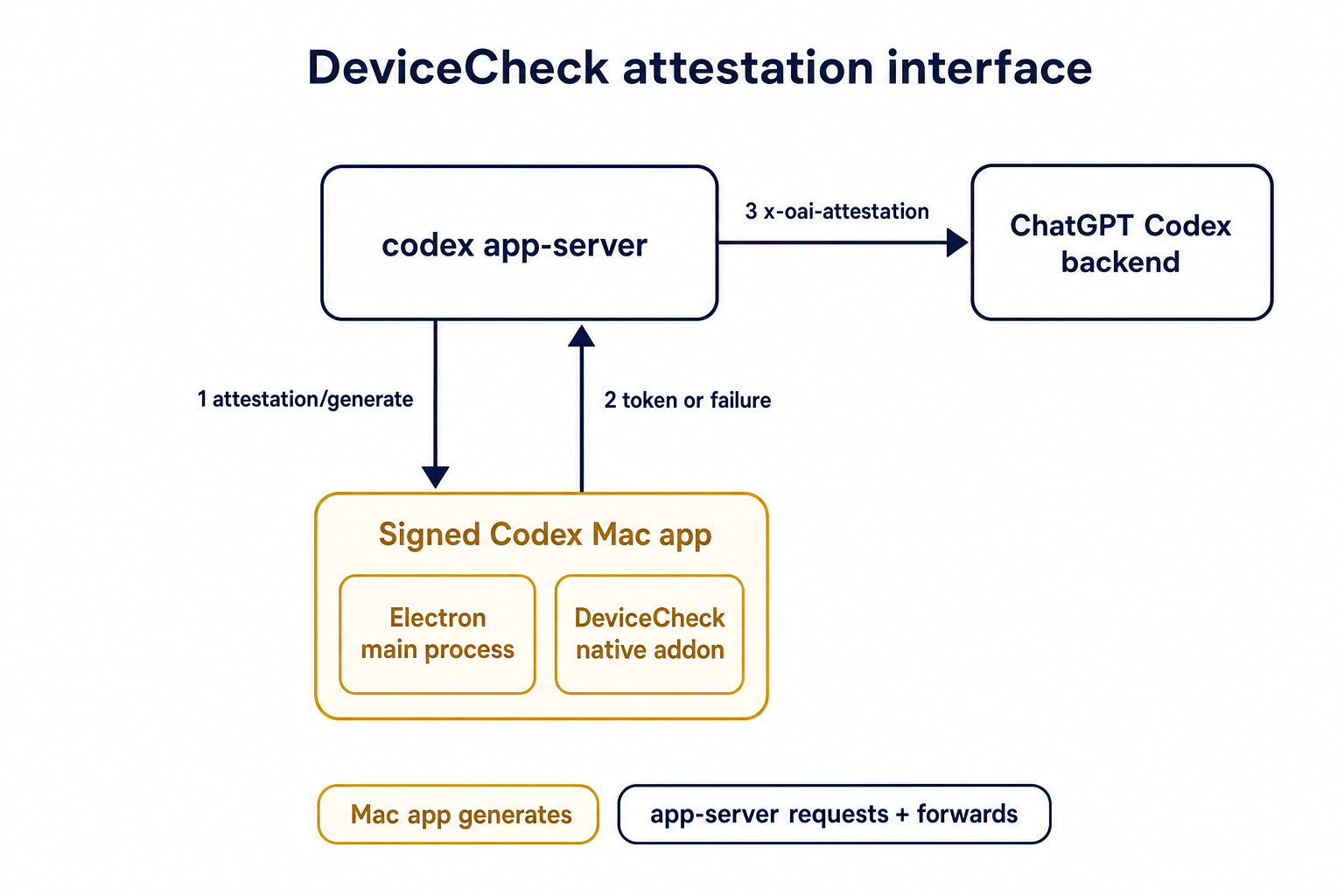
TL;DR: teaches `codex-rs` / app-server to request a desktop-provided
attestation token and attach it as `x-oai-attestation` on the scoped
ChatGPT Codex request paths.
## Details
This PR teaches the Codex app-server runtime how to request and attach
an attestation token. It does not generate DeviceCheck tokens directly;
instead, it relies on the connected desktop app to advertise that it can
generate attestation and then asks that app for a fresh header value
when needed.
The flow is:
1. The Codex desktop app connects to app-server.
2. During `initialize`, the app can advertise that it supports
`requestAttestation`.
3. Before app-server calls selected ChatGPT Codex endpoints, it sends
the internal server request `attestation/generate` to the app.
4. app-server receives a pre-encoded header value back.
5. app-server forwards that value as `x-oai-attestation` on the scoped
outbound requests.
The code in this repo is mostly protocol and runtime plumbing: it adds
the app-server request/response shape, introduces an attestation
provider in core, wires that provider into Responses / compaction /
realtime setup paths, and covers the intended scoping with tests. The
signed macOS DeviceCheck generation remains owned by the desktop app PR.
## Related PR
- Codex desktop app implementation:
https://github.com/openai/openai/pull/878649
## Validation
<details>
<summary>Tests run</summary>
```sh
cargo test -p codex-app-server-protocol
cargo test -p codex-core attestation --lib
cargo test -p codex-app-server --lib attestation
```
Also ran:
```sh
just fix -p codex-core
just fix -p codex-app-server
just fix -p codex-app-server-protocol
just fmt
just write-app-server-schema
```
</details>
<details>
<summary>E2E DeviceCheck validation</summary>
First validated the signed desktop app boundary directly: launched a
packaged signed `Codex.app`, sent `attestation/generate`, decoded the
returned `v1.` attestation header, and validated the extracted
DeviceCheck token with `personal/jm/verify_devicecheck_token.py` using
bundle ID `com.openai.codex`. Apple returned `status_code: 200` and
`is_ok: true`.
Then ran the fuller app + app-server flow. The packaged `Codex.app`
launched a current-branch app-server via `CODEX_CLI_PATH`, and a local
MITM proxy intercepted outbound `chatgpt.com` traffic. The app-server
requested `attestation/generate` from the real Electron app process, and
the intercepted `/backend-api/codex/responses` traffic included
`x-oai-attestation` on both routes:
```text
GET /backend-api/codex/responses Upgrade: websocket x-oai-attestation: present
POST /backend-api/codex/responses Upgrade: none x-oai-attestation: present
```
The captured header decoded to a DeviceCheck token that also validated
with Apple for `com.openai.codex` (`status_code: 200`, `is_ok: true`,
team `2DC432GLL2`).
</details>
---------
Co-authored-by: Codex <noreply@openai.com>
## Summary

Codex is repurposing `session` to mean a thread group, so the realtime
provider session id should no longer use `session_id` / `sessionId` in
Codex-facing protocol payloads. This PR renames that provider-specific
field to `realtime_session_id` / `realtimeSessionId` and intentionally
breaks clients that still send the old field names.

## What Changed

- Renamed realtime provider session fields in `ConversationStartParams`,
`RealtimeConversationStartedEvent`, and `RealtimeEvent::SessionUpdated`.
- Renamed app-server v2 realtime request and notification fields to
`realtimeSessionId`.
- Removed legacy serde aliases for `session_id` / `sessionId`; clients
must send the new names.
- Propagated the rename through core realtime startup, app-server
adapters, codex-api websocket handling, and TUI realtime state.
- Regenerated app-server protocol schema/TypeScript outputs and updated
app-server README examples.
- Kept upstream Realtime API concepts unchanged: provider `session.id`
parsing and `x-session-id` headers still use the upstream wire names.

## Testing

- CI is running on the latest pushed commit.
- Earlier local verification on this PR:
  - `cargo test -p codex-protocol`
- `CODEX_SKIP_VENDORED_BWRAP=1 cargo test -p codex-core
realtime_conversation`
  - `cargo test -p codex-app-server-protocol`
- `CODEX_SKIP_VENDORED_BWRAP=1 cargo test -p codex-app-server
realtime_conversation`
- attempted `CODEX_SKIP_VENDORED_BWRAP=1 cargo test -p codex-tui` (local
linker bus error while linking the test binary)

---------

Co-authored-by: Codex <noreply@openai.com>
- Add outputModality to thread/realtime/start and wire text/audio output
selection through app-server, core, API, and TUI.\n- Rename the realtime
transcript delta notification and add a separate transcript done
notification that forwards final text from item done without correlating
it with deltas.
- Adds a core-owned realtime backend prompt template and preparation
path.
- Makes omitted realtime start prompts use the core default, while null
or empty prompts intentionally send empty instructions.
- Covers the core realtime path and app-server v2 path with integration
coverage.

---------

Co-authored-by: Codex <noreply@openai.com>
Adds WebRTC startup to the experimental app-server
`thread/realtime/start` method with an optional transport enum. The
websocket path remains the default; WebRTC offers create the realtime
session through the shared start flow and emit the answer SDP via
`thread/realtime/sdp`.

---------

Co-authored-by: Codex <noreply@openai.com>
## Summary
- add `skill_approval` to `RejectConfig` and the app-server v2
`AskForApproval::Reject` payload so skill-script prompts can be
configured independently from sandbox and rule-based prompts
- update Unix shell escalation to reject prompts based on the actual
decision source, keeping prefix rules tied to `rules`, unmatched command
fallbacks tied to `sandbox_approval`, and skill scripts tied to
`skill_approval`
- regenerate the affected protocol/config schemas and expand
unit/integration coverage for the new flag and skill approval behavior
Add experimental `thread/realtime/*` v2 requests and notifications, then
route app-server realtime events through that thread-scoped surface with
integration coverage.

---------

Co-authored-by: Codex <noreply@openai.com>
## Problem being solved
- We need a single, reliable way to mark app-server API surface as
experimental so that:
  1. the runtime can reject experimental usage unless the client opts in
2. generated TS/JSON schemas can exclude experimental methods/fields for
stable clients.

Right now that’s easy to drift or miss when done ad-hoc.

## How to declare experimental methods and fields
- **Experimental method**: add `#[experimental("method/name")]` to the
`ClientRequest` variant in `client_request_definitions!`.
- **Experimental field**: on the params struct, derive `ExperimentalApi`
and annotate the field with `#[experimental("method/name.field")]` + set
`inspect_params: true` for the method variant so
`ClientRequest::experimental_reason()` inspects params for experimental
fields.

## How the macro solves it
- The new derive macro lives in
`codex-rs/codex-experimental-api-macros/src/lib.rs` and is used via
`#[derive(ExperimentalApi)]` plus `#[experimental("reason")]`
attributes.
- **Structs**:
- Generates `ExperimentalApi::experimental_reason(&self)` that checks
only annotated fields.
  - The “presence” check is type-aware:
    - `Option<T>`: `is_some_and(...)` recursively checks inner.
    - `Vec`/`HashMap`/`BTreeMap`: must be non-empty.
    - `bool`: must be `true`.
    - Other types: considered present (returns `true`).
- Registers each experimental field in an `inventory` with `(type_name,
serialized field name, reason)` and exposes `EXPERIMENTAL_FIELDS` for
that type. Field names are converted from `snake_case` to `camelCase`
for schema/TS filtering.
- **Enums**:
- Generates an exhaustive `match` returning `Some(reason)` for annotated
variants and `None` otherwise (no wildcard arm).
- **Wiring**:
- Runtime gating uses `ExperimentalApi::experimental_reason()` in
`codex-rs/app-server/src/message_processor.rs` to reject requests unless
`InitializeParams.capabilities.experimental_api == true`.
- Schema/TS export filters use the inventory list and
`EXPERIMENTAL_CLIENT_METHODS` from `client_request_definitions!` to
strip experimental methods/fields when `experimental_api` is false.

 Eric TrautandGitHub


 jif-oaiandGitHub
 Jack MousseauandGitHub

 Celia ChenandMichael Bolin

