mirror of
https://github.com/pchuan98/codex.git
synced 2026-07-01 00:31:56 +08:00
c0f7e1b99fce210e1e0dfc97160d79454c04a987
152
Commits
| Author | SHA1 | Message | Date | |
|---|---|---|---|---|
  Eric TrautandGitHub Eric TrautandGitHub
|
c0f7e1b99f |
[2 of 2] Start fresh TUI thread in background (#23176)
## Why After the terminal-probe work in #23175, fresh-session startup still waits for `thread/start` before the chat input can become usable. The chat widget already has the machinery to hold early submissions until a session is configured, so fresh `thread/start` does not need to stay on the input-ready hot path. Refs #16335. ## What This PR starts fresh app-server threads in a background task, reports completion through a startup app event, and attaches the primary session once `thread/start` returns. Resume and fork startup paths remain synchronous. ## Benchmark In the local pty startup benchmark, this PR's pre-optimization base branch, #23175, measured about 152ms median from launch to accepted chat input. The stacked result measured about 66ms median, for an approximate additional savings of 85-95ms. For broader context, the original `main` baseline before either startup optimization was about 250.5ms median. We also measured Codex 0.117.0 on the same machine at about 64.6ms median, so the stacked branch is back in the old-startup-time range. ## Stack 1. [#23175: [1 of 2] Optimize TUI startup terminal probes](https://github.com/openai/codex/pull/23175) — base PR 2. [#23176: [2 of 2] Start fresh TUI thread in background](https://github.com/openai/codex/pull/23176) — this PR ## Verification - `cargo test -p codex-tui` |
||
 canvrno-oaiandGitHub canvrno-oaiandGitHub
|
27c4c67b15 |
Fix: TUI starting in wrong CWD (#23538)
This fixes a regression wher codex could start in the wrong directory when a live local app-server socket was present. The issue was that implicit local socket reuse was being treated like an explicit remote workspace session, which dropped the invoking cwd unless --cd was passed. The change separates local socket transport from true remote workspace semantics. - Plain local startup keeps local cwd, trust, resume, picker, and config-refresh behavior. - Explicit --remote keeps the existing remote cwd behavior. - Added coverage for launch target selection and local-session filtering/cwd behavior. Steps to test: - Start a local app-server from a different directory than the repo you want to use. - Launch codex from a project/worktree without --cd. - Confirm the session starts in the invoking directory, not the app-server process directory. - Confirm explicit codex --remote ... still preserves existing remote behavior. |
||
 viyatb-oaiandGitHub viyatb-oaiandGitHub
|
3c76081876 |
Make deny canonical for filesystem permission entries (#23493)
## Why Filesystem permission profiles used `none` for deny-read entries, which is less direct than the action the entry actually represents. This change makes `deny` the canonical filesystem permission spelling while preserving compatibility for older configs that still send `none`. ## What changed - rename `FileSystemAccessMode::None` to `Deny` - serialize and generate schemas with `deny` as the canonical value - retain `none` only as a legacy input alias for temporary config compatibility - update filesystem glob diagnostics and regression coverage to use the canonical spelling - refresh config and app-server schema fixtures to match the new wire shape ## Validation - `cargo test -p codex-protocol` - `cargo test -p codex-app-server-protocol` - `cargo test -p codex-core config_toml_deserializes_permission_profiles --lib` - `cargo test -p codex-core read_write_glob_patterns_still_reject_non_subpath_globs --lib` Earlier in the session, a broad `cargo test -p codex-core` run reached unrelated pre-existing failures in timing/snapshot/git-info tests under this environment; the targeted surfaces touched by this PR passed cleanly. |
||
|
Eric TrautandGitHub
|
ae10708ae0 |
[2 of 4] tui: route app and skill enablement through app server (#22914)
## Why App and skill toggles are user config mutations too. When the TUI is attached to a remote app server, writing those toggles into the local `config.toml` makes the UI report success without updating the server that actually owns the session. This is **[2 of 4]** in a stacked series that moves TUI-owned config mutations onto app-server APIs. ## What changed - Routed app enable/disable persistence through app-server config batch writes. - Routed skill enable/disable persistence through `skills/config/write`. - Avoided refreshing local config from disk after these writes when the TUI is connected to a remote app server. ## Config keys affected - `apps.<app_id>.enabled` - `apps.<app_id>.disabled_reason` - `[[skills.config]]` entries keyed by `path`, with `enabled = false` used for persisted disables ## Suggested manual validation - Connect the TUI to a remote app server, disable an app, reconnect, and confirm the app remains disabled from remote config rather than local disk state. - Re-enable the same app and confirm both `apps.<app_id>.enabled` and `apps.<app_id>.disabled_reason` are cleared remotely. - Disable a skill in the manage-skills UI and confirm a remote `[[skills.config]]` disable entry appears. - Re-enable that skill and confirm the disable entry is removed and the effective enabled state updates without relying on local config reloads. ## Stack 1. [#22913](https://github.com/openai/codex/pull/22913) `[1 of 4]` primary settings writes 2. [#22914](https://github.com/openai/codex/pull/22914) `[2 of 4]` app and skill enablement 3. [#22915](https://github.com/openai/codex/pull/22915) `[3 of 4]` feature and memory toggles 4. [#22916](https://github.com/openai/codex/pull/22916) `[4 of 4]` startup and onboarding bookkeeping |
||

|
4ac3ea20a2 |
Clarify resume hints for renamed threads (#23234)
Addresses #23181 ## Why Renamed threads can share names, so hints that suggest resuming directly by name are ambiguous. Issue #23181 asks for the picker hint to include the thread name and thread ID in parens so users can disambiguate safely. ## What - Adds a shared resume hint formatter for named threads: run `codex resume`, then select `<name> (<thread-id>)`. - Uses that hint for /rename confirmations, TUI session summaries, and CLI/TUI exit messages. - Keeps direct `codex resume <thread-id>` guidance for unnamed threads. ## Verification Manually verified that message after `/rename` and after `/exit` include session ID in parens. --------- Co-authored-by: Felipe Coury <felipe.coury@openai.com> |
||
|
Eric TrautandGitHub
|
0d344aca9b |
goal: pause continuation loops on usage limits and blockers (#23094)
Addresses #22833, #22245, #23067 ## Why `/goal` can keep synthesizing turns even when the next turn cannot make meaningful progress. Hard usage exhaustion can replay failing turns, and repeated permission or external-resource blockers can keep burning tokens while waiting for user or system intervention. ## What changed - Add resumable `blocked` and `usageLimited` goal states. As with `paused`, goal continuation stops with these states. - Move to `usageLimited` after usage-limit failures. - Allow the built-in `update_goal` tool to set `blocked` only under explicit repeated-impasse guidance. Updated goal continuation prompt to specify that agent should use `blocked` only when it has made at least three attempts to get past an impasse. Most of the files touched by this PR are because of the small app server protocol update. ## Validation I manually reproduced a number of situations where an agent can run into a true impasse and verified that it properly enters `blocked` state. I then resumed and verified that it once again entered `blocked` state several turns later if the impasse still exists. I also manually reproduced the usage-limit condition by creating a simulated responses API endpoint that returns 429 errors with the appropriate error message. Verified that the goal runtime properly moves the goal into `usageLimited` state and TUI UI updates appropriately. Verified that `/goal resume` resumes (and immediately goes back into `ussageLImited` state if appropriate). ## Follow-up PRs Small changes will be needed to the GUI clients to properly handle the two new states. |
||
|
Felipe CouryandGitHub
|
bb43044cba |
fix(tui): show shutdown feedback on exit (#23323)
## Why Ctrl+C can take a noticeable amount of time to finish when the TUI is waiting for the app-server thread shutdown path to complete. Before this change, the UI could look like it had not accepted the shutdown request because the composer and cursor remained in their normal interactive state during that wait. This PR makes the accepted shutdown visible immediately. It does not add an artificial sleep or change the shutdown timeout; it only draws one final feedback frame before continuing through the existing shutdown flow. ## What Changed - On `ExitMode::ShutdownFirst`, the TUI now renders shutdown feedback before awaiting the existing thread shutdown future. - The bottom pane disables composer input, which hides the cursor through the existing disabled-input cursor path. - The composer shows `Shutting down...` as the disabled input hint and suppresses footer content so the shutdown acknowledgement is not competing with shortcut/status text. - The logout path uses the same feedback path before shutting down. ## How to Test 1. Start Codex from this branch. 2. Press `Ctrl+C` to request shutdown. 3. If shutdown takes long enough to observe, confirm the composer changes to `› Shutting down...`, the cursor disappears, and no footer hint is rendered below it. 4. Regression check: repeat with text already typed in the composer and confirm the visible row still switches to `Shutting down...` while the draft remains preserved internally until the process exits. Targeted tests: - `cargo test -p codex-tui shutdown_in_progress_disables_input_and_uses_hint_without_footer` - `cargo test -p codex-tui bottom_pane::footer::tests::` ## Local Validation Note `cargo test -p codex-tui` still aborts in `app::tests::discard_side_thread_removes_agent_navigation_entry` with a stack overflow. That same test also failed when run alone locally, and the failure appears unrelated to this shutdown feedback path. |
||
|
Eric TrautandGitHub
|
fce10e009d |
tui: keep cleared Fast tier from reappearing after side-thread resume (#23121)
## Why After turning Fast mode off in the TUI, returning from a side thread could make `Fast` appear again in the main chat widget. The opt-out itself was still persisted; the display was being rebuilt from stale cached `ThreadSessionState` data, which made it look like Fast had been re-enabled. Fixes #23104. ## What changed - Keep the active thread's cached `service_tier` in sync whenever the user persists a service-tier selection. - Update both the primary-thread snapshot and the thread event store so restored TUI state reflects the current tier. - Add a focused regression test for clearing a cached Fast tier. ## Manual repro 1. Start a TUI session where `Fast` is enabled by default. 2. Run `/fast` and turn Fast mode off. Confirm `Fast` disappears from the chat widget display. 3. Re-enter thread navigation via either path: - Run `/side test`, then return to the main thread. - Run `/agent`, enter a child thread, then return to the main thread. 4. Before this fix, `Fast` reappears in the main chat widget display even though the opt-out was already persisted. 5. After this fix, `Fast` stays cleared. ## Verification - `cargo test -p codex-tui app::thread_session_state::tests::service_tier_sync_updates_active_cached_session -- --exact` |
||
|
Eric TrautandGitHub
|
0445b290fe |
[1 of 4] tui: route primary settings writes through app server (#22913)
## Why The TUI can run against a remote app server, but several high-traffic settings still persisted by editing the local config file. That sends remote sessions' preference writes to the wrong machine and lets local disk state drift from the app-server-owned config. This is **[1 of 4]** in a stacked series that moves TUI-owned config mutations onto app-server APIs. ## What changed - Added a small TUI helper for typed app-server config writes. - Routed primary interactive preference writes through `config/batchWrite`. - Preserved existing profile scoping for settings that already support `profiles.<profile>.*` overrides. ## Config keys affected - `model` - `model_reasoning_effort` - `personality` - `service_tier` - `plan_mode_reasoning_effort` - `approvals_reviewer` - `notice.fast_default_opt_out` - Profile-scoped equivalents under `profiles.<profile>.*` ## Suggested manual validation - Connect the TUI to a remote app server, change `model` and `model_reasoning_effort`, reconnect, and confirm the remote config retained both values while the local `config.toml` did not change. - Change `personality`, `plan_mode_reasoning_effort`, and the explicit auto-review selection, then reconnect and confirm those choices persist through the app server. - Clear the service tier back to default and confirm `service_tier` is cleared while `notice.fast_default_opt_out = true` is persisted remotely. - Repeat one setting change with an active profile and confirm the write lands under `profiles.<profile>.*`. ## Stack 1. [#22913](https://github.com/openai/codex/pull/22913) `[1 of 4]` primary settings writes 2. [#22914](https://github.com/openai/codex/pull/22914) `[2 of 4]` app and skill enablement 3. [#22915](https://github.com/openai/codex/pull/22915) `[3 of 4]` feature and memory toggles 4. [#22916](https://github.com/openai/codex/pull/22916) `[4 of 4]` startup and onboarding bookkeeping |
||
 Michael BolinandGitHub Michael BolinandGitHub
|
108234b5eb |
core: set permission profiles from snapshots (#22920)
## Why #22891 moved the TUI turn-command path to pass `ActivePermissionProfile` instead of the full `PermissionProfile`, but the remaining config/session bridge still accepted the concrete `PermissionProfile` and active profile id as separate arguments. That shape made it too easy for future callers to update the concrete profile and active profile id out of sync. This PR makes the trusted session snapshot path pass one coherent value into `Permissions`, while keeping `requirements.toml` enforcement owned by the existing constrained permission state. ## What Changed - Added `PermissionProfileSnapshot` as the public snapshot value for trusted session/config synchronization. - Changed `Permissions::set_permission_profile_from_session_snapshot()` and `replace_permission_profile_from_session_snapshot()` to take a `PermissionProfileSnapshot`. - Updated the replacement path to derive its constrained `PermissionProfile` from the snapshot, so callers cannot pass a separate profile that disagrees with the snapshot. - Removed the internal tuple-style `PermissionProfileState::set_active_permission_profile()` mutation path. - Updated core session projection and TUI call sites to construct explicit legacy or active snapshots. - Documented the snapshot constructors so legacy use and id/profile mismatch hazards are called out at the API boundary. - Added a focused config test that verifies snapshot updates still respect existing permission constraints. ## How To Review 1. Start with `codex-rs/core/src/config/resolved_permission_profile.rs`; `PermissionProfileSnapshot` is the public wrapper, while `ResolvedPermissionProfile` stays internal. 2. Check `codex-rs/core/src/config/mod.rs` to confirm both session-snapshot setters validate through `PermissionProfileState` and no longer accept loose profile/id pairs. 3. Skim `codex-rs/core/src/session/session.rs` for the session projection path; it now builds the snapshot before installing it. 4. Skim the TUI changes as call-site migration from loose argument pairs to explicit snapshot construction. ## Verification - `cargo test -p codex-core permission_snapshot_setter_preserves_permission_constraints` - `cargo test -p codex-tui status_permissions_` - `cargo test -p codex-tui session_configured_preserves_profile_workspace_roots` - `just fix -p codex-core -p codex-tui` |
||
|
Michael BolinandGitHub
|
9025550709 |
app-server-protocol: remove PermissionProfile from API (#22924)
## Why The app server API should expose permission profile identity, not the lower-level runtime permission model. `PermissionProfile` is the compiled sandbox/network representation that the server uses internally; exposing it through app-server-protocol forces clients to understand details that should remain implementation-level. The API boundary should prefer `ActivePermissionProfile`: a stable profile id, plus future parent-profile metadata, that clients can pass back when they want to select the same active permissions. This also avoids schema generation collisions between the app-server v2 API type space and the core protocol model. Incidentally, while PR makes a number of changes to `command/exec`, note that we are hoping to deprecate this API in favor of `process/spawn`, so we don't need to be too finicky about these changes. ## What Changed - Removed `PermissionProfile` from the app-server-protocol API surface, including generated schema and TypeScript exports. - Changed `CommandExecParams.permissionProfile` to `ActivePermissionProfile`. - Resolve command exec profile ids through `ConfigManager` for the command cwd, matching turn override selection semantics. - Updated downstream TUI tests/helpers to use core permission types directly instead of app-server-protocol `PermissionProfile` shims. |
||
|
Michael BolinandGitHub
|
bbb5c2811d |
tui: pass active permission profiles through app commands (#22891)
## Why This continues the permissions migration by keeping the TUI command boundary aligned with the app-server protocol direction from #22795: callers should select a permission profile by id instead of passing a concrete `PermissionProfile` value around as the turn configuration. `AppCommand` is internal to the TUI, but it is the path that eventually becomes `thread/turn/start`, so carrying concrete profile details there made it too easy for UI code to keep relying on the old whole-profile replacement model. ## What changed - `AppCommand::UserTurn` and `AppCommand::OverrideTurnContext` now carry `Option<ActivePermissionProfile>` instead of `PermissionProfile`. - Composer submissions copy the active permission profile id from the current session snapshot; legacy snapshots intentionally submit no active profile id. - Permission preset UI events now carry only the active built-in profile id. The app derives the concrete built-in `PermissionProfile` internally only when updating its local config/status snapshot. - Permission presets expose their built-in active profile id, and preset selection preserves that id in both the immediate turn override and the local TUI config snapshot. - Turn routing sends `TurnPermissionsOverride::ActiveProfile` when an active id is present, and only falls back to the legacy sandbox projection for the remaining runtime override path. ## How to review Start with `codex-rs/tui/src/app_command.rs` to verify the command shape no longer exposes `PermissionProfile`. Then read `codex-rs/tui/src/app/thread_routing.rs` to verify the app-server turn-start conversion: active ids go through as ids, while the legacy sandbox fallback is still constrained to the existing runtime override case. Finally, check `codex-rs/tui/src/chatwidget/permission_popups.rs`, `codex-rs/tui/src/app/event_dispatch.rs`, `codex-rs/tui/src/app/config_persistence.rs`, and `codex-rs/utils/approval-presets/src/lib.rs` to see how preset selections stay id-only across TUI events while the local display/config mirror still gets a concrete built-in profile. ## Verification Latest local verification after the id-only `AppEvent` cleanup: - `cargo check -p codex-tui --tests` - `cargo test -p codex-tui permissions_selection_sends_approvals_reviewer_in_override_turn_context` - `cargo test -p codex-tui update_feature_flags_enabling_guardian` - `cargo test -p codex-utils-approval-presets` - `just fmt` - `just fix -p codex-tui -p codex-utils-approval-presets` Earlier in the same PR, before the final event-shape cleanup: - `cargo test -p codex-tui turn_permissions_` - `cargo test -p codex-tui submission_` - `cargo test -p codex-tui session_configured_syncs_widget_config_permissions_and_cwd` - `RUST_MIN_STACK=16777216 cargo test -p codex-tui` |
||
 Curtis 'Fjord' HawthorneandGitHub Curtis 'Fjord' HawthorneandGitHub
|
8543e39885 |
Preserve image detail in app-server inputs (#20693)
## Summary - Add optional image detail to user image inputs across core, app-server v2, thread history/event mapping, and the generated app-server schemas/types. - Preserve requested detail when serializing Responses image inputs: omitted detail stays on the existing `high` default, while explicit `original` keeps local images on the original-resolution path. - Support `high`/`original` consistently for tool image outputs, including MCP `codex/imageDetail`, code-mode image helpers, and `view_image`. |
||
|
Michael BolinandGitHub
|
83bbb4f326 |
app-server: stop returning thread permission profiles (#22792)
## Why The app-server thread lifecycle API should no longer expose the full `PermissionProfile` value. After the permissions-profile migration, clients should round-trip only the active profile identity through `activePermissionProfile` and `permissions` when that identity is known. The full profile is server-side config. Treating a response-derived legacy sandbox projection as a new local profile can lose named-profile restrictions and accidentally widen permissions on the next turn. The legacy `sandbox` response field remains only as the compatibility/display fallback. ## What Changed - Removed `permissionProfile` from `ThreadStartResponse`, `ThreadResumeResponse`, and `ThreadForkResponse`. - Stopped populating that field in app-server thread start/resume/fork responses. - Updated embedded exec/TUI response mapping to derive display permission state from local config or the legacy sandbox fallback instead of a response profile value. - Added a TUI turn override shape that distinguishes preserving server permissions, selecting an active profile id, and sending a legacy sandbox for an explicit local override. - Preserved remote app-server permissions across turns by sending `permissions` only when an `activePermissionProfile` id is known, and otherwise sending no sandbox override unless the user selected a local override. - Kept embedded `thread/resume` hydration server-authored when `activePermissionProfile` is absent, which matches the live-thread attach path where the server ignores requested overrides. - Updated the app-server README to remove the obsolete lifecycle response `permissionProfile` reference. The remaining `permissionProfile` README references are request-side permission overrides. - Regenerated app-server JSON schema and TypeScript fixtures. - Kept the generated typed response enum exempt from `large_enum_variant`, matching the existing payload enum exemption after the lifecycle response variants shrank. ## How To Review Start with `codex-rs/app-server-protocol/src/protocol/v2/thread.rs` to confirm the response shape, then check the response construction in `codex-rs/app-server/src/request_processors`. The generated schema and TypeScript fixture changes are mechanical follow-through from the protocol removal. The TUI behavior is the delicate part: review `codex-rs/tui/src/app_server_session.rs` for response hydration and turn-start override projection, then `codex-rs/tui/src/app/thread_routing.rs` for the decision about whether the next turn should preserve the server snapshot, send an active profile id, or send a legacy sandbox for an explicit local override. ## Verification - `just write-app-server-schema` - `cargo test -p codex-app-server-protocol thread_lifecycle_responses_default_missing_optional_fields` - `cargo test -p codex-exec session_configured_from_thread_response_uses_permission_profile_from_config` - `cargo test -p codex-tui --lib thread_response` - `cargo test -p codex-tui turn_permissions_` - `cargo test -p codex-tui resume_response_restores_turns_from_thread_items` - `cargo test -p codex-analytics track_response_only_enqueues_analytics_relevant_responses` - `just fix -p codex-analytics` - `just fix -p codex-app-server-protocol` - `just fix -p codex-tui` - `just argument-comment-lint` --- [//]: # (BEGIN SAPLING FOOTER) Stack created with [Sapling](https://sapling-scm.com). Best reviewed with [ReviewStack](https://reviewstack.dev/openai/codex/pull/22792). * #22795 * __->__ #22792 |
||
|
Michael BolinandGitHub
|
8a5306ff88 |
app-server: use permission ids and runtime workspace roots (#22611)
## Why This PR builds on [#22610](https://github.com/openai/codex/pull/22610) and is the app-server side of the migration from mutable per-turn `SandboxPolicy` replacement toward selecting immutable permission profiles by id plus mutable runtime workspace roots. Once permission profiles can carry their own immutable `workspace_roots`, app-server no longer needs to mutate the selected `PermissionProfile` just to represent thread-specific filesystem context. The mutable part now lives on the thread as explicit `runtimeWorkspaceRoots`, while `:workspace_roots` remains symbolic until the sandbox is realized for a turn. ## What Changed - Replaced the v2 permission-selection wrapper surface with plain profile ids for `thread/start`, `thread/resume`, `thread/fork`, and `turn/start`. - Removed the API surface for profile modifications (`PermissionProfileSelectionParams`, `PermissionProfileModificationParams`, `ActivePermissionProfileModification`). - Added experimental `runtimeWorkspaceRoots` fields to the thread lifecycle and turn-start APIs. - Threaded runtime workspace roots through core session/thread snapshots, turn overrides, app-server request handling, and command execution permission resolution. - Kept session permission state symbolic so later runtime root updates and cwd-only implicit-root retargeting rebind `:workspace_roots` correctly. - Updated the embedded clients just enough to send and restore the new thread state. - Refreshed the generated schema/TypeScript artifacts and the app-server README to match the new contract. ## Verification Targeted coverage for this layer lives in: - `codex-rs/app-server-protocol/src/protocol/v2/tests.rs` - `codex-rs/app-server/tests/suite/v2/thread_start.rs` - `codex-rs/app-server/tests/suite/v2/thread_resume.rs` - `codex-rs/app-server/tests/suite/v2/turn_start.rs` - `codex-rs/core/src/session/tests.rs` The key regression checks exercise that: - `runtimeWorkspaceRoots` resolve against the effective cwd on thread start. - Profile-declared workspace roots are excluded from the runtime workspace roots returned by app-server. - A turn-level runtime workspace-root update persists onto the thread and is returned by `thread/resume`. - A named permission profile selected on one turn remains symbolic so a later runtime-root-only turn update changes the actual sandbox writes. - A cwd-only turn update retargets the implicit runtime cwd root while preserving additional runtime roots. - The protocol fixtures and generated client artifacts stay in sync with the string-based permission selection contract. --- [//]: # (BEGIN SAPLING FOOTER) Stack created with [Sapling](https://sapling-scm.com). Best reviewed with [ReviewStack](https://reviewstack.dev/openai/codex/pull/22611). * #22612 * __->__ #22611 |
||
|
Eric TrautandGitHub
|
d1235a0a78 |
Prevent Esc from dismissing or rewinding /side (#22710)
Addresses #22599 ## Why `/side` currently lets `Esc` return to the parent thread. Multiple users reported that this collides with queued-steer UI that also advertises `Esc`, so a timing-sensitive keypress can dismiss an ephemeral side chat instead of sending the queued prompt. After removing that dismissal shortcut, the same `Esc` path could fall through to main-thread backtrack/edit-previous handling, which is not valid for ephemeral side conversations. This keeps `/side` out of both global `Esc` behaviors. ## What changed - Remove `Esc` from the `/side` return shortcut matcher while keeping the existing `Ctrl+C` and `Ctrl+D` behavior. - Update side-conversation hints and blocked-command copy to advertise `Ctrl+C` as the return shortcut. - Rename the reserved `Esc` keymap label to describe backtracking only. - Block backtrack/edit-previous handling while a side conversation is active and report `Editing previous prompts is unavailable in side conversations.` when that path would have fired. - Keep composer-owned `Esc` behavior, such as Vim insert-mode escape, routed locally. - Refresh focused shortcut assertions and TUI snapshots for the updated footer and new side-conversation error message. ## Verification Manually tested `/side` use cases and `Esc`, `Ctrl+C`, `Ctrl+D`. |
||
|
Michael BolinandGitHub
|
3c6d727810 |
permissions: resolve profile identity with constraints (#22683)
## Why This PR is the invariant-cleanup layer that follows the workspace-roots base merged in [#22610](https://github.com/openai/codex/pull/22610). #22610 adds `[permissions.<id>.workspace_roots]` and keeps runtime workspace roots separate from the raw permission profile, but its in-memory representation is intentionally transitional: `Permissions` still carries the selected profile identity next to a constrained `PermissionProfile`. That makes APIs such as `set_constrained_permission_profile_with_active_profile()` fragile because the id and value only mean the right thing when every caller keeps them in sync. This PR introduces a single resolved profile state so profile identity, `extends`, the profile value, and profile-declared workspace roots travel together. The next PR, [#22611](https://github.com/openai/codex/pull/22611), builds on this by changing the app-server turn API to select permission profiles by id plus runtime workspace roots. ## Stack Context - #22610, now merged: adds profile-declared `workspace_roots`, runtime workspace roots, and `:workspace_roots` materialization. - This PR: replaces the parallel active-profile/profile-value fields with `PermissionProfileState`. - #22611: switches app-server turn updates toward profile ids plus runtime workspace roots. - #22612: updates TUI/exec summaries to show the effective workspace roots. Keeping this separate from #22611 is deliberate: reviewers can validate the internal state invariant before reviewing the app-server protocol migration. ## What Changed - Added `ResolvedPermissionProfile::{Legacy, BuiltIn, Named}` and `PermissionProfileState`. - Typed built-in profile ids with `BuiltInPermissionProfileId`. - Moved selected profile identity and profile-declared workspace roots into the resolved state. - Replaced `Permissions` parallel profile fields with one `permission_profile_state`. - Removed `set_constrained_permission_profile_with_active_profile()` from session sync paths. - Kept trusted session replay/`SessionConfigured` compatibility through explicit session snapshot helpers. - Updated session configuration, MCP initialization, app-server, exec, TUI, and guardian call sites to consume `&PermissionProfile` directly. ## Review Guide Start with `codex-rs/core/src/config/resolved_permission_profile.rs`; it is the new invariant boundary. Then review `codex-rs/core/src/config/mod.rs` to see how config loading records active profile identity and profile workspace roots. The remaining call-site changes are mostly mechanical fallout from `Permissions::permission_profile()` returning `&PermissionProfile` instead of `&Constrained<PermissionProfile>`. ## Verification The existing config/session coverage now constructs and asserts through `PermissionProfileState`. The workspace-root config test also asserts that profile-declared roots are preserved in the resolved state, which is the behavior #22611 relies on when runtime roots become mutable through the app-server API. --- [//]: # (BEGIN SAPLING FOOTER) Stack created with [Sapling](https://sapling-scm.com). Best reviewed with [ReviewStack](https://reviewstack.dev/openai/codex/pull/22683). * #22612 * #22611 * __->__ #22683 |
||
|
Michael BolinandGitHub
|
c25d905f61 |
permissions: support workspace roots in profiles (#22610)
## Why This is the configuration/model half of the alternative permissions migration we discussed as a comparison point for [#22401](https://github.com/openai/codex/pull/22401) and [#22402](https://github.com/openai/codex/pull/22402). The old `workspace-write` model mixes three concerns that we want to keep separate: - reusable profile rules that should stay immutable once selected - user/runtime workspace roots from `cwd`, `--add-dir`, and legacy workspace-write config - internal Codex writable roots such as memories, which should not be shown as user workspace roots This PR gives permission profiles first-class `workspace_roots` so users can opt multiple repositories into the same `:workspace_roots` rules without using broad absolute-path write grants. It also starts separating the raw selected profile from the effective runtime profile by making `Permissions` expose explicit accessors instead of public mutable fields. A representative `config.toml` looks like this: ```toml default_permissions = "dev" [permissions.dev.workspace_roots] "~/code/openai" = true "~/code/developers-website" = true [permissions.dev.filesystem.":workspace_roots"] "." = "write" ".codex" = "read" ".git" = "read" ".vscode" = "read" ``` If Codex starts in `~/code/codex` with that profile selected, the effective workspace-root set becomes: - `~/code/codex` from the runtime `cwd` - `~/code/openai` from the profile - `~/code/developers-website` from the profile The `:workspace_roots` rules are materialized across each root, so `.git`, `.codex`, and `.vscode` stay scoped the same way everywhere. Runtime additions such as `--add-dir` can still layer on later stack entries without mutating the selected profile. ## Stack Shape This PR intentionally stops before the profile-identity cleanup in [#22683](https://github.com/openai/codex/pull/22683) so the base review stays focused on config loading, workspace-root materialization, and compatibility with legacy `workspace-write`. The representation in this PR is therefore transitional: `Permissions` carries enough state to distinguish the raw constrained profile from the effective runtime profile, and there are still call sites that must keep the active profile identity and constrained profile value in sync. The follow-up PR replaces that with a single resolved profile state (`ResolvedPermissionProfile` / `PermissionProfileState`) that keeps the profile id, immutable `PermissionProfile`, and profile-declared workspace roots together. That follow-up removes APIs such as `set_constrained_permission_profile_with_active_profile()` where separate arguments could drift out of sync. Downstream PRs then build on this base to switch app-server turn updates to profile ids plus runtime workspace roots and to finish the user-visible summary behavior. Reviewers should judge this PR as the workspace-roots foundation, not as the final in-memory shape of selected permission profiles. ## Review Guide Suggested review order: 1. Start with `codex-rs/core/src/config/mod.rs`. This is the main shape change in the base slice. `Permissions` now stores a private raw `Constrained<PermissionProfile>` plus runtime `workspace_roots`. Callers use `permission_profile()` when they need the raw constrained value and `effective_permission_profile()` when they need a materialized runtime profile. As noted above, [#22683](https://github.com/openai/codex/pull/22683) replaces this transitional shape with a resolved profile state that keeps identity and profile data together. 2. Review `codex-rs/config/src/permissions_toml.rs` and `codex-rs/core/src/config/permissions.rs`. These add `[permissions.<id>.workspace_roots]`, resolve enabled entries relative to the policy cwd, and keep `:workspace_roots` deny-read glob patterns symbolic until the actual roots are known. 3. Review `codex-rs/protocol/src/permissions.rs` and `codex-rs/protocol/src/models.rs`. These add the policy/profile materialization helpers that expand exact `:workspace_roots` entries and scoped deny-read globs over every workspace root. This is also where `ActivePermissionProfileModification` is removed from the core model. 4. Review the legacy bridge in `Config::load_from_base_config_with_overrides` and `Config::set_legacy_sandbox_policy`. This is where legacy `workspace-write` roots become runtime workspace roots, while Codex internal writable roots stay internal and do not appear as user-facing workspace roots. 5. Then skim downstream call sites. The interesting pattern is raw-vs-effective access: state/proxy/bwrap paths keep the raw constrained profile, while execution, summaries, and user-visible status use the effective profile and workspace-root list. ## What Changed - added `[permissions.<id>.workspace_roots]` to the config model and schema - added runtime `workspace_roots` state to `Config`/`Permissions` and `ConfigOverrides` - made `Permissions` profile fields private and replaced direct mutation with accessors/setters - added `PermissionProfile` and `FileSystemSandboxPolicy` helpers for materializing `:workspace_roots` exact paths and deny-read globs across all roots - moved legacy additional writable roots into runtime workspace-root state instead of active profile modifications - removed `ActivePermissionProfileModification` and its app-server protocol/schema export - updated sandbox/status summary paths so internal writable roots are not reported as user workspace roots ## Verification Strategy The targeted tests cover the behavior at the layers where regressions are most likely: - `codex-rs/core/src/config/config_tests.rs` verifies config loading, legacy workspace-root seeding, effective profile materialization, and memory-root handling. - `codex-rs/core/src/config/permissions_tests.rs` verifies profile `workspace_roots` parsing and `:workspace_roots` scoped/glob compilation. - `codex-rs/protocol/src/permissions.rs` unit tests verify exact and glob materialization over multiple workspace roots. - `codex-rs/tui/src/status/tests.rs` and `codex-rs/utils/sandbox-summary/src/sandbox_summary.rs` verify the user-facing summaries show effective workspace roots and hide internal writes. I also ran `cargo check --tests` locally after the latest stack refresh to catch cross-crate API breakage from the private-field/accessor changes. --- [//]: # (BEGIN SAPLING FOOTER) Stack created with [Sapling](https://sapling-scm.com). Best reviewed with [ReviewStack](https://reviewstack.dev/openai/codex/pull/22610). * #22612 * #22611 * #22683 * __->__ #22610 |
||
|
Eric TrautandGitHub
|
3dc278b68e |
Trim TUI legacy core helper usage (#22695)
## Why The TUI still had a few low-risk dependencies flowing through the transitional `legacy_core` namespace after the app-server migration. These helpers either already have clearer non-core owners or are presentation logic that does not belong in `codex-core`, so moving them out reduces the compatibility surface without changing product behavior. ## What changed This is a low-risk change, almost completely mechanical in nature. - Route TUI Codex-home lookup through `codex-utils-home-dir`, use `Config::log_dir` directly, and call `codex-sandboxing::system_bwrap_warning` without going through `legacy_core`. - Move shared `codex resume` hint formatting from `codex-core` into `codex-utils-cli`. - Update CLI and TUI call sites to use the shared CLI utility, and keep the resume-command behavior covered by tests in its new home. ## Verification - `cargo test -p codex-utils-cli` - `cargo test -p codex-utils-cli resume_command` |
||
 
|
deedf3b2c4 |
feat: add layered --profile-v2 config files (#17141)
## Why `--profile-v2 <name>` gives launchers and runtime entry points a named profile config without making each profile duplicate the base user config. The base `$CODEX_HOME/config.toml` still loads first, then `$CODEX_HOME/<name>.config.toml` layers above it and becomes the active writable user config for that session. That keeps shared defaults, plugin/MCP setup, and managed/user constraints in one place while letting a named profile override only the pieces that need to differ. ## What Changed - Added the shared `--profile-v2 <name>` runtime option with validated plain names, now represented by `ProfileV2Name`. - Extended config layer state so the base user config and selected profile config are both `User` layers; APIs expose the active user layer and merged effective user config. - Threaded profile selection through runtime entry points: `codex`, `codex exec`, `codex review`, `codex resume`, `codex fork`, and `codex debug prompt-input`. - Made user-facing config writes go to the selected profile file when active, including TUI/settings persistence, app-server config writes, and MCP/app tool approval persistence. - Made plugin, marketplace, MCP, hooks, and config reload paths read from the merged user config so base and profile layers both participate. - Updated app-server config layer schemas to mark profile-backed user layers. ## Limits `--profile-v2` is still rejected for config-management subcommands such as feature, MCP, and marketplace edits. Those paths remain tied to the base `config.toml` until they have explicit profile-selection semantics. Some adjacent background writes may still update base or global state rather than the selected profile: - marketplace auto-upgrade metadata - automatic MCP dependency installs from skills - remote plugin sync or uninstall config edits - personality migration marker/default writes ## Verification Added targeted coverage for profile name validation, layer ordering/merging, selected-profile writes, app-server config writes, session hot reload, plugin config merging, hooks/config fixture updates, and MCP/app approval persistence. --------- Co-authored-by: Codex <noreply@openai.com> |
||
|
Eric TrautandGitHub
|
6a225e4005 |
Defer startup NUX impressions until startup succeeds (#22587)
## Why This is a follow-up to #22573. This problem was surfaced in a code review comment that I missed before merging the previous PR. Fresh-session startup could prepare a model-availability NUX before `app_server.start_thread(&config)` completed. If thread startup then failed, the TUI never rendered the tooltip, but `prepare_startup_tooltip_override(...)` had already persisted one of the limited impressions. ## What Changed - Move startup tooltip preparation inside the fresh-thread startup branch, after `start_thread(...)` succeeds. - Keep resume/fork paths unchanged. - Remove the now-redundant `should_prepare_startup_tooltip_override(...)` helper and its gate test. |
||
|
Eric TrautandGitHub
|
35451ba79c |
Simplify TUI startup test coverage (#22573)
## Why The TUI startup test surface had drifted into expensive, brittle coverage: - `tui/tests/suite/no_panic_on_startup.rs` was already ignored as flaky while still spawning a PTY to exercise malformed exec-policy rules. - `tui/tests/suite/model_availability_nux.rs` used a seeded session, cursor-query spoofing, and repeated interrupts to verify a narrow resume-path invariant. - `app/tests.rs` had started accumulating unrelated startup and summary coverage in one flat module even after the surrounding app code was split into feature modules. This keeps those behaviors covered while making the tests cheaper to understand and less likely to rot. It also preserves the malformed-rules regression from #8803 without requiring a terminal orchestration test. ## What changed - Replaced the malformed `rules` startup PTY case with a direct exec-policy loader regression: [`rules_path_file_returns_read_dir_error`](https://github.com/openai/codex/blob/21b6b5622f18b8cac0ea41fd083b3106778d9ffc/codex-rs/core/src/exec_policy_tests.rs#L264-L284) - Made the existing fresh-session-only startup tooltip behavior explicit with [`should_prepare_startup_tooltip_override`](https://github.com/openai/codex/blob/21b6b5622f18b8cac0ea41fd083b3106778d9ffc/codex-rs/tui/src/app/thread_routing.rs#L1272-L1279), then added focused coverage for the resume/fork gate and the persisted NUX counter. - Split startup and session-summary coverage out of `tui/src/app/tests.rs` into dedicated modules so the test layout better mirrors the current app architecture. - Converted one single-message goal validation snapshot into semantic assertions where layout was not the behavior under test. - Removed the two PTY-heavy suite files that the narrower tests now supersede. ## Verification - `cargo test -p codex-core rules_path_file_returns_read_dir_error` - `cargo test -p codex-tui startup_` - `cargo test -p codex-tui session_summary_` - `cargo test -p codex-tui goal_slash_command_rejects_oversized_objective` |
||
|
Eric TrautandGitHub
|
efdcbba053 |
Remove resurrected /collab slash command (#22535)
## Summary `/collab` was intentionally removed in [#12012](https://github.com/openai/codex/pull/12012), but the TUI/app-server migration accidentally brought that slash-command path back. This restores the earlier product decision so the TUI no longer advertises or dispatches `/collab`. This command was redundant because it did the same thing as `/plan` but in a less-intuitive way. ## What Changed - Remove `SlashCommand::Collab` from the TUI slash-command surface. - Delete the picker and app-event plumbing that only existed to service `/collab`. - Remove obsolete TUI test coverage for the deleted picker flow. |
||
|
canvrno-oaiandGitHub
|
16592f593d |
Use plugin/list to get list of plugins for mentions (#22375)
This switches TUI plugin mentions to use app-server `plugin/list` for plugin inventory and metadata instead of `PluginManager`, while keeping the same mention-eligibility filters as before. Same filters as before: - Only plugins in the current config / cwd scope. - Only installed and enabled plugins. - Only plugins that actually expose a capability, meaning at least one skill, MCP server, or app connector. - Uses `plugin/list` for the mention names/descriptions |
||
 AbhinavandGitHub AbhinavandGitHub
|
392e94e9ea |
add --dangerously-bypass-hook-trust CLI flag (#21768)
# Why Hook trust happens through the TUI in `/hooks` so it can block non-interactive use cases. This flag will allow users that are using codex headlessly to bypass hooks when they want to. # What This adds one invocation-scoped escape hatch. - the CLI flag sets a runtime-only `bypass_hook_trust` override; there is no durable `config.toml` setting - hook discovery still respects normal enablement, so explicitly disabled hooks remain disabled - we show a `--dangerously-bypass-hook-trust is enabled. Enabled hooks may run without review for this invocation.` message on startup so accidental use is visible in both interactive and exec flows This keeps “enabled” and “trusted” as separate concepts in the normal path, while giving CI/E2E callers a stable way to opt into the exceptional path when they already control the hook set. |
||
|
Eric TrautandGitHub
|
ad572709ab |
Add support for UDS in codex --remote (#22414)
## Why Added support for UDS connections in `codex --remote`. TUI also now connects to local app-server using UDS by default if it is running and set to listen to UDS connection. ## What Changed - Introduced `RemoteAppServerEndpoint` with `WebSocket` and `UnixSocket` variants. - Reused the existing JSON-RPC-over-WebSocket protocol over either a TCP WebSocket stream or a UDS stream. - Updated `codex --remote` to accept `ws://host:port`, `wss://host:port`, `unix://`, and `unix://PATH`. - Kept `--remote-auth-token-env` restricted to `wss://` and loopback `ws://` remotes. - Added a fast TUI startup probe for the default daemon socket, falling back to the embedded app server when the daemon is absent or unresponsive. ## Verification - Manually verified that the updated remote flow works. - Added coverage for UDS remote round trips, WebSocket auth headers, auth-token transport policy, remote address parsing, and missing-daemon fallback. - Ran focused remote test coverage locally. |
||
|
Felipe CouryandGitHub
|
95b332c820 |
feat(tui): add ambient terminal pets (#21206)
## Why The Codex App has animated pets, but the TUI had no equivalent ambient companion surface. This brings that experience into terminal Codex while keeping the main chat flow usable: the pet should feel present, but it cannot cover transcript text, composer input, approvals, or picker content. The feature also needs to be terminal-aware. Different terminals support different image protocols, tmux can interfere with image rendering, and some users will want pets disabled entirely or anchored differently depending on their layout. <table> <tr><td> <img width="4110" height="2584" alt="CleanShot 2026-05-05 at 12 41 45@2x" src="https://github.com/user-attachments/assets/68a1fcbc-2104-48d6-b834-69c6aaa95cdf" /> <p align="center">macOS - Ghostty, iTerm2 and WezTerm with Custom Pet</p> </td></tr> <tr><td> ![Uploading CleanShot 2026-05-10 at 20.28.30.png…]() <p align="center">Windows Terminal</p> </td></tr> <tr><td> <img width="3902" height="2752" alt="CleanShot 2026-05-05 at 12 39 02@2x" src="https://github.com/user-attachments/assets/300e2931-6b00-467e-91cb-ab8e28470500" /> <p align="center">Linux - WezTerm and Ghostty</p> </td></tr> </table> ## What Changed - Add a TUI ambient pet renderer in `codex-rs/tui/src/pets/`. - Port the app-style pet animation states so the sprite changes with task status, waiting-for-input states, review/ready states, and failures. - Add `/pets` selection UI with a preview pane, loading state, built-in pet choices, and a first-row `Disable terminal pets` option. - Download built-in pet spritesheets on demand from the same public CDN path already used by Android, under `https://persistent.oaistatic.com/codex/pets/v1/...`, and cache them locally under `~/.codex/cache/tui-pets/`. - Keep custom pets local. - Add config support for pet selection, disabling pets, and choosing whether the pet follows the composer bottom or anchors to the terminal bottom. - Reserve layout space around the pet so transcript wrapping, live responses, and composer input do not render underneath the sprite. - Gate image rendering by terminal capability, disable image pets under tmux, and support both Kitty Graphics and SIXEL terminals. - Add redraw cleanup for terminal image artifacts, including sixel cell clearing. ## Current Scope - This is an initial TUI version of ambient pets, not full App parity. - It focuses on ambient sprite rendering, `/pets` selection, custom pets, terminal capability gating, and on-demand CDN-backed built-in assets. - The ambient text overlay is currently disabled, so the TUI renders the pet sprite without extra status text beside it. ## How to Test 1. Start Codex TUI in a terminal with image support. 2. Run `/pets`. 3. Confirm the picker shows built-in pets plus custom pets, and the first item is `Disable terminal pets`. 4. On a fresh `~/.codex/cache/tui-pets/`, move onto a built-in pet and confirm the first preview downloads the spritesheet from the shared Codex pets CDN and renders successfully. 5. Move through the pet list and confirm subsequent built-in previews use the local cache. 6. Select a pet, then send and receive messages. Confirm transcript and composer text wrap before the pet instead of rendering underneath the sprite. 7. Change the pet anchor setting and confirm the pet can either follow the composer bottom or sit at the terminal bottom. 8. Return to `/pets`, choose `Disable terminal pets`, and confirm the sprite disappears cleanly. Targeted tests: - `cargo test -p codex-tui ambient_pet_` - `cargo test -p codex-tui resize_reflow_wraps_transcript_early_when_pet_is_enabled` - `cargo insta pending-snapshots` |
||
|
Felipe CouryandGitHub
|
e16b4e46d4 | fix(tui): handle hidden app git directives (#21946) | ||
|
Eric TrautandGitHub
|
1e65b3e0af |
Fix goal update and add /goal edit command in TUI (#21954)
## Why Users have requested the ability to edit a goal's objective after a goal has been created. This PR exposes a new `/goal edit` command in the TUI to address this request. In the process of implementing this, I also noticed an existing bug in the goal runtime. When a goal's objective is updated through the `thread/goal/set` app server API, the goal runtime didn't emit a new steering prompt to tell the agent about the new objective. This PR also fixes this hole. ## What Changed - Adds `/goal edit` in the TUI, opening an edit box prefilled with the current goal objective. - Keeps active and paused goals in their current state, resets completed goals to active, keeps budget-limited goals budget-limited, and preserves the existing token budget. - Changes the existing `thread/goal/set` behavior so editing an objective preserves goal accounting instead of resetting it. The older reset-on-new-objective behavior was left over from before `thread/goal/clear`; clients that need to reset accounting can now clear the existing goal and create a new one. - Reuses the existing goal set API path; this does not add or change app-server protocol surface area. - Adds a dedicated goal runtime steering prompt when an externally persisted goal mutation changes the objective, so active turns receive the updated objective. ## Validation - Make sure `/goal edit` returns an error if no goal currently exists - Make sure `/goal edit` displays an edit box that can be optionally canceled with no side effects - Make sure that an edited goal results in a steer so the agent starts pursuing the new objective - Make sure the new objective is reflected in the goal if you use `/goal` to display the goal summary - Make sure that `/goal edit` doesn't reset the token budget, time/token accounting on the updated goal |
||
|
Eric TrautandGitHub
|
c03eb20d8d |
Fix side conversation config inheritance (#22106)
Addresses #22101 ## Why Side conversations are ephemeral forks of the active thread, but `/side` was building its fork config from the app-level config after refreshing it from disk. If the parent thread had runtime settings that differed from the current persisted defaults, such as a changed model, reasoning effort, permissions, reviewer, or fast-mode selection, the side conversation could start with different behavior than its parent. ## What changed - Build side fork config from the active parent `ChatWidget` config, then overlay the parent thread's effective model, reasoning effort, service tier, and fast-mode opt-out state. - Forward model reasoning summary, verbosity, personality, web search mode, and service-tier overrides through TUI app-server start/resume/fork lifecycle params. - Add focused tests for parent runtime inheritance, side developer guardrail preservation, and lifecycle param forwarding. |
||
|
Felipe CouryandGitHub
|
5248e3da2b |
feat(tui): render responsive Markdown tables in TUI (#22052)
## Why The TUI currently treats Markdown tables as ordinary wrapped text, which makes table-heavy responses hard to read and brittle across narrow panes and terminal resizes. This change teaches the TUI to render Markdown tables responsively while preserving the raw Markdown source needed to re-render streamed and finalized transcript content after width changes. The goal is to keep tables legible during streaming, after resize, and once a turn has finished, without corrupting scrollback ordering. ## What Changed - add table detection and responsive table rendering in the Markdown renderer - render standard tables with Unicode box-drawing borders when the pane is wide enough - add a vertical readability fallback for constrained or dense tables so narrow panes still show each row clearly - keep links and `<br>` content inside table cells instead of leaking text outside the table - avoid table normalization inside fenced or indented code blocks - preserve raw streamed Markdown source and keep the active table as a mutable tail until finalization - consolidate finalized streamed content into source-backed transcript cells so post-resize re-rendering stays correct - add snapshot and targeted streaming/resize regression coverage for the new table behavior ## How to Test 1. Start Codex TUI from this branch. 2. Paste this exact prompt: `This is a session to test codex, no need to do any thinking, just end different markdown tables, with columns exploring different markdown contents, like links, bold italic, code, etc. Make them different sizes, some 30+ rows, some not and intertwine them with some paragraphs with complex formatting as well.` 3. Confirm the response includes several Markdown tables mixed with richly formatted paragraphs. 4. Confirm wide-enough tables render with box-drawing borders instead of plain wrapped pipe text. 5. Resize the terminal narrower while the answer is still streaming and confirm the in-progress table stays coherent instead of duplicating headers or leaving broken scrollback behind. 6. Resize again after the turn finishes and confirm the finalized transcript re-renders cleanly at the new width. 7. In a narrow pane, verify dense tables fall back to the vertical per-row layout instead of producing unreadable wrapped columns. 8. Also verify pipe-heavy fenced code blocks still render as code, not as tables. Targeted tests: - `cargo test -p codex-tui table_readability_fallback --no-fail-fast` - `cargo test -p codex-tui markdown_render --no-fail-fast` - `cargo test -p codex-tui streaming::controller --no-fail-fast` - `cargo test -p codex-tui table_resize_lifecycle --no-fail-fast` ## Docs No developer docs update appears necessary. |
||
|
Eric TrautandGitHub
|
90c0bec50c |
Avoid blocking TUI on agent metadata hydration (#21870)
## Why Fixes #16688. The TUI currently hydrates collab receiver metadata by awaiting `thread/read` before each active-thread notification is rendered. During large subagent fan-outs, the embedded app-server can be busy starting agents and processing spawn work, so those synchronous metadata reads queue behind the fan-out and block the TUI event loop. That makes the UI appear frozen even though the underlying agent work can continue. ## What Changed - Replaced eager `thread/read` metadata hydration on the active notification path with local receiver-thread caching. - Kept `ThreadStarted` and picker refreshes as the places that fill in agent nickname/role metadata when it is available. - Skipped caching receiver threads that are explicitly reported as `NotFound`, avoiding live-looking ghost entries for failed stale-agent calls. - Added TUI tests covering both local receiver caching and `NotFound` suppression. ## Verification - `cargo test -p codex-tui collab_receiver_notification` - `just fix -p codex-tui` I also ran the full `cargo test -p codex-tui`; the new test passed, but the full process later aborted with an unrelated stack overflow in `tests::fork_last_filters_latest_session_by_cwd_unless_show_all`. |
||
|
AbhinavandGitHub
|
6d747db7d8 |
Improve hooks trust flow in TUI (#21755)
# Why Hooks that need trust review were easy to miss, and the existing TUI flow made users discover `/hooks` manually before they could decide whether to inspect or trust them. # What - add a startup review prompt for new or changed hooks before normal composer use - add a top-level `t` shortcut in `/hooks` to trust every review-needed hook at once - make pending-review rows and helper copy use warning styling ## TUI ### Startup review interstitial ```text Hooks need review 2 hooks are new or changed. Hooks can run outside the sandbox after you trust them. › 1. Review hooks 2. Trust all and continue 3. Continue without trusting (hooks won't run) ``` ### Top-level `/hooks` page when review is needed ```text Hooks Lifecycle hooks from config and enabled plugins. ⚠ 1 hook needs review before it can run. Event Installed Active Review Description PreToolUse 1 0 1 Before a tool executes ... Press t to trust all; enter to review hooks; esc to close ``` |
||

|
5f4d0ec343 |
[codex] request desktop attestation from app (#20619)
## Summary TL;DR: teaches `codex-rs` / app-server to request a desktop-provided attestation token and attach it as `x-oai-attestation` on the scoped ChatGPT Codex request paths. 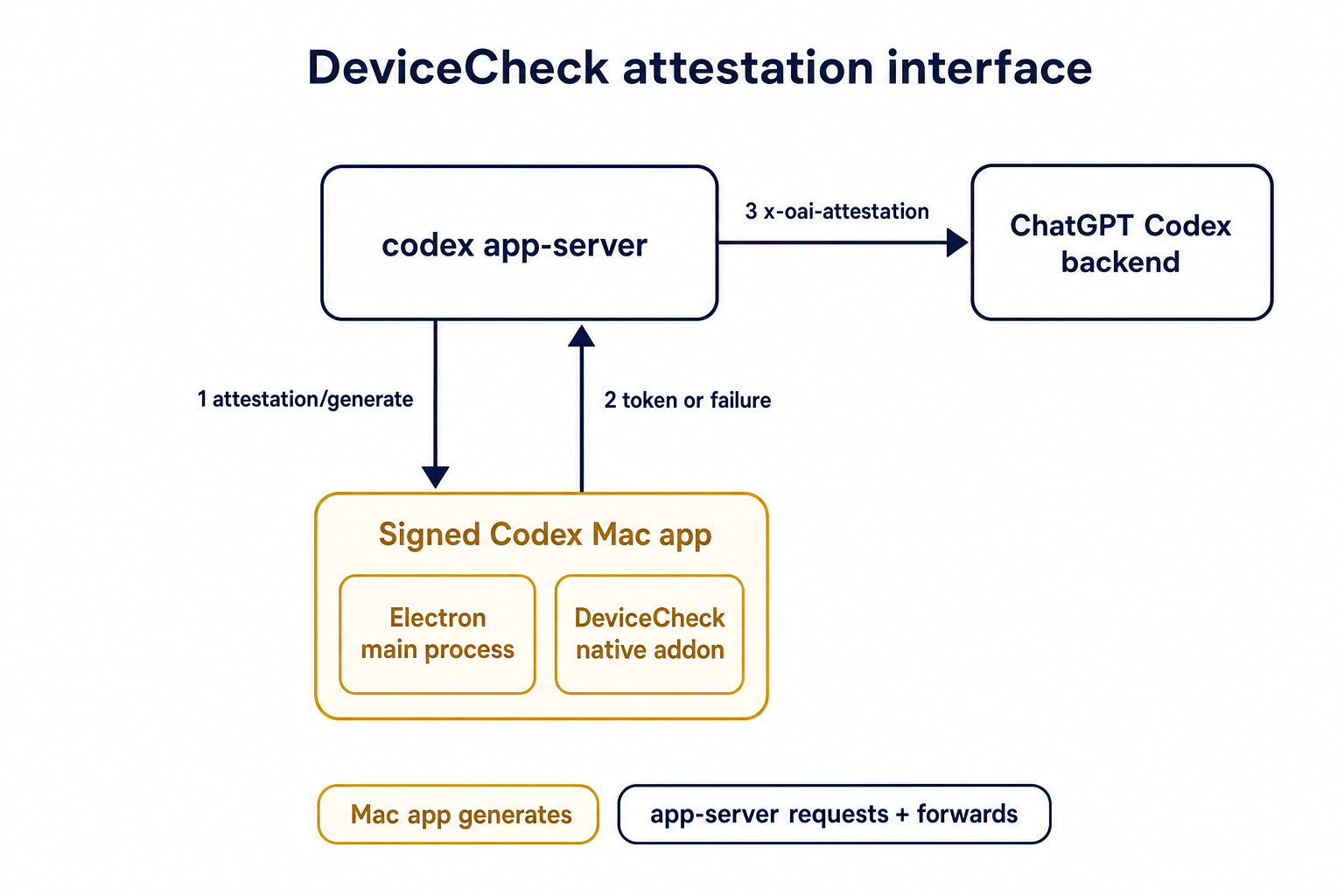 ## Details This PR teaches the Codex app-server runtime how to request and attach an attestation token. It does not generate DeviceCheck tokens directly; instead, it relies on the connected desktop app to advertise that it can generate attestation and then asks that app for a fresh header value when needed. The flow is: 1. The Codex desktop app connects to app-server. 2. During `initialize`, the app can advertise that it supports `requestAttestation`. 3. Before app-server calls selected ChatGPT Codex endpoints, it sends the internal server request `attestation/generate` to the app. 4. app-server receives a pre-encoded header value back. 5. app-server forwards that value as `x-oai-attestation` on the scoped outbound requests. The code in this repo is mostly protocol and runtime plumbing: it adds the app-server request/response shape, introduces an attestation provider in core, wires that provider into Responses / compaction / realtime setup paths, and covers the intended scoping with tests. The signed macOS DeviceCheck generation remains owned by the desktop app PR. ## Related PR - Codex desktop app implementation: https://github.com/openai/openai/pull/878649 ## Validation <details> <summary>Tests run</summary> ```sh cargo test -p codex-app-server-protocol cargo test -p codex-core attestation --lib cargo test -p codex-app-server --lib attestation ``` Also ran: ```sh just fix -p codex-core just fix -p codex-app-server just fix -p codex-app-server-protocol just fmt just write-app-server-schema ``` </details> <details> <summary>E2E DeviceCheck validation</summary> First validated the signed desktop app boundary directly: launched a packaged signed `Codex.app`, sent `attestation/generate`, decoded the returned `v1.` attestation header, and validated the extracted DeviceCheck token with `personal/jm/verify_devicecheck_token.py` using bundle ID `com.openai.codex`. Apple returned `status_code: 200` and `is_ok: true`. Then ran the fuller app + app-server flow. The packaged `Codex.app` launched a current-branch app-server via `CODEX_CLI_PATH`, and a local MITM proxy intercepted outbound `chatgpt.com` traffic. The app-server requested `attestation/generate` from the real Electron app process, and the intercepted `/backend-api/codex/responses` traffic included `x-oai-attestation` on both routes: ```text GET /backend-api/codex/responses Upgrade: websocket x-oai-attestation: present POST /backend-api/codex/responses Upgrade: none x-oai-attestation: present ``` The captured header decoded to a DeviceCheck token that also validated with Apple for `com.openai.codex` (`status_code: 200`, `is_ok: true`, team `2DC432GLL2`). </details> --------- Co-authored-by: Codex <noreply@openai.com> |
||

|
5f2543b74e |
Load configured environments from CODEX_HOME (#20667)
## Why The earlier PRs add stdio transport support and the config-backed environment provider, but the feature remains inert until normal Codex entrypoints construct `EnvironmentManager` with enough context to discover `CODEX_HOME/environments.toml`. This final stack PR activates the provider while preserving the legacy `CODEX_EXEC_SERVER_URL` fallback when no environments file exists. **Stack position:** this is PR 5 of 5. It is the product wiring PR that activates the configured environment provider added in PR 4. ## What Changed - Thread `codex_home` into `EnvironmentManagerArgs`. - Change `EnvironmentManager::new(...)` to load the provider from `CODEX_HOME`. - Preserve legacy behavior by falling back to `DefaultEnvironmentProvider::from_env()` when `environments.toml` is absent. - Make `environments.toml`-backed managers start new threads with all configured environments, default first, while keeping the legacy env-var path single-default. - Update the app-server, TUI, exec, MCP server, connector, prompt-debug, and thread-manager-sample callsites to pass `codex_home` and handle provider-loading errors. ## Self-Review Notes - The multi-environment startup path is intentionally tied to the `environments.toml` provider. Using `>1` configured environment as the only signal would also expand the legacy `CODEX_EXEC_SERVER_URL` provider because it keeps `local` addressable alongside `remote`. - The startup environment list is still derived inside `EnvironmentManager`; the provider only says whether its snapshot should start new threads with all configured environments. - The thread-manager sample was updated to pass the current `ThreadManager::new(...)` installation id argument so the stack compiles under Bazel. ## Stack - 1. https://github.com/openai/codex/pull/20663 - Add stdio exec-server listener - 2. https://github.com/openai/codex/pull/20664 - Add stdio exec-server client transport - 3. https://github.com/openai/codex/pull/20665 - Make environment providers own default selection - 4. https://github.com/openai/codex/pull/20666 - Add CODEX_HOME environments TOML provider - **5. This PR:** https://github.com/openai/codex/pull/20667 - Load configured environments from CODEX_HOME Split from original draft: https://github.com/openai/codex/pull/20508 ## Validation - `just fmt` - `git diff --check` - `bazel build --config=remote --strategy=remote --remote_download_toplevel //codex-rs/thread-manager-sample:codex-thread-manager-sample` - `bazel test --config=remote --strategy=remote --remote_download_toplevel //codex-rs/exec-server:exec-server-unit-tests` - `bazel test --config=remote --strategy=remote --remote_download_toplevel --test_sharding_strategy=disabled --test_arg=default_thread_environment_selections_use_manager_default_id //codex-rs/core:core-unit-tests` - `bazel test --config=remote --strategy=remote --remote_download_toplevel --test_sharding_strategy=disabled --test_arg=start_thread_uses_all_default_environments_from_codex_home //codex-rs/core:core-unit-tests` ## Documentation This activates `CODEX_HOME/environments.toml`; user-facing documentation should be added before this stack is treated as a documented public workflow. --------- Co-authored-by: Codex <noreply@openai.com> |
||

|
7c0e54bf59 |
[codex] Generalize service tier slash commands (#21745)
## Why `/fast` was wired as a one-off slash command even though model metadata now exposes service tiers as catalog data. That meant adding another tier, such as a slower/cheaper tier, would require more hardcoded TUI plumbing instead of letting the model catalog drive the available commands. This change makes service-tier commands data-driven: each advertised `service_tiers` entry becomes a `/name` command using the catalog description, while the request path sends the tier `id` only when the selected model supports it. ## What Changed - Removed the hardcoded `/fast` slash-command variant and introduced dynamic service-tier command items in the composer and command popup. - Added toggle behavior for service-tier commands: invoking `/name` selects that tier, and invoking it again clears the selection. - Preserved the existing Fast-mode keybinding/status affordances by resolving the current model tier whose name is `fast`, while still sending the tier request value such as `priority`. - Persisted service-tier selections as raw request strings so non-fast tiers can round-trip through config. - Updated the Bedrock catalog entry to advertise fast support through `service_tiers` with `id: "priority"` and `name: "fast"`. - Added defensive filtering in core so unsupported selected service tiers are omitted from `/responses` requests. ## Validation - Added/updated coverage for dynamic service-tier slash command lookup, popup descriptions, composer dispatch, TUI fast toggling, and unsupported-tier omission in core request construction. - Local tests were not run per request. --------- Co-authored-by: Codex <noreply@openai.com> |
||
 xli-oaiandGitHub xli-oaiandGitHub
|
314229fd72 |
Remove skills list extra roots (#21485)
## Summary - Remove `perCwdExtraUserRoots` / `SkillsListExtraRootsForCwd` from the `skills/list` app-server API. - Drop Rust app-server and `codex-core-skills` extra-root plumbing so skill scans are keyed by the normal cwd/user/plugin roots only. - Regenerate app-server schemas and update docs/tests that only existed for the removed extra-roots behavior. ## Validation - `just write-app-server-schema` - `just fmt` - `cargo test -p codex-app-server-protocol` - `cargo test -p codex-core-skills` - `just fix -p codex-app-server-protocol` - `just fix -p codex-core-skills` - `just fix -p codex-app-server` - `just fix -p codex-tui` ## Notes - `cargo test -p codex-app-server --test all skills_list` ran the edited skills-list cases, but the full filtered run ended on existing `skills_changed_notification_is_emitted_after_skill_change` timeout after a websocket `401`. - `cargo test -p codex-tui --lib` compiled the changed TUI callers, then failed two unrelated status permission tests because local `/etc/codex/requirements.toml` forbids `DangerFullAccess`. - Source-truth check found the OpenAI monorepo still has generated/app-server-kit mirror references to the removed field; those should be cleaned up when generated app-server types are synced or in a companion OpenAI cleanup. |
||
 rhan-oaiandGitHub rhan-oaiandGitHub
|
99016ec732 |
[codex-analytics] plumb protocol-native review timing (#21434)
## Why We want terminal tool review analytics, but the reducer should not stamp review timing from its own wall clock. This PR plumbs review timing through the real protocol and app-server seams so downstream analytics can consume the emitter's timestamps directly. Guardian reviews keep their enriched `started_at` / `completed_at` analytics fields by deriving those legacy second-based values from the same protocol-native millisecond lifecycle timestamps, rather than sampling a separate analytics clock. ## What changed - add `started_at_ms` to user approval request payloads - add `started_at_ms` / `completed_at_ms` to guardian review notifications - preserve Guardian review `started_at` / `completed_at` enrichment from the protocol-native timing source - stamp typed `ServerResponse` analytics facts with app-server-observed `completed_at_ms` - thread the new timing fields through core, protocol, app-server, TUI, and analytics fixtures ## Verification - `cargo test -p codex-app-server outgoing_message --manifest-path codex-rs/Cargo.toml` - `cargo test -p codex-app-server-protocol guardian --manifest-path codex-rs/Cargo.toml` - `cargo test -p codex-tui guardian --manifest-path codex-rs/Cargo.toml` - `cargo test -p codex-analytics analytics_client_tests --manifest-path codex-rs/Cargo.toml` --- [//]: # (BEGIN SAPLING FOOTER) Stack created with [Sapling](https://sapling-scm.com). Best reviewed with [ReviewStack](https://reviewstack.dev/openai/codex/pull/21434). * #18748 * __->__ #21434 * #18747 * #17090 * #17089 * #20514 |
||
 xl-openaiandGitHub xl-openaiandGitHub
|
11106016ff |
feat: Add marketplace source filtering and plugin share context (#21419)
Adds marketplaceKinds to plugin/list for local, workspace-directory, and shared-with-me; omitted params keep default local plus gated global behavior, while explicit kinds are exact. Exposes shareContext on plugin summaries from local share mappings and remote workspace/shared responses, including remotePluginId and nullable creator metadata. Adds shared-with-me listing through /ps/plugins/workspace/shared, renames the workspace remote namespace to workspace-directory, and keeps direct remote read/share/install/update/delete paths gated by plugins rather than remote_plugin. |
||
 pakrym-oaiandGitHub pakrym-oaiandGitHub
|
2004173cd7 |
Move message history out of core (#21278)
## Why Message history was implemented inside `codex-core` and surfaced through core protocol ops and `SessionConfiguredEvent` fields even though the current consumer is TUI-local prompt recall. That made core own UI history persistence and exposed `history_log_id` / `history_entry_count` through surfaces that app-server and other clients do not need. This change moves message history persistence out of core and keeps the recall plumbing local to the TUI. ## What changed - Added a new `codex-message-history` crate for appending, looking up, trimming, and reading metadata from `history.jsonl`. - Removed core protocol history ops/events: `AddToHistory`, `GetHistoryEntryRequest`, and `GetHistoryEntryResponse`. - Removed `history_log_id` and `history_entry_count` from `SessionConfiguredEvent` and updated exec/MCP/test fixtures accordingly. - Updated the TUI to dispatch local app events for message-history append/lookup and keep its persistent-history metadata in TUI session state. ## Validation - `cargo test -p codex-message-history -p codex-protocol` - `cargo test -p codex-exec event_processor_with_json_output` - `cargo test -p codex-mcp-server outgoing_message` - `cargo test -p codex-tui` - `just fix -p codex-message-history -p codex-protocol -p codex-core -p codex-tui -p codex-exec -p codex-mcp-server` |
||
|
|
be1d3cff93 |
2- Use string service tiers in session protocol (#20971)
## Summary - break service tier session/op/app-server protocol fields from the closed enum to string tier ids - send the service tier string directly through model requests, prewarm, compaction, memories, and TUI/app-server turn starts - regenerate app-server protocol JSON/TypeScript schemas, removing the standalone ServiceTier TS enum ## Verification - just fmt - cargo check -p codex-core -p codex-app-server -p codex-tui - just write-app-server-schema --------- Co-authored-by: Codex <noreply@openai.com> |
||
|
jif-oaiandGitHub
|
5ecff05196 |
feat(app-server): move v2 sessionId onto Thread (#21336)
## Why `session_id` and `thread_id` are separate identities after #20437, but app-server only surfaced `sessionId` on the `thread/start`, `thread/resume`, and `thread/fork` response envelopes. Other thread-bearing surfaces such as `thread/list`, `thread/read`, `thread/started`, `thread/rollback`, `thread/metadata/update`, and `thread/unarchive` either lacked the grouping key or forced clients to special-case those three responses. Making `sessionId` part of the reusable `Thread` payload gives every v2 API surface one place to expose session-tree identity. ## Mental model 1. thread.sessionId lives on `Thread` 2. It is a view/runtime identity for the current live session tree, not durable stored lineage metadata 3. When app-server has a live loaded thread, it copies the real value from core’s session_configured.session_id 4. When it only has stored/unloaded data, it falls back to thread.sessionId = thread.id ## What changed - Added `sessionId` to the v2 [`Thread`](https://github.com/openai/codex/blob/8fc9e9b4cf81b6f61d432e71f1eb266f6f104b63/codex-rs/app-server-protocol/src/protocol/v2/thread_data.rs#L105-L109). - Removed the duplicate top-level `sessionId` fields from `thread/start`, `thread/resume`, and `thread/fork`; clients should now read `response.thread.sessionId`. - Populated `thread.sessionId` when building live thread responses, replaying loaded threads, and returning stored-thread summaries so the field is present across start, resume, fork, list, read, rollback, metadata-update, unarchive, and `thread/started` paths. See [`load_thread_from_resume_source_or_send_internal`](https://github.com/openai/codex/blob/8fc9e9b4cf81b6f61d432e71f1eb266f6f104b63/codex-rs/app-server/src/request_processors/thread_processor.rs#L2824-L2918) and [`thread_from_stored_thread`](https://github.com/openai/codex/blob/8fc9e9b4cf81b6f61d432e71f1eb266f6f104b63/codex-rs/app-server/src/request_processors/thread_processor.rs#L3671-L3719). - Preserved the stored-thread fallback: if a thread has not been loaded into a live session tree yet, `thread.sessionId` falls back to `thread.id`; once the thread is live again, the field reports the active session tree root. - Regenerated the JSON/TypeScript schemas and updated the app-server README examples to show [`thread.sessionId`](https://github.com/openai/codex/blob/8fc9e9b4cf81b6f61d432e71f1eb266f6f104b63/codex-rs/app-server/README.md#L306-L310) on the thread object. |
||
 Matthew ZengandGitHub Matthew ZengandGitHub
|
f9a907aebe |
Support Codex Apps auth elicitations (#19193)
## Summary - request URL-mode MCP elicitations when Codex Apps tool calls fail with connector auth metadata - route Codex Apps auth URL elicitations into the TUI app-link flow ## Test plan - `just fmt` - `cargo test -p codex-core mcp_tool_call::tests` - `cargo test -p codex-mcp` - `cargo test -p codex-tui bottom_pane::app_link_view::tests` - `just fix -p codex-core` - `just fix -p codex-mcp` - `just fix -p codex-tui` Also attempted broader local runs: - `cargo test -p codex-core` fails in unrelated config/request-permission/proxy-sensitive tests under the current Codex Desktop environment. - `cargo test -p codex-tui` fails in unrelated status snapshots/trust-default tests because the ambient environment renders workspace-write/network permission defaults. |
||
|
rhan-oaiandGitHub
|
b3d4f1a9f0 |
[codex-analytics] rework thread_source for thread analytics (#20949)
## Summary - make `thread_source` an explicit optional thread-level field on `thread/start`, `thread/fork`, and returned thread payloads - persist `thread_source` in rollout/session metadata so resumed live threads retain the original value - replace the old best-effort `session_source` -> `thread_source` mapping with an explicit caller-supplied analytics classification ## Why Before this change, analytics `thread_source` was populated by a best-effort mapping from `session_source`. `session_source` describes the runtime/client surface, not the actual thread-level origin, so that projection was not accurate enough to distinguish cases such as `user`, `subagent`, `memory_consolidation`, and future thread origins reliably. Making `thread_source` explicit keeps one thread-level analytics field while letting callers provide the real classification directly instead of recovering it indirectly from `session_source`. ## Impact For new analytics events, `thread_source` now reflects the explicit thread-level classification supplied by the caller rather than an inferred value derived from `session_source`. Existing protocol fields remain optional; callers that omit `threadSource` now produce `null` instead of a best-effort inferred value. ## Validation - `just write-app-server-schema` - `cargo test -p codex-analytics -p codex-core -p codex-app-server-protocol --no-run` - `cargo test -p codex-app-server-protocol generated_ts_optional_nullable_fields_only_in_params` - `cargo test -p codex-analytics thread_initialized_event_serializes_expected_shape` - `cargo test -p codex-core resume_stopped_thread_from_rollout_preserves_thread_source` |
||
|
Felipe CouryandGitHub
|
3b2ebb368e |
feat(tui): redesign session picker (#20065)
## Why The resume/fork picker is becoming the main way users recover previous work, but the old fixed table made sessions hard to scan once thread names, branches, working directories, and timestamps all mattered. This redesign makes the picker denser by default, easier to search, and safer to inspect before resuming or forking. <table> <tr> <td> <img width="1660" height="1103" alt="CleanShot 2026-05-03 at 12 34 10" src="https://github.com/user-attachments/assets/313ede1d-1da4-4863-acd2-56b3e27e9703" /> </td> <td> <img width="1662" height="1100" alt="CleanShot 2026-05-03 at 12 34 15" src="https://github.com/user-attachments/assets/cfde7d5c-bab0-4994-a807-254e53f344ea" /> </td> </tr> <tr> <td> <img width="1664" height="1107" alt="CleanShot 2026-05-03 at 12 39 22" src="https://github.com/user-attachments/assets/e1ee58ca-4dc5-4a35-ae0f-47562da3974c" /> </td> <td> <img width="1662" height="1100" alt="CleanShot 2026-05-03 at 12 35 09" src="https://github.com/user-attachments/assets/9c888072-eedf-4f45-985c-0c14df28bcc7" /> </td> </tr> </table> ## What Changed - Replaces the old session table with responsive session rows that prioritize the session name or preview, then show timestamp, cwd, and branch metadata. - Makes dense view the default while keeping comfortable view available through `Ctrl+O`. - Persists the picker view preference in `[tui].session_picker_view`, including active profile-scoped config. - Adds sort/filter controls for updated time, created time, cwd, and all sessions. - Expands search matching across session name, preview, thread id, branch, and cwd. - Makes `Esc` safer in search mode: it clears an active query before starting a new session. - Adds lazy transcript inspection: - `Space` expands recent transcript context inline. - `Ctrl+T` opens a transcript overlay. - raw reasoning visibility follows `show_raw_agent_reasoning`. - Keeps remote cwd filtering server-side for remote app-server sessions so local path normalization does not incorrectly hide remote results. - Updates snapshots and config schema for the new picker states and config option. ## How to Test 1. Start Codex in a repo with several saved sessions. 2. Press `Ctrl+R` / resume picker entry point. 3. Confirm the picker opens in dense mode and shows session name or preview, timestamp, cwd, and branch metadata. 4. Press `Ctrl+O` and confirm it switches between dense and comfortable views. 5. Restart Codex and confirm the selected view persists. 6. Type a query that matches a branch, cwd, thread id, or session name; confirm matching sessions appear. 7. Press `Esc` while the query is non-empty and confirm it clears search instead of starting a new session. 8. Select a session and press `Space`; confirm recent transcript context expands inline. 9. Press `Ctrl+T`; confirm the transcript overlay opens and respects raw-reasoning visibility settings. Targeted tests: - `cargo test -p codex-tui resume_picker --no-fail-fast` - `cargo test -p codex-core runtime_config_resolves_session_picker_view_default_and_override` - `cargo test -p codex-core profile_tui_rejects_unsupported_settings` - `cargo check -p codex-thread-manager-sample` - `cargo insta pending-snapshots` |
||
|
rhan-oaiandGitHub
|
9e0c191c13 |
add turn items view to app-server turns (#21063)
## Why `Turn.items` currently overloads an empty array to mean either that no items exist or that the server intentionally did not load them for this response. That ambiguity blocks future lazy-loading work where clients need to distinguish unloaded, summary, and fully hydrated turn payloads. ## What changed - add a new `TurnItemsView` enum with `notLoaded`, `summary`, and `full` variants - add required `itemsView` metadata to app-server `Turn` payloads - mark reconstructed persisted history as `full` and live shell-style turn payloads as `notLoaded` - keep current `thread/turns/list` behavior unchanged and document that it still returns `full` turns today - regenerate the JSON and TypeScript protocol fixtures ## Verification - `just write-app-server-schema` - `cargo test -p codex-app-server-protocol` - `cargo test -p codex-app-server thread_read_can_include_turns` - `cargo test -p codex-app-server thread_turns_list_can_page_backward_and_forward` - `cargo test -p codex-app-server thread_resume_rejects_history_when_thread_is_running` - `just fix -p codex-app-server-protocol` - `just fix -p codex-app-server` - `just fmt` |
||
|
AbhinavandGitHub
|
0452dca986 |
hook trust metadata and enforcement (#20321)
# Why We want shared hook trust that both the app and the TUI can build on, but the metadata is only useful if runtime behavior agrees with it. This PR adds a single backend trust model for hooks so unmanaged hooks cannot run until the current definition has been reviewed, while managed hooks remain runnable and non-configurable. # What - persist `trusted_hash` alongside hook state in `config.toml` - expose `currentHash` and derived `trustStatus` through `hooks/list` - derive trust from normalized hook definitions so equivalent hooks from `config.toml` and `hooks.json` share the same trust identity - gate unmanaged hooks on trust before they enter the runnable handler set # Reviewer Notes - key file to review is `codex-rs/hooks/src/engine/discovery.rs` - the only **core** change is schema related |
||
|
Felipe CouryandGitHub
|
5e0a4adbe5 |
feat(tui): add raw scrollback mode (#20819)
## Why Granular copy is particularly difficult with the current output. Part of it was solved with the introduction of the `/copy` command but when you only need to copy parts of a response, you still encounter some issues: - When you copy a paragraph, the result is a sequence of separate lines instead of one correctly joined paragraph. - When a word wraps, part of it stays on the original line and the rest appears at the start of the next line. - When you copy a long command, extra line breaks are often inserted, and command arguments can be split across multiple lines. https://github.com/user-attachments/assets/0ef85c84-9363-4aad-b43a-15fce062a443 ## Solution Now that we own the scrollback and we re-create it when we resize, we have the opportunity of toggling between the raw text and the rich text we see today. - Add TUI raw scrollback mode with `tui.raw_output_mode`, `/raw [on|off]`, and the configurable `tui.keymap.global.toggle_raw_output` action. - Render transcript cells through rich/raw-aware paths so raw mode preserves source text and lets the terminal soft-wrap selection-friendly output. - Bind raw-mode toggle to `alt-r` by default, with the keybinding path toggling silently while `/raw` continues to emit confirmation messages. ## Related Issues Likely addressed by raw mode: - #12200: clean copy for multiline and soft-wrapped output. Raw mode removes Codex-inserted wrapping/indentation and lets the terminal soft-wrap logical lines. - #9252: command suggestions gain unwanted leading spaces when copied. Raw mode renders transcript text without the rich-mode left padding/gutter. - #8258: prompt output is hard to copy because of leading indentation. Raw mode renders user/source-backed transcript text without that decorative indentation. Partially or conditionally addressed: - #2880: copy/export message as Markdown. Raw mode exposes raw Markdown for terminal selection, but this PR does not add a dedicated export/copy-message command. - #19820: mouse drag selection + copy in the TUI. Raw mode improves terminal-native selection of output/history text, but this PR does not implement in-TUI mouse selection, highlighting, auto-copy, or composer selection. - #18979: copied content is divided into two parts. This should improve cases caused by Codex-inserted wraps/padding in rendered output; if the report is about pasting into the composer/input path, that remains outside this PR. ## Validation - `just write-config-schema` - `just fmt` - `cargo test -p codex-config` - `cargo test -p codex-tui` - `just fix -p codex-tui` - `just argument-comment-lint` - `cargo test -p codex-tui raw_output_mode_can_change_without_inserting_notice -- --nocapture` - `cargo test -p codex-tui raw_slash_command_toggles_and_accepts_on_off_args -- --nocapture` - `cargo test -p codex-tui raw_output_toggle -- --nocapture` - `git diff --check` - `cargo insta pending-snapshots` |
||
 
|
4950e7d8a6 |
[codex] Add unsandboxed process exec API (#19040)
## Why App-server clients sometimes need argv-based local process execution while sandbox policy is controlled outside Codex. Those environments can reject sandbox-disabling paths before a command ever starts, even when the caller intentionally wants unsandboxed execution. This PR adds a distinct `process/*` API for that use case instead of extending `command/exec` with another sandbox-disabling shape. Keeping the new surface separate also makes the future removal of `command/exec` simpler: clients that need explicit process lifecycle control can move to the newer handle-based API without depending on `command/exec` business logic. ## What changed - Added v2 process lifecycle methods: `process/spawn`, `process/writeStdin`, `process/resizePty`, and `process/kill`. - Added process notifications: `process/outputDelta` for streamed stdout/stderr chunks and `process/exited` for final exit status and buffered output. - Made `process/spawn` intentionally unsandboxed and omitted sandbox-selection fields such as `sandboxPolicy` and `permissionProfile`. - Added client-supplied, connection-scoped `processHandle` values for follow-up control requests and notification routing. - Supported cwd, environment overrides, PTY mode and size, stdin streaming, stdout/stderr streaming, per-stream output caps, and timeout controls. - Killed active process sessions when the originating app-server connection closes. - Wired the implementation through the modular `request_processors/` app-server layout, with process-handle request serialization for follow-up control calls. - Updated generated JSON/TypeScript schema fixtures and documented the new API in `codex-rs/app-server/README.md`. - Added v2 app-server integration coverage in `codex-rs/app-server/tests/suite/v2/process_exec.rs` for spawn acknowledgement before exit, buffered output caps, and process termination. ## Verification - `cargo test -p codex-app-server-protocol` - `cargo test -p codex-app-server` --------- Co-authored-by: Owen Lin <owen@openai.com> |
||
|
rhan-oaiandGitHub
|
aee1fe2659 |
[codex-analytics] add item lifecycle timing (#20514)
## Why Tool families already disagree on what their existing `duration` fields mean, so lifecycle latency should live on the shared item envelope instead of being inferred from per-tool execution fields. Carrying that envelope through app-server notifications gives downstream consumers one reusable timing signal without pretending every tool has the same execution semantics. ## What changed - Adds `started_at_ms` to core `ItemStartedEvent` values and `completed_at_ms` to core `ItemCompletedEvent` values. - Populates those timestamps in the shared session lifecycle emitters, so protocol-native items get timing without each producer tracking its own clock state. - Exposes `startedAtMs` on app-server `item/started` notifications and `completedAtMs` on `item/completed` notifications. - Maps the lifecycle timestamps through the app-server boundary while leaving legacy-converted notifications nullable when no lifecycle timestamp exists. - Regenerates the app-server JSON schema and TypeScript fixtures for the notification-envelope change and updates downstream fixtures that construct those notifications directly. - Extends the existing web-search and image-generation integration flows to assert the new lifecycle timestamps on the native item events. ## Verification - `cargo check -p codex-protocol -p codex-core -p codex-app-server-protocol -p codex-app-server -p codex-tui -p codex-exec -p codex-app-server-client` - `cargo test -p codex-core --test all web_search_item_is_emitted` - `cargo test -p codex-core --test all image_generation_call_event_is_emitted` - `cargo test -p codex-app-server-protocol` --- [//]: # (BEGIN SAPLING FOOTER) Stack created with [Sapling](https://sapling-scm.com). Best reviewed with [ReviewStack](https://reviewstack.dev/openai/codex/pull/20514). * #18748 * #18747 * #17090 * #17089 * __->__ #20514 |
