mirror of
https://github.com/pchuan98/codex.git
synced 2026-07-01 00:31:56 +08:00
b9dc3b7a8ba24fe2a6ffa33890f35ca1d3e8ecf2
142 Commits
-
feat(app-server): enforce managed remote control disable (#27961)
## Why Managed deployments need a reliable deny gate for remote control. Persisted enablement and explicit startup requests currently remain able to start the transport, while the removed `features.remote_control` key is intentionally only a compatibility no-op. This adds a dedicated requirement that administrators can use to force remote control off without deleting the user's persisted preference. Removing the requirement and restarting restores the prior choice. ## What Changed - Added top-level `allow_remote_control` requirements parsing, sourced layer precedence, debug output, and `configRequirements/read` exposure as `allowRemoteControl`. - Added a typed transport policy captured from the startup requirements snapshot. Managed disable forces the initial state to disabled and prevents enrollment, refresh, connection, and persisted-preference mutation. - Rejected every `remoteControl/*` RPC before parameter deserialization with JSON-RPC `-32600` and `remote control is disabled by managed requirements`. - Preserved the existing disabled status notification and the previous behavior when the requirement is `true` or omitted. - Regenerated app-server protocol schemas and documented the new requirement. ## Verification - Confirmed all remote-control RPCs, including a malformed request, return the managed-policy error while the initial status notification remains `disabled`. - Confirmed explicit ephemeral startup and persisted enablement make no backend connection and leave the SQLite preference unchanged. - Confirmed `allow_remote_control = true` does not enable or block remote control and `configRequirements/read` returns `allowRemoteControl: false` for the deny policy. Related issue: N/A (managed-policy hardening).
Anton Panasenko ·
2026-06-12 20:10:12 -07:00 -
feat(app-server): persist remote-control desired state (#27445)
## Why Remote-control runtime enablement and persisted enrollment preference were represented by separate flags. That made startup rehydration, RPC persistence, and new-enrollment seeding race with one another, and it did not cleanly distinguish runtime-only CLI or daemon starts from durable app-server RPC changes. ## What Changed - Replace the parallel enablement, seed, and rehydration flags with one transport-owned `RemoteControlDesiredState`. - Add nullable enrollment-scoped persistence and preserve existing preferences during enrollment upserts. - Rehydrate plain startup only after auth and client scope resolve, without overwriting a concurrent RPC transition. - Make ordinary `remoteControl/enable` and `remoteControl/disable` durable while retaining `ephemeral: true` for runtime-only callers. - Have the daemon explicitly request ephemeral enablement and regenerate the app-server schemas. ## Verification - Covered migration and `NULL`/`0`/`1` persistence round trips. - Covered plain-start rehydration and runtime-only versus durable enrollment seeding. - Covered durable enable, durable disable, and ephemeral enable through app-server RPC. - Covered the daemon's exact `{ "ephemeral": true }` request payload. Related issue: N/A (internal remote-control persistence architecture change).Anton Panasenko ·
2026-06-11 21:28:52 -07:00 -
fix: Recover from sqlite directory being a file (#27719)
Missed this file in the last PR -- this ensures that if you're in the really-weird edge case of your sqlite directory being a file, that it will fix it and recover properly.
David de Regt ·
2026-06-11 18:23:16 -07:00 -
[codex] Raise app-server recursion limit (#27421)
## Summary Unblock Rust release builds after tracing instrumentation increased the async future query depth beyond rustc's default limit. Set the `codex-app-server` crate recursion limit to 256. This changes compilation only; runtime behavior is unchanged. ## Validation - `just test -p codex-app-server` - `cargo build --release --bin codex-app-server`
Adam Perry @ OpenAI ·
2026-06-10 11:37:14 -07:00 -
fix: Auto-recover from corrupted sqlite databases (#26859)
Further investigation of the sqlite incidents showed that the problems are due to corruption from the older version of SQLite that we recently upgraded, and that the data is truly corrupted in the root database -- recovery of all data is not possible. Given that the data is reconstructable from the rollouts on disk, we should just auto-backup the database and let codex rebuild the rollout info from the disk rollouts. The new behavior is that appserver auto-backs-up and rebuilds (with logs reflecting that behavior). The CLI now pops a message letting you know this happened and the paths of the backed-up corrupt db and the new database. There is also context added so that the desktop app can read the rebuild info from it and inform the user with it.
David de Regt ·
2026-06-10 11:24:29 -07:00 -
fix(app-server): avoid blocking connection cleanup (#26852)
## Why Remote-control app-server sessions can reconnect every 5-7 seconds when the shared transport-event queue fills. The queue's consumer handled `ConnectionClosed` by awaiting all in-flight RPCs for the disconnected connection. A stuck RPC therefore blocked processing of replacement connection and initialize events until remote-control forwarding hit its five-second timeout and reconnected again. Related issue: N/A (internal remote-control incident investigation). ## What Changed - Split fast RPC admission closure from draining: `ConnectionRpcGate::close()` rejects queued and future RPCs, while `shutdown()` continues waiting for RPCs that already started. - Close a disconnected connection's RPC gate before spawning the existing RPC drain and resource cleanup in a tracked background task, so the transport-event consumer remains available without waiting for active RPCs. - Reap completed cleanup tasks during normal operation, drain them during graceful shutdown, and abort them during forced shutdown. - Add regression coverage for closing with an active RPC, rejecting post-close requests without polling them, and preserving the existing shutdown wait behavior. ## Verification `just test -p codex-app-server --lib connection_rpc_gate` passes all 6 tests, including the new close-versus-drain regression coverage.
Anton Panasenko ·
2026-06-08 10:20:54 -07:00 -
Switch runtime to cloud config bundle (#24622)
## Summary - Adapts the moved `codex-cloud-config` crate from the legacy cloud requirements endpoint to the new config bundle endpoint. - Switches runtime consumers from `CloudRequirementsLoader` to `CloudConfigBundleLoader` so one shared bundle supplies cloud-delivered config and requirements. - Removes the legacy cloud requirements domain loader path. ## Details This intentionally keeps `codex-cloud-config` monolithic for review lineage: the previous PR establishes the crate move, and this PR shows the behavior change against that moved implementation. A follow-up PR splits the module back into focused files. The new bundle path preserves the important cloud requirements loader semantics where intended: account-scoped signed cache, 30 minute TTL, 5 minute refresh cadence, retry/backoff, auth recovery, and fail-closed startup loading. The cached payload changes from a single requirements TOML string to the backend-delivered bundle, and validation rejects malformed config or requirements fragments before cache write/use.
joeflorencio-openai ·
2026-06-02 13:18:59 -07:00 -
fix(remote-control): retry after auth recovery (#23775)
## Why When remote control hits an auth failure such as a revoked or reused refresh token, the websocket loop falls into reconnect backoff. If the user fixes auth while that loop is sleeping, remote control can stay offline until the old retry timer expires because nothing wakes the loop or resets its exhausted auth recovery state. ## What Changed Added an auth-change watch on `AuthManager` for refresh-relevant cached auth updates. The remote-control websocket loop now subscribes to that signal, resets `UnauthorizedRecovery` and reconnect backoff when auth changes, and retries immediately instead of waiting for the previous delay. Updated the remote-control transport test to verify that reloading auth with the now-available account id wakes enrollment before the prior retry delay. ## Verification `cargo test -p codex-app-server-transport remote_control_waits_for_account_id_before_enrolling`
Anton Panasenko ·
2026-05-21 14:38:30 -07:00 -
fix: serialize unix app-server startup (#23516)
# Summary Unix-socket app-server startup can currently race when multiple launch attempts target the same `CODEX_HOME`. Those processes can overlap before the control socket exists, which lets them enter SQLite state initialization concurrently and reproduce the startup corruption pattern seen in SSH mode. This change makes the app-server own that singleton startup guarantee. Unix-socket startup now takes a `CODEX_HOME`-scoped advisory lock before SQLite initialization, runs the existing control-socket preparation check while holding that lock, returns the established `AddrInUse` error when another live listener already owns the socket, and releases the lock once the new listener has bound its socket. # Design decisions - The singleton rule lives in `app-server --listen unix://`, not in a desktop-only caller path, so every Unix-socket launch gets the same race protection. - A duplicate raw app-server launch returns an error instead of silently succeeding. The attach operation remains `app-server proxy`, which continues to connect to an already-running listener. - The lock is held only across the dangerous startup window: socket preparation, SQLite initialization, and socket bind. It is not held for the app-server lifetime. - Listener detection stays in `prepare_control_socket_path(...)`, so the preexisting live-listener and stale-socket behavior remains the single source of truth. # Testing Tests: targeted Unix-socket transport tests on the branch checkout, full `codex-cli` build on `efrazer-db10`, and an SSH-style smoke on `efrazer-db10` covering concurrent app-server starts, explicit duplicate-start errors, and absence of SQLite startup-error matches in launch logs.
efrazer-oai ·
2026-05-19 14:57:11 -07:00 -
Make local environment optional in EnvironmentManager (#23369)
## Summary - make `EnvironmentManager` local environment/runtime paths optional - simplify constructor surface around snapshot materialization - rename local env accessors to `require_local_environment` / `try_local_environment` ## Validation - devbox Bazel build for touched crate surfaces - `//codex-rs/exec-server:exec-server-unit-tests` - `//codex-rs/app-server-client:app-server-client-unit-tests` - filtered touched `//codex-rs/core:core-unit-tests` cases
starr-openai ·
2026-05-19 12:55:34 -07:00 -
feat: dedicated goal DB (#23300)
## Why Thread goals are moving toward extension-owned runtime behavior, but their persisted state was still stored in the shared state database. This makes the goal store harder to isolate and keeps future storage splits tied to ad hoc runtime plumbing. This PR gives goals their own SQLite database while keeping the existing `StateRuntime` entry point. The goal is to make this the pattern for adding more dedicated runtime databases later. This also reduce load on existing DB and reduce contention ## Limitation Thread preview from goal is not supported anymore. I'm looking into this [EDIT]: solved ## What changed - Added a dedicated `goals_1.sqlite` database with its own `goals_migrations` directory. - Moved `thread_goals` creation into the goals DB migration set. - Dropped the old `thread_goals` table from the main state DB with a normal state migration. There is intentionally no backfill for existing goal rows. - Changed `GoalStore` to be backed only by the goals DB pool. - Removed the old goal-write side effect that filled empty `threads.preview` values from the goal objective. - Added shared runtime DB path metadata so startup, telemetry, `codex doctor`, and repair handling can include future DBs without bespoke path lists. - Updated Bazel compile data so the new goals migration directory is available to `sqlx::migrate!`. ## Verification - `cargo check --tests -p codex-state -p codex-cli -p codex-core -p codex-app-server` - `just fix -p codex-state` - `just fix -p codex-cli` - `just fix -p codex-app-server`
jif-oai ·
2026-05-19 11:11:41 +02:00 -
Improve
codex remote-controlCLI UX (#22878)## Description This PR makes `codex remote-control` behave like a foreground CLI command by default. Running it now starts remote control, waits for readiness, prints a clear status message with the machine name, and stays alive until Ctrl-C. Users who want daemon behavior can use `codex remote-control start`, and `codex remote-control stop` now prints concise human-readable output. `--json` remains available for scripts. Implementation-wise, this now verifies the real app-server state instead of just assuming startup worked. The CLI starts or connects to app-server, probes its control socket, calls the `remoteControl/enable` API, and waits for the remote-control status response/notification before printing success. For daemon mode, `codex remote-control start` also reports which managed app-server binary was used, including its path and best-effort `codex --version`, so failures are easier to diagnose. ## Examples Example output: ``` > codex remote-control Starting app-server with remote control enabled... This machine is available for remote control as com-97826. Press Ctrl-C to stop. ``` Error case using daemon (currently expected based on our publicly released CLI version): ``` > ./target/debug/codex remote-control start Starting app-server daemon with remote control enabled... Error: app server did not become ready on /Users/owen/.codex/app-server-control/app-server-control.sock Daemon used app-server: path: /Users/owen/.codex/packages/standalone/current/codex version: 0.130.0 Managed app-server stderr (/Users/owen/.codex/app-server-daemon/app-server.stderr.log): error: unexpected argument '--remote-control' found Usage: codex app-server [OPTIONS] [COMMAND] For more information, try '--help'. Caused by: 0: failed to connect to /Users/owen/.codex/app-server-control/app-server-control.sock 1: No such file or directory (os error 2) ``` ## What changed - `codex remote-control` now runs remote control in the foreground and prints a Ctrl-C stop hint. - `codex remote-control start` starts the daemon and waits for remote control readiness before reporting success. - `codex remote-control stop` reports stopped/not-running status in plain language. - Startup failures now include recent managed app-server stderr to make daemon issues easier to diagnose. - Added coverage for CLI output, readiness waiting, foreground shutdown, and stderr log tailing.Owen Lin ·
2026-05-18 13:39:02 -07:00 -
feat(app-server): update remote control APIs for better UX (#22877)
## Why To help improve `codex remote-control` CLI UX which I plan to do in a followup, this PR adds `server-name` to the various remote control APIs: - `remoteControl/enable` - `remoteControl/disable` - `remoteControl/status/changed` Also, add a `remoteControl/status/read` API. This will be helpful in the Codex App.
Owen Lin ·
2026-05-15 14:33:24 -07:00 -
permissions: resolve profile identity with constraints (#22683)
## Why This PR is the invariant-cleanup layer that follows the workspace-roots base merged in [#22610](https://github.com/openai/codex/pull/22610). #22610 adds `[permissions.<id>.workspace_roots]` and keeps runtime workspace roots separate from the raw permission profile, but its in-memory representation is intentionally transitional: `Permissions` still carries the selected profile identity next to a constrained `PermissionProfile`. That makes APIs such as `set_constrained_permission_profile_with_active_profile()` fragile because the id and value only mean the right thing when every caller keeps them in sync. This PR introduces a single resolved profile state so profile identity, `extends`, the profile value, and profile-declared workspace roots travel together. The next PR, [#22611](https://github.com/openai/codex/pull/22611), builds on this by changing the app-server turn API to select permission profiles by id plus runtime workspace roots. ## Stack Context - #22610, now merged: adds profile-declared `workspace_roots`, runtime workspace roots, and `:workspace_roots` materialization. - This PR: replaces the parallel active-profile/profile-value fields with `PermissionProfileState`. - #22611: switches app-server turn updates toward profile ids plus runtime workspace roots. - #22612: updates TUI/exec summaries to show the effective workspace roots. Keeping this separate from #22611 is deliberate: reviewers can validate the internal state invariant before reviewing the app-server protocol migration. ## What Changed - Added `ResolvedPermissionProfile::{Legacy, BuiltIn, Named}` and `PermissionProfileState`. - Typed built-in profile ids with `BuiltInPermissionProfileId`. - Moved selected profile identity and profile-declared workspace roots into the resolved state. - Replaced `Permissions` parallel profile fields with one `permission_profile_state`. - Removed `set_constrained_permission_profile_with_active_profile()` from session sync paths. - Kept trusted session replay/`SessionConfigured` compatibility through explicit session snapshot helpers. - Updated session configuration, MCP initialization, app-server, exec, TUI, and guardian call sites to consume `&PermissionProfile` directly. ## Review Guide Start with `codex-rs/core/src/config/resolved_permission_profile.rs`; it is the new invariant boundary. Then review `codex-rs/core/src/config/mod.rs` to see how config loading records active profile identity and profile workspace roots. The remaining call-site changes are mostly mechanical fallout from `Permissions::permission_profile()` returning `&PermissionProfile` instead of `&Constrained<PermissionProfile>`. ## Verification The existing config/session coverage now constructs and asserts through `PermissionProfileState`. The workspace-root config test also asserts that profile-declared roots are preserved in the resolved state, which is the behavior #22611 relies on when runtime roots become mutable through the app-server API. --- [//]: # (BEGIN SAPLING FOOTER) Stack created with [Sapling](https://sapling-scm.com). Best reviewed with [ReviewStack](https://reviewstack.dev/openai/codex/pull/22683). * #22612 * #22611 * __->__ #22683
Michael Bolin ·
2026-05-14 18:47:44 -07:00 -
permissions: support workspace roots in profiles (#22610)
## Why This is the configuration/model half of the alternative permissions migration we discussed as a comparison point for [#22401](https://github.com/openai/codex/pull/22401) and [#22402](https://github.com/openai/codex/pull/22402). The old `workspace-write` model mixes three concerns that we want to keep separate: - reusable profile rules that should stay immutable once selected - user/runtime workspace roots from `cwd`, `--add-dir`, and legacy workspace-write config - internal Codex writable roots such as memories, which should not be shown as user workspace roots This PR gives permission profiles first-class `workspace_roots` so users can opt multiple repositories into the same `:workspace_roots` rules without using broad absolute-path write grants. It also starts separating the raw selected profile from the effective runtime profile by making `Permissions` expose explicit accessors instead of public mutable fields. A representative `config.toml` looks like this: ```toml default_permissions = "dev" [permissions.dev.workspace_roots] "~/code/openai" = true "~/code/developers-website" = true [permissions.dev.filesystem.":workspace_roots"] "." = "write" ".codex" = "read" ".git" = "read" ".vscode" = "read" ``` If Codex starts in `~/code/codex` with that profile selected, the effective workspace-root set becomes: - `~/code/codex` from the runtime `cwd` - `~/code/openai` from the profile - `~/code/developers-website` from the profile The `:workspace_roots` rules are materialized across each root, so `.git`, `.codex`, and `.vscode` stay scoped the same way everywhere. Runtime additions such as `--add-dir` can still layer on later stack entries without mutating the selected profile. ## Stack Shape This PR intentionally stops before the profile-identity cleanup in [#22683](https://github.com/openai/codex/pull/22683) so the base review stays focused on config loading, workspace-root materialization, and compatibility with legacy `workspace-write`. The representation in this PR is therefore transitional: `Permissions` carries enough state to distinguish the raw constrained profile from the effective runtime profile, and there are still call sites that must keep the active profile identity and constrained profile value in sync. The follow-up PR replaces that with a single resolved profile state (`ResolvedPermissionProfile` / `PermissionProfileState`) that keeps the profile id, immutable `PermissionProfile`, and profile-declared workspace roots together. That follow-up removes APIs such as `set_constrained_permission_profile_with_active_profile()` where separate arguments could drift out of sync. Downstream PRs then build on this base to switch app-server turn updates to profile ids plus runtime workspace roots and to finish the user-visible summary behavior. Reviewers should judge this PR as the workspace-roots foundation, not as the final in-memory shape of selected permission profiles. ## Review Guide Suggested review order: 1. Start with `codex-rs/core/src/config/mod.rs`. This is the main shape change in the base slice. `Permissions` now stores a private raw `Constrained<PermissionProfile>` plus runtime `workspace_roots`. Callers use `permission_profile()` when they need the raw constrained value and `effective_permission_profile()` when they need a materialized runtime profile. As noted above, [#22683](https://github.com/openai/codex/pull/22683) replaces this transitional shape with a resolved profile state that keeps identity and profile data together. 2. Review `codex-rs/config/src/permissions_toml.rs` and `codex-rs/core/src/config/permissions.rs`. These add `[permissions.<id>.workspace_roots]`, resolve enabled entries relative to the policy cwd, and keep `:workspace_roots` deny-read glob patterns symbolic until the actual roots are known. 3. Review `codex-rs/protocol/src/permissions.rs` and `codex-rs/protocol/src/models.rs`. These add the policy/profile materialization helpers that expand exact `:workspace_roots` entries and scoped deny-read globs over every workspace root. This is also where `ActivePermissionProfileModification` is removed from the core model. 4. Review the legacy bridge in `Config::load_from_base_config_with_overrides` and `Config::set_legacy_sandbox_policy`. This is where legacy `workspace-write` roots become runtime workspace roots, while Codex internal writable roots stay internal and do not appear as user-facing workspace roots. 5. Then skim downstream call sites. The interesting pattern is raw-vs-effective access: state/proxy/bwrap paths keep the raw constrained profile, while execution, summaries, and user-visible status use the effective profile and workspace-root list. ## What Changed - added `[permissions.<id>.workspace_roots]` to the config model and schema - added runtime `workspace_roots` state to `Config`/`Permissions` and `ConfigOverrides` - made `Permissions` profile fields private and replaced direct mutation with accessors/setters - added `PermissionProfile` and `FileSystemSandboxPolicy` helpers for materializing `:workspace_roots` exact paths and deny-read globs across all roots - moved legacy additional writable roots into runtime workspace-root state instead of active profile modifications - removed `ActivePermissionProfileModification` and its app-server protocol/schema export - updated sandbox/status summary paths so internal writable roots are not reported as user workspace roots ## Verification Strategy The targeted tests cover the behavior at the layers where regressions are most likely: - `codex-rs/core/src/config/config_tests.rs` verifies config loading, legacy workspace-root seeding, effective profile materialization, and memory-root handling. - `codex-rs/core/src/config/permissions_tests.rs` verifies profile `workspace_roots` parsing and `:workspace_roots` scoped/glob compilation. - `codex-rs/protocol/src/permissions.rs` unit tests verify exact and glob materialization over multiple workspace roots. - `codex-rs/tui/src/status/tests.rs` and `codex-rs/utils/sandbox-summary/src/sandbox_summary.rs` verify the user-facing summaries show effective workspace roots and hide internal writes. I also ran `cargo check --tests` locally after the latest stack refresh to catch cross-crate API breakage from the private-field/accessor changes. --- [//]: # (BEGIN SAPLING FOOTER) Stack created with [Sapling](https://sapling-scm.com). Best reviewed with [ReviewStack](https://reviewstack.dev/openai/codex/pull/22610). * #22612 * #22611 * #22683 * __->__ #22610
Michael Bolin ·
2026-05-14 18:25:23 -07:00 -
enable/disable remote control at runtime, not via features (#22578)
## Why reapplies https://github.com/openai/codex/pull/22386 which was previously reverted Also, introduce `remoteControl/enable` and `remoteControl/disable` app-server APIs to toggle on/off remote control at runtime for a given running app-server instance. ## What Changed - Adds experimental v2 RPCs: - `remoteControl/enable` - `remoteControl/disable` - Adds `RemoteControlRequestProcessor` and routes the new RPCs through it instead of `ConfigRequestProcessor`. - Adds named `RemoteControlHandle::enable`, `disable`, and `status` methods. - Makes `remoteControl/enable` return an error when sqlite state DB is unavailable, while keeping enrollment/websocket failures as async status updates. - Adds `AppServerRuntimeOptions.remote_control_enabled` and hidden `--remote-control` flags for `codex app-server` and `codex-app-server`. - Updates managed daemon startup to use `codex app-server --remote-control --listen unix://`. - Marks `Feature::RemoteControl` as removed and ignores `[features].remote_control`. - Updates app-server README entries for the new remote-control methods.
Owen Lin ·
2026-05-14 01:07:46 +00:00 -
fix: Block appserver startup if state db can't be opened (#22580)
All apps must be able to open the db to proceed -- codex is having issues with manufacturing new installation ids in local mode when the db can't be opened for race conditions or any other reasons.
David de Regt ·
2026-05-14 00:50:17 +00:00 -
revert: mark Feature::RemoteControl as removed (#22520)
reverts: https://github.com/openai/codex/pull/22386
Owen Lin ·
2026-05-13 17:32:15 +00:00 -
config: add strict config parsing (#20559)
## Why Codex intentionally ignores unknown `config.toml` fields by default so older and newer config files keep working across versions. That leniency also makes typo detection hard because misspelled or misplaced keys disappear silently. This change adds an opt-in strict config mode so users and tooling can fail fast on unrecognized config fields without changing the default permissive behavior. This feature is possible because `serde_ignored` exposes the exact signal Codex needs: it lets Codex run ordinary Serde deserialization while recording fields Serde would otherwise ignore. That avoids requiring `#[serde(deny_unknown_fields)]` across every config type and keeps strict validation opt-in around the existing config model. ## What Changed ### Added strict config validation - Added `serde_ignored`-based validation for `ConfigToml` in `codex-rs/config/src/strict_config.rs`. - Combined `serde_ignored` with `serde_path_to_error` so strict mode preserves typed config error paths while also collecting fields Serde would otherwise ignore. - Added strict-mode validation for unknown `[features]` keys, including keys that would otherwise be accepted by `FeaturesToml`'s flattened boolean map. - Kept typed config errors ahead of ignored-field reporting, so malformed known fields are reported before unknown-field diagnostics. - Added source-range diagnostics for top-level and nested unknown config fields, including non-file managed preference source names. ### Kept parsing single-pass per source - Reworked file and managed-config loading so strict validation reuses the already parsed `TomlValue` for that source. - For actual config files and managed config strings, the loader now reads once, parses once, and validates that same parsed value instead of deserializing multiple times. - Validated `-c` / `--config` override layers with the same base-directory context used for normal relative-path resolution, so unknown override keys are still reported when another override contains a relative path. ### Scoped `--strict-config` to config-heavy entry points - Added support for `--strict-config` on the main config-loading entry points where it is most useful: - `codex` - `codex resume` - `codex fork` - `codex exec` - `codex review` - `codex mcp-server` - `codex app-server` when running the server itself - the standalone `codex-app-server` binary - the standalone `codex-exec` binary - Commands outside that set now reject `--strict-config` early with targeted errors instead of accepting it everywhere through shared CLI plumbing. - `codex app-server` subcommands such as `proxy`, `daemon`, and `generate-*` are intentionally excluded from the first rollout. - When app-server strict mode sees invalid config, app-server exits with the config error instead of logging a warning and continuing with defaults. - Introduced a dedicated `ReviewCommand` wrapper in `codex-rs/cli` instead of extending shared `ReviewArgs`, so `--strict-config` stays on the outer config-loading command surface and does not become part of the reusable review payload used by `codex exec review`. ### Coverage - Added tests for top-level and nested unknown config fields, unknown `[features]` keys, typed-error precedence, source-location reporting, and non-file managed preference source names. - Added CLI coverage showing invalid `--enable`, invalid `--disable`, and unknown `-c` overrides still error when `--strict-config` is present, including compound-looking feature names such as `multi_agent_v2.subagent_usage_hint_text`. - Added integration coverage showing both `codex app-server --strict-config` and standalone `codex-app-server --strict-config` exit with an error for unknown config fields instead of starting with fallback defaults. - Added coverage showing unsupported command surfaces reject `--strict-config` with explicit errors. ## Example Usage Run Codex with strict config validation enabled: ```shell codex --strict-config ``` Strict config mode is also available on the supported config-heavy subcommands: ```shell codex --strict-config exec "explain this repository" codex review --strict-config --uncommitted codex mcp-server --strict-config codex app-server --strict-config --listen off codex-app-server --strict-config --listen off ``` For example, if `~/.codex/config.toml` contains a typo in a key name: ```toml model = "gpt-5" approval_polic = "on-request" ``` then `codex --strict-config` reports the misspelled key instead of silently ignoring it. The path is shortened to `~` here for readability: ```text $ codex --strict-config Error loading config.toml: ~/.codex/config.toml:2:1: unknown configuration field `approval_polic` | 2 | approval_polic = "on-request" | ^^^^^^^^^^^^^^ ``` Without `--strict-config`, Codex keeps the existing permissive behavior and ignores the unknown key. Strict config mode also validates ad-hoc `-c` / `--config` overrides: ```text $ codex --strict-config -c foo=bar Error: unknown configuration field `foo` in -c/--config override $ codex --strict-config -c features.foo=true Error: unknown configuration field `features.foo` in -c/--config override ``` Invalid feature toggles are rejected too, including values that look like nested config paths: ```text $ codex --strict-config --enable does_not_exist Error: Unknown feature flag: does_not_exist $ codex --strict-config --disable does_not_exist Error: Unknown feature flag: does_not_exist $ codex --strict-config --enable multi_agent_v2.subagent_usage_hint_text Error: Unknown feature flag: multi_agent_v2.subagent_usage_hint_text ``` Unsupported commands reject the flag explicitly: ```text $ codex --strict-config cloud list Error: `--strict-config` is not supported for `codex cloud` ``` ## Verification The `codex-cli` `strict_config` tests cover invalid `--enable`, invalid `--disable`, the compound `multi_agent_v2.subagent_usage_hint_text` case, unknown `-c` overrides, app-server strict startup failure through `codex app-server`, and rejection for unsupported commands such as `codex cloud`, `codex mcp`, `codex remote-control`, and `codex app-server proxy`. The config and config-loader tests cover unknown top-level fields, unknown nested fields, unknown `[features]` keys, source-location reporting, non-file managed config sources, and `-c` validation for keys such as `features.foo`. The app-server test suite covers standalone `codex-app-server --strict-config` startup failure for an unknown config field. ## Documentation The Codex CLI docs on developers.openai.com/codex should mention `--strict-config` as an opt-in validation mode for supported config-heavy entry points once this ships.
Michael Bolin ·
2026-05-13 16:08:05 +00:00 -
Restore app-server websocket listener with auth guard (#22404)
## Why PR #21843 removed the TCP websocket app-server listener, but that also removed functionality that still needs to exist. Restoring it as-is would reopen the old remote exposure problem, so this keeps the restored listener while making remote and non-loopback usage require explicit auth. ## What Changed - Mostly reverts #21843 and reapplies the small merge-conflict resolutions needed on top of current main. - Restores ws://IP:PORT parsing, the app-server TCP websocket acceptor, websocket auth CLI flags, and the associated tests. - The only intentional behavior change from the restored code is that non-loopback websocket listeners now fail startup unless --ws-auth capability-token or --ws-auth signed-bearer-token is configured. Loopback listeners remain available for local and SSH-forwarding workflows. ## Reviewer Focus Please focus review on the small auth-enforcement delta layered on top of the revert: - codex-rs/app-server-transport/src/transport/websocket.rs: start_websocket_acceptor now rejects unauthenticated non-loopback websocket binds before accepting connections. - codex-rs/app-server-transport/src/transport/auth.rs: helper logic classifies unauthenticated non-loopback listeners. - codex-rs/app-server/tests/suite/v2/connection_handling_websocket.rs: tests cover unauthenticated ws://0.0.0.0 startup rejection and authenticated non-loopback capability-token startup. Everything else is intended to be revert/merge-conflict restoration rather than new product behavior. ## Verification - Manually verified that TUI remoting is restored and that auth is enforced for non-localhost urls.
Eric Traut ·
2026-05-12 18:40:53 -07:00 -
mark Feature::RemoteControl as removed (#22386)
## Why `remote_control` can appear in `config.toml`, CLI feature overrides, and the app-server config APIs. Before this PR, app-server startup treated `config.features.enabled(Feature::RemoteControl)` as the signal to start remote control ([base code](https://github.com/openai/codex/blob/5e3ee5eddfa5333f2e0b011880abf0cbf92bd295/codex-rs/app-server/src/lib.rs#L678-L680)). That meant a user with: ```toml [features] remote_control = true ``` would accidentally opt every app-server process into remote control. Remote-control startup should instead be a per-process launch decision made by CLI flags. ## What Changed - Marks `Feature::RemoteControl` as `Stage::Removed`, keeping `remote_control` as a known compatibility key while making it config-inert. - Adds a hidden `--remote-control` process flag to `codex app-server` and standalone `codex-app-server`. - Plumbs that flag through `AppServerRuntimeOptions.remote_control_enabled` and makes app-server startup use only that runtime option to decide whether to start remote control. - Removes the app-server config mutation hook that reloaded config and toggled remote control at runtime. - Updates managed daemon spawning to use `codex app-server --remote-control --listen unix://` instead of `--enable remote_control`. Config APIs can still list, read, write, and set `remote_control`; those operations just no longer affect remote-control process enrollment.
Owen Lin ·
2026-05-13 00:52:45 +00:00 -
Add process-scoped SQLite telemetry (#22154)
## Summary - add SQLite init, backfill-gate, and fallback telemetry without introducing a cross-cutting state-db access wrapper - install one process-scoped telemetry sink after OTEL startup and let low-level state/rollout paths emit through it directly - add process-start metrics for the process owners that initialize SQLite --------- Co-authored-by: Owen Lin <owen@openai.com>
jif-oai ·
2026-05-11 11:32:40 -07:00 -
app-server: remove TCP websocket listener (#21843)
## Why The app-server no longer needs to expose a TCP websocket listener. Keeping that transport also kept around a separate listener/auth surface that is unnecessary now that local clients can use stdio or the Unix-domain control socket, while remote connectivity is handled by `remote_control`. ## What Changed - Removed `ws://IP:PORT` parsing and the `AppServerTransport::WebSocket` startup path. - Deleted the app-server websocket listener auth module and removed related CLI flags/dependencies. - Kept websocket framing only where it is still needed: over the Unix-domain control socket and in the outbound `remote_control` connection. - Updated app-server CLI/help text and `app-server/README.md` to document only `stdio://`, `unix://`, `unix://PATH`, and `off` for local transports. - Converted affected app-server integration coverage from TCP websocket listeners to UDS-backed websocket connections, and added a parse test that rejects `ws://` listen URLs. - Removed the now-unused workspace `constant_time_eq` dependency and refreshed `Cargo.lock` after `cargo shear` caught the drift. - Moved test app-server UDS socket paths to short Unix temp paths so macOS Bazel test sandboxes do not exceed Unix socket path limits. ## Verification - Added/updated tests around UDS websocket transport behavior and `ws://` listen URL rejection. - `cargo shear` - `cargo metadata --no-deps --format-version 1` - `cargo test -p codex-app-server unix_socket_transport` - `cargo test -p codex-app-server unix_socket_disconnect` - `just fix -p codex-app-server` - `git diff --check` Local full Rust test execution was blocked before compilation by an external fetch failure for the pinned `nornagon/crossterm` git dependency. `just bazel-lock-update` and `just bazel-lock-check` were retried after the manifest cleanup but remain blocked by external BuildBuddy/V8 fetch timeouts.
Ruslan Nigmatullin ·
2026-05-11 10:17:26 -07:00 -
extension: wire extension registries into sessions (#21737)
## Why [#21736](https://github.com/openai/codex/pull/21736) introduces the typed extension API, but the runtime does not yet carry a registry through thread/session startup or give contributors host-owned stores to read from. This PR wires that host-side path so later feature migrations can move product-specific behavior behind typed contributions without adding another bespoke seam directly to `codex-core`. ## What changed - Thread `ExtensionRegistry<Config>` through `ThreadManager`, `CodexSpawnArgs`, `Session`, and sub-agent spawn paths. - Wire `ThreadStartContributor` and `ContextContributor` - Expose the small supporting surface needed by non-core callers that construct threads directly, including `empty_extension_registry()` through `codex-core-api`. This PR lands the host plumbing only: the app-server registry is still empty, and concrete feature migrations are intended to follow separately.
jif-oai ·
2026-05-11 11:38:18 +02:00 -
Reapply "Move skills watcher to app-server" (#21652)
## Why PR #21460 reverted the earlier move of skills change watching from `codex-core` into app-server. This reapplies that boundary change so app-server owns client-facing `skills/changed` notifications and core no longer carries the watcher. ## What - Restore the app-server `SkillsWatcher` and register it from thread listener setup. - Remove the core-owned skills watcher and its core live-reload integration surface. - Restore app-server coverage for `skills/changed` notifications after a watched skill file changes. ## Validation - `cargo test -p codex-app-server --test all suite::v2::skills_list::skills_changed_notification_is_emitted_after_skill_change -- --exact --nocapture` - `cargo test -p codex-core --lib --no-run`
pakrym-oai ·
2026-05-08 17:41:15 -07:00 -
app-server: support daemon-safe restart handling (#21831)
## Why The app-server daemon work needs two app-server behaviors to be safe when lifecycle management is driven by a helper process: - a readiness probe must not become the process-wide client identity just because it connects first - a graceful reload signal needs to keep draining active turns even if it is delivered more than once ## What changed - Treat `codex_app_server_daemon` initialization as a probe-only client for process-global originator and user-agent suffix state. - Distinguish forceable shutdown signals from graceful-only ones, and treat Unix `SIGHUP` as graceful-only while leaving `SIGTERM` and Ctrl-C forceable. - Add regression coverage for daemon probe initialization and repeated `SIGHUP` delivery while a turn is still running. ## Testing - `cargo test -p codex-app-server` - The new daemon-probe and repeated-`SIGHUP` coverage passed. - The run still failed in the existing `suite::conversation_summary::get_conversation_summary_by_relative_rollout_path_resolves_from_codex_home` and `suite::conversation_summary::get_conversation_summary_by_thread_id_reads_rollout` tests because their initialize handshake timed out. - `cargo test -p codex-app-server --test all suite::conversation_summary::` - Reproduced the same two existing initialize-timeout failures in isolation.
Ruslan Nigmatullin ·
2026-05-08 15:47:51 -07:00 -
[codex] request desktop attestation from app (#20619)
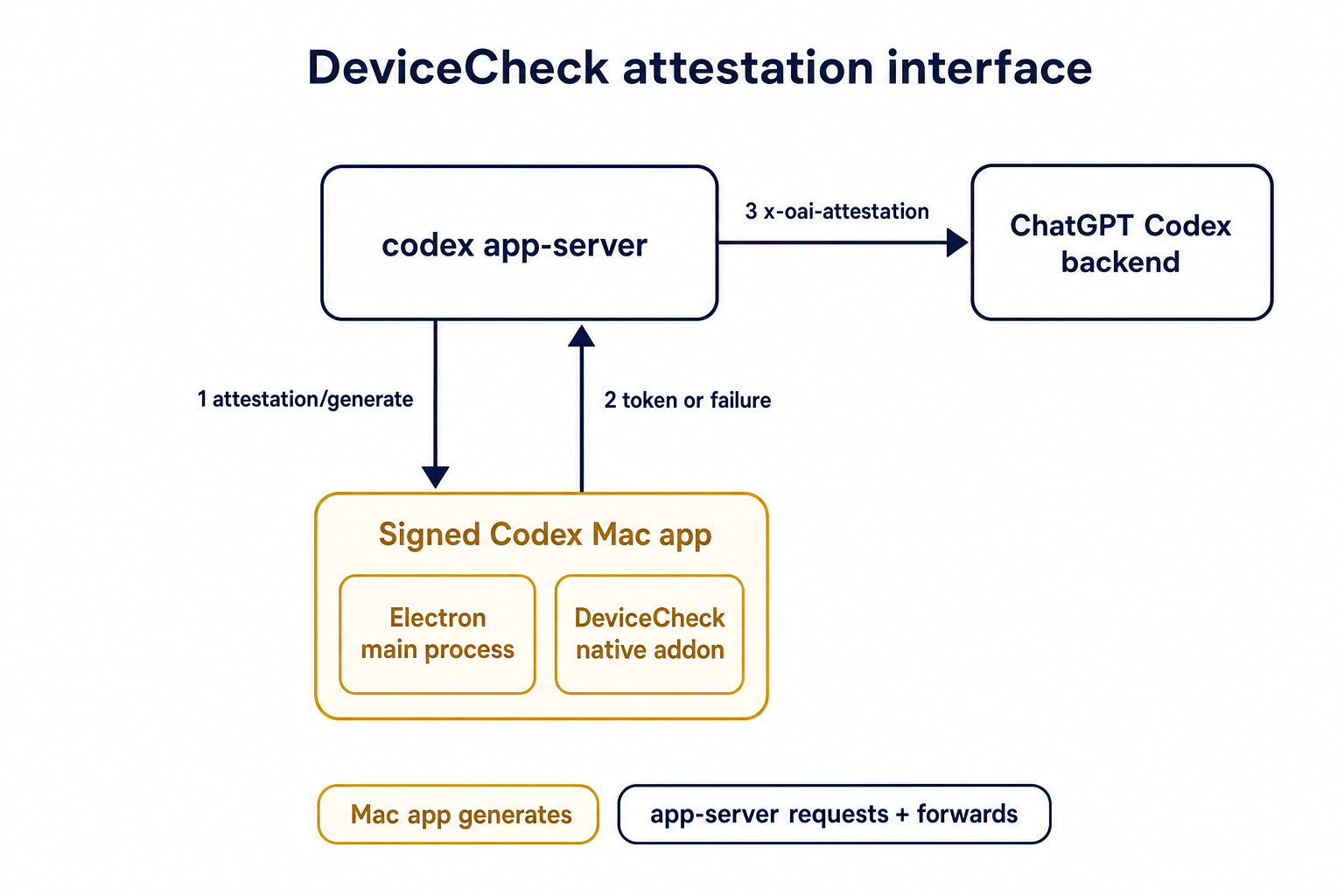
## Summary TL;DR: teaches `codex-rs` / app-server to request a desktop-provided attestation token and attach it as `x-oai-attestation` on the scoped ChatGPT Codex request paths.  ## Details This PR teaches the Codex app-server runtime how to request and attach an attestation token. It does not generate DeviceCheck tokens directly; instead, it relies on the connected desktop app to advertise that it can generate attestation and then asks that app for a fresh header value when needed. The flow is: 1. The Codex desktop app connects to app-server. 2. During `initialize`, the app can advertise that it supports `requestAttestation`. 3. Before app-server calls selected ChatGPT Codex endpoints, it sends the internal server request `attestation/generate` to the app. 4. app-server receives a pre-encoded header value back. 5. app-server forwards that value as `x-oai-attestation` on the scoped outbound requests. The code in this repo is mostly protocol and runtime plumbing: it adds the app-server request/response shape, introduces an attestation provider in core, wires that provider into Responses / compaction / realtime setup paths, and covers the intended scoping with tests. The signed macOS DeviceCheck generation remains owned by the desktop app PR. ## Related PR - Codex desktop app implementation: https://github.com/openai/openai/pull/878649 ## Validation <details> <summary>Tests run</summary> ```sh cargo test -p codex-app-server-protocol cargo test -p codex-core attestation --lib cargo test -p codex-app-server --lib attestation ``` Also ran: ```sh just fix -p codex-core just fix -p codex-app-server just fix -p codex-app-server-protocol just fmt just write-app-server-schema ``` </details> <details> <summary>E2E DeviceCheck validation</summary> First validated the signed desktop app boundary directly: launched a packaged signed `Codex.app`, sent `attestation/generate`, decoded the returned `v1.` attestation header, and validated the extracted DeviceCheck token with `personal/jm/verify_devicecheck_token.py` using bundle ID `com.openai.codex`. Apple returned `status_code: 200` and `is_ok: true`. Then ran the fuller app + app-server flow. The packaged `Codex.app` launched a current-branch app-server via `CODEX_CLI_PATH`, and a local MITM proxy intercepted outbound `chatgpt.com` traffic. The app-server requested `attestation/generate` from the real Electron app process, and the intercepted `/backend-api/codex/responses` traffic included `x-oai-attestation` on both routes: ```text GET /backend-api/codex/responses Upgrade: websocket x-oai-attestation: present POST /backend-api/codex/responses Upgrade: none x-oai-attestation: present ``` The captured header decoded to a DeviceCheck token that also validated with Apple for `com.openai.codex` (`status_code: 200`, `is_ok: true`, team `2DC432GLL2`). </details> --------- Co-authored-by: Codex <noreply@openai.com>
Jiaming Zhang ·
2026-05-08 12:36:02 -07:00 -
Load configured environments from CODEX_HOME (#20667)
## Why The earlier PRs add stdio transport support and the config-backed environment provider, but the feature remains inert until normal Codex entrypoints construct `EnvironmentManager` with enough context to discover `CODEX_HOME/environments.toml`. This final stack PR activates the provider while preserving the legacy `CODEX_EXEC_SERVER_URL` fallback when no environments file exists. **Stack position:** this is PR 5 of 5. It is the product wiring PR that activates the configured environment provider added in PR 4. ## What Changed - Thread `codex_home` into `EnvironmentManagerArgs`. - Change `EnvironmentManager::new(...)` to load the provider from `CODEX_HOME`. - Preserve legacy behavior by falling back to `DefaultEnvironmentProvider::from_env()` when `environments.toml` is absent. - Make `environments.toml`-backed managers start new threads with all configured environments, default first, while keeping the legacy env-var path single-default. - Update the app-server, TUI, exec, MCP server, connector, prompt-debug, and thread-manager-sample callsites to pass `codex_home` and handle provider-loading errors. ## Self-Review Notes - The multi-environment startup path is intentionally tied to the `environments.toml` provider. Using `>1` configured environment as the only signal would also expand the legacy `CODEX_EXEC_SERVER_URL` provider because it keeps `local` addressable alongside `remote`. - The startup environment list is still derived inside `EnvironmentManager`; the provider only says whether its snapshot should start new threads with all configured environments. - The thread-manager sample was updated to pass the current `ThreadManager::new(...)` installation id argument so the stack compiles under Bazel. ## Stack - 1. https://github.com/openai/codex/pull/20663 - Add stdio exec-server listener - 2. https://github.com/openai/codex/pull/20664 - Add stdio exec-server client transport - 3. https://github.com/openai/codex/pull/20665 - Make environment providers own default selection - 4. https://github.com/openai/codex/pull/20666 - Add CODEX_HOME environments TOML provider - **5. This PR:** https://github.com/openai/codex/pull/20667 - Load configured environments from CODEX_HOME Split from original draft: https://github.com/openai/codex/pull/20508 ## Validation - `just fmt` - `git diff --check` - `bazel build --config=remote --strategy=remote --remote_download_toplevel //codex-rs/thread-manager-sample:codex-thread-manager-sample` - `bazel test --config=remote --strategy=remote --remote_download_toplevel //codex-rs/exec-server:exec-server-unit-tests` - `bazel test --config=remote --strategy=remote --remote_download_toplevel --test_sharding_strategy=disabled --test_arg=default_thread_environment_selections_use_manager_default_id //codex-rs/core:core-unit-tests` - `bazel test --config=remote --strategy=remote --remote_download_toplevel --test_sharding_strategy=disabled --test_arg=start_thread_uses_all_default_environments_from_codex_home //codex-rs/core:core-unit-tests` ## Documentation This activates `CODEX_HOME/environments.toml`; user-facing documentation should be added before this stack is treated as a documented public workflow. --------- Co-authored-by: Codex <noreply@openai.com>
starr-openai ·
2026-05-08 11:17:56 -07:00 -
feat: Use installation ID in remote enrollments (#21662)
* Pass installation ID for storage on enrollments server for deduping/grouping multiple appservers per installation * Pass installation ID in remoteControl/status/changed events
David de Regt ·
2026-05-08 17:54:01 +00:00 -
Revert state DB injection and agent graph store (#21481)
## Why Reverts #20689 to restore the previous optional state DB plumbing. The conflict resolution keeps the newer installation ID and session/thread identity changes that landed after #20689, while removing the mandatory state DB and agent graph store dependency from ThreadManager construction. ## What changed - Restored `Option<StateDbHandle>` through app-server, MCP server, prompt debug, and test entry points. - Removed the `codex-core` dependency on `codex-agent-graph-store` and reverted descendant lookup back to the existing state DB path when available. - Kept newer `installation_id` forwarding by passing it beside the optional DB handle. - Kept local thread-name updates working when the optional state DB handle is absent. ## Validation - `git diff --check` - `cargo test -p codex-thread-store` - `cargo test -p codex-state -p codex-rollout -p codex-app-server-protocol` - Attempted `env CARGO_INCREMENTAL=0 cargo test -p codex-core -p codex-app-server -p codex-app-server-client -p codex-mcp-server -p codex-thread-manager-sample -p codex-tui`; blocked locally by a rustc ICE while compiling `v8 v146.4.0` with `rustc 1.93.0 (254b59607 2026-01-19)` on `aarch64-apple-darwin`.
pakrym-oai ·
2026-05-06 22:48:29 -07:00 -
pakrym-oai ·
2026-05-07 02:24:20 +00:00 -
Move skills watcher to app-server (#21287)
## Why Skills update notifications are app-server API behavior, but the watcher lived in `codex-core` and surfaced through `EventMsg::SkillsUpdateAvailable`. Moving the watcher out keeps core focused on thread execution and lets app-server own both cache invalidation and the `skills/changed` notification. ## What changed - Added an app-server-owned skills watcher that watches local skill roots, clears the shared skills cache, and emits `skills/changed` directly. - Registers skill watches from the common app-server thread listener attach path, including direct starts, resumes, and app-server-observed child or forked threads. - Stores the `WatchRegistration` on `ThreadState`, so listener replacement, thread teardown, idle unload, and app-server shutdown deregister by dropping the RAII guard. - Removed `EventMsg::SkillsUpdateAvailable`, the core watcher, and the old core live-reload test. - Extended the app-server skills change test to verify a cached skills list is refreshed after a filesystem change without forcing reload. ## Validation - `cargo check -p codex-core -p codex-app-server -p codex-mcp-server -p codex-rollout -p codex-rollout-trace` - `cargo test -p codex-app-server skills_changed_notification_is_emitted_after_skill_change`
pakrym-oai ·
2026-05-06 15:38:11 -07:00 -
Move installation ID resolution out of core startup (#21182)
## Summary - resolve or inject the installation ID before core startup and pass it through `ThreadManager`, `CodexSpawnArgs`, and `Session` as a plain `String` - keep child sessions on the parent installation ID instead of rediscovering it inside core - propagate installation ID startup failures in `mcp-server` instead of panicking ## Why Core was still touching the filesystem on the session startup path to discover `installation_id`. This moves that work to the outer host boundary so core no longer depends on `codex_home` reads during session construction. --------- Co-authored-by: Codex <noreply@openai.com>
jif-oai ·
2026-05-06 10:48:54 +00:00 -
Preserve session MCP config on refresh (#21055)
# Overview MCP refreshes were rebuilding active threads from fresh disk-backed config only, which dropped thread-start session overlays such as app-injected MCP servers. This keeps refreshes current with disk config while preserving the thread-local config that only the active thread knows about. # Changes - Rebuild refreshed config per active thread using that thread's current `cwd`, rather than fanning out one app-server config to every thread. - Preserve each thread's `SessionFlags` layer while replacing reloadable config layers with freshly loaded config, then derive the MCP refresh payload from the rebuilt result. - Move MCP refresh orchestration into app-server so manual refreshes fail loudly while background refreshes remain best-effort, and route plugin-triggered refreshes through the same per-thread reload path. - Add regression coverage for session overlays, fresh project config, plugin-derived MCP config, current requirements, and strict vs best-effort refresh behavior. # Verification - Passed focused Rust coverage for the thread-config rebuild behavior and deferred MCP refresh flow, plus `cargo test -p codex-app-server --lib`. - Verified end to end in the Codex dev app against the locally built CLI: registered an MCP via thread config, verified that it could be used successfully before refresh, manually triggered MCP refresh, and verified that it continued to be available afterward.
aaronl-openai ·
2026-05-05 21:09:28 -07:00 -
Inject state DB, agent graph store (#20689)
## Why We want the agent graph store to be passed down the stack as a real dependency, the same way we already treat the thread store. This will let us inject the agent graph store as a real dependency and support implementations other than the local SQLite-backed one. Right now most code instantiates a state DB and an agent graph store just-in-time. Ideally, we would not depend on the state DB directly but only read through the higher-level interfaces. This change makes the dependency boundaries explicit and moves state DB initialization to process bootstrap instead of hiding it inside local store implementations. ## What changed - `ThreadManager` now requires a `StateDbHandle` and an `AgentGraphStore` at construction time instead of treating them as optional internals. - The local store constructors no longer lazily initialize SQLite. Callers now initialize the state DB once per process and use that shared handle to build: - `LocalThreadStore` - `LocalAgentGraphStore` - App bootstraps (`app-server`, `mcp-server`, `prompt_debug`, and the thread-manager sample) now initialize the state DB up front and inject the resulting handle down the stack. - `app-server` now consistently uses its process-scoped state DB handle instead of reopening SQLite or trying to recover it from loaded threads. - Device-key storage now reuses the shared state DB handle instead of maintaining its own lazy opener. - The thread archive / descendant traversal paths now use the injected `AgentGraphStore` instead of reaching through local thread-store-specific state. ## Verification - `cargo check -p codex-core -p codex-thread-store -p codex-app-server -p codex-mcp-server -p codex-thread-manager-sample --tests` - `cargo test -p codex-thread-store` - `cargo test -p codex-core thread_manager_accepts_separate_agent_graph_store_and_thread_store -- --nocapture` - `cargo test -p codex-app-server thread_archive_archives_spawned_descendants -- --nocapture`
Rasmus Rygaard ·
2026-05-05 21:45:29 +00:00 -
state: pass state db handles through consumers (#20561)
## Why SQLite state was still being opened from consumer paths, including lazy `OnceCell`-backed thread-store call sites. That let one process construct multiple state DB connections for the same Codex home, which makes SQLite lock contention and `database is locked` failures much easier to hit. State DB lifetime should be chosen by main-like entrypoints and tests, then passed through explicitly. Consumers should use the supplied `Option<StateDbHandle>` or `StateDbHandle` and keep their existing filesystem fallback or error behavior when no handle is available. The startup path also needs to keep the rollout crate in charge of SQLite state initialization. Opening `codex_state::StateRuntime` directly bypasses rollout metadata backfill, so entrypoints should initialize through `codex_rollout::state_db` and receive a handle only after required rollout backfills have completed. ## What Changed - Initialize the state DB in main-like entrypoints for CLI, TUI, app-server, exec, MCP server, and the thread-manager sample. - Pass `Option<StateDbHandle>` through `ThreadManager`, `LocalThreadStore`, app-server processors, TUI app wiring, rollout listing/recording, personality migration, shell snapshot cleanup, session-name lookup, and memory/device-key consumers. - Remove the lazy local state DB wrapper from the thread store so non-test consumers use only the supplied handle or their existing fallback path. - Make `codex_rollout::state_db::init` the local state startup path: it opens/migrates SQLite, runs rollout metadata backfill when needed, waits for concurrent backfill workers up to a bounded timeout, verifies completion, and then returns the initialized handle. - Keep optional/non-owning SQLite helpers, such as remote TUI local reads, as open-only paths that do not run startup backfill. - Switch app-server startup from direct `codex_state::StateRuntime::init` to the rollout state initializer so app-server cannot skip rollout backfill. - Collapse split rollout lookup/list APIs so callers use the normal methods with an optional state handle instead of `_with_state_db` variants. - Restore `getConversationSummary(ThreadId)` to delegate through `ThreadStore::read_thread` instead of a LocalThreadStore-specific rollout path special case. - Keep DB-backed rollout path lookup keyed on the DB row and file existence, without imposing the filesystem filename convention on existing DB rows. - Verify readable DB-backed rollout paths against `session_meta.id` before returning them, so a stale SQLite row that points at another thread's JSONL falls back to filesystem search and read-repairs the DB row. - Keep `debug prompt-input` filesystem-only so a one-off debug command does not initialize or backfill SQLite state just to print prompt input. - Keep goal-session test Codex homes alive only in the goal-specific helper, rather than leaking tempdirs from the shared session test helper. - Update tests and call sites to pass explicit state handles where DB behavior is expected and explicit `None` where filesystem-only behavior is intended. ## Validation - `CARGO_TARGET_DIR=/tmp/codex-target-state-db cargo check -p codex-rollout -p codex-thread-store -p codex-app-server -p codex-core -p codex-tui -p codex-exec -p codex-cli --tests` - `CARGO_TARGET_DIR=/tmp/codex-target-state-db cargo test -p codex-rollout state_db_` - `CARGO_TARGET_DIR=/tmp/codex-target-state-db cargo test -p codex-rollout find_thread_path` - `CARGO_TARGET_DIR=/tmp/codex-target-state-db cargo test -p codex-rollout find_thread_path -- --nocapture` - `CARGO_TARGET_DIR=/tmp/codex-target-state-db cargo test -p codex-rollout try_init_ -- --nocapture` - `CARGO_TARGET_DIR=/tmp/codex-target-state-db cargo test -p codex-rollout` - `CARGO_TARGET_DIR=/tmp/codex-target-state-db cargo clippy -p codex-rollout --lib -- -D warnings` - `CARGO_TARGET_DIR=/tmp/codex-target-state-db cargo test -p codex-thread-store read_thread_falls_back_when_sqlite_path_points_to_another_thread -- --nocapture` - `CARGO_TARGET_DIR=/tmp/codex-target-state-db cargo test -p codex-thread-store` - `CARGO_TARGET_DIR=/tmp/codex-target-state-db cargo test -p codex-core shell_snapshot` - `CARGO_TARGET_DIR=/tmp/codex-target-state-db cargo test -p codex-core --test all personality_migration` - `CARGO_TARGET_DIR=/tmp/codex-target-state-db cargo test -p codex-core --test all rollout_list_find` - `RUST_MIN_STACK=8388608 CODEX_SKIP_VENDORED_BWRAP=1 CARGO_TARGET_DIR=/tmp/codex-target-state-db cargo test -p codex-core --test all rollout_list_find::find_prefers_sqlite_path_by_id -- --nocapture` - `RUST_MIN_STACK=8388608 CODEX_SKIP_VENDORED_BWRAP=1 CARGO_TARGET_DIR=/tmp/codex-target-state-db cargo test -p codex-core --test all rollout_list_find -- --nocapture` - `CARGO_TARGET_DIR=/tmp/codex-target-state-db cargo test -p codex-core interrupt_accounts_active_goal_before_pausing` - `CARGO_TARGET_DIR=/tmp/codex-target-state-db cargo test -p codex-app-server get_auth_status -- --test-threads=1` - `CODEX_SKIP_VENDORED_BWRAP=1 CARGO_TARGET_DIR=/tmp/codex-target-state-db cargo test -p codex-app-server --lib` - `CODEX_SKIP_VENDORED_BWRAP=1 CARGO_TARGET_DIR=/tmp/codex-target-state-db cargo check -p codex-rollout -p codex-app-server --tests` - `CARGO_TARGET_DIR=/tmp/codex-target-state-db just fix -p codex-rollout -p codex-thread-store -p codex-core -p codex-app-server -p codex-tui -p codex-exec -p codex-cli` - `CODEX_SKIP_VENDORED_BWRAP=1 CARGO_TARGET_DIR=/tmp/codex-target-state-db just fix -p codex-rollout -p codex-app-server` - `CARGO_TARGET_DIR=/tmp/codex-target-state-db just fix -p codex-rollout` - `CODEX_SKIP_VENDORED_BWRAP=1 CARGO_TARGET_DIR=/tmp/codex-target-state-db just fix -p codex-core` - `just argument-comment-lint -p codex-core` - `just argument-comment-lint -p codex-rollout` Focused coverage added in `codex-rollout`: - `recorder::tests::state_db_init_backfills_before_returning` verifies the rollout metadata row exists before startup init returns. - `state_db::tests::try_init_waits_for_concurrent_startup_backfill` verifies startup waits for another worker to finish backfill instead of disabling the handle for the process. - `state_db::tests::try_init_times_out_waiting_for_stuck_startup_backfill` verifies startup does not hang indefinitely on a stuck backfill lease. - `tests::find_thread_path_accepts_existing_state_db_path_without_canonical_filename` verifies DB-backed lookup accepts valid existing rollout paths even when the filename does not include the thread UUID. - `tests::find_thread_path_falls_back_when_db_path_points_to_another_thread` verifies DB-backed lookup ignores a stale row whose existing path belongs to another thread and read-repairs the row after filesystem fallback. Focused coverage updated in `codex-core`: - `rollout_list_find::find_prefers_sqlite_path_by_id` now uses a DB-preferred rollout file with matching `session_meta.id`, so it still verifies that valid SQLite paths win without depending on stale/empty rollout contents. `cargo test -p codex-app-server thread_list_respects_search_term_filter -- --test-threads=1 --nocapture` was attempted locally but timed out waiting for the app-server test harness `initialize` response before reaching the changed thread-list code path. `bazel test //codex-rs/thread-store:thread-store-unit-tests --test_output=errors` was attempted locally after the thread-store fix, but this container failed before target analysis while fetching `v8+` through BuildBuddy/direct GitHub. The equivalent local crate coverage, including `cargo test -p codex-thread-store`, passes. A plain local `cargo check -p codex-rollout -p codex-app-server --tests` also requires system `libcap.pc` for `codex-linux-sandbox`; the follow-up app-server check above used `CODEX_SKIP_VENDORED_BWRAP=1` in this container.
Ruslan Nigmatullin ·
2026-05-04 11:46:03 -07:00 -
[codex] Split app-server request processors (#20940)
## Why The app-server request path had grown around a large `CodexMessageProcessor` plus separate API wrapper/helper modules. That made the dependency graph hard to see and forced unrelated request families to share broad processor state. This PR makes the split mechanical and command-prefix oriented so request families own only the dependencies they use. ## What changed - Replaced `CodexMessageProcessor` with command-prefix request processors under `app-server/src/request_processors/`. - Removed the old config, device-key, external-agent-config, and fs API wrapper files by moving their API handling into processors. - Split apps, plugins, marketplace, catalog, account, MCP, command exec, fs, git, feedback, thread, turn, thread goals, and Windows sandbox handling into dedicated processors. - Kept shared lifecycle, summary conversion, token usage replay, and shared error mapping only where multiple processors use them; single-use helpers were inlined into their owning processor. - Removed the fallback processor path and moved processor tests to `_tests` files. ## Validation - `cargo test -p codex-app-server` - `cargo check -p codex-app-server` - `just fix -p codex-app-server`
pakrym-oai ·
2026-05-04 09:34:11 -07:00 -
[codex-analytics] ingest server requests and responses (#17088)
## Why Codex analytics needs a typed seam for app-server-originated request/response traffic so future tool-approval analytics can consume those facts without adding bespoke callsite tracking each time. Server responses arrive as JSON-RPC `id + result` payloads, so analytics has to reconstruct the matching typed response from the original typed request while that request context still exists in app-server. This also puts analytics on the app-server outbound path, which needs to avoid keeping the runtime alive during shutdown. The final ownership fix keeps the normal strong auth-manager retention in analytics and makes the external-auth refresh bridge hold a weak back-reference to `OutgoingMessageSender`, breaking the runtime cycle at the bridge boundary instead of exposing retention policy through the analytics client API. ## What changed - Adds typed `ServerRequest` and `ServerResponse` analytics facts, plus `AnalyticsEventsClient::track_server_request` and `track_server_response`. - Renames the existing client-side facts to `ClientRequest` and `ClientResponse` so reducers can distinguish client-to-server traffic from server-to-client traffic. - Adds `ServerRequest::response_from_result`, allowing a stored typed request to decode the matching typed server response from a raw JSON-RPC result payload. - Threads `AnalyticsEventsClient` through `OutgoingMessageSender` and records targeted server requests, replayed targeted requests, and matching targeted responses with the responding connection id needed for correlation. - Intentionally leaves broadcast server requests/responses out of analytics for now because the current model is per connection, while broadcasts fan one logical request out across multiple connections. - Breaks the app-server shutdown cycle by storing `Weak<OutgoingMessageSender>` in `ExternalAuthRefreshBridge` and upgrading it only when an external-auth refresh is actually requested. - Keeps reducer ingestion of the new server-side facts as no-ops for now; this PR is plumbing for later tool-approval analytics work. ## Verification - `cargo test -p codex-analytics` - `cargo test -p codex-app-server outgoing_message::tests::` - Covers typed-response reconstruction plus the targeted, replayed, broadcast-exclusion, and response-attribution analytics paths. ## Follow-up This PR intentionally stops at ingestion plumbing, so `ServerRequest` and `ServerResponse` facts are still reducer no-ops. Once a follow-up PR adds real downstream analytics output for those facts: - replace the temporary pre-reducer observation seam with reducer tests for the emitted event shape; - add end-to-end coverage in `app-server/tests/suite/v2/analytics.rs` for the real app-server workflow and captured analytics payload; - remove the temporary sender-level observer tests added here in favor of the real-output coverage above. --- [//]: # (BEGIN SAPLING FOOTER) Stack created with [Sapling](https://sapling-scm.com). Best reviewed with [ReviewStack](https://reviewstack.dev/openai/codex/pull/17088). * #18748 * #18747 * #17090 * #17089 * #20241 * #20239 * __->__ #17088
rhan-oai ·
2026-04-29 19:56:41 +00:00 -
Add environment provider snapshot (#20058)
## Summary - Change `EnvironmentProvider` to return concrete `Environment` instances instead of `EnvironmentConfigurations`. - Make `DefaultEnvironmentProvider` provide the provider-visible `local` environment plus optional `remote` environment from `CODEX_EXEC_SERVER_URL`. - Keep `EnvironmentManager` as the concrete cache while exposing its own explicit local environment for `local_environment()` fallback paths. ## Validation - `just fmt` - `git diff --check` --------- Co-authored-by: Codex <noreply@openai.com>
starr-openai ·
2026-04-28 20:05:18 -07:00 -
app-server: notify clients of remote-control status changes (#19919)
## Why Remote-control app-server enrollments have both an internal server id and the environment id exposed to remote-control clients. App-server clients need one current status snapshot that says whether remote control is usable and which environment id, if any, is exposed. A temporary websocket disconnect is not itself an identity change. Account changes, stale enrollment invalidation, successful re-enrollment, and missing ChatGPT auth are meaningful status changes. Disabled remote control remains `disabled` regardless of auth or SQLite state. SQLite startup failure disablement and enrollment persistence failures are handled in #20068; this PR reports the resulting effective status to clients. ## What changed - Adds v2 `remoteControl/status/changed` carrying `state` and `environmentId`. - Adds `RemoteControlConnectionState` values: `disabled`, `connecting`, `connected`, and `errored`. - Exposes remote-control status updates through `RemoteControlHandle` using a Tokio watch channel. - Always sends the current remote-control status snapshot to newly initialized app-server clients. - Broadcasts status changes to initialized app-server clients when state or environment id changes. - Treats missing ChatGPT auth as an `errored` status while leaving it retryable because auth can change at runtime. - Clears `environmentId` when enrollment is cleared for account changes, auth loss, stale backend invalidation, or disabled remote control. - Updates app-server protocol schema fixtures, generated TypeScript, app-server README, remote-control tests, and TUI exhaustive notification matches. ## Stack - Builds on #20068. ## Verification - `just write-app-server-schema` - `cargo test -p codex-app-server-protocol` - `cargo test -p codex-app-server transport::remote_control --lib` - `cargo check -p codex-tui` - `just fix -p codex-app-server-protocol` - `just fix -p codex-app-server` - `just fix -p codex-tui`
Ruslan Nigmatullin ·
2026-04-28 23:52:14 +00:00 -
app-server: disable remote control without sqlite (#20068)
## Why Remote control depends on the app-server SQLite state DB for persisted enrollment identity. If the state DB cannot be opened at startup, continuing with remote control enabled leaves the process in a misleading state where enrollment identity cannot be read or persisted. Feature-disabled remote control remains disabled regardless of SQLite state. This only changes the case where remote control is requested but the SQLite state DB is unavailable. ## What changed - Logs SQLite state DB initialization failures instead of dropping the error silently. - Treats remote control as effectively disabled when the SQLite state DB is unavailable. - Prevents `RemoteControlHandle::set_enabled(true)` from enabling remote control later in the same process if the state DB was unavailable at startup. - Keeps the existing behavior that disabled remote control does not validate or connect to the remote-control URL. - Makes persisted enrollment load/update failures propagate as remote-control errors instead of silently falling back to in-memory state. - Makes the direct websocket connection path fail when called without a SQLite state DB. - Adds coverage for startup without a state DB, later handle enablement with no state DB, and direct websocket connection without a state DB. ## Verification - `cargo test -p codex-app-server transport::remote_control --lib` - `just fix -p codex-app-server`
Ruslan Nigmatullin ·
2026-04-28 13:49:00 -07:00 -
app-server: run initialized rpcs with keyed serialization (#17373)
## Why Initialized app-server RPCs no longer need to bottleneck behind one request processor path. Running them concurrently improves responsiveness, but several request families still mutate shared state or depend on ordered side effects. Those stateful families need an auditable serialization contract so concurrency does not reorder thread, config, auth, command, watcher, MCP, or similar state transitions. This PR keeps that boundary explicit: stateful work is serialized by the smallest useful key, while intentionally read-only or externally concurrent work remains unkeyed. In particular, `thread/list` and `thread/turns/list` explicitly have no serialization because they primarily read append-only rollout storage and should continue to be served concurrently. ## What changed - Adds `ClientRequest::serialization_scope()` in `app-server-protocol` and requires every client request definition to declare its serialization behavior. - Introduces keyed request scopes for thread, thread path, command exec process, fuzzy search session, fs watch, MCP OAuth, and global state buckets such as config, account auth, memory, and device keys. - Routes initialized app-server RPCs through per-key FIFO serialization while allowing unkeyed initialized requests to run concurrently. - Cancels in-flight initialized RPC work when the connection disconnects or the app-server exits so spawned request tasks do not outlive their session. - Adds focused coverage for representative keyed and unkeyed serialization scopes, including explicitly concurrent `thread/turns/list` behavior. ## Validation - Added protocol tests for representative keyed serialization scopes and intentionally unkeyed request families. - Added app-server request serialization tests covering per-key FIFO behavior, concurrent unkeyed execution, disconnect shutdown, and config read-after-write ordering. - Local focused protocol validation after the latest rebase is currently blocked by packageproxy failing to resolve locked `rustls-webpki 0.103.13`; CI is expected to provide the full validation signal.
Ruslan Nigmatullin ·
2026-04-28 12:23:34 -07:00 -
refactor: make auth loading async (#19762)
## Summary Auth loading used to expose synchronous construction helpers in several places even though some auth sources now need async work. This PR makes the auth-loading surface async and updates the callers to await it. This is intentionally only plumbing. It does not change how AgentIdentity tokens are decoded, how task runtime ids are allocated, or how JWT signatures are verified. ## Stack 1. **This PR:** [refactor: make auth loading async](https://github.com/openai/codex/pull/19762) 2. [refactor: load AgentIdentity runtime eagerly](https://github.com/openai/codex/pull/19763) 3. [feat: verify AgentIdentity JWTs with JWKS](https://github.com/openai/codex/pull/19764) ## Important call sites | Area | Change | | --- | --- | | `codex-login` auth loading | `CodexAuth` and `AuthManager` construction paths now await auth loading. | | app-server startup | Auth manager construction is awaited during initialization. | | CLI/TUI/exec/MCP/chatgpt callers | Existing auth-loading calls now await the same behavior. | | cloud requirements storage loader | The loader becomes async so it can share the same auth construction path. | | auth tests | Tests that load auth now run in async contexts. | ## Testing Tests: targeted Rust auth test compilation, formatter, scoped Clippy fix, and Bazel lock check.
efrazer-oai ·
2026-04-27 11:00:27 -07:00 -
Michael Bolin ·
2026-04-26 19:42:39 -07:00 -
[codex] Move config loading into codex-config (#19487)
## Why Config loading had become split across crates: `codex-config` owned the config types and merge logic, while `codex-core` still owned the loader that assembled the layer stack. This change consolidates that responsibility in `codex-config`, so the crate that defines config behavior also owns how configs are discovered and loaded. To make that move possible without reintroducing the old dependency cycle, the shell-environment policy types and helpers that `codex-exec-server` needs now live in `codex-protocol` instead of flowing through `codex-config`. This also makes the migrated loader tests more deterministic on machines that already have managed or system Codex config installed by letting tests override the system config and requirements paths instead of reading the host's `/etc/codex`. ## What Changed - moved the config loader implementation from `codex-core` into `codex-config::loader` and deleted the old `core::config_loader` module instead of leaving a compatibility shim - moved shell-environment policy types and helpers into `codex-protocol`, then updated `codex-exec-server` and other downstream crates to import them from their new home - updated downstream callers to use loader/config APIs from `codex-config` - added test-only loader overrides for system config and requirements paths so loader-focused tests do not depend on host-managed config state - cleaned up now-unused dependency entries and platform-specific cfgs that were surfaced by post-push CI ## Testing - `cargo test -p codex-config` - `cargo test -p codex-core config_loader_tests::` - `cargo test -p codex-protocol -p codex-exec-server -p codex-cloud-requirements -p codex-rmcp-client --lib` - `cargo test --lib -p codex-app-server-client -p codex-exec` - `cargo test --no-run --lib -p codex-app-server` - `cargo test -p codex-linux-sandbox --lib` - `cargo shear` - `just bazel-lock-check` ## Notes - I did not chase unrelated full-suite failures outside the migrated loader surface. - `cargo test -p codex-core --lib` still hits unrelated proxy-sensitive failures on this machine, and Windows CI still shows unrelated long-running/timeouting test noise outside the loader migration itself.
pakrym-oai ·
2026-04-26 15:10:53 -07:00 -
test: harden app-server integration tests (#19683)
## Why Windows Bazel runs in the permissions stack exposed that app-server integration tests were launching normal plugin startup warmups in every subprocess. Those warmups can call `https://chatgpt.com/backend-api/plugins/featured` when a test is not specifically exercising plugin startup, which adds slow background work, noisy stderr, and dependence on external network state. The relevant startup/featured-plugin behavior was introduced across #15042 and #15264. A few app-server tests also had long optional waits or unbounded cleanup paths, making failures expensive to diagnose and contributing to slow Windows shards. One external-agent config test from #18246 used a GitHub-style marketplace source, which was enough to exercise the pending remote-import path but also meant the background completion task could attempt a real clone. ## What Changed - Adds explicit `AppServerRuntimeOptions` / `PluginStartupTasks` plumbing and a hidden debug-only `--disable-plugin-startup-tasks-for-tests` app-server flag, so integration tests can suppress startup plugin warmups without adding a production env-var gate. - Has the app-server test harness pass that hidden flag by default, while opting plugin-startup coverage back in for tests that intentionally exercise startup sync and featured-plugin warmup behavior. - Lowers normal app-server subprocess logging from `info`/`debug` to `warn` to avoid multi-megabyte stderr output in Bazel logs. - Prevents the external-agent config test from attempting a real marketplace clone by using an invalid non-local source while still exercising the pending-import completion path. - Bounds optional filesystem/realtime waits and fake WebSocket test-server shutdown so failures produce targeted timeouts instead of hanging a shard. - Fixes the Unix script-resolution test in `rmcp-client` to exercise PATH resolution directly and include the actual spawn error in failures. ## Verification - `cargo check -p codex-app-server` - `cargo clippy -p codex-app-server --tests -- -D warnings` - `cargo test -p codex-rmcp-client program_resolver::tests::test_unix_executes_script_without_extension` - `cargo test -p codex-app-server --test all external_agent_config_import_sends_completion_notification_after_pending_plugins_finish -- --nocapture` - `cargo test -p codex-app-server --test all plugin_list_uses_warmed_featured_plugin_ids_cache_on_first_request -- --nocapture` - Windows Local Bazel passed with this test-hardening bundle before it was extracted from #19606. --- [//]: # (BEGIN SAPLING FOOTER) Stack created with [Sapling](https://sapling-scm.com). Best reviewed with [ReviewStack](https://reviewstack.dev/openai/codex/pull/19683). * #19395 * #19394 * #19393 * #19392 * #19606 * __->__ #19683
Michael Bolin ·
2026-04-26 12:43:16 -07:00 -
Add remote thread config endpoint (#18908)
## Why App-server needs a way to fetch thread-scoped config from the remote thread config service when the user config opts into that behavior. This mirrors the existing experimental remote thread store endpoint while keeping local/noop behavior as the default. Startup paths also need to avoid silently dropping the remote config endpoint after the first config load. The stdio app-server path discovers the endpoint from the initial config and installs the real thread config loader for later config builds, while in-process clients used by TUI/exec now select the same remote loader directly from their provided config. ## What changed - Added `experimental_thread_config_endpoint` to `ConfigToml`, `Config`, and `core/config.schema.json`. - Added config parsing coverage for the new setting. - Updated app-server startup to select `RemoteThreadConfigLoader` from the initially loaded config, falling back to `NoopThreadConfigLoader` when unset. - Let `ConfigManager` replace its thread config loader after startup discovery so later config loads use the selected loader. - Updated in-process app-server client startup to pass `RemoteThreadConfigLoader` when its config has `experimental_thread_config_endpoint` set. ## Verification - Added `experimental_thread_config_endpoint_loads_from_config_toml`. - Added `runtime_start_args_use_remote_thread_config_loader_when_configured`. - Ran `cargo check -p codex-app-server --lib`. - Ran `cargo test -p codex-app-server-client`.
Rasmus Rygaard ·
2026-04-23 11:46:06 -07:00 -
app-server: add Unix socket transport (#18255)
## Summary - add unix:// app-server transport backed by the shared codex-uds crate - reuse the websocket connection loop for axum and tungstenite-backed streams - add codex app-server proxy to bridge stdio clients to the control socket - tolerate Windows UDS backends that report a missing rendezvous path as connection refused before binding ## Tests - cargo test -p codex-app-server control_socket_acceptor_forwards_websocket_text_messages_and_pings - cargo test -p codex-app-server - just fmt - just fix -p codex-app-server - git -c core.fsmonitor=false diff --check
Ruslan Nigmatullin ·
2026-04-23 11:09:25 -07:00 -
Support multiple managed environments (#18401)
## Summary - refactor EnvironmentManager to own keyed environments with default/local lookup helpers - keep remote exec-server client creation lazy until exec/fs use - preserve disabled agent environment access separately from internal local environment access ## Validation - not run (per Codex worktree instruction to avoid tests/builds unless requested) --------- Co-authored-by: Codex <noreply@openai.com>
starr-openai ·
2026-04-21 15:29:35 -07:00 -
fix: fully revert agent identity runtime wiring (#18757)
## Summary This PR fully reverts the previously merged Agent Identity runtime integration from the old stack: https://github.com/openai/codex/pull/17387/changes It removes the Codex-side task lifecycle wiring, rollout/session persistence, feature flag plumbing, lazy `auth.json` mutation, background task auth paths, and request callsite changes introduced by that stack. This leaves the repo in a clean pre-AgentIdentity integration state so the follow-up PRs can reintroduce the pieces in smaller reviewable layers. ## Stack 1. This PR: full revert 2. https://github.com/openai/codex/pull/18871: move Agent Identity business logic into a crate 3. https://github.com/openai/codex/pull/18785: add explicit AgentIdentity auth mode and startup task allocation 4. https://github.com/openai/codex/pull/18811: migrate auth callsites through AuthProvider ## Testing Tests: targeted Rust checks, cargo-shear, Bazel lock check, and CI.
efrazer-oai ·
2026-04-21 14:30:55 -07:00