## Why

Code mode only used nested spec lookup at execution time to rediscover
whether a nested tool should be invoked as a function tool or a freeform
tool.

That information is already present in the enabled tool metadata that
code mode builds to expose `tools.*` and `ALL_TOOLS`, so re-looking it
up from the router was redundant and kept execution coupled to a
separate spec lookup path.

## What Changed

- thread `CodeModeToolKind` through the code-mode runtime `ToolCall`
event and `CodeModeNestedToolCall`
- emit the nested tool kind directly from the V8 callback using the
already-enabled tool metadata
- build nested tool payloads from the propagated kind instead of calling
`find_spec`
- remove the now-unused `find_spec` plumbing from the router and
parallel runtime helpers
- add unit coverage for function vs freeform payload shaping and update
affected router tests

## Testing

- `cargo test -p codex-code-mode`
- `cargo test -p codex-core code_mode::tests`
- `cargo test -p codex-core
extension_tool_bundles_are_model_visible_and_dispatchable`
- `cargo test -p codex-core
model_visible_specs_filter_deferred_dynamic_tools`
## Why

Tool dispatch had two serialization mechanisms:

- `supports_parallel_tool_calls` decides whether a tool participates in
the shared parallel-execution lock.
- `is_mutating` separately gated some calls inside dispatch.

That second hook no longer carried its weight. The remaining
parallel-support flag is already the per-tool concurrency policy, so
keeping a second mutating gate made dispatch harder to follow and left
behind extra session plumbing that only existed for that path.

## What changed

- Removed `is_mutating` from tool handlers and deleted the
`tool_call_gate` path that existed only to support it.
- Simplified dispatch and routing to rely on the existing per-tool
`supports_parallel_tool_calls` boolean.
- Dropped the now-unused handler overrides and related session/test
scaffolding.
- Kept the router/parallel tests focused on the surviving per-tool
behavior.
- Removed the unused `codex-utils-readiness` dependency from
`codex-core` as a follow-up fix for `cargo shear`.

## Testing

- `cargo test -p codex-core
parallel_support_does_not_match_namespaced_local_tool_names`
- `cargo test -p codex-core mcp_parallel_support_uses_handler_data`
- `cargo test -p codex-core
tools_without_handlers_do_not_support_parallel`
## Summary
- tighten unified exec sandbox initialization
- preserve the requested process workdir independently from sandbox
setup
- add regression coverage for the updated invariant

## Validation
- Ran `/tmp/cargo-tools/bin/just fmt`.
- Ran the targeted `codex-core` regression test successfully.
- Ran `cargo test -p codex-core`; it did not complete cleanly because
unrelated existing agent/config-loader tests failed and the run later
aborted on a stack overflow in
`tools::handlers::multi_agents::tests::tool_handlers_cascade_close_and_resume_and_keep_explicitly_closed_subtrees_closed`.

Co-authored-by: Codex <noreply@openai.com>
## Why

`ToolRouter::tool_supports_parallel()` was still consulting configured
specs when a handler lookup missed, even though parallel schedulability
is really a property of the executable handler. Keeping that metadata on
`ConfiguredToolSpec` duplicated state between the model-visible spec
layer and the runtime handler layer.

This change makes handlers the sole source of truth for parallel tool
support and removes the extra spec wrapper that only existed to carry
duplicated metadata.

## What changed

- removed `ConfiguredToolSpec` and store plain `ToolSpec` values in the
registry/router builder path
- changed `ToolRouter::tool_supports_parallel()` to consult only the
handler registry and fall back to `false`
- simplified spec collection and test helpers to operate directly on
`ToolSpec`
- updated router/spec tests to cover handler-owned parallel behavior and
the no-handler fallback

## Validation

- `cargo test -p codex-tools`
- `cargo test -p codex-core mcp_parallel_support_uses_handler_data`
- `cargo test -p codex-core
deferred_responses_api_tool_serializes_with_defer_loading`
- `cargo test -p codex-core
tools_without_handlers_do_not_support_parallel`
- `cargo test -p codex-core
request_plugin_install_can_be_registered_without_search_tool`

## Docs

No documentation updates needed.
## Why

Older sessions can contain model-warning records persisted as `user`
messages, including the unified exec process-limit warning, the
`apply_patch`-via-`exec_command` warning, and the model-mismatch
high-risk cyber fallback warning. Those warnings are no longer produced
as conversation history items, but when old sessions compact they should
still be recognized as injected context rather than preserved as real
user turns.

## What changed

- Removed `record_model_warning` and the production paths that emitted
these warning messages into conversation history.
- Added `LegacyUnifiedExecProcessLimitWarning`,
`LegacyApplyPatchExecCommandWarning`, and `LegacyModelMismatchWarning`
contextual fragments that are used only for matching old persisted
messages.
- Registered the legacy fragments with contextual user message detection
so compaction filters them through the existing fragment path.
- Added focused compaction coverage for old warning messages being
dropped during compacted-history processing.

## Testing

- `cargo test -p codex-core warning`
- `just fix -p codex-core`
## Why

`PreToolUse` already exposes `updatedInput` in its hook output schema,
but Codex currently rejects it instead of applying the rewrite. That
leaves hook authors unable to make the documented pre-execution
adjustment to a tool call before it runs.

## What

- Accept `updatedInput` from `PreToolUse` hooks when paired with
`permissionDecision: "allow"`.
- Apply the rewritten input before dispatch so the tool executes the
updated payload, not the original one.
- Preserve the stable hook-facing compatibility shapes that
participating tool handlers expose:
- Bash-like tools (`shell`, `container.exec`, `local_shell`,
`shell_command`, `exec_command`) use `{ "command": ... }`.
- `apply_patch` exposes its patch body through the same command-shaped
hook contract.
  - MCP tools expose their JSON argument object directly.
- Keep each participating tool handler responsible for translating
hook-facing `updatedInput` back into its concrete invocation shape.

## Verification

Direct Bash-like rewrite coverage:

- `pre_tool_use_rewrites_shell_before_execution`
- `pre_tool_use_rewrites_container_exec_before_execution`
- `pre_tool_use_rewrites_local_shell_before_execution`
- `pre_tool_use_rewrites_shell_command_before_execution`
- `pre_tool_use_rewrites_exec_command_before_execution`

These cases assert that each supported Bash-like surface runs only the
rewritten command while the hook still observes the original `{
"command": ... }` input.

`pre_tool_use_rewrites_apply_patch_before_execution`

- Model emits one patch.
- Hook swaps in a different patch.
- Asserts only the rewritten file is created, and the hook saw the
original patch.

`pre_tool_use_rewrites_code_mode_nested_exec_command_before_execution`

- Model runs one nested shell command from code mode.
- Hook rewrites it.
- Asserts only the rewritten command runs, and the hook saw the original
nested input.

`pre_tool_use_rewrites_mcp_tool_before_execution`

- Model calls the RMCP echo tool.
- Hook rewrites the MCP arguments.
- Asserts the MCP server receives and returns the rewritten message, not
the original one.
## Summary
- create a selected-cwd filesystem sandbox context for view_image
metadata and file reads in both local and remote environments
- add a local restricted-profile regression test for the previously
unsandboxed read path

## Validation
- just fmt
- bazel test --bes_backend= --bes_results_url= --test_output=errors
--test_filter=view_image::tests::handle_passes_sandbox_context_for_local_filesystem_reads
//codex-rs/core:core-unit-tests

---------

Co-authored-by: Codex <noreply@openai.com>
## Why
The MCP tool path had accumulated a few core-owned special cases: a
dedicated payload variant, resolver plumbing, a legacy `AfterToolUse`
translation path, and a side channel for parallel-call metadata. That
made `ToolRegistry` and the spec builder know more about MCP than they
needed to.

This change moves MCP-specific execution details back onto `ToolInfo`
and `McpHandler` so `codex-core` can treat MCP calls like normal
function calls while still preserving MCP-specific dispatch and
telemetry behavior where it belongs.

## What changed
- removed `resolve_mcp_tool_info`, `ToolPayload::Mcp`, `ToolKind`, and
the remaining registry-side MCP resolver path
- stored MCP routing metadata directly on `McpHandler` and `ToolInfo`,
including `supports_parallel_tool_calls`
- deleted the legacy `AfterToolUse` consumer in `core`, which removes
the need for handler-specific `after_tool_use_payload` implementations
- switched tool-result telemetry to handler-provided tags and kept
MCP-specific dispatch payload construction inside the handler
- simplified tool spec planning/building by passing `ToolInfo` directly
and dropping the direct/deferred MCP wrapper structs and the
parallel-server side table

## Testing
- `cargo check -p codex-core -p codex-mcp -p codex-otel`
- `cargo test -p codex-core
mcp_parallel_support_uses_exact_payload_server`
- `cargo test -p codex-core
direct_mcp_tools_register_namespaced_handlers`
- `cargo test -p codex-core
search_tool_description_lists_each_mcp_source_once`
- `cargo test -p codex-mcp
list_all_tools_uses_startup_snapshot_while_client_is_pending`
- `just fix -p codex-core -p codex-mcp -p codex-otel`
## Summary
- add multi-environment apply_patch routing for both freeform and
function-call tool flows
- parse and reconcile the optional environment selector in the main
apply_patch parser, then verify against the selected environment in the
handler
- carry environment_id through runtime and approval surfaces so
remote-targeted patches stay explicit end to end

## Testing
- just fmt
- remote exec-server e2e: `cargo test -p codex-core --test all
apply_patch_multi_environment_uses_remote_executor -- --nocapture` on
dev via `scripts/test-remote-env.sh`

---------

Co-authored-by: Codex <noreply@openai.com>
## Why

Managed filesystem `deny_read` requirements are administrator-enforced
restrictions on specific paths. Once those requirements are active,
Codex should not drop them just because an execution path would
otherwise leave the sandbox.

Before this change, an explicit escalation, a prefix-rule allow, a
sandbox-denial retry, or an app-server legacy sandbox override could
rebuild the runtime policy without those managed read-deny entries and
expose a path the administrator had marked unreadable.

This is narrower than general sandbox-mode constraints. If an enterprise
only sets `allowed_sandbox_modes`, a trusted `prefix_rule(..., decision
= "allow")` can still run its matching command unsandboxed; this PR only
preserves managed filesystem `deny_read` restrictions across those
paths.

## What Changed

- Mark filesystem policies built from managed `deny_read` requirements
so callers can tell when those deny entries must survive escalation.
- Preserve managed deny-read entries when runtime permission profiles
are rebuilt through protocol, app-server, or legacy sandbox-policy
compatibility paths.
- Keep managed deny-read attempts inside the selected sandbox on the
first attempt and after sandbox-denial retries.
- Preserve the same behavior in the zsh-fork escalation path, including
prefix-rule-driven escalation.
- Add a regression test showing the opposite case too: without managed
deny-read, a prefix-rule allow still chooses unsandboxed execution.

## Verification

Targeted automated verification:

```shell
cargo test -p codex-core shell_request_escalation_execution_is_explicit -- --nocapture
cargo test -p codex-core prefix_rule_uses_unsandboxed_execution_without_managed_deny_read -- --nocapture
cargo test -p codex-core prefix_rule_preserves_managed_deny_read_escalation -- --nocapture
cargo test -p codex-protocol permission_profile_round_trip_preserves_filesystem_policy_metadata -- --nocapture
cargo test -p codex-protocol preserving_deny_entries_keeps_unrestricted_policy_enforceable -- --nocapture
cargo test -p codex-app-server-protocol permission_profile_file_system_permissions_preserves_policy_metadata -- --nocapture
cargo check -p codex-app-server -p codex-tui
```

Smoke-test invocations:

```shell
# macOS exact deny + allowed control
codex exec --skip-git-repo-check -C "$ROOT" \
  -c 'default_permissions="deny_read_smoke"' \
  -c 'permissions.deny_read_smoke.filesystem={":minimal"="read",":project_roots"={"."="write","secrets"="none","future-secret"="none","**/*.env"="none"}}' \
  'Run shell commands only. Print the contents of allowed.txt. Then test whether reading secrets/exact-secret.txt succeeds without printing that file if it does. End with exactly two lines: allowed=<contents> and exact_secret=<BLOCKED or READABLE>.'

# Linux exact deny + allowed control
codex exec --skip-git-repo-check -C "$ROOT" \
  -c 'default_permissions="deny_read_smoke"' \
  -c 'permissions.deny_read_smoke.filesystem={":minimal"="read",glob_scan_max_depth=3,":project_roots"={"."="write","secrets"="none","future-secret"="none","**/*.env"="none"}}' \
  'Run shell commands only. Print the contents of allowed.txt. Then test whether reading secrets/exact-secret.txt succeeds without printing that file if it does. End with exactly two lines: allowed=<contents> and exact_secret=<BLOCKED or READABLE>.'
```

Observed manual smoke matrix:

| Case | macOS Seatbelt | Linux bubblewrap |
| --- | --- | --- |
| `cat allowed.txt` | Pass | Pass |
| `cat secrets/exact-secret.txt` | Blocked | Blocked |
| `cat envs/root.env` | Blocked | Blocked |
| `cat envs/nested/one.env` | Blocked | Blocked |
| `cat envs/nested/two.env` | Blocked | Blocked |
| `cat alias-to-secrets/exact-secret.txt` | Blocked | Blocked |
| Missing denied path | A file created after sandbox setup remained
unreadable | Creation was blocked by the reserved missing-path
placeholder, and the placeholder was cleaned up after exit |
| Real `codex exec` shell turn | Pass | Pass |

Notes:

- The Linux smoke run used the fallback glob walker because the devbox
did not have `rg` installed.
- The smoke matrix verifies the end-to-end filesystem behavior on macOS
and Linux; the escalation-specific behavior is covered by the focused
tests above.

---------

Co-authored-by: Codex <noreply@openai.com>
Co-authored-by: Charlie Marsh <charliemarsh@openai.com>
## Why

This is the next narrow step toward moving concrete tool families out of
core. After #22138 introduced `codex-tool-api`, we still needed a real
end-to-end seam that lets an extension own an executable tool definition
once and have core install it without the temporary `extension-api`
wrapper or a dependency on `codex-tools`.

`codex-tool-api` is the small extension-facing execution contract, while
`codex-tools` still has a different job: host-side shared tool metadata
and planning logic that is not “run this contributed tool”, like spec
shaping, namespaces, discovery, code-mode augmentation, and
MCP/dynamic-to-Responses API conversion

## What changed

- Moved the shared leaf tool-spec and JSON Schema types into
`codex-tool-api`, so the executable contract now lives with
[`ToolBundle`](https://github.com/openai/codex/blob/c538758095337d4fe0a52a172363ccede4066bda/codex-rs/tool-api/src/bundle.rs#L19-L70).
- Replaced the temporary extension-side tool wrapper with direct
`ToolBundle` use in `codex-extension-api`.
- Taught core to collect contributed bundles, include them in spec
planning, register them through
[`ToolRegistryBuilder::register_tool_bundle`](https://github.com/openai/codex/blob/c538758095337d4fe0a52a172363ccede4066bda/codex-rs/core/src/tools/registry.rs#L653-L667),
and dispatch them through the existing router/runtime path.
- Added focused coverage for contributed tools becoming model-visible
and dispatchable, plus spec-planning coverage for contributed function
and freeform tools.

## Verification

- Added `extension_tool_bundles_are_model_visible_and_dispatchable` in
`core/src/tools/router_tests.rs`.
- Added spec-plan coverage in `core/src/tools/spec_plan_tests.rs` for
contributed extension bundles.

## Related

- Follow-up to #22138
## Why

[#21736](https://github.com/openai/codex/pull/21736) introduces the
typed extension API, but the runtime does not yet carry a registry
through thread/session startup or give contributors host-owned stores to
read from. This PR wires that host-side path so later feature migrations
can move product-specific behavior behind typed contributions without
adding another bespoke seam directly to `codex-core`.

## What changed

- Thread `ExtensionRegistry<Config>` through `ThreadManager`,
`CodexSpawnArgs`, `Session`, and sub-agent spawn paths.
- Wire `ThreadStartContributor` and `ContextContributor`
- Expose the small supporting surface needed by non-core callers that
construct threads directly, including `empty_extension_registry()`
through `codex-core-api`.

This PR lands the host plumbing only: the app-server registry is still
empty, and concrete feature migrations are intended to follow
separately.
## Summary
In https://github.com/openai/codex/pull/21584, we disabled doctests for
crates that lack any doctests. We can enforce that property via `cargo
shear --deny-warnings`: crates that lack doctests will be flagged if
doctests are enabled, and crates with doctests will be flagged if
doctests are disabled.
A few additional notes:
- By adding `--deny-warnings`, `cargo shear` also flagged a number of
modules that were not reachable at all. Some of those have been removed.
- This PR removes a usage of `windows_modules!` (since `cargo shear` and
`rustfmt` couldn't see through it) in favor of simple `#[cfg(target_os =
"windows")]` macros. As a consequence, many of these files exhibit churn
in this PR, since they weren't being formatted by `rustfmt` at all on
main.
- Again, to make the code more analyzable, this PR also removes some
usages of `#[path = "cwd_junction.rs"]` in favor of a more standard
module structure. The bin sidecar structure is still retained, but,
e.g., `windows-sandbox-rs/src/bin/command_runner.rs` was moved to
`windows-sandbox-rs/src/bin/command_runner/main.rs`, and so on.
---------
Co-authored-by: Codex <noreply@openai.com>
## Why

The legacy `AfterToolUse` hook path was still wired through core tool
dispatch even though the hooks registry never populated any handlers for
it. The supported hook surface is `PostToolUse`, so the old
infrastructure was dead code on the hot path.

## What changed

- Removed the legacy `AfterToolUse` dispatch from `codex-core` tool
execution.
- Removed the unused legacy hook payload types and exports from
`codex-hooks`.
- Simplified legacy notify handling now that `HookEvent` only carries
`AfterAgent`.

## Validation

- `cargo test -p codex-hooks`
- `cargo test -p codex-core registry`
## Why

`apply_patch` is now a freeform/custom tool. Keeping the old
JSON/function-style registration and parsing path left another way for
models and tests to invoke `apply_patch`, which made the tool surface
harder to reason about.

## What changed

- Removed the `ApplyPatchToolType::Function` variant, JSON `apply_patch`
spec, and handler support for function payloads.
- Kept `apply_patch_tool_type = freeform` as the supported model
metadata path, including Bedrock catalog metadata.
- Migrated `apply_patch` tests and SSE fixtures to custom/freeform tool
calls.

## Verification

- `cargo test -p codex-tools -p codex-protocol -p codex-model-provider`
- `cargo test -p codex-core tools::handlers::apply_patch --lib`
- `cargo test -p codex-core --test all
apply_patch_tool_executes_and_emits_patch_events`
- `cargo test -p codex-core --test all
apply_patch_reports_parse_diagnostics`
- `cargo test -p codex-exec test_apply_patch_tool`
- `just fix -p codex-core`
- `just fix -p codex-tools -p codex-protocol -p codex-model-provider -p
codex-exec`
## Summary
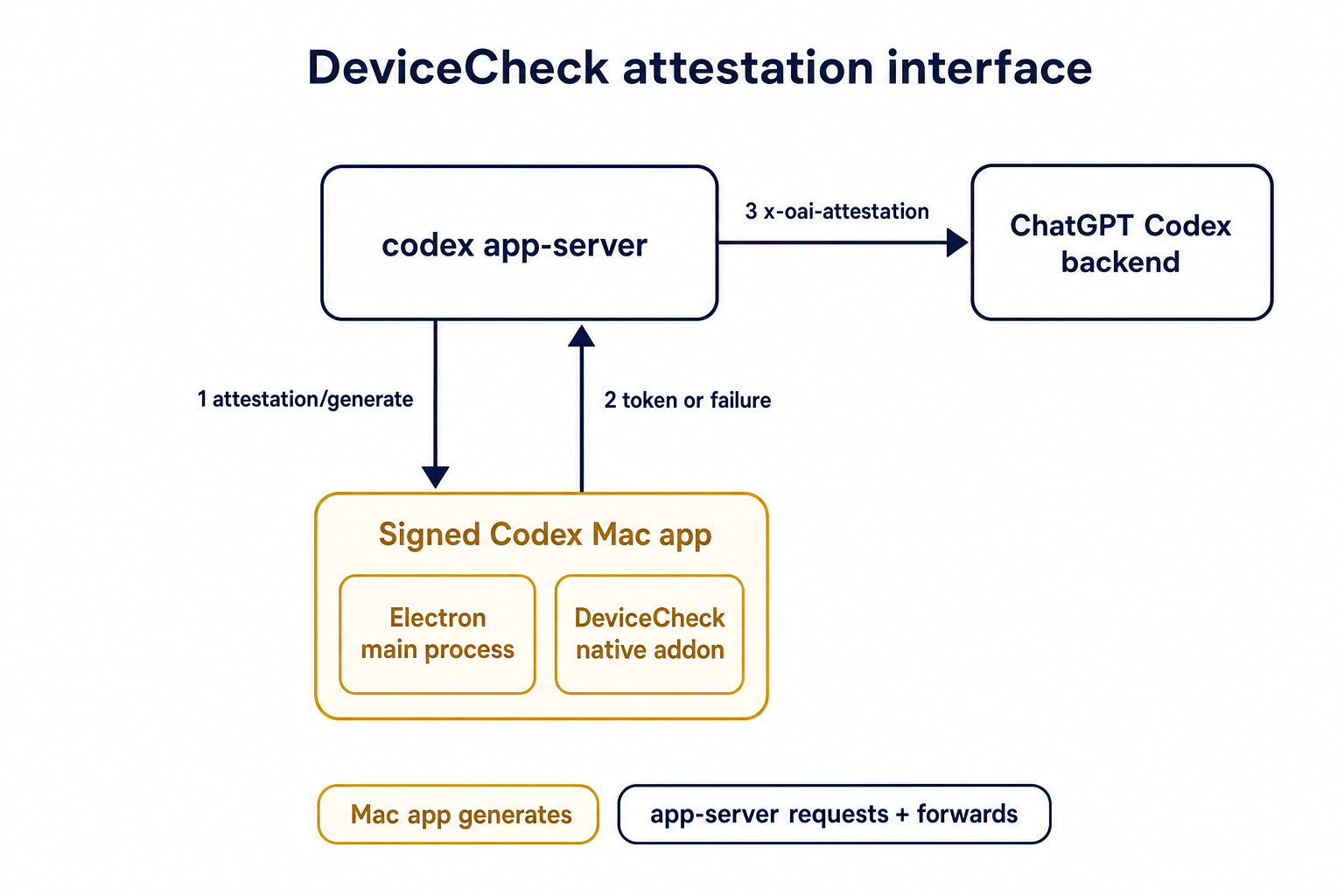
TL;DR: teaches `codex-rs` / app-server to request a desktop-provided
attestation token and attach it as `x-oai-attestation` on the scoped
ChatGPT Codex request paths.
## Details
This PR teaches the Codex app-server runtime how to request and attach
an attestation token. It does not generate DeviceCheck tokens directly;
instead, it relies on the connected desktop app to advertise that it can
generate attestation and then asks that app for a fresh header value
when needed.
The flow is:
1. The Codex desktop app connects to app-server.
2. During `initialize`, the app can advertise that it supports
`requestAttestation`.
3. Before app-server calls selected ChatGPT Codex endpoints, it sends
the internal server request `attestation/generate` to the app.
4. app-server receives a pre-encoded header value back.
5. app-server forwards that value as `x-oai-attestation` on the scoped
outbound requests.
The code in this repo is mostly protocol and runtime plumbing: it adds
the app-server request/response shape, introduces an attestation
provider in core, wires that provider into Responses / compaction /
realtime setup paths, and covers the intended scoping with tests. The
signed macOS DeviceCheck generation remains owned by the desktop app PR.
## Related PR
- Codex desktop app implementation:
https://github.com/openai/openai/pull/878649
## Validation
<details>
<summary>Tests run</summary>
```sh
cargo test -p codex-app-server-protocol
cargo test -p codex-core attestation --lib
cargo test -p codex-app-server --lib attestation
```
Also ran:
```sh
just fix -p codex-core
just fix -p codex-app-server
just fix -p codex-app-server-protocol
just fmt
just write-app-server-schema
```
</details>
<details>
<summary>E2E DeviceCheck validation</summary>
First validated the signed desktop app boundary directly: launched a
packaged signed `Codex.app`, sent `attestation/generate`, decoded the
returned `v1.` attestation header, and validated the extracted
DeviceCheck token with `personal/jm/verify_devicecheck_token.py` using
bundle ID `com.openai.codex`. Apple returned `status_code: 200` and
`is_ok: true`.
Then ran the fuller app + app-server flow. The packaged `Codex.app`
launched a current-branch app-server via `CODEX_CLI_PATH`, and a local
MITM proxy intercepted outbound `chatgpt.com` traffic. The app-server
requested `attestation/generate` from the real Electron app process, and
the intercepted `/backend-api/codex/responses` traffic included
`x-oai-attestation` on both routes:
```text
GET /backend-api/codex/responses Upgrade: websocket x-oai-attestation: present
POST /backend-api/codex/responses Upgrade: none x-oai-attestation: present
```
The captured header decoded to a DeviceCheck token that also validated
with Apple for `com.openai.codex` (`status_code: 200`, `is_ok: true`,
team `2DC432GLL2`).
</details>
---------
Co-authored-by: Codex <noreply@openai.com>
## Why

`ToolName::display()` made it too easy to flatten tool identity and
accidentally compare rendered strings. Tool identity should stay
structural until a legacy string boundary actually requires the
flattened spelling.

## What

- Removes `ToolName::display()` and relies on the existing `Display`
impl for messages and errors.
- Adds structural ordering for `ToolName` and uses it for
sorting/deduping deferred tools.
- Carries `ToolName` through tool/sandbox plumbing, flattening only at
legacy boundaries such as hook payloads, telemetry tags, and Responses
tool names.
- Updates MCP normalization tests to assert `ToolName` structure instead
of rendered strings.

## Testing

- `cargo test -p codex-mcp test_normalize_tools`
- `cargo test -p codex-core unavailable_tool`
- `just fix -p codex-protocol`
- `just fix -p codex-mcp`
- `just fix -p codex-core`
Route view_image through selected environments so image reads use the selected turn environment and cwd, with schema exposure limited to multi-environment toolsets.\n\nCo-authored-by: Codex <noreply@openai.com>
## Why

This is the next stacked step after deleting the tool-handler kind
indirection. Specs should come from the registered handlers themselves
so registry construction has a single source of truth for handler
behavior and exposed tool definitions.

## What changed

- Added `ToolHandler::spec()` plus handler-provided parallel/code-mode
metadata, and made `ToolRegistryBuilder::register_handler` automatically
collect specs from registered handlers.
- Moved builtin tool spec construction into the corresponding handlers
and their adjacent `_spec` modules, including shell, unified exec, apply
patch, view image, request plugin install, tool search, MCP resource,
goals, planning, permissions, agent jobs, and multi-agent tools.
- Reworked configurable handlers to receive their tool-building options
through constructors, with non-optional handler options where the
handler is always spec-backed. Shell fallback handlers keep an explicit
no-spec mode because they are also registered as hidden dispatch
aliases.
- Kept `CodeModeExecuteHandler` on the explicit configured wrapper so
the code-mode exec spec can still be built from the nested registry.

## Verification

- `cargo check -p codex-core`
- `cargo test -p codex-core tools::spec_plan::tests`
- `cargo test -p codex-core tools::spec::tests`
- `cargo test -p codex-core tools::handlers::multi_agents_spec::tests`
- `RUST_MIN_STACK=16777216 cargo test -p codex-core
tools::handlers::multi_agents::tests`
- `cargo test -p codex-core tools::handlers::apply_patch::tests`
- `cargo test -p codex-core tools::handlers::unified_exec::tests`
- `just fix -p codex-core`
- `git diff --check`
## Summary

This PR removes the synthetic `HashMap<String, ToolInfo>` keys from MCP
tool discovery. `McpConnectionManager::list_all_tools()` now returns
normalized `Vec<ToolInfo>`, and downstream code derives identity from
`ToolInfo::canonical_tool_name()`.

The motivation is to keep model-visible tool identity on
`ToolName`/`ToolInfo` instead of parallel string map keys, so future
namespace changes do not have to preserve otherwise-unused lookup keys.

## Changes

- Rename the MCP normalization path from `qualify_tools` to
`normalize_tools_for_model` and return tool values directly.
- Flow MCP tool lists through connectors, plugin injection, router/spec
building, code mode, and tool search as vectors/slices.
- Keep direct/deferred subtraction local to `mcp_tool_exposure`, using
`ToolName` values.
- Update tests to compare `ToolName` instances where MCP identity
matters.

## Validation

- `cargo test -p codex-mcp test_normalize_tools`
- `cargo test -p codex-core mcp_tool_exposure`
- `cargo test -p codex-core
direct_mcp_tools_register_namespaced_handlers`
- `cargo test -p codex-core
search_tool_registers_namespaced_mcp_tool_aliases`
- `just fix -p codex-mcp`
- `just fix -p codex-core`
## Summary
- replace filesystem-based turn diff tracking with an operation-backed
accumulator
- preserve enough verified apply_patch state to render move-overwrite
cases correctly
- keep the turn/diff/updated contract intact while removing remote-only
turn-diff test skips

This takes the assumption that no 3P services rely on the output format
of `apply_patch`

## Why
For the CCA file system isolation push

---------

Co-authored-by: Codex <noreply@openai.com>
## DISCLAIMER
This is experimental and no production service must rely on this

## Why

Built-in MCPs are product-owned runtime capabilities, but they were
previously flattened into the same config-backed stdio path as
user-configured servers. That made them depend on a hidden `codex
builtin-mcp` re-exec path, exposed them through config-oriented CLI
flows, and erased distinctions the runtime needs to preserve—most
notably whether an MCP call should count as external context for
memory-mode pollution.

## What changed

- Model product-owned built-ins separately from config-backed MCP
servers via `BuiltinMcpServer` and `EffectiveMcpServer`.
- Launch built-ins in process through a reusable async transport instead
of the hidden `builtin-mcp` stdio subcommand.
- Keep config-oriented CLI operations such as `codex mcp
list/get/login/logout` scoped to configured servers, while merging
built-ins only into the effective runtime server set.
- Retain server metadata after launch so parallel-tool support and
context classification come from the live server set; built-in
`memories` is now classified as local Codex state rather than external
context.

## Test plan

- `cargo test -p codex-mcp`
- `cargo test -p codex-core --test suite
builtin_memories_mcp_call_does_not_mark_thread_memory_mode_polluted_when_configured`

---------

Co-authored-by: Codex <noreply@openai.com>
## Why

Reverts #20689 to restore the previous optional state DB plumbing. The
conflict resolution keeps the newer installation ID and session/thread
identity changes that landed after #20689, while removing the mandatory
state DB and agent graph store dependency from ThreadManager
construction.

## What changed

- Restored `Option<StateDbHandle>` through app-server, MCP server,
prompt debug, and test entry points.
- Removed the `codex-core` dependency on `codex-agent-graph-store` and
reverted descendant lookup back to the existing state DB path when
available.
- Kept newer `installation_id` forwarding by passing it beside the
optional DB handle.
- Kept local thread-name updates working when the optional state DB
handle is absent.

## Validation

- `git diff --check`
- `cargo test -p codex-thread-store`
- `cargo test -p codex-state -p codex-rollout -p
codex-app-server-protocol`
- Attempted `env CARGO_INCREMENTAL=0 cargo test -p codex-core -p
codex-app-server -p codex-app-server-client -p codex-mcp-server -p
codex-thread-manager-sample -p codex-tui`; blocked locally by a rustc
ICE while compiling `v8 v146.4.0` with `rustc 1.93.0 (254b59607
2026-01-19)` on `aarch64-apple-darwin`.
## Why

The spec split in the parent PR still left an intermediate registry plan
that recorded `ToolHandlerKind` values and translated them into concrete
handlers later. That kept tool registration dependent on static enum
bookkeeping instead of registering handlers from the same code that
assembles their specs.

## What Changed

- Make `build_tool_registry_builder` register concrete handlers directly
while adding specs.
- Add small `ToolRegistryBuilder` helpers for spec augmentation and
nested code-mode inspection.
- Remove `ToolHandlerKind`, `ToolHandlerSpec`, and `ToolRegistryPlan`.
- Update spec-plan tests to assert against the built `ToolRegistry`
instead of static handler descriptors.

## Validation

- `cargo check -p codex-core`
- `cargo test -p codex-core tools::spec_plan::tests`
- `cargo test -p codex-core tools::spec::tests`
- `just fix -p codex-core`
## Why

This is the first mechanical slice of moving tool spec ownership toward
the handlers. `codex-tools` should keep shared primitives and conversion
helpers, while builtin tool specs and registration planning live in
`codex-core` with the handlers that own those tools.

Keeping this PR to relocation and import updates isolates the copy/move
review from the later logic change that wires specs through registered
handlers.

## What changed

- Moved builtin tool spec constructors from `codex-rs/tools/src` into
`codex-rs/core/src/tools/handlers/*_spec.rs` or nearby core tool
modules.
- Moved the registry planning code into
`codex-rs/core/src/tools/spec_plan.rs` and its associated types/tests
into core.
- Kept shared primitives in `codex-tools`, including `ToolSpec`,
schema/types, discovery/config primitives, dynamic/MCP conversion
helpers, and code-mode collection helpers.
- Updated handlers that referenced moved argument types or tool-name
constants to use the core spec modules.
- Moved spec tests next to the moved spec modules.

## Verification

- `cargo check -p codex-tools`
- `cargo check -p codex-core`
- `cargo test -p codex-tools`
- `cargo test -p codex-core _spec::tests`
- `cargo test -p codex-core tools::spec_plan::tests`
- `just fix -p codex-tools`
- `just fix -p codex-core`

Note: I also tried the broader `cargo test -p codex-core tools::`; it
reached the moved spec-plan/spec tests successfully, then aborted with a
stack overflow in
`tools::handlers::multi_agents::tests::tool_handlers_cascade_close_and_resume_and_keep_explicitly_closed_subtrees_closed`,
which is outside this spec relocation.
## Why

Several tool handler modules still bundled multiple `ToolHandler`
implementations in one file. That made the handler directory harder to
navigate and made otherwise local handler edits land in large shared
modules.

## What

- Split grouped tool handlers into one handler file each for agent jobs,
goals, MCP resources, shell tools, and unified exec.
- Kept shared parsing, payload, and runtime helpers in the existing
parent modules, with re-exports preserving the existing handler import
paths.
- Updated the shell handler tests to construct `ShellCommandHandler`
through the existing `ShellCommandBackendConfig` conversion now that the
backend detail lives with the shell-command handler.

## Validation

- `cargo check -p codex-core`
- `cargo clippy -p codex-core --lib -- -D warnings`
- `git diff --check -- codex-rs/core/src/tools/handlers`

Targeted `codex-core` handler tests did not run locally because
`core_test_support` currently fails to compile before reaching these
tests due to an unresolved `similar` import.
## Summary

- resolve or inject the installation ID before core startup and pass it
through `ThreadManager`, `CodexSpawnArgs`, and `Session` as a plain
`String`
- keep child sessions on the parent installation ID instead of
rediscovering it inside core
- propagate installation ID startup failures in `mcp-server` instead of
panicking

## Why

Core was still touching the filesystem on the session startup path to
discover `installation_id`. This moves that work to the outer host
boundary so core no longer depends on `codex_home` reads during session
construction.

---------

Co-authored-by: Codex <noreply@openai.com>
## Why

We want the agent graph store to be passed down the stack as a real
dependency, the same way we already treat the thread store.

This will let us inject the agent graph store as a real dependency and
support implementations other than the local SQLite-backed one. Right
now most code instantiates a state DB and an agent graph store
just-in-time. Ideally, we would not depend on the state DB directly but
only read through the higher-level interfaces.

This change makes the dependency boundaries explicit and moves state DB
initialization to process bootstrap instead of hiding it inside local
store implementations.

## What changed

- `ThreadManager` now requires a `StateDbHandle` and an
`AgentGraphStore` at construction time instead of treating them as
optional internals.
- The local store constructors no longer lazily initialize SQLite.
Callers now initialize the state DB once per process and use that shared
handle to build:
  - `LocalThreadStore`
  - `LocalAgentGraphStore`
- App bootstraps (`app-server`, `mcp-server`, `prompt_debug`, and the
thread-manager sample) now initialize the state DB up front and inject
the resulting handle down the stack.
- `app-server` now consistently uses its process-scoped state DB handle
instead of reopening SQLite or trying to recover it from loaded threads.
- Device-key storage now reuses the shared state DB handle instead of
maintaining its own lazy opener.
- The thread archive / descendant traversal paths now use the injected
`AgentGraphStore` instead of reaching through local
thread-store-specific state.

## Verification

- `cargo check -p codex-core -p codex-thread-store -p codex-app-server
-p codex-mcp-server -p codex-thread-manager-sample --tests`
- `cargo test -p codex-thread-store`
- `cargo test -p codex-core
thread_manager_accepts_separate_agent_graph_store_and_thread_store --
--nocapture`
- `cargo test -p codex-app-server
thread_archive_archives_spawned_descendants -- --nocapture`
## Why

Tool registration used to bind a tool name to a handler externally,
which left ownership split between the registry plan and the handler
implementation. Some built-in handlers also multiplexed multiple in-core
tools by switching on the invoked tool name internally.

This moves the registry identity onto the handler itself and makes
built-in multi-tool areas use separate concrete handlers, so each
registered handler instance owns exactly one tool name and one dispatch
path.

## What Changed

- Added `ToolHandler::tool_name()` and changed
`ToolRegistryBuilder::register_handler` to derive the registry key from
the handler.
- Split built-in multiplexed handlers into concrete per-tool handlers
for unified exec, shell/local shell/container exec, MCP resources, goal
tools, and agent job tools.
- Kept name-carrying handler instances only where the runtime target is
inherently external or dynamic, such as MCP tools, dynamic tools, and
unavailable placeholders.
- Updated `ToolHandlerKind` and registry-plan construction so plan
entries map directly to concrete handler registrations.

## Verification

- `cargo test -p codex-tools tool_registry_plan`
- `cargo test -p codex-core --lib tools::registry_tests`
- `just fix -p codex-tools`
- `just fix -p codex-core`
# Why

We want shared hook trust that both the app and the TUI can build on,
but the metadata is only useful if runtime behavior agrees with it. This
PR adds a single backend trust model for hooks so unmanaged hooks cannot
run until the current definition has been reviewed, while managed hooks
remain runnable and non-configurable.

# What

- persist `trusted_hash` alongside hook state in `config.toml`
- expose `currentHash` and derived `trustStatus` through `hooks/list`
- derive trust from normalized hook definitions so equivalent hooks from
`config.toml` and `hooks.json` share the same trust identity
- gate unmanaged hooks on trust before they enter the runnable handler
set

# Reviewer Notes

- key file to review is `codex-rs/hooks/src/engine/discovery.rs`
- the only **core** change is schema related
## Why
When a turn exposes multiple selected environments, shell-style tools
need a model-facing way to identify the intended target environment and
handlers need to resolve that target before parsing cwd-relative
permission fields or launching processes.

This PR scopes that rollout to process tools. Filesystem-oriented tools
such as `apply_patch`, `view_image`, and `list_dir` are intentionally
left for follow-up slices.

## What Changed
- Adds an `include_environment_id` option to shell-style tool schema
builders.
- Exposes optional `environment_id` on `shell`, `shell_command`, and
`exec_command` only when `ToolEnvironmentMode::Multiple` is active.
- Adds a shared handler helper that parses `environment_id` and
`workdir` from JSON function-call arguments and returns the selected
`Environment` plus effective absolute cwd.
- Uses that helper in `shell`, `shell_command`, and `exec_command`
handling so process execution uses the selected environment filesystem
and cwd.
- Changes `ExecCommandRequest` to carry a required resolved `cwd`,
removing the process-manager fallback to the primary turn cwd for new
exec commands.
- Leaves `write_stdin` unchanged because it targets an existing process
id, not a new environment.

## Testing
- Added unit coverage for process-tool schema exposure, selected
environment resolution, primary fallback, no-environment handling,
unknown environment ids, and resolving cwd-relative permission paths
against the selected environment cwd.
- Added a remote-suite e2e coverage case for `exec_command` routing
across explicit zero environments, one local environment, and
local+remote environments.
- Ran `just fmt` and `git diff --check`.

---------

Co-authored-by: Codex <noreply@openai.com>
# Why

`PreToolUse` already exposes `hookSpecificOutput.additionalContext` in
the generated hook schema, but the runtime still rejected it as
unsupported. That leaves `PreToolUse` out of step with the other
context-injecting hooks and prevents hook authors from attaching
model-visible guidance to a pending tool call before it runs.

# What

- Parse `PreToolUse.additionalContext` and carry it through the hook
event pipeline.
- Record `PreToolUse` context at the hook boundary so successful context
is preserved for both allowed and blocked calls without widening the
tool registry surface.
- Preserve existing deny behavior when context is combined with either
`permissionDecision: "deny"` or the legacy `decision: "block"` shape.
## Why
`list_dir` still carries a full spec/handler/test path, but nothing in
the current model catalog advertises it via
`experimental_supported_tools`. That leaves us maintaining an
environment-backed tool surface that is effectively unused.

## What changed
- delete the `list_dir` handler and its tests from `codex-core`
- remove the `list_dir` spec builder, handler kind, and registry wiring
from `codex-tools`
- clean up the remaining internal README and registry tests so they no
longer mention the removed tool
## Why

Tool families already disagree on what their existing `duration` fields
mean, so lifecycle latency should live on the shared item envelope
instead of being inferred from per-tool execution fields. Carrying that
envelope through app-server notifications gives downstream consumers one
reusable timing signal without pretending every tool has the same
execution semantics.

## What changed

- Adds `started_at_ms` to core `ItemStartedEvent` values and
`completed_at_ms` to core `ItemCompletedEvent` values.
- Populates those timestamps in the shared session lifecycle emitters,
so protocol-native items get timing without each producer tracking its
own clock state.
- Exposes `startedAtMs` on app-server `item/started` notifications and
`completedAtMs` on `item/completed` notifications.
- Maps the lifecycle timestamps through the app-server boundary while
leaving legacy-converted notifications nullable when no lifecycle
timestamp exists.
- Regenerates the app-server JSON schema and TypeScript fixtures for the
notification-envelope change and updates downstream fixtures that
construct those notifications directly.
- Extends the existing web-search and image-generation integration flows
to assert the new lifecycle timestamps on the native item events.

## Verification

- `cargo check -p codex-protocol -p codex-core -p
codex-app-server-protocol -p codex-app-server -p codex-tui -p codex-exec
-p codex-app-server-client`
- `cargo test -p codex-core --test all web_search_item_is_emitted`
- `cargo test -p codex-core --test all
image_generation_call_event_is_emitted`
- `cargo test -p codex-app-server-protocol`

---
[//]: # (BEGIN SAPLING FOOTER)
Stack created with [Sapling](https://sapling-scm.com). Best reviewed
with [ReviewStack](https://reviewstack.dev/openai/codex/pull/20514).
* #18748
* #18747
* #17090
* #17089
* __->__ #20514
## Why

MCP servers can provide `instructions` that explain what their tools are
for. Directly exposed MCP namespaces already use those instructions when
a connector description is not available, but deferred `tool_search`
results did not preserve that fallback. The direct path falls back from
connector metadata to server instructions, while the deferred path only
carried `connector_description` and otherwise fell back to generic
namespace text.

That meant a plain MCP server could provide useful model-facing guidance
and still appear as `Tools in the X namespace.` whenever it was
discovered lazily through `tool_search`.

## What changed

- Store one model-facing `namespace_description` on `ToolInfo`, using
connector descriptions for connector-backed tools and server
instructions for plain MCP servers.
- Thread that namespace description through the `tool_search` source
list, search indexing, and returned namespace metadata.
- Add an end-to-end regression test for deferred non-app MCP search
results exposing server instructions as the namespace description.

## Verification

- `cargo test -p codex-tools
search_tool_description_lists_each_mcp_source_once --lib`
- `cargo test -p codex-core --test all
tool_search_uses_non_app_mcp_server_instructions_as_namespace_description`
## Why

SQLite state was still being opened from consumer paths, including lazy
`OnceCell`-backed thread-store call sites. That let one process
construct multiple state DB connections for the same Codex home, which
makes SQLite lock contention and `database is locked` failures much
easier to hit.

State DB lifetime should be chosen by main-like entrypoints and tests,
then passed through explicitly. Consumers should use the supplied
`Option<StateDbHandle>` or `StateDbHandle` and keep their existing
filesystem fallback or error behavior when no handle is available.

The startup path also needs to keep the rollout crate in charge of
SQLite state initialization. Opening `codex_state::StateRuntime`
directly bypasses rollout metadata backfill, so entrypoints should
initialize through `codex_rollout::state_db` and receive a handle only
after required rollout backfills have completed.

## What Changed

- Initialize the state DB in main-like entrypoints for CLI, TUI,
app-server, exec, MCP server, and the thread-manager sample.
- Pass `Option<StateDbHandle>` through `ThreadManager`,
`LocalThreadStore`, app-server processors, TUI app wiring, rollout
listing/recording, personality migration, shell snapshot cleanup,
session-name lookup, and memory/device-key consumers.
- Remove the lazy local state DB wrapper from the thread store so
non-test consumers use only the supplied handle or their existing
fallback path.
- Make `codex_rollout::state_db::init` the local state startup path: it
opens/migrates SQLite, runs rollout metadata backfill when needed, waits
for concurrent backfill workers up to a bounded timeout, verifies
completion, and then returns the initialized handle.
- Keep optional/non-owning SQLite helpers, such as remote TUI local
reads, as open-only paths that do not run startup backfill.
- Switch app-server startup from direct
`codex_state::StateRuntime::init` to the rollout state initializer so
app-server cannot skip rollout backfill.
- Collapse split rollout lookup/list APIs so callers use the normal
methods with an optional state handle instead of `_with_state_db`
variants.
- Restore `getConversationSummary(ThreadId)` to delegate through
`ThreadStore::read_thread` instead of a LocalThreadStore-specific
rollout path special case.
- Keep DB-backed rollout path lookup keyed on the DB row and file
existence, without imposing the filesystem filename convention on
existing DB rows.
- Verify readable DB-backed rollout paths against `session_meta.id`
before returning them, so a stale SQLite row that points at another
thread's JSONL falls back to filesystem search and read-repairs the DB
row.
- Keep `debug prompt-input` filesystem-only so a one-off debug command
does not initialize or backfill SQLite state just to print prompt input.
- Keep goal-session test Codex homes alive only in the goal-specific
helper, rather than leaking tempdirs from the shared session test
helper.
- Update tests and call sites to pass explicit state handles where DB
behavior is expected and explicit `None` where filesystem-only behavior
is intended.

## Validation

- `CARGO_TARGET_DIR=/tmp/codex-target-state-db cargo check -p
codex-rollout -p codex-thread-store -p codex-app-server -p codex-core -p
codex-tui -p codex-exec -p codex-cli --tests`
- `CARGO_TARGET_DIR=/tmp/codex-target-state-db cargo test -p
codex-rollout state_db_`
- `CARGO_TARGET_DIR=/tmp/codex-target-state-db cargo test -p
codex-rollout find_thread_path`
- `CARGO_TARGET_DIR=/tmp/codex-target-state-db cargo test -p
codex-rollout find_thread_path -- --nocapture`
- `CARGO_TARGET_DIR=/tmp/codex-target-state-db cargo test -p
codex-rollout try_init_ -- --nocapture`
- `CARGO_TARGET_DIR=/tmp/codex-target-state-db cargo test -p
codex-rollout`
- `CARGO_TARGET_DIR=/tmp/codex-target-state-db cargo clippy -p
codex-rollout --lib -- -D warnings`
- `CARGO_TARGET_DIR=/tmp/codex-target-state-db cargo test -p
codex-thread-store
read_thread_falls_back_when_sqlite_path_points_to_another_thread --
--nocapture`
- `CARGO_TARGET_DIR=/tmp/codex-target-state-db cargo test -p
codex-thread-store`
- `CARGO_TARGET_DIR=/tmp/codex-target-state-db cargo test -p codex-core
shell_snapshot`
- `CARGO_TARGET_DIR=/tmp/codex-target-state-db cargo test -p codex-core
--test all personality_migration`
- `CARGO_TARGET_DIR=/tmp/codex-target-state-db cargo test -p codex-core
--test all rollout_list_find`
- `RUST_MIN_STACK=8388608 CODEX_SKIP_VENDORED_BWRAP=1
CARGO_TARGET_DIR=/tmp/codex-target-state-db cargo test -p codex-core
--test all rollout_list_find::find_prefers_sqlite_path_by_id --
--nocapture`
- `RUST_MIN_STACK=8388608 CODEX_SKIP_VENDORED_BWRAP=1
CARGO_TARGET_DIR=/tmp/codex-target-state-db cargo test -p codex-core
--test all rollout_list_find -- --nocapture`
- `CARGO_TARGET_DIR=/tmp/codex-target-state-db cargo test -p codex-core
interrupt_accounts_active_goal_before_pausing`
- `CARGO_TARGET_DIR=/tmp/codex-target-state-db cargo test -p
codex-app-server get_auth_status -- --test-threads=1`
- `CODEX_SKIP_VENDORED_BWRAP=1
CARGO_TARGET_DIR=/tmp/codex-target-state-db cargo test -p
codex-app-server --lib`
- `CODEX_SKIP_VENDORED_BWRAP=1
CARGO_TARGET_DIR=/tmp/codex-target-state-db cargo check -p codex-rollout
-p codex-app-server --tests`
- `CARGO_TARGET_DIR=/tmp/codex-target-state-db just fix -p codex-rollout
-p codex-thread-store -p codex-core -p codex-app-server -p codex-tui -p
codex-exec -p codex-cli`
- `CODEX_SKIP_VENDORED_BWRAP=1
CARGO_TARGET_DIR=/tmp/codex-target-state-db just fix -p codex-rollout -p
codex-app-server`
- `CARGO_TARGET_DIR=/tmp/codex-target-state-db just fix -p
codex-rollout`
- `CODEX_SKIP_VENDORED_BWRAP=1
CARGO_TARGET_DIR=/tmp/codex-target-state-db just fix -p codex-core`
- `just argument-comment-lint -p codex-core`
- `just argument-comment-lint -p codex-rollout`

Focused coverage added in `codex-rollout`:

- `recorder::tests::state_db_init_backfills_before_returning` verifies
the rollout metadata row exists before startup init returns.
- `state_db::tests::try_init_waits_for_concurrent_startup_backfill`
verifies startup waits for another worker to finish backfill instead of
disabling the handle for the process.
-
`state_db::tests::try_init_times_out_waiting_for_stuck_startup_backfill`
verifies startup does not hang indefinitely on a stuck backfill lease.
-
`tests::find_thread_path_accepts_existing_state_db_path_without_canonical_filename`
verifies DB-backed lookup accepts valid existing rollout paths even when
the filename does not include the thread UUID.
-
`tests::find_thread_path_falls_back_when_db_path_points_to_another_thread`
verifies DB-backed lookup ignores a stale row whose existing path
belongs to another thread and read-repairs the row after filesystem
fallback.

Focused coverage updated in `codex-core`:

- `rollout_list_find::find_prefers_sqlite_path_by_id` now uses a
DB-preferred rollout file with matching `session_meta.id`, so it still
verifies that valid SQLite paths win without depending on stale/empty
rollout contents.

`cargo test -p codex-app-server thread_list_respects_search_term_filter
-- --test-threads=1 --nocapture` was attempted locally but timed out
waiting for the app-server test harness `initialize` response before
reaching the changed thread-list code path.

`bazel test //codex-rs/thread-store:thread-store-unit-tests
--test_output=errors` was attempted locally after the thread-store fix,
but this container failed before target analysis while fetching `v8+`
through BuildBuddy/direct GitHub. The equivalent local crate coverage,
including `cargo test -p codex-thread-store`, passes.

A plain local `cargo check -p codex-rollout -p codex-app-server --tests`
also requires system `libcap.pc` for `codex-linux-sandbox`; the
follow-up app-server check above used `CODEX_SKIP_VENDORED_BWRAP=1` in
this container.
## Why
This is a prep PR in the multi-environment process-tool stack. It
separates ownership/config cleanup from the behavior change that teaches
process tools to route by selected environment, so the follow-up PR can
focus on model-facing `environment_id` behavior.

## Stack
1. https://github.com/openai/codex/pull/20646 - `EnvironmentContext`
rendering for selected environments
2. https://github.com/openai/codex/pull/20669 - selected-environment
ownership and tool config prep (this PR)
3. https://github.com/openai/codex/pull/20647 - process-tool
`environment_id` routing

## What Changed
- keep the resolved turn environment list wrapped in
`ResolvedTurnEnvironments` through `TurnContext` instead of unwrapping
it back to a raw `Vec`
- add `TurnContext::resolve_path_against` so cwd-relative path
resolution has one shared helper
- replace the old tool config boolean with `ToolEnvironmentMode::{None,
Single, Multiple}`

## Testing
- Tests not run locally; this prep refactor is covered by GitHub CI for
the stack.

Co-authored-by: Codex <noreply@openai.com>
## Why

`McpToolCall` was still an app-server item synthesized from deprecated
legacy begin/end events. Recent item migrations moved this ownership
into core `TurnItem`s, so MCP tool calls now follow the same canonical
lifecycle and leave legacy events as compatibility fanout.

Keeping the core item close to the v2 `ThreadItem::McpToolCall` shape
also avoids spreading MCP result semantics across app-server conversion
code. Core now owns whether a completed call is `completed` or `failed`,
and whether the payload is a tool result or an error.

## What changed

- Added core `TurnItem::McpToolCall` with flattened `server`, `tool`,
`arguments`, `status`, `result`, and `error` fields.
- Updated MCP tool call emitters, including MCP resource tools, to emit
`ItemStarted`/`ItemCompleted` around directly constructed core MCP
items.
- Updated app-server v2 conversion to project the core MCP item into
`ThreadItem::McpToolCall` without deriving status or splitting `Result`
locally.
- Ignored live deprecated MCP legacy fanout in app-server v2 to avoid
duplicate item notifications, while keeping thread history replay on the
legacy event path.

## Verification

- `cargo test -p codex-protocol`
- `cargo test -p codex-app-server-protocol`
- `cargo test -p codex-core --lib mcp_tool_call`
- `cargo check -p codex-app-server`
- `cargo test -p codex-app-server
mcp_tool_call_completion_notification_contains_truncated_large_result`
Tool suggest still misfires when model needs tool_search, updating the
prompts to further disambiguate it:

- [x] rename it from `tool_suggest` to `request_plugin_install`
- [x] rephrase "suggestion" to "install" in the tool descriptions.
- [x] disambiguate "the tool" vs "the plugin/connector".

Tested with the Codex App and verified it still works.
## Why

Image-view results should be represented as a core-produced turn item
instead of being reconstructed by app-server. At the same time, existing
rollout/history paths still understand the legacy `ViewImageToolCall`
event, so this keeps that event as compatibility output generated from
the new item lifecycle.

## What changed

- Added `TurnItem::ImageView` to `codex-protocol`.
- Emitted image-view item start/completion directly from the core
`view_image` handler.
- Kept `ViewImageToolCall` as a legacy event and generate it from
completed `TurnItem::ImageView` items.
- Kept `thread_history.rs` on the legacy `ViewImageToolCall` replay
path, with `ImageView` item lifecycle events ignored there.
- Updated app-server protocol conversion, rollout persistence, and
affected exhaustive event matches for the new item plus legacy fan-out
shape.

## Verification

- `cargo test -p codex-protocol -p codex-app-server-protocol -p
codex-rollout -p codex-rollout-trace -p codex-mcp-server -p
codex-app-server --lib`
- `cargo test -p codex-core --test all
view_image_tool_attaches_local_image`
- `just fix -p codex-protocol -p codex-core -p codex-app-server-protocol
-p codex-app-server -p codex-rollout -p codex-rollout-trace -p
codex-mcp-server`
- `git diff --check`
## Summary
- make selected turn environments the source of truth for session
runtime cwd and MCP runtime environment selection
- keep local/no-selection fallback behavior intact
- add coverage for duplicate selected environments, cwd resolution, and
MCP runtime environment selection

## Validation
- git diff --check
- rustfmt was run on touched Rust files during the implementation
workflow

CI should provide the full Bazel/test signal.

---------

Co-authored-by: Codex <noreply@openai.com>
## Why

Apply-patch file changes are now part of the core turn item stream, so
v2 clients can consume the same first-class item lifecycle path used by
other turn items instead of relying on app-server-specific remapping
from legacy patch events.

## What changed

- Added a core `TurnItem::FileChange` carrying apply-patch changes and
completion metadata.
- Updated the apply-patch tool emitter to send `ItemStarted` /
`ItemCompleted` with the new `FileChange` item while preserving legacy
`PatchApplyBegin` / `PatchApplyEnd` fan-out.
- Updated app-server v2 conversion to render the new core item directly
and stopped `event_mapping` from remapping old patch begin/end events
into item notifications.
- Kept thread history reconstruction based on the existing old
apply-patch events for rollout compatibility.

## Verification

- `cargo test -p codex-protocol -p codex-app-server-protocol`
- `cargo test -p codex-core --test all
apply_patch_tool_executes_and_emits_patch_events`
- `cargo test -p codex-app-server bespoke_event_handling`
- Build one app-server process ThreadStore from startup config and share
it with ThreadManager and CodexMessageProcessor.
- Remove per-thread/fork store reconstruction so effective thread config
cannot switch the persistence backend.
- Add params to ThreadStore create/resume for specifying thread
metadata, since otherwise the metadata from store creation would be used
(incorrectly).
## Why

Several legacy `EventMsg` variants were still emitted or mapped even
though clients either ignored them or had moved to item/lifecycle
events. `Op::Undo` had also degraded to an unavailable shim, so this
removes that dead task path instead of preserving a command that cannot
do useful work.

`McpStartupComplete`, `WebSearchBegin`, and `ImageGenerationBegin` are
intentionally kept because useful consumers still depend on them: MCP
startup completion drives readiness behavior, and the begin events let
app-server/core consumers surface in-progress web-search and
image-generation items before the final payload arrives.

## What Changed

- Removed weak legacy event variants and payloads from `codex-protocol`,
including legacy agent deltas, background events, and undo lifecycle
events.
- Kept/restored `EventMsg::McpStartupComplete`,
`EventMsg::WebSearchBegin`, and `EventMsg::ImageGenerationBegin` with
serializer and emission coverage.
- Updated core, rollout, MCP server, app-server thread history,
review/delegate filtering, and tests to rely on the useful replacement
events that remain.
- Removed `Op::Undo`, `UndoTask`, the undo test module, and stale TUI
slash-command comments.
- Stopped agent job/background progress and compaction retry notices
from emitting `BackgroundEvent` payloads.

## Verification

- `cargo check -p codex-protocol -p codex-app-server-protocol -p
codex-core -p codex-rollout -p codex-rollout-trace -p codex-mcp-server`
- `cargo test -p codex-protocol -p codex-app-server-protocol -p
codex-rollout -p codex-rollout-trace -p codex-mcp-server`
- `cargo test -p codex-core --test all suite::items`
- `just fix -p codex-protocol -p codex-app-server-protocol -p codex-core
-p codex-rollout -p codex-rollout-trace -p codex-mcp-server`
- Earlier coverage on this PR also included `codex-mcp`, `codex-tui`,
core library tests, MCP/plugin/delegate/review/agent job tests, and MCP
startup TUI tests.
## Why
On Windows, Codex runs shell commands through a top-level
`powershell.exe -NoProfile -Command ...` wrapper. `execpolicy` was
matching that wrapper instead of the inner command, so prefix rules like
`["git", "push"]` did not fire for PowerShell-wrapped commands even
though the same normalization already happens for `bash -lc` on Unix.

This change makes the Windows shell wrapper transparent to rule matching
while preserving the existing Windows unmatched-command safelist and
dangerous-command heuristics.

## What changed
- add `parse_powershell_command_plain_commands()` in
`shell-command/src/powershell.rs` to unwrap the top-level PowerShell
`-Command` body with `extract_powershell_command()` and parse it with
the existing PowerShell AST parser
- update `core/src/exec_policy.rs` so `commands_for_exec_policy()`
treats top-level PowerShell wrappers like `bash -lc` and evaluates rules
against the parsed inner commands
- carry a small `ExecPolicyCommandOrigin` through unmatched-command
evaluation and expose `is_safe_powershell_words()` /
`is_dangerous_powershell_words()` so Windows safelist and
dangerous-command checks still work after unwrap
- add Windows-focused tests for wrapped PowerShell prompt/allow matches,
wrapper parsing, and unmatched safe/dangerous inner commands, and
re-enable the end-to-end `execpolicy_blocks_shell_invocation` test on
Windows

## Testing
- `cargo test -p codex-shell-command`
## Why

`item/fileChange/outputDelta` text output was only the tool's summary or
error text and not used by client surfaces.

We keep `item/fileChange/outputDelta` in the app-server protocol as a
deprecated compatibility entry, but the server no longer emits it.

## What changed

- stop the `apply_patch` runtime from emitting `ExecCommandOutputDelta`
events
- simplify `item_event_to_server_notification` so command output deltas
always map to `item/commandExecution/outputDelta`
- remove the app-server bookkeeping that tried to detect whether an
output delta belonged to a file change
- mark `item/fileChange/outputDelta` as a deprecated legacy protocol
entry in the v2 types, schema, and README
- simplify the file-change approval tests so they only wait for
completion instead of expecting output-delta notifications

## Testing

- `cargo test -p codex-app-server-protocol`
- `cargo test -p codex-thread-manager-sample`
- `cargo test -p codex-app-server-protocol
protocol::event_mapping::tests::exec_command_output_delta_maps_to_command_execution_output_delta
-- --exact`
- `cargo test -p codex-app-server
turn_start_file_change_approval_accept_for_session_persists_v2 --
--exact` *(failed before the test assertions because the wiremock
`/responses` mock received 0 requests in setup)*
pakrym-oai ·
Chris Bookholt ·
Abhinav ·
starr-openai ·
viyatb-oai ·
jif-oai ·
Charlie Marsh ·
Jiaming Zhang ·
Rasmus Rygaard ·
rhan-oai ·
sayan-oai ·
Ruslan Nigmatullin ·
Matthew Zeng ·
Tom ·
iceweasel-oai ·
Akshay Nathan ·
xl-openai ·
