Commit Graph

57 Commits

  • [2 of 2] Finish moving goal runtime to extension (#26548)
    ## Stack
    
    1. [#26547](https://github.com/openai/codex/pull/26547) - [1 of 2] Align
    goal extension with core behavior
    2. [#26548](https://github.com/openai/codex/pull/26548) - [2 of 2] Move
    goal runtime to extension
    
    ## Why
    
    This PR completes the switch of the goal behavior to the
    extension-backed runtime and removes the old core goal implementation.
    
    ## What Changed
    
    - Installs the goal extension for app-server `ThreadManager` sessions.
    - Routes app-server thread goal `get`, `set`, and `clear` through
    `GoalService`.
    - Uses thread-idle lifecycle emission after goal resume and snapshot
    ordering so the extension can decide whether to continue the goal.
    - Forwards extension goal updates through a FIFO async app-server
    notification path so backpressure does not drop them or reorder updates.
    - Keeps review turns from enabling goal runtime behavior.
    - Plans extension tools before dynamic tools so built-in goal tool names
    keep their old precedence when goals are enabled.
    - Removes the old core goal runtime, core goal tool handlers, and core
    goal tool specs.
    - Updates tests that were coupled to the core-owned goal runtime while
    leaving the legacy `<goal_context>` compatibility path in core for old
    threads.
    - Removes the stale cargo-shear ignore now that `codex-goal-extension`
    is used by the workspace.
    - Keeps realtime event matching exhaustive after removing the old
    goal-specific realtime text path.
    
    
    ## Validation
    
    - Ran manual `/goal` runs in TUI. Validated time accounting matched
    wall-clock time and goal lifecycle state transitions.
  • [codex] Forward turn moderation metadata through app-server (#25710)
    ## Why
    First-party backends can supply turn-scoped moderation metadata that
    app-server clients need for client-side presentation. Exposing this as
    an experimental typed notification lets opted-in clients consume it
    without interpreting raw Responses API events.
    
    ## What changed
    - forward `response.metadata.openai_chatgpt_moderation_metadata` from
    Responses API SSE and WebSocket streams as turn-scoped moderation
    metadata
    - emit the experimental app-server v2 `turn/moderationMetadata`
    notification with `{ threadId, turnId, metadata }`
    - add app-server integration coverage for the typed moderation metadata
    notification
    
    ## Testing
    - `just test -p codex-core
    build_ws_client_metadata_includes_window_lineage_and_turn_metadata`
    - `just test -p codex-core` (fails locally: 46 failures and 1 timeout,
    primarily missing `test_stdio_server` and shell snapshot timeouts)
    - `just test -p codex-app-server-protocol`
    - `just test -p codex-app-server
    turn_moderation_metadata_emits_typed_notification_v2`
    - `just test -p codex-app-server` (fails locally: 792 passed, 10 failed,
    and 5 timed out; failures are in existing environment-sensitive tests,
    primarily because nested macOS `sandbox-exec` is not permitted)
    - `just write-app-server-schema --experimental --schema-root
    /tmp/codex-app-server-schema-experimental`
  • feat: show enterprise monthly credit limits in status (#24812)
    ## Summary
    
    Enterprise users can have an effective monthly credit limit, but Codex
    `/status` currently drops that metadata from the account-usage response.
    
    This change adds the optional `spend_control.individual_limit`
    projection to the existing rate-limit snapshot flow. The backend client
    reads the monthly limit, app-server exposes it as `individualLimit`, and
    the TUI renders a `Monthly credit limit` row through the existing
    progress-bar renderer.
    
    When the backend does not return an effective monthly limit, existing
    rate-limit behavior is unchanged.
    
    ## Existing backend state
    
    The account-usage backend already returns the effective monthly limit
    and current usage together:
    
    ```json
    {
      "spend_control": {
        "reached": false,
        "individual_limit": {
          "limit": "25000",
          "used": "8000",
          "remaining": "17000",
          "used_percent": 32,
          "remaining_percent": 68,
          "reset_after_seconds": 86400,
          "reset_at": 1778137680
        }
      }
    }
    ```
    
    Before this change, Codex projected rolling `primary` and `secondary`
    windows plus `credits`. It ignored `spend_control.individual_limit`, so
    app-server clients and `/status` could not render the monthly cap.
    
    The updated flow is:
    
    ```text
    account usage backend
      -> backend-client reads spend_control.individual_limit
      -> existing rate-limit snapshot carries optional individual_limit
      -> app-server exposes optional individualLimit
      -> TUI renders Monthly credit limit
    ```
    
    ## App-server contract
    
    `account/rateLimits/read` and sparse `account/rateLimits/updated`
    notifications now include an additive nullable
    `rateLimits.individualLimit` field:
    
    ```json
    {
      "individualLimit": {
        "limit": "25000",
        "used": "8000",
        "remainingPercent": 68,
        "resetsAt": 1778137680
      }
    }
    ```
    
    In an `account/rateLimits/read` response, `null` means no monthly limit
    is available. `account/rateLimits/updated` remains a sparse rolling
    notification: clients merge available values into their most recent
    `account/rateLimits/read` snapshot or refetch. Nullable account metadata
    in a rolling notification does not clear a previously observed value.
    
    ## Design decisions
    
    - Extend the existing rate-limit snapshot instead of introducing a
    separate request or wire-level update protocol.
    - Keep the Codex projection narrow: `/status` needs the effective limit,
    current usage, remaining percentage, and reset timestamp.
    - Render the monthly row through the existing progress-bar renderer,
    with one optional detail line for `8,000 of 25,000 credits used`.
    - Keep the backend response optional so existing accounts and older
    usage states preserve their current behavior.
    - Preserve cached monthly metadata when sparse rolling notifications
    omit it. Live account-usage reads remain authoritative and can clear a
    removed limit.
    
    ## Visual evidence
    
    ```text
     Monthly credit limit:   [██████████████░░░░░░] 68% left (resets 07:08 on 7 May)
                             8,000 of 25,000 credits used
    ```
    
    Snapshot:
    `codex-rs/tui/src/status/snapshots/codex_tui__status__tests__status_snapshot_includes_enterprise_monthly_credit_limit.snap`
    
    ## Testing
    
    Tests: generated app-server schema verification, protocol tests,
    backend-client tests, app-server integration coverage, TUI snapshot
    coverage, formatting, and workspace lint cleanup.
  • Uprev Rust toolchain pins to 1.95.0 (#24684)
    ## Summary
    - Bump the workspace Rust toolchain from `1.93.0` to `1.95.0` across
    Cargo, Bazel, CI, release workflows, devcontainers, and the Codex
    environment config.
    - Refresh `MODULE.bazel.lock` so the Bazel Rust toolchain artifacts
    match the new version.
    - Leave purpose-specific toolchains unchanged, including the
    `argument-comment-lint` nightly and the upstream `rusty_v8` `1.91.0`
    build pin.
    - Includes fixes for new lints from `just fix` and a few codex-authored
    fixes for lints without a suggestion.
  • Wire app-server extension event sink (#24586)
    ## Why
    
    The goal extension already emits `ThreadGoalUpdated` events, but
    production app-server thread extensions were built with the default
    no-op extension event sink. That meant extension-driven goal updates
    could be produced without ever reaching app-server clients.
    
    ## What changed
    
    - Build app-server thread extensions with a host-provided
    `ExtensionEventSink`.
    - Add an app-server sink that converts extension `ThreadGoalUpdated`
    events into `ServerNotification::ThreadGoalUpdated` broadcasts.
    - Use the existing bounded outgoing message channel via `try_send` so
    event forwarding cannot create an unbounded queue.
    - Pass `NoopExtensionEventSink` in app-server tests that construct a
    `ThreadManager` without an app-server host.
    - Refresh `Cargo.lock` for the existing `codex-memories-extension`
    `codex-otel` dependency.
    
    ## Verification
    
    - `just test -p codex-app-server
    extensions::tests::app_server_event_sink_forwards_thread_goal_updates`
  • [codex-analytics] emit terminal review events (#18748)
    ## Why
    
    Review telemetry should describe reviews as first-class events, not only
    as counters denormalized onto terminal tool-item events. That lets us
    analyze guardian and user reviews consistently across command execution,
    file changes, permissions, and network access, while still preserving
    the terminal item summaries that existing tool analytics need.
    
    To make those review events accurate, analytics also needs the observed
    completion time for each review and enough command metadata to
    distinguish `shell` from `unified_exec` reviews.
    
    ## What changed
    
    - emit generic `codex_review_event` rows for completed user and guardian
    reviews, with review subjects, reviewer, trigger, terminal status,
    resolution, and observed duration
    - reduce approval request / response / abort facts into review events
    for command execution, file change, and permissions flows
    - keep denormalized review counts, final approval outcome, and
    permission-request flags on terminal tool-item events for
    item-associated reviews
    - plumb review completion timing so user-review responses and aborts use
    app-server-observed completion times, while guardian analytics reuse the
    same terminal timestamps emitted on guardian assessment events
    - carry command approval `source` through the protocol and app-server
    layers so review analytics can distinguish `shell` from `unified_exec`
    - add analytics coverage for user-review emission, guardian-review
    emission, permission reviews that should not denormalize onto tool
    items, item-summary isolation across threads, and the serialized
    review-event shape
    
    ## Verification
    
    - `cargo test -p codex-analytics`
    
    ---
    [//]: # (BEGIN SAPLING FOOTER)
    Stack created with [Sapling](https://sapling-scm.com). Best reviewed
    with [ReviewStack](https://reviewstack.dev/openai/codex/pull/18748).
    * __->__ #18748
    * #21434
    * #18747
    * #17090
    * #17089
    * #20514
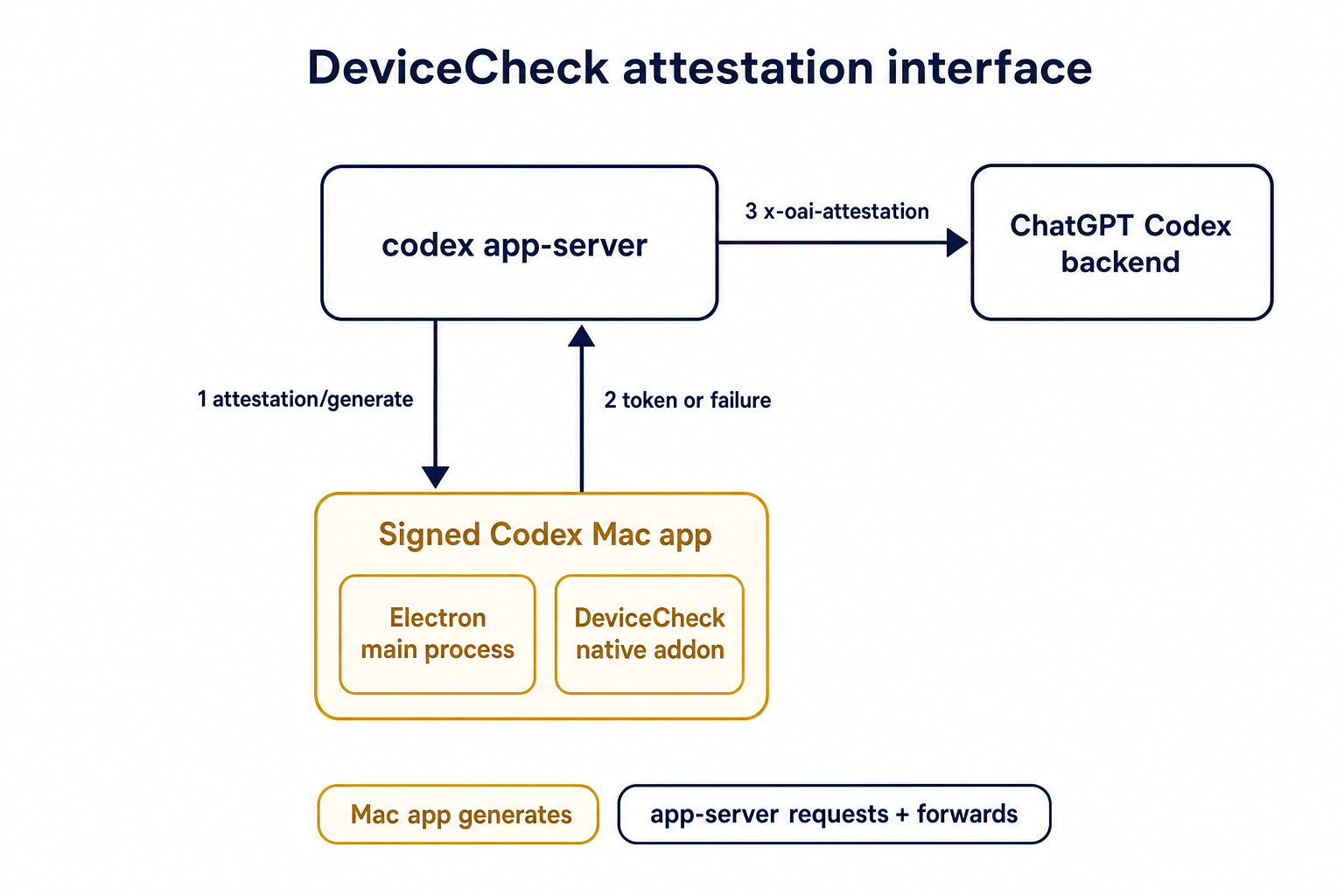
  • [codex] request desktop attestation from app (#20619)
    ## Summary
    
    TL;DR: teaches `codex-rs` / app-server to request a desktop-provided
    attestation token and attach it as `x-oai-attestation` on the scoped
    ChatGPT Codex request paths.
    
    ![DeviceCheck attestation
    interface](https://raw.githubusercontent.com/openai/codex/dev/jm/devicecheck-diagram-assets/pr-assets/devicecheck-attestation-interface.png)
    
    ## Details
    
    This PR teaches the Codex app-server runtime how to request and attach
    an attestation token. It does not generate DeviceCheck tokens directly;
    instead, it relies on the connected desktop app to advertise that it can
    generate attestation and then asks that app for a fresh header value
    when needed.
    
    The flow is:
    
    1. The Codex desktop app connects to app-server.
    2. During `initialize`, the app can advertise that it supports
    `requestAttestation`.
    3. Before app-server calls selected ChatGPT Codex endpoints, it sends
    the internal server request `attestation/generate` to the app.
    4. app-server receives a pre-encoded header value back.
    5. app-server forwards that value as `x-oai-attestation` on the scoped
    outbound requests.
    
    The code in this repo is mostly protocol and runtime plumbing: it adds
    the app-server request/response shape, introduces an attestation
    provider in core, wires that provider into Responses / compaction /
    realtime setup paths, and covers the intended scoping with tests. The
    signed macOS DeviceCheck generation remains owned by the desktop app PR.
    
    ## Related PR
    
    - Codex desktop app implementation:
    https://github.com/openai/openai/pull/878649
    
    ## Validation
    
    <details>
    <summary>Tests run</summary>
    
    ```sh
    cargo test -p codex-app-server-protocol
    cargo test -p codex-core attestation --lib
    cargo test -p codex-app-server --lib attestation
    ```
    
    Also ran:
    
    ```sh
    just fix -p codex-core
    just fix -p codex-app-server
    just fix -p codex-app-server-protocol
    just fmt
    just write-app-server-schema
    ```
    
    </details>
    
    <details>
    <summary>E2E DeviceCheck validation</summary>
    
    First validated the signed desktop app boundary directly: launched a
    packaged signed `Codex.app`, sent `attestation/generate`, decoded the
    returned `v1.` attestation header, and validated the extracted
    DeviceCheck token with `personal/jm/verify_devicecheck_token.py` using
    bundle ID `com.openai.codex`. Apple returned `status_code: 200` and
    `is_ok: true`.
    
    Then ran the fuller app + app-server flow. The packaged `Codex.app`
    launched a current-branch app-server via `CODEX_CLI_PATH`, and a local
    MITM proxy intercepted outbound `chatgpt.com` traffic. The app-server
    requested `attestation/generate` from the real Electron app process, and
    the intercepted `/backend-api/codex/responses` traffic included
    `x-oai-attestation` on both routes:
    
    ```text
    GET  /backend-api/codex/responses  Upgrade: websocket  x-oai-attestation: present
    POST /backend-api/codex/responses  Upgrade: none       x-oai-attestation: present
    ```
    
    The captured header decoded to a DeviceCheck token that also validated
    with Apple for `com.openai.codex` (`status_code: 200`, `is_ok: true`,
    team `2DC432GLL2`).
    
    </details>
    
    ---------
    
    Co-authored-by: Codex <noreply@openai.com>
  • [codex-analytics] plumb protocol-native review timing (#21434)
    ## Why
    
    We want terminal tool review analytics, but the reducer should not stamp
    review timing from its own wall clock.
    
    This PR plumbs review timing through the real protocol and app-server
    seams so downstream analytics can consume the emitter's timestamps
    directly. Guardian reviews keep their enriched `started_at` /
    `completed_at` analytics fields by deriving those legacy second-based
    values from the same protocol-native millisecond lifecycle timestamps,
    rather than sampling a separate analytics clock.
    
    ## What changed
    
    - add `started_at_ms` to user approval request payloads
    - add `started_at_ms` / `completed_at_ms` to guardian review
    notifications
    - preserve Guardian review `started_at` / `completed_at` enrichment from
    the protocol-native timing source
    - stamp typed `ServerResponse` analytics facts with app-server-observed
    `completed_at_ms`
    - thread the new timing fields through core, protocol, app-server, TUI,
    and analytics fixtures
    
    ## Verification
    
    - `cargo test -p codex-app-server outgoing_message --manifest-path
    codex-rs/Cargo.toml`
    - `cargo test -p codex-app-server-protocol guardian --manifest-path
    codex-rs/Cargo.toml`
    - `cargo test -p codex-tui guardian --manifest-path codex-rs/Cargo.toml`
    - `cargo test -p codex-analytics analytics_client_tests --manifest-path
    codex-rs/Cargo.toml`
    
    ---
    [//]: # (BEGIN SAPLING FOOTER)
    Stack created with [Sapling](https://sapling-scm.com). Best reviewed
    with [ReviewStack](https://reviewstack.dev/openai/codex/pull/21434).
    * #18748
    * __->__ #21434
    * #18747
    * #17090
    * #17089
    * #20514
  • [codex-analytics] emit tool item events from item lifecycle (#17090)
    ## Why
    
    After the tool-item schemas are in place, analytics needs to emit them
    from the app-server item lifecycle rather than requiring bespoke
    tracking at each callsite. The reducer should also reuse the shared
    thread analytics context introduced below it in the stack so later event
    families do not repeat the same reducer joins or missing-state ladder.
    
    ## What changed
    
    - Tracks tool-item completion notifications and emits the matching tool
    analytics event when a terminal item arrives.
    - Derives event-specific payload details for command execution, file
    changes, MCP calls, dynamic tools, collaboration tools, web search, and
    image generation.
    - Denormalizes thread, app-server client, runtime, and subagent
    provenance metadata through the shared thread analytics context.
    - Adds reducer coverage for item lifecycle emission and subagent
    metadata inheritance.
    
    ## Duration semantics
    
    `duration_ms` is computed from the app-server item lifecycle timestamps:
    `completed_at_ms - started_at_ms`. That makes it the duration of the
    lifecycle Codex observed locally, not necessarily the upstream
    provider's full execution time.
    
    - Web search usually has a meaningful observed lifecycle because
    Responses can send `response.output_item.added` before
    `response.output_item.done`; in that case `started_at_ms` comes from the
    added event and `completed_at_ms` comes from the done event.
    - Image generation can be much less precise. In the current observed
    stream, image generation often arrives only as a completed
    `response.output_item.done`; when there is no earlier added event, Codex
    synthesizes the started item immediately before completion, so
    `duration_ms` can be `0` even though upstream image generation took
    longer.
    - Standalone web search and standalone image generation work is expected
    to land after this stack. Those paths may introduce more direct
    lifecycle events or timing points, so the current
    web-search/image-generation duration semantics should be treated as the
    best available item-lifecycle approximation, not the final latency
    contract for those tool families.
    - `execution_duration_ms` is populated only where the completed item
    already carries a native execution duration; otherwise it remains `null`
    while `duration_ms` still reflects the local lifecycle interval.
    
    ## Currently placeholder / partial fields
    
    Some fields are included in the schema for the intended steady-state
    contract, but this PR does not yet populate them from real
    approval/review state:
    
    - `review_count`, `guardian_review_count`, and `user_review_count`
    currently default to `0`.
    - `final_approval_outcome` currently defaults to `unknown`.
    - `requested_additional_permissions` and `requested_network_access`
    currently default to `false`.
    
    ## Verification
    
    - `cargo test -p codex-analytics`
    
    ---
    [//]: # (BEGIN SAPLING FOOTER)
    Stack created with [Sapling](https://sapling-scm.com). Best reviewed
    with [ReviewStack](https://reviewstack.dev/openai/codex/pull/17090).
    * #18748
    * #18747
    * __->__ #17090
    * #17089
    * #20514
  • [codex] Use shared app-server JSON-RPC error helpers (#21221)
    ## Why
    
    App-server had repeated hand-built JSON-RPC error objects for standard
    error shapes. Using the shared helpers keeps the common
    `invalid_request`, `invalid_params`, and `internal_error` construction
    in one place and reduces the chance of new call sites drifting from the
    common error payload shape.
    
    ## What changed
    
    - Replaced manual standard JSON-RPC error object creation with
    `internal_error(...)`, `invalid_request(...)`, and `invalid_params(...)`
    across app-server request processors and runtime paths.
    - Removed local duplicate helper definitions from search and review
    request handling.
    - Preserved existing structured `data` payloads by creating the shared
    helper error first and then attaching the existing metadata.
    - Left custom non-standard errors and raw error-code assertions intact.
    
    ## Validation
    
    - `cargo test -p codex-app-server`
  • app-server: move transport into dedicated crate (#20545)
    ## Why
    
    `codex-app-server` currently owns both request-processing code and
    transport implementation details. Splitting the transport layer into its
    own crate makes that boundary explicit, reduces the amount of
    transport-specific dependency surface carried by `codex-app-server`, and
    gives future transport work a narrower place to evolve.
    
    ## What changed
    
    - Added `codex-app-server-transport` and moved the existing transport
    tree into it, including stdio, unix socket, websocket, remote-control
    transport, and websocket auth.
    - Moved shared transport-facing message types into the new crate so both
    the transport implementation and `codex-app-server` use the same
    definitions.
    - Kept processor-facing connection state and outbound routing in
    `codex-app-server`, with the routing tests moved next to that local
    wrapper.
    - Updated workspace metadata, Bazel crate metadata, and
    `codex-app-server` dependencies for the new crate boundary.
    
    ## Validation
    
    - `cargo metadata --locked --no-deps`
    - `git diff --check`
    - Attempted `cargo test -p codex-app-server-transport`, `cargo test -p
    codex-app-server`, `just fix -p codex-app-server-transport`, and `just
    fix -p codex-app-server`; all were blocked before compilation by the
    existing `packageproxy` resolution failure for locked `rustls-webpki =
    0.103.13`.
    - Attempted Bazel build / lockfile validation; those were blocked by
    external fetch failures against BuildBuddy / GitHub while resolving
    `v8`.
  • [app-server] centralize client response analytics (#20059)
    ## Why
    
    The precursor PR keeps successful client responses typed until
    app-server's outgoing response seam. This follow-up uses that seam to
    move successful client-response analytics out of individual handlers and
    into the shared sender path, while keeping filtering decisions inside
    `codex-analytics`.
    
    ## What changed
    
    - Emit successful client-response analytics centrally from
    `OutgoingMessageSender::send_response`.
    - Remove duplicate handler-local response tracking for the current
    thread/turn lifecycle responses.
    - Keep analytics ingestion selective inside `AnalyticsEventsClient`, so
    unrelated client traffic is ignored before cloning or boxing.
    - Collapse client-response analytics facts onto one typed path and
    normalize payloads in the reducer.
    - Add direct client-filter coverage plus sender-level coverage for the
    centralized forwarding path.
    
    ## Verification
    
    - `cargo test -p codex-analytics`
    - `cargo test -p codex-app-server outgoing_message::tests --lib`
  • [app-server] type client response payloads (#20050)
    ## Why
    
    `pr17088` adds typed server-originated request/response plumbing, but
    successful client responses are still erased into bare JSON-RPC `result`
    values before app-server can make any typed decision about them.
    
    This precursor PR keeps successful client responses typed until the
    outgoing response seam. It is intentionally limited to
    protocol/app-server plumbing so the analytics behavior change can review
    separately on top.
    
    ## What changed
    
    - Add `ClientResponsePayload` as the pre-serialization client response
    body type.
    - Route app-server successful response paths through the typed payload
    seam while preserving existing handler-local analytics behavior.
    - Keep `InterruptConversation` JSON-RPC-only because it has no
    `ClientResponse` variant.
    - Move the new payload conversion tests into a dedicated protocol test
    module.
    
    ## Verification
    
    - `cargo check -p codex-app-server`
    - `cargo test -p codex-app-server-protocol`
  • [codex-analytics] ingest server requests and responses (#17088)
    ## Why
    
    Codex analytics needs a typed seam for app-server-originated
    request/response traffic so future tool-approval analytics can consume
    those facts without adding bespoke callsite tracking each time. Server
    responses arrive as JSON-RPC `id + result` payloads, so analytics has to
    reconstruct the matching typed response from the original typed request
    while that request context still exists in app-server.
    
    This also puts analytics on the app-server outbound path, which needs to
    avoid keeping the runtime alive during shutdown. The final ownership fix
    keeps the normal strong auth-manager retention in analytics and makes
    the external-auth refresh bridge hold a weak back-reference to
    `OutgoingMessageSender`, breaking the runtime cycle at the bridge
    boundary instead of exposing retention policy through the analytics
    client API.
    
    ## What changed
    
    - Adds typed `ServerRequest` and `ServerResponse` analytics facts, plus
    `AnalyticsEventsClient::track_server_request` and
    `track_server_response`.
    - Renames the existing client-side facts to `ClientRequest` and
    `ClientResponse` so reducers can distinguish client-to-server traffic
    from server-to-client traffic.
    - Adds `ServerRequest::response_from_result`, allowing a stored typed
    request to decode the matching typed server response from a raw JSON-RPC
    result payload.
    - Threads `AnalyticsEventsClient` through `OutgoingMessageSender` and
    records targeted server requests, replayed targeted requests, and
    matching targeted responses with the responding connection id needed for
    correlation.
    - Intentionally leaves broadcast server requests/responses out of
    analytics for now because the current model is per connection, while
    broadcasts fan one logical request out across multiple connections.
    - Breaks the app-server shutdown cycle by storing
    `Weak<OutgoingMessageSender>` in `ExternalAuthRefreshBridge` and
    upgrading it only when an external-auth refresh is actually requested.
    - Keeps reducer ingestion of the new server-side facts as no-ops for
    now; this PR is plumbing for later tool-approval analytics work.
    
    ## Verification
    
    - `cargo test -p codex-analytics`
    - `cargo test -p codex-app-server outgoing_message::tests::`
    - Covers typed-response reconstruction plus the targeted, replayed,
    broadcast-exclusion, and response-attribution analytics paths.
    
    ## Follow-up
    
    This PR intentionally stops at ingestion plumbing, so `ServerRequest`
    and `ServerResponse` facts are still reducer no-ops. Once a follow-up PR
    adds real downstream analytics output for those facts:
    
    - replace the temporary pre-reducer observation seam with reducer tests
    for the emitted event shape;
    - add end-to-end coverage in `app-server/tests/suite/v2/analytics.rs`
    for the real app-server workflow and captured analytics payload;
    - remove the temporary sender-level observer tests added here in favor
    of the real-output coverage above.
    
    ---
    
    [//]: # (BEGIN SAPLING FOOTER)
    Stack created with [Sapling](https://sapling-scm.com). Best reviewed
    with [ReviewStack](https://reviewstack.dev/openai/codex/pull/17088).
    * #18748
    * #18747
    * #17090
    * #17089
    * #20241
    * #20239
    * __->__ #17088
  • Lift app-server JSON-RPC error handling to request boundary (#19484)
    ## Why
    
    App-server request handling had a lot of repeated JSON-RPC error
    construction and one-off `send_error`/`return` branches. This made small
    handlers noisy and pushed error response details into leaf code that
    otherwise only needed to validate input or call the underlying API.
    
    ## What Changed
    
    - Added shared JSON-RPC error constructors in
    `codex-rs/app-server/src/error_code.rs`.
    - Lifted straightforward request result emission into
    `codex-rs/app-server/src/message_processor.rs` so response/error
    dispatch happens at the request boundary.
    - Reused the result helpers across command exec, config, filesystem,
    device-key, external-agent config, fs-watch, and outgoing-message paths.
    - Removed leaf wrapper handlers where the method body was only
    forwarding to a response helper.
    - Returned request validation errors upward in the simple cases instead
    of sending an error locally and immediately returning.
    
    ## Verification
    
    - `cargo test -p codex-app-server --lib command_exec::tests`
    - `cargo test -p codex-app-server --lib outgoing_message::tests`
    - `cargo test -p codex-app-server --lib in_process::tests`
    - `cargo test -p codex-app-server --test all v2::fs`
    - `cargo test -p codex-app-server --test all v2::config_rpc`
    - `cargo test -p codex-app-server --test all v2::external_agent_config`
    - `cargo test -p codex-app-server --test all v2::initialize`
    - `just fix -p codex-app-server`
    - `git diff --check`
    
    Note: full `cargo test -p codex-app-server` was attempted and stopped in
    `message_processor::tracing_tests::turn_start_jsonrpc_span_parents_core_turn_spans`
    with a stack overflow after unrelated tests had already passed.
  • Add safety check notification and error handling (#19055)
    Adds a new app-server notification that fires when a user account has
    been flagged for potential safety reasons.
  • feat(auto-review) short-circuit (#18890)
    ## Summary
    Short circuit the convo if auto-review hits too many denials
    
    ## Testing
    - [x] Added unit tests
    
    ---------
    
    Co-authored-by: Codex <noreply@openai.com>
  • [tool search] support namespaced deferred dynamic tools (#18413)
    Deferred dynamic tools need to round-trip a namespace so a tool returned
    by `tool_search` can be called through the same registry key that core
    uses for dispatch.
    
    This change adds namespace support for dynamic tool specs/calls,
    persists it through app-server thread state, and routes dynamic tool
    calls by full `ToolName` while still sending the app the leaf tool name.
    Deferred dynamic tools must provide a namespace; non-deferred dynamic
    tools may remain top-level.
    
    It also introduces `LoadableToolSpec` as the shared
    function-or-namespace Responses shape used by both `tool_search` output
    and dynamic tool registration, so dynamic tools use the same wrapping
    logic in both paths.
    
    Validation:
    - `cargo test -p codex-tools`
    - `cargo test -p codex-core tool_search`
    
    ---------
    
    Co-authored-by: Sayan Sisodiya <sayan@openai.com>
  • [codex] Propagate rate limit reached type (#18227)
    ## Summary
    
    First PR in the split from #17956.
    
    - adds the core/app-server `RateLimitReachedType` shape
    - maps backend `rate_limit_reached_type` into Codex rate-limit snapshots
    - carries the field through app-server notifications/responses and
    generated schemas
    - updates existing constructors/tests for the new optional field
    
    ## Validation
    
    - `cargo test -p codex-backend-client`
    - `cargo test -p codex-app-server-protocol`
    - `cargo test -p codex-app-server rate_limits`
    - `cargo test -p codex-tui workspace_`
    - `cargo test -p codex-tui status_`
    - `just fmt`
    - `just fix -p codex-backend-client`
    - `just fix -p codex-app-server-protocol`
    - `just fix -p codex-app-server`
    - `just fix -p codex-tui`
  • Revert "Option to Notify Workspace Owner When Usage Limit is Reached" (#17391)
    Reverts openai/codex#16969
    
    #sev3-2026-04-10-accountscheckversion-500s-for-openai-workspace-7300
  • Option to Notify Workspace Owner When Usage Limit is Reached (#16969)
    ## Summary
    - Replace the manual `/notify-owner` flow with an inline confirmation
    prompt when a usage-based workspace member hits a credits-depleted
    limit.
    - Fetch the current workspace role from the live ChatGPT
    `accounts/check/v4-2023-04-27` endpoint so owner/member behavior matches
    the desktop and web clients.
    - Keep owner, member, and spend-cap messaging distinct so we only offer
    the owner nudge when the workspace is actually out of credits.
    
    ## What Changed
    - `backend-client`
    - Added a typed fetch for the current account role from
    `accounts/check`.
      - Mapped backend role values into a Rust workspace-role enum.
    - `app-server` and protocol
      - Added `workspaceRole` to `account/read` and `account/updated`.
    - Derived `isWorkspaceOwner` from the live role, with a fallback to the
    cached token claim when the role fetch is unavailable.
    - `tui`
      - Removed the explicit `/notify-owner` slash command.
    - When a member is blocked because the workspace is out of credits, the
    error now prompts:
    - `Your workspace is out of credits. Request more from your workspace
    owner? [y/N]`
      - Choosing `y` sends the existing owner-notification request.
    - Choosing `n`, pressing `Esc`, or accepting the default selection
    dismisses the prompt without sending anything.
    - Selection popups now honor explicit item shortcuts, which is how the
    `y` / `n` interaction is wired.
    
    ## Reviewer Notes
    - The main behavior change is scoped to usage-based workspace members
    whose workspace credits are depleted.
    - Spend-cap reached should not show the owner-notification prompt.
    - Owners and admins should continue to see `/usage` guidance instead of
    the member prompt.
    - The live role fetch is best-effort; if it fails, we fall back to the
    existing token-derived ownership signal.
    
    ## Testing
    - Manual verification
      - Workspace owner does not see the member prompt.
    - Workspace member with depleted credits sees the confirmation prompt
    and can send the nudge with `y`.
    - Workspace member with spend cap reached does not see the
    owner-notification prompt.
    
    ### Workspace member out of usage
    
    https://github.com/user-attachments/assets/341ac396-eff4-4a7f-bf0c-60660becbea1
    
    ### Workspace owner
    <img width="1728" height="1086" alt="Screenshot 2026-04-09 at 11 48
    22 AM"
    src="https://github.com/user-attachments/assets/06262a45-e3fc-4cc4-8326-1cbedad46ed6"
    />
  • chore: clean up argument-comment lint and roll out all-target CI on macOS (#16054)
    ## Why
    
    `argument-comment-lint` was green in CI even though the repo still had
    many uncommented literal arguments. The main gap was target coverage:
    the repo wrapper did not force Cargo to inspect test-only call sites, so
    examples like the `latest_session_lookup_params(true, ...)` tests in
    `codex-rs/tui_app_server/src/lib.rs` never entered the blocking CI path.
    
    This change cleans up the existing backlog, makes the default repo lint
    path cover all Cargo targets, and starts rolling that stricter CI
    enforcement out on the platform where it is currently validated.
    
    ## What changed
    
    - mechanically fixed existing `argument-comment-lint` violations across
    the `codex-rs` workspace, including tests, examples, and benches
    - updated `tools/argument-comment-lint/run-prebuilt-linter.sh` and
    `tools/argument-comment-lint/run.sh` so non-`--fix` runs default to
    `--all-targets` unless the caller explicitly narrows the target set
    - fixed both wrappers so forwarded cargo arguments after `--` are
    preserved with a single separator
    - documented the new default behavior in
    `tools/argument-comment-lint/README.md`
    - updated `rust-ci` so the macOS lint lane keeps the plain wrapper
    invocation and therefore enforces `--all-targets`, while Linux and
    Windows temporarily pass `-- --lib --bins`
    
    That temporary CI split keeps the stricter all-targets check where it is
    already cleaned up, while leaving room to finish the remaining Linux-
    and Windows-specific target-gated cleanup before enabling
    `--all-targets` on those runners. The Linux and Windows failures on the
    intermediate revision were caused by the wrapper forwarding bug, not by
    additional lint findings in those lanes.
    
    ## Validation
    
    - `bash -n tools/argument-comment-lint/run.sh`
    - `bash -n tools/argument-comment-lint/run-prebuilt-linter.sh`
    - shell-level wrapper forwarding check for `-- --lib --bins`
    - shell-level wrapper forwarding check for `-- --tests`
    - `just argument-comment-lint`
    - `cargo test` in `tools/argument-comment-lint`
    - `cargo test -p codex-terminal-detection`
    
    ## Follow-up
    
    - Clean up remaining Linux-only target-gated callsites, then switch the
    Linux lint lane back to the plain wrapper invocation.
    - Clean up remaining Windows-only target-gated callsites, then switch
    the Windows lint lane back to the plain wrapper invocation.
  • app-server: Add back pressure and batching to command/exec (#15547)
    * Add
    `OutgoingMessageSender::send_server_notification_to_connection_and_wait`
    which returns only once message is written to websocket (or failed to do
    so)
    * Use this mechanism to apply back pressure to stdout/stderr streams of
    processes spawned by `command/exec`, to limit them to at most one
    message in-memory at a time
    * Use back pressure signal to also batch smaller chunks into ≈64KiB ones
    
    This should make commands execution more robust over
    high-latency/low-throughput networks
  • Finish moving codex exec to app-server (#15424)
    This PR completes the conversion of non-interactive `codex exec` to use
    app server rather than directly using core events and methods.
    
    ### Summary
    - move `codex-exec` off exec-owned `AuthManager` and `ThreadManager`
    state
    - route exec bootstrap, resume, and auth refresh through existing
    app-server paths
    - replace legacy `codex/event/*` decoding in exec with typed app-server
    notification handling
    - update human and JSONL exec output adapters to translate existing
    app-server notifications only
    - clean up "app server client" layer by eliminating support for legacy
    notifications; this is no longer needed
    - remove exposure of `authManager` and `threadManager` from "app server
    client" layer
    
    ### Testing
    - `exec` has pretty extensive unit and integration tests already, and
    these all pass
    - In addition, I asked Codex to put together a comprehensive manual set
    of tests to cover all of the `codex exec` functionality (including
    command-line options), and it successfully generated and ran these tests
  • feat(tracing): tag app-server turn spans with turn_id (#15206)
    So we can find and filter spans by `turn.id`.
    
    We do this for the `turn/start`, `turn/steer`, and `turn/interrupt`
    APIs.
  • Apply argument comment lint across codex-rs (#14652)
    ## Why
    
    Once the repo-local lint exists, `codex-rs` needs to follow the
    checked-in convention and CI needs to keep it from drifting. This commit
    applies the fallback `/*param*/` style consistently across existing
    positional literal call sites without changing those APIs.
    
    The longer-term preference is still to avoid APIs that require comments
    by choosing clearer parameter types and call shapes. This PR is
    intentionally the mechanical follow-through for the places where the
    existing signatures stay in place.
    
    After rebasing onto newer `main`, the rollout also had to cover newly
    introduced `tui_app_server` call sites. That made it clear the first cut
    of the CI job was too expensive for the common path: it was spending
    almost as much time installing `cargo-dylint` and re-testing the lint
    crate as a representative test job spends running product tests. The CI
    update keeps the full workspace enforcement but trims that extra
    overhead from ordinary `codex-rs` PRs.
    
    ## What changed
    
    - keep a dedicated `argument_comment_lint` job in `rust-ci`
    - mechanically annotate remaining opaque positional literals across
    `codex-rs` with exact `/*param*/` comments, including the rebased
    `tui_app_server` call sites that now fall under the lint
    - keep the checked-in style aligned with the lint policy by using
    `/*param*/` and leaving string and char literals uncommented
    - cache `cargo-dylint`, `dylint-link`, and the relevant Cargo
    registry/git metadata in the lint job
    - split changed-path detection so the lint crate's own `cargo test` step
    runs only when `tools/argument-comment-lint/*` or `rust-ci.yml` changes
    - continue to run the repo wrapper over the `codex-rs` workspace, so
    product-code enforcement is unchanged
    
    Most of the code changes in this commit are intentionally mechanical
    comment rewrites or insertions driven by the lint itself.
    
    ## Verification
    
    - `./tools/argument-comment-lint/run.sh --workspace`
    - `cargo test -p codex-tui-app-server -p codex-tui`
    - parsed `.github/workflows/rust-ci.yml` locally with PyYAML
    
    ---
    
    * -> #14652
    * #14651
  • feat(app-server, core): add more spans (#14479)
    ## Description
    
    This PR expands tracing coverage across app-server thread startup, core
    session initialization, and the Responses transport layer. It also gives
    core dispatch spans stable operation-specific names so traces are easier
    to follow than the old generic `submission_dispatch` spans.
    
    Also use `fmt::Display` for types that we serialize in traces so we send
    strings instead of rust types
  • feat(app-server): propagate traces across tasks and core ops (#14387)
    ## Summary
    
    This PR keeps app-server RPC request trace context alive for the full
    lifetime of the work that request kicks off (e.g. for `thread/start`,
    this is `app-server rpc handler -> tokio background task -> core op
    submissions`). Previously we lose trace lineage once the request handler
    returns or hands work off to background tasks.
    
    This approach is especially relevant for `thread/start` and other RPC
    handlers that run in a non-blocking way. In the near future we'll most
    likely want to make all app-server handlers run in a non-blocking way by
    default, and only queue operations that must operate in order (e.g.
    thread RPCs per thread?), so we want to make sure tracing in app-server
    just generally works.
    
    Depends on https://github.com/openai/codex/pull/14300
    
    **Before**
    <img width="155" height="207" alt="image"
    src="https://github.com/user-attachments/assets/c9487459-36f1-436c-beb7-fafeb40737af"
    />
    
    
    **After**
    <img width="299" height="337" alt="image"
    src="https://github.com/user-attachments/assets/727392b2-d072-4427-9dc4-0502d8652dea"
    />
    
    ## What changed
    
    - Keep request-scoped trace context around until we send the final
    response or error, or the connection closes.
    - Thread that trace context through detached `thread/start` work so
    background startup stays attached to the originating request.
    - Pass request trace context through to downstream core operations,
    including:
      - thread creation
      - resume/fork flows
      - turn submission
      - review
      - interrupt
      - realtime conversation operations
    - Add tracing tests that verify:
      - remote W3C trace context is preserved for `thread/start`
      - remote W3C trace context is preserved for `turn/start`
      - downstream core spans stay under the originating request span
      - request-scoped tracing state is cleaned up correctly
    - Clean up shutdown behavior so detached background tasks and spawned
    threads are drained before process exit.
  • Add in-process app server and wire up exec to use it (#14005)
    This is a subset of PR #13636. See that PR for a full overview of the
    architectural change.
    
    This PR implements the in-process app server and modifies the
    non-interactive "exec" entry point to use the app server.
    
    ---------
    
    Co-authored-by: Felipe Coury <felipe.coury@gmail.com>
  • chore(app-server): delete v1 RPC methods and notifications (#13375)
    ## Summary
    This removes the old app-server v1 methods and notifications we no
    longer need, while keeping the small set the main codex app client still
    depends on for now.
    
    The remaining legacy surface is:
    - `initialize`
    - `getConversationSummary`
    - `getAuthStatus`
    - `gitDiffToRemote`
    - `fuzzyFileSearch`
    - `fuzzyFileSearch/sessionStart`
    - `fuzzyFileSearch/sessionUpdate`
    - `fuzzyFileSearch/sessionStop`
    
    And the raw `codex/event/*` notifications emitted from core. These
    notifications will be removed in a followup PR.
    
    ## What changed
    - removed deprecated v1 request variants from the protocol and
    app-server dispatcher
    - removed deprecated typed notifications: `authStatusChange`,
    `loginChatGptComplete`, and `sessionConfigured`
    - updated the app-server test client to use v2 flows instead of deleted
    v1 flows
    - deleted legacy-only app-server test suites and added focused coverage
    for `getConversationSummary`
    - regenerated app-server schema fixtures and updated the MCP interface
    docs to match the remaining compatibility surface
    
    ## Testing
    - `just write-app-server-schema`
    - `cargo test -p codex-app-server-protocol`
    - `cargo test -p codex-app-server`
  • [codex] include plan type in account updates (#13181)
    This change fixes a Codex app account-state sync bug where clients could
    know the user was signed in but still miss the ChatGPT subscription
    tier, which could lead to incorrect upgrade messaging for paid users.
    
    The root cause was that `account/updated` only carried `authMode` while
    plan information was available separately via `account/read` and
    rate-limit snapshots, so this update adds `planType` to
    `account/updated`, populates it consistently across login and refresh
    paths.
  • app-server: Replay pending item requests on thread/resume (#12560)
    Replay pending client requests after `thread/resume` and emit resolved
    notifications when those requests clear so approval/input UI state stays
    in sync after reconnects and across subscribed clients.
    
    Affected RPCs:
    - `item/commandExecution/requestApproval`
    - `item/fileChange/requestApproval`
    - `item/tool/requestUserInput`
    
    Motivation:
    - Resumed clients need to see pending approval/input requests that were
    already outstanding before the reconnect.
    - Clients also need an explicit signal when a pending request resolves
    or is cleared so stale UI can be removed on turn start, completion, or
    interruption.
    
    Implementation notes:
    - Use pending client requests from `OutgoingMessageSender` in order to
    replay them after `thread/resume` attaches the connection, using
    original request ids.
    - Emit `serverRequest/resolved` when pending requests are answered
    or cleared by lifecycle cleanup.
    - Update the app-server protocol schema, generated TypeScript bindings,
    and README docs for the replay/resolution flow.
    
    High-level test plan:
    - Added automated coverage for replaying pending command execution and
    file change approval requests on `thread/resume`.
    - Added automated coverage for resolved notifications in command
    approval, file change approval, request_user_input, turn start, and turn
    interrupt flows.
    - Verified schema/docs updates in the relevant protocol and app-server
    tests.
    
    Manual testing:
    - Tested reconnect/resume with multiple connections.
    - Confirmed state stayed in sync between connections.
  • feat(app-server): thread/unsubscribe API (#10954)
    Adds a new v2 app-server API for a client to be able to unsubscribe to a
    thread:
    - New RPC method: `thread/unsubscribe`
    - New server notification: `thread/closed`
    
    Today clients can start/resume/archive threads, but there wasn’t a way
    to explicitly unload a live thread from memory without archiving it.
    With `thread/unsubscribe`, a client can indicate it is no longer
    actively working with a live Thread. If this is the only client
    subscribed to that given thread, the thread will be automatically closed
    by app-server, at which point the server will send `thread/closed` and
    `thread/status/changed` with `status: notLoaded` notifications.
    
    This gives clients a way to prevent long-running app-server processes
    from accumulating too many thread (and related) objects in memory.
    
    Closed threads will also be removed from `thread/loaded/list`.
  • Add app-server event tracing (#12695)
    To help with debugging
  • Feat: add model reroute notification (#12001)
    ### Summary
    Builiding off
    https://github.com/openai/codex/pull/11964/files/5c75aa7b89a70bc2cc410a6fd238749306ec4c5e#diff-058ae8f109a8b84b4b79bbfa45f522c2233b9d9e139696044ae374d50b6196e0,
    we have created a `model/rerouted` notification that captures the event
    so that consumers can render as expected. Keep the `EventMsg::Warning`
    path in core so that this does not affect TUI rendering.
    
    `model/rerouted` is meant to be generic to account for future usage
    including capacity planning etc.
  • fix(app-server): surface more helpful errors for json-rpc (#11638)
    Propagate client JSON-RPC errors for app-server request callbacks.
    Previously a number of possible errors were collapsed to `channel
    closed`. Now we should be able to see the underlying client error.
    
    ### Summary
    This change stops masking client JSON-RPC error responses as generic
    callback cancellation in app-server server->client request flows.
    
    Previously, when the client responded with a JSON-RPC error, we removed
    the callback entry but did not send anything to the waiting oneshot
    receiver. Waiters then observed channel closure (for example, auth
    refresh request canceled: channel closed), which hid the actual client
    error.
    
    Now, client JSON-RPC errors are forwarded through the callback channel
    and handled explicitly by request consumers.
    
    ### User-visible behavior
    - External auth refresh now surfaces real client JSON-RPC errors when
    provided.
    - True transport/callback-drop cases still report
    canceled/channel-closed semantics.
    
    ### Example: client JSON-RPC error is now propagated (not masked as
    "canceled")
    
    When app-server asks the client to refresh ChatGPT auth tokens, it sends
    a server->client JSON-RPC request like:
    
    ```json
    {
      "id": 42,
      "method": "account/chatgptAuthTokens/refresh",
      "params": {
        "reason": "unauthorized",
        "previousAccountId": "org-abc"
      }
    }
    ```
    
    If the client cannot refresh and responds with a JSON-RPC error:
    ```
    {
      "id": 42,
      "error": {
        "code": -32000,
        "message": "refresh failed",
        "data": null
      }
    }
    ```
    
    app-server now forwards that error through the callback path and
    surfaces:
    `auth refresh request failed: code=-32000 message=refresh failed`
    
    Previously, this same case could be reported as:
    `auth refresh request canceled: channel closed`
  • app-server: thread resume subscriptions (#11474)
    This stack layer makes app-server thread event delivery connection-aware
    so resumed/attached threads only emit notifications and approval prompts
    to subscribed connections.
    
    - Added per-thread subscription tracking in `ThreadState`
    (`subscribed_connections`) and mapped subscription ids to `(thread_id,
    connection_id)`.
    - Updated listener lifecycle so removing a subscription or closing a
    connection only removes that connection from the thread’s subscriber
    set; listener shutdown now happens when the last subscriber is gone.
    - Added `connection_closed(connection_id)` plumbing (`lib.rs` ->
    `message_processor.rs` -> `codex_message_processor.rs`) so disconnect
    cleanup happens immediately.
    - Scoped bespoke event handling outputs through `TargetedOutgoing` to
    send requests/notifications only to subscribed connections.
    - Kept existing threadresume behavior while aligning with the latest
    split-loop transport structure.
  • Reapply "Add app-server transport layer with websocket support" (#11370)
    Reapply "Add app-server transport layer with websocket support" with
    additional fixes from https://github.com/openai/codex/pull/11313/changes
    to avoid deadlocking.
    
    This reverts commit 47356ff83c.
    
    ## Summary
    
    To avoid deadlocking when queues are full, we maintain separate tokio
    tasks dedicated to incoming vs outgoing event handling
    - split the app-server main loop into two tasks in
    `run_main_with_transport`
       - inbound handling (`transport_event_rx`)
       - outbound handling (`outgoing_rx` + `thread_created_rx`)
    - separate incoming and outgoing websocket tasks
    
    ## Validation
    
    Integration tests, testing thoroughly e2e in codex app w/ >10 concurrent
    requests
    
    <img width="1365" height="979" alt="Screenshot 2026-02-10 at 2 54 22 PM"
    src="https://github.com/user-attachments/assets/47ca2c13-f322-4e5c-bedd-25859cbdc45f"
    />
    
    ---------
    
    Co-authored-by: jif-oai <jif@openai.com>
  • feat: support multiple rate limits (#11260)
    Added multi-limit support end-to-end by carrying limit_name in
    rate-limit snapshots and handling multiple buckets instead of only
    codex.
    Extended /usage client parsing to consume additional_rate_limits
    Updated TUI /status and in-memory state to store/render per-limit
    snapshots
    Extended app-server rate-limit read response: kept rate_limits and added
    rate_limits_by_name.
    Adjusted usage-limit error messaging for non-default codex limit buckets
  • feat: opt-out of events in the app-server (#11319)
    Add `optOutNotificationMethods` in the app-server to opt-out events
    based on exact method matching
  • Add app-server transport layer with websocket support (#10693)
    - Adds --listen <URL> to codex app-server with two listen modes:
          - stdio:// (default, existing behavior)
          - ws://IP:PORT (new websocket transport)
      - Refactors message routing to be connection-aware:
    - Tracks per-connection session state (initialize/experimental
    capability)
          - Routes responses/errors to the originating connection
    - Broadcasts server notifications/requests to initialized connections
    - Updates initialization semantics to be per connection (not
    process-global), and updates app-server docs accordingly.
    - Adds websocket accept/read/write handling (JSON-RPC per text frame,
    ping/pong handling, connection lifecycle events).
    
    Testing
    
    - Unit tests for transport URL parsing and targeted response/error
    routing.
      - New websocket integration test validating:
          - per-connection initialization requirements
          - no cross-connection response leakage
          - same request IDs on different connections route independently.
  • feat(app-server): support external auth mode (#10012)
    This enables a new use case where `codex app-server` is embedded into a
    parent application that will directly own the user's ChatGPT auth
    lifecycle, which means it owns the user’s auth tokens and refreshes it
    when necessary. The parent application would just want a way to pass in
    the auth tokens for codex to use directly.
    
    The idea is that we are introducing a new "auth mode" currently only
    exposed via app server: **`chatgptAuthTokens`** which consist of the
    `id_token` (stores account metadata) and `access_token` (the bearer
    token used directly for backend API calls). These auth tokens are only
    stored in-memory. This new mode is in addition to the existing `apiKey`
    and `chatgpt` auth modes.
    
    This PR reuses the shape of our existing app-server account APIs as much
    as possible:
    - Update `account/login/start` with a new `chatgptAuthTokens` variant,
    which will allow the client to pass in the tokens and have codex
    app-server use them directly. Upon success, the server emits
    `account/login/completed` and `account/updated` notifications.
    - A new server->client request called
    `account/chatgptAuthTokens/refresh` which the server can use whenever
    the access token previously passed in has expired and it needs a new one
    from the parent application.
    
    I leveraged the core 401 retry loop which typically triggers auth token
    refreshes automatically, but made it pluggable:
    - **chatgpt** mode refreshes internally, as usual.
    - **chatgptAuthTokens** mode calls the client via
    `account/chatgptAuthTokens/refresh`, the client responds with updated
    tokens, codex updates its in-memory auth, then retries. This RPC has a
    10s timeout and handles JSON-RPC errors from the client.
    
    Also some additional things:
    - chatgpt logins are blocked while external auth is active (have to log
    out first. typically clients will pick one OR the other, not support
    both)
    - `account/logout` clears external auth in memory
    - Ensures that if `forced_chatgpt_workspace_id` is set via the user's
    config, we respect it in both:
    - `account/login/start` with `chatgptAuthTokens` (returns a JSON-RPC
    error back to the client)
    - `account/chatgptAuthTokens/refresh` (fails the turn, and on next
    request app-server will send another `account/chatgptAuthTokens/refresh`
    request to the client).
  • Another round of improvements for config error messages (#9746)
    In a [recent PR](https://github.com/openai/codex/pull/9182), I made some
    improvements to config error messages so errors didn't leave app server
    clients in a dead state. This is a follow-on PR to make these error
    messages more readable and actionable for both TUI and GUI users. For
    example, see #9668 where the user was understandably confused about the
    source of the problem and how to fix it.
    
    The improved error message:
    1. Clearly identifies the config file where the error was found (which
    is more important now that we support layered configs)
    2. Provides a line and column number of the error
    3. Displays the line where the error occurred and underlines it
    
    For example, if my `config.toml` includes the following:
    ```toml
    [features]
    collaboration_modes = "true"
    ```
    
    Here's the current CLI error message:
    ```
    Error loading config.toml: invalid type: string "true", expected a boolean in `features`
    ```
    
    And here's the improved message:
    ```
    Error loading config.toml:
    /Users/etraut/.codex/config.toml:43:23: invalid type: string "true", expected a boolean
       |
    43 | collaboration_modes = "true"
       |                       ^^^^^^
    ```
    
    The bulk of the new logic is contained within a new module
    `config_loader/diagnostics.rs` that is responsible for calculating the
    text range for a given toml path (which is more involved than I would
    have expected).
    
    In addition, this PR adds the file name and text range to the
    `ConfigWarningNotification` app server struct. This allows GUI clients
    to present the user with a better error message and an optional link to
    open the errant config file. This was a suggestion from @.bolinfest when
    he reviewed my previous PR.
  • Improve handling of config and rules errors for app server clients (#9182)
    When an invalid config.toml key or value is detected, the CLI currently
    just quits. This leaves the VSCE in a dead state.
    
    This PR changes the behavior to not quit and bubble up the config error
    to users to make it actionable. It also surfaces errors related to
    "rules" parsing.
    
    This allows us to surface these errors to users in the VSCE, like this:
    
    <img width="342" height="129" alt="Screenshot 2026-01-13 at 4 29 22 PM"
    src="https://github.com/user-attachments/assets/a79ffbe7-7604-400c-a304-c5165b6eebc4"
    />
    
    <img width="346" height="244" alt="Screenshot 2026-01-13 at 4 45 06 PM"
    src="https://github.com/user-attachments/assets/de874f7c-16a2-4a95-8c6d-15f10482e67b"
    />
  • fix: taking plan type from usage endpoint instead of thru auth token (#7610)
    pull plan type from the usage endpoint, persist it in session state /
    tui state, and propagate through rate limit snapshots
  • storing credits (#6858)
    Expand the rate-limit cache/TUI: store credit snapshots alongside
    primary and secondary windows, render “Credits” when the backend reports
    they exist (unlimited vs rounded integer balances)
  • [App-server] Implement v2 for account/login/start and account/login/completed (#6183)
    This PR implements `account/login/start` and `account/login/completed`.
    Instead of having separate endpoints for login with chatgpt and api, we
    have a single enum handling different login methods. For sync auth
    methods like sign in with api key, we still send a `completed`
    notification back to be compatible with the async login flow.