mirror of
https://github.com/pchuan98/codex.git
synced 2026-07-01 00:31:56 +08:00
a6d20ed29701bd8f291e94526154dcac90367d92
23
Commits
| Author | SHA1 | Message | Date | |
|---|---|---|---|---|
  TomandGitHub TomandGitHub
|
ece1dfece0 |
[codex] Inject agent graph store into ThreadManager (#29736)
Pick up the AgentGraphStore migration. - Inject an explicit optional agent graph store into `ThreadManager` - Move all calls to spawn, close, recursive resume, and subtree/archive/delete/feedback traversal through it - Keep using `LocalAgentGraphStore` when SQLite is available This required some changes to the interface to deal with futures: - The interface now matches `ThreadStore`'s object-safe pattern by returning a boxed `AgentGraphStoreFuture` directly, allowing `ThreadManager` to hold `Arc<dyn AgentGraphStore>` *Slight behavior change!* Unfiltered subtree enumeration now performs a single all-status breadth-first traversal, so a closed grandchild beneath an open edge is included; the previous Open-then-Closed traversals could not cross mixed-status paths and silently omitted it. |
||
 rka-oaiandGitHub rka-oaiandGitHub
|
752ed90d78 |
current time reminders impl for system clock (varlatency 2/n) (#28824)
Stacked on #28822. ## Summary - add a host-injectable current-time provider with a built-in system implementation - record UTC developer reminders in history immediately before due model requests - keep cadence state per session and force a refresh after compaction This does NOT include the app server client <-> server clock logic. This PR is only for the reminder message & system clock that will be used in prod. ## Testing - `just test -p codex-core varlatency_` - `just clippy -p codex-core -p codex-app-server -p codex-mcp-server -p codex-thread-manager-sample` - `just fmt` |
||
 jifandGitHub jifandGitHub
|
c8c78b63a7 |
Activate selected executor plugin MCPs in app-server (#27893)
## Why #27870 teaches the MCP extension how to discover stdio MCP servers declared by a selected executor plugin, but app-server does not yet install that contributor or initialize its per-thread state. As a result, `thread/start.selectedCapabilityRoots` can select the plugin while its MCP servers remain inactive. This PR closes that app-server wiring gap: ```text thread/start(selectedCapabilityRoots) -> initialize the thread's selected-plugin MCP snapshot -> read the selected plugin's .mcp.json through its environment -> start declared stdio servers in that environment -> expose their tools only on the selected thread ``` ## What changed - Install the selected-executor-plugin MCP contributor in app-server using the existing shared `EnvironmentManager`. - Initialize its frozen thread snapshot when `thread/start` includes selected capability roots. - Document that selected plugin stdio MCPs are activated in their owning environment. - Add an app-server E2E covering the complete selection-to-tool-call path. The E2E verifies that: - the selected MCP process receives an executor-only environment value, proving the tool runs through the selected environment; - the MCP tool is advertised to the model and can be called; - a normal MCP config reload does not discard the thread's frozen selected-plugin registration; - another thread without the selected root does not see the MCP server. ## Scope - Existing sessions without `selectedCapabilityRoots` are unchanged. - Only stdio MCP declarations are activated. HTTP declarations remain inactive. - This does not change selected-root persistence across resume/fork or add hosted-plugin behavior. ## Verification - Focused app-server E2E: `selected_executor_plugin_exposes_its_stdio_mcp_only_to_that_thread` ## Stack Stacked on #27870. |
||
 Celia ChenandGitHub Celia ChenandGitHub
|
9915d34684 |
feat: use encrypted local secrets for MCP OAuth (#27541)
## Summary - store MCP OAuth credentials in the configured auth credential backend - support encrypted-local OAuth storage, including legacy keyring migration - propagate the credential backend through MCP refresh, session, CLI, and app-server paths ## Stack 1. #27504 — config and feature flag 2. #27535 — auth-specific secret namespaces 3. #27539 — encrypted CLI auth storage 4. this PR — encrypted MCP OAuth storage This is a parallel review stack; the original #17931 remains unchanged. ## Tests - `just test -p codex-rmcp-client` (the transport round-trip test passed after building the required `codex` binary and retrying) - `just test -p codex-mcp` - `just test -p codex-app-server refresh_config_uses_latest_auth_keyring_backend` - `just test -p codex-core refresh_mcp_servers_is_deferred_until_next_turn` - `just test -p codex-cli mcp` - `just fix -p codex-rmcp-client -p codex-mcp -p codex-core -p codex-cli -p codex-app-server -p codex-protocol` - `just bazel-lock-check` |
||
|
jifandGitHub
|
693082f3c4 |
Make MCP server contributions thread-scoped (#27670)
## Why `selectedCapabilityRoots` belongs to one thread, but MCP contributors previously received only the global Codex config. That left no clean way for a selected executor capability to contribute MCP servers to its own thread. ## What this PR does - Gives MCP contributors a small context containing the config and, for a running thread, its frozen host-seeded inputs. - Uses the same thread inputs during startup, status queries, refreshes, and skill dependency checks. - Keeps threadless MCP operations and the existing hosted Apps behavior unchanged. - Adds coverage showing that two threads resolve independent registrations and that later lifecycle mutations do not change the frozen MCP inputs. This PR does not discover plugin manifests, add MCP servers, or launch anything new. It only establishes the thread-scoped registration boundary. ## Follow-ups - Resolve selected executor plugin roots through their owning environment filesystem. - Convert their stdio MCP declarations into environment-bound registrations and add an executor MCP end-to-end test. ## Verification - `just fmt` - `cargo check --tests -p codex-protocol -p codex-extension-api -p codex-mcp-extension -p codex-core -p codex-app-server` Tests and Clippy were not run. |
||
 Adam Perry @ OpenAIandGitHub Adam Perry @ OpenAIandGitHub
|
5a56caf18c |
[codex] Remove async_trait from first-party code (#27475)
## Why First-party async traits should expose their `Send` contracts explicitly without requiring `async_trait`. This completes the migration pattern established in #27303 and #27304. ## What changed - Replaced the remaining first-party `async_trait` traits with native return-position `impl Future + Send` where statically dispatched and explicit boxed `Send` futures where object safety is required. - Kept implementations behavior-preserving, outlining existing async bodies into inherent methods where that keeps the diff reviewable. - Removed all direct first-party `async-trait` dependencies and the workspace dependency declaration. - Added a cargo-deny policy that permits `async-trait` only through the remaining transitive wrapper crates. - Updated `rand` from 0.8.5 to 0.8.6 to resolve RUSTSEC-2026-0097 and keep the full cargo-deny check passing. ## Validation - `just test -p codex-exec-server`: 216 passed, 2 skipped. - `just test -p codex-model-provider`: 39 passed. - `just test -p codex-core` and `just test`: changed tests passed; remaining failures are environment-sensitive suites unrelated to this migration. - `cargo deny check` - `just fix` - `just fmt` - `cargo shear` - `just bazel-lock-check` |
||
|
Adam Perry @ OpenAIandGitHub
|
236b50125d |
[codex] Load user instructions through an injected provider (#27101)
## Why We want to remove implicit use of `$CODEX_HOME` from `codex-core` and make embedders responsible for supplying user-level instructions. This also ensures user instructions load when no primary environment is selected. ## What changed Stacked on #27415, which makes `codex exec` surface thread-scoped runtime warnings. - Added `UserInstructionsProvider` to `codex-extension-api`, with absolute source attribution and recoverable loading warnings. - Added `codex-home` with the filesystem-backed provider for `AGENTS.override.md` and `AGENTS.md`, preserving precedence, fallback, trimming, lossy UTF-8 handling, and the existing uncapped global instruction size. - Removed global instruction loading from `Config` and require `ThreadManager` callers to inject a provider. - Load provider instructions once for each fresh root runtime, including runtimes without a primary environment. Running sessions retain their snapshot, while child agents inherit the parent snapshot without invoking the provider. - Keep provider instructions separate while loading project `AGENTS.md`, then assemble the model-visible instructions with the existing ordering, source attribution, warning, and turn-context behavior. - Wired the Codex home provider through the CLI, app server, MCP server, core facade, and thread-manager sample. ## Validation - `just test -p codex-home -p codex-extension-api` - `just test -p codex-core agents_md` - `just test -p codex-core guardian` - `just test -p codex-app-server thread_start_without_selected_environment_includes_only_global_instruction_source` - `just test -p codex-exec warning` - `just bazel-lock-check` |
||
 Michael BolinandGitHub Michael BolinandGitHub
|
2e377ce5e5 |
feat: make ThreadStore available on ThreadExtensionDependencies (#27439)
Generally useful for extensions. |
||
|
Adam Perry @ OpenAIandGitHub
|
e0cb4ede4e |
[codex] Fix post-merge analytics integration failures (#27285)
## Why Recent merges left `main` with analytics integration build failures. Local Cargo runs also made the trimmed-skills test depend on developer-installed skills, while Bazel used an isolated home. ## What changed - Clone `thread_metadata.thread_source` when constructing goal analytics event parameters. - Group app-server thread extension inputs into `ThreadExtensionDependencies`. - Isolate the trimmed-skills test home so its exact fixture count is stable across Cargo and Bazel. ## Validation - `cargo check -p codex-analytics` - `just test -p codex-analytics` (71 tests) - `just test -p codex-app-server` (837 tests; one unrelated zsh-fork timeout passed on retry) |
||
 marksteinbrick-oaiandGitHub marksteinbrick-oaiandGitHub
|
608b8b1cc6 |
[codex-analytics] emit goal lifecycle analytics (#27078)
## Why - Currently, there is no analytics event for `/goal` behavior - Existing events cannot identify goal execution or its resulting outcome - The original update in [#26182](https://github.com/openai/codex/pull/26182) was implemented before `/goal` moved into `codex-goal-extension`. ## What Changed - Adds `codex_goal_event` serialization and enrichment to `codex-analytics` - Emits goal events from the canonical `codex-goal-extension` mutation and accounting paths: - `created` when a new logical goal is persisted - `usage_accounted` when cumulative goal usage is persisted - `status_changed` when the stored goal status changes - `cleared` when the goal is deleted - Preserves causal `turn_id` for turn driven events and uses null attribution for external or idle lifecycle events - Changes goal deletion to return the deleted row so `cleared` retains the stable goal ID ## Event Details Includes standard analytics metadata along with goal specific fields: - `goal_id`: Stable ID stored in the local SQLite goal row and shared across the goal's events - `event_kind`: Observed operation (see the 4 lifecycle events cited in the above bullet) - `goal_status`: Resulting or last stored status: `active`, `paused`, `blocked`, `usage_limited`, etc. - `has_token_budget`: Indicates whether a token budget is configured - `turn_id`: Causal turn ID, or null when no causal turn exists - `cumulative_tokens_accounted`: Cumulative tokens on `usage_accounted` events; null otherwise - `cumulative_time_accounted_seconds`: Cumulative active time on `usage_accounted` events; null otherwise ## Validation - `just test -p codex-analytics -p codex-state -p codex-goal-extension` - `just test -p codex-core -E 'test(/goal/)'` - `just test -p codex-app-server` - `cargo build -p codex-analytics -p codex-core -p codex-state -p codex-app-server` |
||
|
jifandGitHub
|
4ec3b8eeea |
Route hosted Apps MCP through extensions (#27191)
## Stack - Base: #27184 - This PR is the second vertical and should be reviewed against `jif/external-plugins-1`, not `main`. ## Why CCA is moving toward a split runtime where the orchestrator may have no filesystem or executor, but it still needs to activate remotely hosted plugin components. HTTP MCP servers are the simplest complete example: they need configuration and host authentication, but they do not need an executor process. The Apps MCP endpoint is currently synthesized by a special-purpose loader inside the MCP runtime. That works locally, but it leaves hosted MCP activation outside the extension model being established in #27184. It also makes the Apps path a poor foundation for plugins whose skills, MCP servers, connectors, and hooks may come from different sources or execute in different places. This PR moves that one behavior behind an extension-owned contribution while preserving the existing local fallback. It deliberately does not introduce a generic plugin activation framework. ## What changed ### MCP extension contribution `codex-extension-api` gains an ordered `McpServerContributor` contract. A contributor returns typed `Set` or `Remove` overlays for MCP server configuration; later contributors win for the names they own. The contract stays at the existing MCP configuration boundary. Extensions do not create a second connection manager or transport abstraction. ### Hosted Apps MCP extension A new `codex-mcp-extension` contributes the reserved `codex_apps` server from the existing Apps feature, ChatGPT base URL, path override, and product SKU configuration. When `apps_mcp_path_override` is enabled for `https://chatgpt.com`, the resulting streamable HTTP endpoint is `https://chatgpt.com/backend-api/ps/mcp`. The existing ChatGPT-auth gate remains authoritative, so this server can run in an orchestrator-only process without being exposed for API-key sessions. ### One resolved runtime view `McpManager` now distinguishes three views: - **configured:** config- and plugin-backed servers before extension overlays; - **runtime:** configured servers plus host-installed extension contributions; - **effective:** runtime servers after auth gating and compatibility built-ins. App-server installs the hosted MCP extension and uses the runtime view for thread startup, refresh, status, threadless resource reads, connector discovery, and MCP OAuth lookup. This keeps `mcpServer/oauth/login` consistent with the servers exposed by the other MCP APIs. The hosted Apps server itself continues to use existing ChatGPT host authentication rather than MCP OAuth. ## Compatibility Hosts that do not install the MCP extension retain the existing Apps MCP synthesis path. This preserves current local-only, CLI, and standalone-host behavior while app-server exercises the extension path. Disabling Apps removes the reserved `codex_apps` entry, and losing ChatGPT auth removes it from the effective runtime view. Executor availability is not consulted for this HTTP transport. ## Follow-ups The next vertical will resolve a manifest-declared stdio MCP server from an executor-selected plugin root and execute it in the environment that owns that root. Later verticals can add backend-owned skills, connector metadata, hooks, durable selection semantics, and incremental local convergence without changing the component-specific runtime boundaries introduced here. ## Verification Focused coverage was added for: - contributing the hosted Apps MCP at `/backend-api/ps/mcp` without an executor; - requiring ChatGPT auth in the effective runtime view; - removing a reserved configured Apps server when the Apps feature is disabled. `cargo check -p codex-app-server -p codex-mcp-extension -p codex-extension-api -p codex-mcp` passed. Tests and Clippy were not run locally under the current development instruction; CI provides the full validation pass. |
||
|
jifandGitHub
|
89ac3ec27c |
Load selected executor skills through extensions (#27184)
## Why

CCA is moving toward a split runtime where the orchestrator may not have
a filesystem, while executors can expose preinstalled plugins and
skills. A thread therefore needs to select capabilities without asking
app-server or core to interpret executor-owned paths through the
orchestrator's filesystem.

The longer-term model is broader than executor skills:

- A plugin is a bundle of skills, MCP servers, connectors/apps, and
hooks.
- A plugin root can be local, executor-owned, or hosted by a backend.
- Components inside one plugin can use different access and execution
mechanisms. A skill may be read from a filesystem or through backend
tools; an HTTP MCP server can run without an executor; a stdio MCP
server or hook needs an execution environment.
- Core should carry generic extension initialization data. The extension
that owns a component should discover it, expose it to the model, and
invoke it through the appropriate runtime.

This PR establishes that architecture through one complete vertical:
selecting a root on an executor, discovering the skills beneath it,
exposing those skills to the model, and reading an explicitly invoked
`SKILL.md` through the same executor.

## Contract

`thread/start` gains an experimental `selectedCapabilityRoots` field:

```json
{
  "selectedCapabilityRoots": [
    {
      "id": "deploy-plugin@1",
      "location": {
        "type": "environment",
        "environmentId": "workspace",
        "path": "/opt/codex/plugins/deploy"
      }
    }
  ]
}
```

The root is intentionally not classified as a "plugin" or "skill" in the
API. It can point at a standalone skill, a directory containing several
skills, or a plugin containing skills and other components. This PR only
teaches the skills extension how to consume it; later extensions can
resolve MCP, connector, and hook components from the same selection.

The platform-supplied `id` is stable selection identity. The location
says which runtime owns the root and gives that runtime an opaque path.
App-server does not inspect or canonicalize the path.

## What changed

### Generic thread extension initialization

App-server converts selected roots into `ExtensionDataInit`. Core
carries that generic initialization value until the final thread ID is
known, then creates thread-scoped `ExtensionData` before lifecycle
contributors run.

This keeps `Session` and core independent of the capability-selection
contract. The initialization value is consumed during construction; it
is not retained as another long-lived `Session` field.

### Executor-backed skills

The skills extension now owns an `ExecutorSkillProvider` that:

- resolves the selected environment through `EnvironmentManager`
- discovers, canonicalizes, and reads skills through that environment's
`ExecutorFileSystem`
- contributes the bounded selected-skill catalog as stable developer
context
- reads an explicitly invoked skill body through the authority that
listed it
- warns when an environment or root is unavailable
- never falls back to the orchestrator filesystem for an executor-owned
root

Skill catalog and instruction fragments have hard byte bounds, which
also bound them below the 10K-token per-item context limit. If a
selected executor skill has the same name as a legacy local skill, the
executor selection owns that invocation and the local body is not
injected a second time.

Existing local and bundled skill loading remains in place. Omitting
`selectedCapabilityRoots` therefore preserves current local-only
behavior.

## Current semantics

- Only environment-owned locations are represented in this first
contract.
- Roots are resolved by the destination extension, not by app-server or
core.
- An unavailable executor or invalid root produces a warning and no
capabilities from that root; it does not trigger a local-filesystem
fallback.
- Selection applies to a newly started active thread.
- MCP servers, connectors, and hooks beneath a selected plugin root are
not activated yet.
- Selection is not yet persisted or inherited across resume, fork, or
subagent creation. Existing local capabilities continue to behave as
they do today in those flows.

## Planned vertical follow-ups

1. **Hosted HTTP MCP:** add an extension-backed HTTP MCP source that
works without an executor, then replace the special-purpose MCP plugins
loader with that implementation.
2. **Executor MCP:** register and execute stdio MCP servers through the
environment that owns the selected plugin root.
3. **Backend skills:** add a hosted skill source whose catalog and
bodies are accessed through extension tools rather than a filesystem.
4. **Connectors and hooks:** activate those components through their
owning extensions, using the same selected-root boundary and
component-specific runtime.
5. **Durable selection:** define the desired-selection lifecycle,
persist it, and make resume, fork, and subagent inheritance explicit
rather than accidental.
6. **Local convergence:** incrementally route existing local plugin,
skill, and MCP loading through the same extension model while preserving
current local behavior.

Each follow-up remains reviewable as an end-to-end capability. The
platform selects roots, generic thread extension data carries the
selection, and the owning extension resolves and operates its component.

## Verification

Coverage added for:

- app-server end-to-end discovery and explicit invocation of a skill
inside an executor-selected plugin root
- exclusive invocation when a selected executor skill collides with a
local skill name
- executor filesystem authority for discovery, canonicalization, and
reads
- thread extension initialization before lifecycle contributors run
- stable executor catalog context, explicit invocation, context
rebuilding, hidden skills, and preserved host/remote catalog behavior

Targeted protocol, core-skills, skills-extension, core lifecycle, and
app-server executor-skill tests were run during development.
|
||
 Eric TrautandGitHub Eric TrautandGitHub
|
479a14cf59 |
[2 of 2] Finish moving goal runtime to extension (#26548)
## Stack 1. [#26547](https://github.com/openai/codex/pull/26547) - [1 of 2] Align goal extension with core behavior 2. [#26548](https://github.com/openai/codex/pull/26548) - [2 of 2] Move goal runtime to extension ## Why This PR completes the switch of the goal behavior to the extension-backed runtime and removes the old core goal implementation. ## What Changed - Installs the goal extension for app-server `ThreadManager` sessions. - Routes app-server thread goal `get`, `set`, and `clear` through `GoalService`. - Uses thread-idle lifecycle emission after goal resume and snapshot ordering so the extension can decide whether to continue the goal. - Forwards extension goal updates through a FIFO async app-server notification path so backpressure does not drop them or reorder updates. - Keeps review turns from enabling goal runtime behavior. - Plans extension tools before dynamic tools so built-in goal tool names keep their old precedence when goals are enabled. - Removes the old core goal runtime, core goal tool handlers, and core goal tool specs. - Updates tests that were coupled to the core-owned goal runtime while leaving the legacy `<goal_context>` compatibility path in core for old threads. - Removes the stale cargo-shear ignore now that `codex-goal-extension` is used by the workspace. - Keeps realtime event matching exhaustive after removing the old goal-specific realtime text path. ## Validation - Ran manual `/goal` runs in TUI. Validated time accounting matched wall-clock time and goal lifecycle state transitions. |
||
 joeflorencio-openaiandGitHub joeflorencio-openaiandGitHub
|
d45cd26248 |
Switch runtime to cloud config bundle (#24622)
## Summary - Adapts the moved `codex-cloud-config` crate from the legacy cloud requirements endpoint to the new config bundle endpoint. - Switches runtime consumers from `CloudRequirementsLoader` to `CloudConfigBundleLoader` so one shared bundle supplies cloud-delivered config and requirements. - Removes the legacy cloud requirements domain loader path. ## Details This intentionally keeps `codex-cloud-config` monolithic for review lineage: the previous PR establishes the crate move, and this PR shows the behavior change against that moved implementation. A follow-up PR splits the module back into focused files. The new bundle path preserves the important cloud requirements loader semantics where intended: account-scoped signed cache, 30 minute TTL, 5 minute refresh cadence, retry/backoff, auth recovery, and fail-closed startup loading. The cached payload changes from a single requirements TOML string to the backend-delivered bundle, and validation rejects malformed config or requirements fragments before cache write/use. |
||
 sayan-oaiandGitHub sayan-oaiandGitHub
|
a22706dfae |
standalone websearch extension (#23823)
## Summary Add the extension-backed standalone `web.run` tool so Codex can call the standalone search endpoint through the `codex-api` search client and return its encrypted output to Responses. - gate the new tool behind `standalone_web_search` - install the extension in the app-server thread registry and hide hosted `web_search` when standalone search is enabled for OpenAI providers so the two paths stay mutually exclusive - build search context from persisted history using a small tail heuristic: previous user message, assistant text between the last two user turns capped at about 1k tokens, and current user message ## Test Plan - `cargo test -p codex-web-search-extension` - `cargo test -p codex-api` - `cargo test -p codex-core hosted_tools_follow_provider_auth_model_and_config_gates` |
||
|
jif-oaiandGitHub
|
c4e53d103c |
Wire app-server extension event sink (#24586)
## Why The goal extension already emits `ThreadGoalUpdated` events, but production app-server thread extensions were built with the default no-op extension event sink. That meant extension-driven goal updates could be produced without ever reaching app-server clients. ## What changed - Build app-server thread extensions with a host-provided `ExtensionEventSink`. - Add an app-server sink that converts extension `ThreadGoalUpdated` events into `ServerNotification::ThreadGoalUpdated` broadcasts. - Use the existing bounded outgoing message channel via `try_send` so event forwarding cannot create an unbounded queue. - Pass `NoopExtensionEventSink` in app-server tests that construct a `ThreadManager` without an app-server host. - Refresh `Cargo.lock` for the existing `codex-memories-extension` `codex-otel` dependency. ## Verification - `just test -p codex-app-server extensions::tests::app_server_event_sink_forwards_thread_goal_updates` |
||
|
Michael BolinandGitHub
|
889ee018e7 |
config: add strict config parsing (#20559)
## Why Codex intentionally ignores unknown `config.toml` fields by default so older and newer config files keep working across versions. That leniency also makes typo detection hard because misspelled or misplaced keys disappear silently. This change adds an opt-in strict config mode so users and tooling can fail fast on unrecognized config fields without changing the default permissive behavior. This feature is possible because `serde_ignored` exposes the exact signal Codex needs: it lets Codex run ordinary Serde deserialization while recording fields Serde would otherwise ignore. That avoids requiring `#[serde(deny_unknown_fields)]` across every config type and keeps strict validation opt-in around the existing config model. ## What Changed ### Added strict config validation - Added `serde_ignored`-based validation for `ConfigToml` in `codex-rs/config/src/strict_config.rs`. - Combined `serde_ignored` with `serde_path_to_error` so strict mode preserves typed config error paths while also collecting fields Serde would otherwise ignore. - Added strict-mode validation for unknown `[features]` keys, including keys that would otherwise be accepted by `FeaturesToml`'s flattened boolean map. - Kept typed config errors ahead of ignored-field reporting, so malformed known fields are reported before unknown-field diagnostics. - Added source-range diagnostics for top-level and nested unknown config fields, including non-file managed preference source names. ### Kept parsing single-pass per source - Reworked file and managed-config loading so strict validation reuses the already parsed `TomlValue` for that source. - For actual config files and managed config strings, the loader now reads once, parses once, and validates that same parsed value instead of deserializing multiple times. - Validated `-c` / `--config` override layers with the same base-directory context used for normal relative-path resolution, so unknown override keys are still reported when another override contains a relative path. ### Scoped `--strict-config` to config-heavy entry points - Added support for `--strict-config` on the main config-loading entry points where it is most useful: - `codex` - `codex resume` - `codex fork` - `codex exec` - `codex review` - `codex mcp-server` - `codex app-server` when running the server itself - the standalone `codex-app-server` binary - the standalone `codex-exec` binary - Commands outside that set now reject `--strict-config` early with targeted errors instead of accepting it everywhere through shared CLI plumbing. - `codex app-server` subcommands such as `proxy`, `daemon`, and `generate-*` are intentionally excluded from the first rollout. - When app-server strict mode sees invalid config, app-server exits with the config error instead of logging a warning and continuing with defaults. - Introduced a dedicated `ReviewCommand` wrapper in `codex-rs/cli` instead of extending shared `ReviewArgs`, so `--strict-config` stays on the outer config-loading command surface and does not become part of the reusable review payload used by `codex exec review`. ### Coverage - Added tests for top-level and nested unknown config fields, unknown `[features]` keys, typed-error precedence, source-location reporting, and non-file managed preference source names. - Added CLI coverage showing invalid `--enable`, invalid `--disable`, and unknown `-c` overrides still error when `--strict-config` is present, including compound-looking feature names such as `multi_agent_v2.subagent_usage_hint_text`. - Added integration coverage showing both `codex app-server --strict-config` and standalone `codex-app-server --strict-config` exit with an error for unknown config fields instead of starting with fallback defaults. - Added coverage showing unsupported command surfaces reject `--strict-config` with explicit errors. ## Example Usage Run Codex with strict config validation enabled: ```shell codex --strict-config ``` Strict config mode is also available on the supported config-heavy subcommands: ```shell codex --strict-config exec "explain this repository" codex review --strict-config --uncommitted codex mcp-server --strict-config codex app-server --strict-config --listen off codex-app-server --strict-config --listen off ``` For example, if `~/.codex/config.toml` contains a typo in a key name: ```toml model = "gpt-5" approval_polic = "on-request" ``` then `codex --strict-config` reports the misspelled key instead of silently ignoring it. The path is shortened to `~` here for readability: ```text $ codex --strict-config Error loading config.toml: ~/.codex/config.toml:2:1: unknown configuration field `approval_polic` | 2 | approval_polic = "on-request" | ^^^^^^^^^^^^^^ ``` Without `--strict-config`, Codex keeps the existing permissive behavior and ignores the unknown key. Strict config mode also validates ad-hoc `-c` / `--config` overrides: ```text $ codex --strict-config -c foo=bar Error: unknown configuration field `foo` in -c/--config override $ codex --strict-config -c features.foo=true Error: unknown configuration field `features.foo` in -c/--config override ``` Invalid feature toggles are rejected too, including values that look like nested config paths: ```text $ codex --strict-config --enable does_not_exist Error: Unknown feature flag: does_not_exist $ codex --strict-config --disable does_not_exist Error: Unknown feature flag: does_not_exist $ codex --strict-config --enable multi_agent_v2.subagent_usage_hint_text Error: Unknown feature flag: multi_agent_v2.subagent_usage_hint_text ``` Unsupported commands reject the flag explicitly: ```text $ codex --strict-config cloud list Error: `--strict-config` is not supported for `codex cloud` ``` ## Verification The `codex-cli` `strict_config` tests cover invalid `--enable`, invalid `--disable`, the compound `multi_agent_v2.subagent_usage_hint_text` case, unknown `-c` overrides, app-server strict startup failure through `codex app-server`, and rejection for unsupported commands such as `codex cloud`, `codex mcp`, `codex remote-control`, and `codex app-server proxy`. The config and config-loader tests cover unknown top-level fields, unknown nested fields, unknown `[features]` keys, source-location reporting, non-file managed config sources, and `-c` validation for keys such as `features.foo`. The app-server test suite covers standalone `codex-app-server --strict-config` startup failure for an unknown config field. ## Documentation The Codex CLI docs on developers.openai.com/codex should mention `--strict-config` as an opt-in validation mode for supported config-heavy entry points once this ships. |
||
|
jif-oaiandGitHub
|
d996f5366f |
feat: guardian as an extension (contributors part) (#22216)
Part 1 of guardian as extension. This bind all the logic to spawn another agent from an extension and it adds `ThreadId` in the start thread collaborator |
||
|
jif-oaiandGitHub
|
436c0df658 |
extension: wire extension registries into sessions (#21737)
## Why [#21736](https://github.com/openai/codex/pull/21736) introduces the typed extension API, but the runtime does not yet carry a registry through thread/session startup or give contributors host-owned stores to read from. This PR wires that host-side path so later feature migrations can move product-specific behavior behind typed contributions without adding another bespoke seam directly to `codex-core`. ## What changed - Thread `ExtensionRegistry<Config>` through `ThreadManager`, `CodexSpawnArgs`, `Session`, and sub-agent spawn paths. - Wire `ThreadStartContributor` and `ContextContributor` - Expose the small supporting surface needed by non-core callers that construct threads directly, including `empty_extension_registry()` through `codex-core-api`. This PR lands the host plumbing only: the app-server registry is still empty, and concrete feature migrations are intended to follow separately. |
||
 
|
5f4d0ec343 |
[codex] request desktop attestation from app (#20619)
## Summary TL;DR: teaches `codex-rs` / app-server to request a desktop-provided attestation token and attach it as `x-oai-attestation` on the scoped ChatGPT Codex request paths. 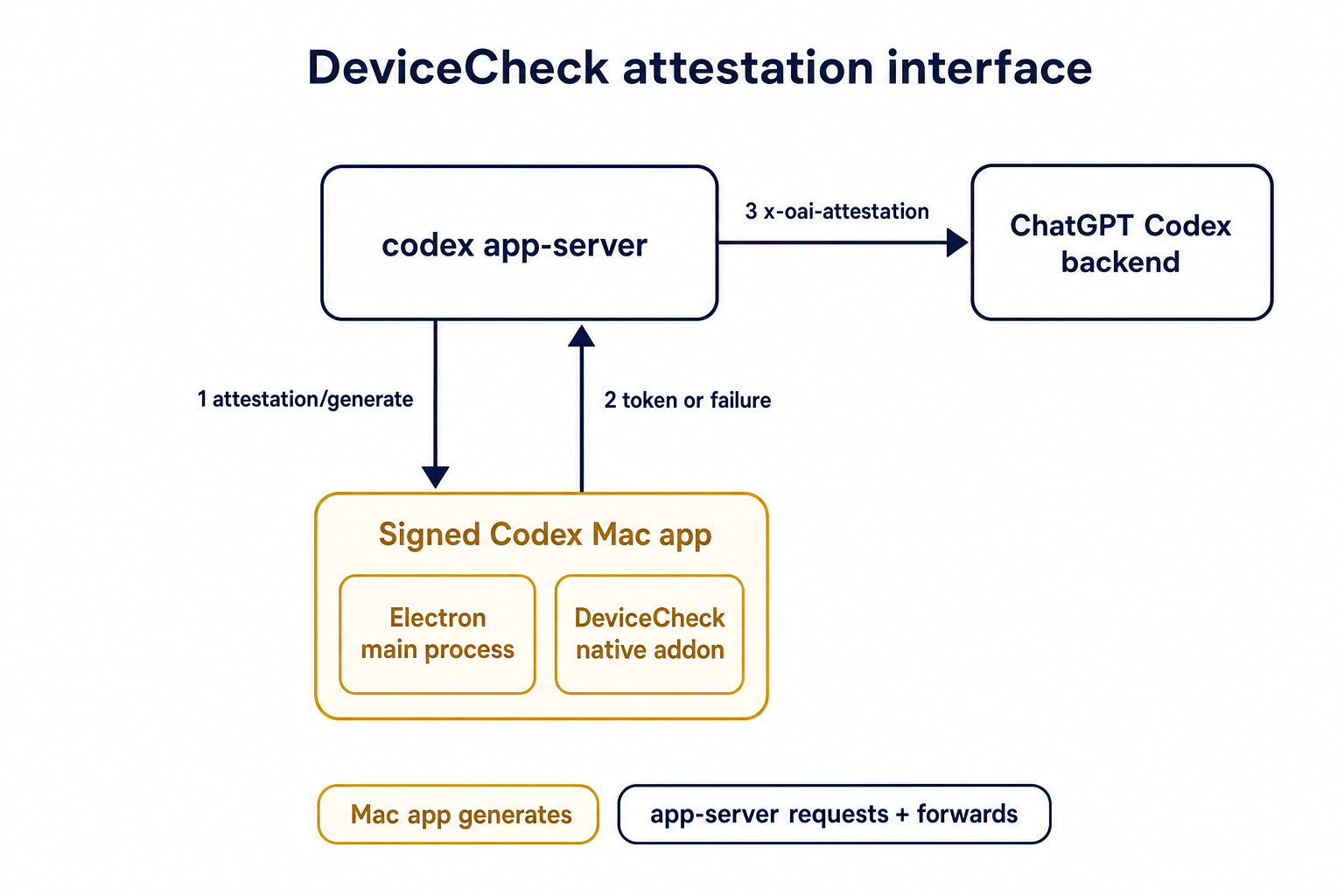 ## Details This PR teaches the Codex app-server runtime how to request and attach an attestation token. It does not generate DeviceCheck tokens directly; instead, it relies on the connected desktop app to advertise that it can generate attestation and then asks that app for a fresh header value when needed. The flow is: 1. The Codex desktop app connects to app-server. 2. During `initialize`, the app can advertise that it supports `requestAttestation`. 3. Before app-server calls selected ChatGPT Codex endpoints, it sends the internal server request `attestation/generate` to the app. 4. app-server receives a pre-encoded header value back. 5. app-server forwards that value as `x-oai-attestation` on the scoped outbound requests. The code in this repo is mostly protocol and runtime plumbing: it adds the app-server request/response shape, introduces an attestation provider in core, wires that provider into Responses / compaction / realtime setup paths, and covers the intended scoping with tests. The signed macOS DeviceCheck generation remains owned by the desktop app PR. ## Related PR - Codex desktop app implementation: https://github.com/openai/openai/pull/878649 ## Validation <details> <summary>Tests run</summary> ```sh cargo test -p codex-app-server-protocol cargo test -p codex-core attestation --lib cargo test -p codex-app-server --lib attestation ``` Also ran: ```sh just fix -p codex-core just fix -p codex-app-server just fix -p codex-app-server-protocol just fmt just write-app-server-schema ``` </details> <details> <summary>E2E DeviceCheck validation</summary> First validated the signed desktop app boundary directly: launched a packaged signed `Codex.app`, sent `attestation/generate`, decoded the returned `v1.` attestation header, and validated the extracted DeviceCheck token with `personal/jm/verify_devicecheck_token.py` using bundle ID `com.openai.codex`. Apple returned `status_code: 200` and `is_ok: true`. Then ran the fuller app + app-server flow. The packaged `Codex.app` launched a current-branch app-server via `CODEX_CLI_PATH`, and a local MITM proxy intercepted outbound `chatgpt.com` traffic. The app-server requested `attestation/generate` from the real Electron app process, and the intercepted `/backend-api/codex/responses` traffic included `x-oai-attestation` on both routes: ```text GET /backend-api/codex/responses Upgrade: websocket x-oai-attestation: present POST /backend-api/codex/responses Upgrade: none x-oai-attestation: present ``` The captured header decoded to a DeviceCheck token that also validated with Apple for `com.openai.codex` (`status_code: 200`, `is_ok: true`, team `2DC432GLL2`). </details> --------- Co-authored-by: Codex <noreply@openai.com> |
||
 pakrym-oaiandGitHub pakrym-oaiandGitHub
|
a8488fec5e |
Revert state DB injection and agent graph store (#21481)
## Why Reverts #20689 to restore the previous optional state DB plumbing. The conflict resolution keeps the newer installation ID and session/thread identity changes that landed after #20689, while removing the mandatory state DB and agent graph store dependency from ThreadManager construction. ## What changed - Restored `Option<StateDbHandle>` through app-server, MCP server, prompt debug, and test entry points. - Removed the `codex-core` dependency on `codex-agent-graph-store` and reverted descendant lookup back to the existing state DB path when available. - Kept newer `installation_id` forwarding by passing it beside the optional DB handle. - Kept local thread-name updates working when the optional state DB handle is absent. ## Validation - `git diff --check` - `cargo test -p codex-thread-store` - `cargo test -p codex-state -p codex-rollout -p codex-app-server-protocol` - Attempted `env CARGO_INCREMENTAL=0 cargo test -p codex-core -p codex-app-server -p codex-app-server-client -p codex-mcp-server -p codex-thread-manager-sample -p codex-tui`; blocked locally by a rustc ICE while compiling `v8 v146.4.0` with `rustc 1.93.0 (254b59607 2026-01-19)` on `aarch64-apple-darwin`. |
||
|
|
8f3bb355f4 |
Move installation ID resolution out of core startup (#21182)
## Summary - resolve or inject the installation ID before core startup and pass it through `ThreadManager`, `CodexSpawnArgs`, and `Session` as a plain `String` - keep child sessions on the parent installation ID instead of rediscovering it inside core - propagate installation ID startup failures in `mcp-server` instead of panicking ## Why Core was still touching the filesystem on the session startup path to discover `installation_id`. This moves that work to the outer host boundary so core no longer depends on `codex_home` reads during session construction. --------- Co-authored-by: Codex <noreply@openai.com> |
||
 aaronl-openaiandGitHub aaronl-openaiandGitHub
|
9f06d171e2 |
Preserve session MCP config on refresh (#21055)
# Overview MCP refreshes were rebuilding active threads from fresh disk-backed config only, which dropped thread-start session overlays such as app-injected MCP servers. This keeps refreshes current with disk config while preserving the thread-local config that only the active thread knows about. # Changes - Rebuild refreshed config per active thread using that thread's current `cwd`, rather than fanning out one app-server config to every thread. - Preserve each thread's `SessionFlags` layer while replacing reloadable config layers with freshly loaded config, then derive the MCP refresh payload from the rebuilt result. - Move MCP refresh orchestration into app-server so manual refreshes fail loudly while background refreshes remain best-effort, and route plugin-triggered refreshes through the same per-thread reload path. - Add regression coverage for session overlays, fresh project config, plugin-derived MCP config, current requirements, and strict vs best-effort refresh behavior. # Verification - Passed focused Rust coverage for the thread-config rebuild behavior and deferred MCP refresh flow, plus `cargo test -p codex-app-server --lib`. - Verified end to end in the Codex dev app against the locally built CLI: registered an MCP via thread config, verified that it could be used successfully before refresh, manually triggered MCP refresh, and verified that it continued to be available afterward. |
