Stacked on #28822.
## Summary
- add a host-injectable current-time provider with a built-in system
implementation
- record UTC developer reminders in history immediately before due model
requests
- keep cadence state per session and force a refresh after compaction
This does NOT include the app server client <-> server clock logic. This
PR is only for the reminder message & system clock that will be used in
prod.
## Testing
- `just test -p codex-core varlatency_`
- `just clippy -p codex-core -p codex-app-server -p codex-mcp-server -p
codex-thread-manager-sample`
- `just fmt`
## Why
Host skill discovery was still exposed as a manager even though it is a
process-owned service shared by sessions, the app-server catalog, and
file-watcher invalidation. The skills extension also consumed an ad hoc
loaded-skills wrapper instead of a named immutable snapshot.
## What changed
- replace `SkillsManager` with concrete `SkillsService`
- make the service cache and return immutable `HostSkillsSnapshot`
values
- migrate the skills extension host provider to the snapshot boundary
- migrate app-server catalog, watcher, and invalidation paths to the
service
This keeps the service limited to host discovery, caching, roots, and
invalidation. Catalog rendering and invocation remain extension
responsibilities for the next stacked change.
## Why
Shell snapshots are currently session-scoped even though shell and cwd
are properties of a selected turn environment. That makes snapshot
refresh depend on separate session-cwd plumbing, prevents retained
environments from retaining their snapshot work, and can make snapshot
construction use a different shell than command execution.
This follows #27955 by making the retained thread-environment service
own environment snapshot lifecycles. Session configuration remains the
requested selection state, while `ThreadEnvironments` remains the source
of successfully resolved environments.
## What changed
- Configure the shell-snapshot builder before initial environment
resolution.
- Start each local environment snapshot task when its `TurnEnvironment`
is built and retain that shared task while environment ID and cwd still
match.
- Inherit retained environment snapshots into spawned child threads.
- Carry the selected `TurnEnvironment` through shell runtimes so
snapshot construction and command execution use the same
environment-specific shell and cwd.
- Load project instructions and warm plugins/skills after initial
environment resolution.
- Continue decoding invalid UTF-8 instruction files lossily without
emitting a startup warning.
- Keep requested selections in `SessionConfiguration`; failed or
duplicate resolutions only affect the resolved environment snapshot.
## Validation
- `cargo check -p codex-core --tests`
- `just test -p codex-home instructions` (6 passed)
- Focused environment, instruction, shell-snapshot, and user-shell tests
(84 passed)
- Focused shell-snapshot, user-shell, and unified-exec tests (126
passed; two event-timing tests passed on retry)
## Why
Selected execution environments are thread-scoped resources, but startup
and turn construction repeatedly resolved their IDs and working
directories. That discarded existing environment handles and shell
metadata even when a selection had not changed.
Session configuration updates also need to affect future turns without
changing the resolved environment set already captured by a running
turn.
## What changed
- Create a `ThreadEnvironments` service inside `Codex` from the spawned
`EnvironmentManager` and raw environment selections, then store it on
`SessionServices`.
- Split service construction from `update_selections`, allowing session
configuration updates to mutate the resolved set in place.
- Retain an existing `TurnEnvironment` when its environment ID and
working directory match; resolve only added or changed selections and
remove selections that are no longer present.
- Normalize duplicate IDs by keeping the first selection and skip
individual selections that fail to resolve instead of rejecting the
entire update.
- Give each `TurnContext` a cloned `TurnEnvironmentSnapshot`, so later
session configuration updates affect future turns without rewriting an
active turn.
- Reuse the service-owned environment manager and resolved snapshot for
startup work, MCP initialization, and child-thread spawning instead of
flowing resolved environments through spawn arguments.
## Test plan
- `cargo check -p codex-core --tests`
- `just test -p codex-core environment_selection`
- `just test -p codex-core turn_environments`
- `just test -p codex-core
session_update_settings_does_not_rewrite_sticky_environment_cwds`
- `just test -p codex-core
default_turn_does_not_overlay_legacy_fallback_cwd_onto_stored_thread_environments`
## Why
Tool router construction rebuilds the deferred-tool BM25 index during
session initialization and before each sampling continuation, even when
the searchable tool metadata is unchanged. Local profiling measured
`append_tool_search_executor` at roughly 113 ms per continuation, making
repeated index construction the largest measured router-building cost.
## What changed
- Add a session-scoped `ToolSearchHandlerCache` so continuations and
user turns can reuse the existing handler.
- Key reuse on the complete ordered `Vec<ToolSearchInfo>`, rebuilding
when searchable text, loadable tool specs, source metadata, or ordering
changes.
- Build handlers outside the cache lock and recheck before publishing
them, avoiding holding the mutex during index construction.
## Verification
- `cache_reuses_identical_search_infos_and_rebuilds_changed_inputs`
covers exact cache reuse and invalidation when the ordered search
metadata changes.
- Local rollout profiling showed the initial router build populating the
cache and unchanged later continuations reusing it:
- uncached: 118 ms median across 14 spans from 3 rollouts
- cached: 4 ms median across 12 spans from 3 rollouts
## Why
Shell snapshot lifecycle state was split between `Shell` and
`SessionServices`: `Shell` carried the receiver while session code
exposed and forwarded the raw sender. That coupled shell identity to
mutable snapshot state and made refresh, inheritance, and file lifetime
harder to reason about.
## What changed
- make each `Arc<ShellSnapshot>` represent one cwd-specific snapshot
generation
- store the active generation in `SessionServices` with `ArcSwapOption`
- have construction start the background build and expose only a
cwd-validated snapshot path
- use `ShellSnapshotFile` ownership to delete snapshot files
automatically
- pass snapshot paths explicitly to shell runtimes instead of storing
snapshot state on `Shell`
- preserve inherited and in-flight generations by pinning their `Arc`
while they are in use
## Test plan
- `cargo check -p codex-core --lib`
- `just test -p codex-core 'shell_snapshot::tests'`
- `just test -p codex-core
shell_command_snapshot_still_intercepts_apply_patch`
- `just test -p codex-core
shell_snapshot_deleted_after_shutdown_with_skills`
## Why
`selectedCapabilityRoots` belongs to one thread, but MCP contributors
previously received only the global Codex config. That left no clean way
for a selected executor capability to contribute MCP servers to its own
thread.
## What this PR does
- Gives MCP contributors a small context containing the config and, for
a running thread, its frozen host-seeded inputs.
- Uses the same thread inputs during startup, status queries, refreshes,
and skill dependency checks.
- Keeps threadless MCP operations and the existing hosted Apps behavior
unchanged.
- Adds coverage showing that two threads resolve independent
registrations and that later lifecycle mutations do not change the
frozen MCP inputs.
This PR does not discover plugin manifests, add MCP servers, or launch
anything new. It only establishes the thread-scoped registration
boundary.
## Follow-ups
- Resolve selected executor plugin roots through their owning
environment filesystem.
- Convert their stdio MCP declarations into environment-bound
registrations and add an executor MCP end-to-end test.
## Verification
- `just fmt`
- `cargo check --tests -p codex-protocol -p codex-extension-api -p
codex-mcp-extension -p codex-core -p codex-app-server`
Tests and Clippy were not run.
## Why
#27198 made the extension-owned `codex_apps` MCP connection the hosted
plugin runtime, but its `mcp/skill` resources still bypassed the skills
extension. App-server could list and read those resources through
generic MCP APIs, but a thread with no selected environment did not
expose them in the model's skills catalog or load their `SKILL.md`
through `$skill`.
Hosted skills should stay remote while using the same typed catalog,
source authority, deduplication, bounded contextual catalog, and
selected-skill prompt injection as host and executor skills. They should
not be downloaded or exposed as ambient filesystem paths.
## What changed
- Add a session-scoped `McpResourceClient` over the replaceable MCP
connection manager so resource list/read calls follow startup and
refresh replacements.
- Add a `BackendSkillProvider` that pages `codex_apps` resources,
accepts bounded and validated `mcp/skill` entries, and reads a selected
skill's `SKILL.md` through the same MCP connection.
- Register the remote provider in app-server and include it in the
skills catalog even when a thread has no selected capability roots or
executor.
- Contribute hosted skill metadata through the bounded
`AvailableSkillsInstructions` developer-context path, exclude remote
entries from per-turn catalog injection, and classify `<skills>`
messages as contextual developer content so rollback can trim and
rebuild them correctly.
## Testing
- Extend the app-server MCP resource integration test with
`environments: []` to exercise two-page discovery, filter a
non-`mcp/skill` resource, verify the escaped developer catalog entry and
user-role `<skill>` fragment containing the fetched `SKILL.md`, and
preserve generic MCP resource reads.
- Add core event-mapping coverage that classifies `<skills>` developer
messages as contextual history.
## Summary
We originally addressed startup prewarming holding the read side of
`RwLock<McpConnectionManager>` by snapshotting tool-list state. Review
feedback identified the broader ownership problem: the outer
synchronization should only publish or retrieve the current manager,
while MCP operations rely on the manager's internal synchronization. A
follow-up preserved operation retirement with a separate gate, but
further review questioned whether that synchronization was actually
required and whether we could support latest-wins replacement instead.
This PR now stores the current MCP manager in `ArcSwap`. Each operation
uses `load_full()` to obtain an owned `Arc<McpConnectionManager>`, then
performs MCP I/O without retaining the publication mechanism. Refresh
cancels obsolete startup work, constructs a replacement, and atomically
publishes it. New operations see the latest manager, while operations
that already loaded the previous manager retain a valid handle. Refresh
happens at a turn boundary, so there should be no active user tool calls
to drain.
Git history supports dropping the outer `RwLock`. It was introduced in
`03ffe4d595` on November 17, 2025 for non-blocking MCP startup: the
session published an empty manager, startup initialized that same object
while holding the write lock, and readers waited for initialization.
`7cd2e84026` on February 19, 2026 removed that two-phase initialization
in favor of constructing a fresh manager and swapping it in, explicitly
noting that `Option` or `OnceCell` could replace the placeholder design.
Hot reload later reused the existing lock to publish a replacement, but
I found no indication that the lock was introduced to guarantee
in-flight tool calls finish before refresh or shutdown.
Terminal shutdown remains separate from refresh: it aborts startup
prewarming and active tasks before shutting down the current manager, so
tool calls may be interrupted and no model WebSocket work continues
after shutdown. Focused regression coverage exercises pending tool-list
cancellation, deferred refresh, and startup-prewarm shutdown.
## Why
Required MCP server startup was enforced in `Session::new` after
`McpConnectionManager` had already created the clients. That split let
other manager construction paths bypass the same requirement and exposed
manager internals solely so the session could validate them. Keeping
required-server readiness in the constructor gives every caller one
consistent startup contract.
## What changed
- make `McpConnectionManager::new` return `anyhow::Result<Self>` and
fail when an enabled, required server cannot initialize
- pass the startup cancellation token into the constructor so
required-server waits remain cancellable
- propagate constructor failures through resource reads, connector
discovery, and MCP status collection
- preserve the active manager and cancellation token when a refreshed
replacement fails
- keep required-startup failure collection private and cover the
constructor error contract directly
## Validation
- updated the focused connection-manager test to assert the complete
required-server startup error
- local tests not run; relying on CI
## Why
Once a named permission profile is selected, runtime state has to keep
that profile identity intact instead of collapsing back to anonymous
effective permissions. The session refresh path also needs to rebuild
profile-derived network proxy state so active profile switches take
effect consistently.
## What changed
- Preserve the active permission profile through session updates.
- Rebuild profile-derived runtime/network configuration when the active
profile changes.
- Keep the runtime path aligned with the current session configuration
APIs.
- Tighten the affected tests, including the Windows delete-pending
memory-file case that was intermittently tripping CI.
## Stack
1. **This PR**: runtime/session/network propagation for active
permission profiles.
2. [#23708](https://github.com/openai/codex/pull/23708): TUI selection
plumbing and guardrail flow.
3. [#21559](https://github.com/openai/codex/pull/21559): profile-aware
`/permissions` menu and custom profile display.
<img width="1296" height="906" alt="image"
src="https://github.com/user-attachments/assets/077fa3a7-80cb-4925-80b1-d2395018d90a"
/>
## Why
[#21736](https://github.com/openai/codex/pull/21736) introduces the
typed extension API, but the runtime does not yet carry a registry
through thread/session startup or give contributors host-owned stores to
read from. This PR wires that host-side path so later feature migrations
can move product-specific behavior behind typed contributions without
adding another bespoke seam directly to `codex-core`.
## What changed
- Thread `ExtensionRegistry<Config>` through `ThreadManager`,
`CodexSpawnArgs`, `Session`, and sub-agent spawn paths.
- Wire `ThreadStartContributor` and `ContextContributor`
- Expose the small supporting surface needed by non-core callers that
construct threads directly, including `empty_extension_registry()`
through `codex-core-api`.
This PR lands the host plumbing only: the app-server registry is still
empty, and concrete feature migrations are intended to follow
separately.
## Why
PR #21460 reverted the earlier move of skills change watching from
`codex-core` into app-server. This reapplies that boundary change so
app-server owns client-facing `skills/changed` notifications and core no
longer carries the watcher.
## What
- Restore the app-server `SkillsWatcher` and register it from thread
listener setup.
- Remove the core-owned skills watcher and its core live-reload
integration surface.
- Restore app-server coverage for `skills/changed` notifications after a
watched skill file changes.
## Validation
- `cargo test -p codex-app-server --test all
suite::v2::skills_list::skills_changed_notification_is_emitted_after_skill_change
-- --exact --nocapture`
- `cargo test -p codex-core --lib --no-run`
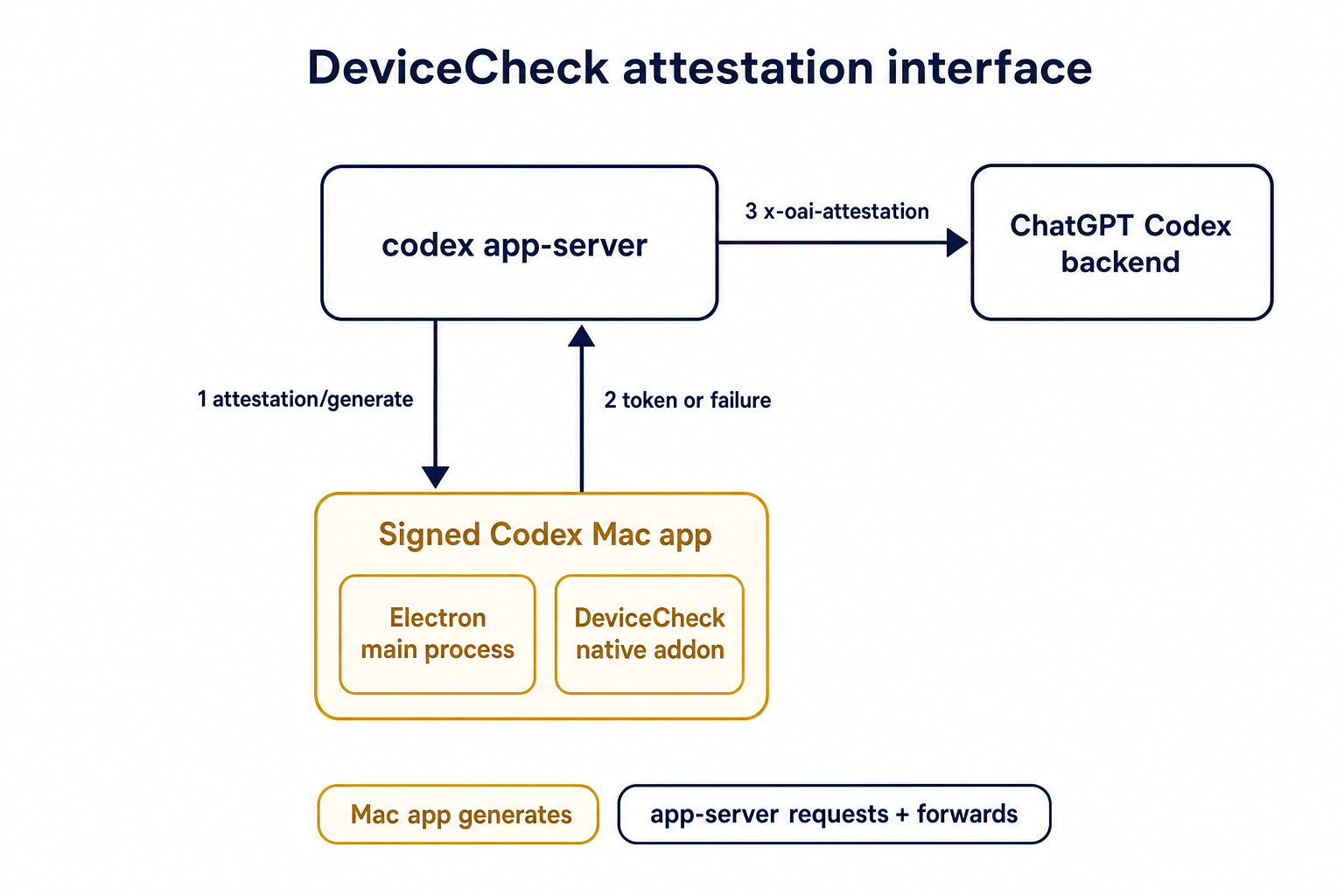
## Summary
TL;DR: teaches `codex-rs` / app-server to request a desktop-provided
attestation token and attach it as `x-oai-attestation` on the scoped
ChatGPT Codex request paths.

## Details
This PR teaches the Codex app-server runtime how to request and attach
an attestation token. It does not generate DeviceCheck tokens directly;
instead, it relies on the connected desktop app to advertise that it can
generate attestation and then asks that app for a fresh header value
when needed.
The flow is:
1. The Codex desktop app connects to app-server.
2. During `initialize`, the app can advertise that it supports
`requestAttestation`.
3. Before app-server calls selected ChatGPT Codex endpoints, it sends
the internal server request `attestation/generate` to the app.
4. app-server receives a pre-encoded header value back.
5. app-server forwards that value as `x-oai-attestation` on the scoped
outbound requests.
The code in this repo is mostly protocol and runtime plumbing: it adds
the app-server request/response shape, introduces an attestation
provider in core, wires that provider into Responses / compaction /
realtime setup paths, and covers the intended scoping with tests. The
signed macOS DeviceCheck generation remains owned by the desktop app PR.
## Related PR
- Codex desktop app implementation:
https://github.com/openai/openai/pull/878649
## Validation
<details>
<summary>Tests run</summary>
```sh
cargo test -p codex-app-server-protocol
cargo test -p codex-core attestation --lib
cargo test -p codex-app-server --lib attestation
```
Also ran:
```sh
just fix -p codex-core
just fix -p codex-app-server
just fix -p codex-app-server-protocol
just fmt
just write-app-server-schema
```
</details>
<details>
<summary>E2E DeviceCheck validation</summary>
First validated the signed desktop app boundary directly: launched a
packaged signed `Codex.app`, sent `attestation/generate`, decoded the
returned `v1.` attestation header, and validated the extracted
DeviceCheck token with `personal/jm/verify_devicecheck_token.py` using
bundle ID `com.openai.codex`. Apple returned `status_code: 200` and
`is_ok: true`.
Then ran the fuller app + app-server flow. The packaged `Codex.app`
launched a current-branch app-server via `CODEX_CLI_PATH`, and a local
MITM proxy intercepted outbound `chatgpt.com` traffic. The app-server
requested `attestation/generate` from the real Electron app process, and
the intercepted `/backend-api/codex/responses` traffic included
`x-oai-attestation` on both routes:
```text
GET /backend-api/codex/responses Upgrade: websocket x-oai-attestation: present
POST /backend-api/codex/responses Upgrade: none x-oai-attestation: present
```
The captured header decoded to a DeviceCheck token that also validated
with Apple for `com.openai.codex` (`status_code: 200`, `is_ok: true`,
team `2DC432GLL2`).
</details>
---------
Co-authored-by: Codex <noreply@openai.com>
## Why
Skills update notifications are app-server API behavior, but the watcher
lived in `codex-core` and surfaced through
`EventMsg::SkillsUpdateAvailable`. Moving the watcher out keeps core
focused on thread execution and lets app-server own both cache
invalidation and the `skills/changed` notification.
## What changed
- Added an app-server-owned skills watcher that watches local skill
roots, clears the shared skills cache, and emits `skills/changed`
directly.
- Registers skill watches from the common app-server thread listener
attach path, including direct starts, resumes, and app-server-observed
child or forked threads.
- Stores the `WatchRegistration` on `ThreadState`, so listener
replacement, thread teardown, idle unload, and app-server shutdown
deregister by dropping the RAII guard.
- Removed `EventMsg::SkillsUpdateAvailable`, the core watcher, and the
old core live-reload test.
- Extended the app-server skills change test to verify a cached skills
list is refreshed after a filesystem change without forcing reload.
## Validation
- `cargo check -p codex-core -p codex-app-server -p codex-mcp-server -p
codex-rollout -p codex-rollout-trace`
- `cargo test -p codex-app-server
skills_changed_notification_is_emitted_after_skill_change`
## Why
After `hooks/list` exposes the hook inventory, clients need a way to
persist user hook preferences, make those changes effective in
already-open sessions, and distinguish user-controllable hooks from
managed requirements without adding another bespoke app-server write
API.
## What
- Extends `hooks/list` entries with effective `enabled` state.
- Persists user-level hook state under `hooks.state.<hook-id>` so the
model can grow beyond a single boolean over time.
- Uses the existing `config/batchWrite` path for hook state updates
instead of introducing a dedicated hook write RPC.
- Refreshes live session hook engines after config writes so
already-open threads observe updated enablement without a restart.
## Stack
1. openai/codex#19705
2. openai/codex#19778
3. This PR - openai/codex#19840
4. openai/codex#19882
## Reviewer Notes
The generated schema files account for much of the raw diff. The core
behavior is in:
- `hooks/src/config_rules.rs`, which resolves per-hook user state from
the config layer stack.
- `hooks/src/engine/discovery.rs`, which projects effective enablement
into `hooks/list` from source-derived managedness.
- `config/src/hook_config.rs`, which defines the new `hooks.state`
representation.
- `core/src/session/mod.rs`, which rebuilds live hook state after user
config reloads.
---------
Co-authored-by: Codex <noreply@openai.com>
## Why
`codex-models-manager` had grown to own provider-specific concerns:
constructing OpenAI-compatible `/models` requests, resolving provider
auth, emitting request telemetry, and deciding how provider catalogs
should be sourced. That made the manager harder to reuse for providers
whose model catalog is not fetched from the OpenAI `/models` endpoint,
such as Amazon Bedrock.
This change moves provider-specific model discovery behind
provider-owned implementations, so the models manager can focus on
refresh policy, cache behavior, picker ordering, and model metadata
merging.
## What Changed
- Introduced a `ModelsManager` trait with separate `OpenAiModelsManager`
and `StaticModelsManager` implementations.
- Added `ModelsEndpointClient` so OpenAI-compatible HTTP fetching lives
outside `codex-models-manager`.
- Moved `/models` request construction, provider auth resolution,
timeout handling, and request telemetry into `codex-model-provider` via
`OpenAiModelsEndpoint`.
- Added provider-owned `models_manager(...)` construction so configured
OpenAI-compatible providers use `OpenAiModelsManager`, while
static/catalog-backed providers can return `StaticModelsManager`.
- Added an Amazon Bedrock static model catalog for the GPT OSS Bedrock
model IDs.
- Updated core/session/thread manager code and tests to depend on
`Arc<dyn ModelsManager>`.
- Moved offline model test helpers into
`codex_models_manager::test_support`.
## Metadata References
The Bedrock catalog metadata is based on the official Amazon Bedrock
OpenAI model documentation:
- [Amazon Bedrock OpenAI
models](https://docs.aws.amazon.com/bedrock/latest/userguide/model-parameters-openai.html)
lists the Bedrock model IDs, text input/output modalities, and `128,000`
token context window for `gpt-oss-20b` and `gpt-oss-120b`.
- [Amazon Bedrock `gpt-oss-120b` model
card](https://docs.aws.amazon.com/bedrock/latest/userguide/model-card-openai-gpt-oss-120b.html)
lists the `bedrock-runtime` model ID `openai.gpt-oss-120b-1:0`, the
`bedrock-mantle` model ID `openai.gpt-oss-120b`, text-only modalities,
and `128K` context window.
- [OpenAI `gpt-oss-120b` model
docs](https://developers.openai.com/api/docs/models/gpt-oss-120b)
document configurable reasoning effort with `low`, `medium`, and `high`,
plus text input/output modality.
The display names, default reasoning effort, and priority ordering are
Codex-local catalog choices.
## Test Plan
- Manually verified app-server model listing with an AWS profile:
```shell
CODEX_HOME="$(mktemp -d)" cargo run -p codex-app-server-test-client -- \
--codex-bin ./target/debug/codex \
-c 'model_provider="amazon-bedrock"' \
-c 'model_providers.amazon-bedrock.aws.profile="codex-bedrock"' \
-c 'model_providers.amazon-bedrock.aws.region="us-west-2"' \
model-list
```
The response returned the Bedrock catalog with `openai.gpt-oss-120b-1:0`
as the default model and `openai.gpt-oss-20b-1:0` as the second listed
model, both text-only and supporting low/medium/high reasoning effort.
## Summary
Adds the debug CLI entry point for reducing recorded rollout traces.
This gives developers a direct way to inspect whether the emitted trace
stream reduces into the expected conversation/runtime model.
## Stack
This is PR 5/5 in the rollout trace stack.
- [#18876](https://github.com/openai/codex/pull/18876): Add rollout
trace crate
- [#18877](https://github.com/openai/codex/pull/18877): Record core
session rollout traces
- [#18878](https://github.com/openai/codex/pull/18878): Trace tool and
code-mode boundaries
- [#18879](https://github.com/openai/codex/pull/18879): Trace sessions
and multi-agent edges
- [#18880](https://github.com/openai/codex/pull/18880): Add debug trace
reduction command
## Review Notes
This PR is intentionally last: it depends on the trace crate, core
recorder, runtime/tool events, and session/agent edge data all existing.
The command should remain a debug/developer tool and avoid adding new
runtime behavior.
The useful review question is whether the CLI exposes the reducer in the
smallest practical way for local inspection without turning the debug
command into a supported user-facing workflow.
Begin migrating the thread write codepaths to ThreadStore.
This starts using ThreadStore inside of core session code, not only in
the app server code.
Rework the interfaces around thread recording/persistence. We're left
with the following:
* `ThreadManager`: owns the process-level registry of loaded threads and
handles cross-thread orchestration: start, resume, fork, lookup, remove,
and route ops to running CodexThreads.
* `CodexThread`: represents one loaded/running thread from the outside.
It is the handle app-server and callers use to submit ops, inspect
session metadata, and shut the thread down.
* `LiveThread`: session-owned persistence lifecycle handle for one
active thread. Core session code uses it to append rollout items,
materialize lazy persistence, flush, shutdown, discard init-failed
writers, and load that thread’s persisted history.
* `ThreadStore`: storage backend abstraction. It answers “how are
threads persisted, read, listed, updated, archived?” Local and remote
implementations live behind this trait.
* `LocalThreadStore`: local ThreadStore implementation. It owns the
file/sqlite-specific details and keeps RolloutRecorder as a local
implementation detail.
This is a few too many Thread abstractions for my liking, but they do
all represent different concepts / needs / layers.
Migration note: in places where the core code explicitly requires a
path, rather than a thread ID, throw an error if we're running with a
remote store.
Cover the new local live-writer lifecycle with focused tests and
preserve app-server thread-start behavior, including ephemeral pathless
sessions.
## Summary
Short circuit the convo if auto-review hits too many denials
## Testing
- [x] Added unit tests
---------
Co-authored-by: Codex <noreply@openai.com>
## Summary
Wires rollout trace recording into `codex-core` session and turn
execution. This records the core model request/response, compaction, and
session lifecycle boundaries needed for replay without yet tracing every
nested runtime/tool boundary.
## Stack
This is PR 2/5 in the rollout trace stack.
- [#18876](https://github.com/openai/codex/pull/18876): Add rollout
trace crate
- [#18877](https://github.com/openai/codex/pull/18877): Record core
session rollout traces
- [#18878](https://github.com/openai/codex/pull/18878): Trace tool and
code-mode boundaries
- [#18879](https://github.com/openai/codex/pull/18879): Trace sessions
and multi-agent edges
- [#18880](https://github.com/openai/codex/pull/18880): Add debug trace
reduction command
## Review Notes
This layer is the first live integration point. The important review
question is whether trace recording is isolated from normal session
behavior: trace failures should not become user-visible execution
failures, and recording should preserve the existing turn/session
lifecycle semantics.
The PR depends on the reducer/data model from the first stack entry and
only introduces the core recorder surface that later PRs use for richer
runtime and relationship events.
## Summary
This PR fully reverts the previously merged Agent Identity runtime
integration from the old stack:
https://github.com/openai/codex/pull/17387/changes
It removes the Codex-side task lifecycle wiring, rollout/session
persistence, feature flag plumbing, lazy `auth.json` mutation,
background task auth paths, and request callsite changes introduced by
that stack.
This leaves the repo in a clean pre-AgentIdentity integration state so
the follow-up PRs can reintroduce the pieces in smaller reviewable
layers.
## Stack
1. This PR: full revert
2. https://github.com/openai/codex/pull/18871: move Agent Identity
business logic into a crate
3. https://github.com/openai/codex/pull/18785: add explicit
AgentIdentity auth mode and startup task allocation
4. https://github.com/openai/codex/pull/18811: migrate auth callsites
through AuthProvider
## Testing
Tests: targeted Rust checks, cargo-shear, Bazel lock check, and CI.
Builds on top of #17659
Move the filesystem + sqlite thread listing-related operations inside of
a local ThreadStore implementation and call ThreadStore from the places
that used to perform these filesystem/sqlite operations.
This is the first of a series of PRs that will implement the rest of the
local ThreadStore.
Testing:
- added unit tests for the thread store implementation
- adjusted some unit tests in the realtime + personality packages whose
callsites changed. Specifically I'm trying to hide ThreadMetadata inside
of the local implementation and make ThreadMetadata a sqlite
implementation detail concern rather than a public interface, preferring
the more generate StoredThread interface instead
- added a corner case test for the personality migration package that
wasn't covered by the existing test suite
- adjust the behavior of searched thread listing to run the existing
local rollout repair/backfill pass _before_ querying SQLite results, so
callers using ThreadStore::list_threads do not miss matches after a
partial metadata warm-up
## Summary
Stack PR 2 of 4 for feature-gated agent identity support.
This PR adds agent identity registration behind
`features.use_agent_identity`. It keeps the app-server protocol
unchanged and starts registration after ChatGPT auth exists rather than
requiring a client restart.
## Stack
- PR1: https://github.com/openai/codex/pull/17385 - add
`features.use_agent_identity`
- PR2: https://github.com/openai/codex/pull/17386 - this PR
- PR3: https://github.com/openai/codex/pull/17387 - register agent tasks
when enabled
- PR4: https://github.com/openai/codex/pull/17388 - use `AgentAssertion`
downstream when enabled
## Validation
Covered as part of the local stack validation pass:
- `just fmt`
- `cargo test -p codex-core --lib agent_identity`
- `cargo test -p codex-core --lib agent_assertion`
- `cargo test -p codex-core --lib websocket_agent_task`
- `cargo test -p codex-api api_bridge`
- `cargo build -p codex-cli --bin codex`
## Notes
The full local app-server E2E path is still being debugged after PR
creation. The current branch stack is directionally ready for review
while that follow-up continues.
## Description
This PR introduces `review_id` as the stable identifier for guardian
reviews and exposes it in app-server `item/autoApprovalReview/started`
and `item/autoApprovalReview/completed` events.
Internally, guardian rejection state is now keyed by `review_id` instead
of the reviewed tool item ID. `target_item_id` is still included when a
review maps to a concrete thread item, but it is no longer overloaded as
the review lifecycle identifier.
## Motivation
We'd like to give users the ability to preempt a guardian review while
it's running (approve or decline).
However, we can't implement the API that allows the user to override a
running guardian review because we didn't have a unique `review_id` per
guardian review. Using `target_item_id` is not correct since:
- with execve reviews, there can be multiple execve calls (and therefore
guardian reviews) per shell command
- with network policy reviews, there is no target item ID
The PR that actually implements user overrides will use `review_id` as
the stable identifier.
## Summary
- reduce public module visibility across Rust crates, preferring private
or crate-private modules with explicit crate-root public exports
- update external call sites and tests to use the intended public crate
APIs instead of reaching through module trees
- add the module visibility guideline to AGENTS.md
## Validation
- `cargo check --workspace --all-targets --message-format=short` passed
before the final fix/format pass
- `just fix` completed successfully
- `just fmt` completed successfully
- `git diff --check` passed
## Summary
- make `CODEX_EXEC_SERVER_URL=none` map to an explicit disabled
environment mode instead of inferring from a missing URL
- expose environment capabilities (`exec_enabled`, `filesystem_enabled`)
so tool building can gate behavior explicitly and future
multi-environment work has a clearer seam
- suppress env-backed tools when the relevant capability is unavailable,
including exec tools, `js_repl`, `apply_patch`, `list_dir`, and
`view_image`
- keep handler/runtime backstops so disabled environments still reject
execution if a tool path somehow bypasses registration
## Testing
- `just fmt`
- `cargo test -p codex-exec-server`
- `cargo test -p codex-tools
disabled_environment_omits_environment_backed_tools`
- `cargo test -p codex-tools
environment_capabilities_gate_exec_and_filesystem_tools_independently`
- remote devbox Bazel build via `codex-applied-devbox`:
`//codex-rs/cli:cli`
Stacked on #16508.
This removes the temporary `codex-core` / `codex-login` re-export shims
from the ownership split and rewrites callsites to import directly from
`codex-model-provider-info`, `codex-models-manager`, `codex-api`,
`codex-protocol`, `codex-feedback`, and `codex-response-debug-context`.
No behavior change intended; this is the mechanical import cleanup layer
split out from the ownership move.
---------
Co-authored-by: Codex <noreply@openai.com>
## Why
`codex-core` was re-exporting APIs owned by sibling `codex-*` crates,
which made downstream crates depend on `codex-core` as a proxy module
instead of the actual owner crate.
Removing those forwards makes crate boundaries explicit and lets leaf
crates drop unnecessary `codex-core` dependencies. In this PR, this
reduces the dependency on `codex-core` to `codex-login` in the following
files:
```
codex-rs/backend-client/Cargo.toml
codex-rs/mcp-server/tests/common/Cargo.toml
```
## What
- Remove `codex-rs/core/src/lib.rs` re-exports for symbols owned by
`codex-login`, `codex-mcp`, `codex-rollout`, `codex-analytics`,
`codex-protocol`, `codex-shell-command`, `codex-sandboxing`,
`codex-tools`, and `codex-utils-path`.
- Delete the `default_client` forwarding shim in `codex-rs/core`.
- Update in-crate and downstream callsites to import directly from the
owning `codex-*` crate.
- Add direct Cargo dependencies where callsites now target the owner
crate, and remove `codex-core` from `codex-rs/backend-client`.
## Summary
- move skill loading and management into codex-core-skills
- leave codex-core with the thin integration layer and shared wiring
## Testing
- CI
---------
Co-authored-by: Codex <noreply@openai.com>
## Summary
- move the analytics events client into codex-analytics
- update codex-core and app-server callsites to use the new crate
## Testing
- CI
---------
Co-authored-by: Codex <noreply@openai.com>
### Summary
Make `FileWatcher` a reusable core component which can be built upon.
Extract skills-related logic into a separate `SkillWatcher`.
Introduce a composable `ThrottledWatchReceiver` to throttle filesystem
events, coalescing affected paths among them.
### Testing
Updated existing unit tests.
The idea is that codex-exec exposes an Environment struct with services
on it. Each of those is a trait.
Depending on construction parameters passed to Environment they are
either backed by local or remote server but core doesn't see these
differences.
## Summary
If a subagent requests approval, and the user persists that approval to
the execpolicy, it should (by default) propagate. We'll need to rethink
this a bit in light of coming Permissions changes, though I think this
is closer to the end state that we'd want, which is that execpolicy
changes to one permissions profile should be synced across threads.
## Testing
- [x] Added integration test
---------
Co-authored-by: Codex <noreply@openai.com>
Adds an environment crate and environment + file system abstraction.
Environment is a combination of attributes and services specific to
environment the agent is connected to:
File system, process management, OS, default shell.
The goal is to move most of agent logic that assumes environment to work
through the environment abstraction.
## Summary
- persist the code mode runner process in the session-scoped code mode
store
- switch the runner protocol from `init` to `start` with explicit
session ids
- handle runner-side session processing without the init waiter queue
## Validation
- just fmt
- cargo check -p codex-core
- node --check codex-rs/core/src/tools/code_mode_runner.cjs
## Summary
This is a purely mechanical refactor of `OtelManager` ->
`SessionTelemetry` to better convey what the struct is doing. No
behavior change.
## Why
`OtelManager` ended up sounding much broader than what this type
actually does. It doesn't manage OTEL globally; it's the session-scoped
telemetry surface for emitting log/trace events and recording metrics
with consistent session metadata (`app_version`, `model`, `slug`,
`originator`, etc.).
`SessionTelemetry` is a more accurate name, and updating the call sites
makes that boundary a lot easier to follow.
## Validation
- `just fmt`
- `cargo test -p codex-otel`
- `cargo test -p codex-core`
Support loading plugins.
Plugins can now be enabled via [plugins.<name>] in config.toml. They are
loaded as first-class entities through PluginsManager, and their default
skills/ and .mcp.json contributions are integrated into the existing
skills and MCP flows.
Previous to this change, `determine_action()` would
1. check if `program` is associated with a skill
2. if so, check if `program` is in `execve_session_approvals` to see
whether the user needs to be prompted
This PR flips the order of these checks to try to set us up so that
"session approvals" are always consulted first (which should soon extend
to include session approvals derived from `prefix_rule()`s, as well).
Though to make the new ordering work, we need to record any relevant
metadata to associate with the approval, which in the case of a
skill-based approval is the `SkillMetadata` so that we can derive the
`PermissionProfile` to include with the escalation. (Though as noted by
the `TODO`, this `PermissionProfile` is not honored yet.)
The new `ExecveSessionApproval` struct is used to retain the necessary
metadata.
## What Changed
- Replace the `execve_session_approvals` `HashSet` with a map that
stores an `ExecveSessionApproval` alongside each approved `program`.
- When a user chooses `ApprovedForSession` for a skill script, capture
the matched `SkillMetadata` in the session approval entry.
- Consult that cache before re-running `find_skill()`, and reuse the
originally approved skill metadata and permission profile when allowing
later execve callbacks in the same session.
## Why
`unix_escalation.rs` checks a session-scoped approval cache before
prompting again for an execve-intercepted skill script. Without also
recording `ReviewDecision::ApprovedForSession`, that cache never gets
populated, so the same skill script can still trigger repeated approval
prompts within one session.
## What Changed
- Add `execve_session_approvals` to `SessionServices` so the session can
track approved skill script paths.
- Record the script path when a skill-script prompt returns
`ReviewDecision::ApprovedForSession`, but only for the skill-script path
rather than broader prefix-rule approvals.
- Reuse the cached approval on later execve callbacks by treating an
already-approved skill script as `Decision::Allow`.
---
[//]: # (BEGIN SAPLING FOOTER)
Stack created with [Sapling](https://sapling-scm.com). Best reviewed
with [ReviewStack](https://reviewstack.dev/openai/codex/pull/12756).
* #12758
* __->__ #12756
## Why
`codex-rs/core/src/tools/runtimes/shell/unix_escalation.rs` previously
located `codex-execve-wrapper` by scanning `PATH` and sibling
directories. That lookup is brittle and can select the wrong binary when
the runtime environment differs from startup assumptions.
We already pass `codex-linux-sandbox` from `codex-arg0`;
`codex-execve-wrapper` should use the same startup-driven path plumbing.
## What changed
- Introduced `Arg0DispatchPaths` in `codex-arg0` to carry both helper
executable paths:
- `codex_linux_sandbox_exe`
- `main_execve_wrapper_exe`
- Updated `arg0_dispatch_or_else()` to pass `Arg0DispatchPaths` to
top-level binaries and preserve helper paths created in
`prepend_path_entry_for_codex_aliases()`.
- Threaded `Arg0DispatchPaths` through entrypoints in `cli`, `exec`,
`tui`, `app-server`, and `mcp-server`.
- Added `main_execve_wrapper_exe` to core configuration plumbing
(`Config`, `ConfigOverrides`, and `SessionServices`).
- Updated zsh-fork shell escalation to consume the configured
`main_execve_wrapper_exe` and removed path-sniffing fallback logic.
- Updated app-server config reload paths so reloaded configs keep the
same startup-provided helper executable paths.
## References
- [`Arg0DispatchPaths`
definition](https://github.com/openai/codex/blob/e355b43d5c2a771f045296a6deae10d7c9c36ec6/codex-rs/arg0/src/lib.rs#L20-L24)
- [`arg0_dispatch_or_else()` forwarding both
paths](https://github.com/openai/codex/blob/e355b43d5c2a771f045296a6deae10d7c9c36ec6/codex-rs/arg0/src/lib.rs#L145-L176)
- [zsh-fork escalation using configured wrapper
path](https://github.com/openai/codex/blob/e355b43d5c2a771f045296a6deae10d7c9c36ec6/codex-rs/core/src/tools/runtimes/shell/unix_escalation.rs#L109-L150)
## Testing
- `cargo check -p codex-arg0 -p codex-core -p codex-exec -p codex-tui -p
codex-mcp-server -p codex-app-server`
- `cargo test -p codex-arg0`
- `cargo test -p codex-core tools::runtimes::shell::unix_escalation:: --
--nocapture`
## Why
This PR switches the `shell_command` zsh-fork path over to
`codex-shell-escalation` so the new shell tool can use the shared
exec-wrapper/escalation protocol instead of the `zsh_exec_bridge`
implementation that was introduced in
https://github.com/openai/codex/pull/12052. `zsh_exec_bridge` relied on
UNIX domain sockets, which is not as tamper-proof as the FD-based
approach in `codex-shell-escalation`.
## What Changed
- Added a Unix zsh-fork runtime adapter in `core`
(`core/src/tools/runtimes/shell/unix_escalation.rs`) that:
- runs zsh-fork commands through
`codex_shell_escalation::run_escalate_server`
- bridges exec-policy / approval decisions into `ShellActionProvider`
- executes escalated commands via a `ShellCommandExecutor` that calls
`process_exec_tool_call`
- Updated `ShellRuntime` / `ShellCommandHandler` / tool spec wiring to
select a `shell_command` backend (`classic` vs `zsh-fork`) while leaving
the generic `shell` tool path unchanged.
- Removed the `zsh_exec_bridge`-based session service and deleted
`core/src/zsh_exec_bridge/mod.rs`.
- Moved exec-wrapper entrypoint dispatch to `arg0` by handling the
`codex-execve-wrapper` arg0 alias there, and removed the old
`codex_core::maybe_run_zsh_exec_wrapper_mode()` hooks from `cli` and
`app-server` mains.
- Added the needed `codex-shell-escalation` dependencies for `core` and
`arg0`.
## Tests
- `cargo test -p codex-core
shell_zsh_fork_prefers_shell_command_over_unified_exec`
- `cargo test -p codex-app-server turn_start_shell_zsh_fork --
--nocapture`
- verifies zsh-fork command execution and approval flows through the new
backend
- includes subcommand approve/decline coverage using the shared zsh
DotSlash fixture in `app-server/tests/suite/zsh`
- To test manually, I added the following to `~/.codex/config.toml`:
```toml
zsh_path = "/Users/mbolin/code/codex3/codex-rs/app-server/tests/suite/zsh"
[features]
shell_zsh_fork = true
```
Then I ran `just c` to run the dev build of Codex with these changes and
sent it the message:
```
run `echo $0`
```
And it replied with:
```
echo $0 printed:
/Users/mbolin/code/codex3/codex-rs/app-server/tests/suite/zsh
In this tool context, $0 reflects the script path used to invoke the shell, not just zsh.
```
so the tool appears to be wired up correctly.
## Notes
- The zsh subcommand-decline integration test now uses `rm` under a
`WorkspaceWrite` sandbox. The previous `/usr/bin/true` scenario is
auto-allowed by the new `shell-escalation` policy path, which no longer
produces subcommand approval prompts.
zsh fork PR stack:
- https://github.com/openai/codex/pull/12051
- https://github.com/openai/codex/pull/12052👈
### Summary
This PR introduces a feature-gated native shell runtime path that routes
shell execution through a patched zsh exec bridge, removing MCP-specific
behavior from the shell hot path while preserving existing
CommandExecution lifecycle semantics.
When shell_zsh_fork is enabled, shell commands run via patched zsh with
per-`execve` interception through EXEC_WRAPPER. Core receives wrapper
IPC requests over a Unix socket, applies existing approval policy, and
returns allow/deny before the subcommand executes.
### What’s included
**1) New zsh exec bridge runtime in core**
- Wrapper-mode entrypoint (maybe_run_zsh_exec_wrapper_mode) for
EXEC_WRAPPER invocations.
- Per-execution Unix-socket IPC handling for wrapper requests/responses.
- Approval callback integration using existing core approval
orchestration.
- Streaming stdout/stderr deltas to existing command output event
pipeline.
- Error handling for malformed IPC, denial/abort, and execution
failures.
**2) Session lifecycle integration**
SessionServices now owns a `ZshExecBridge`.
Session startup initializes bridge state; shutdown tears it down
cleanly.
**3) Shell runtime routing (feature-gated)**
When `shell_zsh_fork` is enabled:
- Build execution env/spec as usual.
- Add wrapper socket env wiring.
- Execute via `zsh_exec_bridge.execute_shell_request(...)` instead of
the regular shell path.
- Non-zsh-fork behavior remains unchanged.
**4) Config + feature wiring**
- Added `Feature::ShellZshFork` (under development).
- Added config support for `zsh_path` (optional absolute path to patched
zsh):
- `Config`, `ConfigToml`, `ConfigProfile`, overrides, and schema.
- Session startup validates that `zsh_path` exists/usable when zsh-fork
is enabled.
- Added startup test for missing `zsh_path` failure mode.
**5) Seatbelt/sandbox updates for wrapper IPC**
- Extended seatbelt policy generation to optionally allow outbound
connection to explicitly permitted Unix sockets.
- Wired sandboxing path to pass wrapper socket path through to seatbelt
policy generation.
- Added/updated seatbelt tests for explicit socket allow rule and
argument emission.
**6) Runtime entrypoint hooks**
- This allows the same binary to act as the zsh wrapper subprocess when
invoked via `EXEC_WRAPPER`.
**7) Tool selection behavior**
- ToolsConfig now prefers ShellCommand type when shell_zsh_fork is
enabled.
- Added test coverage for precedence with unified-exec enabled.