## Summary
TL;DR: teaches `codex-rs` / app-server to request a desktop-provided
attestation token and attach it as `x-oai-attestation` on the scoped
ChatGPT Codex request paths.
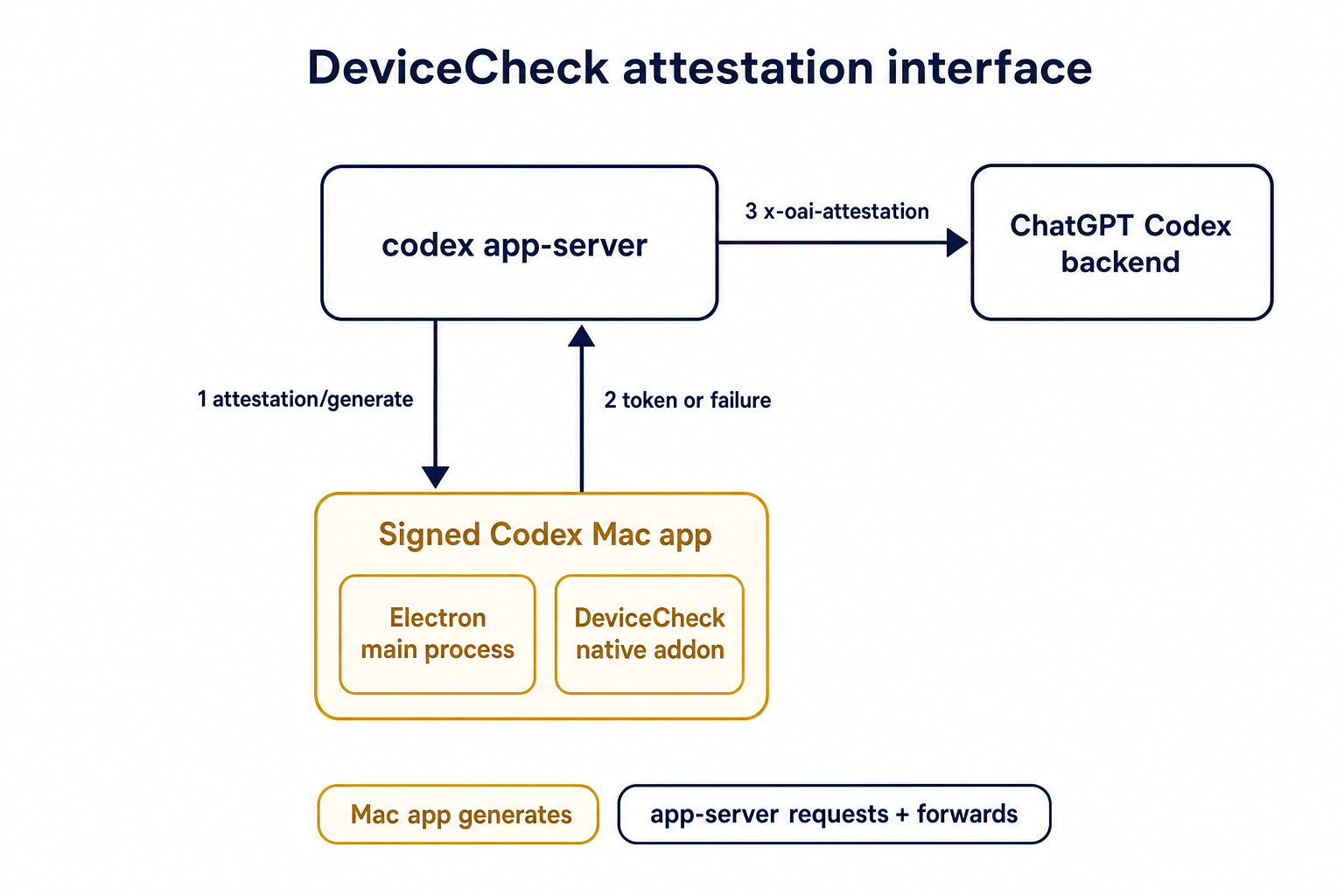
## Details
This PR teaches the Codex app-server runtime how to request and attach
an attestation token. It does not generate DeviceCheck tokens directly;
instead, it relies on the connected desktop app to advertise that it can
generate attestation and then asks that app for a fresh header value
when needed.
The flow is:
1. The Codex desktop app connects to app-server.
2. During `initialize`, the app can advertise that it supports
`requestAttestation`.
3. Before app-server calls selected ChatGPT Codex endpoints, it sends
the internal server request `attestation/generate` to the app.
4. app-server receives a pre-encoded header value back.
5. app-server forwards that value as `x-oai-attestation` on the scoped
outbound requests.
The code in this repo is mostly protocol and runtime plumbing: it adds
the app-server request/response shape, introduces an attestation
provider in core, wires that provider into Responses / compaction /
realtime setup paths, and covers the intended scoping with tests. The
signed macOS DeviceCheck generation remains owned by the desktop app PR.
## Related PR
- Codex desktop app implementation:
https://github.com/openai/openai/pull/878649
## Validation
<details>
<summary>Tests run</summary>
```sh
cargo test -p codex-app-server-protocol
cargo test -p codex-core attestation --lib
cargo test -p codex-app-server --lib attestation
```
Also ran:
```sh
just fix -p codex-core
just fix -p codex-app-server
just fix -p codex-app-server-protocol
just fmt
just write-app-server-schema
```
</details>
<details>
<summary>E2E DeviceCheck validation</summary>
First validated the signed desktop app boundary directly: launched a
packaged signed `Codex.app`, sent `attestation/generate`, decoded the
returned `v1.` attestation header, and validated the extracted
DeviceCheck token with `personal/jm/verify_devicecheck_token.py` using
bundle ID `com.openai.codex`. Apple returned `status_code: 200` and
`is_ok: true`.
Then ran the fuller app + app-server flow. The packaged `Codex.app`
launched a current-branch app-server via `CODEX_CLI_PATH`, and a local
MITM proxy intercepted outbound `chatgpt.com` traffic. The app-server
requested `attestation/generate` from the real Electron app process, and
the intercepted `/backend-api/codex/responses` traffic included
`x-oai-attestation` on both routes:
```text
GET /backend-api/codex/responses Upgrade: websocket x-oai-attestation: present
POST /backend-api/codex/responses Upgrade: none x-oai-attestation: present
```
The captured header decoded to a DeviceCheck token that also validated
with Apple for `com.openai.codex` (`status_code: 200`, `is_ok: true`,
team `2DC432GLL2`).
</details>
---------
Co-authored-by: Codex <noreply@openai.com>
## Why

`/status` was showing the configured `ModelProviderInfo.base_url` for
Amazon Bedrock, which can be stale or misleading because the actual
Bedrock Mantle endpoint is derived at runtime from the resolved AWS
region. This made sessions report the wrong provider endpoint even
though requests used the correct runtime URL.

## What changed

- Added `ModelProvider::runtime_base_url()` so provider implementations
can expose the request-time base URL through the shared runtime provider
abstraction.
- Moved Bedrock region-to-Mantle URL resolution into
`amazon_bedrock::mantle::runtime_base_url()`, keeping region resolution
private to the Mantle module.
- Overrode `runtime_base_url()` for Amazon Bedrock so it returns the
resolved Mantle endpoint instead of the configured default.
- Resolved and cached the runtime provider base URL during TUI startup,
then used that cached value when rendering `/status`.
- Added status coverage that verifies Bedrock displays the runtime URL
and ignores the configured Bedrock `base_url` when they differ.

## Verification
model provider is resolved correctly in local build:
<img width="696" height="245" alt="Screenshot 2026-04-29 at 5 01 36 PM"
src="https://github.com/user-attachments/assets/a13c10a5-3720-41ab-8ace-3c4bc573f971"
/>
## Summary

Amazon Bedrock Mantle's OpenAI-compatible endpoint now lives under
`/openai/v1`, and the GPT-5.4 Mantle model ID no longer uses the `-cmb`
suffix. This updates Codex's built-in Bedrock provider configuration so
generated providers and the static Bedrock catalog use the current
endpoint and model ID.

## Changes

- Update the Bedrock Mantle base URL from
`https://bedrock-mantle.{region}.api.aws/v1` to
`https://bedrock-mantle.{region}.api.aws/openai/v1`.
- Update the Amazon Bedrock default base URL in
`codex-model-provider-info`.
- Change the Bedrock GPT-5.4 catalog slug from `openai.gpt-5.4-cmb` to
`openai.gpt-5.4`.
- Align provider and catalog tests with the new URL and model ID.

## Test Plan

- Manual smoke test:

  ```shell
  target/debug/codex \
      -m openai.gpt-5.4 \
      -c 'model_provider="amazon-bedrock"' \
      -c 'model_providers.amazon-bedrock.aws.region="us-west-2"'
  ```
## Why

Unsupported features must fail closed and Codex must not expose
OpenAI-hosted fallback paths when the active provider cannot support
them. In practice, Bedrock should not surface app connectors, MCP
servers, tool search/suggestions, image generation, web search, or JS
REPL until those paths are explicitly supported for that provider.

This PR moves that decision into provider-owned capability metadata
instead of scattering Bedrock-specific checks across callers.

## What changed

- Adds `ProviderCapabilities` to `codex-model-provider`, with default
support for existing providers and a Bedrock override that disables
unsupported launch surfaces.
- Adds `ToolCapabilityBounds` to `codex-tools` so provider capability
limits can clamp otherwise-enabled tool config.
- Applies capability bounds when building session and review-thread tool
config.
- Routes MCP/app connector configuration through
`McpManager::mcp_config`, which filters configured MCP servers and app
connectors based on the active provider.
- Updates app-server MCP list/read paths to use the filtered MCP config.
- Adds coverage for default provider capabilities, Bedrock disabled
capabilities, and optional tool-surface clamping.

## Testing

built locally and verified that bedrock responses api now return without
errors calling unsupported tools.
Right now, if Codex winds up in a state with auth but it can't refresh
the token, the user is left with an unhelpful message that says to log
out and log back in again.

Ultimately, we should prevent that from happening but if it does,
returning None will allow the caller to redirect the user back to the
login page
## Why

`codex-models-manager` had grown to own provider-specific concerns:
constructing OpenAI-compatible `/models` requests, resolving provider
auth, emitting request telemetry, and deciding how provider catalogs
should be sourced. That made the manager harder to reuse for providers
whose model catalog is not fetched from the OpenAI `/models` endpoint,
such as Amazon Bedrock.

This change moves provider-specific model discovery behind
provider-owned implementations, so the models manager can focus on
refresh policy, cache behavior, picker ordering, and model metadata
merging.

## What Changed

- Introduced a `ModelsManager` trait with separate `OpenAiModelsManager`
and `StaticModelsManager` implementations.
- Added `ModelsEndpointClient` so OpenAI-compatible HTTP fetching lives
outside `codex-models-manager`.
- Moved `/models` request construction, provider auth resolution,
timeout handling, and request telemetry into `codex-model-provider` via
`OpenAiModelsEndpoint`.
- Added provider-owned `models_manager(...)` construction so configured
OpenAI-compatible providers use `OpenAiModelsManager`, while
static/catalog-backed providers can return `StaticModelsManager`.
- Added an Amazon Bedrock static model catalog for the GPT OSS Bedrock
model IDs.
- Updated core/session/thread manager code and tests to depend on
`Arc<dyn ModelsManager>`.
- Moved offline model test helpers into
`codex_models_manager::test_support`.
## Metadata References

The Bedrock catalog metadata is based on the official Amazon Bedrock
OpenAI model documentation:

- [Amazon Bedrock OpenAI
models](https://docs.aws.amazon.com/bedrock/latest/userguide/model-parameters-openai.html)
lists the Bedrock model IDs, text input/output modalities, and `128,000`
token context window for `gpt-oss-20b` and `gpt-oss-120b`.
- [Amazon Bedrock `gpt-oss-120b` model
card](https://docs.aws.amazon.com/bedrock/latest/userguide/model-card-openai-gpt-oss-120b.html)
lists the `bedrock-runtime` model ID `openai.gpt-oss-120b-1:0`, the
`bedrock-mantle` model ID `openai.gpt-oss-120b`, text-only modalities,
and `128K` context window.
- [OpenAI `gpt-oss-120b` model
docs](https://developers.openai.com/api/docs/models/gpt-oss-120b)
document configurable reasoning effort with `low`, `medium`, and `high`,
plus text input/output modality.

The display names, default reasoning effort, and priority ordering are
Codex-local catalog choices.

## Test Plan
- Manually verified app-server model listing with an AWS profile:

```shell
CODEX_HOME="$(mktemp -d)" cargo run -p codex-app-server-test-client -- \
  --codex-bin ./target/debug/codex \
  -c 'model_provider="amazon-bedrock"' \
  -c 'model_providers.amazon-bedrock.aws.profile="codex-bedrock"' \
  -c 'model_providers.amazon-bedrock.aws.region="us-west-2"' \
  model-list
```

The response returned the Bedrock catalog with `openai.gpt-oss-120b-1:0`
as the default model and `openai.gpt-oss-20b-1:0` as the second listed
model, both text-only and supporting low/medium/high reasoning effort.
## Why

AWS/Bedrock mode currently reports `account: null` with
`requiresOpenaiAuth: false` from `account/read`. That suppresses the
OpenAI-auth requirement, but it does not let app clients distinguish AWS
auth from any other non-OpenAI custom provider. For the prototype AWS
provider UX, clients need a simple provider-derived signal so they can
suppress ChatGPT/API-key login and token-refresh paths without
hardcoding Bedrock checks.

## What changed

- Adds an `aws` variant to the v2 `Account` protocol union.
- Adds `ProviderAccountKind` to `codex-model-provider` so the runtime
provider owns the app-visible account classification.
- Makes Amazon Bedrock return `ProviderAccountKind::Aws` from the
model-provider layer.
- Updates app-server `account/read` to map `ProviderAccountKind` to the
existing `GetAccountResponse` wire shape.
- Preserves the existing `account: null, requiresOpenaiAuth: false`
behavior for other non-OpenAI providers.
- Regenerates the app-server protocol schema fixtures.
- Adds coverage for provider account classification and for the Amazon
Bedrock `account/read` response.

## Testing

- `cargo test -p codex-model-provider`
- `cargo test -p codex-app-server-protocol`
- `cargo test -p codex-app-server get_account_with_aws_provider`

## Notes

I attempted `just bazel-lock-update` and `just bazel-lock-check`, but
both are blocked in my local environment because `bazel` is not
installed.
## Summary

Add first-class Amazon Bedrock Mantle provider support so Codex can keep
using its existing Responses API transport with OpenAI-compatible
AWS-hosted endpoints such as AOA/Mantle.

This is needed for the AWS launch path, where provider traffic should
authenticate with AWS credentials instead of OpenAI bearer credentials.
Requests are authenticated immediately before transport send, so SigV4
signs the final method, URL, headers, and body bytes that `reqwest` will
send.

## What Changed

- Added a new `codex-aws-auth` crate for loading AWS SDK config,
resolving credentials, and signing finalized HTTP requests with AWS
SigV4.
- Added a built-in `amazon-bedrock` provider that targets Bedrock Mantle
Responses endpoints, defaults to `us-east-1`, supports region/profile
overrides, disables WebSockets, and does not require OpenAI auth.
- Added Amazon Bedrock auth resolution in `codex-model-provider`: prefer
`AWS_BEARER_TOKEN_BEDROCK` when set, otherwise use AWS SDK credentials
and SigV4 signing.
- Added `AuthProvider::apply_auth` and `Request::prepare_body_for_send`
so request-signing providers can sign the exact outbound request after
JSON serialization/compression.
- Determine the region by taking the `aws.region` config first (required
for bearer token codepath), and fallback to SDK default region.

## Testing
Amazon Bedrock Mantle Responses paths:

- Built the local Codex binary with `cargo build`.
- Verified the custom proxy-backed `aws` provider using `env_key =
"AWS_BEARER_TOKEN_BEDROCK"` streamed raw `responses` output with
`response.output_text.delta`, `response.completed`, and `mantle-env-ok`.
- Verified a full `codex exec --profile aws` turn returned
`mantle-env-ok`.
- Confirmed the custom provider used the bearer env var, not AWS profile
auth: bogus `AWS_PROFILE` still passed, empty env var failed locally,
and malformed env var reached Mantle and failed with `401
invalid_api_key`.
- Verified built-in `amazon-bedrock` with `AWS_BEARER_TOKEN_BEDROCK` set
passed despite bogus AWS profiles, returning `amazon-bedrock-env-ok`.
- Verified built-in `amazon-bedrock` SDK/SigV4 auth passed with
`AWS_BEARER_TOKEN_BEDROCK` unset and temporary AWS session env
credentials, returning `amazon-bedrock-sdk-env-ok`.
## Summary

- Add `codex-model-provider` as the runtime home for model-provider
behavior that does not belong in `codex-core`, `codex-login`, or
`codex-api`.
- The new crate wraps configured `ModelProviderInfo` in a
`ModelProvider` trait object that can resolve the API provider config,
provider-scoped auth manager, and request auth provider for each call.
- This centralizes provider auth behavior in one place today, and gives
us an extension point for future provider-specific auth, model listing,
request setup, and related runtime behavior.

## Tests
Ran tests manually to make sure that provider auth under different
configs still work as expected.

---------

Co-authored-by: pakrym-oai <pakrym@openai.com>


 Celia ChenandGitHub
 pakrym-oaiandGitHub
 Gabriel PealandGitHub
