Commit Graph

147 Commits

  • Add body_after_prefix auto-compact token limit scope (#22870)
    ## Why
    
    `model_auto_compact_token_limit` has only been able to budget the full
    active context. That makes it hard to set a small "growth since
    compaction" budget for sessions that preserve a large carried window
    prefix: the preserved prefix can consume the whole budget and force
    immediate repeated compaction.
    
    This PR adds an opt-in `body_after_prefix` scope so callers can apply
    `model_auto_compact_token_limit` to sampled output and later growth
    after the current carried prefix, while still forcing compaction before
    the full model context window is exhausted.
    
    ## What changed
    
    - Adds `AutoCompactTokenLimitScope` with the existing `total` behavior
    as the default and a new `body_after_prefix` mode:
    [`config_types.rs`](https://github.com/openai/codex/blob/973806b1cb35792555bead994cb3ed94656eb171/codex-rs/protocol/src/config_types.rs#L24-L37).
    - Threads `model_auto_compact_token_limit_scope` through config loading,
    `Config`, `core-api`, and app-server v2 schema/TypeScript generation.
    - Records the first observed input-token count for a `body_after_prefix`
    compaction window and uses it as the baseline when deciding whether the
    scoped auto-compaction budget is exhausted:
    [`turn.rs`](https://github.com/openai/codex/blob/973806b1cb35792555bead994cb3ed94656eb171/codex-rs/core/src/session/turn.rs#L743-L781).
    - Keeps a hard context-window cap in `body_after_prefix`, so scoped
    budgeting cannot let the active context overrun the usable window.
    
    ## Verification
    
    Added compact-suite coverage for the two key behaviors:
    `body_after_prefix` does not re-compact just because the carried prefix
    is larger than the scoped budget, and it still compacts when the total
    active context reaches the configured context window:
    [`compact.rs`](https://github.com/openai/codex/blob/973806b1cb35792555bead994cb3ed94656eb171/codex-rs/core/tests/suite/compact.rs#L3003-L3128).
  • cleanup: Remove skill env var dependency prompting (#22721)
    Deletes the skill env var dependency prompt feature and its runtime
    path. env_var entries in skill dependency metadata are now silently
    ignored during skill loading.
  • [codex] Move pending input into input queue (#22728)
    ## Why
    
    Pending model input was split across `Session`, `TurnState`, and the
    agent mailbox. That made it easy for new paths to manage queued user
    input or mailbox delivery outside the intended ownership boundary.
    
    This PR consolidates the model-facing input lifecycle behind the session
    input queue so turn-local pending input, next-turn queued items, and
    mailbox delivery coordination are owned in one place.
    
    ## What Changed
    
    - Added `session/input_queue.rs` to own pending input queues and mailbox
    delivery coordination.
    - Removed the standalone `agent/mailbox.rs` channel wrapper and store
    mailbox items directly in the input queue.
    - Moved pending-input mutations off `TurnState`; `TurnState` now exposes
    the queue-owned storage directly for now.
    - Routed abort cleanup, mailbox delivery phase changes, next-turn queued
    items, and active-turn pending input through `InputQueue`.
    - Boxed stack-heavy agent resume/fork startup futures that the refactor
    pushed over the default test stack.
    - Updated session, task, goal, stream-event, and multi-agent call sites
    and tests to use the new queue ownership.
    
    ## Verification
    
    - `cargo test -p codex-core --lib agent::control::tests`
    - `cargo test -p codex-core --lib
    agent::control::tests::resume_closed_child_reopens_open_descendants --
    --exact`
    - `cargo test -p codex-core --lib
    agent::control::tests::spawn_agent_fork_last_n_turns_keeps_only_recent_turns
    -- --exact`
    - `cargo test -p codex-core --lib
    agent::control::tests::resume_thread_subagent_restores_stored_nickname_and_role
    -- --exact`
    - `cargo test -p codex-core` was also run; it completed with 1814
    passed, 4 ignored, and one timeout in
    `agent::control::tests::resume_thread_subagent_restores_stored_nickname_and_role`,
    which passed when rerun in isolation.
  • Fix turn extension data task plumbing (#22646)
    ## Summary
    - carry the per-turn extension data through RunningTask so abort
    handling can rebuild SessionTaskContext
    - update stale test ExtensionData::new() callsites to pass the turn id
    
    ## Testing
    - Not run after PR branch creation; CI will cover.
  • feat: move extension scope ids into ExtensionData (#22490)
    ## Summary
    - add a scoped level_id to ExtensionData and expose it through
    level_id()
    - remove thread_id/turn_id parameters from extension contributor inputs
    where the scoped ExtensionData already carries that identity
    - move turn-scoped extension data onto TurnContext so token usage and
    lifecycle contributors can share the same turn store
    
    ## Testing
    - cargo check -p codex-extension-api -p codex-core --tests
    - cargo test -p codex-extension-api
    - cargo test -p codex-guardian
    - cargo test -p codex-core --lib
    record_token_usage_info_notifies_extension_contributors
    - cargo test -p codex-core --lib
    submission_loop_channel_close_emits_thread_stop_lifecycle
    - cargo test -p codex-core --lib
    submission_loop_channel_close_aborts_active_turn_before_thread_stop_lifecycle
    - just fix -p codex-extension-api
    - just fix -p codex-guardian
    - just fix -p codex-core
    - just fmt
    
    ## Note
    - Attempted cargo test -p codex-core; it aborted in
    agent::control::tests::spawn_agent_fork_last_n_turns_keeps_only_recent_turns
    with the existing stack overflow before the full suite completed.
  • feat: add turn lifecycle contributors (#22480)
    ## Why
    
    Extensions can already contribute prompt, tool, turn-item, and
    thread-lifecycle behavior, but there was no explicit host-owned hook for
    per-turn setup and cleanup. That makes extension-private turn state
    awkward: an extension either has to stash it outside the turn lifecycle
    or depend on core runtime objects.
    
    This adds a small turn lifecycle boundary. Extensions receive stable
    identifiers plus the existing session, thread, and turn `ExtensionData`
    stores, while core keeps owning task scheduling, cancellation, and turn
    teardown.
    
    ## What Changed
    
    - Added `TurnLifecycleContributor` with `on_turn_start`, `on_turn_stop`,
    and `on_turn_abort` callbacks in `codex-rs/ext/extension-api`.
    - Added typed `TurnStartInput`, `TurnStopInput`, and `TurnAbortInput`
    payloads that expose `thread_id`, `turn_id`, `session_store`,
    `thread_store`, and `turn_store`.
    - Registered and re-exported turn lifecycle contributors through
    `ExtensionRegistry` and `ExtensionRegistryBuilder`.
    - Wired `Session` to emit turn start, stop, and abort callbacks from the
    existing turn/task lifecycle paths.
    - Carried the turn-scoped `ExtensionData` through `RunningTask` and
    `RemovedTask` so stop/abort callbacks receive the same turn store
    created at turn start.
    
    ## Verification
    
    - Not run locally.
  • extension: wire extension registries into sessions (#21737)
    ## Why
    
    [#21736](https://github.com/openai/codex/pull/21736) introduces the
    typed extension API, but the runtime does not yet carry a registry
    through thread/session startup or give contributors host-owned stores to
    read from. This PR wires that host-side path so later feature migrations
    can move product-specific behavior behind typed contributions without
    adding another bespoke seam directly to `codex-core`.
    
    ## What changed
    
    - Thread `ExtensionRegistry<Config>` through `ThreadManager`,
    `CodexSpawnArgs`, `Session`, and sub-agent spawn paths.
    - Wire `ThreadStartContributor` and `ContextContributor`
    - Expose the small supporting surface needed by non-core callers that
    construct threads directly, including `empty_extension_registry()`
    through `codex-core-api`.
    
    This PR lands the host plumbing only: the app-server registry is still
    empty, and concrete feature migrations are intended to follow
    separately.
  • Reapply "Move skills watcher to app-server" (#21652)
    ## Why
    
    PR #21460 reverted the earlier move of skills change watching from
    `codex-core` into app-server. This reapplies that boundary change so
    app-server owns client-facing `skills/changed` notifications and core no
    longer carries the watcher.
    
    ## What
    
    - Restore the app-server `SkillsWatcher` and register it from thread
    listener setup.
    - Remove the core-owned skills watcher and its core live-reload
    integration surface.
    - Restore app-server coverage for `skills/changed` notifications after a
    watched skill file changes.
    
    ## Validation
    
    - `cargo test -p codex-app-server --test all
    suite::v2::skills_list::skills_changed_notification_is_emitted_after_skill_change
    -- --exact --nocapture`
    - `cargo test -p codex-core --lib --no-run`
  • [codex] request desktop attestation from app (#20619)
    ## Summary
    
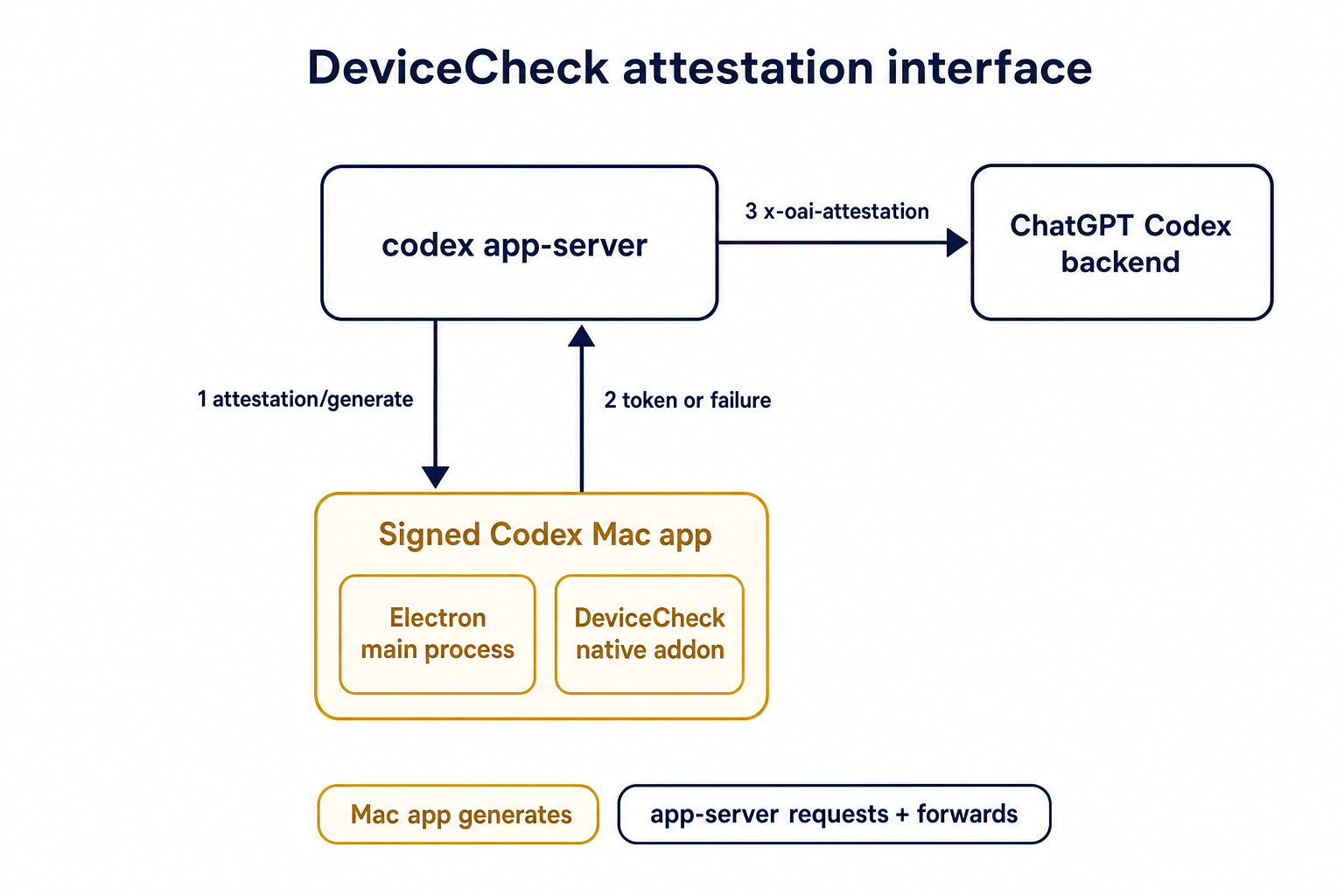
    TL;DR: teaches `codex-rs` / app-server to request a desktop-provided
    attestation token and attach it as `x-oai-attestation` on the scoped
    ChatGPT Codex request paths.
    
    ![DeviceCheck attestation
    interface](https://raw.githubusercontent.com/openai/codex/dev/jm/devicecheck-diagram-assets/pr-assets/devicecheck-attestation-interface.png)
    
    ## Details
    
    This PR teaches the Codex app-server runtime how to request and attach
    an attestation token. It does not generate DeviceCheck tokens directly;
    instead, it relies on the connected desktop app to advertise that it can
    generate attestation and then asks that app for a fresh header value
    when needed.
    
    The flow is:
    
    1. The Codex desktop app connects to app-server.
    2. During `initialize`, the app can advertise that it supports
    `requestAttestation`.
    3. Before app-server calls selected ChatGPT Codex endpoints, it sends
    the internal server request `attestation/generate` to the app.
    4. app-server receives a pre-encoded header value back.
    5. app-server forwards that value as `x-oai-attestation` on the scoped
    outbound requests.
    
    The code in this repo is mostly protocol and runtime plumbing: it adds
    the app-server request/response shape, introduces an attestation
    provider in core, wires that provider into Responses / compaction /
    realtime setup paths, and covers the intended scoping with tests. The
    signed macOS DeviceCheck generation remains owned by the desktop app PR.
    
    ## Related PR
    
    - Codex desktop app implementation:
    https://github.com/openai/openai/pull/878649
    
    ## Validation
    
    <details>
    <summary>Tests run</summary>
    
    ```sh
    cargo test -p codex-app-server-protocol
    cargo test -p codex-core attestation --lib
    cargo test -p codex-app-server --lib attestation
    ```
    
    Also ran:
    
    ```sh
    just fix -p codex-core
    just fix -p codex-app-server
    just fix -p codex-app-server-protocol
    just fmt
    just write-app-server-schema
    ```
    
    </details>
    
    <details>
    <summary>E2E DeviceCheck validation</summary>
    
    First validated the signed desktop app boundary directly: launched a
    packaged signed `Codex.app`, sent `attestation/generate`, decoded the
    returned `v1.` attestation header, and validated the extracted
    DeviceCheck token with `personal/jm/verify_devicecheck_token.py` using
    bundle ID `com.openai.codex`. Apple returned `status_code: 200` and
    `is_ok: true`.
    
    Then ran the fuller app + app-server flow. The packaged `Codex.app`
    launched a current-branch app-server via `CODEX_CLI_PATH`, and a local
    MITM proxy intercepted outbound `chatgpt.com` traffic. The app-server
    requested `attestation/generate` from the real Electron app process, and
    the intercepted `/backend-api/codex/responses` traffic included
    `x-oai-attestation` on both routes:
    
    ```text
    GET  /backend-api/codex/responses  Upgrade: websocket  x-oai-attestation: present
    POST /backend-api/codex/responses  Upgrade: none       x-oai-attestation: present
    ```
    
    The captured header decoded to a DeviceCheck token that also validated
    with Apple for `com.openai.codex` (`status_code: 200`, `is_ok: true`,
    team `2DC432GLL2`).
    
    </details>
    
    ---------
    
    Co-authored-by: Codex <noreply@openai.com>
  • Move skills watcher to app-server (#21287)
    ## Why
    
    Skills update notifications are app-server API behavior, but the watcher
    lived in `codex-core` and surfaced through
    `EventMsg::SkillsUpdateAvailable`. Moving the watcher out keeps core
    focused on thread execution and lets app-server own both cache
    invalidation and the `skills/changed` notification.
    
    ## What changed
    
    - Added an app-server-owned skills watcher that watches local skill
    roots, clears the shared skills cache, and emits `skills/changed`
    directly.
    - Registers skill watches from the common app-server thread listener
    attach path, including direct starts, resumes, and app-server-observed
    child or forked threads.
    - Stores the `WatchRegistration` on `ThreadState`, so listener
    replacement, thread teardown, idle unload, and app-server shutdown
    deregister by dropping the RAII guard.
    - Removed `EventMsg::SkillsUpdateAvailable`, the core watcher, and the
    old core live-reload test.
    - Extended the app-server skills change test to verify a cached skills
    list is refreshed after a filesystem change without forcing reload.
    
    ## Validation
    
    - `cargo check -p codex-core -p codex-app-server -p codex-mcp-server -p
    codex-rollout -p codex-rollout-trace`
    - `cargo test -p codex-app-server
    skills_changed_notification_is_emitted_after_skill_change`
  • Add persisted hook enablement state (#19840)
    ## Why
    
    After `hooks/list` exposes the hook inventory, clients need a way to
    persist user hook preferences, make those changes effective in
    already-open sessions, and distinguish user-controllable hooks from
    managed requirements without adding another bespoke app-server write
    API.
    
    ## What
    
    - Extends `hooks/list` entries with effective `enabled` state.
    - Persists user-level hook state under `hooks.state.<hook-id>` so the
    model can grow beyond a single boolean over time.
    - Uses the existing `config/batchWrite` path for hook state updates
    instead of introducing a dedicated hook write RPC.
    - Refreshes live session hook engines after config writes so
    already-open threads observe updated enablement without a restart.
    
    ## Stack
    
    1. openai/codex#19705
    2. openai/codex#19778
    3. This PR - openai/codex#19840
    4. openai/codex#19882
    
    ## Reviewer Notes
    
    The generated schema files account for much of the raw diff. The core
    behavior is in:
    
    - `hooks/src/config_rules.rs`, which resolves per-hook user state from
    the config layer stack.
    - `hooks/src/engine/discovery.rs`, which projects effective enablement
    into `hooks/list` from source-derived managedness.
    - `config/src/hook_config.rs`, which defines the new `hooks.state`
    representation.
    - `core/src/session/mod.rs`, which rebuilds live hook state after user
    config reloads.
    
    ---------
    
    Co-authored-by: Codex <noreply@openai.com>
  • [codex] Add token usage to turn tracing spans (#19432)
    ## Why
    
    Slow Codex turns are easier to debug when token usage is visible in the
    trace itself, without joining against separate analytics. This adds
    token usage to existing turn-handling spans for regular user turns only.
    
    [Example
    turn](https://openai.datadoghq.com/apm/trace/9d353efa2cb5de1f4c5b93dc33c3df04?colorBy=service&graphType=flamegraph&shouldShowLegend=true&sort=time&spanID=3555541504891512675&spanViewType=metadata&traceQuery=)
    <img width="1447" height="967" alt="Screenshot 2026-04-24 at 3 03 07 PM"
    src="https://github.com/user-attachments/assets/ab7bb187-e7fc-41f0-a366-6c44610b2b2c"
    />
    
    ## What Changed
    
    Added response-level token fields on completed handle_responses spans:
    
    gen_ai.usage.input_tokens
    gen_ai.usage.cache_read.input_tokens
    gen_ai.usage.output_tokens
    codex.usage.reasoning_output_tokens
    codex.usage.total_tokens
    Added aggregate token fields on regular turn spans:
    
    codex.turn.token_usage.*
    Added an explicit regular-turn opt-in via
    SessionTask::records_turn_token_usage_on_span() so this is not coupled
    to span-name strings.
    
    ## Testing
    
    - `cargo test -p codex-otel`
    - `cargo test -p codex-core
    turn_and_completed_response_spans_record_token_usage`
    - `just fmt`
    - `just fix -p codex-core`
    - `just fix -p codex-otel`
    - Manual local Electron/app-server smoke test: regular user turn emits
    the new span fields
    
    Known status: `cargo test -p codex-core` was attempted and failed in
    unrelated existing areas: config approvals, request-permissions,
    git-info ordering, and subagent metadata persistence.
  • Add goal core runtime (4 / 5) (#18076)
    Adds the core runtime behavior for active goals on top of the model
    tools from PR 3.
    
    ## Why
    
    A long-running goal should be a core runtime concern, not something
    every client has to implement. Core owns the turn lifecycle, tool
    completion boundaries, interruptions, resume behavior, and token usage,
    so it is the right place to account progress, enforce budgets, and
    decide when to continue work.
    
    ## What changed
    
    - Centralized goal lifecycle side effects behind
    `Session::goal_runtime_apply(GoalRuntimeEvent::...)`.
    - Starts goal continuation turns only when the session is idle; pending
    user input and mailbox work take priority.
    - Accounts token and wall-clock usage at turn, tool, mutation,
    interrupt, and resume boundaries; `get_thread_goal` remains read-only.
    - Preserves sub-second wall-clock remainder across accounting boundaries
    so long-running goals do not drift downward over time.
    - Treats token budget exhaustion as a soft stop by marking the goal
    `budget_limited` and injecting wrap-up steering instead of aborting the
    active turn.
    - Suppresses budget steering when `update_goal` marks a goal complete.
    - Pauses active goals on interrupt and auto-reactivates paused goals
    when a thread resumes outside plan mode.
    - Suppresses repeated automatic continuation when a continuation turn
    makes no tool calls.
    - Added continuation and budget-limit prompt templates.
    
    ## Verification
    
    - Added focused core coverage for continuation scheduling, accounting
    boundaries, budget-limit steering, completion accounting, interrupt
    pause behavior, resume auto-activation, and wall-clock remainder
    accounting.
  • permissions: make profiles represent enforcement (#19231)
    ## Why
    
    `PermissionProfile` is becoming the canonical permissions abstraction,
    but the old shape only carried optional filesystem and network fields.
    It could describe allowed access, but not who is responsible for
    enforcing it. That made `DangerFullAccess` and `ExternalSandbox` lossy
    when profiles were exported, cached, or round-tripped through app-server
    APIs.
    
    The important model change is that active permissions are now a disjoint
    union over the enforcement mode. Conceptually:
    
    ```rust
    pub enum PermissionProfile {
        Managed {
            file_system: FileSystemSandboxPolicy,
            network: NetworkSandboxPolicy,
        },
        Disabled,
        External {
            network: NetworkSandboxPolicy,
        },
    }
    ```
    
    This distinction matters because `Disabled` means Codex should apply no
    outer sandbox at all, while `External` means filesystem isolation is
    owned by an outside caller. Those are not equivalent to a broad managed
    sandbox. For example, macOS cannot nest Seatbelt inside Seatbelt, so an
    inner sandbox may require the outer Codex layer to use no sandbox rather
    than a permissive one.
    
    ## How Existing Modeling Maps
    
    Legacy `SandboxPolicy` remains a boundary projection, but it now maps
    into the higher-fidelity profile model:
    
    - `ReadOnly` and `WorkspaceWrite` map to `PermissionProfile::Managed`
    with restricted filesystem entries plus the corresponding network
    policy.
    - `DangerFullAccess` maps to `PermissionProfile::Disabled`, preserving
    the “no outer sandbox” intent instead of treating it as a lax managed
    sandbox.
    - `ExternalSandbox { network_access }` maps to
    `PermissionProfile::External { network }`, preserving external
    filesystem enforcement while still carrying the active network policy.
    - Split runtime policies that legacy `SandboxPolicy` cannot faithfully
    express, such as managed unrestricted filesystem plus restricted
    network, stay `Managed` instead of being collapsed into
    `ExternalSandbox`.
    - Per-command/session/turn grants remain partial overlays via
    `AdditionalPermissionProfile`; full `PermissionProfile` is reserved for
    complete active runtime permissions.
    
    ## What Changed
    
    - Change active `PermissionProfile` into a tagged union: `managed`,
    `disabled`, and `external`.
    - Keep partial permission grants separate with
    `AdditionalPermissionProfile` for command/session/turn overlays.
    - Represent managed filesystem permissions as either `restricted`
    entries or `unrestricted`; `glob_scan_max_depth` is non-zero when
    present.
    - Preserve old rollout compatibility by accepting the pre-tagged `{
    network, file_system }` profile shape during deserialization.
    - Preserve fidelity for important edge cases: `DangerFullAccess`
    round-trips as `disabled`, `ExternalSandbox` round-trips as `external`,
    and managed unrestricted filesystem + restricted network stays managed
    instead of being mistaken for external enforcement.
    - Preserve configured deny-read entries and bounded glob scan depth when
    full profiles are projected back into runtime policies, including
    unrestricted replacements that now become `:root = write` plus deny
    entries.
    - Regenerate the experimental app-server v2 JSON/TypeScript schema and
    update the `command/exec` README example for the tagged
    `permissionProfile` shape.
    
    ## Compatibility
    
    Legacy `SandboxPolicy` remains available at config/API boundaries as the
    compatibility projection. Existing rollout lines with the old
    `PermissionProfile` shape continue to load. The app-server
    `permissionProfile` field is experimental, so its v2 wire shape is
    intentionally updated to match the higher-fidelity model.
    
    ## Verification
    
    - `just write-app-server-schema`
    - `cargo check --tests`
    - `cargo test -p codex-protocol permission_profile`
    - `cargo test -p codex-protocol
    preserving_deny_entries_keeps_unrestricted_policy_enforceable`
    - `cargo test -p codex-app-server-protocol
    permission_profile_file_system_permissions`
    - `cargo test -p codex-app-server-protocol serialize_client_response`
    - `cargo test -p codex-core
    session_configured_reports_permission_profile_for_external_sandbox`
    - `just fix`
    - `just fix -p codex-protocol`
    - `just fix -p codex-app-server-protocol`
    - `just fix -p codex-core`
    - `just fix -p codex-app-server`
  • feat: let model providers own model discovery (#18950)
    ## Why
    
    `codex-models-manager` had grown to own provider-specific concerns:
    constructing OpenAI-compatible `/models` requests, resolving provider
    auth, emitting request telemetry, and deciding how provider catalogs
    should be sourced. That made the manager harder to reuse for providers
    whose model catalog is not fetched from the OpenAI `/models` endpoint,
    such as Amazon Bedrock.
    
    This change moves provider-specific model discovery behind
    provider-owned implementations, so the models manager can focus on
    refresh policy, cache behavior, picker ordering, and model metadata
    merging.
    
    ## What Changed
    
    - Introduced a `ModelsManager` trait with separate `OpenAiModelsManager`
    and `StaticModelsManager` implementations.
    - Added `ModelsEndpointClient` so OpenAI-compatible HTTP fetching lives
    outside `codex-models-manager`.
    - Moved `/models` request construction, provider auth resolution,
    timeout handling, and request telemetry into `codex-model-provider` via
    `OpenAiModelsEndpoint`.
    - Added provider-owned `models_manager(...)` construction so configured
    OpenAI-compatible providers use `OpenAiModelsManager`, while
    static/catalog-backed providers can return `StaticModelsManager`.
    - Added an Amazon Bedrock static model catalog for the GPT OSS Bedrock
    model IDs.
    - Updated core/session/thread manager code and tests to depend on
    `Arc<dyn ModelsManager>`.
    - Moved offline model test helpers into
    `codex_models_manager::test_support`.
    ## Metadata References
    
    The Bedrock catalog metadata is based on the official Amazon Bedrock
    OpenAI model documentation:
    
    - [Amazon Bedrock OpenAI
    models](https://docs.aws.amazon.com/bedrock/latest/userguide/model-parameters-openai.html)
    lists the Bedrock model IDs, text input/output modalities, and `128,000`
    token context window for `gpt-oss-20b` and `gpt-oss-120b`.
    - [Amazon Bedrock `gpt-oss-120b` model
    card](https://docs.aws.amazon.com/bedrock/latest/userguide/model-card-openai-gpt-oss-120b.html)
    lists the `bedrock-runtime` model ID `openai.gpt-oss-120b-1:0`, the
    `bedrock-mantle` model ID `openai.gpt-oss-120b`, text-only modalities,
    and `128K` context window.
    - [OpenAI `gpt-oss-120b` model
    docs](https://developers.openai.com/api/docs/models/gpt-oss-120b)
    document configurable reasoning effort with `low`, `medium`, and `high`,
    plus text input/output modality.
    
    The display names, default reasoning effort, and priority ordering are
    Codex-local catalog choices.
    
    ## Test Plan
    - Manually verified app-server model listing with an AWS profile:
    
    ```shell
    CODEX_HOME="$(mktemp -d)" cargo run -p codex-app-server-test-client -- \
      --codex-bin ./target/debug/codex \
      -c 'model_provider="amazon-bedrock"' \
      -c 'model_providers.amazon-bedrock.aws.profile="codex-bedrock"' \
      -c 'model_providers.amazon-bedrock.aws.region="us-west-2"' \
      model-list
    ```
    
    The response returned the Bedrock catalog with `openai.gpt-oss-120b-1:0`
    as the default model and `openai.gpt-oss-20b-1:0` as the second listed
    model, both text-only and supporting low/medium/high reasoning effort.
  • [rollout_trace] Add debug trace reduction command (#18880)
    ## Summary
    
    Adds the debug CLI entry point for reducing recorded rollout traces.
    This gives developers a direct way to inspect whether the emitted trace
    stream reduces into the expected conversation/runtime model.
    
    ## Stack
    
    This is PR 5/5 in the rollout trace stack.
    
    - [#18876](https://github.com/openai/codex/pull/18876): Add rollout
    trace crate
    - [#18877](https://github.com/openai/codex/pull/18877): Record core
    session rollout traces
    - [#18878](https://github.com/openai/codex/pull/18878): Trace tool and
    code-mode boundaries
    - [#18879](https://github.com/openai/codex/pull/18879): Trace sessions
    and multi-agent edges
    - [#18880](https://github.com/openai/codex/pull/18880): Add debug trace
    reduction command
    
    ## Review Notes
    
    This PR is intentionally last: it depends on the trace crate, core
    recorder, runtime/tool events, and session/agent edge data all existing.
    The command should remain a debug/developer tool and avoid adding new
    runtime behavior.
    
    The useful review question is whether the CLI exposes the reducer in the
    smallest practical way for local inspection without turning the debug
    command into a supported user-facing workflow.
  • [codex] Route live thread writes through ThreadStore (#18882)
    Begin migrating the thread write codepaths to ThreadStore.
    
    This starts using ThreadStore inside of core session code, not only in
    the app server code.
    
    Rework the interfaces around thread recording/persistence. We're left
    with the following:
    
    * `ThreadManager`: owns the process-level registry of loaded threads and
    handles cross-thread orchestration: start, resume, fork, lookup, remove,
    and route ops to running CodexThreads.
    * `CodexThread`: represents one loaded/running thread from the outside.
    It is the handle app-server and callers use to submit ops, inspect
    session metadata, and shut the thread down.
    * `LiveThread`: session-owned persistence lifecycle handle for one
    active thread. Core session code uses it to append rollout items,
    materialize lazy persistence, flush, shutdown, discard init-failed
    writers, and load that thread’s persisted history.
    * `ThreadStore`: storage backend abstraction. It answers “how are
    threads persisted, read, listed, updated, archived?” Local and remote
    implementations live behind this trait.
    * `LocalThreadStore`: local ThreadStore implementation. It owns the
    file/sqlite-specific details and keeps RolloutRecorder as a local
    implementation detail.
    
    This is a few too many Thread abstractions for my liking, but they do
    all represent different concepts / needs / layers.
    
    Migration note: in places where the core code explicitly requires a
    path, rather than a thread ID, throw an error if we're running with a
    remote store.
    
    Cover the new local live-writer lifecycle with focused tests and
    preserve app-server thread-start behavior, including ephemeral pathless
    sessions.
  • feat(request-permissions) approve with strict review (#19050)
    ## Summary
    Allow the user to approve a request_permissions_tool request with the
    condition that all commands in the rest of the turn are reviewed by
    guardian, regardless of sandbox status.
    
    ## Testing
    - [x] Added unit tests
    - [x] Ran locally
  • feat(auto-review) short-circuit (#18890)
    ## Summary
    Short circuit the convo if auto-review hits too many denials
    
    ## Testing
    - [x] Added unit tests
    
    ---------
    
    Co-authored-by: Codex <noreply@openai.com>
  • [rollout_trace] Record core session rollout traces (#18877)
    ## Summary
    
    Wires rollout trace recording into `codex-core` session and turn
    execution. This records the core model request/response, compaction, and
    session lifecycle boundaries needed for replay without yet tracing every
    nested runtime/tool boundary.
    
    ## Stack
    
    This is PR 2/5 in the rollout trace stack.
    
    - [#18876](https://github.com/openai/codex/pull/18876): Add rollout
    trace crate
    - [#18877](https://github.com/openai/codex/pull/18877): Record core
    session rollout traces
    - [#18878](https://github.com/openai/codex/pull/18878): Trace tool and
    code-mode boundaries
    - [#18879](https://github.com/openai/codex/pull/18879): Trace sessions
    and multi-agent edges
    - [#18880](https://github.com/openai/codex/pull/18880): Add debug trace
    reduction command
    
    ## Review Notes
    
    This layer is the first live integration point. The important review
    question is whether trace recording is isolated from normal session
    behavior: trace failures should not become user-visible execution
    failures, and recording should preserve the existing turn/session
    lifecycle semantics.
    
    The PR depends on the reducer/data model from the first stack entry and
    only introduces the core recorder surface that later PRs use for richer
    runtime and relationship events.
  • Support multiple managed environments (#18401)
    ## Summary
    - refactor EnvironmentManager to own keyed environments with
    default/local lookup helpers
    - keep remote exec-server client creation lazy until exec/fs use
    - preserve disabled agent environment access separately from internal
    local environment access
    
    ## Validation
    - not run (per Codex worktree instruction to avoid tests/builds unless
    requested)
    
    ---------
    
    Co-authored-by: Codex <noreply@openai.com>
  • fix: fully revert agent identity runtime wiring (#18757)
    ## Summary
    
    This PR fully reverts the previously merged Agent Identity runtime
    integration from the old stack:
    https://github.com/openai/codex/pull/17387/changes
    
    It removes the Codex-side task lifecycle wiring, rollout/session
    persistence, feature flag plumbing, lazy `auth.json` mutation,
    background task auth paths, and request callsite changes introduced by
    that stack.
    
    This leaves the repo in a clean pre-AgentIdentity integration state so
    the follow-up PRs can reintroduce the pieces in smaller reviewable
    layers.
    
    ## Stack
    
    1. This PR: full revert
    2. https://github.com/openai/codex/pull/18871: move Agent Identity
    business logic into a crate
    3. https://github.com/openai/codex/pull/18785: add explicit
    AgentIdentity auth mode and startup task allocation
    4. https://github.com/openai/codex/pull/18811: migrate auth callsites
    through AuthProvider
    
    ## Testing
    
    Tests: targeted Rust checks, cargo-shear, Bazel lock check, and CI.
  • sandboxing: intersect permission profiles semantically (#18275)
    ## Why
    
    Permission approval responses must not be able to grant more access than
    the tool requested. Moving this flow to `PermissionProfile` means the
    comparison must be profile-shaped instead of `SandboxPolicy`-shaped, and
    cwd-relative special paths such as `:cwd` and `:project_roots` must stay
    anchored to the turn that produced the request.
    
    ## What changed
    
    This implements semantic `PermissionProfile` intersection in
    `codex-sandboxing` for file-system and network permissions. The
    intersection accepts narrower path grants, rejects broader grants,
    preserves deny-read carve-outs and glob scan depth, and materializes
    cwd-dependent special-path grants to absolute paths before they can be
    recorded for reuse.
    
    The request-permissions response paths now use that intersection
    consistently. App-server captures the request turn cwd before waiting
    for the client response, includes that cwd in the v2 approval params,
    and core stores the requested profile plus cwd for direct TUI/client
    responses and Guardian decisions before recording turn- or
    session-scoped grants. The TUI app-server bridge now preserves the
    app-server request cwd when converting permission approval params into
    core events.
    
    ## Verification
    
    - `cargo test -p codex-sandboxing intersect_permission_profiles --
    --nocapture`
    - `cargo test -p codex-app-server request_permissions_response --
    --nocapture`
    - `cargo test -p codex-core
    request_permissions_response_materializes_session_cwd_grants_before_recording
    -- --nocapture`
    - `cargo check -p codex-tui --tests`
    - `cargo check --tests`
    - `cargo test -p codex-tui
    app_server_request_permissions_preserves_file_system_permissions`
  • feat: add metric to track the number of turns with memory usage (#18662)
    Add a metric `codex.turn.memory` to know if a turn used memories or not.
    This is not part of the other turn metrics as a label to limit
    cardinality
  • Persist and prewarm agent tasks per thread (#17978)
    ## Summary
    - persist registered agent tasks in the session state update stream so
    the thread can reuse them
    - prewarm task registration once identity registration succeeds, while
    keeping startup failures best-effort
    - isolate the session-side task lifecycle into a dedicated module so
    AgentIdentityManager and RegisteredAgentTask do not leak across as many
    core layers
    
    ## Testing
    - cargo test -p codex-core startup_agent_task_prewarm
    - cargo test -p codex-core
    cached_agent_task_for_current_identity_clears_stale_task
    - cargo test -p codex-core record_initial_history_
  • [codex] Propagate rate limit reached type (#18227)
    ## Summary
    
    First PR in the split from #17956.
    
    - adds the core/app-server `RateLimitReachedType` shape
    - maps backend `rate_limit_reached_type` into Codex rate-limit snapshots
    - carries the field through app-server notifications/responses and
    generated schemas
    - updates existing constructors/tests for the new optional field
    
    ## Validation
    
    - `cargo test -p codex-backend-client`
    - `cargo test -p codex-app-server-protocol`
    - `cargo test -p codex-app-server rate_limits`
    - `cargo test -p codex-tui workspace_`
    - `cargo test -p codex-tui status_`
    - `just fmt`
    - `just fix -p codex-backend-client`
    - `just fix -p codex-app-server-protocol`
    - `just fix -p codex-app-server`
    - `just fix -p codex-tui`
  • Move codex module under session (#18249)
    ## Summary
    - rename the core codex module root to session/mod.rs without using
    #[path]
    - move the codex module directory and tests under core/src/session
    - remove session/mod.rs reexports so call sites use explicit child
    module paths
    
    ## Testing
    - cargo test -p codex-core --lib
    - cargo check -p codex-core --tests
    - just fmt
    - just fix -p codex-core
    - git diff --check
  • Register agent tasks behind use_agent_identity (#17387)
    ## Summary
    
    Stack PR3 for feature-gated agent identity support.
    
    This PR adds per-thread agent task registration behind
    `features.use_agent_identity`. Tasks are minted on the first real user
    turn and cached in thread runtime state for later turns.
    
    ## Stack
    
    - PR1: https://github.com/openai/codex/pull/17385 - add
    `features.use_agent_identity`
    - PR2: https://github.com/openai/codex/pull/17386 - register agent
    identities when enabled
    - PR3: https://github.com/openai/codex/pull/17387 - this PR, original
    task registration slice
    - PR3.1: https://github.com/openai/codex/pull/17978 - persist and
    prewarm registered tasks per thread
    - PR4: https://github.com/openai/codex/pull/17980 - use `AgentAssertion`
    downstream when enabled
    
    ## Validation
    
    Covered as part of the local stack validation pass:
    
    - `just fmt`
    - `cargo test -p codex-core --lib agent_identity`
    - `cargo test -p codex-core --lib agent_assertion`
    - `cargo test -p codex-core --lib websocket_agent_task`
    - `cargo test -p codex-api api_bridge`
    - `cargo build -p codex-cli --bin codex`
    
    ## Notes
    
    The full local app-server E2E path is still being debugged after PR
    creation. The current branch stack is directionally ready for review
    while that follow-up continues.
  • [codex] Add local thread store listing (#17824)
    Builds on top of #17659 
    
    Move the filesystem + sqlite thread listing-related operations inside of
    a local ThreadStore implementation and call ThreadStore from the places
    that used to perform these filesystem/sqlite operations.
    
    This is the first of a series of PRs that will implement the rest of the
    local ThreadStore.
    
    Testing:
    - added unit tests for the thread store implementation
    - adjusted some unit tests in the realtime + personality packages whose
    callsites changed. Specifically I'm trying to hide ThreadMetadata inside
    of the local implementation and make ThreadMetadata a sqlite
    implementation detail concern rather than a public interface, preferring
    the more generate StoredThread interface instead
    - added a corner case test for the personality migration package that
    wasn't covered by the existing test suite
    - adjust the behavior of searched thread listing to run the existing
    local rollout repair/backfill pass _before_ querying SQLite results, so
    callers using ThreadStore::list_threads do not miss matches after a
    partial metadata warm-up
  • Register agent identities behind use_agent_identity (#17386)
    ## Summary
    
    Stack PR 2 of 4 for feature-gated agent identity support.
    
    This PR adds agent identity registration behind
    `features.use_agent_identity`. It keeps the app-server protocol
    unchanged and starts registration after ChatGPT auth exists rather than
    requiring a client restart.
    
    ## Stack
    
    - PR1: https://github.com/openai/codex/pull/17385 - add
    `features.use_agent_identity`
    - PR2: https://github.com/openai/codex/pull/17386 - this PR
    - PR3: https://github.com/openai/codex/pull/17387 - register agent tasks
    when enabled
    - PR4: https://github.com/openai/codex/pull/17388 - use `AgentAssertion`
    downstream when enabled
    
    ## Validation
    
    Covered as part of the local stack validation pass:
    
    - `just fmt`
    - `cargo test -p codex-core --lib agent_identity`
    - `cargo test -p codex-core --lib agent_assertion`
    - `cargo test -p codex-core --lib websocket_agent_task`
    - `cargo test -p codex-api api_bridge`
    - `cargo build -p codex-cli --bin codex`
    
    ## Notes
    
    The full local app-server E2E path is still being debugged after PR
    creation. The current branch stack is directionally ready for review
    while that follow-up continues.
  • [codex-analytics] feature plumbing and emittance (#16640)
    ---
    [//]: # (BEGIN SAPLING FOOTER)
    Stack created with [Sapling](https://sapling-scm.com). Best reviewed
    with [ReviewStack](https://reviewstack.dev/openai/codex/pull/16640).
    * #16870
    * #16706
    * #16641
    * __->__ #16640
  • Revert "Option to Notify Workspace Owner When Usage Limit is Reached" (#17391)
    Reverts openai/codex#16969
    
    #sev3-2026-04-10-accountscheckversion-500s-for-openai-workspace-7300
  • fix(guardian, app-server): introduce guardian review ids (#17298)
    ## Description
    
    This PR introduces `review_id` as the stable identifier for guardian
    reviews and exposes it in app-server `item/autoApprovalReview/started`
    and `item/autoApprovalReview/completed` events.
    
    Internally, guardian rejection state is now keyed by `review_id` instead
    of the reviewed tool item ID. `target_item_id` is still included when a
    review maps to a concrete thread item, but it is no longer overloaded as
    the review lifecycle identifier.
    
    ## Motivation
    
    We'd like to give users the ability to preempt a guardian review while
    it's running (approve or decline).
    
    However, we can't implement the API that allows the user to override a
    running guardian review because we didn't have a unique `review_id` per
    guardian review. Using `target_item_id` is not correct since:
    - with execve reviews, there can be multiple execve calls (and therefore
    guardian reviews) per shell command
    - with network policy reviews, there is no target item ID
    
    The PR that actually implements user overrides will use `review_id` as
    the stable identifier.
  • Option to Notify Workspace Owner When Usage Limit is Reached (#16969)
    ## Summary
    - Replace the manual `/notify-owner` flow with an inline confirmation
    prompt when a usage-based workspace member hits a credits-depleted
    limit.
    - Fetch the current workspace role from the live ChatGPT
    `accounts/check/v4-2023-04-27` endpoint so owner/member behavior matches
    the desktop and web clients.
    - Keep owner, member, and spend-cap messaging distinct so we only offer
    the owner nudge when the workspace is actually out of credits.
    
    ## What Changed
    - `backend-client`
    - Added a typed fetch for the current account role from
    `accounts/check`.
      - Mapped backend role values into a Rust workspace-role enum.
    - `app-server` and protocol
      - Added `workspaceRole` to `account/read` and `account/updated`.
    - Derived `isWorkspaceOwner` from the live role, with a fallback to the
    cached token claim when the role fetch is unavailable.
    - `tui`
      - Removed the explicit `/notify-owner` slash command.
    - When a member is blocked because the workspace is out of credits, the
    error now prompts:
    - `Your workspace is out of credits. Request more from your workspace
    owner? [y/N]`
      - Choosing `y` sends the existing owner-notification request.
    - Choosing `n`, pressing `Esc`, or accepting the default selection
    dismisses the prompt without sending anything.
    - Selection popups now honor explicit item shortcuts, which is how the
    `y` / `n` interaction is wired.
    
    ## Reviewer Notes
    - The main behavior change is scoped to usage-based workspace members
    whose workspace credits are depleted.
    - Spend-cap reached should not show the owner-notification prompt.
    - Owners and admins should continue to see `/usage` guidance instead of
    the member prompt.
    - The live role fetch is best-effort; if it fails, we fall back to the
    existing token-derived ownership signal.
    
    ## Testing
    - Manual verification
      - Workspace owner does not see the member prompt.
    - Workspace member with depleted credits sees the confirmation prompt
    and can send the nudge with `y`.
    - Workspace member with spend cap reached does not see the
    owner-notification prompt.
    
    ### Workspace member out of usage
    
    https://github.com/user-attachments/assets/341ac396-eff4-4a7f-bf0c-60660becbea1
    
    ### Workspace owner
    <img width="1728" height="1086" alt="Screenshot 2026-04-09 at 11 48
    22 AM"
    src="https://github.com/user-attachments/assets/06262a45-e3fc-4cc4-8326-1cbedad46ed6"
    />
  • Update guardian output schema (#17061)
    ## Summary
    - Update guardian output schema to separate risk, authorization,
    outcome, and rationale.
    - Feed guardian rationale into rejection messages.
    - Split the guardian policy into template and tenant-config sections.
    
    ## Validation
    - `cargo test -p codex-core mcp_tool_call`
    - `env -u CODEX_SANDBOX_NETWORK_DISABLED INSTA_UPDATE=always cargo test
    -p codex-core guardian::`
    
    ---------
    
    Co-authored-by: Owen Lin <owen@openai.com>
  • [codex] reduce module visibility (#16978)
    ## Summary
    - reduce public module visibility across Rust crates, preferring private
    or crate-private modules with explicit crate-root public exports
    - update external call sites and tests to use the intended public crate
    APIs instead of reaching through module trees
    - add the module visibility guideline to AGENTS.md
    
    ## Validation
    - `cargo check --workspace --all-targets --message-format=short` passed
    before the final fix/format pass
    - `just fix` completed successfully
    - `just fmt` completed successfully
    - `git diff --check` passed
  • Disable env-bound tools when exec server is none (#16349)
    ## Summary
    - make `CODEX_EXEC_SERVER_URL=none` map to an explicit disabled
    environment mode instead of inferring from a missing URL
    - expose environment capabilities (`exec_enabled`, `filesystem_enabled`)
    so tool building can gate behavior explicitly and future
    multi-environment work has a clearer seam
    - suppress env-backed tools when the relevant capability is unavailable,
    including exec tools, `js_repl`, `apply_patch`, `list_dir`, and
    `view_image`
    - keep handler/runtime backstops so disabled environments still reject
    execution if a tool path somehow bypasses registration
    
    ## Testing
    - `just fmt`
    - `cargo test -p codex-exec-server`
    - `cargo test -p codex-tools
    disabled_environment_omits_environment_backed_tools`
    - `cargo test -p codex-tools
    environment_capabilities_gate_exec_and_filesystem_tools_independently`
    - remote devbox Bazel build via `codex-applied-devbox`:
    `//codex-rs/cli:cli`
  • remove temporary ownership re-exports (#16626)
    Stacked on #16508.
    
    This removes the temporary `codex-core` / `codex-login` re-export shims
    from the ownership split and rewrites callsites to import directly from
    `codex-model-provider-info`, `codex-models-manager`, `codex-api`,
    `codex-protocol`, `codex-feedback`, and `codex-response-debug-context`.
    
    No behavior change intended; this is the mechanical import cleanup layer
    split out from the ownership move.
    
    ---------
    
    Co-authored-by: Codex <noreply@openai.com>
  • core: cut codex-core compile time 48% with native async SessionTask (#16631)
    ## Why
    
    This continues the compile-time cleanup from #16630. `SessionTask`
    implementations are monomorphized, but `Session` stores the task behind
    a `dyn` boundary so it can drive and abort heterogenous turn tasks
    uniformly. That means we can move the `#[async_trait]` expansion off the
    implementation trait, keep a small boxed adapter only at the storage
    boundary, and preserve the existing task lifecycle semantics while
    reducing the amount of generated async-trait glue in `codex-core`.
    
    One measurement caveat showed up while exploring this: a warm
    incremental benchmark based on `touch core/src/tasks/mod.rs && cargo
    check -p codex-core --lib` was basically flat, but that was the wrong
    benchmark for this change. Using package-clean `codex-core` rebuilds,
    like #16630, shows the real win.
    
    Relevant pre-change code:
    
    - [`SessionTask` with
    `#[async_trait]`](https://github.com/openai/codex/blob/3c7f013f9735e67796c70d95f75f436b7f97e3ec/codex-rs/core/src/tasks/mod.rs#L129-L182)
    - [`RunningTask` storing `Arc<dyn
    SessionTask>`](https://github.com/openai/codex/blob/3c7f013f9735e67796c70d95f75f436b7f97e3ec/codex-rs/core/src/state/turn.rs#L69-L77)
    
    ## What changed
    
    - Switched `SessionTask::{run, abort}` to native RPITIT futures with
    explicit `Send` bounds.
    - Added a private `AnySessionTask` adapter that boxes those futures only
    at the `Arc<dyn ...>` storage boundary.
    - Updated `RunningTask` to store `Arc<dyn AnySessionTask>` and removed
    `#[async_trait]` from the concrete task impls plus test-only
    `SessionTask` impls.
    
    ## Timing
    
    Benchmarked package-clean `codex-core` rebuilds with dependencies left
    warm:
    
    ```shell
    cargo check -p codex-core --lib >/dev/null
    cargo clean -p codex-core >/dev/null
    /usr/bin/time -p cargo +nightly rustc -p codex-core --lib -- \
      -Z time-passes \
      -Z time-passes-format=json >/dev/null
    ```
    
    | revision | rustc `total` | process `real` | `generate_crate_metadata`
    | `MIR_borrow_checking` | `monomorphization_collector_graph_walk` |
    | --- | ---: | ---: | ---: | ---: | ---: |
    | parent `3c7f013f9735` | 67.21s | 67.71s | 24.61s | 23.43s | 22.43s |
    | this PR `2cafd783ac22` | 35.08s | 35.60s | 8.01s | 7.25s | 7.15s |
    | delta | -47.8% | -47.4% | -67.5% | -69.1% | -68.1% |
    
    For completeness, the warm touched-file benchmark stayed flat (`1.96s`
    parent vs `1.97s` this PR), which is why that benchmark should not be
    used to evaluate this refactor.
    
    ## Verification
    
    - Ran `cargo test -p codex-core`; this change compiled and task-related
    tests passed before hitting the same unrelated 5
    `config::tests::*guardian*` failures already present on the parent
    stack.
  • core: remove cross-crate re-exports from lib.rs (#16512)
    ## Why
    
    `codex-core` was re-exporting APIs owned by sibling `codex-*` crates,
    which made downstream crates depend on `codex-core` as a proxy module
    instead of the actual owner crate.
    
    Removing those forwards makes crate boundaries explicit and lets leaf
    crates drop unnecessary `codex-core` dependencies. In this PR, this
    reduces the dependency on `codex-core` to `codex-login` in the following
    files:
    
    ```
    codex-rs/backend-client/Cargo.toml
    codex-rs/mcp-server/tests/common/Cargo.toml
    ```
    
    ## What
    
    - Remove `codex-rs/core/src/lib.rs` re-exports for symbols owned by
    `codex-login`, `codex-mcp`, `codex-rollout`, `codex-analytics`,
    `codex-protocol`, `codex-shell-command`, `codex-sandboxing`,
    `codex-tools`, and `codex-utils-path`.
    - Delete the `default_client` forwarding shim in `codex-rs/core`.
    - Update in-crate and downstream callsites to import directly from the
    owning `codex-*` crate.
    - Add direct Cargo dependencies where callsites now target the owner
    crate, and remove `codex-core` from `codex-rs/backend-client`.
  • Extract codex-core-skills crate (#15749)
    ## Summary
    - move skill loading and management into codex-core-skills
    - leave codex-core with the thin integration layer and shared wiring
    
    ## Testing
    - CI
    
    ---------
    
    Co-authored-by: Codex <noreply@openai.com>
  • Extract codex-analytics crate (#15748)
    ## Summary
    - move the analytics events client into codex-analytics
    - update codex-core and app-server callsites to use the new crate
    
    ## Testing
    - CI
    
    ---------
    
    Co-authored-by: Codex <noreply@openai.com>