## Summary
TL;DR: teaches `codex-rs` / app-server to request a desktop-provided
attestation token and attach it as `x-oai-attestation` on the scoped
ChatGPT Codex request paths.
## Details
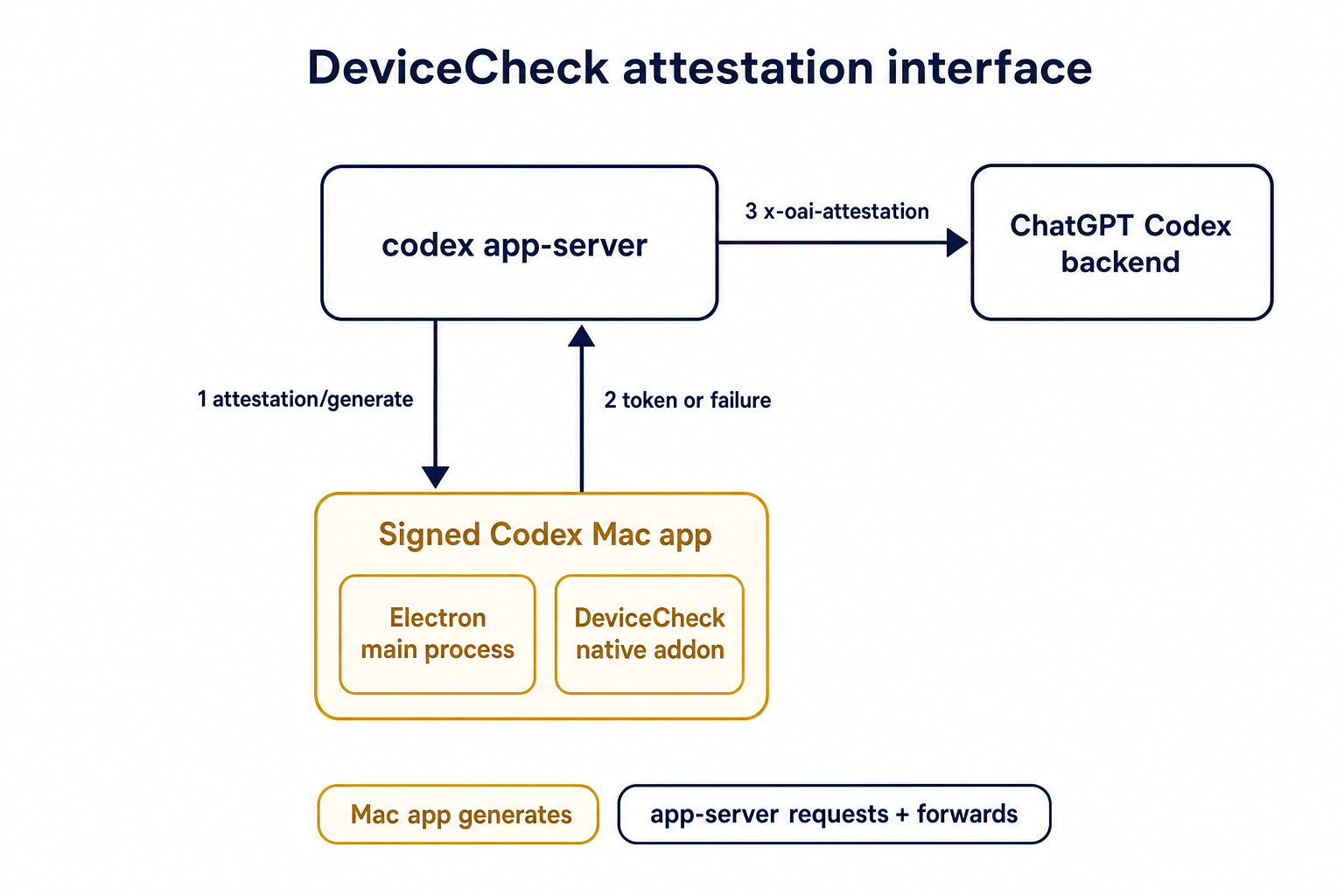
This PR teaches the Codex app-server runtime how to request and attach
an attestation token. It does not generate DeviceCheck tokens directly;
instead, it relies on the connected desktop app to advertise that it can
generate attestation and then asks that app for a fresh header value
when needed.
The flow is:
1. The Codex desktop app connects to app-server.
2. During `initialize`, the app can advertise that it supports
`requestAttestation`.
3. Before app-server calls selected ChatGPT Codex endpoints, it sends
the internal server request `attestation/generate` to the app.
4. app-server receives a pre-encoded header value back.
5. app-server forwards that value as `x-oai-attestation` on the scoped
outbound requests.
The code in this repo is mostly protocol and runtime plumbing: it adds
the app-server request/response shape, introduces an attestation
provider in core, wires that provider into Responses / compaction /
realtime setup paths, and covers the intended scoping with tests. The
signed macOS DeviceCheck generation remains owned by the desktop app PR.
## Related PR
- Codex desktop app implementation:
https://github.com/openai/openai/pull/878649
## Validation
<details>
<summary>Tests run</summary>
```sh
cargo test -p codex-app-server-protocol
cargo test -p codex-core attestation --lib
cargo test -p codex-app-server --lib attestation
```
Also ran:
```sh
just fix -p codex-core
just fix -p codex-app-server
just fix -p codex-app-server-protocol
just fmt
just write-app-server-schema
```
</details>
<details>
<summary>E2E DeviceCheck validation</summary>
First validated the signed desktop app boundary directly: launched a
packaged signed `Codex.app`, sent `attestation/generate`, decoded the
returned `v1.` attestation header, and validated the extracted
DeviceCheck token with `personal/jm/verify_devicecheck_token.py` using
bundle ID `com.openai.codex`. Apple returned `status_code: 200` and
`is_ok: true`.
Then ran the fuller app + app-server flow. The packaged `Codex.app`
launched a current-branch app-server via `CODEX_CLI_PATH`, and a local
MITM proxy intercepted outbound `chatgpt.com` traffic. The app-server
requested `attestation/generate` from the real Electron app process, and
the intercepted `/backend-api/codex/responses` traffic included
`x-oai-attestation` on both routes:
```text
GET /backend-api/codex/responses Upgrade: websocket x-oai-attestation: present
POST /backend-api/codex/responses Upgrade: none x-oai-attestation: present
```
The captured header decoded to a DeviceCheck token that also validated
with Apple for `com.openai.codex` (`status_code: 200`, `is_ok: true`,
team `2DC432GLL2`).
</details>
---------
Co-authored-by: Codex <noreply@openai.com>
## Summary

- Teach app-server `thread/list` to accept either a single `cwd` or an
array of cwd filters, returning threads whose recorded session cwd
matches any requested path
- Add `useStateDbOnly` as an explicit opt-in fast path for callers that
want to answer `thread/list` from SQLite without scanning JSONL rollout
files
- Preserve backwards compatibility: by default, `thread/list` still
scans JSONL rollouts and repairs SQLite state
- Wire the new cwd array and SQLite-only options through app-server,
local/remote thread-store, rollout listing, generated TypeScript/schema
fixtures, proto output, and docs

## Test Plan

- `cargo test -p codex-app-server-protocol`
- `cargo test -p codex-rollout`
- `cargo test -p codex-thread-store`
- `cargo test -p codex-app-server thread_list`
- `just fmt`
- `just fix -p codex-app-server-protocol -p codex-rollout -p
codex-thread-store -p codex-app-server`
- `cargo build -p codex-cli --bin codex`
To improve performance of UI loads from the app, add two main
improvements:
1. The `thread/list` api now gets a `sortDirection` request field and a
`backwardsCursor` to the response, which lets you paginate forwards and
backwards from a window. This lets you fetch the first few items to
display immediately while you paginate to fill in history, then can
paginate "backwards" on future loads to catch up with any changes since
the last UI load without a full reload of the entire data set.
2. Added a new `thread/turns/list` api which also has sortDirection and
backwardsCursor for the same behavior as `thread/list`, allowing you the
same small-fetch for immediate display followed by background fill-in
and resync catchup.
In the app-server debug client, allow redirecting output to a file in
addition to just stdout. Shell redirecting works OK but is a bit weird
with the interactive mode of the debug client since a bunch of newlines
get dumped into the shell. With async messages from MCPs starting it's
also tricky to actually type in a prompt.
## Why

Bazel clippy now catches lints that `cargo clippy` can still miss when a
crate under `codex-rs` forgets to opt into workspace lints. The concrete
example here was `codex-rs/app-server/tests/common/Cargo.toml`: Bazel
flagged a clippy violation in `models_cache.rs`, but Cargo did not
because that crate inherited workspace package metadata without
declaring `[lints] workspace = true`.

We already mirror the workspace clippy deny list into Bazel after
[#15955](https://github.com/openai/codex/pull/15955), so we also need a
repo-side check that keeps every `codex-rs` manifest opted into the same
workspace settings.

## What changed

- add `.github/scripts/verify_cargo_workspace_manifests.py`, which
parses every `codex-rs/**/Cargo.toml` with `tomllib` and verifies:
  - `version.workspace = true`
  - `edition.workspace = true`
  - `license.workspace = true`
  - `[lints] workspace = true`
- top-level crate names follow the `codex-*` / `codex-utils-*`
conventions, with explicit exceptions for `windows-sandbox-rs` and
`utils/path-utils`
- run that script in `.github/workflows/ci.yml`
- update the current outlier manifests so the check is enforceable
immediately
- fix the newly exposed clippy violations in the affected crates
(`app-server/tests/common`, `file-search`, `feedback`,
`shell-escalation`, and `debug-client`)


---
[//]: # (BEGIN SAPLING FOOTER)
Stack created with [Sapling](https://sapling-scm.com). Best reviewed
with [ReviewStack](https://reviewstack.dev/openai/codex/pull/16353).
* #16351
* __->__ #16353
## Why

Once the repo-local lint exists, `codex-rs` needs to follow the
checked-in convention and CI needs to keep it from drifting. This commit
applies the fallback `/*param*/` style consistently across existing
positional literal call sites without changing those APIs.

The longer-term preference is still to avoid APIs that require comments
by choosing clearer parameter types and call shapes. This PR is
intentionally the mechanical follow-through for the places where the
existing signatures stay in place.

After rebasing onto newer `main`, the rollout also had to cover newly
introduced `tui_app_server` call sites. That made it clear the first cut
of the CI job was too expensive for the common path: it was spending
almost as much time installing `cargo-dylint` and re-testing the lint
crate as a representative test job spends running product tests. The CI
update keeps the full workspace enforcement but trims that extra
overhead from ordinary `codex-rs` PRs.

## What changed

- keep a dedicated `argument_comment_lint` job in `rust-ci`
- mechanically annotate remaining opaque positional literals across
`codex-rs` with exact `/*param*/` comments, including the rebased
`tui_app_server` call sites that now fall under the lint
- keep the checked-in style aligned with the lint policy by using
`/*param*/` and leaving string and char literals uncommented
- cache `cargo-dylint`, `dylint-link`, and the relevant Cargo
registry/git metadata in the lint job
- split changed-path detection so the lint crate's own `cargo test` step
runs only when `tools/argument-comment-lint/*` or `rust-ci.yml` changes
- continue to run the repo wrapper over the `codex-rs` workspace, so
product-code enforcement is unchanged

Most of the code changes in this commit are intentionally mechanical
comment rewrites or insertions driven by the lint itself.

## Verification

- `./tools/argument-comment-lint/run.sh --workspace`
- `cargo test -p codex-tui-app-server -p codex-tui`
- parsed `.github/workflows/rust-ci.yml` locally with PyYAML

---

* -> #14652
* #14651
## Summary
In an effort to start simplifying our sandbox setup, we're announcing
this approval_policy as deprecated. In general, it performs worse than
`on-request`, and we're focusing on making fewer sandbox configurations
perform much better.

## Testing
- [x] Tested locally
- [x] Existing tests pass
## Problem being solved
- We need a single, reliable way to mark app-server API surface as
experimental so that:
  1. the runtime can reject experimental usage unless the client opts in
2. generated TS/JSON schemas can exclude experimental methods/fields for
stable clients.

Right now that’s easy to drift or miss when done ad-hoc.

## How to declare experimental methods and fields
- **Experimental method**: add `#[experimental("method/name")]` to the
`ClientRequest` variant in `client_request_definitions!`.
- **Experimental field**: on the params struct, derive `ExperimentalApi`
and annotate the field with `#[experimental("method/name.field")]` + set
`inspect_params: true` for the method variant so
`ClientRequest::experimental_reason()` inspects params for experimental
fields.

## How the macro solves it
- The new derive macro lives in
`codex-rs/codex-experimental-api-macros/src/lib.rs` and is used via
`#[derive(ExperimentalApi)]` plus `#[experimental("reason")]`
attributes.
- **Structs**:
- Generates `ExperimentalApi::experimental_reason(&self)` that checks
only annotated fields.
  - The “presence” check is type-aware:
    - `Option<T>`: `is_some_and(...)` recursively checks inner.
    - `Vec`/`HashMap`/`BTreeMap`: must be non-empty.
    - `bool`: must be `true`.
    - Other types: considered present (returns `true`).
- Registers each experimental field in an `inventory` with `(type_name,
serialized field name, reason)` and exposes `EXPERIMENTAL_FIELDS` for
that type. Field names are converted from `snake_case` to `camelCase`
for schema/TS filtering.
- **Enums**:
- Generates an exhaustive `match` returning `Some(reason)` for annotated
variants and `None` otherwise (no wildcard arm).
- **Wiring**:
- Runtime gating uses `ExperimentalApi::experimental_reason()` in
`codex-rs/app-server/src/message_processor.rs` to reject requests unless
`InitializeParams.capabilities.experimental_api == true`.
- Schema/TS export filters use the inventory list and
`EXPERIMENTAL_CLIENT_METHODS` from `client_request_definitions!` to
strip experimental methods/fields when `experimental_api` is false.
## Summary
- Stream proposed plans in Plan Mode using `<proposed_plan>` tags parsed
in core, emitting plan deltas plus a plan `ThreadItem`, while stripping
tags from normal assistant output.
- Persist plan items and rebuild them on resume so proposed plans show
in thread history.
- Wire plan items/deltas through app-server protocol v2 and render a
dedicated proposed-plan view in the TUI, including the “Implement this
plan?” prompt only when a plan item is present.

## Changes

### Core (`codex-rs/core`)
- Added a generic, line-based tag parser that buffers each line until it
can disprove a tag prefix; implements auto-close on `finish()` for
unterminated tags. `codex-rs/core/src/tagged_block_parser.rs`
- Refactored proposed plan parsing to wrap the generic parser.
`codex-rs/core/src/proposed_plan_parser.rs`
- In plan mode, stream assistant deltas as:
  - **Normal text** → `AgentMessageContentDelta`
  - **Plan text** → `PlanDelta` + `TurnItem::Plan` start/completion
  (`codex-rs/core/src/codex.rs`)
- Final plan item content is derived from the completed assistant
message (authoritative), not necessarily the concatenated deltas.
- Strips `<proposed_plan>` blocks from assistant text in plan mode so
tags don’t appear in normal messages.
(`codex-rs/core/src/stream_events_utils.rs`)
- Persist `ItemCompleted` events only for plan items for rollout replay.
(`codex-rs/core/src/rollout/policy.rs`)
- Guard `update_plan` tool in Plan Mode with a clear error message.
(`codex-rs/core/src/tools/handlers/plan.rs`)
- Updated Plan Mode prompt to:
  - keep `<proposed_plan>` out of non-final reasoning/preambles
  - require exact tag formatting
  - allow only one `<proposed_plan>` block per turn
  (`codex-rs/core/templates/collaboration_mode/plan.md`)

### Protocol / App-server protocol
- Added `TurnItem::Plan` and `PlanDeltaEvent` to core protocol items.
(`codex-rs/protocol/src/items.rs`, `codex-rs/protocol/src/protocol.rs`)
- Added v2 `ThreadItem::Plan` and `PlanDeltaNotification` with
EXPERIMENTAL markers and note that deltas may not match the final plan
item. (`codex-rs/app-server-protocol/src/protocol/v2.rs`)
- Added plan delta route in app-server protocol common mapping.
(`codex-rs/app-server-protocol/src/protocol/common.rs`)
- Rebuild plan items from persisted `ItemCompleted` events on resume.
(`codex-rs/app-server-protocol/src/protocol/thread_history.rs`)

### App-server
- Forward plan deltas to v2 clients and map core plan items to v2 plan
items. (`codex-rs/app-server/src/bespoke_event_handling.rs`,
`codex-rs/app-server/src/codex_message_processor.rs`)
- Added v2 plan item tests.
(`codex-rs/app-server/tests/suite/v2/plan_item.rs`)

### TUI
- Added a dedicated proposed plan history cell with special background
and padding, and moved “• Proposed Plan” outside the highlighted block.
(`codex-rs/tui/src/history_cell.rs`, `codex-rs/tui/src/style.rs`)
- Only show “Implement this plan?” when a plan item exists.
(`codex-rs/tui/src/chatwidget.rs`,
`codex-rs/tui/src/chatwidget/tests.rs`)

<img width="831" height="847" alt="Screenshot 2026-01-29 at 7 06 24 PM"
src="https://github.com/user-attachments/assets/69794c8c-f96b-4d36-92ef-c1f5c3a8f286"
/>

### Docs / Misc
- Updated protocol docs to mention plan deltas.
(`codex-rs/docs/protocol_v1.md`)
- Minor plumbing updates in exec/debug clients to tolerate plan deltas.
(`codex-rs/debug-client/src/reader.rs`, `codex-rs/exec/...`)

## Tests
- Added core integration tests:
  - Plan mode strips plan from agent messages.
  - Missing `</proposed_plan>` closes at end-of-message.
  (`codex-rs/core/tests/suite/items.rs`)
- Added unit tests for generic tag parser (prefix buffering, non-tag
lines, auto-close). (`codex-rs/core/src/tagged_block_parser.rs`)
- Existing app-server plan item tests in v2.
(`codex-rs/app-server/tests/suite/v2/plan_item.rs`)

## Notes / Behavior
- Plan output no longer appears in standard assistant text in Plan Mode;
it streams via `PlanDelta` and completes as a `TurnItem::Plan`.
- The final plan item content is authoritative and may diverge from
streamed deltas (documented as experimental).
- Reasoning summaries are not filtered; prompt instructs the model not
to include `<proposed_plan>` outside the final plan message.

## Codex Author
`codex fork 019bec2d-b09d-7450-b292-d7bcdddcdbfb`
Continuation of breaking up this PR
https://github.com/openai/codex/pull/9116

## Summary
- Thread user text element ranges through TUI/TUI2 input, submission,
queueing, and history so placeholders survive resume/edit flows.
- Preserve local image attachments alongside text elements and rehydrate
placeholders when restoring drafts.
- Keep model-facing content shapes clean by attaching UI metadata only
to user input/events (no API content changes).

## Key Changes
- TUI/TUI2 composer now captures text element ranges, trims them with
text edits, and restores them when submission is suppressed.
- User history cells render styled spans for text elements and keep
local image paths for future rehydration.
- Initial chat widget bootstraps accept empty `initial_text_elements` to
keep initialization uniform.
- Protocol/core helpers updated to tolerate the new InputText field
shape without changing payloads sent to the API.
Add support for returning threads by either `created_at` OR `updated_at`
descending. Previously core always returned threads ordered by
`created_at`.

This PR:
- updates core to be able to list threads by `updated_at` OR
`created_at` descending based on what the caller wants
- also update `thread/list` in app-server to expose this (default to
`created_at` if not specified)

All existing codepaths (app-server, TUI) still default to `created_at`,
so no behavior change is expected with this PR.

**Implementation**
To sort by `updated_at` is a bit nontrivial (whereas `created_at` is
easy due to the way we structure the folders and filenames on disk,
which are all based on `created_at`).

The most naive way to do this without introducing a cache file or sqlite
DB (which we have to implement/maintain) is to scan files in reverse
`created_at` order on disk, and look at the file's mtime (last modified
timestamp according to the filesystem) until we reach `MAX_SCAN_FILES`
(currently set to 10,000). Then, we can return the most recent N
threads.

Based on some quick and dirty benchmarking on my machine with ~1000
rollout files, calling `thread/list` with limit 50, the `updated_at`
path is slower as expected due to all the I/O:
- updated-at: average 103.10 ms
- created-at: average 41.10 ms

Those absolute numbers aren't a big deal IMO, but we can certainly
optimize this in a followup if needed by introducing more state stored
on disk.

**Caveat**
There's also a limitation in that any files older than `MAX_SCAN_FILES`
will be excluded, which means if a user continues a REALLY old thread,
it's possible to not be included. In practice that should not be too big
of an issue.

If a user makes...
- 1000 rollouts/day → threads older than 10 days won't show up
- 100 rollouts/day → ~100 days

If this becomes a problem for some reason, even more motivation to
implement an updated_at cache.


 acrognale-oaiandGitHub
 David de RegtandGitHub
 Rasmus RygaardandGitHub
 Michael BolinandGitHub
 jif-oaiandGitHub
 Dylan HurdandGitHub
 Charley CunninghamandGitHub
 Owen LinandGitHub
