Commit Graph

59 Commits

  • Expose thread-level multi-agent mode (#28792)
    ## Why
    
    Once multi-agent mode can be selected per turn, clients also need to
    choose the initial selection when creating a thread and observe that
    selection through lifecycle and settings APIs.
    
    The selected value is intentionally distinct from the effective
    model-visible value: no client selection is represented as `null`, even
    though an eligible multi-agent v2 turn derives `explicitRequestOnly` as
    its effective default.
    
    ## What changed
    
    - Add the optional experimental `thread/start.multiAgentMode` parameter
    and pass it through thread creation.
    - Preserve an omitted initial value as an unset selection rather than
    eagerly storing `explicitRequestOnly`.
    - Apply an explicit `thread/start` selection to the first turn through
    the session configuration established at thread creation.
    - Restore the latest persisted effective mode as the selected baseline
    on cold resume when rollout history contains one.
    - Inherit the optional selected mode from a loaded parent when creating
    related runtime threads.
    - Return the current selected `multiAgentMode` from `thread/start`,
    `thread/resume`, `thread/fork`, and thread settings, using `null` when
    no mode is selected.
    - Keep lifecycle reporting independent from model capability and feature
    eligibility; core turn construction remains responsible for calculating
    and persisting the effective mode.
    
    ## Not covered
    
    - Clearing an existing loaded-session selection back to unset through
    `turn/start`; omitted or `null` currently retains the session's
    selection.
    - A TUI control, slash command, or `config.toml` preference.
    
    ## Verification
    
    - `CARGO_INCREMENTAL=0 just test -p codex-app-server-protocol`
    - `CARGO_INCREMENTAL=0 just test -p codex-app-server multi_agent_mode`
    
    The focused app-server coverage verifies explicit `thread/start`
    initialization, first-turn prompting, nullable reporting for an omitted
    selection, and retention of selections that are not currently
    runtime-eligible.
    
    ## Stack
    
    Stacked on #28685. This PR contains only the thread initialization and
    lifecycle/settings API layer.
  • current time reminders impl for system clock (varlatency 2/n) (#28824)
    Stacked on #28822.
    
    ## Summary
    
    - add a host-injectable current-time provider with a built-in system
    implementation
    - record UTC developer reminders in history immediately before due model
    requests
    - keep cadence state per session and force a refresh after compaction
    
    This does NOT include the app server client <-> server clock logic. This
    PR is only for the reminder message & system clock that will be used in
    prod.
    
    ## Testing
    
    - `just test -p codex-core varlatency_`
    - `just clippy -p codex-core -p codex-app-server -p codex-mcp-server -p
    codex-thread-manager-sample`
    - `just fmt`
  • Support openai/form extended form elicitations (#27500)
    # Summary
    Allow App Server clients to opt into `openai/form` MCP elicitations.
  • [codex] Add optional IDs to response items (#28812)
    ## Why
    
    `ResponseItem` variants do not have a consistent internal ID shape: some
    variants carry required IDs, some carry optional IDs, and some cannot
    represent an ID at all. The existing fields also use inconsistent serde,
    TypeScript, and JSON-schema annotations. A single enum-level access path
    is needed before history recording can assign and retain IDs.
    
    This PR establishes that internal model only. It intentionally does not
    generate or serialize IDs; allocation and wire persistence are isolated
    in the stacked follow-up.
    
    ## What changed
    
    - Give every concrete `ResponseItem` variant an `Option<String>` ID
    field.
    - Apply the same internal-only annotations to every ID field:
    `#[serde(default, skip_serializing)]`, `#[ts(skip)]`, and
    `#[schemars(skip)]`.
    - Add `ResponseItem::id()` and `ResponseItem::set_id()` as the shared
    accessors.
    - Preserve IDs when history items are rewritten for truncation.
    - Adapt consumers that previously assumed reasoning and image-generation
    IDs were required.
    - Regenerate app-server schemas so the hidden fields are represented
    consistently.
    
    The serde catch-all `ResponseItem::Other` remains ID-less because it
    must remain a unit variant.
    
    ## Test plan
    
    - `cargo check --tests -p codex-core -p codex-api -p codex-rollout-trace
    -p codex-image-generation-extension`
    - `just test -p codex-protocol`
    - `just test -p codex-app-server-protocol`
    - `just test -p codex-api -p codex-rollout-trace -p
    codex-image-generation-extension`
    - `just test -p codex-core event_mapping`
  • app-server: preserve target-native environment cwd (#28146)
    ## Why
    
    app-server may run on a different OS from the selected exec-server
    environment. Parsing that environment’s cwd with the Codex host’s path
    rules prevents thread startup.
    
    ## What
    
    Carry environment cwd values as `LegacyAppPathString` at the app-server
    boundary and `PathUri` internally. Existing tool-call schemas and
    relative-path behavior stay host-native; remaining local-only consumers
    convert explicitly and leave follow-up TODOs.
    
    The Wine integration test verifies app-server can start a thread and
    complete an ordinary turn with a Windows environment cwd from Linux.
    
    ## Validation
    
    - `bazel test //codex-rs/core/tests/remote_env_windows:smoke-test
    --test_output=errors`
    - focused app-server environment-selection and protocol schema tests
    - scoped Clippy for `codex-core` and `codex-app-server-protocol`
  • [codex] retain resolved environments across turns (#27955)
    ## Why
    
    Selected execution environments are thread-scoped resources, but startup
    and turn construction repeatedly resolved their IDs and working
    directories. That discarded existing environment handles and shell
    metadata even when a selection had not changed.
    
    Session configuration updates also need to affect future turns without
    changing the resolved environment set already captured by a running
    turn.
    
    ## What changed
    
    - Create a `ThreadEnvironments` service inside `Codex` from the spawned
    `EnvironmentManager` and raw environment selections, then store it on
    `SessionServices`.
    - Split service construction from `update_selections`, allowing session
    configuration updates to mutate the resolved set in place.
    - Retain an existing `TurnEnvironment` when its environment ID and
    working directory match; resolve only added or changed selections and
    remove selections that are no longer present.
    - Normalize duplicate IDs by keeping the first selection and skip
    individual selections that fail to resolve instead of rejecting the
    entire update.
    - Give each `TurnContext` a cloned `TurnEnvironmentSnapshot`, so later
    session configuration updates affect future turns without rewriting an
    active turn.
    - Reuse the service-owned environment manager and resolved snapshot for
    startup work, MCP initialization, and child-thread spawning instead of
    flowing resolved environments through spawn arguments.
    
    ## Test plan
    
    - `cargo check -p codex-core --tests`
    - `just test -p codex-core environment_selection`
    - `just test -p codex-core turn_environments`
    - `just test -p codex-core
    session_update_settings_does_not_rewrite_sticky_environment_cwds`
    - `just test -p codex-core
    default_turn_does_not_overlay_legacy_fallback_cwd_onto_stored_thread_environments`
  • feat(core): add metadata field to ResponseItem (#28355)
    ## Description
    
    This PR adds an optional `metadata` field to `ResponseItem` for
    Responses API calls. Only mechanical plumbing, no actual values
    populated and sent yet. Turns out just adding a new field to
    `ResponseItem` has quite a large blast radius already.
    
    This change is backwards compatible because `metadata` is optional and
    omitted when absent, so existing response items and rollout history
    without it still deserialize and requests that do not set it keep the
    same wire shape. For provider compatibility, we strip out `metadata`
    before non-OpenAI Responses requests so Azure and AWS Bedrock never see
    this field.
    
    My followup PR here will actually make use of it to start storing and
    passing along `turn_id`: https://github.com/openai/codex/pull/28360
    
    ## What changed
    
    - Added `ResponseItemMetadata` with optional `turn_id`, plus optional
    `metadata` on Responses API item variants and inter-agent communication.
    - Preserved item metadata through response-item rewrites such as
    truncation, missing tool-output synthesis, compaction history
    rebuilding, visible-history conversion, rollout/resume, and generated
    app-server schemas/types.
    - Strip item metadata from non-OpenAI Responses requests while
    preserving it for OpenAI-shaped requests.
    - Updated the mechanical fixture/test construction churn required by the
    new optional field.
  • Add selected-plugin precedence and attribution to the MCP catalog (#27884)
    ## Why
    
    **In short:** this PR resolves already-discovered MCP registrations. It
    does not read selected plugins or discover their MCP servers.
    
    The resolved MCP catalog currently builds config and auto-discovered
    plugin registrations before runtime contributors are applied. A
    thread-selected plugin needs a distinct precedence tier in that same
    initial resolution pass: otherwise a disabled lower-precedence winner
    can leave stale name-level state behind, and the winning MCP tools
    cannot be attributed to the selected package reliably.
    
    This PR adds that catalog boundary before executor discovery is
    connected.
    
    ## What changed
    
    - Added an explicit selected-plugin registration tier between
    auto-discovered plugins and explicit config.
    - Collected selected-plugin contributions before the initial catalog
    build, while leaving compatibility and generic extension overlays in
    their existing runtime phase.
    - Retained the winning plugin ID and display name directly on
    plugin-owned catalog registrations.
    - Derived MCP tool provenance from the winning catalog entry instead of
    joining against local-only plugin summaries.
    - Retained the winning selected server's tool approval policy in the
    running connection manager, so a selected registration cannot inherit
    approval behavior from a losing local plugin.
    - Kept remembered approval session-scoped for selected plugins until
    there is an authority-aware persistence contract; Codex will not write
    approval back to an unrelated local plugin.
    - Preserved existing name-level disabled vetoes for discovered plugins
    and config, while keeping a selected package's own disabled registration
    scoped to that registration.
    - Preserved deterministic selection order and existing config,
    compatibility, and extension precedence.
    
    The resulting order is:
    
    ```text
    auto-discovered plugin
      < selected plugin
      < explicit config
      < compatibility registration
      < extension overlay
    ```
    
    ## Behavior and scope
    
    This is a catalog and provenance change only. No production host
    contributes selected-plugin MCP registrations yet, so existing local MCP
    behavior remains unchanged.
    
    The stacked follow-up, #27870, installs the executor plugin provider
    that produces these registrations. App-server activation remains a
    separate final step.
    
    ## Verification
    
    Focused tests cover precedence, deterministic selected-plugin conflicts,
    disabled-veto behavior across catalog phases, managed requirements
    before selected-plugin resolution, winning-server approval policy, and
    attribution when local and selected packages share an ID or server name.
    CI owns execution of the test suite.
  • [codex] exec-server honors remote environment cwd and shell (#28122)
    ## Why
    
    Next slice needed to make progress on the `remote_env_windows` test is
    to support passing a Windows cwd for the remote environment and using
    that environment's native shell. This lets the test run a real Windows
    process instead of only recording an early path or shell mismatch.
    
    ## What
    
    - change `TurnEnvironmentSelection.cwd` from `AbsolutePathBuf` to
    `PathUri`
    - convert local cwd values to URIs when constructing selections
    - preserve a remote primary cwd instead of replacing it with the local
    legacy fallback
    - prefer the selected environment's discovered shell for unified exec,
    falling back to the session shell when unavailable
    - convert back to a host-native absolute path at current native-only
    consumer boundaries
    - reject or deny unsupported foreign cwd values at the existing
    request-permissions boundary, with TODOs for its future migration
    - extend the hermetic Wine test to execute Windows PowerShell in
    `C:\windows` and verify successful process completion
    - record the current app-server rejection against the same Wine-backed
    remote Windows fixture when its cwd is supplied as a native Windows path
  • sandboxing: migrate cwd inputs to PathUri (#27816)
    ## Why
    
    Sandbox cwd values can cross app-server and exec-server host boundaries.
    They should retain URI semantics until the receiving host validates them
    instead of being interpreted early as native paths.
    
    ## What
    
    - Carry `PathUri` through filesystem sandbox contexts, sandbox commands,
    and transform inputs.
    - Convert command and policy cwd once in `SandboxManager::transform`,
    then keep launch requests native.
    - Preserve sandbox cwd over remote filesystem transport and reject
    non-native URIs without fallback.
    - Cache paired native/URI turn-environment cwd values during migration,
    with immutable access to keep them synchronized.
    - Extend existing protocol, forwarding, transform, and core runtime
    tests.
  • Make MCP server contributions thread-scoped (#27670)
    ## Why
    
    `selectedCapabilityRoots` belongs to one thread, but MCP contributors
    previously received only the global Codex config. That left no clean way
    for a selected executor capability to contribute MCP servers to its own
    thread.
    
    ## What this PR does
    
    - Gives MCP contributors a small context containing the config and, for
    a running thread, its frozen host-seeded inputs.
    - Uses the same thread inputs during startup, status queries, refreshes,
    and skill dependency checks.
    - Keeps threadless MCP operations and the existing hosted Apps behavior
    unchanged.
    - Adds coverage showing that two threads resolve independent
    registrations and that later lifecycle mutations do not change the
    frozen MCP inputs.
    
    This PR does not discover plugin manifests, add MCP servers, or launch
    anything new. It only establishes the thread-scoped registration
    boundary.
    
    ## Follow-ups
    
    - Resolve selected executor plugin roots through their owning
    environment filesystem.
    - Convert their stdio MCP declarations into environment-bound
    registrations and add an executor MCP end-to-end test.
    
    ## Verification
    
    - `just fmt`
    - `cargo check --tests -p codex-protocol -p codex-extension-api -p
    codex-mcp-extension -p codex-core -p codex-app-server`
    
    Tests and Clippy were not run.
  • [codex] Load AGENTS.md from all bound environments (#27696)
    ## Why
    
    We already have the machinery to support multiple environments on a
    single thread, but we only show the model the contents of `AGENTS.md`
    files in the primary environment.
    
    We should show the model all of the relevant project instructions when
    we know there's more than one environment.
    
    ## Known Gaps
    
    As discussed in the RFC, this implementation:
    
    1. doesn't handle environments being added/removed to/from the thread
    after its creation
    2. it doesn't enforce an aggregate context budget across environments,
    and instead applies the configured project maximum independently to each
    environment
    
    ## Implementation
    
    - Discover project instructions in environment order with an independent
    byte budget per environment and preserve source provenance/order.
    - Keep the legacy fragment byte-for-byte when exactly one environment
    contributes project instructions; use environment-labeled sections when
    two or more environments contribute.
    - Freeze the complete rendered fragment in `LoadedAgentsMd`, insert it
    directly into requests, and recognize both layouts in contextual and
    memory filtering.
    - Add exact rendering, independent-budget, source-order,
    creation-snapshot, and consumer coverage without changing app-server
    schemas.
  • [codex] Load user instructions through an injected provider (#27101)
    ## Why
    
    We want to remove implicit use of `$CODEX_HOME` from `codex-core` and
    make embedders responsible for supplying user-level instructions. This
    also ensures user instructions load when no primary environment is
    selected.
    
    ## What changed
    
    Stacked on #27415, which makes `codex exec` surface thread-scoped
    runtime warnings.
    
    - Added `UserInstructionsProvider` to `codex-extension-api`, with
    absolute source attribution and recoverable loading warnings.
    - Added `codex-home` with the filesystem-backed provider for
    `AGENTS.override.md` and `AGENTS.md`, preserving precedence, fallback,
    trimming, lossy UTF-8 handling, and the existing uncapped global
    instruction size.
    - Removed global instruction loading from `Config` and require
    `ThreadManager` callers to inject a provider.
    - Load provider instructions once for each fresh root runtime, including
    runtimes without a primary environment. Running sessions retain their
    snapshot, while child agents inherit the parent snapshot without
    invoking the provider.
    - Keep provider instructions separate while loading project `AGENTS.md`,
    then assemble the model-visible instructions with the existing ordering,
    source attribution, warning, and turn-context behavior.
    - Wired the Codex home provider through the CLI, app server, MCP server,
    core facade, and thread-manager sample.
    
    ## Validation
    
    - `just test -p codex-home -p codex-extension-api`
    - `just test -p codex-core agents_md`
    - `just test -p codex-core guardian`
    - `just test -p codex-app-server
    thread_start_without_selected_environment_includes_only_global_instruction_source`
    - `just test -p codex-exec warning`
    - `just bazel-lock-check`
  • Remove async-trait from extension contributors (#27383)
    ## Why
    
    Extension contributors are registered behind `dyn Trait` objects, so
    native `async fn`/RPITIT methods would make these traits
    non-object-safe. Spell out the boxed, `Send` future contract directly so
    `extension-api` no longer needs `async-trait` while retaining the
    existing runtime model.
    
    ## What changed
    
    - add a shared `ExtensionFuture` alias and use it for asynchronous
    contributor methods
    - migrate production and test implementations to return `Box::pin(async
    move { ... })`
    - remove `async-trait` dependencies where they are no longer used,
    keeping it dev-only where unrelated test executors still require it
    
    ## Behavior
    
    No behavior change is intended. Contributor futures remain boxed,
    `Send`, dynamically dispatched, and lazily executed; cancellation and
    callback ordering stay unchanged.
    
    ## Testing
    
    - `just test -p codex-extension-api` (11 passed)
    - affected extension crates (64 passed)
    - targeted `codex-core` contributor tests (14 passed)
    - `just fmt`
    - `just bazel-lock-update`
    - `just bazel-lock-check`
    
    A broad local `codex-core` run compiled successfully but encountered
    unrelated sandbox and missing test-binary fixture failures; CI will run
    the full checks.
  • Load selected executor skills through extensions (#27184)
    ## Why
    
    CCA is moving toward a split runtime where the orchestrator may not have
    a filesystem, while executors can expose preinstalled plugins and
    skills. A thread therefore needs to select capabilities without asking
    app-server or core to interpret executor-owned paths through the
    orchestrator's filesystem.
    
    The longer-term model is broader than executor skills:
    
    - A plugin is a bundle of skills, MCP servers, connectors/apps, and
    hooks.
    - A plugin root can be local, executor-owned, or hosted by a backend.
    - Components inside one plugin can use different access and execution
    mechanisms. A skill may be read from a filesystem or through backend
    tools; an HTTP MCP server can run without an executor; a stdio MCP
    server or hook needs an execution environment.
    - Core should carry generic extension initialization data. The extension
    that owns a component should discover it, expose it to the model, and
    invoke it through the appropriate runtime.
    
    This PR establishes that architecture through one complete vertical:
    selecting a root on an executor, discovering the skills beneath it,
    exposing those skills to the model, and reading an explicitly invoked
    `SKILL.md` through the same executor.
    
    ## Contract
    
    `thread/start` gains an experimental `selectedCapabilityRoots` field:
    
    ```json
    {
      "selectedCapabilityRoots": [
        {
          "id": "deploy-plugin@1",
          "location": {
            "type": "environment",
            "environmentId": "workspace",
            "path": "/opt/codex/plugins/deploy"
          }
        }
      ]
    }
    ```
    
    The root is intentionally not classified as a "plugin" or "skill" in the
    API. It can point at a standalone skill, a directory containing several
    skills, or a plugin containing skills and other components. This PR only
    teaches the skills extension how to consume it; later extensions can
    resolve MCP, connector, and hook components from the same selection.
    
    The platform-supplied `id` is stable selection identity. The location
    says which runtime owns the root and gives that runtime an opaque path.
    App-server does not inspect or canonicalize the path.
    
    ## What changed
    
    ### Generic thread extension initialization
    
    App-server converts selected roots into `ExtensionDataInit`. Core
    carries that generic initialization value until the final thread ID is
    known, then creates thread-scoped `ExtensionData` before lifecycle
    contributors run.
    
    This keeps `Session` and core independent of the capability-selection
    contract. The initialization value is consumed during construction; it
    is not retained as another long-lived `Session` field.
    
    ### Executor-backed skills
    
    The skills extension now owns an `ExecutorSkillProvider` that:
    
    - resolves the selected environment through `EnvironmentManager`
    - discovers, canonicalizes, and reads skills through that environment's
    `ExecutorFileSystem`
    - contributes the bounded selected-skill catalog as stable developer
    context
    - reads an explicitly invoked skill body through the authority that
    listed it
    - warns when an environment or root is unavailable
    - never falls back to the orchestrator filesystem for an executor-owned
    root
    
    Skill catalog and instruction fragments have hard byte bounds, which
    also bound them below the 10K-token per-item context limit. If a
    selected executor skill has the same name as a legacy local skill, the
    executor selection owns that invocation and the local body is not
    injected a second time.
    
    Existing local and bundled skill loading remains in place. Omitting
    `selectedCapabilityRoots` therefore preserves current local-only
    behavior.
    
    ## Current semantics
    
    - Only environment-owned locations are represented in this first
    contract.
    - Roots are resolved by the destination extension, not by app-server or
    core.
    - An unavailable executor or invalid root produces a warning and no
    capabilities from that root; it does not trigger a local-filesystem
    fallback.
    - Selection applies to a newly started active thread.
    - MCP servers, connectors, and hooks beneath a selected plugin root are
    not activated yet.
    - Selection is not yet persisted or inherited across resume, fork, or
    subagent creation. Existing local capabilities continue to behave as
    they do today in those flows.
    
    ## Planned vertical follow-ups
    
    1. **Hosted HTTP MCP:** add an extension-backed HTTP MCP source that
    works without an executor, then replace the special-purpose MCP plugins
    loader with that implementation.
    2. **Executor MCP:** register and execute stdio MCP servers through the
    environment that owns the selected plugin root.
    3. **Backend skills:** add a hosted skill source whose catalog and
    bodies are accessed through extension tools rather than a filesystem.
    4. **Connectors and hooks:** activate those components through their
    owning extensions, using the same selected-root boundary and
    component-specific runtime.
    5. **Durable selection:** define the desired-selection lifecycle,
    persist it, and make resume, fork, and subagent inheritance explicit
    rather than accidental.
    6. **Local convergence:** incrementally route existing local plugin,
    skill, and MCP loading through the same extension model while preserving
    current local behavior.
    
    Each follow-up remains reviewable as an end-to-end capability. The
    platform selects roots, generic thread extension data carries the
    selection, and the owning extension resolves and operates its component.
    
    ## Verification
    
    Coverage added for:
    
    - app-server end-to-end discovery and explicit invocation of a skill
    inside an executor-selected plugin root
    - exclusive invocation when a selected executor skill collides with a
    local skill name
    - executor filesystem authority for discovery, canonicalization, and
    reads
    - thread extension initialization before lifecycle contributors run
    - stable executor catalog context, explicit invocation, context
    rebuilding, hidden skills, and preserved host/remote catalog behavior
    
    Targeted protocol, core-skills, skills-extension, core lifecycle, and
    app-server executor-skill tests were run during development.
  • Pair thread environment settings (#26687)
    ## Why
    
    Thread cwd and environment selections are a single logical setting in
    core: updating one without the other can silently desynchronize the
    next-turn execution context. This change makes that relationship
    explicit in the internal thread settings flow while preserving the
    existing app-server public API shape.
    
    ## What changed
    
    - Moved the cwd/environment pair through internal
    `ThreadSettingsOverrides.environment_settings` instead of a top-level
    internal `cwd` field.
    - Kept `thread/settings/update` public params unchanged, with app-server
    translating top-level `cwd` into the paired internal settings shape.
    - Moved `Op::UserInput` environment overrides into thread settings so
    user turns and settings updates use the same core path.
    - Updated core, app-server, MCP, memories, sample, and test callsites to
    construct the paired settings shape.
    
    ## Verification
    
    - `git diff --check`
    - Local test run starting after PR creation.
  • [2 of 2] Finish moving goal runtime to extension (#26548)
    ## Stack
    
    1. [#26547](https://github.com/openai/codex/pull/26547) - [1 of 2] Align
    goal extension with core behavior
    2. [#26548](https://github.com/openai/codex/pull/26548) - [2 of 2] Move
    goal runtime to extension
    
    ## Why
    
    This PR completes the switch of the goal behavior to the
    extension-backed runtime and removes the old core goal implementation.
    
    ## What Changed
    
    - Installs the goal extension for app-server `ThreadManager` sessions.
    - Routes app-server thread goal `get`, `set`, and `clear` through
    `GoalService`.
    - Uses thread-idle lifecycle emission after goal resume and snapshot
    ordering so the extension can decide whether to continue the goal.
    - Forwards extension goal updates through a FIFO async app-server
    notification path so backpressure does not drop them or reorder updates.
    - Keeps review turns from enabling goal runtime behavior.
    - Plans extension tools before dynamic tools so built-in goal tool names
    keep their old precedence when goals are enabled.
    - Removes the old core goal runtime, core goal tool handlers, and core
    goal tool specs.
    - Updates tests that were coupled to the core-owned goal runtime while
    leaving the legacy `<goal_context>` compatibility path in core for old
    threads.
    - Removes the stale cargo-shear ignore now that `codex-goal-extension`
    is used by the workspace.
    - Keeps realtime event matching exhaustive after removing the old
    goal-specific realtime text path.
    
    
    ## Validation
    
    - Ran manual `/goal` runs in TUI. Validated time accounting matched
    wall-clock time and goal lifecycle state transitions.
  • app-server: remove experimental persist_extended_history bool flag (#25712)
    ## Summary
    
    Remove the dead experimental `persistExtendedHistory` app-server flag
    and collapse rollout persistence to the single policy app-server already
    used.
    
    ## What Changed
    
    - Removed `persistExtendedHistory` from v2 thread start/resume/fork
    params and deleted its deprecation notice path.
    - Removed the persistence-mode enums and plumbing through core, rollout,
    and thread-store.
    - Made rollout filtering mode-free, keeping the existing limited
    persisted-history behavior.
    
    ## Test Plan
    
    - `just write-app-server-schema`
    - `cargo nextest run --no-fail-fast -p codex-app-server-protocol
    schema_fixtures`
    - `cargo nextest run --no-fail-fast -p codex-app-server
    thread_shell_command_history_responses_exclude_persisted_command_executions`
    - `cargo nextest run --no-fail-fast -p codex-rollout -p
    codex-thread-store`
    - final `rg` for removed flag/type names
  • [codex] Add user input client ids (#24653)
    ## Summary
    
    Adds an optional `clientId` field to app-server v2 `UserInput` and
    carries it through the core `UserInput` model so clients can correlate
    echoed user input items without relying on payload equality.
    
    ## Details
    
    - Adds `client_id: Option<String>` to core `UserInput` variants.
    - Exposes the v2 app-server field as `clientId` on the wire and in
    generated TypeScript.
    - Preserves the id when converting between app-server v2 and core
    protocol types.
    - Regenerates app-server schema fixtures.
    
    ## Validation
    
    - `just fmt`
    - `just write-app-server-schema`
    - `cargo test -p codex-app-server-protocol`
    - `cargo test -p codex-protocol`
    - `just fix -p codex-app-server-protocol`
    - `just fix -p codex-protocol`
    - `git diff --check`
  • Add trace_id to TurnStartedEvent (#23980)
    ## Why
    [Recent PR](https://github.com/openai/codex/pull/22709) removed
    `trace_id` from `TurnContextItem`.
    
    ## What changed
    - Add to `TurnStartedEvent` so rollout consumers can correlate turns
    with telemetry traces.
    - Note that the branch name is out of date because I originally re-added
    to `TurnContextItem`, but we decided to move it to `TurnStartedEvent`.
    
    ## Verification
    - `cargo test -p codex-protocol`
    - `cargo test -p codex-core --lib
    regular_turn_emits_turn_started_without_waiting_for_startup_prewarm`
    - `cargo test -p codex-core --test all
    emits_warning_when_resumed_model_differs`
    - `cargo test -p codex-rollout`
    - `cargo test -p codex-state`
  • Make local environment optional in EnvironmentManager (#23369)
    ## Summary
    - make `EnvironmentManager` local environment/runtime paths optional
    - simplify constructor surface around snapshot materialization
    - rename local env accessors to `require_local_environment` /
    `try_local_environment`
    
    ## Validation
    - devbox Bazel build for touched crate surfaces
    - `//codex-rs/exec-server:exec-server-unit-tests`
    - `//codex-rs/app-server-client:app-server-client-unit-tests`
    - filtered touched `//codex-rs/core:core-unit-tests` cases
  • chore: isolate thread goal storage behind GoalStore (#23295)
    ## Why
    
    Thread goal persistence is being prepared for a dedicated storage
    boundary. Before that split, goal-specific reads, writes, accounting,
    and cleanup were exposed directly on `StateRuntime`, so core and
    app-server callsites stayed coupled to the full runtime instead of a
    goal-specific store.
    
    This PR introduces that boundary without changing the goal wire API or
    current persistence behavior. Callers now go through
    `StateRuntime::thread_goals()` and the new `GoalStore`, while
    `GoalStore` still uses the existing state DB pool underneath.
    
    ## What changed
    
    - Added `GoalStore` in `state/src/runtime/goals.rs` and exposed it from
    `StateRuntime` via `thread_goals()`.
    - Moved thread-goal reads, writes, status updates, pause, delete, and
    usage accounting onto `GoalStore`.
    - Updated core session goal handling, app-server goal RPCs, resume
    snapshots, and goal tests to use the store boundary.
    - Kept thread deletion responsible for cascading goal cleanup by
    deleting the goal through the store only after a thread row is removed.
    
    ## Testing
    
    - Existing goal persistence, resume, and accounting tests were updated
    to exercise the new `GoalStore` access path.
  • Preserve image detail in app-server inputs (#20693)
    ## Summary
    
    - Add optional image detail to user image inputs across core, app-server
    v2, thread history/event mapping, and the generated app-server
    schemas/types.
    - Preserve requested detail when serializing Responses image inputs:
    omitted detail stays on the existing `high` default, while explicit
    `original` keeps local images on the original-resolution path.
    - Support `high`/`original` consistently for tool image outputs,
    including MCP `codex/imageDetail`, code-mode image helpers, and
    `view_image`.
  • extension: wire extension registries into sessions (#21737)
    ## Why
    
    [#21736](https://github.com/openai/codex/pull/21736) introduces the
    typed extension API, but the runtime does not yet carry a registry
    through thread/session startup or give contributors host-owned stores to
    read from. This PR wires that host-side path so later feature migrations
    can move product-specific behavior behind typed contributions without
    adding another bespoke seam directly to `codex-core`.
    
    ## What changed
    
    - Thread `ExtensionRegistry<Config>` through `ThreadManager`,
    `CodexSpawnArgs`, `Session`, and sub-agent spawn paths.
    - Wire `ThreadStartContributor` and `ContextContributor`
    - Expose the small supporting surface needed by non-core callers that
    construct threads directly, including `empty_extension_registry()`
    through `codex-core-api`.
    
    This PR lands the host plumbing only: the app-server registry is still
    empty, and concrete feature migrations are intended to follow
    separately.
  • Make environment provider snapshots path-free (#21794)
    ## Summary
    - make EnvironmentProvider::snapshot path-free and keep providers
    focused on provider-owned remote environments
    - let provider snapshots request local inclusion via include_local, with
    environments.toml including local and CODEX_EXEC_SERVER_URL excluding
    local
    - move reserved local environment construction into EnvironmentManager
    using ExecServerRuntimePaths
    
    Follow-up to https://github.com/openai/codex/pull/20667
    
    ## Testing
    - just fmt
    - git diff --check
    - devbox: bazel build --bes_backend= --bes_results_url=
    //codex-rs/exec-server:exec-server
    - devbox: bazel test --bes_backend= --bes_results_url=
    //codex-rs/exec-server:exec-server-unit-tests
    
    Co-authored-by: Codex <noreply@openai.com>
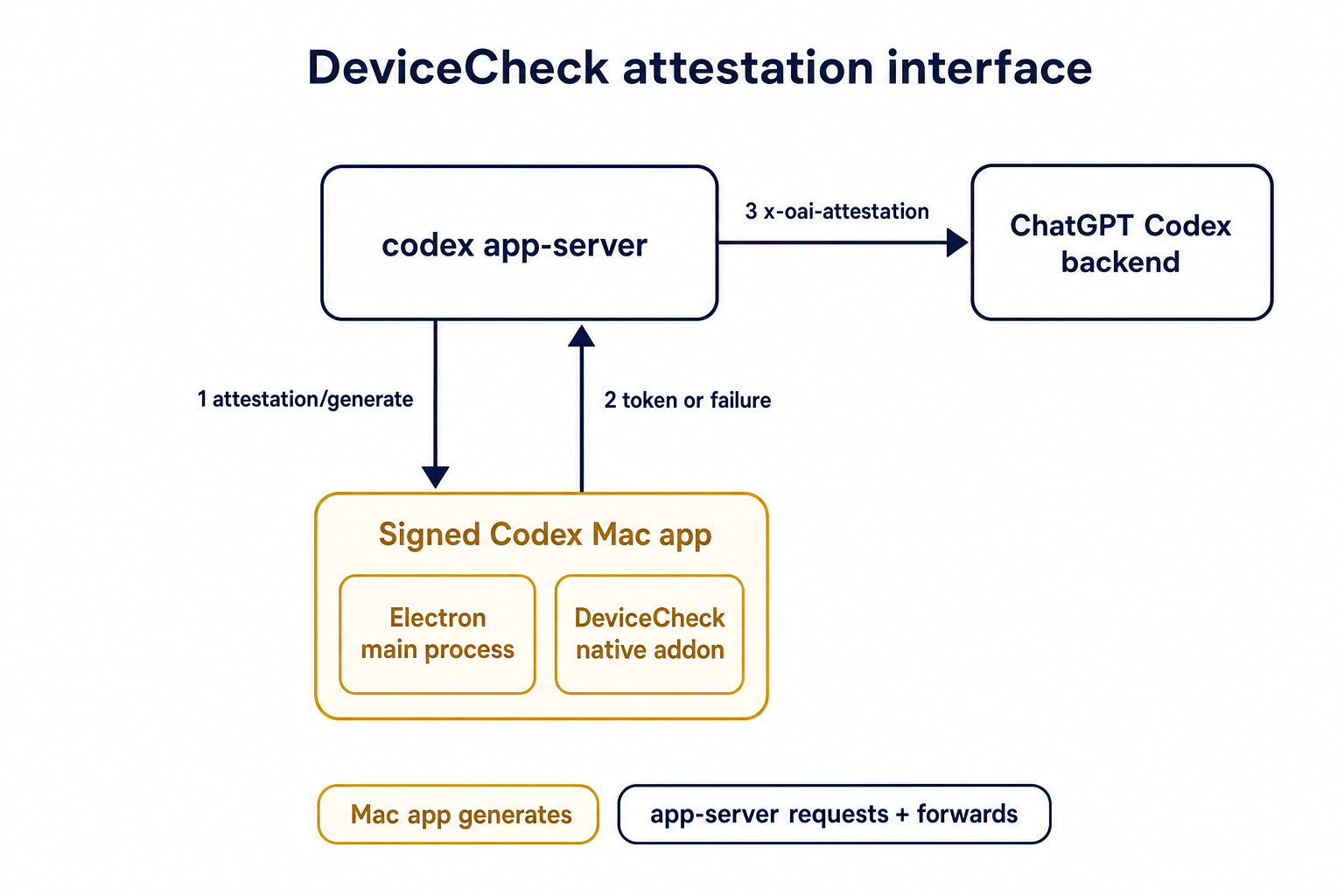
  • [codex] request desktop attestation from app (#20619)
    ## Summary
    
    TL;DR: teaches `codex-rs` / app-server to request a desktop-provided
    attestation token and attach it as `x-oai-attestation` on the scoped
    ChatGPT Codex request paths.
    
    ![DeviceCheck attestation
    interface](https://raw.githubusercontent.com/openai/codex/dev/jm/devicecheck-diagram-assets/pr-assets/devicecheck-attestation-interface.png)
    
    ## Details
    
    This PR teaches the Codex app-server runtime how to request and attach
    an attestation token. It does not generate DeviceCheck tokens directly;
    instead, it relies on the connected desktop app to advertise that it can
    generate attestation and then asks that app for a fresh header value
    when needed.
    
    The flow is:
    
    1. The Codex desktop app connects to app-server.
    2. During `initialize`, the app can advertise that it supports
    `requestAttestation`.
    3. Before app-server calls selected ChatGPT Codex endpoints, it sends
    the internal server request `attestation/generate` to the app.
    4. app-server receives a pre-encoded header value back.
    5. app-server forwards that value as `x-oai-attestation` on the scoped
    outbound requests.
    
    The code in this repo is mostly protocol and runtime plumbing: it adds
    the app-server request/response shape, introduces an attestation
    provider in core, wires that provider into Responses / compaction /
    realtime setup paths, and covers the intended scoping with tests. The
    signed macOS DeviceCheck generation remains owned by the desktop app PR.
    
    ## Related PR
    
    - Codex desktop app implementation:
    https://github.com/openai/openai/pull/878649
    
    ## Validation
    
    <details>
    <summary>Tests run</summary>
    
    ```sh
    cargo test -p codex-app-server-protocol
    cargo test -p codex-core attestation --lib
    cargo test -p codex-app-server --lib attestation
    ```
    
    Also ran:
    
    ```sh
    just fix -p codex-core
    just fix -p codex-app-server
    just fix -p codex-app-server-protocol
    just fmt
    just write-app-server-schema
    ```
    
    </details>
    
    <details>
    <summary>E2E DeviceCheck validation</summary>
    
    First validated the signed desktop app boundary directly: launched a
    packaged signed `Codex.app`, sent `attestation/generate`, decoded the
    returned `v1.` attestation header, and validated the extracted
    DeviceCheck token with `personal/jm/verify_devicecheck_token.py` using
    bundle ID `com.openai.codex`. Apple returned `status_code: 200` and
    `is_ok: true`.
    
    Then ran the fuller app + app-server flow. The packaged `Codex.app`
    launched a current-branch app-server via `CODEX_CLI_PATH`, and a local
    MITM proxy intercepted outbound `chatgpt.com` traffic. The app-server
    requested `attestation/generate` from the real Electron app process, and
    the intercepted `/backend-api/codex/responses` traffic included
    `x-oai-attestation` on both routes:
    
    ```text
    GET  /backend-api/codex/responses  Upgrade: websocket  x-oai-attestation: present
    POST /backend-api/codex/responses  Upgrade: none       x-oai-attestation: present
    ```
    
    The captured header decoded to a DeviceCheck token that also validated
    with Apple for `com.openai.codex` (`status_code: 200`, `is_ok: true`,
    team `2DC432GLL2`).
    
    </details>
    
    ---------
    
    Co-authored-by: Codex <noreply@openai.com>
  • Load configured environments from CODEX_HOME (#20667)
    ## Why
    
    The earlier PRs add stdio transport support and the config-backed
    environment provider, but the feature remains inert until normal Codex
    entrypoints construct `EnvironmentManager` with enough context to
    discover `CODEX_HOME/environments.toml`. This final stack PR activates
    the provider while preserving the legacy `CODEX_EXEC_SERVER_URL`
    fallback when no environments file exists.
    
    **Stack position:** this is PR 5 of 5. It is the product wiring PR that
    activates the configured environment provider added in PR 4.
    
    ## What Changed
    
    - Thread `codex_home` into `EnvironmentManagerArgs`.
    - Change `EnvironmentManager::new(...)` to load the provider from
    `CODEX_HOME`.
    - Preserve legacy behavior by falling back to
    `DefaultEnvironmentProvider::from_env()` when `environments.toml` is
    absent.
    - Make `environments.toml`-backed managers start new threads with all
    configured environments, default first, while keeping the legacy env-var
    path single-default.
    - Update the app-server, TUI, exec, MCP server, connector, prompt-debug,
    and thread-manager-sample callsites to pass `codex_home` and handle
    provider-loading errors.
    
    ## Self-Review Notes
    
    - The multi-environment startup path is intentionally tied to the
    `environments.toml` provider. Using `>1` configured environment as the
    only signal would also expand the legacy `CODEX_EXEC_SERVER_URL`
    provider because it keeps `local` addressable alongside `remote`.
    - The startup environment list is still derived inside
    `EnvironmentManager`; the provider only says whether its snapshot should
    start new threads with all configured environments.
    - The thread-manager sample was updated to pass the current
    `ThreadManager::new(...)` installation id argument so the stack compiles
    under Bazel.
    
    ## Stack
    
    - 1. https://github.com/openai/codex/pull/20663 - Add stdio exec-server
    listener
    - 2. https://github.com/openai/codex/pull/20664 - Add stdio exec-server
    client transport
    - 3. https://github.com/openai/codex/pull/20665 - Make environment
    providers own default selection
    - 4. https://github.com/openai/codex/pull/20666 - Add CODEX_HOME
    environments TOML provider
    - **5. This PR:** https://github.com/openai/codex/pull/20667 - Load
    configured environments from CODEX_HOME
    
    Split from original draft: https://github.com/openai/codex/pull/20508
    
    ## Validation
    
    - `just fmt`
    - `git diff --check`
    - `bazel build --config=remote --strategy=remote
    --remote_download_toplevel
    //codex-rs/thread-manager-sample:codex-thread-manager-sample`
    - `bazel test --config=remote --strategy=remote
    --remote_download_toplevel
    //codex-rs/exec-server:exec-server-unit-tests`
    - `bazel test --config=remote --strategy=remote
    --remote_download_toplevel --test_sharding_strategy=disabled
    --test_arg=default_thread_environment_selections_use_manager_default_id
    //codex-rs/core:core-unit-tests`
    - `bazel test --config=remote --strategy=remote
    --remote_download_toplevel --test_sharding_strategy=disabled
    --test_arg=start_thread_uses_all_default_environments_from_codex_home
    //codex-rs/core:core-unit-tests`
    
    ## Documentation
    
    This activates `CODEX_HOME/environments.toml`; user-facing documentation
    should be added before this stack is treated as a documented public
    workflow.
    
    ---------
    
    Co-authored-by: Codex <noreply@openai.com>
  • Route ThreadManager rollout path reads through thread store (#21265)
    - Route ThreadManager rollout-path resume/fork through ThreadStore
    history reads.
    - Add in-memory store coverage proving path-addressed reads are used.
    
    This isn't strictly necessary for the ThreadStore migration, since these
    ThreadManager methods _only_ work for path-based lookups, but I'm trying
    to migrate all the rollout recorder callsites to use the threadstore
    were possible for consistency.
  • Revert state DB injection and agent graph store (#21481)
    ## Why
    
    Reverts #20689 to restore the previous optional state DB plumbing. The
    conflict resolution keeps the newer installation ID and session/thread
    identity changes that landed after #20689, while removing the mandatory
    state DB and agent graph store dependency from ThreadManager
    construction.
    
    ## What changed
    
    - Restored `Option<StateDbHandle>` through app-server, MCP server,
    prompt debug, and test entry points.
    - Removed the `codex-core` dependency on `codex-agent-graph-store` and
    reverted descendant lookup back to the existing state DB path when
    available.
    - Kept newer `installation_id` forwarding by passing it beside the
    optional DB handle.
    - Kept local thread-name updates working when the optional state DB
    handle is absent.
    
    ## Validation
    
    - `git diff --check`
    - `cargo test -p codex-thread-store`
    - `cargo test -p codex-state -p codex-rollout -p
    codex-app-server-protocol`
    - Attempted `env CARGO_INCREMENTAL=0 cargo test -p codex-core -p
    codex-app-server -p codex-app-server-client -p codex-mcp-server -p
    codex-thread-manager-sample -p codex-tui`; blocked locally by a rustc
    ICE while compiling `v8 v146.4.0` with `rustc 1.93.0 (254b59607
    2026-01-19)` on `aarch64-apple-darwin`.
  • Move installation ID resolution out of core startup (#21182)
    ## Summary
    
    - resolve or inject the installation ID before core startup and pass it
    through `ThreadManager`, `CodexSpawnArgs`, and `Session` as a plain
    `String`
    - keep child sessions on the parent installation ID instead of
    rediscovering it inside core
    - propagate installation ID startup failures in `mcp-server` instead of
    panicking
    
    ## Why
    
    Core was still touching the filesystem on the session startup path to
    discover `installation_id`. This moves that work to the outer host
    boundary so core no longer depends on `codex_home` reads during session
    construction.
    
    ---------
    
    Co-authored-by: Codex <noreply@openai.com>
  • [codex-analytics] rework thread_source for thread analytics (#20949)
    ## Summary
    - make `thread_source` an explicit optional thread-level field on
    `thread/start`, `thread/fork`, and returned thread payloads
    - persist `thread_source` in rollout/session metadata so resumed live
    threads retain the original value
    - replace the old best-effort `session_source` -> `thread_source`
    mapping with an explicit caller-supplied analytics classification
    
    ## Why
    Before this change, analytics `thread_source` was populated by a
    best-effort mapping from `session_source`. `session_source` describes
    the runtime/client surface, not the actual thread-level origin, so that
    projection was not accurate enough to distinguish cases such as `user`,
    `subagent`, `memory_consolidation`, and future thread origins reliably.
    
    Making `thread_source` explicit keeps one thread-level analytics field
    while letting callers provide the real classification directly instead
    of recovering it indirectly from `session_source`.
    
    ## Impact
    For new analytics events, `thread_source` now reflects the explicit
    thread-level classification supplied by the caller rather than an
    inferred value derived from `session_source`. Existing protocol fields
    remain optional; callers that omit `threadSource` now produce `null`
    instead of a best-effort inferred value.
    
    ## Validation
    - `just write-app-server-schema`
    - `cargo test -p codex-analytics -p codex-core -p
    codex-app-server-protocol --no-run`
    - `cargo test -p codex-app-server-protocol
    generated_ts_optional_nullable_fields_only_in_params`
    - `cargo test -p codex-analytics
    thread_initialized_event_serializes_expected_shape`
    - `cargo test -p codex-core
    resume_stopped_thread_from_rollout_preserves_thread_source`
  • Inject state DB, agent graph store (#20689)
    ## Why
    
    We want the agent graph store to be passed down the stack as a real
    dependency, the same way we already treat the thread store.
    
    This will let us inject the agent graph store as a real dependency and
    support implementations other than the local SQLite-backed one. Right
    now most code instantiates a state DB and an agent graph store
    just-in-time. Ideally, we would not depend on the state DB directly but
    only read through the higher-level interfaces.
    
    This change makes the dependency boundaries explicit and moves state DB
    initialization to process bootstrap instead of hiding it inside local
    store implementations.
    
    ## What changed
    
    - `ThreadManager` now requires a `StateDbHandle` and an
    `AgentGraphStore` at construction time instead of treating them as
    optional internals.
    - The local store constructors no longer lazily initialize SQLite.
    Callers now initialize the state DB once per process and use that shared
    handle to build:
      - `LocalThreadStore`
      - `LocalAgentGraphStore`
    - App bootstraps (`app-server`, `mcp-server`, `prompt_debug`, and the
    thread-manager sample) now initialize the state DB up front and inject
    the resulting handle down the stack.
    - `app-server` now consistently uses its process-scoped state DB handle
    instead of reopening SQLite or trying to recover it from loaded threads.
    - Device-key storage now reuses the shared state DB handle instead of
    maintaining its own lazy opener.
    - The thread archive / descendant traversal paths now use the injected
    `AgentGraphStore` instead of reaching through local
    thread-store-specific state.
    
    ## Verification
    
    - `cargo check -p codex-core -p codex-thread-store -p codex-app-server
    -p codex-mcp-server -p codex-thread-manager-sample --tests`
    - `cargo test -p codex-thread-store`
    - `cargo test -p codex-core
    thread_manager_accepts_separate_agent_graph_store_and_thread_store --
    --nocapture`
    - `cargo test -p codex-app-server
    thread_archive_archives_spawned_descendants -- --nocapture`
  • state: pass state db handles through consumers (#20561)
    ## Why
    
    SQLite state was still being opened from consumer paths, including lazy
    `OnceCell`-backed thread-store call sites. That let one process
    construct multiple state DB connections for the same Codex home, which
    makes SQLite lock contention and `database is locked` failures much
    easier to hit.
    
    State DB lifetime should be chosen by main-like entrypoints and tests,
    then passed through explicitly. Consumers should use the supplied
    `Option<StateDbHandle>` or `StateDbHandle` and keep their existing
    filesystem fallback or error behavior when no handle is available.
    
    The startup path also needs to keep the rollout crate in charge of
    SQLite state initialization. Opening `codex_state::StateRuntime`
    directly bypasses rollout metadata backfill, so entrypoints should
    initialize through `codex_rollout::state_db` and receive a handle only
    after required rollout backfills have completed.
    
    ## What Changed
    
    - Initialize the state DB in main-like entrypoints for CLI, TUI,
    app-server, exec, MCP server, and the thread-manager sample.
    - Pass `Option<StateDbHandle>` through `ThreadManager`,
    `LocalThreadStore`, app-server processors, TUI app wiring, rollout
    listing/recording, personality migration, shell snapshot cleanup,
    session-name lookup, and memory/device-key consumers.
    - Remove the lazy local state DB wrapper from the thread store so
    non-test consumers use only the supplied handle or their existing
    fallback path.
    - Make `codex_rollout::state_db::init` the local state startup path: it
    opens/migrates SQLite, runs rollout metadata backfill when needed, waits
    for concurrent backfill workers up to a bounded timeout, verifies
    completion, and then returns the initialized handle.
    - Keep optional/non-owning SQLite helpers, such as remote TUI local
    reads, as open-only paths that do not run startup backfill.
    - Switch app-server startup from direct
    `codex_state::StateRuntime::init` to the rollout state initializer so
    app-server cannot skip rollout backfill.
    - Collapse split rollout lookup/list APIs so callers use the normal
    methods with an optional state handle instead of `_with_state_db`
    variants.
    - Restore `getConversationSummary(ThreadId)` to delegate through
    `ThreadStore::read_thread` instead of a LocalThreadStore-specific
    rollout path special case.
    - Keep DB-backed rollout path lookup keyed on the DB row and file
    existence, without imposing the filesystem filename convention on
    existing DB rows.
    - Verify readable DB-backed rollout paths against `session_meta.id`
    before returning them, so a stale SQLite row that points at another
    thread's JSONL falls back to filesystem search and read-repairs the DB
    row.
    - Keep `debug prompt-input` filesystem-only so a one-off debug command
    does not initialize or backfill SQLite state just to print prompt input.
    - Keep goal-session test Codex homes alive only in the goal-specific
    helper, rather than leaking tempdirs from the shared session test
    helper.
    - Update tests and call sites to pass explicit state handles where DB
    behavior is expected and explicit `None` where filesystem-only behavior
    is intended.
    
    ## Validation
    
    - `CARGO_TARGET_DIR=/tmp/codex-target-state-db cargo check -p
    codex-rollout -p codex-thread-store -p codex-app-server -p codex-core -p
    codex-tui -p codex-exec -p codex-cli --tests`
    - `CARGO_TARGET_DIR=/tmp/codex-target-state-db cargo test -p
    codex-rollout state_db_`
    - `CARGO_TARGET_DIR=/tmp/codex-target-state-db cargo test -p
    codex-rollout find_thread_path`
    - `CARGO_TARGET_DIR=/tmp/codex-target-state-db cargo test -p
    codex-rollout find_thread_path -- --nocapture`
    - `CARGO_TARGET_DIR=/tmp/codex-target-state-db cargo test -p
    codex-rollout try_init_ -- --nocapture`
    - `CARGO_TARGET_DIR=/tmp/codex-target-state-db cargo test -p
    codex-rollout`
    - `CARGO_TARGET_DIR=/tmp/codex-target-state-db cargo clippy -p
    codex-rollout --lib -- -D warnings`
    - `CARGO_TARGET_DIR=/tmp/codex-target-state-db cargo test -p
    codex-thread-store
    read_thread_falls_back_when_sqlite_path_points_to_another_thread --
    --nocapture`
    - `CARGO_TARGET_DIR=/tmp/codex-target-state-db cargo test -p
    codex-thread-store`
    - `CARGO_TARGET_DIR=/tmp/codex-target-state-db cargo test -p codex-core
    shell_snapshot`
    - `CARGO_TARGET_DIR=/tmp/codex-target-state-db cargo test -p codex-core
    --test all personality_migration`
    - `CARGO_TARGET_DIR=/tmp/codex-target-state-db cargo test -p codex-core
    --test all rollout_list_find`
    - `RUST_MIN_STACK=8388608 CODEX_SKIP_VENDORED_BWRAP=1
    CARGO_TARGET_DIR=/tmp/codex-target-state-db cargo test -p codex-core
    --test all rollout_list_find::find_prefers_sqlite_path_by_id --
    --nocapture`
    - `RUST_MIN_STACK=8388608 CODEX_SKIP_VENDORED_BWRAP=1
    CARGO_TARGET_DIR=/tmp/codex-target-state-db cargo test -p codex-core
    --test all rollout_list_find -- --nocapture`
    - `CARGO_TARGET_DIR=/tmp/codex-target-state-db cargo test -p codex-core
    interrupt_accounts_active_goal_before_pausing`
    - `CARGO_TARGET_DIR=/tmp/codex-target-state-db cargo test -p
    codex-app-server get_auth_status -- --test-threads=1`
    - `CODEX_SKIP_VENDORED_BWRAP=1
    CARGO_TARGET_DIR=/tmp/codex-target-state-db cargo test -p
    codex-app-server --lib`
    - `CODEX_SKIP_VENDORED_BWRAP=1
    CARGO_TARGET_DIR=/tmp/codex-target-state-db cargo check -p codex-rollout
    -p codex-app-server --tests`
    - `CARGO_TARGET_DIR=/tmp/codex-target-state-db just fix -p codex-rollout
    -p codex-thread-store -p codex-core -p codex-app-server -p codex-tui -p
    codex-exec -p codex-cli`
    - `CODEX_SKIP_VENDORED_BWRAP=1
    CARGO_TARGET_DIR=/tmp/codex-target-state-db just fix -p codex-rollout -p
    codex-app-server`
    - `CARGO_TARGET_DIR=/tmp/codex-target-state-db just fix -p
    codex-rollout`
    - `CODEX_SKIP_VENDORED_BWRAP=1
    CARGO_TARGET_DIR=/tmp/codex-target-state-db just fix -p codex-core`
    - `just argument-comment-lint -p codex-core`
    - `just argument-comment-lint -p codex-rollout`
    
    Focused coverage added in `codex-rollout`:
    
    - `recorder::tests::state_db_init_backfills_before_returning` verifies
    the rollout metadata row exists before startup init returns.
    - `state_db::tests::try_init_waits_for_concurrent_startup_backfill`
    verifies startup waits for another worker to finish backfill instead of
    disabling the handle for the process.
    -
    `state_db::tests::try_init_times_out_waiting_for_stuck_startup_backfill`
    verifies startup does not hang indefinitely on a stuck backfill lease.
    -
    `tests::find_thread_path_accepts_existing_state_db_path_without_canonical_filename`
    verifies DB-backed lookup accepts valid existing rollout paths even when
    the filename does not include the thread UUID.
    -
    `tests::find_thread_path_falls_back_when_db_path_points_to_another_thread`
    verifies DB-backed lookup ignores a stale row whose existing path
    belongs to another thread and read-repairs the row after filesystem
    fallback.
    
    Focused coverage updated in `codex-core`:
    
    - `rollout_list_find::find_prefers_sqlite_path_by_id` now uses a
    DB-preferred rollout file with matching `session_meta.id`, so it still
    verifies that valid SQLite paths win without depending on stale/empty
    rollout contents.
    
    `cargo test -p codex-app-server thread_list_respects_search_term_filter
    -- --test-threads=1 --nocapture` was attempted locally but timed out
    waiting for the app-server test harness `initialize` response before
    reaching the changed thread-list code path.
    
    `bazel test //codex-rs/thread-store:thread-store-unit-tests
    --test_output=errors` was attempted locally after the thread-store fix,
    but this container failed before target analysis while fetching `v8+`
    through BuildBuddy/direct GitHub. The equivalent local crate coverage,
    including `cargo test -p codex-thread-store`, passes.
    
    A plain local `cargo check -p codex-rollout -p codex-app-server --tests`
    also requires system `libcap.pc` for `codex-linux-sandbox`; the
    follow-up app-server check above used `CODEX_SKIP_VENDORED_BWRAP=1` in
    this container.
  • Prepare selected environment plumbing (#20669)
    ## Why
    This is a prep PR in the multi-environment process-tool stack. It
    separates ownership/config cleanup from the behavior change that teaches
    process tools to route by selected environment, so the follow-up PR can
    focus on model-facing `environment_id` behavior.
    
    ## Stack
    1. https://github.com/openai/codex/pull/20646 - `EnvironmentContext`
    rendering for selected environments
    2. https://github.com/openai/codex/pull/20669 - selected-environment
    ownership and tool config prep (this PR)
    3. https://github.com/openai/codex/pull/20647 - process-tool
    `environment_id` routing
    
    ## What Changed
    - keep the resolved turn environment list wrapped in
    `ResolvedTurnEnvironments` through `TurnContext` instead of unwrapping
    it back to a raw `Vec`
    - add `TurnContext::resolve_path_against` so cwd-relative path
    resolution has one shared helper
    - replace the old tool config boolean with `ToolEnvironmentMode::{None,
    Single, Multiple}`
    
    ## Testing
    - Tests not run locally; this prep refactor is covered by GitHub CI for
    the stack.
    
    Co-authored-by: Codex <noreply@openai.com>
  • Keep paused goals paused on thread resume (#20790)
    ## Summary
    
    Early adopters of the `/goal` feature have provided feedback that they
    expect a goal they explicitly paused to remain paused when they resume a
    thread. Previously, resuming a thread would reactivate a paused goal.
    
    This PR keeps persisted goal status unchanged during thread resume. This
    honors the user feedback while also simplifying the core goal logic.
    
    Rather than have the core logic automatically resume a paused goal, that
    responsibility is transferred to the client. The TUI now detects a
    resumed thread with a paused goal and asks the user whether to `Resume
    goal` or `Leave paused`. The prompt appears only for quiet resume flows,
    so users who resume with an immediate prompt are not interrupted.
    
    <img width="544" height="111" alt="image"
    src="https://github.com/user-attachments/assets/0ac9de1c-6ee6-47ba-b223-c03c8eb4c192"
    />
  • Make thread store process-scoped (#19474)
    - Build one app-server process ThreadStore from startup config and share
    it with ThreadManager and CodexMessageProcessor.
    - Remove per-thread/fork store reconstruction so effective thread config
    cannot switch the persistence backend.
    - Add params to ThreadStore create/resume for specifying thread
    metadata, since otherwise the metadata from store creation would be used
    (incorrectly).
  • Reduce the surface of collaboration modes (#20149)
    Collaboration modes were slightly invasive both into ThreadManager
    construction and ModelProvider
  • Add ThreadManager sample crate (#20141)
    Summary:
    - Add codex-thread-manager-sample, a one-shot binary that starts a
    ThreadManager thread, submits a prompt, and prints the final assistant
    output.
    - Pass ThreadStore into ThreadManager::new and expose
    thread_store_from_config for existing callsites.
    - Build the sample Config directly with only --model and prompt inputs.
    
    Verification:
    - just fmt
    - cargo check -p codex-thread-manager-sample -p codex-app-server -p
    codex-mcp-server
    - git diff --check
    
    Tests: Not run per request.
  • Add environment provider snapshot (#20058)
    ## Summary
    - Change `EnvironmentProvider` to return concrete `Environment`
    instances instead of `EnvironmentConfigurations`.
    - Make `DefaultEnvironmentProvider` provide the provider-visible `local`
    environment plus optional `remote` environment from
    `CODEX_EXEC_SERVER_URL`.
    - Keep `EnvironmentManager` as the concrete cache while exposing its own
    explicit local environment for `local_environment()` fallback paths.
    
    ## Validation
    - `just fmt`
    - `git diff --check`
    
    ---------
    
    Co-authored-by: Codex <noreply@openai.com>
  • feat: split memories part 2 (#19860)
    Keep extracting memories out of core and moving the write trigger in the
    app-server
    This is temporary and it should move at the client level as a follow-up
    This makes core fully independant from `codex-memories-write`
    
    ---------
    
    Co-authored-by: Codex <noreply@openai.com>
  • Add goal core runtime (4 / 5) (#18076)
    Adds the core runtime behavior for active goals on top of the model
    tools from PR 3.
    
    ## Why
    
    A long-running goal should be a core runtime concern, not something
    every client has to implement. Core owns the turn lifecycle, tool
    completion boundaries, interruptions, resume behavior, and token usage,
    so it is the right place to account progress, enforce budgets, and
    decide when to continue work.
    
    ## What changed
    
    - Centralized goal lifecycle side effects behind
    `Session::goal_runtime_apply(GoalRuntimeEvent::...)`.
    - Starts goal continuation turns only when the session is idle; pending
    user input and mailbox work take priority.
    - Accounts token and wall-clock usage at turn, tool, mutation,
    interrupt, and resume boundaries; `get_thread_goal` remains read-only.
    - Preserves sub-second wall-clock remainder across accounting boundaries
    so long-running goals do not drift downward over time.
    - Treats token budget exhaustion as a soft stop by marking the goal
    `budget_limited` and injecting wrap-up steering instead of aborting the
    active turn.
    - Suppresses budget steering when `update_goal` marks a goal complete.
    - Pauses active goals on interrupt and auto-reactivates paused goals
    when a thread resumes outside plan mode.
    - Suppresses repeated automatic continuation when a continuation turn
    makes no tool calls.
    - Added continuation and budget-limit prompt templates.
    
    ## Verification
    
    - Added focused core coverage for continuation scheduling, accounting
    boundaries, budget-limit steering, completion accounting, interrupt
    pause behavior, resume auto-activation, and wall-clock remainder
    accounting.
  • Add agents.interrupt_message for interruption markers (#19351)
    ## Why
    
    Agent interruptions currently always persist a model-visible
    interrupted-turn marker before emitting `TurnAborted`. That marker is
    useful by default because it gives the next model turn context about a
    deliberately interrupted task, but some deployments need to suppress
    that history injection entirely while still keeping the client-visible
    interruption event.
    
    ## What changed
    
    - Add `[agents] interrupt_message = false` to disable the model-visible
    interrupted-turn marker.
    - Resolve the setting into `Config::agent_interrupt_message_enabled`,
    defaulting to `true` so existing behavior is unchanged.
    - Apply the setting to both live interrupted turns and interrupted fork
    snapshots.
    - Keep emitting `TurnAborted` even when the history marker is disabled.
    - Regenerate `core/config.schema.json` for the new
    `agents.interrupt_message` field.
    
    ## Testing
    
    - `cargo test -p codex-core load_config_resolves_agent_interrupt_message
    -- --nocapture`
    - `cargo test -p codex-core
    disabled_interrupted_fork_snapshot_appends_only_interrupt_event --
    --nocapture`
    - `cargo test -p codex-core
    multi_agent_v2_interrupted_marker_uses_developer_input_message --
    --nocapture`
    - `cargo test -p codex-core
    multi_agent_v2_followup_task_can_disable_interrupted_marker --
    --nocapture`
    - `cargo test -p codex-core
    multi_agent_v2_followup_task_interrupts_busy_child_without_losing_message
    -- --nocapture`
    - `cargo check -p codex-core`
  • Make MultiAgentV2 interruption markers assistant-authored (#19124)
    ## Why
    
    `MultiAgentV2` follow-up messages are delivered to agents as
    assistant-authored `InterAgentCommunication` envelopes. When
    `followup_task` used `interrupt: true`, the interrupted-turn guidance
    was still persisted as a contextual user message, so model-visible
    history made a system-generated interruption boundary look
    user-authored.
    
    This keeps interruption guidance consistent with the rest of the v2
    inter-agent message stream while preserving the legacy marker shape for
    non-v2 sessions.
    
    ## What changed
    
    - Make `interrupted_turn_history_marker` feature-aware.
    - Record the interrupted-turn marker as an assistant `OutputText`
    message when `Feature::MultiAgentV2` is enabled.
    - Keep the existing user contextual fragment for non-v2 sessions.
    - Apply the same feature-aware marker to interrupted fork snapshots.
    - Add coverage for the live `followup_task` interrupt path and the
    helper-level v2 marker shape.
    
    ## Testing
    
    - `cargo test -p codex-core
    multi_agent_v2_followup_task_interrupts_busy_child_without_losing_message
    -- --nocapture`
    - `cargo test -p codex-core
    multi_agent_v2_interrupted_marker_uses_assistant_output_message --
    --nocapture`
    - `cargo test -p codex-core interrupted_fork_snapshot -- --nocapture`
  • feat: let model providers own model discovery (#18950)
    ## Why
    
    `codex-models-manager` had grown to own provider-specific concerns:
    constructing OpenAI-compatible `/models` requests, resolving provider
    auth, emitting request telemetry, and deciding how provider catalogs
    should be sourced. That made the manager harder to reuse for providers
    whose model catalog is not fetched from the OpenAI `/models` endpoint,
    such as Amazon Bedrock.
    
    This change moves provider-specific model discovery behind
    provider-owned implementations, so the models manager can focus on
    refresh policy, cache behavior, picker ordering, and model metadata
    merging.
    
    ## What Changed
    
    - Introduced a `ModelsManager` trait with separate `OpenAiModelsManager`
    and `StaticModelsManager` implementations.
    - Added `ModelsEndpointClient` so OpenAI-compatible HTTP fetching lives
    outside `codex-models-manager`.
    - Moved `/models` request construction, provider auth resolution,
    timeout handling, and request telemetry into `codex-model-provider` via
    `OpenAiModelsEndpoint`.
    - Added provider-owned `models_manager(...)` construction so configured
    OpenAI-compatible providers use `OpenAiModelsManager`, while
    static/catalog-backed providers can return `StaticModelsManager`.
    - Added an Amazon Bedrock static model catalog for the GPT OSS Bedrock
    model IDs.
    - Updated core/session/thread manager code and tests to depend on
    `Arc<dyn ModelsManager>`.
    - Moved offline model test helpers into
    `codex_models_manager::test_support`.
    ## Metadata References
    
    The Bedrock catalog metadata is based on the official Amazon Bedrock
    OpenAI model documentation:
    
    - [Amazon Bedrock OpenAI
    models](https://docs.aws.amazon.com/bedrock/latest/userguide/model-parameters-openai.html)
    lists the Bedrock model IDs, text input/output modalities, and `128,000`
    token context window for `gpt-oss-20b` and `gpt-oss-120b`.
    - [Amazon Bedrock `gpt-oss-120b` model
    card](https://docs.aws.amazon.com/bedrock/latest/userguide/model-card-openai-gpt-oss-120b.html)
    lists the `bedrock-runtime` model ID `openai.gpt-oss-120b-1:0`, the
    `bedrock-mantle` model ID `openai.gpt-oss-120b`, text-only modalities,
    and `128K` context window.
    - [OpenAI `gpt-oss-120b` model
    docs](https://developers.openai.com/api/docs/models/gpt-oss-120b)
    document configurable reasoning effort with `low`, `medium`, and `high`,
    plus text input/output modality.
    
    The display names, default reasoning effort, and priority ordering are
    Codex-local catalog choices.
    
    ## Test Plan
    - Manually verified app-server model listing with an AWS profile:
    
    ```shell
    CODEX_HOME="$(mktemp -d)" cargo run -p codex-app-server-test-client -- \
      --codex-bin ./target/debug/codex \
      -c 'model_provider="amazon-bedrock"' \
      -c 'model_providers.amazon-bedrock.aws.profile="codex-bedrock"' \
      -c 'model_providers.amazon-bedrock.aws.region="us-west-2"' \
      model-list
    ```
    
    The response returned the Bedrock catalog with `openai.gpt-oss-120b-1:0`
    as the default model and `openai.gpt-oss-20b-1:0` as the second listed
    model, both text-only and supporting low/medium/high reasoning effort.
  • Add sticky environment API and thread state (#18897)
    ## Summary
    - add sticky environment selections to app-server v2 thread/start and
    turn/start request flow
    - carry thread-level selections through core session/thread state
    - add app-server coverage for sticky selections and turn overrides
    
    ## Stack
    1. This PR: API and thread persistence
    2. #18898: config.toml named environment loading
    3. #18899: downstream tool/runtime consumers
    
    ## Validation
    - Not run locally; split only.
    
    ---------
    
    Co-authored-by: Codex <noreply@openai.com>
  • Support multiple managed environments (#18401)
    ## Summary
    - refactor EnvironmentManager to own keyed environments with
    default/local lookup helpers
    - keep remote exec-server client creation lazy until exec/fs use
    - preserve disabled agent environment access separately from internal
    local environment access
    
    ## Validation
    - not run (per Codex worktree instruction to avoid tests/builds unless
    requested)
    
    ---------
    
    Co-authored-by: Codex <noreply@openai.com>
  • Move codex module under session (#18249)
    ## Summary
    - rename the core codex module root to session/mod.rs without using
    #[path]
    - move the codex module directory and tests under core/src/session
    - remove session/mod.rs reexports so call sites use explicit child
    module paths
    
    ## Testing
    - cargo test -p codex-core --lib
    - cargo check -p codex-core --tests
    - just fmt
    - just fix -p codex-core
    - git diff --check
  • Async config loading (#18022)
    Parts of config will come from executor. Prepare for that by making
    config loading methods async.