## Summary
- move the pure sandbox policy transform helpers from `codex-core` into
`codex-sandboxing`
- move the corresponding unit tests with the extracted implementation
- update `core` and `app-server` callers to import the moved APIs
directly, without re-exports or proxy methods

## Testing
- cargo test -p codex-sandboxing
- cargo test -p codex-core sandboxing
- cargo test -p codex-app-server --lib
- just fix -p codex-sandboxing
- just fix -p codex-core
- just fix -p codex-app-server
- just fmt
- just argument-comment-lint
## Summary
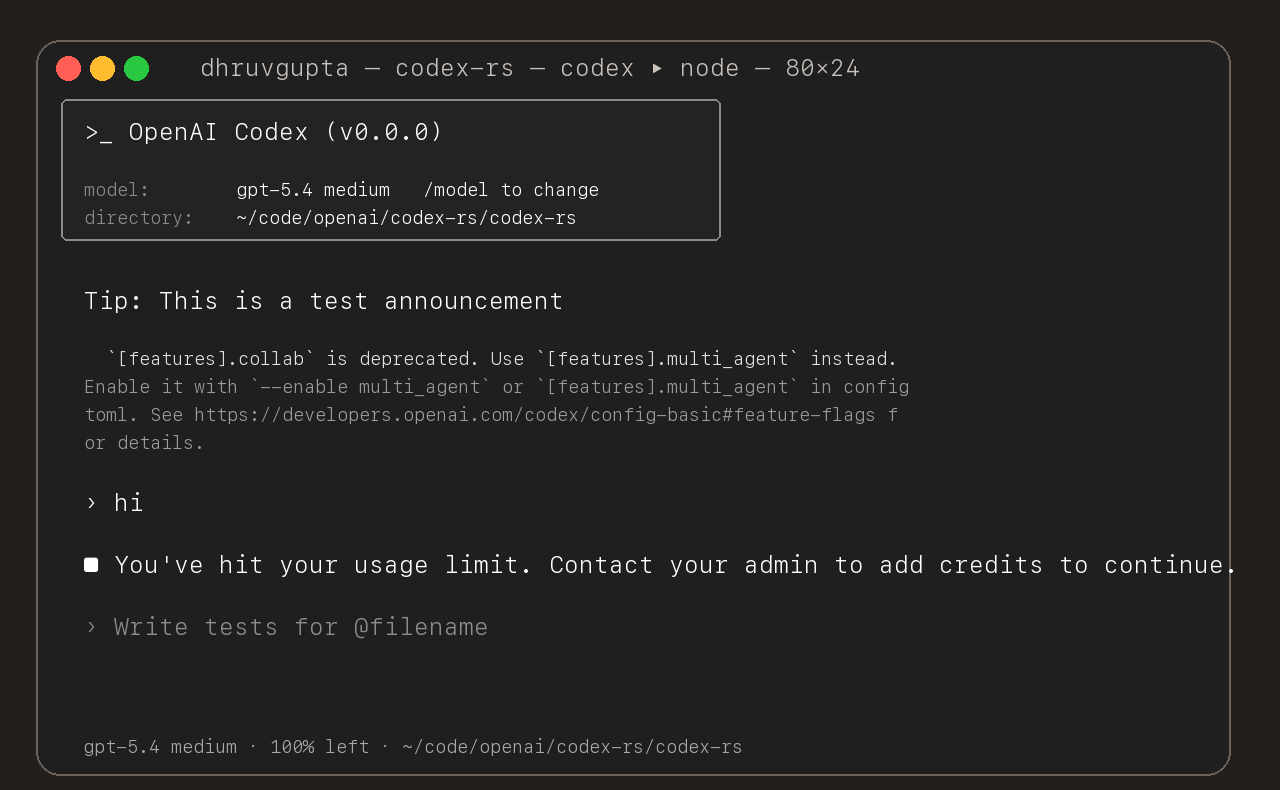
- update the self-serve business usage-based limit message to direct
users to their admin for additional credits
- add a focused unit test for the self_serve_business_usage_based plan
branch
Added also:
If you are at a rate limit but you still have credits, codex cli would
tell you to switch the model. We shouldnt do this if you have credits so
fixed this.
## Test
- launched the source-built CLI and verified the updated message is
shown for the self-serve business usage-based plan
## Summary
- move macOS permission merging/intersection logic and tests from
`codex-core` into `codex-sandboxing`
- move seatbelt policy builders, permissions logic, SBPL assets, and
their tests into `codex-sandboxing`
- keep `codex-core` owning only the seatbelt spawn wrapper and switch
call sites to import the moved APIs directly

## Notes
- no re-exports added
- moved the seatbelt tests with the implementation so internal helpers
could stay private
- local verification is still finishing while this PR is open
Use `serde` to encode the inter agent communication to an assistant
message and use the decode to see if this is such a message

Note: this assume serde on small pattern is fast enough
- add `PreToolUse` hook for bash-like tool execution only at first
- block shell execution before dispatch with deny-only hook behavior
- introduces common.rs matcher framework for matching when hooks are run

example run:

```
› run three parallel echo commands, and the second one should echo "[block-pre-tool-use]" as a test


• Running the three echo commands in parallel now and I’ll report the output directly.

• Running PreToolUse hook: name for demo pre tool use hook

• Running PreToolUse hook: name for demo pre tool use hook

• Running PreToolUse hook: name for demo pre tool use hook

PreToolUse hook (completed)
  warning: wizard-tower PreToolUse demo inspected Bash: echo "first parallel echo"

PreToolUse hook (blocked)
  warning: wizard-tower PreToolUse demo blocked a Bash command on purpose.
  feedback: PreToolUse demo blocked the command. Remove [block-pre-tool-use] to continue.

PreToolUse hook (completed)
  warning: wizard-tower PreToolUse demo inspected Bash: echo "third parallel echo"

• Ran echo "first parallel echo"
  └ first parallel echo

• Ran echo "third parallel echo"
  └ third parallel echo

• Three little waves went out in parallel.

  1. printed first parallel echo
  2. was blocked before execution because it contained the exact test string [block-pre-tool-use]
  3. printed third parallel echo

  There was also an unrelated macOS defaults warning around the successful commands, but the echoes
  themselves worked fine. If you want, I can rerun the second one with a slightly modified string so
  it passes cleanly.
```
Send input now sends messages as assistant message and with this format:

```
author: /root/worker_a
recipient: /root/worker_a/tester
other_recipients: []
Content: bla bla bla. Actual content. Only text for now
```
Moves Code Mode to a new crate with no dependencies on codex. This
create encodes the code mode semantics that we want for lifetime,
mounting, tool calling.

The model-facing surface is mostly unchanged. `exec` still runs raw
JavaScript, `wait` still resumes or terminates a `cell_id`, nested tools
are still available through `tools.*`, and helpers like `text`, `image`,
`store`, `load`, `notify`, `yield_control`, and `exit` still exist.

The major change is underneath that surface:

- Old code mode was an external Node runtime.
- New code mode is an in-process V8 runtime embedded directly in Rust.
- Old code mode managed cells inside a long-lived Node runner process.
- New code mode manages cells in Rust, with one V8 runtime thread per
active `exec`.
- Old code mode used JSON protocol messages over child stdin/stdout plus
Node worker-thread messages.
- New code mode uses Rust channels and direct V8 callbacks/events.

This PR also fixes the two migration regressions that fell out of that
substrate change:

- `wait { terminate: true }` now waits for the V8 runtime to actually
stop before reporting termination.
- synchronous top-level `exit()` now succeeds again instead of surfacing
as a script error.

---

- `core/src/tools/code_mode/*` is now mostly an adapter layer for the
public `exec` / `wait` tools.
- `code-mode/src/service.rs` owns cell sessions and async control flow
in Rust.
- `code-mode/src/runtime/*.rs` owns the embedded V8 isolate and
JavaScript execution.
- each `exec` spawns a dedicated runtime thread plus a Rust
session-control task.
- helper globals are installed directly into the V8 context instead of
being injected through a source prelude.
- helper modules like `tools.js` and `@openai/code_mode` are synthesized
through V8 module resolution callbacks in Rust.

---

Also added a benchmark for showing the speed of init and use of a code
mode env:
```
$ cargo bench -p codex-code-mode --bench exec_overhead -- --samples 30 --warm-iterations 25 --tool-counts 0,32,128
Finished [`bench` profile [optimized]](https://doc.rust-lang.org/cargo/reference/profiles.html#default-profiles) target(s) in 0.18s
     Running benches/exec_overhead.rs (target/release/deps/exec_overhead-008c440d800545ae)
exec_overhead: samples=30, warm_iterations=25, tool_counts=[0, 32, 128]
scenario       tools samples    warmups      iters      mean/exec       p95/exec       rssΔ p50       rssΔ max
cold_exec          0      30          0          1         1.13ms         1.20ms        8.05MiB        8.06MiB
warm_exec          0      30          1         25       473.43us       512.49us      912.00KiB        1.33MiB
cold_exec         32      30          0          1         1.03ms         1.15ms        8.08MiB        8.11MiB
warm_exec         32      30          1         25       509.73us       545.76us      960.00KiB        1.30MiB
cold_exec        128      30          0          1         1.14ms         1.19ms        8.30MiB        8.34MiB
warm_exec        128      30          1         25       575.08us       591.03us      736.00KiB      864.00KiB
memory uses a fresh-process max RSS delta for each scenario
```

---------

Co-authored-by: Codex <noreply@openai.com>
This PR add an URI-based system to reference agents within a tree. This
comes from a sync between research and engineering.

The main agent (the one manually spawned by a user) is always called
`/root`. Any sub-agent spawned by it will be `/root/agent_1` for example
where `agent_1` is chosen by the model.

Any agent can contact any agents using the path.

Paths can be used either in absolute or relative to the calling agents

Resume is not supported for now on this new path
- Split the feature system into a new `codex-features` crate.
- Cut `codex-core` and workspace consumers over to the new config and
warning APIs.

Co-authored-by: Ahmed Ibrahim <219906144+aibrahim-oai@users.noreply.github.com>
Co-authored-by: Codex <noreply@openai.com>
For each feature we have:
1. Trait exposed on environment
2. **Local Implementation** of the trait
3. Remote implementation that uses the client to proxy via network
4. Handler implementation that handles PRC requests and calls into
**Local Implementation**
updated Windows shell/unified_exec tool descriptions:

`exec_command`
```text
Runs a command in a PTY, returning output or a session ID for ongoing interaction.

Windows safety rules:
- Do not compose destructive filesystem commands across shells. Do not enumerate paths in PowerShell and then pass them to `cmd /c`, batch builtins, or another shell for deletion or moving. Use one shell end-to-end, prefer native PowerShell cmdlets such as `Remove-Item` / `Move-Item` with `-LiteralPath`, and avoid string-built shell commands for file operations.
- Before any recursive delete or move on Windows, verify the resolved absolute target paths stay within the intended workspace or explicitly named target directory. Never issue a recursive delete or move against a computed path if the final target has not been checked.
```

`shell`
```text
Runs a Powershell command (Windows) and returns its output. Arguments to `shell` will be passed to CreateProcessW(). Most commands should be prefixed with ["powershell.exe", "-Command"].

Examples of valid command strings:

- ls -a (show hidden): ["powershell.exe", "-Command", "Get-ChildItem -Force"]
- recursive find by name: ["powershell.exe", "-Command", "Get-ChildItem -Recurse -Filter *.py"]
- recursive grep: ["powershell.exe", "-Command", "Get-ChildItem -Path C:\\myrepo -Recurse | Select-String -Pattern 'TODO' -CaseSensitive"]
- ps aux | grep python: ["powershell.exe", "-Command", "Get-Process | Where-Object { $_.ProcessName -like '*python*' }"]
- setting an env var: ["powershell.exe", "-Command", "$env:FOO='bar'; echo $env:FOO"]
- running an inline Python script: ["powershell.exe", "-Command", "@'\nprint('Hello, world!')\n'@ | python -"]

Windows safety rules:
- Do not compose destructive filesystem commands across shells. Do not enumerate paths in PowerShell and then pass them to `cmd /c`, batch builtins, or another shell for deletion or moving. Use one shell end-to-end, prefer native PowerShell cmdlets such as `Remove-Item` / `Move-Item` with `-LiteralPath`, and avoid string-built shell commands for file operations.
- Before any recursive delete or move on Windows, verify the resolved absolute target paths stay within the intended workspace or explicitly named target directory. Never issue a recursive delete or move against a computed path if the final target has not been checked.
```

`shell_command`
```text
Runs a Powershell command (Windows) and returns its output.

Examples of valid command strings:

- ls -a (show hidden): "Get-ChildItem -Force"
- recursive find by name: "Get-ChildItem -Recurse -Filter *.py"
- recursive grep: "Get-ChildItem -Path C:\\myrepo -Recurse | Select-String -Pattern 'TODO' -CaseSensitive"
- ps aux | grep python: "Get-Process | Where-Object { $_.ProcessName -like '*python*' }"
- setting an env var: "$env:FOO='bar'; echo $env:FOO"
- running an inline Python script: "@'\nprint('Hello, world!')\n'@ | python -"

Windows safety rules:
- Do not compose destructive filesystem commands across shells. Do not enumerate paths in PowerShell and then pass them to `cmd /c`, batch builtins, or another shell for deletion or moving. Use one shell end-to-end, prefer native PowerShell cmdlets such as `Remove-Item` / `Move-Item` with `-LiteralPath`, and avoid string-built shell commands for file operations.
- Before any recursive delete or move on Windows, verify the resolved absolute target paths stay within the intended workspace or explicitly named target directory. Never issue a recursive delete or move against a computed path if the final target has not been checked.
```
## Summary

- log guardian-reviewed tool approvals as `source=automated_reviewer` in
`codex.tool_decision`
- keep direct user approvals as `source=user` and config-driven
approvals as `source=config`

## Testing

-
`/Users/gabec/.codex/skills/codex-oss-fastdev/scripts/codex-rs-fmt-quiet.sh`
-
`/Users/gabec/.codex/skills/codex-oss-fastdev/scripts/codex-rs-test-quiet.sh
-p codex-otel` (fails in sandboxed loopback bind tests under
`otel/tests/suite/otlp_http_loopback.rs`)
- `cargo test -p codex-core guardian -- --nocapture` (original-tree run
reached Guardian tests and only hit sandbox-related listener/proxy
failures)

Co-authored-by: Codex <noreply@openai.com>
The idea is that codex-exec exposes an Environment struct with services
on it. Each of those is a trait.

Depending on construction parameters passed to Environment they are
either backed by local or remote server but core doesn't see these
differences.
Add a representation of the agent graph. This is now used for:
* Cascade close agents (when I close a parent, it close the kids)
* Cascade resume (oposite)

Later, this will also be used for post-compaction stuffing of the
context

Direct fix for: https://github.com/openai/codex/issues/14458
Resubmit https://github.com/openai/codex/pull/15020 with correct
content.

1. Use requirement-resolved config.features as the plugin gate.
2. Guard plugin/list, plugin/read, and related flows behind that gate.
3. Skip bad marketplace.json files instead of failing the whole list.
4. Simplify plugin state and caching.
Cleanup image semantics in code mode.

`view_image` now returns `{image_url:string, details?: string}`

`image()` now allows both string parameter and `{image_url:string,
details?: string}`
Adds an environment crate and environment + file system abstraction.

Environment is a combination of attributes and services specific to
environment the agent is connected to:
File system, process management, OS, default shell.

The goal is to move most of agent logic that assumes environment to work
through the environment abstraction.
Summary
- document that code mode only exposes `exec` and the renamed `wait`
tool
- update code mode tool spec and descriptions to match the new tool name
- rename tests and helper references from `exec_wait` to `wait`

Testing
- Not run (not requested)
It now supports:

- Connectors that are from installed and enabled plugins that are not
installed yet
- Plugins that are on the allowlist that are not installed yet.
## Summary
- make `report_agent_job_result` atomically transition an item from
running to completed while storing `result_json`
- remove brittle finalization grace-sleep logic and make finished-item
cleanup idempotent
- replace blind fixed-interval waiting with status-subscription-based
waiting for active worker threads
- add state runtime tests for atomic completion and late-report
rejection
## Why
This addresses the race and polling concerns in #13948 by removing
timing-based correctness assumptions and reducing unnecessary status
polling churn.
## Validation
- `cd codex-rs && just fmt`
- `cd codex-rs && cargo test -p codex-state`
- `cd codex-rs && cargo test -p codex-core --test all suite::agent_jobs`
- `cd codex-rs && cargo test`
- fails in an unrelated app-server tracing test:
`message_processor::tracing_tests::thread_start_jsonrpc_span_exports_server_span_and_parents_children`
timed out waiting for response
## Notes
- This PR supersedes #14129 with the same agent-jobs fix on a clean
branch from `main`.
- The earlier PR branch was stacked on unrelated history, which made the
review diff include unrelated commits.
Fixes#13948
## Why

Once the repo-local lint exists, `codex-rs` needs to follow the
checked-in convention and CI needs to keep it from drifting. This commit
applies the fallback `/*param*/` style consistently across existing
positional literal call sites without changing those APIs.

The longer-term preference is still to avoid APIs that require comments
by choosing clearer parameter types and call shapes. This PR is
intentionally the mechanical follow-through for the places where the
existing signatures stay in place.

After rebasing onto newer `main`, the rollout also had to cover newly
introduced `tui_app_server` call sites. That made it clear the first cut
of the CI job was too expensive for the common path: it was spending
almost as much time installing `cargo-dylint` and re-testing the lint
crate as a representative test job spends running product tests. The CI
update keeps the full workspace enforcement but trims that extra
overhead from ordinary `codex-rs` PRs.

## What changed

- keep a dedicated `argument_comment_lint` job in `rust-ci`
- mechanically annotate remaining opaque positional literals across
`codex-rs` with exact `/*param*/` comments, including the rebased
`tui_app_server` call sites that now fall under the lint
- keep the checked-in style aligned with the lint policy by using
`/*param*/` and leaving string and char literals uncommented
- cache `cargo-dylint`, `dylint-link`, and the relevant Cargo
registry/git metadata in the lint job
- split changed-path detection so the lint crate's own `cargo test` step
runs only when `tools/argument-comment-lint/*` or `rust-ci.yml` changes
- continue to run the repo wrapper over the `codex-rs` workspace, so
product-code enforcement is unchanged

Most of the code changes in this commit are intentionally mechanical
comment rewrites or insertions driven by the lint itself.

## Verification

- `./tools/argument-comment-lint/run.sh --workspace`
- `cargo test -p codex-tui-app-server -p codex-tui`
- parsed `.github/workflows/rust-ci.yml` locally with PyYAML

---

* -> #14652
* #14651
- **Summary**
- expose `exit` through the code mode bridge and module so scripts can
stop mid-flight
  - surface the helper in the description documentation
  - add a regression test ensuring `exit()` terminates execution cleanly
- **Testing**
  - Not run (not requested)
## Summary
- reuse a guardian subagent session across approvals so reviews keep a
stable prompt cache key and avoid one-shot startup overhead
- clear the guardian child history before each review so prior guardian
decisions do not leak into later approvals
- include the `smart_approvals` -> `guardian_approval` feature flag
rename in the same PR to minimize release latency on a very tight
timeline
- add regression coverage for prompt-cache-key reuse without
prior-review prompt bleed

## Request
- Bug/enhancement request: internal guardian prompt-cache and latency
improvement request

---------

Co-authored-by: Codex <noreply@openai.com>
This extends dynamic_tool_calls to allow us to hide a tool from the
model context but still use it as part of the general tool calling
runtime (for ex from js_repl/code_mode)
## Summary
- reapply the live split filesystem and network sandbox policies when
building spawned subagent configs
- keep spawned child sessions aligned with the parent turn after
role-layer config reloads
- add regression coverage for both config construction and spawned
child-turn inheritance
We regularly get bug reports from users who mistakenly have the
`OPENAI_BASE_URL` environment variable set. This PR deprecates this
environment variable in favor of a top-level config key
`openai_base_url` that is used for the same purpose. By making it a
config key, it will be more visible to users. It will also participate
in all of the infrastructure we've added for layered and managed
configs.

Summary
- introduce the `openai_base_url` top-level config key, update
schema/tests, and route the built-in openai provider through it while
- fall back to deprecated `OPENAI_BASE_URL` env var but warn user of
deprecation when no `openai_base_url` config key is present
- update CLI, SDK, and TUI code to prefer the new config path (with a
deprecated env-var fallback) and document the SDK behavior change
## Why

The unified-exec path was carrying zsh-fork state in a partially
flattened way.

First, the decision about whether zsh-fork was active came from feature
selection in `ToolsConfig`, while the real prerequisites lived in
session state. That left the handler and runtime defending against
partially configured cases later.

Second, once zsh-fork was active, its two runtime-only paths were
threaded through the runtime as separate arguments even though they form
one coherent piece of configuration.

This change keeps unified-exec on a single session-derived source of
truth and bundles the zsh-fork-specific paths into a named config type
so the runtime can pass them around as one unit.

In particular, this PR introduces this enum so the `ZshFork` variant can
carry the appropriate state with it:

```rust
#[derive(Debug, Clone, Eq, PartialEq)]
pub enum UnifiedExecShellMode {
    Direct,
    ZshFork(ZshForkConfig),
}

#[derive(Debug, Clone, Eq, PartialEq)]
pub struct ZshForkConfig {
    pub(crate) shell_zsh_path: AbsolutePathBuf,
    pub(crate) main_execve_wrapper_exe: AbsolutePathBuf,
}
```

This cleanup was done in preparation for
https://github.com/openai/codex/pull/13432.

## What Changed

- Replaced the feature-only `UnifiedExecBackendConfig` split with
`UnifiedExecShellMode` in `codex-rs/core/src/tools/spec.rs`.
- Derived the unified-exec mode from session-backed inputs when building
turn `ToolsConfig`, and preserved that mode across model switches and
review turns.
- Introduced `ZshForkConfig`, which stores the resolved zsh-fork
`AbsolutePathBuf` values for the configured `zsh` binary and `execve`
wrapper.
- Threaded `ZshForkConfig` through unified-exec command construction and
the zsh-fork preparation path so zsh-fork-specific runtime code consumes
a single config object instead of separate path arguments.
- Added focused tests for constructing zsh-fork mode only when session
prerequisites are available, and updated the zsh-fork expectations to be
target-platform aware.

## Testing

- `cargo test -p codex-core zsh_fork --lib`


---
[//]: # (BEGIN SAPLING FOOTER)
Stack created with [Sapling](https://sapling-scm.com). Best reviewed
with [ReviewStack](https://reviewstack.dev/openai/codex/pull/14633).
* #13432
* __->__ #14633
## Summary
- replace the stale `create_wait_tool()` reference in `spec_tests.rs`
- use `create_wait_agent_tool()` to match the actual multi-agent tool
rename from `#14631`
- fix the resulting `codex-core` spec-test compile failure on current
`main`

## Context
`#14631` renamed the model-facing multi-agent tool from `wait` to
`wait_agent` and renamed the corresponding spec helper to
`create_wait_agent_tool()`.

One `spec_tests.rs` call site was left behind, so current `main` fails
to compile `codex-core` tests with:
- `cannot find function create_wait_tool`

Using `create_wait_agent_tool()` is the correct fix here;
`create_exec_wait_tool()` would point at the separate exec wait tool and
would not match the renamed multi-agent toolset.

## Testing
- not rerun locally after the rebase

Co-authored-by: Codex <noreply@openai.com>
## Summary
- add `approvals_reviewer = "user" | "guardian_subagent"` as the runtime
control for who reviews approval requests
- route Smart Approvals guardian review through core for command
execution, file changes, managed-network approvals, MCP approvals, and
delegated/subagent approval flows
- expose guardian review in app-server with temporary unstable
`item/autoApprovalReview/{started,completed}` notifications carrying
`targetItemId`, `review`, and `action`
- update the TUI so Smart Approvals can be enabled from `/experimental`,
aligned with the matching `/approvals` mode, and surfaced clearly while
reviews are pending or resolved

## Runtime model
This PR does not introduce a new `approval_policy`.

Instead:
- `approval_policy` still controls when approval is needed
- `approvals_reviewer` controls who reviewable approval requests are
routed to:
  - `user`
  - `guardian_subagent`

`guardian_subagent` is a carefully prompted reviewer subagent that
gathers relevant context and applies a risk-based decision framework
before approving or denying the request.

The `smart_approvals` feature flag is a rollout/UI gate. Core runtime
behavior keys off `approvals_reviewer`.

When Smart Approvals is enabled from the TUI, it also switches the
current `/approvals` settings to the matching Smart Approvals mode so
users immediately see guardian review in the active thread:
- `approval_policy = on-request`
- `approvals_reviewer = guardian_subagent`
- `sandbox_mode = workspace-write`

Users can still change `/approvals` afterward.

Config-load behavior stays intentionally narrow:
- plain `smart_approvals = true` in `config.toml` remains just the
rollout/UI gate and does not auto-set `approvals_reviewer`
- the deprecated `guardian_approval = true` alias migration does
backfill `approvals_reviewer = "guardian_subagent"` in the same scope
when that reviewer is not already configured there, so old configs
preserve their original guardian-enabled behavior

ARC remains a separate safety check. For MCP tool approvals, ARC
escalations now flow into the configured reviewer instead of always
bypassing guardian and forcing manual review.

## Config stability
The runtime reviewer override is stable, but the config-backed
app-server protocol shape is still settling.

- `thread/start`, `thread/resume`, and `turn/start` keep stable
`approvalsReviewer` overrides
- the config-backed `approvals_reviewer` exposure returned via
`config/read` (including profile-level config) is now marked
`[UNSTABLE]` / experimental in the app-server protocol until we are more
confident in that config surface

## App-server surface
This PR intentionally keeps the guardian app-server shape narrow and
temporary.

It adds generic unstable lifecycle notifications:
- `item/autoApprovalReview/started`
- `item/autoApprovalReview/completed`

with payloads of the form:
- `{ threadId, turnId, targetItemId, review, action? }`

`review` is currently:
- `{ status, riskScore?, riskLevel?, rationale? }`
- where `status` is one of `inProgress`, `approved`, `denied`, or
`aborted`

`action` carries the guardian action summary payload from core when
available. This lets clients render temporary standalone pending-review
UI, including parallel reviews, even when the underlying tool item has
not been emitted yet.

These notifications are explicitly documented as `[UNSTABLE]` and
expected to change soon.

This PR does **not** persist guardian review state onto `thread/read`
tool items. The intended follow-up is to attach guardian review state to
the reviewed tool item lifecycle instead, which would improve
consistency with manual approvals and allow thread history / reconnect
flows to replay guardian review state directly.

## TUI behavior
- `/experimental` exposes the rollout gate as `Smart Approvals`
- enabling it in the TUI enables the feature and switches the current
session to the matching Smart Approvals `/approvals` mode
- disabling it in the TUI clears the persisted `approvals_reviewer`
override when appropriate and returns the session to default manual
review when the effective reviewer changes
- `/approvals` still exposes the reviewer choice directly
- the TUI renders:
- pending guardian review state in the live status footer, including
parallel review aggregation
  - resolved approval/denial state in history

## Scope notes
This PR includes the supporting core/runtime work needed to make Smart
Approvals usable end-to-end:
- shell / unified-exec / apply_patch / managed-network / MCP guardian
review
- delegated/subagent approval routing into guardian review
- guardian review risk metadata and action summaries for app-server/TUI
- config/profile/TUI handling for `smart_approvals`, `guardian_approval`
alias migration, and `approvals_reviewer`
- a small internal cleanup of delegated approval forwarding to dedupe
fallback paths and simplify guardian-vs-parent approval waiting (no
intended behavior change)

Out of scope for this PR:
- redesigning the existing manual approval protocol shapes
- persisting guardian review state onto app-server `ThreadItem`s
- delegated MCP elicitation auto-review (the current delegated MCP
guardian shim only covers the legacy `RequestUserInput` path)

---------

Co-authored-by: Codex <noreply@openai.com>

 jif-oaiandGitHub
 pakrym-oaiandGitHub
 dhruvgupta-oaiandGitHub
 Andrei EternalandGitHub


 Dylan HurdandGitHub


 Michael BolinandGitHub
 iceweasel-oaiandGitHub

 xl-openaiandGitHub
 Matthew ZengandGitHub
 daveaitel-openaiandGitHub

 viyatb-oaiandGitHub
 Eric TrautandGitHub
