mirror of
https://github.com/pchuan98/codex.git
synced 2026-07-01 00:31:56 +08:00
768848ab6fc6f05f19c447786fd76fd233fa1d69
203 Commits
-
fix(app-server): fix optional bool annotations (#24099)
`#[serde(default)]` wasn't sufficient for our generated TS types to reflect that clients didn't have to set them. We also need `skip_serializing_if = "std::ops::Not::not"`. This is already a rule in our agents.md file.
Owen Lin ·
2026-05-22 16:52:53 +00:00 -
[codex] Add rollout-backed thread content search (#23519)
## Summary - add experimental `thread/search` for local rollout-backed thread search using `rg` over JSONL rollouts - return search-specific result rows with optional previews instead of storing preview data on `StoredThread` or ordinary `Thread` responses - keep `thread/list` separate from full-content search and document the new app-server surface ## Testing - `cargo test -p codex-app-server-protocol` - `cargo test -p codex-app-server thread_search_returns_content_and_title_matches -- --nocapture`
Francis Chalissery ·
2026-05-21 11:52:24 -07:00 -
Make goals feature on by default and no longer experimental (#23732)
## Why The `goals` feature is ready to be available without requiring users to opt into experimental features. Keeping it behind the beta flag leaves persisted thread goals and automatic goal continuation disabled by default. This PR also marks the goal-related app server APIs and events as no longer experimental. ## What changed - Mark `goals` as `Stage::Stable`. - Enable `goals` by default in `codex-rs/features/src/lib.rs`.
Eric Traut ·
2026-05-20 15:07:35 -07:00 -
Add thread/settings/update app-server API (#23502)
## Why App-server clients need a way to update a thread's next-turn settings without starting a turn, adding transcript content, or waiting for turn lifecycle events. This gives settings UI a direct path for durable thread settings while clients observe the eventual effective state through a notification. This is a simplified rework of PR https://github.com/openai/codex/pull/22509. In particular, it changes the `thread/settings/update` api to return immediately rather than waiting and returning the effective (updated) thread settings. This makes the new api consistent with `turn/start` and greatly reduces the complexity of the implementation relative to the earlier attempt. ## What Changed - Adds experimental `thread/settings/update` with partial-update request fields and an empty acknowledgment response. - Adds experimental `thread/settings/updated`, carrying full effective `ThreadSettings` and scoped by `threadId` to subscribed clients for the affected thread. - Shares durable settings validation with `turn/start`, including `sandboxPolicy` plus `permissions` rejection and `serviceTier: null` clearing. - Emits the same settings notification when `turn/start` overrides change the stored effective thread settings. - Regenerates app-server protocol schema fixtures and updates `app-server/README.md`.
Eric Traut ·
2026-05-20 11:03:20 -07:00 -
feat: add permission profile list api (#23412)
## Why Clients need a typed permission-profile catalog instead of reconstructing that state from config internals. ## What changed - Added `permissionProfile/list` to the app-server v2 protocol with cursor pagination and optional `cwd`. - The list response includes built-in permission profiles plus config-defined `[permissions.<id>]` profiles from the effective config for the request context. - Permission profiles keep optional `description` metadata for display purposes. - App-server docs and schema fixtures are updated for the new RPC.
viyatb-oai ·
2026-05-20 02:42:56 +00:00 -
app-server: use profile ids in v2 permission params (#23360)
## Why The v2 app-server permission profile fields are experimental, but the previous migration kept a legacy object payload for profile selection. That made clients aware of server-owned `activePermissionProfile` metadata such as `extends`, and it kept a `legacy_additional_writable_roots` path even though `runtimeWorkspaceRoots` now owns runtime workspace-root selection. This PR makes the client contract match the intended model: clients select a permission profile by id, and the server resolves and reports active profile provenance in response payloads. Follow-up to #22611. ## What Changed - Changed `thread/start`, `thread/resume`, `thread/fork`, and `turn/start` permission profile selection to plain profile id strings. - Changed `command/exec.permissionProfile` to a plain profile id string for the same client/server ownership split. - Removed `PermissionProfileSelectionParams` and the legacy `{ type: "profile", modifications: [...] }` compatibility deserializer. - Updated app-server, TUI, and `codex exec` call sites to send only ids, while keeping `activePermissionProfile` as server response metadata. - Updated app-server docs and schema fixtures for the revised `command/exec.permissionProfile` shape. ## Verification - `cargo test -p codex-app-server-protocol` - `RUST_MIN_STACK=8388608 cargo test -p codex-app-server` - `cargo test -p codex-exec` - `RUST_MIN_STACK=8388608 cargo test -p codex-tui` --- [//]: # (BEGIN SAPLING FOOTER) Stack created with [Sapling](https://sapling-scm.com). Best reviewed with [ReviewStack](https://reviewstack.dev/openai/codex/pull/23360). * #23368 * __->__ #23360
Michael Bolin ·
2026-05-18 17:28:50 -07:00 -
feat(app-server): add optional thread_id to experimentalFeature/list (#23335)
## Why `experimentalFeature/list` reports effective feature enablement, but currently does not resolve it against a working directory where project-local config.toml files can exist and toggle on/off features when merged into the effective config after resolving the various config layers. That means we effectively (and incorrectly) ignore features set in project-local config. To address that, this PR exposes an optional `thread_id` param which allows us to load the thread's `cwd. ## Testing - `cargo test -p codex-app-server-protocol` - `cargo test -p codex-app-server experimental_feature_list`
Owen Lin ·
2026-05-18 12:12:14 -07:00 -
[codex] Add installed-plugin mention API (#22448)
## Summary - add app-server `plugin/installed` for mention-oriented plugin loading - return installed plugins plus explicitly requested install-suggestion rows - keep remote handling on installed-state data instead of the broad catalog listing path ## Why The `@` mention surface only needs plugins that are usable now, plus a small product-approved set of install suggestions. It does not need the full catalog-shaped `plugin/list` payload that the Plugins page uses. ## Validation - `just write-app-server-schema` - `just fmt` - `cargo test -p codex-app-server-protocol` - `cargo test -p codex-core-plugins` - `cargo test -p codex-app-server --test all plugin_installed_` ## Notes - The package-wide `cargo test -p codex-app-server` run still hits an existing unrelated stack overflow in `in_process::tests::in_process_start_clamps_zero_channel_capacity`. - Companion webview PR: https://github.com/openai/openai/pull/915672
xli-oai ·
2026-05-18 03:11:54 -07:00 -
app-server-protocol: remove PermissionProfile from API (#22924)
## Why The app server API should expose permission profile identity, not the lower-level runtime permission model. `PermissionProfile` is the compiled sandbox/network representation that the server uses internally; exposing it through app-server-protocol forces clients to understand details that should remain implementation-level. The API boundary should prefer `ActivePermissionProfile`: a stable profile id, plus future parent-profile metadata, that clients can pass back when they want to select the same active permissions. This also avoids schema generation collisions between the app-server v2 API type space and the core protocol model. Incidentally, while PR makes a number of changes to `command/exec`, note that we are hoping to deprecate this API in favor of `process/spawn`, so we don't need to be too finicky about these changes. ## What Changed - Removed `PermissionProfile` from the app-server-protocol API surface, including generated schema and TypeScript exports. - Changed `CommandExecParams.permissionProfile` to `ActivePermissionProfile`. - Resolve command exec profile ids through `ConfigManager` for the command cwd, matching turn override selection semantics. - Updated downstream TUI tests/helpers to use core permission types directly instead of app-server-protocol `PermissionProfile` shims.
Michael Bolin ·
2026-05-15 17:10:15 -07:00 -
feat(app-server): update remote control APIs for better UX (#22877)
## Why To help improve `codex remote-control` CLI UX which I plan to do in a followup, this PR adds `server-name` to the various remote control APIs: - `remoteControl/enable` - `remoteControl/disable` - `remoteControl/status/changed` Also, add a `remoteControl/status/read` API. This will be helpful in the Codex App.
Owen Lin ·
2026-05-15 14:33:24 -07:00 -
app-server: stop returning thread permission profiles (#22792)
## Why The app-server thread lifecycle API should no longer expose the full `PermissionProfile` value. After the permissions-profile migration, clients should round-trip only the active profile identity through `activePermissionProfile` and `permissions` when that identity is known. The full profile is server-side config. Treating a response-derived legacy sandbox projection as a new local profile can lose named-profile restrictions and accidentally widen permissions on the next turn. The legacy `sandbox` response field remains only as the compatibility/display fallback. ## What Changed - Removed `permissionProfile` from `ThreadStartResponse`, `ThreadResumeResponse`, and `ThreadForkResponse`. - Stopped populating that field in app-server thread start/resume/fork responses. - Updated embedded exec/TUI response mapping to derive display permission state from local config or the legacy sandbox fallback instead of a response profile value. - Added a TUI turn override shape that distinguishes preserving server permissions, selecting an active profile id, and sending a legacy sandbox for an explicit local override. - Preserved remote app-server permissions across turns by sending `permissions` only when an `activePermissionProfile` id is known, and otherwise sending no sandbox override unless the user selected a local override. - Kept embedded `thread/resume` hydration server-authored when `activePermissionProfile` is absent, which matches the live-thread attach path where the server ignores requested overrides. - Updated the app-server README to remove the obsolete lifecycle response `permissionProfile` reference. The remaining `permissionProfile` README references are request-side permission overrides. - Regenerated app-server JSON schema and TypeScript fixtures. - Kept the generated typed response enum exempt from `large_enum_variant`, matching the existing payload enum exemption after the lifecycle response variants shrank. ## How To Review Start with `codex-rs/app-server-protocol/src/protocol/v2/thread.rs` to confirm the response shape, then check the response construction in `codex-rs/app-server/src/request_processors`. The generated schema and TypeScript fixture changes are mechanical follow-through from the protocol removal. The TUI behavior is the delicate part: review `codex-rs/tui/src/app_server_session.rs` for response hydration and turn-start override projection, then `codex-rs/tui/src/app/thread_routing.rs` for the decision about whether the next turn should preserve the server snapshot, send an active profile id, or send a legacy sandbox for an explicit local override. ## Verification - `just write-app-server-schema` - `cargo test -p codex-app-server-protocol thread_lifecycle_responses_default_missing_optional_fields` - `cargo test -p codex-exec session_configured_from_thread_response_uses_permission_profile_from_config` - `cargo test -p codex-tui --lib thread_response` - `cargo test -p codex-tui turn_permissions_` - `cargo test -p codex-tui resume_response_restores_turns_from_thread_items` - `cargo test -p codex-analytics track_response_only_enqueues_analytics_relevant_responses` - `just fix -p codex-analytics` - `just fix -p codex-app-server-protocol` - `just fix -p codex-tui` - `just argument-comment-lint` --- [//]: # (BEGIN SAPLING FOOTER) Stack created with [Sapling](https://sapling-scm.com). Best reviewed with [ReviewStack](https://reviewstack.dev/openai/codex/pull/22792). * #22795 * __->__ #22792
Michael Bolin ·
2026-05-15 12:45:48 -07:00 -
app-server: use permission ids and runtime workspace roots (#22611)
## Why This PR builds on [#22610](https://github.com/openai/codex/pull/22610) and is the app-server side of the migration from mutable per-turn `SandboxPolicy` replacement toward selecting immutable permission profiles by id plus mutable runtime workspace roots. Once permission profiles can carry their own immutable `workspace_roots`, app-server no longer needs to mutate the selected `PermissionProfile` just to represent thread-specific filesystem context. The mutable part now lives on the thread as explicit `runtimeWorkspaceRoots`, while `:workspace_roots` remains symbolic until the sandbox is realized for a turn. ## What Changed - Replaced the v2 permission-selection wrapper surface with plain profile ids for `thread/start`, `thread/resume`, `thread/fork`, and `turn/start`. - Removed the API surface for profile modifications (`PermissionProfileSelectionParams`, `PermissionProfileModificationParams`, `ActivePermissionProfileModification`). - Added experimental `runtimeWorkspaceRoots` fields to the thread lifecycle and turn-start APIs. - Threaded runtime workspace roots through core session/thread snapshots, turn overrides, app-server request handling, and command execution permission resolution. - Kept session permission state symbolic so later runtime root updates and cwd-only implicit-root retargeting rebind `:workspace_roots` correctly. - Updated the embedded clients just enough to send and restore the new thread state. - Refreshed the generated schema/TypeScript artifacts and the app-server README to match the new contract. ## Verification Targeted coverage for this layer lives in: - `codex-rs/app-server-protocol/src/protocol/v2/tests.rs` - `codex-rs/app-server/tests/suite/v2/thread_start.rs` - `codex-rs/app-server/tests/suite/v2/thread_resume.rs` - `codex-rs/app-server/tests/suite/v2/turn_start.rs` - `codex-rs/core/src/session/tests.rs` The key regression checks exercise that: - `runtimeWorkspaceRoots` resolve against the effective cwd on thread start. - Profile-declared workspace roots are excluded from the runtime workspace roots returned by app-server. - A turn-level runtime workspace-root update persists onto the thread and is returned by `thread/resume`. - A named permission profile selected on one turn remains symbolic so a later runtime-root-only turn update changes the actual sandbox writes. - A cwd-only turn update retargets the implicit runtime cwd root while preserving additional runtime roots. - The protocol fixtures and generated client artifacts stay in sync with the string-based permission selection contract. --- [//]: # (BEGIN SAPLING FOOTER) Stack created with [Sapling](https://sapling-scm.com). Best reviewed with [ReviewStack](https://reviewstack.dev/openai/codex/pull/22611). * #22612 * __->__ #22611
Michael Bolin ·
2026-05-14 23:00:05 -07:00 -
Unqueue plugin list and read requests (#22703)
## Summary - remove the app-server `plugin-read` serialization queue from `plugin/list` and `plugin/read` - allow plugin read/list requests to start immediately instead of waiting behind other plugin read/list requests ## Test plan - `just fmt` - `cargo test -p codex-app-server-protocol`
xli-oai ·
2026-05-14 15:07:20 -07:00 -
enable/disable remote control at runtime, not via features (#22578)
## Why reapplies https://github.com/openai/codex/pull/22386 which was previously reverted Also, introduce `remoteControl/enable` and `remoteControl/disable` app-server APIs to toggle on/off remote control at runtime for a given running app-server instance. ## What Changed - Adds experimental v2 RPCs: - `remoteControl/enable` - `remoteControl/disable` - Adds `RemoteControlRequestProcessor` and routes the new RPCs through it instead of `ConfigRequestProcessor`. - Adds named `RemoteControlHandle::enable`, `disable`, and `status` methods. - Makes `remoteControl/enable` return an error when sqlite state DB is unavailable, while keeping enrollment/websocket failures as async status updates. - Adds `AppServerRuntimeOptions.remote_control_enabled` and hidden `--remote-control` flags for `codex app-server` and `codex-app-server`. - Updates managed daemon startup to use `codex app-server --remote-control --listen unix://`. - Marks `Feature::RemoteControl` as removed and ignores `[features].remote_control`. - Updates app-server README entries for the new remote-control methods.
Owen Lin ·
2026-05-14 01:07:46 +00:00 -
[codex] isolate plugin/list from config serialization queue (#22437)
## Summary - move `plugin/list` from the shared `config` read queue onto a dedicated `plugin-list` shared-read queue - move `plugin/read` onto that same dedicated shared-read queue as well - keep the existing scheduler behavior unchanged - allow plugin list/read operations to proceed independently of config-family writes, accepting temporary stale or transient read errors during concurrent mutations ## Validation - `just fmt` - `cargo test -p codex-app-server-protocol`
xli-oai ·
2026-05-13 11:05:57 +00:00 -
feat: Add plugin share checkout (#22435)
Adds plugin/share/checkout to turn a shared remote plugin into a local working copy under ~/plugins/<name>. Registers the copy in the managed personal marketplace and records the remote-to-local mapping for later share/save flows. --------- Co-authored-by: Codex <noreply@openai.com>
xl-openai ·
2026-05-13 00:50:29 -07:00 -
[codex] support executor registry remote environments (#21323)
## Summary Support registry-backed remote executors end to end so downstream services can resolve an executor id into an exec-server URL and make that environment available to Codex without relying on the legacy cloud environments flow. ## What changed - switch remote executor registration to the executor registry bootstrap contract - allow named remote environments to be inserted into `EnvironmentManager` at runtime - add the experimental app-server RPC `environment/add` so initialized experimental clients can register those remote environments for later `thread/start` and `turn/start` selection ## Validation Ran focused validation locally: - `cargo test -p codex-exec-server environment_manager_` - `cargo test -p codex-exec-server register_executor_posts_with_bearer_token_header` - `cargo test -p codex-app-server-protocol`
Michael Zeng ·
2026-05-08 16:30:07 -07:00 -
[codex] request desktop attestation from app (#20619)
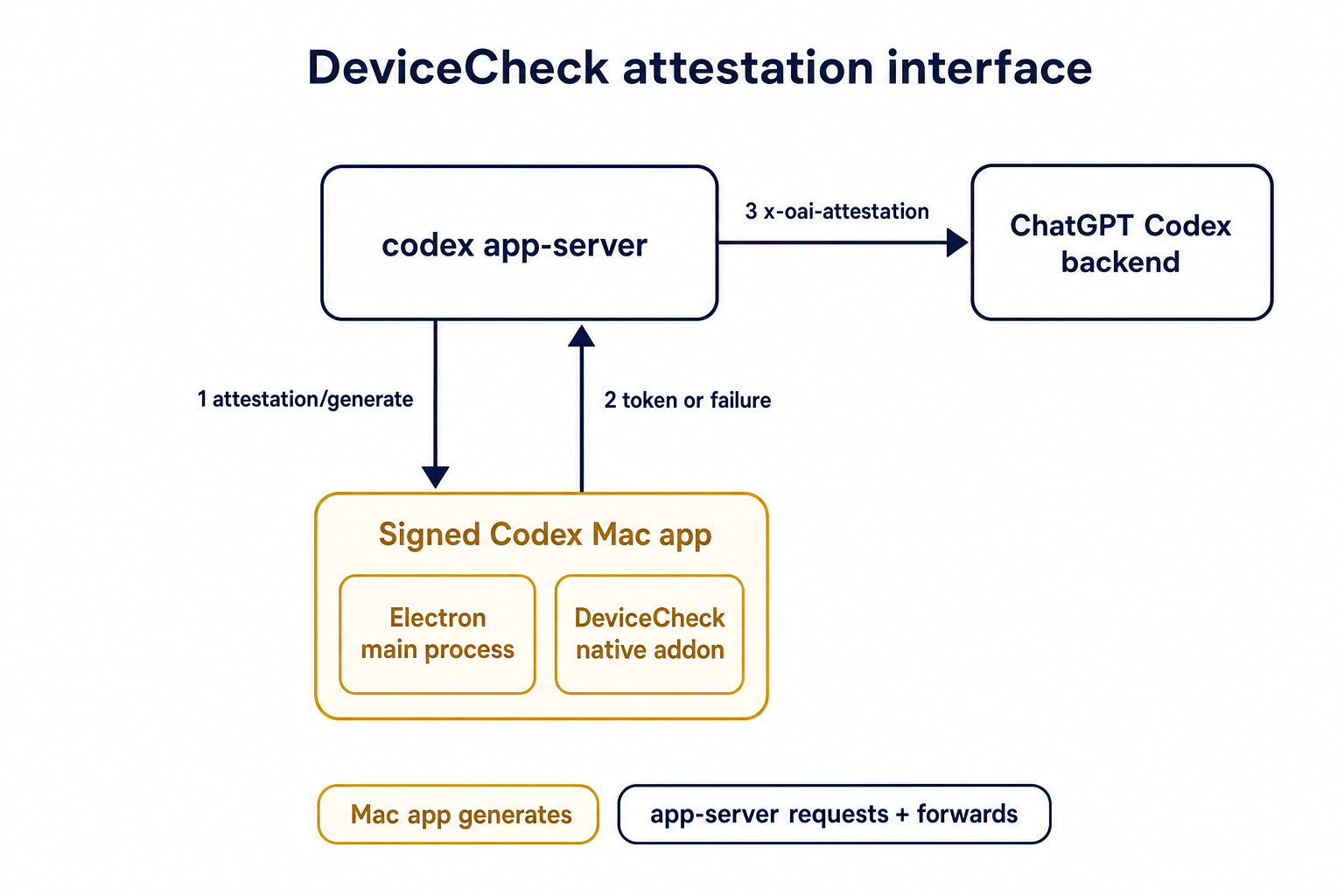
## Summary TL;DR: teaches `codex-rs` / app-server to request a desktop-provided attestation token and attach it as `x-oai-attestation` on the scoped ChatGPT Codex request paths.  ## Details This PR teaches the Codex app-server runtime how to request and attach an attestation token. It does not generate DeviceCheck tokens directly; instead, it relies on the connected desktop app to advertise that it can generate attestation and then asks that app for a fresh header value when needed. The flow is: 1. The Codex desktop app connects to app-server. 2. During `initialize`, the app can advertise that it supports `requestAttestation`. 3. Before app-server calls selected ChatGPT Codex endpoints, it sends the internal server request `attestation/generate` to the app. 4. app-server receives a pre-encoded header value back. 5. app-server forwards that value as `x-oai-attestation` on the scoped outbound requests. The code in this repo is mostly protocol and runtime plumbing: it adds the app-server request/response shape, introduces an attestation provider in core, wires that provider into Responses / compaction / realtime setup paths, and covers the intended scoping with tests. The signed macOS DeviceCheck generation remains owned by the desktop app PR. ## Related PR - Codex desktop app implementation: https://github.com/openai/openai/pull/878649 ## Validation <details> <summary>Tests run</summary> ```sh cargo test -p codex-app-server-protocol cargo test -p codex-core attestation --lib cargo test -p codex-app-server --lib attestation ``` Also ran: ```sh just fix -p codex-core just fix -p codex-app-server just fix -p codex-app-server-protocol just fmt just write-app-server-schema ``` </details> <details> <summary>E2E DeviceCheck validation</summary> First validated the signed desktop app boundary directly: launched a packaged signed `Codex.app`, sent `attestation/generate`, decoded the returned `v1.` attestation header, and validated the extracted DeviceCheck token with `personal/jm/verify_devicecheck_token.py` using bundle ID `com.openai.codex`. Apple returned `status_code: 200` and `is_ok: true`. Then ran the fuller app + app-server flow. The packaged `Codex.app` launched a current-branch app-server via `CODEX_CLI_PATH`, and a local MITM proxy intercepted outbound `chatgpt.com` traffic. The app-server requested `attestation/generate` from the real Electron app process, and the intercepted `/backend-api/codex/responses` traffic included `x-oai-attestation` on both routes: ```text GET /backend-api/codex/responses Upgrade: websocket x-oai-attestation: present POST /backend-api/codex/responses Upgrade: none x-oai-attestation: present ``` The captured header decoded to a DeviceCheck token that also validated with Apple for `com.openai.codex` (`status_code: 200`, `is_ok: true`, team `2DC432GLL2`). </details> --------- Co-authored-by: Codex <noreply@openai.com>
Jiaming Zhang ·
2026-05-08 12:36:02 -07:00 -
Remove skills list extra roots (#21485)
## Summary - Remove `perCwdExtraUserRoots` / `SkillsListExtraRootsForCwd` from the `skills/list` app-server API. - Drop Rust app-server and `codex-core-skills` extra-root plumbing so skill scans are keyed by the normal cwd/user/plugin roots only. - Regenerate app-server schemas and update docs/tests that only existed for the removed extra-roots behavior. ## Validation - `just write-app-server-schema` - `just fmt` - `cargo test -p codex-app-server-protocol` - `cargo test -p codex-core-skills` - `just fix -p codex-app-server-protocol` - `just fix -p codex-core-skills` - `just fix -p codex-app-server` - `just fix -p codex-tui` ## Notes - `cargo test -p codex-app-server --test all skills_list` ran the edited skills-list cases, but the full filtered run ended on existing `skills_changed_notification_is_emitted_after_skill_change` timeout after a websocket `401`. - `cargo test -p codex-tui --lib` compiled the changed TUI callers, then failed two unrelated status permission tests because local `/etc/codex/requirements.toml` forbids `DangerFullAccess`. - Source-truth check found the OpenAI monorepo still has generated/app-server-kit mirror references to the removed field; those should be cleaned up when generated app-server types are synced or in a companion OpenAI cleanup.
xli-oai ·
2026-05-07 20:56:42 -07:00 -
[codex-analytics] plumb protocol-native review timing (#21434)
## Why We want terminal tool review analytics, but the reducer should not stamp review timing from its own wall clock. This PR plumbs review timing through the real protocol and app-server seams so downstream analytics can consume the emitter's timestamps directly. Guardian reviews keep their enriched `started_at` / `completed_at` analytics fields by deriving those legacy second-based values from the same protocol-native millisecond lifecycle timestamps, rather than sampling a separate analytics clock. ## What changed - add `started_at_ms` to user approval request payloads - add `started_at_ms` / `completed_at_ms` to guardian review notifications - preserve Guardian review `started_at` / `completed_at` enrichment from the protocol-native timing source - stamp typed `ServerResponse` analytics facts with app-server-observed `completed_at_ms` - thread the new timing fields through core, protocol, app-server, TUI, and analytics fixtures ## Verification - `cargo test -p codex-app-server outgoing_message --manifest-path codex-rs/Cargo.toml` - `cargo test -p codex-app-server-protocol guardian --manifest-path codex-rs/Cargo.toml` - `cargo test -p codex-tui guardian --manifest-path codex-rs/Cargo.toml` - `cargo test -p codex-analytics analytics_client_tests --manifest-path codex-rs/Cargo.toml` --- [//]: # (BEGIN SAPLING FOOTER) Stack created with [Sapling](https://sapling-scm.com). Best reviewed with [ReviewStack](https://reviewstack.dev/openai/codex/pull/21434). * #18748 * __->__ #21434 * #18747 * #17090 * #17089 * #20514
rhan-oai ·
2026-05-07 20:31:41 -07:00 -
feat(app-server, threadstore): Thread pagination APIs and ThreadStore contract (#21566)
## Why The goal of this PR is to align on app-server and `ThreadStore` API updates for paginating through large threads. #### app-server ##### `thread/turns/list` - Updates `thread/turns/list` to support `itemsView?: "notLoaded" | "summary" | "full" | null`, defaulting to `summary`. - Implements the current `thread/turns/list` behavior over the existing persisted rollout-history fallback: - `notLoaded` returns turn envelopes with empty `items`. - `summary` returns the first user message and final assistant message when available. - `full` preserves the existing full item behavior. Note that this method still uses the naive approach of loading the entire rollout file, and returns just the filtered slice of the data. Real pagination will come later by leveraging SQLite. ##### `thread/turns/items/list` - Adds the experimental `thread/turns/items/list` protocol, schema, dispatcher, and processor stub. The app-server currently returns JSON-RPC `-32601` with `thread/turns/items/list is not supported yet`. #### ThreadStore - Adds the experimental `thread/turns/items/list` protocol, schema, dispatcher, and processor stub. The app-server currently returns JSON-RPC `-32601` with `thread/turns/items/list is not supported yet`. - Adds `ThreadStore` contract types and stubbed methods for listing thread turns and listing items within a turn. - Adds a typed `StoredTurnStatus` and `StoredTurnError` to avoid baking app-server API enums or lossy string status values into the store-facing turn contract. - Adds a typed `StoredTurnStatus` and `StoredTurnError` to avoid baking app-server API enums or lossy string status values into the store-facing turn contract. This also sketches the storage abstraction we expect to need once turns are indexed/stored. In particular, `notLoaded` is useful only if ThreadStore can eventually list turn metadata without loading every persisted item for each turn. ## Validation - Added/updated protocol serialization coverage for the new request and response shapes. - Added app-server integration coverage for `thread/turns/list` default summary behavior and all three `itemsView` modes. - Added app-server integration coverage that `thread/turns/items/list` returns the expected unsupported JSON-RPC error when experimental APIs are enabled. - Added thread-store coverage that the default trait methods return `ThreadStoreError::Unsupported`. No developers.openai.com documentation update is needed for this internal experimental app-server API surface.
Owen Lin ·
2026-05-07 15:44:43 -07:00 -
Ruslan Nigmatullin ·
2026-05-07 09:01:44 -07:00 -
Revert state DB injection and agent graph store (#21481)
## Why Reverts #20689 to restore the previous optional state DB plumbing. The conflict resolution keeps the newer installation ID and session/thread identity changes that landed after #20689, while removing the mandatory state DB and agent graph store dependency from ThreadManager construction. ## What changed - Restored `Option<StateDbHandle>` through app-server, MCP server, prompt debug, and test entry points. - Removed the `codex-core` dependency on `codex-agent-graph-store` and reverted descendant lookup back to the existing state DB path when available. - Kept newer `installation_id` forwarding by passing it beside the optional DB handle. - Kept local thread-name updates working when the optional state DB handle is absent. ## Validation - `git diff --check` - `cargo test -p codex-thread-store` - `cargo test -p codex-state -p codex-rollout -p codex-app-server-protocol` - Attempted `env CARGO_INCREMENTAL=0 cargo test -p codex-core -p codex-app-server -p codex-app-server-client -p codex-mcp-server -p codex-thread-manager-sample -p codex-tui`; blocked locally by a rustc ICE while compiling `v8 v146.4.0` with `rustc 1.93.0 (254b59607 2026-01-19)` on `aarch64-apple-darwin`.
pakrym-oai ·
2026-05-06 22:48:29 -07:00 -
[codex] allow shared config reads in app-server queue (#21340)
## Summary - add a shared-read serialization mode for global app-server request families - let consecutive leading shared reads for the same family run together while keeping exclusive requests ordered - mark only `skills/list`, `config/read` and `plugin/list` as shared reads for now ## Why `skills/list` and `plugin/list` are read-only config-family requests, but the app-server queue currently treats every config request as exclusive. That means one long `skills/list` can make a later `plugin/list` wait even though the two requests do not mutate config. This change keeps the existing queue order but lets adjacent reads overlap. If a write is already waiting, later reads still stay behind it, so writes do not starve. ## Scope This intentionally keeps the first pass narrow: - shared reads: `skills/list`, `plugin/list` - still exclusive: `plugin/install`, `marketplace/*`, `skills/config/write`, `config/*write`, `config/read`, and the rest of the config family ## Validation - `just fmt` - `cargo test -p codex-app-server-protocol` - `cargo test -p codex-app-server` - `just fix -p codex-app-server-protocol` - `just fix -p codex-app-server` ## Desktop verification I ran the dev desktop app against this branch's built binary with the existing UI timing logs enabled. The app did use `/Users/xli/code/codex_6/codex-rs/target/debug/codex`. The new scheduler behavior works, but this narrow change does not remove every cold-start delay: in the observed trace, an earlier exclusive `config/read` was already queued ahead of the later `skills/list` and `plugin/list` requests, so the page-open plugin requests still waited behind that earlier exclusive config-family request before they could run together. That means this PR is the scheduler primitive needed for shared reads, not the complete end-to-end latency fix by itself. ## Not run - full workspace test suite, because repo policy requires explicit approval before running it after touching `app-server-protocol`
xli-oai ·
2026-05-06 21:16:31 -07:00 -
feat(app-server): move v2
sessionIdontoThread(#21336)## Why `session_id` and `thread_id` are separate identities after #20437, but app-server only surfaced `sessionId` on the `thread/start`, `thread/resume`, and `thread/fork` response envelopes. Other thread-bearing surfaces such as `thread/list`, `thread/read`, `thread/started`, `thread/rollback`, `thread/metadata/update`, and `thread/unarchive` either lacked the grouping key or forced clients to special-case those three responses. Making `sessionId` part of the reusable `Thread` payload gives every v2 API surface one place to expose session-tree identity. ## Mental model 1. thread.sessionId lives on `Thread` 2. It is a view/runtime identity for the current live session tree, not durable stored lineage metadata 3. When app-server has a live loaded thread, it copies the real value from core’s session_configured.session_id 4. When it only has stored/unloaded data, it falls back to thread.sessionId = thread.id ## What changed - Added `sessionId` to the v2 [`Thread`](https://github.com/openai/codex/blob/8fc9e9b4cf81b6f61d432e71f1eb266f6f104b63/codex-rs/app-server-protocol/src/protocol/v2/thread_data.rs#L105-L109). - Removed the duplicate top-level `sessionId` fields from `thread/start`, `thread/resume`, and `thread/fork`; clients should now read `response.thread.sessionId`. - Populated `thread.sessionId` when building live thread responses, replaying loaded threads, and returning stored-thread summaries so the field is present across start, resume, fork, list, read, rollback, metadata-update, unarchive, and `thread/started` paths. See [`load_thread_from_resume_source_or_send_internal`](https://github.com/openai/codex/blob/8fc9e9b4cf81b6f61d432e71f1eb266f6f104b63/codex-rs/app-server/src/request_processors/thread_processor.rs#L2824-L2918) and [`thread_from_stored_thread`](https://github.com/openai/codex/blob/8fc9e9b4cf81b6f61d432e71f1eb266f6f104b63/codex-rs/app-server/src/request_processors/thread_processor.rs#L3671-L3719). - Preserved the stored-thread fallback: if a thread has not been loaded into a live session tree yet, `thread.sessionId` falls back to `thread.id`; once the thread is live again, the field reports the active session tree root. - Regenerated the JSON/TypeScript schemas and updated the app-server README examples to show [`thread.sessionId`](https://github.com/openai/codex/blob/8fc9e9b4cf81b6f61d432e71f1eb266f6f104b63/codex-rs/app-server/README.md#L306-L310) on the thread object.
jif-oai ·
2026-05-06 15:23:25 +02:00 -
feat: add
session_id(#20437)## Summary Related to https://openai.slack.com/archives/C095U48JNL9/p1777537279707449 TLDR: We update the meaning of session ids and thread ids: * thread_id stays as now * session_id become a shared id between every thread under a /root thread (i.e. every sub-agent share the same session id) This PR introduces an explicit `SessionId` and threads it through the protocol/client boundary so `session_id` and `thread_id` can diverge when they need to, while preserving compatibility for older serialized `session_configured` events. --------- Co-authored-by: Codex <noreply@openai.com>
jif-oai ·
2026-05-06 10:48:37 +02:00 -
feat: Add plugin share access controls (#21124)
Extends `plugin/share/save` to accept optional discoverability and shareTargets while uploading plugin contents, and adds `plugin/share/updateTargets` for share-only target updates without re-uploading.
xl-openai ·
2026-05-05 20:14:18 -07:00 -
[codex-analytics] rework thread_source for thread analytics (#20949)
## Summary - make `thread_source` an explicit optional thread-level field on `thread/start`, `thread/fork`, and returned thread payloads - persist `thread_source` in rollout/session metadata so resumed live threads retain the original value - replace the old best-effort `session_source` -> `thread_source` mapping with an explicit caller-supplied analytics classification ## Why Before this change, analytics `thread_source` was populated by a best-effort mapping from `session_source`. `session_source` describes the runtime/client surface, not the actual thread-level origin, so that projection was not accurate enough to distinguish cases such as `user`, `subagent`, `memory_consolidation`, and future thread origins reliably. Making `thread_source` explicit keeps one thread-level analytics field while letting callers provide the real classification directly instead of recovering it indirectly from `session_source`. ## Impact For new analytics events, `thread_source` now reflects the explicit thread-level classification supplied by the caller rather than an inferred value derived from `session_source`. Existing protocol fields remain optional; callers that omit `threadSource` now produce `null` instead of a best-effort inferred value. ## Validation - `just write-app-server-schema` - `cargo test -p codex-analytics -p codex-core -p codex-app-server-protocol --no-run` - `cargo test -p codex-app-server-protocol generated_ts_optional_nullable_fields_only_in_params` - `cargo test -p codex-analytics thread_initialized_event_serializes_expected_shape` - `cargo test -p codex-core resume_stopped_thread_from_rollout_preserves_thread_source`
rhan-oai ·
2026-05-06 02:12:31 +00:00 -
Add Windows sandbox readiness RPC (#20708)
## Why The desktop app on Windows needs a read-only way to tell, before the next tool call, whether the local Windows sandbox setup is in a state that should block the user and ask for setup again. The main case we want to cover is the elevated sandbox setup version bump. Today, if the app is configured for elevated Windows sandboxing and the installed setup is stale, the next sandboxed shell/exec path can end up triggering the elevated setup flow directly. That means the user can see an unexpected UAC prompt with no UI explanation. This change adds a small app-server preflight so the desktop app can ask “is Windows sandbox ready, not configured, or update-required?” during startup and show the appropriate blocking UI before the user hits a tool call. ## What changed - Added a new read-only app-server RPC: `windowsSandbox/readiness` - Added a new protocol enum and response type: - `WindowsSandboxReadiness` - `WindowsSandboxReadinessResponse` - Added core readiness logic in `core/src/windows_sandbox.rs`: - `ready` - `notConfigured` - `updateRequired` - Wired the new request through `codex_message_processor` - Regenerated the vendored app-server schema fixtures ## Readiness semantics This is intentionally a coarse startup/version-bump readiness check, not a full predictor of every runtime repair case. For now, readiness is determined from: - the configured Windows sandbox level - `sandbox_setup_is_complete()` for elevated mode That means: - `disabled` maps to `notConfigured` - `restricted token` maps to `ready` - `elevated` maps to `ready` or `updateRequired` depending on `sandbox_setup_is_complete()` This is deliberate for the first UI integration because the common case we want to catch is “the app updated, the elevated setup version bumped, and the user should see an update-required blocker instead of a surprise UAC prompt”. It does not attempt to model every case where the deeper runtime path might decide to repair or re-run setup. ## Testing - Ran `cargo fmt --all -- app-server-protocol/src/protocol/common.rs app-server-protocol/src/protocol/v2.rs app-server/src/codex_message_processor.rs core/src/windows_sandbox.rs core/src/windows_sandbox_tests.rs` - Added unit tests for the pure readiness mapping in `core/src/windows_sandbox_tests.rs` - Regenerated vendored schema fixtures with `cargo run -p codex-app-server-protocol --bin write_schema_fixtures -- --schema-root app-server-protocol/schema` - Did not run the full cargo test suite
iceweasel-oai ·
2026-05-05 09:58:23 -07:00 -
[codex] Add unsandboxed process exec API (#19040)
## Why App-server clients sometimes need argv-based local process execution while sandbox policy is controlled outside Codex. Those environments can reject sandbox-disabling paths before a command ever starts, even when the caller intentionally wants unsandboxed execution. This PR adds a distinct `process/*` API for that use case instead of extending `command/exec` with another sandbox-disabling shape. Keeping the new surface separate also makes the future removal of `command/exec` simpler: clients that need explicit process lifecycle control can move to the newer handle-based API without depending on `command/exec` business logic. ## What changed - Added v2 process lifecycle methods: `process/spawn`, `process/writeStdin`, `process/resizePty`, and `process/kill`. - Added process notifications: `process/outputDelta` for streamed stdout/stderr chunks and `process/exited` for final exit status and buffered output. - Made `process/spawn` intentionally unsandboxed and omitted sandbox-selection fields such as `sandboxPolicy` and `permissionProfile`. - Added client-supplied, connection-scoped `processHandle` values for follow-up control requests and notification routing. - Supported cwd, environment overrides, PTY mode and size, stdin streaming, stdout/stderr streaming, per-stream output caps, and timeout controls. - Killed active process sessions when the originating app-server connection closes. - Wired the implementation through the modular `request_processors/` app-server layout, with process-handle request serialization for follow-up control calls. - Updated generated JSON/TypeScript schema fixtures and documented the new API in `codex-rs/app-server/README.md`. - Added v2 app-server integration coverage in `codex-rs/app-server/tests/suite/v2/process_exec.rs` for spawn acknowledgement before exit, buffered output caps, and process termination. ## Verification - `cargo test -p codex-app-server-protocol` - `cargo test -p codex-app-server` --------- Co-authored-by: Owen Lin <owen@openai.com>
Ruslan Nigmatullin ·
2026-05-04 16:43:58 -07:00 -
Add remote plugin skill read API (#20150)
## Summary Adds an app-server `plugin/skill/read` method for remote plugin skill markdown. The new method calls the plugin-service skill detail endpoint and returns `skill_md_contents`, so clients can preview skills for remote plugins before the bundle is installed locally. ## Why Uninstalled remote plugin skills do not have local `SKILL.md` files. Without an on-demand remote read, the desktop plugin details UI cannot render the skill details modal for those skills. ## Validation - `just write-app-server-schema` - `just fmt` - `cargo test -p codex-app-server-protocol` - `cargo test -p codex-app-server --test all -- suite::v2::plugin_read::plugin_skill_read_reads_remote_skill_contents_when_remote_plugin_enabled --exact` - `just fix -p codex-app-server-protocol -p codex-core-plugins -p codex-app-server`
xli-oai ·
2026-05-01 00:16:25 -07:00 -
fix(app-server): mark thread/turns/list and exclude_turns as experime… (#20499)
…ntal We have some bugs to work out and it is not quite ready to consume as a public API.
Owen Lin ·
2026-04-30 17:39:08 -07:00 -
Stop emitting item/fileChange/outputDelta output delta notifications (#20471)
## Why `item/fileChange/outputDelta` text output was only the tool's summary or error text and not used by client surfaces. We keep `item/fileChange/outputDelta` in the app-server protocol as a deprecated compatibility entry, but the server no longer emits it. ## What changed - stop the `apply_patch` runtime from emitting `ExecCommandOutputDelta` events - simplify `item_event_to_server_notification` so command output deltas always map to `item/commandExecution/outputDelta` - remove the app-server bookkeeping that tried to detect whether an output delta belonged to a file change - mark `item/fileChange/outputDelta` as a deprecated legacy protocol entry in the v2 types, schema, and README - simplify the file-change approval tests so they only wait for completion instead of expecting output-delta notifications ## Testing - `cargo test -p codex-app-server-protocol` - `cargo test -p codex-thread-manager-sample` - `cargo test -p codex-app-server-protocol protocol::event_mapping::tests::exec_command_output_delta_maps_to_command_execution_output_delta -- --exact` - `cargo test -p codex-app-server turn_start_file_change_approval_accept_for_session_persists_v2 -- --exact` *(failed before the test assertions because the wiremock `/responses` mock received 0 requests in setup)*
pakrym-oai ·
2026-04-30 11:42:07 -07:00 -
realtime: rename provider session ids (#20361)
## Summary Codex is repurposing `session` to mean a thread group, so the realtime provider session id should no longer use `session_id` / `sessionId` in Codex-facing protocol payloads. This PR renames that provider-specific field to `realtime_session_id` / `realtimeSessionId` and intentionally breaks clients that still send the old field names. ## What Changed - Renamed realtime provider session fields in `ConversationStartParams`, `RealtimeConversationStartedEvent`, and `RealtimeEvent::SessionUpdated`. - Renamed app-server v2 realtime request and notification fields to `realtimeSessionId`. - Removed legacy serde aliases for `session_id` / `sessionId`; clients must send the new names. - Propagated the rename through core realtime startup, app-server adapters, codex-api websocket handling, and TUI realtime state. - Regenerated app-server protocol schema/TypeScript outputs and updated app-server README examples. - Kept upstream Realtime API concepts unchanged: provider `session.id` parsing and `x-session-id` headers still use the upstream wire names. ## Testing - CI is running on the latest pushed commit. - Earlier local verification on this PR: - `cargo test -p codex-protocol` - `CODEX_SKIP_VENDORED_BWRAP=1 cargo test -p codex-core realtime_conversation` - `cargo test -p codex-app-server-protocol` - `CODEX_SKIP_VENDORED_BWRAP=1 cargo test -p codex-app-server realtime_conversation` - attempted `CODEX_SKIP_VENDORED_BWRAP=1 cargo test -p codex-tui` (local linker bus error while linking the test binary) --------- Co-authored-by: Codex <noreply@openai.com>
Ahmed Ibrahim ·
2026-04-30 13:39:48 +03:00 -
feat: Add workspace plugin sharing APIs (#20278)
1. Adds v2 plugin/share/save, plugin/share/list, and plugin/share/delete RPCs. 2. Implements save by archiving a local plugin root, enforcing a size limit, uploading through the workspace upload flow, and supporting updates via remotePluginId. 3. Lists created workspace plugins 4. Deletes a previously uploaded/shared plugin.
xl-openai ·
2026-04-29 23:49:20 -07:00 -
Michael Bolin ·
2026-04-29 20:54:59 -07:00 -
Add hooks/list app-server RPC (#19778)
## Why We need a way to list the available hooks to expose via the TUI and App so users can view and manage their hooks ## What - Adds `hooks/list` for one or more `cwd` values that returns discovered hook metadata ## Stack 1. openai/codex#19705 2. This PR - openai/codex#19778 3. openai/codex#19840 4. openai/codex#19882 ## Review Notes The generated schema files account for most of the raw diff, these files have the core change: - `hooks/src/engine/discovery.rs` builds the inventory entries during hook discovery while leaving runtime handlers focused on execution. - `app-server/src/codex_message_processor.rs` wires `hooks/list` into the app-server flow for each requested `cwd`. - `app-server-protocol/src/protocol/v2.rs` defines the new v2 request/response payloads exposed on the wire. ### Core Changes `core/src/plugins/manager.rs` adds `plugins_for_layer_stack(...)` so `skills/list` and `hooks/list`can resolve plugin state for each requested `cwd` --------- Co-authored-by: Codex <noreply@openai.com>
Abhinav ·
2026-04-29 23:39:57 +00:00 -
Update Codex login success page UX (#20136)
## Summary update the local login success page to match the Codex desktop auth UX use theme-aware colors and an inline 20px Codex mark keep the actual localhost success page aligned with the browser auth UX PR ## Tests <img width="1728" height="1117" alt="Screenshot 2026-04-29 at 12 00 34 PM" src="https://github.com/user-attachments/assets/76a40c3f-07c3-452c-97da-e7c43717cd2c" />
rafael-jac ·
2026-04-29 19:14:53 -04:00 -
[app-server] type client response payloads (#20050)
## Why `pr17088` adds typed server-originated request/response plumbing, but successful client responses are still erased into bare JSON-RPC `result` values before app-server can make any typed decision about them. This precursor PR keeps successful client responses typed until the outgoing response seam. It is intentionally limited to protocol/app-server plumbing so the analytics behavior change can review separately on top. ## What changed - Add `ClientResponsePayload` as the pre-serialization client response body type. - Route app-server successful response paths through the typed payload seam while preserving existing handler-local analytics behavior. - Keep `InterruptConversation` JSON-RPC-only because it has no `ClientResponse` variant. - Move the new payload conversion tests into a dedicated protocol test module. ## Verification - `cargo check -p codex-app-server` - `cargo test -p codex-app-server-protocol`
rhan-oai ·
2026-04-29 20:50:47 +00:00 -
[codex-analytics] ingest server requests and responses (#17088)
## Why Codex analytics needs a typed seam for app-server-originated request/response traffic so future tool-approval analytics can consume those facts without adding bespoke callsite tracking each time. Server responses arrive as JSON-RPC `id + result` payloads, so analytics has to reconstruct the matching typed response from the original typed request while that request context still exists in app-server. This also puts analytics on the app-server outbound path, which needs to avoid keeping the runtime alive during shutdown. The final ownership fix keeps the normal strong auth-manager retention in analytics and makes the external-auth refresh bridge hold a weak back-reference to `OutgoingMessageSender`, breaking the runtime cycle at the bridge boundary instead of exposing retention policy through the analytics client API. ## What changed - Adds typed `ServerRequest` and `ServerResponse` analytics facts, plus `AnalyticsEventsClient::track_server_request` and `track_server_response`. - Renames the existing client-side facts to `ClientRequest` and `ClientResponse` so reducers can distinguish client-to-server traffic from server-to-client traffic. - Adds `ServerRequest::response_from_result`, allowing a stored typed request to decode the matching typed server response from a raw JSON-RPC result payload. - Threads `AnalyticsEventsClient` through `OutgoingMessageSender` and records targeted server requests, replayed targeted requests, and matching targeted responses with the responding connection id needed for correlation. - Intentionally leaves broadcast server requests/responses out of analytics for now because the current model is per connection, while broadcasts fan one logical request out across multiple connections. - Breaks the app-server shutdown cycle by storing `Weak<OutgoingMessageSender>` in `ExternalAuthRefreshBridge` and upgrading it only when an external-auth refresh is actually requested. - Keeps reducer ingestion of the new server-side facts as no-ops for now; this PR is plumbing for later tool-approval analytics work. ## Verification - `cargo test -p codex-analytics` - `cargo test -p codex-app-server outgoing_message::tests::` - Covers typed-response reconstruction plus the targeted, replayed, broadcast-exclusion, and response-attribution analytics paths. ## Follow-up This PR intentionally stops at ingestion plumbing, so `ServerRequest` and `ServerResponse` facts are still reducer no-ops. Once a follow-up PR adds real downstream analytics output for those facts: - replace the temporary pre-reducer observation seam with reducer tests for the emitted event shape; - add end-to-end coverage in `app-server/tests/suite/v2/analytics.rs` for the real app-server workflow and captured analytics payload; - remove the temporary sender-level observer tests added here in favor of the real-output coverage above. --- [//]: # (BEGIN SAPLING FOOTER) Stack created with [Sapling](https://sapling-scm.com). Best reviewed with [ReviewStack](https://reviewstack.dev/openai/codex/pull/17088). * #18748 * #18747 * #17090 * #17089 * #20241 * #20239 * __->__ #17088
rhan-oai ·
2026-04-29 19:56:41 +00:00 -
feat: expose provider capability bounds to app server clients (#20049)
follow up of #19442. The app server now exposes provider-derived bounds through a new v2 `modelProvider/read` method. The response reports the configured provider map key as `modelProvider` and returns the effective capability booleans so clients can align their UI with the same provider-owned limits used by core.
Celia Chen ·
2026-04-29 01:36:19 +00:00 -
app-server: notify clients of remote-control status changes (#19919)
## Why Remote-control app-server enrollments have both an internal server id and the environment id exposed to remote-control clients. App-server clients need one current status snapshot that says whether remote control is usable and which environment id, if any, is exposed. A temporary websocket disconnect is not itself an identity change. Account changes, stale enrollment invalidation, successful re-enrollment, and missing ChatGPT auth are meaningful status changes. Disabled remote control remains `disabled` regardless of auth or SQLite state. SQLite startup failure disablement and enrollment persistence failures are handled in #20068; this PR reports the resulting effective status to clients. ## What changed - Adds v2 `remoteControl/status/changed` carrying `state` and `environmentId`. - Adds `RemoteControlConnectionState` values: `disabled`, `connecting`, `connected`, and `errored`. - Exposes remote-control status updates through `RemoteControlHandle` using a Tokio watch channel. - Always sends the current remote-control status snapshot to newly initialized app-server clients. - Broadcasts status changes to initialized app-server clients when state or environment id changes. - Treats missing ChatGPT auth as an `errored` status while leaving it retryable because auth can change at runtime. - Clears `environmentId` when enrollment is cleared for account changes, auth loss, stale backend invalidation, or disabled remote control. - Updates app-server protocol schema fixtures, generated TypeScript, app-server README, remote-control tests, and TUI exhaustive notification matches. ## Stack - Builds on #20068. ## Verification - `just write-app-server-schema` - `cargo test -p codex-app-server-protocol` - `cargo test -p codex-app-server transport::remote_control --lib` - `cargo check -p codex-tui` - `just fix -p codex-app-server-protocol` - `just fix -p codex-app-server` - `just fix -p codex-tui`
Ruslan Nigmatullin ·
2026-04-28 23:52:14 +00:00 -
app-server: run initialized rpcs with keyed serialization (#17373)
## Why Initialized app-server RPCs no longer need to bottleneck behind one request processor path. Running them concurrently improves responsiveness, but several request families still mutate shared state or depend on ordered side effects. Those stateful families need an auditable serialization contract so concurrency does not reorder thread, config, auth, command, watcher, MCP, or similar state transitions. This PR keeps that boundary explicit: stateful work is serialized by the smallest useful key, while intentionally read-only or externally concurrent work remains unkeyed. In particular, `thread/list` and `thread/turns/list` explicitly have no serialization because they primarily read append-only rollout storage and should continue to be served concurrently. ## What changed - Adds `ClientRequest::serialization_scope()` in `app-server-protocol` and requires every client request definition to declare its serialization behavior. - Introduces keyed request scopes for thread, thread path, command exec process, fuzzy search session, fs watch, MCP OAuth, and global state buckets such as config, account auth, memory, and device keys. - Routes initialized app-server RPCs through per-key FIFO serialization while allowing unkeyed initialized requests to run concurrently. - Cancels in-flight initialized RPC work when the connection disconnects or the app-server exits so spawned request tasks do not outlive their session. - Adds focused coverage for representative keyed and unkeyed serialization scopes, including explicitly concurrent `thread/turns/list` behavior. ## Validation - Added protocol tests for representative keyed serialization scopes and intentionally unkeyed request families. - Added app-server request serialization tests covering per-key FIFO behavior, concurrent unkeyed execution, disconnect shutdown, and config read-after-write ordering. - Local focused protocol validation after the latest rebase is currently blocked by packageproxy failing to resolve locked `rustls-webpki 0.103.13`; CI is expected to provide the full validation signal.
Ruslan Nigmatullin ·
2026-04-28 12:23:34 -07:00 -
app-server-protocol: mark permission profiles experimental (#19899)
## Why `PermissionProfile` is now the canonical internal permissions representation, but the app-server wire shape is still intentionally unstable while the migration continues. Stable app-server clients should not see or generate code for these fields until the wire format settles. ## What changed - Marks every app-server v2 field that sends `PermissionProfile` as experimental, including `command/exec`, `thread/start`, `thread/resume`, `thread/fork`, and `turn/start` request/response payloads. - Enables per-field experimental inspection for `command/exec`, so `permissionProfile` is gated without making the entire method experimental. - Fixes the generated TypeScript schema filter to be comment-aware. The previous scanner treated apostrophes inside doc comments as string delimiters, so some experimental fields leaked into stable TypeScript even though stable JSON was filtered correctly. ## Verification - `cargo test -p codex-app-server-protocol` --- [//]: # (BEGIN SAPLING FOOTER) Stack created with [Sapling](https://sapling-scm.com). Best reviewed with [ReviewStack](https://reviewstack.dev/openai/codex/pull/19899). * #19900 * __->__ #19899
Michael Bolin ·
2026-04-28 06:08:34 +00:00 -
Add goal app-server API (2 / 5) (#18074)
Adds the app-server v2 goal API on top of the persisted goal state from PR 1. ## Why Clients need a stable app-server surface for reading and controlling materialized thread goals before the model tools and TUI can use them. Goal changes also need to be observable by app-server clients, including clients that resume an existing thread. ## What changed - Added v2 `thread/goal/get`, `thread/goal/set`, and `thread/goal/clear` RPCs for materialized threads. - Added `thread/goal/updated` and `thread/goal/cleared` notifications so clients can keep local goal state in sync. - Added resume/snapshot wiring so reconnecting clients see the current goal state for a thread. - Added app-server handlers that reconcile persisted rollout state before direct goal mutations. - Updated the app-server README plus generated JSON and TypeScript schema fixtures for the new API surface. ## Verification - Added app-server v2 coverage for goal get/set/clear behavior, notification emission, resume snapshots, and non-local thread-store interactions.
Eric Traut ·
2026-04-24 20:53:41 -07:00 -
permissions: make legacy profile conversion cwd-free (#19414)
## Why The profile conversion path still required a `cwd` even when it was only translating a legacy `SandboxPolicy` into a `PermissionProfile`. That made profile producers invent an ambient `cwd`, which is exactly the anchoring we are trying to remove from permission-profile data. A legacy workspace-write policy can be represented symbolically instead: `:cwd = write` plus read-only `:project_roots` metadata subpaths. This PR creates that cwd-free base so the rest of the stack can stop threading cwd through profile construction. Callers that actually need a concrete runtime filesystem policy for a specific cwd still have an explicitly named cwd-bound conversion. ## What Changed - `PermissionProfile::from_legacy_sandbox_policy` now takes only `&SandboxPolicy`. - `FileSystemSandboxPolicy::from_legacy_sandbox_policy` is now the symbolic, cwd-free projection for profiles. - The old concrete projection is retained as `FileSystemSandboxPolicy::from_legacy_sandbox_policy_for_cwd` for runtime/boundary code that must materialize legacy cwd behavior. - Workspace-write profiles preserve `CurrentWorkingDirectory` and `ProjectRoots` special entries instead of materializing cwd into absolute paths. ## Verification - `cargo check -p codex-protocol -p codex-core -p codex-app-server-protocol -p codex-app-server -p codex-exec -p codex-exec-server -p codex-tui -p codex-sandboxing -p codex-linux-sandbox -p codex-analytics --tests` - `just fix -p codex-protocol -p codex-core -p codex-app-server-protocol -p codex-app-server -p codex-exec -p codex-exec-server -p codex-tui -p codex-sandboxing -p codex-linux-sandbox -p codex-analytics` --- [//]: # (BEGIN SAPLING FOOTER) Stack created with [Sapling](https://sapling-scm.com). Best reviewed with [ReviewStack](https://reviewstack.dev/openai/codex/pull/19414). * #19395 * #19394 * #19393 * #19392 * #19391 * __->__ #19414
Michael Bolin ·
2026-04-24 13:42:05 -07:00 -
permissions: make profiles represent enforcement (#19231)
## Why `PermissionProfile` is becoming the canonical permissions abstraction, but the old shape only carried optional filesystem and network fields. It could describe allowed access, but not who is responsible for enforcing it. That made `DangerFullAccess` and `ExternalSandbox` lossy when profiles were exported, cached, or round-tripped through app-server APIs. The important model change is that active permissions are now a disjoint union over the enforcement mode. Conceptually: ```rust pub enum PermissionProfile { Managed { file_system: FileSystemSandboxPolicy, network: NetworkSandboxPolicy, }, Disabled, External { network: NetworkSandboxPolicy, }, } ``` This distinction matters because `Disabled` means Codex should apply no outer sandbox at all, while `External` means filesystem isolation is owned by an outside caller. Those are not equivalent to a broad managed sandbox. For example, macOS cannot nest Seatbelt inside Seatbelt, so an inner sandbox may require the outer Codex layer to use no sandbox rather than a permissive one. ## How Existing Modeling Maps Legacy `SandboxPolicy` remains a boundary projection, but it now maps into the higher-fidelity profile model: - `ReadOnly` and `WorkspaceWrite` map to `PermissionProfile::Managed` with restricted filesystem entries plus the corresponding network policy. - `DangerFullAccess` maps to `PermissionProfile::Disabled`, preserving the “no outer sandbox” intent instead of treating it as a lax managed sandbox. - `ExternalSandbox { network_access }` maps to `PermissionProfile::External { network }`, preserving external filesystem enforcement while still carrying the active network policy. - Split runtime policies that legacy `SandboxPolicy` cannot faithfully express, such as managed unrestricted filesystem plus restricted network, stay `Managed` instead of being collapsed into `ExternalSandbox`. - Per-command/session/turn grants remain partial overlays via `AdditionalPermissionProfile`; full `PermissionProfile` is reserved for complete active runtime permissions. ## What Changed - Change active `PermissionProfile` into a tagged union: `managed`, `disabled`, and `external`. - Keep partial permission grants separate with `AdditionalPermissionProfile` for command/session/turn overlays. - Represent managed filesystem permissions as either `restricted` entries or `unrestricted`; `glob_scan_max_depth` is non-zero when present. - Preserve old rollout compatibility by accepting the pre-tagged `{ network, file_system }` profile shape during deserialization. - Preserve fidelity for important edge cases: `DangerFullAccess` round-trips as `disabled`, `ExternalSandbox` round-trips as `external`, and managed unrestricted filesystem + restricted network stays managed instead of being mistaken for external enforcement. - Preserve configured deny-read entries and bounded glob scan depth when full profiles are projected back into runtime policies, including unrestricted replacements that now become `:root = write` plus deny entries. - Regenerate the experimental app-server v2 JSON/TypeScript schema and update the `command/exec` README example for the tagged `permissionProfile` shape. ## Compatibility Legacy `SandboxPolicy` remains available at config/API boundaries as the compatibility projection. Existing rollout lines with the old `PermissionProfile` shape continue to load. The app-server `permissionProfile` field is experimental, so its v2 wire shape is intentionally updated to match the higher-fidelity model. ## Verification - `just write-app-server-schema` - `cargo check --tests` - `cargo test -p codex-protocol permission_profile` - `cargo test -p codex-protocol preserving_deny_entries_keeps_unrestricted_policy_enforceable` - `cargo test -p codex-app-server-protocol permission_profile_file_system_permissions` - `cargo test -p codex-app-server-protocol serialize_client_response` - `cargo test -p codex-core session_configured_reports_permission_profile_for_external_sandbox` - `just fix` - `just fix -p codex-protocol` - `just fix -p codex-app-server-protocol` - `just fix -p codex-core` - `just fix -p codex-app-server`Michael Bolin ·
2026-04-23 23:02:18 -07:00 -
Add app-server marketplace upgrade RPC (#19074)
## Summary - add a v2 `marketplace/upgrade` app-server RPC that mirrors the existing configured Git marketplace upgrade path - expose typed request/response/error payloads and regenerate JSON/TypeScript schema fixtures - add app-server integration coverage for all, named, already up-to-date, and invalid marketplace upgrade requests ## Tests - `just write-app-server-schema` - `cargo test -p codex-app-server-protocol` - `cargo test -p codex-app-server marketplace_upgrade` - `just fix -p codex-app-server-protocol` - `just fix -p codex-app-server` - `just fmt`
xli-oai ·
2026-04-23 13:00:46 -07:00 -
Add safety check notification and error handling (#19055)
Adds a new app-server notification that fires when a user account has been flagged for potential safety reasons.
Eric Traut ·
2026-04-22 22:24:12 -07:00 -
feat(auto-review) short-circuit (#18890)
## Summary Short circuit the convo if auto-review hits too many denials ## Testing - [x] Added unit tests --------- Co-authored-by: Codex <noreply@openai.com>
Dylan Hurd ·
2026-04-22 20:34:15 +00:00