## Description

This PR adds an optional `metadata` field to `ResponseItem` for
Responses API calls. Only mechanical plumbing, no actual values
populated and sent yet. Turns out just adding a new field to
`ResponseItem` has quite a large blast radius already.

This change is backwards compatible because `metadata` is optional and
omitted when absent, so existing response items and rollout history
without it still deserialize and requests that do not set it keep the
same wire shape. For provider compatibility, we strip out `metadata`
before non-OpenAI Responses requests so Azure and AWS Bedrock never see
this field.

My followup PR here will actually make use of it to start storing and
passing along `turn_id`: https://github.com/openai/codex/pull/28360

## What changed

- Added `ResponseItemMetadata` with optional `turn_id`, plus optional
`metadata` on Responses API item variants and inter-agent communication.
- Preserved item metadata through response-item rewrites such as
truncation, missing tool-output synthesis, compaction history
rebuilding, visible-history conversion, rollout/resume, and generated
app-server schemas/types.
- Strip item metadata from non-OpenAI Responses requests while
preserving it for OpenAI-shaped requests.
- Updated the mechanical fixture/test construction churn required by the
new optional field.
## Why

External-agent imports can complete synchronously or continue in the
background for plugins/sessions. Clients need a stable import id to
correlate the immediate response with the eventual completion
notification, and the completion payload needs enough accounting to show
which artifact types succeeded or failed without hiding partial
failures.

## What Changed

- `externalAgentConfig/import` now returns an `importId`;
`externalAgentConfig/import/completed` includes the same `importId` plus
type-level `itemResults`.
- Completed `itemResults` report `successCount`, `errorCount`,
`successes`, and `rawErrors` for each migrated item type.
- Added protocol/schema/TypeScript types for import successes, raw
errors, and type-level results. No progress notification is included in
the final PR.
- `ExternalAgentConfigService::import` now returns an outcome object
with synchronous item results and pending plugin imports.
- Plugin import outcomes track succeeded/failed marketplaces, plugin
ids, and raw errors. Plugin failures can be reported in completed
accounting while later migration items continue.
- Non-plugin synchronous import failures still fail the request, so
invalid config/skills-style failures are not reported as a successful
import response.
- Session imports now return item results. Successful imports include
the source session path and imported thread id; prepare, persist,
ledger, and source-validation failures become raw errors in completion
accounting where the import can continue.
- The request processor generates the `importId`, aggregates synchronous
results with background plugin/session results, and sends a single
completed notification when all selected work is done.
- App-server docs and generated schema fixtures were updated for the new
response/completed payload shapes.

## Validation

- `just test -p codex-app-server-protocol`
- `just test -p codex-app-server-client event_requires_delivery`
- `CODEX_SQLITE_HOME=/private/tmp/codex-app-server-review-sync-error
just test -p codex-app-server
external_agent_config_import_returns_error_for_failed_sync_import`
- `CODEX_SQLITE_HOME=/private/tmp/codex-app-server-review-external-agent
just test -p codex-app-server external_agent_config`

Note: local sandbox validation used `CODEX_SQLITE_HOME` because the
default sqlite state path is read-only in this environment.
## Why

Memory read telemetry currently reconstructs the executable shell
command after a tool call finishes. That duplicates shell, login-policy,
and cwd resolution owned by the tool handlers, and can diverge from the
environment-specific command that unified exec actually ran.

## What changed

- Expose the existing restricted shell-script parser directly for raw
script text.
- Parse `shell_command` and `exec_command` input into plain command argv
before classifying memory reads.
- Preserve all-or-nothing safe-command validation for multi-command
scripts.
- Remove cwd resolution, shell selection, and the unnecessary async
boundary from memory read metric emission.

## Testing

- `just test -p codex-shell-command`
- `cargo check -p codex-core`
## Intent

Keep Bazel and Starlark files consistently formatted without requiring
contributors to install or version buildifier themselves.

## Implementation

- Add a SHA-256-pinned, cross-platform DotSlash manifest for buildifier
v8.5.1.
- Run buildifier from the shared `just fmt` and `just fmt-check` driver,
with Windows-safe explicit DotSlash invocation.
- Provision DotSlash in formatting CI and contributor devcontainers, and
document the source-build prerequisite.
- Apply the initial mechanical buildifier formatting baseline.
## Why

Multi-agent v2 `send_message` deliveries already reach the receiving
model as typed `agent_message` items with encrypted content.
Child-completion notifications are generated by Codex itself, so their
content is plaintext and previously fell back to a serialized JSON
envelope inside an assistant message.

With plaintext `input_text` supported for `agent_message`, both delivery
paths can use the same model-visible type while preserving explicit
author and recipient metadata.

## What changed

- add plaintext `input_text` support to `AgentMessageInputContent` and
regenerate the affected app-server schemas
- preserve `InterAgentCommunication` as structured mailbox input instead
of converting it to assistant text
- record delivered communications as typed `agent_message` history items
- persist a dedicated rollout item so local delivery metadata such as
`trigger_turn` remains available without leaking into the Responses
request
- reconstruct typed agent messages on resume and preserve fork-turn
truncation behavior
- remove request-time assistant-content parsing
- preserve plaintext and encrypted inter-agent deliveries in stage-one
memory inputs
- normalize and link plaintext and encrypted agent messages in rollout
traces without treating inbound messages as child results
- cover the real MultiAgent V2 child-completion path end to end with
deterministic mailbox synchronization

## Verification

- `just test -p codex-core
plaintext_multi_agent_v2_completion_sends_agent_message`
- `just test -p codex-core input_queue_drains_mailbox_in_delivery_order
record_initial_history_reconstructs_typed_inter_agent_message
fork_turn_positions_use_inter_agent_delivery_metadata`
- `just test -p codex-memories-write
serializes_inter_agent_communications_for_memory`
- `just test -p codex-rollout-trace
agent_messages_preserve_routing_and_content
sub_agent_started_activity_creates_spawn_edge`
- `just test -p codex-rollout-trace
agent_result_edge_falls_back_to_child_thread_without_result_message`
- `just test -p codex-protocol -p codex-rollout -p
codex-app-server-protocol`
## Why

We already have the machinery to support multiple environments on a
single thread, but we only show the model the contents of `AGENTS.md`
files in the primary environment.

We should show the model all of the relevant project instructions when
we know there's more than one environment.

## Known Gaps

As discussed in the RFC, this implementation:

1. doesn't handle environments being added/removed to/from the thread
after its creation
2. it doesn't enforce an aggregate context budget across environments,
and instead applies the configured project maximum independently to each
environment

## Implementation

- Discover project instructions in environment order with an independent
byte budget per environment and preserve source provenance/order.
- Keep the legacy fragment byte-for-byte when exactly one environment
contributes project instructions; use environment-labeled sections when
two or more environments contribute.
- Freeze the complete rendered fragment in `LoadedAgentsMd`, insert it
directly into requests, and recognize both layouts in contextual and
memory filtering.
- Add exact rendering, independent-budget, source-order,
creation-snapshot, and consumer coverage without changing app-server
schemas.
## Why

First-party async traits should expose their `Send` contracts explicitly
without requiring `async_trait`. This completes the migration pattern
established in #27303 and #27304.

## What changed

- Replaced the remaining first-party `async_trait` traits with native
return-position `impl Future + Send` where statically dispatched and
explicit boxed `Send` futures where object safety is required.
- Kept implementations behavior-preserving, outlining existing async
bodies into inherent methods where that keeps the diff reviewable.
- Removed all direct first-party `async-trait` dependencies and the
workspace dependency declaration.
- Added a cargo-deny policy that permits `async-trait` only through the
remaining transitive wrapper crates.
- Updated `rand` from 0.8.5 to 0.8.6 to resolve RUSTSEC-2026-0097 and
keep the full cargo-deny check passing.

## Validation

- `just test -p codex-exec-server`: 216 passed, 2 skipped.
- `just test -p codex-model-provider`: 39 passed.
- `just test -p codex-core` and `just test`: changed tests passed;
remaining failures are environment-sensitive suites unrelated to this
migration.
- `cargo deny check`
- `just fix`
- `just fmt`
- `cargo shear`
- `just bazel-lock-check`
## What
Introduce a `CodexResponsesMetadata` struct that defines all the core
metadata we send to Responses API. Example fields are `thread_id`,
`turn_id`, `window_id`, etc.

Going forward, `client_metadata["x-codex-turn-metadata"]` will be the
canonical way Codex sends metadata to Responses API across both HTTP and
websocket transports.

For now, we continue to emit the existing top-level HTTP headers and
top-level `client_metadata` fields from the same
`CodexResponsesMetadata` struct for compatibility reasons.

Also, app-server clients who specify additional
`responsesapi_client_metadata` via `turn/start` and `turn/steer` will
have those fields merged into
`client_metadata["x-codex-turn-metadata"]`, but cannot override the
reserved fields that core uses (i.e. the fields in
`CodexResponsesMetadata`).

## Why

Responses API request instrumentation is the source of truth for
downstream Codex analytics that join requests by Codex IDs such as
session, thread, turn, and context window. Before this change, those
values were assembled through several request-specific paths: HTTP
request bodies, websocket handshake headers, websocket `response.create`
payloads, compaction requests, and the rich `x-codex-turn-metadata`
envelope all had their own wiring.

That made metadata propagation easy to drift across API-key/direct
Responses API requests, ChatGPT-auth/proxied requests, websocket
requests, and compaction requests. It also made additions like
`window_id` error-prone because a field could be added to one transport
projection but missed in another.

## What changed

- Added `CodexResponsesMetadata` as the core-owned snapshot for Codex
metadata sent to ResponsesAPI.
- Render `client_metadata["x-codex-turn-metadata"]`, flat
`client_metadata` projections, and direct compatibility headers from
that same snapshot.
- Include the known Codex-owned fields in the turn metadata blob,
including installation/session/thread/turn/window IDs, request kind,
lineage, sandbox/workspace metadata, timing, and compaction details.
- Treat app-server `responsesapi_client_metadata` as enrichment for the
Codex turn metadata blob while preventing those extras from overriding
Codex-owned fields.
- Use the same metadata path for normal turns, websocket prewarm, local
compaction, remote v1 compaction, and remote v2 compaction.
- Keep websocket connection-only preconnect metadata separate so
handshakes carry compatibility identity headers without inventing a fake
turn metadata blob.

## Verification

- `cargo check -p codex-core`
- `just fix -p codex-core`
## Why

Compaction window identity is part of session history, not model-client
transport state. Persisting it with the compacted rollout item lets
resumed threads continue from the reconstructed window without keeping
mutable window state on `ModelClient`.

## What changed

- Added `window_id` to `CompactedItem` and stamp it when
`replace_compacted_history` installs compacted history.
- Moved auto-compact window id ownership into `AutoCompactWindow` /
`SessionState`; `ModelClient` now receives the request window id from
callers instead of storing it.
- Returned `window_id` from rollout reconstruction for resume.
Reconstruction uses the newest surviving compacted item's stored
`window_id` when present, and falls back to the legacy compacted-item
count when it is absent.
- Kept fork startup at the fresh default window id and updated direct
model-client tests to pass explicit test window ids.

## Validation

- `cargo check -p codex-core --tests`
## Why

Memory startup used hardcoded OpenAI model slugs for extraction and
consolidation. That works for the default OpenAI-compatible path, but
provider-specific backends can require different model identifiers. In
particular, Amazon Bedrock should use its Bedrock model ID for these
background memory requests instead of the OpenAI `gpt-5.4-mini` /
`gpt-5.4` slugs.

## What Changed

- Added provider-owned preferred memory model methods alongside
`approval_review_preferred_model`.
- Updated memory extraction and consolidation to resolve their default
model through the active `ModelProvider`.
- Added Amazon Bedrock overrides so both memory stages use
`openai.gpt-5.4` through Bedrock’s provider-specific model ID.
- Kept explicit `memories.extract_model` and
`memories.consolidation_model` config overrides taking precedence.
- Added startup coverage for default OpenAI and Bedrock memory model
selection.

#closes #26288
## Why

CCA is moving toward a split runtime where the orchestrator may not have
a filesystem, while executors can expose preinstalled plugins and
skills. A thread therefore needs to select capabilities without asking
app-server or core to interpret executor-owned paths through the
orchestrator's filesystem.

The longer-term model is broader than executor skills:

- A plugin is a bundle of skills, MCP servers, connectors/apps, and
hooks.
- A plugin root can be local, executor-owned, or hosted by a backend.
- Components inside one plugin can use different access and execution
mechanisms. A skill may be read from a filesystem or through backend
tools; an HTTP MCP server can run without an executor; a stdio MCP
server or hook needs an execution environment.
- Core should carry generic extension initialization data. The extension
that owns a component should discover it, expose it to the model, and
invoke it through the appropriate runtime.

This PR establishes that architecture through one complete vertical:
selecting a root on an executor, discovering the skills beneath it,
exposing those skills to the model, and reading an explicitly invoked
`SKILL.md` through the same executor.

## Contract

`thread/start` gains an experimental `selectedCapabilityRoots` field:

```json
{
  "selectedCapabilityRoots": [
    {
      "id": "deploy-plugin@1",
      "location": {
        "type": "environment",
        "environmentId": "workspace",
        "path": "/opt/codex/plugins/deploy"
      }
    }
  ]
}
```

The root is intentionally not classified as a "plugin" or "skill" in the
API. It can point at a standalone skill, a directory containing several
skills, or a plugin containing skills and other components. This PR only
teaches the skills extension how to consume it; later extensions can
resolve MCP, connector, and hook components from the same selection.

The platform-supplied `id` is stable selection identity. The location
says which runtime owns the root and gives that runtime an opaque path.
App-server does not inspect or canonicalize the path.

## What changed

### Generic thread extension initialization

App-server converts selected roots into `ExtensionDataInit`. Core
carries that generic initialization value until the final thread ID is
known, then creates thread-scoped `ExtensionData` before lifecycle
contributors run.

This keeps `Session` and core independent of the capability-selection
contract. The initialization value is consumed during construction; it
is not retained as another long-lived `Session` field.

### Executor-backed skills

The skills extension now owns an `ExecutorSkillProvider` that:

- resolves the selected environment through `EnvironmentManager`
- discovers, canonicalizes, and reads skills through that environment's
`ExecutorFileSystem`
- contributes the bounded selected-skill catalog as stable developer
context
- reads an explicitly invoked skill body through the authority that
listed it
- warns when an environment or root is unavailable
- never falls back to the orchestrator filesystem for an executor-owned
root

Skill catalog and instruction fragments have hard byte bounds, which
also bound them below the 10K-token per-item context limit. If a
selected executor skill has the same name as a legacy local skill, the
executor selection owns that invocation and the local body is not
injected a second time.

Existing local and bundled skill loading remains in place. Omitting
`selectedCapabilityRoots` therefore preserves current local-only
behavior.

## Current semantics

- Only environment-owned locations are represented in this first
contract.
- Roots are resolved by the destination extension, not by app-server or
core.
- An unavailable executor or invalid root produces a warning and no
capabilities from that root; it does not trigger a local-filesystem
fallback.
- Selection applies to a newly started active thread.
- MCP servers, connectors, and hooks beneath a selected plugin root are
not activated yet.
- Selection is not yet persisted or inherited across resume, fork, or
subagent creation. Existing local capabilities continue to behave as
they do today in those flows.

## Planned vertical follow-ups

1. **Hosted HTTP MCP:** add an extension-backed HTTP MCP source that
works without an executor, then replace the special-purpose MCP plugins
loader with that implementation.
2. **Executor MCP:** register and execute stdio MCP servers through the
environment that owns the selected plugin root.
3. **Backend skills:** add a hosted skill source whose catalog and
bodies are accessed through extension tools rather than a filesystem.
4. **Connectors and hooks:** activate those components through their
owning extensions, using the same selected-root boundary and
component-specific runtime.
5. **Durable selection:** define the desired-selection lifecycle,
persist it, and make resume, fork, and subagent inheritance explicit
rather than accidental.
6. **Local convergence:** incrementally route existing local plugin,
skill, and MCP loading through the same extension model while preserving
current local behavior.

Each follow-up remains reviewable as an end-to-end capability. The
platform selects roots, generic thread extension data carries the
selection, and the owning extension resolves and operates its component.

## Verification

Coverage added for:

- app-server end-to-end discovery and explicit invocation of a skill
inside an executor-selected plugin root
- exclusive invocation when a selected executor skill collides with a
local skill name
- executor filesystem authority for discovery, canonicalization, and
reads
- thread extension initialization before lifecycle contributors run
- stable executor catalog context, explicit invocation, context
rebuilding, hidden skills, and preserved host/remote catalog behavior

Targeted protocol, core-skills, skills-extension, core lifecycle, and
app-server executor-skill tests were run during development.
## Why

Thread cwd and environment selections are a single logical setting in
core: updating one without the other can silently desynchronize the
next-turn execution context. This change makes that relationship
explicit in the internal thread settings flow while preserving the
existing app-server public API shape.

## What changed

- Moved the cwd/environment pair through internal
`ThreadSettingsOverrides.environment_settings` instead of a top-level
internal `cwd` field.
- Kept `thread/settings/update` public params unchanged, with app-server
translating top-level `cwd` into the paired internal settings shape.
- Moved `Op::UserInput` environment overrides into thread settings so
user turns and settings updates use the same core path.
- Updated core, app-server, MCP, memories, sample, and test callsites to
construct the paired settings shape.

## Verification

- `git diff --check`
- Local test run starting after PR creation.
## Summary
- accept non-empty model-defined reasoning effort values while
preserving built-in effort behavior
- propagate the non-Copy effort type through core, app-server, TUI,
telemetry, and persistence call sites
- preserve string wire encoding and expose an open-string schema for
clients
- update model selection and shortcut behavior for model-advertised
effort values

## Root cause
`ReasoningEffort` gained a string-backed custom variant, so it could no
longer implement `Copy` or rely on derived closed-enum serialization.
Existing consumers still moved effort values from shared references and
assumed a fixed built-in value set.

## Validation
- `just fmt`
- Local tests and compilation were not run per request; relying on CI.
## Summary

Enterprise users can have an effective monthly credit limit, but Codex
`/status` currently drops that metadata from the account-usage response.

This change adds the optional `spend_control.individual_limit`
projection to the existing rate-limit snapshot flow. The backend client
reads the monthly limit, app-server exposes it as `individualLimit`, and
the TUI renders a `Monthly credit limit` row through the existing
progress-bar renderer.

When the backend does not return an effective monthly limit, existing
rate-limit behavior is unchanged.

## Existing backend state

The account-usage backend already returns the effective monthly limit
and current usage together:

```json
{
  "spend_control": {
    "reached": false,
    "individual_limit": {
      "limit": "25000",
      "used": "8000",
      "remaining": "17000",
      "used_percent": 32,
      "remaining_percent": 68,
      "reset_after_seconds": 86400,
      "reset_at": 1778137680
    }
  }
}
```

Before this change, Codex projected rolling `primary` and `secondary`
windows plus `credits`. It ignored `spend_control.individual_limit`, so
app-server clients and `/status` could not render the monthly cap.

The updated flow is:

```text
account usage backend
  -> backend-client reads spend_control.individual_limit
  -> existing rate-limit snapshot carries optional individual_limit
  -> app-server exposes optional individualLimit
  -> TUI renders Monthly credit limit
```

## App-server contract

`account/rateLimits/read` and sparse `account/rateLimits/updated`
notifications now include an additive nullable
`rateLimits.individualLimit` field:

```json
{
  "individualLimit": {
    "limit": "25000",
    "used": "8000",
    "remainingPercent": 68,
    "resetsAt": 1778137680
  }
}
```

In an `account/rateLimits/read` response, `null` means no monthly limit
is available. `account/rateLimits/updated` remains a sparse rolling
notification: clients merge available values into their most recent
`account/rateLimits/read` snapshot or refetch. Nullable account metadata
in a rolling notification does not clear a previously observed value.

## Design decisions

- Extend the existing rate-limit snapshot instead of introducing a
separate request or wire-level update protocol.
- Keep the Codex projection narrow: `/status` needs the effective limit,
current usage, remaining percentage, and reset timestamp.
- Render the monthly row through the existing progress-bar renderer,
with one optional detail line for `8,000 of 25,000 credits used`.
- Keep the backend response optional so existing accounts and older
usage states preserve their current behavior.
- Preserve cached monthly metadata when sparse rolling notifications
omit it. Live account-usage reads remain authoritative and can clear a
removed limit.

## Visual evidence

```text
 Monthly credit limit:   [██████████████░░░░░░] 68% left (resets 07:08 on 7 May)
                         8,000 of 25,000 credits used
```

Snapshot:
`codex-rs/tui/src/status/snapshots/codex_tui__status__tests__status_snapshot_includes_enterprise_monthly_credit_limit.snap`

## Testing

Tests: generated app-server schema verification, protocol tests,
backend-client tests, app-server integration coverage, TUI snapshot
coverage, formatting, and workspace lint cleanup.
## Summary

Remove the dead experimental `persistExtendedHistory` app-server flag
and collapse rollout persistence to the single policy app-server already
used.

## What Changed

- Removed `persistExtendedHistory` from v2 thread start/resume/fork
params and deleted its deprecation notice path.
- Removed the persistence-mode enums and plumbing through core, rollout,
and thread-store.
- Made rollout filtering mode-free, keeping the existing limited
persisted-history behavior.

## Test Plan

- `just write-app-server-schema`
- `cargo nextest run --no-fail-fast -p codex-app-server-protocol
schema_fixtures`
- `cargo nextest run --no-fail-fast -p codex-app-server
thread_shell_command_history_responses_exclude_persisted_command_executions`
- `cargo nextest run --no-fail-fast -p codex-rollout -p
codex-thread-store`
- final `rg` for removed flag/type names
## Why

This PR
https://github.com/openai/codex/pull/24161#discussion_r3325692763
revealed a subagent data modeling issue, where we overloaded
`forked_from_id` to also mean `parent_thread_id`. That's incorrect since
guardian and review subagents can be a subagent and NOT fork the main
thread's history.

The solution here is to explicitly store a new `parent_thread_id` on
`SessionMeta`, alongside `forked_from_id` which already exists. While
we're at it, also expose it in the app-server protocol on the `Thread`
object.

A thread->subagent relationship and a fork of thread history are
orthogonal concepts.

## What Changed

- Added top-level `parent_thread_id` persistence on `SessionMeta` and
runtime/session plumbing through `SessionConfiguredEvent`,
`CodexSpawnArgs`, `SessionConfiguration`, `ThreadConfigSnapshot`,
`TurnContext`, and `ModelClient`.
- Made turn metadata, request headers, analytics, and subagent-start
events read the separate runtime/top-level parent field instead of
deriving general parent lineage from `SessionSource` or
`forked_from_thread_id`.
- Passed parent lineage separately at delegated subagent, review,
guardian, agent-job, and multi-agent spawn construction sites;
copied-history fork lineage remains derived only from `InitialHistory`.
- Persisted and exposed parent lineage through rollout/thread-store
projections and app-server v2 `Thread.parentThreadId`.
- Updated app-server README text and regenerated app-server schema
fixtures for the additive `parentThreadId` response field.
## Why

Config loading should not create or write-authorize the memories root
just because memory support exists. Memory startup is the code path that
actually materializes that tree.

## What

- Stop creating the memories root during Config load and remove it from
legacy workspace-write projections.
- Grant the memories root read access only when the memories feature and
use_memories are enabled.
- Create the memories root inside memories startup before seeding
extension instructions.
- Update config and startup tests around the ownership boundary.

## Tests

- just fmt
- just fix -p codex-core
- just fix -p codex-memories-write
- just test -p codex-core
memory_tool_makes_memories_root_readable_without_creating_or_widening_writes
workspace_write_includes_configured_writable_root_once_without_memories_root
permission_profile_override_keeps_memories_root_out_of_legacy_projection
permissions_profiles_allow_direct_write_roots_outside_workspace_root
default_permissions_profile_populates_runtime_sandbox_policy
- just test -p codex-memories-write memories_startup_creates_memory_root

Note: a broader just test -p codex-core run is not clean in this
sandbox; it hit missing test_stdio_server plus seatbelt, realtime, and
environment-sensitive failures. The changed config tests above pass.
## Summary
- Add `request_kind` values for foreground turn, startup prewarm,
compaction, and detached memory model requests.
- Attach compaction dispatch metadata to local Responses, legacy
`/v1/responses/compact`, and remote v2 compact requests.
- Add the existing logical context-window identifier as `window_id` on
turn-owned model request metadata.
- Keep identity fields optional for detached memory requests, while
still emitting `request_kind="memory"` in non-git/no-sandbox workspaces.

## Root Cause
`x-codex-turn-metadata` has more than one producer. Foreground turns and
compaction requests own a real turn and should carry that turn identity.
Detached memory stage-one requests do not own a foreground turn, so
absent identity fields are valid rather than missing data. Startup
websocket prewarm is also a model request, but it has `generate=false`
and must not be counted as a foreground turn.

`thread_source` or session source identifies where a thread came from
(for example review, guardian, or another subagent). `request_kind`
identifies what the current outbound model request is doing (`turn`,
`prewarm`, `compaction`, or `memory`). A review or guardian thread can
issue either a normal turn request or a compaction request, so source
cannot replace request kind.

## Behavior / Impact
- Ordinary foreground requests send `request_kind="turn"`, their real
identity fields, and `window_id="<thread_id>:<window_generation>"`.
- Startup websocket warmup requests send `request_kind="prewarm"` so
they are not counted as foreground turns.
- Compaction requests send `request_kind="compaction"`, their real
owning turn identity, the existing `window_id`, and
`compaction.{trigger,reason,implementation,phase,strategy}`.
- Detached memory stage-one requests send `request_kind="memory"`
without `session_id`, `thread_id`, `turn_id`, or `window_id`; when no
workspace metadata exists, the kind-only header is still emitted.
- `session_id`, `thread_id`, `turn_id`, and `window_id` remain optional
in the header schema because detached memory requests do not own a
foreground turn or context window.
- `window_id` is not a new ID system: it is copied from the already-sent
`x-codex-window-id` / WS client metadata value at model-request dispatch
time.
- Existing `x-codex-window-id` HTTP/WS emission, value format,
generation advancement, resume behavior, and fork reset behavior are
unchanged.
- `request_kind`, `window_id`, and upstream turn-owned identity fields
remain schema-owned; input `responsesapi_client_metadata` cannot replace
their canonical values.
- No table, DAG, export, app-server API, or MCP `_meta` schema changes
are included.

A compaction attempt stopped by a pre-compact hook issues no model
request and therefore has no request header; its outcome remains in
analytics events. Status, error, duration, and token deltas also remain
analytics fields rather than request-header fields.

Future detached-memory attribution using a real initiating turn ID as
`trigger_turn_id` is intentionally not part of this PR.

## Sync With Main
- Final pushed head `716342e79` is rebased onto `origin/main@0d37db4b2`.
- The metadata conflict came from upstream `#24160`, which added
`forked_from_thread_id` on the same `turn_metadata` surface. Resolution
preserves that field and its protection from client metadata override
alongside this PR's request-kind, compaction, and window-id fields.
- While resolving the overlapping commits, I removed an accidental
recursive model-request overlay and a duplicate detached-memory header
builder before completing the rebase.

## Latency / User Experience Boundary
- Foreground turns perform no new filesystem, git, or network work. New
fields are inserted into metadata already serialized for outgoing
requests.
- Compaction issues the same model/HTTP requests with the same prompt,
model, service tier, and sampling settings; only metadata bytes change.
- Startup prewarm already sent metadata; it is now correctly classified
as `prewarm`.
- Non-git detached memory now sends a small kind-only metadata header
rather than no header.
- This client diff adds no user-visible latency mechanism beyond
negligible serialization and header bytes on already-existing requests.

## Validation
On conflict-resolved head `1d35c2cfb` based on `origin/main@487521733`:
- `just fmt` (passed)
- `just fix -p codex-core` (passed)
- `git diff --check origin/main...HEAD` (passed)
- `just test -p codex-core -E 'test(turn_metadata) |
test(websocket_first_turn_uses_startup_prewarm_and_create) |
test(responses_stream_includes_turn_metadata_header_for_git_workspace_e2e)
|
test(responses_websocket_forwards_turn_metadata_on_initial_and_incremental_create)
| test(remote_compact_v2_retries_failures_with_stream_retry_budget) |
test(window_id_advances_after_compact_persists_on_resume_and_resets_on_fork)'`
(`23 passed`; `bench-smoke` passed)
- `just test -p codex-app-server -E
'test(turn_start_forwards_client_metadata_to_responses_request_v2) |
test(turn_start_forwards_client_metadata_to_responses_websocket_request_body_v2)
| test(auto_compaction_remote_emits_started_and_completed_items)'` (`3
passed`; `bench-smoke` passed)
- `just test -p codex-memories-write` (`29 passed`; `bench-smoke`
passed)
## Summary
- Bump the workspace Rust toolchain from `1.93.0` to `1.95.0` across
Cargo, Bazel, CI, release workflows, devcontainers, and the Codex
environment config.
- Refresh `MODULE.bazel.lock` so the Bazel Rust toolchain artifacts
match the new version.
- Leave purpose-specific toolchains unchanged, including the
`argument-comment-lint` nightly and the upstream `rusty_v8` `1.91.0`
build pin.
- Includes fixes for new lints from `just fix` and a few codex-authored
fixes for lints without a suggestion.
## Summary

Adds experimental `additionalContext` support to `turn/start` and
`turn/steer` so clients can provide ephemeral external context, such as
browser or automation state, without turning that plumbing into a
visible user prompt or triggering user-prompt lifecycle behavior.

## API Shape

The parameter shape is:

```ts
additionalContext?: Record<string, {
  value: string
  kind: "untrusted" | "application"
}> | null
```

Example:

```json
{
  "additionalContext": {
    "browser_info": {
      "value": "Active tab is CI failures.",
      "kind": "untrusted"
    },
    "automation_info": {
      "value": "CI rerun is in progress.",
      "kind": "application"
    }
  }
}
```

The keys are opaque and caller-defined.

## Context Injection

When provided, accepted entries are inserted into model context as
hidden contextual message items, not as visible thread user-message
items.

`kind: "untrusted"` entries are inserted with role `user`:

```text
<external_${key}>${value}</external_${key}>
```

`kind: "application"` entries are inserted with role `developer`:

```text
<${key}>${value}</${key}>
```

Values are not escaped. Each value is truncated to 1k approximate tokens
before wrapping.

For `turn/start`, accepted additional context is inserted before normal
user input. For `turn/steer`, additional context is merged only when the
steer includes non-empty user input; context-only steers still reject as
empty input.

## Dedupe Strategy

`AdditionalContextStore` lives on session state and stores the latest
complete additional-context map.

Each `turn/start` or non-empty `turn/steer` treats its
`additionalContext` as the current complete set of values. Entries are
injected only when the key is new or the exact entry for that key
changed, including `value` or `kind`. After merging, the store is
replaced with the provided map, so omitted keys are removed from the
retained set and can be injected again later if reintroduced.

Omitting `additionalContext`, passing `null`, or passing an empty object
resets the store to empty and injects nothing.

## What Changed

- Threads experimental v2 `additionalContext` through app-server into
core turn start and steer handling.
- Adds separate contextual fragment types for untrusted user-role
context and application developer-role context.
- Uses pending response input items so additional context can be
combined with normal user input without treating it as prompt text.
- Adds integration coverage for start/steer flow, role routing,
dedupe/reset behavior, deletion/re-add behavior, hook-blocked input
behavior, empty context-only steer rejection, external-fragment marker
matching, and truncation.
## Summary

Generated memory rows and their stage-one/stage-two job state currently
live in `state_5.sqlite` alongside thread metadata. That makes memory
cleanup and regeneration share the main state schema even though those
rows are memory-pipeline data and can be rebuilt independently from the
durable thread records.

This PR moves the memory-owned tables into a dedicated
`memories_1.sqlite` runtime database while keeping thread metadata in
`state_5.sqlite`.

## Changes

- Adds a separate memories DB runtime, migrator, path helpers, telemetry
kind, and Bazel compile data for `state/memory_migrations`.
- Introduces `MemoryStore` behind `StateRuntime::memories()` and moves
memory table/job operations onto that store.
- Drops the old memory tables from the state DB and recreates their
schema in `state/memory_migrations/0001_memories.sql`.
- Updates memory startup, citation usage tracking, rollout pollution
handling, `debug clear-memories`, and app-server `memory/reset` to
operate through the memories DB.
- Preserves cross-DB behavior by hydrating thread metadata from the
state DB when selecting visible memory outputs and checking stage-one
staleness.

## Verification

- Added/updated `codex-state` tests for deleted-thread memory visibility
and already-polluted phase-two enqueue behavior.
- Updated `debug clear-memories`, app-server `memory/reset`, and
memories startup tests to seed and assert memory rows through
`memories_1.sqlite`.
## Why

The memories extension now owns the read-path developer instructions it
injects at thread start. Keeping that prompt builder and template in
`codex-memories-read` left the extension depending on a helper crate for
extension-specific prompt assembly, and kept async template/truncation
dependencies in the read crate after the remaining read surface no
longer needed them.

## What changed

- Moved `prompts.rs`, its tests, and `templates/memories/read_path.md`
from `memories/read` into `ext/memories`.
- Wired `MemoryExtension` to call the local prompt builder and added the
moved templates to `ext/memories/BUILD.bazel` compile data.
- Removed the now-unused prompt export and prompt-related dependencies
from `codex-memories-read`.

## Testing

- Not run locally.
## Why

The memory read-tool surface had two implementations: the app-server
extension path under `ext/memories`, and an unused `codex-memories-mcp`
workspace crate under `memories/mcp`. The MCP crate no longer has
reverse dependents, so keeping it around preserves duplicate backend,
schema, and tool code that is not part of the live app-server memory
path.

Dropping the orphaned crate makes the remaining memory crate split
clearer: `memories/read` owns read-path prompt/citation helpers,
`memories/write` owns the write pipeline, and `ext/memories` owns the
app-server extension integration.

## What changed

- Removed the `memories/mcp` crate and its Bazel/Cargo metadata.
- Removed `memories/mcp` from the Rust workspace and lockfile.
- Updated `memories/README.md` so it only lists the remaining reusable
memory crates.

## Verification

- `cargo metadata --format-version 1 --no-deps` succeeds.
**Stack position:** [5 of 7]

## Summary

This PR adds `Op::ThreadSettings`, a queued settings-only update
mechanism for changing stored thread settings without starting a new
turn. It also removes the legacy `Op::OverrideTurnContext` in the same
layer, so reviewers can see the replacement and deletion together.

## Changes

- Add `Op::ThreadSettings` for settings-only queued updates.
- Emit `ThreadSettingsApplied` with the effective thread settings
snapshot after core applies an update.
- Route settings-only updates through the same submission queue as user
input.
- Migrate remaining `OverrideTurnContext` tests and callers to the
queued `Op::ThreadSettings` path.
- Delete `Op::OverrideTurnContext` from the core protocol and submission
loop.

This stack addresses #20656 and #22090.

## Stack

1. [1 of 7] [Add thread settings to
UserInput](https://github.com/openai/codex/pull/23080)
2. [2 of 7] [Remove
UserInputWithTurnContext](https://github.com/openai/codex/pull/23081)
3. [3 of 7] [Remove
UserTurn](https://github.com/openai/codex/pull/23075)
4. [4 of 7] [Placeholder for OverrideTurnContext
cleanup](https://github.com/openai/codex/pull/23087)
5. [5 of 7] [Replace OverrideTurnContext with
ThreadSettings](https://github.com/openai/codex/pull/22508) (this PR)
6. [6 of 7] [Add app-server thread settings
API](https://github.com/openai/codex/pull/22509)
7. [7 of 7] [Sync TUI thread
settings](https://github.com/openai/codex/pull/22510)
**Stack position:** [1 of 7]

## Summary

The first three PRs in this stack are a cleanup pass before the actual
thread settings API work.

Today, core has several overlapping "user input" ops: `UserInput`,
`UserInputWithTurnContext`, and `UserTurn`. They differ mostly in how
much next-turn state they carry, which makes the later queued thread
settings update harder to reason about and review.

This PR starts that cleanup by adding the shared
`ThreadSettingsOverrides` payload and allowing `Op::UserInput` to carry
it. Existing variants remain in place here, so this layer is mostly a
behavior-preserving API shape change plus mechanical constructor
updates.

## End State After PR3

By the end of PR3, `Op::UserInput` is the only "user input" core op. It
can carry optional thread settings overrides for callers that need to
update stored defaults with a turn, while callers without updates use
empty settings. `Op::UserInputWithTurnContext` and `Op::UserTurn` are
deleted.

## End State After PR5

By the end of PR5, core will have only two ops for this area:

- `Op::UserInput` for user-input-bearing submissions.
- `Op::ThreadSettings` for settings-only updates.

## Stack

1. [1 of 7] [Add thread settings to
UserInput](https://github.com/openai/codex/pull/23080) (this PR)
2. [2 of 7] [Remove
UserInputWithTurnContext](https://github.com/openai/codex/pull/23081)
3. [3 of 7] [Remove
UserTurn](https://github.com/openai/codex/pull/23075)
4. [4 of 7] [Placeholder for OverrideTurnContext
cleanup](https://github.com/openai/codex/pull/23087)
5. [5 of 7] [Replace OverrideTurnContext with
ThreadSettings](https://github.com/openai/codex/pull/22508)
6. [6 of 7] [Add app-server thread settings
API](https://github.com/openai/codex/pull/22509)
7. [7 of 7] [Sync TUI thread
settings](https://github.com/openai/codex/pull/22510)
## Why

`memory_summary.md` is injected into every session, so its value depends
on staying compact, navigational, and easy to regenerate when the
expected shape changes. The previous consolidation prompt encouraged a
broad actionable inventory and allowed older summary structures to be
patched in place, which makes it easier for stale or overly verbose
summaries to keep accumulating.

This change makes the summary format explicitly versioned and biases
Phase 2 memory consolidation toward denser prompt-loaded context.

## What changed

- Require `memory_summary.md` to begin with an exact `v1` header.
- Teach consolidation to regenerate `memory_summary.md` from scratch
when the header is missing or incompatible, while still allowing
incremental updates to `MEMORY.md`.
- Tighten the `memory_summary.md` instructions so it acts as a compact
routing/index layer instead of a second handbook.
- Lower `MEMORY_TOOL_DEVELOPER_INSTRUCTIONS_SUMMARY_TOKEN_LIMIT` from
`5_000` to `2_500` so the runtime prompt budget matches the denser
summary target.

## Verification

Not run; this is a prompt/template update plus a prompt budget constant
change.
## Summary
TL;DR: teaches `codex-rs` / app-server to request a desktop-provided
attestation token and attach it as `x-oai-attestation` on the scoped
ChatGPT Codex request paths.
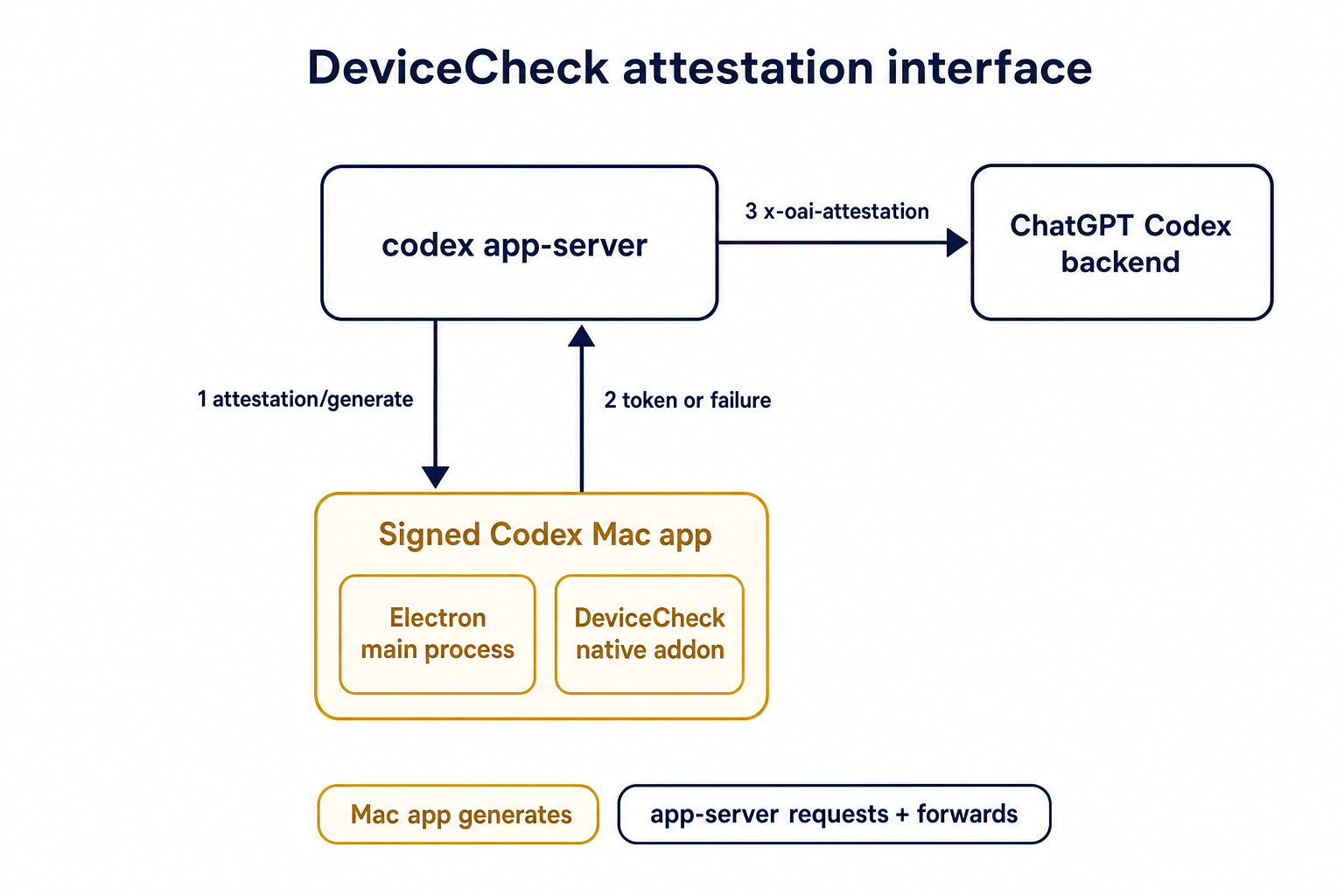
## Details
This PR teaches the Codex app-server runtime how to request and attach
an attestation token. It does not generate DeviceCheck tokens directly;
instead, it relies on the connected desktop app to advertise that it can
generate attestation and then asks that app for a fresh header value
when needed.
The flow is:
1. The Codex desktop app connects to app-server.
2. During `initialize`, the app can advertise that it supports
`requestAttestation`.
3. Before app-server calls selected ChatGPT Codex endpoints, it sends
the internal server request `attestation/generate` to the app.
4. app-server receives a pre-encoded header value back.
5. app-server forwards that value as `x-oai-attestation` on the scoped
outbound requests.
The code in this repo is mostly protocol and runtime plumbing: it adds
the app-server request/response shape, introduces an attestation
provider in core, wires that provider into Responses / compaction /
realtime setup paths, and covers the intended scoping with tests. The
signed macOS DeviceCheck generation remains owned by the desktop app PR.
## Related PR
- Codex desktop app implementation:
https://github.com/openai/openai/pull/878649
## Validation
<details>
<summary>Tests run</summary>
```sh
cargo test -p codex-app-server-protocol
cargo test -p codex-core attestation --lib
cargo test -p codex-app-server --lib attestation
```
Also ran:
```sh
just fix -p codex-core
just fix -p codex-app-server
just fix -p codex-app-server-protocol
just fmt
just write-app-server-schema
```
</details>
<details>
<summary>E2E DeviceCheck validation</summary>
First validated the signed desktop app boundary directly: launched a
packaged signed `Codex.app`, sent `attestation/generate`, decoded the
returned `v1.` attestation header, and validated the extracted
DeviceCheck token with `personal/jm/verify_devicecheck_token.py` using
bundle ID `com.openai.codex`. Apple returned `status_code: 200` and
`is_ok: true`.
Then ran the fuller app + app-server flow. The packaged `Codex.app`
launched a current-branch app-server via `CODEX_CLI_PATH`, and a local
MITM proxy intercepted outbound `chatgpt.com` traffic. The app-server
requested `attestation/generate` from the real Electron app process, and
the intercepted `/backend-api/codex/responses` traffic included
`x-oai-attestation` on both routes:
```text
GET /backend-api/codex/responses Upgrade: websocket x-oai-attestation: present
POST /backend-api/codex/responses Upgrade: none x-oai-attestation: present
```
The captured header decoded to a DeviceCheck token that also validated
with Apple for `com.openai.codex` (`status_code: 200`, `is_ok: true`,
team `2DC432GLL2`).
</details>
---------
Co-authored-by: Codex <noreply@openai.com>
## Summary

`cargo test` has entails both running standard Rust tests and doctests.
It turns out that the doctest discovery is fairly slow, and it's a cost
you pay even for crates that don't include any doctests.

This PR disables doctests with `doctest = false` for crates that lack
any doctests.

For the collection of crates below, this speeds up test execution by
>4x.

E.g., before this PR:

```
Benchmark 1: cargo test     -p codex-utils-absolute-path     -p codex-utils-cache     -p codex-utils-cli     -p codex-utils-home-dir     -p codex-utils-output-truncation     -p codex-utils-path     -p codex-utils-string     -p codex-utils-template     -p codex-utils-elapsed     -p codex-utils-json-to-toml
  Time (mean ± σ):      1.849 s ±  4.455 s    [User: 0.752 s, System: 1.367 s]
  Range (min … max):    0.418 s … 14.529 s    10 runs
```

And after:

```
Benchmark 1: cargo test     -p codex-utils-absolute-path     -p codex-utils-cache     -p codex-utils-cli     -p codex-utils-home-dir     -p codex-utils-output-truncation     -p codex-utils-path     -p codex-utils-string     -p codex-utils-template     -p codex-utils-elapsed     -p codex-utils-json-to-toml
  Time (mean ± σ):     428.6 ms ±   6.9 ms    [User: 187.7 ms, System: 219.7 ms]
  Range (min … max):   418.0 ms … 436.8 ms    10 runs
```

For a single crate, with >2x speedup, before:

```
Benchmark 1: cargo test -p codex-utils-string
  Time (mean ± σ):     491.1 ms ±   9.0 ms    [User: 229.8 ms, System: 234.9 ms]
  Range (min … max):   480.9 ms … 512.0 ms    10 runs
```

And after:

```
Benchmark 1: cargo test -p codex-utils-string
  Time (mean ± σ):     213.9 ms ±   4.3 ms    [User: 112.8 ms, System: 84.0 ms]
  Range (min … max):   206.8 ms … 221.0 ms    13 runs
```

Co-authored-by: Codex <noreply@openai.com>
## DISCLAIMER
This is experimental and no production service must rely on this

## Why

Built-in MCPs are product-owned runtime capabilities, but they were
previously flattened into the same config-backed stdio path as
user-configured servers. That made them depend on a hidden `codex
builtin-mcp` re-exec path, exposed them through config-oriented CLI
flows, and erased distinctions the runtime needs to preserve—most
notably whether an MCP call should count as external context for
memory-mode pollution.

## What changed

- Model product-owned built-ins separately from config-backed MCP
servers via `BuiltinMcpServer` and `EffectiveMcpServer`.
- Launch built-ins in process through a reusable async transport instead
of the hidden `builtin-mcp` stdio subcommand.
- Keep config-oriented CLI operations such as `codex mcp
list/get/login/logout` scoped to configured servers, while merging
built-ins only into the effective runtime server set.
- Retain server metadata after launch so parallel-tool support and
context classification come from the live server set; built-in
`memories` is now classified as local Codex state rather than external
context.

## Test plan

- `cargo test -p codex-mcp`
- `cargo test -p codex-core --test suite
builtin_memories_mcp_call_does_not_mark_thread_memory_mode_polluted_when_configured`

---------

Co-authored-by: Codex <noreply@openai.com>
## Summary

Related to
https://openai.slack.com/archives/C095U48JNL9/p1777537279707449
TLDR:
We update the meaning of session ids and thread ids:
* thread_id stays as now
* session_id become a shared id between every thread under a /root
thread (i.e. every sub-agent share the same session id)

This PR introduces an explicit `SessionId` and threads it through the
protocol/client boundary so `session_id` and `thread_id` can diverge
when they need to, while preserving compatibility for older serialized
`session_configured` events.

---------

Co-authored-by: Codex <noreply@openai.com>
## Summary
- make `thread_source` an explicit optional thread-level field on
`thread/start`, `thread/fork`, and returned thread payloads
- persist `thread_source` in rollout/session metadata so resumed live
threads retain the original value
- replace the old best-effort `session_source` -> `thread_source`
mapping with an explicit caller-supplied analytics classification

## Why
Before this change, analytics `thread_source` was populated by a
best-effort mapping from `session_source`. `session_source` describes
the runtime/client surface, not the actual thread-level origin, so that
projection was not accurate enough to distinguish cases such as `user`,
`subagent`, `memory_consolidation`, and future thread origins reliably.

Making `thread_source` explicit keeps one thread-level analytics field
while letting callers provide the real classification directly instead
of recovering it indirectly from `session_source`.

## Impact
For new analytics events, `thread_source` now reflects the explicit
thread-level classification supplied by the caller rather than an
inferred value derived from `session_source`. Existing protocol fields
remain optional; callers that omit `threadSource` now produce `null`
instead of a best-effort inferred value.

## Validation
- `just write-app-server-schema`
- `cargo test -p codex-analytics -p codex-core -p
codex-app-server-protocol --no-run`
- `cargo test -p codex-app-server-protocol
generated_ts_optional_nullable_fields_only_in_params`
- `cargo test -p codex-analytics
thread_initialized_event_serializes_expected_shape`
- `cargo test -p codex-core
resume_stopped_thread_from_rollout_preserves_thread_source`
## Why

Memory search currently treats separators literally, so callers need to
know whether a stored term uses spaces, hyphens, or no separators at
all. That makes recall brittle for terms such as `MultiAgentV2` vs.
`multi agent v2` and `cold-resume` vs. `cold resume`.

## What changed

- Add an opt-in `normalized` mode to memory search that removes
non-alphanumeric separators after any requested case folding.
- Thread the new flag through the MCP `search` tool into the local
backend while keeping existing literal matching as the default.
- Reject queries that normalize to an empty string, and add regression
coverage for both normalized matching and that validation path.

## Testing

- `cargo test -p codex-memories-mcp`
## Why

Memory search currently supports either independent substring matches or
requiring every query to appear on the same line. That is too
restrictive for memory files where related terms often land on nearby
lines in the same note or bullet block.

## What changed

- Replace the old `all` match mode with explicit tagged modes:
`all_on_same_line` and `all_within_lines { line_count }`.
- Add windowed matching in `codex-rs/memories/mcp/src/local.rs` so
callers can require every query to appear within a bounded line range
while returning only the minimal qualifying windows.
- Reject invalid zero-width windows and update the MCP tool description
plus argument parsing to expose the new mode.
- Add coverage for same-line matching, windowed matching, and invalid
`line_count` input.

## Verification

- Added targeted coverage in `codex-rs/memories/mcp/src/local_tests.rs`
for `search_supports_all_within_lines_match_mode` and
`search_rejects_zero_line_window`.
- Added server-side parsing coverage in
`codex-rs/memories/mcp/src/server.rs` for
`search_args_accept_windowed_all_match_mode`.
## Why

The local memories root can contain implementation details such as
`.git` plus incidental OS metadata like `.DS_Store`. Those entries are
not authored memory content, so the memories MCP should keep them
invisible instead of exposing them through normal discovery or direct
lookup.

Only for local implementation ofc

## What changed

- Return `NotFound` for scoped `list`, `read`, and `search` requests
that include a hidden path component.
- Skip hidden files and directories while listing a directory or
recursively searching the memories tree.
- Add regression coverage for hidden files, hidden directories, and
hidden scoped requests across `list`, `read`, and `search`.

## Testing

- Added focused regression tests in `memories/mcp/src/local_tests.rs`
covering hidden-path behavior across the affected APIs.
## Why

The local memories MCP backend only rejected symlinks after resolving
the final path. That left room for scoped requests like
`skills/secret.md` to walk through a symlinked ancestor directory and
escape the configured memories root.

This change also makes missing scoped paths fail explicitly instead of
looking like an empty `list` / `search` result or a `NotFile` read
error.

## What Changed

- walk each scoped path component in
`LocalMemoriesBackend::resolve_scoped_path` and reject symlinked
ancestors before accessing the target
- reject scoped paths that traverse through a non-directory intermediate
component
- add a `NotFound` backend error for missing `read`, `list`, and
`search` paths and map it through the MCP server error conversion
- add coverage for missing paths and symlinked ancestor directories in
`codex-rs/memories/mcp/src/local_tests.rs`

## Testing

- added unit coverage in `codex-rs/memories/mcp/src/local_tests.rs` for
missing paths and symlinked ancestor directories across `read`, `list`,
and `search`
## Why
The memories MCP `search` tool only accepts a single substring today,
which makes it hard for clients to express combined queries or explain
why a line matched. This change adds the richer search shape needed for
the next client iteration while keeping the legacy single-`query` call
working.

## What changed
- accept either the legacy `query` field or a new `queries` array, plus
`match_mode: any|all`
- teach the local memories backend to evaluate multi-query line matches
and return `matched_queries` on each hit
- update the MCP input/output schema and add coverage for parser
behavior, ordering, pagination, case sensitivity, and match modes

## Testing
- added unit coverage in `memories/mcp/src/local_tests.rs` and
`memories/mcp/src/server.rs`
## Why

The paginated memories MCP `search` tool still returned only the
matching line text, which made it harder for clients to present useful
search results or decide whether they needed to follow up with a
separate `read` call. Adding a small amount of surrounding context makes
individual hits much more usable while keeping the search response
deterministic and line-addressable.

## What changed

- add an optional `context_lines` search argument and thread it through
the MCP server into the local memories backend
- change search matches to return the matched `line_number` plus a
`start_line_number` and multi-line `content` block for the requested
context window
- update the search tool schema and description to document the new
request/response shape
- extend the local backend tests to cover zero-context matches,
contextual results, pagination, and invalid cursors that point past the
end of the result set

## Testing

- Added targeted unit coverage in `memories/mcp/src/local_tests.rs`
- GitHub Actions are running for the branch

---------

Co-authored-by: Codex <noreply@openai.com>
## Why

The memories MCP `search` tool previously stopped once it hit
`max_results`, so callers could tell there were more matches via
`truncated` but had no way to fetch the rest of the result set. That
made large searches awkward for clients that need to keep paging through
a stable, deterministic view of the matches.

## What changed

- add an optional `cursor` field to `SearchMemoriesRequest` / tool input
and return `next_cursor` in `SearchMemoriesResponse`
- update the MCP schemas and tool wiring so clients can request
subsequent pages explicitly
- change the local memories backend to collect and sort the full scoped
match list, then slice the requested page and reject invalid cursors
- add unit coverage for paginated search results and invalid cursor
handling in `memories/mcp/src/local_tests.rs`

## Testing

- Added targeted unit coverage in `memories/mcp/src/local_tests.rs`
- GitHub Actions are running for the branch
## Why
The memories MCP `list` tool should behave like a directory listing, not
a recursive tree walk. Recursive results make pagination harder to
reason about, return unexpectedly deep paths for scoped requests, and no
longer match the intended tool contract.

## What Changed
- Changed the local memories backend so `list` returns only the
immediate children of the requested path.
- Preserved file-scoped requests by returning the file itself, and
missing paths by returning an empty result.
- Updated cursor handling to paginate over the shallow sibling set and
reject cursors past the available results.
- Updated the MCP tool description to say it lists immediate files and
directories under a path.
- Reworked the local backend tests to cover shallow top-level listing,
shallow scoped listing, sibling ordering, and pagination.

## Testing
- `cargo test -p codex-memories-mcp`
## Why

Large memories trees do not fit well into a single MCP `list` response.
This change makes the memories MCP server page `list` results so callers
can continue walking the tree without overfetching or relying on
ambiguous truncation.

## What changed

- add an optional `cursor` input to the memories MCP `list` API and
return `next_cursor` alongside `truncated` in the response
- paginate recursive local-memory traversal while preserving
lexicographic path order across directories
- reject malformed and out-of-range cursors as invalid MCP requests
- update the server/schema wiring and add coverage for pagination,
ordering, and cursor validation in `memories/mcp/src/local_tests.rs`

## Testing

- `cargo test -p codex-memories-mcp`
## Why

The memories MCP `read` tool already supports `line_offset`, but it
cannot return a bounded line range. That makes it awkward to page
through large memory files or request a small slice without relying on
token truncation.

## What changed

- add an optional `max_lines` parameter to the memories MCP `read` tool
schema and request parsing
- cap local backend reads to the requested number of lines before token
truncation
- treat `max_lines = 0` as an invalid request and surface it as
`invalid_params`
- add backend tests for bounded reads and invalid line request
validation

## Testing

- added coverage in `memories/mcp/src/local_tests.rs` for `max_lines`
reads and invalid `max_lines` / `line_offset` requests
## Why

Memory clients sometimes need to continue reading a file from a known
line instead of starting over from the top. Adding a line offset to the
`read` MCP keeps that resume logic simple and avoids re-reading
already-consumed content.

## What changed

- Added an optional `line_offset` argument to the memory `read` tool,
defaulting to `1`.
- Read content starting at the requested 1-indexed line before token
truncation, and return `start_line_number` in the response.
- Treat invalid offsets as invalid params errors and cover the new
behavior in `codex-rs/memories/mcp/src/local_tests.rs`.

## Testing

- Added unit tests for reading from a non-default starting line.
- Added unit tests for rejecting `0` and past-end line offsets.

 Owen LinandGitHub
 charlesgong-openaiandGitHub
 pakrym-oaiandGitHub
 Adam Perry @ OpenAIandGitHub
 jifandGitHub
 Celia ChenandGitHub
 Ahmed IbrahimandGitHub
 efrazer-oaiandGitHub
 ningyi-oaiandGitHub
 Eric TrautandGitHub


 rhan-oaiandGitHub
