Problem: TUI desktop notifications are hard-gated on terminal focus, so
terminal/IDE hosts that want in-focus notifications cannot opt in.

Solution: Add a flat `[tui] notification_condition` setting (`unfocused`
by default, `always` opt-in), carry grouped TUI notification settings
through runtime config, apply method + condition together in the TUI,
and regenerate the config schema.
When running with remote executor the cwd is the remote path. Today we
check for existence of a local directory on startup and attempt to load
config from it.

For remote executors don't do that.
Addresses #3793

Problem: /status only reported project-level AGENTS files, so sessions
with a loaded global $CODEX_HOME/AGENTS.md still showed Agents.md as
<none>.

Solution: Track the global instructions file loaded during config
initialization and prepend that path to the /status Agents.md summary,
with coverage for AGENTS.md, AGENTS.override.md, and global-plus-project
ordering.
Allow multi_agent_v2 features to have its own temporary configuration
under `[features.multi_agent_v2]`

```
[features.multi_agent_v2]
enabled = true
usage_hint_enabled = false
usage_hint_text = "Custom delegation guidance."
hide_spawn_agent_metadata = true
```

Absent `usage_hint_text` means use the default hint.

```
[features]
multi_agent_v2 = true
```

still works as the boolean shorthand.
## Summary

Fix network proxy sessions so changing sandbox mode recomputes the
effective managed network policy and applies it to the already-running
per-session proxy.

## Root Cause

`danger_full_access_denylist_only` injects `"*"` only while building the
proxy spec for Full Access. Sessions built that spec once at startup, so
a later permission switch to Full Access left the live proxy in its
original restricted policy. Switching back needed the same recompute
path to remove the synthetic wildcard again.

## What Changed

- Preserve the original managed network proxy config/requirements so the
effective spec can be recomputed for a new sandbox policy.
- Refresh the current session proxy when sandbox settings change, then
reapply exec-policy network overlays.
- Add an in-place proxy state update path while rejecting
listener/port/SOCKS changes that cannot be hot-reloaded.
- Keep runtime proxy settings cheap to snapshot and update.
- Add regression coverage for workspace-write -> Full Access ->
workspace-write.
## Summary
- reduce public module visibility across Rust crates, preferring private
or crate-private modules with explicit crate-root public exports
- update external call sites and tests to use the intended public crate
APIs instead of reaching through module trees
- add the module visibility guideline to AGENTS.md

## Validation
- `cargo check --workspace --all-targets --message-format=short` passed
before the final fix/format pass
- `just fix` completed successfully
- `just fmt` completed successfully
- `git diff --check` passed
## Summary

This adds `experimental_network.danger_full_access_denylist_only` for
orgs that want yolo / danger-full-access sessions to keep full network
access while still enforcing centrally managed deny rules.

When the flag is true and the session sandbox is `danger-full-access`,
the network proxy starts with:

- domain allowlist set to `*`
- managed domain `deny` entries enforced
- upstream proxy use allowed
- all Unix sockets allowed
- local/private binding allowed

Caveat: the denylist is best effort only. In yolo / danger-full-access
mode, Codex or the model can use an allowed socket or other
local/private network path to bypass the proxy denylist, so this should
not be treated as a hard security boundary.

The flag is intentionally scoped to `SandboxPolicy::DangerFullAccess`.
Read-only and workspace-write modes keep the existing managed/user
allowlist, denylist, Unix socket, and local-binding behavior. This does
not enable the non-loopback proxy listener setting; that still requires
its own explicit config.

This also threads the new field through config requirements parsing,
app-server protocol/schema output, config API mapping, and the TUI debug
config output.

## How to use

Add the flag under `[experimental_network]` in the network policy config
that is delivered to Codex. The setting is not under `[permissions]`.

```toml
[experimental_network]
enabled = true
danger_full_access_denylist_only = true

[experimental_network.domains]
"blocked.example.com" = "deny"
"*.blocked.example.com" = "deny"
```

With that configuration, yolo / danger-full-access sessions get broad
network access except for the managed denied domains above. The denylist
remains a best-effort proxy policy because the session may still use
allowed sockets to bypass it. Other sandbox modes do not get the
wildcard domain allowlist or the socket/local-binding relaxations from
this flag.

## Verification

- `cargo test -p codex-config network_requirements`
- `cargo test -p codex-core network_proxy_spec`
- `cargo test -p codex-app-server map_requirements_toml_to_api`
- `cargo test -p codex-tui debug_config_output`
- `cargo test -p codex-app-server-protocol`
- `just write-app-server-schema`
- `just fmt`
- `just fix -p codex-config -p codex-core -p codex-app-server-protocol
-p codex-app-server -p codex-tui`
- `just fix -p codex-core -p codex-config`
- `git diff --check`
- `cargo clean`
Extract a shared helper that builds AuthManager from Config and applies
the forced ChatGPT workspace override in one place.

Create the shared AuthManager at MessageProcessor call sites so that
upcoming new transport's initialization can reuse the same handle, and
keep only external auth refresher wiring inside `MessageProcessor`.

Remove the now-unused `AuthManager::shared_with_external_auth` helper.
## Description

Add requirements.toml support for `allowed_approvals_reviewers =
["user", "guardian_subagent"]`, so admins can now restrict the use of
guardian mode.

Note: If a user sets a reviewer that isn’t allowed by requirements.toml,
config loading falls back to the first allowed reviewer and emits a
startup warning.

The table below describes the possible admin controls.
| Admin intent | `requirements.toml` | User `config.toml` | End result |
|---|---|---|---|
| Leave Guardian optional | omit `allowed_approvals_reviewers` or set
`["user", "guardian_subagent"]` | user chooses `approvals_reviewer =
"user"` or `"guardian_subagent"` | Guardian off for `user`, on for
`guardian_subagent` + `approval_policy = "on-request"` |
| Force Guardian off | `allowed_approvals_reviewers = ["user"]` | any
user value | Effective reviewer is `user`; Guardian off |
| Force Guardian on | `allowed_approvals_reviewers =
["guardian_subagent"]` and usually `allowed_approval_policies =
["on-request"]` | any user reviewer value; user should also have
`approval_policy = "on-request"` unless policy is forced | Effective
reviewer is `guardian_subagent`; Guardian on when effective approval
policy is `on-request` |
| Allow both, but default to manual if user does nothing |
`allowed_approvals_reviewers = ["user", "guardian_subagent"]` | omit
`approvals_reviewer` | Effective reviewer is `user`; Guardian off |
| Allow both, and user explicitly opts into Guardian |
`allowed_approvals_reviewers = ["user", "guardian_subagent"]` |
`approvals_reviewer = "guardian_subagent"` and `approval_policy =
"on-request"` | Guardian on |
| Invalid admin config | `allowed_approvals_reviewers = []` | anything |
Config load error |
This adds an `include_environment_context` config/profile flag that
defaults on, and guards both initial injection and later environment
updates to allow skipping injection of `<environment_context>`.
This PR adds root and profile config switches to omit the generated
`<permissions instructions>` and `<apps_instructions>` prompt blocks
while keeping both enabled by default, and it gates both the initial
developer-context injection and later permissions diff injection so
turning the permissions block off stays effective across turn-context
overrides.

Also added a prompt debug tool that can be used as `codex debug
prompt-input "hello"` and dumps the constructed items list.
The `OPENAI_BASE_URL` environment variable has been a significant
support issue, so we decided to deprecate it in favor of an
`openai_base_url` config key. We've had the deprecation warning in place
for about a month, so users have had time to migrate to the new
mechanism. This PR removes support for `OPENAI_BASE_URL` entirely.
## Why

Extracted from [#16528](https://github.com/openai/codex/pull/16528) so
the Windows Bazel app-server test failures can be reviewed independently
from the rest of that PR.

This PR targets:

-
`suite::v2::thread_shell_command::thread_shell_command_runs_as_standalone_turn_and_persists_history`
-
`suite::v2::thread_start::thread_start_with_elevated_sandbox_trusts_project_and_followup_loads_project_config`
-
`suite::v2::thread_start::thread_start_with_nested_git_cwd_trusts_repo_root`

There were two Windows-specific assumptions baked into those tests and
the underlying trust lookup:

- project trust keys were persisted and looked up using raw path
strings, but Bazel's Windows test environment can surface canonicalized
paths with `\\?\` / UNC prefixes or normalized symlink/junction targets,
so follow-up `thread/start` requests no longer matched the project entry
that had just been written
- `item/commandExecution/outputDelta` assertions compared exact trailing
line endings even though shell output chunk boundaries and CRLF handling
can differ on Windows, and Bazel made that timing-sensitive mismatch
visible

There was also one behavior bug separate from the assertion cleanup:
`thread/start` decided whether to persist trust from the final resolved
sandbox policy, but on Windows an explicit `workspace-write` request may
be downgraded to `read-only`. That incorrectly skipped writing trust
even though the request had asked to elevate the project, so the new
logic also keys off the requested sandbox mode.

## What

- Canonicalize project trust keys when persisting/loading `[projects]`
entries, while still accepting legacy raw keys for existing configs.
- Persist project trust when `thread/start` explicitly requests
`workspace-write` or `danger-full-access`, even if the resolved policy
is later downgraded on Windows.
- Make the Windows app-server tests compare persisted trust paths and
command output deltas in a path/newline-normalized way.

## Verification

- Existing app-server v2 tests cover the three failing Windows Bazel
cases above.
Stacked on #16508.

This removes the temporary `codex-core` / `codex-login` re-export shims
from the ownership split and rewrites callsites to import directly from
`codex-model-provider-info`, `codex-models-manager`, `codex-api`,
`codex-protocol`, `codex-feedback`, and `codex-response-debug-context`.

No behavior change intended; this is the mechanical import cleanup layer
split out from the ownership move.

---------

Co-authored-by: Codex <noreply@openai.com>
## Summary
- split `models-manager` out of `core` and add `ModelsManagerConfig`
plus `Config::to_models_manager_config()` so model metadata paths stop
depending on `core::Config`
- move login-owned/auth-owned code out of `core` into `codex-login`,
move model provider config into `codex-model-provider-info`, move API
bridge mapping into `codex-api`, move protocol-owned types/impls into
`codex-protocol`, and move response debug helpers into a dedicated
`response-debug-context` crate
- move feedback tag emission into `codex-feedback`, relocate tests to
the crates that now own the code, and keep broad temporary re-exports so
this PR avoids a giant import-only rewrite

## Major moves and decisions
- created `codex-models-manager` as the owner for model
cache/catalog/config/model info logic, including the new
`ModelsManagerConfig` struct
- created `codex-model-provider-info` as the owner for provider config
parsing/defaults and kept temporary `codex-login`/`codex-core`
re-exports for old import paths
- moved `api_bridge` error mapping + `CoreAuthProvider` into
`codex-api`, while `codex-login::api_bridge` temporarily re-exports
those symbols and keeps the `auth_provider_from_auth` wrapper
- moved `auth_env_telemetry` and `provider_auth` ownership to
`codex-login`
- moved `CodexErr` ownership to `codex-protocol::error`, plus
`StreamOutput`, `bytes_to_string_smart`, and network policy helpers to
protocol-owned modules
- created `codex-response-debug-context` for
`extract_response_debug_context`, `telemetry_transport_error_message`,
and related response-debug plumbing instead of leaving that behavior in
`core`
- moved `FeedbackRequestTags`, `emit_feedback_request_tags`, and
`emit_feedback_request_tags_with_auth_env` to `codex-feedback`
- deferred removal of temporary re-exports and the mechanical import
rewrites to a stacked follow-up PR so this PR stays reviewable

## Test moves
- moved auth refresh coverage from `core/tests/suite/auth_refresh.rs` to
`login/tests/suite/auth_refresh.rs`
- moved text encoding coverage from
`core/tests/suite/text_encoding_fix.rs` to
`protocol/src/exec_output_tests.rs`
- moved model info override coverage from
`core/tests/suite/model_info_overrides.rs` to
`models-manager/src/model_info_overrides_tests.rs`

---------

Co-authored-by: Codex <noreply@openai.com>
## Why

This finishes the config-type move out of `codex-core` by removing the
temporary compatibility shim in `codex_core::config::types`. Callers now
depend on `codex-config` directly, which keeps these config model types
owned by the config crate instead of re-expanding `codex-core` as a
transitive API surface.

## What Changed

- Removed the `codex-rs/core/src/config/types.rs` re-export shim and the
`core::config::ApprovalsReviewer` re-export.
- Updated `codex-core`, `codex-cli`, `codex-tui`, `codex-app-server`,
`codex-mcp-server`, and `codex-linux-sandbox` call sites to import
`codex_config::types` directly.
- Added explicit `codex-config` dependencies to downstream crates that
previously relied on the `codex-core` re-export.
- Regenerated `codex-rs/core/config.schema.json` after updating the
config docs path reference.
## Why

`codex-rs/core/src/config/types.rs` is a plain config-type module with
no dependency on `codex-core`. Moving it into `codex-config` shrinks the
core crate and gives config-only consumers a more natural dependency
boundary.

## What Changed

- Added `codex_config::types` with the moved structs, enums, constants,
and unit tests.
- Kept `codex_core::config::types` as a compatibility re-export to avoid
a broad call-site migration in this PR.
- Switched notice-table writes in `core/src/config/edit.rs` to a local
`NOTICE_TABLE_KEY` constant.
- Added the `wildmatch` runtime dependency and `tempfile` test
dependency to `codex-config`.
## Why

`codex-core` was re-exporting APIs owned by sibling `codex-*` crates,
which made downstream crates depend on `codex-core` as a proxy module
instead of the actual owner crate.

Removing those forwards makes crate boundaries explicit and lets leaf
crates drop unnecessary `codex-core` dependencies. In this PR, this
reduces the dependency on `codex-core` to `codex-login` in the following
files:

```
codex-rs/backend-client/Cargo.toml
codex-rs/mcp-server/tests/common/Cargo.toml
```

## What

- Remove `codex-rs/core/src/lib.rs` re-exports for symbols owned by
`codex-login`, `codex-mcp`, `codex-rollout`, `codex-analytics`,
`codex-protocol`, `codex-shell-command`, `codex-sandboxing`,
`codex-tools`, and `codex-utils-path`.
- Delete the `default_client` forwarding shim in `codex-rs/core`.
- Update in-crate and downstream callsites to import directly from the
owning `codex-*` crate.
- Add direct Cargo dependencies where callsites now target the owner
crate, and remove `codex-core` from `codex-rs/backend-client`.
- Split MCP runtime/server code out of `codex-core` into the new
`codex-mcp` crate. New/moved public structs/types include `McpConfig`,
`McpConnectionManager`, `ToolInfo`, `ToolPluginProvenance`,
`CodexAppsToolsCacheKey`, and the `McpManager` API
(`codex_mcp::mcp::McpManager` plus the `codex_core::mcp::McpManager`
wrapper/shim). New/moved functions include `with_codex_apps_mcp`,
`configured_mcp_servers`, `effective_mcp_servers`,
`collect_mcp_snapshot`, `collect_mcp_snapshot_from_manager`,
`qualified_mcp_tool_name_prefix`, and the MCP auth/skill-dependency
helpers. Why: this creates a focused MCP crate boundary and shrinks
`codex-core` without forcing every consumer to migrate in the same PR.

- Move MCP server config schema and persistence into `codex-config`.
New/moved structs/enums include `AppToolApproval`,
`McpServerToolConfig`, `McpServerConfig`, `RawMcpServerConfig`,
`McpServerTransportConfig`, `McpServerDisabledReason`, and
`codex_config::ConfigEditsBuilder`. New/moved functions include
`load_global_mcp_servers` and
`ConfigEditsBuilder::replace_mcp_servers`/`apply`. Why: MCP TOML
parsing/editing is config ownership, and this keeps config
validation/round-tripping (including per-tool approval overrides and
inline bearer-token rejection) in the config crate instead of
`codex-core`.

- Rewire `codex-core`, app-server, and plugin call sites onto the new
crates. Updated `Config::to_mcp_config(&self, plugins_manager)`,
`codex-rs/core/src/mcp.rs`, `codex-rs/core/src/connectors.rs`,
`codex-rs/core/src/codex.rs`,
`CodexMessageProcessor::list_mcp_server_status_task`, and
`utils/plugins/src/mcp_connector.rs` to build/pass the new MCP
config/runtime types. Why: plugin-provided MCP servers still merge with
user-configured servers, and runtime auth (`CodexAuth`) is threaded into
`with_codex_apps_mcp` / `collect_mcp_snapshot` explicitly so `McpConfig`
stays config-only.
Problem: `chatwidget/tests.rs` had grown into a single oversized test
blob that was hard to maintain and exceeded the repo's blob size limit.

Solution: split the chatwidget tests into topical modules with a thin
root `tests.rs`, shared helper utilities, preserved snapshot naming, and
hermetic test config so the refactor stays stable and passes the
`codex-tui` test suite.
## Summary
Fixes#15189.
Custom model providers that set `requires_openai_auth = false` could
only use static credentials via `env_key` or
`experimental_bearer_token`. That is not enough for providers that mint
short-lived bearer tokens, because Codex had no way to run a command to
obtain a bearer token, cache it briefly in memory, and retry with a
refreshed token after a `401`.
This PR adds that provider config and wires it through the existing auth
design: request paths still go through `AuthManager.auth()` and
`UnauthorizedRecovery`, with `core` only choosing when to use a
provider-backed bearer-only `AuthManager`.
## Scope
To keep this PR reviewable, `/models` only uses provider auth for the
initial request in this change. It does **not** add a dedicated `401`
retry path for `/models`; that can be follow-up work if we still need it
after landing the main provider-token support.
## Example Usage
```toml
model_provider = "corp-openai"
[model_providers.corp-openai]
name = "Corp OpenAI"
base_url = "https://gateway.example.com/openai"
requires_openai_auth = false
[model_providers.corp-openai.auth]
command = "gcloud"
args = ["auth", "print-access-token"]
timeout_ms = 5000
refresh_interval_ms = 300000
```
The command contract is intentionally small:
- write the bearer token to `stdout`
- exit `0`
- any leading or trailing whitespace is trimmed before the token is used
## What Changed
- add `model_providers.<id>.auth` to the config model and generated
schema
- validate that command-backed provider auth is mutually exclusive with
`env_key`, `experimental_bearer_token`, and `requires_openai_auth`
- build a bearer-only `AuthManager` for `ModelClient` and
`ModelsManager` when a provider configures `auth`
- let normal Responses requests and realtime websocket connects use the
provider-backed bearer source through the same `AuthManager.auth()` path
- allow `/models` online refresh for command-auth providers and attach
the provider token to the initial `/models` request
- keep `auth.cwd` available as an advanced escape hatch and include it
in the generated config schema
## Testing
- `cargo test -p codex-core provider_auth_command`
- `cargo test -p codex-core
refresh_available_models_uses_provider_auth_token`
- `cargo test -p codex-core
test_deserialize_provider_auth_config_defaults`
## Docs
- `developers.openai.com/codex` should document the new
`[model_providers.<id>.auth]` block and the token-command contract
## Why

`argument-comment-lint` was green in CI even though the repo still had
many uncommented literal arguments. The main gap was target coverage:
the repo wrapper did not force Cargo to inspect test-only call sites, so
examples like the `latest_session_lookup_params(true, ...)` tests in
`codex-rs/tui_app_server/src/lib.rs` never entered the blocking CI path.

This change cleans up the existing backlog, makes the default repo lint
path cover all Cargo targets, and starts rolling that stricter CI
enforcement out on the platform where it is currently validated.

## What changed

- mechanically fixed existing `argument-comment-lint` violations across
the `codex-rs` workspace, including tests, examples, and benches
- updated `tools/argument-comment-lint/run-prebuilt-linter.sh` and
`tools/argument-comment-lint/run.sh` so non-`--fix` runs default to
`--all-targets` unless the caller explicitly narrows the target set
- fixed both wrappers so forwarded cargo arguments after `--` are
preserved with a single separator
- documented the new default behavior in
`tools/argument-comment-lint/README.md`
- updated `rust-ci` so the macOS lint lane keeps the plain wrapper
invocation and therefore enforces `--all-targets`, while Linux and
Windows temporarily pass `-- --lib --bins`

That temporary CI split keeps the stricter all-targets check where it is
already cleaned up, while leaving room to finish the remaining Linux-
and Windows-specific target-gated cleanup before enabling
`--all-targets` on those runners. The Linux and Windows failures on the
intermediate revision were caused by the wrapper forwarding bug, not by
additional lint findings in those lanes.

## Validation

- `bash -n tools/argument-comment-lint/run.sh`
- `bash -n tools/argument-comment-lint/run-prebuilt-linter.sh`
- shell-level wrapper forwarding check for `-- --lib --bins`
- shell-level wrapper forwarding check for `-- --tests`
- `just argument-comment-lint`
- `cargo test` in `tools/argument-comment-lint`
- `cargo test -p codex-terminal-detection`

## Follow-up

- Clean up remaining Linux-only target-gated callsites, then switch the
Linux lint lane back to the plain wrapper invocation.
- Clean up remaining Windows-only target-gated callsites, then switch
the Windows lint lane back to the plain wrapper invocation.
## Summary

This PR replaces the legacy network allow/deny list model with explicit
rule maps for domains and unix sockets across managed requirements,
permissions profiles, the network proxy config, and the app server
protocol.

Concretely, it:

- introduces typed domain (`allow` / `deny`) and unix socket permission
(`allow` / `none`) entries instead of separate `allowed_domains`,
`denied_domains`, and `allow_unix_sockets` lists
- updates config loading, managed requirements merging, and exec-policy
overlays to read and upsert rule entries consistently
- exposes the new shape through protocol/schema outputs, debug surfaces,
and app-server config APIs
- rejects the legacy list-based keys and updates docs/tests to reflect
the new config format

## Why

The previous representation split related network policy across multiple
parallel lists, which made merging and overriding rules harder to reason
about. Moving to explicit keyed permission maps gives us a single source
of truth per host/socket entry, makes allow/deny precedence clearer, and
gives protocol consumers access to the full rule state instead of
derived projections only.

## Backward Compatibility

### Backward compatible

- Managed requirements still accept the legacy
`experimental_network.allowed_domains`,
`experimental_network.denied_domains`, and
`experimental_network.allow_unix_sockets` fields. They are normalized
into the new canonical `domains` and `unix_sockets` maps internally.
- App-server v2 still deserializes legacy `allowedDomains`,
`deniedDomains`, and `allowUnixSockets` payloads, so older clients can
continue reading managed network requirements.
- App-server v2 responses still populate `allowedDomains`,
`deniedDomains`, and `allowUnixSockets` as legacy compatibility views
derived from the canonical maps.
- `managed_allowed_domains_only` keeps the same behavior after
normalization. Legacy managed allowlists still participate in the same
enforcement path as canonical `domains` entries.

### Not backward compatible

- Permissions profiles under `[permissions.<profile>.network]` no longer
accept the legacy list-based keys. Those configs must use the canonical
`[domains]` and `[unix_sockets]` tables instead of `allowed_domains`,
`denied_domains`, or `allow_unix_sockets`.
- Managed `experimental_network` config cannot mix canonical and legacy
forms in the same block. For example, `domains` cannot be combined with
`allowed_domains` or `denied_domains`, and `unix_sockets` cannot be
combined with `allow_unix_sockets`.
- The canonical format can express explicit `"none"` entries for unix
sockets, but those entries do not round-trip through the legacy
compatibility fields because the legacy fields only represent allow/deny
lists.
## Testing
`/target/debug/codex sandbox macos --log-denials /bin/zsh -c 'curl
https://www.example.com' ` gives 200 with config
```
[permissions.workspace.network.domains]
"www.example.com" = "allow"
```
and fails when set to deny: `curl: (56) CONNECT tunnel failed, response
403`.

Also tested backward compatibility path by verifying that adding the
following to `/etc/codex/requirements.toml` works:
```
[experimental_network]
allowed_domains = ["www.example.com"]
```
## Why

`PermissionProfile` should only describe the per-command permissions we
still want to grant dynamically. Keeping
`MacOsSeatbeltProfileExtensions` in that surface forced extra macOS-only
approval, protocol, schema, and TUI branches for a capability we no
longer want to expose.

## What changed

- Removed the macOS-specific permission-profile types from
`codex-protocol`, the app-server v2 API, and the generated
schema/TypeScript artifacts.
- Deleted the core and sandboxing plumbing that threaded
`MacOsSeatbeltProfileExtensions` through execution requests and seatbelt
construction.
- Simplified macOS seatbelt generation so it always includes the fixed
read-only preferences allowlist instead of carrying a configurable
profile extension.
- Removed the macOS additional-permissions UI/docs/test coverage and
deleted the obsolete macOS permission modules.
- Tightened `request_permissions` intersection handling so explicitly
empty requested read lists are preserved only when that field was
actually granted, avoiding zero-grant responses being stored as active
permissions.
## Summary
- move the bwrap PATH lookup and warning helpers out of config/mod.rs
- move the related tests into a dedicated bwrap_tests.rs file

## Validation
- git diff --check
- skipped heavier local tests per request

Follow-up to #15791.
## Summary
- resolve system bwrap from PATH instead of hardcoding /usr/bin/bwrap
- skip PATH entries that resolve inside the current workspace before
launching the sandbox helper
- keep the vendored bubblewrap fallback when no trusted system bwrap is
found

## Validation
- cargo test -p codex-core bwrap --lib
- cargo test -p codex-linux-sandbox
- just fix -p codex-core
- just fix -p codex-linux-sandbox
- just fmt
- just argument-comment-lint
- cargo clean
Fixes#15283.
## Summary
Older system bubblewrap builds reject `--argv0`, which makes our Linux
sandbox fail before the helper can re-exec. This PR keeps using system
`/usr/bin/bwrap` whenever it exists and only falls back to vendored
bwrap when the system binary is missing. That matters on stricter
AppArmor hosts, where the distro bwrap package also provides the policy
setup needed for user namespaces.
For old system bwrap, we avoid `--argv0` instead of switching binaries:
- pass the sandbox helper a full-path `argv0`,
- keep the existing `current_exe() + --argv0` path when the selected
launcher supports it,
- otherwise omit `--argv0` and re-exec through the helper's own
`argv[0]` path, whose basename still dispatches as
`codex-linux-sandbox`.
Also updates the launcher/warning tests and docs so they match the new
behavior: present-but-old system bwrap uses the compatibility path, and
only absent system bwrap falls back to vendored.
### Validation
1. Install Ubuntu 20.04 in a VM
2. Compile codex and run without bubblewrap installed - see a warning
about falling back to the vendored bwrap
3. Install bwrap and verify version is 0.4.0 without `argv0` support
4. run codex and use apply_patch tool without errors
<img width="802" height="631" alt="Screenshot 2026-03-25 at 11 48 36 PM"
src="https://github.com/user-attachments/assets/77248a29-aa38-4d7c-9833-496ec6a458b8"
/>
<img width="807" height="634" alt="Screenshot 2026-03-25 at 11 47 32 PM"
src="https://github.com/user-attachments/assets/5af8b850-a466-489b-95a6-455b76b5050f"
/>
<img width="812" height="635" alt="Screenshot 2026-03-25 at 11 45 45 PM"
src="https://github.com/user-attachments/assets/438074f0-8435-4274-a667-332efdd5cb57"
/>
<img width="801" height="623" alt="Screenshot 2026-03-25 at 11 43 56 PM"
src="https://github.com/user-attachments/assets/0dc8d3f5-e8cf-4218-b4b4-a4f7d9bf02e3"
/>
---------
Co-authored-by: Michael Bolin <mbolin@openai.com>
Add environment manager that is a singleton and is created early in
app-server (before skill manager, before config loading).

Use an environment variable to point to a running exec server.
## Summary
- move skill loading and management into codex-core-skills
- leave codex-core with the thin integration layer and shared wiring

## Testing
- CI

---------

Co-authored-by: Codex <noreply@openai.com>
Migrate `cwd` and related session/config state to `AbsolutePathBuf` so
downstream consumers consistently see absolute working directories.

Add test-only `.abs()` helpers for `Path`, `PathBuf`, and `TempDir`, and
update branch-local tests to use them instead of
`AbsolutePathBuf::try_from(...)`.

For the remaining TUI/app-server snapshot coverage that renders absolute
cwd values, keep the snapshots unchanged and skip the Windows-only cases
where the platform-specific absolute path layout differs.
- create `codex-git-utils` and move the shared git helpers into it with
file moves preserved for diff readability
- move the `GitInfo` helpers out of `core` so stacked rollout work can
depend on the shared crate without carrying its own git info module

---------

Co-authored-by: Ahmed Ibrahim <219906144+aibrahim-oai@users.noreply.github.com>
Co-authored-by: Codex <noreply@openai.com>
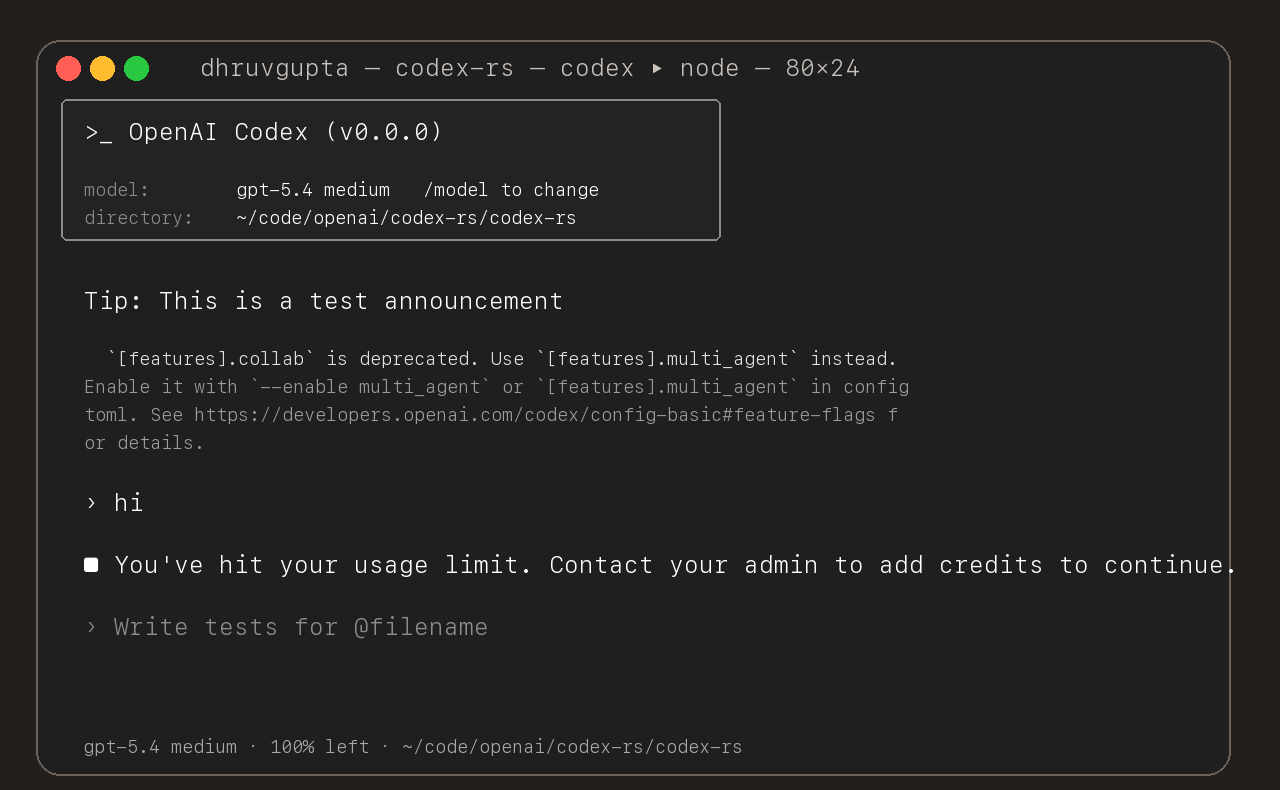
## Summary
- update the self-serve business usage-based limit message to direct
users to their admin for additional credits
- add a focused unit test for the self_serve_business_usage_based plan
branch
Added also:
If you are at a rate limit but you still have credits, codex cli would
tell you to switch the model. We shouldnt do this if you have credits so
fixed this.
## Test
- launched the source-built CLI and verified the updated message is
shown for the self-serve business usage-based plan
## Why

Fixes [#15283](https://github.com/openai/codex/issues/15283), where
sandboxed tool calls fail on older distro `bubblewrap` builds because
`/usr/bin/bwrap` does not understand `--argv0`. The upstream [bubblewrap
v0.9.0 release
notes](https://github.com/containers/bubblewrap/releases/tag/v0.9.0)
explicitly call out `Add --argv0`. Flipping `use_legacy_landlock`
globally works around that compatibility bug, but it also weakens the
default Linux sandbox and breaks proxy-routed and split-policy cases
called out in review.

The follow-up Linux CI failure was in the new launcher test rather than
the launcher logic: the fake `bwrap` helper stayed open for writing, so
Linux would not exec it. This update also closes the user-visibility gap
from review by surfacing the same startup warning when `/usr/bin/bwrap`
is present but too old for `--argv0`, not only when it is missing.

## What Changed

- keep `use_legacy_landlock` default-disabled
- teach `codex-rs/linux-sandbox/src/launcher.rs` to fall back to the
vendored bubblewrap build when `/usr/bin/bwrap` does not advertise
`--argv0` support
- add launcher tests for supported, unsupported, and missing system
`bwrap`
- write the fake `bwrap` test helper to a closed temp path so the
supported-path launcher test works on Linux too
- extend the startup warning path so Codex warns when `/usr/bin/bwrap`
is missing or too old to support `--argv0`
- mirror the warning/fallback wording across
`codex-rs/linux-sandbox/README.md` and `codex-rs/core/README.md`,
including that the fallback is the vendored bubblewrap compiled into the
binary
- cite the upstream `bubblewrap` release that introduced `--argv0`

## Verification

- `bazel test --config=remote --platforms=//:rbe
//codex-rs/linux-sandbox:linux-sandbox-unit-tests
--test_filter=launcher::tests::prefers_system_bwrap_when_help_lists_argv0
--test_output=errors`
- `cargo test -p codex-core system_bwrap_warning`
- `cargo check -p codex-exec -p codex-tui -p codex-tui-app-server -p
codex-app-server`
- `just argument-comment-lint`
Remove the legacy `smart_approvals` config migration from core config
loading.

This change:
- stops rewriting `smart_approvals` into `guardian_approval`
- stops backfilling `approvals_reviewer = "guardian_subagent"`
- replaces the migration tests with regression coverage that asserts the
deprecated key is ignored in root and profile scopes

Verification:
- `just fmt`
- `cargo test -p codex-core smart_approvals_alias_is_ignored`
- `cargo test -p codex-core approvals_reviewer_`
- `just argument-comment-lint`

Notes:
- `cargo test -p codex-core` still hits an unrelated existing failure in
`tools::js_repl::tests::js_repl_imported_local_files_can_access_repl_globals`;
the JS REPL kernel exits after `mktemp` fails under the current
environment.

Enhancement request: requested cleanup to delete the `smart_approvals`
alias migration; no public issue link is available.

Co-authored-by: Codex <noreply@openai.com>
## Summary

This PR fixes restricted filesystem permission profiles so Codex's
runtime-managed helper executables remain readable without requiring
explicit user configuration.

- add implicit readable roots for the configured `zsh` helper path and
the main execve wrapper
- allowlist the shared `$CODEX_HOME/tmp/arg0` root when the execve
wrapper lives there, so session-specific helper paths keep working
- dedupe injected paths and avoid adding duplicate read entries to the
sandbox policy
- add regression coverage for restricted read mode with helper
executable overrides

## Testing
before this change: got this error when executing a shell command via
zsh fork:
```
"sandbox error: sandbox denied exec error, exit code: 127, stdout: , stderr: /etc/zprofile:11: operation not permitted: /usr/libexec/path_helper\nzsh:1: operation not permitted: .codex/skills/proxy-a/scripts/fetch_example.sh\n"
```

saw this change went away after this change, meaning the readable roots
and injected correctly.
- Split the feature system into a new `codex-features` crate.
- Cut `codex-core` and workspace consumers over to the new config and
warning APIs.

Co-authored-by: Ahmed Ibrahim <219906144+aibrahim-oai@users.noreply.github.com>
Co-authored-by: Codex <noreply@openai.com>

 Eric TrautandGitHub
 Ahmed IbrahimandGitHub


 pakrym-oaiandGitHub

 viyatb-oaiandGitHub
 Dylan HurdandGitHub
 Ruslan NigmatullinandGitHub
 Owen LinandGitHub
 Thibault SottiauxandGitHub
 Michael BolinandGitHub
 Celia ChenandGitHub
 Matthew ZengandGitHub
 jif-oaiandGitHub


 dhruvgupta-oaiandGitHub
 xl-openaiandGitHub

