mirror of
https://github.com/pchuan98/codex.git
synced 2026-07-01 00:31:56 +08:00
6b4b15a1ed2271c2b35d7e73bdf532cf11e33388
102 Commits
-
Add forked_from_thread_id turn metadata (#24160)
## Why When Codex calls responsesapi, we currently send `session_id`, `thread_id`, and `turn_id` among other things as `client_metadata["x-codex-turn-metadata"]`. This PR adds `forked_from_thread_id` which helps explain the "lineage" of a forked thread. ## What's changed - Track the immediate history source copied into a forked thread through thread/session creation, including subagent and review turn metadata paths. - Include `forked_from_thread_id` in Codex turn metadata while preventing turn-scoped Responses API client metadata from overwriting Codex-owned lineage fields. - Add coverage for fork lineage in turn metadata and the app-server Responses API request path.
Owen Lin ·
2026-05-26 14:05:28 -07:00 -
Avoid config snapshots in live agent subtree traversal (#24057)
## Why `/feedback` asks `ThreadManager` for the selected agent subtree before it uploads logs. The previous live subtree path reconstructed parent-child links by iterating every loaded thread and awaiting each thread config snapshot, so unrelated loaded-thread state could stall feedback subtree enumeration. The loaded-thread set already belongs to [`ThreadManagerState`](https://github.com/openai/codex/blob/50e6644c9425df2dcbfe52f65fd60bd7f15a8ea2/codex-rs/core/src/thread_manager.rs). Reading thread-spawn parents from the captured `CodexThread` session sources at that boundary keeps unload and resume behavior manager-owned while avoiding per-session config inspection. ## What Changed - expose parent-child thread-spawn edges for loaded, non-internal threads from `ThreadManagerState` - build the live child map from those edges while keeping agent metadata lookup and ordering in `AgentControl` - add regression coverage for live subtree enumeration when no state DB is available ## Validation - `git diff --check` - local Rust tests not run per request
jif-oai ·
2026-05-22 13:06:40 +02:00 -
Make extension lifecycle hooks async (#23291)
## Why Extension lifecycle hooks sit on the host/extension boundary, but the current trait surface only allows synchronous callbacks. That forces extensions that need to seed, rehydrate, observe, or flush extension-owned state during thread and turn transitions to either block inside the callback or move async work into separate host plumbing. This PR makes those lifecycle callbacks awaitable so extension implementations can perform async work directly at the lifecycle point where the host already has the relevant session, thread, or turn stores available. ## What changed - Makes `ThreadLifecycleContributor` and `TurnLifecycleContributor` async in `codex-extension-api`. - Awaits thread start/resume/stop and turn start/stop/abort lifecycle callbacks from `codex-core`. - Updates the guardian and memories extensions to implement the async lifecycle trait surface. - Updates the existing lifecycle tests to use async contributor implementations. - Adds `async-trait` to the crates that now expose or implement these async object-safe lifecycle traits. ## Testing - Existing `codex-core` lifecycle tests were updated to cover async implementations for thread stop and turn abort ordering.
jif-oai ·
2026-05-18 13:53:58 +02:00 -
feat: add thread lifecycle contributor hooks (#22476)
## Why Extensions that need thread-scoped state currently only get a start-time callback. That is enough for seeding stores, but it leaves the host without a shared extension seam for later thread rehydrate and flush work as thread ownership evolves. This PR turns that start-only seam into a host-owned thread lifecycle contributor contract so extension-private state can stay behind the extension API instead of leaking extra orchestration through core. ## What changed - Replaced `ThreadStartContributor` with `ThreadLifecycleContributor` and added typed lifecycle inputs for thread start, resume, and stop. The contract lives in [`contributors/thread_lifecycle.rs`](https://github.com/openai/codex/blob/d0e9211f70e58d6b07ef07e84f359d1b9aa25955/codex-rs/ext/extension-api/src/contributors/thread_lifecycle.rs#L1-L64). - Kept the existing start-time behavior intact by routing session construction through `on_thread_start`. - Invoked `on_thread_stop` during session shutdown before thread-scoped extension state is dropped, while isolating contributor failures behind warning logs. - Migrated `git-attribution` and `guardian` onto the lifecycle registration path. - Renamed the extension registry plumbing from start-specific contributors to lifecycle-specific contributors. ## Notes `on_thread_resume` is introduced at the API boundary here so extensions can target the final lifecycle shape; host resume dispatch can be wired where that runtime path is finalized.
jif-oai ·
2026-05-13 13:11:30 +02:00 -
Unify thread metadata updates above store (#22236)
- make ThreadStore::update_thread_metadata accept a broad range of metadata patches - keep ThreadStore::append_items as raw canonical history append (no metadata side effects) - in the local store, write these metadata updates to a combination of sqlite and rollout jsonl files for backwards-compat. It special cases which fields need to go into jsonl vs sqlite vs whatever, confining the awkwardness to just this implementation - in remote stores we can simply persist the metadata directly to a database, no special casing required. - move the "implicit metadata updates triggered by appending rollout items" from the RolloutRecorder (which is local-threadstore-specific) to the LiveThread layer above the ThreadStore, inside of a private helper utility called ThreadMetadataSync. LiveThread calls ThreadStore append_items and update_metadata separately. - Add a generic update metadata method to ThreadManager that works on both live threads and "cold" threads - Call that ThreadManager method from app server code, so app server doesn't need to worry about whether the thread is live or not
Tom ·
2026-05-13 00:28:15 +00:00 -
feat: guardian as an extension (contributors part) (#22216)
Part 1 of guardian as extension. This bind all the logic to spawn another agent from an extension and it adds `ThreadId` in the start thread collaborator
jif-oai ·
2026-05-12 14:41:45 +02:00 -
extension: wire extension registries into sessions (#21737)
## Why [#21736](https://github.com/openai/codex/pull/21736) introduces the typed extension API, but the runtime does not yet carry a registry through thread/session startup or give contributors host-owned stores to read from. This PR wires that host-side path so later feature migrations can move product-specific behavior behind typed contributions without adding another bespoke seam directly to `codex-core`. ## What changed - Thread `ExtensionRegistry<Config>` through `ThreadManager`, `CodexSpawnArgs`, `Session`, and sub-agent spawn paths. - Wire `ThreadStartContributor` and `ContextContributor` - Expose the small supporting surface needed by non-core callers that construct threads directly, including `empty_extension_registry()` through `codex-core-api`. This PR lands the host plumbing only: the app-server registry is still empty, and concrete feature migrations are intended to follow separately.
jif-oai ·
2026-05-11 11:38:18 +02:00 -
Reapply "Move skills watcher to app-server" (#21652)
## Why PR #21460 reverted the earlier move of skills change watching from `codex-core` into app-server. This reapplies that boundary change so app-server owns client-facing `skills/changed` notifications and core no longer carries the watcher. ## What - Restore the app-server `SkillsWatcher` and register it from thread listener setup. - Remove the core-owned skills watcher and its core live-reload integration surface. - Restore app-server coverage for `skills/changed` notifications after a watched skill file changes. ## Validation - `cargo test -p codex-app-server --test all suite::v2::skills_list::skills_changed_notification_is_emitted_after_skill_change -- --exact --nocapture` - `cargo test -p codex-core --lib --no-run`
pakrym-oai ·
2026-05-08 17:41:15 -07:00 -
[codex] request desktop attestation from app (#20619)
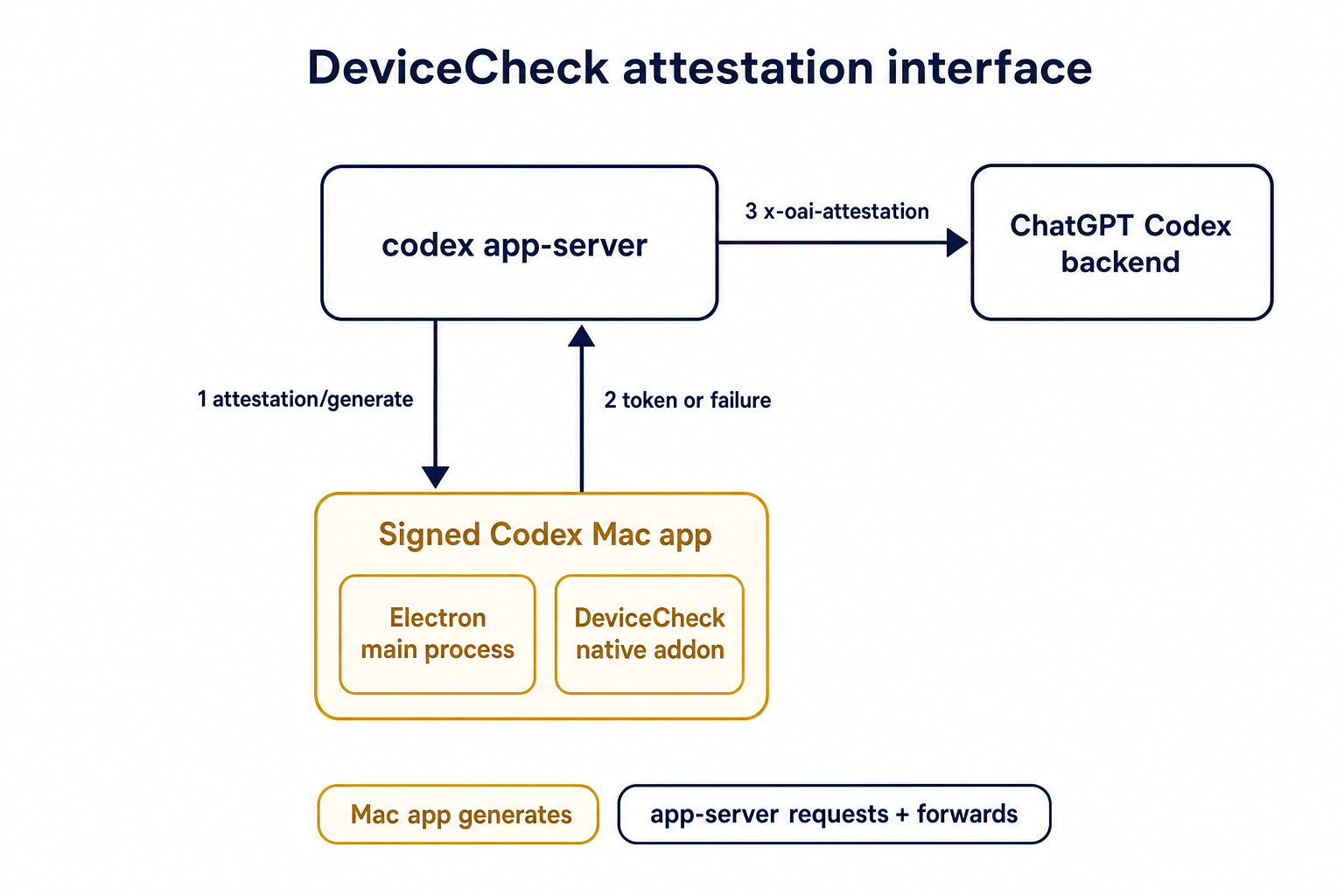
## Summary TL;DR: teaches `codex-rs` / app-server to request a desktop-provided attestation token and attach it as `x-oai-attestation` on the scoped ChatGPT Codex request paths.  ## Details This PR teaches the Codex app-server runtime how to request and attach an attestation token. It does not generate DeviceCheck tokens directly; instead, it relies on the connected desktop app to advertise that it can generate attestation and then asks that app for a fresh header value when needed. The flow is: 1. The Codex desktop app connects to app-server. 2. During `initialize`, the app can advertise that it supports `requestAttestation`. 3. Before app-server calls selected ChatGPT Codex endpoints, it sends the internal server request `attestation/generate` to the app. 4. app-server receives a pre-encoded header value back. 5. app-server forwards that value as `x-oai-attestation` on the scoped outbound requests. The code in this repo is mostly protocol and runtime plumbing: it adds the app-server request/response shape, introduces an attestation provider in core, wires that provider into Responses / compaction / realtime setup paths, and covers the intended scoping with tests. The signed macOS DeviceCheck generation remains owned by the desktop app PR. ## Related PR - Codex desktop app implementation: https://github.com/openai/openai/pull/878649 ## Validation <details> <summary>Tests run</summary> ```sh cargo test -p codex-app-server-protocol cargo test -p codex-core attestation --lib cargo test -p codex-app-server --lib attestation ``` Also ran: ```sh just fix -p codex-core just fix -p codex-app-server just fix -p codex-app-server-protocol just fmt just write-app-server-schema ``` </details> <details> <summary>E2E DeviceCheck validation</summary> First validated the signed desktop app boundary directly: launched a packaged signed `Codex.app`, sent `attestation/generate`, decoded the returned `v1.` attestation header, and validated the extracted DeviceCheck token with `personal/jm/verify_devicecheck_token.py` using bundle ID `com.openai.codex`. Apple returned `status_code: 200` and `is_ok: true`. Then ran the fuller app + app-server flow. The packaged `Codex.app` launched a current-branch app-server via `CODEX_CLI_PATH`, and a local MITM proxy intercepted outbound `chatgpt.com` traffic. The app-server requested `attestation/generate` from the real Electron app process, and the intercepted `/backend-api/codex/responses` traffic included `x-oai-attestation` on both routes: ```text GET /backend-api/codex/responses Upgrade: websocket x-oai-attestation: present POST /backend-api/codex/responses Upgrade: none x-oai-attestation: present ``` The captured header decoded to a DeviceCheck token that also validated with Apple for `com.openai.codex` (`status_code: 200`, `is_ok: true`, team `2DC432GLL2`). </details> --------- Co-authored-by: Codex <noreply@openai.com>
Jiaming Zhang ·
2026-05-08 12:36:02 -07:00 -
[codex] Remove remote thread store implementation (#21596)
Remove the remote thread-store backend and checked-in protobuf artifacts. We've moved these into another crate that link against this one. Also remove the config settings for thread store backend selection, since we'll instead pass an instantiated thread store into the core-api crate's main entrypoint.
Tom ·
2026-05-08 00:02:46 +00:00 -
Route ThreadManager rollout path reads through thread store (#21265)
- Route ThreadManager rollout-path resume/fork through ThreadStore history reads. - Add in-memory store coverage proving path-addressed reads are used. This isn't strictly necessary for the ThreadStore migration, since these ThreadManager methods _only_ work for path-based lookups, but I'm trying to migrate all the rollout recorder callsites to use the threadstore were possible for consistency.
Tom ·
2026-05-07 11:25:25 -07:00 -
Revert state DB injection and agent graph store (#21481)
## Why Reverts #20689 to restore the previous optional state DB plumbing. The conflict resolution keeps the newer installation ID and session/thread identity changes that landed after #20689, while removing the mandatory state DB and agent graph store dependency from ThreadManager construction. ## What changed - Restored `Option<StateDbHandle>` through app-server, MCP server, prompt debug, and test entry points. - Removed the `codex-core` dependency on `codex-agent-graph-store` and reverted descendant lookup back to the existing state DB path when available. - Kept newer `installation_id` forwarding by passing it beside the optional DB handle. - Kept local thread-name updates working when the optional state DB handle is absent. ## Validation - `git diff --check` - `cargo test -p codex-thread-store` - `cargo test -p codex-state -p codex-rollout -p codex-app-server-protocol` - Attempted `env CARGO_INCREMENTAL=0 cargo test -p codex-core -p codex-app-server -p codex-app-server-client -p codex-mcp-server -p codex-thread-manager-sample -p codex-tui`; blocked locally by a rustc ICE while compiling `v8 v146.4.0` with `rustc 1.93.0 (254b59607 2026-01-19)` on `aarch64-apple-darwin`.
pakrym-oai ·
2026-05-06 22:48:29 -07:00 -
pakrym-oai ·
2026-05-07 02:24:20 +00:00 -
Move skills watcher to app-server (#21287)
## Why Skills update notifications are app-server API behavior, but the watcher lived in `codex-core` and surfaced through `EventMsg::SkillsUpdateAvailable`. Moving the watcher out keeps core focused on thread execution and lets app-server own both cache invalidation and the `skills/changed` notification. ## What changed - Added an app-server-owned skills watcher that watches local skill roots, clears the shared skills cache, and emits `skills/changed` directly. - Registers skill watches from the common app-server thread listener attach path, including direct starts, resumes, and app-server-observed child or forked threads. - Stores the `WatchRegistration` on `ThreadState`, so listener replacement, thread teardown, idle unload, and app-server shutdown deregister by dropping the RAII guard. - Removed `EventMsg::SkillsUpdateAvailable`, the core watcher, and the old core live-reload test. - Extended the app-server skills change test to verify a cached skills list is refreshed after a filesystem change without forcing reload. ## Validation - `cargo check -p codex-core -p codex-app-server -p codex-mcp-server -p codex-rollout -p codex-rollout-trace` - `cargo test -p codex-app-server skills_changed_notification_is_emitted_after_skill_change`
pakrym-oai ·
2026-05-06 15:38:11 -07:00 -
Move installation ID resolution out of core startup (#21182)
## Summary - resolve or inject the installation ID before core startup and pass it through `ThreadManager`, `CodexSpawnArgs`, and `Session` as a plain `String` - keep child sessions on the parent installation ID instead of rediscovering it inside core - propagate installation ID startup failures in `mcp-server` instead of panicking ## Why Core was still touching the filesystem on the session startup path to discover `installation_id`. This moves that work to the outer host boundary so core no longer depends on `codex_home` reads during session construction. --------- Co-authored-by: Codex <noreply@openai.com>
jif-oai ·
2026-05-06 10:48:54 +00:00 -
Preserve session MCP config on refresh (#21055)
# Overview MCP refreshes were rebuilding active threads from fresh disk-backed config only, which dropped thread-start session overlays such as app-injected MCP servers. This keeps refreshes current with disk config while preserving the thread-local config that only the active thread knows about. # Changes - Rebuild refreshed config per active thread using that thread's current `cwd`, rather than fanning out one app-server config to every thread. - Preserve each thread's `SessionFlags` layer while replacing reloadable config layers with freshly loaded config, then derive the MCP refresh payload from the rebuilt result. - Move MCP refresh orchestration into app-server so manual refreshes fail loudly while background refreshes remain best-effort, and route plugin-triggered refreshes through the same per-thread reload path. - Add regression coverage for session overlays, fresh project config, plugin-derived MCP config, current requirements, and strict vs best-effort refresh behavior. # Verification - Passed focused Rust coverage for the thread-config rebuild behavior and deferred MCP refresh flow, plus `cargo test -p codex-app-server --lib`. - Verified end to end in the Codex dev app against the locally built CLI: registered an MCP via thread config, verified that it could be used successfully before refresh, manually triggered MCP refresh, and verified that it continued to be available afterward.
aaronl-openai ·
2026-05-05 21:09:28 -07:00 -
[codex-analytics] rework thread_source for thread analytics (#20949)
## Summary - make `thread_source` an explicit optional thread-level field on `thread/start`, `thread/fork`, and returned thread payloads - persist `thread_source` in rollout/session metadata so resumed live threads retain the original value - replace the old best-effort `session_source` -> `thread_source` mapping with an explicit caller-supplied analytics classification ## Why Before this change, analytics `thread_source` was populated by a best-effort mapping from `session_source`. `session_source` describes the runtime/client surface, not the actual thread-level origin, so that projection was not accurate enough to distinguish cases such as `user`, `subagent`, `memory_consolidation`, and future thread origins reliably. Making `thread_source` explicit keeps one thread-level analytics field while letting callers provide the real classification directly instead of recovering it indirectly from `session_source`. ## Impact For new analytics events, `thread_source` now reflects the explicit thread-level classification supplied by the caller rather than an inferred value derived from `session_source`. Existing protocol fields remain optional; callers that omit `threadSource` now produce `null` instead of a best-effort inferred value. ## Validation - `just write-app-server-schema` - `cargo test -p codex-analytics -p codex-core -p codex-app-server-protocol --no-run` - `cargo test -p codex-app-server-protocol generated_ts_optional_nullable_fields_only_in_params` - `cargo test -p codex-analytics thread_initialized_event_serializes_expected_shape` - `cargo test -p codex-core resume_stopped_thread_from_rollout_preserves_thread_source`
rhan-oai ·
2026-05-06 02:12:31 +00:00 -
Inject state DB, agent graph store (#20689)
## Why We want the agent graph store to be passed down the stack as a real dependency, the same way we already treat the thread store. This will let us inject the agent graph store as a real dependency and support implementations other than the local SQLite-backed one. Right now most code instantiates a state DB and an agent graph store just-in-time. Ideally, we would not depend on the state DB directly but only read through the higher-level interfaces. This change makes the dependency boundaries explicit and moves state DB initialization to process bootstrap instead of hiding it inside local store implementations. ## What changed - `ThreadManager` now requires a `StateDbHandle` and an `AgentGraphStore` at construction time instead of treating them as optional internals. - The local store constructors no longer lazily initialize SQLite. Callers now initialize the state DB once per process and use that shared handle to build: - `LocalThreadStore` - `LocalAgentGraphStore` - App bootstraps (`app-server`, `mcp-server`, `prompt_debug`, and the thread-manager sample) now initialize the state DB up front and inject the resulting handle down the stack. - `app-server` now consistently uses its process-scoped state DB handle instead of reopening SQLite or trying to recover it from loaded threads. - Device-key storage now reuses the shared state DB handle instead of maintaining its own lazy opener. - The thread archive / descendant traversal paths now use the injected `AgentGraphStore` instead of reaching through local thread-store-specific state. ## Verification - `cargo check -p codex-core -p codex-thread-store -p codex-app-server -p codex-mcp-server -p codex-thread-manager-sample --tests` - `cargo test -p codex-thread-store` - `cargo test -p codex-core thread_manager_accepts_separate_agent_graph_store_and_thread_store -- --nocapture` - `cargo test -p codex-app-server thread_archive_archives_spawned_descendants -- --nocapture`
Rasmus Rygaard ·
2026-05-05 21:45:29 +00:00 -
state: pass state db handles through consumers (#20561)
## Why SQLite state was still being opened from consumer paths, including lazy `OnceCell`-backed thread-store call sites. That let one process construct multiple state DB connections for the same Codex home, which makes SQLite lock contention and `database is locked` failures much easier to hit. State DB lifetime should be chosen by main-like entrypoints and tests, then passed through explicitly. Consumers should use the supplied `Option<StateDbHandle>` or `StateDbHandle` and keep their existing filesystem fallback or error behavior when no handle is available. The startup path also needs to keep the rollout crate in charge of SQLite state initialization. Opening `codex_state::StateRuntime` directly bypasses rollout metadata backfill, so entrypoints should initialize through `codex_rollout::state_db` and receive a handle only after required rollout backfills have completed. ## What Changed - Initialize the state DB in main-like entrypoints for CLI, TUI, app-server, exec, MCP server, and the thread-manager sample. - Pass `Option<StateDbHandle>` through `ThreadManager`, `LocalThreadStore`, app-server processors, TUI app wiring, rollout listing/recording, personality migration, shell snapshot cleanup, session-name lookup, and memory/device-key consumers. - Remove the lazy local state DB wrapper from the thread store so non-test consumers use only the supplied handle or their existing fallback path. - Make `codex_rollout::state_db::init` the local state startup path: it opens/migrates SQLite, runs rollout metadata backfill when needed, waits for concurrent backfill workers up to a bounded timeout, verifies completion, and then returns the initialized handle. - Keep optional/non-owning SQLite helpers, such as remote TUI local reads, as open-only paths that do not run startup backfill. - Switch app-server startup from direct `codex_state::StateRuntime::init` to the rollout state initializer so app-server cannot skip rollout backfill. - Collapse split rollout lookup/list APIs so callers use the normal methods with an optional state handle instead of `_with_state_db` variants. - Restore `getConversationSummary(ThreadId)` to delegate through `ThreadStore::read_thread` instead of a LocalThreadStore-specific rollout path special case. - Keep DB-backed rollout path lookup keyed on the DB row and file existence, without imposing the filesystem filename convention on existing DB rows. - Verify readable DB-backed rollout paths against `session_meta.id` before returning them, so a stale SQLite row that points at another thread's JSONL falls back to filesystem search and read-repairs the DB row. - Keep `debug prompt-input` filesystem-only so a one-off debug command does not initialize or backfill SQLite state just to print prompt input. - Keep goal-session test Codex homes alive only in the goal-specific helper, rather than leaking tempdirs from the shared session test helper. - Update tests and call sites to pass explicit state handles where DB behavior is expected and explicit `None` where filesystem-only behavior is intended. ## Validation - `CARGO_TARGET_DIR=/tmp/codex-target-state-db cargo check -p codex-rollout -p codex-thread-store -p codex-app-server -p codex-core -p codex-tui -p codex-exec -p codex-cli --tests` - `CARGO_TARGET_DIR=/tmp/codex-target-state-db cargo test -p codex-rollout state_db_` - `CARGO_TARGET_DIR=/tmp/codex-target-state-db cargo test -p codex-rollout find_thread_path` - `CARGO_TARGET_DIR=/tmp/codex-target-state-db cargo test -p codex-rollout find_thread_path -- --nocapture` - `CARGO_TARGET_DIR=/tmp/codex-target-state-db cargo test -p codex-rollout try_init_ -- --nocapture` - `CARGO_TARGET_DIR=/tmp/codex-target-state-db cargo test -p codex-rollout` - `CARGO_TARGET_DIR=/tmp/codex-target-state-db cargo clippy -p codex-rollout --lib -- -D warnings` - `CARGO_TARGET_DIR=/tmp/codex-target-state-db cargo test -p codex-thread-store read_thread_falls_back_when_sqlite_path_points_to_another_thread -- --nocapture` - `CARGO_TARGET_DIR=/tmp/codex-target-state-db cargo test -p codex-thread-store` - `CARGO_TARGET_DIR=/tmp/codex-target-state-db cargo test -p codex-core shell_snapshot` - `CARGO_TARGET_DIR=/tmp/codex-target-state-db cargo test -p codex-core --test all personality_migration` - `CARGO_TARGET_DIR=/tmp/codex-target-state-db cargo test -p codex-core --test all rollout_list_find` - `RUST_MIN_STACK=8388608 CODEX_SKIP_VENDORED_BWRAP=1 CARGO_TARGET_DIR=/tmp/codex-target-state-db cargo test -p codex-core --test all rollout_list_find::find_prefers_sqlite_path_by_id -- --nocapture` - `RUST_MIN_STACK=8388608 CODEX_SKIP_VENDORED_BWRAP=1 CARGO_TARGET_DIR=/tmp/codex-target-state-db cargo test -p codex-core --test all rollout_list_find -- --nocapture` - `CARGO_TARGET_DIR=/tmp/codex-target-state-db cargo test -p codex-core interrupt_accounts_active_goal_before_pausing` - `CARGO_TARGET_DIR=/tmp/codex-target-state-db cargo test -p codex-app-server get_auth_status -- --test-threads=1` - `CODEX_SKIP_VENDORED_BWRAP=1 CARGO_TARGET_DIR=/tmp/codex-target-state-db cargo test -p codex-app-server --lib` - `CODEX_SKIP_VENDORED_BWRAP=1 CARGO_TARGET_DIR=/tmp/codex-target-state-db cargo check -p codex-rollout -p codex-app-server --tests` - `CARGO_TARGET_DIR=/tmp/codex-target-state-db just fix -p codex-rollout -p codex-thread-store -p codex-core -p codex-app-server -p codex-tui -p codex-exec -p codex-cli` - `CODEX_SKIP_VENDORED_BWRAP=1 CARGO_TARGET_DIR=/tmp/codex-target-state-db just fix -p codex-rollout -p codex-app-server` - `CARGO_TARGET_DIR=/tmp/codex-target-state-db just fix -p codex-rollout` - `CODEX_SKIP_VENDORED_BWRAP=1 CARGO_TARGET_DIR=/tmp/codex-target-state-db just fix -p codex-core` - `just argument-comment-lint -p codex-core` - `just argument-comment-lint -p codex-rollout` Focused coverage added in `codex-rollout`: - `recorder::tests::state_db_init_backfills_before_returning` verifies the rollout metadata row exists before startup init returns. - `state_db::tests::try_init_waits_for_concurrent_startup_backfill` verifies startup waits for another worker to finish backfill instead of disabling the handle for the process. - `state_db::tests::try_init_times_out_waiting_for_stuck_startup_backfill` verifies startup does not hang indefinitely on a stuck backfill lease. - `tests::find_thread_path_accepts_existing_state_db_path_without_canonical_filename` verifies DB-backed lookup accepts valid existing rollout paths even when the filename does not include the thread UUID. - `tests::find_thread_path_falls_back_when_db_path_points_to_another_thread` verifies DB-backed lookup ignores a stale row whose existing path belongs to another thread and read-repairs the row after filesystem fallback. Focused coverage updated in `codex-core`: - `rollout_list_find::find_prefers_sqlite_path_by_id` now uses a DB-preferred rollout file with matching `session_meta.id`, so it still verifies that valid SQLite paths win without depending on stale/empty rollout contents. `cargo test -p codex-app-server thread_list_respects_search_term_filter -- --test-threads=1 --nocapture` was attempted locally but timed out waiting for the app-server test harness `initialize` response before reaching the changed thread-list code path. `bazel test //codex-rs/thread-store:thread-store-unit-tests --test_output=errors` was attempted locally after the thread-store fix, but this container failed before target analysis while fetching `v8+` through BuildBuddy/direct GitHub. The equivalent local crate coverage, including `cargo test -p codex-thread-store`, passes. A plain local `cargo check -p codex-rollout -p codex-app-server --tests` also requires system `libcap.pc` for `codex-linux-sandbox`; the follow-up app-server check above used `CODEX_SKIP_VENDORED_BWRAP=1` in this container.
Ruslan Nigmatullin ·
2026-05-04 11:46:03 -07:00 -
Prepare selected environment plumbing (#20669)
## Why This is a prep PR in the multi-environment process-tool stack. It separates ownership/config cleanup from the behavior change that teaches process tools to route by selected environment, so the follow-up PR can focus on model-facing `environment_id` behavior. ## Stack 1. https://github.com/openai/codex/pull/20646 - `EnvironmentContext` rendering for selected environments 2. https://github.com/openai/codex/pull/20669 - selected-environment ownership and tool config prep (this PR) 3. https://github.com/openai/codex/pull/20647 - process-tool `environment_id` routing ## What Changed - keep the resolved turn environment list wrapped in `ResolvedTurnEnvironments` through `TurnContext` instead of unwrapping it back to a raw `Vec` - add `TurnContext::resolve_path_against` so cwd-relative path resolution has one shared helper - replace the old tool config boolean with `ToolEnvironmentMode::{None, Single, Multiple}` ## Testing - Tests not run locally; this prep refactor is covered by GitHub CI for the stack. Co-authored-by: Codex <noreply@openai.com>
starr-openai ·
2026-05-04 17:55:49 +00:00 -
Use selected turn environments for runtime context (#20281)
## Summary - make selected turn environments the source of truth for session runtime cwd and MCP runtime environment selection - keep local/no-selection fallback behavior intact - add coverage for duplicate selected environments, cwd resolution, and MCP runtime environment selection ## Validation - git diff --check - rustfmt was run on touched Rust files during the implementation workflow CI should provide the full Bazel/test signal. --------- Co-authored-by: Codex <noreply@openai.com>
starr-openai ·
2026-05-01 11:00:14 -07:00 -
Make thread store process-scoped (#19474)
- Build one app-server process ThreadStore from startup config and share it with ThreadManager and CodexMessageProcessor. - Remove per-thread/fork store reconstruction so effective thread config cannot switch the persistence backend. - Add params to ThreadStore create/resume for specifying thread metadata, since otherwise the metadata from store creation would be used (incorrectly).
Tom ·
2026-04-30 21:24:59 -07:00 -
xl-openai ·
2026-04-30 14:26:14 -07:00 -
[codex] Migrate thread turns list to thread store (#19280)
- migrate `thread/turns/list` to ThreadStore. Uses ThreadStore for most data now but merges in the in-memory state from thread manager - keep v2 `thread/list` pathless-store friendly by converting `StoredThread` directly to API `Thread` - add regression coverage for pathless store history/listing
Tom ·
2026-04-30 14:16:42 -07:00 -
Reduce the surface of collaboration modes (#20149)
Collaboration modes were slightly invasive both into ThreadManager construction and ModelProvider
pakrym-oai ·
2026-04-29 17:22:41 -07:00 -
Add ThreadManager sample crate (#20141)
Summary: - Add codex-thread-manager-sample, a one-shot binary that starts a ThreadManager thread, submits a prompt, and prints the final assistant output. - Pass ThreadStore into ThreadManager::new and expose thread_store_from_config for existing callsites. - Build the sample Config directly with only --model and prompt inputs. Verification: - just fmt - cargo check -p codex-thread-manager-sample -p codex-app-server -p codex-mcp-server - git diff --check Tests: Not run per request.
pakrym-oai ·
2026-04-29 11:21:06 -07:00 -
feat: split memories part 2 (#19860)
Keep extracting memories out of core and moving the write trigger in the app-server This is temporary and it should move at the client level as a follow-up This makes core fully independant from `codex-memories-write` --------- Co-authored-by: Codex <noreply@openai.com>
jif-oai ·
2026-04-28 13:03:28 +02:00 -
Add goal core runtime (4 / 5) (#18076)
Adds the core runtime behavior for active goals on top of the model tools from PR 3. ## Why A long-running goal should be a core runtime concern, not something every client has to implement. Core owns the turn lifecycle, tool completion boundaries, interruptions, resume behavior, and token usage, so it is the right place to account progress, enforce budgets, and decide when to continue work. ## What changed - Centralized goal lifecycle side effects behind `Session::goal_runtime_apply(GoalRuntimeEvent::...)`. - Starts goal continuation turns only when the session is idle; pending user input and mailbox work take priority. - Accounts token and wall-clock usage at turn, tool, mutation, interrupt, and resume boundaries; `get_thread_goal` remains read-only. - Preserves sub-second wall-clock remainder across accounting boundaries so long-running goals do not drift downward over time. - Treats token budget exhaustion as a soft stop by marking the goal `budget_limited` and injecting wrap-up steering instead of aborting the active turn. - Suppresses budget steering when `update_goal` marks a goal complete. - Pauses active goals on interrupt and auto-reactivates paused goals when a thread resumes outside plan mode. - Suppresses repeated automatic continuation when a continuation turn makes no tool calls. - Added continuation and budget-limit prompt templates. ## Verification - Added focused core coverage for continuation scheduling, accounting boundaries, budget-limit steering, completion accounting, interrupt pause behavior, resume auto-activation, and wall-clock remainder accounting.
Eric Traut ·
2026-04-24 21:16:00 -07:00 -
[codex] add non-local thread store regression harness (#19266)
- Add an integration test that guarantees nothing gets written to codex home dir or sqlite when running a rollout with a non-local ThreadStore - Add an in-memory "spy" ThreadStore for tests like this Note I could not find a good way to also ensure there were no filesystem _reads_ that didn't go through threadstore. I explored a more elaborate sandboxed-subprocess approach but it isn't platform portable and felt like it wasn't (yet) worth it.
Tom ·
2026-04-24 15:45:44 -07:00 -
Migrate fork and resume reads to thread store (#18900)
- Route cold thread/resume and thread/fork source loading through ThreadStore reads instead of direct rollout path operations - Keep lookups that explicitly specify a rollout-path using the local thread store methods but return an invalid-request error for remote ThreadStore configurations - Add some additional unit tests for code path coverage
Tom ·
2026-04-24 13:51:37 -07:00 -
Add agents.interrupt_message for interruption markers (#19351)
## Why Agent interruptions currently always persist a model-visible interrupted-turn marker before emitting `TurnAborted`. That marker is useful by default because it gives the next model turn context about a deliberately interrupted task, but some deployments need to suppress that history injection entirely while still keeping the client-visible interruption event. ## What changed - Add `[agents] interrupt_message = false` to disable the model-visible interrupted-turn marker. - Resolve the setting into `Config::agent_interrupt_message_enabled`, defaulting to `true` so existing behavior is unchanged. - Apply the setting to both live interrupted turns and interrupted fork snapshots. - Keep emitting `TurnAborted` even when the history marker is disabled. - Regenerate `core/config.schema.json` for the new `agents.interrupt_message` field. ## Testing - `cargo test -p codex-core load_config_resolves_agent_interrupt_message -- --nocapture` - `cargo test -p codex-core disabled_interrupted_fork_snapshot_appends_only_interrupt_event -- --nocapture` - `cargo test -p codex-core multi_agent_v2_interrupted_marker_uses_developer_input_message -- --nocapture` - `cargo test -p codex-core multi_agent_v2_followup_task_can_disable_interrupted_marker -- --nocapture` - `cargo test -p codex-core multi_agent_v2_followup_task_interrupts_busy_child_without_losing_message -- --nocapture` - `cargo check -p codex-core`
jif-oai ·
2026-04-24 16:02:45 +02:00 -
Make MultiAgentV2 interruption markers assistant-authored (#19124)
## Why `MultiAgentV2` follow-up messages are delivered to agents as assistant-authored `InterAgentCommunication` envelopes. When `followup_task` used `interrupt: true`, the interrupted-turn guidance was still persisted as a contextual user message, so model-visible history made a system-generated interruption boundary look user-authored. This keeps interruption guidance consistent with the rest of the v2 inter-agent message stream while preserving the legacy marker shape for non-v2 sessions. ## What changed - Make `interrupted_turn_history_marker` feature-aware. - Record the interrupted-turn marker as an assistant `OutputText` message when `Feature::MultiAgentV2` is enabled. - Keep the existing user contextual fragment for non-v2 sessions. - Apply the same feature-aware marker to interrupted fork snapshots. - Add coverage for the live `followup_task` interrupt path and the helper-level v2 marker shape. ## Testing - `cargo test -p codex-core multi_agent_v2_followup_task_interrupts_busy_child_without_losing_message -- --nocapture` - `cargo test -p codex-core multi_agent_v2_interrupted_marker_uses_assistant_output_message -- --nocapture` - `cargo test -p codex-core interrupted_fork_snapshot -- --nocapture`
jif-oai ·
2026-04-24 13:39:26 +02:00 -
feat: let model providers own model discovery (#18950)
## Why `codex-models-manager` had grown to own provider-specific concerns: constructing OpenAI-compatible `/models` requests, resolving provider auth, emitting request telemetry, and deciding how provider catalogs should be sourced. That made the manager harder to reuse for providers whose model catalog is not fetched from the OpenAI `/models` endpoint, such as Amazon Bedrock. This change moves provider-specific model discovery behind provider-owned implementations, so the models manager can focus on refresh policy, cache behavior, picker ordering, and model metadata merging. ## What Changed - Introduced a `ModelsManager` trait with separate `OpenAiModelsManager` and `StaticModelsManager` implementations. - Added `ModelsEndpointClient` so OpenAI-compatible HTTP fetching lives outside `codex-models-manager`. - Moved `/models` request construction, provider auth resolution, timeout handling, and request telemetry into `codex-model-provider` via `OpenAiModelsEndpoint`. - Added provider-owned `models_manager(...)` construction so configured OpenAI-compatible providers use `OpenAiModelsManager`, while static/catalog-backed providers can return `StaticModelsManager`. - Added an Amazon Bedrock static model catalog for the GPT OSS Bedrock model IDs. - Updated core/session/thread manager code and tests to depend on `Arc<dyn ModelsManager>`. - Moved offline model test helpers into `codex_models_manager::test_support`. ## Metadata References The Bedrock catalog metadata is based on the official Amazon Bedrock OpenAI model documentation: - [Amazon Bedrock OpenAI models](https://docs.aws.amazon.com/bedrock/latest/userguide/model-parameters-openai.html) lists the Bedrock model IDs, text input/output modalities, and `128,000` token context window for `gpt-oss-20b` and `gpt-oss-120b`. - [Amazon Bedrock `gpt-oss-120b` model card](https://docs.aws.amazon.com/bedrock/latest/userguide/model-card-openai-gpt-oss-120b.html) lists the `bedrock-runtime` model ID `openai.gpt-oss-120b-1:0`, the `bedrock-mantle` model ID `openai.gpt-oss-120b`, text-only modalities, and `128K` context window. - [OpenAI `gpt-oss-120b` model docs](https://developers.openai.com/api/docs/models/gpt-oss-120b) document configurable reasoning effort with `low`, `medium`, and `high`, plus text input/output modality. The display names, default reasoning effort, and priority ordering are Codex-local catalog choices. ## Test Plan - Manually verified app-server model listing with an AWS profile: ```shell CODEX_HOME="$(mktemp -d)" cargo run -p codex-app-server-test-client -- \ --codex-bin ./target/debug/codex \ -c 'model_provider="amazon-bedrock"' \ -c 'model_providers.amazon-bedrock.aws.profile="codex-bedrock"' \ -c 'model_providers.amazon-bedrock.aws.region="us-west-2"' \ model-list ``` The response returned the Bedrock catalog with `openai.gpt-oss-120b-1:0` as the default model and `openai.gpt-oss-20b-1:0` as the second listed model, both text-only and supporting low/medium/high reasoning effort.
Celia Chen ·
2026-04-24 04:28:25 +00:00 -
Add sticky environment API and thread state (#18897)
## Summary - add sticky environment selections to app-server v2 thread/start and turn/start request flow - carry thread-level selections through core session/thread state - add app-server coverage for sticky selections and turn overrides ## Stack 1. This PR: API and thread persistence 2. #18898: config.toml named environment loading 3. #18899: downstream tool/runtime consumers ## Validation - Not run locally; split only. --------- Co-authored-by: Codex <noreply@openai.com>
starr-openai ·
2026-04-23 18:57:13 -07:00 -
[rollout_trace] Add debug trace reduction command (#18880)
## Summary Adds the debug CLI entry point for reducing recorded rollout traces. This gives developers a direct way to inspect whether the emitted trace stream reduces into the expected conversation/runtime model. ## Stack This is PR 5/5 in the rollout trace stack. - [#18876](https://github.com/openai/codex/pull/18876): Add rollout trace crate - [#18877](https://github.com/openai/codex/pull/18877): Record core session rollout traces - [#18878](https://github.com/openai/codex/pull/18878): Trace tool and code-mode boundaries - [#18879](https://github.com/openai/codex/pull/18879): Trace sessions and multi-agent edges - [#18880](https://github.com/openai/codex/pull/18880): Add debug trace reduction command ## Review Notes This PR is intentionally last: it depends on the trace crate, core recorder, runtime/tool events, and session/agent edge data all existing. The command should remain a debug/developer tool and avoid adding new runtime behavior. The useful review question is whether the CLI exposes the reducer in the smallest practical way for local inspection without turning the debug command into a supported user-facing workflow.
cassirer-openai ·
2026-04-24 01:56:48 +00:00 -
Tom ·
2026-04-23 17:49:28 +00:00 -
[codex] Route live thread writes through ThreadStore (#18882)
Begin migrating the thread write codepaths to ThreadStore. This starts using ThreadStore inside of core session code, not only in the app server code. Rework the interfaces around thread recording/persistence. We're left with the following: * `ThreadManager`: owns the process-level registry of loaded threads and handles cross-thread orchestration: start, resume, fork, lookup, remove, and route ops to running CodexThreads. * `CodexThread`: represents one loaded/running thread from the outside. It is the handle app-server and callers use to submit ops, inspect session metadata, and shut the thread down. * `LiveThread`: session-owned persistence lifecycle handle for one active thread. Core session code uses it to append rollout items, materialize lazy persistence, flush, shutdown, discard init-failed writers, and load that thread’s persisted history. * `ThreadStore`: storage backend abstraction. It answers “how are threads persisted, read, listed, updated, archived?” Local and remote implementations live behind this trait. * `LocalThreadStore`: local ThreadStore implementation. It owns the file/sqlite-specific details and keeps RolloutRecorder as a local implementation detail. This is a few too many Thread abstractions for my liking, but they do all represent different concepts / needs / layers. Migration note: in places where the core code explicitly requires a path, rather than a thread ID, throw an error if we're running with a remote store. Cover the new local live-writer lifecycle with focused tests and preserve app-server thread-start behavior, including ephemeral pathless sessions.
Tom ·
2026-04-23 10:17:09 -07:00 -
[rollout_trace] Record core session rollout traces (#18877)
## Summary Wires rollout trace recording into `codex-core` session and turn execution. This records the core model request/response, compaction, and session lifecycle boundaries needed for replay without yet tracing every nested runtime/tool boundary. ## Stack This is PR 2/5 in the rollout trace stack. - [#18876](https://github.com/openai/codex/pull/18876): Add rollout trace crate - [#18877](https://github.com/openai/codex/pull/18877): Record core session rollout traces - [#18878](https://github.com/openai/codex/pull/18878): Trace tool and code-mode boundaries - [#18879](https://github.com/openai/codex/pull/18879): Trace sessions and multi-agent edges - [#18880](https://github.com/openai/codex/pull/18880): Add debug trace reduction command ## Review Notes This layer is the first live integration point. The important review question is whether trace recording is isolated from normal session behavior: trace failures should not become user-visible execution failures, and recording should preserve the existing turn/session lifecycle semantics. The PR depends on the reducer/data model from the first stack entry and only introduces the core recorder surface that later PRs use for richer runtime and relationship events.
cassirer-openai ·
2026-04-22 17:00:48 +00:00 -
Support multiple managed environments (#18401)
## Summary - refactor EnvironmentManager to own keyed environments with default/local lookup helpers - keep remote exec-server client creation lazy until exec/fs use - preserve disabled agent environment access separately from internal local environment access ## Validation - not run (per Codex worktree instruction to avoid tests/builds unless requested) --------- Co-authored-by: Codex <noreply@openai.com>
starr-openai ·
2026-04-21 15:29:35 -07:00 -
Andrey Mishchenko ·
2026-04-20 05:42:22 +00:00 -
Move codex module under session (#18249)
## Summary - rename the core codex module root to session/mod.rs without using #[path] - move the codex module directory and tests under core/src/session - remove session/mod.rs reexports so call sites use explicit child module paths ## Testing - cargo test -p codex-core --lib - cargo check -p codex-core --tests - just fmt - just fix -p codex-core - git diff --check
pakrym-oai ·
2026-04-17 16:18:53 +00:00 -
Make skill loading filesystem-aware (#17720)
Migrates skill loading to support reading repo skills from the remote environment.
pakrym-oai ·
2026-04-14 15:40:40 -07:00 -
Refactor plugin loading to async (#17747)
Simplifies skills migration.
pakrym-oai ·
2026-04-13 21:52:56 -07:00 -
Use AbsolutePathBuf in skill loading and codex_home (#17407)
Helps with FS migration later
pakrym-oai ·
2026-04-13 10:26:51 -07:00 -
Support clear SessionStart source (#17073)
## Motivation The `SessionStart` hook already receives `startup` and `resume` sources, but sessions created from `/clear` previously looked like normal startup sessions. This makes it impossible for hook authors to distinguish between these with the matcher. ## Summary - Add `InitialHistory::Cleared` so `/clear`-created sessions can be distinguished from ordinary startup sessions. - Add `SessionStartSource::Clear` and wire it through core, app-server thread start params, and TUI clear-session flow. - Update app-server protocol schemas, generated TypeScript, docs, and related tests. https://github.com/user-attachments/assets/9cae3cb4-41c7-4d06-b34f-966252442e5c
Abhinav ·
2026-04-10 16:05:21 -07:00 -
[codex-analytics] add compaction analytics event (#17155)
- event for compaction analytics - introduces thread-connection and thread metadata caches for data denormalization, expected to be useful for denormalization onto core emitted events in general - threads analytics event client into core (mirrors approved implementation in #16640) - denormalizes key thread metadata: thread_source, subagent_source, parent_thread_id, as well as app-server client and runtime metadata) - compaction strategy defaults to memento, forward compatible with expected prefill_compaction strategy 1. Manual standalone compact, local `INFO | 2026-04-09 17:35:50 | codex_backend.routers.analytics_events | analytics_events.track_analytics_events:526 | Tracked codex_compaction_event event params={'thread_id': '019d74d0-5cfb-70c0-bef9-165c3bf9b2df', 'turn_id': '019d74d0-d7f6-7c81-acc6-aae2030243d6', 'product_surface': 'codex', 'app_server_client': {'product_client_id': 'CODEX_CLI', 'client_name': 'codex-tui', 'client_version': '0.0.0', 'rpc_transport': 'in_process', 'experimental_api_enabled': True}, 'runtime': {'codex_rs_version': '0.0.0', 'runtime_os': 'macos', 'runtime_os_version': '26.4.0', 'runtime_arch': 'aarch64'}, 'trigger': 'manual', 'reason': 'user_requested', 'implementation': 'responses', 'phase': 'standalone_turn', 'strategy': 'memento', 'status': 'completed', 'active_context_tokens_before': 20170, 'active_context_tokens_after': 4830, 'started_at': 1775781337, 'completed_at': 1775781350, 'thread_source': 'user', 'subagent_source': None, 'parent_thread_id': None, 'error': None, 'duration_ms': 13524} | ` 2. Auto pre-turn compact, local `INFO | 2026-04-09 17:37:30 | codex_backend.routers.analytics_events | analytics_events.track_analytics_events:526 | Tracked codex_compaction_event event params={'thread_id': '019d74d2-45ef-71d1-9c93-23cc0c13d988', 'turn_id': '019d74d2-7b42-7372-9f0e-c0da3f352328', 'product_surface': 'codex', 'app_server_client': {'product_client_id': 'CODEX_CLI', 'client_name': 'codex-tui', 'client_version': '0.0.0', 'rpc_transport': 'in_process', 'experimental_api_enabled': True}, 'runtime': {'codex_rs_version': '0.0.0', 'runtime_os': 'macos', 'runtime_os_version': '26.4.0', 'runtime_arch': 'aarch64'}, 'trigger': 'auto', 'reason': 'context_limit', 'implementation': 'responses', 'phase': 'pre_turn', 'strategy': 'memento', 'status': 'completed', 'active_context_tokens_before': 20063, 'active_context_tokens_after': 4822, 'started_at': 1775781444, 'completed_at': 1775781449, 'thread_source': 'user', 'subagent_source': None, 'parent_thread_id': None, 'error': None, 'duration_ms': 5497} | ` 3. Auto mid-turn compact, local `INFO | 2026-04-09 17:38:28 | codex_backend.routers.analytics_events | analytics_events.track_analytics_events:526 | Tracked codex_compaction_event event params={'thread_id': '019d74d3-212f-7a20-8c0a-4816a978675e', 'turn_id': '019d74d3-3ee1-7462-89f6-2ffbeefcd5e3', 'product_surface': 'codex', 'app_server_client': {'product_client_id': 'CODEX_CLI', 'client_name': 'codex-tui', 'client_version': '0.0.0', 'rpc_transport': 'in_process', 'experimental_api_enabled': True}, 'runtime': {'codex_rs_version': '0.0.0', 'runtime_os': 'macos', 'runtime_os_version': '26.4.0', 'runtime_arch': 'aarch64'}, 'trigger': 'auto', 'reason': 'context_limit', 'implementation': 'responses', 'phase': 'mid_turn', 'strategy': 'memento', 'status': 'completed', 'active_context_tokens_before': 20325, 'active_context_tokens_after': 14641, 'started_at': 1775781500, 'completed_at': 1775781508, 'thread_source': 'user', 'subagent_source': None, 'parent_thread_id': None, 'error': None, 'duration_ms': 7507} | ` 4. Remote /responses/compact, manual standalone `INFO | 2026-04-09 17:40:20 | codex_backend.routers.analytics_events | analytics_events.track_analytics_events:526 | Tracked codex_compaction_event event params={'thread_id': '019d74d4-7a11-78a1-89f7-0535a1149416', 'turn_id': '019d74d4-e087-7183-9c20-b1e40b7578c0', 'product_surface': 'codex', 'app_server_client': {'product_client_id': 'CODEX_CLI', 'client_name': 'codex-tui', 'client_version': '0.0.0', 'rpc_transport': 'in_process', 'experimental_api_enabled': True}, 'runtime': {'codex_rs_version': '0.0.0', 'runtime_os': 'macos', 'runtime_os_version': '26.4.0', 'runtime_arch': 'aarch64'}, 'trigger': 'manual', 'reason': 'user_requested', 'implementation': 'responses_compact', 'phase': 'standalone_turn', 'strategy': 'memento', 'status': 'completed', 'active_context_tokens_before': 23461, 'active_context_tokens_after': 6171, 'started_at': 1775781601, 'completed_at': 1775781620, 'thread_source': 'user', 'subagent_source': None, 'parent_thread_id': None, 'error': None, 'duration_ms': 18971} | `
rhan-oai ·
2026-04-10 13:03:54 -07:00 -
feat: /feedback cascade (#16442)
Example here: https://openai.sentry.io/issues/7380240430/?project=4510195390611458&query=019d498f-bec4-7ba2-96d2-612b1e4507df&referrer=issue-stream
jif-oai ·
2026-04-07 12:47:37 +01:00 -
[codex-analytics] add protocol-native turn timestamps (#16638)
--- [//]: # (BEGIN SAPLING FOOTER) Stack created with [Sapling](https://sapling-scm.com). Best reviewed with [ReviewStack](https://reviewstack.dev/openai/codex/pull/16638). * #16870 * #16706 * #16659 * #16641 * #16640 * __->__ #16638
rhan-oai ·
2026-04-06 16:22:59 -07:00 -
remove temporary ownership re-exports (#16626)
Stacked on #16508. This removes the temporary `codex-core` / `codex-login` re-export shims from the ownership split and rewrites callsites to import directly from `codex-model-provider-info`, `codex-models-manager`, `codex-api`, `codex-protocol`, `codex-feedback`, and `codex-response-debug-context`. No behavior change intended; this is the mechanical import cleanup layer split out from the ownership move. --------- Co-authored-by: Codex <noreply@openai.com>
Ahmed Ibrahim ·
2026-04-03 00:33:34 -07:00 -
core: remove cross-crate re-exports from lib.rs (#16512)
## Why `codex-core` was re-exporting APIs owned by sibling `codex-*` crates, which made downstream crates depend on `codex-core` as a proxy module instead of the actual owner crate. Removing those forwards makes crate boundaries explicit and lets leaf crates drop unnecessary `codex-core` dependencies. In this PR, this reduces the dependency on `codex-core` to `codex-login` in the following files: ``` codex-rs/backend-client/Cargo.toml codex-rs/mcp-server/tests/common/Cargo.toml ``` ## What - Remove `codex-rs/core/src/lib.rs` re-exports for symbols owned by `codex-login`, `codex-mcp`, `codex-rollout`, `codex-analytics`, `codex-protocol`, `codex-shell-command`, `codex-sandboxing`, `codex-tools`, and `codex-utils-path`. - Delete the `default_client` forwarding shim in `codex-rs/core`. - Update in-crate and downstream callsites to import directly from the owning `codex-*` crate. - Add direct Cargo dependencies where callsites now target the owner crate, and remove `codex-core` from `codex-rs/backend-client`.
Michael Bolin ·
2026-04-01 23:06:24 -07:00