mirror of
https://github.com/pchuan98/codex.git
synced 2026-07-01 00:31:56 +08:00
5a6e90599434137b677b7224d995932183844646
41
Commits
| Author | SHA1 | Message | Date | |
|---|---|---|---|---|
  Francis ChalisseryandGitHub Francis ChalisseryandGitHub
|
ac0bff27e7 |
[codex] Add rollout-backed thread content search (#23519)
## Summary - add experimental `thread/search` for local rollout-backed thread search using `rg` over JSONL rollouts - return search-specific result rows with optional previews instead of storing preview data on `StoredThread` or ordinary `Thread` responses - keep `thread/list` separate from full-content search and document the new app-server surface ## Testing - `cargo test -p codex-app-server-protocol` - `cargo test -p codex-app-server thread_search_returns_content_and_title_matches -- --nocapture` |
||
 starr-openaiandGitHub starr-openaiandGitHub
|
298e5cfce1 |
Route MCP servers through explicit environments (#23583)
## Summary - route each configured MCP server through an explicit per-server `environment_id` instead of a manager-wide remote toggle - default omitted `environment_id` to `local`, resolve named ids through `EnvironmentManager`, and fail only the affected MCP server when an explicit id is unknown - keep local stdio on the existing local launcher path for now, while named-environment stdio uses the selected environment backend and requires an absolute `cwd` - allow local HTTP MCP servers to keep using the ambient HTTP client when no local `Environment` is configured; named-environment HTTP MCPs use that environment's HTTP client ## Validation - devbox Bazel build: `bazel build --bes_backend= --bes_results_url= //codex-rs/cli:codex //codex-rs/rmcp-client:test_stdio_server //codex-rs/rmcp-client:test_streamable_http_server` - devbox app-server config matrix with real `config.toml` / `environments.toml` files covering omitted local, explicit local, omitted local under remote default, explicit remote stdio, local HTTP without local env, explicit remote HTTP, local stdio without local env, unknown explicit env, and remote stdio without `cwd` |
||
 Eric TrautandGitHub Eric TrautandGitHub
|
771a4e74ac |
Add thread/settings/update app-server API (#23502)
## Why App-server clients need a way to update a thread's next-turn settings without starting a turn, adding transcript content, or waiting for turn lifecycle events. This gives settings UI a direct path for durable thread settings while clients observe the eventual effective state through a notification. This is a simplified rework of PR https://github.com/openai/codex/pull/22509. In particular, it changes the `thread/settings/update` api to return immediately rather than waiting and returning the effective (updated) thread settings. This makes the new api consistent with `turn/start` and greatly reduces the complexity of the implementation relative to the earlier attempt. ## What Changed - Adds experimental `thread/settings/update` with partial-update request fields and an empty acknowledgment response. - Adds experimental `thread/settings/updated`, carrying full effective `ThreadSettings` and scoped by `threadId` to subscribed clients for the affected thread. - Shares durable settings validation with `turn/start`, including `sandboxPolicy` plus `permissions` rejection and `serviceTier: null` clearing. - Emits the same settings notification when `turn/start` overrides change the stored effective thread settings. - Regenerates app-server protocol schema fixtures and updates `app-server/README.md`. |
||
 Felipe CouryandGitHub Felipe CouryandGitHub
|
050a2e2668 |
fix(app-server): speed up shutdown (#23578)
## Why Pressing `Ctrl+C` or `Ctrl+D` in the TUI could make Codex pause during shutdown when app-server background work still held outbound sender clones. Shutdown tracing against the current `~/.codex` path found three relevant holders: - `SkillsWatcher` kept its event-loop task alive until the shutdown timeout path. - `AppServerAttestationProvider` retained a strong `Arc<OutgoingMessageSender>`, which could keep outbound teardown waiting after the processor task had exited. - A background `apps/list` task could still own an outbound sender when shutdown began, causing the in-process app-server runtime to wait for its outbound channel to close. ## What Changed - Give `SkillsWatcher` an explicit shutdown `CancellationToken` and cancel it from app-server teardown so its event loop drops the outbound sender promptly. - Change `AppServerAttestationProvider` to keep a `Weak<OutgoingMessageSender>` and return immediately when it can no longer be upgraded. - Give `AppsRequestProcessor` a shutdown `CancellationToken` and cancel in-flight background `apps/list` work during teardown. ## How to Test 1. Start Codex TUI from a real home configuration. 2. Press `Ctrl+C`. 3. Confirm Codex exits promptly instead of pausing during shutdown. 4. Repeat with `Ctrl+D` and confirm the same prompt exit path. Focused manual trace validation from the investigation: - Before the full fix, reproduced shutdown traces showed outbound teardown waiting on lingering owners, including `attestation.provider=1` and later `apps.list.task=1`. - After the fix, fresh real-home `Ctrl+D` traces showed `app_server.runtime.outbound_state_after_processor_join` with `owners=none`, `app_server.runtime.wait_outbound_handle = 0ms`, and total TUI app-server shutdown around `18ms`. Targeted validation: - `RUST_MIN_STACK=8388608 cargo test -p codex-app-server` |
||
 viyatb-oaiandGitHub viyatb-oaiandGitHub
|
c3faea0b09 |
feat: add permission profile list api (#23412)
## Why Clients need a typed permission-profile catalog instead of reconstructing that state from config internals. ## What changed - Added `permissionProfile/list` to the app-server v2 protocol with cursor pagination and optional `cwd`. - The list response includes built-in permission profiles plus config-defined `[permissions.<id>]` profiles from the effective config for the request context. - Permission profiles keep optional `description` metadata for display purposes. - App-server docs and schema fixtures are updated for the new RPC. |
||
|
Eric TrautandGitHub
|
ae10708ae0 |
[2 of 4] tui: route app and skill enablement through app server (#22914)
## Why App and skill toggles are user config mutations too. When the TUI is attached to a remote app server, writing those toggles into the local `config.toml` makes the UI report success without updating the server that actually owns the session. This is **[2 of 4]** in a stacked series that moves TUI-owned config mutations onto app-server APIs. ## What changed - Routed app enable/disable persistence through app-server config batch writes. - Routed skill enable/disable persistence through `skills/config/write`. - Avoided refreshing local config from disk after these writes when the TUI is connected to a remote app server. ## Config keys affected - `apps.<app_id>.enabled` - `apps.<app_id>.disabled_reason` - `[[skills.config]]` entries keyed by `path`, with `enabled = false` used for persisted disables ## Suggested manual validation - Connect the TUI to a remote app server, disable an app, reconnect, and confirm the app remains disabled from remote config rather than local disk state. - Re-enable the same app and confirm both `apps.<app_id>.enabled` and `apps.<app_id>.disabled_reason` are cleared remotely. - Disable a skill in the manage-skills UI and confirm a remote `[[skills.config]]` disable entry appears. - Re-enable that skill and confirm the disable entry is removed and the effective enabled state updates without relying on local config reloads. ## Stack 1. [#22913](https://github.com/openai/codex/pull/22913) `[1 of 4]` primary settings writes 2. [#22914](https://github.com/openai/codex/pull/22914) `[2 of 4]` app and skill enablement 3. [#22915](https://github.com/openai/codex/pull/22915) `[3 of 4]` feature and memory toggles 4. [#22916](https://github.com/openai/codex/pull/22916) `[4 of 4]` startup and onboarding bookkeeping |
||
|
Eric TrautandGitHub
|
84d941d07f |
[1 of 7] Add thread settings to UserInput (#23080)
**Stack position:** [1 of 7] ## Summary The first three PRs in this stack are a cleanup pass before the actual thread settings API work. Today, core has several overlapping "user input" ops: `UserInput`, `UserInputWithTurnContext`, and `UserTurn`. They differ mostly in how much next-turn state they carry, which makes the later queued thread settings update harder to reason about and review. This PR starts that cleanup by adding the shared `ThreadSettingsOverrides` payload and allowing `Op::UserInput` to carry it. Existing variants remain in place here, so this layer is mostly a behavior-preserving API shape change plus mechanical constructor updates. ## End State After PR3 By the end of PR3, `Op::UserInput` is the only "user input" core op. It can carry optional thread settings overrides for callers that need to update stored defaults with a turn, while callers without updates use empty settings. `Op::UserInputWithTurnContext` and `Op::UserTurn` are deleted. ## End State After PR5 By the end of PR5, core will have only two ops for this area: - `Op::UserInput` for user-input-bearing submissions. - `Op::ThreadSettings` for settings-only updates. ## Stack 1. [1 of 7] [Add thread settings to UserInput](https://github.com/openai/codex/pull/23080) (this PR) 2. [2 of 7] [Remove UserInputWithTurnContext](https://github.com/openai/codex/pull/23081) 3. [3 of 7] [Remove UserTurn](https://github.com/openai/codex/pull/23075) 4. [4 of 7] [Placeholder for OverrideTurnContext cleanup](https://github.com/openai/codex/pull/23087) 5. [5 of 7] [Replace OverrideTurnContext with ThreadSettings](https://github.com/openai/codex/pull/22508) 6. [6 of 7] [Add app-server thread settings API](https://github.com/openai/codex/pull/22509) 7. [7 of 7] [Sync TUI thread settings](https://github.com/openai/codex/pull/22510) |
||
 Michael BolinandGitHub Michael BolinandGitHub
|
3fd79b7986 |
app-server: use profile ids in v2 permission params (#23360)
## Why The v2 app-server permission profile fields are experimental, but the previous migration kept a legacy object payload for profile selection. That made clients aware of server-owned `activePermissionProfile` metadata such as `extends`, and it kept a `legacy_additional_writable_roots` path even though `runtimeWorkspaceRoots` now owns runtime workspace-root selection. This PR makes the client contract match the intended model: clients select a permission profile by id, and the server resolves and reports active profile provenance in response payloads. Follow-up to #22611. ## What Changed - Changed `thread/start`, `thread/resume`, `thread/fork`, and `turn/start` permission profile selection to plain profile id strings. - Changed `command/exec.permissionProfile` to a plain profile id string for the same client/server ownership split. - Removed `PermissionProfileSelectionParams` and the legacy `{ type: "profile", modifications: [...] }` compatibility deserializer. - Updated app-server, TUI, and `codex exec` call sites to send only ids, while keeping `activePermissionProfile` as server response metadata. - Updated app-server docs and schema fixtures for the revised `command/exec.permissionProfile` shape. ## Verification - `cargo test -p codex-app-server-protocol` - `RUST_MIN_STACK=8388608 cargo test -p codex-app-server` - `cargo test -p codex-exec` - `RUST_MIN_STACK=8388608 cargo test -p codex-tui` --- [//]: # (BEGIN SAPLING FOOTER) Stack created with [Sapling](https://sapling-scm.com). Best reviewed with [ReviewStack](https://reviewstack.dev/openai/codex/pull/23360). * #23368 * __->__ #23360 |
||
 xli-oaiandGitHub xli-oaiandGitHub
|
da14dd2add |
[codex] Add installed-plugin mention API (#22448)
## Summary - add app-server `plugin/installed` for mention-oriented plugin loading - return installed plugins plus explicitly requested install-suggestion rows - keep remote handling on installed-state data instead of the broad catalog listing path ## Why The `@` mention surface only needs plugins that are usable now, plus a small product-approved set of install suggestions. It does not need the full catalog-shaped `plugin/list` payload that the Plugins page uses. ## Validation - `just write-app-server-schema` - `just fmt` - `cargo test -p codex-app-server-protocol` - `cargo test -p codex-core-plugins` - `cargo test -p codex-app-server --test all plugin_installed_` ## Notes - The package-wide `cargo test -p codex-app-server` run still hits an existing unrelated stack overflow in `in_process::tests::in_process_start_clamps_zero_channel_capacity`. - Companion webview PR: https://github.com/openai/openai/pull/915672 |
||
|
Michael BolinandGitHub
|
9025550709 |
app-server-protocol: remove PermissionProfile from API (#22924)
## Why The app server API should expose permission profile identity, not the lower-level runtime permission model. `PermissionProfile` is the compiled sandbox/network representation that the server uses internally; exposing it through app-server-protocol forces clients to understand details that should remain implementation-level. The API boundary should prefer `ActivePermissionProfile`: a stable profile id, plus future parent-profile metadata, that clients can pass back when they want to select the same active permissions. This also avoids schema generation collisions between the app-server v2 API type space and the core protocol model. Incidentally, while PR makes a number of changes to `command/exec`, note that we are hoping to deprecate this API in favor of `process/spawn`, so we don't need to be too finicky about these changes. ## What Changed - Removed `PermissionProfile` from the app-server-protocol API surface, including generated schema and TypeScript exports. - Changed `CommandExecParams.permissionProfile` to `ActivePermissionProfile`. - Resolve command exec profile ids through `ConfigManager` for the command cwd, matching turn override selection semantics. - Updated downstream TUI tests/helpers to use core permission types directly instead of app-server-protocol `PermissionProfile` shims. |
||
|
Michael BolinandGitHub
|
8a5306ff88 |
app-server: use permission ids and runtime workspace roots (#22611)
## Why This PR builds on [#22610](https://github.com/openai/codex/pull/22610) and is the app-server side of the migration from mutable per-turn `SandboxPolicy` replacement toward selecting immutable permission profiles by id plus mutable runtime workspace roots. Once permission profiles can carry their own immutable `workspace_roots`, app-server no longer needs to mutate the selected `PermissionProfile` just to represent thread-specific filesystem context. The mutable part now lives on the thread as explicit `runtimeWorkspaceRoots`, while `:workspace_roots` remains symbolic until the sandbox is realized for a turn. ## What Changed - Replaced the v2 permission-selection wrapper surface with plain profile ids for `thread/start`, `thread/resume`, `thread/fork`, and `turn/start`. - Removed the API surface for profile modifications (`PermissionProfileSelectionParams`, `PermissionProfileModificationParams`, `ActivePermissionProfileModification`). - Added experimental `runtimeWorkspaceRoots` fields to the thread lifecycle and turn-start APIs. - Threaded runtime workspace roots through core session/thread snapshots, turn overrides, app-server request handling, and command execution permission resolution. - Kept session permission state symbolic so later runtime root updates and cwd-only implicit-root retargeting rebind `:workspace_roots` correctly. - Updated the embedded clients just enough to send and restore the new thread state. - Refreshed the generated schema/TypeScript artifacts and the app-server README to match the new contract. ## Verification Targeted coverage for this layer lives in: - `codex-rs/app-server-protocol/src/protocol/v2/tests.rs` - `codex-rs/app-server/tests/suite/v2/thread_start.rs` - `codex-rs/app-server/tests/suite/v2/thread_resume.rs` - `codex-rs/app-server/tests/suite/v2/turn_start.rs` - `codex-rs/core/src/session/tests.rs` The key regression checks exercise that: - `runtimeWorkspaceRoots` resolve against the effective cwd on thread start. - Profile-declared workspace roots are excluded from the runtime workspace roots returned by app-server. - A turn-level runtime workspace-root update persists onto the thread and is returned by `thread/resume`. - A named permission profile selected on one turn remains symbolic so a later runtime-root-only turn update changes the actual sandbox writes. - A cwd-only turn update retargets the implicit runtime cwd root while preserving additional runtime roots. - The protocol fixtures and generated client artifacts stay in sync with the string-based permission selection contract. --- [//]: # (BEGIN SAPLING FOOTER) Stack created with [Sapling](https://sapling-scm.com). Best reviewed with [ReviewStack](https://reviewstack.dev/openai/codex/pull/22611). * #22612 * __->__ #22611 |
||
 Owen LinandGitHub Owen LinandGitHub
|
4e368aa2e9 |
enable/disable remote control at runtime, not via features (#22578)
## Why reapplies https://github.com/openai/codex/pull/22386 which was previously reverted Also, introduce `remoteControl/enable` and `remoteControl/disable` app-server APIs to toggle on/off remote control at runtime for a given running app-server instance. ## What Changed - Adds experimental v2 RPCs: - `remoteControl/enable` - `remoteControl/disable` - Adds `RemoteControlRequestProcessor` and routes the new RPCs through it instead of `ConfigRequestProcessor`. - Adds named `RemoteControlHandle::enable`, `disable`, and `status` methods. - Makes `remoteControl/enable` return an error when sqlite state DB is unavailable, while keeping enrollment/websocket failures as async status updates. - Adds `AppServerRuntimeOptions.remote_control_enabled` and hidden `--remote-control` flags for `codex app-server` and `codex-app-server`. - Updates managed daemon startup to use `codex app-server --remote-control --listen unix://`. - Marks `Feature::RemoteControl` as removed and ignores `[features].remote_control`. - Updates app-server README entries for the new remote-control methods. |
||
|
Felipe CouryandGitHub
|
9798eb377a |
feat(cli): add codex doctor diagnostics (#22336)
## Why Users and support need a single command that captures the local Codex runtime, configuration, auth, terminal, network, and state shape without asking the user to know which diagnostic depth to choose first. `codex doctor` now runs the useful checks by default and makes the detailed human output the default because the command is usually run when someone already needs context. The command also targets concrete support failure modes we have seen while iterating on the design: - update-target mismatches like #21956, where the installed package manager target can differ from the running executable - terminal and multiplexer issues that depend on `TERM`, tmux/zellij state, color handling, and TTY metadata - provider-specific HTTP/WebSocket connectivity, including ChatGPT WebSocket handshakes and API-key/provider endpoint reachability - local state/log SQLite integrity problems and large rollout directories - feedback reports that need an attached, redacted diagnostic snapshot without asking the user to run a second command ## What Changed - Adds `codex doctor` as a grouped CLI diagnostic report with default detailed output and `--summary` for the compact view. - Adds stable report sections for Environment, Configuration, Updates, Connectivity, and Background Server, plus a top Notes block that promotes anomalies such as available updates, large rollout directories, optional MCP issues, and mixed auth signals. - Adds runtime provenance, install consistency, bundled/system search readiness, terminal/multiplexer metadata, `config.toml` parse status, auth mode details, sandbox details, feature flag summaries, update cache/latest-version state, app-server daemon state, SQLite integrity checks, rollout statistics, and provider-aware network diagnostics. - Adds ChatGPT WebSocket diagnostics that report the negotiated HTTP upgrade as `HTTP 101 Switching Protocols` and include timeout, DNS, auth, and provider context in detailed output. - Makes reachability provider-aware: API-key OpenAI setups check the API endpoint, ChatGPT auth checks the ChatGPT path, and custom/AWS/local providers check configured HTTP endpoints when available. - Adds structured, redacted JSON output where `checks` is keyed by check id and `details` is a key/value object for support tooling. - Integrates doctor with feedback uploads by attaching a best-effort `codex-doctor-report.json` report and adding derived Sentry tags for overall status and failing/warning checks. - Updates the TUI feedback consent copy so users can see that the doctor report is included when logs/diagnostics are uploaded. - Updates the CLI bug issue template to ask reporters for `codex doctor --json` and render pasted reports as JSON. ## Example Output The examples below are sanitized from local smoke runs with `--no-color` so the structure is reviewable in plain text. ### `codex doctor` ```text Codex Doctor v0.0.0 · macos-aarch64 Notes ↑ updates 0.130.0 available (current 0.0.0, dismissed 0.128.0) ⚠ rollouts 1,526 active files · 2.53 GB on disk ⚠ mcp MCP configuration has optional issues ⚠ auth mixed auth signals: ChatGPT login plus API key env var; HTTP reachability uses API-key mode ───────────────────────────────────────────────────────────── Environment ✓ runtime local debug build version 0.0.0 install method other commit unknown executable ~/code/codex.fcoury-doct…x-rs/target/debug/codex ✓ install consistent context other managed by npm: no · bun: no · package root — PATH entries (2) ~/.local/share/mise/installs/node/24/bin/codex ~/.local/share/mise/shims/codex ✓ search ripgrep 15.1.0 (system, `rg`) ✓ terminal Ghostty 1.3.2-main-+b0f827665 · tmux 3.6a · TERM=xterm-256color terminal Ghostty TERM_PROGRAM ghostty terminal version 1.3.2-main-+b0f827665 TERM xterm-256color multiplexer tmux 3.6a tmux extended-keys on tmux allow-passthrough on tmux set-clipboard on ✓ state databases healthy CODEX_HOME ~/.codex (dir) state DB ~/.codex/state_5.sqlite (file) · integrity ok log DB ~/.codex/logs_2.sqlite (file) · integrity ok active rollouts 1,526 files · 2.53 GB (avg 1.70 MB) archived rollouts 8 files · 3.84 MB (avg 491.11 KB) Configuration ✓ config loaded model gpt-5.5 · openai cwd ~/code/codex.fcoury-doctor/codex-rs config.toml ~/.codex/config.toml config.toml parse ok MCP servers 1 feature flags 36 enabled · 7 overridden (full list with --all) overrides code_mode, code_mode_only, memories, chronicle, goals, remote_control, prevent_idle_sleep ✓ auth auth is configured auth storage mode File auth file ~/.codex/auth.json auth env vars present OPENAI_API_KEY stored auth mode chatgpt stored API key false stored ChatGPT tokens true stored agent identity false ⚠ mcp MCP configuration has optional issues — Set the missing MCP env vars or disable the affected server. configured servers 1 disabled servers 0 streamable_http servers 1 optional reachability openaiDeveloperDocs: https://developers.openai.com/mcp (HEAD connect failed; GET connect failed) ✓ sandbox restricted fs + restricted network · approval OnRequest approval policy OnRequest filesystem sandbox restricted network sandbox restricted Connectivity ✓ network network-related environment looks readable ✓ websocket connected (HTTP 101 Switching Protocols) · 15s timeout model provider openai provider name OpenAI wire API responses supports websockets true connect timeout 15000 ms auth mode chatgpt endpoint wss://chatgpt.com/backend-api/<redacted> DNS 2 IPv4, 2 IPv6, first IPv6 handshake result HTTP 101 Switching Protocols ✗ reachability one or more required provider endpoints are unreachable over HTTP — Check proxy, VPN, firewall, DNS, and custom CA configuration. reachability mode API key auth openai API https://api.openai.com/v1 connect failed (required) Background Server ○ app-server not running (ephemeral mode) ───────────────────────────────────────────────────────────── 11 ok · 1 idle · 4 notes · 1 warn · 1 fail failed --summary compact output --all expand truncated lists --json redacted report ``` ### `codex doctor --summary` ```text Codex Doctor v0.0.0 · macos-aarch64 Notes ↑ updates 0.130.0 available (current 0.0.0, dismissed 0.128.0) ⚠ rollouts 1,526 active files · 2.53 GB on disk ⚠ mcp MCP configuration has optional issues ⚠ auth mixed auth signals: ChatGPT login plus API key env var; HTTP reachability uses API-key mode ───────────────────────────────────────────────────────────── Environment ✓ runtime local debug build ✓ install consistent ✓ search ripgrep 15.1.0 (system, `rg`) ✓ terminal Ghostty 1.3.2-main-+b0f827665 · tmux 3.6a · TERM=xterm-256color ✓ state databases healthy Configuration ✓ config loaded ✓ auth auth is configured ⚠ mcp MCP configuration has optional issues — Set the missing MCP env vars or disable the affected server. ✓ sandbox restricted fs + restricted network · approval OnRequest Updates ✓ updates update configuration is locally consistent Connectivity ✓ network network-related environment looks readable ✓ websocket connected (HTTP 101 Switching Protocols) · 15s timeout ✗ reachability one or more required provider endpoints are unreachable over HTTP — Check proxy, VPN, firewall, DNS, and custom CA configuration. Background Server ○ app-server not running (ephemeral mode) ───────────────────────────────────────────────────────────── 11 ok · 1 idle · 4 notes · 1 warn · 1 fail failed Run codex doctor without --summary for detailed diagnostics. --all expand truncated lists --json redacted report ``` ### `codex doctor --json` shape ```json { "schema_version": 1, "overall_status": "fail", "checks": { "runtime.provenance": { "id": "runtime.provenance", "category": "Environment", "status": "ok", "summary": "local debug build", "details": { "version": "0.0.0", "install method": "other", "commit": "unknown" } }, "sandbox.helpers": { "id": "sandbox.helpers", "category": "Configuration", "status": "ok", "summary": "restricted fs + restricted network · approval OnRequest", "details": { "approval policy": "OnRequest", "filesystem sandbox": "restricted", "network sandbox": "restricted" } } } } ``` ### `/feedback` new sentry attachment <img width="938" height="798" alt="CleanShot 2026-05-13 at 15 36 14" src="https://github.com/user-attachments/assets/715e62e0-d7b4-4fea-a35a-fd5d5d33c4c0" /> ### New section in CLI issue template <img width="1164" height="435" alt="CleanShot 2026-05-13 at 15 47 24" src="https://github.com/user-attachments/assets/9081dc25-a28c-4afa-8ba1-e299c2b4031d" /> ## How to Test 1. Run `cargo run --bin codex -- doctor --no-color`. 2. Confirm the detailed report is the default and includes promoted Notes, grouped sections, terminal details, state DB integrity, rollout stats, provider reachability, WebSocket diagnostics, and app-server status. 3. Run `cargo run --bin codex -- doctor --summary --no-color`. 4. Confirm the compact view keeps the same sections and summary counts but omits detailed key/value rows. 5. Run `cargo run --bin codex -- doctor --json`. 6. Confirm the output is redacted JSON, `checks` is an object keyed by check id, and each check's `details` is a key/value object. 7. Preview the CLI bug issue template and confirm the `Codex doctor report` field appears after the terminal field, asks for `codex doctor --json`, and renders pasted output as JSON. 8. Start a feedback flow that includes logs. 9. Confirm the upload consent copy lists `codex-doctor-report.json` alongside the log attachments. Targeted tests: - `cargo test -p codex-cli doctor` - `cargo test -p codex-app-server doctor_report_tags_summarize_status_counts` - `cargo test -p codex-feedback` - `cargo test -p codex-tui feedback_view` - `just argument-comment-lint` - `git diff --check` |
||
 
|
2a67c46de4 |
feat: Add plugin share checkout (#22435)
Adds plugin/share/checkout to turn a shared remote plugin into a local working copy under ~/plugins/<name>. Registers the copy in the managed personal marketplace and records the remote-to-local mapping for later share/save flows. --------- Co-authored-by: Codex <noreply@openai.com> |
||
 TomandGitHub TomandGitHub
|
c51c65ad09 |
Unify thread metadata updates above store (#22236)
- make ThreadStore::update_thread_metadata accept a broad range of metadata patches - keep ThreadStore::append_items as raw canonical history append (no metadata side effects) - in the local store, write these metadata updates to a combination of sqlite and rollout jsonl files for backwards-compat. It special cases which fields need to go into jsonl vs sqlite vs whatever, confining the awkwardness to just this implementation - in remote stores we can simply persist the metadata directly to a database, no special casing required. - move the "implicit metadata updates triggered by appending rollout items" from the RolloutRecorder (which is local-threadstore-specific) to the LiveThread layer above the ThreadStore, inside of a private helper utility called ThreadMetadataSync. LiveThread calls ThreadStore append_items and update_metadata separately. - Add a generic update metadata method to ThreadManager that works on both live threads and "cold" threads - Call that ThreadManager method from app server code, so app server doesn't need to worry about whether the thread is live or not |
||
|
Owen LinandGitHub
|
7bddb3083d |
fix(app-server): thread history redaction for remote clients (#22178)
## Summary Remote clients can still receive large `thread/resume` histories when prior turns include MCP tool call payloads or image-generation results. This adds a temporary response-only redaction path for the known remote client names. Longer term we will move towards fully paginated APIs backed by SQLite. ## Changes - Redact MCP tool call payload-bearing fields in `thread/resume` responses for `codex_chatgpt_android_remote` and `codex_chatgpt_ios_remote`. - Drop `imageGeneration` items from those `thread/resume` responses. - Keep redaction out of persisted rollout files, `thread/read`, `thread/turns/list`, live notifications, and token usage replay. - Cover the behavior with app-server helper tests and a v2 resume integration test that checks both remote clients plus a non-target control client. ## Testing - `cargo test -p codex-app-server thread_resume_redaction` - `cargo test -p codex-app-server thread_resume_redacts_payloads_for_chatgpt_remote_clients` |
||
 
|
b401666ca5 |
Add process-scoped SQLite telemetry (#22154)
## Summary - add SQLite init, backfill-gate, and fallback telemetry without introducing a cross-cutting state-db access wrapper - install one process-scoped telemetry sink after OTEL startup and let low-level state/rollout paths emit through it directly - add process-start metrics for the process owners that initialize SQLite --------- Co-authored-by: Owen Lin <owen@openai.com> |
||
 pakrym-oaiandGitHub pakrym-oaiandGitHub
|
408e6218ab |
Reapply "Move skills watcher to app-server" (#21652)
## Why PR #21460 reverted the earlier move of skills change watching from `codex-core` into app-server. This reapplies that boundary change so app-server owns client-facing `skills/changed` notifications and core no longer carries the watcher. ## What - Restore the app-server `SkillsWatcher` and register it from thread listener setup. - Remove the core-owned skills watcher and its core live-reload integration surface. - Restore app-server coverage for `skills/changed` notifications after a watched skill file changes. ## Validation - `cargo test -p codex-app-server --test all suite::v2::skills_list::skills_changed_notification_is_emitted_after_skill_change -- --exact --nocapture` - `cargo test -p codex-core --lib --no-run` |
||
 Michael ZengandGitHub Michael ZengandGitHub
|
8f4020846e |
[codex] support executor registry remote environments (#21323)
## Summary Support registry-backed remote executors end to end so downstream services can resolve an executor id into an exec-server URL and make that environment available to Codex without relying on the legacy cloud environments flow. ## What changed - switch remote executor registration to the executor registry bootstrap contract - allow named remote environments to be inserted into `EnvironmentManager` at runtime - add the experimental app-server RPC `environment/add` so initialized experimental clients can register those remote environments for later `thread/start` and `turn/start` selection ## Validation Ran focused validation locally: - `cargo test -p codex-exec-server environment_manager_` - `cargo test -p codex-exec-server register_executor_posts_with_bearer_token_header` - `cargo test -p codex-app-server-protocol` |
||

|
5f4d0ec343 |
[codex] request desktop attestation from app (#20619)
## Summary TL;DR: teaches `codex-rs` / app-server to request a desktop-provided attestation token and attach it as `x-oai-attestation` on the scoped ChatGPT Codex request paths. 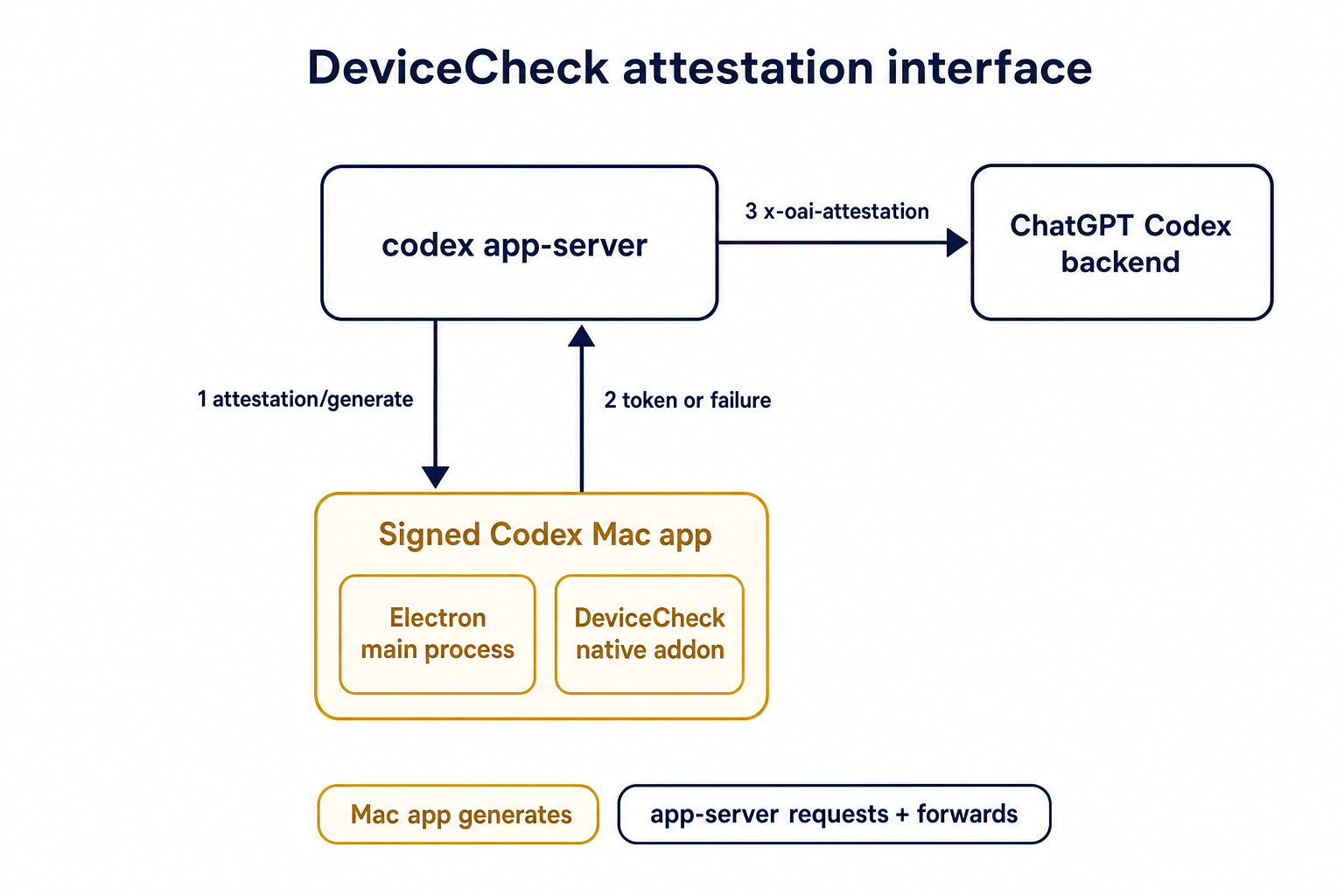 ## Details This PR teaches the Codex app-server runtime how to request and attach an attestation token. It does not generate DeviceCheck tokens directly; instead, it relies on the connected desktop app to advertise that it can generate attestation and then asks that app for a fresh header value when needed. The flow is: 1. The Codex desktop app connects to app-server. 2. During `initialize`, the app can advertise that it supports `requestAttestation`. 3. Before app-server calls selected ChatGPT Codex endpoints, it sends the internal server request `attestation/generate` to the app. 4. app-server receives a pre-encoded header value back. 5. app-server forwards that value as `x-oai-attestation` on the scoped outbound requests. The code in this repo is mostly protocol and runtime plumbing: it adds the app-server request/response shape, introduces an attestation provider in core, wires that provider into Responses / compaction / realtime setup paths, and covers the intended scoping with tests. The signed macOS DeviceCheck generation remains owned by the desktop app PR. ## Related PR - Codex desktop app implementation: https://github.com/openai/openai/pull/878649 ## Validation <details> <summary>Tests run</summary> ```sh cargo test -p codex-app-server-protocol cargo test -p codex-core attestation --lib cargo test -p codex-app-server --lib attestation ``` Also ran: ```sh just fix -p codex-core just fix -p codex-app-server just fix -p codex-app-server-protocol just fmt just write-app-server-schema ``` </details> <details> <summary>E2E DeviceCheck validation</summary> First validated the signed desktop app boundary directly: launched a packaged signed `Codex.app`, sent `attestation/generate`, decoded the returned `v1.` attestation header, and validated the extracted DeviceCheck token with `personal/jm/verify_devicecheck_token.py` using bundle ID `com.openai.codex`. Apple returned `status_code: 200` and `is_ok: true`. Then ran the fuller app + app-server flow. The packaged `Codex.app` launched a current-branch app-server via `CODEX_CLI_PATH`, and a local MITM proxy intercepted outbound `chatgpt.com` traffic. The app-server requested `attestation/generate` from the real Electron app process, and the intercepted `/backend-api/codex/responses` traffic included `x-oai-attestation` on both routes: ```text GET /backend-api/codex/responses Upgrade: websocket x-oai-attestation: present POST /backend-api/codex/responses Upgrade: none x-oai-attestation: present ``` The captured header decoded to a DeviceCheck token that also validated with Apple for `com.openai.codex` (`status_code: 200`, `is_ok: true`, team `2DC432GLL2`). </details> --------- Co-authored-by: Codex <noreply@openai.com> |
||
|
xl-openaiandGitHub
|
ae15343243 |
feat: Update plugin share settings with discoverability (#21637)
Requires discoverability on plugin/share/updateTargets so the server can manage workspace link access consistently, including auto-adding the workspace principal for UNLISTED. Also rejects LISTED on share creation and blocks client-supplied workspace principals while preserving response parsing for LISTED. |
||
|
Owen LinandGitHub
|
0d0835dd53 |
feat(app-server, threadstore): Thread pagination APIs and ThreadStore contract (#21566)
## Why The goal of this PR is to align on app-server and `ThreadStore` API updates for paginating through large threads. #### app-server ##### `thread/turns/list` - Updates `thread/turns/list` to support `itemsView?: "notLoaded" | "summary" | "full" | null`, defaulting to `summary`. - Implements the current `thread/turns/list` behavior over the existing persisted rollout-history fallback: - `notLoaded` returns turn envelopes with empty `items`. - `summary` returns the first user message and final assistant message when available. - `full` preserves the existing full item behavior. Note that this method still uses the naive approach of loading the entire rollout file, and returns just the filtered slice of the data. Real pagination will come later by leveraging SQLite. ##### `thread/turns/items/list` - Adds the experimental `thread/turns/items/list` protocol, schema, dispatcher, and processor stub. The app-server currently returns JSON-RPC `-32601` with `thread/turns/items/list is not supported yet`. #### ThreadStore - Adds the experimental `thread/turns/items/list` protocol, schema, dispatcher, and processor stub. The app-server currently returns JSON-RPC `-32601` with `thread/turns/items/list is not supported yet`. - Adds `ThreadStore` contract types and stubbed methods for listing thread turns and listing items within a turn. - Adds a typed `StoredTurnStatus` and `StoredTurnError` to avoid baking app-server API enums or lossy string status values into the store-facing turn contract. - Adds a typed `StoredTurnStatus` and `StoredTurnError` to avoid baking app-server API enums or lossy string status values into the store-facing turn contract. This also sketches the storage abstraction we expect to need once turns are indexed/stored. In particular, `notLoaded` is useful only if ThreadStore can eventually list turn metadata without loading every persisted item for each turn. ## Validation - Added/updated protocol serialization coverage for the new request and response shapes. - Added app-server integration coverage for `thread/turns/list` default summary behavior and all three `itemsView` modes. - Added app-server integration coverage that `thread/turns/items/list` returns the expected unsupported JSON-RPC error when experimental APIs are enabled. - Added thread-store coverage that the default trait methods return `ThreadStoreError::Unsupported`. No developers.openai.com documentation update is needed for this internal experimental app-server API surface. |
||
|
TomandGitHub
|
0274398901 |
[codex] Fix pathless thread summaries (#21266)
## Summary Fix `getConversationSummary` so thread-id summaries work for stored threads that do not have a local rollout path, such as remote thread stores. The root cause was that `summary_from_stored_thread` returned `None` when `StoredThread.rollout_path` was absent, and `get_thread_summary_response_inner` treated that as an internal error. This made conversation-id lookups depend on a local-only field even though the thread store can address the thread by id. |
||
|
TomandGitHub
|
56823ec46b |
Move thread name edits to ThreadStore (#21264)
- Route live thread renames through `ThreadStore` metadata updates. - Read resumed thread names from store metadata with legacy local fallback preserved in the store. |
||
 Ruslan NigmatullinandGitHub Ruslan NigmatullinandGitHub
|
e64a8979b0 | device-key: clean up unused crate (#21487) | ||
|
pakrym-oaiandGitHub
|
103dc2b6ae |
Revert "Move skills watcher to app-server" (#21460)
Reverts openai/codex#21287 |
||
|
xl-openaiandGitHub
|
11106016ff |
feat: Add marketplace source filtering and plugin share context (#21419)
Adds marketplaceKinds to plugin/list for local, workspace-directory, and shared-with-me; omitted params keep default local plus gated global behavior, while explicit kinds are exact. Exposes shareContext on plugin summaries from local share mappings and remote workspace/shared responses, including remotePluginId and nullable creator metadata. Adds shared-with-me listing through /ps/plugins/workspace/shared, renames the workspace remote namespace to workspace-directory, and keeps direct remote read/share/install/update/delete paths gated by plugins rather than remote_plugin. |
||
|
pakrym-oaiandGitHub
|
d5eea229cc |
Move skills watcher to app-server (#21287)
## Why Skills update notifications are app-server API behavior, but the watcher lived in `codex-core` and surfaced through `EventMsg::SkillsUpdateAvailable`. Moving the watcher out keeps core focused on thread execution and lets app-server own both cache invalidation and the `skills/changed` notification. ## What changed - Added an app-server-owned skills watcher that watches local skill roots, clears the shared skills cache, and emits `skills/changed` directly. - Registers skill watches from the common app-server thread listener attach path, including direct starts, resumes, and app-server-observed child or forked threads. - Stores the `WatchRegistration` on `ThreadState`, so listener replacement, thread teardown, idle unload, and app-server shutdown deregister by dropping the RAII guard. - Removed `EventMsg::SkillsUpdateAvailable`, the core watcher, and the old core live-reload test. - Extended the app-server skills change test to verify a cached skills list is refreshed after a filesystem change without forcing reload. ## Validation - `cargo check -p codex-core -p codex-app-server -p codex-mcp-server -p codex-rollout -p codex-rollout-trace` - `cargo test -p codex-app-server skills_changed_notification_is_emitted_after_skill_change` |
||
 aaronl-openaiandGitHub aaronl-openaiandGitHub
|
9f06d171e2 |
Preserve session MCP config on refresh (#21055)
# Overview MCP refreshes were rebuilding active threads from fresh disk-backed config only, which dropped thread-start session overlays such as app-injected MCP servers. This keeps refreshes current with disk config while preserving the thread-local config that only the active thread knows about. # Changes - Rebuild refreshed config per active thread using that thread's current `cwd`, rather than fanning out one app-server config to every thread. - Preserve each thread's `SessionFlags` layer while replacing reloadable config layers with freshly loaded config, then derive the MCP refresh payload from the rebuilt result. - Move MCP refresh orchestration into app-server so manual refreshes fail loudly while background refreshes remain best-effort, and route plugin-triggered refreshes through the same per-thread reload path. - Add regression coverage for session overlays, fresh project config, plugin-derived MCP config, current requirements, and strict vs best-effort refresh behavior. # Verification - Passed focused Rust coverage for the thread-config rebuild behavior and deferred MCP refresh flow, plus `cargo test -p codex-app-server --lib`. - Verified end to end in the Codex dev app against the locally built CLI: registered an MCP via thread config, verified that it could be used successfully before refresh, manually triggered MCP refresh, and verified that it continued to be available afterward. |
||
|
xl-openaiandGitHub
|
5119680f85 |
feat: Add plugin share access controls (#21124)
Extends `plugin/share/save` to accept optional discoverability and shareTargets while uploading plugin contents, and adds `plugin/share/updateTargets` for share-only target updates without re-uploading. |
||
 rhan-oaiandGitHub rhan-oaiandGitHub
|
9e0c191c13 |
add turn items view to app-server turns (#21063)
## Why `Turn.items` currently overloads an empty array to mean either that no items exist or that the server intentionally did not load them for this response. That ambiguity blocks future lazy-loading work where clients need to distinguish unloaded, summary, and fully hydrated turn payloads. ## What changed - add a new `TurnItemsView` enum with `notLoaded`, `summary`, and `full` variants - add required `itemsView` metadata to app-server `Turn` payloads - mark reconstructed persisted history as `full` and live shell-style turn payloads as `notLoaded` - keep current `thread/turns/list` behavior unchanged and document that it still returns `full` turns today - regenerate the JSON and TypeScript protocol fixtures ## Verification - `just write-app-server-schema` - `cargo test -p codex-app-server-protocol` - `cargo test -p codex-app-server thread_read_can_include_turns` - `cargo test -p codex-app-server thread_turns_list_can_page_backward_and_forward` - `cargo test -p codex-app-server thread_resume_rejects_history_when_thread_is_running` - `just fix -p codex-app-server-protocol` - `just fix -p codex-app-server` - `just fmt` |
||
|
pakrym-oaiandGitHub
|
b6d4c4ea6b |
[codex] Use shared app-server JSON-RPC error helpers (#21221)
## Why App-server had repeated hand-built JSON-RPC error objects for standard error shapes. Using the shared helpers keeps the common `invalid_request`, `invalid_params`, and `internal_error` construction in one place and reduces the chance of new call sites drifting from the common error payload shape. ## What changed - Replaced manual standard JSON-RPC error object creation with `internal_error(...)`, `invalid_request(...)`, and `invalid_params(...)` across app-server request processors and runtime paths. - Removed local duplicate helper definitions from search and review request handling. - Preserved existing structured `data` payloads by creating the shared helper error first and then attaching the existing metadata. - Left custom non-standard errors and raw error-code assertions intact. ## Validation - `cargo test -p codex-app-server` |
||
|
Owen LinandGitHub
|
6075b77001 |
app-server: ignore persist_extended_history param (#21225)
## Why Taking a step to removing the `persistExtendedHistory` field. It's not scalable to be persisting so much data in the rollout file and returning it in the thread history. When a client explicitly sends `true`, the server now tells that client the parameter is deprecated and ignored so the caller has a clear migration signal via the `deprecationNotice` notification. ## What changed - Keep the `persist_extended_history` / `persistExtendedHistory` field in the v2 protocol for compatibility, but document it as deprecated and ignored. - Ignore the parameter in app-server `thread/start`, `thread/resume`, and `thread/fork`; those paths always use limited history persistence now. - Stop treating `persistExtendedHistory` as a running-thread resume override mismatch. - Emit a connection-scoped `deprecationNotice` when a request explicitly sets `persist_extended_history: true`. ## Verification - Added `thread_start_deprecates_persist_extended_history_true` to cover the deprecation notice. - `cargo test -p codex-app-server` - `cargo test -p codex-app-server-protocol` |
||
 iceweasel-oaiandGitHub iceweasel-oaiandGitHub
|
f35285dc78 |
Add Windows sandbox readiness RPC (#20708)
## Why The desktop app on Windows needs a read-only way to tell, before the next tool call, whether the local Windows sandbox setup is in a state that should block the user and ask for setup again. The main case we want to cover is the elevated sandbox setup version bump. Today, if the app is configured for elevated Windows sandboxing and the installed setup is stale, the next sandboxed shell/exec path can end up triggering the elevated setup flow directly. That means the user can see an unexpected UAC prompt with no UI explanation. This change adds a small app-server preflight so the desktop app can ask “is Windows sandbox ready, not configured, or update-required?” during startup and show the appropriate blocking UI before the user hits a tool call. ## What changed - Added a new read-only app-server RPC: `windowsSandbox/readiness` - Added a new protocol enum and response type: - `WindowsSandboxReadiness` - `WindowsSandboxReadinessResponse` - Added core readiness logic in `core/src/windows_sandbox.rs`: - `ready` - `notConfigured` - `updateRequired` - Wired the new request through `codex_message_processor` - Regenerated the vendored app-server schema fixtures ## Readiness semantics This is intentionally a coarse startup/version-bump readiness check, not a full predictor of every runtime repair case. For now, readiness is determined from: - the configured Windows sandbox level - `sandbox_setup_is_complete()` for elevated mode That means: - `disabled` maps to `notConfigured` - `restricted token` maps to `ready` - `elevated` maps to `ready` or `updateRequired` depending on `sandbox_setup_is_complete()` This is deliberate for the first UI integration because the common case we want to catch is “the app updated, the elevated setup version bumped, and the user should see an update-required blocker instead of a surprise UAC prompt”. It does not attempt to model every case where the deeper runtime path might decide to repair or re-run setup. ## Testing - Ran `cargo fmt --all -- app-server-protocol/src/protocol/common.rs app-server-protocol/src/protocol/v2.rs app-server/src/codex_message_processor.rs core/src/windows_sandbox.rs core/src/windows_sandbox_tests.rs` - Added unit tests for the pure readiness mapping in `core/src/windows_sandbox_tests.rs` - Regenerated vendored schema fixtures with `cargo run -p codex-app-server-protocol --bin write_schema_fixtures -- --schema-root app-server-protocol/schema` - Did not run the full cargo test suite |
||
|
Eric TrautandGitHub
|
91b7350187 |
Add goal lifecycle metrics (#20799)
## Why Adding goal metrics makes it possible to track how often goals are created, completed, and stopped by budget limits, plus the final token and wall-clock usage for terminal outcomes. ## What Changed - Added OpenTelemetry metric constants for goal lifecycle tracking: - `codex.goal.created`: increments each time a new persisted goal is created or an existing goal is replaced with a new objective. - `codex.goal.completed`: increments when a goal transitions to `complete`. - `codex.goal.budget_limited`: increments when a goal transitions to `budget_limited` because its token budget has been reached. - `codex.goal.token_count`: records the final persisted token count when a goal transitions to `complete` or `budget_limited`. - `codex.goal.duration_s`: records the final persisted elapsed wall-clock time, in seconds, when a goal transitions to `complete` or `budget_limited`. - Emitted creation metrics when a goal is created or replaced. - Emitted terminal outcome counters and final usage histograms when a goal transitions to `complete` or `budget_limited`, avoiding double-counting later in-flight accounting for already budget-limited goals. - Added focused `codex-core` tests for create/complete metrics and one-time budget-limit metrics. |
||
|
TomandGitHub
|
33d24b0df5 |
codex: migrate (more) app-server thread history reads to ThreadStore (#20575)
Migrate token usage replay, rollback responses, and detached review setup (a special case of forking) to be served from ThreadStore reads rather direct rollout files. - replay restored token usage from already-loaded `RolloutItem` history instead of reopening `Thread.path` - rebuild rollback responses from loaded `ThreadStore` snapshots and history - start detached reviews from store-backed parent history and stored review-thread metadata - remove obsolete app-server rollout-summary helper code that became dead after the store-backed migration - preserve response/notification ordering for resume, fork, rollback, and detached review flows - add integration test coverage for the affected paths |
||
|
TomandGitHub
|
707e51bd8b |
codex: route metadata updates through ThreadStore (#20576)
- Route `thread/metadata/update` through `ThreadStore::update_thread_metadata`. - Add `LocalThreadStore` git metadata patch support for set, partial update, and clear semantics. - Add some unit tests for the new thread store code - Remove a lot of dead code/tests! |
||
|
|
4950e7d8a6 |
[codex] Add unsandboxed process exec API (#19040)
## Why App-server clients sometimes need argv-based local process execution while sandbox policy is controlled outside Codex. Those environments can reject sandbox-disabling paths before a command ever starts, even when the caller intentionally wants unsandboxed execution. This PR adds a distinct `process/*` API for that use case instead of extending `command/exec` with another sandbox-disabling shape. Keeping the new surface separate also makes the future removal of `command/exec` simpler: clients that need explicit process lifecycle control can move to the newer handle-based API without depending on `command/exec` business logic. ## What changed - Added v2 process lifecycle methods: `process/spawn`, `process/writeStdin`, `process/resizePty`, and `process/kill`. - Added process notifications: `process/outputDelta` for streamed stdout/stderr chunks and `process/exited` for final exit status and buffered output. - Made `process/spawn` intentionally unsandboxed and omitted sandbox-selection fields such as `sandboxPolicy` and `permissionProfile`. - Added client-supplied, connection-scoped `processHandle` values for follow-up control requests and notification routing. - Supported cwd, environment overrides, PTY mode and size, stdin streaming, stdout/stderr streaming, per-stream output caps, and timeout controls. - Killed active process sessions when the originating app-server connection closes. - Wired the implementation through the modular `request_processors/` app-server layout, with process-handle request serialization for follow-up control calls. - Updated generated JSON/TypeScript schema fixtures and documented the new API in `codex-rs/app-server/README.md`. - Added v2 app-server integration coverage in `codex-rs/app-server/tests/suite/v2/process_exec.rs` for spawn acknowledgement before exit, buffered output caps, and process termination. ## Verification - `cargo test -p codex-app-server-protocol` - `cargo test -p codex-app-server` --------- Co-authored-by: Owen Lin <owen@openai.com> |
||
|
Ruslan NigmatullinandGitHub
|
4d201e340e |
state: pass state db handles through consumers (#20561)
## Why SQLite state was still being opened from consumer paths, including lazy `OnceCell`-backed thread-store call sites. That let one process construct multiple state DB connections for the same Codex home, which makes SQLite lock contention and `database is locked` failures much easier to hit. State DB lifetime should be chosen by main-like entrypoints and tests, then passed through explicitly. Consumers should use the supplied `Option<StateDbHandle>` or `StateDbHandle` and keep their existing filesystem fallback or error behavior when no handle is available. The startup path also needs to keep the rollout crate in charge of SQLite state initialization. Opening `codex_state::StateRuntime` directly bypasses rollout metadata backfill, so entrypoints should initialize through `codex_rollout::state_db` and receive a handle only after required rollout backfills have completed. ## What Changed - Initialize the state DB in main-like entrypoints for CLI, TUI, app-server, exec, MCP server, and the thread-manager sample. - Pass `Option<StateDbHandle>` through `ThreadManager`, `LocalThreadStore`, app-server processors, TUI app wiring, rollout listing/recording, personality migration, shell snapshot cleanup, session-name lookup, and memory/device-key consumers. - Remove the lazy local state DB wrapper from the thread store so non-test consumers use only the supplied handle or their existing fallback path. - Make `codex_rollout::state_db::init` the local state startup path: it opens/migrates SQLite, runs rollout metadata backfill when needed, waits for concurrent backfill workers up to a bounded timeout, verifies completion, and then returns the initialized handle. - Keep optional/non-owning SQLite helpers, such as remote TUI local reads, as open-only paths that do not run startup backfill. - Switch app-server startup from direct `codex_state::StateRuntime::init` to the rollout state initializer so app-server cannot skip rollout backfill. - Collapse split rollout lookup/list APIs so callers use the normal methods with an optional state handle instead of `_with_state_db` variants. - Restore `getConversationSummary(ThreadId)` to delegate through `ThreadStore::read_thread` instead of a LocalThreadStore-specific rollout path special case. - Keep DB-backed rollout path lookup keyed on the DB row and file existence, without imposing the filesystem filename convention on existing DB rows. - Verify readable DB-backed rollout paths against `session_meta.id` before returning them, so a stale SQLite row that points at another thread's JSONL falls back to filesystem search and read-repairs the DB row. - Keep `debug prompt-input` filesystem-only so a one-off debug command does not initialize or backfill SQLite state just to print prompt input. - Keep goal-session test Codex homes alive only in the goal-specific helper, rather than leaking tempdirs from the shared session test helper. - Update tests and call sites to pass explicit state handles where DB behavior is expected and explicit `None` where filesystem-only behavior is intended. ## Validation - `CARGO_TARGET_DIR=/tmp/codex-target-state-db cargo check -p codex-rollout -p codex-thread-store -p codex-app-server -p codex-core -p codex-tui -p codex-exec -p codex-cli --tests` - `CARGO_TARGET_DIR=/tmp/codex-target-state-db cargo test -p codex-rollout state_db_` - `CARGO_TARGET_DIR=/tmp/codex-target-state-db cargo test -p codex-rollout find_thread_path` - `CARGO_TARGET_DIR=/tmp/codex-target-state-db cargo test -p codex-rollout find_thread_path -- --nocapture` - `CARGO_TARGET_DIR=/tmp/codex-target-state-db cargo test -p codex-rollout try_init_ -- --nocapture` - `CARGO_TARGET_DIR=/tmp/codex-target-state-db cargo test -p codex-rollout` - `CARGO_TARGET_DIR=/tmp/codex-target-state-db cargo clippy -p codex-rollout --lib -- -D warnings` - `CARGO_TARGET_DIR=/tmp/codex-target-state-db cargo test -p codex-thread-store read_thread_falls_back_when_sqlite_path_points_to_another_thread -- --nocapture` - `CARGO_TARGET_DIR=/tmp/codex-target-state-db cargo test -p codex-thread-store` - `CARGO_TARGET_DIR=/tmp/codex-target-state-db cargo test -p codex-core shell_snapshot` - `CARGO_TARGET_DIR=/tmp/codex-target-state-db cargo test -p codex-core --test all personality_migration` - `CARGO_TARGET_DIR=/tmp/codex-target-state-db cargo test -p codex-core --test all rollout_list_find` - `RUST_MIN_STACK=8388608 CODEX_SKIP_VENDORED_BWRAP=1 CARGO_TARGET_DIR=/tmp/codex-target-state-db cargo test -p codex-core --test all rollout_list_find::find_prefers_sqlite_path_by_id -- --nocapture` - `RUST_MIN_STACK=8388608 CODEX_SKIP_VENDORED_BWRAP=1 CARGO_TARGET_DIR=/tmp/codex-target-state-db cargo test -p codex-core --test all rollout_list_find -- --nocapture` - `CARGO_TARGET_DIR=/tmp/codex-target-state-db cargo test -p codex-core interrupt_accounts_active_goal_before_pausing` - `CARGO_TARGET_DIR=/tmp/codex-target-state-db cargo test -p codex-app-server get_auth_status -- --test-threads=1` - `CODEX_SKIP_VENDORED_BWRAP=1 CARGO_TARGET_DIR=/tmp/codex-target-state-db cargo test -p codex-app-server --lib` - `CODEX_SKIP_VENDORED_BWRAP=1 CARGO_TARGET_DIR=/tmp/codex-target-state-db cargo check -p codex-rollout -p codex-app-server --tests` - `CARGO_TARGET_DIR=/tmp/codex-target-state-db just fix -p codex-rollout -p codex-thread-store -p codex-core -p codex-app-server -p codex-tui -p codex-exec -p codex-cli` - `CODEX_SKIP_VENDORED_BWRAP=1 CARGO_TARGET_DIR=/tmp/codex-target-state-db just fix -p codex-rollout -p codex-app-server` - `CARGO_TARGET_DIR=/tmp/codex-target-state-db just fix -p codex-rollout` - `CODEX_SKIP_VENDORED_BWRAP=1 CARGO_TARGET_DIR=/tmp/codex-target-state-db just fix -p codex-core` - `just argument-comment-lint -p codex-core` - `just argument-comment-lint -p codex-rollout` Focused coverage added in `codex-rollout`: - `recorder::tests::state_db_init_backfills_before_returning` verifies the rollout metadata row exists before startup init returns. - `state_db::tests::try_init_waits_for_concurrent_startup_backfill` verifies startup waits for another worker to finish backfill instead of disabling the handle for the process. - `state_db::tests::try_init_times_out_waiting_for_stuck_startup_backfill` verifies startup does not hang indefinitely on a stuck backfill lease. - `tests::find_thread_path_accepts_existing_state_db_path_without_canonical_filename` verifies DB-backed lookup accepts valid existing rollout paths even when the filename does not include the thread UUID. - `tests::find_thread_path_falls_back_when_db_path_points_to_another_thread` verifies DB-backed lookup ignores a stale row whose existing path belongs to another thread and read-repairs the row after filesystem fallback. Focused coverage updated in `codex-core`: - `rollout_list_find::find_prefers_sqlite_path_by_id` now uses a DB-preferred rollout file with matching `session_meta.id`, so it still verifies that valid SQLite paths win without depending on stale/empty rollout contents. `cargo test -p codex-app-server thread_list_respects_search_term_filter -- --test-threads=1 --nocapture` was attempted locally but timed out waiting for the app-server test harness `initialize` response before reaching the changed thread-list code path. `bazel test //codex-rs/thread-store:thread-store-unit-tests --test_output=errors` was attempted locally after the thread-store fix, but this container failed before target analysis while fetching `v8+` through BuildBuddy/direct GitHub. The equivalent local crate coverage, including `cargo test -p codex-thread-store`, passes. A plain local `cargo check -p codex-rollout -p codex-app-server --tests` also requires system `libcap.pc` for `codex-linux-sandbox`; the follow-up app-server check above used `CODEX_SKIP_VENDORED_BWRAP=1` in this container. |
||
|
Owen LinandGitHub
|
541e99cf09 |
feat(app-server): always return limited thread history (#20682)
## Why Whenever we return a thread's history (turns and items) over app-server, always return the limited form as specified by the rollout policy `EventPersistenceMode::Limited`, even if the thread was previously started with `EventPersistenceMode::Extended`. We're finding it is quite unscalable to be returning the extended history, so let's apply the same filtering logic of the rollout policy when we load and return the thread's history. ## What Changed - Reuse the rollout persistence policy when reconstructing app-server `ThreadItem` history so only `EventPersistenceMode::Limited` rollout items are replayed into API turns. - Route `thread/read`, `thread/resume`, `thread/fork`, `thread/turns/list`, and rollback responses through the same filtered app-server history projection. - Keep live active turns intact when composing a response for a currently running thread. - Update command execution coverage so persisted extended command events are excluded from returned history for `thread/read`, `thread/fork`, and `thread/turns/list`. ## Test Plan - `cargo test -p codex-app-server limited` - `cargo test -p codex-app-server thread_shell_command` - `cargo test -p codex-app-server thread_read` - `cargo test -p codex-app-server thread_rollback` - `cargo test -p codex-app-server thread_fork` - `cargo test -p codex-app-server-protocol` |
||
|
pakrym-oaiandGitHub
|
33b19bcfde |
[codex] Split app-server request processors (#20940)
## Why The app-server request path had grown around a large `CodexMessageProcessor` plus separate API wrapper/helper modules. That made the dependency graph hard to see and forced unrelated request families to share broad processor state. This PR makes the split mechanical and command-prefix oriented so request families own only the dependencies they use. ## What changed - Replaced `CodexMessageProcessor` with command-prefix request processors under `app-server/src/request_processors/`. - Removed the old config, device-key, external-agent-config, and fs API wrapper files by moving their API handling into processors. - Split apps, plugins, marketplace, catalog, account, MCP, command exec, fs, git, feedback, thread, turn, thread goals, and Windows sandbox handling into dedicated processors. - Kept shared lifecycle, summary conversion, token usage replay, and shared error mapping only where multiple processors use them; single-use helpers were inlined into their owning processor. - Removed the fallback processor path and moved processor tests to `_tests` files. ## Validation - `cargo test -p codex-app-server` - `cargo check -p codex-app-server` - `just fix -p codex-app-server` |
