## Summary
- accept non-empty model-defined reasoning effort values while
preserving built-in effort behavior
- propagate the non-Copy effort type through core, app-server, TUI,
telemetry, and persistence call sites
- preserve string wire encoding and expose an open-string schema for
clients
- update model selection and shortcut behavior for model-advertised
effort values

## Root cause
`ReasoningEffort` gained a string-backed custom variant, so it could no
longer implement `Copy` or rely on derived closed-enum serialization.
Existing consumers still moved effort values from shared references and
assumed a fixed built-in value set.

## Validation
- `just fmt`
- Local tests and compilation were not run per request; relying on CI.
## Summary

Enterprise users can have an effective monthly credit limit, but Codex
`/status` currently drops that metadata from the account-usage response.

This change adds the optional `spend_control.individual_limit`
projection to the existing rate-limit snapshot flow. The backend client
reads the monthly limit, app-server exposes it as `individualLimit`, and
the TUI renders a `Monthly credit limit` row through the existing
progress-bar renderer.

When the backend does not return an effective monthly limit, existing
rate-limit behavior is unchanged.

## Existing backend state

The account-usage backend already returns the effective monthly limit
and current usage together:

```json
{
  "spend_control": {
    "reached": false,
    "individual_limit": {
      "limit": "25000",
      "used": "8000",
      "remaining": "17000",
      "used_percent": 32,
      "remaining_percent": 68,
      "reset_after_seconds": 86400,
      "reset_at": 1778137680
    }
  }
}
```

Before this change, Codex projected rolling `primary` and `secondary`
windows plus `credits`. It ignored `spend_control.individual_limit`, so
app-server clients and `/status` could not render the monthly cap.

The updated flow is:

```text
account usage backend
  -> backend-client reads spend_control.individual_limit
  -> existing rate-limit snapshot carries optional individual_limit
  -> app-server exposes optional individualLimit
  -> TUI renders Monthly credit limit
```

## App-server contract

`account/rateLimits/read` and sparse `account/rateLimits/updated`
notifications now include an additive nullable
`rateLimits.individualLimit` field:

```json
{
  "individualLimit": {
    "limit": "25000",
    "used": "8000",
    "remainingPercent": 68,
    "resetsAt": 1778137680
  }
}
```

In an `account/rateLimits/read` response, `null` means no monthly limit
is available. `account/rateLimits/updated` remains a sparse rolling
notification: clients merge available values into their most recent
`account/rateLimits/read` snapshot or refetch. Nullable account metadata
in a rolling notification does not clear a previously observed value.

## Design decisions

- Extend the existing rate-limit snapshot instead of introducing a
separate request or wire-level update protocol.
- Keep the Codex projection narrow: `/status` needs the effective limit,
current usage, remaining percentage, and reset timestamp.
- Render the monthly row through the existing progress-bar renderer,
with one optional detail line for `8,000 of 25,000 credits used`.
- Keep the backend response optional so existing accounts and older
usage states preserve their current behavior.
- Preserve cached monthly metadata when sparse rolling notifications
omit it. Live account-usage reads remain authoritative and can clear a
removed limit.

## Visual evidence

```text
 Monthly credit limit:   [██████████████░░░░░░] 68% left (resets 07:08 on 7 May)
                         8,000 of 25,000 credits used
```

Snapshot:
`codex-rs/tui/src/status/snapshots/codex_tui__status__tests__status_snapshot_includes_enterprise_monthly_credit_limit.snap`

## Testing

Tests: generated app-server schema verification, protocol tests,
backend-client tests, app-server integration coverage, TUI snapshot
coverage, formatting, and workspace lint cleanup.
## Summary

Remove the dead experimental `persistExtendedHistory` app-server flag
and collapse rollout persistence to the single policy app-server already
used.

## What Changed

- Removed `persistExtendedHistory` from v2 thread start/resume/fork
params and deleted its deprecation notice path.
- Removed the persistence-mode enums and plumbing through core, rollout,
and thread-store.
- Made rollout filtering mode-free, keeping the existing limited
persisted-history behavior.

## Test Plan

- `just write-app-server-schema`
- `cargo nextest run --no-fail-fast -p codex-app-server-protocol
schema_fixtures`
- `cargo nextest run --no-fail-fast -p codex-app-server
thread_shell_command_history_responses_exclude_persisted_command_executions`
- `cargo nextest run --no-fail-fast -p codex-rollout -p
codex-thread-store`
- final `rg` for removed flag/type names
## Why

This PR
https://github.com/openai/codex/pull/24161#discussion_r3325692763
revealed a subagent data modeling issue, where we overloaded
`forked_from_id` to also mean `parent_thread_id`. That's incorrect since
guardian and review subagents can be a subagent and NOT fork the main
thread's history.

The solution here is to explicitly store a new `parent_thread_id` on
`SessionMeta`, alongside `forked_from_id` which already exists. While
we're at it, also expose it in the app-server protocol on the `Thread`
object.

A thread->subagent relationship and a fork of thread history are
orthogonal concepts.

## What Changed

- Added top-level `parent_thread_id` persistence on `SessionMeta` and
runtime/session plumbing through `SessionConfiguredEvent`,
`CodexSpawnArgs`, `SessionConfiguration`, `ThreadConfigSnapshot`,
`TurnContext`, and `ModelClient`.
- Made turn metadata, request headers, analytics, and subagent-start
events read the separate runtime/top-level parent field instead of
deriving general parent lineage from `SessionSource` or
`forked_from_thread_id`.
- Passed parent lineage separately at delegated subagent, review,
guardian, agent-job, and multi-agent spawn construction sites;
copied-history fork lineage remains derived only from `InitialHistory`.
- Persisted and exposed parent lineage through rollout/thread-store
projections and app-server v2 `Thread.parentThreadId`.
- Updated app-server README text and regenerated app-server schema
fixtures for the additive `parentThreadId` response field.
## Why

Config loading should not create or write-authorize the memories root
just because memory support exists. Memory startup is the code path that
actually materializes that tree.

## What

- Stop creating the memories root during Config load and remove it from
legacy workspace-write projections.
- Grant the memories root read access only when the memories feature and
use_memories are enabled.
- Create the memories root inside memories startup before seeding
extension instructions.
- Update config and startup tests around the ownership boundary.

## Tests

- just fmt
- just fix -p codex-core
- just fix -p codex-memories-write
- just test -p codex-core
memory_tool_makes_memories_root_readable_without_creating_or_widening_writes
workspace_write_includes_configured_writable_root_once_without_memories_root
permission_profile_override_keeps_memories_root_out_of_legacy_projection
permissions_profiles_allow_direct_write_roots_outside_workspace_root
default_permissions_profile_populates_runtime_sandbox_policy
- just test -p codex-memories-write memories_startup_creates_memory_root

Note: a broader just test -p codex-core run is not clean in this
sandbox; it hit missing test_stdio_server plus seatbelt, realtime, and
environment-sensitive failures. The changed config tests above pass.
## Summary
- Add `request_kind` values for foreground turn, startup prewarm,
compaction, and detached memory model requests.
- Attach compaction dispatch metadata to local Responses, legacy
`/v1/responses/compact`, and remote v2 compact requests.
- Add the existing logical context-window identifier as `window_id` on
turn-owned model request metadata.
- Keep identity fields optional for detached memory requests, while
still emitting `request_kind="memory"` in non-git/no-sandbox workspaces.

## Root Cause
`x-codex-turn-metadata` has more than one producer. Foreground turns and
compaction requests own a real turn and should carry that turn identity.
Detached memory stage-one requests do not own a foreground turn, so
absent identity fields are valid rather than missing data. Startup
websocket prewarm is also a model request, but it has `generate=false`
and must not be counted as a foreground turn.

`thread_source` or session source identifies where a thread came from
(for example review, guardian, or another subagent). `request_kind`
identifies what the current outbound model request is doing (`turn`,
`prewarm`, `compaction`, or `memory`). A review or guardian thread can
issue either a normal turn request or a compaction request, so source
cannot replace request kind.

## Behavior / Impact
- Ordinary foreground requests send `request_kind="turn"`, their real
identity fields, and `window_id="<thread_id>:<window_generation>"`.
- Startup websocket warmup requests send `request_kind="prewarm"` so
they are not counted as foreground turns.
- Compaction requests send `request_kind="compaction"`, their real
owning turn identity, the existing `window_id`, and
`compaction.{trigger,reason,implementation,phase,strategy}`.
- Detached memory stage-one requests send `request_kind="memory"`
without `session_id`, `thread_id`, `turn_id`, or `window_id`; when no
workspace metadata exists, the kind-only header is still emitted.
- `session_id`, `thread_id`, `turn_id`, and `window_id` remain optional
in the header schema because detached memory requests do not own a
foreground turn or context window.
- `window_id` is not a new ID system: it is copied from the already-sent
`x-codex-window-id` / WS client metadata value at model-request dispatch
time.
- Existing `x-codex-window-id` HTTP/WS emission, value format,
generation advancement, resume behavior, and fork reset behavior are
unchanged.
- `request_kind`, `window_id`, and upstream turn-owned identity fields
remain schema-owned; input `responsesapi_client_metadata` cannot replace
their canonical values.
- No table, DAG, export, app-server API, or MCP `_meta` schema changes
are included.

A compaction attempt stopped by a pre-compact hook issues no model
request and therefore has no request header; its outcome remains in
analytics events. Status, error, duration, and token deltas also remain
analytics fields rather than request-header fields.

Future detached-memory attribution using a real initiating turn ID as
`trigger_turn_id` is intentionally not part of this PR.

## Sync With Main
- Final pushed head `716342e79` is rebased onto `origin/main@0d37db4b2`.
- The metadata conflict came from upstream `#24160`, which added
`forked_from_thread_id` on the same `turn_metadata` surface. Resolution
preserves that field and its protection from client metadata override
alongside this PR's request-kind, compaction, and window-id fields.
- While resolving the overlapping commits, I removed an accidental
recursive model-request overlay and a duplicate detached-memory header
builder before completing the rebase.

## Latency / User Experience Boundary
- Foreground turns perform no new filesystem, git, or network work. New
fields are inserted into metadata already serialized for outgoing
requests.
- Compaction issues the same model/HTTP requests with the same prompt,
model, service tier, and sampling settings; only metadata bytes change.
- Startup prewarm already sent metadata; it is now correctly classified
as `prewarm`.
- Non-git detached memory now sends a small kind-only metadata header
rather than no header.
- This client diff adds no user-visible latency mechanism beyond
negligible serialization and header bytes on already-existing requests.

## Validation
On conflict-resolved head `1d35c2cfb` based on `origin/main@487521733`:
- `just fmt` (passed)
- `just fix -p codex-core` (passed)
- `git diff --check origin/main...HEAD` (passed)
- `just test -p codex-core -E 'test(turn_metadata) |
test(websocket_first_turn_uses_startup_prewarm_and_create) |
test(responses_stream_includes_turn_metadata_header_for_git_workspace_e2e)
|
test(responses_websocket_forwards_turn_metadata_on_initial_and_incremental_create)
| test(remote_compact_v2_retries_failures_with_stream_retry_budget) |
test(window_id_advances_after_compact_persists_on_resume_and_resets_on_fork)'`
(`23 passed`; `bench-smoke` passed)
- `just test -p codex-app-server -E
'test(turn_start_forwards_client_metadata_to_responses_request_v2) |
test(turn_start_forwards_client_metadata_to_responses_websocket_request_body_v2)
| test(auto_compaction_remote_emits_started_and_completed_items)'` (`3
passed`; `bench-smoke` passed)
- `just test -p codex-memories-write` (`29 passed`; `bench-smoke`
passed)
## Summary
- Bump the workspace Rust toolchain from `1.93.0` to `1.95.0` across
Cargo, Bazel, CI, release workflows, devcontainers, and the Codex
environment config.
- Refresh `MODULE.bazel.lock` so the Bazel Rust toolchain artifacts
match the new version.
- Leave purpose-specific toolchains unchanged, including the
`argument-comment-lint` nightly and the upstream `rusty_v8` `1.91.0`
build pin.
- Includes fixes for new lints from `just fix` and a few codex-authored
fixes for lints without a suggestion.
## Summary

Adds experimental `additionalContext` support to `turn/start` and
`turn/steer` so clients can provide ephemeral external context, such as
browser or automation state, without turning that plumbing into a
visible user prompt or triggering user-prompt lifecycle behavior.

## API Shape

The parameter shape is:

```ts
additionalContext?: Record<string, {
  value: string
  kind: "untrusted" | "application"
}> | null
```

Example:

```json
{
  "additionalContext": {
    "browser_info": {
      "value": "Active tab is CI failures.",
      "kind": "untrusted"
    },
    "automation_info": {
      "value": "CI rerun is in progress.",
      "kind": "application"
    }
  }
}
```

The keys are opaque and caller-defined.

## Context Injection

When provided, accepted entries are inserted into model context as
hidden contextual message items, not as visible thread user-message
items.

`kind: "untrusted"` entries are inserted with role `user`:

```text
<external_${key}>${value}</external_${key}>
```

`kind: "application"` entries are inserted with role `developer`:

```text
<${key}>${value}</${key}>
```

Values are not escaped. Each value is truncated to 1k approximate tokens
before wrapping.

For `turn/start`, accepted additional context is inserted before normal
user input. For `turn/steer`, additional context is merged only when the
steer includes non-empty user input; context-only steers still reject as
empty input.

## Dedupe Strategy

`AdditionalContextStore` lives on session state and stores the latest
complete additional-context map.

Each `turn/start` or non-empty `turn/steer` treats its
`additionalContext` as the current complete set of values. Entries are
injected only when the key is new or the exact entry for that key
changed, including `value` or `kind`. After merging, the store is
replaced with the provided map, so omitted keys are removed from the
retained set and can be injected again later if reintroduced.

Omitting `additionalContext`, passing `null`, or passing an empty object
resets the store to empty and injects nothing.

## What Changed

- Threads experimental v2 `additionalContext` through app-server into
core turn start and steer handling.
- Adds separate contextual fragment types for untrusted user-role
context and application developer-role context.
- Uses pending response input items so additional context can be
combined with normal user input without treating it as prompt text.
- Adds integration coverage for start/steer flow, role routing,
dedupe/reset behavior, deletion/re-add behavior, hook-blocked input
behavior, empty context-only steer rejection, external-fragment marker
matching, and truncation.
## Summary

Generated memory rows and their stage-one/stage-two job state currently
live in `state_5.sqlite` alongside thread metadata. That makes memory
cleanup and regeneration share the main state schema even though those
rows are memory-pipeline data and can be rebuilt independently from the
durable thread records.

This PR moves the memory-owned tables into a dedicated
`memories_1.sqlite` runtime database while keeping thread metadata in
`state_5.sqlite`.

## Changes

- Adds a separate memories DB runtime, migrator, path helpers, telemetry
kind, and Bazel compile data for `state/memory_migrations`.
- Introduces `MemoryStore` behind `StateRuntime::memories()` and moves
memory table/job operations onto that store.
- Drops the old memory tables from the state DB and recreates their
schema in `state/memory_migrations/0001_memories.sql`.
- Updates memory startup, citation usage tracking, rollout pollution
handling, `debug clear-memories`, and app-server `memory/reset` to
operate through the memories DB.
- Preserves cross-DB behavior by hydrating thread metadata from the
state DB when selecting visible memory outputs and checking stage-one
staleness.

## Verification

- Added/updated `codex-state` tests for deleted-thread memory visibility
and already-polluted phase-two enqueue behavior.
- Updated `debug clear-memories`, app-server `memory/reset`, and
memories startup tests to seed and assert memory rows through
`memories_1.sqlite`.
**Stack position:** [5 of 7]

## Summary

This PR adds `Op::ThreadSettings`, a queued settings-only update
mechanism for changing stored thread settings without starting a new
turn. It also removes the legacy `Op::OverrideTurnContext` in the same
layer, so reviewers can see the replacement and deletion together.

## Changes

- Add `Op::ThreadSettings` for settings-only queued updates.
- Emit `ThreadSettingsApplied` with the effective thread settings
snapshot after core applies an update.
- Route settings-only updates through the same submission queue as user
input.
- Migrate remaining `OverrideTurnContext` tests and callers to the
queued `Op::ThreadSettings` path.
- Delete `Op::OverrideTurnContext` from the core protocol and submission
loop.

This stack addresses #20656 and #22090.

## Stack

1. [1 of 7] [Add thread settings to
UserInput](https://github.com/openai/codex/pull/23080)
2. [2 of 7] [Remove
UserInputWithTurnContext](https://github.com/openai/codex/pull/23081)
3. [3 of 7] [Remove
UserTurn](https://github.com/openai/codex/pull/23075)
4. [4 of 7] [Placeholder for OverrideTurnContext
cleanup](https://github.com/openai/codex/pull/23087)
5. [5 of 7] [Replace OverrideTurnContext with
ThreadSettings](https://github.com/openai/codex/pull/22508) (this PR)
6. [6 of 7] [Add app-server thread settings
API](https://github.com/openai/codex/pull/22509)
7. [7 of 7] [Sync TUI thread
settings](https://github.com/openai/codex/pull/22510)
**Stack position:** [1 of 7]

## Summary

The first three PRs in this stack are a cleanup pass before the actual
thread settings API work.

Today, core has several overlapping "user input" ops: `UserInput`,
`UserInputWithTurnContext`, and `UserTurn`. They differ mostly in how
much next-turn state they carry, which makes the later queued thread
settings update harder to reason about and review.

This PR starts that cleanup by adding the shared
`ThreadSettingsOverrides` payload and allowing `Op::UserInput` to carry
it. Existing variants remain in place here, so this layer is mostly a
behavior-preserving API shape change plus mechanical constructor
updates.

## End State After PR3

By the end of PR3, `Op::UserInput` is the only "user input" core op. It
can carry optional thread settings overrides for callers that need to
update stored defaults with a turn, while callers without updates use
empty settings. `Op::UserInputWithTurnContext` and `Op::UserTurn` are
deleted.

## End State After PR5

By the end of PR5, core will have only two ops for this area:

- `Op::UserInput` for user-input-bearing submissions.
- `Op::ThreadSettings` for settings-only updates.

## Stack

1. [1 of 7] [Add thread settings to
UserInput](https://github.com/openai/codex/pull/23080) (this PR)
2. [2 of 7] [Remove
UserInputWithTurnContext](https://github.com/openai/codex/pull/23081)
3. [3 of 7] [Remove
UserTurn](https://github.com/openai/codex/pull/23075)
4. [4 of 7] [Placeholder for OverrideTurnContext
cleanup](https://github.com/openai/codex/pull/23087)
5. [5 of 7] [Replace OverrideTurnContext with
ThreadSettings](https://github.com/openai/codex/pull/22508)
6. [6 of 7] [Add app-server thread settings
API](https://github.com/openai/codex/pull/22509)
7. [7 of 7] [Sync TUI thread
settings](https://github.com/openai/codex/pull/22510)
## Why

`memory_summary.md` is injected into every session, so its value depends
on staying compact, navigational, and easy to regenerate when the
expected shape changes. The previous consolidation prompt encouraged a
broad actionable inventory and allowed older summary structures to be
patched in place, which makes it easier for stale or overly verbose
summaries to keep accumulating.

This change makes the summary format explicitly versioned and biases
Phase 2 memory consolidation toward denser prompt-loaded context.

## What changed

- Require `memory_summary.md` to begin with an exact `v1` header.
- Teach consolidation to regenerate `memory_summary.md` from scratch
when the header is missing or incompatible, while still allowing
incremental updates to `MEMORY.md`.
- Tighten the `memory_summary.md` instructions so it acts as a compact
routing/index layer instead of a second handbook.
- Lower `MEMORY_TOOL_DEVELOPER_INSTRUCTIONS_SUMMARY_TOKEN_LIMIT` from
`5_000` to `2_500` so the runtime prompt budget matches the denser
summary target.

## Verification

Not run; this is a prompt/template update plus a prompt budget constant
change.
## Summary
TL;DR: teaches `codex-rs` / app-server to request a desktop-provided
attestation token and attach it as `x-oai-attestation` on the scoped
ChatGPT Codex request paths.
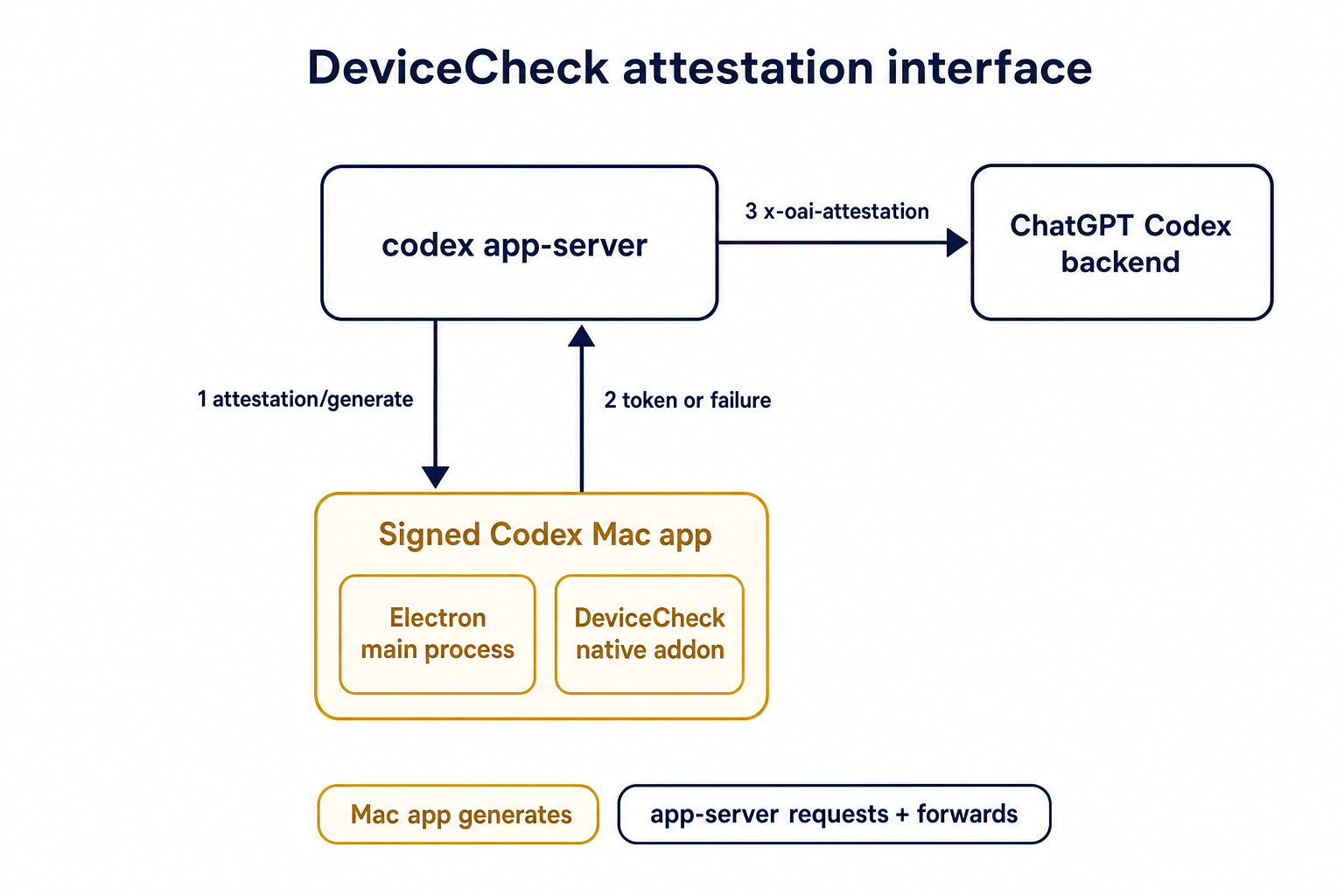
## Details
This PR teaches the Codex app-server runtime how to request and attach
an attestation token. It does not generate DeviceCheck tokens directly;
instead, it relies on the connected desktop app to advertise that it can
generate attestation and then asks that app for a fresh header value
when needed.
The flow is:
1. The Codex desktop app connects to app-server.
2. During `initialize`, the app can advertise that it supports
`requestAttestation`.
3. Before app-server calls selected ChatGPT Codex endpoints, it sends
the internal server request `attestation/generate` to the app.
4. app-server receives a pre-encoded header value back.
5. app-server forwards that value as `x-oai-attestation` on the scoped
outbound requests.
The code in this repo is mostly protocol and runtime plumbing: it adds
the app-server request/response shape, introduces an attestation
provider in core, wires that provider into Responses / compaction /
realtime setup paths, and covers the intended scoping with tests. The
signed macOS DeviceCheck generation remains owned by the desktop app PR.
## Related PR
- Codex desktop app implementation:
https://github.com/openai/openai/pull/878649
## Validation
<details>
<summary>Tests run</summary>
```sh
cargo test -p codex-app-server-protocol
cargo test -p codex-core attestation --lib
cargo test -p codex-app-server --lib attestation
```
Also ran:
```sh
just fix -p codex-core
just fix -p codex-app-server
just fix -p codex-app-server-protocol
just fmt
just write-app-server-schema
```
</details>
<details>
<summary>E2E DeviceCheck validation</summary>
First validated the signed desktop app boundary directly: launched a
packaged signed `Codex.app`, sent `attestation/generate`, decoded the
returned `v1.` attestation header, and validated the extracted
DeviceCheck token with `personal/jm/verify_devicecheck_token.py` using
bundle ID `com.openai.codex`. Apple returned `status_code: 200` and
`is_ok: true`.
Then ran the fuller app + app-server flow. The packaged `Codex.app`
launched a current-branch app-server via `CODEX_CLI_PATH`, and a local
MITM proxy intercepted outbound `chatgpt.com` traffic. The app-server
requested `attestation/generate` from the real Electron app process, and
the intercepted `/backend-api/codex/responses` traffic included
`x-oai-attestation` on both routes:
```text
GET /backend-api/codex/responses Upgrade: websocket x-oai-attestation: present
POST /backend-api/codex/responses Upgrade: none x-oai-attestation: present
```
The captured header decoded to a DeviceCheck token that also validated
with Apple for `com.openai.codex` (`status_code: 200`, `is_ok: true`,
team `2DC432GLL2`).
</details>
---------
Co-authored-by: Codex <noreply@openai.com>
## Summary

`cargo test` has entails both running standard Rust tests and doctests.
It turns out that the doctest discovery is fairly slow, and it's a cost
you pay even for crates that don't include any doctests.

This PR disables doctests with `doctest = false` for crates that lack
any doctests.

For the collection of crates below, this speeds up test execution by
>4x.

E.g., before this PR:

```
Benchmark 1: cargo test     -p codex-utils-absolute-path     -p codex-utils-cache     -p codex-utils-cli     -p codex-utils-home-dir     -p codex-utils-output-truncation     -p codex-utils-path     -p codex-utils-string     -p codex-utils-template     -p codex-utils-elapsed     -p codex-utils-json-to-toml
  Time (mean ± σ):      1.849 s ±  4.455 s    [User: 0.752 s, System: 1.367 s]
  Range (min … max):    0.418 s … 14.529 s    10 runs
```

And after:

```
Benchmark 1: cargo test     -p codex-utils-absolute-path     -p codex-utils-cache     -p codex-utils-cli     -p codex-utils-home-dir     -p codex-utils-output-truncation     -p codex-utils-path     -p codex-utils-string     -p codex-utils-template     -p codex-utils-elapsed     -p codex-utils-json-to-toml
  Time (mean ± σ):     428.6 ms ±   6.9 ms    [User: 187.7 ms, System: 219.7 ms]
  Range (min … max):   418.0 ms … 436.8 ms    10 runs
```

For a single crate, with >2x speedup, before:

```
Benchmark 1: cargo test -p codex-utils-string
  Time (mean ± σ):     491.1 ms ±   9.0 ms    [User: 229.8 ms, System: 234.9 ms]
  Range (min … max):   480.9 ms … 512.0 ms    10 runs
```

And after:

```
Benchmark 1: cargo test -p codex-utils-string
  Time (mean ± σ):     213.9 ms ±   4.3 ms    [User: 112.8 ms, System: 84.0 ms]
  Range (min … max):   206.8 ms … 221.0 ms    13 runs
```

Co-authored-by: Codex <noreply@openai.com>
## Summary

Related to
https://openai.slack.com/archives/C095U48JNL9/p1777537279707449
TLDR:
We update the meaning of session ids and thread ids:
* thread_id stays as now
* session_id become a shared id between every thread under a /root
thread (i.e. every sub-agent share the same session id)

This PR introduces an explicit `SessionId` and threads it through the
protocol/client boundary so `session_id` and `thread_id` can diverge
when they need to, while preserving compatibility for older serialized
`session_configured` events.

---------

Co-authored-by: Codex <noreply@openai.com>
## Summary
- make `thread_source` an explicit optional thread-level field on
`thread/start`, `thread/fork`, and returned thread payloads
- persist `thread_source` in rollout/session metadata so resumed live
threads retain the original value
- replace the old best-effort `session_source` -> `thread_source`
mapping with an explicit caller-supplied analytics classification

## Why
Before this change, analytics `thread_source` was populated by a
best-effort mapping from `session_source`. `session_source` describes
the runtime/client surface, not the actual thread-level origin, so that
projection was not accurate enough to distinguish cases such as `user`,
`subagent`, `memory_consolidation`, and future thread origins reliably.

Making `thread_source` explicit keeps one thread-level analytics field
while letting callers provide the real classification directly instead
of recovering it indirectly from `session_source`.

## Impact
For new analytics events, `thread_source` now reflects the explicit
thread-level classification supplied by the caller rather than an
inferred value derived from `session_source`. Existing protocol fields
remain optional; callers that omit `threadSource` now produce `null`
instead of a best-effort inferred value.

## Validation
- `just write-app-server-schema`
- `cargo test -p codex-analytics -p codex-core -p
codex-app-server-protocol --no-run`
- `cargo test -p codex-app-server-protocol
generated_ts_optional_nullable_fields_only_in_params`
- `cargo test -p codex-analytics
thread_initialized_event_serializes_expected_shape`
- `cargo test -p codex-core
resume_stopped_thread_from_rollout_preserves_thread_source`
## Summary

Ad-hoc memory notes are written under `memories/extensions/ad_hoc/`, but
the consolidation agent only knows how to interpret an extension when
the extension folder has an `instructions.md`. Seed those instructions
from the memories write pipeline so an enabled memories startup creates
the expected ad-hoc extension layout automatically.

This also moves extension-specific write behavior behind a dedicated
`memories/write/src/extensions/` module. `ad_hoc` owns the seeded
instructions template, while the existing resource-retention cleanup
lives in its own `prune` module so future memory extensions can add
their own write-side setup without growing a flat helper file.

## Changes

- Seed `memories/extensions/ad_hoc/instructions.md` during eligible
memory startup without overwriting an existing file.
- Store the ad-hoc instructions template under
`memories/write/templates/extensions/ad_hoc/`, keeping ownership in
`codex-memories-write`.
- Split memory extension support into `extensions::ad_hoc` and
`extensions::prune`.
- Keep the existing old-resource pruning behavior unchanged.

## Verification

- `cargo test -p codex-memories-write`
- `bazel build //codex-rs/memories/write:write`

---------

Co-authored-by: chatgpt-codex-connector[bot] <199175422+chatgpt-codex-connector[bot]@users.noreply.github.com>
- Build one app-server process ThreadStore from startup config and share
it with ThreadManager and CodexMessageProcessor.
- Remove per-thread/fork store reconstruction so effective thread config
cannot switch the persistence backend.
- Add params to ThreadStore create/resume for specifying thread
metadata, since otherwise the metadata from store creation would be used
(incorrectly).
## Why

This bug is exposed by Guardian/auto-review approvals. With the managed
network proxy enabled, a blocked network request can be reported back
through the network approval service as an approval denial after the
command has already started. Before this change, the shell and unified
exec runtimes registered those network approval calls, but did not have
a way to observe an async proxy denial as a cancellation/failure signal
for the running process.

The result was confusing: Guardian/auto-review could correctly deny
network access, but the command path could keep running or unregister
the approval without surfacing the denial as the command failure.

## What Changed

- `NetworkApprovalService` now attaches a cancellation token to active
and deferred network approvals.
- Proxy-denial outcomes are recorded only for active registrations,
cancel the owning token, and are consumed when the approval is
finalized.
- The shell runtime combines the normal command timeout with the
network-denial cancellation token.
- Unified exec stores the deferred network approval object, terminates
tracked processes when the proxy denial arrives, and returns the denial
as a process failure while polling or completing the process.
- Tool orchestration passes the active network approval cancellation
token into the sandbox attempt and preserves deferred approval errors
instead of silently unregistering them.
- App-server `command/exec` now handles the combined
timeout-or-cancellation expiration variant used by the runtime.

## Verification

- `cargo test -p codex-core network_approval --lib`
- `cargo clippy -p codex-app-server --all-targets -- -D warnings`
- `cargo clippy -p codex-core --all-targets -- -D warnings`

---------

Co-authored-by: Codex <noreply@openai.com>
Summary:
- Add codex-thread-manager-sample, a one-shot binary that starts a
ThreadManager thread, submits a prompt, and prints the final assistant
output.
- Pass ThreadStore into ThreadManager::new and expose
thread_store_from_config for existing callsites.
- Build the sample Config directly with only --model and prompt inputs.

Verification:
- just fmt
- cargo check -p codex-thread-manager-sample -p codex-app-server -p
codex-mcp-server
- git diff --check

Tests: Not run per request.
## Why

Memory startup runs in the background after an eligible turn, but it can
consume Codex backend quota at exactly the wrong time: when the user is
already near a rate-limit boundary. This PR adds a guard so the memory
pipeline backs off when the Codex rate-limit snapshot says the remaining
budget is too low.

## What Changed

- Added `memories.min_rate_limit_remaining_percent` with a default of
`25`, clamped to `0..=100`, and regenerated `core/config.schema.json`.
- Added `codex-rs/memories/write/src/guard.rs`, which fetches Codex
backend rate limits before memory startup and skips phase 1 / phase 2
when the Codex limit is reached or either tracked window is above the
configured usage ceiling.
- Keeps startup best-effort: non-Codex auth or rate-limit fetch/client
failures preserve the existing memory startup behavior.
- Records a `codex.memory.startup` counter with
`status=skipped_rate_limit` when startup is skipped.
- Added config parsing/clamping coverage and guard unit tests.

## Verification

- Added `codex-rs/memories/write/src/guard_tests.rs` for threshold,
primary/secondary window, and reached-limit behavior.
- Added config tests for TOML parsing and clamping.
## Why

Memory startup was tied to thread lifecycle events such as create, load,
and fork. That can run memory work before a thread receives real user
input, and it makes startup cost scale with thread management instead of
actual turns. Moving the trigger to `thread/sendInput` keeps memory
startup aligned with the first real user turn and lets it use the
current thread config at turn time.

The idea is to prevent ghost cost due to pre-warm triggered by the app

Turn-based startup can also make global phase-2 consolidation easier to
request repeatedly, so this adds a success cooldown and tightens the
default startup scan window.

## What Changed

- Start `codex_memories_write::start_memories_startup_task` after a
non-empty `thread/sendInput` turn is submitted, instead of from thread
create/load/fork paths:
https://github.com/openai/codex/blob/d4a6885b7829e2fd2ec7a09355e4f75ebe1d1fe3/codex-rs/app-server/src/codex_message_processor.rs#L6477-L6487
- Expose `CodexThread::config()` so app-server can pass the live config
into memory startup at turn time.
- Add a six-hour successful-run cooldown for global phase-2
consolidation via `SkippedCooldown`:
https://github.com/openai/codex/blob/d4a6885b7829e2fd2ec7a09355e4f75ebe1d1fe3/codex-rs/state/src/runtime/memories.rs#L963-L966
- Reduce memory startup defaults to at most 2 rollouts over 10 days:
https://github.com/openai/codex/blob/d4a6885b7829e2fd2ec7a09355e4f75ebe1d1fe3/codex-rs/config/src/types.rs#L31-L34

## Verification

Updated the memory runtime coverage around phase-2 reclaim behavior,
including `phase2_global_lock_respects_success_cooldown`.

---------

Co-authored-by: Codex <noreply@openai.com>
## Why

Phase 2 still needs to choose the most relevant stage-1 memory outputs
by usage and recency, but exposing that ranking as the rendered
`raw_memories.md` order creates unnecessary large diff. Usage-count or
timestamp changes can reshuffle otherwise unchanged memories, making the
workspace diff noisy and giving the consolidation prompt a misleading
recency signal from file position.
This fix will reduce token consumption

## What Changed

- Keep the existing top-N Phase 2 selection ranking by `usage_count`,
`last_usage`, `source_updated_at`, and `thread_id`.
- Return the selected rows in stable ascending `thread_id` order before
syncing Phase 2 filesystem inputs.
- Update the memory README, raw memories header, and consolidation
prompt so they describe the stable order and tell the prompt to use
metadata and workspace diffs instead of file order as the recency
signal.
- Adjust the memory runtime tests to use deterministic thread IDs and
assert the stable return order separately from the ranked selection
semantics.

## Test Coverage

- Existing memory runtime tests in
`codex-rs/state/src/runtime/memories.rs` now cover the stable returned
ordering for Phase 2 inputs.

---------

Co-authored-by: Codex <noreply@openai.com>
Keep extracting memories out of core and moving the write trigger in the
app-server
This is temporary and it should move at the client level as a follow-up
This makes core fully independant from `codex-memories-write`

---------

Co-authored-by: Codex <noreply@openai.com>
Ahmed Ibrahim ·
efrazer-oai ·
Owen Lin ·
jif-oai ·
ningyi-oai ·
Adam Perry @ OpenAI ·
pakrym-oai ·
Eric Traut ·
Jiaming Zhang ·
Charlie Marsh ·
rhan-oai ·
Tom ·
viyatb-oai ·
