Commit Graph

53 Commits

  • [codex-analytics] add extensible feature thread sources (#27063)
    ## Why
    - `ThreadSource` currently defines a closed set of core-owned values
    - Product features also create threads for background or scheduled work
    - Adding every product-specific value to the core enum would require
    repeated `codex-rs` protocol changes
    - Feature-backed values let product callers provide precise attribution
    while preserving the existing core classifications
    
    ## What Changed
    - Adds `ThreadSource::Feature(String)` for app-owned thread source
    values
    - Represents all app-server v2 thread sources as scalar strings, so a
    feature source is supplied as `"automation"`
    - Persists and emits the feature's plain string label, so `"automation"`
    produces `thread_source="automation"` in analytics
    - Keeps `user`, `subagent`, and `memory_consolidation` as explicit
    core-owned values and regenerates the app-server schemas and TypeScript
    bindings
    
    ## Verification
    - `just write-app-server-schema`
    - `cargo check --workspace`
    - `just test -p codex-protocol
    feature_thread_source_serializes_as_its_app_owned_label`
    - `just test -p codex-app-server-protocol
    thread_sources_round_trip_as_scalar_labels`
    - `cargo test -p codex-analytics
    thread_initialized_event_serializes_expected_shape`
    - `just fmt`
  • Load selected executor skills through extensions (#27184)
    ## Why
    
    CCA is moving toward a split runtime where the orchestrator may not have
    a filesystem, while executors can expose preinstalled plugins and
    skills. A thread therefore needs to select capabilities without asking
    app-server or core to interpret executor-owned paths through the
    orchestrator's filesystem.
    
    The longer-term model is broader than executor skills:
    
    - A plugin is a bundle of skills, MCP servers, connectors/apps, and
    hooks.
    - A plugin root can be local, executor-owned, or hosted by a backend.
    - Components inside one plugin can use different access and execution
    mechanisms. A skill may be read from a filesystem or through backend
    tools; an HTTP MCP server can run without an executor; a stdio MCP
    server or hook needs an execution environment.
    - Core should carry generic extension initialization data. The extension
    that owns a component should discover it, expose it to the model, and
    invoke it through the appropriate runtime.
    
    This PR establishes that architecture through one complete vertical:
    selecting a root on an executor, discovering the skills beneath it,
    exposing those skills to the model, and reading an explicitly invoked
    `SKILL.md` through the same executor.
    
    ## Contract
    
    `thread/start` gains an experimental `selectedCapabilityRoots` field:
    
    ```json
    {
      "selectedCapabilityRoots": [
        {
          "id": "deploy-plugin@1",
          "location": {
            "type": "environment",
            "environmentId": "workspace",
            "path": "/opt/codex/plugins/deploy"
          }
        }
      ]
    }
    ```
    
    The root is intentionally not classified as a "plugin" or "skill" in the
    API. It can point at a standalone skill, a directory containing several
    skills, or a plugin containing skills and other components. This PR only
    teaches the skills extension how to consume it; later extensions can
    resolve MCP, connector, and hook components from the same selection.
    
    The platform-supplied `id` is stable selection identity. The location
    says which runtime owns the root and gives that runtime an opaque path.
    App-server does not inspect or canonicalize the path.
    
    ## What changed
    
    ### Generic thread extension initialization
    
    App-server converts selected roots into `ExtensionDataInit`. Core
    carries that generic initialization value until the final thread ID is
    known, then creates thread-scoped `ExtensionData` before lifecycle
    contributors run.
    
    This keeps `Session` and core independent of the capability-selection
    contract. The initialization value is consumed during construction; it
    is not retained as another long-lived `Session` field.
    
    ### Executor-backed skills
    
    The skills extension now owns an `ExecutorSkillProvider` that:
    
    - resolves the selected environment through `EnvironmentManager`
    - discovers, canonicalizes, and reads skills through that environment's
    `ExecutorFileSystem`
    - contributes the bounded selected-skill catalog as stable developer
    context
    - reads an explicitly invoked skill body through the authority that
    listed it
    - warns when an environment or root is unavailable
    - never falls back to the orchestrator filesystem for an executor-owned
    root
    
    Skill catalog and instruction fragments have hard byte bounds, which
    also bound them below the 10K-token per-item context limit. If a
    selected executor skill has the same name as a legacy local skill, the
    executor selection owns that invocation and the local body is not
    injected a second time.
    
    Existing local and bundled skill loading remains in place. Omitting
    `selectedCapabilityRoots` therefore preserves current local-only
    behavior.
    
    ## Current semantics
    
    - Only environment-owned locations are represented in this first
    contract.
    - Roots are resolved by the destination extension, not by app-server or
    core.
    - An unavailable executor or invalid root produces a warning and no
    capabilities from that root; it does not trigger a local-filesystem
    fallback.
    - Selection applies to a newly started active thread.
    - MCP servers, connectors, and hooks beneath a selected plugin root are
    not activated yet.
    - Selection is not yet persisted or inherited across resume, fork, or
    subagent creation. Existing local capabilities continue to behave as
    they do today in those flows.
    
    ## Planned vertical follow-ups
    
    1. **Hosted HTTP MCP:** add an extension-backed HTTP MCP source that
    works without an executor, then replace the special-purpose MCP plugins
    loader with that implementation.
    2. **Executor MCP:** register and execute stdio MCP servers through the
    environment that owns the selected plugin root.
    3. **Backend skills:** add a hosted skill source whose catalog and
    bodies are accessed through extension tools rather than a filesystem.
    4. **Connectors and hooks:** activate those components through their
    owning extensions, using the same selected-root boundary and
    component-specific runtime.
    5. **Durable selection:** define the desired-selection lifecycle,
    persist it, and make resume, fork, and subagent inheritance explicit
    rather than accidental.
    6. **Local convergence:** incrementally route existing local plugin,
    skill, and MCP loading through the same extension model while preserving
    current local behavior.
    
    Each follow-up remains reviewable as an end-to-end capability. The
    platform selects roots, generic thread extension data carries the
    selection, and the owning extension resolves and operates its component.
    
    ## Verification
    
    Coverage added for:
    
    - app-server end-to-end discovery and explicit invocation of a skill
    inside an executor-selected plugin root
    - exclusive invocation when a selected executor skill collides with a
    local skill name
    - executor filesystem authority for discovery, canonicalization, and
    reads
    - thread extension initialization before lifecycle contributors run
    - stable executor catalog context, explicit invocation, context
    rebuilding, hidden skills, and preserved host/remote catalog behavior
    
    Targeted protocol, core-skills, skills-extension, core lifecycle, and
    app-server executor-skill tests were run during development.
  • Avoid rereading rollout history during cold resume (#27031)
    ## Summary
    
    - reuse the history-bearing `StoredThread` loaded while probing for a
    running thread
    - avoid rereading and reparsing the rollout when that probe finds no
    active process
    - reload after shutting down a loaded thread because shutdown may flush
    newer rollout items
    - add a regression test that verifies cold resume performs one
    history-bearing store read
    
    ## Problem
    
    `thread/resume` first reads the persisted thread with history while
    checking whether the thread is
    already running. When no running process exists, cold resume currently
    falls through to
    `resume_thread_from_rollout`, which reads and parses the same history
    again.
    
    That duplicate work grows with rollout size and remains on the
    synchronous resume path even when
    the caller requests `excludeTurns`.
    
    ## Background
    
    The duplicate read was introduced by #24528, which fixed resume
    overrides for idle cached
    threads. To support resumes specified by rollout path,
    `resume_running_thread` began loading the
    stored thread with history so it could resolve the canonical thread ID
    and determine whether a
    cached `CodexThread` was already loaded.
    
    That history is needed when the loaded-thread path handles the request.
    On a cold miss, however,
    the function's boolean result could only report that no loaded thread
    handled the request. It
    discarded the history-bearing `StoredThread`, and the normal cold-resume
    path immediately loaded
    and parsed the same rollout again.
    
    This change preserves the idle cached-thread behavior from #24528 while
    allowing the cold-resume
    path to reuse the probe result.
    
    ## Performance
    
    I benchmarked real retained rollouts using isolated `CODEX_HOME`
    directories, explicit rollout
    paths, debug builds of the commit and its exact parent, and alternating
    parent/patch order. The
    table below uses `thread/resume` with `excludeTurns: true`; response
    payload sizes were identical.
    
    | Rollout size | Records | Parent median | Patch median | Median paired
    saving |
    | ---: | ---: | ---: | ---: | ---: |
    | 6 MB | 3,574 | 541 ms | 441 ms | 132 ms |
    | 30 MB | 15,220 | 1.505 s | 1.041 s | 701 ms |
    | 60 MB | 31,453 | 2.644 s | 1.742 s | 970 ms |
    | 149 MB | 100,874 | 10.506 s | 7.156 s | 3.350 s |
    | 559 MB | 259,734 | 27.759 s | 16.725 s | 9.836 s |
    
    The absolute saving increases with thread size, as expected when
    removing one complete JSONL
    history read and parse. Total resume time is also content-dependent, so
    the relationship is not
    perfectly linear.
    
    I also tested full-history resume with `excludeTurns: false`. The
    response payload was
    byte-identical between variants, and the same size-dependent improvement
    remained visible:
    
    | Rollout size | Parent median | Patch median | Median paired saving |
    | ---: | ---: | ---: | ---: |
    | 6 MB | 1.052 s | 904 ms | 270 ms |
    | 30 MB | 2.667 s | 1.762 s | 924 ms |
    | 60 MB | 8.464 s | 6.272 s | 3.680 s |
    | 149 MB | 26.719 s | 12.118 s | 14.601 s |
    | 559 MB | 40.359 s | 25.475 s | 16.590 s |
    
    ## Validation
    
    - `just test -p codex-app-server
    cold_thread_resume_reuses_non_local_history_probe`
    - `just fix -p codex-app-server -p codex-thread-store`
    - `just fmt`
  • Pair thread environment settings (#26687)
    ## Why
    
    Thread cwd and environment selections are a single logical setting in
    core: updating one without the other can silently desynchronize the
    next-turn execution context. This change makes that relationship
    explicit in the internal thread settings flow while preserving the
    existing app-server public API shape.
    
    ## What changed
    
    - Moved the cwd/environment pair through internal
    `ThreadSettingsOverrides.environment_settings` instead of a top-level
    internal `cwd` field.
    - Kept `thread/settings/update` public params unchanged, with app-server
    translating top-level `cwd` into the paired internal settings shape.
    - Moved `Op::UserInput` environment overrides into thread settings so
    user turns and settings updates use the same core path.
    - Updated core, app-server, MCP, memories, sample, and test callsites to
    construct the paired settings shape.
    
    ## Verification
    
    - `git diff --check`
    - Local test run starting after PR creation.
  • Make runtime workspace roots absolute in app-server API (#26552)
    Stacked on #26532.
    
    ## Why
    
    #26532 moves cwd normalization to the app-server/core boundary.
    `runtimeWorkspaceRoots` still accepted raw paths in v2 requests and in
    `ConfigOverrides`, which left core responsible for interpreting those
    roots later. This makes runtime workspace roots follow the same
    absolute-path boundary as cwd.
    
    ## What
    
    - Change v2 `runtimeWorkspaceRoots` request fields for `thread/start`,
    `thread/resume`, `thread/fork`, and `turn/start` to `AbsolutePathBuf`.
    - Deduplicate already-absolute runtime roots in app-server handlers and
    pass them through `ConfigOverrides.workspace_roots` as
    `AbsolutePathBuf`.
    - Update TUI and exec client request builders to pass absolute runtime
    roots directly.
    - Update app-server docs, schema fixtures, and focused tests for
    absolute runtime roots.
    
    ## Testing
    
    - `just test -p codex-app-server-protocol`
    - `just test -p codex-app-server runtime_workspace_roots`
    - `just test -p codex-core
    session_permission_profile_rebinds_runtime_workspace_roots`
    - `just test -p codex-tui app_server_session`
    - `just test -p codex-exec`
  • [codex] Support model-defined reasoning efforts (#26444)
    ## Summary
    - accept non-empty model-defined reasoning effort values while
    preserving built-in effort behavior
    - propagate the non-Copy effort type through core, app-server, TUI,
    telemetry, and persistence call sites
    - preserve string wire encoding and expose an open-string schema for
    clients
    - update model selection and shortcut behavior for model-advertised
    effort values
    
    ## Root cause
    `ReasoningEffort` gained a string-backed custom variant, so it could no
    longer implement `Copy` or rely on derived closed-enum serialization.
    Existing consumers still moved effort values from shared references and
    assumed a fixed built-in value set.
    
    ## Validation
    - `just fmt`
    - Local tests and compilation were not run per request; relying on CI.
  • Route AGENTS.md loading through environment filesystems (#26205)
    ## Why
    
    Workspace-specific `AGENTS.md` loading needs to use the selected
    environment filesystem so remote workspaces and child agents read
    instructions from their actual environment instead of the host
    filesystem. The app-server should report the same instruction sources
    the initialized thread actually loaded, rather than independently
    rescanning configuration and filesystem state.
    
    ## What changed
    
    - Introduce `LoadedAgentsMd` to retain ordered user, project, and
    internal instructions with their provenance.
    - Load and canonicalize workspace `AGENTS.md` paths through the primary
    `EnvironmentManager` environment, then render the loaded instructions
    when constructing turn context.
    - Expose cached loaded instruction sources from initialized threads and
    use them for app-server start, resume, and fork responses.
    - Preserve global `CODEX_HOME` loading and separator behavior while
    excluding empty project files that did not supply model-visible
    instructions.
    - Add integration coverage for CLI injection, selected-environment
    provenance and rendering, empty environment selection, and cached
    sources on loaded-thread resume.
    
    ## Validation
    
    - `just test -p codex-core agents_md`
    - `just test -p codex-core
    selected_environment_sources_match_model_visible_instructions`
    - `just test -p codex-exec agents_md`
    - `just test -p codex-app-server instruction_sources`
    - `just test -p codex-app-server --status-level fail`
  • Fix forked thread name inheritance (#26075)
    Fixes #25950.
    
    ## Why
    Forking a renamed thread could fall back to the source thread's
    first-prompt title because the fork path did not preserve the source's
    explicit name. That meant fork-of-renamed-fork flows could show stale
    sidebar labels even though the user had renamed the parent.
    
    ## What changed
    `thread/fork` now reads the source thread's distinct `name`, normalizes
    it, persists it onto materialized forks, and applies it to the returned
    API thread. Because the source `name` already excludes first-prompt
    pseudo-titles, forks inherit only an explicit user rename instead of
    stale generated metadata.
  • Fix Windows running thread resume path normalization (#25509)
    ## Why
    
    Fixes #24944.
    
    On Windows, app-server resume could reject an active running thread when
    the requested session path used normal `C:\...` form and the
    already-running path used verbatim `\\?\C:\...` form. The paths point at
    the same JSONL file, but the resume stale-path guard compared raw
    `PathBuf`s, so desktop resume and heartbeat flows could fail with a
    mismatched-path error.
    
    ## What Changed
    
    - Compare requested and active rollout paths with
    `path_utils::paths_match_after_normalization`.
    - Extend the existing running-thread mismatched-path test with a
    Windows-only same-file resume case before the stale-path rejection.
    
    ## Verification
    
    - `just test -p codex-app-server
    thread_resume_rejects_mismatched_path_for_running_thread_id`
  • app-server: remove experimental persist_extended_history bool flag (#25712)
    ## Summary
    
    Remove the dead experimental `persistExtendedHistory` app-server flag
    and collapse rollout persistence to the single policy app-server already
    used.
    
    ## What Changed
    
    - Removed `persistExtendedHistory` from v2 thread start/resume/fork
    params and deleted its deprecation notice path.
    - Removed the persistence-mode enums and plumbing through core, rollout,
    and thread-store.
    - Made rollout filtering mode-free, keeping the existing limited
    persisted-history behavior.
    
    ## Test Plan
    
    - `just write-app-server-schema`
    - `cargo nextest run --no-fail-fast -p codex-app-server-protocol
    schema_fixtures`
    - `cargo nextest run --no-fail-fast -p codex-app-server
    thread_shell_command_history_responses_exclude_persisted_command_executions`
    - `cargo nextest run --no-fail-fast -p codex-rollout -p
    codex-thread-store`
    - final `rg` for removed flag/type names
  • store and expose parent_thread_id on Threads (#25113)
    ## Why
    
    This PR
    https://github.com/openai/codex/pull/24161#discussion_r3325692763
    revealed a subagent data modeling issue, where we overloaded
    `forked_from_id` to also mean `parent_thread_id`. That's incorrect since
    guardian and review subagents can be a subagent and NOT fork the main
    thread's history.
    
    The solution here is to explicitly store a new `parent_thread_id` on
    `SessionMeta`, alongside `forked_from_id` which already exists. While
    we're at it, also expose it in the app-server protocol on the `Thread`
    object.
    
    A thread->subagent relationship and a fork of thread history are
    orthogonal concepts.
    
    ## What Changed
    
    - Added top-level `parent_thread_id` persistence on `SessionMeta` and
    runtime/session plumbing through `SessionConfiguredEvent`,
    `CodexSpawnArgs`, `SessionConfiguration`, `ThreadConfigSnapshot`,
    `TurnContext`, and `ModelClient`.
    - Made turn metadata, request headers, analytics, and subagent-start
    events read the separate runtime/top-level parent field instead of
    deriving general parent lineage from `SessionSource` or
    `forked_from_thread_id`.
    - Passed parent lineage separately at delegated subagent, review,
    guardian, agent-job, and multi-agent spawn construction sites;
    copied-history fork lineage remains derived only from `InitialHistory`.
    - Persisted and exposed parent lineage through rollout/thread-store
    projections and app-server v2 `Thread.parentThreadId`.
    - Updated app-server README text and regenerated app-server schema
    fixtures for the additive `parentThreadId` response field.
  • Add thread archive CLI commands (#25021)
    ## Problem
    
    Saved threads can already be archived through app-server RPCs, but the
    command line did not expose direct archive or unarchive commands.
    
    ## Solution
    
    Add `codex archive <thread>` and `codex unarchive <thread>`, resolving
    UUIDs or exact thread names before calling the existing `thread/archive`
    and `thread/unarchive` RPCs. The commands support scoped remote flags so
    callers can target remote app-server endpoints when archiving or
    unarchiving threads.
    
    This also fixes a long-standing bug in `codex resume <thread id>` and
    `codex fork <thread id>` that I found when testing the new commands.
    These operations shouldn't be allowed on archived sessions. They now
    fail with an error that tells the user to run `codex unarchive <thread
    id>` first.
    
    ## Verification
    
    Added app-server coverage for rejecting archived thread resume by id and
    checking that the error includes the matching `codex unarchive <thread
    id>` command.
  • feat(app-server): include turns page on thread resume (#23534)
    ## Summary
    
    The client currently calls `thread/resume` to establish live updates and
    immediately follows it with `thread/turns/list` to hydrate recent turns.
    This lets `thread/resume` return that page directly, eliminating a round
    trip and the ordering/deduplication gap between the two calls.
    
    Experimental clients opt in with `initialTurnsPage: { limit,
    sortDirection, itemsView }`. The response returns `initialTurnsPage` as
    a `TurnsPage`, including cursors for paging further back in history.
    Keeping the controls in a nested opt-in object provides the useful
    `thread/turns/list` knobs without spreading page-specific parameters
    across `thread/resume`.
    
    ## Verification
    
    - `just fmt`
    - `just write-app-server-schema --experimental`
    - `just write-app-server-schema`
    - `cargo test -p codex-app-server-protocol`
    - `cargo test -p codex-app-server
    thread_resume_initial_turns_page_matches_requested_turns_list_page
    --tests`
    - `cargo test -p codex-app-server
    thread_resume_rejoins_running_thread_even_with_override_mismatch
    --tests`
    - `just fix -p codex-app-server-protocol -p codex-app-server`
  • Respect resume cwd overrides for idle cached threads (#24528)
    Fixes #24186.
    
    ## Why
    When the TUI resumes a thread through the local app-server daemon with a
    selected workspace, `thread/resume` can hit an already-loaded but idle
    cached thread. That path previously rejoined the cached `CodexThread`,
    so cwd/config overrides in `ThreadResumeParams` were ignored and the
    resumed session kept using the old cwd.
    
    ## What changed
    App-server now treats a loaded-but-idle thread with no subscribers as a
    cache entry when resume overrides differ: it unloads that cached thread
    and lets the normal resume path rebuild it with the requested
    cwd/config. Threads that still have subscribers, or active runtime work,
    continue to rejoin the existing loaded thread so in-flight state remains
    observable.
    
    The existing thread teardown helper was generalized from
    archive-specific cleanup to shared unload cleanup for this path.
  • Move memory state to a dedicated SQLite DB (#24591)
    ## Summary
    
    Generated memory rows and their stage-one/stage-two job state currently
    live in `state_5.sqlite` alongside thread metadata. That makes memory
    cleanup and regeneration share the main state schema even though those
    rows are memory-pipeline data and can be rebuilt independently from the
    durable thread records.
    
    This PR moves the memory-owned tables into a dedicated
    `memories_1.sqlite` runtime database while keeping thread metadata in
    `state_5.sqlite`.
    
    ## Changes
    
    - Adds a separate memories DB runtime, migrator, path helpers, telemetry
    kind, and Bazel compile data for `state/memory_migrations`.
    - Introduces `MemoryStore` behind `StateRuntime::memories()` and moves
    memory table/job operations onto that store.
    - Drops the old memory tables from the state DB and recreates their
    schema in `state/memory_migrations/0001_memories.sql`.
    - Updates memory startup, citation usage tracking, rollout pollution
    handling, `debug clear-memories`, and app-server `memory/reset` to
    operate through the memories DB.
    - Preserves cross-DB behavior by hydrating thread metadata from the
    state DB when selecting visible memory outputs and checking stage-one
    staleness.
    
    ## Verification
    
    - Added/updated `codex-state` tests for deleted-thread memory visibility
    and already-polluted phase-two enqueue behavior.
    - Updated `debug clear-memories`, app-server `memory/reset`, and
    memories startup tests to seed and assert memory rows through
    `memories_1.sqlite`.
  • [codex] Add rollout-backed thread content search (#23519)
    ## Summary
    - add experimental `thread/search` for local rollout-backed thread
    search using `rg` over JSONL rollouts
    - return search-specific result rows with optional previews instead of
    storing preview data on `StoredThread` or ordinary `Thread` responses
    - keep `thread/list` separate from full-content search and document the
    new app-server surface
    
    ## Testing
    - `cargo test -p codex-app-server-protocol`
    - `cargo test -p codex-app-server
    thread_search_returns_content_and_title_matches -- --nocapture`
  • Fix empty rollout path app-server handling (#23400)
    ## Summary
    - Coerce `path: ""` to `None` at the v2 protocol params deserialization
    boundary for `thread/resume` and `thread/fork`.
    - Restore the pre-ThreadStore running-thread resume behavior: if
    `threadId` is already running, rejoin it by id and treat a non-empty
    `path` only as a consistency check; otherwise cold resume keeps `history
    > path > threadId` precedence.
    - Add protocol, resume, and fork regression coverage for empty path
    payloads; refresh app-server schema fixtures for the clarified params
    docs.
    
    ## Tests
    - `just fmt`
    - `just write-app-server-schema`
    - `cargo test -p codex-app-server-protocol
    thread_path_params_deserialize_empty_path_as_none`
    - `cargo test -p codex-app-server-protocol --test schema_fixtures`
    - `cargo test -p codex-app-server empty_path`
    - `RUST_MIN_STACK=8388608 cargo test -p codex-app-server --test all
    thread_resume_rejects_mismatched_path_for_running_thread_id`
    - `RUST_MIN_STACK=8388608 cargo test -p codex-app-server --test all
    thread_resume_uses_path_over_non_running_thread_id`
  • Make local environment optional in EnvironmentManager (#23369)
    ## Summary
    - make `EnvironmentManager` local environment/runtime paths optional
    - simplify constructor surface around snapshot materialization
    - rename local env accessors to `require_local_environment` /
    `try_local_environment`
    
    ## Validation
    - devbox Bazel build for touched crate surfaces
    - `//codex-rs/exec-server:exec-server-unit-tests`
    - `//codex-rs/app-server-client:app-server-client-unit-tests`
    - filtered touched `//codex-rs/core:core-unit-tests` cases
  • app-server: use profile ids in v2 permission params (#23360)
    ## Why
    
    The v2 app-server permission profile fields are experimental, but the
    previous migration kept a legacy object payload for profile selection.
    That made clients aware of server-owned `activePermissionProfile`
    metadata such as `extends`, and it kept a
    `legacy_additional_writable_roots` path even though
    `runtimeWorkspaceRoots` now owns runtime workspace-root selection.
    
    This PR makes the client contract match the intended model: clients
    select a permission profile by id, and the server resolves and reports
    active profile provenance in response payloads.
    
    Follow-up to #22611.
    
    ## What Changed
    
    - Changed `thread/start`, `thread/resume`, `thread/fork`, and
    `turn/start` permission profile selection to plain profile id strings.
    - Changed `command/exec.permissionProfile` to a plain profile id string
    for the same client/server ownership split.
    - Removed `PermissionProfileSelectionParams` and the legacy `{ type:
    "profile", modifications: [...] }` compatibility deserializer.
    - Updated app-server, TUI, and `codex exec` call sites to send only ids,
    while keeping `activePermissionProfile` as server response metadata.
    - Updated app-server docs and schema fixtures for the revised
    `command/exec.permissionProfile` shape.
    
    ## Verification
    
    - `cargo test -p codex-app-server-protocol`
    - `RUST_MIN_STACK=8388608 cargo test -p codex-app-server`
    - `cargo test -p codex-exec`
    - `RUST_MIN_STACK=8388608 cargo test -p codex-tui`
    
    ---
    [//]: # (BEGIN SAPLING FOOTER)
    Stack created with [Sapling](https://sapling-scm.com). Best reviewed
    with [ReviewStack](https://reviewstack.dev/openai/codex/pull/23360).
    * #23368
    * __->__ #23360
  • app-server: stop returning thread permission profiles (#22792)
    ## Why
    
    The app-server thread lifecycle API should no longer expose the full
    `PermissionProfile` value. After the permissions-profile migration,
    clients should round-trip only the active profile identity through
    `activePermissionProfile` and `permissions` when that identity is known.
    
    The full profile is server-side config. Treating a response-derived
    legacy sandbox projection as a new local profile can lose named-profile
    restrictions and accidentally widen permissions on the next turn. The
    legacy `sandbox` response field remains only as the
    compatibility/display fallback.
    
    ## What Changed
    
    - Removed `permissionProfile` from `ThreadStartResponse`,
    `ThreadResumeResponse`, and `ThreadForkResponse`.
    - Stopped populating that field in app-server thread start/resume/fork
    responses.
    - Updated embedded exec/TUI response mapping to derive display
    permission state from local config or the legacy sandbox fallback
    instead of a response profile value.
    - Added a TUI turn override shape that distinguishes preserving server
    permissions, selecting an active profile id, and sending a legacy
    sandbox for an explicit local override.
    - Preserved remote app-server permissions across turns by sending
    `permissions` only when an `activePermissionProfile` id is known, and
    otherwise sending no sandbox override unless the user selected a local
    override.
    - Kept embedded `thread/resume` hydration server-authored when
    `activePermissionProfile` is absent, which matches the live-thread
    attach path where the server ignores requested overrides.
    - Updated the app-server README to remove the obsolete lifecycle
    response `permissionProfile` reference. The remaining
    `permissionProfile` README references are request-side permission
    overrides.
    - Regenerated app-server JSON schema and TypeScript fixtures.
    - Kept the generated typed response enum exempt from
    `large_enum_variant`, matching the existing payload enum exemption after
    the lifecycle response variants shrank.
    
    ## How To Review
    
    Start with `codex-rs/app-server-protocol/src/protocol/v2/thread.rs` to
    confirm the response shape, then check the response construction in
    `codex-rs/app-server/src/request_processors`. The generated schema and
    TypeScript fixture changes are mechanical follow-through from the
    protocol removal.
    
    The TUI behavior is the delicate part: review
    `codex-rs/tui/src/app_server_session.rs` for response hydration and
    turn-start override projection, then
    `codex-rs/tui/src/app/thread_routing.rs` for the decision about whether
    the next turn should preserve the server snapshot, send an active
    profile id, or send a legacy sandbox for an explicit local override.
    
    ## Verification
    
    - `just write-app-server-schema`
    - `cargo test -p codex-app-server-protocol
    thread_lifecycle_responses_default_missing_optional_fields`
    - `cargo test -p codex-exec
    session_configured_from_thread_response_uses_permission_profile_from_config`
    - `cargo test -p codex-tui --lib thread_response`
    - `cargo test -p codex-tui turn_permissions_`
    - `cargo test -p codex-tui
    resume_response_restores_turns_from_thread_items`
    - `cargo test -p codex-analytics
    track_response_only_enqueues_analytics_relevant_responses`
    - `just fix -p codex-analytics`
    - `just fix -p codex-app-server-protocol`
    - `just fix -p codex-tui`
    - `just argument-comment-lint`
    
    ---
    [//]: # (BEGIN SAPLING FOOTER)
    Stack created with [Sapling](https://sapling-scm.com). Best reviewed
    with [ReviewStack](https://reviewstack.dev/openai/codex/pull/22792).
    * #22795
    * __->__ #22792
  • app-server: use permission ids and runtime workspace roots (#22611)
    ## Why
    
    This PR builds on [#22610](https://github.com/openai/codex/pull/22610)
    and is the app-server side of the migration from mutable per-turn
    `SandboxPolicy` replacement toward selecting immutable permission
    profiles by id plus mutable runtime workspace roots.
    
    Once permission profiles can carry their own immutable
    `workspace_roots`, app-server no longer needs to mutate the selected
    `PermissionProfile` just to represent thread-specific filesystem
    context. The mutable part now lives on the thread as explicit
    `runtimeWorkspaceRoots`, while `:workspace_roots` remains symbolic until
    the sandbox is realized for a turn.
    
    ## What Changed
    
    - Replaced the v2 permission-selection wrapper surface with plain
    profile ids for `thread/start`, `thread/resume`, `thread/fork`, and
    `turn/start`.
    - Removed the API surface for profile modifications
    (`PermissionProfileSelectionParams`,
    `PermissionProfileModificationParams`,
    `ActivePermissionProfileModification`).
    - Added experimental `runtimeWorkspaceRoots` fields to the thread
    lifecycle and turn-start APIs.
    - Threaded runtime workspace roots through core session/thread
    snapshots, turn overrides, app-server request handling, and command
    execution permission resolution.
    - Kept session permission state symbolic so later runtime root updates
    and cwd-only implicit-root retargeting rebind `:workspace_roots`
    correctly.
    - Updated the embedded clients just enough to send and restore the new
    thread state.
    - Refreshed the generated schema/TypeScript artifacts and the app-server
    README to match the new contract.
    
    ## Verification
    
    Targeted coverage for this layer lives in:
    
    - `codex-rs/app-server-protocol/src/protocol/v2/tests.rs`
    - `codex-rs/app-server/tests/suite/v2/thread_start.rs`
    - `codex-rs/app-server/tests/suite/v2/thread_resume.rs`
    - `codex-rs/app-server/tests/suite/v2/turn_start.rs`
    - `codex-rs/core/src/session/tests.rs`
    
    The key regression checks exercise that:
    
    - `runtimeWorkspaceRoots` resolve against the effective cwd on thread
    start.
    - Profile-declared workspace roots are excluded from the runtime
    workspace roots returned by app-server.
    - A turn-level runtime workspace-root update persists onto the thread
    and is returned by `thread/resume`.
    - A named permission profile selected on one turn remains symbolic so a
    later runtime-root-only turn update changes the actual sandbox writes.
    - A cwd-only turn update retargets the implicit runtime cwd root while
    preserving additional runtime roots.
    - The protocol fixtures and generated client artifacts stay in sync with
    the string-based permission selection contract.


    ---
    [//]: # (BEGIN SAPLING FOOTER)
    Stack created with [Sapling](https://sapling-scm.com). Best reviewed
    with [ReviewStack](https://reviewstack.dev/openai/codex/pull/22611).
    * #22612
    * __->__ #22611
  • permissions: support workspace roots in profiles (#22610)
    ## Why
    
    This is the configuration/model half of the alternative permissions
    migration we discussed as a comparison point for
    [#22401](https://github.com/openai/codex/pull/22401) and
    [#22402](https://github.com/openai/codex/pull/22402).
    
    The old `workspace-write` model mixes three concerns that we want to
    keep separate:
    - reusable profile rules that should stay immutable once selected
    - user/runtime workspace roots from `cwd`, `--add-dir`, and legacy
    workspace-write config
    - internal Codex writable roots such as memories, which should not be
    shown as user workspace roots
    
    This PR gives permission profiles first-class `workspace_roots` so users
    can opt multiple repositories into the same `:workspace_roots` rules
    without using broad absolute-path write grants. It also starts
    separating the raw selected profile from the effective runtime profile
    by making `Permissions` expose explicit accessors instead of public
    mutable fields.
    
    A representative `config.toml` looks like this:
    
    ```toml
    default_permissions = "dev"
    
    [permissions.dev.workspace_roots]
    "~/code/openai" = true
    "~/code/developers-website" = true
    
    [permissions.dev.filesystem.":workspace_roots"]
    "." = "write"
    ".codex" = "read"
    ".git" = "read"
    ".vscode" = "read"
    ```
    
    If Codex starts in `~/code/codex` with that profile selected, the
    effective workspace-root set becomes:
    - `~/code/codex` from the runtime `cwd`
    - `~/code/openai` from the profile
    - `~/code/developers-website` from the profile
    
    The `:workspace_roots` rules are materialized across each root, so
    `.git`, `.codex`, and `.vscode` stay scoped the same way everywhere.
    Runtime additions such as `--add-dir` can still layer on later stack
    entries without mutating the selected profile.
    
    ## Stack Shape
    
    This PR intentionally stops before the profile-identity cleanup in
    [#22683](https://github.com/openai/codex/pull/22683) so the base review
    stays focused on config loading, workspace-root materialization, and
    compatibility with legacy `workspace-write`.
    
    The representation in this PR is therefore transitional: `Permissions`
    carries enough state to distinguish the raw constrained profile from the
    effective runtime profile, and there are still call sites that must keep
    the active profile identity and constrained profile value in sync. The
    follow-up PR replaces that with a single resolved profile state
    (`ResolvedPermissionProfile` / `PermissionProfileState`) that keeps the
    profile id, immutable `PermissionProfile`, and profile-declared
    workspace roots together. That follow-up removes APIs such as
    `set_constrained_permission_profile_with_active_profile()` where
    separate arguments could drift out of sync.
    
    Downstream PRs then build on this base to switch app-server turn updates
    to profile ids plus runtime workspace roots and to finish the
    user-visible summary behavior. Reviewers should judge this PR as the
    workspace-roots foundation, not as the final in-memory shape of selected
    permission profiles.
    
    ## Review Guide
    
    Suggested review order:
    
    1. Start with `codex-rs/core/src/config/mod.rs`.
    This is the main shape change in the base slice. `Permissions` now
    stores a private raw `Constrained<PermissionProfile>` plus runtime
    `workspace_roots`. Callers use `permission_profile()` when they need the
    raw constrained value and `effective_permission_profile()` when they
    need a materialized runtime profile. As noted above,
    [#22683](https://github.com/openai/codex/pull/22683) replaces this
    transitional shape with a resolved profile state that keeps identity and
    profile data together.
    
    2. Review `codex-rs/config/src/permissions_toml.rs` and
    `codex-rs/core/src/config/permissions.rs`.
    These add `[permissions.<id>.workspace_roots]`, resolve enabled entries
    relative to the policy cwd, and keep `:workspace_roots` deny-read glob
    patterns symbolic until the actual roots are known.
    
    3. Review `codex-rs/protocol/src/permissions.rs` and
    `codex-rs/protocol/src/models.rs`.
    These add the policy/profile materialization helpers that expand exact
    `:workspace_roots` entries and scoped deny-read globs over every
    workspace root. This is also where `ActivePermissionProfileModification`
    is removed from the core model.
    
    4. Review the legacy bridge in
    `Config::load_from_base_config_with_overrides` and
    `Config::set_legacy_sandbox_policy`.
    This is where legacy `workspace-write` roots become runtime workspace
    roots, while Codex internal writable roots stay internal and do not
    appear as user-facing workspace roots.
    
    5. Then skim downstream call sites.
    The interesting pattern is raw-vs-effective access: state/proxy/bwrap
    paths keep the raw constrained profile, while execution, summaries, and
    user-visible status use the effective profile and workspace-root list.
    
    ## What Changed
    
    - added `[permissions.<id>.workspace_roots]` to the config model and
    schema
    - added runtime `workspace_roots` state to `Config`/`Permissions` and
    `ConfigOverrides`
    - made `Permissions` profile fields private and replaced direct mutation
    with accessors/setters
    - added `PermissionProfile` and `FileSystemSandboxPolicy` helpers for
    materializing `:workspace_roots` exact paths and deny-read globs across
    all roots
    - moved legacy additional writable roots into runtime workspace-root
    state instead of active profile modifications
    - removed `ActivePermissionProfileModification` and its app-server
    protocol/schema export
    - updated sandbox/status summary paths so internal writable roots are
    not reported as user workspace roots
    
    ## Verification Strategy
    
    The targeted tests cover the behavior at the layers where regressions
    are most likely:
    - `codex-rs/core/src/config/config_tests.rs` verifies config loading,
    legacy workspace-root seeding, effective profile materialization, and
    memory-root handling.
    - `codex-rs/core/src/config/permissions_tests.rs` verifies profile
    `workspace_roots` parsing and `:workspace_roots` scoped/glob
    compilation.
    - `codex-rs/protocol/src/permissions.rs` unit tests verify exact and
    glob materialization over multiple workspace roots.
    - `codex-rs/tui/src/status/tests.rs` and
    `codex-rs/utils/sandbox-summary/src/sandbox_summary.rs` verify the
    user-facing summaries show effective workspace roots and hide internal
    writes.
    
    I also ran `cargo check --tests` locally after the latest stack refresh
    to catch cross-crate API breakage from the private-field/accessor
    changes.


    ---
    [//]: # (BEGIN SAPLING FOOTER)
    Stack created with [Sapling](https://sapling-scm.com). Best reviewed
    with [ReviewStack](https://reviewstack.dev/openai/codex/pull/22610).
    * #22612
    * #22611
    * #22683
    * __->__ #22610
  • permissions: canonicalize workspace_roots and danger-full-access names (#22624)
    ## Why
    
    This is a small precursor to the larger permissions-migration work. Both
    the comparison stack in
    [#22401](https://github.com/openai/codex/pull/22401) /
    [#22402](https://github.com/openai/codex/pull/22402) and the alternate
    stack in [#22610](https://github.com/openai/codex/pull/22610) /
    [#22611](https://github.com/openai/codex/pull/22611) /
    [#22612](https://github.com/openai/codex/pull/22612) are easier to
    review if the terminology is already settled underneath them.
    
    Because `:project_roots` and `:danger-no-sandbox` have not shipped as
    stable user-facing surface area, carrying them forward as aliases would
    just add more migration logic to the later stacks. This PR removes that
    ambiguity now so the follow-on work can rely on one spelling for each
    built-in concept.
    
    ## What Changed
    
    - renamed the config-facing special filesystem key from `:project_roots`
    to `:workspace_roots`
    - dropped unpublished `:project_roots` parsing support in
    `core/src/config/permissions.rs`, so new config only recognizes
    `:workspace_roots`
    - renamed the built-in full-access permission profile id from
    `:danger-no-sandbox` to `:danger-full-access`
    - dropped unpublished `:danger-no-sandbox` support entirely, including
    the old active-profile canonicalization path, and added explicit
    rejection coverage for the legacy id
    - introduced shared built-in permission-profile id constants in
    `codex-rs/protocol/src/models.rs`
    - updated `core`, `app-server`, and `tui` call sites that special-case
    built-in profiles to use the shared constants and canonical ids
    - updated tests and the Linux sandbox README to use `:workspace_roots` /
    `:danger-full-access`
    
    ## Verification
    
    I focused verification on the three places this rename can regress:
    config parsing, active-profile identity surfaced back out of `core`, and
    user/server call sites that special-case built-in profiles.
    
    Targeted checks:
    
    -
    `config::tests::default_permissions_can_select_builtin_profile_without_permissions_table`
    -
    `config::tests::default_permissions_read_only_applies_additional_writable_roots_as_modifications`
    -
    `config::tests::default_permissions_can_select_builtin_full_access_profile`
    - `config::tests::legacy_danger_no_sandbox_is_rejected`
    - `workspace_root` filtered `codex-core` tests
    -
    `request_processors::thread_processor::thread_processor_tests::thread_processor_behavior_tests::requested_permissions_trust_project_uses_permission_profile_intent`
    -
    `suite::v2::turn_start::turn_start_rejects_invalid_permission_selection_before_starting_turn`
    - `status::tests::status_snapshot_shows_auto_review_permissions`
    -
    `status::tests::status_permissions_full_disk_managed_with_network_is_danger_full_access`
    -
    `app_server_session::tests::embedded_turn_permissions_use_active_profile_selection`
  • Unify thread metadata updates above store (#22236)
    - make ThreadStore::update_thread_metadata accept a broad range of
    metadata patches
    - keep ThreadStore::append_items as raw canonical history append (no
    metadata side effects)
    - in the local store, write these metadata updates to a combination of
    sqlite and rollout jsonl files for backwards-compat. It special cases
    which fields need to go into jsonl vs sqlite vs whatever, confining the
    awkwardness to just this implementation
    - in remote stores we can simply persist the metadata directly to a
    database, no special casing required.
    - move the "implicit metadata updates triggered by appending rollout
    items" from the RolloutRecorder (which is local-threadstore-specific) to
    the LiveThread layer above the ThreadStore, inside of a private helper
    utility called ThreadMetadataSync. LiveThread calls ThreadStore
    append_items and update_metadata separately.
    - Add a generic update metadata method to ThreadManager that works on
    both live threads and "cold" threads
    - Call that ThreadManager method from app server code, so app server
    doesn't need to worry about whether the thread is live or not
  • Add production startup and TTFT telemetry (#22198)
    ## Why
    
    While investigating `codex exec hi` startup latency, the useful
    questions were not "is startup slow?" but "which durable bucket is slow
    in production?"
    
    The path we observed has a few distinct stages:
    
    1. `thread/start` creates the session
    2. startup prewarm builds the turn context, tools, and prompt
    3. startup prewarm warms the websocket
    4. the first real turn resolves the prewarm
    5. the model produces the first token
    
    Before this PR, production telemetry had some of the raw measurements
    already:
    
    - aggregate startup-prewarm duration / age-at-first-turn metrics
    - TTFT as a metric
    - websocket request telemetry
    
    But there was no coherent production event stream for the startup
    breakdown itself, and TTFT was metric-only. That made it hard to answer
    the same latency questions from OpenTelemetry-backed logs without adding
    one-off local instrumentation.
    
    ## What changed
    
    Add durable production telemetry on the existing `SessionTelemetry`
    path:
    
    - new `codex.startup_phase` OTel log/trace events plus
    `codex.startup.phase.duration_ms`
    - new `codex.turn_ttft` OTel log/trace events while preserving the
    existing TTFT metric
    
    The startup phase event is emitted for the coarse buckets we actually
    observed while running `exec hi`:
    
    - `thread_start_create_thread`
    - `startup_prewarm_total`
    - `startup_prewarm_create_turn_context`
    - `startup_prewarm_build_tools`
    - `startup_prewarm_build_prompt`
    - `startup_prewarm_websocket_warmup`
    - `startup_prewarm_resolve`
    
    These phases are intentionally low-cardinality so they remain safe as
    production telemetry tags.
    
    ## Why this shape
    
    This keeps the instrumentation on the same production path as the rest
    of the session telemetry instead of adding a local debug-only trace
    mode. It also avoids changing startup behavior:
    
    - prewarm still runs
    - no control flow changes
    - no extra remote calls
    - no user-visible behavior changes
    
    One boundary is intentional: very early process bootstrap that happens
    before a session exists is not included here, because this PR uses
    session-scoped production telemetry. The expensive buckets we were
    trying to understand after `thread/start` are now covered durably.
    
    ## Verification
    
    - `cargo test -p codex-otel`
    - `cargo test -p codex-core turn_timing`
    - `cargo test -p codex-core
    regular_turn_emits_turn_started_without_waiting_for_startup_prewarm`
    - `cargo test -p codex-core
    interrupting_regular_turn_waiting_on_startup_prewarm_emits_turn_aborted`
    - `cargo test -p codex-app-server thread_start`
    - `just fix -p codex-otel -p codex-core -p codex-app-server`
    
    I also ran `cargo test -p codex-core`; it built successfully and then
    hit an existing unrelated stack overflow in
    `tools::handlers::multi_agents::tests::tool_handlers_cascade_close_and_resume_and_keep_explicitly_closed_subtrees_closed`.
  • fix(app-server): thread history redaction for remote clients (#22178)
    ## Summary
    
    Remote clients can still receive large `thread/resume` histories when
    prior turns include MCP tool call payloads or image-generation results.
    This adds a temporary response-only redaction path for the known remote
    client names.
    
    Longer term we will move towards fully paginated APIs backed by SQLite.
    
    ## Changes
    
    - Redact MCP tool call payload-bearing fields in `thread/resume`
    responses for `codex_chatgpt_android_remote` and
    `codex_chatgpt_ios_remote`.
    - Drop `imageGeneration` items from those `thread/resume` responses.
    - Keep redaction out of persisted rollout files, `thread/read`,
    `thread/turns/list`, live notifications, and token usage replay.
    - Cover the behavior with app-server helper tests and a v2 resume
    integration test that checks both remote clients plus a non-target
    control client.
    
    ## Testing
    
    - `cargo test -p codex-app-server thread_resume_redaction`
    - `cargo test -p codex-app-server
    thread_resume_redacts_payloads_for_chatgpt_remote_clients`
  • Use goal preview metadata for goal-first threads (#21981)
    Fixes #20792
    
    ## Why
    
    `/goal`-first threads are valid resumable threads, but they can be
    missing from `codex resume` and app recents because discovery depends on
    metadata derived from a normal first user message.
    
    PR #21489 attempted to fix this by using the goal objective as
    `first_user_message`. Review feedback pointed out that
    `first_user_message` does more than provide visible text today: it gates
    listing, supplies preview text, and participates in deciding whether a
    later title should surface as a distinct thread name. Reusing it for the
    goal objective could leave a `/goal`-first thread with
    `first_user_message=<goal>` and `title=<later prompt>`, even though the
    goal should only provide the initial visible preview.
    
    This PR follows that feedback by and keeps the `first_user_message` as
    is but introduces a new `preview` field to separate concerns. The
    `preview` field is populated from the first user message or the goal
    objective. We can extend it in the future to include other sources.
    
    ## What Changed
    
    - Added internal thread `preview` metadata in `codex-state`, including a
    SQLite migration that backfills from `first_user_message` and from
    existing `thread_goals` objectives when needed.
    - Treated `ThreadGoalUpdated` as preview-bearing metadata so goal-first
    threads can be listed and searched without mutating
    `first_user_message`.
    - Updated rollout listing, state queries, thread-store conversion, and
    app-server mapping to use preview metadata while continuing to expose
    the existing public `preview` field.
    - Preserved title/name distinctness behavior around literal
    `first_user_message`, so a later normal prompt after `/goal` does not
    surface as a separate name just because the goal supplied the initial
    preview.
    - Preserved compatibility for older/internal metadata writes by deriving
    preview from `first_user_message` when explicit preview metadata is
    absent.
    
    ## Verification
    
    - Manually verified that a thread that starts with a `/goal <objective>`
    shows up in the resume picker.
  • Reapply "Move skills watcher to app-server" (#21652)
    ## Why
    
    PR #21460 reverted the earlier move of skills change watching from
    `codex-core` into app-server. This reapplies that boundary change so
    app-server owns client-facing `skills/changed` notifications and core no
    longer carries the watcher.
    
    ## What
    
    - Restore the app-server `SkillsWatcher` and register it from thread
    listener setup.
    - Remove the core-owned skills watcher and its core live-reload
    integration surface.
    - Restore app-server coverage for `skills/changed` notifications after a
    watched skill file changes.
    
    ## Validation
    
    - `cargo test -p codex-app-server --test all
    suite::v2::skills_list::skills_changed_notification_is_emitted_after_skill_change
    -- --exact --nocapture`
    - `cargo test -p codex-core --lib --no-run`
  • [codex] request desktop attestation from app (#20619)
    ## Summary
    
    TL;DR: teaches `codex-rs` / app-server to request a desktop-provided
    attestation token and attach it as `x-oai-attestation` on the scoped
    ChatGPT Codex request paths.
    
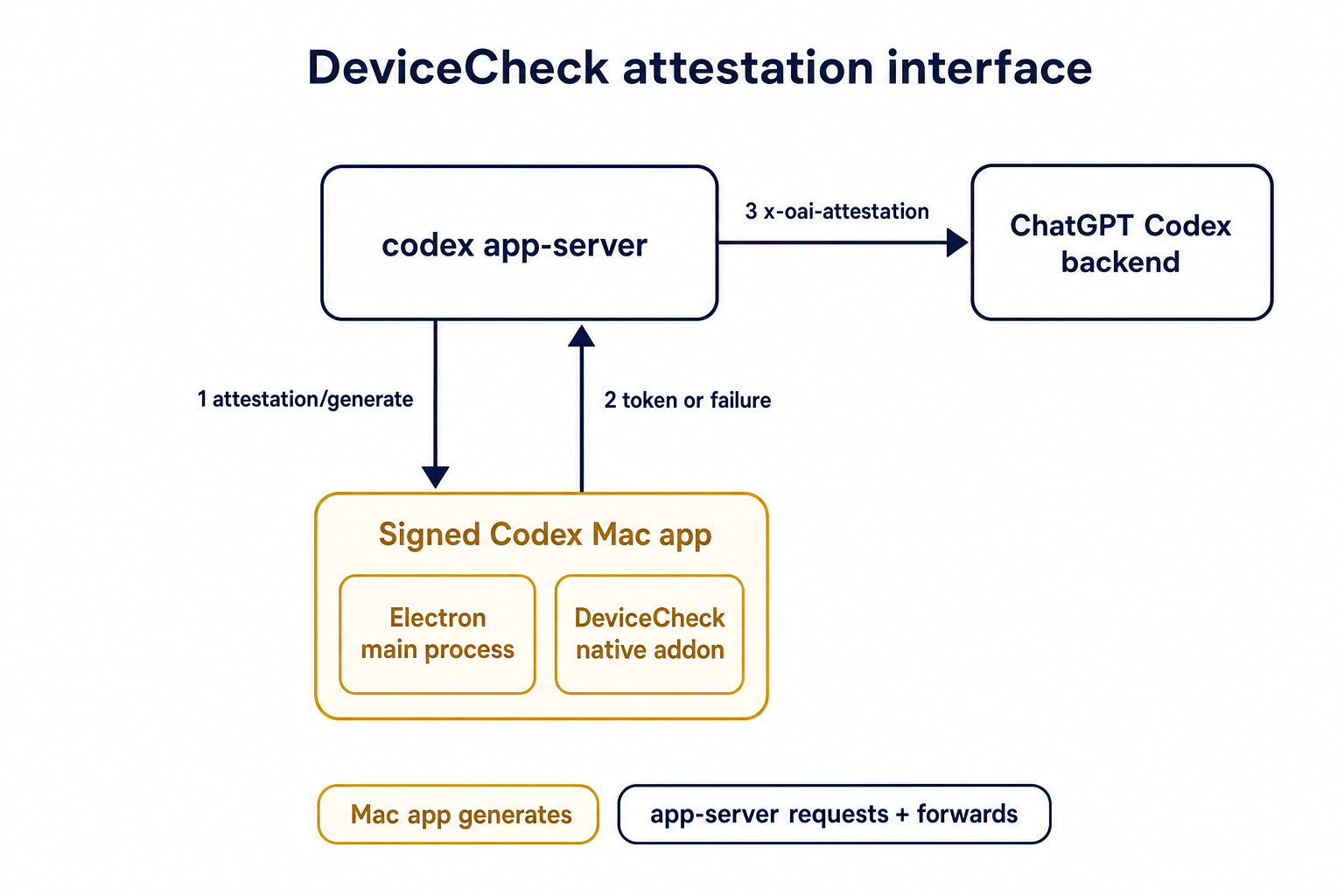
    ![DeviceCheck attestation
    interface](https://raw.githubusercontent.com/openai/codex/dev/jm/devicecheck-diagram-assets/pr-assets/devicecheck-attestation-interface.png)
    
    ## Details
    
    This PR teaches the Codex app-server runtime how to request and attach
    an attestation token. It does not generate DeviceCheck tokens directly;
    instead, it relies on the connected desktop app to advertise that it can
    generate attestation and then asks that app for a fresh header value
    when needed.
    
    The flow is:
    
    1. The Codex desktop app connects to app-server.
    2. During `initialize`, the app can advertise that it supports
    `requestAttestation`.
    3. Before app-server calls selected ChatGPT Codex endpoints, it sends
    the internal server request `attestation/generate` to the app.
    4. app-server receives a pre-encoded header value back.
    5. app-server forwards that value as `x-oai-attestation` on the scoped
    outbound requests.
    
    The code in this repo is mostly protocol and runtime plumbing: it adds
    the app-server request/response shape, introduces an attestation
    provider in core, wires that provider into Responses / compaction /
    realtime setup paths, and covers the intended scoping with tests. The
    signed macOS DeviceCheck generation remains owned by the desktop app PR.
    
    ## Related PR
    
    - Codex desktop app implementation:
    https://github.com/openai/openai/pull/878649
    
    ## Validation
    
    <details>
    <summary>Tests run</summary>
    
    ```sh
    cargo test -p codex-app-server-protocol
    cargo test -p codex-core attestation --lib
    cargo test -p codex-app-server --lib attestation
    ```
    
    Also ran:
    
    ```sh
    just fix -p codex-core
    just fix -p codex-app-server
    just fix -p codex-app-server-protocol
    just fmt
    just write-app-server-schema
    ```
    
    </details>
    
    <details>
    <summary>E2E DeviceCheck validation</summary>
    
    First validated the signed desktop app boundary directly: launched a
    packaged signed `Codex.app`, sent `attestation/generate`, decoded the
    returned `v1.` attestation header, and validated the extracted
    DeviceCheck token with `personal/jm/verify_devicecheck_token.py` using
    bundle ID `com.openai.codex`. Apple returned `status_code: 200` and
    `is_ok: true`.
    
    Then ran the fuller app + app-server flow. The packaged `Codex.app`
    launched a current-branch app-server via `CODEX_CLI_PATH`, and a local
    MITM proxy intercepted outbound `chatgpt.com` traffic. The app-server
    requested `attestation/generate` from the real Electron app process, and
    the intercepted `/backend-api/codex/responses` traffic included
    `x-oai-attestation` on both routes:
    
    ```text
    GET  /backend-api/codex/responses  Upgrade: websocket  x-oai-attestation: present
    POST /backend-api/codex/responses  Upgrade: none       x-oai-attestation: present
    ```
    
    The captured header decoded to a DeviceCheck token that also validated
    with Apple for `com.openai.codex` (`status_code: 200`, `is_ok: true`,
    team `2DC432GLL2`).
    
    </details>
    
    ---------
    
    Co-authored-by: Codex <noreply@openai.com>
  • feat(app-server, threadstore): Thread pagination APIs and ThreadStore contract (#21566)
    ## Why
    The goal of this PR is to align on app-server and `ThreadStore` API
    updates for paginating through large threads.
    
    
    #### app-server
    ##### `thread/turns/list`
    - Updates `thread/turns/list` to support `itemsView?: "notLoaded" |
    "summary" | "full" | null`, defaulting to `summary`.
    - Implements the current `thread/turns/list` behavior over the existing
    persisted rollout-history fallback:
      - `notLoaded` returns turn envelopes with empty `items`.
    - `summary` returns the first user message and final assistant message
    when available.
      - `full` preserves the existing full item behavior.
    
    Note that this method still uses the naive approach of loading the
    entire rollout file, and returns just the filtered slice of the data.
    Real pagination will come later by leveraging SQLite.
    
    ##### `thread/turns/items/list`
    - Adds the experimental `thread/turns/items/list` protocol, schema,
    dispatcher, and processor stub. The app-server currently returns
    JSON-RPC `-32601` with `thread/turns/items/list is not supported yet`.
    
    #### ThreadStore
    - Adds the experimental `thread/turns/items/list` protocol, schema,
    dispatcher, and processor stub. The app-server currently returns
    JSON-RPC `-32601` with `thread/turns/items/list is not supported yet`.
    - Adds `ThreadStore` contract types and stubbed methods for listing
    thread turns and listing items within a turn.
    - Adds a typed `StoredTurnStatus` and `StoredTurnError` to avoid baking
    app-server API enums or lossy string status values into the store-facing
    turn contract.
    - Adds a typed `StoredTurnStatus` and `StoredTurnError` to avoid baking
    app-server API enums or lossy string status values into the store-facing
    turn contract.
    
    This also sketches the storage abstraction we expect to need once turns
    are indexed/stored. In particular, `notLoaded` is useful only if
    ThreadStore can eventually list turn metadata without loading every
    persisted item for each turn.
    
    ## Validation
    
    - Added/updated protocol serialization coverage for the new request and
    response shapes.
    - Added app-server integration coverage for `thread/turns/list` default
    summary behavior and all three `itemsView` modes.
    - Added app-server integration coverage that `thread/turns/items/list`
    returns the expected unsupported JSON-RPC error when experimental APIs
    are enabled.
    - Added thread-store coverage that the default trait methods return
    `ThreadStoreError::Unsupported`.
    
    No developers.openai.com documentation update is needed for this
    internal experimental app-server API surface.
  • [codex] Fix pathless thread summaries (#21266)
    ## Summary
    
    Fix `getConversationSummary` so thread-id summaries work for stored
    threads that do not have a local rollout path, such as remote thread
    stores.
    
    The root cause was that `summary_from_stored_thread` returned `None`
    when `StoredThread.rollout_path` was absent, and
    `get_thread_summary_response_inner` treated that as an internal error.
    This made conversation-id lookups depend on a local-only field even
    though the thread store can address the thread by id.
  • Move thread name edits to ThreadStore (#21264)
    - Route live thread renames through `ThreadStore` metadata updates.
    - Read resumed thread names from store metadata with legacy local
    fallback preserved in the store.
  • Revert state DB injection and agent graph store (#21481)
    ## Why
    
    Reverts #20689 to restore the previous optional state DB plumbing. The
    conflict resolution keeps the newer installation ID and session/thread
    identity changes that landed after #20689, while removing the mandatory
    state DB and agent graph store dependency from ThreadManager
    construction.
    
    ## What changed
    
    - Restored `Option<StateDbHandle>` through app-server, MCP server,
    prompt debug, and test entry points.
    - Removed the `codex-core` dependency on `codex-agent-graph-store` and
    reverted descendant lookup back to the existing state DB path when
    available.
    - Kept newer `installation_id` forwarding by passing it beside the
    optional DB handle.
    - Kept local thread-name updates working when the optional state DB
    handle is absent.
    
    ## Validation
    
    - `git diff --check`
    - `cargo test -p codex-thread-store`
    - `cargo test -p codex-state -p codex-rollout -p
    codex-app-server-protocol`
    - Attempted `env CARGO_INCREMENTAL=0 cargo test -p codex-core -p
    codex-app-server -p codex-app-server-client -p codex-mcp-server -p
    codex-thread-manager-sample -p codex-tui`; blocked locally by a rustc
    ICE while compiling `v8 v146.4.0` with `rustc 1.93.0 (254b59607
    2026-01-19)` on `aarch64-apple-darwin`.
  • Move skills watcher to app-server (#21287)
    ## Why
    
    Skills update notifications are app-server API behavior, but the watcher
    lived in `codex-core` and surfaced through
    `EventMsg::SkillsUpdateAvailable`. Moving the watcher out keeps core
    focused on thread execution and lets app-server own both cache
    invalidation and the `skills/changed` notification.
    
    ## What changed
    
    - Added an app-server-owned skills watcher that watches local skill
    roots, clears the shared skills cache, and emits `skills/changed`
    directly.
    - Registers skill watches from the common app-server thread listener
    attach path, including direct starts, resumes, and app-server-observed
    child or forked threads.
    - Stores the `WatchRegistration` on `ThreadState`, so listener
    replacement, thread teardown, idle unload, and app-server shutdown
    deregister by dropping the RAII guard.
    - Removed `EventMsg::SkillsUpdateAvailable`, the core watcher, and the
    old core live-reload test.
    - Extended the app-server skills change test to verify a cached skills
    list is refreshed after a filesystem change without forcing reload.
    
    ## Validation
    
    - `cargo check -p codex-core -p codex-app-server -p codex-mcp-server -p
    codex-rollout -p codex-rollout-trace`
    - `cargo test -p codex-app-server
    skills_changed_notification_is_emitted_after_skill_change`
  • [codex-analytics] emit tool item events from item lifecycle (#17090)
    ## Why
    
    After the tool-item schemas are in place, analytics needs to emit them
    from the app-server item lifecycle rather than requiring bespoke
    tracking at each callsite. The reducer should also reuse the shared
    thread analytics context introduced below it in the stack so later event
    families do not repeat the same reducer joins or missing-state ladder.
    
    ## What changed
    
    - Tracks tool-item completion notifications and emits the matching tool
    analytics event when a terminal item arrives.
    - Derives event-specific payload details for command execution, file
    changes, MCP calls, dynamic tools, collaboration tools, web search, and
    image generation.
    - Denormalizes thread, app-server client, runtime, and subagent
    provenance metadata through the shared thread analytics context.
    - Adds reducer coverage for item lifecycle emission and subagent
    metadata inheritance.
    
    ## Duration semantics
    
    `duration_ms` is computed from the app-server item lifecycle timestamps:
    `completed_at_ms - started_at_ms`. That makes it the duration of the
    lifecycle Codex observed locally, not necessarily the upstream
    provider's full execution time.
    
    - Web search usually has a meaningful observed lifecycle because
    Responses can send `response.output_item.added` before
    `response.output_item.done`; in that case `started_at_ms` comes from the
    added event and `completed_at_ms` comes from the done event.
    - Image generation can be much less precise. In the current observed
    stream, image generation often arrives only as a completed
    `response.output_item.done`; when there is no earlier added event, Codex
    synthesizes the started item immediately before completion, so
    `duration_ms` can be `0` even though upstream image generation took
    longer.
    - Standalone web search and standalone image generation work is expected
    to land after this stack. Those paths may introduce more direct
    lifecycle events or timing points, so the current
    web-search/image-generation duration semantics should be treated as the
    best available item-lifecycle approximation, not the final latency
    contract for those tool families.
    - `execution_duration_ms` is populated only where the completed item
    already carries a native execution duration; otherwise it remains `null`
    while `duration_ms` still reflects the local lifecycle interval.
    
    ## Currently placeholder / partial fields
    
    Some fields are included in the schema for the intended steady-state
    contract, but this PR does not yet populate them from real
    approval/review state:
    
    - `review_count`, `guardian_review_count`, and `user_review_count`
    currently default to `0`.
    - `final_approval_outcome` currently defaults to `unknown`.
    - `requested_additional_permissions` and `requested_network_access`
    currently default to `false`.
    
    ## Verification
    
    - `cargo test -p codex-analytics`
    
    ---
    [//]: # (BEGIN SAPLING FOOTER)
    Stack created with [Sapling](https://sapling-scm.com). Best reviewed
    with [ReviewStack](https://reviewstack.dev/openai/codex/pull/17090).
    * #18748
    * #18747
    * __->__ #17090
    * #17089
    * #20514
  • 2- Use string service tiers in session protocol (#20971)
    ## Summary
    - break service tier session/op/app-server protocol fields from the
    closed enum to string tier ids
    - send the service tier string directly through model requests, prewarm,
    compaction, memories, and TUI/app-server turn starts
    - regenerate app-server protocol JSON/TypeScript schemas, removing the
    standalone ServiceTier TS enum
    
    ## Verification
    - just fmt
    - cargo check -p codex-core -p codex-app-server -p codex-tui
    - just write-app-server-schema
    
    ---------
    
    Co-authored-by: Codex <noreply@openai.com>
  • feat(app-server): move v2 sessionId onto Thread (#21336)
    ## Why
    
    `session_id` and `thread_id` are separate identities after #20437, but
    app-server only surfaced `sessionId` on the `thread/start`,
    `thread/resume`, and `thread/fork` response envelopes. Other
    thread-bearing surfaces such as `thread/list`, `thread/read`,
    `thread/started`, `thread/rollback`, `thread/metadata/update`, and
    `thread/unarchive` either lacked the grouping key or forced clients to
    special-case those three responses.
    
    Making `sessionId` part of the reusable `Thread` payload gives every v2
    API surface one place to expose session-tree identity.
    
    ## Mental model
      1. thread.sessionId lives on `Thread`
    2. It is a view/runtime identity for the current live session tree, not
    durable stored lineage metadata
    3. When app-server has a live loaded thread, it copies the real value
    from core’s session_configured.session_id
    4. When it only has stored/unloaded data, it falls back to
    thread.sessionId = thread.id
    
    ## What changed
    
    - Added `sessionId` to the v2
    [`Thread`](https://github.com/openai/codex/blob/8fc9e9b4cf81b6f61d432e71f1eb266f6f104b63/codex-rs/app-server-protocol/src/protocol/v2/thread_data.rs#L105-L109).
    - Removed the duplicate top-level `sessionId` fields from
    `thread/start`, `thread/resume`, and `thread/fork`; clients should now
    read `response.thread.sessionId`.
    - Populated `thread.sessionId` when building live thread responses,
    replaying loaded threads, and returning stored-thread summaries so the
    field is present across start, resume, fork, list, read, rollback,
    metadata-update, unarchive, and `thread/started` paths. See
    [`load_thread_from_resume_source_or_send_internal`](https://github.com/openai/codex/blob/8fc9e9b4cf81b6f61d432e71f1eb266f6f104b63/codex-rs/app-server/src/request_processors/thread_processor.rs#L2824-L2918)
    and
    [`thread_from_stored_thread`](https://github.com/openai/codex/blob/8fc9e9b4cf81b6f61d432e71f1eb266f6f104b63/codex-rs/app-server/src/request_processors/thread_processor.rs#L3671-L3719).
    - Preserved the stored-thread fallback: if a thread has not been loaded
    into a live session tree yet, `thread.sessionId` falls back to
    `thread.id`; once the thread is live again, the field reports the active
    session tree root.
    - Regenerated the JSON/TypeScript schemas and updated the app-server
    README examples to show
    [`thread.sessionId`](https://github.com/openai/codex/blob/8fc9e9b4cf81b6f61d432e71f1eb266f6f104b63/codex-rs/app-server/README.md#L306-L310)
    on the thread object.
  • feat: return session ID from thread/fork (#21332)
    ## Why
    
    `thread/start` and `thread/resume` already return `sessionId`, but
    `thread/fork` only returned the new thread. That left clients to infer
    the forked thread's session identity from `thread.id`, which kept the
    new `session_id` / `thread_id` split implicit at one lifecycle boundary.
    Follow-up to #20437.
    
    ## What changed
    
    - Add `sessionId` to `ThreadForkResponse`.
    - Populate it from the forked session configuration.
    - Regenerate the v2 JSON/TypeScript schema fixtures and update the
    app-server docs/example.
    - Extend the fork integration test to assert the returned `sessionId`.
    
    ## Verification
    
    - Added coverage in `thread_fork_creates_new_thread_and_emits_started`
    for the new response field.
  • feat: add session_id (#20437)
    ## Summary
    
    Related to
    https://openai.slack.com/archives/C095U48JNL9/p1777537279707449
    TLDR:
    We update the meaning of session ids and thread ids:
    * thread_id stays as now
    * session_id become a shared id between every thread under a /root
    thread (i.e. every sub-agent share the same session id)
    
    This PR introduces an explicit `SessionId` and threads it through the
    protocol/client boundary so `session_id` and `thread_id` can diverge
    when they need to, while preserving compatibility for older serialized
    `session_configured` events.
    
    ---------
    
    Co-authored-by: Codex <noreply@openai.com>
  • app-server: align dynamic tool identifiers with Responses API (#20724)
    ## Why
    
    Codex currently accepts dynamic tool names and namespaces that the
    upstream Responses function-tool path does not actually support. In
    practice, that means app-server can register a dynamic tool successfully
    and only discover later that the LLM-facing tool contract will reject or
    mishandle it.
    
    This PR tightens the app-server-side dynamic tool contract to match the
    Responses API before we stack dynamic tool hook support on top of it.
    
    ## What changed
    
    - validate dynamic tool `name` against the Responses function-tool
    identifier contract: `^[a-zA-Z0-9_-]+$`, length `1..128`
    - validate dynamic tool `namespace` the same way, with the Responses
    namespace length limit `1..64`
    - reject namespaces that collide with the always-reserved Responses
    runtime namespaces such as `functions`, `multi_tool_use`, `file_search`,
    `web`, `browser`, `image_gen`, `computer`, `container`, `terminal`,
    `python`, `python_user_visible`, `api_tool`, `tool_search`, and
    `submodel_delegator`
    - escape invalid identifiers in error messages so control characters do
    not spill raw into logs or client-visible error text
    - document the tightened dynamic tool identifier contract in
    `codex-rs/app-server/README.md`
    - add both unit coverage for the validator and an app-server integration
    test that rejects a `thread/start` request with Responses-incompatible
    dynamic tool identifiers
    
    ## Verification
    
    - `cargo test -p codex-app-server validate_dynamic_tools_`
    - `cargo test -p codex-app-server --test all
    thread_start_rejects_dynamic_tools_not_supported_by_responses`
  • [codex-analytics] rework thread_source for thread analytics (#20949)
    ## Summary
    - make `thread_source` an explicit optional thread-level field on
    `thread/start`, `thread/fork`, and returned thread payloads
    - persist `thread_source` in rollout/session metadata so resumed live
    threads retain the original value
    - replace the old best-effort `session_source` -> `thread_source`
    mapping with an explicit caller-supplied analytics classification
    
    ## Why
    Before this change, analytics `thread_source` was populated by a
    best-effort mapping from `session_source`. `session_source` describes
    the runtime/client surface, not the actual thread-level origin, so that
    projection was not accurate enough to distinguish cases such as `user`,
    `subagent`, `memory_consolidation`, and future thread origins reliably.
    
    Making `thread_source` explicit keeps one thread-level analytics field
    while letting callers provide the real classification directly instead
    of recovering it indirectly from `session_source`.
    
    ## Impact
    For new analytics events, `thread_source` now reflects the explicit
    thread-level classification supplied by the caller rather than an
    inferred value derived from `session_source`. Existing protocol fields
    remain optional; callers that omit `threadSource` now produce `null`
    instead of a best-effort inferred value.
    
    ## Validation
    - `just write-app-server-schema`
    - `cargo test -p codex-analytics -p codex-core -p
    codex-app-server-protocol --no-run`
    - `cargo test -p codex-app-server-protocol
    generated_ts_optional_nullable_fields_only_in_params`
    - `cargo test -p codex-analytics
    thread_initialized_event_serializes_expected_shape`
    - `cargo test -p codex-core
    resume_stopped_thread_from_rollout_preserves_thread_source`
  • [codex] Move thread naming to app server (#21260)
    ## Why
    
    Thread names are app-server metadata now, backed by the thread store and
    sqlite state database. Keeping a core `SetThreadName` op plus a rollout
    `thread_name_updated` event made rename persistence live in the wrong
    layer and required historical replay support for an event that new
    app-server flows should not write.
    
    ## What changed
    
    - Removed `Op::SetThreadName` and `EventMsg::ThreadNameUpdated` from the
    core protocol and deleted the core handler path that appended rename
    events to rollouts.
    - Updated app-server `thread/name/set` so both loaded and unloaded
    threads write through thread-store metadata and app-server emits
    `thread/name/updated` notifications.
    - Updated local thread-store name metadata updates to write sqlite title
    metadata and the legacy thread-name index without appending rollout
    events.
    - Removed state extraction and rollout handling for the deleted
    thread-name event.
    
    ## Validation
    
    - `cargo test -p codex-app-server thread_name_updated_broadcasts`
    - `cargo test -p codex-app-server
    thread_name_set_is_reflected_in_read_list_and_resume`
    - `cargo test -p codex-thread-store
    update_thread_metadata_sets_name_on_active_rollout_and_indexes_name`
    - `cargo test -p codex-state`
    - `cargo check -p codex-mcp-server -p codex-rollout-trace`
    - `just fix -p codex-app-server -p codex-thread-store -p codex-state -p
    codex-mcp-server -p codex-rollout-trace`
    
    ## Docs
    
    No external documentation update is expected for this internal ownership
    change.
  • Inject state DB, agent graph store (#20689)
    ## Why
    
    We want the agent graph store to be passed down the stack as a real
    dependency, the same way we already treat the thread store.
    
    This will let us inject the agent graph store as a real dependency and
    support implementations other than the local SQLite-backed one. Right
    now most code instantiates a state DB and an agent graph store
    just-in-time. Ideally, we would not depend on the state DB directly but
    only read through the higher-level interfaces.
    
    This change makes the dependency boundaries explicit and moves state DB
    initialization to process bootstrap instead of hiding it inside local
    store implementations.
    
    ## What changed
    
    - `ThreadManager` now requires a `StateDbHandle` and an
    `AgentGraphStore` at construction time instead of treating them as
    optional internals.
    - The local store constructors no longer lazily initialize SQLite.
    Callers now initialize the state DB once per process and use that shared
    handle to build:
      - `LocalThreadStore`
      - `LocalAgentGraphStore`
    - App bootstraps (`app-server`, `mcp-server`, `prompt_debug`, and the
    thread-manager sample) now initialize the state DB up front and inject
    the resulting handle down the stack.
    - `app-server` now consistently uses its process-scoped state DB handle
    instead of reopening SQLite or trying to recover it from loaded threads.
    - Device-key storage now reuses the shared state DB handle instead of
    maintaining its own lazy opener.
    - The thread archive / descendant traversal paths now use the injected
    `AgentGraphStore` instead of reaching through local
    thread-store-specific state.
    
    ## Verification
    
    - `cargo check -p codex-core -p codex-thread-store -p codex-app-server
    -p codex-mcp-server -p codex-thread-manager-sample --tests`
    - `cargo test -p codex-thread-store`
    - `cargo test -p codex-core
    thread_manager_accepts_separate_agent_graph_store_and_thread_store --
    --nocapture`
    - `cargo test -p codex-app-server
    thread_archive_archives_spawned_descendants -- --nocapture`
  • Auto-deny MCP elicitations for Xcode 26.4 clients (#21113)
    ## Summary
    
    Xcode 26.4 was built against app-server behavior from before MCP
    elicitation requests became client-visible in CLI 0.120.0 via #17043.
    That client line does not expect the new events/messages, so this PR
    restores the old behavior for exactly that client/version combination.
    
    The compatibility handling stays in the app-server layer: when the
    initialized client is `Xcode` and its version starts with `26.4`, the
    app server marks the live Codex thread so MCP elicitations are
    auto-denied. The flag is applied on thread start/resume/fork/turn
    attachment, carried through `Codex`/`CodexThread`, and stored on
    `McpConnectionManager` so refreshed MCP managers preserve the behavior.
    
    ## Notes
    
    This is intentionally narrow and includes a TODO to remove the
    compatibility path once Xcode 26.4 ages out.
  • [codex] Use shared app-server JSON-RPC error helpers (#21221)
    ## Why
    
    App-server had repeated hand-built JSON-RPC error objects for standard
    error shapes. Using the shared helpers keeps the common
    `invalid_request`, `invalid_params`, and `internal_error` construction
    in one place and reduces the chance of new call sites drifting from the
    common error payload shape.
    
    ## What changed
    
    - Replaced manual standard JSON-RPC error object creation with
    `internal_error(...)`, `invalid_request(...)`, and `invalid_params(...)`
    across app-server request processors and runtime paths.
    - Removed local duplicate helper definitions from search and review
    request handling.
    - Preserved existing structured `data` payloads by creating the shared
    helper error first and then attaching the existing metadata.
    - Left custom non-standard errors and raw error-code assertions intact.
    
    ## Validation
    
    - `cargo test -p codex-app-server`
  • app-server: ignore persist_extended_history param (#21225)
    ## Why
    
    Taking a step to removing the `persistExtendedHistory` field. It's not
    scalable to be persisting so much data in the rollout file and returning
    it in the thread history.
    
    When a client explicitly sends `true`, the server now tells that client
    the parameter is deprecated and ignored so the caller has a clear
    migration signal via the `deprecationNotice` notification.
    
    ## What changed
    
    - Keep the `persist_extended_history` / `persistExtendedHistory` field
    in the v2 protocol for compatibility, but document it as deprecated and
    ignored.
    - Ignore the parameter in app-server `thread/start`, `thread/resume`,
    and `thread/fork`; those paths always use limited history persistence
    now.
    - Stop treating `persistExtendedHistory` as a running-thread resume
    override mismatch.
    - Emit a connection-scoped `deprecationNotice` when a request explicitly
    sets `persist_extended_history: true`.
    
    ## Verification
    
    - Added `thread_start_deprecates_persist_extended_history_true` to cover
    the deprecation notice.
    - `cargo test -p codex-app-server`
    - `cargo test -p codex-app-server-protocol`
  • codex: migrate (more) app-server thread history reads to ThreadStore (#20575)
    Migrate token usage replay, rollback responses, and detached review
    setup (a special case of forking) to be served from ThreadStore reads
    rather direct rollout files.
    
    - replay restored token usage from already-loaded `RolloutItem` history
    instead of reopening `Thread.path`
    - rebuild rollback responses from loaded `ThreadStore` snapshots and
    history
    - start detached reviews from store-backed parent history and stored
    review-thread metadata
    - remove obsolete app-server rollout-summary helper code that became
    dead after the store-backed migration
    - preserve response/notification ordering for resume, fork, rollback,
    and detached review flows
    - add integration test coverage for the affected paths
  • codex: route metadata updates through ThreadStore (#20576)
    - Route `thread/metadata/update` through
    `ThreadStore::update_thread_metadata`.
    - Add `LocalThreadStore` git metadata patch support for set, partial
    update, and clear semantics.
    - Add some unit tests for the new thread store code
    - Remove a lot of dead code/tests!