Commit Graph

34 Commits

  • [codex] Add user input client ids (#24653)
    ## Summary
    
    Adds an optional `clientId` field to app-server v2 `UserInput` and
    carries it through the core `UserInput` model so clients can correlate
    echoed user input items without relying on payload equality.
    
    ## Details
    
    - Adds `client_id: Option<String>` to core `UserInput` variants.
    - Exposes the v2 app-server field as `clientId` on the wire and in
    generated TypeScript.
    - Preserves the id when converting between app-server v2 and core
    protocol types.
    - Regenerates app-server schema fixtures.
    
    ## Validation
    
    - `just fmt`
    - `just write-app-server-schema`
    - `cargo test -p codex-app-server-protocol`
    - `cargo test -p codex-protocol`
    - `just fix -p codex-app-server-protocol`
    - `just fix -p codex-protocol`
    - `git diff --check`
  • [codex] request desktop attestation from app (#20619)
    ## Summary
    
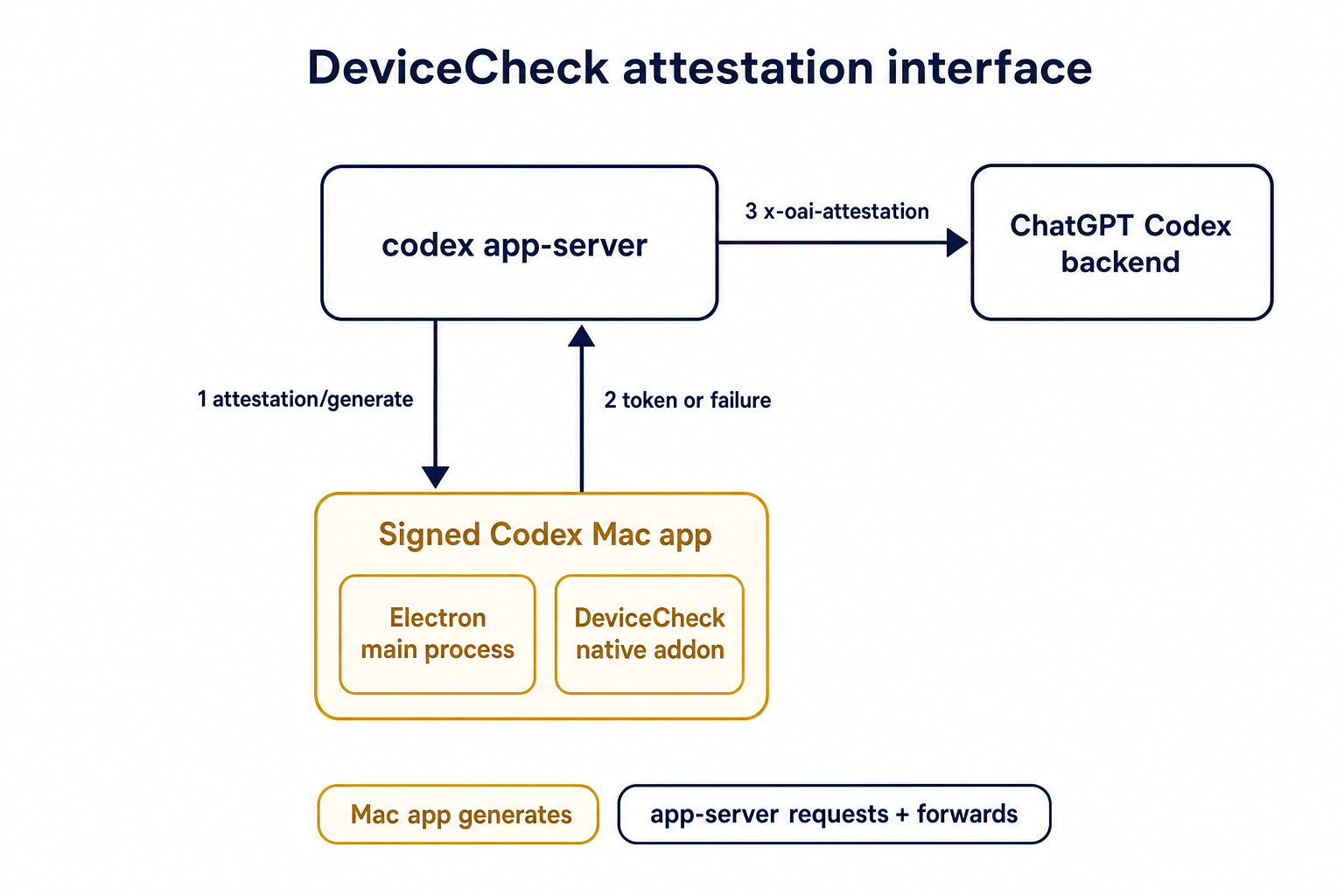
    TL;DR: teaches `codex-rs` / app-server to request a desktop-provided
    attestation token and attach it as `x-oai-attestation` on the scoped
    ChatGPT Codex request paths.
    
    ![DeviceCheck attestation
    interface](https://raw.githubusercontent.com/openai/codex/dev/jm/devicecheck-diagram-assets/pr-assets/devicecheck-attestation-interface.png)
    
    ## Details
    
    This PR teaches the Codex app-server runtime how to request and attach
    an attestation token. It does not generate DeviceCheck tokens directly;
    instead, it relies on the connected desktop app to advertise that it can
    generate attestation and then asks that app for a fresh header value
    when needed.
    
    The flow is:
    
    1. The Codex desktop app connects to app-server.
    2. During `initialize`, the app can advertise that it supports
    `requestAttestation`.
    3. Before app-server calls selected ChatGPT Codex endpoints, it sends
    the internal server request `attestation/generate` to the app.
    4. app-server receives a pre-encoded header value back.
    5. app-server forwards that value as `x-oai-attestation` on the scoped
    outbound requests.
    
    The code in this repo is mostly protocol and runtime plumbing: it adds
    the app-server request/response shape, introduces an attestation
    provider in core, wires that provider into Responses / compaction /
    realtime setup paths, and covers the intended scoping with tests. The
    signed macOS DeviceCheck generation remains owned by the desktop app PR.
    
    ## Related PR
    
    - Codex desktop app implementation:
    https://github.com/openai/openai/pull/878649
    
    ## Validation
    
    <details>
    <summary>Tests run</summary>
    
    ```sh
    cargo test -p codex-app-server-protocol
    cargo test -p codex-core attestation --lib
    cargo test -p codex-app-server --lib attestation
    ```
    
    Also ran:
    
    ```sh
    just fix -p codex-core
    just fix -p codex-app-server
    just fix -p codex-app-server-protocol
    just fmt
    just write-app-server-schema
    ```
    
    </details>
    
    <details>
    <summary>E2E DeviceCheck validation</summary>
    
    First validated the signed desktop app boundary directly: launched a
    packaged signed `Codex.app`, sent `attestation/generate`, decoded the
    returned `v1.` attestation header, and validated the extracted
    DeviceCheck token with `personal/jm/verify_devicecheck_token.py` using
    bundle ID `com.openai.codex`. Apple returned `status_code: 200` and
    `is_ok: true`.
    
    Then ran the fuller app + app-server flow. The packaged `Codex.app`
    launched a current-branch app-server via `CODEX_CLI_PATH`, and a local
    MITM proxy intercepted outbound `chatgpt.com` traffic. The app-server
    requested `attestation/generate` from the real Electron app process, and
    the intercepted `/backend-api/codex/responses` traffic included
    `x-oai-attestation` on both routes:
    
    ```text
    GET  /backend-api/codex/responses  Upgrade: websocket  x-oai-attestation: present
    POST /backend-api/codex/responses  Upgrade: none       x-oai-attestation: present
    ```
    
    The captured header decoded to a DeviceCheck token that also validated
    with Apple for `com.openai.codex` (`status_code: 200`, `is_ok: true`,
    team `2DC432GLL2`).
    
    </details>
    
    ---------
    
    Co-authored-by: Codex <noreply@openai.com>
  • [codex-analytics] plumb protocol-native review timing (#21434)
    ## Why
    
    We want terminal tool review analytics, but the reducer should not stamp
    review timing from its own wall clock.
    
    This PR plumbs review timing through the real protocol and app-server
    seams so downstream analytics can consume the emitter's timestamps
    directly. Guardian reviews keep their enriched `started_at` /
    `completed_at` analytics fields by deriving those legacy second-based
    values from the same protocol-native millisecond lifecycle timestamps,
    rather than sampling a separate analytics clock.
    
    ## What changed
    
    - add `started_at_ms` to user approval request payloads
    - add `started_at_ms` / `completed_at_ms` to guardian review
    notifications
    - preserve Guardian review `started_at` / `completed_at` enrichment from
    the protocol-native timing source
    - stamp typed `ServerResponse` analytics facts with app-server-observed
    `completed_at_ms`
    - thread the new timing fields through core, protocol, app-server, TUI,
    and analytics fixtures
    
    ## Verification
    
    - `cargo test -p codex-app-server outgoing_message --manifest-path
    codex-rs/Cargo.toml`
    - `cargo test -p codex-app-server-protocol guardian --manifest-path
    codex-rs/Cargo.toml`
    - `cargo test -p codex-tui guardian --manifest-path codex-rs/Cargo.toml`
    - `cargo test -p codex-analytics analytics_client_tests --manifest-path
    codex-rs/Cargo.toml`
    
    ---
    [//]: # (BEGIN SAPLING FOOTER)
    Stack created with [Sapling](https://sapling-scm.com). Best reviewed
    with [ReviewStack](https://reviewstack.dev/openai/codex/pull/21434).
    * #18748
    * __->__ #21434
    * #18747
    * #17090
    * #17089
    * #20514
  • Update Codex login success page UX (#20136)
    ## Summary
    
    update the local login success page to match the Codex desktop auth UX
    use theme-aware colors and an inline 20px Codex mark
    keep the actual localhost success page aligned with the browser auth UX
    PR
    
    ## Tests
    
    <img width="1728" height="1117" alt="Screenshot 2026-04-29 at 12 00
    34 PM"
    src="https://github.com/user-attachments/assets/76a40c3f-07c3-452c-97da-e7c43717cd2c"
    />
  • permissions: remove legacy read-only access modes (#19449)
    ## Why
    
    `ReadOnlyAccess` was a transitional legacy shape on `SandboxPolicy`:
    `FullAccess` meant the historical read-only/workspace-write modes could
    read the full filesystem, while `Restricted` tried to carry partial
    readable roots. The partial-read model now belongs in
    `FileSystemSandboxPolicy` and `PermissionProfile`, so keeping it on
    `SandboxPolicy` makes every legacy projection reintroduce lossy
    read-root bookkeeping and creates unnecessary noise in the rest of the
    permissions migration.
    
    This PR makes the legacy policy model narrower and explicit:
    `SandboxPolicy::ReadOnly` and `SandboxPolicy::WorkspaceWrite` represent
    the old full-read sandbox modes only. Split readable roots, deny-read
    globs, and platform-default/minimal read behavior stay in the runtime
    permissions model.
    
    ## What changed
    
    - Removes `ReadOnlyAccess` from
    `codex_protocol::protocol::SandboxPolicy`, including the generated
    `access` and `readOnlyAccess` API fields.
    - Updates legacy policy/profile conversions so restricted filesystem
    reads are represented only by `FileSystemSandboxPolicy` /
    `PermissionProfile` entries.
    - Keeps app-server v2 compatible with legacy `fullAccess` read-access
    payloads by accepting and ignoring that no-op shape, while rejecting
    legacy `restricted` read-access payloads instead of silently widening
    them to full-read legacy policies.
    - Carries Windows sandbox platform-default read behavior with an
    explicit override flag instead of depending on
    `ReadOnlyAccess::Restricted`.
    - Refreshes generated app-server schema/types and updates tests/docs for
    the simplified legacy policy shape.
    
    ## Verification
    
    - `cargo check -p codex-app-server-protocol --tests`
    - `cargo check -p codex-windows-sandbox --tests`
    - `cargo test -p codex-app-server-protocol sandbox_policy_`
    
    
    ---
    [//]: # (BEGIN SAPLING FOOTER)
    Stack created with [Sapling](https://sapling-scm.com). Best reviewed
    with [ReviewStack](https://reviewstack.dev/openai/codex/pull/19449).
    * #19395
    * #19394
    * #19393
    * #19392
    * #19391
    * __->__ #19449
  • Support multiple cwd filters for thread list (#18502)
    ## Summary
    
    - Teach app-server `thread/list` to accept either a single `cwd` or an
    array of cwd filters, returning threads whose recorded session cwd
    matches any requested path
    - Add `useStateDbOnly` as an explicit opt-in fast path for callers that
    want to answer `thread/list` from SQLite without scanning JSONL rollout
    files
    - Preserve backwards compatibility: by default, `thread/list` still
    scans JSONL rollouts and repairs SQLite state
    - Wire the new cwd array and SQLite-only options through app-server,
    local/remote thread-store, rollout listing, generated TypeScript/schema
    fixtures, proto output, and docs
    
    ## Test Plan
    
    - `cargo test -p codex-app-server-protocol`
    - `cargo test -p codex-rollout`
    - `cargo test -p codex-thread-store`
    - `cargo test -p codex-app-server thread_list`
    - `just fmt`
    - `just fix -p codex-app-server-protocol -p codex-rollout -p
    codex-thread-store -p codex-app-server`
    - `cargo build -p codex-cli --bin codex`
  • Add sorting/backwardsCursor to thread/list and new thread/turns/list api (#17305)
    To improve performance of UI loads from the app, add two main
    improvements:
    1. The `thread/list` api now gets a `sortDirection` request field and a
    `backwardsCursor` to the response, which lets you paginate forwards and
    backwards from a window. This lets you fetch the first few items to
    display immediately while you paginate to fill in history, then can
    paginate "backwards" on future loads to catch up with any changes since
    the last UI load without a full reload of the entire data set.
    2. Added a new `thread/turns/list` api which also has sortDirection and
    backwardsCursor for the same behavior as `thread/list`, allowing you the
    same small-fetch for immediate display followed by background fill-in
    and resync catchup.
  • Add ChatGPT device-code login to app server (#15525)
    ## Problem
    
    App-server clients could only initiate ChatGPT login through the browser
    callback flow, even though the shared login crate already supports
    device-code auth. That left VS Code, Codex App, and other app-server
    clients without a first-class way to use the existing device-code
    backend when browser redirects are brittle or when the client UX wants
    to own the login ceremony.
    
    ## Mental model
    
    This change adds a second ChatGPT login start path to app-server:
    clients can now call `account/login/start` with `type:
    "chatgptDeviceCode"`. App-server immediately returns a `loginId` plus
    the device-code UX payload (`verificationUrl` and `userCode`), then
    completes the login asynchronously in the background using the existing
    `codex_login` polling flow. Successful device-code login still resolves
    to ordinary `chatgpt` auth, and completion continues to flow through the
    existing `account/login/completed` and `account/updated` notifications.
    
    ## Non-goals
    
    This does not introduce a new auth mode, a new account shape, or a
    device-code eligibility discovery API. It also does not add automatic
    fallback to browser login in core; clients remain responsible for
    choosing when to request device code and whether to retry with a
    different UX if the backend/admin policy rejects it.
    
    ## Tradeoffs
    
    We intentionally keep `login_chatgpt_common` as a local validation
    helper instead of turning it into a capability probe. Device-code
    eligibility is checked by actually calling `request_device_code`, which
    means policy-disabled cases surface as an immediate request error rather
    than an async completion event. We also keep the active-login state
    machine minimal: browser and device-code logins share the same public
    cancel contract, but device-code cancellation is implemented with a
    local cancel token rather than a larger cross-crate refactor.
    
    ## Architecture
    
    The protocol grows a new `chatgptDeviceCode` request/response variant in
    app-server v2. On the server side, the new handler reuses the existing
    ChatGPT login precondition checks, calls `request_device_code`, returns
    the device-code payload, and then spawns a background task that waits on
    either cancellation or `complete_device_code_login`. On success, it
    reuses the existing auth reload and cloud-requirements refresh path
    before emitting `account/login/completed` success and `account/updated`.
    On failure or cancellation, it emits only `account/login/completed`
    failure. The existing `account/login/cancel { loginId }` contract
    remains unchanged and now works for both browser and device-code
    attempts.
    
    
    ## Tests
    
    Added protocol serialization coverage for the new request/response
    variant, plus app-server tests for device-code success, failure, cancel,
    and start-time rejection behavior. Existing browser ChatGPT login
    coverage remains in place to show that the callback-based flow is
    unchanged.
  • chore: remove skill metadata from command approval payloads (#15906)
    ## Why
    
    This is effectively a follow-up to
    [#15812](https://github.com/openai/codex/pull/15812). That change
    removed the special skill-script exec path, but `skill_metadata` was
    still being threaded through command-approval payloads even though the
    approval flow no longer uses it to render prompts or resolve decisions.
    
    Keeping it around added extra protocol, schema, and client surface area
    without changing behavior.
    
    Removing it keeps the command-approval contract smaller and avoids
    carrying a dead field through app-server, TUI, and MCP boundaries.
    
    ## What changed
    
    - removed `ExecApprovalRequestSkillMetadata` and the corresponding
    `skillMetadata` field from core approval events and the v2 app-server
    protocol
    - removed the generated JSON and TypeScript schema output for that field
    - updated app-server, MCP server, TUI, and TUI app-server approval
    plumbing to stop forwarding the field
    - cleaned up tests that previously constructed or asserted
    `skillMetadata`
    
    ## Testing
    
    - `cargo test -p codex-app-server-protocol`
    - `cargo test -p codex-protocol`
    - `cargo test -p codex-app-server-test-client`
    - `cargo test -p codex-mcp-server`
    - `just argument-comment-lint`
  • Apply argument comment lint across codex-rs (#14652)
    ## Why
    
    Once the repo-local lint exists, `codex-rs` needs to follow the
    checked-in convention and CI needs to keep it from drifting. This commit
    applies the fallback `/*param*/` style consistently across existing
    positional literal call sites without changing those APIs.
    
    The longer-term preference is still to avoid APIs that require comments
    by choosing clearer parameter types and call shapes. This PR is
    intentionally the mechanical follow-through for the places where the
    existing signatures stay in place.
    
    After rebasing onto newer `main`, the rollout also had to cover newly
    introduced `tui_app_server` call sites. That made it clear the first cut
    of the CI job was too expensive for the common path: it was spending
    almost as much time installing `cargo-dylint` and re-testing the lint
    crate as a representative test job spends running product tests. The CI
    update keeps the full workspace enforcement but trims that extra
    overhead from ordinary `codex-rs` PRs.
    
    ## What changed
    
    - keep a dedicated `argument_comment_lint` job in `rust-ci`
    - mechanically annotate remaining opaque positional literals across
    `codex-rs` with exact `/*param*/` comments, including the rebased
    `tui_app_server` call sites that now fall under the lint
    - keep the checked-in style aligned with the lint policy by using
    `/*param*/` and leaving string and char literals uncommented
    - cache `cargo-dylint`, `dylint-link`, and the relevant Cargo
    registry/git metadata in the lint job
    - split changed-path detection so the lint crate's own `cargo test` step
    runs only when `tools/argument-comment-lint/*` or `rust-ci.yml` changes
    - continue to run the repo wrapper over the `codex-rs` workspace, so
    product-code enforcement is unchanged
    
    Most of the code changes in this commit are intentionally mechanical
    comment rewrites or insertions driven by the lint itself.
    
    ## Verification
    
    - `./tools/argument-comment-lint/run.sh --workspace`
    - `cargo test -p codex-tui-app-server -p codex-tui`
    - parsed `.github/workflows/rust-ci.yml` locally with PyYAML
    
    ---
    
    * -> #14652
    * #14651
  • chore(app-server): stop emitting codex/event/ notifications (#14392)
    ## Description
    
    This PR stops emitting legacy `codex/event/*` notifications from the
    public app-server transports.
    
    It's been a long time coming! app-server was still producing a raw
    notification stream from core, alongside the typed app-server
    notifications and server requests, for compatibility reasons. Now,
    external clients should no longer be depending on those legacy
    notifications, so this change removes them from the stdio and websocket
    contract and updates the surrounding docs, examples, and tests to match.
    
    ### Caveat
    I left the "in-process" version of app-server alone for now, since
    `codex exec` was recently based on top of app-server via this in-process
    form here: https://github.com/openai/codex/pull/14005
    
    Seems like `codex exec` still consumes some legacy notifications
    internally, so this branch only removes `codex/event/*` from app-server
    over stdio and websockets.
    
    ## Follow-up
    
    Once `codex exec` is fully migrated off `codex/event/*` notifications,
    we'll be able to stop emitting them entirely entirely instead of just
    filtering it at the external transport boundary.
  • fix(otel): make HTTP trace export survive app-server runtimes (#14300)
    ## Summary
    
    This PR fixes OTLP HTTP trace export in runtimes where the previous
    exporter setup was unreliable, especially around app-server usage. It
    also removes the old `codex_otel::otel_provider` compatibility shim and
    switches remaining call sites over to the crate-root
    `codex_otel::OtelProvider` export.
    
    ## What changed
    
    - Use a runtime-safe OTLP HTTP trace exporter path for Tokio runtimes.
    - Add an async HTTP client path for trace export when we are already
    inside a multi-thread Tokio runtime.
    - Make provider shutdown flush traces before tearing down the tracer
    provider.
    - Add loopback coverage that verifies traces are actually sent to
    `/v1/traces`:
      - outside Tokio
      - inside a multi-thread Tokio runtime
      - inside a current-thread Tokio runtime
    - Remove the `codex_otel::otel_provider` shim and update remaining
    imports.
    
    ## Why
    
    I hit cases where spans were being created correctly but never made it
    to the collector. The issue turned out to be in exporter/runtime
    behavior rather than the span plumbing itself. This PR narrows that gap
    and gives us regression coverage for the actual export path.
  • Implemented thread-level atomic elicitation counter for stopwatch pausing (#12296)
    ### Purpose
    While trying to build out CLI-Tools for the agent to use under skills we
    have found that those tools sometimes need to invoke a user elicitation.
    These elicitations are handled out of band of the codex app-server but
    need to indicate to the exec manager that the command running is not
    going to progress on the usual timeout horizon.
    
    ### Example
    Model calls universal exec:
    `$ download-credit-card-history --start-date 2026-01-19 --end-date
    2026-02-19 > credit_history.jsonl`
    
    download-cred-card-history might hit a hosted/preauthenticated service
    to fetch data. That service might decide that the request requires an
    end user approval the access to the personal data. It should be able to
    signal to the running thread that the command in question is blocked on
    user elicitation. In that case we want the exec to continue, but the
    timeout to not expire on the tool call, essentially freezing time until
    the user approves or rejects the command at which point the tool would
    signal the app-server to decrement the outstanding elicitation count.
    Now timeouts would proceed as normal.
    
    ### What's Added
    
    - New v2 RPC methods:
        - thread/increment_elicitation
        - thread/decrement_elicitation
    - Protocol updates in:
        - codex-rs/app-server-protocol/src/protocol/common.rs
        - codex-rs/app-server-protocol/src/protocol/v2.rs
    - App-server handlers wired in:
        - codex-rs/app-server/src/codex_message_processor.rs
    
    ### Behavior
    
    - Counter starts at 0 per thread.
    - increment atomically increases the counter.
    - decrement atomically decreases the counter; decrement at 0 returns
    invalid request.
    - Transition rules:
    - 0 -> 1: broadcast pause state, pausing all active stopwatches
    immediately.
        - \>0 -> >0: remain paused.
        - 1 -> 0: broadcast unpause state, resuming stopwatches.
    - Core thread/session logic:
        - codex-rs/core/src/codex_thread.rs
        - codex-rs/core/src/codex.rs
        - codex-rs/core/src/mcp_connection_manager.rs
    
    ### Exec-server stopwatch integration
    
    - Added centralized stopwatch tracking/controller:
        - codex-rs/exec-server/src/posix/stopwatch_controller.rs
    - Hooked pause/unpause broadcast handling + stopwatch registration:
        - codex-rs/exec-server/src/posix/mcp.rs
        - codex-rs/exec-server/src/posix/stopwatch.rs
        - codex-rs/exec-server/src/posix.rs
  • app-server: include experimental skill metadata in exec approval requests (#13929)
    ## Summary
    
    This change surfaces skill metadata on command approval requests so
    app-server clients can tell when an approval came from a skill script
    and identify the originating `SKILL.md`.
    
    - add `skill_metadata` to exec approval events in the shared protocol
    - thread skill metadata through core shell escalation and delegated
    approval handling for skill-triggered approvals
    - expose the field in app-server v2 as experimental `skillMetadata`
    - regenerate the JSON/TypeScript schemas and cover the new field in
    protocol, transport, core, and TUI tests
    
    ## Why
    
    Skill-triggered approvals already carry skill context inside core, but
    app-server clients could not see which skill caused the prompt. Sending
    the skill metadata with the approval request makes it possible for
    clients to present better approval UX and connect the prompt back to the
    relevant skill definition.
    
    
    ## example event in app-server-v2
    verified that we see this event when experimental api is on:
    ```
    < {
    <   "id": 11,
    <   "method": "item/commandExecution/requestApproval",
    <   "params": {
    <     "additionalPermissions": {
    <       "fileSystem": null,
    <       "macos": {
    <         "accessibility": false,
    <         "automations": {
    <           "bundle_ids": [
    <             "com.apple.Notes"
    <           ]
    <         },
    <         "calendar": false,
    <         "preferences": "read_only"
    <       },
    <       "network": null
    <     },
    <     "approvalId": "25d600ee-5a3c-4746-8d17-e2e61fb4c563",
    <     "availableDecisions": [
    <       "accept",
    <       "acceptForSession",
    <       "cancel"
    <     ],
    <     "command": "/Applications/ChatGPT.app/Contents/Resources/CodexAppServer_CodexAppServerBundledSkills.bundle/Contents/Resources/skills/apple-notes/scripts/notes_info",
    <     "commandActions": [
    <       {
    <         "command": "/Applications/ChatGPT.app/Contents/Resources/CodexAppServer_CodexAppServerBundledSkills.bundle/Contents/Resources/skills/apple-notes/scripts/notes_info",
    <         "type": "unknown"
    <       }
    <     ],
    <     "cwd": "/Applications/ChatGPT.app/Contents/Resources/CodexAppServer_CodexAppServerBundledSkills.bundle/Contents/Resources/skills/apple-notes",
    <     "itemId": "call_jZp3xFpNg4D8iKAD49cvEvZy",
    <     "skillMetadata": {
    <       "pathToSkillsMd": "/Applications/ChatGPT.app/Contents/Resources/CodexAppServer_CodexAppServerBundledSkills.bundle/Contents/Resources/skills/apple-notes/SKILL.md"
    <     },
    <     "threadId": "019ccc10-b7d3-7ff2-84fe-3a75e7681e69",
    <     "turnId": "019ccc10-b848-76f1-81b3-4a1fa225493f"
    <   }
    < }`
    ```
    
    & verified that this is the event when experimental api is off:
    ```
    < {
    <   "id": 13,
    <   "method": "item/commandExecution/requestApproval",
    <   "params": {
    <     "approvalId": "5fbbf776-261b-4cf8-899b-c125b547f2c0",
    <     "availableDecisions": [
    <       "accept",
    <       "acceptForSession",
    <       "cancel"
    <     ],
    <     "command": "/Applications/ChatGPT.app/Contents/Resources/CodexAppServer_CodexAppServerBundledSkills.bundle/Contents/Resources/skills/apple-notes/scripts/notes_info",
    <     "commandActions": [
    <       {
    <         "command": "/Applications/ChatGPT.app/Contents/Resources/CodexAppServer_CodexAppServerBundledSkills.bundle/Contents/Resources/skills/apple-notes/scripts/notes_info",
    <         "type": "unknown"
    <       }
    <     ],
    <     "cwd": "/Users/celia/code/codex/codex-rs",
    <     "itemId": "call_OV2DHzTgYcbYtWaTTBWlocOt",
    <     "threadId": "019ccc16-2a2b-7be1-8500-e00d45b892d4",
    <     "turnId": "019ccc16-2a8e-7961-98ec-649600e7d06a"
    <   }
    < }
    ```
  • app-server: Add streaming and tty/pty capabilities to command/exec (#13640)
    * Add an ability to stream stdin, stdout, and stderr
    * Streaming of stdout and stderr has a configurable cap for total amount
    of transmitted bytes (with an ability to disable it)
    * Add support for overriding environment variables
    * Add an ability to terminate running applications (using
    `command/exec/terminate`)
    * Add TTY/PTY support, with an ability to resize the terminal (using
    `command/exec/resize`)
  • feat(app-server-test-client): OTEL setup for tracing (#13493)
    ### Overview
    This PR:
    - Updates `app-server-test-client` to load OTEL settings from
    `$CODEX_HOME/config.toml` and initializes its own OTEL provider.
    - Add real client root spans to app-server test client traces.
    
    This updates `codex-app-server-test-client` so its Datadog traces
    reflect the full client-driven flow instead of a set of server spans
    stitched together under a synthetic parent.
    
    Before this change, the test client generated a fake `traceparent` once
    and reused it for every JSON-RPC request. That kept the requests in one
    trace, but there was no real client span at the top, so Datadog ended up
    showing the sequence in a slightly misleading way, where all RPCs were
    anchored under `initialize`.
    
    Now the test client:
    - loads OTEL settings from the normal Codex config path, including
    `$CODEX_HOME/config.toml` and existing --config overrides
    - initializes tracing the same way other Codex binaries do when trace
    export is enabled
    - creates a real client root span for each scripted command
    - creates per-request client spans for JSON-RPC methods like
    `initialize`, `thread/start`, and `turn/start`
    - injects W3C trace context from the current client span into
    request.trace instead of reusing a fabricated carrier
    
    This gives us a cleaner trace shape in Datadog:
    - one trace URL for the whole scripted flow
    - a visible client root span
    - proper client/server parent-child relationships for each app-server
    request
  • Feat: Preserve network access on read-only sandbox policies (#13409)
    ## Summary
    
    `PermissionProfile.network` could not be preserved when additional or
    compiled permissions resolved to
    `SandboxPolicy::ReadOnly`, because `ReadOnly` had no network_access
    field. This change makes read-only + network
    enabled representable directly and threads that through the protocol,
    app-server v2 mirror, and permission-
      merging logic.
    
    ## What changed
    
    - Added `network_access: bool` to `SandboxPolicy::ReadOnly` in the core
    protocol and app-server v2 protocol.
    - Kept backward compatibility by defaulting the new field to false, so
    legacy read-only payloads still
        deserialize unchanged.
    - Updated `has_full_network_access()` and sandbox summaries to respect
    read-only network access.
      - Preserved PermissionProfile.network when:
          - compiling skill permission profiles into sandbox policies
          - normalizing additional permissions
          - merging additional permissions into existing sandbox policies
    - Updated the approval overlay to show network in the rendered
    permission rule when requested.
      - Regenerated app-server schema fixtures for the new v2 wire shape.
  • chore(app-server): delete v1 RPC methods and notifications (#13375)
    ## Summary
    This removes the old app-server v1 methods and notifications we no
    longer need, while keeping the small set the main codex app client still
    depends on for now.
    
    The remaining legacy surface is:
    - `initialize`
    - `getConversationSummary`
    - `getAuthStatus`
    - `gitDiffToRemote`
    - `fuzzyFileSearch`
    - `fuzzyFileSearch/sessionStart`
    - `fuzzyFileSearch/sessionUpdate`
    - `fuzzyFileSearch/sessionStop`
    
    And the raw `codex/event/*` notifications emitted from core. These
    notifications will be removed in a followup PR.
    
    ## What changed
    - removed deprecated v1 request variants from the protocol and
    app-server dispatcher
    - removed deprecated typed notifications: `authStatusChange`,
    `loginChatGptComplete`, and `sessionConfigured`
    - updated the app-server test client to use v2 flows instead of deleted
    v1 flows
    - deleted legacy-only app-server test suites and added focused coverage
    for `getConversationSummary`
    - regenerated app-server schema fixtures and updated the MCP interface
    docs to match the remaining compatibility surface
    
    ## Testing
    - `just write-app-server-schema`
    - `cargo test -p codex-app-server-protocol`
    - `cargo test -p codex-app-server`
  • app-server: Add an ability to watch events in the test client (#13080)
    Add a `watch` subcommand to `codex-app-server-test-client` binary to
    help in manual testing of events flow.
  • feat: include available decisions in command approval requests (#12758)
    Command-approval clients currently infer which choices to show from
    side-channel fields like `networkApprovalContext`,
    `proposedExecpolicyAmendment`, and `additionalPermissions`. That makes
    the request shape harder to evolve, and it forces each client to
    replicate the server's heuristics instead of receiving the exact
    decision list for the prompt.
    
    This PR introduces a mapping between `CommandExecutionApprovalDecision`
    and `codex_protocol::protocol::ReviewDecision`:
    
    ```rust
    impl From<CoreReviewDecision> for CommandExecutionApprovalDecision {
        fn from(value: CoreReviewDecision) -> Self {
            match value {
                CoreReviewDecision::Approved => Self::Accept,
                CoreReviewDecision::ApprovedExecpolicyAmendment {
                    proposed_execpolicy_amendment,
                } => Self::AcceptWithExecpolicyAmendment {
                    execpolicy_amendment: proposed_execpolicy_amendment.into(),
                },
                CoreReviewDecision::ApprovedForSession => Self::AcceptForSession,
                CoreReviewDecision::NetworkPolicyAmendment {
                    network_policy_amendment,
                } => Self::ApplyNetworkPolicyAmendment {
                    network_policy_amendment: network_policy_amendment.into(),
                },
                CoreReviewDecision::Abort => Self::Cancel,
                CoreReviewDecision::Denied => Self::Decline,
            }
        }
    }
    ```
    
    And updates `CommandExecutionRequestApprovalParams` to have a new field:
    
    ```rust
    available_decisions: Option<Vec<CommandExecutionApprovalDecision>>
    ```
    
    when, if specified, should make it easier for clients to display an
    appropriate list of options in the UI.
    
    This makes it possible for `CoreShellActionProvider::prompt()` in
    `unix_escalation.rs` to specify the `Vec<ReviewDecision>` directly,
    adding support for `ApprovedForSession` when approving a skill script,
    which was previously missing in the TUI.
    
    Note this results in a significant change to `exec_options()` in
    `approval_overlay.rs`, as the displayed options are now derived from
    `available_decisions: &[ReviewDecision]`.
    
    ## What Changed
    
    - Add `available_decisions` to
    [`ExecApprovalRequestEvent`](https://github.com/openai/codex/blob/de00e932dd9801de0a4faac0519162099753f331/codex-rs/protocol/src/approvals.rs#L111-L175),
    including helpers to derive the legacy default choices when older
    senders omit the field.
    - Map `codex_protocol::protocol::ReviewDecision` to app-server
    `CommandExecutionApprovalDecision` and expose the ordered list as
    experimental `availableDecisions` in
    [`CommandExecutionRequestApprovalParams`](https://github.com/openai/codex/blob/de00e932dd9801de0a4faac0519162099753f331/codex-rs/app-server-protocol/src/protocol/v2.rs#L3798-L3807).
    - Thread optional `available_decisions` through the core approval path
    so Unix shell escalation can explicitly request `ApprovedForSession` for
    session-scoped approvals instead of relying on client heuristics.
    [`unix_escalation.rs`](https://github.com/openai/codex/blob/de00e932dd9801de0a4faac0519162099753f331/codex-rs/core/src/tools/runtimes/shell/unix_escalation.rs#L194-L214)
    - Update the TUI approval overlay to build its buttons from the ordered
    decision list, while preserving the legacy fallback when
    `available_decisions` is missing.
    - Update the app-server README, test client output, and generated schema
    artifacts to document and surface the new field.
    
    ## Testing
    
    - Add `approval_overlay.rs` coverage for explicit decision lists,
    including the generic `ApprovedForSession` path and network approval
    options.
    - Update `chatwidget/tests.rs` and app-server protocol tests to populate
    the new optional field and keep older event shapes working.
    
    ## Developers Docs
    
    - If we document `item/commandExecution/requestApproval` on
    [developers.openai.com/codex](https://developers.openai.com/codex), add
    experimental `availableDecisions` as the preferred source of approval
    choices and note that older servers may omit it.
  • Revert "Add skill approval event/response (#12633)" (#12811)
    This reverts commit https://github.com/openai/codex/pull/12633. We no
    longer need this PR, because we favor sending normal exec command
    approval server request with `additional_permissions` of skill
    permissions instead
  • feat: add search term to thread list (#12578)
    Add `searchTerm` to `thread/list` that will search for a match in the
    titles (the condition being `searchTerm` $$\in$$ `title`)
  • feat(ui): add network approval persistence plumbing (#12358)
    ## Summary
    - add TUI approval options for persistent network host rules
    - add app-server v2 approval payload plumbing for network approval
    context + proposed network policy amendments
    - add app-server handling to translate `applyNetworkPolicyAmendment`
    decisions back into core review decisions
    - update docs/test client output and generated app-server schemas/types
  • feat: add experimental additionalPermissions to v2 command execution approval requests (#12737)
    This adds additionalPermissions to the app-server v2
    item/commandExecution/requestApproval payload as an experimental field.
    
    The field is now exposed on CommandExecutionRequestApprovalParams and is
    populated from the existing core approval event when a command requests
    additional sandbox permissions.
    
    This PR also contains changes to make server requests to support
    experiment API.
    
    A real app server test client test:
    
    sample payload with experimental flag off:
    ```
     {
    <   "id": 0,
    <   "method": "item/commandExecution/requestApproval",
    <   "params": {
    <     "command": "/bin/zsh -lc 'mkdir -p ~/some/test && touch ~/some/test/file'",
    <     "commandActions": [
    <       {
    <         "command": "mkdir -p '~/some/test'",
    <         "type": "unknown"
    <       },
    <       {
    <         "command": "touch '~/some/test/file'",
    <         "type": "unknown"
    <       }
    <     ],
    <     "cwd": "/Users/celia/code/codex/codex-rs",
    <     "itemId": "call_QLp0LWkQ1XkU6VW9T2vUZFWB",
    <     "proposedExecpolicyAmendment": [
    <       "mkdir",
    <       "-p",
    <       "~/some/test"
    <     ],
    <     "reason": "Do you want to allow creating ~/some/test/file outside the workspace?",
    <     "threadId": "019c9309-e209-7d82-a01b-dcf9556a354d",
    <     "turnId": "019c9309-e27a-7f33-834f-6011e795c2d6"
    <   }
    < }
    ```
    with experimental flag on: 
    ```
    < {
    <   "id": 0,
    <   "method": "item/commandExecution/requestApproval",
    <   "params": {
    <     "additionalPermissions": {
    <       "fileSystem": null,
    <       "macos": null,
    <       "network": true
    <     },
    <     "command": "/bin/zsh -lc 'install -D /dev/null ~/some/test/file'",
    <     "commandActions": [
    <       {
    <         "command": "install -D /dev/null '~/some/test/file'",
    <         "type": "unknown"
    <       }
    <     ],
    <     "cwd": "/Users/celia/code/codex/codex-rs",
    <     "itemId": "call_K3U4b3dRbj3eMCqslmncbGsq",
    <     "proposedExecpolicyAmendment": [
    <       "install",
    <       "-D"
    <     ],
    <     "reason": "Do you want to allow creating the file at ~/some/test/file outside the workspace sandbox?",
    <     "threadId": "019c9303-3a8e-76e1-81bf-d67ac446d892",
    <     "turnId": "019c9303-3af1-7143-88a1-73132f771234"
    <   }
    < }
    ```
  • Add skill approval event/response (#12633)
    Set the stage for skill-level permission approval in addition to
    command-level.
    
    Behind a feature flag.
  • Refactor network approvals to host/protocol/port scope (#12140)
    ## Summary
    Simplify network approvals by removing per-attempt proxy correlation and
    moving to session-level approval dedupe keyed by (host, protocol, port).
    Instead of encoding attempt IDs into proxy credentials/URLs, we now
    treat approvals as a destination policy decision.
    
    - Concurrent calls to the same destination share one approval prompt.
    - Different destinations (or same host on different ports) get separate
    prompts.
    - Allow once approves the current queued request group only.
    - Allow for session caches that (host, protocol, port) and auto-allows
    future matching requests.
    - Never policy continues to deny without prompting.
    
    Example:
    - 3 calls: 
      - a.com (line 443)
      - b.com (line 443)
      - a.com (line 443)
    => 2 prompts total (a, b), second a waits on the first decision.
    - a.com:80 is treated separately from a.com line 443
    
    ## Testing
    - `just fmt` (in `codex-rs`)
    - `cargo test -p codex-core tools::network_approval::tests`
    - `cargo test -p codex-core` (unit tests pass; existing
    integration-suite failures remain in this environment)
  • feat(core): zsh exec bridge (#12052)
    zsh fork PR stack:
    - https://github.com/openai/codex/pull/12051 
    - https://github.com/openai/codex/pull/12052 👈 
    
    ### Summary
    This PR introduces a feature-gated native shell runtime path that routes
    shell execution through a patched zsh exec bridge, removing MCP-specific
    behavior from the shell hot path while preserving existing
    CommandExecution lifecycle semantics.
    
    When shell_zsh_fork is enabled, shell commands run via patched zsh with
    per-`execve` interception through EXEC_WRAPPER. Core receives wrapper
    IPC requests over a Unix socket, applies existing approval policy, and
    returns allow/deny before the subcommand executes.
    
    ### What’s included
    **1) New zsh exec bridge runtime in core**
    - Wrapper-mode entrypoint (maybe_run_zsh_exec_wrapper_mode) for
    EXEC_WRAPPER invocations.
    - Per-execution Unix-socket IPC handling for wrapper requests/responses.
    - Approval callback integration using existing core approval
    orchestration.
    - Streaming stdout/stderr deltas to existing command output event
    pipeline.
    - Error handling for malformed IPC, denial/abort, and execution
    failures.
    
    **2) Session lifecycle integration**
    SessionServices now owns a `ZshExecBridge`.
    Session startup initializes bridge state; shutdown tears it down
    cleanly.
    
    **3) Shell runtime routing (feature-gated)**
    When `shell_zsh_fork` is enabled:
    - Build execution env/spec as usual.
    - Add wrapper socket env wiring.
    - Execute via `zsh_exec_bridge.execute_shell_request(...)` instead of
    the regular shell path.
    - Non-zsh-fork behavior remains unchanged.
    
    **4) Config + feature wiring**
    - Added `Feature::ShellZshFork` (under development).
    - Added config support for `zsh_path` (optional absolute path to patched
    zsh):
    - `Config`, `ConfigToml`, `ConfigProfile`, overrides, and schema.
    - Session startup validates that `zsh_path` exists/usable when zsh-fork
    is enabled.
    - Added startup test for missing `zsh_path` failure mode.
    
    **5) Seatbelt/sandbox updates for wrapper IPC**
    - Extended seatbelt policy generation to optionally allow outbound
    connection to explicitly permitted Unix sockets.
    - Wired sandboxing path to pass wrapper socket path through to seatbelt
    policy generation.
    - Added/updated seatbelt tests for explicit socket allow rule and
    argument emission.
    
    **6) Runtime entrypoint hooks**
    - This allows the same binary to act as the zsh wrapper subprocess when
    invoked via `EXEC_WRAPPER`.
    
    **7) Tool selection behavior**
    - ToolsConfig now prefers ShellCommand type when shell_zsh_fork is
    enabled.
    - Added test coverage for precedence with unified-exec enabled.
  • feat(core): plumb distinct approval ids for command approvals (#12051)
    zsh fork PR stack:
    - https://github.com/openai/codex/pull/12051 👈 
    - https://github.com/openai/codex/pull/12052
    
    With upcoming support for a fork of zsh that allows us to intercept
    `execve` and run execpolicy checks for each subcommand as part of a
    `CommandExecution`, it will be possible for there to be multiple
    approval requests for a shell command like `/path/to/zsh -lc 'git status
    && rg \"TODO\" src && make test'`.
    
    To support that, this PR introduces a new `approval_id` field across
    core, protocol, and app-server so that we can associate approvals
    properly for subcommands.
  • app-server-test-client websocket client and thread tools (#11755)
    - add websocket endpoint mode with default ws://127.0.0.1:4222 while
    keeping stdio codex-bin path compatibility
    - add thread-resume (follow stream) and thread-list commands for manual
    thread lifecycle testing
    - quickstart docs
  • feat: make sandbox read access configurable with ReadOnlyAccess (#11387)
    `SandboxPolicy::ReadOnly` previously implied broad read access and could
    not express a narrower read surface.
    This change introduces an explicit read-access model so we can support
    user-configurable read restrictions in follow-up work, while preserving
    current behavior today.
    
    It also ensures unsupported backends fail closed for restricted-read
    policies instead of silently granting broader access than intended.
    
    ## What
    
    - Added `ReadOnlyAccess` in protocol with:
      - `Restricted { include_platform_defaults, readable_roots }`
      - `FullAccess`
    - Updated `SandboxPolicy` to carry read-access configuration:
      - `ReadOnly { access: ReadOnlyAccess }`
      - `WorkspaceWrite { ..., read_only_access: ReadOnlyAccess }`
    - Preserved existing behavior by defaulting current construction paths
    to `ReadOnlyAccess::FullAccess`.
    - Threaded the new fields through sandbox policy consumers and call
    sites across `core`, `tui`, `linux-sandbox`, `windows-sandbox`, and
    related tests.
    - Updated Seatbelt policy generation to honor restricted read roots by
    emitting scoped read rules when full read access is not granted.
    - Added fail-closed behavior on Linux and Windows backends when
    restricted read access is requested but not yet implemented there
    (`UnsupportedOperation`).
    - Regenerated app-server protocol schema and TypeScript artifacts,
    including `ReadOnlyAccess`.
    
    ## Compatibility / rollout
    
    - Runtime behavior remains unchanged by default (`FullAccess`).
    - API/schema changes are in place so future config wiring can enable
    restricted read access without another policy-shape migration.
  • chore: persist turn_id in rollout session and make turn_id uuid based (#11246)
    Problem:
    1. turn id is constructed in-memory;
    2. on resuming threads, turn_id might not be unique;
    3. client cannot no the boundary of a turn from rollout files easily.
    
    This PR does three things:
    1. persist `task_started` and `task_complete` events;
    1. persist `turn_id` in rollout turn events;
    5. generate turn_id as unique uuids instead of incrementing it in
    memory.
    
    This helps us resolve the issue of clients wanting to have unique turn
    ids for resuming a thread, and knowing the boundry of each turn in
    rollout files.
    
    example debug logs
    ```
    2026-02-11T00:32:10.746876Z DEBUG codex_app_server_protocol::protocol::thread_history: built turn from rollout items turn_index=8 turn=Turn { id: "019c4a07-d809-74c3-bc4b-fd9618487b4b", items: [UserMessage { id: "item-24", content: [Text { text: "hi", text_elements: [] }] }, AgentMessage { id: "item-25", text: "Hi. I’m in the workspace with your current changes loaded and ready. Send the next task and I’ll execute it end-to-end." }], status: Completed, error: None }
    2026-02-11T00:32:10.746888Z DEBUG codex_app_server_protocol::protocol::thread_history: built turn from rollout items turn_index=9 turn=Turn { id: "019c4a18-1004-76c0-a0fb-a77610f6a9b8", items: [UserMessage { id: "item-26", content: [Text { text: "hello", text_elements: [] }] }, AgentMessage { id: "item-27", text: "Hello. Ready for the next change in `codex-rs`; I can continue from the current in-progress diff or start a new task." }], status: Completed, error: None }
    2026-02-11T00:32:10.746899Z DEBUG codex_app_server_protocol::protocol::thread_history: built turn from rollout items turn_index=10 turn=Turn { id: "019c4a19-41f0-7db0-ad78-74f1503baeb8", items: [UserMessage { id: "item-28", content: [Text { text: "hello", text_elements: [] }] }, AgentMessage { id: "item-29", text: "Hello. Send the specific change you want in `codex-rs`, and I’ll implement it and run the required checks." }], status: Completed, error: None }
    ```
    
    backward compatibility:
    if you try to resume an old session without task_started and
    task_complete event populated, the following happens:
    - If you resume and do nothing: those reconstructed historical IDs can
    differ next time you resume.
    - If you resume and send a new turn: the new turn gets a fresh UUID from
    live submission flow and is persisted, so that new turn’s ID is stable
    on later resumes.
    I think this behavior is fine, because we only care about deterministic
    turn id once a turn is triggered.
  • feat: opt-out of events in the app-server (#11319)
    Add `optOutNotificationMethods` in the app-server to opt-out events
    based on exact method matching
  • chore: add codex debug app-server tooling (#10367)
    codex debug app-server <user message> forwards the message through
    codex-app-server-test-client’s send_message_v2 library entry point,
    using std::env::current_exe() to resolve the codex binary.
    
    for how it looks like, see:
    
    ```
    celia@com-92114 codex-rs % cargo build -p codex-cli && target/debug/codex debug app-server --help                       
        Finished `dev` profile [unoptimized + debuginfo] target(s) in 0.34s
    Tooling: helps debug the app server
    
    Usage: codex debug app-server [OPTIONS] <COMMAND>
    
    Commands:
      send-message-v2  
      help             Print this message or the help of the given subcommand(s)
    ````
    and
    ```
    celia@com-92114 codex-rs % cargo build -p codex-cli && target/debug/codex debug app-server send-message-v2 "hello world"
       Compiling codex-cli v0.0.0 (/Users/celia/code/codex/codex-rs/cli)
        Finished `dev` profile [unoptimized + debuginfo] target(s) in 1.38s
    > {
    >   "method": "initialize",
    >   "id": "f8ba9f60-3a49-4ea9-81d6-4ab6853e3954",
    >   "params": {
    >     "clientInfo": {
    >       "name": "codex-toy-app-server",
    >       "title": "Codex Toy App Server",
    >       "version": "0.0.0"
    >     },
    >     "capabilities": {
    >       "experimentalApi": true
    >     }
    >   }
    > }
    < {
    <   "id": "f8ba9f60-3a49-4ea9-81d6-4ab6853e3954",
    <   "result": {
    <     "userAgent": "codex-toy-app-server/0.0.0 (Mac OS 26.2.0; arm64) vscode/2.4.27 (codex-toy-app-server; 0.0.0)"
    <   }
    < }
    < initialize response: InitializeResponse { user_agent: "codex-toy-app-server/0.0.0 (Mac OS 26.2.0; arm64) vscode/2.4.27 (codex-toy-app-server; 0.0.0)" }
    > {
    >   "method": "thread/start",
    >   "id": "203f1630-beee-4e60-b17b-9eff16b1638b",
    >   "params": {
    >     "model": null,
    >     "modelProvider": null,
    >     "cwd": null,
    >     "approvalPolicy": null,
    >     "sandbox": null,
    >     "config": null,
    >     "baseInstructions": null,
    >     "developerInstructions": null,
    >     "personality": null,
    >     "ephemeral": null,
    >     "dynamicTools": null,
    >     "mockExperimentalField": null,
    >     "experimentalRawEvents": false
    >   }
    > }
    ...
    ```