Commit Graph

25 Commits

  • feat(core): add metadata field to ResponseItem (#28355)
    ## Description
    
    This PR adds an optional `metadata` field to `ResponseItem` for
    Responses API calls. Only mechanical plumbing, no actual values
    populated and sent yet. Turns out just adding a new field to
    `ResponseItem` has quite a large blast radius already.
    
    This change is backwards compatible because `metadata` is optional and
    omitted when absent, so existing response items and rollout history
    without it still deserialize and requests that do not set it keep the
    same wire shape. For provider compatibility, we strip out `metadata`
    before non-OpenAI Responses requests so Azure and AWS Bedrock never see
    this field.
    
    My followup PR here will actually make use of it to start storing and
    passing along `turn_id`: https://github.com/openai/codex/pull/28360
    
    ## What changed
    
    - Added `ResponseItemMetadata` with optional `turn_id`, plus optional
    `metadata` on Responses API item variants and inter-agent communication.
    - Preserved item metadata through response-item rewrites such as
    truncation, missing tool-output synthesis, compaction history
    rebuilding, visible-history conversion, rollout/resume, and generated
    app-server schemas/types.
    - Strip item metadata from non-OpenAI Responses requests while
    preserving it for OpenAI-shaped requests.
    - Updated the mechanical fixture/test construction churn required by the
    new optional field.
  • [codex] Send request-scoped turn state over WebSocket (#27996)
    ## Context
    
    Turn state is scoped to one logical turn, but the WebSocket path
    currently exchanges it through upgrade headers, which are scoped to the
    physical connection. A connection may be reused across turns, so its
    handshake cannot represent the turn lifecycle reliably.
    
    ## Change
    
    Exchange turn state on each WebSocket response request instead:
    
    - send an established value in `response.create.client_metadata`
    - read the returned value from the existing `response.metadata` event
    - retain the first value in the turn-scoped `ModelClientSession`
    `OnceLock`
    - start the next logical turn without state, even when it reuses the
    same WebSocket connection
    
    This gives WebSocket requests the same first-value-wins contract as the
    existing HTTP path.
    
    ## Test plan
    
    Integration coverage verifies that:
    
    - WebSocket replays returned state on same-turn follow-ups
    - later response metadata does not replace the first value
    - state resets at the logical turn boundary without requiring a
    reconnect
    
    CI validates the full change.
    
    ## Stack
    
    This is 1/2. #28002 builds on this request-scoped transport to carry
    established state through compact requests.
  • core: Consolidate Responses API Codex metadata (#27122)
    ## What
    Introduce a `CodexResponsesMetadata` struct that defines all the core
    metadata we send to Responses API. Example fields are `thread_id`,
    `turn_id`, `window_id`, etc.
    
    Going forward, `client_metadata["x-codex-turn-metadata"]` will be the
    canonical way Codex sends metadata to Responses API across both HTTP and
    websocket transports.
    
    For now, we continue to emit the existing top-level HTTP headers and
    top-level `client_metadata` fields from the same
    `CodexResponsesMetadata` struct for compatibility reasons.
    
    Also, app-server clients who specify additional
    `responsesapi_client_metadata` via `turn/start` and `turn/steer` will
    have those fields merged into
    `client_metadata["x-codex-turn-metadata"]`, but cannot override the
    reserved fields that core uses (i.e. the fields in
    `CodexResponsesMetadata`).
    
    ## Why
    
    Responses API request instrumentation is the source of truth for
    downstream Codex analytics that join requests by Codex IDs such as
    session, thread, turn, and context window. Before this change, those
    values were assembled through several request-specific paths: HTTP
    request bodies, websocket handshake headers, websocket `response.create`
    payloads, compaction requests, and the rich `x-codex-turn-metadata`
    envelope all had their own wiring.
    
    That made metadata propagation easy to drift across API-key/direct
    Responses API requests, ChatGPT-auth/proxied requests, websocket
    requests, and compaction requests. It also made additions like
    `window_id` error-prone because a field could be added to one transport
    projection but missed in another.
    
    ## What changed
    
    - Added `CodexResponsesMetadata` as the core-owned snapshot for Codex
    metadata sent to ResponsesAPI.
    - Render `client_metadata["x-codex-turn-metadata"]`, flat
    `client_metadata` projections, and direct compatibility headers from
    that same snapshot.
    - Include the known Codex-owned fields in the turn metadata blob,
    including installation/session/thread/turn/window IDs, request kind,
    lineage, sandbox/workspace metadata, timing, and compaction details.
    - Treat app-server `responsesapi_client_metadata` as enrichment for the
    Codex turn metadata blob while preventing those extras from overriding
    Codex-owned fields.
    - Use the same metadata path for normal turns, websocket prewarm, local
    compaction, remote v1 compaction, and remote v2 compaction.
    - Keep websocket connection-only preconnect metadata separate so
    handshakes carry compatibility identity headers without inventing a fake
    turn metadata blob.
    
    ## Verification
    
    - `cargo check -p codex-core`
    - `just fix -p codex-core`
  • [codex] Store compact window id in rollout (#27264)
    ## Why
    
    Compaction window identity is part of session history, not model-client
    transport state. Persisting it with the compacted rollout item lets
    resumed threads continue from the reconstructed window without keeping
    mutable window state on `ModelClient`.
    
    ## What changed
    
    - Added `window_id` to `CompactedItem` and stamp it when
    `replace_compacted_history` installs compacted history.
    - Moved auto-compact window id ownership into `AutoCompactWindow` /
    `SessionState`; `ModelClient` now receives the request window id from
    callers instead of storing it.
    - Returned `window_id` from rollout reconstruction for resume.
    Reconstruction uses the newest surviving compacted item's stored
    `window_id` when present, and falls back to the legacy compacted-item
    count when it is absent.
    - Kept fork startup at the fresh default window id and updated direct
    model-client tests to pass explicit test window ids.
    
    ## Validation
    
    - `cargo check -p codex-core --tests`
  • [codex] Send Responses Lite transport header (#26542)
    ## Summary
    
    - send `X-OpenAI-Internal-Codex-Responses-Lite: true` on HTTP Responses
    requests and WebSocket upgrade requests when model metadata enables
    Responses Lite
    - use client metadata when sending it over the websocket
    
    This PR is stacked on #26490.
    
    ## Why
    
    The Responses Lite marker is request-scoped for HTTP but
    connection-scoped for Responses-over-WebSocket because it is carried on
    the upgrade request. Reusing a cached socket opened for the opposite
    mode would therefore send the wrong transport contract.
    
    ## Validation
    
    - `just test -p codex-core responses_lite`
    - `just test -p codex-core
    responses_websocket_reconnects_when_responses_lite_mode_changes`
    - `just fix -p codex-core`
    - `just fmt`
  • store and expose parent_thread_id on Threads (#25113)
    ## Why
    
    This PR
    https://github.com/openai/codex/pull/24161#discussion_r3325692763
    revealed a subagent data modeling issue, where we overloaded
    `forked_from_id` to also mean `parent_thread_id`. That's incorrect since
    guardian and review subagents can be a subagent and NOT fork the main
    thread's history.
    
    The solution here is to explicitly store a new `parent_thread_id` on
    `SessionMeta`, alongside `forked_from_id` which already exists. While
    we're at it, also expose it in the app-server protocol on the `Thread`
    object.
    
    A thread->subagent relationship and a fork of thread history are
    orthogonal concepts.
    
    ## What Changed
    
    - Added top-level `parent_thread_id` persistence on `SessionMeta` and
    runtime/session plumbing through `SessionConfiguredEvent`,
    `CodexSpawnArgs`, `SessionConfiguration`, `ThreadConfigSnapshot`,
    `TurnContext`, and `ModelClient`.
    - Made turn metadata, request headers, analytics, and subagent-start
    events read the separate runtime/top-level parent field instead of
    deriving general parent lineage from `SessionSource` or
    `forked_from_thread_id`.
    - Passed parent lineage separately at delegated subagent, review,
    guardian, agent-job, and multi-agent spawn construction sites;
    copied-history fork lineage remains derived only from `InitialHistory`.
    - Persisted and exposed parent lineage through rollout/thread-store
    projections and app-server v2 `Thread.parentThreadId`.
    - Updated app-server README text and regenerated app-server schema
    fixtures for the additive `parentThreadId` response field.
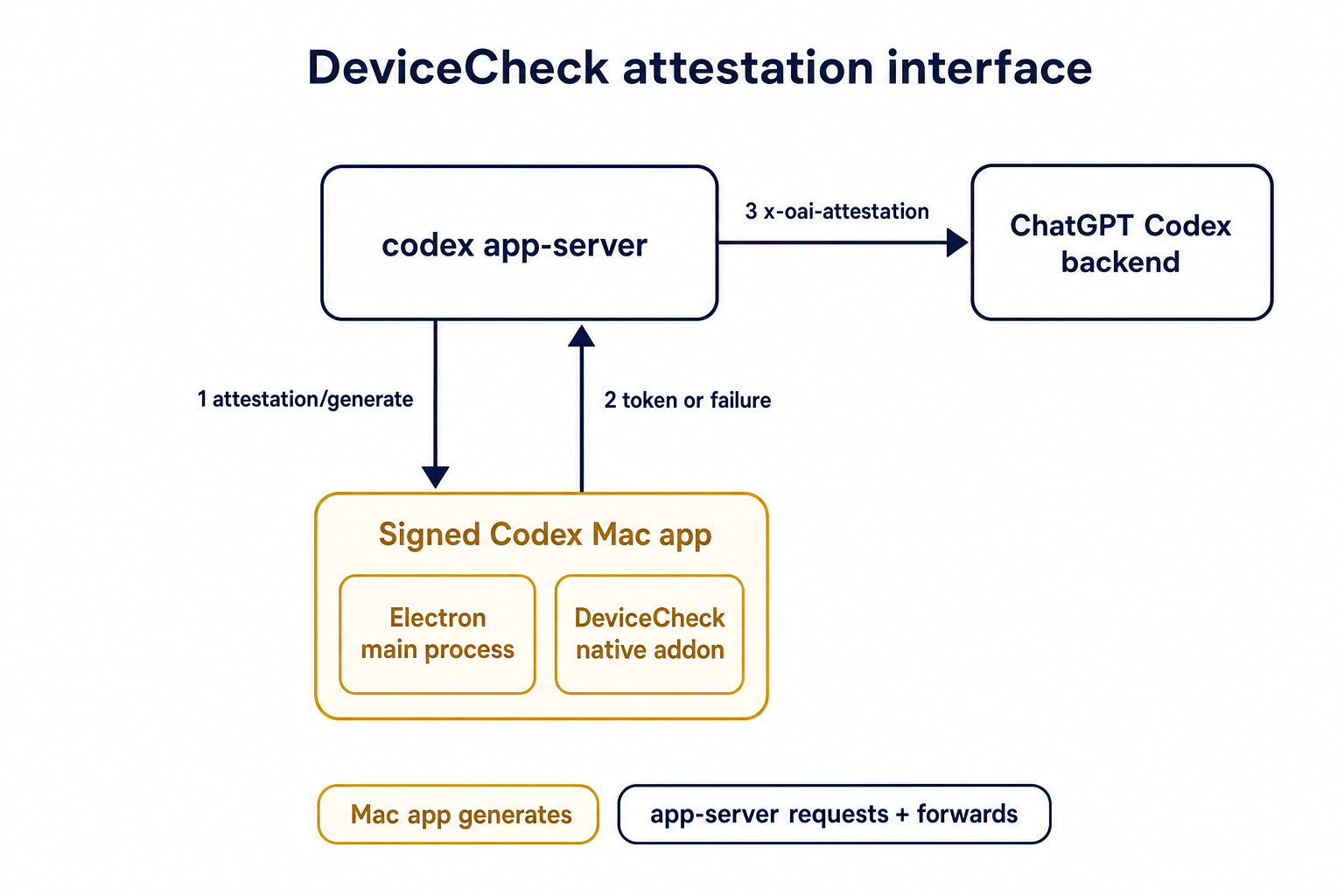
  • [codex] request desktop attestation from app (#20619)
    ## Summary
    
    TL;DR: teaches `codex-rs` / app-server to request a desktop-provided
    attestation token and attach it as `x-oai-attestation` on the scoped
    ChatGPT Codex request paths.
    
    ![DeviceCheck attestation
    interface](https://raw.githubusercontent.com/openai/codex/dev/jm/devicecheck-diagram-assets/pr-assets/devicecheck-attestation-interface.png)
    
    ## Details
    
    This PR teaches the Codex app-server runtime how to request and attach
    an attestation token. It does not generate DeviceCheck tokens directly;
    instead, it relies on the connected desktop app to advertise that it can
    generate attestation and then asks that app for a fresh header value
    when needed.
    
    The flow is:
    
    1. The Codex desktop app connects to app-server.
    2. During `initialize`, the app can advertise that it supports
    `requestAttestation`.
    3. Before app-server calls selected ChatGPT Codex endpoints, it sends
    the internal server request `attestation/generate` to the app.
    4. app-server receives a pre-encoded header value back.
    5. app-server forwards that value as `x-oai-attestation` on the scoped
    outbound requests.
    
    The code in this repo is mostly protocol and runtime plumbing: it adds
    the app-server request/response shape, introduces an attestation
    provider in core, wires that provider into Responses / compaction /
    realtime setup paths, and covers the intended scoping with tests. The
    signed macOS DeviceCheck generation remains owned by the desktop app PR.
    
    ## Related PR
    
    - Codex desktop app implementation:
    https://github.com/openai/openai/pull/878649
    
    ## Validation
    
    <details>
    <summary>Tests run</summary>
    
    ```sh
    cargo test -p codex-app-server-protocol
    cargo test -p codex-core attestation --lib
    cargo test -p codex-app-server --lib attestation
    ```
    
    Also ran:
    
    ```sh
    just fix -p codex-core
    just fix -p codex-app-server
    just fix -p codex-app-server-protocol
    just fmt
    just write-app-server-schema
    ```
    
    </details>
    
    <details>
    <summary>E2E DeviceCheck validation</summary>
    
    First validated the signed desktop app boundary directly: launched a
    packaged signed `Codex.app`, sent `attestation/generate`, decoded the
    returned `v1.` attestation header, and validated the extracted
    DeviceCheck token with `personal/jm/verify_devicecheck_token.py` using
    bundle ID `com.openai.codex`. Apple returned `status_code: 200` and
    `is_ok: true`.
    
    Then ran the fuller app + app-server flow. The packaged `Codex.app`
    launched a current-branch app-server via `CODEX_CLI_PATH`, and a local
    MITM proxy intercepted outbound `chatgpt.com` traffic. The app-server
    requested `attestation/generate` from the real Electron app process, and
    the intercepted `/backend-api/codex/responses` traffic included
    `x-oai-attestation` on both routes:
    
    ```text
    GET  /backend-api/codex/responses  Upgrade: websocket  x-oai-attestation: present
    POST /backend-api/codex/responses  Upgrade: none       x-oai-attestation: present
    ```
    
    The captured header decoded to a DeviceCheck token that also validated
    with Apple for `com.openai.codex` (`status_code: 200`, `is_ok: true`,
    team `2DC432GLL2`).
    
    </details>
    
    ---------
    
    Co-authored-by: Codex <noreply@openai.com>
  • feat: add session_id (#20437)
    ## Summary
    
    Related to
    https://openai.slack.com/archives/C095U48JNL9/p1777537279707449
    TLDR:
    We update the meaning of session ids and thread ids:
    * thread_id stays as now
    * session_id become a shared id between every thread under a /root
    thread (i.e. every sub-agent share the same session id)
    
    This PR introduces an explicit `SessionId` and threads it through the
    protocol/client boundary so `session_id` and `thread_id` can diverge
    when they need to, while preserving compatibility for older serialized
    `session_configured` events.
    
    ---------
    
    Co-authored-by: Codex <noreply@openai.com>
  • core: preserve last model ids in feedback tags (#21026)
    ## Why
    
    Feedback reports do not currently surface a direct pointer to the last
    model call, so investigations may require searching through many
    requests in a session to find the bad response. Preserve the last
    model-side IDs at response-stream time so immediate feedback reports
    carry that breadcrumb.
    
    ## What changed
    
    - Record `last_model_request_id` when a Responses stream exposes an
    upstream request ID.
    - Record `last_model_response_id` when the model response completes.
    - Add unit coverage for the emitted feedback tags.
    
    ## Verification
    
    - `cargo test -p codex-core
    client::tests::response_stream_records_last_model_feedback_ids`
  • [rollout-trace] Include x-request-id in rollout trace. (#20066)
    ## Why
    
    Rollout traces need an identifier that can be used to correlate a Codex
    inference with upstream Responses API, proxy, and engine logs. The
    reduced trace model already exposed `upstream_request_id`, but it was
    being populated from the Responses API `response.id`. That value is
    useful for `previous_response_id` chaining, but it is not the transport
    request id that upstream systems key on.
    
    This PR separates those concepts so trace consumers can reliably answer
    both questions:
    
    - which Responses API response did this inference produce?
    - which upstream request handled it?
    
    ## Structure
    
    The change keeps the upstream request id at the same lifecycle level as
    the provider stream:
    
    - `codex-api` captures the `x-request-id` HTTP response header when the
    SSE stream is created and exposes it on `ResponseStream`. Fixture and
    websocket streams set the field to `None` because they do not have that
    HTTP response header.
    - `codex-core` carries that stream-level id into `InferenceTraceAttempt`
    when recording terminal stream outcomes. Completed, failed, cancelled,
    dropped-stream, and pre-response error paths all record the id when it
    is available.
    - `rollout-trace` now records both identifiers in raw terminal inference
    events and response payloads: `response_id` for the Responses API
    `response.id`, and `upstream_request_id` for `x-request-id`.
    - The reducer stores both fields on `InferenceCall`. It also uses
    `response_id` for `previous_response_id` conversation linking, which
    removes the old accidental dependency on the misnamed
    `upstream_request_id` field.
    - Terminal inference reduction now consumes the full terminal payload
    (`InferenceCompleted`, `InferenceFailed`, or `InferenceCancelled`) in
    one place. That keeps status, partial payloads, response ids, and
    upstream request ids consistent across success, failure, cancellation,
    and late stream-mapper events.
    
    ## Why This Shape
    
    `x-request-id` is a property of the HTTP/provider response envelope, not
    an SSE event. Capturing it once in `codex-api` and plumbing it through
    terminal trace recording avoids trying to infer the value from stream
    contents, and it preserves the id even when the stream fails or is
    cancelled after only partial output.
    
    Keeping `response_id` separate from `upstream_request_id` also makes the
    reduced trace model less surprising: `response_id` remains the
    conversation-continuation id, while `upstream_request_id` is the
    operational correlation id for upstream debugging.
    
    ## Validation
    
    The PR updates trace and reducer coverage for:
    
    - reading `x-request-id` from SSE response headers;
    - storing the true upstream request id on completed inference calls;
    - preserving upstream request ids for cancelled and late-cancelled
    inference streams;
    - keeping `previous_response_id` reconstruction tied to `response_id`
    rather than transport request ids.
  • feat: split memories part 2 (#19860)
    Keep extracting memories out of core and moving the write trigger in the
    app-server
    This is temporary and it should move at the client level as a follow-up
    This makes core fully independant from `codex-memories-write`
    
    ---------
    
    Co-authored-by: Codex <noreply@openai.com>
  • [codex] Trace cancelled inference streams (#19839)
    Records cancelled inference streams when Codex stops consuming a
    provider response before `response.completed`, preserving complete
    output items observed before cancellation.
    
    Also closes still-running inference calls when the owning turn ends, so
    reduced rollout traces do not leave stale `Running` inference nodes.
    
    Covered by focused reducer coverage and a core stream-drop test for
    partial output preservation.
  • fix: fully revert agent identity runtime wiring (#18757)
    ## Summary
    
    This PR fully reverts the previously merged Agent Identity runtime
    integration from the old stack:
    https://github.com/openai/codex/pull/17387/changes
    
    It removes the Codex-side task lifecycle wiring, rollout/session
    persistence, feature flag plumbing, lazy `auth.json` mutation,
    background task auth paths, and request callsite changes introduced by
    that stack.
    
    This leaves the repo in a clean pre-AgentIdentity integration state so
    the follow-up PRs can reintroduce the pieces in smaller reviewable
    layers.
    
    ## Stack
    
    1. This PR: full revert
    2. https://github.com/openai/codex/pull/18871: move Agent Identity
    business logic into a crate
    3. https://github.com/openai/codex/pull/18785: add explicit
    AgentIdentity auth mode and startup task allocation
    4. https://github.com/openai/codex/pull/18811: migrate auth callsites
    through AuthProvider
    
    ## Testing
    
    Tests: targeted Rust checks, cargo-shear, Bazel lock check, and CI.
  • [codex] Use AgentAssertion downstream behind use_agent_identity (#17980)
    ## Summary
    
    This is the AgentAssertion downstream slice for feature-gated agent
    identity support, replacing the oversized AgentAssertion slice from PR
    #17807.
    
    It isolates task-scoped downstream AgentAssertion wiring on top of the
    merged PR3.1 work without re-carrying the earlier agent registration,
    task registration, or task-state history.
    
    This PR includes the task-scoped bug-fix call sites from the review:
    generic file upload auth, MCP OpenAI file upload auth, and ARC monitor
    auth. Broader user/control-plane calls move to PR4.1 and PR4.2.
    
    ## Stack
    
    - PR1: https://github.com/openai/codex/pull/17385 - add
    `features.use_agent_identity`
    - PR2: https://github.com/openai/codex/pull/17386 - register agent
    identities when enabled
    - PR3: https://github.com/openai/codex/pull/17387 - register agent tasks
    when enabled
    - PR3.1: https://github.com/openai/codex/pull/17978 - persist and
    prewarm registered tasks per thread
    - PR4: this PR - use task-scoped `AgentAssertion` downstream when
    enabled
    - PR4.1: https://github.com/openai/codex/pull/18094 - introduce
    AuthManager-owned background/control-plane `AgentAssertion` auth
    - PR4.2: https://github.com/openai/codex/pull/18260 - use background
    task auth for additional backend/control-plane calls
    
    ## What Changed
    
    - add AgentAssertion envelope generation in `codex-core`
    - route downstream HTTP and websocket auth through AgentAssertion when
    an agent task is present
    - extend the model-provider auth provider so non-bearer authorization
    schemes can be passed through cleanly
    - make generic file uploads attach the full authorization header value
    - make MCP OpenAI file uploads use the cached thread agent task
    assertion when present
    - make ARC monitor calls use the cached thread agent task assertion when
    present
    
    ## Why
    
    The original PR had drifted ancestry and showed a much larger diff than
    the semantic change actually required. Restacking it onto PR3.1 keeps
    the reviewable surface down to the downstream assertion slice.
    
    ## Validation
    
    - `just fmt`
    - `cargo check -p codex-core -p codex-login -p codex-analytics -p
    codex-app-server -p codex-cloud-requirements -p codex-cloud-tasks -p
    codex-models-manager -p codex-chatgpt -p codex-model-provider -p
    codex-mcp -p codex-core-skills`
    - `cargo test -p codex-model-provider bearer_auth_provider`
    - `cargo test -p codex-core agent_assertion`
    - `cargo test -p codex-app-server remote_control`
    - `cargo test -p codex-cloud-requirements fetch_cloud_requirements`
    - `cargo test -p codex-models-manager manager::tests`
    - `cargo test -p codex-chatgpt`
    - `cargo test -p codex-cloud-tasks`
    - `cargo test -p codex-login agent_identity`
    - `just fix -p codex-core -p codex-login -p codex-analytics -p
    codex-app-server -p codex-cloud-requirements -p codex-cloud-tasks -p
    codex-models-manager -p codex-chatgpt -p codex-model-provider -p
    codex-mcp -p codex-core-skills`
    - `just fix -p codex-app-server`
    - `git diff --check`
  • feat: add opt-in provider runtime abstraction (#17713)
    ## Summary
    
    - Add `codex-model-provider` as the runtime home for model-provider
    behavior that does not belong in `codex-core`, `codex-login`, or
    `codex-api`.
    - The new crate wraps configured `ModelProviderInfo` in a
    `ModelProvider` trait object that can resolve the API provider config,
    provider-scoped auth manager, and request auth provider for each call.
    - This centralizes provider auth behavior in one place today, and gives
    us an extension point for future provider-specific auth, model listing,
    request setup, and related runtime behavior.
    
    ## Tests
    Ran tests manually to make sure that provider auth under different
    configs still work as expected.
    
    ---------
    
    Co-authored-by: pakrym-oai <pakrym@openai.com>
  • feat(analytics): generate an installation_id and pass it in responsesapi client_metadata (#16912)
    ## Summary
    
    This adds a stable Codex installation ID and includes it on Responses
    API requests via `x-codex-installation-id` passed in via the
    `client_metadata` field for analytics/debugging.
    
    The main pieces are:
    - persist a UUID in `$CODEX_HOME/installation_id`
    - thread the installation ID into `ModelClient`
    - send it in `client_metadata` on Responses requests so it works
    consistently across HTTP and WebSocket transports
  • [codex] reduce module visibility (#16978)
    ## Summary
    - reduce public module visibility across Rust crates, preferring private
    or crate-private modules with explicit crate-root public exports
    - update external call sites and tests to use the intended public crate
    APIs instead of reaching through module trees
    - add the module visibility guideline to AGENTS.md
    
    ## Validation
    - `cargo check --workspace --all-targets --message-format=short` passed
    before the final fix/format pass
    - `just fix` completed successfully
    - `just fmt` completed successfully
    - `git diff --check` passed
  • [codex] add context-window lineage headers (#16758)
    This change adds client-owned context-window and parent thread id
    headers to all requests to responses api.
  • remove temporary ownership re-exports (#16626)
    Stacked on #16508.
    
    This removes the temporary `codex-core` / `codex-login` re-export shims
    from the ownership split and rewrites callsites to import directly from
    `codex-model-provider-info`, `codex-models-manager`, `codex-api`,
    `codex-protocol`, `codex-feedback`, and `codex-response-debug-context`.
    
    No behavior change intended; this is the mechanical import cleanup layer
    split out from the ownership move.
    
    ---------
    
    Co-authored-by: Codex <noreply@openai.com>
  • extract models manager and related ownership from core (#16508)
    ## Summary
    - split `models-manager` out of `core` and add `ModelsManagerConfig`
    plus `Config::to_models_manager_config()` so model metadata paths stop
    depending on `core::Config`
    - move login-owned/auth-owned code out of `core` into `codex-login`,
    move model provider config into `codex-model-provider-info`, move API
    bridge mapping into `codex-api`, move protocol-owned types/impls into
    `codex-protocol`, and move response debug helpers into a dedicated
    `response-debug-context` crate
    - move feedback tag emission into `codex-feedback`, relocate tests to
    the crates that now own the code, and keep broad temporary re-exports so
    this PR avoids a giant import-only rewrite
    
    ## Major moves and decisions
    - created `codex-models-manager` as the owner for model
    cache/catalog/config/model info logic, including the new
    `ModelsManagerConfig` struct
    - created `codex-model-provider-info` as the owner for provider config
    parsing/defaults and kept temporary `codex-login`/`codex-core`
    re-exports for old import paths
    - moved `api_bridge` error mapping + `CoreAuthProvider` into
    `codex-api`, while `codex-login::api_bridge` temporarily re-exports
    those symbols and keeps the `auth_provider_from_auth` wrapper
    - moved `auth_env_telemetry` and `provider_auth` ownership to
    `codex-login`
    - moved `CodexErr` ownership to `codex-protocol::error`, plus
    `StreamOutput`, `bytes_to_string_smart`, and network policy helpers to
    protocol-owned modules
    - created `codex-response-debug-context` for
    `extract_response_debug_context`, `telemetry_transport_error_message`,
    and related response-debug plumbing instead of leaving that behavior in
    `core`
    - moved `FeedbackRequestTags`, `emit_feedback_request_tags`, and
    `emit_feedback_request_tags_with_auth_env` to `codex-feedback`
    - deferred removal of temporary re-exports and the mechanical import
    rewrites to a stacked follow-up PR so this PR stays reviewable
    
    ## Test moves
    - moved auth refresh coverage from `core/tests/suite/auth_refresh.rs` to
    `login/tests/suite/auth_refresh.rs`
    - moved text encoding coverage from
    `core/tests/suite/text_encoding_fix.rs` to
    `protocol/src/exec_output_tests.rs`
    - moved model info override coverage from
    `core/tests/suite/model_info_overrides.rs` to
    `models-manager/src/model_info_overrides_tests.rs`
    
    ---------
    
    Co-authored-by: Codex <noreply@openai.com>
  • core: remove cross-crate re-exports from lib.rs (#16512)
    ## Why
    
    `codex-core` was re-exporting APIs owned by sibling `codex-*` crates,
    which made downstream crates depend on `codex-core` as a proxy module
    instead of the actual owner crate.
    
    Removing those forwards makes crate boundaries explicit and lets leaf
    crates drop unnecessary `codex-core` dependencies. In this PR, this
    reduces the dependency on `codex-core` to `codex-login` in the following
    files:
    
    ```
    codex-rs/backend-client/Cargo.toml
    codex-rs/mcp-server/tests/common/Cargo.toml
    ```
    
    ## What
    
    - Remove `codex-rs/core/src/lib.rs` re-exports for symbols owned by
    `codex-login`, `codex-mcp`, `codex-rollout`, `codex-analytics`,
    `codex-protocol`, `codex-shell-command`, `codex-sandboxing`,
    `codex-tools`, and `codex-utils-path`.
    - Delete the `default_client` forwarding shim in `codex-rs/core`.
    - Update in-crate and downstream callsites to import directly from the
    owning `codex-*` crate.
    - Add direct Cargo dependencies where callsites now target the owner
    crate, and remove `codex-core` from `codex-rs/backend-client`.
  • chore: clean up argument-comment lint and roll out all-target CI on macOS (#16054)
    ## Why
    
    `argument-comment-lint` was green in CI even though the repo still had
    many uncommented literal arguments. The main gap was target coverage:
    the repo wrapper did not force Cargo to inspect test-only call sites, so
    examples like the `latest_session_lookup_params(true, ...)` tests in
    `codex-rs/tui_app_server/src/lib.rs` never entered the blocking CI path.
    
    This change cleans up the existing backlog, makes the default repo lint
    path cover all Cargo targets, and starts rolling that stricter CI
    enforcement out on the platform where it is currently validated.
    
    ## What changed
    
    - mechanically fixed existing `argument-comment-lint` violations across
    the `codex-rs` workspace, including tests, examples, and benches
    - updated `tools/argument-comment-lint/run-prebuilt-linter.sh` and
    `tools/argument-comment-lint/run.sh` so non-`--fix` runs default to
    `--all-targets` unless the caller explicitly narrows the target set
    - fixed both wrappers so forwarded cargo arguments after `--` are
    preserved with a single separator
    - documented the new default behavior in
    `tools/argument-comment-lint/README.md`
    - updated `rust-ci` so the macOS lint lane keeps the plain wrapper
    invocation and therefore enforces `--all-targets`, while Linux and
    Windows temporarily pass `-- --lib --bins`
    
    That temporary CI split keeps the stricter all-targets check where it is
    already cleaned up, while leaving room to finish the remaining Linux-
    and Windows-specific target-gated cleanup before enabling
    `--all-targets` on those runners. The Linux and Windows failures on the
    intermediate revision were caused by the wrapper forwarding bug, not by
    additional lint findings in those lanes.
    
    ## Validation
    
    - `bash -n tools/argument-comment-lint/run.sh`
    - `bash -n tools/argument-comment-lint/run-prebuilt-linter.sh`
    - shell-level wrapper forwarding check for `-- --lib --bins`
    - shell-level wrapper forwarding check for `-- --tests`
    - `just argument-comment-lint`
    - `cargo test` in `tools/argument-comment-lint`
    - `cargo test -p codex-terminal-detection`
    
    ## Follow-up
    
    - Clean up remaining Linux-only target-gated callsites, then switch the
    Linux lint lane back to the plain wrapper invocation.
    - Clean up remaining Windows-only target-gated callsites, then switch
    the Windows lint lane back to the plain wrapper invocation.
  • Prefer websockets when providers support them (#13592)
    Remove all flags and model settings.
    
    ---------
    
    Co-authored-by: Codex <noreply@openai.com>
  • Add auth 401 observability to client bug reports (#14611)
    CXC-392
    
      [With
      401](https://openai.sentry.io/issues/7333870443/?project=4510195390611458&query=019ce8f8-560c-7f10-a00a-c59553740674&referrer=issue-stream)
      <img width="1909" height="555" alt="401 auth tags in Sentry"
      src="https://github.com/user-attachments/assets/412ea950-61c4-4780-9697-15c270971ee3"
      />
    
    
      - auth_401_*: preserved facts from the latest unauthorized response snapshot
      - auth_*: latest auth-related facts from the latest request attempt
      - auth_recovery_*: unauthorized recovery state and follow-up result
    
    
      Without 401
      <img width="1917" height="522" alt="happy-path auth tags in Sentry"
      src="https://github.com/user-attachments/assets/3381ed28-8022-43b0-b6c0-623a630e679f"
      />
    
      ###### Summary
      - Add client-visible 401 diagnostics for auth attachment, upstream auth classification, and 401 request id / cf-ray correlation.
      - Record unauthorized recovery mode, phase, outcome, and retry/follow-up status without changing auth behavior.
      - Surface the highest-signal auth and recovery fields on uploaded client bug reports so they are usable in Sentry.
      - Preserve original unauthorized evidence under `auth_401_*` while keeping follow-up result tags separate.
    
      ###### Rationale (from spec findings)
      - The dominant bucket needed proof of whether the client attached auth before send or upstream still classified the request as missing auth.
      - Client uploads needed to show whether unauthorized recovery ran and what the client tried next.
      - Request id and cf-ray needed to be preserved on the unauthorized response so server-side correlation is immediate.
      - The bug-report path needed the same auth evidence as the request telemetry path, otherwise the observability would not be operationally useful.
    
      ###### Scope
      - Add auth 401 and unauthorized-recovery observability in `codex-rs/core`, `codex-rs/codex-api`, and `codex-rs/otel`, including feedback-tag surfacing.
      - Keep auth semantics, refresh behavior, retry behavior, endpoint classification, and geo-denial follow-up work out of this PR.
    
      ###### Trade-offs
      - This exports only safe auth evidence: header presence/name, upstream auth classification, request ids, and recovery state. It does not export token values or raw upstream bodies.
      - This keeps websocket connection reuse as a transport clue because it can help distinguish stale reused sessions from fresh reconnects.
      - Misroute/base-url classification and geo-denial are intentionally deferred to a separate follow-up PR so this review stays focused on the dominant auth 401 bucket.
    
      ###### Client follow-up
      - PR 2 will add misroute/provider and geo-denial observability plus the matching feedback-tag surfacing.
      - A separate host/app-server PR should log auth-decision inputs so pre-send host auth state can be correlated with client request evidence.
      - `device_id` remains intentionally separate until there is a safe existing source on the feedback upload path.
    
      ###### Testing
      - `cargo test -p codex-core refresh_available_models_sorts_by_priority`
      - `cargo test -p codex-core emit_feedback_request_tags_`
      - `cargo test -p codex-core emit_feedback_auth_recovery_tags_`
      - `cargo test -p codex-core auth_request_telemetry_context_tracks_attached_auth_and_retry_phase`
      - `cargo test -p codex-core extract_response_debug_context_decodes_identity_headers`
      - `cargo test -p codex-core identity_auth_details`
      - `cargo test -p codex-core telemetry_error_messages_preserve_non_http_details`
      - `cargo test -p codex-core --all-features --no-run`
      - `cargo test -p codex-otel otel_export_routing_policy_routes_api_request_auth_observability`
      - `cargo test -p codex-otel otel_export_routing_policy_routes_websocket_connect_auth_observability`
      - `cargo test -p codex-otel otel_export_routing_policy_routes_websocket_request_transport_observability`
  • fix: move inline codex-rs/core unit tests into sibling files (#14444)
    ## Why
    PR #13783 moved the `codex.rs` unit tests into `codex_tests.rs`. This
    applies the same extraction pattern across the rest of `codex-rs/core`
    so the production modules stay focused on runtime code instead of large
    inline test blocks.
    
    Keeping the tests in sibling files also makes follow-up edits easier to
    review because product changes no longer have to share a file with
    hundreds or thousands of lines of test scaffolding.
    
    ## What changed
    - replaced each inline `mod tests { ... }` in `codex-rs/core/src/**`
    with a path-based module declaration
    - moved each extracted unit test module into a sibling `*_tests.rs`
    file, using `mod_tests.rs` for `mod.rs` modules
    - preserved the existing `cfg(...)` guards and module-local structure so
    the refactor remains structural rather than behavioral
    
    ## Testing
    - `cargo test -p codex-core --lib` (`1653 passed; 0 failed; 5 ignored`)
    - `just fix -p codex-core`
    - `cargo fmt --check`
    - `cargo shear`