mirror of
https://github.com/pchuan98/codex.git
synced 2026-07-01 00:31:56 +08:00
17d552fb4d53d602eab87076acff1239a0420708
261 Commits
-
[codex] Remove external websocket session resets (#23384)
## Why Compaction now installs replacement history inside the session, but the turn and compaction callers were still reaching into `ModelClientSession` to reset websocket transport state after that install. That made a transport-level reset part of the compaction API even though websocket incremental request selection already checks whether the next request is a strict extension of the previous one and falls back to a full `response.create` when it is not. ## What changed - Removed the compaction-side calls to `reset_websocket_session` from `compact.rs` and `session/turn.rs`. - Simplified pre-sampling and mid-turn compaction helpers so they return `CodexResult<()>` instead of carrying a reset flag. - Made `ModelClientSession::reset_websocket_session` private to `client.rs`, leaving only the websocket timeout recovery path inside the client as a caller. ## Validation - `cargo test -p codex-core --test all responses_websocket_creates_on_non_prefix` - `cargo test -p codex-core --test all steered_user_input_waits_for_model_continuation_after_mid_turn_compact` - `cargo test -p codex-core --test all pre_sampling_compact_runs_on_switch_to_smaller_context_model`
pakrym-oai ·
2026-05-19 01:13:38 +00:00 -
Remove CODEX_RS_SSE_FIXTURE test hook (#22413)
## Why `CODEX_RS_SSE_FIXTURE` let integration-style CLI, exec, and TUI tests bypass the normal Responses transport by reading SSE from local files. That kept test-only behavior wired through production client code. The affected tests can stay hermetic by using the existing `core_test_support::responses` mock server and passing `openai_base_url` instead. ## What Changed - Removed the `CODEX_RS_SSE_FIXTURE` flag, `codex_api::stream_from_fixture`, the `env-flags` dependency, and the checked-in SSE fixture files. - Repointed the affected core, exec, and TUI tests at `MockServer` with the existing SSE event constructors. - Removed the Bazel test data plumbing for the deleted fixtures and refreshed cargo/Bazel lock state. ## Verification - `cargo build -p codex-cli` - `cargo test -p codex-api` - `cargo test -p codex-core --test all responses_api_stream_cli` - `cargo test -p codex-core --test all integration_creates_and_checks_session_file` - `cargo test -p codex-exec --test all ephemeral` - `cargo test -p codex-exec --test all resume` - `cargo test -p codex-tui --test all resume_startup_does_not_consume_model_availability_nux_count` - `just bazel-lock-update` - `just bazel-lock-check` - `just fix -p codex-api -p codex-core -p codex-exec -p codex-tui` - `git diff --check`
pakrym-oai ·
2026-05-13 03:08:01 +00:00 -
[rollout-trace] Add x-codex-inference-call-id header to inference calls. (#22311)
This allows us to attach call logs to inference requests in traces.
cassirer-openai ·
2026-05-12 05:55:11 -07:00 -
Add x-codex-ws-stream-request-start-ms (#22113)
For capturing client-side timing information.
Andrey Mishchenko ·
2026-05-11 08:15:52 -07:00 -
[codex] request desktop attestation from app (#20619)
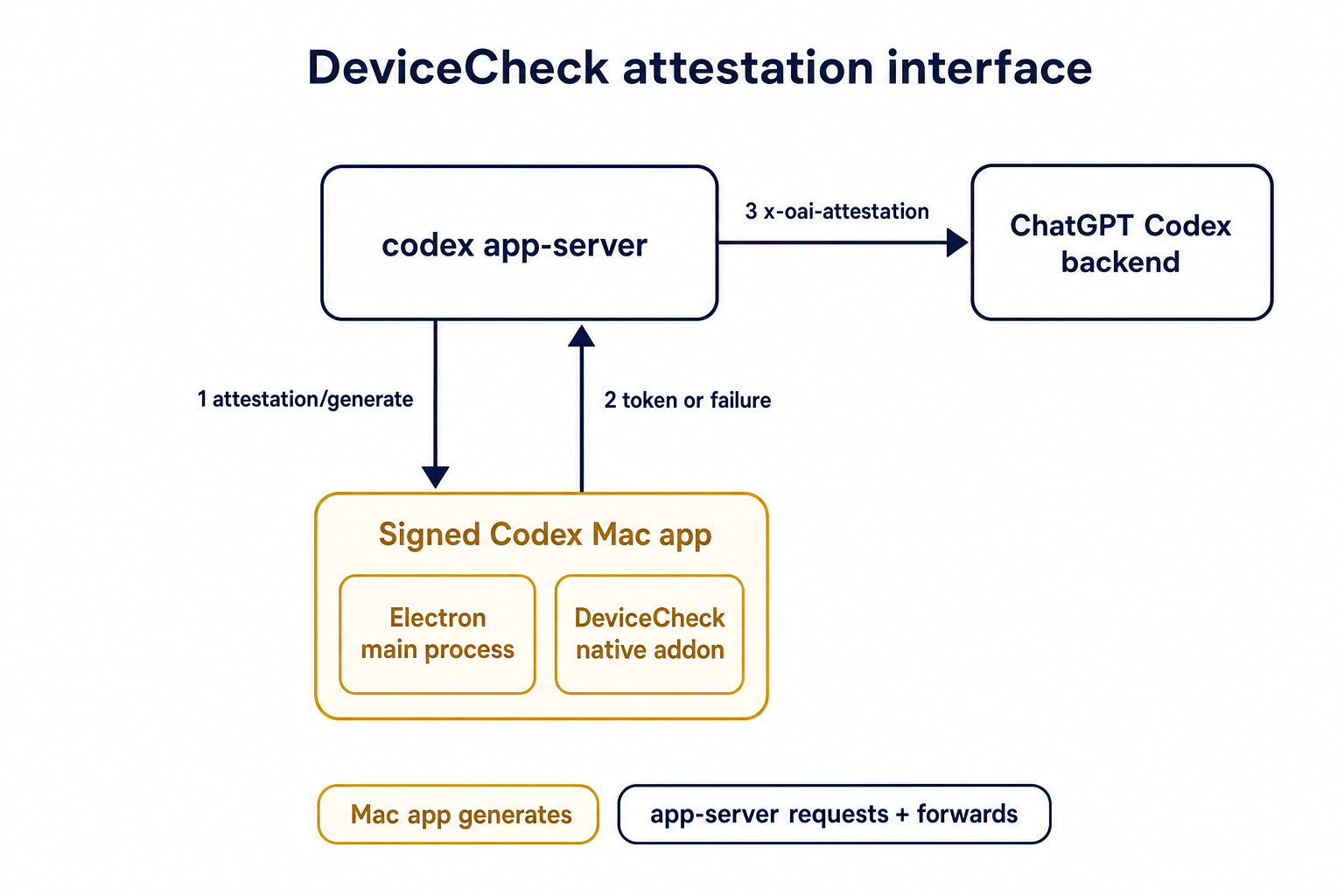
## Summary TL;DR: teaches `codex-rs` / app-server to request a desktop-provided attestation token and attach it as `x-oai-attestation` on the scoped ChatGPT Codex request paths.  ## Details This PR teaches the Codex app-server runtime how to request and attach an attestation token. It does not generate DeviceCheck tokens directly; instead, it relies on the connected desktop app to advertise that it can generate attestation and then asks that app for a fresh header value when needed. The flow is: 1. The Codex desktop app connects to app-server. 2. During `initialize`, the app can advertise that it supports `requestAttestation`. 3. Before app-server calls selected ChatGPT Codex endpoints, it sends the internal server request `attestation/generate` to the app. 4. app-server receives a pre-encoded header value back. 5. app-server forwards that value as `x-oai-attestation` on the scoped outbound requests. The code in this repo is mostly protocol and runtime plumbing: it adds the app-server request/response shape, introduces an attestation provider in core, wires that provider into Responses / compaction / realtime setup paths, and covers the intended scoping with tests. The signed macOS DeviceCheck generation remains owned by the desktop app PR. ## Related PR - Codex desktop app implementation: https://github.com/openai/openai/pull/878649 ## Validation <details> <summary>Tests run</summary> ```sh cargo test -p codex-app-server-protocol cargo test -p codex-core attestation --lib cargo test -p codex-app-server --lib attestation ``` Also ran: ```sh just fix -p codex-core just fix -p codex-app-server just fix -p codex-app-server-protocol just fmt just write-app-server-schema ``` </details> <details> <summary>E2E DeviceCheck validation</summary> First validated the signed desktop app boundary directly: launched a packaged signed `Codex.app`, sent `attestation/generate`, decoded the returned `v1.` attestation header, and validated the extracted DeviceCheck token with `personal/jm/verify_devicecheck_token.py` using bundle ID `com.openai.codex`. Apple returned `status_code: 200` and `is_ok: true`. Then ran the fuller app + app-server flow. The packaged `Codex.app` launched a current-branch app-server via `CODEX_CLI_PATH`, and a local MITM proxy intercepted outbound `chatgpt.com` traffic. The app-server requested `attestation/generate` from the real Electron app process, and the intercepted `/backend-api/codex/responses` traffic included `x-oai-attestation` on both routes: ```text GET /backend-api/codex/responses Upgrade: websocket x-oai-attestation: present POST /backend-api/codex/responses Upgrade: none x-oai-attestation: present ``` The captured header decoded to a DeviceCheck token that also validated with Apple for `com.openai.codex` (`status_code: 200`, `is_ok: true`, team `2DC432GLL2`). </details> --------- Co-authored-by: Codex <noreply@openai.com>
Jiaming Zhang ·
2026-05-08 12:36:02 -07:00 -
[codex] Generalize service tier slash commands (#21745)
## Why `/fast` was wired as a one-off slash command even though model metadata now exposes service tiers as catalog data. That meant adding another tier, such as a slower/cheaper tier, would require more hardcoded TUI plumbing instead of letting the model catalog drive the available commands. This change makes service-tier commands data-driven: each advertised `service_tiers` entry becomes a `/name` command using the catalog description, while the request path sends the tier `id` only when the selected model supports it. ## What Changed - Removed the hardcoded `/fast` slash-command variant and introduced dynamic service-tier command items in the composer and command popup. - Added toggle behavior for service-tier commands: invoking `/name` selects that tier, and invoking it again clears the selection. - Preserved the existing Fast-mode keybinding/status affordances by resolving the current model tier whose name is `fast`, while still sending the tier request value such as `priority`. - Persisted service-tier selections as raw request strings so non-fast tiers can round-trip through config. - Updated the Bedrock catalog entry to advertise fast support through `service_tiers` with `id: "priority"` and `name: "fast"`. - Added defensive filtering in core so unsupported selected service tiers are omitted from `/responses` requests. ## Validation - Added/updated coverage for dynamic service-tier slash command lookup, popup descriptions, composer dispatch, TUI fast toggling, and unsupported-tier omission in core request construction. - Local tests were not run per request. --------- Co-authored-by: Codex <noreply@openai.com>
Ahmed Ibrahim ·
2026-05-08 20:09:51 +03:00 -
[codex] Add response.processed websocket request (#21284)
## Summary - Add a `response.processed` websocket request payload and sender for Responses API websockets. - Send `response.processed` from `try_run_sampling_request` after a response completes, local turn processing succeeds, and the session-owned feature flag is enabled. - Add websocket coverage for both enabled and disabled feature-flag behavior. ## Validation - `just fmt` - `cargo test -p codex-core response_processed` - `cargo test -p codex-api responses_websocket` - `cargo test -p codex-features responses_websocket_response_processed_is_under_development` - `git diff --check` - `just fix -p codex-api -p codex-core -p codex-features` - `git diff --check origin/main...HEAD`
pakrym-oai ·
2026-05-06 09:58:46 -07:00 -
2- Use string service tiers in session protocol (#20971)
## Summary - break service tier session/op/app-server protocol fields from the closed enum to string tier ids - send the service tier string directly through model requests, prewarm, compaction, memories, and TUI/app-server turn starts - regenerate app-server protocol JSON/TypeScript schemas, removing the standalone ServiceTier TS enum ## Verification - just fmt - cargo check -p codex-core -p codex-app-server -p codex-tui - just write-app-server-schema --------- Co-authored-by: Codex <noreply@openai.com>
Ahmed Ibrahim ·
2026-05-06 18:00:21 +03:00 -
Propagate cache key and service tiers in compact (#21249)
## Why `/responses/compact` should preserve the request-affinity fields that apply to the active auth mode. ChatGPT-auth compact requests need the effective `service_tier`, and compact requests for every auth mode need the stable `prompt_cache_key`, so compaction does not quietly lose routing or cache behavior that normal sampling already has. This follows the request-parity direction from #20719, but keeps the net change focused on the compact payload fields needed here. ## What changed - Add `service_tier` and `prompt_cache_key` to the compact endpoint input payload. - Build the remote compact payload from the existing responses request builder output so `Fast` still maps to `priority` when compact sends a service tier. - Pass the turn service tier into remote compaction, but only include it in compact payloads for ChatGPT-backed auth. - Keep `prompt_cache_key` on compact payloads for all auth modes. - Add request-body diff snapshot coverage in `core/tests/suite/compact_remote.rs` for: - API-key auth reusing `prompt_cache_key` while omitting `service_tier` even when `Fast` is configured. - ChatGPT auth reusing both `service_tier` and `prompt_cache_key`. - Drive the snapshot coverage through five varied turns: plain text, multi-part text, tool-call continuation, image+text input, local-shell continuation, and final-turn reasoning output. ## Verification - Added insta snapshots for compact request-body parity against the last normal `/responses` request after five varied turns. - Not run locally per repo guidance; relying on GitHub CI for test execution. --------- Co-authored-by: Codex <noreply@openai.com>
Ahmed Ibrahim ·
2026-05-06 13:38:43 +03:00 -
feat: add
session_id(#20437)## Summary Related to https://openai.slack.com/archives/C095U48JNL9/p1777537279707449 TLDR: We update the meaning of session ids and thread ids: * thread_id stays as now * session_id become a shared id between every thread under a /root thread (i.e. every sub-agent share the same session id) This PR introduces an explicit `SessionId` and threads it through the protocol/client boundary so `session_id` and `thread_id` can diverge when they need to, while preserving compatibility for older serialized `session_configured` events. --------- Co-authored-by: Codex <noreply@openai.com>
jif-oai ·
2026-05-06 10:48:37 +02:00 -
core: preserve last model ids in feedback tags (#21026)
## Why Feedback reports do not currently surface a direct pointer to the last model call, so investigations may require searching through many requests in a session to find the bad response. Preserve the last model-side IDs at response-stream time so immediate feedback reports carry that breadcrumb. ## What changed - Record `last_model_request_id` when a Responses stream exposes an upstream request ID. - Record `last_model_response_id` when the model response completes. - Add unit coverage for the emitted feedback tags. ## Verification - `cargo test -p codex-core client::tests::response_stream_records_last_model_feedback_ids`
sayan-oai ·
2026-05-04 12:46:08 -07:00 -
core: share responses request builder with compact requests (#20989)
## Why `ModelClientSession` and `compact_conversation_history()` were still rebuilding the same `ResponsesApiRequest` fields separately. That duplication makes it easy for normal `/responses` turns and compact requests to drift when request-shape changes land later, which is exactly the kind of cache-affecting divergence we want to avoid. This follow-up keeps the scope small by extracting the shared request-construction logic into one helper and using it from both paths. ## What changed - move `ResponsesApiRequest` construction into a shared `ModelClient::build_responses_request(...)` helper in `core/src/client.rs` - update the normal `/responses` streaming path to call that helper instead of the old `ModelClientSession`-local implementation - update `compact_conversation_history()` to derive its compact payload from the same helper so `model`, `instructions`, `input`, `tools`, `parallel_tool_calls`, `reasoning`, and `text` stay aligned with normal request building - add a unit test covering the shared helper's prompt cache key, installation metadata, and `service_tier` behavior ## Verification - `cargo test -p codex-core build_responses_request_sets_shared_cache_and_metadata_fields` - `cargo test -p codex-core --test all remote_compact_v2_reuses_context_compaction_for_followups` ## Docs No docs update needed.
jif-oai ·
2026-05-04 17:18:38 +00:00 -
feat: add remote compaction v2 Responses client path (#20773)
## Why This adds the `remote_compaction_v2` client path so remote compaction can run through the normal Responses stream and install a `context_compaction` item that trigger a compaction. The goal is to migrate some of the compaction logic on the client side We keeps the v2 transport behind a feature flag while letting follow-up requests reuse the compacted context instead of falling back to the legacy compaction item shape. ## What changed - add `ResponseItem::ContextCompaction` and refresh the generated app-server / schema / TypeScript fixtures that expose response items on the wire - add `core/src/compact_remote_v2.rs` to send compaction through the standard streamed Responses client, require exactly one `context_compaction` output item, and install that item into compacted history - route manual compact and auto-compaction through the v2 path when `remote_compaction_v2` is enabled, while keeping the existing remote compaction path as the fallback - preserve the new item type across history retention, follow-up request construction, telemetry, rollout persistence, and rollout-trace normalization - add targeted coverage for the feature flag, `context_compaction` serialization, rollout-trace normalization, and remote-compaction follow-up behavior ## Verification - added protocol tests for `context_compaction` serialization/deserialization in `protocol/src/models.rs` - added rollout-trace coverage for `context_compaction` normalization in `rollout-trace/src/reducer/conversation_tests.rs` - added remote compaction integration coverage for v2 follow-up reuse and mixed compaction output streams in `core/tests/suite/compact_remote.rs` --------- Co-authored-by: Codex <noreply@openai.com>
jif-oai ·
2026-05-04 14:15:01 +02:00 -
[rollout-trace] Include x-request-id in rollout trace. (#20066)
## Why Rollout traces need an identifier that can be used to correlate a Codex inference with upstream Responses API, proxy, and engine logs. The reduced trace model already exposed `upstream_request_id`, but it was being populated from the Responses API `response.id`. That value is useful for `previous_response_id` chaining, but it is not the transport request id that upstream systems key on. This PR separates those concepts so trace consumers can reliably answer both questions: - which Responses API response did this inference produce? - which upstream request handled it? ## Structure The change keeps the upstream request id at the same lifecycle level as the provider stream: - `codex-api` captures the `x-request-id` HTTP response header when the SSE stream is created and exposes it on `ResponseStream`. Fixture and websocket streams set the field to `None` because they do not have that HTTP response header. - `codex-core` carries that stream-level id into `InferenceTraceAttempt` when recording terminal stream outcomes. Completed, failed, cancelled, dropped-stream, and pre-response error paths all record the id when it is available. - `rollout-trace` now records both identifiers in raw terminal inference events and response payloads: `response_id` for the Responses API `response.id`, and `upstream_request_id` for `x-request-id`. - The reducer stores both fields on `InferenceCall`. It also uses `response_id` for `previous_response_id` conversation linking, which removes the old accidental dependency on the misnamed `upstream_request_id` field. - Terminal inference reduction now consumes the full terminal payload (`InferenceCompleted`, `InferenceFailed`, or `InferenceCancelled`) in one place. That keeps status, partial payloads, response ids, and upstream request ids consistent across success, failure, cancellation, and late stream-mapper events. ## Why This Shape `x-request-id` is a property of the HTTP/provider response envelope, not an SSE event. Capturing it once in `codex-api` and plumbing it through terminal trace recording avoids trying to infer the value from stream contents, and it preserves the id even when the stream fails or is cancelled after only partial output. Keeping `response_id` separate from `upstream_request_id` also makes the reduced trace model less surprising: `response_id` remains the conversation-continuation id, while `upstream_request_id` is the operational correlation id for upstream debugging. ## Validation The PR updates trace and reducer coverage for: - reading `x-request-id` from SSE response headers; - storing the true upstream request id on completed inference calls; - preserving upstream request ids for cancelled and late-cancelled inference streams; - keeping `previous_response_id` reconstruction tied to `response_id` rather than transport request ids.
cassirer-openai ·
2026-04-28 21:11:17 +00:00 -
feat: split memories part 2 (#19860)
Keep extracting memories out of core and moving the write trigger in the app-server This is temporary and it should move at the client level as a follow-up This makes core fully independant from `codex-memories-write` --------- Co-authored-by: Codex <noreply@openai.com>
jif-oai ·
2026-04-28 13:03:28 +02:00 -
[codex] Trace cancelled inference streams (#19839)
Records cancelled inference streams when Codex stops consuming a provider response before `response.completed`, preserving complete output items observed before cancellation. Also closes still-running inference calls when the owning turn ends, so reduced rollout traces do not leave stale `Running` inference nodes. Covered by focused reducer coverage and a core stream-drop test for partial output preservation.
cassirer-openai ·
2026-04-27 21:58:29 +00:00 -
Support end_turn in response.completed (#19610)
Some providers of Responses API forward a model-defined `end_turn` boolean indicating explicitly the model's indication of whether it would like to end the turn or to be inferenced again. In this PR, we update the sampling loop to use this field correctly if it's set. If the field is not set by the provider, we fall back to the existing sampling logic.
Andrey Mishchenko ·
2026-04-25 21:57:42 -07:00 -
refactor: route Codex auth through AuthProvider (#18811)
## Summary This PR moves Codex backend request authentication from direct bearer-token handling to `AuthProvider`. The new `codex-auth-provider` crate defines the shared request-auth trait. `CodexAuth::provider()` returns a provider that can apply all headers needed for the selected auth mode. This lets ChatGPT token auth and AgentIdentity auth share the same callsite path: - ChatGPT token auth applies bearer auth plus account/FedRAMP headers where needed. - AgentIdentity auth applies AgentAssertion plus account/FedRAMP headers where needed. Reference old stack: https://github.com/openai/codex/pull/17387/changes ## Callsite Migration | Area | Change | | --- | --- | | backend-client | accepts an `AuthProvider` instead of a raw token/header | | chatgpt client/connectors | applies auth through `CodexAuth::provider()` | | cloud tasks | keeps Codex-backend gating, applies auth through provider | | cloud requirements | uses Codex-backend auth checks and provider headers | | app-server remote control | applies provider headers for backend calls | | MCP Apps/connectors | gates on `uses_codex_backend()` and keys caches from generic account getters | | model refresh | treats AgentIdentity as Codex-backend auth | | OpenAI file upload path | rejects non-Codex-backend auth before applying headers | | core client setup | keeps model-provider auth flow and allows AgentIdentity through provider-backed OpenAI auth | ## Stack 1. https://github.com/openai/codex/pull/18757: full revert 2. https://github.com/openai/codex/pull/18871: isolated Agent Identity crate 3. https://github.com/openai/codex/pull/18785: explicit AgentIdentity auth mode and startup task allocation 4. This PR: migrate Codex backend auth callsites through AuthProvider 5. https://github.com/openai/codex/pull/18904: accept AgentIdentity JWTs and load `CODEX_AGENT_IDENTITY` ## Testing Tests: targeted Rust checks, cargo-shear, Bazel lock check, and CI.
efrazer-oai ·
2026-04-23 17:14:02 -07:00 -
[rollout_trace] Record core session rollout traces (#18877)
## Summary Wires rollout trace recording into `codex-core` session and turn execution. This records the core model request/response, compaction, and session lifecycle boundaries needed for replay without yet tracing every nested runtime/tool boundary. ## Stack This is PR 2/5 in the rollout trace stack. - [#18876](https://github.com/openai/codex/pull/18876): Add rollout trace crate - [#18877](https://github.com/openai/codex/pull/18877): Record core session rollout traces - [#18878](https://github.com/openai/codex/pull/18878): Trace tool and code-mode boundaries - [#18879](https://github.com/openai/codex/pull/18879): Trace sessions and multi-agent edges - [#18880](https://github.com/openai/codex/pull/18880): Add debug trace reduction command ## Review Notes This layer is the first live integration point. The important review question is whether trace recording is isolated from normal session behavior: trace failures should not become user-visible execution failures, and recording should preserve the existing turn/session lifecycle semantics. The PR depends on the reducer/data model from the first stack entry and only introduces the core recorder surface that later PRs use for richer runtime and relationship events.
cassirer-openai ·
2026-04-22 17:00:48 +00:00 -
feat: add explicit AgentIdentity auth mode (#18785)
## Summary This PR adds `CodexAuth::AgentIdentity` as an explicit auth mode. An AgentIdentity auth record is a standalone `auth.json` mode. When `AuthManager::auth().await` loads that mode, it registers one process-scoped task and stores it in runtime-only state on the auth value. Header creation stays synchronous after that because the task is initialized before callers receive the auth object. This PR also removes the old feature flag path. AgentIdentity is selected by explicit auth mode, not by a hidden flag or lazy mutation of ChatGPT auth records. Reference old stack: https://github.com/openai/codex/pull/17387/changes ## Design Decisions - AgentIdentity is a real auth enum variant because it can be the only credential in `auth.json`. - The process task is ephemeral runtime state. It is not serialized and is not stored in rollout/session data. - Account/user metadata needed by existing Codex backend checks lives on the AgentIdentity record for now. - `is_chatgpt_auth()` remains token-specific. - `uses_codex_backend()` is the broader predicate for ChatGPT-token auth and AgentIdentity auth. ## Stack 1. https://github.com/openai/codex/pull/18757: full revert 2. https://github.com/openai/codex/pull/18871: isolated Agent Identity crate 3. This PR: explicit AgentIdentity auth mode and startup task allocation 4. https://github.com/openai/codex/pull/18811: migrate Codex backend auth callsites through AuthProvider 5. https://github.com/openai/codex/pull/18904: accept AgentIdentity JWTs and load `CODEX_AGENT_IDENTITY` ## Testing Tests: targeted Rust checks, cargo-shear, Bazel lock check, and CI.
efrazer-oai ·
2026-04-21 22:33:24 -07:00 -
Allow guardian bare allow output (#18797)
## Summary Allow guardian to skip other fields and output only `{"outcome":"allow"}` when the command is low risk. This change lets guardian reviews use a non-strict text format while keeping the JSON schema itself as plain user-visible schema data, so transport strictness is carried out-of-band instead of through a schema marker key. ## What changed - Add an explicit `output_schema_strict` flag to model prompts and pass it into `codex-api` text formatting. - Set guardian reviewer prompts to non-strict schema validation while preserving strict-by-default behavior for normal callers. - Update the guardian output contract so definitely-low-risk decisions may return only `{"outcome":"allow"}`. - Treat bare allow responses as low-risk approvals in the guardian parser. - Add tests and snapshots covering the non-strict guardian request and optional guardian output fields. ## Verification - `cargo test -p codex-core guardian::tests::guardian` - `cargo test -p codex-core guardian::tests::` - `cargo test -p codex-core client_common::tests::` - `cargo test -p codex-protocol user_input_serialization_includes_final_output_json_schema` - `cargo test -p codex-api` - `git diff --check` Note: `cargo test -p codex-core` was also attempted, but this desktop environment injects ambient config/proxy state that causes unrelated config/session tests expecting pristine defaults to fail. --------- Co-authored-by: Dylan Hurd <dylan.hurd@openai.com> Co-authored-by: Codex <noreply@openai.com>maja-openai ·
2026-04-21 15:37:12 -07:00 -
fix: fully revert agent identity runtime wiring (#18757)
## Summary This PR fully reverts the previously merged Agent Identity runtime integration from the old stack: https://github.com/openai/codex/pull/17387/changes It removes the Codex-side task lifecycle wiring, rollout/session persistence, feature flag plumbing, lazy `auth.json` mutation, background task auth paths, and request callsite changes introduced by that stack. This leaves the repo in a clean pre-AgentIdentity integration state so the follow-up PRs can reintroduce the pieces in smaller reviewable layers. ## Stack 1. This PR: full revert 2. https://github.com/openai/codex/pull/18871: move Agent Identity business logic into a crate 3. https://github.com/openai/codex/pull/18785: add explicit AgentIdentity auth mode and startup task allocation 4. https://github.com/openai/codex/pull/18811: migrate auth callsites through AuthProvider ## Testing Tests: targeted Rust checks, cargo-shear, Bazel lock check, and CI.
efrazer-oai ·
2026-04-21 14:30:55 -07:00 -
feat: add mem 2 agent header (#18644)
Add a header to memory phase 2 agent for analytics
jif-oai ·
2026-04-20 09:58:32 +01:00 -
[codex] Use AgentAssertion downstream behind use_agent_identity (#17980)
## Summary This is the AgentAssertion downstream slice for feature-gated agent identity support, replacing the oversized AgentAssertion slice from PR #17807. It isolates task-scoped downstream AgentAssertion wiring on top of the merged PR3.1 work without re-carrying the earlier agent registration, task registration, or task-state history. This PR includes the task-scoped bug-fix call sites from the review: generic file upload auth, MCP OpenAI file upload auth, and ARC monitor auth. Broader user/control-plane calls move to PR4.1 and PR4.2. ## Stack - PR1: https://github.com/openai/codex/pull/17385 - add `features.use_agent_identity` - PR2: https://github.com/openai/codex/pull/17386 - register agent identities when enabled - PR3: https://github.com/openai/codex/pull/17387 - register agent tasks when enabled - PR3.1: https://github.com/openai/codex/pull/17978 - persist and prewarm registered tasks per thread - PR4: this PR - use task-scoped `AgentAssertion` downstream when enabled - PR4.1: https://github.com/openai/codex/pull/18094 - introduce AuthManager-owned background/control-plane `AgentAssertion` auth - PR4.2: https://github.com/openai/codex/pull/18260 - use background task auth for additional backend/control-plane calls ## What Changed - add AgentAssertion envelope generation in `codex-core` - route downstream HTTP and websocket auth through AgentAssertion when an agent task is present - extend the model-provider auth provider so non-bearer authorization schemes can be passed through cleanly - make generic file uploads attach the full authorization header value - make MCP OpenAI file uploads use the cached thread agent task assertion when present - make ARC monitor calls use the cached thread agent task assertion when present ## Why The original PR had drifted ancestry and showed a much larger diff than the semantic change actually required. Restacking it onto PR3.1 keeps the reviewable surface down to the downstream assertion slice. ## Validation - `just fmt` - `cargo check -p codex-core -p codex-login -p codex-analytics -p codex-app-server -p codex-cloud-requirements -p codex-cloud-tasks -p codex-models-manager -p codex-chatgpt -p codex-model-provider -p codex-mcp -p codex-core-skills` - `cargo test -p codex-model-provider bearer_auth_provider` - `cargo test -p codex-core agent_assertion` - `cargo test -p codex-app-server remote_control` - `cargo test -p codex-cloud-requirements fetch_cloud_requirements` - `cargo test -p codex-models-manager manager::tests` - `cargo test -p codex-chatgpt` - `cargo test -p codex-cloud-tasks` - `cargo test -p codex-login agent_identity` - `just fix -p codex-core -p codex-login -p codex-analytics -p codex-app-server -p codex-cloud-requirements -p codex-cloud-tasks -p codex-models-manager -p codex-chatgpt -p codex-model-provider -p codex-mcp -p codex-core-skills` - `just fix -p codex-app-server` - `git diff --check`
Adrian ·
2026-04-19 23:16:43 -07:00 -
feat: add opt-in provider runtime abstraction (#17713)
## Summary - Add `codex-model-provider` as the runtime home for model-provider behavior that does not belong in `codex-core`, `codex-login`, or `codex-api`. - The new crate wraps configured `ModelProviderInfo` in a `ModelProvider` trait object that can resolve the API provider config, provider-scoped auth manager, and request auth provider for each call. - This centralizes provider auth behavior in one place today, and gives us an extension point for future provider-specific auth, model listing, request setup, and related runtime behavior. ## Tests Ran tests manually to make sure that provider auth under different configs still work as expected. --------- Co-authored-by: pakrym-oai <pakrym@openai.com>
Celia Chen ·
2026-04-17 02:27:45 +00:00 -
Refactor auth providers to mutate request headers (#17866)
## Summary - Move auth header construction into the `AuthProvider::add_auth_headers` contract. - Inline `CoreAuthProvider` header mutation in its provider impl and remove the shared header-map helper. - Update HTTP, websocket, file upload, sideband websocket, and test auth callsites to use the provider method. - Add direct coverage for `CoreAuthProvider` auth header mutation. ## Testing - `just fmt` - `cargo test -p codex-api` - `cargo test -p codex-core client::tests::auth_request_telemetry_context_tracks_attached_auth_and_retry_phase` - `cargo test -p codex-core` failed on unrelated/reproducible `tools::handlers::multi_agents::tests::multi_agent_v2_followup_task_interrupts_busy_child_without_losing_message` --------- Co-authored-by: Celia Chen <celia@openai.com>
pakrym-oai ·
2026-04-15 11:52:51 -07:00 -
Attach WebRTC realtime starts to sideband websocket (#17057)
Summary: - parse the realtime call Location header and join that call over the direct realtime WebSocket - keep WebRTC starts alive on the existing realtime conversation path Validation: - just fmt - git diff --check - cargo check -p codex-api - cargo check -p codex-core --tests - local cargo tests not run; relying on PR CI
Ahmed Ibrahim ·
2026-04-08 15:25:42 -07:00 -
Add WebRTC transport to realtime start (#16960)
Adds WebRTC startup to the experimental app-server `thread/realtime/start` method with an optional transport enum. The websocket path remains the default; WebRTC offers create the realtime session through the shared start flow and emit the answer SDP via `thread/realtime/sdp`. --------- Co-authored-by: Codex <noreply@openai.com>
Ahmed Ibrahim ·
2026-04-07 15:43:38 -07:00 -
Dylan Hurd ·
2026-04-07 15:18:34 -07:00 -
feat(analytics): generate an installation_id and pass it in responsesapi client_metadata (#16912)
## Summary This adds a stable Codex installation ID and includes it on Responses API requests via `x-codex-installation-id` passed in via the `client_metadata` field for analytics/debugging. The main pieces are: - persist a UUID in `$CODEX_HOME/installation_id` - thread the installation ID into `ModelClient` - send it in `client_metadata` on Responses requests so it works consistently across HTTP and WebSocket transports
Owen Lin ·
2026-04-07 09:52:17 -07:00 -
[codex] reduce module visibility (#16978)
## Summary - reduce public module visibility across Rust crates, preferring private or crate-private modules with explicit crate-root public exports - update external call sites and tests to use the intended public crate APIs instead of reaching through module trees - add the module visibility guideline to AGENTS.md ## Validation - `cargo check --workspace --all-targets --message-format=short` passed before the final fix/format pass - `just fix` completed successfully - `just fmt` completed successfully - `git diff --check` passed
pakrym-oai ·
2026-04-07 08:03:35 -07:00 -
Honor null thread instructions (#16964)
- Treat explicit null thread instructions as a blank-slate override while preserving omitted-field fallback behavior. - Preserve null through rollout resume/fork and keep explicit empty strings distinct. - Add app-server v2 start/fork coverage for the tri-state instruction params.
Ahmed Ibrahim ·
2026-04-07 04:10:19 +00:00 -
[codex] add context-window lineage headers (#16758)
This change adds client-owned context-window and parent thread id headers to all requests to responses api.
Thibault Sottiaux ·
2026-04-04 05:54:31 +00:00 -
remove temporary ownership re-exports (#16626)
Stacked on #16508. This removes the temporary `codex-core` / `codex-login` re-export shims from the ownership split and rewrites callsites to import directly from `codex-model-provider-info`, `codex-models-manager`, `codex-api`, `codex-protocol`, `codex-feedback`, and `codex-response-debug-context`. No behavior change intended; this is the mechanical import cleanup layer split out from the ownership move. --------- Co-authored-by: Codex <noreply@openai.com>
Ahmed Ibrahim ·
2026-04-03 00:33:34 -07:00 -
extract models manager and related ownership from core (#16508)
## Summary - split `models-manager` out of `core` and add `ModelsManagerConfig` plus `Config::to_models_manager_config()` so model metadata paths stop depending on `core::Config` - move login-owned/auth-owned code out of `core` into `codex-login`, move model provider config into `codex-model-provider-info`, move API bridge mapping into `codex-api`, move protocol-owned types/impls into `codex-protocol`, and move response debug helpers into a dedicated `response-debug-context` crate - move feedback tag emission into `codex-feedback`, relocate tests to the crates that now own the code, and keep broad temporary re-exports so this PR avoids a giant import-only rewrite ## Major moves and decisions - created `codex-models-manager` as the owner for model cache/catalog/config/model info logic, including the new `ModelsManagerConfig` struct - created `codex-model-provider-info` as the owner for provider config parsing/defaults and kept temporary `codex-login`/`codex-core` re-exports for old import paths - moved `api_bridge` error mapping + `CoreAuthProvider` into `codex-api`, while `codex-login::api_bridge` temporarily re-exports those symbols and keeps the `auth_provider_from_auth` wrapper - moved `auth_env_telemetry` and `provider_auth` ownership to `codex-login` - moved `CodexErr` ownership to `codex-protocol::error`, plus `StreamOutput`, `bytes_to_string_smart`, and network policy helpers to protocol-owned modules - created `codex-response-debug-context` for `extract_response_debug_context`, `telemetry_transport_error_message`, and related response-debug plumbing instead of leaving that behavior in `core` - moved `FeedbackRequestTags`, `emit_feedback_request_tags`, and `emit_feedback_request_tags_with_auth_env` to `codex-feedback` - deferred removal of temporary re-exports and the mechanical import rewrites to a stacked follow-up PR so this PR stays reviewable ## Test moves - moved auth refresh coverage from `core/tests/suite/auth_refresh.rs` to `login/tests/suite/auth_refresh.rs` - moved text encoding coverage from `core/tests/suite/text_encoding_fix.rs` to `protocol/src/exec_output_tests.rs` - moved model info override coverage from `core/tests/suite/model_info_overrides.rs` to `models-manager/src/model_info_overrides_tests.rs` --------- Co-authored-by: Codex <noreply@openai.com>
Ahmed Ibrahim ·
2026-04-02 23:00:02 -07:00 -
core: remove cross-crate re-exports from lib.rs (#16512)
## Why `codex-core` was re-exporting APIs owned by sibling `codex-*` crates, which made downstream crates depend on `codex-core` as a proxy module instead of the actual owner crate. Removing those forwards makes crate boundaries explicit and lets leaf crates drop unnecessary `codex-core` dependencies. In this PR, this reduces the dependency on `codex-core` to `codex-login` in the following files: ``` codex-rs/backend-client/Cargo.toml codex-rs/mcp-server/tests/common/Cargo.toml ``` ## What - Remove `codex-rs/core/src/lib.rs` re-exports for symbols owned by `codex-login`, `codex-mcp`, `codex-rollout`, `codex-analytics`, `codex-protocol`, `codex-shell-command`, `codex-sandboxing`, `codex-tools`, and `codex-utils-path`. - Delete the `default_client` forwarding shim in `codex-rs/core`. - Update in-crate and downstream callsites to import directly from the owning `codex-*` crate. - Add direct Cargo dependencies where callsites now target the owner crate, and remove `codex-core` from `codex-rs/backend-client`.
Michael Bolin ·
2026-04-01 23:06:24 -07:00 -
core: support dynamic auth tokens for model providers (#16288)
## Summary Fixes #15189. Custom model providers that set `requires_openai_auth = false` could only use static credentials via `env_key` or `experimental_bearer_token`. That is not enough for providers that mint short-lived bearer tokens, because Codex had no way to run a command to obtain a bearer token, cache it briefly in memory, and retry with a refreshed token after a `401`. This PR adds that provider config and wires it through the existing auth design: request paths still go through `AuthManager.auth()` and `UnauthorizedRecovery`, with `core` only choosing when to use a provider-backed bearer-only `AuthManager`. ## Scope To keep this PR reviewable, `/models` only uses provider auth for the initial request in this change. It does **not** add a dedicated `401` retry path for `/models`; that can be follow-up work if we still need it after landing the main provider-token support. ## Example Usage ```toml model_provider = "corp-openai" [model_providers.corp-openai] name = "Corp OpenAI" base_url = "https://gateway.example.com/openai" requires_openai_auth = false [model_providers.corp-openai.auth] command = "gcloud" args = ["auth", "print-access-token"] timeout_ms = 5000 refresh_interval_ms = 300000 ``` The command contract is intentionally small: - write the bearer token to `stdout` - exit `0` - any leading or trailing whitespace is trimmed before the token is used ## What Changed - add `model_providers.<id>.auth` to the config model and generated schema - validate that command-backed provider auth is mutually exclusive with `env_key`, `experimental_bearer_token`, and `requires_openai_auth` - build a bearer-only `AuthManager` for `ModelClient` and `ModelsManager` when a provider configures `auth` - let normal Responses requests and realtime websocket connects use the provider-backed bearer source through the same `AuthManager.auth()` path - allow `/models` online refresh for command-auth providers and attach the provider token to the initial `/models` request - keep `auth.cwd` available as an advanced escape hatch and include it in the generated config schema ## Testing - `cargo test -p codex-core provider_auth_command` - `cargo test -p codex-core refresh_available_models_uses_provider_auth_token` - `cargo test -p codex-core test_deserialize_provider_auth_config_defaults` ## Docs - `developers.openai.com/codex` should document the new `[model_providers.<id>.auth]` block and the token-command contract
Michael Bolin ·
2026-03-31 01:37:27 -07:00 -
codex-tools: extract configured tool specs (#16129)
## Why This continues the `codex-tools` migration by moving another passive tool-spec layer out of `codex-core`. After `ToolSpec` moved into `codex-tools`, `codex-core` still owned `ConfiguredToolSpec` and `create_tools_json_for_responses_api()`. Both are data-model and serialization helpers rather than runtime orchestration, so keeping them in `core/src/tools/registry.rs` and `core/src/tools/spec.rs` left passive tool-definition code coupled to `codex-core` longer than necessary. ## What changed - moved `ConfiguredToolSpec` into `codex-rs/tools/src/tool_spec.rs` - moved `create_tools_json_for_responses_api()` into `codex-rs/tools/src/tool_spec.rs` - re-exported the new surface from `codex-rs/tools/src/lib.rs`, which remains exports-only - updated `core/src/client.rs`, `core/src/tools/registry.rs`, and `core/src/tools/router.rs` to consume the extracted types and serializer from `codex-tools` - moved the tool-list serialization test into `codex-rs/tools/src/tool_spec_tests.rs` - added focused unit coverage for `ConfiguredToolSpec::name()` - simplified `core/src/tools/spec_tests.rs` to use the extracted `ConfiguredToolSpec::name()` directly and removed the now-redundant local `tool_name()` helper - updated `codex-rs/tools/README.md` so the crate boundary reflects the newly extracted tool-spec wrapper and serialization helper ## Test plan - `cargo test -p codex-tools` - `CARGO_TARGET_DIR=/tmp/codex-core-configured-spec cargo test -p codex-core --lib tools::spec::` - `CARGO_TARGET_DIR=/tmp/codex-core-configured-spec cargo test -p codex-core --lib client::` - `just fix -p codex-tools -p codex-core` - `just argument-comment-lint` ## References - #15923 - #15928 - #15944 - #15953 - #16031 - #16047
Michael Bolin ·
2026-03-28 14:24:14 -07:00 -
Move auth code into login crate (#15150)
- Move the auth implementation and token data into codex-login. - Keep codex-core re-exporting that surface from codex-login for existing callers. --------- Co-authored-by: Codex <noreply@openai.com>
Ahmed Ibrahim ·
2026-03-19 18:58:17 -07:00 -
feat(core, tracing): create turn spans over websockets (#14632)
## Description Dependent on: - [responsesapi] https://github.com/openai/openai/pull/760991 - [codex-backend] https://github.com/openai/openai/pull/760985 `codex app-server -> codex-backend -> responsesapi` now reuses a persistent websocket connection across many turns. This PR updates tracing when using websockets so that each `response.create` websocket request propagates the current tracing context, so we can get a holistic end-to-end trace for each turn. Tracing is propagated via special keys (`ws_request_header_traceparent`, `ws_request_header_tracestate`) set in the `client_metadata` param in Responses API. Currently tracing on websockets is a bit broken because we only set tracing context on ws connection time, so it's detached from a `turn/start` request.
Owen Lin ·
2026-03-19 03:41:06 +00:00 -
Prefer websockets when providers support them (#13592)
Remove all flags and model settings. --------- Co-authored-by: Codex <noreply@openai.com>
pakrym-oai ·
2026-03-17 19:46:44 -07:00 -
Add auth env observability (#14905)
CXC-410 Emit Env Var Status with `/feedback` report Add more observability on top of #14611 [Unset](https://openai.sentry.io/issues/7340419168/?project=4510195390611458&query=019cfa8d-c1ba-7002-96fa-e35fc340551d&referrer=issue-stream) [Set](https://openai.sentry.io/issues/7340426331/?project=4510195390611458&query=019cfa91-aba1-7823-ab7e-762edfbc0ed4&referrer=issue-stream) <img width="1063" height="610" alt="image" src="https://github.com/user-attachments/assets/937ab026-1c2d-4757-81d5-5f31b853113e" /> ###### Summary - Adds auth-env telemetry that records whether key auth-related env overrides were present on session start and request paths. - Threads those auth-env fields through `/responses`, websocket, and `/models` telemetry and feedback metadata. - Buckets custom provider `env_key` configuration to a safe `"configured"` value instead of emitting raw config text. - Keeps the slice observability-only: no raw token values or raw URLs are emitted. ###### Rationale (from spec findings) - 401 and auth-path debugging needs a way to distinguish env-driven auth paths from sessions with no auth env override. - Startup and model-refresh failures need the same auth-env diagnostics as normal request failures. - Feedback and Sentry tags need the same auth-env signal as OTel events so reports can be triaged consistently. - Custom provider config is user-controlled text, so the telemetry contract must stay presence-only / bucketed. ###### Scope - Adds a small `AuthEnvTelemetry` bundle for env presence collection and threads it through the main request/session telemetry paths. - Does not add endpoint/base-url/provider-header/geo routing attribution or broader telemetry API redesign. ###### Trade-offs - `provider_env_key_name` is bucketed to `"configured"` instead of preserving the literal configured env var name. - `/models` is included because startup/model-refresh auth failures need the same diagnostics, but broader parity work remains out of scope. - This slice keeps the existing telemetry APIs and layers auth-env fields onto them rather than redesigning the metadata model. ###### Client follow-up - Add the separate endpoint/base-url attribution slice if routing-source diagnosis is still needed. - Add provider-header or residency attribution only if auth-env presence proves insufficient in real reports. - Revisit whether any additional auth-related env inputs need safe bucketing after more 401 triage data. ###### Testing - `cargo test -p codex-core emit_feedback_request_tags -- --nocapture` - `cargo test -p codex-core collect_auth_env_telemetry_buckets_provider_env_key_name -- --nocapture` - `cargo test -p codex-core models_request_telemetry_emits_auth_env_feedback_tags_on_failure -- --nocapture` - `cargo test -p codex-otel otel_export_routing_policy_routes_api_request_auth_observability -- --nocapture` - `cargo test -p codex-otel otel_export_routing_policy_routes_websocket_connect_auth_observability -- --nocapture` - `cargo test -p codex-otel otel_export_routing_policy_routes_websocket_request_transport_observability -- --nocapture` - `cargo test -p codex-core --no-run --message-format short` - `cargo test -p codex-otel --no-run --message-format short` --------- Co-authored-by: Codex <noreply@openai.com>
Colin Young ·
2026-03-17 14:26:27 -07:00 -
fix(core): prevent hanging turn/start due to websocket warming issues (#14838)
## Description This PR fixes a bad first-turn failure mode in app-server when the startup websocket prewarm hangs. Before this change, `initialize -> thread/start -> turn/start` could sit behind the prewarm for up to five minutes, so the client would not see `turn/started`, and even `turn/interrupt` would block because the turn had not actually started yet. Now, we: - set a (configurable) timeout of 15s for websocket startup time, exposed as `websocket_startup_timeout_ms` in config.toml - `turn/started` is sent immediately on `turn/start` even if the websocket is still connecting - `turn/interrupt` can be used to cancel a turn that is still waiting on the websocket warmup - the turn task will wait for the full 15s websocket warming timeout before falling back ## Why The old behavior made app-server feel stuck at exactly the moment the client expects turn lifecycle events to start flowing. That was especially painful for external clients, because from their point of view the server had accepted the request but then went silent for minutes. ## Configuring the websocket startup timeout Can set it in config.toml like this: ``` [model_providers.openai] supports_websockets = true websocket_connect_timeout_ms = 15000 ```
Owen Lin ·
2026-03-17 10:07:46 -07:00 -
Apply argument comment lint across codex-rs (#14652)
## Why Once the repo-local lint exists, `codex-rs` needs to follow the checked-in convention and CI needs to keep it from drifting. This commit applies the fallback `/*param*/` style consistently across existing positional literal call sites without changing those APIs. The longer-term preference is still to avoid APIs that require comments by choosing clearer parameter types and call shapes. This PR is intentionally the mechanical follow-through for the places where the existing signatures stay in place. After rebasing onto newer `main`, the rollout also had to cover newly introduced `tui_app_server` call sites. That made it clear the first cut of the CI job was too expensive for the common path: it was spending almost as much time installing `cargo-dylint` and re-testing the lint crate as a representative test job spends running product tests. The CI update keeps the full workspace enforcement but trims that extra overhead from ordinary `codex-rs` PRs. ## What changed - keep a dedicated `argument_comment_lint` job in `rust-ci` - mechanically annotate remaining opaque positional literals across `codex-rs` with exact `/*param*/` comments, including the rebased `tui_app_server` call sites that now fall under the lint - keep the checked-in style aligned with the lint policy by using `/*param*/` and leaving string and char literals uncommented - cache `cargo-dylint`, `dylint-link`, and the relevant Cargo registry/git metadata in the lint job - split changed-path detection so the lint crate's own `cargo test` step runs only when `tools/argument-comment-lint/*` or `rust-ci.yml` changes - continue to run the repo wrapper over the `codex-rs` workspace, so product-code enforcement is unchanged Most of the code changes in this commit are intentionally mechanical comment rewrites or insertions driven by the lint itself. ## Verification - `./tools/argument-comment-lint/run.sh --workspace` - `cargo test -p codex-tui-app-server -p codex-tui` - parsed `.github/workflows/rust-ci.yml` locally with PyYAML --- * -> #14652 * #14651
Michael Bolin ·
2026-03-16 16:48:15 -07:00 -
Add auth 401 observability to client bug reports (#14611)
CXC-392 [With 401](https://openai.sentry.io/issues/7333870443/?project=4510195390611458&query=019ce8f8-560c-7f10-a00a-c59553740674&referrer=issue-stream) <img width="1909" height="555" alt="401 auth tags in Sentry" src="https://github.com/user-attachments/assets/412ea950-61c4-4780-9697-15c270971ee3" /> - auth_401_*: preserved facts from the latest unauthorized response snapshot - auth_*: latest auth-related facts from the latest request attempt - auth_recovery_*: unauthorized recovery state and follow-up result Without 401 <img width="1917" height="522" alt="happy-path auth tags in Sentry" src="https://github.com/user-attachments/assets/3381ed28-8022-43b0-b6c0-623a630e679f" /> ###### Summary - Add client-visible 401 diagnostics for auth attachment, upstream auth classification, and 401 request id / cf-ray correlation. - Record unauthorized recovery mode, phase, outcome, and retry/follow-up status without changing auth behavior. - Surface the highest-signal auth and recovery fields on uploaded client bug reports so they are usable in Sentry. - Preserve original unauthorized evidence under `auth_401_*` while keeping follow-up result tags separate. ###### Rationale (from spec findings) - The dominant bucket needed proof of whether the client attached auth before send or upstream still classified the request as missing auth. - Client uploads needed to show whether unauthorized recovery ran and what the client tried next. - Request id and cf-ray needed to be preserved on the unauthorized response so server-side correlation is immediate. - The bug-report path needed the same auth evidence as the request telemetry path, otherwise the observability would not be operationally useful. ###### Scope - Add auth 401 and unauthorized-recovery observability in `codex-rs/core`, `codex-rs/codex-api`, and `codex-rs/otel`, including feedback-tag surfacing. - Keep auth semantics, refresh behavior, retry behavior, endpoint classification, and geo-denial follow-up work out of this PR. ###### Trade-offs - This exports only safe auth evidence: header presence/name, upstream auth classification, request ids, and recovery state. It does not export token values or raw upstream bodies. - This keeps websocket connection reuse as a transport clue because it can help distinguish stale reused sessions from fresh reconnects. - Misroute/base-url classification and geo-denial are intentionally deferred to a separate follow-up PR so this review stays focused on the dominant auth 401 bucket. ###### Client follow-up - PR 2 will add misroute/provider and geo-denial observability plus the matching feedback-tag surfacing. - A separate host/app-server PR should log auth-decision inputs so pre-send host auth state can be correlated with client request evidence. - `device_id` remains intentionally separate until there is a safe existing source on the feedback upload path. ###### Testing - `cargo test -p codex-core refresh_available_models_sorts_by_priority` - `cargo test -p codex-core emit_feedback_request_tags_` - `cargo test -p codex-core emit_feedback_auth_recovery_tags_` - `cargo test -p codex-core auth_request_telemetry_context_tracks_attached_auth_and_retry_phase` - `cargo test -p codex-core extract_response_debug_context_decodes_identity_headers` - `cargo test -p codex-core identity_auth_details` - `cargo test -p codex-core telemetry_error_messages_preserve_non_http_details` - `cargo test -p codex-core --all-features --no-run` - `cargo test -p codex-otel otel_export_routing_policy_routes_api_request_auth_observability` - `cargo test -p codex-otel otel_export_routing_policy_routes_websocket_connect_auth_observability` - `cargo test -p codex-otel otel_export_routing_policy_routes_websocket_request_transport_observability`
Colin Young ·
2026-03-14 15:38:51 -07:00 -
feat(app-server, core): add more spans (#14479)
## Description This PR expands tracing coverage across app-server thread startup, core session initialization, and the Responses transport layer. It also gives core dispatch spans stable operation-specific names so traces are easier to follow than the old generic `submission_dispatch` spans. Also use `fmt::Display` for types that we serialize in traces so we send strings instead of rust types
Owen Lin ·
2026-03-13 13:16:33 -07:00 -
Reapply "Pass more params to compaction" (#14298) (#14521)
This reverts commit 8af97ce4b08fdedadc6037851b5e20cc653e9536. Confirmed that this runs locally without the previous issues with tool use
Rasmus Rygaard ·
2026-03-12 23:27:21 +00:00 -
fix: move inline codex-rs/core unit tests into sibling files (#14444)
## Why PR #13783 moved the `codex.rs` unit tests into `codex_tests.rs`. This applies the same extraction pattern across the rest of `codex-rs/core` so the production modules stay focused on runtime code instead of large inline test blocks. Keeping the tests in sibling files also makes follow-up edits easier to review because product changes no longer have to share a file with hundreds or thousands of lines of test scaffolding. ## What changed - replaced each inline `mod tests { ... }` in `codex-rs/core/src/**` with a path-based module declaration - moved each extracted unit test module into a sibling `*_tests.rs` file, using `mod_tests.rs` for `mod.rs` modules - preserved the existing `cfg(...)` guards and module-local structure so the refactor remains structural rather than behavioral ## Testing - `cargo test -p codex-core --lib` (`1653 passed; 0 failed; 5 ignored`) - `just fix -p codex-core` - `cargo fmt --check` - `cargo shear`
Michael Bolin ·
2026-03-12 08:16:36 -07:00 -
Rasmus Rygaard ·
2026-03-11 12:33:10 -07:00 -
Responses: set x-client-request-id as convesration_id when talking to responses (#14312)
Right now we're sending the header session_id to responses which is ignored/dropped. This sets a useful x-client-request-id to the conversation_id.
Channing Conger ·
2026-03-11 12:33:10 -07:00