## Why

Pressing `Ctrl+C` or `Ctrl+D` in the TUI could make Codex pause during
shutdown when app-server background work still held outbound sender
clones.

Shutdown tracing against the current `~/.codex` path found three
relevant holders:

- `SkillsWatcher` kept its event-loop task alive until the shutdown
timeout path.
- `AppServerAttestationProvider` retained a strong
`Arc<OutgoingMessageSender>`, which could keep outbound teardown waiting
after the processor task had exited.
- A background `apps/list` task could still own an outbound sender when
shutdown began, causing the in-process app-server runtime to wait for
its outbound channel to close.

## What Changed

- Give `SkillsWatcher` an explicit shutdown `CancellationToken` and
cancel it from app-server teardown so its event loop drops the outbound
sender promptly.
- Change `AppServerAttestationProvider` to keep a
`Weak<OutgoingMessageSender>` and return immediately when it can no
longer be upgraded.
- Give `AppsRequestProcessor` a shutdown `CancellationToken` and cancel
in-flight background `apps/list` work during teardown.

## How to Test

1. Start Codex TUI from a real home configuration.
2. Press `Ctrl+C`.
3. Confirm Codex exits promptly instead of pausing during shutdown.
4. Repeat with `Ctrl+D` and confirm the same prompt exit path.

Focused manual trace validation from the investigation:

- Before the full fix, reproduced shutdown traces showed outbound
teardown waiting on lingering owners, including `attestation.provider=1`
and later `apps.list.task=1`.
- After the fix, fresh real-home `Ctrl+D` traces showed
`app_server.runtime.outbound_state_after_processor_join` with
`owners=none`, `app_server.runtime.wait_outbound_handle = 0ms`, and
total TUI app-server shutdown around `18ms`.

Targeted validation:

- `RUST_MIN_STACK=8388608 cargo test -p codex-app-server`
## Summary
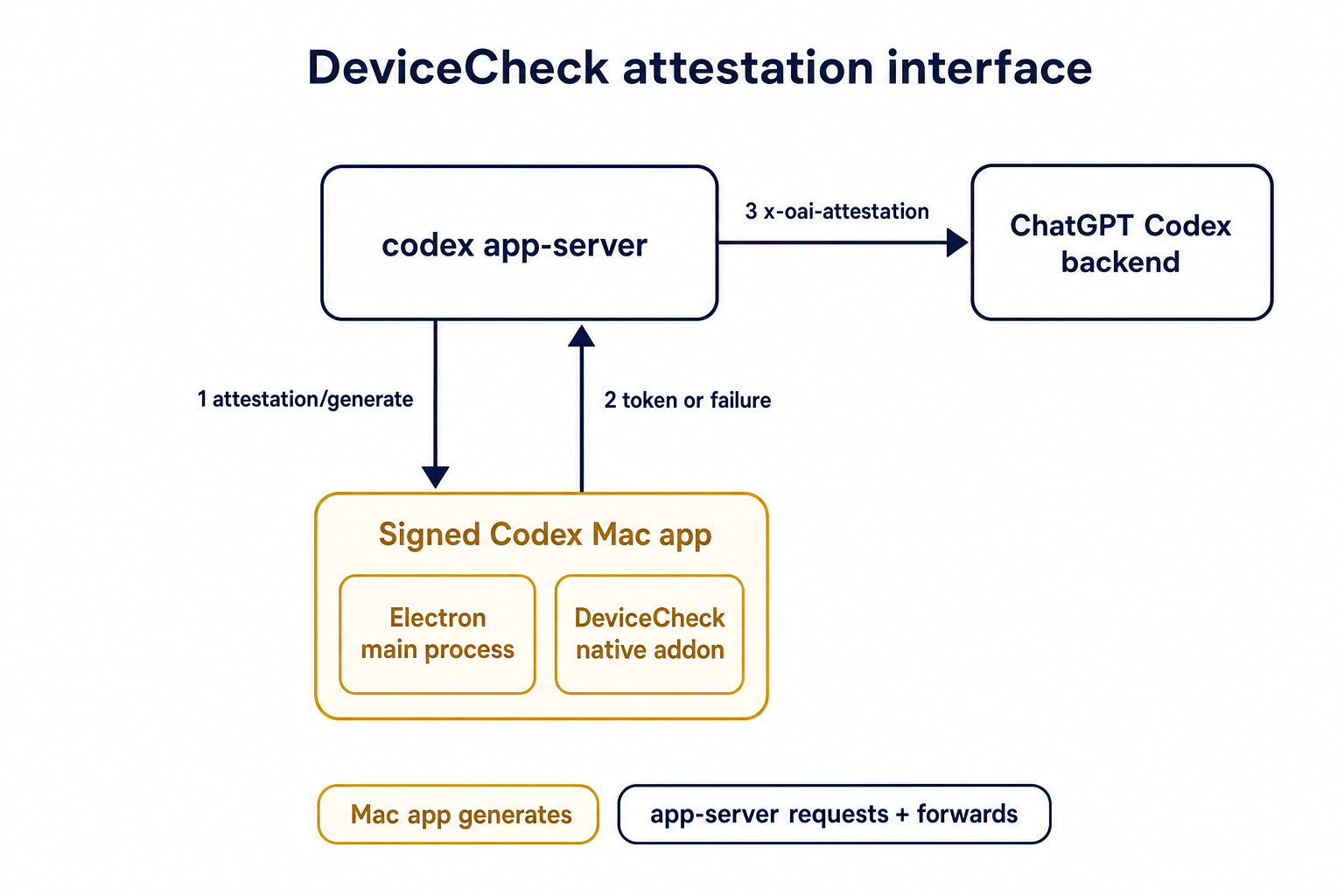
TL;DR: teaches `codex-rs` / app-server to request a desktop-provided
attestation token and attach it as `x-oai-attestation` on the scoped
ChatGPT Codex request paths.
## Details
This PR teaches the Codex app-server runtime how to request and attach
an attestation token. It does not generate DeviceCheck tokens directly;
instead, it relies on the connected desktop app to advertise that it can
generate attestation and then asks that app for a fresh header value
when needed.
The flow is:
1. The Codex desktop app connects to app-server.
2. During `initialize`, the app can advertise that it supports
`requestAttestation`.
3. Before app-server calls selected ChatGPT Codex endpoints, it sends
the internal server request `attestation/generate` to the app.
4. app-server receives a pre-encoded header value back.
5. app-server forwards that value as `x-oai-attestation` on the scoped
outbound requests.
The code in this repo is mostly protocol and runtime plumbing: it adds
the app-server request/response shape, introduces an attestation
provider in core, wires that provider into Responses / compaction /
realtime setup paths, and covers the intended scoping with tests. The
signed macOS DeviceCheck generation remains owned by the desktop app PR.
## Related PR
- Codex desktop app implementation:
https://github.com/openai/openai/pull/878649
## Validation
<details>
<summary>Tests run</summary>
```sh
cargo test -p codex-app-server-protocol
cargo test -p codex-core attestation --lib
cargo test -p codex-app-server --lib attestation
```
Also ran:
```sh
just fix -p codex-core
just fix -p codex-app-server
just fix -p codex-app-server-protocol
just fmt
just write-app-server-schema
```
</details>
<details>
<summary>E2E DeviceCheck validation</summary>
First validated the signed desktop app boundary directly: launched a
packaged signed `Codex.app`, sent `attestation/generate`, decoded the
returned `v1.` attestation header, and validated the extracted
DeviceCheck token with `personal/jm/verify_devicecheck_token.py` using
bundle ID `com.openai.codex`. Apple returned `status_code: 200` and
`is_ok: true`.
Then ran the fuller app + app-server flow. The packaged `Codex.app`
launched a current-branch app-server via `CODEX_CLI_PATH`, and a local
MITM proxy intercepted outbound `chatgpt.com` traffic. The app-server
requested `attestation/generate` from the real Electron app process, and
the intercepted `/backend-api/codex/responses` traffic included
`x-oai-attestation` on both routes:
```text
GET /backend-api/codex/responses Upgrade: websocket x-oai-attestation: present
POST /backend-api/codex/responses Upgrade: none x-oai-attestation: present
```
The captured header decoded to a DeviceCheck token that also validated
with Apple for `com.openai.codex` (`status_code: 200`, `is_ok: true`,
team `2DC432GLL2`).
</details>
---------
Co-authored-by: Codex <noreply@openai.com>
Felipe Coury ·
Jiaming Zhang ·
