mirror of
https://github.com/pchuan98/codex.git
synced 2026-07-01 00:31:56 +08:00
0d4351c1b80cae3a40a2d0d64d4e87ca1d5c4afa
51
Commits
| Author | SHA1 | Message | Date | |
|---|---|---|---|---|
  TomandGitHub TomandGitHub
|
ece1dfece0 |
[codex] Inject agent graph store into ThreadManager (#29736)
Pick up the AgentGraphStore migration. - Inject an explicit optional agent graph store into `ThreadManager` - Move all calls to spawn, close, recursive resume, and subtree/archive/delete/feedback traversal through it - Keep using `LocalAgentGraphStore` when SQLite is available This required some changes to the interface to deal with futures: - The interface now matches `ThreadStore`'s object-safe pattern by returning a boxed `AgentGraphStoreFuture` directly, allowing `ThreadManager` to hold `Arc<dyn AgentGraphStore>` *Slight behavior change!* Unfiltered subtree enumeration now performs a single all-status breadth-first traversal, so a closed grandchild beneath an open edge is included; the previous Open-then-Closed traversals could not cross mixed-status paths and silently omitted it. |
||
 pakrym-oaiandGitHub pakrym-oaiandGitHub
|
6df037d47f |
[codex] add configurable token budget compaction reminder (#29255)
## Why

The token-budget feature reports coarse remaining-context milestones,
but it does not give the model a configurable wrap-up prompt before
automatic compaction. A strict threshold-crossing check can also miss
resumed or reconfigured windows that are already inside the threshold.

## What changed

- Add structured `[features.token_budget]` configuration for an absolute
`reminder_threshold_tokens` and bounded `reminder_message_template`;
`{n_remaining}` is expanded when the reminder is delivered.
- Compute remaining tokens against the next effective auto-compaction
boundary, including scoped `body_after_prefix` accounting and the full
context-window limit.
- Make reminder delivery level-triggered before and after sampling, with
one-shot state owned by `AutoCompactWindow` and re-armed on compaction,
`new_context`, restore, or history replacement.
- Leave the existing initial full-window token-budget context, 25/50/75%
notices, and token-budget tools unchanged.
- Persist the resolved feature configuration in the session config lock
and regenerate the config schema.

## Validation

- `just test -p codex-core token_budget`
- `just test -p codex-core
token_budget_reminder_emits_after_crossing_compaction_threshold`
- `just test -p codex-core auto_compact_window`
- `just test -p codex-core
lock_contains_prompts_and_materializes_features`
- `just test -p codex-features`
- `just test -p codex-config`
|
||
 jifandGitHub jifandGitHub
|
81b000421d |
Add config toggles for orchestrator skills and MCP (#28942)
## Why Orchestrator-provided skills and Codex Apps MCP tools add model-visible instructions, resources, and tools beyond the local workspace. Hosts need config-level switches to disable those orchestrator-owned surfaces independently, without disabling regular skills or regular MCP servers. ## What changed - Adds `[orchestrator.skills].enabled` and `[orchestrator.mcp].enabled` config entries, both defaulting to `true`. - Includes the new settings in `config.schema.json` and in the config lock so resolved thread configuration preserves the same orchestrator exposure decisions. - Threads `orchestrator.skills.enabled` through the app-server skills extension so disabled orchestrator skills do not expose the `skills` namespace or inject orchestrator skill context. - Gates Codex Apps MCP exposure, app instructions, and app auth eligibility on `orchestrator.mcp.enabled` while leaving non-Codex-Apps MCP tools available. - Updates the thread-manager sample config to disable both orchestrator-owned surfaces. ## Verification - Added config parsing, loading, defaulting, and schema coverage for the new settings. - Added MCP exposure coverage that `orchestrator.mcp.enabled = false` removes Codex Apps tools while preserving regular MCP tools. - Added app-server coverage that `orchestrator.skills.enabled = false` prevents orchestrator skill tools, prompts, and resource reads from reaching the model turn. |
||
 rka-oaiandGitHub rka-oaiandGitHub
|
752ed90d78 |
current time reminders impl for system clock (varlatency 2/n) (#28824)
Stacked on #28822. ## Summary - add a host-injectable current-time provider with a built-in system implementation - record UTC developer reminders in history immediately before due model requests - keep cadence state per session and force a refresh after compaction This does NOT include the app server client <-> server clock logic. This PR is only for the reminder message & system clock that will be used in prod. ## Testing - `just test -p codex-core varlatency_` - `just clippy -p codex-core -p codex-app-server -p codex-mcp-server -p codex-thread-manager-sample` - `just fmt` |
||
|
rka-oaiandGitHub
|
df5f122854 |
Add Config for Time Reminders (varlatency 1/n) (#28822)
## Summary Example: > [features.current_time_reminder] enabled = true reminder_interval_model_requests = 1 clock_source = "system" ## Testing - `just test -p codex-core varlatency` - `just test -p codex-core lock_contains_prompts_and_materializes_features` - `just fix -p codex-core -p codex-config -p codex-features` |
||
|
rka-oaiandGitHub
|
ecc4c30e28 |
[codex] add rollout token budget configuration (varlength 1/N) (#28746)
## What This PR defines the structured configuration contract for shared rollout token budgets (across ALL agent threads under 1 rollout). ```toml [features.rollout_budget] enabled = true limit_tokens = 100000 reminder_interval_tokens = 10000 sampling_token_weight = 1.0 prefill_token_weight = 0.1 ``` The reminder interval defaults to 10% of the rollout limit. Sampling and prefill weights default to `1.0`. ## Scope This PR only defines and validates configuration. It does not track usage, inject reminders, or stop a rollout. Accounting and reminders are implemented in the stacked follow-up #28494. The existing `token_budget` feature remains unchanged. `rollout_budget` has its own feature key and configuration type. ## Tests The config test verifies that the structured fields resolve into `RolloutBudgetConfig` and do not enable the existing `token_budget` feature. Local checks: - `just write-config-schema` - `just test -p codex-core load_config_resolves_rollout_budget` - `cargo check -p codex-thread-manager-sample` - `git diff --check` The full workspace test suite was not run locally. |
||
 canvrno-oaiandGitHub canvrno-oaiandGitHub
|
f0cb96bcb1 |
PAC 1 - Add system proxy feature config surface (#26706)
## Summary Introduces the default-off `respect_system_proxy` feature flag used to gate first-class system PAC/proxy support for Codex-owned native clients. With the feature disabled or absent, behavior remains unchanged. This PR establishes the configuration and managed-requirement surface; proxy discovery and request routing are implemented by follow-up PRs. ## Configuration User configuration uses the standard boolean feature form: ```toml [features] respect_system_proxy = true ``` Managed feature requirements use the corresponding boolean key. The effective runtime configuration is exposed as a boolean and defaults to `false`. ## Implementation - Registers `respect_system_proxy` as an under-development, default-off feature. - Resolves user configuration and managed feature requirements into `Config.respect_system_proxy`. - Provides bootstrap resolution for startup paths that must evaluate the feature before full configuration loading completes. - Uses the standard feature CLI and config-editing behavior. - Excludes `features.respect_system_proxy` from project-local configuration. - Updates the generated configuration schema. ## End-user behavior - No networking behavior changes when the feature is absent or disabled. - Enabling the feature makes the boolean available to the native proxy-routing implementation in follow-up PRs. - Repository-local configuration cannot enable the feature. ## Test coverage Covers scalar configuration and CLI override resolution, managed requirement constraints, bootstrap resolution, and project-local filtering. |
||
 Peter BakkumandGitHub Peter BakkumandGitHub
|
6652e82dd0 |
realtime: add AVAS architecture override (#27720)
## Summary Adds a `RealtimeConversationArchitecture` option for realtime conversation startup, with `realtimeapi` as the default and `avas` as an opt-in architecture. The AVAS path is limited to realtime v1 conversational WebRTC starts, and WebRTC call creation appends `intent=quicksilver&architecture=avas` to `/v1/realtime/calls`. The existing sideband websocket still joins by `call_id`. This also exposes the per-session architecture override through app-server v2 `thread/realtime/start` params and updates the config schema for `[realtime].architecture`. ## Validation - `just fmt` - `just write-config-schema` - `just test -p codex-api sends_avas_session_call_query_params` - `just test -p codex-core -E 'test(~conversation_webrtc_start_uses_avas_architecture_query)'` - `just test -p codex-core -E 'test(realtime_loads_from_config_toml)'` - `just test -p codex-app-server-protocol -E 'test(~serialize_thread_realtime_start) | test(generated_ts_optional_nullable_fields_only_in_params)'` - `just test -p codex-app-server -E 'test(realtime_webrtc_start_emits_sdp_notification)'` |
||
 Adam Perry @ OpenAIandGitHub Adam Perry @ OpenAIandGitHub
|
236b50125d |
[codex] Load user instructions through an injected provider (#27101)
## Why We want to remove implicit use of `$CODEX_HOME` from `codex-core` and make embedders responsible for supplying user-level instructions. This also ensures user instructions load when no primary environment is selected. ## What changed Stacked on #27415, which makes `codex exec` surface thread-scoped runtime warnings. - Added `UserInstructionsProvider` to `codex-extension-api`, with absolute source attribution and recoverable loading warnings. - Added `codex-home` with the filesystem-backed provider for `AGENTS.override.md` and `AGENTS.md`, preserving precedence, fallback, trimming, lossy UTF-8 handling, and the existing uncapped global instruction size. - Removed global instruction loading from `Config` and require `ThreadManager` callers to inject a provider. - Load provider instructions once for each fresh root runtime, including runtimes without a primary environment. Running sessions retain their snapshot, while child agents inherit the parent snapshot without invoking the provider. - Keep provider instructions separate while loading project `AGENTS.md`, then assemble the model-visible instructions with the existing ordering, source attribution, warning, and turn-context behavior. - Wired the Codex home provider through the CLI, app server, MCP server, core facade, and thread-manager sample. ## Validation - `just test -p codex-home -p codex-extension-api` - `just test -p codex-core agents_md` - `just test -p codex-core guardian` - `just test -p codex-app-server thread_start_without_selected_environment_includes_only_global_instruction_source` - `just test -p codex-exec warning` - `just bazel-lock-check` |
||
|
jifandGitHub
|
9cd11e9e62 |
Use plugin-service MCP as the hosted plugin runtime (#27198)
## Stack - Base: #27191 - This PR is the third vertical and should be reviewed against `jif/external-plugins-2`, not `main`. ## Why #27191 moves the host-owned Apps MCP registration behind an extension contributor, but deliberately preserves the existing endpoint-selection feature while that contribution contract lands. App-server can therefore resolve the server through extensions, yet the hosted plugin endpoint is still selected through temporary `apps_mcp_path_override` plumbing. That is not the long-term plugin model. A plugin can bundle skills, connectors, MCP servers, and hooks, and those components do not all need the same source or execution environment. In particular, an authenticated HTTP MCP server can expose plugin capabilities directly from a backend without an executor or an orchestrator filesystem. This PR completes that hosted vertical. App-server's MCP extension now owns the aggregate hosted plugin runtime at `/ps/mcp`. Connector actions continue to arrive as MCP tools, while backend-provided skills arrive as MCP resources and use Codex's existing resource list/read paths. No second backend client, skill filesystem, or generic plugin activation framework is introduced. The backend route remains the hosted implementation. This change replaces Codex's temporary endpoint-selection mechanism, not the service behind the endpoint. ## What changed ### Hosted plugin runtime The MCP extension now contributes `codex_apps` as the hosted plugin runtime rather than as a configurable Apps endpoint: - `https://chatgpt.com` resolves to `https://chatgpt.com/backend-api/ps/mcp`; - a bare custom ChatGPT base resolves to `/api/codex/ps/mcp`; - the existing product-SKU header and ChatGPT authentication behavior are preserved; - executor availability is never consulted for this streamable HTTP transport. The same MCP connection carries both component shapes supported by the hosted endpoint: - connector actions are discovered and invoked as MCP tools; - hosted skills are enumerated and read as MCP resources through the existing `list_mcp_resources` and `read_mcp_resource` paths. This keeps component access in the subsystem that already owns the protocol instead of downloading backend skills into an orchestrator filesystem or inventing a parallel hosted-skill client. ### Explicit runtime ordering `McpManager` now resolves the reserved `codex_apps` entry in three ordered phases: 1. install the legacy Apps fallback for compatibility; 2. apply ordered extension `Set` or `Remove` overlays; 3. apply the final ChatGPT-auth gate without synthesizing the server again. This ordering is important: - an ordinary configured or plugin MCP server cannot claim the auth-bearing `codex_apps` name; - an extension-contributed hosted runtime wins over the fallback; - an extension `Remove` remains authoritative; - a host without the MCP extension retains the legacy Apps endpoint and current local-only behavior. The temporary `legacy_apps_mcp_loader_enabled` coordination flag is no longer needed. ### Remove the path override The `apps_mcp_path_override` feature and its runtime plumbing are removed, including: - the feature registry entry and structured feature config; - `Config` and `McpConfig` fields; - config schema output; - config-lock materialization; - URL override handling in `codex-mcp`. Existing boolean and structured forms still deserialize as ignored compatibility input. They are omitted from new serialized config, and config-lock comparison normalizes the removed input so older locks remain replayable. ### App-server coverage App-server MCP fixtures now serve the hosted route at `/api/codex/ps/mcp`. Existing resource-read and tool/elicitation flows therefore exercise the extension-owned endpoint rather than succeeding through the legacy fallback. The stack also adds the missing `codex_chatgpt::connectors` re-export for the manager-backed connector helper introduced in #27191. ## Compatibility - App-server installs the extension and uses `/ps/mcp` for the hosted runtime. - CLI and other hosts that do not install the extension retain the legacy Apps endpoint. - Apps disabled or non-ChatGPT authentication removes `codex_apps` from the effective runtime view. - Existing local plugins, local skills, executor-selected skills, configured MCP servers, and MCP OAuth behavior are otherwise unchanged. - Backend plugin enablement remains account/workspace state owned by the hosted endpoint; this PR does not add thread-local backend plugin selection. ## Architectural fit The stack now proves two independent runtime shapes: 1. #27184 resolves filesystem-backed skills through the executor that owns a selected root. 2. #27191 and this PR resolve a backend-hosted HTTP MCP through an extension with no executor. Together they preserve the intended separation: - selection identifies a plugin/root when explicit selection is needed; - each component's owning extension resolves its concrete access mechanism; - execution stays with the runtime required by that component; - existing skills, MCP, connector, and hook subsystems remain the downstream consumers. ## Planned follow-ups 1. **Executor stdio MCP:** selecting an executor plugin registers a manifest-declared stdio MCP server and executes it in the environment that owns the plugin. 2. **Optional backend selection:** only if CCA needs thread-local selection distinct from backend account/workspace enablement, add a concrete backend-owned capability location and surface those selected skills through the skills catalog. 3. **Connector metadata and hooks:** activate those plugin components through their existing owning subsystems, with executor hooks remaining environment-bound. 4. **Propagation and persistence:** define explicit resume, fork, subagent, refresh, and environment-removal semantics once selected roots have multiple real consumers. 5. **Local convergence:** migrate legacy local skill, MCP, connector, and hook paths behind their owning extensions one vertical at a time, then remove duplicate core managers and compatibility plumbing after parity. ## Verification Coverage in this change exercises: - extension-owned `/backend-api/ps/mcp` registration without an executor; - preservation of the legacy endpoint in hosts without the extension; - extension `Set` and `Remove` precedence over the legacy fallback; - ChatGPT-auth gating for the reserved server; - hosted MCP resource reads with and without an active thread; - connector tool invocation and MCP elicitation through the hosted route; - ignored boolean and structured forms of the removed path override; - config-lock replay compatibility for the removed feature. `cargo check -p codex-features -p codex-mcp-extension -p codex-app-server` passes. Tests and Clippy were not run locally under the current development instruction; CI provides the full validation pass. |
||
|
jifandGitHub
|
fae2709320 |
multi-agent: add path-based v2 activity tracking (#27007)
## Why Multi-agent v2 identifies agents by canonical paths, but its tool handlers still emitted the larger legacy collaboration begin/end events built around nickname and role metadata. App-server, rollout-trace, analytics, and TUI consumers therefore lacked one compact path-based completion signal that behaved consistently across live events and replay. The TUI also needs a bounded `/agent` status surface for v2 agents. It should use recent local activity for previews, refresh liveness without loading full histories, and keep the legacy picker available when no path-backed v2 agent is known. ## What changed - Replace the v2 `spawn_agent`, `send_message`, `followup_task`, and `interrupt_agent` legacy lifecycle emissions with a success-only `SubAgentActivity` event. The event records the tool call ID, occurrence time, affected thread, canonical agent path, and `started`, `interacted`, or `interrupted` kind. - Expose the activity as a completion-only app-server v2 `subAgentActivity` thread item in live notifications and reconstructed history, regenerate the protocol schemas, and count it in sub-agent tool analytics. - Track canonical paths from live activity and loaded-thread metadata in the TUI, and render the activity in live and replayed transcripts. - Make `/agent` list running path-backed agents with summaries from bounded local event buffers. Each summary is capped at 240 graphemes, the scan is capped at six recent items, only the last three wrapped lines are shown, and command output is omitted. Liveness falls back to metadata-only `thread/read` when local turn state is unavailable. - Persist the activity as a terminal rollout-trace runtime payload and reduce it to the corresponding spawn, send, follow-up, or close interaction edge. `interrupt_agent` is classified as a close-edge operation. - Preserve the legacy picker when no path-backed v2 agent is known. ## Compatibility App-server v2 clients that consumed `collabAgentToolCall` begin/end pairs for these tools must handle the new completion-only `subAgentActivity` item. Legacy v1 collaboration behavior is unchanged. ## Screenshot <img width="684" height="288" alt="Screenshot 2026-06-08 at 15 40 47" src="https://github.com/user-attachments/assets/194b3cd0-619d-45fb-b587-cf3e2b1b8a1d" /> ## Testing - `just test -p codex-app-server-protocol` - `just test -p codex-rollout-trace` - Added focused coverage for activity analytics, terminal trace serialization, spawn-edge reduction, `interrupt_agent` classification, TUI status rendering without aggregated command output, and clearing stale running state after a completed turn. |
||
 Boyang NiuandGitHub Boyang NiuandGitHub
|
e127a0cf99 | Add extra config to StoredThread, leave empty for now (#27092) | ||
|
pakrym-oaiandGitHub
|
f3c1283411 |
Pair thread environment settings (#26687)
## Why Thread cwd and environment selections are a single logical setting in core: updating one without the other can silently desynchronize the next-turn execution context. This change makes that relationship explicit in the internal thread settings flow while preserving the existing app-server public API shape. ## What changed - Moved the cwd/environment pair through internal `ThreadSettingsOverrides.environment_settings` instead of a top-level internal `cwd` field. - Kept `thread/settings/update` public params unchanged, with app-server translating top-level `cwd` into the paired internal settings shape. - Moved `Op::UserInput` environment overrides into thread settings so user turns and settings updates use the same core path. - Updated core, app-server, MCP, memories, sample, and test callsites to construct the paired settings shape. ## Verification - `git diff --check` - Local test run starting after PR creation. |
||
 sayan-oaiandGitHub sayan-oaiandGitHub
|
8b1238856b |
core: allow excluding tool namespaces from code mode (#26320)
## Why Research and training setups need to control which tool namespaces appear inside code mode's nested `tools` surface without disabling those tools entirely. This makes it possible to train against a deliberately reduced nested-tool setup while preserving the normal direct and deferred tool paths. ## What - Extend `features.code_mode` to accept structured configuration while preserving the existing boolean syntax. - Add an exact `excluded_tool_namespaces` list under `[features.code_mode]`: ```toml [features.code_mode] enabled = true excluded_tool_namespaces = ["mcp__codex_apps", "multi_agent_v1"] ``` - Filter matching canonical `ToolName` namespaces when constructing code mode's nested router and code-mode-specific direct tool descriptions. - Keep excluded tools registered, directly exposed in mixed code mode, and discoverable through top-level `tool_search` when otherwise eligible. - Derive deferred nested-tool guidance after namespace filtering so the `exec` description does not advertise excluded-only deferred tools. - Preserve the boolean/table representation when materializing config locks and update the generated config schema. ## Testing - `just test -p codex-features` - `just test -p codex-config` - `just test -p codex-core load_config_resolves_code_mode_config` - `just test -p codex-core lock_contains_prompts_and_materializes_features` - `just test -p codex-core excluded_deferred_namespaces_do_not_enable_nested_tool_guidance` - `just test -p codex-core code_mode_excludes_configured_nested_tool_namespaces` - `cargo check -p codex-thread-manager-sample` |
||
 Dylan HurdandGitHub Dylan HurdandGitHub
|
e0435afb72 |
feat(config) experimental_request_user_input toggle (#24541)
## Summary Experimental flag to allow toggling `request_user_input`: ``` tools.experimental_request_user_input = false ``` ## Testing - [x] Added unit tests |
||
|
pakrym-oaiandGitHub
|
768848ab6f |
Add experimental turn additional context (#24154)
## Summary

Adds experimental `additionalContext` support to `turn/start` and
`turn/steer` so clients can provide ephemeral external context, such as
browser or automation state, without turning that plumbing into a
visible user prompt or triggering user-prompt lifecycle behavior.

## API Shape

The parameter shape is:

```ts
additionalContext?: Record<string, {
  value: string
  kind: "untrusted" | "application"
}> | null
```

Example:

```json
{
  "additionalContext": {
    "browser_info": {
      "value": "Active tab is CI failures.",
      "kind": "untrusted"
    },
    "automation_info": {
      "value": "CI rerun is in progress.",
      "kind": "application"
    }
  }
}
```

The keys are opaque and caller-defined.

## Context Injection

When provided, accepted entries are inserted into model context as
hidden contextual message items, not as visible thread user-message
items.

`kind: "untrusted"` entries are inserted with role `user`:

```text
<external_${key}>${value}</external_${key}>
```

`kind: "application"` entries are inserted with role `developer`:

```text
<${key}>${value}</${key}>
```

Values are not escaped. Each value is truncated to 1k approximate tokens
before wrapping.

For `turn/start`, accepted additional context is inserted before normal
user input. For `turn/steer`, additional context is merged only when the
steer includes non-empty user input; context-only steers still reject as
empty input.

## Dedupe Strategy

`AdditionalContextStore` lives on session state and stores the latest
complete additional-context map.

Each `turn/start` or non-empty `turn/steer` treats its
`additionalContext` as the current complete set of values. Entries are
injected only when the key is new or the exact entry for that key
changed, including `value` or `kind`. After merging, the store is
replaced with the provided map, so omitted keys are removed from the
retained set and can be injected again later if reintroduced.

Omitting `additionalContext`, passing `null`, or passing an empty object
resets the store to empty and injects nothing.

## What Changed

- Threads experimental v2 `additionalContext` through app-server into
core turn start and steer handling.
- Adds separate contextual fragment types for untrusted user-role
context and application developer-role context.
- Uses pending response input items so additional context can be
combined with normal user input without treating it as prompt text.
- Adds integration coverage for start/steer flow, role routing,
dedupe/reset behavior, deletion/re-add behavior, hook-blocked input
behavior, empty context-only steer rejection, external-fragment marker
matching, and truncation.
|
||
 viyatb-oaiandGitHub viyatb-oaiandGitHub
|
f6fd753039 |
tui: add named permission profile picker (#21559)
## Why Users who opt into named permission profiles through `default_permissions` or `[permissions.*]` should stay in named-profile semantics when they open `/permissions`. The legacy picker rewrites those users into anonymous preset state, which loses the active profile identity and hides custom configured profiles. ## What changed - Switch `/permissions` to a profile-aware picker when profile mode is active. - Show friendly built-in labels instead of raw `:` profile syntax. - Include configured custom profiles and their descriptions in the picker. - Route selections through the split TUI profile-selection flow below this PR. - Add TUI snapshots and regression coverage for built-ins, custom profiles, and conflicting legacy runtime overrides. ## Stack 1. [#22931](https://github.com/openai/codex/pull/22931): runtime/session/network propagation for active permission profiles. 2. [#23708](https://github.com/openai/codex/pull/23708): TUI selection plumbing and guardrail flow. 3. **This PR**: profile-aware `/permissions` menu and custom profile display. ## UX impact In profile mode, `/permissions` shows the same human-facing built-ins users already know: ```text Default Auto-review Full Access Read Only locked-down web-enabled ``` Selecting `locked-down` keeps `active_permission_profile = Some("locked-down")`; selecting a built-in keeps the friendly label while switching to its named built-in profile. ## Screenshots Live `$test-tui` smoke screenshots uploaded through GitHub attachments: **Profile mode with built-ins and custom profiles** <img width="832" alt="Profile mode permissions picker with custom profiles" src="https://github.com/user-attachments/assets/58b72431-418c-4839-9e39-575076db4c8f" /> **Legacy mode remains anonymous preset picker** <img width="1232" alt="Legacy permissions picker" src="https://github.com/user-attachments/assets/95f413ab-4cee-411c-9afb-92580a885c97" /> <img width="1296" height="906" alt="image" src="https://github.com/user-attachments/assets/ea381a78-9904-4aa2-828f-b7f2e43f60f2" /> <img width="705" height="207" alt="Screenshot 2026-05-18 at 2 58 00 PM" src="https://github.com/user-attachments/assets/2fa6dd71-0296-449e-a6de-a72d78a1cb70" /> ## Validation - `git diff --cached --check` before commit. - Full test run skipped at the user request while pushing the split stack. |
||
|
jif-oaiandGitHub
|
2c6605ab35 |
config: remove legacy profile write paths (#24055)
## Why [#23883](https://github.com/openai/codex/pull/23883) moved the user-facing `--profile` flag onto profile v2 and [#23886](https://github.com/openai/codex/pull/23886) removed CLI forwarding for the legacy profile-v1 path. Core and TUI config persistence still carried `active_profile` and `ConfigEditsBuilder::with_profile`, which let later writes continue targeting legacy `[profiles.<name>]` tables after profile selection moved to profile-v2 config files. ## What - Remove legacy profile routing from [`ConfigEditsBuilder`](https://github.com/openai/codex/blob/4b38e9c22e762261d7f7eef49d8a21792e241a06/codex-rs/core/src/config/edit.rs#L1064-L1294), so core config edits no longer carry `with_profile` or infer `[profiles.*]` write targets from a `profile` key. - Drop `active_profile` plumbing from runtime `Config`, TUI startup/state, app-server config override forwarding, and Windows sandbox setup persistence. - Make app-server-backed TUI config edits use unscoped model, service-tier, feature, Auto-review, plan-mode, and Windows sandbox paths through [`tui/src/config_update.rs`](https://github.com/openai/codex/blob/4b38e9c22e762261d7f7eef49d8a21792e241a06/codex-rs/tui/src/config_update.rs#L43-L112). - Update config edit coverage so legacy `profile` state stays untouched by direct model writes, and remove tests whose only contract was the deleted profile-scoped persistence path. ## Testing - Not run locally. |
||
 starr-openaiandGitHub starr-openaiandGitHub
|
5c43a64e2b |
Make local environment optional in EnvironmentManager (#23369)
## Summary - make `EnvironmentManager` local environment/runtime paths optional - simplify constructor surface around snapshot materialization - rename local env accessors to `require_local_environment` / `try_local_environment` ## Validation - devbox Bazel build for touched crate surfaces - `//codex-rs/exec-server:exec-server-unit-tests` - `//codex-rs/app-server-client:app-server-client-unit-tests` - filtered touched `//codex-rs/core:core-unit-tests` cases |
||
|
jif-oaiandGitHub
|
80fdd4688f |
Add body_after_prefix auto-compact token limit scope (#22870)
## Why `model_auto_compact_token_limit` has only been able to budget the full active context. That makes it hard to set a small "growth since compaction" budget for sessions that preserve a large carried window prefix: the preserved prefix can consume the whole budget and force immediate repeated compaction. This PR adds an opt-in `body_after_prefix` scope so callers can apply `model_auto_compact_token_limit` to sampled output and later growth after the current carried prefix, while still forcing compaction before the full model context window is exhausted. ## What changed - Adds `AutoCompactTokenLimitScope` with the existing `total` behavior as the default and a new `body_after_prefix` mode: [`config_types.rs`](https://github.com/openai/codex/blob/973806b1cb35792555bead994cb3ed94656eb171/codex-rs/protocol/src/config_types.rs#L24-L37). - Threads `model_auto_compact_token_limit_scope` through config loading, `Config`, `core-api`, and app-server v2 schema/TypeScript generation. - Records the first observed input-token count for a `body_after_prefix` compaction window and uses it as the baseline when deciding whether the scoped auto-compaction budget is exhausted: [`turn.rs`](https://github.com/openai/codex/blob/973806b1cb35792555bead994cb3ed94656eb171/codex-rs/core/src/session/turn.rs#L743-L781). - Keeps a hard context-window cap in `body_after_prefix`, so scoped budgeting cannot let the active context overrun the usable window. ## Verification Added compact-suite coverage for the two key behaviors: `body_after_prefix` does not re-compact just because the carried prefix is larger than the scoped budget, and it still compacts when the total active context reaches the configured context window: [`compact.rs`](https://github.com/openai/codex/blob/973806b1cb35792555bead994cb3ed94656eb171/codex-rs/core/tests/suite/compact.rs#L3003-L3128). |
||
|
viyatb-oaiandGitHub
|
3009e23644 |
core: expose permission profile picker metadata (#22928)
## Why The `/permissions` picker needs a config-level way to distinguish legacy anonymous presets from named permission-profile mode. That signal cannot be inferred reliably in the TUI, especially for the edge case where `default_permissions = ":workspace"` is present without a `[permissions]` table. ## What changed - Expose whether the merged config is explicitly in permission-profile mode. - Expose the configured custom permission profile IDs alongside the built-in profile semantics. - Add regression coverage for profile mode detection and custom profile metadata, including the `default_permissions = ":workspace"` case. - Update the thread-manager sample config literal to match the expanded config shape. ## Stack 1. **This PR**: config metadata needed by downstream permission-profile consumers. 2. [#22931](https://github.com/openai/codex/pull/22931): refresh active permission profiles through runtime/session/network state. 3. [#21559](https://github.com/openai/codex/pull/21559): switch `/permissions` to the profile-aware TUI picker. ## Verification - `cargo check -p codex-thread-manager-sample` - `cargo test -p codex-core default_permissions_can_select_builtin_profile_without_permissions_table` - `cargo test -p codex-core permissions_profiles_allow_direct_write_roots_outside_workspace_root` |
||
 Eric TrautandGitHub Eric TrautandGitHub
|
84d941d07f |
[1 of 7] Add thread settings to UserInput (#23080)
**Stack position:** [1 of 7] ## Summary The first three PRs in this stack are a cleanup pass before the actual thread settings API work. Today, core has several overlapping "user input" ops: `UserInput`, `UserInputWithTurnContext`, and `UserTurn`. They differ mostly in how much next-turn state they carry, which makes the later queued thread settings update harder to reason about and review. This PR starts that cleanup by adding the shared `ThreadSettingsOverrides` payload and allowing `Op::UserInput` to carry it. Existing variants remain in place here, so this layer is mostly a behavior-preserving API shape change plus mechanical constructor updates. ## End State After PR3 By the end of PR3, `Op::UserInput` is the only "user input" core op. It can carry optional thread settings overrides for callers that need to update stored defaults with a turn, while callers without updates use empty settings. `Op::UserInputWithTurnContext` and `Op::UserTurn` are deleted. ## End State After PR5 By the end of PR5, core will have only two ops for this area: - `Op::UserInput` for user-input-bearing submissions. - `Op::ThreadSettings` for settings-only updates. ## Stack 1. [1 of 7] [Add thread settings to UserInput](https://github.com/openai/codex/pull/23080) (this PR) 2. [2 of 7] [Remove UserInputWithTurnContext](https://github.com/openai/codex/pull/23081) 3. [3 of 7] [Remove UserTurn](https://github.com/openai/codex/pull/23075) 4. [4 of 7] [Placeholder for OverrideTurnContext cleanup](https://github.com/openai/codex/pull/23087) 5. [5 of 7] [Replace OverrideTurnContext with ThreadSettings](https://github.com/openai/codex/pull/22508) 6. [6 of 7] [Add app-server thread settings API](https://github.com/openai/codex/pull/22509) 7. [7 of 7] [Sync TUI thread settings](https://github.com/openai/codex/pull/22510) |
||
 
|
c15613f2b6 |
Forward apps MCP product SKU from Codex config (#22872)
This adds `apps_mcp_product_sku` as a toplevel config.toml key. We pass the given value as a header when listing MCPs for the client, allowing connectors to be filtered per product entry point. --------- Co-authored-by: Codex <noreply@openai.com> |
||
 Michael BolinandGitHub Michael BolinandGitHub
|
3c6d727810 |
permissions: resolve profile identity with constraints (#22683)
## Why This PR is the invariant-cleanup layer that follows the workspace-roots base merged in [#22610](https://github.com/openai/codex/pull/22610). #22610 adds `[permissions.<id>.workspace_roots]` and keeps runtime workspace roots separate from the raw permission profile, but its in-memory representation is intentionally transitional: `Permissions` still carries the selected profile identity next to a constrained `PermissionProfile`. That makes APIs such as `set_constrained_permission_profile_with_active_profile()` fragile because the id and value only mean the right thing when every caller keeps them in sync. This PR introduces a single resolved profile state so profile identity, `extends`, the profile value, and profile-declared workspace roots travel together. The next PR, [#22611](https://github.com/openai/codex/pull/22611), builds on this by changing the app-server turn API to select permission profiles by id plus runtime workspace roots. ## Stack Context - #22610, now merged: adds profile-declared `workspace_roots`, runtime workspace roots, and `:workspace_roots` materialization. - This PR: replaces the parallel active-profile/profile-value fields with `PermissionProfileState`. - #22611: switches app-server turn updates toward profile ids plus runtime workspace roots. - #22612: updates TUI/exec summaries to show the effective workspace roots. Keeping this separate from #22611 is deliberate: reviewers can validate the internal state invariant before reviewing the app-server protocol migration. ## What Changed - Added `ResolvedPermissionProfile::{Legacy, BuiltIn, Named}` and `PermissionProfileState`. - Typed built-in profile ids with `BuiltInPermissionProfileId`. - Moved selected profile identity and profile-declared workspace roots into the resolved state. - Replaced `Permissions` parallel profile fields with one `permission_profile_state`. - Removed `set_constrained_permission_profile_with_active_profile()` from session sync paths. - Kept trusted session replay/`SessionConfigured` compatibility through explicit session snapshot helpers. - Updated session configuration, MCP initialization, app-server, exec, TUI, and guardian call sites to consume `&PermissionProfile` directly. ## Review Guide Start with `codex-rs/core/src/config/resolved_permission_profile.rs`; it is the new invariant boundary. Then review `codex-rs/core/src/config/mod.rs` to see how config loading records active profile identity and profile workspace roots. The remaining call-site changes are mostly mechanical fallout from `Permissions::permission_profile()` returning `&PermissionProfile` instead of `&Constrained<PermissionProfile>`. ## Verification The existing config/session coverage now constructs and asserts through `PermissionProfileState`. The workspace-root config test also asserts that profile-declared roots are preserved in the resolved state, which is the behavior #22611 relies on when runtime roots become mutable through the app-server API. --- [//]: # (BEGIN SAPLING FOOTER) Stack created with [Sapling](https://sapling-scm.com). Best reviewed with [ReviewStack](https://reviewstack.dev/openai/codex/pull/22683). * #22612 * #22611 * __->__ #22683 |
||
|
Michael BolinandGitHub
|
c25d905f61 |
permissions: support workspace roots in profiles (#22610)
## Why This is the configuration/model half of the alternative permissions migration we discussed as a comparison point for [#22401](https://github.com/openai/codex/pull/22401) and [#22402](https://github.com/openai/codex/pull/22402). The old `workspace-write` model mixes three concerns that we want to keep separate: - reusable profile rules that should stay immutable once selected - user/runtime workspace roots from `cwd`, `--add-dir`, and legacy workspace-write config - internal Codex writable roots such as memories, which should not be shown as user workspace roots This PR gives permission profiles first-class `workspace_roots` so users can opt multiple repositories into the same `:workspace_roots` rules without using broad absolute-path write grants. It also starts separating the raw selected profile from the effective runtime profile by making `Permissions` expose explicit accessors instead of public mutable fields. A representative `config.toml` looks like this: ```toml default_permissions = "dev" [permissions.dev.workspace_roots] "~/code/openai" = true "~/code/developers-website" = true [permissions.dev.filesystem.":workspace_roots"] "." = "write" ".codex" = "read" ".git" = "read" ".vscode" = "read" ``` If Codex starts in `~/code/codex` with that profile selected, the effective workspace-root set becomes: - `~/code/codex` from the runtime `cwd` - `~/code/openai` from the profile - `~/code/developers-website` from the profile The `:workspace_roots` rules are materialized across each root, so `.git`, `.codex`, and `.vscode` stay scoped the same way everywhere. Runtime additions such as `--add-dir` can still layer on later stack entries without mutating the selected profile. ## Stack Shape This PR intentionally stops before the profile-identity cleanup in [#22683](https://github.com/openai/codex/pull/22683) so the base review stays focused on config loading, workspace-root materialization, and compatibility with legacy `workspace-write`. The representation in this PR is therefore transitional: `Permissions` carries enough state to distinguish the raw constrained profile from the effective runtime profile, and there are still call sites that must keep the active profile identity and constrained profile value in sync. The follow-up PR replaces that with a single resolved profile state (`ResolvedPermissionProfile` / `PermissionProfileState`) that keeps the profile id, immutable `PermissionProfile`, and profile-declared workspace roots together. That follow-up removes APIs such as `set_constrained_permission_profile_with_active_profile()` where separate arguments could drift out of sync. Downstream PRs then build on this base to switch app-server turn updates to profile ids plus runtime workspace roots and to finish the user-visible summary behavior. Reviewers should judge this PR as the workspace-roots foundation, not as the final in-memory shape of selected permission profiles. ## Review Guide Suggested review order: 1. Start with `codex-rs/core/src/config/mod.rs`. This is the main shape change in the base slice. `Permissions` now stores a private raw `Constrained<PermissionProfile>` plus runtime `workspace_roots`. Callers use `permission_profile()` when they need the raw constrained value and `effective_permission_profile()` when they need a materialized runtime profile. As noted above, [#22683](https://github.com/openai/codex/pull/22683) replaces this transitional shape with a resolved profile state that keeps identity and profile data together. 2. Review `codex-rs/config/src/permissions_toml.rs` and `codex-rs/core/src/config/permissions.rs`. These add `[permissions.<id>.workspace_roots]`, resolve enabled entries relative to the policy cwd, and keep `:workspace_roots` deny-read glob patterns symbolic until the actual roots are known. 3. Review `codex-rs/protocol/src/permissions.rs` and `codex-rs/protocol/src/models.rs`. These add the policy/profile materialization helpers that expand exact `:workspace_roots` entries and scoped deny-read globs over every workspace root. This is also where `ActivePermissionProfileModification` is removed from the core model. 4. Review the legacy bridge in `Config::load_from_base_config_with_overrides` and `Config::set_legacy_sandbox_policy`. This is where legacy `workspace-write` roots become runtime workspace roots, while Codex internal writable roots stay internal and do not appear as user-facing workspace roots. 5. Then skim downstream call sites. The interesting pattern is raw-vs-effective access: state/proxy/bwrap paths keep the raw constrained profile, while execution, summaries, and user-visible status use the effective profile and workspace-root list. ## What Changed - added `[permissions.<id>.workspace_roots]` to the config model and schema - added runtime `workspace_roots` state to `Config`/`Permissions` and `ConfigOverrides` - made `Permissions` profile fields private and replaced direct mutation with accessors/setters - added `PermissionProfile` and `FileSystemSandboxPolicy` helpers for materializing `:workspace_roots` exact paths and deny-read globs across all roots - moved legacy additional writable roots into runtime workspace-root state instead of active profile modifications - removed `ActivePermissionProfileModification` and its app-server protocol/schema export - updated sandbox/status summary paths so internal writable roots are not reported as user workspace roots ## Verification Strategy The targeted tests cover the behavior at the layers where regressions are most likely: - `codex-rs/core/src/config/config_tests.rs` verifies config loading, legacy workspace-root seeding, effective profile materialization, and memory-root handling. - `codex-rs/core/src/config/permissions_tests.rs` verifies profile `workspace_roots` parsing and `:workspace_roots` scoped/glob compilation. - `codex-rs/protocol/src/permissions.rs` unit tests verify exact and glob materialization over multiple workspace roots. - `codex-rs/tui/src/status/tests.rs` and `codex-rs/utils/sandbox-summary/src/sandbox_summary.rs` verify the user-facing summaries show effective workspace roots and hide internal writes. I also ran `cargo check --tests` locally after the latest stack refresh to catch cross-crate API breakage from the private-field/accessor changes. --- [//]: # (BEGIN SAPLING FOOTER) Stack created with [Sapling](https://sapling-scm.com). Best reviewed with [ReviewStack](https://reviewstack.dev/openai/codex/pull/22610). * #22612 * #22611 * #22683 * __->__ #22610 |
||
|
Dylan HurdandGitHub
|
85915a2a21 |
chore(config) rm windows_wsl_setup_acknowledged (#22717)
## Summary Remove dead code from a notice that no longer exists. ## Testing - [x] Unit tests pass. |
||
|
Dylan HurdandGitHub
|
51b0e94105 |
chore(features) rm Feature::ApplyPatchFreeform (#22711)
## Summary Removes the feature since this is effectively on by default in all cases where we should use it, or can be configured via models.json. ## Testing - [x] unit tests pass |
||
|
Dylan HurdandGitHub
|
d18a7c982e |
chore(config) rm Feature::CodexGitCommit (#22412)
## Summary Removes the unused Feature::CodexGitCommit ## Testing - [x] tests pass |
||
 AbhinavandGitHub AbhinavandGitHub
|
392e94e9ea |
add --dangerously-bypass-hook-trust CLI flag (#21768)
# Why Hook trust happens through the TUI in `/hooks` so it can block non-interactive use cases. This flag will allow users that are using codex headlessly to bypass hooks when they want to. # What This adds one invocation-scoped escape hatch. - the CLI flag sets a runtime-only `bypass_hook_trust` override; there is no durable `config.toml` setting - hook discovery still respects normal enablement, so explicitly disabled hooks remain disabled - we show a `--dangerously-bypass-hook-trust is enabled. Enabled hooks may run without review for this invocation.` message on startup so accidental use is visible in both interactive and exec flows This keeps “enabled” and “trusted” as separate concepts in the normal path, while giving CI/E2E callers a stable way to opt into the exceptional path when they already control the hook set. |
||
|
Dylan HurdandGitHub
|
8123bddb16 |
chore(config) include_collaboration_mode_instructions (#22383)
## Summary Adds include_collaboration_mode_instructions, which is a config equivalent to include_permissions_instructions for collaboration modes. Desired for situations where we want to disable this instruction from entering the context ## Testing - [x] Added unit test |
||
 Felipe CouryandGitHub Felipe CouryandGitHub
|
95b332c820 |
feat(tui): add ambient terminal pets (#21206)
## Why The Codex App has animated pets, but the TUI had no equivalent ambient companion surface. This brings that experience into terminal Codex while keeping the main chat flow usable: the pet should feel present, but it cannot cover transcript text, composer input, approvals, or picker content. The feature also needs to be terminal-aware. Different terminals support different image protocols, tmux can interfere with image rendering, and some users will want pets disabled entirely or anchored differently depending on their layout. <table> <tr><td> <img width="4110" height="2584" alt="CleanShot 2026-05-05 at 12 41 45@2x" src="https://github.com/user-attachments/assets/68a1fcbc-2104-48d6-b834-69c6aaa95cdf" /> <p align="center">macOS - Ghostty, iTerm2 and WezTerm with Custom Pet</p> </td></tr> <tr><td> ![Uploading CleanShot 2026-05-10 at 20.28.30.png…]() <p align="center">Windows Terminal</p> </td></tr> <tr><td> <img width="3902" height="2752" alt="CleanShot 2026-05-05 at 12 39 02@2x" src="https://github.com/user-attachments/assets/300e2931-6b00-467e-91cb-ab8e28470500" /> <p align="center">Linux - WezTerm and Ghostty</p> </td></tr> </table> ## What Changed - Add a TUI ambient pet renderer in `codex-rs/tui/src/pets/`. - Port the app-style pet animation states so the sprite changes with task status, waiting-for-input states, review/ready states, and failures. - Add `/pets` selection UI with a preview pane, loading state, built-in pet choices, and a first-row `Disable terminal pets` option. - Download built-in pet spritesheets on demand from the same public CDN path already used by Android, under `https://persistent.oaistatic.com/codex/pets/v1/...`, and cache them locally under `~/.codex/cache/tui-pets/`. - Keep custom pets local. - Add config support for pet selection, disabling pets, and choosing whether the pet follows the composer bottom or anchors to the terminal bottom. - Reserve layout space around the pet so transcript wrapping, live responses, and composer input do not render underneath the sprite. - Gate image rendering by terminal capability, disable image pets under tmux, and support both Kitty Graphics and SIXEL terminals. - Add redraw cleanup for terminal image artifacts, including sixel cell clearing. ## Current Scope - This is an initial TUI version of ambient pets, not full App parity. - It focuses on ambient sprite rendering, `/pets` selection, custom pets, terminal capability gating, and on-demand CDN-backed built-in assets. - The ambient text overlay is currently disabled, so the TUI renders the pet sprite without extra status text beside it. ## How to Test 1. Start Codex TUI in a terminal with image support. 2. Run `/pets`. 3. Confirm the picker shows built-in pets plus custom pets, and the first item is `Disable terminal pets`. 4. On a fresh `~/.codex/cache/tui-pets/`, move onto a built-in pet and confirm the first preview downloads the spritesheet from the shared Codex pets CDN and renders successfully. 5. Move through the pet list and confirm subsequent built-in previews use the local cache. 6. Select a pet, then send and receive messages. Confirm transcript and composer text wrap before the pet instead of rendering underneath the sprite. 7. Change the pet anchor setting and confirm the pet can either follow the composer bottom or sit at the terminal bottom. 8. Return to `/pets`, choose `Disable terminal pets`, and confirm the sprite disappears cleanly. Targeted tests: - `cargo test -p codex-tui ambient_pet_` - `cargo test -p codex-tui resize_reflow_wraps_transcript_early_when_pet_is_enabled` - `cargo insta pending-snapshots` |
||
|
jif-oaiandGitHub
|
436c0df658 |
extension: wire extension registries into sessions (#21737)
## Why [#21736](https://github.com/openai/codex/pull/21736) introduces the typed extension API, but the runtime does not yet carry a registry through thread/session startup or give contributors host-owned stores to read from. This PR wires that host-side path so later feature migrations can move product-specific behavior behind typed contributions without adding another bespoke seam directly to `codex-core`. ## What changed - Thread `ExtensionRegistry<Config>` through `ThreadManager`, `CodexSpawnArgs`, `Session`, and sub-agent spawn paths. - Wire `ThreadStartContributor` and `ContextContributor` - Expose the small supporting surface needed by non-core callers that construct threads directly, including `empty_extension_registry()` through `codex-core-api`. This PR lands the host plumbing only: the app-server registry is still empty, and concrete feature migrations are intended to follow separately. |
||

|
5f4d0ec343 |
[codex] request desktop attestation from app (#20619)
## Summary TL;DR: teaches `codex-rs` / app-server to request a desktop-provided attestation token and attach it as `x-oai-attestation` on the scoped ChatGPT Codex request paths. 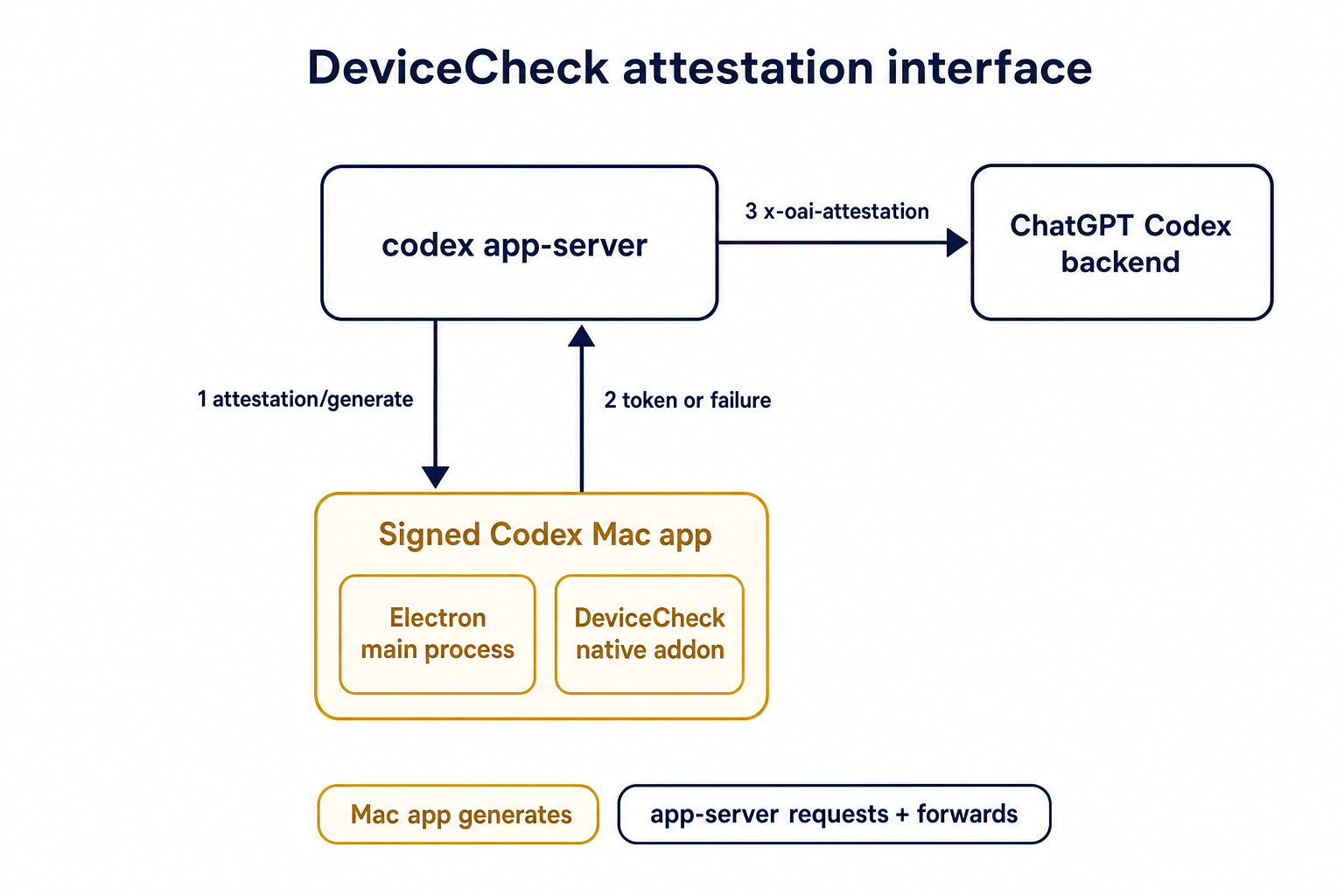 ## Details This PR teaches the Codex app-server runtime how to request and attach an attestation token. It does not generate DeviceCheck tokens directly; instead, it relies on the connected desktop app to advertise that it can generate attestation and then asks that app for a fresh header value when needed. The flow is: 1. The Codex desktop app connects to app-server. 2. During `initialize`, the app can advertise that it supports `requestAttestation`. 3. Before app-server calls selected ChatGPT Codex endpoints, it sends the internal server request `attestation/generate` to the app. 4. app-server receives a pre-encoded header value back. 5. app-server forwards that value as `x-oai-attestation` on the scoped outbound requests. The code in this repo is mostly protocol and runtime plumbing: it adds the app-server request/response shape, introduces an attestation provider in core, wires that provider into Responses / compaction / realtime setup paths, and covers the intended scoping with tests. The signed macOS DeviceCheck generation remains owned by the desktop app PR. ## Related PR - Codex desktop app implementation: https://github.com/openai/openai/pull/878649 ## Validation <details> <summary>Tests run</summary> ```sh cargo test -p codex-app-server-protocol cargo test -p codex-core attestation --lib cargo test -p codex-app-server --lib attestation ``` Also ran: ```sh just fix -p codex-core just fix -p codex-app-server just fix -p codex-app-server-protocol just fmt just write-app-server-schema ``` </details> <details> <summary>E2E DeviceCheck validation</summary> First validated the signed desktop app boundary directly: launched a packaged signed `Codex.app`, sent `attestation/generate`, decoded the returned `v1.` attestation header, and validated the extracted DeviceCheck token with `personal/jm/verify_devicecheck_token.py` using bundle ID `com.openai.codex`. Apple returned `status_code: 200` and `is_ok: true`. Then ran the fuller app + app-server flow. The packaged `Codex.app` launched a current-branch app-server via `CODEX_CLI_PATH`, and a local MITM proxy intercepted outbound `chatgpt.com` traffic. The app-server requested `attestation/generate` from the real Electron app process, and the intercepted `/backend-api/codex/responses` traffic included `x-oai-attestation` on both routes: ```text GET /backend-api/codex/responses Upgrade: websocket x-oai-attestation: present POST /backend-api/codex/responses Upgrade: none x-oai-attestation: present ``` The captured header decoded to a DeviceCheck token that also validated with Apple for `com.openai.codex` (`status_code: 200`, `is_ok: true`, team `2DC432GLL2`). </details> --------- Co-authored-by: Codex <noreply@openai.com> |
||
|
|
5f2543b74e |
Load configured environments from CODEX_HOME (#20667)
## Why The earlier PRs add stdio transport support and the config-backed environment provider, but the feature remains inert until normal Codex entrypoints construct `EnvironmentManager` with enough context to discover `CODEX_HOME/environments.toml`. This final stack PR activates the provider while preserving the legacy `CODEX_EXEC_SERVER_URL` fallback when no environments file exists. **Stack position:** this is PR 5 of 5. It is the product wiring PR that activates the configured environment provider added in PR 4. ## What Changed - Thread `codex_home` into `EnvironmentManagerArgs`. - Change `EnvironmentManager::new(...)` to load the provider from `CODEX_HOME`. - Preserve legacy behavior by falling back to `DefaultEnvironmentProvider::from_env()` when `environments.toml` is absent. - Make `environments.toml`-backed managers start new threads with all configured environments, default first, while keeping the legacy env-var path single-default. - Update the app-server, TUI, exec, MCP server, connector, prompt-debug, and thread-manager-sample callsites to pass `codex_home` and handle provider-loading errors. ## Self-Review Notes - The multi-environment startup path is intentionally tied to the `environments.toml` provider. Using `>1` configured environment as the only signal would also expand the legacy `CODEX_EXEC_SERVER_URL` provider because it keeps `local` addressable alongside `remote`. - The startup environment list is still derived inside `EnvironmentManager`; the provider only says whether its snapshot should start new threads with all configured environments. - The thread-manager sample was updated to pass the current `ThreadManager::new(...)` installation id argument so the stack compiles under Bazel. ## Stack - 1. https://github.com/openai/codex/pull/20663 - Add stdio exec-server listener - 2. https://github.com/openai/codex/pull/20664 - Add stdio exec-server client transport - 3. https://github.com/openai/codex/pull/20665 - Make environment providers own default selection - 4. https://github.com/openai/codex/pull/20666 - Add CODEX_HOME environments TOML provider - **5. This PR:** https://github.com/openai/codex/pull/20667 - Load configured environments from CODEX_HOME Split from original draft: https://github.com/openai/codex/pull/20508 ## Validation - `just fmt` - `git diff --check` - `bazel build --config=remote --strategy=remote --remote_download_toplevel //codex-rs/thread-manager-sample:codex-thread-manager-sample` - `bazel test --config=remote --strategy=remote --remote_download_toplevel //codex-rs/exec-server:exec-server-unit-tests` - `bazel test --config=remote --strategy=remote --remote_download_toplevel --test_sharding_strategy=disabled --test_arg=default_thread_environment_selections_use_manager_default_id //codex-rs/core:core-unit-tests` - `bazel test --config=remote --strategy=remote --remote_download_toplevel --test_sharding_strategy=disabled --test_arg=start_thread_uses_all_default_environments_from_codex_home //codex-rs/core:core-unit-tests` ## Documentation This activates `CODEX_HOME/environments.toml`; user-facing documentation should be added before this stack is treated as a documented public workflow. --------- Co-authored-by: Codex <noreply@openai.com> |
||
|
pakrym-oaiandGitHub
|
a8488fec5e |
Revert state DB injection and agent graph store (#21481)
## Why Reverts #20689 to restore the previous optional state DB plumbing. The conflict resolution keeps the newer installation ID and session/thread identity changes that landed after #20689, while removing the mandatory state DB and agent graph store dependency from ThreadManager construction. ## What changed - Restored `Option<StateDbHandle>` through app-server, MCP server, prompt debug, and test entry points. - Removed the `codex-core` dependency on `codex-agent-graph-store` and reverted descendant lookup back to the existing state DB path when available. - Kept newer `installation_id` forwarding by passing it beside the optional DB handle. - Kept local thread-name updates working when the optional state DB handle is absent. ## Validation - `git diff --check` - `cargo test -p codex-thread-store` - `cargo test -p codex-state -p codex-rollout -p codex-app-server-protocol` - Attempted `env CARGO_INCREMENTAL=0 cargo test -p codex-core -p codex-app-server -p codex-app-server-client -p codex-mcp-server -p codex-thread-manager-sample -p codex-tui`; blocked locally by a rustc ICE while compiling `v8 v146.4.0` with `rustc 1.93.0 (254b59607 2026-01-19)` on `aarch64-apple-darwin`. |
||
|
|
8f3bb355f4 |
Move installation ID resolution out of core startup (#21182)
## Summary - resolve or inject the installation ID before core startup and pass it through `ThreadManager`, `CodexSpawnArgs`, and `Session` as a plain `String` - keep child sessions on the parent installation ID instead of rediscovering it inside core - propagate installation ID startup failures in `mcp-server` instead of panicking ## Why Core was still touching the filesystem on the session startup path to discover `installation_id`. This moves that work to the outer host boundary so core no longer depends on `codex_home` reads during session construction. --------- Co-authored-by: Codex <noreply@openai.com> |
||
 Rasmus RygaardandGitHub Rasmus RygaardandGitHub
|
7e310bc7f3 |
Inject state DB, agent graph store (#20689)
## Why We want the agent graph store to be passed down the stack as a real dependency, the same way we already treat the thread store. This will let us inject the agent graph store as a real dependency and support implementations other than the local SQLite-backed one. Right now most code instantiates a state DB and an agent graph store just-in-time. Ideally, we would not depend on the state DB directly but only read through the higher-level interfaces. This change makes the dependency boundaries explicit and moves state DB initialization to process bootstrap instead of hiding it inside local store implementations. ## What changed - `ThreadManager` now requires a `StateDbHandle` and an `AgentGraphStore` at construction time instead of treating them as optional internals. - The local store constructors no longer lazily initialize SQLite. Callers now initialize the state DB once per process and use that shared handle to build: - `LocalThreadStore` - `LocalAgentGraphStore` - App bootstraps (`app-server`, `mcp-server`, `prompt_debug`, and the thread-manager sample) now initialize the state DB up front and inject the resulting handle down the stack. - `app-server` now consistently uses its process-scoped state DB handle instead of reopening SQLite or trying to recover it from loaded threads. - Device-key storage now reuses the shared state DB handle instead of maintaining its own lazy opener. - The thread archive / descendant traversal paths now use the injected `AgentGraphStore` instead of reaching through local thread-store-specific state. ## Verification - `cargo check -p codex-core -p codex-thread-store -p codex-app-server -p codex-mcp-server -p codex-thread-manager-sample --tests` - `cargo test -p codex-thread-store` - `cargo test -p codex-core thread_manager_accepts_separate_agent_graph_store_and_thread_store -- --nocapture` - `cargo test -p codex-app-server thread_archive_archives_spawned_descendants -- --nocapture` |
||
|
Felipe CouryandGitHub
|
3b2ebb368e |
feat(tui): redesign session picker (#20065)
## Why The resume/fork picker is becoming the main way users recover previous work, but the old fixed table made sessions hard to scan once thread names, branches, working directories, and timestamps all mattered. This redesign makes the picker denser by default, easier to search, and safer to inspect before resuming or forking. <table> <tr> <td> <img width="1660" height="1103" alt="CleanShot 2026-05-03 at 12 34 10" src="https://github.com/user-attachments/assets/313ede1d-1da4-4863-acd2-56b3e27e9703" /> </td> <td> <img width="1662" height="1100" alt="CleanShot 2026-05-03 at 12 34 15" src="https://github.com/user-attachments/assets/cfde7d5c-bab0-4994-a807-254e53f344ea" /> </td> </tr> <tr> <td> <img width="1664" height="1107" alt="CleanShot 2026-05-03 at 12 39 22" src="https://github.com/user-attachments/assets/e1ee58ca-4dc5-4a35-ae0f-47562da3974c" /> </td> <td> <img width="1662" height="1100" alt="CleanShot 2026-05-03 at 12 35 09" src="https://github.com/user-attachments/assets/9c888072-eedf-4f45-985c-0c14df28bcc7" /> </td> </tr> </table> ## What Changed - Replaces the old session table with responsive session rows that prioritize the session name or preview, then show timestamp, cwd, and branch metadata. - Makes dense view the default while keeping comfortable view available through `Ctrl+O`. - Persists the picker view preference in `[tui].session_picker_view`, including active profile-scoped config. - Adds sort/filter controls for updated time, created time, cwd, and all sessions. - Expands search matching across session name, preview, thread id, branch, and cwd. - Makes `Esc` safer in search mode: it clears an active query before starting a new session. - Adds lazy transcript inspection: - `Space` expands recent transcript context inline. - `Ctrl+T` opens a transcript overlay. - raw reasoning visibility follows `show_raw_agent_reasoning`. - Keeps remote cwd filtering server-side for remote app-server sessions so local path normalization does not incorrectly hide remote results. - Updates snapshots and config schema for the new picker states and config option. ## How to Test 1. Start Codex in a repo with several saved sessions. 2. Press `Ctrl+R` / resume picker entry point. 3. Confirm the picker opens in dense mode and shows session name or preview, timestamp, cwd, and branch metadata. 4. Press `Ctrl+O` and confirm it switches between dense and comfortable views. 5. Restart Codex and confirm the selected view persists. 6. Type a query that matches a branch, cwd, thread id, or session name; confirm matching sessions appear. 7. Press `Esc` while the query is non-empty and confirm it clears search instead of starting a new session. 8. Select a session and press `Space`; confirm recent transcript context expands inline. 9. Press `Ctrl+T`; confirm the transcript overlay opens and respects raw-reasoning visibility settings. Targeted tests: - `cargo test -p codex-tui resume_picker --no-fail-fast` - `cargo test -p codex-core runtime_config_resolves_session_picker_view_default_and_override` - `cargo test -p codex-core profile_tui_rejects_unsupported_settings` - `cargo check -p codex-thread-manager-sample` - `cargo insta pending-snapshots` |
||
|
Felipe CouryandGitHub
|
5e0a4adbe5 |
feat(tui): add raw scrollback mode (#20819)
## Why Granular copy is particularly difficult with the current output. Part of it was solved with the introduction of the `/copy` command but when you only need to copy parts of a response, you still encounter some issues: - When you copy a paragraph, the result is a sequence of separate lines instead of one correctly joined paragraph. - When a word wraps, part of it stays on the original line and the rest appears at the start of the next line. - When you copy a long command, extra line breaks are often inserted, and command arguments can be split across multiple lines. https://github.com/user-attachments/assets/0ef85c84-9363-4aad-b43a-15fce062a443 ## Solution Now that we own the scrollback and we re-create it when we resize, we have the opportunity of toggling between the raw text and the rich text we see today. - Add TUI raw scrollback mode with `tui.raw_output_mode`, `/raw [on|off]`, and the configurable `tui.keymap.global.toggle_raw_output` action. - Render transcript cells through rich/raw-aware paths so raw mode preserves source text and lets the terminal soft-wrap selection-friendly output. - Bind raw-mode toggle to `alt-r` by default, with the keybinding path toggling silently while `/raw` continues to emit confirmation messages. ## Related Issues Likely addressed by raw mode: - #12200: clean copy for multiline and soft-wrapped output. Raw mode removes Codex-inserted wrapping/indentation and lets the terminal soft-wrap logical lines. - #9252: command suggestions gain unwanted leading spaces when copied. Raw mode renders transcript text without the rich-mode left padding/gutter. - #8258: prompt output is hard to copy because of leading indentation. Raw mode renders user/source-backed transcript text without that decorative indentation. Partially or conditionally addressed: - #2880: copy/export message as Markdown. Raw mode exposes raw Markdown for terminal selection, but this PR does not add a dedicated export/copy-message command. - #19820: mouse drag selection + copy in the TUI. Raw mode improves terminal-native selection of output/history text, but this PR does not implement in-TUI mouse selection, highlighting, auto-copy, or composer selection. - #18979: copied content is divided into two parts. This should improve cases caused by Codex-inserted wraps/padding in rendered output; if the report is about pasting into the composer/input path, that remains outside this PR. ## Validation - `just write-config-schema` - `just fmt` - `cargo test -p codex-config` - `cargo test -p codex-tui` - `just fix -p codex-tui` - `just argument-comment-lint` - `cargo test -p codex-tui raw_output_mode_can_change_without_inserting_notice -- --nocapture` - `cargo test -p codex-tui raw_slash_command_toggles_and_accepts_on_off_args -- --nocapture` - `cargo test -p codex-tui raw_output_toggle -- --nocapture` - `git diff --check` - `cargo insta pending-snapshots` |
||
 Ruslan NigmatullinandGitHub Ruslan NigmatullinandGitHub
|
4d201e340e |
state: pass state db handles through consumers (#20561)
## Why SQLite state was still being opened from consumer paths, including lazy `OnceCell`-backed thread-store call sites. That let one process construct multiple state DB connections for the same Codex home, which makes SQLite lock contention and `database is locked` failures much easier to hit. State DB lifetime should be chosen by main-like entrypoints and tests, then passed through explicitly. Consumers should use the supplied `Option<StateDbHandle>` or `StateDbHandle` and keep their existing filesystem fallback or error behavior when no handle is available. The startup path also needs to keep the rollout crate in charge of SQLite state initialization. Opening `codex_state::StateRuntime` directly bypasses rollout metadata backfill, so entrypoints should initialize through `codex_rollout::state_db` and receive a handle only after required rollout backfills have completed. ## What Changed - Initialize the state DB in main-like entrypoints for CLI, TUI, app-server, exec, MCP server, and the thread-manager sample. - Pass `Option<StateDbHandle>` through `ThreadManager`, `LocalThreadStore`, app-server processors, TUI app wiring, rollout listing/recording, personality migration, shell snapshot cleanup, session-name lookup, and memory/device-key consumers. - Remove the lazy local state DB wrapper from the thread store so non-test consumers use only the supplied handle or their existing fallback path. - Make `codex_rollout::state_db::init` the local state startup path: it opens/migrates SQLite, runs rollout metadata backfill when needed, waits for concurrent backfill workers up to a bounded timeout, verifies completion, and then returns the initialized handle. - Keep optional/non-owning SQLite helpers, such as remote TUI local reads, as open-only paths that do not run startup backfill. - Switch app-server startup from direct `codex_state::StateRuntime::init` to the rollout state initializer so app-server cannot skip rollout backfill. - Collapse split rollout lookup/list APIs so callers use the normal methods with an optional state handle instead of `_with_state_db` variants. - Restore `getConversationSummary(ThreadId)` to delegate through `ThreadStore::read_thread` instead of a LocalThreadStore-specific rollout path special case. - Keep DB-backed rollout path lookup keyed on the DB row and file existence, without imposing the filesystem filename convention on existing DB rows. - Verify readable DB-backed rollout paths against `session_meta.id` before returning them, so a stale SQLite row that points at another thread's JSONL falls back to filesystem search and read-repairs the DB row. - Keep `debug prompt-input` filesystem-only so a one-off debug command does not initialize or backfill SQLite state just to print prompt input. - Keep goal-session test Codex homes alive only in the goal-specific helper, rather than leaking tempdirs from the shared session test helper. - Update tests and call sites to pass explicit state handles where DB behavior is expected and explicit `None` where filesystem-only behavior is intended. ## Validation - `CARGO_TARGET_DIR=/tmp/codex-target-state-db cargo check -p codex-rollout -p codex-thread-store -p codex-app-server -p codex-core -p codex-tui -p codex-exec -p codex-cli --tests` - `CARGO_TARGET_DIR=/tmp/codex-target-state-db cargo test -p codex-rollout state_db_` - `CARGO_TARGET_DIR=/tmp/codex-target-state-db cargo test -p codex-rollout find_thread_path` - `CARGO_TARGET_DIR=/tmp/codex-target-state-db cargo test -p codex-rollout find_thread_path -- --nocapture` - `CARGO_TARGET_DIR=/tmp/codex-target-state-db cargo test -p codex-rollout try_init_ -- --nocapture` - `CARGO_TARGET_DIR=/tmp/codex-target-state-db cargo test -p codex-rollout` - `CARGO_TARGET_DIR=/tmp/codex-target-state-db cargo clippy -p codex-rollout --lib -- -D warnings` - `CARGO_TARGET_DIR=/tmp/codex-target-state-db cargo test -p codex-thread-store read_thread_falls_back_when_sqlite_path_points_to_another_thread -- --nocapture` - `CARGO_TARGET_DIR=/tmp/codex-target-state-db cargo test -p codex-thread-store` - `CARGO_TARGET_DIR=/tmp/codex-target-state-db cargo test -p codex-core shell_snapshot` - `CARGO_TARGET_DIR=/tmp/codex-target-state-db cargo test -p codex-core --test all personality_migration` - `CARGO_TARGET_DIR=/tmp/codex-target-state-db cargo test -p codex-core --test all rollout_list_find` - `RUST_MIN_STACK=8388608 CODEX_SKIP_VENDORED_BWRAP=1 CARGO_TARGET_DIR=/tmp/codex-target-state-db cargo test -p codex-core --test all rollout_list_find::find_prefers_sqlite_path_by_id -- --nocapture` - `RUST_MIN_STACK=8388608 CODEX_SKIP_VENDORED_BWRAP=1 CARGO_TARGET_DIR=/tmp/codex-target-state-db cargo test -p codex-core --test all rollout_list_find -- --nocapture` - `CARGO_TARGET_DIR=/tmp/codex-target-state-db cargo test -p codex-core interrupt_accounts_active_goal_before_pausing` - `CARGO_TARGET_DIR=/tmp/codex-target-state-db cargo test -p codex-app-server get_auth_status -- --test-threads=1` - `CODEX_SKIP_VENDORED_BWRAP=1 CARGO_TARGET_DIR=/tmp/codex-target-state-db cargo test -p codex-app-server --lib` - `CODEX_SKIP_VENDORED_BWRAP=1 CARGO_TARGET_DIR=/tmp/codex-target-state-db cargo check -p codex-rollout -p codex-app-server --tests` - `CARGO_TARGET_DIR=/tmp/codex-target-state-db just fix -p codex-rollout -p codex-thread-store -p codex-core -p codex-app-server -p codex-tui -p codex-exec -p codex-cli` - `CODEX_SKIP_VENDORED_BWRAP=1 CARGO_TARGET_DIR=/tmp/codex-target-state-db just fix -p codex-rollout -p codex-app-server` - `CARGO_TARGET_DIR=/tmp/codex-target-state-db just fix -p codex-rollout` - `CODEX_SKIP_VENDORED_BWRAP=1 CARGO_TARGET_DIR=/tmp/codex-target-state-db just fix -p codex-core` - `just argument-comment-lint -p codex-core` - `just argument-comment-lint -p codex-rollout` Focused coverage added in `codex-rollout`: - `recorder::tests::state_db_init_backfills_before_returning` verifies the rollout metadata row exists before startup init returns. - `state_db::tests::try_init_waits_for_concurrent_startup_backfill` verifies startup waits for another worker to finish backfill instead of disabling the handle for the process. - `state_db::tests::try_init_times_out_waiting_for_stuck_startup_backfill` verifies startup does not hang indefinitely on a stuck backfill lease. - `tests::find_thread_path_accepts_existing_state_db_path_without_canonical_filename` verifies DB-backed lookup accepts valid existing rollout paths even when the filename does not include the thread UUID. - `tests::find_thread_path_falls_back_when_db_path_points_to_another_thread` verifies DB-backed lookup ignores a stale row whose existing path belongs to another thread and read-repairs the row after filesystem fallback. Focused coverage updated in `codex-core`: - `rollout_list_find::find_prefers_sqlite_path_by_id` now uses a DB-preferred rollout file with matching `session_meta.id`, so it still verifies that valid SQLite paths win without depending on stale/empty rollout contents. `cargo test -p codex-app-server thread_list_respects_search_term_filter -- --test-threads=1 --nocapture` was attempted locally but timed out waiting for the app-server test harness `initialize` response before reaching the changed thread-list code path. `bazel test //codex-rs/thread-store:thread-store-unit-tests --test_output=errors` was attempted locally after the thread-store fix, but this container failed before target analysis while fetching `v8+` through BuildBuddy/direct GitHub. The equivalent local crate coverage, including `cargo test -p codex-thread-store`, passes. A plain local `cargo check -p codex-rollout -p codex-app-server --tests` also requires system `libcap.pc` for `codex-linux-sandbox`; the follow-up app-server check above used `CODEX_SKIP_VENDORED_BWRAP=1` in this container. |
||
|
jif-oaiandGitHub
|
0b04d1b3cc |
feat: export and replay effective config locks (#20405)
## Why For reproducibility. A hand-written `config.toml` is not enough to recreate what a Codex session actually ran with because layered config, CLI overrides, defaults, feature aliases, resolved feature config, prompt setup, and model-catalog/session values can all affect the final runtime behavior. This PR adds an effective config lockfile path: one run can export the resolved session config, and a later run can replay that lockfile and fail early if the regenerated effective config drifts. ## What Changed - Add a dedicated `ConfigLockfileToml` wrapper with top-level lockfile metadata plus the replayable config: ```toml version = 1 codex_version = "..." [config] # effective ConfigToml fields ``` - Keep lockfile metadata out of regular `ConfigToml`; replay loads `ConfigLockfileToml` and then uses its nested `config` as the authoritative config layer. - Add `debug.config_lockfile.export_dir` to write `<thread_id>.config.lock.toml` when a root session starts. - Add `debug.config_lockfile.load_path` to replay a saved lockfile and validate the regenerated session lockfile against it. - Add `debug.config_lockfile.allow_codex_version_mismatch` to optionally tolerate Codex binary version drift while still comparing the rest of the lockfile. - Add `debug.config_lockfile.save_fields_resolved_from_model_catalog` so lock creation can either save model-catalog/session-resolved fields or intentionally leave those fields dynamic. - Build lockfiles from the effective config plus resolved runtime values such as model selection, reasoning settings, prompts, service tier, web search mode, feature states/config, memories config, skill instructions, and agent limits. - Materialize feature aliases and custom feature config into the lockfile so replay compares canonical resolved behavior instead of user-authored alias shape. - Strip profile/debug/file-include/environment-specific inputs from generated lockfiles so they contain replayable values rather than the inputs that produced those values. - Surface JSON-RPC server error code/data in app-server client and TUI bootstrap errors so config-lock replay failures include the actual TOML diff. - Regenerate the config schema for the new debug config keys. ## Review Notes The main flow is split across these files: - `config/src/config_toml.rs`: lockfile/debug TOML shapes. - `core/src/config/mod.rs`: loading `debug.config_lockfile.*`, replaying a lockfile as a config layer, and preserving the expected lockfile for validation. - `core/src/session/config_lock.rs`: exporting the current session lockfile and materializing resolved session/config values. - `core/src/config_lock.rs`: lockfile parsing, metadata/version checks, replay comparison, and diff formatting. ## Usage Export a lockfile from a normal session: ```sh codex -c 'debug.config_lockfile.export_dir="/tmp/codex-locks"' ``` Export a lockfile without saving model-catalog/session-resolved fields: ```sh codex -c 'debug.config_lockfile.export_dir="/tmp/codex-locks"' \ -c 'debug.config_lockfile.save_fields_resolved_from_model_catalog=false' ``` Replay a saved lockfile in a later session: ```sh codex -c 'debug.config_lockfile.load_path="/tmp/codex-locks/<thread_id>.config.lock.toml"' ``` If replay resolves to a different effective config, startup fails with a TOML diff. To tolerate Codex binary version drift during replay: ```sh codex -c 'debug.config_lockfile.load_path="/tmp/codex-locks/<thread_id>.config.lock.toml"' \ -c 'debug.config_lockfile.allow_codex_version_mismatch=true' ``` ## Limitations This does not support custom rules/network policies. ## Verification - `cargo test -p codex-core config_lock` - `cargo test -p codex-config` - `cargo test -p codex-thread-manager-sample` |
||
|
Eric TrautandGitHub
|
a93c89f497 |
Color TUI statusline from active theme (#19631)
## Why Users have shared that the TUI can feel too visually flat because themes mostly show up in code syntax highlighting. The configurable statusline is a natural place to make the active theme more visible, while still letting users keep the existing monotone statusline if they prefer it. ## What Changed - Added a statusline styling helper that builds the rendered statusline from `(StatusLineItem, text)` segments, preserving item identity while keeping the plain text output unchanged. - Derived foreground accent colors from the active syntax theme by looking up TextMate scopes through the existing syntax highlighter, with conservative ANSI fallbacks when a scope does not provide a foreground. - Tuned theme-derived colors to keep the accents visible without making the statusline feel overly bright. - Added `[tui].status_line_use_colors`, defaulting to `true`, plus a separated `/statusline` toggle so users can enable or disable theme-derived statusline colors from the setup UI. - Updated the live statusline and `/statusline` preview to use the same styled builder, while keeping terminal-title preview text plain. - Kept statusline separators and active-agent add-ons subdued while removing blanket dimming from the whole passive statusline. ## Verification - `cargo test -p codex-tui status_line` - `cargo test -p codex-tui theme_picker` - `cargo test -p codex-tui foreground_style_for_scopes` - `cargo test -p codex-tui` - `cargo test -p codex-config` - `cargo test -p codex-core status_line_use_colors` - `cargo insta pending-snapshots --manifest-path tui/Cargo.toml` ## Visual <img width="369" height="23" alt="Screenshot 2026-04-30 at 6 16 08 PM" src="https://github.com/user-attachments/assets/11d03efb-8e4f-4450-8f4d-00a9659ef4cd" /> <img width="385" height="23" alt="Screenshot 2026-04-30 at 6 16 02 PM" src="https://github.com/user-attachments/assets/a3d89f36-bdc1-42e8-8e84-61350e3999e2" /> |
||
|
TomandGitHub
|
fe05acad23 |
Make thread store process-scoped (#19474)
- Build one app-server process ThreadStore from startup config and share it with ThreadManager and CodexMessageProcessor. - Remove per-thread/fork store reconstruction so effective thread config cannot switch the persistence backend. - Add params to ThreadStore create/resume for specifying thread metadata, since otherwise the metadata from store creation would be used (incorrectly). |
||
|
Felipe CouryandGitHub
|
b6f81257f8 |
feat(tui): add vim composer mode (#18595)
## Why Codex now has configurable TUI keymaps, but the composer still behaves like a plain text field. Users who prefer modal editing need a way to keep Vim muscle memory while drafting prompts, and the keymap picker needs to expose Vim-specific actions if those bindings are configurable instead of hardcoded. ## What Changed - Adds composer Vim mode with insert/normal state, common normal-mode movement and editing commands, `d`/`y` operator-pending flows, and mode-aware footer and cursor indicators. - Adds `/vim`, an optional global `toggle_vim_mode` binding, and `tui.vim_mode_default` so Vim mode can be toggled per session or enabled as the default composer state. - Extends runtime and config keymaps with `vim_normal` and `vim_operator` contexts, exposes those contexts in `/keymap`, refreshes the config schema, and validates Vim bindings separately. - Integrates Vim normal mode with existing composer behavior: `/` opens slash command entry, `!` enters shell mode, `j`/`k` navigate history at history boundaries, successful submissions reset back to normal mode, and paste burst handling remains insert-mode only. - Teaches the TUI render path to apply and restore cursor style so Vim insert mode can use a bar cursor without leaving the terminal in that state after exit. ## Validation - `cargo test -p codex-tui keymap -- --nocapture` on the keymap/Vim coverage - `cargo insta pending-snapshots` ## Docs This introduces user-facing `/vim`, `tui.vim_mode_default`, and Vim keymap contexts under `tui.keymap`, so the public CLI configuration and slash-command docs should be updated before the feature ships. |
||
|
pakrym-oaiandGitHub
|
b52083146c |
Stop emitting item/fileChange/outputDelta output delta notifications (#20471)
## Why `item/fileChange/outputDelta` text output was only the tool's summary or error text and not used by client surfaces. We keep `item/fileChange/outputDelta` in the app-server protocol as a deprecated compatibility entry, but the server no longer emits it. ## What changed - stop the `apply_patch` runtime from emitting `ExecCommandOutputDelta` events - simplify `item_event_to_server_notification` so command output deltas always map to `item/commandExecution/outputDelta` - remove the app-server bookkeeping that tried to detect whether an output delta belonged to a file change - mark `item/fileChange/outputDelta` as a deprecated legacy protocol entry in the v2 types, schema, and README - simplify the file-change approval tests so they only wait for completion instead of expecting output-delta notifications ## Testing - `cargo test -p codex-app-server-protocol` - `cargo test -p codex-thread-manager-sample` - `cargo test -p codex-app-server-protocol protocol::event_mapping::tests::exec_command_output_delta_maps_to_command_execution_output_delta -- --exact` - `cargo test -p codex-app-server turn_start_file_change_approval_accept_for_session_persists_v2 -- --exact` *(failed before the test assertions because the wiremock `/responses` mock received 0 requests in setup)* |
||
|
pakrym-oaiandGitHub
|
5cc5f12efc |
Move item event mapping into app-server-protocol (#20299)
## Why Follow-up to #20291. The v2 item-event-to-notification translation had been embedded in `app-server/src/bespoke_event_handling.rs`, which made it hard to reuse anywhere else. This PR moves that stateless mapping into shared protocol code so other entry points can produce the same `ServerNotification` payloads without copying app-server logic. That also lets `thread-manager-sample` demonstrate the same notification surface that the app server exposes, instead of only printing the final assistant message. ## What changed - move `item_event_to_server_notification` into `codex-app-server-protocol::protocol::event_mapping` - keep the mapper tests next to the shared implementation in `codex-app-server-protocol` - re-export the mapper from `codex-core-api` so lightweight consumers can use it without reaching into `app-server-protocol` directly - simplify `app-server/src/bespoke_event_handling.rs` so it delegates the stateless event-to-notification projection to the shared helper - update `thread-manager-sample` to: - print mapped notifications as newline-delimited JSON - use the shared mapper through `codex-core-api` - enable the default feature set so the sample exposes the normal tool surface - use a `read_only` permission profile so shell commands can run in the sample without widening permissions ## Testing - `cargo test -p codex-app-server-protocol` - `cargo test -p codex-core-api` - `cargo test -p codex-app-server bespoke_event_handling::tests` - `cargo test -p codex-thread-manager-sample` - `cargo run -p codex-thread-manager-sample -- "briefly explore the repo with pwd and ls, then summarize it"` |
||
|
Michael BolinandGitHub
|
ac4332c05b | permissions: expose active profile metadata (#20095) | ||
|
pakrym-oaiandGitHub
|
fedcefe9da |
Reduce the surface of collaboration modes (#20149)
Collaboration modes were slightly invasive both into ThreadManager construction and ModelProvider |
||
|
pakrym-oaiandGitHub
|
8de2a7a16d |
Add codex-core public API listing (#20243)
Summary: - Add a checked-in codex-core public API listing generated by cargo-public-api. - Add scripts/regen-public-api.sh with an embedded crate list, auto-install for cargo-public-api 0.51.0, pinned nightly, and --check mode. - Add Rust CI jobs on the codex Linux x64 runner pool to verify the listing stays up to date. Testing: - bash -n scripts/regen-public-api.sh - just regen-public-api --check - yq '.' .github/workflows/rust-ci.yml .github/workflows/rust-ci-full.yml - git diff --check |
||
 Alex DaleyandGitHub Alex DaleyandGitHub
|
f63b19bedd |
[apps] Add apps MCP path override (#20231)
Summary - Add `[features.apps_mcp_path_override]` config with a `path` field for overriding only the built-in apps MCP path. - Keep existing host/base URL derivation unchanged and append the configured path after that base. - Regenerate the config schema with the custom feature-config case. Test Plan - Not run for latest revision; only `just fmt` and `just write-config-schema` were run. - Earlier revision: `cargo test -p codex-features` - Earlier revision: `cargo test -p codex-mcp` |
