## What
Introduce a `CodexResponsesMetadata` struct that defines all the core
metadata we send to Responses API. Example fields are `thread_id`,
`turn_id`, `window_id`, etc.

Going forward, `client_metadata["x-codex-turn-metadata"]` will be the
canonical way Codex sends metadata to Responses API across both HTTP and
websocket transports.

For now, we continue to emit the existing top-level HTTP headers and
top-level `client_metadata` fields from the same
`CodexResponsesMetadata` struct for compatibility reasons.

Also, app-server clients who specify additional
`responsesapi_client_metadata` via `turn/start` and `turn/steer` will
have those fields merged into
`client_metadata["x-codex-turn-metadata"]`, but cannot override the
reserved fields that core uses (i.e. the fields in
`CodexResponsesMetadata`).

## Why

Responses API request instrumentation is the source of truth for
downstream Codex analytics that join requests by Codex IDs such as
session, thread, turn, and context window. Before this change, those
values were assembled through several request-specific paths: HTTP
request bodies, websocket handshake headers, websocket `response.create`
payloads, compaction requests, and the rich `x-codex-turn-metadata`
envelope all had their own wiring.

That made metadata propagation easy to drift across API-key/direct
Responses API requests, ChatGPT-auth/proxied requests, websocket
requests, and compaction requests. It also made additions like
`window_id` error-prone because a field could be added to one transport
projection but missed in another.

## What changed

- Added `CodexResponsesMetadata` as the core-owned snapshot for Codex
metadata sent to ResponsesAPI.
- Render `client_metadata["x-codex-turn-metadata"]`, flat
`client_metadata` projections, and direct compatibility headers from
that same snapshot.
- Include the known Codex-owned fields in the turn metadata blob,
including installation/session/thread/turn/window IDs, request kind,
lineage, sandbox/workspace metadata, timing, and compaction details.
- Treat app-server `responsesapi_client_metadata` as enrichment for the
Codex turn metadata blob while preventing those extras from overriding
Codex-owned fields.
- Use the same metadata path for normal turns, websocket prewarm, local
compaction, remote v1 compaction, and remote v2 compaction.
- Keep websocket connection-only preconnect metadata separate so
handshakes carry compatibility identity headers without inventing a fake
turn metadata blob.

## Verification

- `cargo check -p codex-core`
- `just fix -p codex-core`
## Why

We want to remove implicit use of `$CODEX_HOME` from `codex-core` and
make embedders responsible for supplying user-level instructions. This
also ensures user instructions load when no primary environment is
selected.

## What changed

Stacked on #27415, which makes `codex exec` surface thread-scoped
runtime warnings.

- Added `UserInstructionsProvider` to `codex-extension-api`, with
absolute source attribution and recoverable loading warnings.
- Added `codex-home` with the filesystem-backed provider for
`AGENTS.override.md` and `AGENTS.md`, preserving precedence, fallback,
trimming, lossy UTF-8 handling, and the existing uncapped global
instruction size.
- Removed global instruction loading from `Config` and require
`ThreadManager` callers to inject a provider.
- Load provider instructions once for each fresh root runtime, including
runtimes without a primary environment. Running sessions retain their
snapshot, while child agents inherit the parent snapshot without
invoking the provider.
- Keep provider instructions separate while loading project `AGENTS.md`,
then assemble the model-visible instructions with the existing ordering,
source attribution, warning, and turn-context behavior.
- Wired the Codex home provider through the CLI, app server, MCP server,
core facade, and thread-manager sample.

## Validation

- `just test -p codex-home -p codex-extension-api`
- `just test -p codex-core agents_md`
- `just test -p codex-core guardian`
- `just test -p codex-app-server
thread_start_without_selected_environment_includes_only_global_instruction_source`
- `just test -p codex-exec warning`
- `just bazel-lock-check`
## Summary

Adds complete client-side image preparation behind the default-off
`resize_all_images` feature flag.

When enabled, local image producers defer decoding and resizing. Images
are prepared centrally before insertion into conversation history,
covering user input, `view_image`, and structured tool-output images.

## Behavior

- Processes base64 `data:` images in messages and function/custom tool
outputs.
- Leaves non-data URLs, including HTTP(S) URLs, unchanged.
- Applies image-detail budgets:
  - `high` and omitted: 2048px maximum dimension and 2.5K 32px patches.
  - `original`: 6000px maximum dimension and 10K 32px patches.
  - `auto`: uses the same 2048px / 2.5K-patch budget as high.
  - `low`: unsupported and replaced with an actionable placeholder.
- Preserves original image bytes when no resize or format conversion is
needed.
- Enforces the shared 1 GiB encoded and decoded data-URL sanity limits.
- Replaces only an image that fails preparation, preserving sibling
content and tool-output metadata.
- Uses bounded placeholders distinguishing generic processing failures,
oversized images, and unsupported `low` detail.
- Prepares resumed and forked history before installing it as live
history without modifying persisted rollouts.

## Flag-Off Behavior

When `resize_all_images` is disabled:

- Existing local user-input and `view_image` processing remains
unchanged.
- Existing decoding and error behavior remains unchanged.
- Arbitrary tool-output images are not processed.
- HTTP(S) image URLs continue to be forwarded unchanged.


#### [git stack](https://github.com/magus/git-stack-cli)
- ✅ `1` https://github.com/openai/codex/pull/27245
- 👉 `2` https://github.com/openai/codex/pull/27247
- ⏳ `3` https://github.com/openai/codex/pull/27246
- ⏳ `4` https://github.com/openai/codex/pull/27266
## Summary

Codex Apps needs app-server as the source of truth for chat-started
background terminals instead of guessing from local process trees.

This PR adds experimental v2 APIs to list and terminate background
terminals for a loaded thread using app-server process ids, so clients
can manage background terminals without local PID discovery.

## Changes

- `thread/backgroundTerminals/list` returns paginated background
terminal records with `itemId`, app-server `processId`, `command`,
`cwd`, nullable `osPid`, nullable `cpuPercent`, and nullable `rssKb`.
- `thread/backgroundTerminals/terminate` terminates one running
background terminal by app-server `processId` and returns whether a
process was terminated.
- Background terminal list and terminate operations use unified-exec
process manager state as their source of truth.
## Stack

1. [#26547](https://github.com/openai/codex/pull/26547) - [1 of 2] Align
goal extension with core behavior
2. [#26548](https://github.com/openai/codex/pull/26548) - [2 of 2] Move
goal runtime to extension

## Why

This PR completes the switch of the goal behavior to the
extension-backed runtime and removes the old core goal implementation.

## What Changed

- Installs the goal extension for app-server `ThreadManager` sessions.
- Routes app-server thread goal `get`, `set`, and `clear` through
`GoalService`.
- Uses thread-idle lifecycle emission after goal resume and snapshot
ordering so the extension can decide whether to continue the goal.
- Forwards extension goal updates through a FIFO async app-server
notification path so backpressure does not drop them or reorder updates.
- Keeps review turns from enabling goal runtime behavior.
- Plans extension tools before dynamic tools so built-in goal tool names
keep their old precedence when goals are enabled.
- Removes the old core goal runtime, core goal tool handlers, and core
goal tool specs.
- Updates tests that were coupled to the core-owned goal runtime while
leaving the legacy `<goal_context>` compatibility path in core for old
threads.
- Removes the stale cargo-shear ignore now that `codex-goal-extension`
is used by the workspace.
- Keeps realtime event matching exhaustive after removing the old
goal-specific realtime text path.


## Validation

- Ran manual `/goal` runs in TUI. Validated time accounting matched
wall-clock time and goal lifecycle state transitions.
## Why

Shell detection needs to be available through the `Environment`
abstraction so callers can ask the selected local or remote environment
for shell metadata without adding a separate HTTP endpoint or parallel
info-source path. This keeps shell metadata shaped like the existing
environment-owned filesystem capability and lets remote environments
answer through exec-server JSON-RPC.

## What changed

- Added `environment/info` to the exec-server protocol/client/server and
exposed `Environment::info()`.
- Added local and remote environment info providers on `Environment`,
following the existing capability-provider pattern used for filesystem
access.
- Moved the shared shell detection logic into `codex-shell-command` and
kept core shell APIs as wrappers around that implementation.
- Returned shell metadata as `EnvironmentInfo { shell: ShellInfo }`
using the existing shell detection path.
- Added a remote environment test that calls `Environment::info()`
through an exec-server-backed environment.

## Validation

- `git diff --check`
- `just test -p codex-shell-command`
- `just test -p codex-core -E 'test(/shell::tests::/)'`\n- `just test -p
codex-exec-server environment`
## Why

Workspace-specific `AGENTS.md` loading needs to use the selected
environment filesystem so remote workspaces and child agents read
instructions from their actual environment instead of the host
filesystem. The app-server should report the same instruction sources
the initialized thread actually loaded, rather than independently
rescanning configuration and filesystem state.

## What changed

- Introduce `LoadedAgentsMd` to retain ordered user, project, and
internal instructions with their provenance.
- Load and canonicalize workspace `AGENTS.md` paths through the primary
`EnvironmentManager` environment, then render the loaded instructions
when constructing turn context.
- Expose cached loaded instruction sources from initialized threads and
use them for app-server start, resume, and fork responses.
- Preserve global `CODEX_HOME` loading and separator behavior while
excluding empty project files that did not supply model-visible
instructions.
- Add integration coverage for CLI injection, selected-environment
provenance and rendering, empty environment selection, and cached
sources on loaded-thread resume.

## Validation

- `just test -p codex-core agents_md`
- `just test -p codex-core
selected_environment_sources_match_model_visible_instructions`
- `just test -p codex-exec agents_md`
- `just test -p codex-app-server instruction_sources`
- `just test -p codex-app-server --status-level fail`
## Why

Standalone image generation returns image bytes to the model, but the
model also needs the host artifact path to reference the generated file
in follow-up work.

## What changed

- Append the default saved-image path hint alongside the generated image
tool output.
- Reuse the existing core image-generation hint text.
- Pass the thread ID and Codex home directory needed to compute the
artifact path.
- Add app-server and extension coverage for the model-visible hint.

## Validation

- `just fmt`
- `just bazel-lock-check`
- `just test -p codex-app-server
standalone_image_generation_returns_saved_path_hint_to_model`
## Why

Goal idle continuation is extension-triggered model-visible work, so it
should follow one core-owned rule for when automatic work may start. In
particular, it should not jump ahead of queued user/client work, start
while another task is active, or inject a continuation turn while the
thread is in Plan mode.

Keeping this policy in `try_start_turn_if_idle` avoids passing
`collaboration_mode` or review-specific state through
`ThreadLifecycleContributor::on_thread_idle`. Active `/review` is
covered by the same active-task gate because Review turns are not
steerable.

## What Changed

- Teach `Session::try_start_turn_if_idle` to reject automatic idle turns
in Plan mode, both before reserving an idle turn and after building the
turn context.
- Document `CodexThread::try_start_turn_if_idle` as the extension-facing
gate for automatic idle work, including Plan-mode and active Review-task
behavior.
- Add focused coverage for Plan-mode rejection and active Review-task
rejection without queuing synthetic input.

## Testing

- `just test -p codex-core try_start_turn_if_idle`
## Summary

Remove the dead experimental `persistExtendedHistory` app-server flag
and collapse rollout persistence to the single policy app-server already
used.

## What Changed

- Removed `persistExtendedHistory` from v2 thread start/resume/fork
params and deleted its deprecation notice path.
- Removed the persistence-mode enums and plumbing through core, rollout,
and thread-store.
- Made rollout filtering mode-free, keeping the existing limited
persisted-history behavior.

## Test Plan

- `just write-app-server-schema`
- `cargo nextest run --no-fail-fast -p codex-app-server-protocol
schema_fixtures`
- `cargo nextest run --no-fail-fast -p codex-app-server
thread_shell_command_history_responses_exclude_persisted_command_executions`
- `cargo nextest run --no-fail-fast -p codex-rollout -p
codex-thread-store`
- final `rg` for removed flag/type names
## Why

`codex_core` is consistently a bottleneck for incremental builds during
iteration. The simplest fix is to make the crate smaller.

## Summary

`codex-core` owns several reusable prompt renderers and static prompt
assets, which makes the crate harder to split apart.

Rename `codex-review-prompts` to `codex-prompts` and move shared review,
goal, permissions, compaction, realtime, hierarchical AGENTS.md, and
`apply_patch` prompts into it. Move prompt-only tests and update
consumers and `CODEOWNERS`.

## Validation

- `just test -p codex-prompts -p codex-apply-patch`
- `just test -p codex-core prompt_caching`
- Bazel builds for the affected crates
## Why

#23951 added remote compaction v2 retries, but it left the retry and WS
-> HTTPS fallback behavior duplicated between normal Responses turns and
compaction. This follow-up centralizes the common retry handling so
future changes to fallback, retry delay, retry notifications, and retry
sleep do not have to be kept in sync across both callsites.

## What changed

- Added `core/src/responses_retry.rs` with a shared handler for
retryable Responses stream errors.
- Reused that handler from normal turn sampling and remote compaction
v2.
- Kept each callsite responsible for its retry budget: normal turns
still use `stream_max_retries`, while compaction v2 still uses
`min(stream_max_retries, 2)`.
- Preserved caller-specific behavior around non-retryable errors,
context-window errors, usage-limit errors, and compact-specific final
failure logging.

The shared handler now owns:

- WS -> HTTPS fallback warning emission
- retry delay selection, including server-requested stream retry delay
- retry logging
- first-WebSocket-retry notification suppression
- `Reconnecting... n/max` stream-error notification
- sleeping before the next retry attempt

## Verification

- `cargo test -p codex-core remote_compact_v2`
- `cargo test -p codex-core websocket_fallback`
- `just fix -p codex-core`

Did not run the full workspace test suite.

---------

Co-authored-by: jif-oai <jif@openai.com>
## Summary
- remove the unreachable ARC monitor path from MCP tool approval
handling
- delete the unused ARC monitor module/tests and trim the orphaned
safety-monitor decision plumbing
- keep `always allow` approvals on the existing auto-approval
short-circuit without a dead monitor hop

## Testing
- `cargo test -p codex-core mcp_tool_call`
- `just fmt`
- `just fix -p codex-core`
- `git diff --check`

## Additional validation
- Attempted `cargo test -p codex-core`; the library test target passed,
then the integration target failed in this local environment.
- The narrower MCP-focused rerun passed its unit coverage and only hit
missing local `test_stdio_server` binaries in filtered integration
cases.
**Stack position:** [1 of 7]

## Summary

The first three PRs in this stack are a cleanup pass before the actual
thread settings API work.

Today, core has several overlapping "user input" ops: `UserInput`,
`UserInputWithTurnContext`, and `UserTurn`. They differ mostly in how
much next-turn state they carry, which makes the later queued thread
settings update harder to reason about and review.

This PR starts that cleanup by adding the shared
`ThreadSettingsOverrides` payload and allowing `Op::UserInput` to carry
it. Existing variants remain in place here, so this layer is mostly a
behavior-preserving API shape change plus mechanical constructor
updates.

## End State After PR3

By the end of PR3, `Op::UserInput` is the only "user input" core op. It
can carry optional thread settings overrides for callers that need to
update stored defaults with a turn, while callers without updates use
empty settings. `Op::UserInputWithTurnContext` and `Op::UserTurn` are
deleted.

## End State After PR5

By the end of PR5, core will have only two ops for this area:

- `Op::UserInput` for user-input-bearing submissions.
- `Op::ThreadSettings` for settings-only updates.

## Stack

1. [1 of 7] [Add thread settings to
UserInput](https://github.com/openai/codex/pull/23080) (this PR)
2. [2 of 7] [Remove
UserInputWithTurnContext](https://github.com/openai/codex/pull/23081)
3. [3 of 7] [Remove
UserTurn](https://github.com/openai/codex/pull/23075)
4. [4 of 7] [Placeholder for OverrideTurnContext
cleanup](https://github.com/openai/codex/pull/23087)
5. [5 of 7] [Replace OverrideTurnContext with
ThreadSettings](https://github.com/openai/codex/pull/22508)
6. [6 of 7] [Add app-server thread settings
API](https://github.com/openai/codex/pull/22509)
7. [7 of 7] [Sync TUI thread
settings](https://github.com/openai/codex/pull/22510)
Deletes the skill env var dependency prompt feature and its runtime
path. env_var entries in skill dependency metadata are now silently
ignored during skill loading.
## Why

`UnavailableDummyTools` kept synthetic placeholder tools alive for
historical tool calls whose backing MCP tool was no longer available.
That path adds stale model-visible tool specs and special routing at the
point where unavailable MCP calls should use ordinary current-tool
handling. This removes the runtime backfill instead of preserving a
second compatibility lane.

## Is it safe to remove?

The unavailable tools were added in #17853 after a CS issue when a
previously-called MCP tool failed to load and was omitted from the CS
spec. Now that we have tool search, I think this is resolved:
- API merges tools from previous TST output into effective tool set so
theyre always in CS spec
- if an MCP tool surfaced by TST later becomes unavailable, the model
can still call it and it will just return model-visible error
- both TST output and function call output are dropped on compaction so
model will not remember old calls to MCP post compaction

## What changed

- Delete unavailable-tool collection, placeholder handler, router/spec
plumbing, and obsolete placeholder coverage.
- Keep `features.unavailable_dummy_tools` as a removed no-op feature
tombstone so existing configs still parse cleanly.
- Add an integration-style `tool_search` regression test showing that a
deferred MCP tool surfaced through `tool_search` still routes through
MCP and returns a model-visible tool-call error rather than `unsupported
call`.

## Verification

- `cargo test -p codex-core tool_search`
## Why

`CODEX_RS_SSE_FIXTURE` let integration-style CLI, exec, and TUI tests
bypass the normal Responses transport by reading SSE from local files.
That kept test-only behavior wired through production client code. The
affected tests can stay hermetic by using the existing
`core_test_support::responses` mock server and passing `openai_base_url`
instead.

## What Changed

- Removed the `CODEX_RS_SSE_FIXTURE` flag,
`codex_api::stream_from_fixture`, the `env-flags` dependency, and the
checked-in SSE fixture files.
- Repointed the affected core, exec, and TUI tests at `MockServer` with
the existing SSE event constructors.
- Removed the Bazel test data plumbing for the deleted fixtures and
refreshed cargo/Bazel lock state.

## Verification

- `cargo build -p codex-cli`
- `cargo test -p codex-api`
- `cargo test -p codex-core --test all responses_api_stream_cli`
- `cargo test -p codex-core --test all
integration_creates_and_checks_session_file`
- `cargo test -p codex-exec --test all ephemeral`
- `cargo test -p codex-exec --test all resume`
- `cargo test -p codex-tui --test all
resume_startup_does_not_consume_model_availability_nux_count`
- `just bazel-lock-update`
- `just bazel-lock-check`
- `just fix -p codex-api -p codex-core -p codex-exec -p codex-tui`
- `git diff --check`
## Why

[#21736](https://github.com/openai/codex/pull/21736) introduces the
typed extension API, but the runtime does not yet carry a registry
through thread/session startup or give contributors host-owned stores to
read from. This PR wires that host-side path so later feature migrations
can move product-specific behavior behind typed contributions without
adding another bespoke seam directly to `codex-core`.

## What changed

- Thread `ExtensionRegistry<Config>` through `ThreadManager`,
`CodexSpawnArgs`, `Session`, and sub-agent spawn paths.
- Wire `ThreadStartContributor` and `ContextContributor`
- Expose the small supporting surface needed by non-core callers that
construct threads directly, including `empty_extension_registry()`
through `codex-core-api`.

This PR lands the host plumbing only: the app-server registry is still
empty, and concrete feature migrations are intended to follow
separately.
## Why

The app-server watcher relocation leaves the generic filesystem watcher
as the last watcher-specific implementation still living inside
`codex-core`. Moving that code to a small crate keeps `codex-core`
focused on thread execution and lets app-server depend on the watcher
without reaching back into core for filesystem watching primitives.

This PR is stacked on #21287.

## What changed

- Added a new `codex-file-watcher` crate containing the existing watcher
implementation and its unit tests.
- Updated app-server `fs_watch`, `skills_watcher`, and listener state to
import watcher types from `codex-file-watcher`.
- Removed the `file_watcher` module and `notify` dependency from
`codex-core`.
- Updated Cargo workspace metadata and `Cargo.lock` for the new internal
crate.

## Validation

- `cargo check -p codex-file-watcher -p codex-core -p codex-app-server`
- `cargo test -p codex-file-watcher`
- `cargo test -p codex-app-server
skills_changed_notification_is_emitted_after_skill_change`
- `just bazel-lock-update`
- `just bazel-lock-check`
- `just fix -p codex-file-watcher`
- `just fix -p codex-core`
- `just fix -p codex-app-server`
## Why

PR #21460 reverted the earlier move of skills change watching from
`codex-core` into app-server. This reapplies that boundary change so
app-server owns client-facing `skills/changed` notifications and core no
longer carries the watcher.

## What

- Restore the app-server `SkillsWatcher` and register it from thread
listener setup.
- Remove the core-owned skills watcher and its core live-reload
integration surface.
- Restore app-server coverage for `skills/changed` notifications after a
watched skill file changes.

## Validation

- `cargo test -p codex-app-server --test all
suite::v2::skills_list::skills_changed_notification_is_emitted_after_skill_change
-- --exact --nocapture`
- `cargo test -p codex-core --lib --no-run`
## Summary
TL;DR: teaches `codex-rs` / app-server to request a desktop-provided
attestation token and attach it as `x-oai-attestation` on the scoped
ChatGPT Codex request paths.
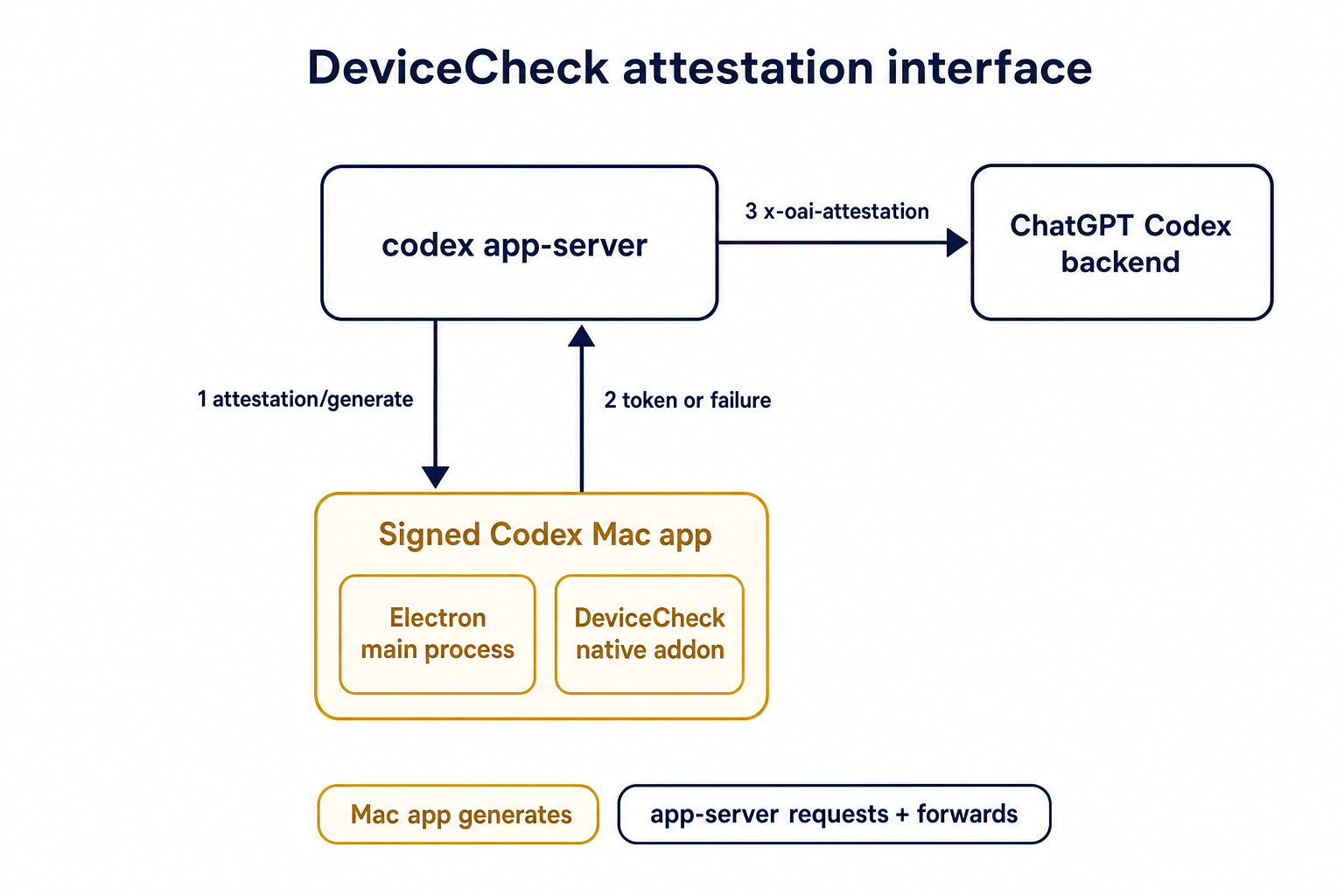
## Details
This PR teaches the Codex app-server runtime how to request and attach
an attestation token. It does not generate DeviceCheck tokens directly;
instead, it relies on the connected desktop app to advertise that it can
generate attestation and then asks that app for a fresh header value
when needed.
The flow is:
1. The Codex desktop app connects to app-server.
2. During `initialize`, the app can advertise that it supports
`requestAttestation`.
3. Before app-server calls selected ChatGPT Codex endpoints, it sends
the internal server request `attestation/generate` to the app.
4. app-server receives a pre-encoded header value back.
5. app-server forwards that value as `x-oai-attestation` on the scoped
outbound requests.
The code in this repo is mostly protocol and runtime plumbing: it adds
the app-server request/response shape, introduces an attestation
provider in core, wires that provider into Responses / compaction /
realtime setup paths, and covers the intended scoping with tests. The
signed macOS DeviceCheck generation remains owned by the desktop app PR.
## Related PR
- Codex desktop app implementation:
https://github.com/openai/openai/pull/878649
## Validation
<details>
<summary>Tests run</summary>
```sh
cargo test -p codex-app-server-protocol
cargo test -p codex-core attestation --lib
cargo test -p codex-app-server --lib attestation
```
Also ran:
```sh
just fix -p codex-core
just fix -p codex-app-server
just fix -p codex-app-server-protocol
just fmt
just write-app-server-schema
```
</details>
<details>
<summary>E2E DeviceCheck validation</summary>
First validated the signed desktop app boundary directly: launched a
packaged signed `Codex.app`, sent `attestation/generate`, decoded the
returned `v1.` attestation header, and validated the extracted
DeviceCheck token with `personal/jm/verify_devicecheck_token.py` using
bundle ID `com.openai.codex`. Apple returned `status_code: 200` and
`is_ok: true`.
Then ran the fuller app + app-server flow. The packaged `Codex.app`
launched a current-branch app-server via `CODEX_CLI_PATH`, and a local
MITM proxy intercepted outbound `chatgpt.com` traffic. The app-server
requested `attestation/generate` from the real Electron app process, and
the intercepted `/backend-api/codex/responses` traffic included
`x-oai-attestation` on both routes:
```text
GET /backend-api/codex/responses Upgrade: websocket x-oai-attestation: present
POST /backend-api/codex/responses Upgrade: none x-oai-attestation: present
```
The captured header decoded to a DeviceCheck token that also validated
with Apple for `com.openai.codex` (`status_code: 200`, `is_ok: true`,
team `2DC432GLL2`).
</details>
---------
Co-authored-by: Codex <noreply@openai.com>
## Why

Reverts #20689 to restore the previous optional state DB plumbing. The
conflict resolution keeps the newer installation ID and session/thread
identity changes that landed after #20689, while removing the mandatory
state DB and agent graph store dependency from ThreadManager
construction.

## What changed

- Restored `Option<StateDbHandle>` through app-server, MCP server,
prompt debug, and test entry points.
- Removed the `codex-core` dependency on `codex-agent-graph-store` and
reverted descendant lookup back to the existing state DB path when
available.
- Kept newer `installation_id` forwarding by passing it beside the
optional DB handle.
- Kept local thread-name updates working when the optional state DB
handle is absent.

## Validation

- `git diff --check`
- `cargo test -p codex-thread-store`
- `cargo test -p codex-state -p codex-rollout -p
codex-app-server-protocol`
- Attempted `env CARGO_INCREMENTAL=0 cargo test -p codex-core -p
codex-app-server -p codex-app-server-client -p codex-mcp-server -p
codex-thread-manager-sample -p codex-tui`; blocked locally by a rustc
ICE while compiling `v8 v146.4.0` with `rustc 1.93.0 (254b59607
2026-01-19)` on `aarch64-apple-darwin`.
## Why

Skills update notifications are app-server API behavior, but the watcher
lived in `codex-core` and surfaced through
`EventMsg::SkillsUpdateAvailable`. Moving the watcher out keeps core
focused on thread execution and lets app-server own both cache
invalidation and the `skills/changed` notification.

## What changed

- Added an app-server-owned skills watcher that watches local skill
roots, clears the shared skills cache, and emits `skills/changed`
directly.
- Registers skill watches from the common app-server thread listener
attach path, including direct starts, resumes, and app-server-observed
child or forked threads.
- Stores the `WatchRegistration` on `ThreadState`, so listener
replacement, thread teardown, idle unload, and app-server shutdown
deregister by dropping the RAII guard.
- Removed `EventMsg::SkillsUpdateAvailable`, the core watcher, and the
old core live-reload test.
- Extended the app-server skills change test to verify a cached skills
list is refreshed after a filesystem change without forcing reload.

## Validation

- `cargo check -p codex-core -p codex-app-server -p codex-mcp-server -p
codex-rollout -p codex-rollout-trace`
- `cargo test -p codex-app-server
skills_changed_notification_is_emitted_after_skill_change`
## Why

Message history was implemented inside `codex-core` and surfaced through
core protocol ops and `SessionConfiguredEvent` fields even though the
current consumer is TUI-local prompt recall. That made core own UI
history persistence and exposed `history_log_id` / `history_entry_count`
through surfaces that app-server and other clients do not need.

This change moves message history persistence out of core and keeps the
recall plumbing local to the TUI.

## What changed

- Added a new `codex-message-history` crate for appending, looking up,
trimming, and reading metadata from `history.jsonl`.
- Removed core protocol history ops/events: `AddToHistory`,
`GetHistoryEntryRequest`, and `GetHistoryEntryResponse`.
- Removed `history_log_id` and `history_entry_count` from
`SessionConfiguredEvent` and updated exec/MCP/test fixtures accordingly.
- Updated the TUI to dispatch local app events for message-history
append/lookup and keep its persistent-history metadata in TUI session
state.

## Validation

- `cargo test -p codex-message-history -p codex-protocol`
- `cargo test -p codex-exec event_processor_with_json_output`
- `cargo test -p codex-mcp-server outgoing_message`
- `cargo test -p codex-tui`
- `just fix -p codex-message-history -p codex-protocol -p codex-core -p
codex-tui -p codex-exec -p codex-mcp-server`
## Why

`skills/list` is already exposed through app-server v2 and covered by
the app-server test suite. Keeping the separate core `Op::ListSkills`
path leaves a duplicate legacy protocol surface that no longer needs to
be maintained.

## What Changed

- Removed `Op::ListSkills` and `EventMsg::ListSkillsResponse` from the
core protocol.
- Deleted the corresponding core session handler and stale core
integration tests.
- Removed rollout/MCP ignore branches and protocol v1 docs references
for the deleted event/op.
- Left app-server `skills/list` and its existing coverage intact.

## Validation

- `cargo test -p codex-protocol`
- `cargo test -p codex-core --test all suite::skills`
- `cargo check -p codex-mcp-server -p codex-rollout -p
codex-rollout-trace`
- `just fix -p codex-core`
## Why

We want the agent graph store to be passed down the stack as a real
dependency, the same way we already treat the thread store.

This will let us inject the agent graph store as a real dependency and
support implementations other than the local SQLite-backed one. Right
now most code instantiates a state DB and an agent graph store
just-in-time. Ideally, we would not depend on the state DB directly but
only read through the higher-level interfaces.

This change makes the dependency boundaries explicit and moves state DB
initialization to process bootstrap instead of hiding it inside local
store implementations.

## What changed

- `ThreadManager` now requires a `StateDbHandle` and an
`AgentGraphStore` at construction time instead of treating them as
optional internals.
- The local store constructors no longer lazily initialize SQLite.
Callers now initialize the state DB once per process and use that shared
handle to build:
  - `LocalThreadStore`
  - `LocalAgentGraphStore`
- App bootstraps (`app-server`, `mcp-server`, `prompt_debug`, and the
thread-manager sample) now initialize the state DB up front and inject
the resulting handle down the stack.
- `app-server` now consistently uses its process-scoped state DB handle
instead of reopening SQLite or trying to recover it from loaded threads.
- Device-key storage now reuses the shared state DB handle instead of
maintaining its own lazy opener.
- The thread archive / descendant traversal paths now use the injected
`AgentGraphStore` instead of reaching through local
thread-store-specific state.

## Verification

- `cargo check -p codex-core -p codex-thread-store -p codex-app-server
-p codex-mcp-server -p codex-thread-manager-sample --tests`
- `cargo test -p codex-thread-store`
- `cargo test -p codex-core
thread_manager_accepts_separate_agent_graph_store_and_thread_store --
--nocapture`
- `cargo test -p codex-app-server
thread_archive_archives_spawned_descendants -- --nocapture`
## Why

Adding goal metrics makes it possible to track how often goals are
created, completed, and stopped by budget limits, plus the final token
and wall-clock usage for terminal outcomes.

## What Changed

- Added OpenTelemetry metric constants for goal lifecycle tracking:
- `codex.goal.created`: increments each time a new persisted goal is
created or an existing goal is replaced with a new objective.
- `codex.goal.completed`: increments when a goal transitions to
`complete`.
- `codex.goal.budget_limited`: increments when a goal transitions to
`budget_limited` because its token budget has been reached.
- `codex.goal.token_count`: records the final persisted token count when
a goal transitions to `complete` or `budget_limited`.
- `codex.goal.duration_s`: records the final persisted elapsed
wall-clock time, in seconds, when a goal transitions to `complete` or
`budget_limited`.
- Emitted creation metrics when a goal is created or replaced.
- Emitted terminal outcome counters and final usage histograms when a
goal transitions to `complete` or `budget_limited`, avoiding
double-counting later in-flight accounting for already budget-limited
goals.
- Added focused `codex-core` tests for create/complete metrics and
one-time budget-limit metrics.
## Why

SQLite state was still being opened from consumer paths, including lazy
`OnceCell`-backed thread-store call sites. That let one process
construct multiple state DB connections for the same Codex home, which
makes SQLite lock contention and `database is locked` failures much
easier to hit.

State DB lifetime should be chosen by main-like entrypoints and tests,
then passed through explicitly. Consumers should use the supplied
`Option<StateDbHandle>` or `StateDbHandle` and keep their existing
filesystem fallback or error behavior when no handle is available.

The startup path also needs to keep the rollout crate in charge of
SQLite state initialization. Opening `codex_state::StateRuntime`
directly bypasses rollout metadata backfill, so entrypoints should
initialize through `codex_rollout::state_db` and receive a handle only
after required rollout backfills have completed.

## What Changed

- Initialize the state DB in main-like entrypoints for CLI, TUI,
app-server, exec, MCP server, and the thread-manager sample.
- Pass `Option<StateDbHandle>` through `ThreadManager`,
`LocalThreadStore`, app-server processors, TUI app wiring, rollout
listing/recording, personality migration, shell snapshot cleanup,
session-name lookup, and memory/device-key consumers.
- Remove the lazy local state DB wrapper from the thread store so
non-test consumers use only the supplied handle or their existing
fallback path.
- Make `codex_rollout::state_db::init` the local state startup path: it
opens/migrates SQLite, runs rollout metadata backfill when needed, waits
for concurrent backfill workers up to a bounded timeout, verifies
completion, and then returns the initialized handle.
- Keep optional/non-owning SQLite helpers, such as remote TUI local
reads, as open-only paths that do not run startup backfill.
- Switch app-server startup from direct
`codex_state::StateRuntime::init` to the rollout state initializer so
app-server cannot skip rollout backfill.
- Collapse split rollout lookup/list APIs so callers use the normal
methods with an optional state handle instead of `_with_state_db`
variants.
- Restore `getConversationSummary(ThreadId)` to delegate through
`ThreadStore::read_thread` instead of a LocalThreadStore-specific
rollout path special case.
- Keep DB-backed rollout path lookup keyed on the DB row and file
existence, without imposing the filesystem filename convention on
existing DB rows.
- Verify readable DB-backed rollout paths against `session_meta.id`
before returning them, so a stale SQLite row that points at another
thread's JSONL falls back to filesystem search and read-repairs the DB
row.
- Keep `debug prompt-input` filesystem-only so a one-off debug command
does not initialize or backfill SQLite state just to print prompt input.
- Keep goal-session test Codex homes alive only in the goal-specific
helper, rather than leaking tempdirs from the shared session test
helper.
- Update tests and call sites to pass explicit state handles where DB
behavior is expected and explicit `None` where filesystem-only behavior
is intended.

## Validation

- `CARGO_TARGET_DIR=/tmp/codex-target-state-db cargo check -p
codex-rollout -p codex-thread-store -p codex-app-server -p codex-core -p
codex-tui -p codex-exec -p codex-cli --tests`
- `CARGO_TARGET_DIR=/tmp/codex-target-state-db cargo test -p
codex-rollout state_db_`
- `CARGO_TARGET_DIR=/tmp/codex-target-state-db cargo test -p
codex-rollout find_thread_path`
- `CARGO_TARGET_DIR=/tmp/codex-target-state-db cargo test -p
codex-rollout find_thread_path -- --nocapture`
- `CARGO_TARGET_DIR=/tmp/codex-target-state-db cargo test -p
codex-rollout try_init_ -- --nocapture`
- `CARGO_TARGET_DIR=/tmp/codex-target-state-db cargo test -p
codex-rollout`
- `CARGO_TARGET_DIR=/tmp/codex-target-state-db cargo clippy -p
codex-rollout --lib -- -D warnings`
- `CARGO_TARGET_DIR=/tmp/codex-target-state-db cargo test -p
codex-thread-store
read_thread_falls_back_when_sqlite_path_points_to_another_thread --
--nocapture`
- `CARGO_TARGET_DIR=/tmp/codex-target-state-db cargo test -p
codex-thread-store`
- `CARGO_TARGET_DIR=/tmp/codex-target-state-db cargo test -p codex-core
shell_snapshot`
- `CARGO_TARGET_DIR=/tmp/codex-target-state-db cargo test -p codex-core
--test all personality_migration`
- `CARGO_TARGET_DIR=/tmp/codex-target-state-db cargo test -p codex-core
--test all rollout_list_find`
- `RUST_MIN_STACK=8388608 CODEX_SKIP_VENDORED_BWRAP=1
CARGO_TARGET_DIR=/tmp/codex-target-state-db cargo test -p codex-core
--test all rollout_list_find::find_prefers_sqlite_path_by_id --
--nocapture`
- `RUST_MIN_STACK=8388608 CODEX_SKIP_VENDORED_BWRAP=1
CARGO_TARGET_DIR=/tmp/codex-target-state-db cargo test -p codex-core
--test all rollout_list_find -- --nocapture`
- `CARGO_TARGET_DIR=/tmp/codex-target-state-db cargo test -p codex-core
interrupt_accounts_active_goal_before_pausing`
- `CARGO_TARGET_DIR=/tmp/codex-target-state-db cargo test -p
codex-app-server get_auth_status -- --test-threads=1`
- `CODEX_SKIP_VENDORED_BWRAP=1
CARGO_TARGET_DIR=/tmp/codex-target-state-db cargo test -p
codex-app-server --lib`
- `CODEX_SKIP_VENDORED_BWRAP=1
CARGO_TARGET_DIR=/tmp/codex-target-state-db cargo check -p codex-rollout
-p codex-app-server --tests`
- `CARGO_TARGET_DIR=/tmp/codex-target-state-db just fix -p codex-rollout
-p codex-thread-store -p codex-core -p codex-app-server -p codex-tui -p
codex-exec -p codex-cli`
- `CODEX_SKIP_VENDORED_BWRAP=1
CARGO_TARGET_DIR=/tmp/codex-target-state-db just fix -p codex-rollout -p
codex-app-server`
- `CARGO_TARGET_DIR=/tmp/codex-target-state-db just fix -p
codex-rollout`
- `CODEX_SKIP_VENDORED_BWRAP=1
CARGO_TARGET_DIR=/tmp/codex-target-state-db just fix -p codex-core`
- `just argument-comment-lint -p codex-core`
- `just argument-comment-lint -p codex-rollout`

Focused coverage added in `codex-rollout`:

- `recorder::tests::state_db_init_backfills_before_returning` verifies
the rollout metadata row exists before startup init returns.
- `state_db::tests::try_init_waits_for_concurrent_startup_backfill`
verifies startup waits for another worker to finish backfill instead of
disabling the handle for the process.
-
`state_db::tests::try_init_times_out_waiting_for_stuck_startup_backfill`
verifies startup does not hang indefinitely on a stuck backfill lease.
-
`tests::find_thread_path_accepts_existing_state_db_path_without_canonical_filename`
verifies DB-backed lookup accepts valid existing rollout paths even when
the filename does not include the thread UUID.
-
`tests::find_thread_path_falls_back_when_db_path_points_to_another_thread`
verifies DB-backed lookup ignores a stale row whose existing path
belongs to another thread and read-repairs the row after filesystem
fallback.

Focused coverage updated in `codex-core`:

- `rollout_list_find::find_prefers_sqlite_path_by_id` now uses a
DB-preferred rollout file with matching `session_meta.id`, so it still
verifies that valid SQLite paths win without depending on stale/empty
rollout contents.

`cargo test -p codex-app-server thread_list_respects_search_term_filter
-- --test-threads=1 --nocapture` was attempted locally but timed out
waiting for the app-server test harness `initialize` response before
reaching the changed thread-list code path.

`bazel test //codex-rs/thread-store:thread-store-unit-tests
--test_output=errors` was attempted locally after the thread-store fix,
but this container failed before target analysis while fetching `v8+`
through BuildBuddy/direct GitHub. The equivalent local crate coverage,
including `cargo test -p codex-thread-store`, passes.

A plain local `cargo check -p codex-rollout -p codex-app-server --tests`
also requires system `libcap.pc` for `codex-linux-sandbox`; the
follow-up app-server check above used `CODEX_SKIP_VENDORED_BWRAP=1` in
this container.
## Why

This adds the `remote_compaction_v2` client path so remote compaction
can run through the normal Responses stream and install a
`context_compaction` item that trigger a compaction.

The goal is to migrate some of the compaction logic on the client side

We keeps the v2 transport behind a feature flag while letting follow-up
requests reuse the compacted context instead of falling back to the
legacy compaction item shape.

## What changed

- add `ResponseItem::ContextCompaction` and refresh the generated
app-server / schema / TypeScript fixtures that expose response items on
the wire
- add `core/src/compact_remote_v2.rs` to send compaction through the
standard streamed Responses client, require exactly one
`context_compaction` output item, and install that item into compacted
history
- route manual compact and auto-compaction through the v2 path when
`remote_compaction_v2` is enabled, while keeping the existing remote
compaction path as the fallback
- preserve the new item type across history retention, follow-up request
construction, telemetry, rollout persistence, and rollout-trace
normalization
- add targeted coverage for the feature flag, `context_compaction`
serialization, rollout-trace normalization, and remote-compaction
follow-up behavior

## Verification

- added protocol tests for `context_compaction`
serialization/deserialization in `protocol/src/models.rs`
- added rollout-trace coverage for `context_compaction` normalization in
`rollout-trace/src/reducer/conversation_tests.rs`
- added remote compaction integration coverage for v2 follow-up reuse
and mixed compaction output streams in
`core/tests/suite/compact_remote.rs`

---------

Co-authored-by: Codex <noreply@openai.com>
## Why

For reproducibility. A hand-written `config.toml` is not enough to
recreate what a Codex session actually ran with because layered config,
CLI overrides, defaults, feature aliases, resolved feature config,
prompt setup, and model-catalog/session values can all affect the final
runtime behavior.

This PR adds an effective config lockfile path: one run can export the
resolved session config, and a later run can replay that lockfile and
fail early if the regenerated effective config drifts.

## What Changed

- Add a dedicated `ConfigLockfileToml` wrapper with top-level lockfile
metadata plus the replayable config:

  ```toml
  version = 1
  codex_version = "..."

  [config]
  # effective ConfigToml fields
  ```

- Keep lockfile metadata out of regular `ConfigToml`; replay loads
`ConfigLockfileToml` and then uses its nested `config` as the
authoritative config layer.
- Add `debug.config_lockfile.export_dir` to write
`<thread_id>.config.lock.toml` when a root session starts.
- Add `debug.config_lockfile.load_path` to replay a saved lockfile and
validate the regenerated session lockfile against it.
- Add `debug.config_lockfile.allow_codex_version_mismatch` to optionally
tolerate Codex binary version drift while still comparing the rest of
the lockfile.
- Add `debug.config_lockfile.save_fields_resolved_from_model_catalog` so
lock creation can either save model-catalog/session-resolved fields or
intentionally leave those fields dynamic.
- Build lockfiles from the effective config plus resolved runtime values
such as model selection, reasoning settings, prompts, service tier, web
search mode, feature states/config, memories config, skill instructions,
and agent limits.
- Materialize feature aliases and custom feature config into the
lockfile so replay compares canonical resolved behavior instead of
user-authored alias shape.
- Strip profile/debug/file-include/environment-specific inputs from
generated lockfiles so they contain replayable values rather than the
inputs that produced those values.
- Surface JSON-RPC server error code/data in app-server client and TUI
bootstrap errors so config-lock replay failures include the actual TOML
diff.
- Regenerate the config schema for the new debug config keys.

## Review Notes

The main flow is split across these files:

- `config/src/config_toml.rs`: lockfile/debug TOML shapes.
- `core/src/config/mod.rs`: loading `debug.config_lockfile.*`, replaying
a lockfile as a config layer, and preserving the expected lockfile for
validation.
- `core/src/session/config_lock.rs`: exporting the current session
lockfile and materializing resolved session/config values.
- `core/src/config_lock.rs`: lockfile parsing, metadata/version checks,
replay comparison, and diff formatting.

## Usage

Export a lockfile from a normal session:

```sh
codex -c 'debug.config_lockfile.export_dir="/tmp/codex-locks"'
```

Export a lockfile without saving model-catalog/session-resolved fields:

```sh
codex -c 'debug.config_lockfile.export_dir="/tmp/codex-locks"' \
  -c 'debug.config_lockfile.save_fields_resolved_from_model_catalog=false'
```

Replay a saved lockfile in a later session:

```sh
codex -c 'debug.config_lockfile.load_path="/tmp/codex-locks/<thread_id>.config.lock.toml"'
```

If replay resolves to a different effective config, startup fails with a
TOML diff.

To tolerate Codex binary version drift during replay:

```sh
codex -c 'debug.config_lockfile.load_path="/tmp/codex-locks/<thread_id>.config.lock.toml"' \
  -c 'debug.config_lockfile.allow_codex_version_mismatch=true'
```

## Limitations

This does not support custom rules/network policies.

## Verification

- `cargo test -p codex-core config_lock`
- `cargo test -p codex-config`
- `cargo test -p codex-thread-manager-sample`
Summary:
- Add a checked-in codex-core public API listing generated by
cargo-public-api.
- Add scripts/regen-public-api.sh with an embedded crate list,
auto-install for cargo-public-api 0.51.0, pinned nightly, and --check
mode.
- Add Rust CI jobs on the codex Linux x64 runner pool to verify the
listing stays up to date.

Testing:
- bash -n scripts/regen-public-api.sh
- just regen-public-api --check
- yq '.' .github/workflows/rust-ci.yml
.github/workflows/rust-ci-full.yml
- git diff --check
Summary:
- Add codex-thread-manager-sample, a one-shot binary that starts a
ThreadManager thread, submits a prompt, and prints the final assistant
output.
- Pass ThreadStore into ThreadManager::new and expose
thread_store_from_config for existing callsites.
- Build the sample Config directly with only --model and prompt inputs.

Verification:
- just fmt
- cargo check -p codex-thread-manager-sample -p codex-app-server -p
codex-mcp-server
- git diff --check

Tests: Not run per request.
Keep extracting memories out of core and moving the write trigger in the
app-server
This is temporary and it should move at the client level as a follow-up
This makes core fully independant from `codex-memories-write`

---------

Co-authored-by: Codex <noreply@openai.com>
## Why

Config loading had become split across crates: `codex-config` owned the
config types and merge logic, while `codex-core` still owned the loader
that assembled the layer stack. This change consolidates that
responsibility in `codex-config`, so the crate that defines config
behavior also owns how configs are discovered and loaded.

To make that move possible without reintroducing the old dependency
cycle, the shell-environment policy types and helpers that
`codex-exec-server` needs now live in `codex-protocol` instead of
flowing through `codex-config`.

This also makes the migrated loader tests more deterministic on machines
that already have managed or system Codex config installed by letting
tests override the system config and requirements paths instead of
reading the host's `/etc/codex`.

## What Changed

- moved the config loader implementation from `codex-core` into
`codex-config::loader` and deleted the old `core::config_loader` module
instead of leaving a compatibility shim
- moved shell-environment policy types and helpers into
`codex-protocol`, then updated `codex-exec-server` and other downstream
crates to import them from their new home
- updated downstream callers to use loader/config APIs from
`codex-config`
- added test-only loader overrides for system config and requirements
paths so loader-focused tests do not depend on host-managed config state
- cleaned up now-unused dependency entries and platform-specific cfgs
that were surfaced by post-push CI

## Testing

- `cargo test -p codex-config`
- `cargo test -p codex-core config_loader_tests::`
- `cargo test -p codex-protocol -p codex-exec-server -p
codex-cloud-requirements -p codex-rmcp-client --lib`
- `cargo test --lib -p codex-app-server-client -p codex-exec`
- `cargo test --no-run --lib -p codex-app-server`
- `cargo test -p codex-linux-sandbox --lib`
- `cargo shear`
- `just bazel-lock-check`

## Notes

- I did not chase unrelated full-suite failures outside the migrated
loader surface.
- `cargo test -p codex-core --lib` still hits unrelated proxy-sensitive
failures on this machine, and Windows CI still shows unrelated
long-running/timeouting test noise outside the loader migration itself.
Adds the model-facing goal tools on top of the app-server API from PR 2.

## Why

Once goals are persisted and exposed to clients, the model needs a
small, constrained tool surface for goal workflows. The tool contract
should let the model inspect goals, create them only when explicitly
requested, and mark them complete without giving it broad control over
user/runtime-owned state.

## What changed

- Added `get_goal`, `create_goal`, and `update_goal` tool specs behind
the `goals` feature flag.
- Added core goal tool handlers that validate objectives and token
budgets before mutating persisted state.
- Constrained `create_goal` to create only when no goal exists, with
optional `token_budget` only when a budget is explicitly provided.
- Tightened the `create_goal` instructions so the model does not infer
goals from ordinary task requests.
- Constrained `update_goal` to expose only goal completion; pause,
resume, clear, and budget-limited transitions remain user- or
runtime-controlled.
- Registered the goal tools in the tool registry and kept them out of
review contexts where they should not appear.

## Verification

- Added tool-registry coverage for feature gating and tool availability.
- Added core session tests for create/get/update behavior, duplicate
goal rejection, budget validation, and completion-only updates.
## Why

`PermissionProfile` is becoming the canonical permissions shape shared
by core and app-server. After app-server responses expose the active
profile, clients need to be able to send that same shape back when
starting, resuming, forking, or overriding a turn instead of translating
through the legacy `sandbox`/`sandboxPolicy` shorthands.

This still needs to preserve the existing requirements/platform
enforcement model. A profile-shaped request can be downgraded or
rejected by constraints, but the server should keep the user's
elevated-access intent for project trust decisions. Turn-level profile
overrides also need to retain existing read protections, including
deny-read entries and bounded glob-scan metadata, so a permission
override cannot accidentally drop configured protections such as
`**/*.env = deny`.

## What changed

- Adds optional `permissionProfile` request fields to `thread/start`,
`thread/resume`, `thread/fork`, and `turn/start`.
- Rejects ambiguous requests that specify both `permissionProfile` and
the legacy `sandbox`/`sandboxPolicy` fields, including running-thread
resume requests.
- Converts profile-shaped overrides into core runtime filesystem/network
permissions while continuing to derive the constrained legacy sandbox
projection used by existing execution paths.
- Preserves project-trust intent for profile overrides that are
equivalent to workspace-write or full-access sandbox requests.
- Preserves existing deny-read entries and `globScanMaxDepth` when
applying turn-level `permissionProfile` overrides.
- Updates app-server docs plus generated JSON/TypeScript schema fixtures
and regression coverage.

## Verification

- `cargo test -p codex-app-server-protocol schema_fixtures`
- `cargo test -p codex-core
session_configuration_apply_permission_profile_preserves_existing_deny_read_entries`


---
[//]: # (BEGIN SAPLING FOOTER)
Stack created with [Sapling](https://sapling-scm.com). Best reviewed
with [ReviewStack](https://reviewstack.dev/openai/codex/pull/18279).
* #18288
* #18287
* #18286
* #18285
* #18284
* #18283
* #18282
* #18281
* #18280
* __->__ #18279
## Summary

This PR fully reverts the previously merged Agent Identity runtime
integration from the old stack:
https://github.com/openai/codex/pull/17387/changes

It removes the Codex-side task lifecycle wiring, rollout/session
persistence, feature flag plumbing, lazy `auth.json` mutation,
background task auth paths, and request callsite changes introduced by
that stack.

This leaves the repo in a clean pre-AgentIdentity integration state so
the follow-up PRs can reintroduce the pieces in smaller reviewable
layers.

## Stack

1. This PR: full revert
2. https://github.com/openai/codex/pull/18871: move Agent Identity
business logic into a crate
3. https://github.com/openai/codex/pull/18785: add explicit
AgentIdentity auth mode and startup task allocation
4. https://github.com/openai/codex/pull/18811: migrate auth callsites
through AuthProvider

## Testing

Tests: targeted Rust checks, cargo-shear, Bazel lock check, and CI.
## Summary
- Move external agent config migration logic and tests from `codex-core`
into `app-server/src/config`.
- Keep the migration service crate-private to app-server and update the
API adapter imports.
- Remove stale core re-exports and expose only the needed marketplace
source helper.

## Testing
- `cargo test -p codex-app-server config::external_agent_config`
- `just fmt`
- `just fix -p codex-app-server`
- `just fix -p codex-core`
- `git diff --check`
Cap the model-visible skills section to a small share of the context
window, with a fallback character budget, and keep only as many implicit
skills as fit within that budget.

Emit a non-fatal warning when enabled skills are omitted, and add a new
app-server warning notification

Record thread-start skill metrics for total enabled skills, kept skills,
and whether truncation happened

---------

Co-authored-by: Matthew Zeng <mzeng@openai.com>
Co-authored-by: Codex <noreply@openai.com>
To improve performance of UI loads from the app, add two main
improvements:
1. The `thread/list` api now gets a `sortDirection` request field and a
`backwardsCursor` to the response, which lets you paginate forwards and
backwards from a window. This lets you fetch the first few items to
display immediately while you paginate to fill in history, then can
paginate "backwards" on future loads to catch up with any changes since
the last UI load without a full reload of the entire data set.
2. Added a new `thread/turns/list` api which also has sortDirection and
backwardsCursor for the same behavior as `thread/list`, allowing you the
same small-fetch for immediate display followed by background fill-in
and resync catchup.

 Owen LinandGitHub
 Adam Perry @ OpenAIandGitHub
 Curtis 'Fjord' HawthorneandGitHub
 Eric TrautandGitHub
 pakrym-oaiandGitHub
 Won ParkandGitHub
 jifandGitHub

 Matthew ZengandGitHub
 xl-openaiandGitHub
 sayan-oaiandGitHub


 Rasmus RygaardandGitHub
 Ruslan NigmatullinandGitHub

 Michael BolinandGitHub
 efrazer-oaiandGitHub
 Andrey MishchenkoandGitHub
 David de RegtandGitHub
