The workspace denies `clippy::expect_used` in production. Although
`clippy.toml` allows `expect` in tests, Bazel Clippy compiles
integration-test helper code in a way that does not receive that
exemption, which encouraged verbose `unwrap_or_else(... panic!(...))`
and equivalent `match`/`let else` forms.

This allows `clippy::expect_used` once at each integration-test crate
root (including aggregated suites and test-support libraries), then
replaces manual panic-based Result and Option unwraps with
`expect`/`expect_err`. Standalone `tests/*.rs` files remain their own
crate roots. Intentional assertion and unexpected-variant panics remain
unchanged, and the production `expect_used = "deny"` lint remains in
place.

The cleanup is mechanical and net-negative in line count.
## Why

`terminal_resize_reflow` is now stable and should behave as always on.
Keeping the disabled runtime paths around made the feature look
configurable even though the rollout is complete, and old config could
still suggest there was a supported off mode.

## What Changed

- Marked `terminal_resize_reflow` as `Stage::Removed` while keeping it
default-enabled for compatibility.
- Ignored `[features].terminal_resize_reflow` config entries so stale
`false` settings no longer affect the effective feature set.
- Removed TUI branches that depended on the flag being disabled, so
draw, replay buffering, stream finalization, and resize scheduling all
assume resize reflow is active.
- Simplified resize smoke coverage to exercise the always-on behavior
only.

## Verification

- `just test -p codex-features`
- `just test -p codex-tui resize_reflow`
- `just test -p codex-tui initial_replay_buffer
thread_switch_replay_buffer`
## Why

The TUI startup test surface had drifted into expensive, brittle
coverage:

- `tui/tests/suite/no_panic_on_startup.rs` was already ignored as flaky
while still spawning a PTY to exercise malformed exec-policy rules.
- `tui/tests/suite/model_availability_nux.rs` used a seeded session,
cursor-query spoofing, and repeated interrupts to verify a narrow
resume-path invariant.
- `app/tests.rs` had started accumulating unrelated startup and summary
coverage in one flat module even after the surrounding app code was
split into feature modules.

This keeps those behaviors covered while making the tests cheaper to
understand and less likely to rot. It also preserves the malformed-rules
regression from #8803 without requiring a terminal orchestration test.

## What changed

- Replaced the malformed `rules` startup PTY case with a direct
exec-policy loader regression:

[`rules_path_file_returns_read_dir_error`](https://github.com/openai/codex/blob/21b6b5622f18b8cac0ea41fd083b3106778d9ffc/codex-rs/core/src/exec_policy_tests.rs#L264-L284)
- Made the existing fresh-session-only startup tooltip behavior explicit
with

[`should_prepare_startup_tooltip_override`](https://github.com/openai/codex/blob/21b6b5622f18b8cac0ea41fd083b3106778d9ffc/codex-rs/tui/src/app/thread_routing.rs#L1272-L1279),
then added focused coverage for the resume/fork gate and the persisted
NUX counter.
- Split startup and session-summary coverage out of
`tui/src/app/tests.rs` into dedicated modules so the test layout better
mirrors the current app architecture.
- Converted one single-message goal validation snapshot into semantic
assertions where layout was not the behavior under test.
- Removed the two PTY-heavy suite files that the narrower tests now
supersede.

## Verification

- `cargo test -p codex-core rules_path_file_returns_read_dir_error`
- `cargo test -p codex-tui startup_`
- `cargo test -p codex-tui session_summary_`
- `cargo test -p codex-tui
goal_slash_command_rejects_oversized_objective`
## Why

`CODEX_RS_SSE_FIXTURE` let integration-style CLI, exec, and TUI tests
bypass the normal Responses transport by reading SSE from local files.
That kept test-only behavior wired through production client code. The
affected tests can stay hermetic by using the existing
`core_test_support::responses` mock server and passing `openai_base_url`
instead.

## What Changed

- Removed the `CODEX_RS_SSE_FIXTURE` flag,
`codex_api::stream_from_fixture`, the `env-flags` dependency, and the
checked-in SSE fixture files.
- Repointed the affected core, exec, and TUI tests at `MockServer` with
the existing SSE event constructors.
- Removed the Bazel test data plumbing for the deleted fixtures and
refreshed cargo/Bazel lock state.

## Verification

- `cargo build -p codex-cli`
- `cargo test -p codex-api`
- `cargo test -p codex-core --test all responses_api_stream_cli`
- `cargo test -p codex-core --test all
integration_creates_and_checks_session_file`
- `cargo test -p codex-exec --test all ephemeral`
- `cargo test -p codex-exec --test all resume`
- `cargo test -p codex-tui --test all
resume_startup_does_not_consume_model_availability_nux_count`
- `just bazel-lock-update`
- `just bazel-lock-check`
- `just fix -p codex-api -p codex-core -p codex-exec -p codex-tui`
- `git diff --check`
## Why
Some consumers expect conventional hyphenated HTTP headers. Codex
already sends the session and thread IDs on outbound Responses requests,
but it only uses the underscore spellings today, which makes those IDs
harder to consume in systems that normalize or reject underscore header
names.

Full context here:
https://openai.slack.com/archives/C08KCGLSPSQ/p1778248578422369

## What changed
- `build_session_headers` now emits both `session_id` and `session-id`
when a session ID is present.
- It does the same for `thread_id` and `thread-id`.
- Added regression coverage in `codex-api/tests/clients.rs` and
`core/tests/suite/client.rs` so both the lower-level client tests and
the end-to-end request tests assert the two header spellings are
present.

## Test plan
- Added header assertions in `codex-api/tests/clients.rs`.
- Added request-header assertions in `core/tests/suite/client.rs` for
both the `/v1/responses` and `/api/codex/responses` request paths.
Fixes multiple scrollback and terminal resize issues: #5538, #5576,
#8352, #12223, #16165, and #15380.

## Why

Codex writes finalized transcript output into terminal scrollback after
wrapping it for the current viewport width. A later terminal resize
could leave that scrollback shaped for the old width, so wider windows
kept narrow output and narrower windows could show stale wrapping
artifacts until enough new output replaced the visible area.

This is also the foundation PR for responsive markdown tables. Table
rendering needs finalized transcript content to be width-sensitive after
insertion, not only while content is first streaming. Markdown table
rendering itself stays in #18576.

## Stack

- PR1: resize backlog reflow and interrupt cleanup
- #18576: markdown table support

## What Changed

- Rebuild source-backed transcript history when the terminal width
changes. `terminal_resize_reflow` is introduced through the experimental
feature system, but is enabled by default for this rollout so we can
validate behavior across real terminals.
- Preserve assistant and plan stream source so finalized streaming
output can participate in resize reflow after consolidation.
- Debounce resize work, but force a final source-backed reflow when a
resize happened during active or unconsolidated streaming output.
- Clear stale pending history lines on resize so old-width wrapped
output is not emitted just before rebuilt scrollback.
- Bound replay work with `[tui.terminal_resize_reflow].max_rows`:
omitted uses terminal-specific defaults, `0` keeps all rendered rows,
and a positive value sets an explicit cap. The cap applies both while
initially replaying a resumed transcript into scrollback and when
rebuilding scrollback after terminal resize.
- Consolidate interrupted assistant streams before cleanup, then clear
pending stream output and active-tail state consistently.
- Move resize reflow and thread event buffering helpers out of `app.rs`
into dedicated TUI modules.
- Add focused coverage for resize reflow, feature-gated behavior,
streaming source preservation, interrupted output cleanup,
unicode-neutral text, terminal-specific row caps, and composer/layout
stability.

## Runtime Bounds

Resize reflow keeps only the most recent rendered rows when a row cap is
active. The default is `auto`, which maps to the detected terminal's
default scrollback size where Codex can identify it: VS Code `1000`,
Windows Terminal `9001`, WezTerm `3500`, and Alacritty `10000`.
Terminals without a dedicated mapping use the conservative fallback of
`1000` rows. Users can override this with `[tui.terminal_resize_reflow]
max_rows = N`, or set `max_rows = 0` to disable row limiting.

## Validation

- `just fmt`
- `git diff --check`
- `cargo test --manifest-path codex-rs/Cargo.toml -p codex-tui reflow`
- `cargo test --manifest-path codex-rs/Cargo.toml -p codex-tui
transcript_reflow`
- `just fix -p codex-tui`
- PR CI in progress on the squashed branch
## Summary
- reduce public module visibility across Rust crates, preferring private
or crate-private modules with explicit crate-root public exports
- update external call sites and tests to use the intended public crate
APIs instead of reaching through module trees
- add the module visibility guideline to AGENTS.md

## Validation
- `cargo check --workspace --all-targets --message-format=short` passed
before the final fix/format pass
- `just fix` completed successfully
- `just fmt` completed successfully
- `git diff --check` passed
The `OPENAI_BASE_URL` environment variable has been a significant
support issue, so we decided to deprecate it in favor of an
`openai_base_url` config key. We've had the deprecation warning in place
for about a month, so users have had time to migrate to the new
mechanism. This PR removes support for `OPENAI_BASE_URL` entirely.
Stacked on #16508.

This removes the temporary `codex-core` / `codex-login` re-export shims
from the ownership split and rewrites callsites to import directly from
`codex-model-provider-info`, `codex-models-manager`, `codex-api`,
`codex-protocol`, `codex-feedback`, and `codex-response-debug-context`.

No behavior change intended; this is the mechanical import cleanup layer
split out from the ownership move.

---------

Co-authored-by: Codex <noreply@openai.com>
## Summary
- split `models-manager` out of `core` and add `ModelsManagerConfig`
plus `Config::to_models_manager_config()` so model metadata paths stop
depending on `core::Config`
- move login-owned/auth-owned code out of `core` into `codex-login`,
move model provider config into `codex-model-provider-info`, move API
bridge mapping into `codex-api`, move protocol-owned types/impls into
`codex-protocol`, and move response debug helpers into a dedicated
`response-debug-context` crate
- move feedback tag emission into `codex-feedback`, relocate tests to
the crates that now own the code, and keep broad temporary re-exports so
this PR avoids a giant import-only rewrite

## Major moves and decisions
- created `codex-models-manager` as the owner for model
cache/catalog/config/model info logic, including the new
`ModelsManagerConfig` struct
- created `codex-model-provider-info` as the owner for provider config
parsing/defaults and kept temporary `codex-login`/`codex-core`
re-exports for old import paths
- moved `api_bridge` error mapping + `CoreAuthProvider` into
`codex-api`, while `codex-login::api_bridge` temporarily re-exports
those symbols and keeps the `auth_provider_from_auth` wrapper
- moved `auth_env_telemetry` and `provider_auth` ownership to
`codex-login`
- moved `CodexErr` ownership to `codex-protocol::error`, plus
`StreamOutput`, `bytes_to_string_smart`, and network policy helpers to
protocol-owned modules
- created `codex-response-debug-context` for
`extract_response_debug_context`, `telemetry_transport_error_message`,
and related response-debug plumbing instead of leaving that behavior in
`core`
- moved `FeedbackRequestTags`, `emit_feedback_request_tags`, and
`emit_feedback_request_tags_with_auth_env` to `codex-feedback`
- deferred removal of temporary re-exports and the mechanical import
rewrites to a stacked follow-up PR so this PR stays reviewable

## Test moves
- moved auth refresh coverage from `core/tests/suite/auth_refresh.rs` to
`login/tests/suite/auth_refresh.rs`
- moved text encoding coverage from
`core/tests/suite/text_encoding_fix.rs` to
`protocol/src/exec_output_tests.rs`
- moved model info override coverage from
`core/tests/suite/model_info_overrides.rs` to
`models-manager/src/model_info_overrides_tests.rs`

---------

Co-authored-by: Codex <noreply@openai.com>
## Why

The remaining `vt100-tests` and `debug-logs` features in `codex-tui`
were only gating test-only and debug-only behavior. Those feature
toggles add Cargo and Bazel permutations without buying anything, and
they make it easier for more crate features to linger in the workspace.

## What changed

- delete `vt100-tests` and `debug-logs` from `codex-tui`
- always compile the VT100 integration tests in the TUI test target
instead of hiding them behind a Cargo feature
- remove the unused textarea debug logging branch instead of replacing
it with another gate
- add the required argument-comment annotations in the VT100 tests now
that Bazel sees those callsites during linting
- shrink the manifest verifier allowlist again so only the remaining
real feature exceptions stay permitted

## How tested

- `cargo test -p codex-tui`
- `just argument-comment-lint -p codex-tui`
This is a follow-up to https://github.com/openai/codex/pull/15922. That
previous PR deleted the old `tui` directory and left the new
`tui_app_server` directory in place. This PR renames `tui_app_server` to
`tui` and fixes up all references.
This is the part 1 of 2 PRs that will delete the `tui` /
`tui_app_server` split. This part simply deletes the existing `tui`
directory and marks the `tui_app_server` feature flag as removed. I left
the `tui_app_server` feature flag in place for now so its presence
doesn't result in an error. It is simply ignored.

Part 2 will rename the `tui_app_server` directory `tui`. I did this as
two parts to reduce visible code churn.
CHAINED PR - note that base is eternal/hooks-pretooluse-bash, not main
-- so the following PR should be first

Matching post-tool hook to the pre-tool functionality here:
https://github.com/openai/codex/pull/15211

So, PreToolUse calls for plain shell calls, allows blocking. This
PostToolUse call runs after the command executed

example run:

```
› as a test, run in parallel the following commands:
  - echo 'one'
  - echo '[block-pre-tool-use]'
  - echo '[block-post-tool-use]'


⚠ MCP startup incomplete (failed: notion, linear)

• Cruising through those three commands in parallel now, and I’ll share the exact outputs right after
  they land.

• Running PreToolUse hook: checking the observatory runes

• Running PreToolUse hook: checking the observatory runes

• Running PreToolUse hook: checking the observatory runes

PreToolUse hook (blocked)
  warning: wizard-tower PreToolUse demo blocked a Bash command on purpose.
  feedback: PreToolUse demo blocked the command. Remove [block-pre-tool-use] to continue.

PreToolUse hook (completed)
  warning: wizard-tower PreToolUse demo inspected Bash: echo 'one'

PreToolUse hook (completed)
  warning: wizard-tower PreToolUse demo inspected Bash: echo '[block-post-tool-use]'

• Ran echo '[block-post-tool-use]'
  └ [block-post-tool-use]

• Ran echo 'one'
  └ one

• Running PostToolUse hook: reading the observatory aftermath

• Running PostToolUse hook: reading the observatory aftermath

PostToolUse hook (blocked)
  warning: wizard-tower PostToolUse demo blocked the Bash follow-through on purpose.
  feedback: PostToolUse demo blocked the result after execution. Remove [block-post-tool-use] to
continue.

PostToolUse hook (completed)
  warning: wizard-tower PostToolUse demo inspected Bash: echo 'one'
  hook context: PostToolUse demo saw the Bash result. Response preview: one

──────────────────────────────────────────────────────────────────────────────────────────────────────

• Ran them in parallel. Little wave report:

  - echo 'one' completed and returned one.
  - echo '[block-pre-tool-use]' was blocked before execution by the PreToolUse hook.
  - echo '[block-post-tool-use]' ran, but its result was blocked afterward by the PostToolUse hook.

  The hook messages were:

  - PreToolUse demo blocked the command. Remove [block-pre-tool-use] to continue.
  - PostToolUse demo blocked the result after execution. Remove [block-post-tool-use] to continue.


› for the blocked messages (correctly blocked in this test) did the tool output land back into
  context?


• Yeah, from this run:

  - PreToolUse block: the command itself did not execute, so no command output landed in context. Only
    the block message did.
  - PostToolUse block: the command did execute, but the actual stdout did not come back into context.
    Only the post-tool block message did.

  So the blocked notifications landed in context, but the blocked command payloads themselves did not.
  Nice clean guardrail, aloha.
```
This PR completes the conversion of non-interactive `codex exec` to use
app server rather than directly using core events and methods.

### Summary
- move `codex-exec` off exec-owned `AuthManager` and `ThreadManager`
state
- route exec bootstrap, resume, and auth refresh through existing
app-server paths
- replace legacy `codex/event/*` decoding in exec with typed app-server
notification handling
- update human and JSONL exec output adapters to translate existing
app-server notifications only
- clean up "app server client" layer by eliminating support for legacy
notifications; this is no longer needed
- remove exposure of `authManager` and `threadManager` from "app server
client" layer

### Testing
- `exec` has pretty extensive unit and integration tests already, and
these all pass
- In addition, I asked Codex to put together a comprehensive manual set
of tests to cover all of the `codex exec` functionality (including
command-line options), and it successfully generated and ran these tests
## Summary
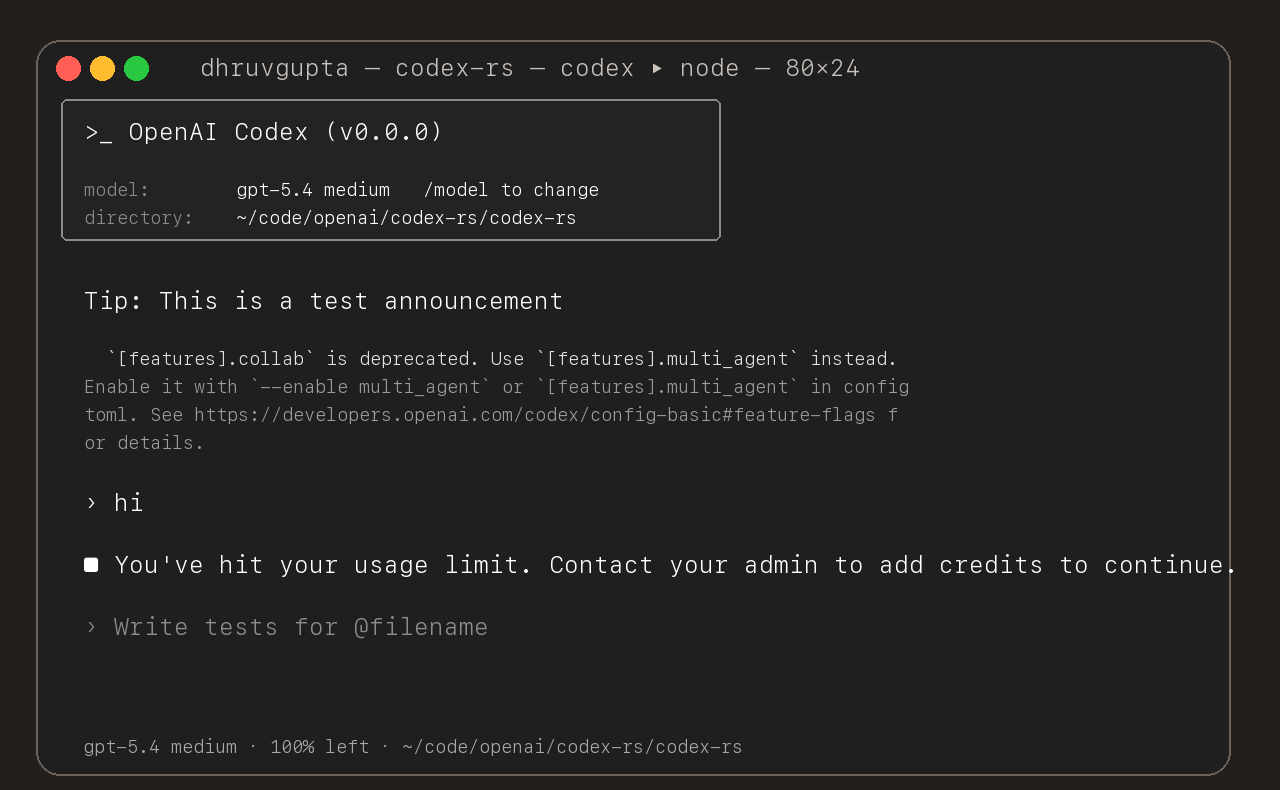
- update the self-serve business usage-based limit message to direct
users to their admin for additional credits
- add a focused unit test for the self_serve_business_usage_based plan
branch
Added also:
If you are at a rate limit but you still have credits, codex cli would
tell you to switch the model. We shouldnt do this if you have credits so
fixed this.
## Test
- launched the source-built CLI and verified the updated message is
shown for the self-serve business usage-based plan
Enhance pty utils:
* Support closing stdin
* Separate stderr and stdout streams to allow consumers differentiate them
* Provide compatibility helper to merge both streams back into combined one
* Support specifying terminal size for pty, including on-demand resizes while process is already running
* Support terminating the process while still consuming its outputs
- override startup tooltips with model availability NUX and persist
per-model show counts in config
- stop showing each model after four exposures and fall back to normal
tooltips
When an invalid config.toml key or value is detected, the CLI currently
just quits. This leaves the VSCE in a dead state.

This PR changes the behavior to not quit and bubble up the config error
to users to make it actionable. It also surfaces errors related to
"rules" parsing.

This allows us to surface these errors to users in the VSCE, like this:

<img width="342" height="129" alt="Screenshot 2026-01-13 at 4 29 22 PM"
src="https://github.com/user-attachments/assets/a79ffbe7-7604-400c-a304-c5165b6eebc4"
/>

<img width="346" height="244" alt="Screenshot 2026-01-13 at 4 45 06 PM"
src="https://github.com/user-attachments/assets/de874f7c-16a2-4a95-8c6d-15f10482e67b"
/>
Adds an integration test for the new behavior introduced in
https://github.com/openai/codex/pull/9011. The work to create the test
setup was substantial enough that I thought it merited a separate PR.

This integration test spawns `codex` in TUI mode, which requires
spawning a PTY to run successfully, so I had to introduce quite a bit of
scaffolding in `run_codex_cli()`. I was surprised to discover that we
have not done this in our codebase before, so perhaps this should get
moved to a common location so it can be reused.

The test itself verifies that a malformed `rules` in `$CODEX_HOME`
prints a human-readable error message and exits nonzero.
## What?
Fixed error handling in `insert_history_lines_to_writer` where all
terminal operations were silently ignoring errors via `.ok()`.

  ## Why?
Silent I/O failures could leave the terminal in an inconsistent state
(e.g., scroll region not reset) with no way to debug. This violates Rust
error handling best practices.

  ## How?
  - Changed function signature to return `io::Result<()>`
  - Replaced all `.ok()` calls with `?` operator to propagate errors
- Added `tracing::warn!` in wrapper function for backward compatibility
  - Updated 15 test call sites to handle Result  with `.expect()`

  ## Testing
  - ✅ Pass all tests

  ## Type of Change
  - [x] Bug fix (non-breaking change)

---------

Signed-off-by: Huaiwu Li <lhwzds@gmail.com>
Co-authored-by: Eric Traut <etraut@openai.com>
this dramatically improves time to run `cargo test -p codex-core` (~25x
speedup).

before:
```
cargo test -p codex-core  35.96s user 68.63s system 19% cpu 8:49.80 total
```

after:
```
cargo test -p codex-core  5.51s user 8.16s system 63% cpu 21.407 total
```

both tests measured "hot", i.e. on a 2nd run with no filesystem changes,
to exclude compile times.

approach inspired by [Delete Cargo Integration
Tests](https://matklad.github.io/2021/02/27/delete-cargo-integration-tests.html),
we move all test cases in tests/ into a single suite in order to have a
single binary, as there is significant overhead for each test binary
executed, and because test execution is only parallelized with a single
binary.

 pakrym-oaiandGitHub
 Eric TrautandGitHub
 jif-oaiandGitHub
 Felipe CouryandGitHub
 David de RegtandGitHub


 Michael BolinandGitHub
 Andrei EternalandGitHub
 dhruvgupta-oaiandGitHub
 Ruslan NigmatullinandGitHub

 Jeremy RoseandGitHub
