The workspace denies `clippy::expect_used` in production. Although
`clippy.toml` allows `expect` in tests, Bazel Clippy compiles
integration-test helper code in a way that does not receive that
exemption, which encouraged verbose `unwrap_or_else(... panic!(...))`
and equivalent `match`/`let else` forms.

This allows `clippy::expect_used` once at each integration-test crate
root (including aggregated suites and test-support libraries), then
replaces manual panic-based Result and Option unwraps with
`expect`/`expect_err`. Standalone `tests/*.rs` files remain their own
crate roots. Intentional assertion and unexpected-variant panics remain
unchanged, and the production `expect_used = "deny"` lint remains in
place.

The cleanup is mechanical and net-negative in line count.
## Why

`terminal_resize_reflow` is now stable and should behave as always on.
Keeping the disabled runtime paths around made the feature look
configurable even though the rollout is complete, and old config could
still suggest there was a supported off mode.

## What Changed

- Marked `terminal_resize_reflow` as `Stage::Removed` while keeping it
default-enabled for compatibility.
- Ignored `[features].terminal_resize_reflow` config entries so stale
`false` settings no longer affect the effective feature set.
- Removed TUI branches that depended on the flag being disabled, so
draw, replay buffering, stream finalization, and resize scheduling all
assume resize reflow is active.
- Simplified resize smoke coverage to exercise the always-on behavior
only.

## Verification

- `just test -p codex-features`
- `just test -p codex-tui resize_reflow`
- `just test -p codex-tui initial_replay_buffer
thread_switch_replay_buffer`
## Why

The TUI startup test surface had drifted into expensive, brittle
coverage:

- `tui/tests/suite/no_panic_on_startup.rs` was already ignored as flaky
while still spawning a PTY to exercise malformed exec-policy rules.
- `tui/tests/suite/model_availability_nux.rs` used a seeded session,
cursor-query spoofing, and repeated interrupts to verify a narrow
resume-path invariant.
- `app/tests.rs` had started accumulating unrelated startup and summary
coverage in one flat module even after the surrounding app code was
split into feature modules.

This keeps those behaviors covered while making the tests cheaper to
understand and less likely to rot. It also preserves the malformed-rules
regression from #8803 without requiring a terminal orchestration test.

## What changed

- Replaced the malformed `rules` startup PTY case with a direct
exec-policy loader regression:

[`rules_path_file_returns_read_dir_error`](https://github.com/openai/codex/blob/21b6b5622f18b8cac0ea41fd083b3106778d9ffc/codex-rs/core/src/exec_policy_tests.rs#L264-L284)
- Made the existing fresh-session-only startup tooltip behavior explicit
with

[`should_prepare_startup_tooltip_override`](https://github.com/openai/codex/blob/21b6b5622f18b8cac0ea41fd083b3106778d9ffc/codex-rs/tui/src/app/thread_routing.rs#L1272-L1279),
then added focused coverage for the resume/fork gate and the persisted
NUX counter.
- Split startup and session-summary coverage out of
`tui/src/app/tests.rs` into dedicated modules so the test layout better
mirrors the current app architecture.
- Converted one single-message goal validation snapshot into semantic
assertions where layout was not the behavior under test.
- Removed the two PTY-heavy suite files that the narrower tests now
supersede.

## Verification

- `cargo test -p codex-core rules_path_file_returns_read_dir_error`
- `cargo test -p codex-tui startup_`
- `cargo test -p codex-tui session_summary_`
- `cargo test -p codex-tui
goal_slash_command_rejects_oversized_objective`
## Why

`CODEX_RS_SSE_FIXTURE` let integration-style CLI, exec, and TUI tests
bypass the normal Responses transport by reading SSE from local files.
That kept test-only behavior wired through production client code. The
affected tests can stay hermetic by using the existing
`core_test_support::responses` mock server and passing `openai_base_url`
instead.

## What Changed

- Removed the `CODEX_RS_SSE_FIXTURE` flag,
`codex_api::stream_from_fixture`, the `env-flags` dependency, and the
checked-in SSE fixture files.
- Repointed the affected core, exec, and TUI tests at `MockServer` with
the existing SSE event constructors.
- Removed the Bazel test data plumbing for the deleted fixtures and
refreshed cargo/Bazel lock state.

## Verification

- `cargo build -p codex-cli`
- `cargo test -p codex-api`
- `cargo test -p codex-core --test all responses_api_stream_cli`
- `cargo test -p codex-core --test all
integration_creates_and_checks_session_file`
- `cargo test -p codex-exec --test all ephemeral`
- `cargo test -p codex-exec --test all resume`
- `cargo test -p codex-tui --test all
resume_startup_does_not_consume_model_availability_nux_count`
- `just bazel-lock-update`
- `just bazel-lock-check`
- `just fix -p codex-api -p codex-core -p codex-exec -p codex-tui`
- `git diff --check`
## Why
Some consumers expect conventional hyphenated HTTP headers. Codex
already sends the session and thread IDs on outbound Responses requests,
but it only uses the underscore spellings today, which makes those IDs
harder to consume in systems that normalize or reject underscore header
names.

Full context here:
https://openai.slack.com/archives/C08KCGLSPSQ/p1778248578422369

## What changed
- `build_session_headers` now emits both `session_id` and `session-id`
when a session ID is present.
- It does the same for `thread_id` and `thread-id`.
- Added regression coverage in `codex-api/tests/clients.rs` and
`core/tests/suite/client.rs` so both the lower-level client tests and
the end-to-end request tests assert the two header spellings are
present.

## Test plan
- Added header assertions in `codex-api/tests/clients.rs`.
- Added request-header assertions in `core/tests/suite/client.rs` for
both the `/v1/responses` and `/api/codex/responses` request paths.
## Why

Message history was implemented inside `codex-core` and surfaced through
core protocol ops and `SessionConfiguredEvent` fields even though the
current consumer is TUI-local prompt recall. That made core own UI
history persistence and exposed `history_log_id` / `history_entry_count`
through surfaces that app-server and other clients do not need.

This change moves message history persistence out of core and keeps the
recall plumbing local to the TUI.

## What changed

- Added a new `codex-message-history` crate for appending, looking up,
trimming, and reading metadata from `history.jsonl`.
- Removed core protocol history ops/events: `AddToHistory`,
`GetHistoryEntryRequest`, and `GetHistoryEntryResponse`.
- Removed `history_log_id` and `history_entry_count` from
`SessionConfiguredEvent` and updated exec/MCP/test fixtures accordingly.
- Updated the TUI to dispatch local app events for message-history
append/lookup and keep its persistent-history metadata in TUI session
state.

## Validation

- `cargo test -p codex-message-history -p codex-protocol`
- `cargo test -p codex-exec event_processor_with_json_output`
- `cargo test -p codex-mcp-server outgoing_message`
- `cargo test -p codex-tui`
- `just fix -p codex-message-history -p codex-protocol -p codex-core -p
codex-tui -p codex-exec -p codex-mcp-server`
Fixes multiple scrollback and terminal resize issues: #5538, #5576,
#8352, #12223, #16165, and #15380.

## Why

Codex writes finalized transcript output into terminal scrollback after
wrapping it for the current viewport width. A later terminal resize
could leave that scrollback shaped for the old width, so wider windows
kept narrow output and narrower windows could show stale wrapping
artifacts until enough new output replaced the visible area.

This is also the foundation PR for responsive markdown tables. Table
rendering needs finalized transcript content to be width-sensitive after
insertion, not only while content is first streaming. Markdown table
rendering itself stays in #18576.

## Stack

- PR1: resize backlog reflow and interrupt cleanup
- #18576: markdown table support

## What Changed

- Rebuild source-backed transcript history when the terminal width
changes. `terminal_resize_reflow` is introduced through the experimental
feature system, but is enabled by default for this rollout so we can
validate behavior across real terminals.
- Preserve assistant and plan stream source so finalized streaming
output can participate in resize reflow after consolidation.
- Debounce resize work, but force a final source-backed reflow when a
resize happened during active or unconsolidated streaming output.
- Clear stale pending history lines on resize so old-width wrapped
output is not emitted just before rebuilt scrollback.
- Bound replay work with `[tui.terminal_resize_reflow].max_rows`:
omitted uses terminal-specific defaults, `0` keeps all rendered rows,
and a positive value sets an explicit cap. The cap applies both while
initially replaying a resumed transcript into scrollback and when
rebuilding scrollback after terminal resize.
- Consolidate interrupted assistant streams before cleanup, then clear
pending stream output and active-tail state consistently.
- Move resize reflow and thread event buffering helpers out of `app.rs`
into dedicated TUI modules.
- Add focused coverage for resize reflow, feature-gated behavior,
streaming source preservation, interrupted output cleanup,
unicode-neutral text, terminal-specific row caps, and composer/layout
stability.

## Runtime Bounds

Resize reflow keeps only the most recent rendered rows when a row cap is
active. The default is `auto`, which maps to the detected terminal's
default scrollback size where Codex can identify it: VS Code `1000`,
Windows Terminal `9001`, WezTerm `3500`, and Alacritty `10000`.
Terminals without a dedicated mapping use the conservative fallback of
`1000` rows. Users can override this with `[tui.terminal_resize_reflow]
max_rows = N`, or set `max_rows = 0` to disable row limiting.

## Validation

- `just fmt`
- `git diff --check`
- `cargo test --manifest-path codex-rs/Cargo.toml -p codex-tui reflow`
- `cargo test --manifest-path codex-rs/Cargo.toml -p codex-tui
transcript_reflow`
- `just fix -p codex-tui`
- PR CI in progress on the squashed branch
## Summary
- reduce public module visibility across Rust crates, preferring private
or crate-private modules with explicit crate-root public exports
- update external call sites and tests to use the intended public crate
APIs instead of reaching through module trees
- add the module visibility guideline to AGENTS.md

## Validation
- `cargo check --workspace --all-targets --message-format=short` passed
before the final fix/format pass
- `just fix` completed successfully
- `just fmt` completed successfully
- `git diff --check` passed
# Why this PR exists

This PR is trying to fix a coverage gap in the Windows Bazel Rust test
lane.

Before this change, the Windows `bazel test //...` job was nominally
part of PR CI, but a non-trivial set of `//codex-rs/...` Rust test
targets did not actually contribute test signal on Windows. In
particular, targets such as `//codex-rs/core:core-unit-tests`,
`//codex-rs/core:core-all-test`, and `//codex-rs/login:login-unit-tests`
were incompatible during Bazel analysis on the Windows gnullvm platform,
so they never reached test execution there. That is why the
Cargo-powered Windows CI job could surface Windows-only failures that
the Bazel-powered job did not report: Cargo was executing those tests,
while Bazel was silently dropping them from the runnable target set.

The main goal of this PR is to make the Windows Bazel test lane execute
those Rust test targets instead of skipping them during analysis, while
still preserving `windows-gnullvm` as the target configuration for the
code under test. In other words: use an MSVC host/exec toolchain where
Bazel helper binaries and build scripts need it, but continue compiling
the actual crate targets with the Windows gnullvm cfgs that our current
Bazel matrix is supposed to exercise.

# Important scope note

This branch intentionally removes the non-resource-loading `.rs` test
and production-code changes from the earlier
`codex/windows-bazel-rust-test-coverage` branch. The only Rust source
changes kept here are runfiles/resource-loading fixes in TUI tests:

- `codex-rs/tui/src/chatwidget/tests.rs`
- `codex-rs/tui/tests/manager_dependency_regression.rs`

That is deliberate. Since the corresponding tests already pass under
Cargo, this PR is meant to test whether Bazel infrastructure/toolchain
fixes alone are enough to get a healthy Windows Bazel test signal,
without changing test behavior for Windows timing, shell output, or
SQLite file-locking.

# How this PR changes the Windows Bazel setup

## 1. Split Windows host/exec and target concerns in the Bazel test lane

The core change is that the Windows Bazel test job now opts into an MSVC
host platform for Bazel execution-time tools, but only for `bazel test`,
not for the Bazel clippy build.

Files:

- `.github/workflows/bazel.yml`
- `.github/scripts/run-bazel-ci.sh`
- `MODULE.bazel`

What changed:

- `run-bazel-ci.sh` now accepts `--windows-msvc-host-platform`.
- When that flag is present on Windows, the wrapper appends
`--host_platform=//:local_windows_msvc` unless the caller already
provided an explicit `--host_platform`.
- `bazel.yml` passes that wrapper flag only for the Windows `bazel test
//...` job.
- The Bazel clippy job intentionally does **not** pass that flag, so
clippy stays on the default Windows gnullvm host/exec path and continues
linting against the target cfgs we care about.
- `run-bazel-ci.sh` also now forwards `CODEX_JS_REPL_NODE_PATH` on
Windows and normalizes the `node` executable path with `cygpath -w`, so
tests that need Node resolve the runner's Node installation correctly
under the Windows Bazel test environment.

Why this helps:

- The original incompatibility chain was mostly on the **exec/tool**
side of the graph, not in the Rust test code itself. Moving host tools
to MSVC lets Bazel resolve helper binaries and generators that were not
viable on the gnullvm exec platform.
- Keeping the target platform on gnullvm preserves cfg coverage for the
crates under test, which is important because some Windows behavior
differs between `msvc` and `gnullvm`.

## 2. Teach the repo's Bazel Rust macro about Windows link flags and
integration-test knobs

Files:

- `defs.bzl`
- `codex-rs/core/BUILD.bazel`
- `codex-rs/otel/BUILD.bazel`
- `codex-rs/tui/BUILD.bazel`

What changed:

- Replaced the old gnullvm-only linker flag block with
`WINDOWS_RUSTC_LINK_FLAGS`, which now handles both Windows ABIs:
  - gnullvm gets `-C link-arg=-Wl,--stack,8388608`
- MSVC gets `-C link-arg=/STACK:8388608`, `-C
link-arg=/NODEFAULTLIB:libucrt.lib`, and `-C link-arg=ucrt.lib`
- Threaded those Windows link flags into generated `rust_binary`,
unit-test binaries, and integration-test binaries.
- Extended `codex_rust_crate(...)` with:
  - `integration_test_args`
  - `integration_test_timeout`
- Used those new knobs to:
- mark `//codex-rs/core:core-all-test` as a long-running integration
test
  - serialize `//codex-rs/otel:otel-all-test` with `--test-threads=1`
- Added `src/**/*.rs` to `codex-rs/tui` test runfiles, because one
regression test scans source files at runtime and Bazel does not expose
source-tree directories unless they are declared as data.

Why this helps:

- Once host-side MSVC tools are available, we still need the generated
Rust test binaries to link correctly on Windows. The MSVC-side
stack/UCRT flags make those binaries behave more like their Cargo-built
equivalents.
- The integration-test macro knobs avoid hardcoding one-off test
behavior in ad hoc BUILD rules and make the generated test targets more
expressive where Bazel and Cargo have different runtime defaults.

## 3. Patch `rules_rs` / `rules_rust` so Windows MSVC exec-side Rust and
build scripts are actually usable

Files:

- `MODULE.bazel`
- `patches/rules_rs_windows_exec_linker.patch`
- `patches/rules_rust_windows_bootstrap_process_wrapper_linker.patch`
- `patches/rules_rust_windows_build_script_runner_paths.patch`
- `patches/rules_rust_windows_exec_msvc_build_script_env.patch`
- `patches/rules_rust_windows_msvc_direct_link_args.patch`
- `patches/rules_rust_windows_process_wrapper_skip_temp_outputs.patch`
- `patches/BUILD.bazel`

What these patches do:

- `rules_rs_windows_exec_linker.patch`
- Adds a `rust-lld` filegroup for Windows Rust toolchain repos,
symlinked to `lld-link.exe` from `PATH`.
  - Marks Windows toolchains as using a direct linker driver.
  - Supplies Windows stdlib link flags for both gnullvm and MSVC.
- `rules_rust_windows_bootstrap_process_wrapper_linker.patch`
- For Windows MSVC Rust targets, prefers the Rust toolchain linker over
an inherited C++ linker path like `clang++`.
- This specifically avoids the broken mixed-mode command line where
rustc emits MSVC-style `/NOLOGO` / `/LIBPATH:` / `/OUT:` arguments but
Bazel still invokes `clang++.exe`.
- `rules_rust_windows_build_script_runner_paths.patch`
- Normalizes forward-slash execroot-relative paths into Windows path
separators before joining them on Windows.
- Uses short Windows paths for `RUSTC`, `OUT_DIR`, and the build-script
working directory to avoid path-length and quoting issues in third-party
build scripts.
- Exposes `RULES_RUST_BAZEL_BUILD_SCRIPT_RUNNER=1` to build scripts so
crate-local patches can detect "this is running under Bazel's
build-script runner".
- Fixes the Windows runfiles cleanup filter so generated files with
retained suffixes are actually retained.
- `rules_rust_windows_exec_msvc_build_script_env.patch`
- For exec-side Windows MSVC build scripts, stops force-injecting
Bazel's `CC`, `CXX`, `LD`, `CFLAGS`, and `CXXFLAGS` when that would send
GNU-flavored tool paths/flags into MSVC-oriented Cargo build scripts.
- Rewrites or strips GNU-only `--sysroot`, MinGW include/library paths,
stack-protector, and `_FORTIFY_SOURCE` flags on the MSVC exec path.
- The practical effect is that build scripts can fall back to the Visual
Studio toolchain environment already exported by CI instead of crashing
inside Bazel's hermetic `clang.exe` setup.
- `rules_rust_windows_msvc_direct_link_args.patch`
- When using a direct linker on Windows, stops forwarding GNU driver
flags such as `-L...` and `--sysroot=...` that `lld-link.exe` does not
understand.
- Passes non-`.lib` native artifacts as explicit `-Clink-arg=<path>`
entries when needed.
- Filters C++ runtime libraries to `.lib` artifacts on the Windows
direct-driver path.
- `rules_rust_windows_process_wrapper_skip_temp_outputs.patch`
- Excludes transient `*.tmp*` and `*.rcgu.o` files from process-wrapper
dependency search-path consolidation, so unstable compiler outputs do
not get treated as real link search-path inputs.

Why this helps:

- The host-platform split alone was not enough. Once Bazel started
analyzing/running previously incompatible Rust tests on Windows, the
next failures were in toolchain plumbing:
- MSVC-targeted Rust tests were being linked through `clang++` with
MSVC-style arguments.
- Cargo build scripts running under Bazel's Windows MSVC exec platform
were handed Unix/GNU-flavored path and flag shapes.
- Some generated paths were too long or had path-separator forms that
third-party Windows build scripts did not tolerate.
- These patches make that mixed Bazel/Cargo/Rust/MSVC path workable
enough for the test lane to actually build and run the affected crates.

## 4. Patch third-party crate build scripts that were not robust under
Bazel's Windows MSVC build-script path

Files:

- `MODULE.bazel`
- `patches/aws-lc-sys_windows_msvc_prebuilt_nasm.patch`
- `patches/ring_windows_msvc_include_dirs.patch`
- `patches/zstd-sys_windows_msvc_include_dirs.patch`

What changed:

- `aws-lc-sys`
- Detects Bazel's Windows MSVC build-script runner via
`RULES_RUST_BAZEL_BUILD_SCRIPT_RUNNER` or a `bazel-out` manifest-dir
path.
- Uses `clang-cl` for Bazel Windows MSVC builds when no explicit
`CC`/`CXX` is set.
- Allows prebuilt NASM on the Bazel Windows MSVC path even when `nasm`
is not available directly in the runner environment.
- Avoids canonicalizing `CARGO_MANIFEST_DIR` in the Bazel Windows MSVC
case, because that path may point into Bazel output/runfiles state where
preserving the given path is more reliable than forcing a local
filesystem canonicalization.
- `ring`
- Under the Bazel Windows MSVC build-script runner, copies the
pregenerated source tree into `OUT_DIR` and uses that as the
generated-source root.
- Adds include paths needed by MSVC compilation for
Fiat/curve25519/P-256 generated headers.
- Rewrites a few relative includes in C sources so the added include
directories are sufficient.
- `zstd-sys`
- Adds MSVC-only include directories for `compress`, `decompress`, and
feature-gated dictionary/legacy/seekable sources.
- Skips `-fvisibility=hidden` on MSVC targets, where that
GCC/Clang-style flag is not the right mechanism.

Why this helps:

- After the `rules_rust` plumbing started running build scripts on the
Windows MSVC exec path, some third-party crates still failed for
crate-local reasons: wrong compiler choice, missing include directories,
build-script assumptions about manifest paths, or Unix-only C compiler
flags.
- These crate patches address those crate-local assumptions so the
larger toolchain change can actually reach first-party Rust test
execution.

## 5. Keep the only `.rs` test changes to Bazel/Cargo runfiles parity

Files:

- `codex-rs/tui/src/chatwidget/tests.rs`
- `codex-rs/tui/tests/manager_dependency_regression.rs`

What changed:

- Instead of asking `find_resource!` for a directory runfile like
`src/chatwidget/snapshots` or `src`, these tests now resolve one known
file runfile first and then walk to its parent directory.

Why this helps:

- Bazel runfiles are more reliable for explicitly declared files than
for source-tree directories that happen to exist in a Cargo checkout.
- This keeps the tests working under both Cargo and Bazel without
changing their actual assertions.

# What we tried before landing on this shape, and why those attempts did
not work

## Attempt 1: Force `--host_platform=//:local_windows_msvc` for all
Windows Bazel jobs

This did make the previously incompatible test targets show up during
analysis, but it also pushed the Bazel clippy job and some unrelated
build actions onto the MSVC exec path.

Why that was bad:

- Windows clippy started running third-party Cargo build scripts with
Bazel's MSVC exec settings and crashed in crates such as `tree-sitter`
and `libsqlite3-sys`.
- That was a regression in a job that was previously giving useful
gnullvm-targeted lint signal.

What this PR does instead:

- The wrapper flag is opt-in, and `bazel.yml` uses it only for the
Windows `bazel test` lane.
- The clippy lane stays on the default Windows gnullvm host/exec
configuration.

## Attempt 2: Broaden the `rules_rust` linker override to all Windows
Rust actions

This fixed the MSVC test-lane failure where normal `rust_test` targets
were linked through `clang++` with MSVC-style arguments, but it broke
the default gnullvm path.

Why that was bad:

-
`@@rules_rs++rules_rust+rules_rust//util/process_wrapper:process_wrapper`
on the gnullvm exec platform started linking with `lld-link.exe` and
then failed to resolve MinGW-style libraries such as `-lkernel32`,
`-luser32`, and `-lmingw32`.

What this PR does instead:

- The linker override is restricted to Windows MSVC targets only.
- The gnullvm path keeps its original linker behavior, while MSVC uses
the direct Windows linker.

## Attempt 3: Keep everything on pure Windows gnullvm and patch the V8 /
Python incompatibility chain instead

This would have preserved a single Windows ABI everywhere, but it is a
much larger project than this PR.

Why that was not the practical first step:

- The original incompatibility chain ran through exec-side generators
and helper tools, not only through crate code.
- `third_party/v8` is already special-cased on Windows gnullvm because
`rusty_v8` only publishes Windows prebuilts under MSVC names.
- Fixing that path likely means deeper changes in
V8/rules_python/rules_rust toolchain resolution and generator execution,
not just one local CI flag.

What this PR does instead:

- Keep gnullvm for the target cfgs we want to exercise.
- Move only the Windows test lane's host/exec platform to MSVC, then
patch the build-script/linker boundary enough for that split
configuration to work.

## Attempt 4: Validate compatibility with `bazel test --nobuild ...`

This turned out to be a misleading local validation command.

Why:

- `bazel test --nobuild ...` can successfully analyze targets and then
still exit 1 with "Couldn't start the build. Unable to run tests"
because there are no runnable test actions after `--nobuild`.

Better local check:

```powershell
bazel build --nobuild --keep_going --host_platform=//:local_windows_msvc //codex-rs/login:login-unit-tests //codex-rs/core:core-unit-tests //codex-rs/core:core-all-test
```

# Which patches probably deserve upstream follow-up

My rough take is that the `rules_rs` / `rules_rust` patches are the
highest-value upstream candidates, because they are fixing generic
Windows host/exec + MSVC direct-linker behavior rather than
Codex-specific test logic.

Strong upstream candidates:

- `patches/rules_rs_windows_exec_linker.patch`
- `patches/rules_rust_windows_bootstrap_process_wrapper_linker.patch`
- `patches/rules_rust_windows_build_script_runner_paths.patch`
- `patches/rules_rust_windows_exec_msvc_build_script_env.patch`
- `patches/rules_rust_windows_msvc_direct_link_args.patch`
- `patches/rules_rust_windows_process_wrapper_skip_temp_outputs.patch`

Why these seem upstreamable:

- They address general-purpose problems in the Windows MSVC exec path:
  - missing direct-linker exposure for Rust toolchains
  - wrong linker selection when rustc emits MSVC-style args
- Windows path normalization/short-path issues in the build-script
runner
  - forwarding GNU-flavored CC/link flags into MSVC Cargo build scripts
  - unstable temp outputs polluting process-wrapper search-path state

Potentially upstreamable crate patches, but likely with more care:

- `patches/zstd-sys_windows_msvc_include_dirs.patch`
- `patches/ring_windows_msvc_include_dirs.patch`
- `patches/aws-lc-sys_windows_msvc_prebuilt_nasm.patch`

Notes on those:

- The `zstd-sys` and `ring` include-path fixes look fairly generic for
MSVC/Bazel build-script environments and may be straightforward to
propose upstream after we confirm CI stability.
- The `aws-lc-sys` patch is useful, but it includes a Bazel-specific
environment probe and CI-specific compiler fallback behavior. That
probably needs a cleaner upstream-facing shape before sending it out, so
upstream maintainers are not forced to adopt Codex's exact CI
assumptions.

Probably not worth upstreaming as-is:

- The repo-local Starlark/test target changes in `defs.bzl`,
`codex-rs/*/BUILD.bazel`, and `.github/scripts/run-bazel-ci.sh` are
mostly Codex-specific policy and CI wiring, not generic rules changes.

# Validation notes for reviewers

On this branch, I ran the following local checks after dropping the
non-resource-loading Rust edits:

```powershell
cargo test -p codex-tui
just --shell 'C:\Program Files\Git\bin\bash.exe' --shell-arg -lc -- fix -p codex-tui
python .\tools\argument-comment-lint\run-prebuilt-linter.py -p codex-tui
just --shell 'C:\Program Files\Git\bin\bash.exe' --shell-arg -lc fmt
```

One local caveat:

- `just argument-comment-lint` still fails on this Windows machine for
an unrelated Bazel toolchain-resolution issue in
`//codex-rs/exec:exec-all-test`, so I used the direct prebuilt linter
for `codex-tui` as the local fallback.

# Expected reviewer takeaway

If this PR goes green, the important conclusion is that the Windows
Bazel test coverage gap was primarily a Bazel host/exec toolchain
problem, not a need to make the Rust tests themselves Windows-specific.
That would be a strong signal that the deleted non-resource-loading Rust
test edits from the earlier branch should stay out, and that future work
should focus on upstreaming the generic `rules_rs` / `rules_rust`
Windows fixes and reducing the crate-local patch surface.
The `OPENAI_BASE_URL` environment variable has been a significant
support issue, so we decided to deprecate it in favor of an
`openai_base_url` config key. We've had the deprecation warning in place
for about a month, so users have had time to migrate to the new
mechanism. This PR removes support for `OPENAI_BASE_URL` entirely.
Stacked on #16508.

This removes the temporary `codex-core` / `codex-login` re-export shims
from the ownership split and rewrites callsites to import directly from
`codex-model-provider-info`, `codex-models-manager`, `codex-api`,
`codex-protocol`, `codex-feedback`, and `codex-response-debug-context`.

No behavior change intended; this is the mechanical import cleanup layer
split out from the ownership move.

---------

Co-authored-by: Codex <noreply@openai.com>
## Summary
- split `models-manager` out of `core` and add `ModelsManagerConfig`
plus `Config::to_models_manager_config()` so model metadata paths stop
depending on `core::Config`
- move login-owned/auth-owned code out of `core` into `codex-login`,
move model provider config into `codex-model-provider-info`, move API
bridge mapping into `codex-api`, move protocol-owned types/impls into
`codex-protocol`, and move response debug helpers into a dedicated
`response-debug-context` crate
- move feedback tag emission into `codex-feedback`, relocate tests to
the crates that now own the code, and keep broad temporary re-exports so
this PR avoids a giant import-only rewrite

## Major moves and decisions
- created `codex-models-manager` as the owner for model
cache/catalog/config/model info logic, including the new
`ModelsManagerConfig` struct
- created `codex-model-provider-info` as the owner for provider config
parsing/defaults and kept temporary `codex-login`/`codex-core`
re-exports for old import paths
- moved `api_bridge` error mapping + `CoreAuthProvider` into
`codex-api`, while `codex-login::api_bridge` temporarily re-exports
those symbols and keeps the `auth_provider_from_auth` wrapper
- moved `auth_env_telemetry` and `provider_auth` ownership to
`codex-login`
- moved `CodexErr` ownership to `codex-protocol::error`, plus
`StreamOutput`, `bytes_to_string_smart`, and network policy helpers to
protocol-owned modules
- created `codex-response-debug-context` for
`extract_response_debug_context`, `telemetry_transport_error_message`,
and related response-debug plumbing instead of leaving that behavior in
`core`
- moved `FeedbackRequestTags`, `emit_feedback_request_tags`, and
`emit_feedback_request_tags_with_auth_env` to `codex-feedback`
- deferred removal of temporary re-exports and the mechanical import
rewrites to a stacked follow-up PR so this PR stays reviewable

## Test moves
- moved auth refresh coverage from `core/tests/suite/auth_refresh.rs` to
`login/tests/suite/auth_refresh.rs`
- moved text encoding coverage from
`core/tests/suite/text_encoding_fix.rs` to
`protocol/src/exec_output_tests.rs`
- moved model info override coverage from
`core/tests/suite/model_info_overrides.rs` to
`models-manager/src/model_info_overrides_tests.rs`

---------

Co-authored-by: Codex <noreply@openai.com>
## Why

The remaining `vt100-tests` and `debug-logs` features in `codex-tui`
were only gating test-only and debug-only behavior. Those feature
toggles add Cargo and Bazel permutations without buying anything, and
they make it easier for more crate features to linger in the workspace.

## What changed

- delete `vt100-tests` and `debug-logs` from `codex-tui`
- always compile the VT100 integration tests in the TUI test target
instead of hiding them behind a Cargo feature
- remove the unused textarea debug logging branch instead of replacing
it with another gate
- add the required argument-comment annotations in the VT100 tests now
that Bazel sees those callsites during linting
- shrink the manifest verifier allowlist again so only the remaining
real feature exceptions stay permitted

## How tested

- `cargo test -p codex-tui`
- `just argument-comment-lint -p codex-tui`
This is a follow-up to https://github.com/openai/codex/pull/15922. That
previous PR deleted the old `tui` directory and left the new
`tui_app_server` directory in place. This PR renames `tui_app_server` to
`tui` and fixes up all references.
This is the part 1 of 2 PRs that will delete the `tui` /
`tui_app_server` split. This part simply deletes the existing `tui`
directory and marks the `tui_app_server` feature flag as removed. I left
the `tui_app_server` feature flag in place for now so its presence
doesn't result in an error. It is simply ignored.

Part 2 will rename the `tui_app_server` directory `tui`. I did this as
two parts to reduce visible code churn.
CHAINED PR - note that base is eternal/hooks-pretooluse-bash, not main
-- so the following PR should be first

Matching post-tool hook to the pre-tool functionality here:
https://github.com/openai/codex/pull/15211

So, PreToolUse calls for plain shell calls, allows blocking. This
PostToolUse call runs after the command executed

example run:

```
› as a test, run in parallel the following commands:
  - echo 'one'
  - echo '[block-pre-tool-use]'
  - echo '[block-post-tool-use]'


⚠ MCP startup incomplete (failed: notion, linear)

• Cruising through those three commands in parallel now, and I’ll share the exact outputs right after
  they land.

• Running PreToolUse hook: checking the observatory runes

• Running PreToolUse hook: checking the observatory runes

• Running PreToolUse hook: checking the observatory runes

PreToolUse hook (blocked)
  warning: wizard-tower PreToolUse demo blocked a Bash command on purpose.
  feedback: PreToolUse demo blocked the command. Remove [block-pre-tool-use] to continue.

PreToolUse hook (completed)
  warning: wizard-tower PreToolUse demo inspected Bash: echo 'one'

PreToolUse hook (completed)
  warning: wizard-tower PreToolUse demo inspected Bash: echo '[block-post-tool-use]'

• Ran echo '[block-post-tool-use]'
  └ [block-post-tool-use]

• Ran echo 'one'
  └ one

• Running PostToolUse hook: reading the observatory aftermath

• Running PostToolUse hook: reading the observatory aftermath

PostToolUse hook (blocked)
  warning: wizard-tower PostToolUse demo blocked the Bash follow-through on purpose.
  feedback: PostToolUse demo blocked the result after execution. Remove [block-post-tool-use] to
continue.

PostToolUse hook (completed)
  warning: wizard-tower PostToolUse demo inspected Bash: echo 'one'
  hook context: PostToolUse demo saw the Bash result. Response preview: one

──────────────────────────────────────────────────────────────────────────────────────────────────────

• Ran them in parallel. Little wave report:

  - echo 'one' completed and returned one.
  - echo '[block-pre-tool-use]' was blocked before execution by the PreToolUse hook.
  - echo '[block-post-tool-use]' ran, but its result was blocked afterward by the PostToolUse hook.

  The hook messages were:

  - PreToolUse demo blocked the command. Remove [block-pre-tool-use] to continue.
  - PostToolUse demo blocked the result after execution. Remove [block-post-tool-use] to continue.


› for the blocked messages (correctly blocked in this test) did the tool output land back into
  context?


• Yeah, from this run:

  - PreToolUse block: the command itself did not execute, so no command output landed in context. Only
    the block message did.
  - PostToolUse block: the command did execute, but the actual stdout did not come back into context.
    Only the post-tool block message did.

  So the blocked notifications landed in context, but the blocked command payloads themselves did not.
  Nice clean guardrail, aloha.
```
This PR completes the conversion of non-interactive `codex exec` to use
app server rather than directly using core events and methods.

### Summary
- move `codex-exec` off exec-owned `AuthManager` and `ThreadManager`
state
- route exec bootstrap, resume, and auth refresh through existing
app-server paths
- replace legacy `codex/event/*` decoding in exec with typed app-server
notification handling
- update human and JSONL exec output adapters to translate existing
app-server notifications only
- clean up "app server client" layer by eliminating support for legacy
notifications; this is no longer needed
- remove exposure of `authManager` and `threadManager` from "app server
client" layer

### Testing
- `exec` has pretty extensive unit and integration tests already, and
these all pass
- In addition, I asked Codex to put together a comprehensive manual set
of tests to cover all of the `codex exec` functionality (including
command-line options), and it successfully generated and ran these tests
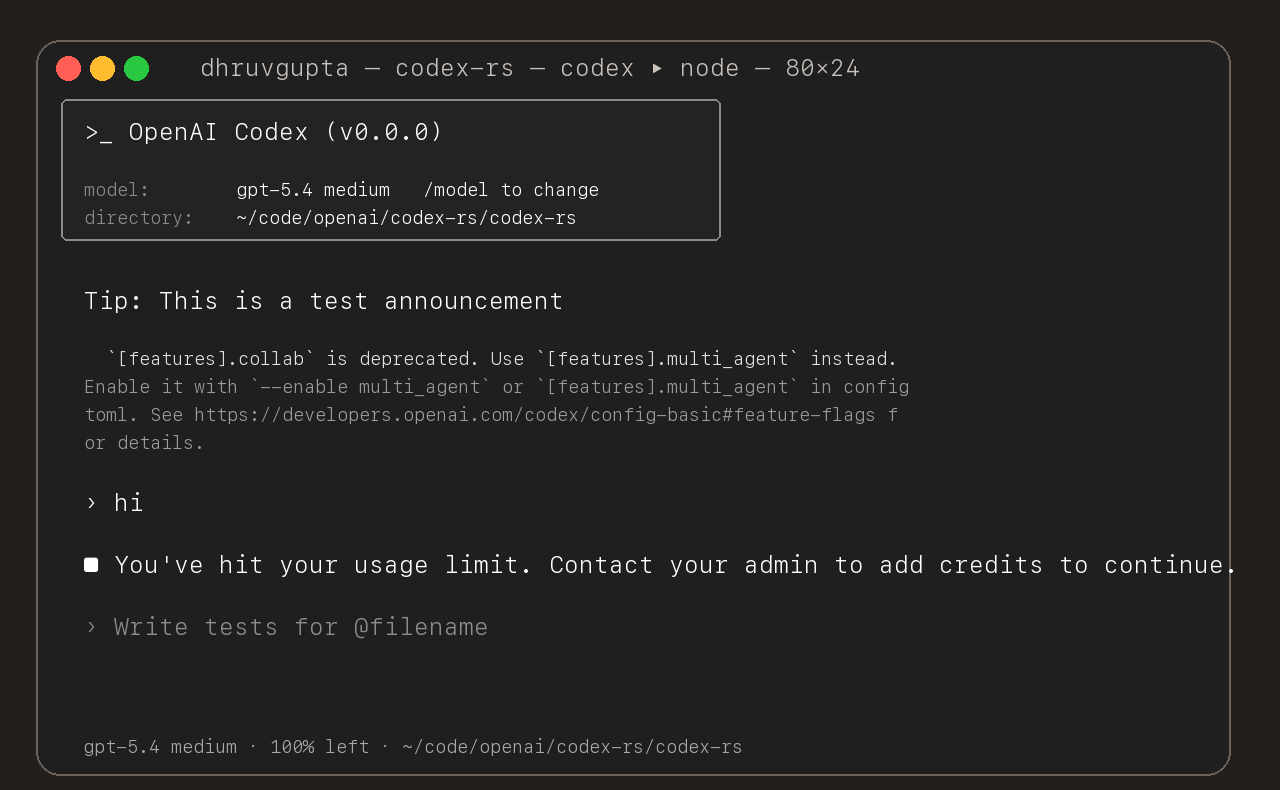
## Summary
- update the self-serve business usage-based limit message to direct
users to their admin for additional credits
- add a focused unit test for the self_serve_business_usage_based plan
branch
Added also:
If you are at a rate limit but you still have credits, codex cli would
tell you to switch the model. We shouldnt do this if you have credits so
fixed this.
## Test
- launched the source-built CLI and verified the updated message is
shown for the self-serve business usage-based plan
Enhance pty utils:
* Support closing stdin
* Separate stderr and stdout streams to allow consumers differentiate them
* Provide compatibility helper to merge both streams back into combined one
* Support specifying terminal size for pty, including on-demand resizes while process is already running
* Support terminating the process while still consuming its outputs
- override startup tooltips with model availability NUX and persist
per-model show counts in config
- stop showing each model after four exposures and fall back to normal
tooltips
## Problem

Codex’s TUI quit behavior has historically been easy to trigger
accidentally and hard to reason
about.

- `Ctrl+C`/`Ctrl+D` could terminate the UI immediately, which is a
common key to press while trying
  to dismiss a modal, cancel a command, or recover from a stuck state.
- “Quit” and “shutdown” were not consistently separated, so some exit
paths could bypass the
  shutdown/cleanup work that should run before the process terminates.

This PR makes quitting both safer (harder to do by accident) and more
uniform across quit
gestures, while keeping the shutdown-first semantics explicit.

## Mental model

After this change, the system treats quitting as a UI request that is
coordinated by the app
layer.

- The UI requests exit via `AppEvent::Exit(ExitMode)`.
- `ExitMode::ShutdownFirst` is the normal user path: the app triggers
`Op::Shutdown`, continues
rendering while shutdown runs, and only ends the UI loop once shutdown
has completed.
- `ExitMode::Immediate` exists as an escape hatch (and as the
post-shutdown “now actually exit”
signal); it bypasses cleanup and should not be the default for
user-triggered quits.

User-facing quit gestures are intentionally “two-step” for safety:

- `Ctrl+C` and `Ctrl+D` no longer exit immediately.
- The first press arms a 1-second window and shows a footer hint (“ctrl
+ <key> again to quit”).
- Pressing the same key again within the window requests a
shutdown-first quit; otherwise the
  hint expires and the next press starts a fresh window.

Key routing remains modal-first:

- A modal/popup gets first chance to consume `Ctrl+C`.
- If a modal handles `Ctrl+C`, any armed quit shortcut is cleared so
dismissing a modal cannot
  prime a subsequent `Ctrl+C` to quit.
- `Ctrl+D` only participates in quitting when the composer is empty and
no modal/popup is active.

The design doc `docs/exit-confirmation-prompt-design.md` captures the
intended routing and the
invariants the UI should maintain.

## Non-goals

- This does not attempt to redesign modal UX or make modals uniformly
dismissible via `Ctrl+C`.
It only ensures modals get priority and that quit arming does not leak
across modal handling.
- This does not introduce a persistent confirmation prompt/menu for
quitting; the goal is to keep
  the exit gesture lightweight and consistent.
- This does not change the semantics of core shutdown itself; it changes
how the UI requests and
  sequences it.

## Tradeoffs

- Quitting via `Ctrl+C`/`Ctrl+D` now requires a deliberate second
keypress, which adds friction for
  users who relied on the old “instant quit” behavior.
- The UI now maintains a small time-bounded state machine for the armed
shortcut, which increases
  complexity and introduces timing-dependent behavior.

This design was chosen over alternatives (a modal confirmation prompt or
a long-lived “are you
sure” state) because it provides an explicit safety barrier while
keeping the flow fast and
keyboard-native.

## Architecture

- `ChatWidget` owns the quit-shortcut state machine and decides when a
quit gesture is allowed
  (idle vs cancellable work, composer state, etc.).
- `BottomPane` owns rendering and local input routing for modals/popups.
It is responsible for
consuming cancellation keys when a view is active and for
showing/expiring the footer hint.
- `App` owns shutdown sequencing: translating
`AppEvent::Exit(ShutdownFirst)` into `Op::Shutdown`
  and only terminating the UI loop when exit is safe.

This keeps “what should happen” decisions (quit vs interrupt vs ignore)
in the chat/widget layer,
while keeping “how it looks and which view gets the key” in the
bottom-pane layer.

## Observability

You can tell this is working by running the TUIs and exercising the quit
gestures:

- While idle: pressing `Ctrl+C` (or `Ctrl+D` with an empty composer and
no modal) shows a footer
hint for ~1 second; pressing again within that window exits via
shutdown-first.
- While streaming/tools/review are active: `Ctrl+C` interrupts work
rather than quitting.
- With a modal/popup open: `Ctrl+C` dismisses/handles the modal (if it
chooses to) and does not
arm a quit shortcut; a subsequent quick `Ctrl+C` should not quit unless
the user re-arms it.

Failure modes are visible as:

- Quits that happen immediately (no hint window) from `Ctrl+C`/`Ctrl+D`.
- Quits that occur while a modal is open and consuming `Ctrl+C`.
- UI termination before shutdown completes (cleanup skipped).

## Tests

- Updated/added unit and snapshot coverage in `codex-tui` and
`codex-tui2` to validate:
  - The quit hint appears and expires on the expected key.
- Double-press within the window triggers a shutdown-first quit request.
- Modal-first routing prevents quit bypass and clears any armed shortcut
when a modal consumes
    `Ctrl+C`.

These tests focus on the UI-level invariants and rendered output; they
do not attempt to validate
real terminal key-repeat timing or end-to-end process shutdown behavior.

---
Screenshot:
<img width="912" height="740" alt="Screenshot 2026-01-13 at 1 05 28 PM"
src="https://github.com/user-attachments/assets/18f3d22e-2557-47f2-a369-ae7a9531f29f"
/>
When an invalid config.toml key or value is detected, the CLI currently
just quits. This leaves the VSCE in a dead state.

This PR changes the behavior to not quit and bubble up the config error
to users to make it actionable. It also surfaces errors related to
"rules" parsing.

This allows us to surface these errors to users in the VSCE, like this:

<img width="342" height="129" alt="Screenshot 2026-01-13 at 4 29 22 PM"
src="https://github.com/user-attachments/assets/a79ffbe7-7604-400c-a304-c5165b6eebc4"
/>

<img width="346" height="244" alt="Screenshot 2026-01-13 at 4 45 06 PM"
src="https://github.com/user-attachments/assets/de874f7c-16a2-4a95-8c6d-15f10482e67b"
/>
Adds an integration test for the new behavior introduced in
https://github.com/openai/codex/pull/9011. The work to create the test
setup was substantial enough that I thought it merited a separate PR.

This integration test spawns `codex` in TUI mode, which requires
spawning a PTY to run successfully, so I had to introduce quite a bit of
scaffolding in `run_codex_cli()`. I was surprised to discover that we
have not done this in our codebase before, so perhaps this should get
moved to a common location so it can be reused.

The test itself verifies that a malformed `rules` in `$CODEX_HOME`
prints a human-readable error message and exits nonzero.
We're running into quite a bit of drag maintaining this test, since
every time we add fields to an EventMsg that happened to be dumped into
the `binary-size-log.jsonl` fixture, this test starts to fail. The fix
is usually to either manually update the `binary-size-log.jsonl` fixture
file, or update the `upgrade_event_payload_for_tests` function to map
the data in that file into something workable.

Eason says it's fine to delete this test, so let's just delete it
## What?
Fixed error handling in `insert_history_lines_to_writer` where all
terminal operations were silently ignoring errors via `.ok()`.

  ## Why?
Silent I/O failures could leave the terminal in an inconsistent state
(e.g., scroll region not reset) with no way to debug. This violates Rust
error handling best practices.

  ## How?
  - Changed function signature to return `io::Result<()>`
  - Replaced all `.ok()` calls with `?` operator to propagate errors
- Added `tracing::warn!` in wrapper function for backward compatibility
  - Updated 15 test call sites to handle Result  with `.expect()`

  ## Testing
  - ✅ Pass all tests

  ## Type of Change
  - [x] Bug fix (non-breaking change)

---------

Signed-off-by: Huaiwu Li <lhwzds@gmail.com>
Co-authored-by: Eric Traut <etraut@openai.com>
This adds `parsed_cmd: Vec<ParsedCommand>` to `ExecApprovalRequestEvent`
in the core protocol (`protocol/src/protocol.rs`), which is also what
this field is named on `ExecCommandBeginEvent`. Honestly, I don't love
the name (it sounds like a single command, but it is actually a list of
them), but I don't want to get distracted by a naming discussion right
now.

This also adds `parsed_cmd` to `ExecCommandApprovalParams` in
`codex-rs/app-server-protocol/src/protocol.rs`, so it will be available
via `codex app-server`, as well.

For consistency, I also updated `ExecApprovalElicitRequestParams` in
`codex-rs/mcp-server/src/exec_approval.rs` to include this field under
the name `codex_parsed_cmd`, as that struct already has a number of
special `codex_*` fields. Note this is the code for when Codex is used
as an MCP _server_ and therefore has to conform to the official spec for
an MCP elicitation type.
`ClientRequest::NewConversation` picks up the reasoning level from the user's defaults in `config.toml`, so it should be reported in `NewConversationResponse`.
Adding the `rollout_path` to the `NewConversationResponse` makes it so a
client can perform subsequent operations on a `(ConversationId,
PathBuf)` pair. #3353 will introduce support for `ArchiveConversation`.

---
[//]: # (BEGIN SAPLING FOOTER)
Stack created with [Sapling](https://sapling-scm.com). Best reviewed
with [ReviewStack](https://reviewstack.dev/openai/codex/pull/3352).
* #3353
* __->__ #3352
this dramatically improves time to run `cargo test -p codex-core` (~25x
speedup).

before:
```
cargo test -p codex-core  35.96s user 68.63s system 19% cpu 8:49.80 total
```

after:
```
cargo test -p codex-core  5.51s user 8.16s system 63% cpu 21.407 total
```

both tests measured "hot", i.e. on a 2nd run with no filesystem changes,
to exclude compile times.

approach inspired by [Delete Cargo Integration
Tests](https://matklad.github.io/2021/02/27/delete-cargo-integration-tests.html),
we move all test cases in tests/ into a single suite in order to have a
single binary, as there is significant overhead for each test binary
executed, and because test execution is only parallelized with a single
binary.
We want to send an aggregated output of stderr and stdout so we don't
have to aggregate it stderr+stdout as we lose order sometimes.

---------

Co-authored-by: Gabriel Peal <gpeal@users.noreply.github.com>
Codex created this PR from the following prompt:

> upgrade this entire repo to Rust 1.89. Note that this requires
updating codex-rs/rust-toolchain.toml as well as the workflows in
.github/. Make sure that things are "clippy clean" as this change will
likely uncover new Clippy errors. `just fmt` and `cargo clippy --tests`
are sufficient to check for correctness

Note this modifies a lot of lines because it folds nested `if`
statements using `&&`.

---
[//]: # (BEGIN SAPLING FOOTER)
Stack created with [Sapling](https://sapling-scm.com). Best reviewed
with [ReviewStack](https://reviewstack.dev/openai/codex/pull/2465).
* #2467
* __->__ #2465
Wait for newlines, then render markdown on a line by line basis. Word wrap it for the current terminal size and then spit it out line by line into the UI. Also adds tests and fixes some UI regressions.
We wait until we have an entire newline, then format it with markdown and stream in to the UI. This reduces time to first token but is the right thing to do with our current rendering model IMO. Also lets us add word wrapping!
Stream models thoughts and responses instead of waiting for the whole
thing to come through. Very rough right now, but I'm making the risk call to push through.
As stated in `codex-rs/README.md`:

Today, Codex CLI is written in TypeScript and requires Node.js 22+ to
run it. For a number of users, this runtime requirement inhibits
adoption: they would be better served by a standalone executable. As
maintainers, we want Codex to run efficiently in a wide range of
environments with minimal overhead. We also want to take advantage of
operating system-specific APIs to provide better sandboxing, where
possible.

To that end, we are moving forward with a Rust implementation of Codex
CLI contained in this folder, which has the following benefits:

- The CLI compiles to small, standalone, platform-specific binaries.
- Can make direct, native calls to
[seccomp](https://man7.org/linux/man-pages/man2/seccomp.2.html) and
[landlock](https://man7.org/linux/man-pages/man7/landlock.7.html) in
order to support sandboxing on Linux.
- No runtime garbage collection, resulting in lower memory consumption
and better, more predictable performance.

Currently, the Rust implementation is materially behind the TypeScript
implementation in functionality, so continue to use the TypeScript
implmentation for the time being. We will publish native executables via
GitHub Releases as soon as we feel the Rust version is usable.

 pakrym-oaiandGitHub
 Eric TrautandGitHub
 jif-oaiandGitHub
 Felipe CouryandGitHub
 David de RegtandGitHub
 Michael BolinandGitHub


 Andrei EternalandGitHub
 dhruvgupta-oaiandGitHub
 Ruslan NigmatullinandGitHub
 Josh McKinneyandGitHub
 Owen LinandGitHub

 Jeremy RoseandGitHub
 Thibault SottiauxandGitHub

 easong-openaiandGitHub
