The workspace denies `clippy::expect_used` in production. Although
`clippy.toml` allows `expect` in tests, Bazel Clippy compiles
integration-test helper code in a way that does not receive that
exemption, which encouraged verbose `unwrap_or_else(... panic!(...))`
and equivalent `match`/`let else` forms.

This allows `clippy::expect_used` once at each integration-test crate
root (including aggregated suites and test-support libraries), then
replaces manual panic-based Result and Option unwraps with
`expect`/`expect_err`. Standalone `tests/*.rs` files remain their own
crate roots. Intentional assertion and unexpected-variant panics remain
unchanged, and the production `expect_used = "deny"` lint remains in
place.

The cleanup is mechanical and net-negative in line count.
## Why

Thread cwd and environment selections are a single logical setting in
core: updating one without the other can silently desynchronize the
next-turn execution context. This change makes that relationship
explicit in the internal thread settings flow while preserving the
existing app-server public API shape.

## What changed

- Moved the cwd/environment pair through internal
`ThreadSettingsOverrides.environment_settings` instead of a top-level
internal `cwd` field.
- Kept `thread/settings/update` public params unchanged, with app-server
translating top-level `cwd` into the paired internal settings shape.
- Moved `Op::UserInput` environment overrides into thread settings so
user turns and settings updates use the same core path.
- Updated core, app-server, MCP, memories, sample, and test callsites to
construct the paired settings shape.

## Verification

- `git diff --check`
- Local test run starting after PR creation.
## Why

Thread settings cwd overrides are expected to be resolved before they
enter core. Keeping this boundary as a plain `PathBuf` made it easy for
core/session code to keep fallback normalization and relative-path
resolution logic in places that should only receive an already-resolved
cwd.

This is intentionally the absolute-cwd-only slice: it does not change
environment selection stickiness or cwd-to-default-environment fallback
behavior.

## What changed

- Changes `ThreadSettingsOverrides.cwd`,
`CodexThreadSettingsOverrides.cwd`, and `SessionSettingsUpdate.cwd` to
use `AbsolutePathBuf`.
- Removes core-side cwd normalization/resolution from session settings
updates.
- Updates affected core/app-server test helpers and callsites to pass
existing absolute cwd values or use `abs()` helpers.

## Validation

Opening as draft so CI can start while local validation continues.
## Summary

Adds experimental `additionalContext` support to `turn/start` and
`turn/steer` so clients can provide ephemeral external context, such as
browser or automation state, without turning that plumbing into a
visible user prompt or triggering user-prompt lifecycle behavior.

## API Shape

The parameter shape is:

```ts
additionalContext?: Record<string, {
  value: string
  kind: "untrusted" | "application"
}> | null
```

Example:

```json
{
  "additionalContext": {
    "browser_info": {
      "value": "Active tab is CI failures.",
      "kind": "untrusted"
    },
    "automation_info": {
      "value": "CI rerun is in progress.",
      "kind": "application"
    }
  }
}
```

The keys are opaque and caller-defined.

## Context Injection

When provided, accepted entries are inserted into model context as
hidden contextual message items, not as visible thread user-message
items.

`kind: "untrusted"` entries are inserted with role `user`:

```text
<external_${key}>${value}</external_${key}>
```

`kind: "application"` entries are inserted with role `developer`:

```text
<${key}>${value}</${key}>
```

Values are not escaped. Each value is truncated to 1k approximate tokens
before wrapping.

For `turn/start`, accepted additional context is inserted before normal
user input. For `turn/steer`, additional context is merged only when the
steer includes non-empty user input; context-only steers still reject as
empty input.

## Dedupe Strategy

`AdditionalContextStore` lives on session state and stores the latest
complete additional-context map.

Each `turn/start` or non-empty `turn/steer` treats its
`additionalContext` as the current complete set of values. Entries are
injected only when the key is new or the exact entry for that key
changed, including `value` or `kind`. After merging, the store is
replaced with the provided map, so omitted keys are removed from the
retained set and can be injected again later if reintroduced.

Omitting `additionalContext`, passing `null`, or passing an empty object
resets the store to empty and injects nothing.

## What Changed

- Threads experimental v2 `additionalContext` through app-server into
core turn start and steer handling.
- Adds separate contextual fragment types for untrusted user-role
context and application developer-role context.
- Uses pending response input items so additional context can be
combined with normal user input without treating it as prompt text.
- Adds integration coverage for start/steer flow, role routing,
dedupe/reset behavior, deletion/re-add behavior, hook-blocked input
behavior, empty context-only steer rejection, external-fragment marker
matching, and truncation.
## Summary
Removes the feature since this is effectively on by default in all cases
where we should use it, or can be configured via models.json.

## Testing
- [x] unit tests pass
## Summary
- Migrate another batch of direct `Op::UserTurn` test construction from
legacy `SandboxPolicy` values to `PermissionProfile` inputs via
`turn_permission_fields()`.
- Replace a one-off read-only `SandboxPolicy` bridge in the macOS exec
test with `PermissionProfile::read_only()`.
- Reduce `SandboxPolicy` references in `codex-rs/core/tests` from 32
files at the start of the cleanup stack to 27 files.

## Testing
- `cargo check -p codex-core --tests`
- `just fmt`
- `just fix -p codex-core`
## Why

Per-turn permission overrides should use the same canonical profile
abstraction as session configuration. That lets TUI submissions preserve
exact configured permissions without round-tripping through legacy
sandbox fields.

## What changed

This adds `permission_profile` to user-turn operations, threads it
through TUI/app-server submission paths, fills the new field in existing
test fixtures, and adds coverage that composer submission includes the
configured profile.

## Verification

- `cargo test -p codex-tui permissions -- --nocapture`
- `cargo test -p codex-core --test all permissions_messages --
--nocapture`


---
[//]: # (BEGIN SAPLING FOOTER)
Stack created with [Sapling](https://sapling-scm.com). Best reviewed
with [ReviewStack](https://reviewstack.dev/openai/codex/pull/18285).
* #18288
* #18287
* #18286
* __->__ #18285
## Summary
- add experimental turn/start.environments params for per-turn
environment id + cwd selections
- pass selections through core protocol ops and resolve them with
EnvironmentManager before TurnContext creation
- treat omitted selections as default behavior, empty selections as no
environment, and non-empty selections as first environment/cwd as the
turn primary

## Testing
- ran `just fmt`
- ran `just write-app-server-schema`
- not run: unit tests for this stacked PR

---------

Co-authored-by: Codex <noreply@openai.com>
## Summary
- route apply_patch runtime execution through the selected Environment
filesystem instead of the local self-exec path
- keep the standalone apply_patch command surface intact while restoring
its launcher/test/docs contract
- add focused apply_patch filesystem sandbox regression coverage

## Validation
- remote devbox Bazel run in progress
- passed: //codex-rs/apply-patch:apply-patch-unit-tests
--test_filter=test_read_file_utf8_with_context_reports_invalid_utf8
- in progress / follow-up: focused core and exec Bazel test slices on
dev

## Follow-up under review
- remote pre-verification and approval/retry behavior still need
explicit scrutiny for delete/update flows
- runtime sandbox-denial classification may need a tighter assertion
path than rendered stderr matching

---------

Co-authored-by: Codex <noreply@openai.com>
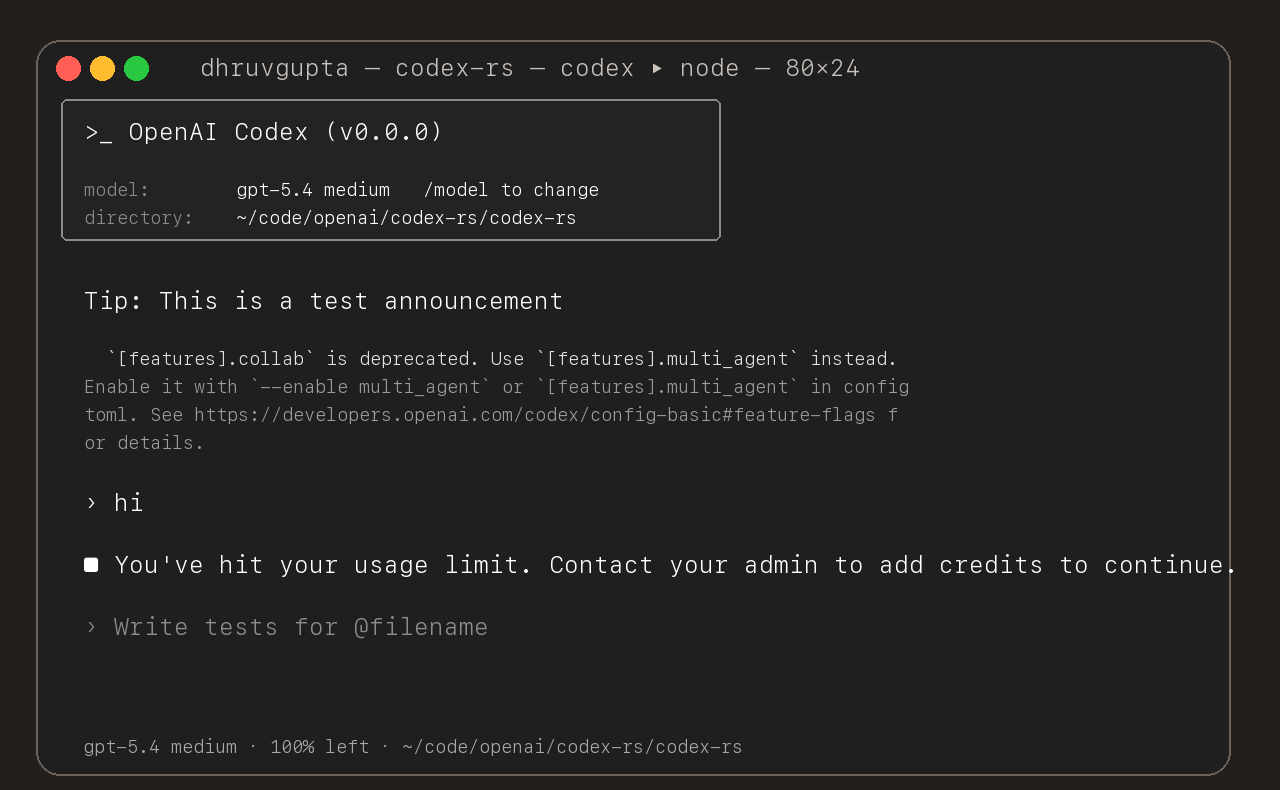
## Summary
- update the self-serve business usage-based limit message to direct
users to their admin for additional credits
- add a focused unit test for the self_serve_business_usage_based plan
branch
Added also:
If you are at a rate limit but you still have credits, codex cli would
tell you to switch the model. We shouldnt do this if you have credits so
fixed this.
## Test
- launched the source-built CLI and verified the updated message is
shown for the self-serve business usage-based plan
## Summary
- add `ForkSnapshotMode` to `ThreadManager::fork_thread` so callers can
request either a committed snapshot or an interrupted snapshot
- share the model-visible `<turn_aborted>` history marker between the
live interrupt path and interrupted forks
- update the small set of direct fork callsites to pass
`ForkSnapshotMode::Committed`

Note: this enables /btw to work similarly as Esc to interrupt (hopefully
somewhat in distribution)

---------

Co-authored-by: Codex <noreply@openai.com>
## Summary
Adds support for approvals_reviewer to `Op::UserTurn` so we can migrate
`[CodexMessageProcessor::turn_start]` to use Op::UserTurn

## Testing
- [x] Adds quick test for the new field

Co-authored-by: Codex <noreply@openai.com>
- Split the feature system into a new `codex-features` crate.
- Cut `codex-core` and workspace consumers over to the new config and
warning APIs.

Co-authored-by: Ahmed Ibrahim <219906144+aibrahim-oai@users.noreply.github.com>
Co-authored-by: Codex <noreply@openai.com>
## Why

Enterprises can already constrain approvals, sandboxing, and web search
through `requirements.toml` and MDM, but feature flags were still only
configurable as managed defaults. That meant an enterprise could suggest
feature values, but it could not actually pin them.

This change closes that gap and makes enterprise feature requirements
behave like the other constrained settings. The effective feature set
now stays consistent with enterprise requirements during config load,
when config writes are validated, and when runtime code mutates feature
flags later in the session.

It also tightens the runtime API for managed features. `ManagedFeatures`
now follows the same constraint-oriented shape as `Constrained<T>`
instead of exposing panic-prone mutation helpers, and production code
can no longer construct it through an unconstrained `From<Features>`
path.

The PR also hardens the `compact_resume_fork` integration coverage on
Windows. After the feature-management changes,
`compact_resume_after_second_compaction_preserves_history` was
overflowing the libtest/Tokio thread stacks on Windows, so the test now
uses an explicit larger-stack harness as a pragmatic mitigation. That
may not be the ideal root-cause fix, and it merits a parallel
investigation into whether part of the async future chain should be
boxed to reduce stack pressure instead.

## What Changed

Enterprises can now pin feature values in `requirements.toml` with the
requirements-side `features` table:

```toml
[features]
personality = true
unified_exec = false
```

Only canonical feature keys are allowed in the requirements `features`
table; omitted keys remain unconstrained.

- Added a requirements-side pinned feature map to
`ConfigRequirementsToml`, threaded it through source-preserving
requirements merge and normalization in `codex-config`, and made the
TOML surface use `[features]` (while still accepting legacy
`[feature_requirements]` for compatibility).
- Exposed `featureRequirements` from `configRequirements/read`,
regenerated the JSON/TypeScript schema artifacts, and updated the
app-server README.
- Wrapped the effective feature set in `ManagedFeatures`, backed by
`ConstrainedWithSource<Features>`, and changed its API to mirror
`Constrained<T>`: `can_set(...)`, `set(...) -> ConstraintResult<()>`,
and result-returning `enable` / `disable` / `set_enabled` helpers.
- Removed the legacy-usage and bulk-map passthroughs from
`ManagedFeatures`; callers that need those behaviors now mutate a plain
`Features` value and reapply it through `set(...)`, so the constrained
wrapper remains the enforcement boundary.
- Removed the production loophole for constructing unconstrained
`ManagedFeatures`. Non-test code now creates it through the configured
feature-loading path, and `impl From<Features> for ManagedFeatures` is
restricted to `#[cfg(test)]`.
- Rejected legacy feature aliases in enterprise feature requirements,
and return a load error when a pinned combination cannot survive
dependency normalization.
- Validated config writes against enterprise feature requirements before
persisting changes, including explicit conflicting writes and
profile-specific feature states that normalize into invalid
combinations.
- Updated runtime and TUI feature-toggle paths to use the constrained
setter API and to persist or apply the effective post-constraint value
rather than the requested value.
- Updated the `core_test_support` Bazel target to include the bundled
core model-catalog fixtures in its runtime data, so helper code that
resolves `core/models.json` through runfiles works in remote Bazel test
environments.
- Renamed the core config test coverage to emphasize that effective
feature values are normalized at runtime, while conflicting persisted
config writes are rejected.
- Ran `compact_resume_after_second_compaction_preserves_history` inside
an explicit 8 MiB test thread and Tokio runtime worker stack, following
the existing larger-stack integration-test pattern, to keep the Windows
`compact_resume_fork` test slice from aborting while a parallel
investigation continues into whether some of the underlying async
futures should be boxed.

## Verification

- `cargo test -p codex-config`
- `cargo test -p codex-core feature_requirements_ -- --nocapture`
- `cargo test -p codex-core
load_requirements_toml_produces_expected_constraints -- --nocapture`
- `cargo test -p codex-core
compact_resume_after_second_compaction_preserves_history -- --nocapture`
- `cargo test -p codex-core compact_resume_fork -- --nocapture`
- Re-ran the built `codex-core` `tests/all` binary with
`RUST_MIN_STACK=262144` for
`compact_resume_after_second_compaction_preserves_history` to confirm
the explicit-stack harness fixes the deterministic low-stack repro.
- `cargo test -p codex-core`
- This still fails locally in unrelated integration areas that expect
the `codex` / `test_stdio_server` binaries or hit existing `search_tool`
wiremock mismatches.

## Docs

`developers.openai.com/codex` should document the requirements-side
`[features]` table for enterprise and MDM-managed configuration,
including that it only accepts canonical feature keys and that
conflicting config writes are rejected.
- add a local Fast mode setting in codex-core (similar to how model id
is currently stored on disk locally)
- send `service_tier=priority` on requests when Fast is enabled
- add `/fast` in the TUI and persist it locally
- feature flag
Summary is a required parameter on UserTurn. Ideally we'd like the core
to decide the appropriate summary level.

Make the summary optional and don't send it when not needed.
## Why

`codex-rs/core/src/lib.rs` re-exported a broad set of types and modules
from `codex-protocol` and `codex-shell-command`. That made it easy for
workspace crates to import those APIs through `codex-core`, which in
turn hides dependency edges and makes it harder to reduce compile-time
coupling over time.

This change removes those public re-exports so call sites must import
from the source crates directly. Even when a crate still depends on
`codex-core` today, this makes dependency boundaries explicit and
unblocks future work to drop `codex-core` dependencies where possible.

## What Changed

- Removed public re-exports from `codex-rs/core/src/lib.rs` for:
- `codex_protocol::protocol` and related protocol/model types (including
`InitialHistory`)
  - `codex_protocol::config_types` (`protocol_config_types`)
- `codex_shell_command::{bash, is_dangerous_command, is_safe_command,
parse_command, powershell}`
- Migrated workspace Rust call sites to import directly from:
  - `codex_protocol::protocol`
  - `codex_protocol::config_types`
  - `codex_protocol::models`
  - `codex_shell_command`
- Added explicit `Cargo.toml` dependencies (`codex-protocol` /
`codex-shell-command`) in crates that now import those crates directly.
- Kept `codex-core` internal modules compiling by using `pub(crate)`
aliases in `core/src/lib.rs` (internal-only, not part of the public
API).
- Updated the two utility crates that can already drop a `codex-core`
dependency edge entirely:
  - `codex-utils-approval-presets`
  - `codex-utils-cli`

## Verification

- `cargo test -p codex-utils-approval-presets`
- `cargo test -p codex-utils-cli`
- `cargo check --workspace --all-targets`
- `just clippy`
## Summary

Implements a configurable MCP OAuth callback URL override for `codex mcp
login` and app-server OAuth login flows, including support for non-local
callback endpoints (for example, devbox ingress URLs).

## What changed

- Added new config key: `mcp_oauth_callback_url` in
`~/.codex/config.toml`.
- OAuth authorization now uses `mcp_oauth_callback_url` as
`redirect_uri` when set.
- Callback handling validates the callback path against the configured
redirect URI path.
- Listener bind behavior is now host-aware:
- local callback URL hosts (`localhost`, `127.0.0.1`, `::1`) bind to
`127.0.0.1`
  - non-local callback URL hosts bind to `0.0.0.0`
- `mcp_oauth_callback_port` remains supported and is used for the
listener port.
- Wired through:
  - CLI MCP login flow
  - App-server MCP OAuth login flow
  - Skill dependency OAuth login flow
- Updated config schema and config tests.

## Why

Some environments need OAuth callbacks to land on a specific reachable
URL (for example ingress in remote devboxes), not loopback. This change
allows that while preserving local defaults for existing users.

## Backward compatibility

- No behavior change when `mcp_oauth_callback_url` is unset.
- Existing `mcp_oauth_callback_port` behavior remains intact.
- Local callback flows continue binding to loopback by default.

## Testing

- `cargo test -p codex-rmcp-client callback -- --nocapture`
- `cargo test -p codex-core --lib mcp_oauth_callback -- --nocapture`
- `cargo check -p codex-cli -p codex-app-server -p codex-rmcp-client`

## Example config

```toml
mcp_oauth_callback_port = 5555
mcp_oauth_callback_url = "https://<devbox>-<namespace>.gateway.<cluster>.internal.api.openai.org/callback"
## Summary
Support updating Personality mid-Thread via UserTurn/OverwriteTurn. This
is explicitly unused by the clients so far, to simplify PRs - app-server
and tui implementations will be follow-ups.

## Testing
- [x] added integration tests
1. Remove PUBLIC skills and introduce SYSTEM skills embedded in the
binary and installed into $CODEX_HOME/skills/.system at startup.
2. Skills are now always enabled (feature flag removed).
3. Update skills/list to accept forceReload and plumb it through (not
used by clients yet).
The problem is that the `tokio` task own an `Arc` reference of the
session and that this task only exit with the broadcast channel get
closed. But this never get closed if the session is not dropped. So it's
a snake biting his tail basically

The most notable result was that non of the `Drop` implementation were
triggered (temporary files, shell snapshots, session cleaning etc etc)
when closing the session (through a `/new` for example)

The fix is just to weaken the `Arc` and upgrade it on the fly
pakrym-oai ·
Eric Traut ·
Dylan Hurd ·
Michael Bolin ·
starr-openai ·
dhruvgupta-oai ·
Charley Cunningham ·
Ahmed Ibrahim ·
pash-openai ·
daveaitel-openai ·
dkumar-oai ·
jif-oai ·
xl-openai ·
