## Why

Topology-neutral app-server integration tests should exercise automatic
environment selection so the same setup covers local and remote
executors.

## What

Migrate eligible tests to `TestAppServer::new_with_auto_env()` and
`send_thread_start_request_with_auto_env()`. Leave explicit-topology
tests unchanged, and skip the request-permissions case on Windows with a
TODO for cross-platform tool routing.

## Validation

- `just test -p codex-app-server`
- `bazel test //codex-rs/app-server:app-server-all-wine-exec-test
--test_output=errors`

Stacked on #29788.
This PR brought to you via VS Code rather than Codex...

- opened `codex-rs/app-server/tests/common/mcp_process.rs`
- put the cursor on `McpServer`
- hit `F2` and renamed the symbol to `TestAppServer`
- went to the file tree
- hit enter and renamed `mcp_process.rs` to `test_app_server.rs`
- ran **Save All Files** from the Command Palette
- ran `just fmt`

The End

(Admittedly, most of the local variables for `TestAppServer` are still
named `mcp`, though.)
## Summary

Adds an optional `clientId` field to app-server v2 `UserInput` and
carries it through the core `UserInput` model so clients can correlate
echoed user input items without relying on payload equality.

## Details

- Adds `client_id: Option<String>` to core `UserInput` variants.
- Exposes the v2 app-server field as `clientId` on the wire and in
generated TypeScript.
- Preserves the id when converting between app-server v2 and core
protocol types.
- Regenerates app-server schema fixtures.

## Validation

- `just fmt`
- `just write-app-server-schema`
- `cargo test -p codex-app-server-protocol`
- `cargo test -p codex-protocol`
- `just fix -p codex-app-server-protocol`
- `just fix -p codex-protocol`
- `git diff --check`
## Summary
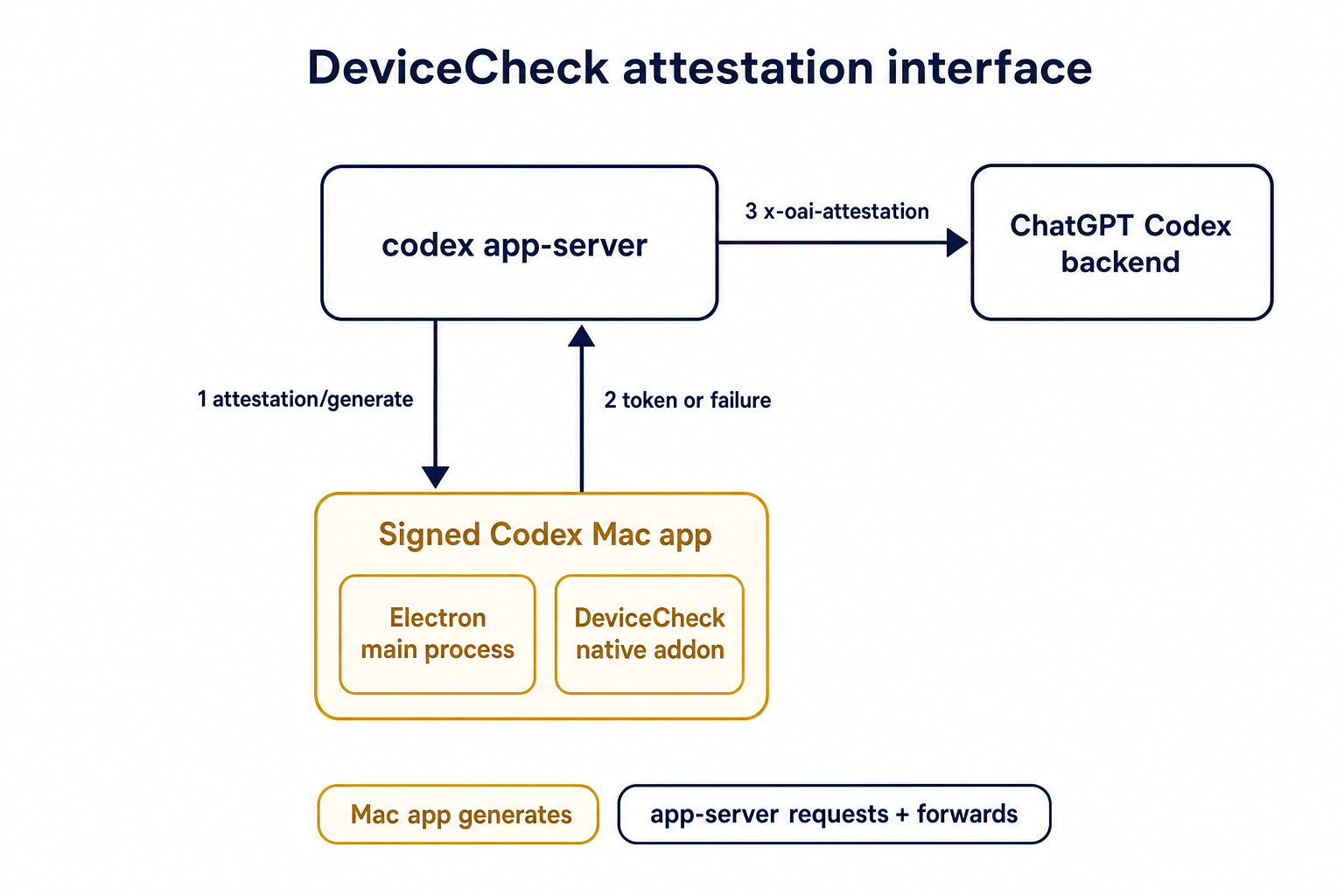
TL;DR: teaches `codex-rs` / app-server to request a desktop-provided
attestation token and attach it as `x-oai-attestation` on the scoped
ChatGPT Codex request paths.
## Details
This PR teaches the Codex app-server runtime how to request and attach
an attestation token. It does not generate DeviceCheck tokens directly;
instead, it relies on the connected desktop app to advertise that it can
generate attestation and then asks that app for a fresh header value
when needed.
The flow is:
1. The Codex desktop app connects to app-server.
2. During `initialize`, the app can advertise that it supports
`requestAttestation`.
3. Before app-server calls selected ChatGPT Codex endpoints, it sends
the internal server request `attestation/generate` to the app.
4. app-server receives a pre-encoded header value back.
5. app-server forwards that value as `x-oai-attestation` on the scoped
outbound requests.
The code in this repo is mostly protocol and runtime plumbing: it adds
the app-server request/response shape, introduces an attestation
provider in core, wires that provider into Responses / compaction /
realtime setup paths, and covers the intended scoping with tests. The
signed macOS DeviceCheck generation remains owned by the desktop app PR.
## Related PR
- Codex desktop app implementation:
https://github.com/openai/openai/pull/878649
## Validation
<details>
<summary>Tests run</summary>
```sh
cargo test -p codex-app-server-protocol
cargo test -p codex-core attestation --lib
cargo test -p codex-app-server --lib attestation
```
Also ran:
```sh
just fix -p codex-core
just fix -p codex-app-server
just fix -p codex-app-server-protocol
just fmt
just write-app-server-schema
```
</details>
<details>
<summary>E2E DeviceCheck validation</summary>
First validated the signed desktop app boundary directly: launched a
packaged signed `Codex.app`, sent `attestation/generate`, decoded the
returned `v1.` attestation header, and validated the extracted
DeviceCheck token with `personal/jm/verify_devicecheck_token.py` using
bundle ID `com.openai.codex`. Apple returned `status_code: 200` and
`is_ok: true`.
Then ran the fuller app + app-server flow. The packaged `Codex.app`
launched a current-branch app-server via `CODEX_CLI_PATH`, and a local
MITM proxy intercepted outbound `chatgpt.com` traffic. The app-server
requested `attestation/generate` from the real Electron app process, and
the intercepted `/backend-api/codex/responses` traffic included
`x-oai-attestation` on both routes:
```text
GET /backend-api/codex/responses Upgrade: websocket x-oai-attestation: present
POST /backend-api/codex/responses Upgrade: none x-oai-attestation: present
```
The captured header decoded to a DeviceCheck token that also validated
with Apple for `com.openai.codex` (`status_code: 200`, `is_ok: true`,
team `2DC432GLL2`).
</details>
---------
Co-authored-by: Codex <noreply@openai.com>
Motivation
- Today, a newly connected client has no direct way to determine the
current runtime status of threads from read/list responses alone.
- This forces clients to infer state from transient events, which can
lead to stale or inconsistent UI when reconnecting or attaching late.

Changes
- Add `status` to `thread/read` responses.
- Add `statuses` to `thread/list` responses.
- Emit `thread/status/changed` notifications with `threadId` and the new
status.
- Track runtime status for all loaded threads and default unknown
threads to `idle`.
- Update protocol/docs/tests/schema fixtures for the revised API.

Testing
- Validated protocol API changes with automated protocol tests and
regenerated schema/type fixtures.
- Validated app-server behavior with unit and integration test suites,
including status transitions and notifications.
Adam Perry @ OpenAI ·
Gabriel Peal ·
Michael Bolin ·
Alexi Christakis ·
Jiaming Zhang ·
Ruslan Nigmatullin ·
