mirror of
https://github.com/pchuan98/codex.git
synced 2026-07-01 00:31:56 +08:00
dev
87 Commits
-
[app-server] expose environment info RPC (#30291)
## Why App-server clients that configure named execution environments need to discover an environment's shell and working directory before selecting it for a thread or turn. Because the environment can run on a different operating system than app-server, its working directory is represented as a canonical `file:` URI rather than a host-local path string. The probe also needs a bounded response time: an exec-server that completes initialization but never answers `environment/info` must not hold the environment serialization queue indefinitely. ## What changed - Add an experimental `environment/info` app-server RPC for named environments. - Route the probe through the managed environment connection and return target-native shell metadata plus the default working directory as a `PathUri`. - Return connection and protocol failures as JSON-RPC errors. - Bound the exec-server probe response to 30 seconds and remove timed-out calls from the pending-request table so later environment mutations can proceed. - Cover successful responses, omitted working directories, unknown environments, connection failures, and pending-call cleanup. ## Protocol examples Request: ```json { "id": 42, "method": "environment/info", "params": { "environmentId": "remote-a" } } ``` Successful response: ```json { "id": 42, "result": { "shell": { "name": "zsh", "path": "/bin/zsh" }, "cwd": "file:///workspace" } } ``` If the exec-server initializes but does not answer the probe within 30 seconds: ```json { "id": 42, "error": { "code": -32603, "message": "failed to get info for environment `remote-a`: exec-server protocol error: timed out waiting for exec-server `environment/info` response after 30s" } } ``` ## Testing - App-server integration coverage for successful info (including omitted `cwd`), unknown environments, and connection failures. - Exec-server RPC coverage verifying a timed-out call is removed from the pending-request table. --------- Co-authored-by: Michael Bolin <mbolin@openai.com>Max Johnson ·
2026-06-27 19:34:10 +00:00 -
Test selected capabilities across availability and resume (#30157)
## Why This stack crosses World State, executor skills, selected plugin metadata, MCP processes, connectors, dynamic environments, and resume. This PR adds two end-to-end scenarios that validate those pieces together. Both tests enable `deferred_executor`, so they exercise the real delayed-environment path. ## Scenario 1: availability across turns and resume ```text 1. Start a thread with one selected plugin root bound to E1. 2. E1 is unavailable. - executor skill is absent - selected MCP is absent - connector has no selected-plugin attribution 3. Start E1 and register the same stable environment ID. 4. Start a new turn. - the executor skill appears through World State - its body beats a colliding host skill - the selected MCP tool is advertised and executes inside E1 - the connector is attributed to the selected plugin 5. Start another turn without changing E1. - the MCP PID stays the same, proving runtime reuse 6. Restart app-server and resume the thread. - durable selected-root intent is restored - skills, MCP, and connector attribution are restored - a new MCP PID proves ephemeral process state was rebuilt ``` ## Scenario 2: availability changes inside one turn ```text 1. Start a turn while E1 is unavailable. 2. The first model sample sees no executor skill, MCP, or selected connector. 3. The turn pauses on request_user_input. 4. Start E1 and register it while that same turn is still active. 5. Continue the turn. 6. The very next model sample sees: - the executor skill catalog - the selected MCP tool - selected-plugin connector attribution 7. The model calls the MCP, and its output proves execution happened inside E1. ``` This second scenario specifically protects the aeon-style behavior: capability state is captured again for every sampling step, not only at the next user turn. ## Scope These are integration tests only. They do not add a combinatorial matrix for unsupported plugin-file mutation, environment generations, transport disconnects, or delayed `required = true` executor MCPs.
jif ·
2026-06-26 03:11:55 +01:00 -
test: add app-server auto environment helper (#29746)
## Why Start moving towards app-server tests defaulting to running against remote & foreign OS executors. To do so we need a point of indirection similar to core integration tests' `build_with_auto_env`, but with the flexibility of letting tests control environment registration if they need to. ## What This adds: - `TestAppServer::new_with_auto_env()` for constructing an app server with a default environment defined by the test runner (e.g. bazel) - `TestAppServer::auto_env_params()` for tests to easily acquire turn env params tailored to the automatic environment - `TestAppServer::send_thread_start_request_with_auto_env()` to make it easy for tests to start a thread using the automatic environment The above methods all fail if the test calling them has set up an environment where the automatic environment configuration conflicts with test-created state. ## Validation Adds a couple of basic smoke tests to the app-server test suite. Follow-ups will migrate more tests to use it.
Adam Perry @ OpenAI ·
2026-06-24 01:06:29 +00:00 -
[codex] reject remote images at app-server ingress (#29419)
## Stack Stacked on #29417. Review and land that PR first. ## Summary - reject HTTP(S) image URLs in the handlers for `turn/start` and `turn/steer` - validate `thread/inject_items` after its existing JSON-to-`ResponseItem` conversion, so each item is deserialized once - turn invalid dynamic-tool image responses into the existing unsuccessful text fallback; the model receives the validation message as the function output - leave `thread/resume.history` compatible with legacy history; #29417 replaces remote images before model input - continue accepting inline data URLs and `localImage` inputs - keep this policy in app-server; this PR does not add a shared protocol API or change core image preparation ## Test plan - `just test -p codex-app-server -E 'test(/request_handlers_reject_remote_image_urls|dynamic_tool_remote_image_response_becomes_model_visible_error|dynamic_tool_call_round_trip_sends_content_items_to_model|turn_start_tracks_turn_event_analytics|standalone_image_edit_uses_recent_pathless_image/)'` (5 passed) - `just fix -p codex-app-server` - `just fmt`
rka-oai ·
2026-06-23 00:43:56 +00:00 -
[3/3] app-server: configure environment connection timeout (#29025)
## Why Remote environments registered through `environment/add` currently use the fixed 10-second WebSocket connection timeout. Slow-starting executors need a caller-selected connection window, but this should not add retry policy or couple exec-server behavior to Core’s `deferred_executor` feature. Make the timeout an optional part of the existing experimental request. Existing clients continue using the current default, while callers that know an executor may take longer can request a larger window explicitly. Depends on #28683. ## What changed - Add optional `connectTimeoutMs` to `EnvironmentAddParams` and document it in the app-server README. - Pass the optional timeout through `EnvironmentRequestProcessor` into one `EnvironmentManager::upsert_environment()` path; the manager applies the existing default when it is omitted. - Preserve the existing single-attempt lifecycle. The configured value controls WebSocket connection and handshake time for both initial connection and later reconnects; initialization retains its separate timeout. - Add an app-server integration test that sends the real JSON-RPC request and verifies a stalled handshake observes the requested timeout. ## Test plan - `just test -p codex-app-server-protocol` - `just test -p codex-exec-server` - `just test -p codex-app-server environment_add_applies_connect_timeout` ## Rollout This is additive and does not enable `deferred_executor`. Callers should send a non-default timeout only after a compatible app-server is deployed; omitted or `null` values retain the existing 10-second default.
sayan-oai ·
2026-06-19 05:27:45 +00:00 -
Add app-server current-time impl (varlatency 3/n) (#28835)
## What Server should request: ``` { "id": 42, "method": "currentTime/read", "params": { "threadId": "11111111-1111-1111-1111-aaaaafdc2c11" } } ``` Client should respond with something like: ```rust { "id": 42, "result": { "currentTimeAt": 1781717655 } } ``` ## Why Sessions configured with `clock_source = "external"` need a thread-specific external time source before inference. The system clock remains the default production provider. ## Validation - `cargo test -p codex-app-server-protocol` - `cargo test -p codex-app-server --test all current_time_read_round_trip_adds_reminder_to_model_input` - `cargo test -p codex-app-server first_attestation_capable_connection_for_thread_only_uses_thread_subscribers` - `cargo test -p codex-analytics` - `just fix -p codex-app-server-protocol` - `just fix -p codex-app-server` Stacked on #28824.rka-oai ·
2026-06-18 13:12:11 -07:00 -
[codex] [3/4] Activate endpoint plugin recommendations (#27704)
Summary\n- Await endpoint recommendation selection while constructing each authenticated turn, removing the first-turn cache race.\n- Snapshot and filter endpoint candidates once per turn, then use that same set for the bounded contextual user fragment, tool exposure, and exact install validation.\n- Keep recommendation selection ephemeral: do not persist recommendation state in or gate resumed threads on prior context.\n- Hide the legacy list tool in endpoint mode and preserve legacy discovery unchanged when the endpoint is disabled or unavailable.\n- Keep remote plugin and connector app identities out of model-visible context and attach them only to Codex-owned elicitation metadata.\n\nStack\n- 3/4, based on #28400.\n- Endpoint client and cache: #28399.\n- Generalized suggestion presentation: #28400.\n- Install-schema follow-up: #28403.\n\nValidation\n- \n- \n- \n- \n- Full : 2,649 passed and 88 environment-dependent tests failed because this sandbox cannot write , nest Seatbelt, or locate auxiliary test binaries.
Alex Daley ·
2026-06-16 23:04:07 +00:00 -
[codex] Add interruptible sleep tool (#28429)
## Why Models sometimes need to pause briefly while waiting for external work, but using a shell command for that delay ties the wait to a process and does not naturally resume when new turn input arrives. ## What changed - add a built-in `sleep` tool behind the under-development `sleep_tool` feature - accept a bounded `duration_ms` argument, matching the millisecond convention used by unified exec - end the sleep early when either steered user input or mailbox input arrives - include elapsed wall-clock time in completed and interrupted outputs - emit a dedicated core `SleepItem` through `item/started` and `item/completed` - expose the sleep item as app-server v2 `ThreadItem::Sleep` and retain it in reconstructed thread history - regenerate the configuration schema for the new feature flag - regenerate app-server JSON and TypeScript schema fixtures ## Test plan - `just test -p codex-core sleep_tool_follows_feature_gate` - `just test -p codex-core any_new_input_interrupts_sleep` - `just test -p codex-app-server-protocol` - `just test -p codex-app-server sleep_emits_started_and_completed_items`
pakrym-oai ·
2026-06-15 21:39:21 -07:00 -
feat(app-server): expose rate-limit reset credits (#28143)
## Why Codex users can earn personal rate-limit reset credits, but app-server clients do not currently have an API for reading or redeeming them. This adds the backend and protocol foundation used by the `/usage` TUI flow in #28154. ## What changed - Extend `account/rateLimits/read` with a nullable `rateLimitResetCredits` summary sourced from the existing usage response. - Add backend-client and app-server support for consuming a reset with a caller-generated idempotency key. A UUID is recommended, and clients reuse the same key when retrying the same logical reset. - Return only the consume `outcome`; clients refetch `account/rateLimits/read` for updated window state. - Document the response field and each consume outcome, and regenerate the JSON and TypeScript schema fixtures. - Clarify in `AGENTS.md` that new app-server string enum values use camelCase on the wire. - Update the existing TUI response fixture for the expanded protocol shape. - Add coverage for authentication, response mapping, backend failures, consume outcomes, and request timeout behavior. ## Validation - `just test -p codex-app-server-protocol` — 231 passed. - `just test -p codex-backend-client` — 14 passed. - Focused `codex-app-server` reset-credit tests — 5 passed. - Focused `codex-tui` protocol response fixture test — passed. - `just fix -p codex-backend-client -p codex-app-server-protocol -p codex-app-server` — passed. - `just fmt` — passed.
jay ·
2026-06-15 21:54:01 +00:00 -
Activate selected executor plugin MCPs in app-server (#27893)
## Why #27870 teaches the MCP extension how to discover stdio MCP servers declared by a selected executor plugin, but app-server does not yet install that contributor or initialize its per-thread state. As a result, `thread/start.selectedCapabilityRoots` can select the plugin while its MCP servers remain inactive. This PR closes that app-server wiring gap: ```text thread/start(selectedCapabilityRoots) -> initialize the thread's selected-plugin MCP snapshot -> read the selected plugin's .mcp.json through its environment -> start declared stdio servers in that environment -> expose their tools only on the selected thread ``` ## What changed - Install the selected-executor-plugin MCP contributor in app-server using the existing shared `EnvironmentManager`. - Initialize its frozen thread snapshot when `thread/start` includes selected capability roots. - Document that selected plugin stdio MCPs are activated in their owning environment. - Add an app-server E2E covering the complete selection-to-tool-call path. The E2E verifies that: - the selected MCP process receives an executor-only environment value, proving the tool runs through the selected environment; - the MCP tool is advertised to the model and can be called; - a normal MCP config reload does not discard the thread's frozen selected-plugin registration; - another thread without the selected root does not see the MCP server. ## Scope - Existing sessions without `selectedCapabilityRoots` are unchanged. - Only stdio MCP declarations are activated. HTTP declarations remain inactive. - This does not change selected-root persistence across resume/fork or add hosted-plugin behavior. ## Verification - Focused app-server E2E: `selected_executor_plugin_exposes_its_stdio_mcp_only_to_that_thread` ## Stack Stacked on #27870.
jif ·
2026-06-15 16:23:37 +02:00 -
Add app-server
thread/deleteAPI (#25018)## Why Clients can archive and unarchive threads today, but there is no app-server API for permanently removing a thread. Deletion also needs to cover the full session tree: deleting a main thread should remove spawned subagent threads and the related local metadata instead of leaving orphaned rollout files, goals, or subagent state behind. ## What - Adds the v2 `thread/delete` request and `thread/deleted` notification, with the response shape kept consistent with `thread/archive`. - Implements local hard delete for active and archived rollout files. - Deletes the requested thread's state DB row as the commit point, then best-effort cleans associated state including spawned descendants, goals, spawn edges, logs, dynamic tools, and agent job assignments. - Updates app-server API docs and generated protocol schema/TypeScript fixtures.
Eric Traut ·
2026-06-10 11:22:12 -07:00 -
Load selected executor skills through extensions (#27184)
## Why CCA is moving toward a split runtime where the orchestrator may not have a filesystem, while executors can expose preinstalled plugins and skills. A thread therefore needs to select capabilities without asking app-server or core to interpret executor-owned paths through the orchestrator's filesystem. The longer-term model is broader than executor skills: - A plugin is a bundle of skills, MCP servers, connectors/apps, and hooks. - A plugin root can be local, executor-owned, or hosted by a backend. - Components inside one plugin can use different access and execution mechanisms. A skill may be read from a filesystem or through backend tools; an HTTP MCP server can run without an executor; a stdio MCP server or hook needs an execution environment. - Core should carry generic extension initialization data. The extension that owns a component should discover it, expose it to the model, and invoke it through the appropriate runtime. This PR establishes that architecture through one complete vertical: selecting a root on an executor, discovering the skills beneath it, exposing those skills to the model, and reading an explicitly invoked `SKILL.md` through the same executor. ## Contract `thread/start` gains an experimental `selectedCapabilityRoots` field: ```json { "selectedCapabilityRoots": [ { "id": "deploy-plugin@1", "location": { "type": "environment", "environmentId": "workspace", "path": "/opt/codex/plugins/deploy" } } ] } ``` The root is intentionally not classified as a "plugin" or "skill" in the API. It can point at a standalone skill, a directory containing several skills, or a plugin containing skills and other components. This PR only teaches the skills extension how to consume it; later extensions can resolve MCP, connector, and hook components from the same selection. The platform-supplied `id` is stable selection identity. The location says which runtime owns the root and gives that runtime an opaque path. App-server does not inspect or canonicalize the path. ## What changed ### Generic thread extension initialization App-server converts selected roots into `ExtensionDataInit`. Core carries that generic initialization value until the final thread ID is known, then creates thread-scoped `ExtensionData` before lifecycle contributors run. This keeps `Session` and core independent of the capability-selection contract. The initialization value is consumed during construction; it is not retained as another long-lived `Session` field. ### Executor-backed skills The skills extension now owns an `ExecutorSkillProvider` that: - resolves the selected environment through `EnvironmentManager` - discovers, canonicalizes, and reads skills through that environment's `ExecutorFileSystem` - contributes the bounded selected-skill catalog as stable developer context - reads an explicitly invoked skill body through the authority that listed it - warns when an environment or root is unavailable - never falls back to the orchestrator filesystem for an executor-owned root Skill catalog and instruction fragments have hard byte bounds, which also bound them below the 10K-token per-item context limit. If a selected executor skill has the same name as a legacy local skill, the executor selection owns that invocation and the local body is not injected a second time. Existing local and bundled skill loading remains in place. Omitting `selectedCapabilityRoots` therefore preserves current local-only behavior. ## Current semantics - Only environment-owned locations are represented in this first contract. - Roots are resolved by the destination extension, not by app-server or core. - An unavailable executor or invalid root produces a warning and no capabilities from that root; it does not trigger a local-filesystem fallback. - Selection applies to a newly started active thread. - MCP servers, connectors, and hooks beneath a selected plugin root are not activated yet. - Selection is not yet persisted or inherited across resume, fork, or subagent creation. Existing local capabilities continue to behave as they do today in those flows. ## Planned vertical follow-ups 1. **Hosted HTTP MCP:** add an extension-backed HTTP MCP source that works without an executor, then replace the special-purpose MCP plugins loader with that implementation. 2. **Executor MCP:** register and execute stdio MCP servers through the environment that owns the selected plugin root. 3. **Backend skills:** add a hosted skill source whose catalog and bodies are accessed through extension tools rather than a filesystem. 4. **Connectors and hooks:** activate those components through their owning extensions, using the same selected-root boundary and component-specific runtime. 5. **Durable selection:** define the desired-selection lifecycle, persist it, and make resume, fork, and subagent inheritance explicit rather than accidental. 6. **Local convergence:** incrementally route existing local plugin, skill, and MCP loading through the same extension model while preserving current local behavior. Each follow-up remains reviewable as an end-to-end capability. The platform selects roots, generic thread extension data carries the selection, and the owning extension resolves and operates its component. ## Verification Coverage added for: - app-server end-to-end discovery and explicit invocation of a skill inside an executor-selected plugin root - exclusive invocation when a selected executor skill collides with a local skill name - executor filesystem authority for discovery, canonicalization, and reads - thread extension initialization before lifecycle contributors run - stable executor catalog context, explicit invocation, context rebuilding, hidden skills, and preserved host/remote catalog behavior Targeted protocol, core-skills, skills-extension, core lifecycle, and app-server executor-skill tests were run during development.jif ·
2026-06-09 19:51:54 +02:00 -
Expose standalone image generation in code mode (#25923)
## Why Standalone image generation remained top-level-only in code-mode sessions. ## What changed - Change imagegen exposure from `DirectModelOnly` to `Direct`. - Keep direct-mode access while enabling nested code-mode access. - Add a focused regression test for the exposure contract. ## Validation - `just test -p codex-image-generation-extension`
Won Park ·
2026-06-02 22:27:52 +00:00 -
Route standalone image generation through host finalization md (#25176)
## Why Standalone image-generation extensions emitted turn items through the low-level event path, bypassing host-owned finalization such as image persistence and contributor processing. At the same time, the generated-image save-path hint must remain visible to the model through the extension tool's `FunctionCallOutput`, rather than the legacy built-in developer-message path. ## What changed - Extended `ExtensionTurnItem` to support image-generation items while keeping the extension-facing emitter API limited to `emit_started` and `emit_completed`. - Routed extension completion through core `finalize_turn_item`, so standalone image-generation items receive host-owned processing and persisted `saved_path` values before publication. - Kept legacy built-in image generation on its existing developer-message hint path, while standalone image generation returns its deterministic saved-path hint in `FunctionCallOutput`. - Shared the image artifact path and output-hint formatting used by core and the image-generation extension. - Passed thread identity through extension tool calls so standalone image generation can construct the same intended artifact path as core. - Added an app-server integration test covering real standalone image generation, saved artifact publication, model-visible output hint wiring, and absence of the legacy developer-message hint. ## Validation - `just fmt` - `just test -p codex-image-generation-extension` - `just test -p codex-web-search-extension` - `just test -p codex-goal-extension` - `just test -p codex-memories-extension` - Targeted `codex-core` tests for image save history, extension completion finalization, and contributor execution - `just test -p codex-app-server standalone_image_generation_returns_saved_path_hint_to_model` - `just fix -p codex-core` - `just fix -p codex-image-generation-extension` - `just bazel-lock-update` - `just bazel-lock-check`
Won Park ·
2026-06-02 12:00:04 -07:00 -
standalone websearch extension (#23823)
## Summary Add the extension-backed standalone `web.run` tool so Codex can call the standalone search endpoint through the `codex-api` search client and return its encrypted output to Responses. - gate the new tool behind `standalone_web_search` - install the extension in the app-server thread registry and hide hosted `web_search` when standalone search is enabled for OpenAI providers so the two paths stay mutually exclusive - build search context from persisted history using a small tail heuristic: previous user message, assistant text between the last two user turns capped at about 1k tokens, and current user message ## Test Plan - `cargo test -p codex-web-search-extension` - `cargo test -p codex-api` - `cargo test -p codex-core hosted_tools_follow_provider_auth_model_and_config_gates`
sayan-oai ·
2026-05-26 11:12:24 -07:00 -
Add thread/settings/update app-server API (#23502)
## Why App-server clients need a way to update a thread's next-turn settings without starting a turn, adding transcript content, or waiting for turn lifecycle events. This gives settings UI a direct path for durable thread settings while clients observe the eventual effective state through a notification. This is a simplified rework of PR https://github.com/openai/codex/pull/22509. In particular, it changes the `thread/settings/update` api to return immediately rather than waiting and returning the effective (updated) thread settings. This makes the new api consistent with `turn/start` and greatly reduces the complexity of the implementation relative to the earlier attempt. ## What Changed - Adds experimental `thread/settings/update` with partial-update request fields and an empty acknowledgment response. - Adds experimental `thread/settings/updated`, carrying full effective `ThreadSettings` and scoped by `threadId` to subscribed clients for the affected thread. - Shares durable settings validation with `turn/start`, including `sandboxPolicy` plus `permissions` rejection and `serviceTier: null` clearing. - Emits the same settings notification when `turn/start` overrides change the stored effective thread settings. - Regenerates app-server protocol schema fixtures and updates `app-server/README.md`.
Eric Traut ·
2026-05-20 11:03:20 -07:00 -
feat: add permission profile list api (#23412)
## Why Clients need a typed permission-profile catalog instead of reconstructing that state from config internals. ## What changed - Added `permissionProfile/list` to the app-server v2 protocol with cursor pagination and optional `cwd`. - The list response includes built-in permission profiles plus config-defined `[permissions.<id>]` profiles from the effective config for the request context. - Permission profiles keep optional `description` metadata for display purposes. - App-server docs and schema fixtures are updated for the new RPC.
viyatb-oai ·
2026-05-20 02:42:56 +00:00 -
enable/disable remote control at runtime, not via features (#22578)
## Why reapplies https://github.com/openai/codex/pull/22386 which was previously reverted Also, introduce `remoteControl/enable` and `remoteControl/disable` app-server APIs to toggle on/off remote control at runtime for a given running app-server instance. ## What Changed - Adds experimental v2 RPCs: - `remoteControl/enable` - `remoteControl/disable` - Adds `RemoteControlRequestProcessor` and routes the new RPCs through it instead of `ConfigRequestProcessor`. - Adds named `RemoteControlHandle::enable`, `disable`, and `status` methods. - Makes `remoteControl/enable` return an error when sqlite state DB is unavailable, while keeping enrollment/websocket failures as async status updates. - Adds `AppServerRuntimeOptions.remote_control_enabled` and hidden `--remote-control` flags for `codex app-server` and `codex-app-server`. - Updates managed daemon startup to use `codex app-server --remote-control --listen unix://`. - Marks `Feature::RemoteControl` as removed and ignores `[features].remote_control`. - Updates app-server README entries for the new remote-control methods.
Owen Lin ·
2026-05-14 01:07:46 +00:00 -
[codex] request desktop attestation from app (#20619)
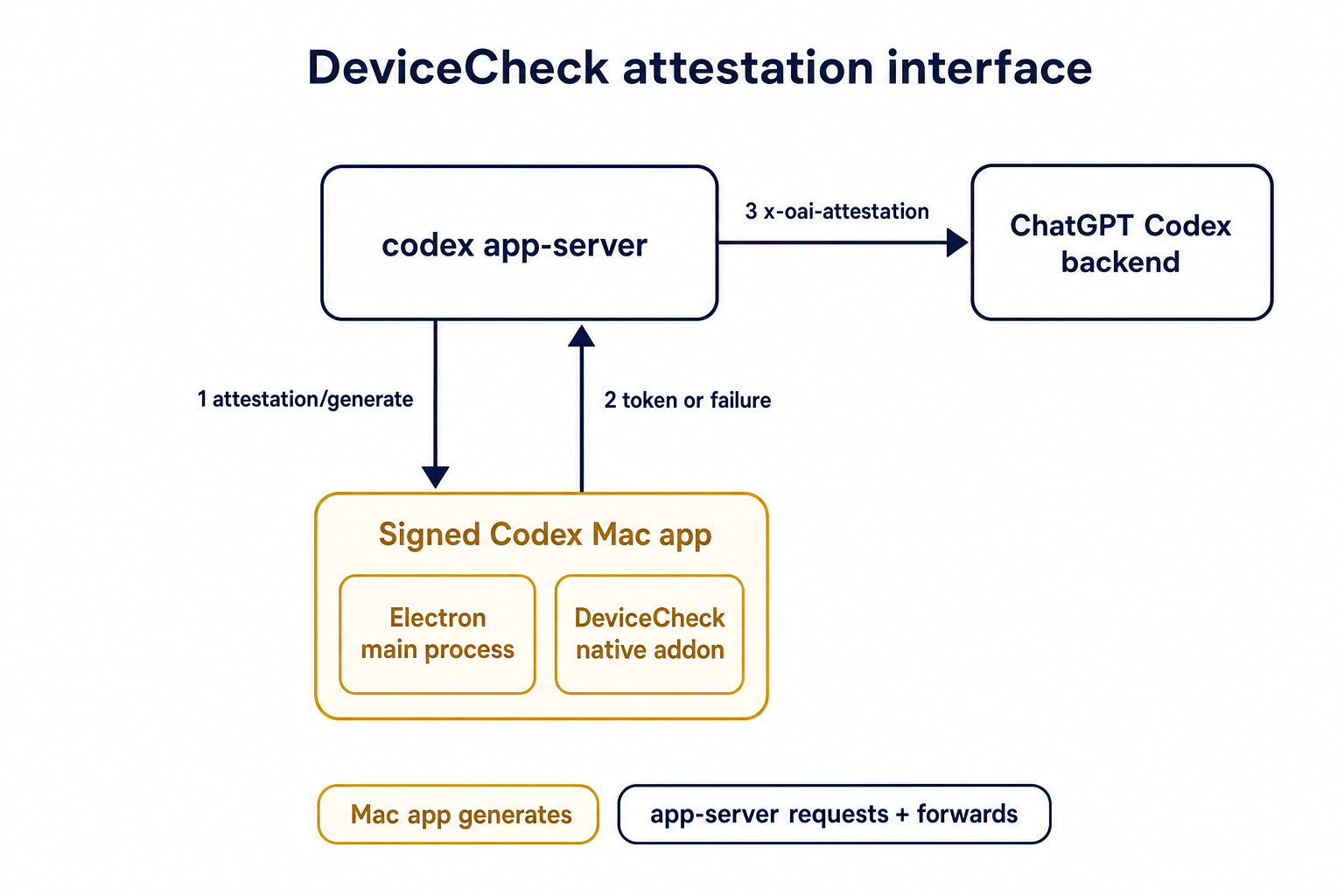
## Summary TL;DR: teaches `codex-rs` / app-server to request a desktop-provided attestation token and attach it as `x-oai-attestation` on the scoped ChatGPT Codex request paths.  ## Details This PR teaches the Codex app-server runtime how to request and attach an attestation token. It does not generate DeviceCheck tokens directly; instead, it relies on the connected desktop app to advertise that it can generate attestation and then asks that app for a fresh header value when needed. The flow is: 1. The Codex desktop app connects to app-server. 2. During `initialize`, the app can advertise that it supports `requestAttestation`. 3. Before app-server calls selected ChatGPT Codex endpoints, it sends the internal server request `attestation/generate` to the app. 4. app-server receives a pre-encoded header value back. 5. app-server forwards that value as `x-oai-attestation` on the scoped outbound requests. The code in this repo is mostly protocol and runtime plumbing: it adds the app-server request/response shape, introduces an attestation provider in core, wires that provider into Responses / compaction / realtime setup paths, and covers the intended scoping with tests. The signed macOS DeviceCheck generation remains owned by the desktop app PR. ## Related PR - Codex desktop app implementation: https://github.com/openai/openai/pull/878649 ## Validation <details> <summary>Tests run</summary> ```sh cargo test -p codex-app-server-protocol cargo test -p codex-core attestation --lib cargo test -p codex-app-server --lib attestation ``` Also ran: ```sh just fix -p codex-core just fix -p codex-app-server just fix -p codex-app-server-protocol just fmt just write-app-server-schema ``` </details> <details> <summary>E2E DeviceCheck validation</summary> First validated the signed desktop app boundary directly: launched a packaged signed `Codex.app`, sent `attestation/generate`, decoded the returned `v1.` attestation header, and validated the extracted DeviceCheck token with `personal/jm/verify_devicecheck_token.py` using bundle ID `com.openai.codex`. Apple returned `status_code: 200` and `is_ok: true`. Then ran the fuller app + app-server flow. The packaged `Codex.app` launched a current-branch app-server via `CODEX_CLI_PATH`, and a local MITM proxy intercepted outbound `chatgpt.com` traffic. The app-server requested `attestation/generate` from the real Electron app process, and the intercepted `/backend-api/codex/responses` traffic included `x-oai-attestation` on both routes: ```text GET /backend-api/codex/responses Upgrade: websocket x-oai-attestation: present POST /backend-api/codex/responses Upgrade: none x-oai-attestation: present ``` The captured header decoded to a DeviceCheck token that also validated with Apple for `com.openai.codex` (`status_code: 200`, `is_ok: true`, team `2DC432GLL2`). </details> --------- Co-authored-by: Codex <noreply@openai.com>
Jiaming Zhang ·
2026-05-08 12:36:02 -07:00 -
Ruslan Nigmatullin ·
2026-05-07 09:01:44 -07:00 -
[codex] Add unsandboxed process exec API (#19040)
## Why App-server clients sometimes need argv-based local process execution while sandbox policy is controlled outside Codex. Those environments can reject sandbox-disabling paths before a command ever starts, even when the caller intentionally wants unsandboxed execution. This PR adds a distinct `process/*` API for that use case instead of extending `command/exec` with another sandbox-disabling shape. Keeping the new surface separate also makes the future removal of `command/exec` simpler: clients that need explicit process lifecycle control can move to the newer handle-based API without depending on `command/exec` business logic. ## What changed - Added v2 process lifecycle methods: `process/spawn`, `process/writeStdin`, `process/resizePty`, and `process/kill`. - Added process notifications: `process/outputDelta` for streamed stdout/stderr chunks and `process/exited` for final exit status and buffered output. - Made `process/spawn` intentionally unsandboxed and omitted sandbox-selection fields such as `sandboxPolicy` and `permissionProfile`. - Added client-supplied, connection-scoped `processHandle` values for follow-up control requests and notification routing. - Supported cwd, environment overrides, PTY mode and size, stdin streaming, stdout/stderr streaming, per-stream output caps, and timeout controls. - Killed active process sessions when the originating app-server connection closes. - Wired the implementation through the modular `request_processors/` app-server layout, with process-handle request serialization for follow-up control calls. - Updated generated JSON/TypeScript schema fixtures and documented the new API in `codex-rs/app-server/README.md`. - Added v2 app-server integration coverage in `codex-rs/app-server/tests/suite/v2/process_exec.rs` for spawn acknowledgement before exit, buffered output caps, and process termination. ## Verification - `cargo test -p codex-app-server-protocol` - `cargo test -p codex-app-server` --------- Co-authored-by: Owen Lin <owen@openai.com>
Ruslan Nigmatullin ·
2026-05-04 16:43:58 -07:00 -
feat: Add workspace plugin sharing APIs (#20278)
1. Adds v2 plugin/share/save, plugin/share/list, and plugin/share/delete RPCs. 2. Implements save by archiving a local plugin root, enforcing a size limit, uploading through the workspace upload flow, and supporting updates via remotePluginId. 3. Lists created workspace plugins 4. Deletes a previously uploaded/shared plugin.
xl-openai ·
2026-04-29 23:49:20 -07:00 -
Add hooks/list app-server RPC (#19778)
## Why We need a way to list the available hooks to expose via the TUI and App so users can view and manage their hooks ## What - Adds `hooks/list` for one or more `cwd` values that returns discovered hook metadata ## Stack 1. openai/codex#19705 2. This PR - openai/codex#19778 3. openai/codex#19840 4. openai/codex#19882 ## Review Notes The generated schema files account for most of the raw diff, these files have the core change: - `hooks/src/engine/discovery.rs` builds the inventory entries during hook discovery while leaving runtime handlers focused on execution. - `app-server/src/codex_message_processor.rs` wires `hooks/list` into the app-server flow for each requested `cwd`. - `app-server-protocol/src/protocol/v2.rs` defines the new v2 request/response payloads exposed on the wire. ### Core Changes `core/src/plugins/manager.rs` adds `plugins_for_layer_stack(...)` so `skills/list` and `hooks/list`can resolve plugin state for each requested `cwd` --------- Co-authored-by: Codex <noreply@openai.com>
Abhinav ·
2026-04-29 23:39:57 +00:00 -
feat: expose provider capability bounds to app server clients (#20049)
follow up of #19442. The app server now exposes provider-derived bounds through a new v2 `modelProvider/read` method. The response reports the configured provider map key as `modelProvider` and returns the effective capability booleans so clients can align their UI with the same provider-owned limits used by core.
Celia Chen ·
2026-04-29 01:36:19 +00:00 -
[codex] add non-local thread store regression harness (#19266)
- Add an integration test that guarantees nothing gets written to codex home dir or sqlite when running a rollout with a non-local ThreadStore - Add an in-memory "spy" ThreadStore for tests like this Note I could not find a good way to also ensure there were no filesystem _reads_ that didn't go through threadstore. I explored a more elaborate sandboxed-subprocess approach but it isn't platform portable and felt like it wasn't (yet) worth it.
Tom ·
2026-04-24 15:45:44 -07:00 -
Add app-server marketplace upgrade RPC (#19074)
## Summary - add a v2 `marketplace/upgrade` app-server RPC that mirrors the existing configured Git marketplace upgrade path - expose typed request/response/error payloads and regenerate JSON/TypeScript schema fixtures - add app-server integration coverage for all, named, already up-to-date, and invalid marketplace upgrade requests ## Tests - `just write-app-server-schema` - `cargo test -p codex-app-server-protocol` - `cargo test -p codex-app-server marketplace_upgrade` - `just fix -p codex-app-server-protocol` - `just fix -p codex-app-server` - `just fmt`
xli-oai ·
2026-04-23 13:00:46 -07:00 -
app-server: implement device key v2 methods (#18430)
## Why The device-key protocol needs an app-server implementation that keeps local key operations behind the same request-processing boundary as other v2 APIs. app-server owns request dispatch, transport policy, documentation, and JSON-RPC error shaping. `codex-device-key` owns key binding, validation, platform provider selection, and signing mechanics. Keeping the adapter thin makes the boundary easier to review and avoids moving local key-management details into thread orchestration code. ## What changed - Added `DeviceKeyApi` as the app-server adapter around `DeviceKeyStore`. - Converted protocol protection policies, payload variants, algorithms, and protection classes to and from the device-key crate types. - Encoded SPKI public keys and DER signatures as base64 protocol fields. - Routed `device/key/create`, `device/key/public`, and `device/key/sign` through `MessageProcessor`. - Rejected remote transports before provider access while allowing local `stdio` and in-process callers to reach the device-key API. - Added stdio, in-process, and websocket tests for device-key validation and transport policy. - Documented the device-key methods in the app-server v2 method list. ## Test coverage - `device_key_create_rejects_empty_account_user_id` - `in_process_allows_device_key_requests_to_reach_device_key_api` - `device_key_methods_are_rejected_over_websocket` ## Stack This is PR 3 of 4 in the device-key app-server stack. It is stacked on #18429. ## Validation - `cargo test -p codex-app-server device_key` - `just fix -p codex-app-server`
Ruslan Nigmatullin ·
2026-04-21 14:07:08 -07:00 -
[codex] Add marketplace/remove app-server RPC (#17751)
## Summary Add a new app-server `marketplace/remove` RPC on top of the shared marketplace-remove implementation. This change: - adds `MarketplaceRemoveParams` / `MarketplaceRemoveResponse` to the app-server protocol - wires the new request through `codex_message_processor` - reuses the shared core marketplace-remove flow from the stacked refactor PR - updates generated schema files and adds focused app-server coverage ## Validation - `just write-app-server-schema` - `just fmt` - heavy compile/test coverage deferred to GitHub CI per request
xli-oai ·
2026-04-19 23:22:49 -07:00 -
Sync local plugin imports, async remote imports, refresh caches after… (#18246)
… import ## Why `externalAgentConfig/import` used to spawn plugin imports in the background and return immediately. That meant local marketplace imports could still be in flight when the caller refreshed plugin state, so newly imported plugins would not show up right away. This change makes local marketplace imports complete before the RPC returns, while keeping remote marketplace imports asynchronous so we do not block on remote fetches. ## What changed - split plugin migration details into local and remote marketplace imports based on the external config source - import local marketplaces synchronously during `externalAgentConfig/import` - return pending remote plugin imports to the app-server so it can finish them in the background - clear the plugin and skills caches before responding to plugin imports, and again after background remote imports complete, so the next `plugin/list` reloads fresh state - keep marketplace source parsing encapsulated behind `is_local_marketplace_source(...)` instead of re-exporting the internal enum - add core and app-server coverage for the synchronous local import path and the pending remote import path ## Verification - `cargo test -p codex-app-server-protocol` - `cargo test -p codex-core` (currently fails an existing unrelated test: `config_loader::tests::cli_override_can_update_project_local_mcp_server_when_project_is_trusted`) - `cargo test` (currently fails existing `codex-app-server` integration tests in MCP/skills/thread-start areas, plus the unrelated `codex-core` failure above)
alexsong-oai ·
2026-04-17 09:34:55 +00:00 -
jif-oai ·
2026-04-15 10:35:06 +01:00 -
[codex] Refactor marketplace add into shared core flow (#17717)
## Summary Move `codex marketplace add` onto a shared core implementation so the CLI and app-server path can use one source of truth. This change: - adds shared marketplace-add orchestration in `codex-core` - switches the CLI command to call that shared implementation - removes duplicated CLI-only marketplace add helpers - preserves focused parser and add-path coverage while moving the shared behavior into core tests ## Why The new `marketplace/add` RPC should reuse the same underlying marketplace-add flow as the CLI. This refactor lands that consolidation first so the follow-up app-server PR can be mostly protocol and handler wiring. ## Validation - `cargo test -p codex-core marketplace_add` - `cargo test -p codex-cli marketplace_cmd` - `just fix -p codex-core` - `just fix -p codex-cli` - `just fmt`
xli-oai ·
2026-04-13 20:37:11 -07:00 -
Add turn item injection API (#17703)
## Summary - Add `turn/inject_items` app-server v2 request support for appending raw Responses API items to a loaded thread history without starting a turn. - Generate JSON schema and TypeScript protocol artifacts for the new params and empty response. - Document the new endpoint and include a request/response example. - Preserve compatibility with the typo alias `turn/injet_items` while returning the canonical method name. ## Testing - Not run (not requested)
pakrym-oai ·
2026-04-13 16:11:05 -07:00 -
jif-oai ·
2026-04-13 18:29:49 +01:00 -
[mcp] Support MCP Apps part 3 - Add mcp tool call support. (#17364)
- [x] Add a new app-server method so that MCP Apps can call their own MCP server directly.
Matthew Zeng ·
2026-04-11 04:39:19 +00:00 -
Revert "Option to Notify Workspace Owner When Usage Limit is Reached" (#17391)
Reverts openai/codex#16969 #sev3-2026-04-10-accountscheckversion-500s-for-openai-workspace-7300
Shijie Rao ·
2026-04-10 23:33:13 +00:00 -
Option to Notify Workspace Owner When Usage Limit is Reached (#16969)
## Summary - Replace the manual `/notify-owner` flow with an inline confirmation prompt when a usage-based workspace member hits a credits-depleted limit. - Fetch the current workspace role from the live ChatGPT `accounts/check/v4-2023-04-27` endpoint so owner/member behavior matches the desktop and web clients. - Keep owner, member, and spend-cap messaging distinct so we only offer the owner nudge when the workspace is actually out of credits. ## What Changed - `backend-client` - Added a typed fetch for the current account role from `accounts/check`. - Mapped backend role values into a Rust workspace-role enum. - `app-server` and protocol - Added `workspaceRole` to `account/read` and `account/updated`. - Derived `isWorkspaceOwner` from the live role, with a fallback to the cached token claim when the role fetch is unavailable. - `tui` - Removed the explicit `/notify-owner` slash command. - When a member is blocked because the workspace is out of credits, the error now prompts: - `Your workspace is out of credits. Request more from your workspace owner? [y/N]` - Choosing `y` sends the existing owner-notification request. - Choosing `n`, pressing `Esc`, or accepting the default selection dismisses the prompt without sending anything. - Selection popups now honor explicit item shortcuts, which is how the `y` / `n` interaction is wired. ## Reviewer Notes - The main behavior change is scoped to usage-based workspace members whose workspace credits are depleted. - Spend-cap reached should not show the owner-notification prompt. - Owners and admins should continue to see `/usage` guidance instead of the member prompt. - The live role fetch is best-effort; if it fails, we fall back to the existing token-derived ownership signal. ## Testing - Manual verification - Workspace owner does not see the member prompt. - Workspace member with depleted credits sees the confirmation prompt and can send the nudge with `y`. - Workspace member with spend cap reached does not see the owner-notification prompt. ### Workspace member out of usage https://github.com/user-attachments/assets/341ac396-eff4-4a7f-bf0c-60660becbea1 ### Workspace owner <img width="1728" height="1086" alt="Screenshot 2026-04-09 at 11 48 22 AM" src="https://github.com/user-attachments/assets/06262a45-e3fc-4cc4-8326-1cbedad46ed6" />
richardopenai ·
2026-04-09 21:15:17 -07:00 -
Forward app-server turn clientMetadata to Responses (#16009)
## Summary App-server v2 already receives turn-scoped `clientMetadata`, but the Rust app-server was dropping it before the outbound Responses request. This change keeps the fix lightweight by threading that metadata through the existing turn-metadata path rather than inventing a new transport. ## What we're trying to do and why We want turn-scoped metadata from the app-server protocol layer, especially fields like Hermes/GAAS run IDs, to survive all the way to the actual Responses API request so it is visible in downstream websocket request logging and analytics. The specific bug was: - app-server protocol uses camelCase `clientMetadata` - Responses transport already has an existing turn metadata carrier: `x-codex-turn-metadata` - websocket transport already rewrites that header into `request.request_body.client_metadata["x-codex-turn-metadata"]` - but the Rust app-server never parsed or stored `clientMetadata`, so nothing from the app-server request was making it into that existing path This PR fixes that without adding a new header or a second metadata channel. ## How we did it ### Protocol surface - Add optional `clientMetadata` to v2 `TurnStartParams` and `TurnSteerParams` - Regenerate the JSON schema / TypeScript fixtures - Update app-server docs to describe the field and its behavior ### Runtime plumbing - Add a dedicated core op for app-server user input carrying turn-scoped metadata: `Op::UserInputWithClientMetadata` - Wire `turn/start` and `turn/steer` through that op / signature path instead of dropping the metadata at the message-processor boundary - Store the metadata in `TurnMetadataState` ### Transport behavior - Reuse the existing serialized `x-codex-turn-metadata` payload - Merge the new app-server `clientMetadata` into that JSON additively - Do **not** replace built-in reserved fields already present in the turn metadata payload - Keep websocket behavior unchanged at the outer shape level: it still sends only `client_metadata["x-codex-turn-metadata"]`, but that JSON string now contains the merged fields - Keep HTTP fallback behavior unchanged except that the existing `x-codex-turn-metadata` header now includes the merged fields too ### Request shape before / after Before, a websocket `response.create` looked like: ```json { "type": "response.create", "client_metadata": { "x-codex-turn-metadata": "{\"session_id\":\"...\",\"turn_id\":\"...\"}" } } ``` Even if the app-server caller supplied `clientMetadata`, it was not represented there. After, the same request shape is preserved, but the serialized payload now includes the new turn-scoped fields: ```json { "type": "response.create", "client_metadata": { "x-codex-turn-metadata": "{\"session_id\":\"...\",\"turn_id\":\"...\",\"fiber_run_id\":\"fiber-start-123\",\"origin\":\"gaas\"}" } } ``` ## Validation ### Targeted tests added / updated - protocol round-trip coverage for `clientMetadata` on `turn/start` and `turn/steer` - protocol round-trip coverage for `Op::UserInputWithClientMetadata` - `TurnMetadataState` merge test proving client metadata is added without overwriting reserved built-in fields - websocket request-shape test proving outbound `response.create` contains merged metadata inside `client_metadata["x-codex-turn-metadata"]` - app-server integration tests proving: - `turn/start` forwards `clientMetadata` into the outbound Responses request path - websocket warmup + real turn request both behave correctly - `turn/steer` updates the follow-up request metadata ### Commands run - `just write-app-server-schema` - `cargo test -p codex-app-server-protocol` - `cargo test -p codex-protocol` - `cargo test -p codex-core turn_metadata_state_merges_client_metadata_without_replacing_reserved_fields --lib` - `cargo test -p codex-core --test all responses_websocket_preserves_custom_turn_metadata_fields` - `cargo test -p codex-app-server --test all client_metadata` - `cargo test -p codex-app-server --test all turn_start_forwards_client_metadata_to_responses_websocket_request_body_v2 -- --nocapture` - `just fmt` - `just fix -p codex-core -p codex-protocol -p codex-app-server-protocol -p codex-app-server` - `just fix -p codex-exec -p codex-tui-app-server` - `just argument-comment-lint` ### Full suite note `cargo test` in `codex-rs` still fails in: - `suite::v2::turn_interrupt::turn_interrupt_resolves_pending_command_approval_request` I verified that same failure on a clean detached `HEAD` worktree with an isolated `CARGO_TARGET_DIR`, so it is not caused by this patch.neil-oai ·
2026-04-09 11:52:37 -07:00 -
[mcp] Support MCP Apps part 1. (#16082)
- [x] Add `mcpResource/read` method to read mcp resource.
Matthew Zeng ·
2026-04-06 19:17:14 -07:00 -
Fix MCP tool listing for hyphenated server names (#16674)
Addresses #16671 and #14927 Problem: `mcpServerStatus/list` rebuilt MCP tool groups from sanitized tool prefixes but looked them up by unsanitized server names, so hyphenated servers rendered as having no tools in `/mcp`. This was reported as a regression when the TUI switched to use the app server. Solution: Build each server's tool map using the original server name's sanitized prefix, include effective runtime MCP servers in the status response, and add a regression test for hyphenated server names.
Eric Traut ·
2026-04-03 09:05:50 -07:00 -
Add thread/shellCommand to app server API surface (#14988)
This PR adds a new `thread/shellCommand` app server API so clients can implement `!` shell commands. These commands are executed within the sandbox, and the command text and output are visible to the model. The internal implementation mirrors the current TUI `!` behavior. - persist shell command execution as `CommandExecution` thread items, including source and formatted output metadata - bridge live and replayed app-server command execution events back into the existing `tui_app_server` exec rendering path This PR also wires `tui_app_server` to submit `!` commands through the new API.
Eric Traut ·
2026-03-18 23:42:40 -06:00 -
app-server: add v2 filesystem APIs (#14245)
Add a protocol-level filesystem surface to the v2 app-server so Codex clients can read and write files, inspect directories, and subscribe to path changes without relying on host-specific helpers. High-level changes: - define the new v2 fs/readFile, fs/writeFile, fs/createDirectory, fs/getMetadata, fs/readDirectory, fs/remove, fs/copy RPCs - implement the app-server handlers, including absolute-path validation, base64 file payloads, recursive copy/remove semantics - document the API, regenerate protocol schemas/types, and add end-to-end tests for filesystem operations, copy edge cases Testing plan: - validate protocol serialization and generated schema output for the new fs request, response, and notification types - run app-server integration coverage for file and directory CRUD paths, metadata/readDirectory responses, copy failure modes, and absolute-path validation
Ruslan Nigmatullin ·
2026-03-13 14:42:20 -07:00 -
feat: add plugin/read. (#14445)
return more information for a specific plugin.
xl-openai ·
2026-03-12 16:52:21 -07:00 -
chore: plugin/uninstall endpoint (#14111)
add `plugin/uninstall` app-server endpoint to fully rm plugin from plugins cache dir and rm entry from user config file. plugin-enablement is session-scoped, so uninstalls are only picked up in new sessions (like installs). added tests.
sayan-oai ·
2026-03-09 12:40:25 -07:00 -
Add request permissions tool (#13092)
Adds a built-in `request_permissions` tool and wires it through the Codex core, protocol, and app-server layers so a running turn can ask the client for additional permissions instead of relying on a static session policy. The new flow emits a `RequestPermissions` event from core, tracks the pending request by call ID, forwards it through app-server v2 as an `item/permissions/requestApproval` request, and resumes the tool call once the client returns an approved subset of the requested permission profile.
Jack Mousseau ·
2026-03-08 20:23:06 -07:00 -
app-server: Add streaming and tty/pty capabilities to
command/exec(#13640)* Add an ability to stream stdin, stdout, and stderr * Streaming of stdout and stderr has a configurable cap for total amount of transmitted bytes (with an ability to disable it) * Add support for overriding environment variables * Add an ability to terminate running applications (using `command/exec/terminate`) * Add TTY/PTY support, with an ability to resize the terminal (using `command/exec/resize`)
Ruslan Nigmatullin ·
2026-03-06 17:30:17 -08:00 -
Ruslan Nigmatullin ·
2026-03-06 10:25:18 -08:00 -
support plugin/list. (#13540)
Introduce a plugin/list which reads from local marketplace.json. Also update the signature for plugin/install.
xl-openai ·
2026-03-05 21:58:50 -05:00 -
feat(app-server): support mcp elicitations in v2 api (#13425)
This adds a first-class server request for MCP server elicitations: `mcpServer/elicitation/request`. Until now, MCP elicitation requests only showed up as a raw `codex/event/elicitation_request` event from core. That made it hard for v2 clients to handle elicitations using the same request/response flow as other server-driven interactions (like shell and `apply_patch` tools). This also updates the underlying MCP elicitation request handling in core to pass through the full MCP request (including URL and form data) so we can expose it properly in app-server. ### Why not `item/mcpToolCall/elicitationRequest`? This is because MCP elicitations are related to MCP servers first, and only optionally to a specific MCP tool call. In the MCP protocol, elicitation is a server-to-client capability: the server sends `elicitation/create`, and the client replies with an elicitation result. RMCP models it that way as well. In practice an elicitation is often triggered by an MCP tool call, but not always. ### What changed - add `mcpServer/elicitation/request` to the v2 app-server API - translate core `codex/event/elicitation_request` events into the new v2 server request - map client responses back into `Op::ResolveElicitation` so the MCP server can continue - update app-server docs and generated protocol schema - add an end-to-end app-server test that covers the full round trip through a real RMCP elicitation flow - The new test exercises a realistic case where an MCP tool call triggers an elicitation, the app-server emits mcpServer/elicitation/request, the client accepts it, and the tool call resumes and completes successfully. ### app-server API flow - Client starts a thread with `thread/start`. - Client starts a turn with `turn/start`. - App-server sends `item/started` for the `mcpToolCall`. - While that tool call is in progress, app-server sends `mcpServer/elicitation/request`. - Client responds to that request with `{ action: "accept" | "decline" | "cancel" }`. - App-server sends `serverRequest/resolved`. - App-server sends `item/completed` for the mcpToolCall. - App-server sends `turn/completed`. - If the turn is interrupted while the elicitation is pending, app-server still sends `serverRequest/resolved` before the turn finishes.Owen Lin ·
2026-03-05 07:20:20 -08:00 -
Add thread metadata update endpoint to app server (#13280)
## Summary - add the v2 `thread/metadata/update` API, including protocol/schema/TypeScript exports and app-server docs - patch stored thread `gitInfo` in sqlite without resuming the thread, with validation plus support for explicit `null` clears - repair missing sqlite thread rows from rollout data before patching, and make those repairs safe by inserting only when absent and updating only git columns so newer metadata is not clobbered - keep sqlite authoritative for mutable thread git metadata by preserving existing sqlite git fields during reconcile/backfill and only using rollout `SessionMeta` git fields to fill gaps - add regression coverage for the endpoint, repair paths, concurrent sqlite writes, clearing git fields, and rollout/backfill reconciliation - fix the login server shutdown race so cancelling before the waiter starts still terminates `block_until_done()` correctly ## Testing - `cargo test -p codex-state apply_rollout_items_preserves_existing_git_branch_and_fills_missing_git_fields` - `cargo test -p codex-state update_thread_git_info_preserves_newer_non_git_metadata` - `cargo test -p codex-core backfill_sessions_preserves_existing_git_branch_and_fills_missing_git_fields` - `cargo test -p codex-app-server thread_metadata_update` - `cargo test` - currently fails in existing `codex-core` grep-files tests with `unsupported call: grep_files`: - `suite::grep_files::grep_files_tool_collects_matches` - `suite::grep_files::grep_files_tool_reports_empty_results`joeytrasatti-openai ·
2026-03-03 15:56:11 -08:00 -
Revert "Add skill approval event/response (#12633)" (#12811)
This reverts commit https://github.com/openai/codex/pull/12633. We no longer need this PR, because we favor sending normal exec command approval server request with `additional_permissions` of skill permissions instead
Celia Chen ·
2026-02-26 01:02:42 +00:00