20 Commits

  • test: use automatic environments in app-server integration tests (#29789)
    ## Why
    
    Topology-neutral app-server integration tests should exercise automatic
    environment selection so the same setup covers local and remote
    executors.
    
    ## What
    
    Migrate eligible tests to `TestAppServer::new_with_auto_env()` and
    `send_thread_start_request_with_auto_env()`. Leave explicit-topology
    tests unchanged, and skip the request-permissions case on Windows with a
    TODO for cross-platform tool routing.
    
    ## Validation
    
    - `just test -p codex-app-server`
    - `bazel test //codex-rs/app-server:app-server-all-wine-exec-test
    --test_output=errors`
    
    Stacked on #29788.
  • Support openai/form extended form elicitations (#27500)
    # Summary
    Allow App Server clients to opt into `openai/form` MCP elicitations.
  • fix: rename McpServer to TestAppServer (#25701)
    This PR brought to you via VS Code rather than Codex...
    
    - opened `codex-rs/app-server/tests/common/mcp_process.rs`
    - put the cursor on `McpServer`
    - hit `F2` and renamed the symbol to `TestAppServer`
    - went to the file tree
    - hit enter and renamed `mcp_process.rs` to `test_app_server.rs`
    - ran **Save All Files** from the Command Palette
    - ran `just fmt`
    
    The End
    
    (Admittedly, most of the local variables for `TestAppServer` are still
    named `mcp`, though.)
  • [codex] Add user input client ids (#24653)
    ## Summary
    
    Adds an optional `clientId` field to app-server v2 `UserInput` and
    carries it through the core `UserInput` model so clients can correlate
    echoed user input items without relying on payload equality.
    
    ## Details
    
    - Adds `client_id: Option<String>` to core `UserInput` variants.
    - Exposes the v2 app-server field as `clientId` on the wire and in
    generated TypeScript.
    - Preserves the id when converting between app-server v2 and core
    protocol types.
    - Regenerates app-server schema fixtures.
    
    ## Validation
    
    - `just fmt`
    - `just write-app-server-schema`
    - `cargo test -p codex-app-server-protocol`
    - `cargo test -p codex-protocol`
    - `just fix -p codex-app-server-protocol`
    - `just fix -p codex-protocol`
    - `git diff --check`
  • fix: prevent codex-backend from stealing originator (#22533)
    ## Why
    
    Remote control starts by letting `codex-backend` initialize against the
    app-server as an infrastructure health/proxy client before the real
    remote client connects. App-server initialization also sets the
    process-wide `originator` from `client_info.name`, so `codex-backend`
    could become the sticky originator for later model/API requests even
    after the real client initialized.
    
    ## What changed
    
    - Treat `codex-backend` as a non-originating initialize client,
    alongside the existing `codex_app_server_daemon` probe client.
    - Preserve normal per-connection initialize behavior, including session
    metadata and initialize analytics.
    - Add regression coverage that verifies `codex-backend` initialize does
    not replace the default originator.
    
    ## Testing
    
    - `cargo test -p codex-app-server --test all
    initialize_codex_backend_does_not_override_originator`
  • app-server: support daemon-safe restart handling (#21831)
    ## Why
    
    The app-server daemon work needs two app-server behaviors to be safe
    when lifecycle management is driven by a helper process:
    
    - a readiness probe must not become the process-wide client identity
    just because it connects first
    - a graceful reload signal needs to keep draining active turns even if
    it is delivered more than once
    
    ## What changed
    
    - Treat `codex_app_server_daemon` initialization as a probe-only client
    for process-global originator and user-agent suffix state.
    - Distinguish forceable shutdown signals from graceful-only ones, and
    treat Unix `SIGHUP` as graceful-only while leaving `SIGTERM` and Ctrl-C
    forceable.
    - Add regression coverage for daemon probe initialization and repeated
    `SIGHUP` delivery while a turn is still running.
    
    ## Testing
    
    - `cargo test -p codex-app-server`
      - The new daemon-probe and repeated-`SIGHUP` coverage passed.
    - The run still failed in the existing
    `suite::conversation_summary::get_conversation_summary_by_relative_rollout_path_resolves_from_codex_home`
    and
    `suite::conversation_summary::get_conversation_summary_by_thread_id_reads_rollout`
    tests because their initialize handshake timed out.
    - `cargo test -p codex-app-server --test all
    suite::conversation_summary::`
    - Reproduced the same two existing initialize-timeout failures in
    isolation.
  • [codex] request desktop attestation from app (#20619)
    ## Summary
    
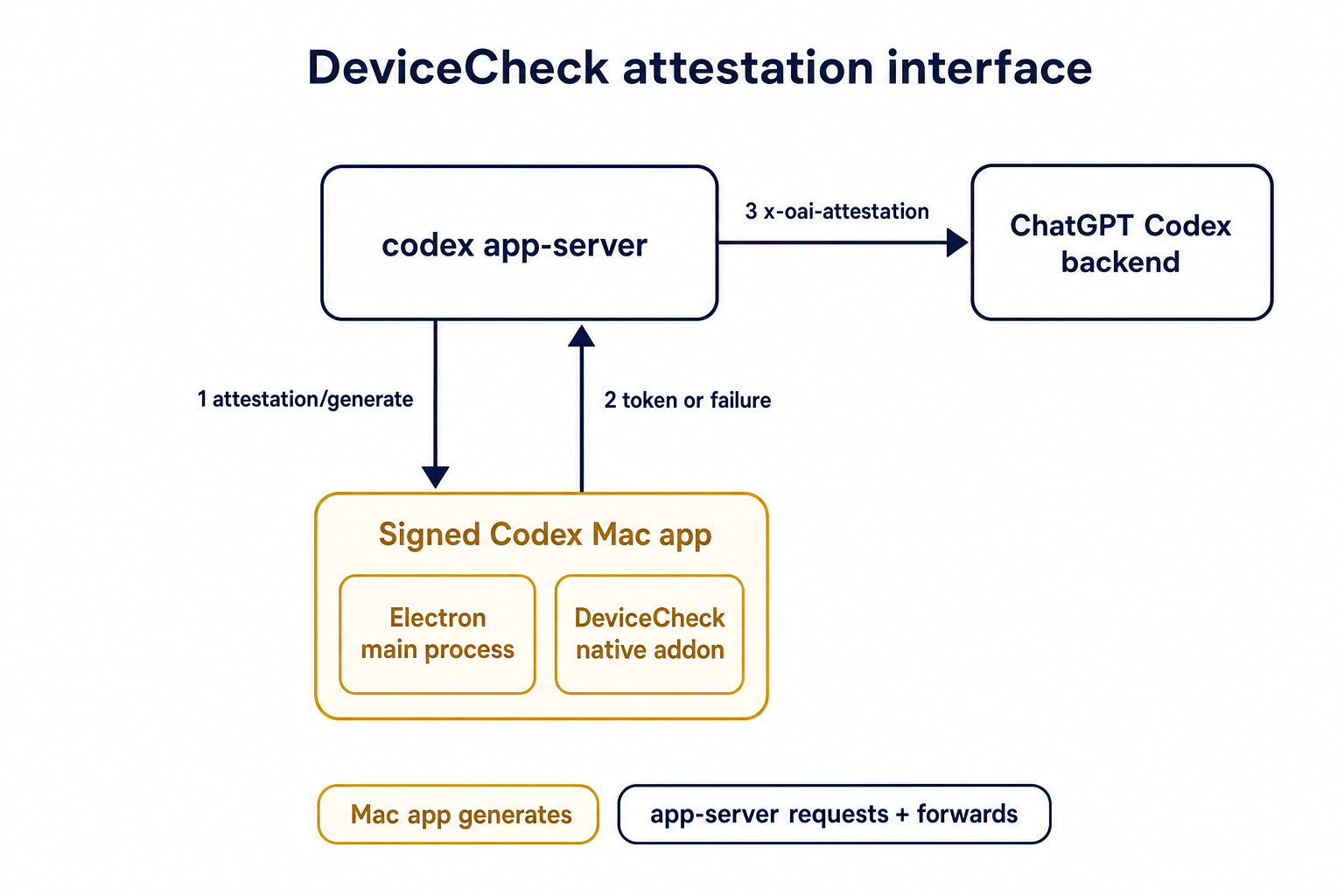
    TL;DR: teaches `codex-rs` / app-server to request a desktop-provided
    attestation token and attach it as `x-oai-attestation` on the scoped
    ChatGPT Codex request paths.
    
    ![DeviceCheck attestation
    interface](https://raw.githubusercontent.com/openai/codex/dev/jm/devicecheck-diagram-assets/pr-assets/devicecheck-attestation-interface.png)
    
    ## Details
    
    This PR teaches the Codex app-server runtime how to request and attach
    an attestation token. It does not generate DeviceCheck tokens directly;
    instead, it relies on the connected desktop app to advertise that it can
    generate attestation and then asks that app for a fresh header value
    when needed.
    
    The flow is:
    
    1. The Codex desktop app connects to app-server.
    2. During `initialize`, the app can advertise that it supports
    `requestAttestation`.
    3. Before app-server calls selected ChatGPT Codex endpoints, it sends
    the internal server request `attestation/generate` to the app.
    4. app-server receives a pre-encoded header value back.
    5. app-server forwards that value as `x-oai-attestation` on the scoped
    outbound requests.
    
    The code in this repo is mostly protocol and runtime plumbing: it adds
    the app-server request/response shape, introduces an attestation
    provider in core, wires that provider into Responses / compaction /
    realtime setup paths, and covers the intended scoping with tests. The
    signed macOS DeviceCheck generation remains owned by the desktop app PR.
    
    ## Related PR
    
    - Codex desktop app implementation:
    https://github.com/openai/openai/pull/878649
    
    ## Validation
    
    <details>
    <summary>Tests run</summary>
    
    ```sh
    cargo test -p codex-app-server-protocol
    cargo test -p codex-core attestation --lib
    cargo test -p codex-app-server --lib attestation
    ```
    
    Also ran:
    
    ```sh
    just fix -p codex-core
    just fix -p codex-app-server
    just fix -p codex-app-server-protocol
    just fmt
    just write-app-server-schema
    ```
    
    </details>
    
    <details>
    <summary>E2E DeviceCheck validation</summary>
    
    First validated the signed desktop app boundary directly: launched a
    packaged signed `Codex.app`, sent `attestation/generate`, decoded the
    returned `v1.` attestation header, and validated the extracted
    DeviceCheck token with `personal/jm/verify_devicecheck_token.py` using
    bundle ID `com.openai.codex`. Apple returned `status_code: 200` and
    `is_ok: true`.
    
    Then ran the fuller app + app-server flow. The packaged `Codex.app`
    launched a current-branch app-server via `CODEX_CLI_PATH`, and a local
    MITM proxy intercepted outbound `chatgpt.com` traffic. The app-server
    requested `attestation/generate` from the real Electron app process, and
    the intercepted `/backend-api/codex/responses` traffic included
    `x-oai-attestation` on both routes:
    
    ```text
    GET  /backend-api/codex/responses  Upgrade: websocket  x-oai-attestation: present
    POST /backend-api/codex/responses  Upgrade: none       x-oai-attestation: present
    ```
    
    The captured header decoded to a DeviceCheck token that also validated
    with Apple for `com.openai.codex` (`status_code: 200`, `is_ok: true`,
    team `2DC432GLL2`).
    
    </details>
    
    ---------
    
    Co-authored-by: Codex <noreply@openai.com>
  • fix: fully revert agent identity runtime wiring (#18757)
    ## Summary
    
    This PR fully reverts the previously merged Agent Identity runtime
    integration from the old stack:
    https://github.com/openai/codex/pull/17387/changes
    
    It removes the Codex-side task lifecycle wiring, rollout/session
    persistence, feature flag plumbing, lazy `auth.json` mutation,
    background task auth paths, and request callsite changes introduced by
    that stack.
    
    This leaves the repo in a clean pre-AgentIdentity integration state so
    the follow-up PRs can reintroduce the pieces in smaller reviewable
    layers.
    
    ## Stack
    
    1. This PR: full revert
    2. https://github.com/openai/codex/pull/18871: move Agent Identity
    business logic into a crate
    3. https://github.com/openai/codex/pull/18785: add explicit
    AgentIdentity auth mode and startup task allocation
    4. https://github.com/openai/codex/pull/18811: migrate auth callsites
    through AuthProvider
    
    ## Testing
    
    Tests: targeted Rust checks, cargo-shear, Bazel lock check, and CI.
  • Persist and prewarm agent tasks per thread (#17978)
    ## Summary
    - persist registered agent tasks in the session state update stream so
    the thread can reuse them
    - prewarm task registration once identity registration succeeds, while
    keeping startup failures best-effort
    - isolate the session-side task lifecycle into a dedicated module so
    AgentIdentityManager and RegisteredAgentTask do not leak across as many
    core layers
    
    ## Testing
    - cargo test -p codex-core startup_agent_task_prewarm
    - cargo test -p codex-core
    cached_agent_task_for_current_identity_clears_stale_task
    - cargo test -p codex-core record_initial_history_
  • app-server: Return codex home in initialize response (#15689)
    This allows clients to get enough information to interact with the codex
    skills/configuration/etc.
  • app-server: Add platform os and family to init response (#14527)
    This allows the client to pick os-specific behavior while interacting
    with the app server, e.g. to use proper path separators.
  • chore(app-server): stop emitting codex/event/ notifications (#14392)
    ## Description
    
    This PR stops emitting legacy `codex/event/*` notifications from the
    public app-server transports.
    
    It's been a long time coming! app-server was still producing a raw
    notification stream from core, alongside the typed app-server
    notifications and server requests, for compatibility reasons. Now,
    external clients should no longer be depending on those legacy
    notifications, so this change removes them from the stdio and websocket
    contract and updates the surrounding docs, examples, and tests to match.
    
    ### Caveat
    I left the "in-process" version of app-server alone for now, since
    `codex exec` was recently based on top of app-server via this in-process
    form here: https://github.com/openai/codex/pull/14005
    
    Seems like `codex exec` still consumes some legacy notifications
    internally, so this branch only removes `codex/event/*` from app-server
    over stdio and websockets.
    
    ## Follow-up
    
    Once `codex exec` is fully migrated off `codex/event/*` notifications,
    we'll be able to stop emitting them entirely entirely instead of just
    filtering it at the external transport boundary.
  • Stabilize app-server notify initialize test (#13939)
    ## What changed
    - This PR changes only the flaky test setup for
    `turn_start_notify_payload_includes_initialize_client_name`.
    - Instead of shelling out to `python3` to write the notify payload, the
    test uses the first-party `codex-app-server-test-notify-capture` helper.
    - The helper writes `notify.json` atomically and the test waits for the
    file to exist before reading it.
    
    ## Why this fixes the flake
    - The old test depended on an external Python interpreter being present
    and behaving consistently on every CI runner.
    - It also raced the file write: the test could observe the path before
    the payload had been fully written, which produced partial reads and
    intermittent assertion failures.
    - Moving the write into a repo-owned helper removes the external
    dependency, and atomic write-plus-wait makes the handoff deterministic.
    
    ## Scope
    - Test-only change.
  • Stabilize abort task follow-up handling (#13874)
    - production logic plus tests; cancel running tasks before clearing
    pending turn state
    - suppress follow-up model requests after cancellation and assert on
    stabilized request counts instead of fixed sleeps
  • notify: include client in legacy hook payload (#12968)
    ## Why
    
    The `notify` hook payload did not identify which Codex client started
    the turn. That meant downstream notification hooks could not distinguish
    between completions coming from the TUI and completions coming from
    app-server clients such as VS Code or Xcode. Now that the Codex App
    provides its own desktop notifications, it would be nice to be able to
    filter those out.
    
    This change adds that context without changing the existing payload
    shape for callers that do not know the client name, and keeps the new
    end-to-end test cross-platform.
    
    ## What changed
    
    - added an optional top-level `client` field to the legacy `notify` JSON
    payload
    - threaded that value through `core` and `hooks`; the internal session
    and turn state now carries it as `app_server_client_name`
    - set the field to `codex-tui` for TUI turns
    - captured `initialize.clientInfo.name` in the app server and applied it
    to subsequent turns before dispatching hooks
    - replaced the notify integration test hook with a `python3` script so
    the test does not rely on Unix shell permissions or `bash`
    - documented the new field in `docs/config.md`
    
    ## Testing
    
    - `cargo test -p codex-hooks`
    - `cargo test -p codex-tui`
    - `cargo test -p codex-app-server
    suite::v2::initialize::turn_start_notify_payload_includes_initialize_client_name
    -- --exact --nocapture`
    - `cargo test -p codex-core` (`src/lib.rs` passed; `core/tests/all.rs`
    still has unrelated existing failures in this environment)
    
    ## Docs
    
    The public config reference on `developers.openai.com/codex` should
    mention that the legacy `notify` payload may include a top-level
    `client` field. The TUI reports `codex-tui`, and the app server reports
    `initialize.clientInfo.name` when it is available.
  • feat: opt-out of events in the app-server (#11319)
    Add `optOutNotificationMethods` in the app-server to opt-out events
    based on exact method matching
  • fix(app-server): set originator header from initialize JSON-RPC request (#8873)
    **Motivation**
    The `originator` header is important for codex-backend’s Responses API
    proxy because it identifies the real end client (codex cli, codex vscode
    extension, codex exec, future IDEs) and is used to categorize requests
    by client for our enterprise compliance API.
    
    Today the `originator` header is set by either:
    - the `CODEX_INTERNAL_ORIGINATOR_OVERRIDE` env var (our VSCode extension
    does this)
    - calling `set_default_originator()` which sets a global immutable
    singleton (`codex exec` does this)
    
    For `codex app-server`, we want the `initialize` JSON-RPC request to set
    that header because it is a natural place to do so. Example:
    ```json
    {
      "method": "initialize",
      "id": 0,
      "params": {
        "clientInfo": {
          "name": "codex_vscode",
          "title": "Codex VS Code Extension",
          "version": "0.1.0"
        }
      }
    }
    ```
    and when app-server receives that request, it can call
    `set_default_originator()`. This is a much more natural interface than
    asking third party developers to set an env var.
    
    One hiccup is that `originator()` reads the global singleton and locks
    in the value, preventing a later `set_default_originator()` call from
    setting it. This would be fine but is brittle, since any codepath that
    calls `originator()` before app-server can process an `initialize`
    JSON-RPC call would prevent app-server from setting it. This was
    actually the case with OTEL initialization which runs on boot, but I
    also saw this behavior in certain tests.
    
    Instead, what we now do is:
    - [unchanged] If `CODEX_INTERNAL_ORIGINATOR_OVERRIDE` env var is set,
    `originator()` would return that value and `set_default_originator()`
    with some other value does NOT override it.
    - [new] If no env var is set, `originator()` would return the default
    value which is `codex_cli_rs` UNTIL `set_default_originator()` is called
    once, in which case it is set to the new value and becomes immutable.
    Later calls to `set_default_originator()` returns
    `SetOriginatorError::AlreadyInitialized`.
    
    **Other notes**
    - I updated `codex_core::otel_init::build_provider` to accepts a service
    name override, and app-server sends a hardcoded `codex_app_server`
    service name to distinguish it from `codex_cli_rs` used by default (e.g.
    TUI).
    
    **Next steps**
    - Update VSCE to set the proper value for `clientInfo.name` on
    `initialize` and drop the `CODEX_INTERNAL_ORIGINATOR_OVERRIDE` env var.
    - Delete support for `CODEX_INTERNAL_ORIGINATOR_OVERRIDE` in codex-rs.