## Summary
- Remove the realtime `architecture` selector from core protocol,
app-server protocol, config parsing, generated schemas, and callers.
- Always create WebRTC realtime calls with the AVAS query params:
`intent=quicksilver&architecture=avas`.
- Keep direct websocket realtime behavior on the existing config/default
path, while WebRTC starts without an explicit version now default to
realtime v1 because AVAS requires v1.
## Notes
- WebRTC realtime now means AVAS. If a caller explicitly asks to start
WebRTC with realtime v2, Codex rejects that request because the AVAS
WebRTC path only supports realtime v1. Websocket realtime is separate
and can still use realtime v2.
- The old `[realtime] architecture = "realtimeapi" | "avas"` config knob
is removed. Local configs that still set it will need to delete that
line.
- Some app-server tests that were only trying to exercise realtime v2
protocol behavior now use websocket transport, because WebRTC is
intentionally locked to AVAS/v1. Separate WebRTC tests cover the AVAS
query params, v1 startup, SDP flow, and sideband join.
## Validation
- Merged fresh `origin/main` at `83e6a786a2`.
- `just fmt`
- `just write-config-schema`
- `just write-app-server-schema`
- `git diff --check`
- `just test -p codex-api -p codex-core -p codex-app-server-protocol -p
codex-app-server realtime` (176 passed)
- `just test -p codex-protocol -p codex-config` (413 passed)
## What
Built on the realtime speech-control plumbing merged in #27917.
- Add optional `codexResponseHandoffPrefix` to `thread/realtime/start`.
- Apply that prefix only to automatic V1 commentary sent through
`conversation.handoff.append`; final answers remain unprefixed.
- Add opt-in `clientManagedHandoffs`. When true, core suppresses
automatic response handoffs and completion output so delivery is
controlled by explicit client append APIs.
- Preserve existing automatic behavior by default.
`codexResponsesAsItems: true` continues to select item routing when
client-managed mode is disabled.
## Why
Voice clients need two delivery policies: automatic background context
with silent commentary instructions and fully client-owned handoffs.
Phase-aware prefixing keeps routine commentary silent without
suppressing the final answer, while client-managed mode lets an app
decide exactly which updates to append.
## Validation
- `just fmt`
- `cargo test -p codex-app-server-protocol
serialize_thread_realtime_start`
- `RUST_MIN_STACK=16777216 cargo test -p codex-core --test all
conversation_handoff_persists_across_item_done_until_turn_complete`
- `RUST_MIN_STACK=16777216 cargo test -p codex-app-server --test all
webrtc_v1_client_managed_handoffs_disable_automatic_output`
- `RUST_MIN_STACK=16777216 cargo test -p codex-app-server --test all
webrtc_v1_final_automatic_handoff_omits_silent_prefix`
- `cargo build -p codex-cli --bin codex`
- Local Codex Apps compatibility check: 43 focused webview tests passed,
and a live voice session routed through the source-built app-server.
The explicit `RUST_MIN_STACK` avoids a macOS Tokio test-worker stack
overflow seen with the default test environment.
## Summary
- Add `includeStartupContext` to realtime start requests so callers can
explicitly skip Codex startup context while keeping the backend prompt
- Thread the new flag through protocol types, request processing, and
realtime session config
- Update app-server docs and coverage for the new default and opt-out
behavior
## Testing
- Added protocol serialization coverage for `includeStartupContext`
- Added realtime integration coverage for starting a session with
startup context disabled
## Why
Realtime voice harness tuning needs app-side control over what backend
Codex text is spoken. Backend orchestrator text is written for a reading
UI, so automatically speaking every preamble, progress update, or final
assistant message can make the realtime voice model too chatty.
For experimentation, clients need two simple controls: keep app/client
text-item injection on the existing item-create path, and add an
explicit speakable path that app code can call only when it wants
realtime to speak. Automatic Codex output also needs an opt-in way to
switch from the protocol's default speakable path to regular realtime
items, with a caller-provided prefix so prompt wording can be tuned
outside core.
The default remains unchanged: if a client omits the new start fields
and never calls `appendSpeech`, automatic backend output continues down
the existing speakable path for the selected realtime protocol.
## What Changed
- Adds experimental `thread/realtime/appendSpeech` for app-provided
speakable text.
- Keeps existing `thread/realtime/appendText` as the item-create API for
app-provided realtime text items.
- Adds `codexResponsesAsItems` / `codex_responses_as_items` on
`thread/realtime/start` to send automatic Codex responses with
`conversation.item.create` instead of the protocol's default speakable
output path.
- Adds `codexResponseItemPrefix` / `codex_response_item_prefix` so
clients can prepend experiment instructions to those automatic Codex
response items.
- Keeps literal `conversation.handoff.append` routing scoped to the v1
speakable path; v2 default speech uses its item/function-output plus
`response.create` behavior.
- Removes the earlier public silent-context API and hardcoded
silent-context prefix.
- Updates realtime tests to cover default automatic speakable behavior,
opt-in automatic item-create behavior, and explicit `appendSpeech`
behavior.
## Validation
- `cargo check -p codex-core -p codex-app-server -p codex-api`
- `just test -p codex-app-server realtime_conversation`
- `just test -p codex-core realtime_conversation` (50/51 passed in the
filtered parallel run; the lone failure passed when rerun in isolation)
- `just test -p codex-core
conversation_mirrors_assistant_message_text_to_realtime_handoff`
- `just test -p codex-api
e2e_connect_and_exchange_events_against_mock_ws_server`
- `just fix -p codex-core`
- `just fix -p codex-app-server`
- `cargo build -p codex-cli`
## Summary
Adds a `RealtimeConversationArchitecture` option for realtime
conversation startup, with `realtimeapi` as the default and `avas` as an
opt-in architecture.
The AVAS path is limited to realtime v1 conversational WebRTC starts,
and WebRTC call creation appends `intent=quicksilver&architecture=avas`
to `/v1/realtime/calls`. The existing sideband websocket still joins by
`call_id`.
This also exposes the per-session architecture override through
app-server v2 `thread/realtime/start` params and updates the config
schema for `[realtime].architecture`.
## Validation
- `just fmt`
- `just write-config-schema`
- `just test -p codex-api sends_avas_session_call_query_params`
- `just test -p codex-core -E
'test(~conversation_webrtc_start_uses_avas_architecture_query)'`
- `just test -p codex-core -E 'test(realtime_loads_from_config_toml)'`
- `just test -p codex-app-server-protocol -E
'test(~serialize_thread_realtime_start) |
test(generated_ts_optional_nullable_fields_only_in_params)'`
- `just test -p codex-app-server -E
'test(realtime_webrtc_start_emits_sdp_notification)'`
## Why
Clients need to select a realtime session configuration for an
individual start without rewriting persisted configuration or restarting
the app-server process.
## What Changed
- Add optional `model` and `version` fields to `thread/realtime/start`
- Forward those optional values through the realtime start operation and
apply them only for that session
- Preserve existing configured/default behavior when the new fields are
omitted
- Update generated protocol schema and app-server documentation
## Validation
- Added/updated protocol serialization coverage for the new optional
request fields
- Added focused core coverage for a session override taking precedence
over configured realtime selection
- Added focused app-server coverage that a request override reaches the
realtime WebSocket handshake
This PR brought to you via VS Code rather than Codex...
- opened `codex-rs/app-server/tests/common/mcp_process.rs`
- put the cursor on `McpServer`
- hit `F2` and renamed the symbol to `TestAppServer`
- went to the file tree
- hit enter and renamed `mcp_process.rs` to `test_app_server.rs`
- ran **Save All Files** from the Command Palette
- ran `just fmt`
The End
(Admittedly, most of the local variables for `TestAppServer` are still
named `mcp`, though.)
## Why
App-server clients need a way to update a thread's next-turn settings
without starting a turn, adding transcript content, or waiting for turn
lifecycle events. This gives settings UI a direct path for durable
thread settings while clients observe the eventual effective state
through a notification.
This is a simplified rework of PR
https://github.com/openai/codex/pull/22509. In particular, it changes
the `thread/settings/update` api to return immediately rather than
waiting and returning the effective (updated) thread settings. This
makes the new api consistent with `turn/start` and greatly reduces the
complexity of the implementation relative to the earlier attempt.
## What Changed
- Adds experimental `thread/settings/update` with partial-update request
fields and an empty acknowledgment response.
- Adds experimental `thread/settings/updated`, carrying full effective
`ThreadSettings` and scoped by `threadId` to subscribed clients for the
affected thread.
- Shares durable settings validation with `turn/start`, including
`sandboxPolicy` plus `permissions` rejection and `serviceTier: null`
clearing.
- Emits the same settings notification when `turn/start` overrides
change the stored effective thread settings.
- Regenerates app-server protocol schema fixtures and updates
`app-server/README.md`.
## Summary
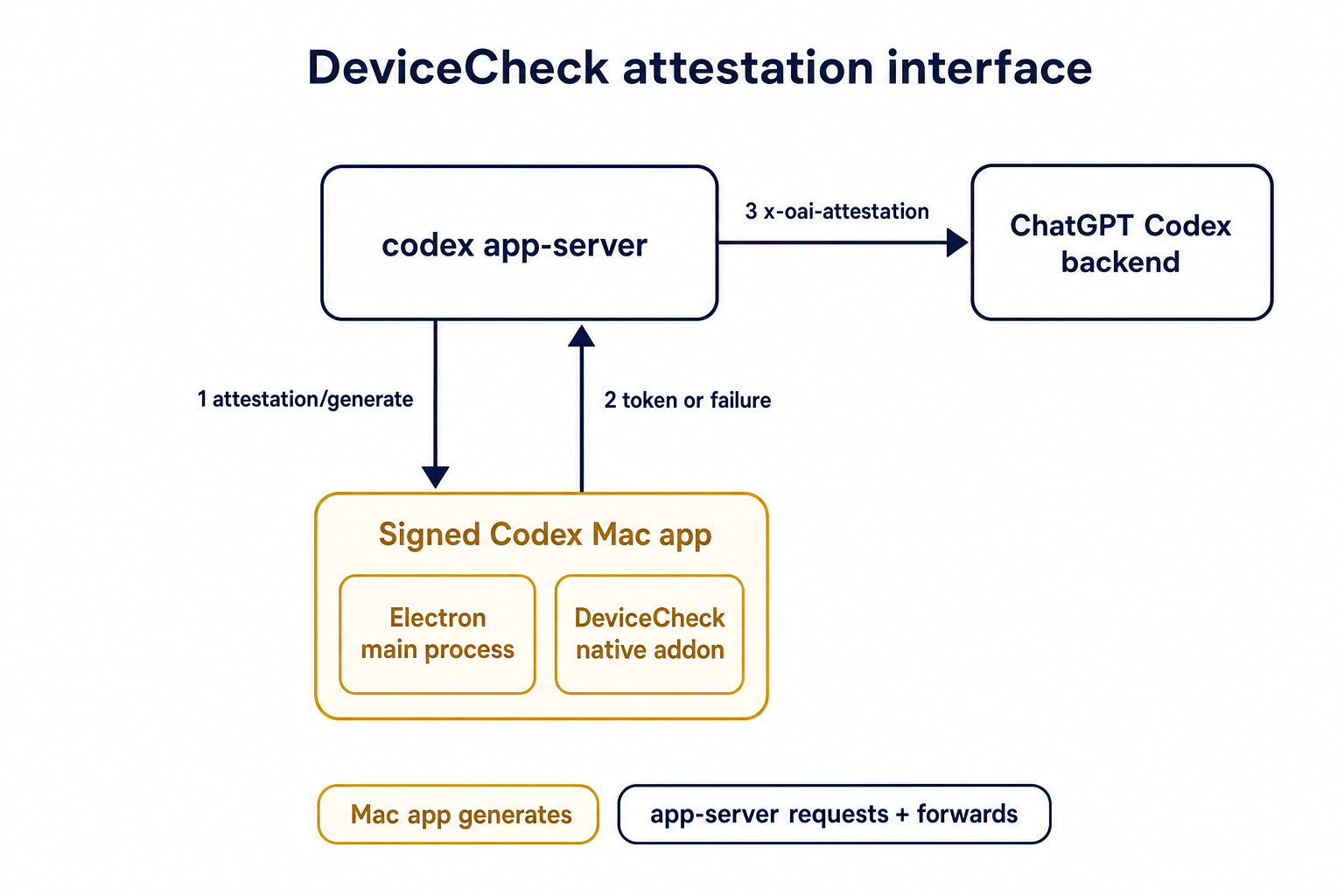
TL;DR: teaches `codex-rs` / app-server to request a desktop-provided
attestation token and attach it as `x-oai-attestation` on the scoped
ChatGPT Codex request paths.

## Details
This PR teaches the Codex app-server runtime how to request and attach
an attestation token. It does not generate DeviceCheck tokens directly;
instead, it relies on the connected desktop app to advertise that it can
generate attestation and then asks that app for a fresh header value
when needed.
The flow is:
1. The Codex desktop app connects to app-server.
2. During `initialize`, the app can advertise that it supports
`requestAttestation`.
3. Before app-server calls selected ChatGPT Codex endpoints, it sends
the internal server request `attestation/generate` to the app.
4. app-server receives a pre-encoded header value back.
5. app-server forwards that value as `x-oai-attestation` on the scoped
outbound requests.
The code in this repo is mostly protocol and runtime plumbing: it adds
the app-server request/response shape, introduces an attestation
provider in core, wires that provider into Responses / compaction /
realtime setup paths, and covers the intended scoping with tests. The
signed macOS DeviceCheck generation remains owned by the desktop app PR.
## Related PR
- Codex desktop app implementation:
https://github.com/openai/openai/pull/878649
## Validation
<details>
<summary>Tests run</summary>
```sh
cargo test -p codex-app-server-protocol
cargo test -p codex-core attestation --lib
cargo test -p codex-app-server --lib attestation
```
Also ran:
```sh
just fix -p codex-core
just fix -p codex-app-server
just fix -p codex-app-server-protocol
just fmt
just write-app-server-schema
```
</details>
<details>
<summary>E2E DeviceCheck validation</summary>
First validated the signed desktop app boundary directly: launched a
packaged signed `Codex.app`, sent `attestation/generate`, decoded the
returned `v1.` attestation header, and validated the extracted
DeviceCheck token with `personal/jm/verify_devicecheck_token.py` using
bundle ID `com.openai.codex`. Apple returned `status_code: 200` and
`is_ok: true`.
Then ran the fuller app + app-server flow. The packaged `Codex.app`
launched a current-branch app-server via `CODEX_CLI_PATH`, and a local
MITM proxy intercepted outbound `chatgpt.com` traffic. The app-server
requested `attestation/generate` from the real Electron app process, and
the intercepted `/backend-api/codex/responses` traffic included
`x-oai-attestation` on both routes:
```text
GET /backend-api/codex/responses Upgrade: websocket x-oai-attestation: present
POST /backend-api/codex/responses Upgrade: none x-oai-attestation: present
```
The captured header decoded to a DeviceCheck token that also validated
with Apple for `com.openai.codex` (`status_code: 200`, `is_ok: true`,
team `2DC432GLL2`).
</details>
---------
Co-authored-by: Codex <noreply@openai.com>
## Summary
Codex is repurposing `session` to mean a thread group, so the realtime
provider session id should no longer use `session_id` / `sessionId` in
Codex-facing protocol payloads. This PR renames that provider-specific
field to `realtime_session_id` / `realtimeSessionId` and intentionally
breaks clients that still send the old field names.
## What Changed
- Renamed realtime provider session fields in `ConversationStartParams`,
`RealtimeConversationStartedEvent`, and `RealtimeEvent::SessionUpdated`.
- Renamed app-server v2 realtime request and notification fields to
`realtimeSessionId`.
- Removed legacy serde aliases for `session_id` / `sessionId`; clients
must send the new names.
- Propagated the rename through core realtime startup, app-server
adapters, codex-api websocket handling, and TUI realtime state.
- Regenerated app-server protocol schema/TypeScript outputs and updated
app-server README examples.
- Kept upstream Realtime API concepts unchanged: provider `session.id`
parsing and `x-session-id` headers still use the upstream wire names.
## Testing
- CI is running on the latest pushed commit.
- Earlier local verification on this PR:
- `cargo test -p codex-protocol`
- `CODEX_SKIP_VENDORED_BWRAP=1 cargo test -p codex-core
realtime_conversation`
- `cargo test -p codex-app-server-protocol`
- `CODEX_SKIP_VENDORED_BWRAP=1 cargo test -p codex-app-server
realtime_conversation`
- attempted `CODEX_SKIP_VENDORED_BWRAP=1 cargo test -p codex-tui` (local
linker bus error while linking the test binary)
---------
Co-authored-by: Codex <noreply@openai.com>
- Add outputModality to thread/realtime/start and wire text/audio output
selection through app-server, core, API, and TUI.\n- Rename the realtime
transcript delta notification and add a separate transcript done
notification that forwards final text from item done without correlating
it with deltas.
- Adds a core-owned realtime backend prompt template and preparation
path.
- Makes omitted realtime start prompts use the core default, while null
or empty prompts intentionally send empty instructions.
- Covers the core realtime path and app-server v2 path with integration
coverage.
---------
Co-authored-by: Codex <noreply@openai.com>
Adds WebRTC startup to the experimental app-server
`thread/realtime/start` method with an optional transport enum. The
websocket path remains the default; WebRTC offers create the realtime
session through the shared start flow and emit the answer SDP via
`thread/realtime/sdp`.
---------
Co-authored-by: Codex <noreply@openai.com>
## Summary
- add `skill_approval` to `RejectConfig` and the app-server v2
`AskForApproval::Reject` payload so skill-script prompts can be
configured independently from sandbox and rule-based prompts
- update Unix shell escalation to reject prompts based on the actual
decision source, keeping prefix rules tied to `rules`, unmatched command
fallbacks tied to `sandbox_approval`, and skill scripts tied to
`skill_approval`
- regenerate the affected protocol/config schemas and expand
unit/integration coverage for the new flag and skill approval behavior
Add experimental `thread/realtime/*` v2 requests and notifications, then
route app-server realtime events through that thread-scoped surface with
integration coverage.
---------
Co-authored-by: Codex <noreply@openai.com>
## Problem being solved
- We need a single, reliable way to mark app-server API surface as
experimental so that:
1. the runtime can reject experimental usage unless the client opts in
2. generated TS/JSON schemas can exclude experimental methods/fields for
stable clients.
Right now that’s easy to drift or miss when done ad-hoc.
## How to declare experimental methods and fields
- **Experimental method**: add `#[experimental("method/name")]` to the
`ClientRequest` variant in `client_request_definitions!`.
- **Experimental field**: on the params struct, derive `ExperimentalApi`
and annotate the field with `#[experimental("method/name.field")]` + set
`inspect_params: true` for the method variant so
`ClientRequest::experimental_reason()` inspects params for experimental
fields.
## How the macro solves it
- The new derive macro lives in
`codex-rs/codex-experimental-api-macros/src/lib.rs` and is used via
`#[derive(ExperimentalApi)]` plus `#[experimental("reason")]`
attributes.
- **Structs**:
- Generates `ExperimentalApi::experimental_reason(&self)` that checks
only annotated fields.
- The “presence” check is type-aware:
- `Option<T>`: `is_some_and(...)` recursively checks inner.
- `Vec`/`HashMap`/`BTreeMap`: must be non-empty.
- `bool`: must be `true`.
- Other types: considered present (returns `true`).
- Registers each experimental field in an `inventory` with `(type_name,
serialized field name, reason)` and exposes `EXPERIMENTAL_FIELDS` for
that type. Field names are converted from `snake_case` to `camelCase`
for schema/TS filtering.
- **Enums**:
- Generates an exhaustive `match` returning `Some(reason)` for annotated
variants and `None` otherwise (no wildcard arm).
- **Wiring**:
- Runtime gating uses `ExperimentalApi::experimental_reason()` in
`codex-rs/app-server/src/message_processor.rs` to reject requests unless
`InitializeParams.capabilities.experimental_api == true`.
- Schema/TS export filters use the inventory list and
`EXPERIMENTAL_CLIENT_METHODS` from `client_request_definitions!` to
strip experimental methods/fields when `experimental_api` is false.